



Abstract
This study investigates whether lethal violence can serve as a reliable indicator for assessing characteristics of non-lethal violence. Using police administrative data from Australia, the research examines violent incidents occurring between 2018 and 2022, categorizing them into three groups: non-lethal violence (n = 61,813), near-lethal violence (attempted murder, n = 211), and lethal violence (completed homicide, n = 362). Employing multinomial regression analyses, the study identifies significant differences across these violence categories, highlighting variations in characteristics of offenders and their offending histories (such as prior history of property, weapons, and drug offences) and situational factors (including the use of firearms, location, and timing of the incidents). These findings suggest that the dynamics leading to lethal or near-lethal outcomes are distinct from those associated with non-lethal violence. Lethal and near-lethal violence was more commonly associated with offending history, weapon use, private settings, and night-time incidents, whereas non-lethal violence was more commonly associated with offender alcohol use and domestic violence indicators. Consequently, the study advises caution in assuming that characteristics of lethal (or near-lethal) violence can accurately reflect those of non-lethal violence. It underscores the necessity for tailored approaches in understanding and addressing different forms of violence, given their divergent underlying factors.
Introduction
Lethal violence has long been used as an indicator of the extent and trends of non-lethal violence (e.g., Indermaur, 1996; United Nations office on Drugs and Crime, 2019). However, despite decades of research, it is still not clear whether and how violent altercations that end up lethal differ from those that do not. Two competing frameworks for lethal violence have been proposed in the literature: the continuum approach and the typology approach. The former approach positions lethal violence at one end of a spectrum, ranging from less severe forms of violence to violence with lethal outcomes (Harries, 1989; Skott, 2022; Suonpää et al., 2020). According to this perspective, significant similarities would be expected in the characteristics of non-lethal and lethal violence such that “. . . it may be mainly a matter of chance that an assault becomes a homicide” (Pokorny, 1965, p. 497). In contrast to this perspective, some research instead supports a typology approach, whereby non-lethal and lethal violence represent categorically different types of violence (e.g., Bankston, 1988; Chan & Beauregard, 2016; Gelles, 1991; van Breen et al., 2024). Proponents of this perspective have argued that “scholars should not speak of homicide as if it were interchangeable with crime or violence” (van Breen et al., 2023, p. 14). To date, this debate has yet to be resolved.
In this study, we use police administrative data from Queensland, Australia to shed light on the extent to which characteristics of offenders, victims and situations predict whether violent altercations have lethal outcomes. We examine violent offenses committed between 2018 and 2022 and separate these into three categories of violence, namely non-lethal violence (n = 61,813), near-lethal violence (attempted murder, n = 211), and lethal violence (completed homicide, n = 362). We first focus on examining whether the characteristics of the offenders and victims (e.g., sex, age) and the incidents (e.g., time, location, firearm use) predict lethality. We then turn our focus to the offending histories of the offenders involved in the violent offense and examine whether lethality is predicted by different types of offending (violence, property, weapons, drugs, other) across four time periods (30 days, 1 year, 3 years, and 10 years) preceding the violent offense. Importantly, throughout the analyses we treat “attempted murder” as a distinct category (near-lethal violence), as opposed to combining it with either non-lethal or lethal violence.
Literature Review
Homicide is often thought to result from the offender’s loss of self-control. Such assumptions are evident, for example, in the literature around provocation, diminished responsibility, and other forms of legal defenses where the loss of self-control is “triggered” by the circumstances preceding the homicide (for a critical review, see Sorial, 2019). Self-control as a predictor of homicide and other forms of violence has also been operationalized as an inherent trait characteristic indicative of an offender’s propensity to commit violent acts (e.g., Piquero et al., 2005). Within this framework, people are argued to engage in violent behavior because of traits such as impulsivity, temper, risk-seeking, and self-centeredness; traits which are more likely to lead an individual to seek immediate gratification rather than consider the long-term consequences of their behavior (Gottfredson & Hirschi, 1990). More severe forms of violence would be a result of lower levels of self-control compared with less severe forms of violence. Thus, it is important to understand who “arrives at the scene” of a violent altercation, as this information gives us an indication of their propensity to engage in violence.
In terms of criminal propensity, much of the available empirical literature examines aspects of a person’s offending history as indicative of their propensity to commit crime (e.g., Ganpat et al., 2014; Suonpää et al., 2018). While some studies do find that offenders of lethal violence have more severe and/or frequent histories of delinquency and offending compared with non-lethal violence offenders (Loeber et al., 2005) these studies are in the minority. Instead, from the literature, a different picture emerges whereby homicide offenders display less problematic lives compared with their non-lethal counterparts (DiCataldo & Everett, 2008; Dobash et al., 2007; Ganpat et al., 2014). For example, Ganpat et al. (2014) found offenders of lethal violence were less likely to have a history of violence (38%) compared with offenders of attempted murder (48%). Similarly, DiCataldo and Everett (2008) found juvenile homicide offenders had on average fewer records of delinquency (including violence; M = 3.7) compared with juvenile non-homicide offenders (M = 7.1). In contrast, other studies do not find differences in the criminal histories of offenders for homicide and less severe forms of violence (Felson & Steadman, 1983; Suonpää et al., 2020). For example, Suonpää et al. (2020) found that the offending pathways for homicide offenders, characterized for example by increasing or persistent violent offending, mainly resembled those for offenders of attempted homicide and aggravated assault, leading the authors to conclude that “. . . the lethality of the violent encounter cannot be predicted based on an offender’s history of violent crimes. . .” (p. 8). These variations in findings may reflect differences in the area of study, such as young offenders (DiCataldo & Everett, 2008) or domestic violence-related cases (Dobash et al., 2007), as well as differences in sample size and resulting statistical power. Nevertheless, they highlight that more research is needed to better understand whether offenders who commit lethal violence are similar to (suggestive of a continuum approach) or different from (suggestive of a typology approach) offenders who commit non-lethal violence in terms of their criminal propensity.
However, a sole focus on the characteristics of violent offenders risks overlooking the situations in which violent altercations occur. Situational approaches to understanding violence suggest that what distinguishes between lethal and non-lethal violence has much to do with the circumstances surrounding the violent altercation rather than the characteristics of the offender and what they bring to the scene. For example, a symbolic interactionist framework emphasizes the importance of understanding the interactions between offenders and victims (Athens, 1977; Felson & Steadman, 1983; Luckenbill, 1977). Indeed, such a framework suggests that situational factors are so influential that it is not until the end of an altercation that the roles of offender and victim can be assigned to the people involved in the altercation. Although studies using a symbolic interactionist framework often do make inferences based on characteristics of the people involved, such as their age, gender, and physical strength, these characteristics are interpreted through the lens of interactions rather than criminal propensity. For example, scholars note that opponents with greater capability for retaliation are more likely to be interpreted as a threat and therefore more likely to be taken out “for good” (i.e., killed; e.g., Felson, 2023). This shows the importance of taking situational factors into account when analyzing violence.
A variety of situational factors conceptually linked to lethal and non-lethal violence have also been studied in past literature, including temporal and geographic characteristics of violent altercations. Similar to the research on criminal propensity, such research is mainly inconclusive in terms of similarities and differences across lethal and non-lethal violence. For example, some research shows homicide more likely occurs in private, indoor locations, such as in the home (Skott, 2022; Weaver et al., 2004), while other research suggests it is more likely to occur in open access location (Libby & Corzine, 2007), and further research shows no significant differences in terms of event location (Ganpat et al., 2013). Similar inconclusive findings relate to time of day (Ganpat et al., 2013; Libby, 2009; Pokorny, 1965; Weaver et al., 2004). In terms of geographic location, some research suggests regional location (e.g., urban/rural) does not distinguish between lethal and non-lethal violence (Libby, 2009). However, comparisons over regional differences in medical resources and expertise show that violent altercations occurring in areas (often rural) with less medical resources have higher lethality rates compared with areas (often urban) with more medical resources (Doerner & Speir, 1986).
The most studied situational factor, and the one that renders overwhelming empirical support, is weapon use. Across studies examining the situations in which violence occurs, weapon use is consistently strongly associated with increased lethality (Apel et al., 2013; DiCataldo & Everett, 2008; Felson & Messner, 1996; Ganpat et al., 2017; Harries, 1989; Kleck & McElrath, 1991; Libby & Corzine, 2007; Skott, 2022; Weaver et al., 2004; Zimring, 1968), with some exceptions (Felson & Steadman, 1983). One study, for example, found that the odds of a lethal outcome was 113 times higher if the offender displayed or used a firearm compared to if they did not (Ganpat et al., 2017). However, debate is still ongoing as to what it is about firearms that make them more lethal. Some argue the presence of firearms independently increase the risk of violent encounters turning lethal (e.g., Libby & Corzine, 2007; Zimring & Hawkins, 1997), while others note that determined offenders may go to any length possible to kill their opponent, irrespective of availability of weapons such as firearms (e.g., Reuter & Mouzos, 2003; Wolfgang, 1958). The use of firearms and other weapons may also signal an “objectification” of the victim (Dobash et al., 2007). Whatever the underlying reasons, it is clear firearms are associated with increased risk of lethal violence.
Nevertheless, it is reasonable to argue that violence is shaped both by individual characteristics (factors relating to the “person”) and the surrounding context or environment (factors relating to the “situation”) and that both of these perspectives are important to understanding violence. For example, theoretical developments within the developmental and life-course criminology literature have emphasized that crime is shaped not only by the criminal propensity of people who commit violence, but also factors relating to the situations in which violence occurs (Farrington, 2005; Wikström, 2019). This complex interplay between the person and the situation suggests that criminal behavior cannot be fully explained by either perspective in isolation.
The current study is not able to resolve any theoretical debates in the field, but they do guide us to consider the extent to which the criminal propensity of offenders (as measured through offense histories) and the situations in which violence occurs predict whether a violent altercation is likely to turn lethal. We do this by using data obtained from the Queensland Police Service through the Social Analytics Laboratory at the Griffith Criminology Institute at Griffith University. We compare three categories of violence, namely non-lethal violence (assault, robbery, sexual assault), near-lethal violence (attempted murder), and lethal violence (completed homicide). The inclusion of the “middle” category of near-lethal violence (attempted murder) is particularly important, given scholars have highlighted the importance of examining attempted murder as a distinct category (e.g., DeLisi et al., 2018). Past research has used a variety of methods to deal with attempted murder. While some exclude attempted murder altogether (e.g., DiCataldo & Everett, 2008), others use attempted murder as the non-lethal violence category to which completed homicide is compared (e.g., Ganpat et al., 2013). Further, some studies include attempted murder into the homicide category (e.g., Farrell et al., 2018), while others include attempted murder in the non-lethal violence category together with less severe forms of violence such as assault or aggravated assault (e.g., Weaver et al., 2004). Given attempted murder may have some the unique features, it is important to separate out any distinct characteristics of attempted murder, especially as they compare with completed homicides and other less serious forms of violence such as assault. In the Queensland jurisdiction, violent altercations are classified as attempted murder if they contain features of intentionality. Thus, one would expect characteristics of offenders of attempted murder (referred to in this study as “near-lethal violence”) to be similar to the characteristics of lethal violence. It is also expected that situational characteristics, such as use of a weapon (e.g., firearm) or reduced access to immediate medical services (e.g., living in a remote community), would distinguish between the two.
Methods
Study Context
The study is set in Queensland, a state located in the north-east of Australia. It is one of the largest states in Australia, with a population of approximately 5.50 million mainly concentrated around the south-east coast (Australian Bureau of Statistics, 2024a). Aboriginal and Torres Strait Islander peoples, the First Nations peoples of Australia, represent approximately 4.6% of the Queensland population (Australian Bureau of Statistics, 2023). Queensland’s large geographical area (1.72 km2) features a diverse landscape including tropical rainforests, mountain ranges, and deserts. In Queensland, the victimization rate is around 1,000 per 100,000 persons for assault (Australian Bureau of Statistics, 2024b) and around one per 100,000 for homicide (Australian Institute of Criminology, 2024).
Data
Data for this study were extracted from the Social Analytics Laboratory, a purpose-built, secure-access facility housed at the Griffith Criminology Institute at Griffith University. University to store, manage and analyze sensitive administrative data for research and teaching purposes. In Australia, police agencies are state-based, and the dataset used is Queensland Police Service’s (QPS) Queensland Police Records and Information Management Exchange (QPRIME), which is an administrative database for recording information on criminal incidents entered by police officers. Data housed in the Social Analytics Laboratory are available from the year 2008 onward.
Two steps were involved to configure the data. The first step was to identify the offenders’ index offense based on solved violent incidents in the time period 2018 to 2022. The dataset was composed of police calls-for-service, with each row initially representing a separate incident that involved police response. To focus on individual offenders, we restructured the data from an incident-based (long format) to a person-based (wide format), ensuring that each row corresponded to a unique offender. All offenders captured in the original format were retained in the transformed dataset. We then classified the offenders based on their index offense into non-lethal violence, near-lethal violence (attempted murder), and lethal violence (completed homicide). Offenders who had committed homicide were classified in the lethal violence category, even if they had also committed non-lethal or near-lethal violence within the same time period. If an offender had been involved in several incidents of the same category of violence, the most recent instance in the time period was chosen as the index offense.
Of the 62,386 solved violent incidents from 2018 to 2022, only cases with complete data on all study variables were included in the final sample. Missing data were mainly an issue for the victims’ sex (2.45% missing) and age (2.37% missing). The final analytical sample consisted of 59,230 individuals involved in violent offenses in 2018 and 2022. Of these, 58,685 (99.08%) were non-lethal, 206 (0.34%) were near-lethal (attempted murder), and 339 (0.57%) were lethal (completed homicide, i.e., murder or manslaughter).
Once the index offense had been established and categorized, the second step was to retrieve information about the offenders’ involvement in offending behavior in the 10 years immediately preceding the index offense. To illustrate, for an offender who had perpetrated lethal violence on 12 April 2020 (the index offense), we retrieved data on their offending history for the time period 11 April 2010 to 11 April 2020. Although this means that the exact dates for each offender will be slightly different (albeit still within a 5 year window, given the index offense was committed sometime in 2018–2022), this ensures we are analyzing all offending behavior leading up to the day before the index offense and not missing out on potentially important data that would otherwise be lost if using the exact same 10 year period for all offenders, irrespective of index offense date.
Measures
Offender and Victim Information
Demographics of the offender and victim involved in the index offense include sex (0 = female, 1 = male) and an ordinal measure of age at the time of index offense (1 = 10–19, 2 = 20–29, 3 = 30+). Information about whether the offender had previously offended against the victim prior to the index offense (any type of offense) was also coded (0 = no, 1 = yes). This was achieved by applying a syntax that flags a “yes” when the index offense unique person identifiers appear for victim and offender in an earlier incident.
Situational Characteristics
Geographic Location
The location of the index offense was coded into public (which included commercial, public place, public building, education, medical, leisure; coded 1) and private (which included dwelling and private grounds; coded 0). Remoteness of the index offense was measured using the Accessibility/Remoteness Index of Australia (ARIA+), which is the official classification of remoteness used by the Australian Bureau of Statistics. Incidents that occurred in major cities were coded 0, while all other locations (regional and remote) were coded 1.
Temporal Information
Date and time of the index offense was used to code season, day of week, and time of day. Summer (November, December, or January; coded 1) was compared to all other seasons (coded 0). or Sunday were coded as weekend (1) with all other days coded as weekdays (0). Time of the index offense was coded into night-time (6 pm–5:59 am; coded 1) and day-time (6 am–5:59 pm; coded 0).
Other Incident-Specific Indicators
The dataset contains indicators for whether the incident was classified as alcohol-involved, firearm-involved, and domestic violence-involved, options for which are available for the attending police officer to choose based on the characteristics of the incident. All variables are dichotomous (0 = no, 1 = yes).
Offender Criminal Propensity
Offender criminal propensity was operationalized as past history of committing offenses. The prevalence of the offending history for the offender involved in the index offense were coded based on offense type using the Australian and New Zealand Standard Offense Classification (ANZSOC) 2011 into categories of violent offenses (ANZSOC codes 01–06), property offenses (ANZSOC codes 07–09 and 12), illicit drug offenses (ANZSOC code 10), weapons offenses (ANZSOC code 11) and other offenses (ANZSOC codes 13–16). Each category was measured across four time periods leading up to the date of the index offense (past 10 years, past 3 years, past 1 year, and past 30 days). All items were coded dichotomously (0 = no, 1 = yes).
Analytical Strategy
Analyzes were conducted using SPSS (version 29). Multinomial regressions were used given the outcome variable (violence type) had three nominal categories (non-lethal violence, near-lethal violence, and lethal violence), with non-lethal violence used as the reference category. Five separate regressions were run using different independent predictors for each: (1) offender, victim, and situational factors, (2) offense history (10 years), (3) offense history (3 years), (4) offense history (1 year), and (5) offense history (30 days). The ordinal variable offender age at time of the index offense was included as a control variable in two regressions, namely offense history (10 years) and offense history (3 years) to account for the additional opportunity older offenders would have had to commit offenses given their age. Multicollinearity was not a concern in any of the models (as checked through VIF, Tolerance, and correlations). A series of sensitivity analyses that involved two key exclusions were also conducted, the results of which are reported in end notes. First, individuals charged with manslaughter were removed from the lethal violence category. 1 Second, individuals whose index offense was classified as lethal or near-lethal were excluded if they had also engaged in less severe forms of violence during the same time period. 2
Results
Offender, Victim, and Incident Characteristics
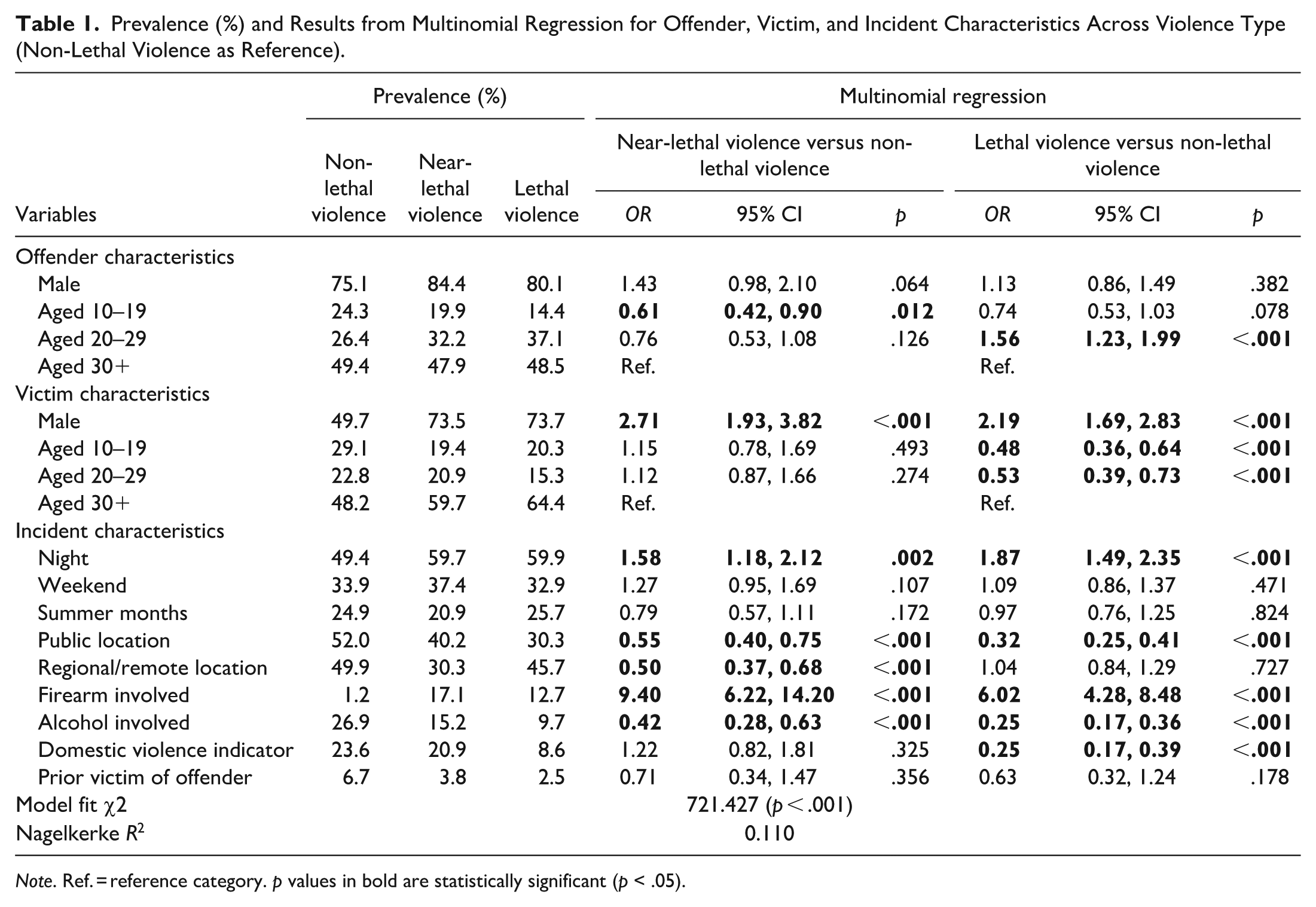
Table 1 shows details about the prevalence of offender, victim, and incident characteristics across the type of violence listed in the index offense (non-lethal, near-lethal, and lethal violence) types. In addition to these descriptive details about prevalence, Table 1 shows results from the multinomial regression. Non-violent incidents were used as the reference category in the regressions, with the results displaying the odds of near-lethal violence and lethal violence versus non-lethal violence.
Prevalence (%) and Results from Multinomial Regression for Offender, Victim, and Incident Characteristics Across Violence Type (Non-Lethal Violence as Reference).
Note. Ref. = reference category. p values in bold are statistically significant (p < .05).
The multinomial regression shows that for non-lethal violence versus near-lethal violence, offender age, victim gender, time of day, location, geographical area, firearm use, and alcohol use were statistically significant, holding all variables included in the model constant (see Table 1). The odds of near-lethal violence increased when victims were male (OR 2.71), and when the incidents occurred at night (OR 1.58) and involved firearms (OR 9.40). In contrast, the odds of near-lethal violence decreased when victims were aged 19 or below (OR 0.61; compared to 30+), occurred in a public location (OR 0.55), occurred in regional or remote geographical areas (OR 0.50) and when incidents involved alcohol (OR 0.42). The odds of near-lethal violence did not change based on offender gender and age, day of the week, and season. Nor did it change based on the domestic violence indicator and victims’ prior victimization by offender.
The results for non-lethal violence versus lethal violence are similar, albeit with slight differences (see Table 1). The odds of lethal violence increased when offenders were aged in their 20s (compared to 30+; OR 1.56), victims were male (OR 2.19), when victims were aged 19 or below (OR 0.48) or 20 to 29 (OR 0.53; compared to 30+), and when the incidents occurred at night (OR 1.87) and involved firearms (OR 6.02). The odds of lethal violence decreased when incidents involved alcohol (OR 0.25) and had an indicator for domestic violence (OR 0.25). The odds of lethal violence did not change based on offender gender, day of the week, geographical area, season, and whether the victim had previously been victimized by the offender.
Offense History
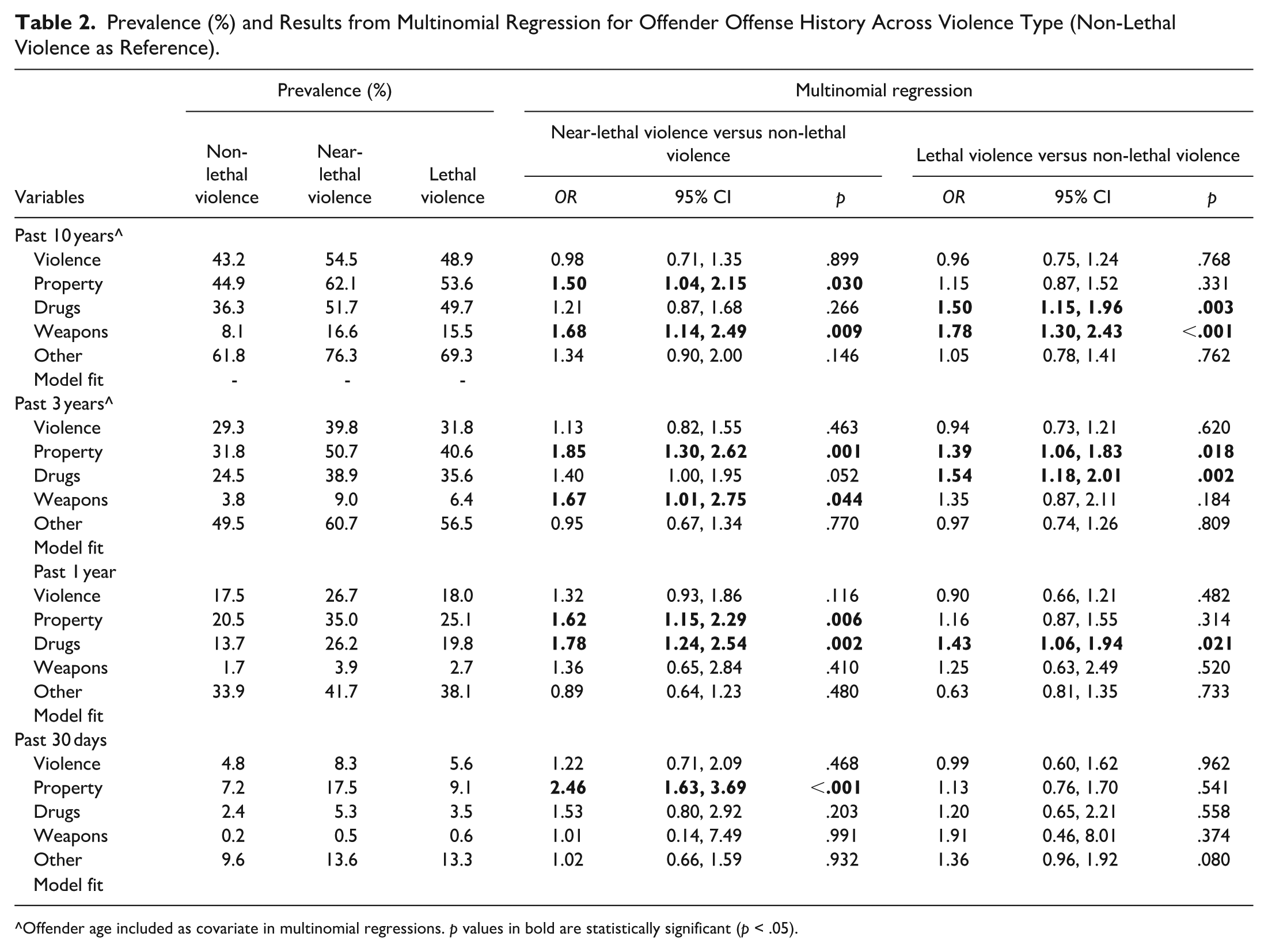
Table 2 shows the offense history of the offender involved in the index offense across the type of violence of the index offense (non-lethal violence, near-lethal violence, and lethal violence). Offense histories are classified into type (violence, property, drugs, weapon, and other) across four time periods leading up to the index offense (10 years, 3 years, 1 year, and 30 days). The table contains descriptive details about prevalence and the results of multinomial regressions, for which non-violence was used as the reference category (against which near-lethal and lethal violence are compared). Four separate multinomial regressions were run, one for each time period.
Prevalence (%) and Results from Multinomial Regression for Offender Offense History Across Violence Type (Non-Lethal Violence as Reference).
Offender age included as covariate in multinomial regressions. p values in bold are statistically significant (p < .05).
The multinomial regressions for non-lethal versus near-lethal violence, consistently shows past property offenses across all time periods (10-year OR 1.50; 3-year OR 1.85; 1-year OR 1.62; 30-day OR 2.46) increased the odds of near-lethal violence (see Table 2). In addition, weapons offenses in the past 10 years (OR 1.68) and 3 years (OR 1.67) and drugs offenses in the past 1 year (OR 1.78) increased the odds of near-lethal violence. Neither violence offenses nor offenses classified as “other” were statistically significant.
For non-lethal violence versus lethal violence, property offenses only increased the odds in the 3-year time period (OR 1.39). In addition, weapons offenses in the past 10 years (OR 1.78) and drugs offenses in the past 3 years (OR 1.54) and 1 year (OR 1.43) increased the odds of lethal violence. Similar to near-lethal violence, neither violent offenses nor offenses classified as “other” increased the odds of lethal violence.
Discussion
Some perspectives within criminology consider homicides (or attempted homicide) as assaults gone “too far.” At its most extreme form, such perspectives would view the lethality (or near-lethality) of violent events as mainly a matter of chance. Other perspectives view homicide as a qualitatively different phenomenon to assault, arguing that lethal violence should not be used as an indicator of the level and extent of non-lethal violence in society. Using police administrative data from an Australian jurisdiction, our data show significant differences (with a few exceptions) between lethal and non-lethal violence, suggesting that survival in a violent event may not be attributable solely to chance. Instead, key details about the offenders and their offending histories (e.g., history of property, weapons, and drug offenses), as well as the situations in which the violence takes place (e.g., firearm use, location, and time) predict lethality (or near-lethality). Further, the results suggest that the predictors of near-lethal (attempted murder) and lethal (completed homicide) are similar, with some crucial differences such as remoteness of the location. Below we highlight the key findings, relate our findings back existing literature, and discuss the implications our research has for policy, practice, and future research endeavors.
To varying degrees, depending on the timeframe used, a history of committing property offenses, weapons offenses, and drug offenses increased the likelihood of lethal and near-lethal violence. Although this finding aligns with research suggesting large proportions of homicide offenders have engaged in offending behavior prior to the homicide (Eriksson et al., 2019), research is mixed in terms of whether past offending is a good predictor of lethality (DiCataldo & Everett, 2008; Dobash et al., 2007; Ganpat et al., 2014; Loeber et al., 2005). Our study adds important insights in this regard, given our emphasis on specific offense categories, rather than any offending, or broad categories such as violent versus non-violent offending. In terms of interpretation, a past history of weapons and drug offenses might indicate involvement in criminal milieus (Bright et al., 2023). It might also indicate accessibility to prohibited weapons, which, in the context of Australia, is rare. Estimates of civilian firearm ownership per capita in Australia reveal low rates by international standards (Karp, 2018).
In our study, firearm use was also a key differentiator in terms of situational characteristics. The data showed that violent incidents involving firearms were more likely to be near-lethal or lethal than violent incidents that did not involve firearms. Indeed, this was the strongest predictor. Based on prior research, these findings are not surprising. Firearms have consistently been linked to increased lethality (Apel et al., 2013; DiCataldo & Everett, 2008; Felson & Messner, 1996; Ganpat et al., 2017; Harries, 1989; Kleck & McElrath, 1991; Libby & Corzine, 2007; Skott, 2022; Weaver et al., 2004; Zimring, 1968), albeit with some exceptions (Felson & Steadman, 1983). However, our study is not able to shed light on what it is about firearms that increase the risk of lethality. To fully understand the roles intentionality and motivation play in this regard (i.e., whether “guns kill people” or “people kill people”), we encourage scholars to make use of the (limited) available data collected directly from homicide offenders about their motives, cognitions, and actions associated with violent events. Nevertheless, our results clearly show that firearm use increases lethality, highlighting the need for evidence-based policies to combat firearm violence (Pizarro et al., 2022). Most homicides in Australia involve weapons that are illegally obtained, likely through illicit importation, unlawful domestic manufacturing, or the reactivation of decommissioned firearms (Bricknell, 2008). This highlights the importance of tightened supply-side interventions, including stricter border controls, regulation of firearm components, and enhanced enforcement against trafficking networks.
With regards to situational characteristics, results further showed that lethal and near-lethal violence was more likely to occur at night-time (as opposed to day-time) and in private (as opposed to public) locations when compared to non-lethal violence. These findings add important value to existing research findings, which generally have produced inconclusive results in terms of time and location (Ganpat et al., 2013; Libby, 2009; Pokorny, 1965; Skott, 2022; Weaver et al., 2004). An offense occurring in a private location has an increased odds of resulting in more severe forms of violence and this could possibly be explained by the presence (or, rather, the absence) of bystanders who are capable and willing to intervene to de-escalate the conflict (Cohen & Felson, 1979) or deliver first aid at the scene (Oliver et al., 2017). Given bystander intervention is rare in private locations, policies should focus on proactive measures such as mandatory reporting for professionals, and protective orders that are enforceable and monitored. Unfortunately, no measure of bystander presence was available in the current dataset.
Another noteworthy finding in the current study is that violent incidents classified by police as involving alcohol were less likely to lead to lethal or near-lethal outcomes. This finding is interesting given both international and Australian studies show a substantial proportion (approximately 50%) of homicides involve the use of alcohol (Eriksson et al., 2024; Kuhns et al., 2014). Past research is inconclusive in terms of the role played by alcohol in distinguishing between lethal and non-lethal violence (Brookman & Wright, 2017). Some studies find alcohol (or substance) use is more common in lethal violence (DiCataldo & Everett, 2008), whereas others find it is more common in non-lethal violence (Ganpat et al., 2017; Libby, 2009) or that it does not differentiate between lethal and non-lethal violent events (Baglivio & Wolff, 2017; Felson & Steadman, 1983; Ganpat et al., 2013). Alcohol impairs cognitive capacity and self-control, and increases psychological arousal, thus making offenders less likely to consider the consequences of their actions and conflict more likely to occur (Assaad & Exum, 2002). So then why was alcohol less likely to be associated with lethal and near-lethal than non-lethal violence in the current study? It might be that alcohol, especially consumed in high amounts, impairs the offender’s ability to inflict lethal violence and increases the likelihood of a victim successfully deflecting an attack (see Brecklin & Ullman, 2001 for such findings regarding completion of rape). It might also be that offenders affected by alcohol at the time of the incident are less likely to have planned the violence or to bring a lethal weapon to the scene, although past research is inconclusive in these regards (Eriksson et al., 2024; Kuhns et al., 2014; Palijan et al., 2009; Pridemore & Eckhardt, 2008).
Overall, the findings indicate that both individual characteristics and the immediate situational context are important in distinguishing between lethal (or non-lethal) and non-lethal violence. While prior research has often framed results in terms of person-situation contrasts, it is reasonable to argue that violence is shaped by the interplay of both individual-level factors and contextual or environmental conditions, and that both of these perspectives are important in understanding violence. We encourage scholars to explore these interactions drawing on theoretical frameworks that emphasize both. For example, the Integrated Cognitive Antisocial Potential theory focuses attention on the interplay between a person’s long-term potential to commit antisocial act (influenced by, e.g., people’s socialization experiences and their levels of impulsivity) and their short-term antisocial potential (influenced by the more immediate social environment, such as victim availability and witnesses; Farrington, 2005). While complex in its theoretical propositions, at its core, this theory provides an example of how person and situation may combine to shape violence, suggesting the need for multi-pronged approaches to disrupt violence.
A key contribution of this paper is the distinction between near-lethal violence (attempted murder) and lethal violence (completed homicide). Two key observations are important here. First, incidents involving younger victims and/or a domestic violence indicator flag reduced the likelihood of lethal, but not near-lethal, violence. This is an interesting finding, given past research shows domestic conflicts are 10 times more likely to end up lethal (as opposed to near-lethal) compared to non-domestic conflicts (Ganpat et al., 2017). Similarly, comparisons of lethal and non-lethal domestic violence show a higher proportion of lethal offenders (56.9%) displaying a history of violence against previous partners compared to non-lethal offenders (27.9%; Dobash et al., 2007).
The second key observation is that regional/remote location of the incident decreased the likelihood of near-lethal, but not lethal, violence. Here it is important to situate the findings within the geographic and demographic context of the study location. Queensland, the setting of the study, is a large and diverse state in terms of geographical characteristics. A large proportion of the state consists of remote or regional areas and approximately one-third of the population live in these areas (Australian Bureau of Statistics, 2021). Despite higher levels of social disadvantage, these areas remain under-resourced in areas such as health service delivery (Wakerman & Humphreys, 2019). Mortality rates are higher in rural areas than in urban areas (Mitchell & Chong, 2010), likely in part due to reduced access to trauma and other medical services. Further, policing looks very different in rural areas of Australia compared to major cities. In terms of their day-to-day functions, police in rural areas are “generalists” who deal with a wide variety of crimes, in addition to welfare and humanitarian duties (Barclay et al., 2010). When a suspicious death occurs, specialist investigative and intelligence support is made available from homicide investigation units located in the major cities, in coordination and consultation with the regional crime coordinator (Queensland Police Service, 2024). It is possible that under-resourcing and a lack of specialist policing resources in these areas might result in different classifications in a major city compared to a rural area. For example, violent events that would have been classified as attempted murder (i.e., near-lethal violence) in a major city are instead classified as non-lethal in more rural areas. Of course, more research is needed to understand the extent to which such a hypothesis accurately reflects current practices.
Although our findings are mostly supportive of a typological explanation, in that key differences exist between lethal, near-lethal, and non-lethal violence, some important exceptions were evident. One key exception, and important finding, is that a prior history of violent offending did not predict lethal or near-lethal violence in any of the models. Our data show no statistically significant differences in terms of whether offenders had a history of violent offenses when comparing non-lethal to lethal and near-lethal violence. The 10-year prevalence rate for violent offenses is approximately 50%, suggesting that a large proportion of violent offenders have a history of violence prior to the index offense. Given this finding, we concur with the conclusions drawn by Suonpää et al. (2020) that “. . . the lethality of the violent encounter cannot be predicted based on an offender’s history of violent crimes. . .” (p. 8). Thus, people who commit violence, whether this is non-lethal, near-lethal, or lethal violence, often have a past history of committing violence.
Another key exception to our overall conclusion is the role of seasonality, which did not differ across forms of violence. This finding contributes to a limited and inconsistent literature (McDowall & Curtis, 2015; Rock et al., 2008). However, it is important to acknowledge a key distinction between this and previous research regarding weather. The temperature in Queensland, the state in Australia from which the current data are drawn, seldom drops below freezing point. Summers are marked by heat (25°C–40°C, with great regional variation), humidity and rainfall, and winters are dry with less intense temperatures (10°C–30°C, with great regional variation). This lack of variability across seasons is important to consider when interpreting the data, because explanations for the seasonal effects of violence tend to rely on temperature as the key explanatory factor, in that offenders and victims are less likely spend time outdoors and thus come into contact with each other in colder weather, and that victims are less likely to survive their injuries if left outside in freezing temperatures (see McDowall & Curtis, 2015 for discussions).
Study Strengths and Limitations
This study adds important knowledge to our understanding of the similarities and differences in offender propensity and situational characteristics of lethal and non-lethal violent events. Key strengths of the study include the long timespan leading up to the violent event (10 years), specificity in terms of offense categories (e.g., drug offenses, weapons offenses), and treating near-lethal violence (attempted murder) as a separate category. Further, the use of administrative data allowed for the examination of lethal violence, something that is rare in population survey-based studies (a notable exception is the Pittsburgh Youth Study, see Loeber et al., 2005). Nevertheless, we caution scholars about drawing conclusions from the data without considering the specific parameters and contexts of the study. First, our data consists of violent events that have come to the attention of police. While most (although not all) homicides come to the attention of police, the dark figure of crime is much higher for non-lethal violence. Even when police are made aware of violent events, the discretionary powers of police to label events as criminal is much greater for non-lethal violence than for lethal violence. In addition, lethal violence is often given priority in terms of the allocation of police resources compared with non-lethal violence, which likely affects clearance rates. Taken together, these factors showcase that our understanding of lethal violence is much more comprehensive than our understanding of non-lethal violence.
Further, as with all research using administrative data, variables were limited to those available in the police records and information management system, which is designed for operational use. These data are mainly collected by frontline police officers arriving at the scene of an incident. Although some details are always included (e.g., exact time and location) other details are frequently missing or not collected. For example, we were not able to include information about victim-offender relationship or Aboriginal and Torres Strait Islander status of victims and offenders in the current study, due to the large amount of missing or inconsistent data. This lack of data is problematic, especially given the significant overrepresentation of First Nations peoples in Australia in terms of contact with the criminal justice system as a result of racism and systematic disadvantage (Cunneen & Tauri, 2017).
Further, administrative data provide limited information about offender motives and cognitions, which are important aspects to consider when attempting to understand offender behavior (Dobash & Dobash, 2011; Felson & Messner, 1996; Mazerolle et al., 2015). Homicide contemplation or ideation plays a particularly important role (DeLisi et al., 2018). However, as noted by Felson and Messner (1996), who used data FBI’s Supplementary Homicide Reports to make inferences about the intentionality of offenders, “lethal intent is an extremely difficult concept to measure” (p. 538). Instead of using administrative data, information about intentions and motivations is often better captured through interviews with victims (or, in the case of homicide, people who can speak on behalf of the victim) or the offenders themselves. However, such data are rare, especially within the homicide field (although see, e.g., Campbell et al., 2009; Dobash & Dobash, 2015; Eriksson et al., 2022; Johnson et al., 2019).
Conclusions
Results from the current study suggest appropriate caution is needed when using non-lethal violence as indicator of the characteristics of lethal violence in society. Using police administrative data from an Australian jurisdiction, the results show key differences between non-lethal and lethal violence, including details about the offenders and their offending histories (e.g., history of property, weapons, and drug offenses), as well as the situations in which the violence takes place (e.g., firearm use, location, and time). These results mainly lend support to a typology approach to severity of violence, as opposed to a continuum approach. Nevertheless, it is important to keep in mind that lethal (and near-lethal) violence are rare events and, as such, are difficult to predict.
Footnotes
Acknowledgements
The authors gratefully acknowledge use of the services and facilities of the Griffith Criminology Institute’s Social Analytics Lab at Griffith University. The authors also wish to acknowledge Joel Young for assistance with wrangling complex administrative data, construction of data sets, and data cleaning.
Consent to Participate
Not applicable.
Data Availability

Declaration of Conflicting Interests
The authors declared no potential conflicts of interest with respect to the research, authorship, and/or publication of this article.
Ethics
The project received ethics approval from the Griffith University Human Research Ethics Committee.
Funding
The authors disclosed receipt of the following financial support for the research, authorship, and/or publication of this article: The research was funded by a Griffith University (Arts, Education and Law) Research Project Grant.