




Abstract
This study analyzes the trend in firearm and criminal milieu–related homicides in Sweden in the past three decades. A particular focus is on the 2010–2019 period, during which a dramatic increase was noted, although an increase in firearm homicides with illegal guns had already started in the late 1990s. In extant literature, the rapid increase in the 2010s is posited to be associated with fast access to illegal weapons, especially among youth in the most urban regions, Stockholm and Skaane County in particular. As a result, many victims and perpetrators are young men. This issue is proposed to be exacerbated by the new possibilities for organized crime setups in the wake of the digital revolution, a heightened level of social problems in the aftermath of high immigration from developing countries in combination with the dismantling of welfare institutions, and a self-increasing chain reaction of violence triggered by random episodes in the criminal milieu. These hypotheses are largely supported by this study’s findings.
Introduction
After decades of decline, in the mid-2010s, the Swedish homicide rate started to show an upward trend (Selin, 2021; Suonpää et al., 2022). According to the cause-of-death statistics provided by the National Board of Health and Welfare (Socialstyrelsen, 2023), the homicide rate increased from an average of 0.8 victims per 100,000 inhabitants in 2008–2012 to 0.9 victims per 100,000 inhabitants in 2013–2017 and further to 1.0 during the 2018–2022 period.
This increase in homicide mortality has been found to be primarily driven by an increase in firearm homicides that have more than doubled during the 2010s (Krusselmann et al., 2023; Öberg, 2020; Sturup et al., 2019). The subgroup of criminal milieu–related homicides—in the public debate more commonly referred to as “gang” homicides—also saw a sharp increase in this decade (Öberg, 2020; Suonpää et al., 2022). Although criminal milieu homicides do not per se infer firearm modus, it is logical that these two subcategories follow the same trend in contemporary Sweden.
Other subgroups of homicides during the same era, such as knife-perpetrated homicides, intimate partner homicides, child homicides, and homicides within the frame of nightlife violence, have however remained stable or have even continued to decline (Granath, 2022a; Öberg, 2020).
According to the available data, during the 2010s, Sweden had one of the highest firearm homicide rates in Western Europe (Selin, 2021; Sturup et al., 2019). Yet there is presently no consensus among Swedish criminological researchers on the reasons behind this recent trend. Hypotheses have varied from an increased availability of illegal firearms and illegal drugs in the aftermath of the establishment of the Öresund bridge and the digital communications revolution (Granath, 2022a, 2022b) to social changes associated with a widening income gap, the dismantling of welfare institutions, and high rate of immigration from developing countries (Granath, 2022a). Suggested as a circumstance behind the increase has also been a number of merely random episodes in the criminal world, triggering a chain reaction of violence unstoppable by a legal force typically failing to solve gun homicides within the criminal milieu (Selin, 2021).
Previous Findings on the Trend
Although recent research has no straightforward answer as to why the firearm and criminal milieu–related incidents have increased in the 2010s, some solid findings have been established. First, the increase mainly relates to male victims and perpetrators aged 15 to 24 years (Granath, 2022a; Sturup et al., 2019). There has been an increase in older firearm homicide victims aged 25 years and older as well, but is not nearly as dramatic as that among 15- to 24-year-olds (Granath, 2022a; Öberg, 2020).
Second, the young men involved in this type of violence are usually characterized as career criminals, or are at least on the path toward becoming such. These individuals are frequently engaging in a palette of serious and profit-driven crimes where local drug trade plays a central part, alongside blackmailing, hit man missions, and mugging (Granath, 2022a, 2022b; Öberg, 2020). Many of the individuals involved in the homicides also exhibit multiple risk factors for a persistent antisocial behavior (Granath, 2022a). In this group of adolescents, poor school performance and large, widespread networks of criminally active peers are historically among the most significant factors that contribute to crime involvement (Moffitt, 1993; Sarnecki, 2001).
Third, most of the firearm and criminal milieu–related homicides in Sweden do not involve traditional, “official” gangs, such as outlaw motorcycle clubs, soccer hooligan firms, or ethnically high-profile street gangs that emulate American counterparts, such as “Bloods” and “Crips.” Instead, the firearm and criminal milieu homicides tend to be linked to rather small, informal—although sometimes hierarchical and “tight”—criminal networks rooted in a certain locality or centered around a certain individual (Granath, 2022a; Rostami, 2016).
Fourth, the most notable increase in firearm and criminal milieu homicides has been recorded in the most urban regions of Sweden—Stockholm, Malmoe, and Gothenburg. Within those regions, criminality is the highest in the suburban areas characterized by multi-scale public housing, a relatively high share of persons receiving welfare benefits, low average educational status, and a high percentage of large households with immigrants coming from developing countries (Granath, 2022a). The latter implies that, among the young men involved in the firearm and criminal homicides in the 2010s, there was a high representation of first- or second-generation immigrants coming from developing countries (Granath, 2022a; Örstadius, 2021; Rostami, 2016). Yet criminal networks are rarely ethnically profiled and instead usually consist of members with diverse ethnic backgrounds—Middle Eastern, Swedish, Finnish, African, Latin American, Eastern European, and so forth (Granath, 2022a; Rostami, 2016).
This Study
The aim of this quantitative study is to explore the trend and structure of firearm and criminal milieu–related homicides in Sweden. To achieve this objective, register data are analyzed and the phenomena of interest are described in numbers and percentages. This approach is mainly descriptive as the goal is to present the trend and structure in terms of overall rates, regional distribution, incident characteristics, and victim and perpetrator characteristics. In other words, the intent is not to fully explain the increase and seemingly high rate of firearm homicides in Sweden compared with other European countries. As Suonpää et al. (2022) pointed out, homicide trends need to be described and disaggregated before they can be explained. Some possible explanations from earlier studies will, however, be discussed at the end of the article.
The period in focus of the investigation spans from 1990 to 2019, broadly coinciding with the 1992–2016 period studied by Krusselmann et al. (2023) to obtain a European perspective, as well as the 2005–2017 period chosen by Öberg (2020) who focused specifically on Sweden. However, neither of these studies jointly explored firearm and criminal milieu–related homicides. From this perspective, this study will hopefully add to, and further expand upon, the empirical knowledge on the trend and structure of firearm and criminal milieu–related homicides in Sweden.
In this study, firearm homicides and criminal milieu–related homicides are treated as two separate subcategories—one defined by the modus and the other by motives and milieu. As pointed out in the introduction, these two categories overlap and are “dependent” on each other in contemporary Sweden (Granath, 2022a; Öberg, 2020). For example, almost 80% of the criminal milieu–related homicides in 2005–2017 had firearm modus (Granath, 2022a; Öberg, 2020). Thus, it is advantageous to study firearm homicides and criminal milieu–related homicides somewhat simultaneously, while also examining their peculiarities.
The term “criminal milieu–related homicide” was deliberately chosen, although in modern debate “gang” homicides is usually used, as the latter term may imply a reference to outlaw motorcycle clubs or ethnically high-profile street gangs modeled on American counterparts. Rather, “criminal milieu–related” covers the whole spectra of conflicts and businesses within the milieu of criminal networks of various character. Accordingly, the definition of criminal milieu–related homicides provided by the European Homicide Monitor (EHM) was adopted, which refers to rip deals, narcotics affairs, or other conflicts within or around the milieu of criminal networks, no matter the modus of the homicide (Granath et al., 2011).
During the analyses, structural comparisons across 10-year periods (1990–1999, 2000–2009, and 2010–2019) or even 5-year periods (1990–1994, 1995–1999, 2000–2004, 2005–2009, 2010–2014, and 2015–2019) will be made. The chosen “break points” are merely mathematically motivated. With a division in three 10-year periods, for example, we have enough cases in each sample to talk about plausible percentages. Some extra attention, however, will be given to 2010–2019, as this most contemporary period is likely the most relevant for the potential forecasts of future trends.
Data Sources
To conduct analyses, the research data on completed homicides curated by the Swedish National Council for Crime Prevention were sourced from their database. These data are available for the 1990–2019 period and cover the legal codes for murder, manslaughter, and infanticide, as well as the codes for assault leading to death. Sources behind these data include police reports, court files, and psychiatric examination reports if available. The curated data contain information on the homicide event, victim, and—considering cleared homicides—the offender, coded mainly in the EHM format (Suonpää et al., 2022).
For 2018 and 2019, although the data collection was not fully completed by the National Council for Crime Prevention at the time of the analyses, all cases were in place, including the information on modus (firearm or non-firearm), crime date, region, sex of the victim, and, after some processing, also on motive and on some information on the offender (e.g., sex and age), required for the analyses. During processing and coding, the EHM format was followed to facilitate comparison with the data related to the 1990–2017 period. In sum, the research data for this study consist of 2,881 cases of homicide, 654 of which are firearm homicides (184 in 1990–1999, 179 in 2000–2009, and 291 in 2010–2019).
In the descriptions of the overall rates of firearm homicides and of homicides in total, the cause-of-death statistics compiled by the National Board of Health and Welfare (Socialstyrelsen, 2023) will be used to control the quality of the findings. The aim is also to postulate some trends beyond 2019 as prior studies point to a very good agreement between the National Board of Health and Welfare and EHM records, both in terms of the overall numbers and specific types of modus (Granath et al., 2011; Öberg & Selin, 2019).
Results
Contemporary Trend in Firearm and Criminal Milieu–Related Homicides
As shown in Figure 1, the firearm homicide rate in Sweden fluctuated around 0.2 per 100,000 inhabitants during the first two studied decades, after which it started to increase, reaching an “all-time high” of around 0.5 per 100,000 inhabitants at the beginning of the 2020s.
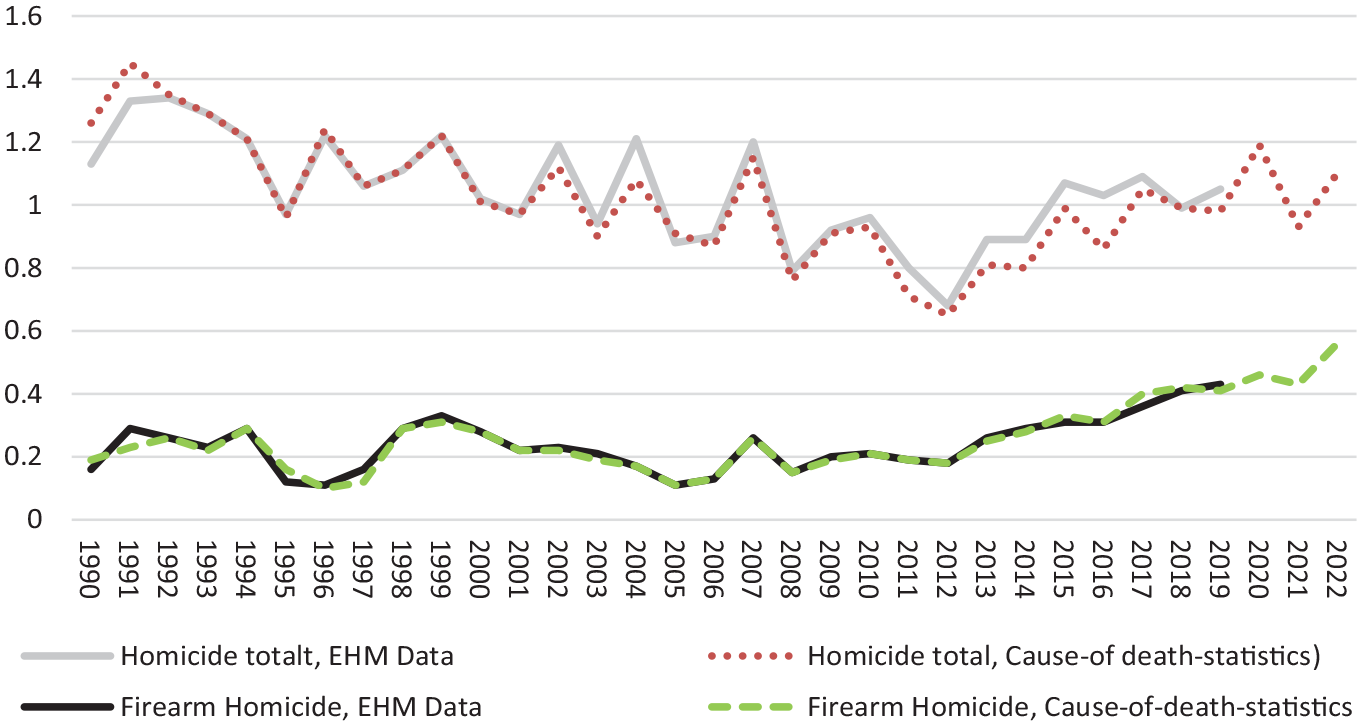
Total Annual Homicide Rate (Victims per 100,000 inh.) and Annual Firearm Homicide Rate in Sweden, Based on the EHM Data (1990–2019) and Cause-of-Death Statistics (1990–2022).
In absolute numbers, firearm homicides increased from about 20 victims per year at the beginning of the 2010s to almost 50 victims annually at the beginning of the 2020s (see Figure 2).
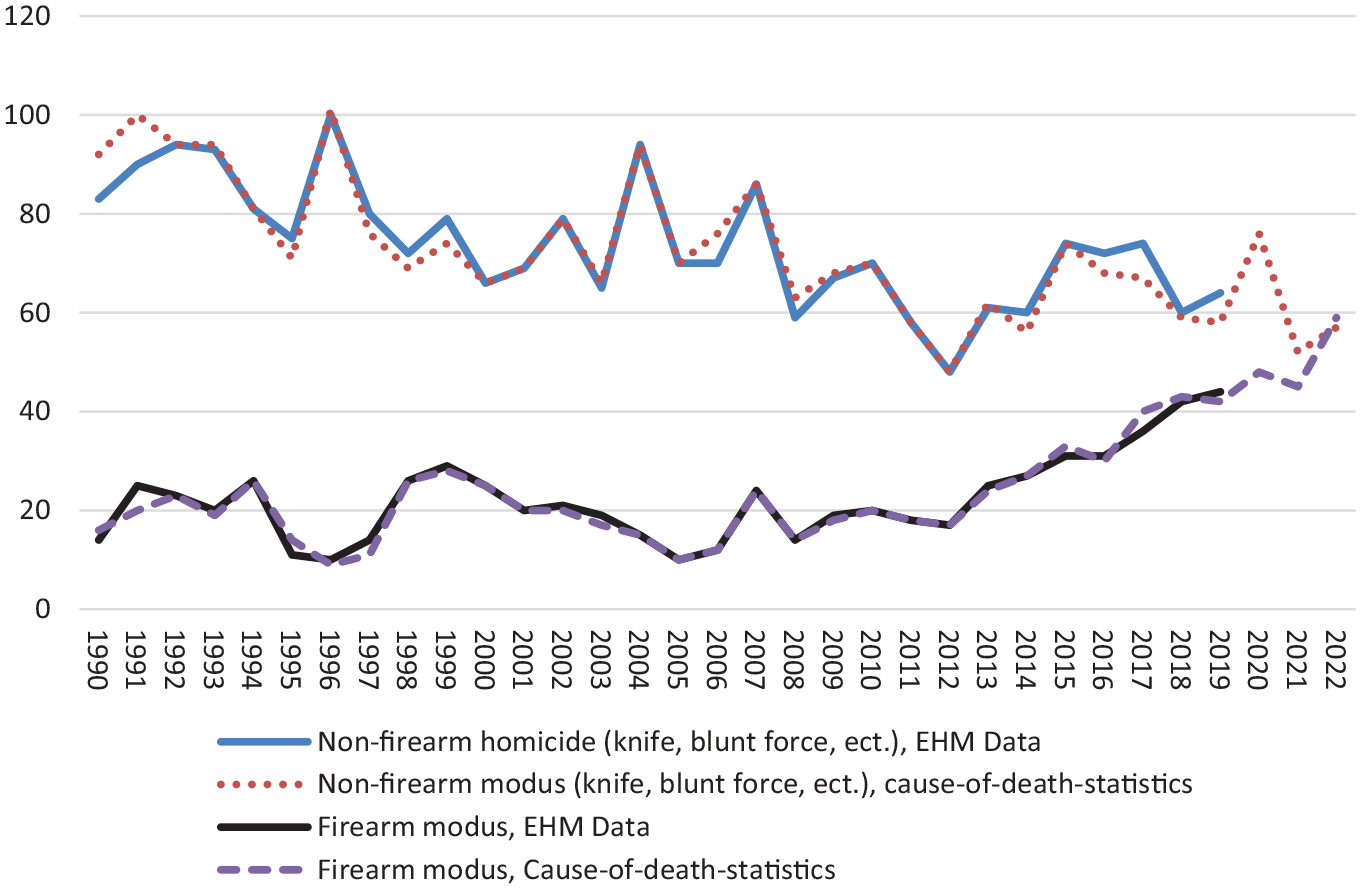
Annual Number of Firearm Homicides and Non-Firearm Homicides (e.g., Knife, Blunt Force) in Sweden Based on the EHM Data (1990–2019) and the Cause-of-Death Statistics (1990–2022).
The non-firearm homicide rates and numbers, on the contrary, had not increased in the 2010s (see Figure 2). The increase in overall homicide rates in this decade thus seems to be caused by the increase in firearm homicides.
As firearm homicides are a rather small crime category in absolute numbers, it is of course hard to say whether observed increases and decreases are just part of random fluctuations or not. However, the increases in numbers and rates after 2012 do differ from earlier fluctuations in both continuity and substance, providing an average annual rate of 0.4 firearm homicides in the 2013–2022 period as compared with 0.2 during 2003–2012 and 1993–2002. In terms of absolute numbers, an average frequency of almost 40 cases annually in 2013–2022 is a dramatic increase compared with about 20 during 2003–2012 and 1993–2002. From this perspective, and due to the fact that the “dark figure” of firearm homicides is very small (perhaps even nonexistent) in contemporary Sweden (see Granath et al., 2011), some possible explanations for the trend in 2010s will be discussed in the “Conclusion” section of this article.
As mentioned, some fluctuations and temporary increases were also present in the late 1990s. Here, one should be careful with interpretations, however, as these fluctuations seem rather temporary and minor. Nonetheless, it can be noted that the late 1990s—when we see a temporary increase in rates—have been portrayed in mass media and documentaries as the era of the “Balkan Mafia,” as a reference to wars in Stockholm involving a number of lethal shootings in urban spots (see Weirup & Larsson, 2007). Malmoe and nearby parts in southern Sweden are also said to have experienced a spurt in gang-related and mafia wars during the 1990s and 2000s (Barkman & Palmkvist, 2011).
The criminal milieu–related homicides also saw an increase in the 2010s, more specifically since 2013 (see Figure 3). As mentioned in the “Introduction” section, as this subgroup is tightly connected to the subgroup of firearm homicides, similar trends are expected and are confirmed by the available data.
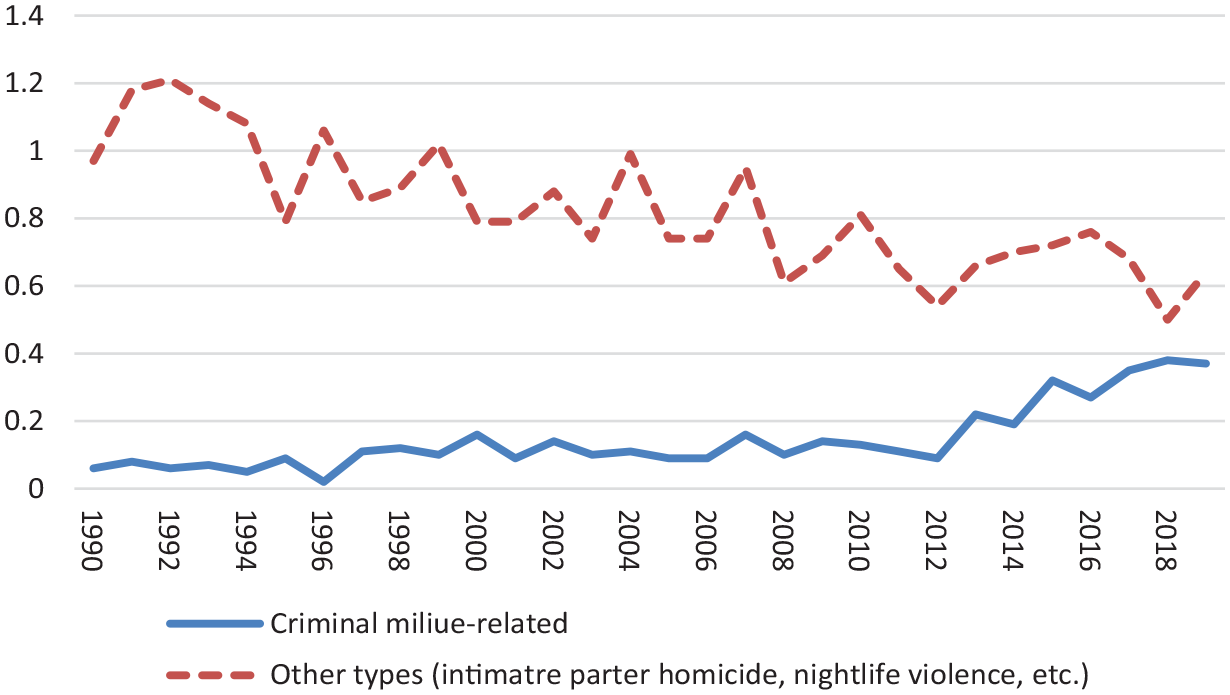
Annual Rate (Victims per 100,000 inh.) of Criminal Milieu–Related Homicides and Other Types of Homicides (e.g., Intimate Partner Homicides, Nightlife Violence) in Sweden During 1990–2019. Missing Cases (Unknown Homicide Types) Are Excluded.
The criminal milieu–related homicides, akin to the firearm homicides, show some increases in the late 1990s and early 2000s as well, albeit neither very pronounced nor seemingly continuous. The criminal milieu–related homicides continued, however, to fluctuate around a somewhat higher level in the mid- and late 2000s. From the perspective of this long-term trend in criminal milieu–related homicides, it is likely that some increases in the firearm homicides—at least those presumably conducted with illegal firearms—seem to have started already in the late 1990s due to episodes in the criminal world.
Regional Distribution
Almost 80% of all firearm homicides in 2010–2019 occurred in one of the three most urban counties (Stockholm, Skaane, and West Goetaland) although only about half of the population of Sweden resides in these counties. The Stockholm County accounted for the largest number and percentage in 2010–2019 (35%; N = 102), followed by Skaane County (24%; N = 72) and finally West Goetaland (20%; N = 57). The other 18 counties jointly accounted for the remaining 20%.
As shown in Figure 4, the concentration of firearm homicides in the most urban parts of Sweden was not as prominent during the 1990s and 2000s, when “nonurban” counties accounted for as much as 40%, as compared with 28% in 2000–2009 and 21% in 2010–2019. Similar findings were reported by other authors, who attributed those patterns to the use of legal hunting weapons to commit intimate partner or family violence, which is not solely an urban phenomenon (Granath, 2015). Thus, it is important to analyze and compare the numbers of firearm homicides committed with legal and illegal weapons, which will be done in a later section.
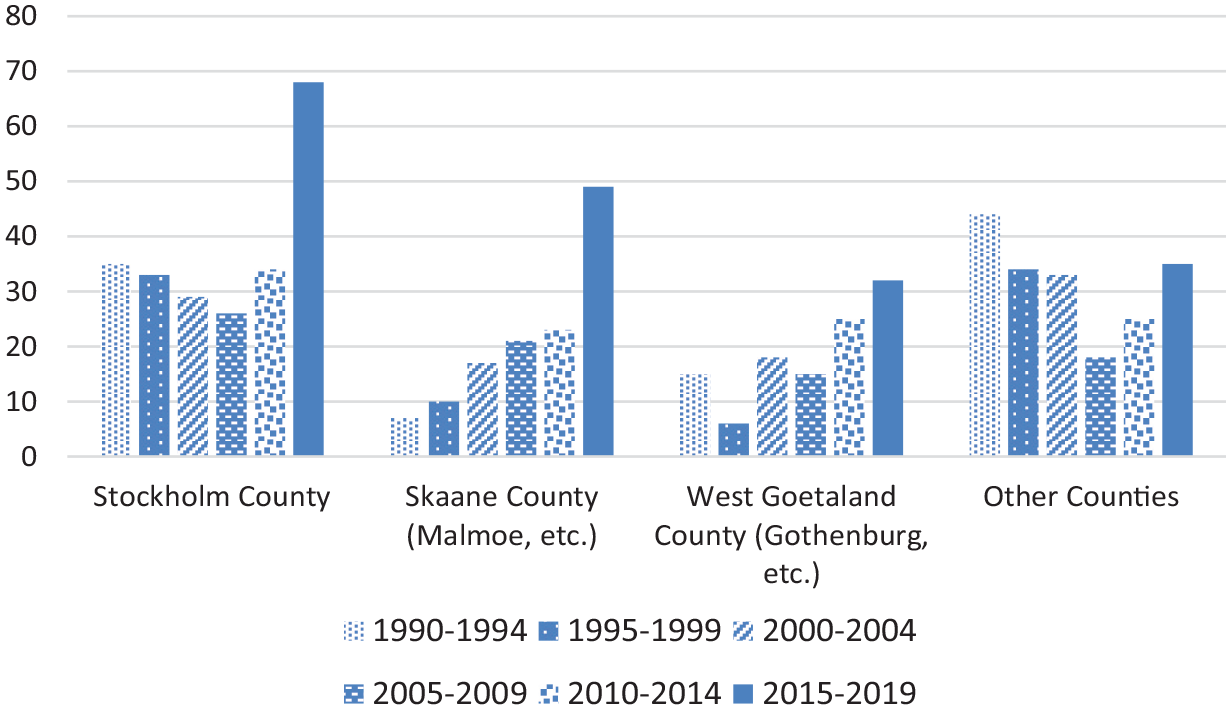
Total Number of Firearm Homicides in 2005–2009, 2010–2014, and 2015–2019, by County in Sweden (NUTS3 Region).
The increase in firearm homicides in the 2010s was most pronounced in Stockholm and Skaane County (Malmoe with surroundings). In Skaane County, however, there was also a sharp increase in firearm homicides from the 1990s to the 2000s (see Figure 4). In 1990–1999, this county accounted for only about 10% of all firearm homicides, but this percentage increased to 20% during 2000–2009. As mentioned earlier, Skaane is known for gang-related and mafia feuds during the first decade of the 21st century. Perhaps this was a sign of what was to come in Stockholm and other counties. As shown in Figure 4, although not as dramatic as in Stockholm and Skaane, increases in firearm homicides did occur in the other counties, both from 2010–2014 to 2015–2019 and in the 2010s as compared with the foregoing 5 years.
Based on the available data, criminal milieu–related homicides seem even more urban than firearm homicides. About 85% of all 240 criminal milieu homicides in 2010–2019 occurred in either Stockholm, Skaane, or West Goetaland County, according to the EHM data. As with the firearm homicides, at 37%, Stockholm County accounted for the largest share.
One difference from the firearm homicides is that this urban concentration seems to have been established already in the 1990s and early 2000s. In these decades, criminal milieu homicides in these three urban counties accounted for an 80% to 85% share. This difference might imply that criminal milieu–related homicide was an urban phenomenon already in the 1990s. Thus, there were a good number of such homicides in those days in Stockholm, for example, although firearms were far from present in those milieus as they became in the 2010s. This in turn most probably resulted in fewer casualties and less intensive feuds. In the next section of this article, focus will be on the incident characteristics of the firearm and criminal milieu–related homicides.
Motives and Victim−Perpetrator Relationship
Motives behind the firearm and criminal milieu–related homicides often seem to be rooted in narcotics (either small-scale or large-scale) distribution. According to the EHM data, almost 50% of all firearm homicides in 2010–2019 were drug-related in a “systemic” sense, meaning that the violence sparks from aggressive patterns of interaction within the system of drug distribution or use (see Goldstein, 1985). The most common motive coded in the EHM data on firearm homicides committed during 2010–2019 was, however, “revenge” (12%), followed by “narcotics affairs” (10%), and “other illegal affairs” (9%). Still, the relatively high prevalence of “separation” (6%) or “jealousy” (4%) as a motive indicates that firearms were an integral part of domestic violence as well.
Regarding revenge as a motive, qualitative descriptions of the cases suggest that firearm homicides also often occur as “retaliations” for prior firearm violence incidents. These initial incidents were likely a reaction to a conflict in the drug distribution milieu, giving rise to a self-perpetuating spiral of revenge-driven violence. This description of contemporary firearm homicides as an aftermath of other firearm homicides has been given in other recent studies on criminal homicides in Sweden (Öberg, 2020).
The domination of motives related to conflicts in the criminal milieu and/or in the narcotics business has grown stronger since the 1990s. In the 1990–1999 period, about 25% of all the firearm homicides were coded as criminal milieu–related in the EHM data. In the 2000–2009 period, the corresponding share was 40% and in 2010–2019—when the firearm homicides became much more numerous—it increased to 70%. This trend coincides with earlier research results, showing that the so-called “systemic drug-related cases” have increased among homicides in general in Sweden during the past decades (Granath, 2022b).
Simultaneously, use of firearms for committing criminal milieu–related homicides has become more common. Its share increased from 56% in 1990–1999 to 65% in 2000–2009 and to 85% in 2010–2019. Such a trend is in line with the previously stated hypothesis that it is first and foremost in the criminal milieu that firearms have become more available in Sweden. Clearly, firearms seem to have been far less present in that milieu in the 1990s although they already existed in the urban regions during this decade.
As most of the firearm homicides are related to conflicts in the criminal milieu, a rather large share of the perpetrators seems to have been unknown or just slightly known to the victim (nearly 40% in 2010–2019). Correspondingly, the share of family or partner perpetrators was low (15% in 2010–2019) among the firearm homicides, at least in comparison with the homicides in general (33% in 2010–2019). The same pattern is noted for the whole subgroup of criminal homicides, among which acquaintance is the most common relation between the perpetrator and the victim. It should also be noted that a rather large share of the firearm and criminal milieu homicides remain unsolved (50%–60% in 2010–2019). Therefore, as we do not know the victim–perpetrator relationship in many cases, acquaintances may be more prevalent. Not surprisingly, the share of unsolved cases and cases with an unknown perpetrator or a perpetrator just slightly known to the victim has increased since the 1990s as the firearm and criminal milieu homicides have increasingly become assassination-like killings related to systemic conflicts in the drug trade.
Crime Locations
The most common location for the firearm and criminal milieu–related homicides is a street, square, park, or other public place in the urban environment, accounting for almost 70% of all firearm homicides in 2010–2019. This does not mean that a majority of homicides took place in a well-attended urban space with a wide range of commercial business outlets and a high number of bystanders. Rather, the firearm and criminal milieu–related homicides are typically committed in less central places such as unfrequented parks outside residential areas or in abandoned parking lots, to where the victim has been strategically lured (Granath, 2022a).
The tilt to public places has also grown stronger over the past decades, as intimate partner, family-related, and spontaneous alcohol-driven motives have become less prevalent among firearm homicides. In 1990–1999, only about 45% of the firearm homicides were committed in a public place, increasing to 50% in 2000–2009. According to the mass media reports, however, the 2022–2023 period has witnessed an increase in firearm and criminal milieu–related homicides committed in private places as the perpetrators have found it harder to coax their enemies to public places, and are increasingly resorting to attacking them in, or just outside, their homes.
Types of Firearms
Information on what kind of firearm—illegal or legal, pistol or long-gun—was used in the homicides is not always available in the EHM data, especially in the records related to the early years. If we, however, consider the 40% to 70% of the cases where this information is recorded, we find that a majority of the firearm homicides were committed with an illegal firearm (smuggled, or illegally constructed from certain pieces), whereas only about 10% were committed with a legal weapon (in the sense that the perpetrator had a firearm license). Since 2015, there has actually been only a handful of homicides committed with a legal firearm in all Sweden.
From the technical perspective, one-hand pistols are the most common type of firearm used in the homicide. About two thirds of all firearm homicides in 2010–2019 were committed with a pistol according to the EHM data. Second most common weapon was a machinegun (20%), whereas revolvers or hunting rifles were somewhat rare, jointly accounting for about 10% of the firearms used. These results concur with those of more local and qualitatively oriented studies, indicating that firearm homicide perpetrators in contemporary Sweden mainly have access to—and do prefer—smuggled pistols or ex-military machineguns (Granath, 2022a; Polismyndigheten, 2023).
The data also indicate that the share and numbers of illegal guns (e.g., smuggled pistols) have increased among the firearm homicides over the past decades, from 75% in 1990–1999% to 80% in 2000–2010, and to almost 90% in 2010–2019. Simultaneously, the numbers and share of legal guns (usually hunting guns) have decreased. This trend has also been found in earlier studies (Granath, 2015), and is of relevance in interpreting the general firearm homicide trends. As the absolute number of firearm homicides committed with legal firearms has declined from the early 1990s until the early 2010s, and has subsequently reached a rate so low that it cannot substantially decline any further, this has “hidden” an increase in firearm homicides with illegal weapons in criminal milieus that started already in the late 1990s. As the upward trend in firearm homicides committed with illegal guns escalated in the 2010s, it gives a clear impact on the overall firearm homicide rate, which is no longer tempered by a decline in homicides involving legal firearms.
Sex and Age of the Persons Involved
As with homicides in general, most victims and perpetrators of firearm and criminal milieu–rated homicides are male. The male preponderance is even stronger among these homicides than among homicides in general—a finding yielded by several international studies (Krusselmann et al., 2023). In 2010–2019, about 90% of all victims and almost 100% of all known perpetrators of firearm homicides were male, as compared with 72% of the victims and 94% of the perpetrators of all homicides in Sweden in the same decade.
The male dominance among the victims and perpetrators in firearm and criminal milieu–related homicides has also grown stronger in the past decades. In 1990–1999, for example, when firearm homicides more often occurred in the context of intimate partner and family violence, “only” 70% of the victims and 95% of the perpetrators were male. A moderate increase in the share of male victims can also be noted among criminal milieu–related homicides since the 1990s. As these homicides are increasingly committed using firearm and in the context of well-planned assassinations within conflicts between and in local criminal networks, the share of male victims has increased from 94% in the 1990s to 98% in the 2010s. This progression, together with the fact that these homicides have grown substantially in numbers since 2000, has caused the overall homicide structure to reach an all-time high tilt to male victims in the past few years. According to the cause-of-death statistics, 80% of all homicide victims in 2020–2022 were male. The overall male homicide victim rate in this period was the highest (1.7 per 100,000 inh.) in almost 30 years, whereas it was the lowest (0.4 per 100,000 inh.) among women.
Regarding the sex of the victims and perpetrators of contemporary firearm and criminal milieu–related homicides, qualitative data indicate that women sometimes actually do take part in these homicides, however not as principal perpetrators. Instead, they have roles as decoys or providers of dwellings to store weapons, for example (Granath, 2022a). Past years have also seen women sporadically becoming victims of these homicides, as they end up in the line of fire when their male partners and relatives are ambushed by rivaling criminal networks or by hit men.
The age of the victims and perpetrators of firearm and criminal homicide is relatively low, with a median of 27 and 25 years, respectively, in 2010–2019. This can be compared with a median of 36 and 35 years for the victims and perpetrators of all homicides in the same period.
The share of young victims and perpetrators of the firearm and criminal milieu–related homicides has also increased over the past decades, successively lowering the median ages. Especially from 2000–2009 to 2010–2019, the number and share of young adults and teenagers involved in these homicides increased substantially. For example, the share of 15- to 24-year-olds among the victims of firearm homicides increased from 18% to 39% between these two decades. The same tendencies are present among the perpetrators. This trend indicates that the increase in firearm and criminal milieu–related homicides during the past decade is primarily due to the involvement of young people in antisocial careers—a finding yielded by earlier studies on firearm homicides in contemporary Sweden (see “Introduction” section).
Native and Foreign Descent of the Persons Involved
Earlier studies indicate that residents born abroad are overrepresented as both victims and perpetrators of homicides in northwestern European countries (Ganpat & Liem, 2011; Granath et al., 2011; Lehti et al., 2019). With the caution that the EHM data rather often (20%–60%) lacks information on the country of birth for the individuals involved, this pattern seems certainly present in the firearm and criminal milieu–related homicides. In 2010–2019, 60% of the victims and 50% of the perpetrators of the firearm homicides were born abroad. This constitutes a fourfold and 3.3-fold overrepresentation of foreign-born individuals among the victims and the perpetrators, respectively, as compared with native-born residents, countering the previously published findings for Sweden in the mid-2010s (Lehti et al., 2019) and for the Netherlands (Ganpat & Liem, 2011).
Developing countries outside Europe (mainly in the Middle East and Africa) are the most common origin for the victims and perpetrators born abroad. This finding corresponds fairly well with the results obtained in earlier studies on homicide in the Nordic countries (Lehti et al., 2019). Still, it should again be said that, for subgroups of homicides such as firearm homicide or criminal milieu–related homicide, nation of birth is rarely recorded—especially for the perpetrators—due to which the results need to be interpreted with caution. Regarding the firearm homicides in 2010–2019 (N = 291) for example, we know the country of birth for only 110 perpetrators (38% of the cases).
In earlier decades, the share of foreign-born victims and perpetrators seemed somewhat lower. In 1990–1999, it was 26% among both victims and perpetrators, increasing to 30% and 38%, respectively, in 2000–2009, and then further in 2010–2019 (see earlier section). This tendency also indicates a decline in the absolute numbers of Swedish-born firearm homicide victims and perpetrators in the past decades although the total numbers have increased. The same tendency over time can be found in the criminal milieu–related homicides.
Conclusion and Discussion
Empirical Summary
Firearm homicide rate in Sweden increased sharply in the first half of the 2010s and then continued to increase, reaching a then all-time high in the beginning of the 2020s. Simultaneously, the subgroup of criminal milieu–related homicides increased sharply, as over the past decades, these homicides have become synonymous with firearm homicides, and vice versa. The rates of the firearm homicides and criminal milieu homicides were on average more than double in the 2015–2019 period compared with the 1990s and 2000s.
On the contrary, other subgroups of homicides (e.g., deadly beatings, knife-conducted homicides, and intimate partner homicides) did not increase in the 2010s. In fact, such lethal violence declined during the study period, especially in the 1990s and 2000s.
Although the increase in firearm and criminal milieu–related homicides was clearly most substantial and visible in the 2010s, disaggregated analyses show that an increase in homicides conducted with illegal guns already started, albeit moderately, in the late 1990s. This increase was thus “masked” in the overall firearm rate by a decline in firearm homicides involving legal guns (e.g., mainly hunting rifles, in the context of family violence), which had been ongoing from the mid-1990s until the early 2010s.
Regarding victims, perpetrators, and social context, the substantial increase in firearm homicides and criminal milieu–related homicides in the 2010s was found to be associated with young men, often first- or second-generation immigrants coming from developing countries, and was motivated by conflicts in the drug trade. The increase in such incidents was mainly noted in the most urban regions, Stockholm County in particular.
Interestingly, the long-term trends and structural change in homicide modus—increasing numbers of firearm homicides and declining numbers of homicides as a result of stabbing or physical violence—found in this study do resemble the findings of earlier studies on nonlethal but severe violence, at least among young people (Granath, 2022a). This previous research has shown that the number of young adult patients treated in hospital emergency departments for severe injuries (mainly caused by blunt force) has steadily declined in the past two decades. On the contrary, the number of patients treated for gunshot wounds, although small, has substantially increased since 2010 and that related to knife wounds has stopped declining in mid-2010s. This similarity in long-term trends for lethal and nonlethal severe violence might indicate that homicide trends are actually part of major trends in severe violence, as stated by, among others, Spierenburg (2008).
The descriptions provided in this study also emphasize the importance of disaggregated analyses when studying homicide trends, as previously pointed out by Lehti (2014) and other scholars. For example, firearm homicides committed with illegal guns and legal guns are found to exhibit different trends, thus biasing the interpretations of the overall firearm homicide trend.
Possible Explanations for the Increase in the 2010s
In a recent study on so-called gang crimes among young people in Sweden, Granath (2022a) interpreted an increase in young victims of lethal firearm violence in the 2010s as a “method-change” among the small group of young people involved in crime-active lifestyles and antisocial careers. This hypothesis is in turn rooted in the notion put forward by Sivertssons et al. (2022) that criminal or violent behavior, either serious or less serious, has not increased among young people in general in Sweden in the 2000s or the 2010s.
Granath (2022a) also argued that a method-change toward firearms has probably been fueled by growing supplies of illegal weapons and illegal drugs since the 1990s, thus expanding the drug trade economy and the conflicts within such economy. Such hypothesis is supported by the results obtained in this study, as the first marked increase in firearm homicide was first recorded in Skaane County (south of Sweden) in the mid-2000s. The establishment of the Öresund bridge connecting southern Sweden with the rest of the continent most probably made the logistics of drug and gun smuggling easier (see Granath, 2022a). Thus, it is also reasonable to assume that the new wave of illegal weapons and drugs first reached Skaane County. In this context, it is also noteworthy that many of the illegal guns used in the criminal milieu–related homicides during the past two decades were of ex-Yugoslav or former Eastern Block origin (Polismyndigheten, 2020). The first rises in firearm-conducted criminal milieu homicides were then hypothetically sparked by an increased access to illegal guns in the aftermath of the Balkan wars in the 1990s and the downfall of the Eastern Block in the same era. As organized crime milieus in Sweden have for decades had many social contact areas with the Balkan region (see Weirup & Larsson, 2007), this most probably fueled a heightened access to illegal weapons and international drug distribution after the civil war and disintegration of Yugoslavia.
Earlier studies on gang crimes in Sweden in the 2010s have also focused on the importance of the digital revolution, with the breakthrough of smartphones, and so forth, providing the youngsters in antisocial careers new possibilities to administer drug and weapon logistics and to gain information and contacts for crime setups that in earlier eras were more exclusively reserved for older career criminals (Granath, 2022a; Polismyndigheten, 2023). Studies based on—among other sources—police intelligence reports, do emphasize the crucialness of new communications apps and IP-telephony for young perpetrators to conduct contract killings and firearm violence retaliations. Apps such as “WhatsApp” and “Signal” are providing platforms for communication between young delinquents and more established adult career criminals over much greater territories and, to a certain degree, across national and continental borders, while enabling young perpetrators to gain timely information on the whereabouts of their enemies (Granath, 2022a; Polismyndigheten, 2023). The finding yielded by this study that the substantial increase in firearm homicides in the young criminal milieu very much coincides in time with the proliferation of smartphones can be said to support this “digital revolution” hypothesis.
In another recent study, Selin (2021) pointed out that a rise in firearm homicides with young criminally active victims and perpetrators, fueled by heightened access to illegal guns, drugs, and new communication techniques, can also be self-increasing, causing a self-sustaining chain reaction of revenge and retaliation in the same milieu, as young criminals learn from each other (Öberg, 2020; Selin, 2021). In addition, this “chain reaction” hypothesis is supported by the results of this study as the increase in firearm and criminal milieu–related homicides was found to vary considerably across regions, especially when certain 5-year periods are examined. The “chain reaction” hypothesis can probably also explain why a dramatic rise in firearm homicides committed by young persons in criminal milieus has been seen in Sweden in the 2010s but not yet to the same degree in other countries in northwestern Europe (Krusselmann et al., 2023; Suonpää et al., 2022). According to the “chain reaction” hypothesis, a rather small difference in essential conditions (e.g., gun availability, population structure) can result in a rather big difference in the outcome of certain serious crimes.
Furthermore, the “increased accesses to illegal guns” hypothesis, the “digital revolution” hypothesis, or the “chain reaction” hypothesis cannot however fully explain why Sweden was found in earlier studies to have much higher firearm homicide rates in the 2010s compared with other northwestern countries (Selin, 2021; Sturup et al., 2019). As the authors of these earlier studies, as well as Duqet (2016), have pointed out, firearms from the Balkan civil wars have been spreading out to other western European countries (as seen, for example, in the terror attacks in France and Belgium). In addition, Sweden is certainly not the only country to be affected by the digital revolution (although Sweden was actually the first country to establish digital payment systems such as “Swish” and 50% of its population has a smartphone; see Internetstiftelsen, 2022).
Thus, some social factors highlighted in earlier studies as possible explanations for the rise in firearm and criminal milieu homicide rates in the 2010s seem worthy of discussion, especially the growing income gap and high level of immigration from developing countries in the past decades (Granath, 2022a). Sweden is one of the European countries with the most widened income gap since the 1990s according to the OECD (2022) although the income gap is still far from the highest in Europe. In addition, it has had a higher rate of immigration from developing countries than other countries in northwestern Europe in the past decades (Örstadius, 2022). This study indicates that immigrant youth have been highly overrepresented as both victims and perpetrators of firearm homicides in the criminal milieus in the past decade and are almost solely responsible for the increase in prevalence in the 2010s. Hence, the immigration patterns do seem to play a role, albeit in combination with other, and probably more important, factors, such as heightened availability of drugs and illegal guns, and the digital revolution. One should bear in mind also the argument put forward by Suonpää et al. (2022) that changes in homicide levels are often the outcome of more than one phenomenon.
Limitations of the Study
This study does not include a time series analysis of the trends and fluctuations in the firearm and criminal homicide rates over the past three decades. As the actual figures are relatively low, it is hard to determine whether the noted increases and decreases in rates are part of random fluctuations. Similarly, it is difficult to appropriately weight the possible explanations for the observed trends. Thus, further longitudinal studies based on larger data sets extending beyond 2019 are required to obtain reliable and current data. It would also be beneficial to apply time series analysis to a data set with a longer observation period.
Footnotes
Acknowledgements
The author thanks Prof. Nora Markwalder at the St. Gallen University and Prof. Janne Kivivuori at the Helsinki University for their initiative and support in the writing of this article, as well as Professors Cecilia Magnusson and Rosaria Galanti at Karolinska Institutet (K.I.) in Stockholm for the opportunity to work with the European Homicide Monitor (EHM) data in the 2020–2021 academic year.
Declaration of Conflicting Interests
The author(s) declared no potential conflicts of interest with respect to the research, authorship, and/or publication of this article.
Funding
The author(s) received no financial support for the research, authorship, and/or publication of this article.