



Abstract
The 2018 mass shooting at Marjory Stoneman Douglas High School in Parkland, Florida reignited a discourse about safety and prevention that often follows such tragedies. Using a case study approach, we analyze the events leading up to the shooting (via official records from law enforcement and the shooting’s review commission) to identify missed opportunities for intervention, de-escalation, and ultimately prevention. The Path to Intended Violence model is employed to highlight the perpetrator’s escalating behaviors from grievance through the attack itself. The lessons learned then are utilized to offer recommendations for schools and communities seeking to prevent similar mass violence attacks.
On February 14, 2018, a 19-year-old former student returned to his high school armed with an AR-15. 1 In under 6 minutes, he committed what remains, to date, the most lethal mass shooting in a U.S. high school, killing 14 students and 3 teachers, injuring 17 others, and leaving a community and the nation in shock. The events that unfolded at Marjory Stoneman Douglas High School (MSD) in Parkland, Florida led to renewed calls to identify opportunities to prevent future tragedies that echoed other school shootings, including those at Columbine High School (1999) and Sandy Hook Elementary School (2012). Less than a month after the shooting, Governor Rick Scott signed the Marjory Stoneman Douglas High School Public Safety Act into law, which, among other provisions, established a review commission tasked with investigating the shooting and what led up to it (see, generally, Florida Department of Law Enforcement, n.d.). The Marjory Stoneman Douglas High School Public Safety Commission’s (MSDPSC) initial report was made public in January 2019, with a second report released in November of the same year. Like prior tragedies, the Commission found numerous failures that could possibly have prevented the shooting. Absent their inquiry, however, was a clear framework through which to analyze these findings.
Contrary to the discourse that often follows public mass shootings like Parkland, there are no known demographic profiles of perpetrators that can accurately predict who will attempt or successfully carry out these attacks (Calhoun & Weston, 2003; Congressional Research Service, 2013; Pollack et al., 2008; U.S. Department of Justice, 2017). Despite this, perpetrators have been found to follow a clear, discernible path toward targeted violence, as these attacks are seldom impulsive or spontaneous (Calhoun & Weston, 2003; Fein & Vossekuil, 1997). These individuals often methodically prepare and plan for their attacks and display certain warning behaviors that may indicate they are moving along a pathway toward violence. Therefore, it is recommended that efforts like threat assessment focus on warning behaviors, or what the individual is doing, instead of solely on the threats the individual is making or attempting to profile them (Borum et al., 1999; Calhoun & Weston, 2003, 2015; Fein & Vossekuil, 1997; Meloy et al., 2011). If warning behaviors are identified and appropriately managed, many of these attacks likely would be prevented (Fein & Vossekuil, 1997; Pollack et al., 2008).
In this paper, we employ a case study approach to examining the Parkland school shooting within the context of the Path to Intended Violence model (Calhoun & Weston, 2003). This particular case, which has been called “the United States’ most preventable school shooting” (“Parkland: Our Investigations,” 2019, para. 1), is optimal for such an evaluation given the high volume of investigatory material that emerged in its aftermath, which is rare to most similar events save a few notable exceptions (e.g., the attacks at Columbine or Sandy Hook). It also garnered considerable widespread public interest (e.g., Agiesta, 2018; Graf, 2018) and subsequent mobilization for policy change (e.g., Alter, 2018), the likes of which has never been observed. Official investigatory documents and open-source records, including the reports from the MSDPSC, are analyzed within each stage of the framework to better understand not only the events that led up to the shooting but also the opportunities that existed to intervene and potentially prevent the attack. We then consider the important implications that these findings have for future policy and offer recommendations based on the lessons learned from this tragedy.
The Path to Intended Violence Model
Calhoun and Weston (2003) developed the Path to Intended Violence model to illustrate the progressive journey toward violence. This six-stage model is based on findings from the Exceptional Case Study Project (ECSP) conducted by the United States Secret Service that explored the behaviors of individuals who had attacked or were at risk of assassinating a public figure (Fein & Vossekuil, 1997). When conducting the ECSP, Fein and Vossekuil (1997) found that individuals who had engaged in or were at risk of targeted violence all had similar “attack-related behaviors” (p. 48). Further, a subsequent study with similar methodology conducted by the U.S. Secret Service, the Safe School Initiative (SSI; Vossekuil et al., 2004), found that school shooters also often displayed similar pre-attack behaviors. Specifically, Vossekuil et al. (2004) found that at least 93% of the school shooters in their sample displayed one or more warning signs before their attacks. The warning signs and behaviors identified in these two studies were utilized by Calhoun and Weston (2003) in their development of the Path to Intended Violence model. This model frequently is employed by the Federal Bureau of Investigation’s (FBI) Behavioral Analysis Unit (BAU) to help conceptualize cases of intended violence (U.S. Department of Justice, 2017) as well as researchers analyzing other high-profile mass violence events (e.g., Allely & Faccini, 2017a, 2017b, 2018; Faccini & Allely, 2016). Additionally, the U.S. Department of Homeland Security (2019) has encouraged the adoption of this model.
The six stages of the Path to Intended Violence model outline the path perpetrators traverse from their grievance(s) to attack (Calhoun & Weston, 2003). Figure 1 depicts this model’s progressive stages. The rate at which the perpetrator travels along this path varies depending on a multitude of factors, and some will never reach the final attack stage (Kaiser, 2012). Additionally, the path a perpetrator takes toward violence is not always linear (U.S. Department of Justice, 2017). Stages can be skipped, and at times, the perpetrator may retreat to earlier points on the pathway (Calhoun & Weston, 2003; U.S. Department of Justice, 2017). Nonetheless, this model allows threat assessors and others to identify points of intervention that may assist with taking the individual off the path (Calhoun & Weston, 2003).
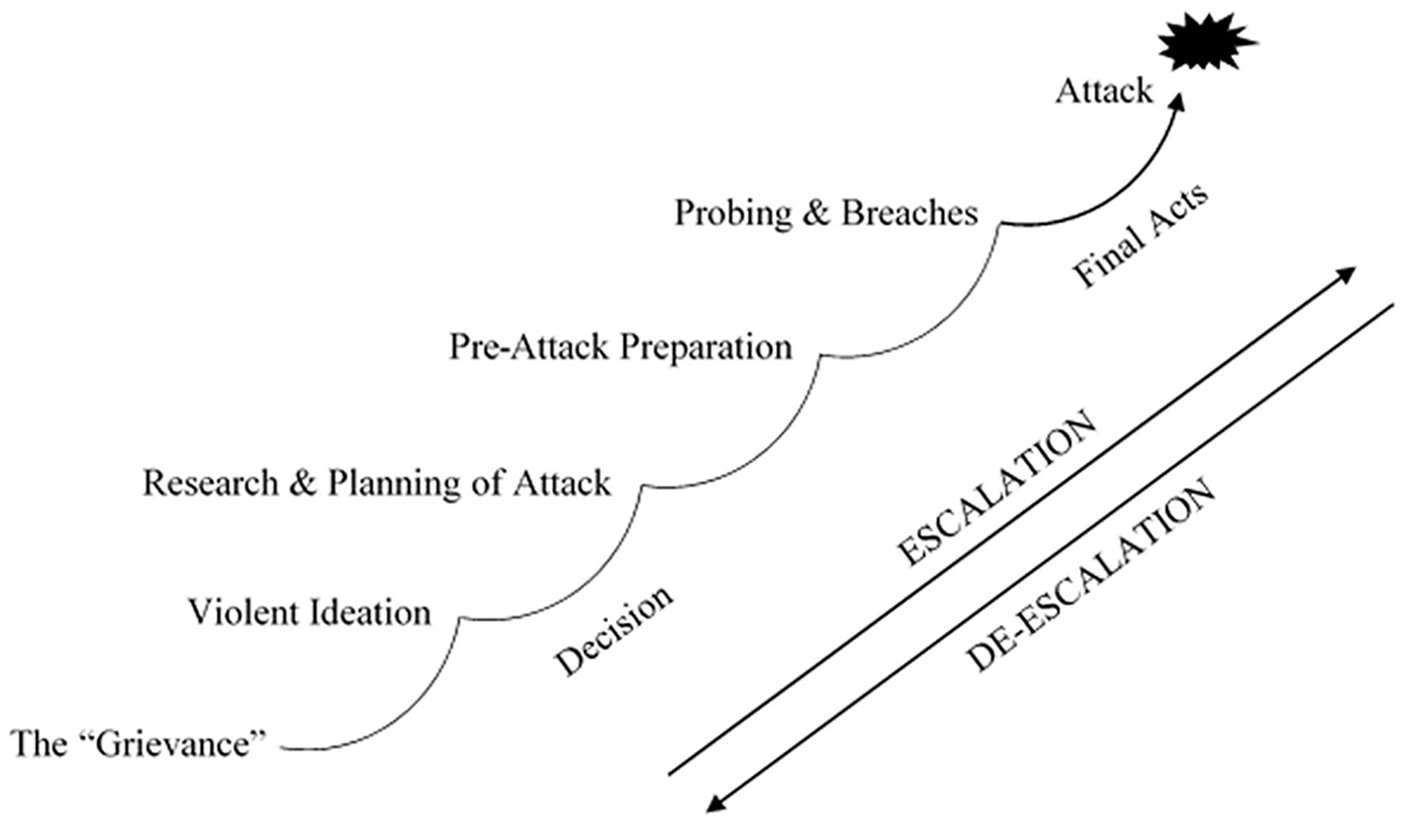
The Path to Intended Violence model.
The first stage of the Path to Intended Violence model is the grievance stage (Calhoun & Weston, 2003). During this stage, the perpetrator feels as though they have been treated unjustly in some way. These individuals may be “injustice collectors” (O’Toole, 2000, p. 17) and keep a running list of occasions where they have felt wronged or slighted. These grievances may be driven by paranoid or delusional thinking, or they may be rooted in reality, such as experiencing issues in a romantic relationship, being terminated from a job, or being bullied. While everyone has grievances at some point in their lives, these individuals are unable to move past them.
As these individuals become more fixated on the grievance(s), they may transition into the ideation stage of the pathway model (Calhoun & Weston, 2003). During this stage, they begin to think about and may even fantasize about using violence to resolve the grievance(s). They may conduct extensive research on past mass shootings, identify with other perpetrators, or become immersed in their violent thoughts (Calhoun & Weston, 2003; Kaiser, 2012). Leakage, or discussing these violent thoughts and ideas with a third party, is an overt sign of this stage (Meloy & O’Toole, 2011). Leakage occurs in many forms, including verbal communications, letters, journals, and social media posts. This behavior is especially common before school shootings. O’Toole (2000), for example, found that all the school shooters within her sample engaged in leakage before their attacks. Similarly, the SSI study found that in 81% of cases, at least one other person knew about the perpetrator’s plan; they also found that more than one individual had knowledge of the plan in 59% of the incidents (Vossekuil et al., 2004). More recently, the National Threat Assessment Center (2021) found that 94% of the plotters in their study shared their intentions ahead of their attack, which most often were observed by friends or classmates.
Leakage serves a variety of purposes. One principal reason this phenomenon occurs is that the perpetrator is so consumed with thinking about violent acts that they have trouble containing these thoughts and keeping them to themselves (Meloy & O’Toole, 2011). Despite others having this pre-attack knowledge, however, many of these shootings still are carried out (Pollack et al., 2008). This could be due in part to the bystander effect (Latané & Darley, 1970), which puts forth that when multiple individuals are aware of a crisis or situation that necessitates intervention, the prospect of them taking action decreases (Fischer et al., 2011). Several hypotheses attempt to explain the bystander effect phenomenon, including how individuals may feel less personally responsible when others are aware of or present during a crisis, or they may fear that any action they take will be judged by others (Latané & Darley, 1970). In the context of school shootings, research has lent support to this idea (Meloy & O’Toole, 2011). Without successful intervention, however, the perpetrator is left to continue along the path.
Moving past the ideation stage of the pathway model, individuals may progress into the research and planning stage, where they begin to determine how they will carry out their attack (Calhoun & Weston, 2003). This planning period can be minimal or extensive depending on the nature of the intended attack, such as how familiar the perpetrator is with the intended location and their target(s). Perpetrators may need to gather information about their target and, therefore, might ask suspicious questions. Additionally, they may need to research and plan other logistics, such as the type of weapon they should use and escape routes they could take after their attack. Calhoun and Weston (2003) suggest that the research and planning stage often is the most identifiable out of all the stages of the path model as many of these planning behaviors are observable.
Once the individual completes the necessary planning and research activities for their attack, they must begin preparing. During the preparation stage, individuals often engage in actions to ready themselves to carry out their plan, such as acquiring the necessary tools to do so (Calhoun & Weston, 2003). They will procure weapons, ammunition, and costuming, such as body armor, for their attack. They also may participate in other final act behaviors, such as contacting loved ones, giving away sentimental items, or creating a manifesto. As in the research and planning phase, the behaviors at this stage also may be noticeable by others. Consequently, perpetrators may become increasingly isolated as they continue along the path to prevent others from intervening and thwarting their planned attack.
Individuals progress to the breach stage of the pathway model once they have solidified the plan and acquired the tools needed to carry it out (Calhoun & Weston, 2003). During this stage, they may engage in a dry run or a probe to test security at the planned location of their attack. They also may attempt to see how close they can get to their target or visit their attack site to view the layout and determine points of access or potential barriers, if any. At this point of the path, their attack is imminent. Importantly, not all who reach this stage will go on to attack for a range of reasons, such as realizing that the site is too secure to breach.
The final stage of the path model is the attack stage (Calhoun & Weston, 2003). During this stage, most perpetrators implement their plans and carry out their attacks. Like the breach stage, not all perpetrators who reach the attack stage will have the opportunity to carry out their plan if measures are taken by law enforcement or others to prevent it from occurring. Additionally, although unlikely, the attacker ultimately may decide against implementing their plan, even during this final stage.
The Present Study
The present study utilizes a case study approach to analyze the events leading up to the Parkland school shooting. We employ the Path to Intended Violence model (Calhoun & Weston, 2003) as our primary framework to analyze each stage of the perpetrator’s actions and behaviors with specific focus on identifying opportunities for intervention, de-escalation, and potential prevention of the attack. This model was developed to overcome the limitations of other techniques, such as utilizing diagnoses and profiling, to predict violence (Allely & Faccini, 2017b), which can be even more difficult to employ given the small base rate of school and mass shootings that limits potential forecasting efforts (Borum et al., 1999; Rocque, 2012). As noted, this model has been applied to other such mass violence cases, including the perpetrators of the attacks in Oslo and Utøya, Norway in 2011 (Allely & Faccini, 2017a; Faccini & Allely, 2016), Newtown, Connecticut in 2012 (Allely & Faccini, 2017a), Isla Vista, California in 2014 (Allely & Faccini, 2017b; White, 2017), and Charleston, South Carolina in 2015 (Allely & Faccini, 2018). It bears noting, however, that these prior studies focused primarily on the perpetrators’ psychopathology and developmental disorders using assessments relative to conditions like Asperger’s syndrome, autism spectrum disorder, and narcissistic personality disorder. Conversely, in the present study, we focus on specific pre-attack behaviors and warning signs beyond the Parkland perpetrator’s mental health that presented opportunities for threat identification and subsequent management.
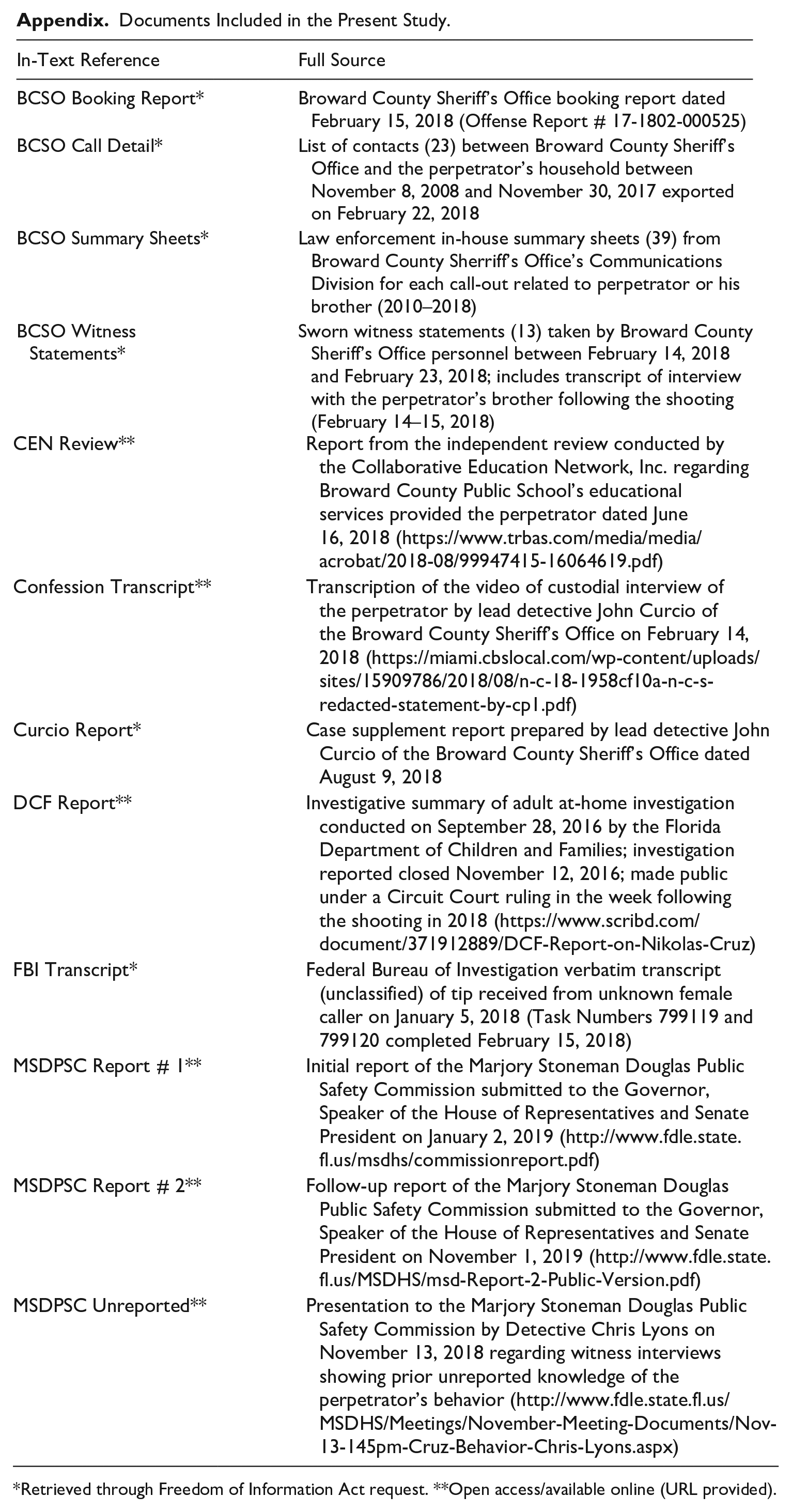
Primary documents reviewed as part of this case study were retrieved from the Broward County Sheriff’s Office (BCSO) through a Freedom of Information Act (FOIA) request submitted on January 24, 2019. 2 Although multiple local jurisdictions (e.g., Coral Springs Police Department, Fort Lauderdale Police Department, Hollywood Police Department) responded to the school to provide assistance during and after the shooting, responses to similar FOIA requests submitted to these agencies indicated that all records should be retrieved through BCSO. Electronic records were released to the researchers by BCSO on February 5, 2019. Secondary documents utilized in the analysis were retrieved from sources including the MSDPSC reports and other records made available through media outlets or others after being released by the courts. A list of documents included in the present study, as well as how they were obtained and how they are referenced in-text, is available in the Appendix. Collectively, 1,886 pages of documentation were analyzed across these 12 sources. As this case remains open at the time of this writing (pending the start of the perpetrator’s penalty phase trial following his guilty plea entered on October 20, 2021; see Madigan et al., 2021), some of the information received was redacted. Other information, such as the perpetrator’s mental health records, were not available in accordance with Health Insurance Portability and Accountability Act (HIPAA) laws.
As noted, Calhoun and Weston (2003) describe intended violence as “a process of discrete, sequential, recognizable behaviors” that can culminate in an attack if not disrupted or de-escalated (p. 57). Our analysis in the next section subsequently explores the actions and events leading up to the shooting in the context of these discrete steps. Although the attack is the final stage of the path, we begin with a short overview of the events of February 14, 2018, to establish the necessary background through which to understand how the behaviors presented in the context of each step were important warning signs and opportunities for intervention.
Applying the Path to Intended Violence Model to the Parkland Shooting
The Attack: February 14, 2018 3
On Valentine’s Day in 2018, the perpetrator took an Uber to the school and made his way to Building 12, which housed many of the freshmen classes. He entered the building through the east hallway at approximately 2:21 p.m. local time, less than 20 minutes before the school day ended. He quickly loaded his semiautomatic rifle and magazine-carrying vest in the nearby stairwell before returning to the first floor hallway and opening fire. Students Martin Duque Anguiano, Luke Hoyer, and Gina Montalto were killed; another student was injured. The perpetrator then fired into classrooms on the same level, either through the doors or the windows next to them, attempting to harm anyone he could see. Within three of these rooms, students Alyssa Alhadeff, Nicholas Dworet, Alaina Petty, Helena Ramsay, Alex Schachter, and Carmen Schentrup were killed, and 12 other students were wounded. School monitors Chris Hixon and Aaron Feis each responded to the building as the attack was in progress; both were fatally shot.
Just over one minute after the shooting began, the fire alarm in the building was activated by dust that fell from the ceiling tiles as they shook from the reverberations of the gunshots. Teachers and students in the rooms on Building 12’s second floor could distinctly hear the gunshots and consequently remained locked down (though a Code Red—the district’s signifier for an active shooter event—had not been called). When the perpetrator made his way to the second floor, he was unable to see anyone as the occupants were out of sight of the corridor windows. He fired six rounds into classrooms, but no injuries were sustained. By this time, the teachers and students on the third floor had exited their classrooms in response to the fire alarm, but quickly fled back toward their rooms when they eventually heard the gunshots. As the perpetrator reached the third floor, approximately 20 people remained in the hallway. He opened fire, shooting 10 of them, six—students Jaime Guttenberg, Cara Loughran, Joaquin Oliver, Meadow Pollack, and Peter Wang and teacher Scott Beigel—fatally. The perpetrator attempted to shoot out the windows in the teachers’ lounge to fire at fleeing students and teachers, but the storm-resistant glass held.
Less than six minutes after the first shots were fired, the last rounds were captured on a responding BCSO deputy’s body camera. The perpetrator then abandoned his weapon, vest, and additional magazines with live rounds in the stairwell off the third floor and fled the building, blending in with other students who were exiting the school. He first went to a nearby Walmart and then to a McDonalds before continuing to move away from the school. He was taken into custody 1 hour and 16 minutes after the shooting started about two miles from MSD.
Grievances
Grievances held by individuals along the pathway may be either real or perceived (Calhoun & Weston, 2003). They can include, but certainly not be limited to, problems within or the loss of a relationship, feeling bullied or persecuted in some way, or experiencing financial or job loss. For the Parkland perpetrator, a review of the history leading up to the attack suggests that he experienced what Levin and Madfis (2009) refer to as “cumulative strain,” whereby chronic and prolonged stressors experienced early in one’s life are compounded by a lack of positive social support (uncontrolled strain) that exacerbates the effects of a short-term negative event (acute strain) and leads to mass destruction (p. 1227). Like the Path to Intended Violence model, this framework relies on a sequence of stages that build upon one another and converge in a cumulative manner that produces the attack if left unaddressed.
In the case of the Parkland perpetrator, records indicate that he experienced several chronic strains in his life. He was adopted less than five months after his birth, and his adoptive father passed away when he was five years old, leaving his adoptive mother to raise he and his biological half-brother who the couple also had adopted (MSDPSC Report # 1). By all accounts, his upbringing was tumultuous, and he began displaying aggressive and violent tendencies as young as age three (CEN Review; MSCPSC Report # 2). He often was physically and verbally abusive toward his mother, including encouraging her to kill herself and advising that if she did not, he would do it for her and burn the house down (MSDPSC Unreported). The perpetrator hit his mother on multiple occasions (BCSO Summary Sheets; Curcio Report) and reportedly even previously pulled a gun on her (FBI Transcript). She often had trouble disciplining the boys and involved local law enforcement; BCSO specifically had 43 separate contacts with the family beginning in late 2008 (BCSO Call Detail; BCSO Summary Sheets; MSDPSC Report # 1). His mother passed away on November 1, 2017, just over three months prior to the shooting (MSDPSC Report # 1). He and his brother then moved in with a family friend (Rocxanne Deschamps) in neighboring Palm Beach County, but after four weeks that culminated in a violent argument, he left and moved in with the family of a friend (JT Snead), who he stayed with until the day of the attack (MSDPSC Report # 1). Thus, from the perspective of his homelife, the perpetrator experienced significant chronic strain as the result of a lack of structure and stability.
Evidence of uncontrolled strains is present relative to the perpetrator’s education history (CEN Review). In January 2002, when he was just three-and-a-half years old, he was removed from a Pre-K program for kicking and biting. A subsequent evaluation showed significant developmental delays; several months later, he qualified for exceptional student education (ESE) services and an individual education plan (IEP) was developed. In fall 2002, he enrolled at one elementary school but was moved to a different school the following year and another the year after that. Although he showed improvements academically and behaviorally, he repeated his kindergarten year “to create a stronger foundation” (CEN Report, p. 23). Throughout his formative years, he was transitioned back and forth between his ESE classroom and a regular classroom depending on his progress per the IEP; he also was diagnosed with attention deficit hyperactivity disorder (ADHD). Still, he was able to successfully complete elementary school and transitioned to middle school in Fall 2011.
During middle school, there was a marked negative shift in behavior that led to numerous referrals and, as the years progressed, the problems worsened (CEN Review). In the spring term of his sixth grade year (May 2012), he received three referrals; in the spring of his seventh grade year (February 2013 through June 2013), this increased to 19, and in eighth grade (August 2013 through January 2014), he received 28 separate referrals. These referrals often resulted in in-school (ISS) or out-of-school suspensions (OSS) or alternatives to external suspension (AES; an equivalent to OSS that incorporates supervision); he also received several days of detention. On February 6, 2014 (8th grade), he transferred to Cross Creek, an ESE-focused school for students with significant behavioral, social, and/or emotional challenges, where he remained throughout his first year of high school.
During the fall of 2015 (10th grade), the perpetrator began his transfer to MSD, spending part of the day there and part of the day at Cross Creek (CEN Review). By January 2016, he had transitioned to MSD full time. In September 2016 (11th grade), he turned 18 and his behavior again significantly changed, resulting in multiple referrals, and his academic performance also began to diminish. That November, it was recommended that he return to Cross Creek, but he elected to remain at MSD with no IEP in place and continued to receive disciplinary referrals. On February 8, 2017, the perpetrator subsequently withdrew from MSD and enrolled at an Off Campus Learning Center (OCLC) at Taravella High School in the neighboring city of Coral Springs, where he remained into his senior year until he transferred to an alternative high school that October. He transferred schools again, this time to another OCLC, on December 15, 2017, and remained there until the shooting. In total, his discipline record revealed 70 incidents in which he was involved, 55 of which resulted in disciplinary referrals (MSDPSC Report # 1).
Romantic relationships also presented another source of strain for the perpetrator, though these likely were more acute in nature. Two years prior to the shooting, he dated a fellow student named Emilee, who he had been set up with through a friend’s girlfriend (Curcio Report). During the relationship (around January 2016), the perpetrator was both physically and verbally abusive toward her, and they subsequently broke up when he smashed her phone after seeing the phone number of a male classmate stored in it (BCSO Witness Statements; Curcio Report). In his confession to law enforcement after the shooting, he acknowledged that he had felt embarrassed about the fight that led to the breakup as Emilee was the “love of his life” (Confession Transcript, p. 118).
The summer prior to the shooting, the perpetrator met another girl, Angie, who lived near his work (Curcio Report). The two often spoke on the phone and texted but never dated; they met up at a local Target five days before the shooting after Angie insisted that it be a public place because she was afraid of him. The perpetrator texted and called her more frequently the day before and day of the attack, leaving her voicemails that indicated he wanted to date and someday marry her. On the night before the shooting, she told him that a relationship was never going to happen, that she could not deal with him and his issues, and that he was “too unstable” (Curcio Report, p. 301). He continued to text and call her up to the point that he arrived at MSD on the day of the shooting (Curcio Report). Searches of his phone after the attack showed that he had saved multiple notes written to Angie on February 5, 2018, expressing his love for her, and on February 9, 2018 (the same day they met at the Target), he Googled terms like “how to get a girlfriend,” “how to get into a relationship,” and “how not to be afraid of a girl you like” (MSDPSC Report # 1, p. 253). He also spoke at length during his confession about being lonely (Confession Transcript).
The investigation revealed several other possible strains experienced by the perpetrator prior to the shooting. In her witness statement, the perpetrator’s manager at the Dollar Tree store, where he had worked for two years, reported that he told her that he was bullied in school and often had to defend himself physically (Curcio Report). While the investigatory documents do reference fighting (e.g., BCSO Witness Statements; CEN Review; Confession Transcript), most instances suggest that he was the aggressor rather than the victim. The perpetrator also had dreamed of becoming an Army ranger once he graduated from school (Confession Transcript). Within the five months leading up to the shooting, however, he took the Armed Services Vocational Aptitude Battery (ASVAB) test that helps to identify which branch of the armed services was the best fit but did not meet the minimum score to be considered for enlistment.
In this context, the ongoing lack of structure and stability within the perpetrator’s family unit, combined with the deaths of his father and mother, served as a source of chronic strain. This is consistent with Levin and Madfis (2009) finding that many school shooters experienced chronic strain at home (see also Leary et al. (2003), who found that a majority of the 15 school shooters in their sample faced chronic rejection). The constant movement of the perpetrator between schools and programs within them also made it difficult for him to form meaningful relationships and a support network, which served as uncontrolled strain in his life. Like other school shooters, he struggled to fit in (Levin & Madfis, 2009), and even when he was able to form relationships or friendships, they often were short-lived. Finally, he experienced multiple instances of acute strain extending from the death of his mother, his leaving MSD (as he had intended to stay and complete his high school education there), rejection from the girl he liked, and not achieving the necessary score on the ASVAB in the months leading up to the MSD shooting. Given the chronic and uncontrolled strains he already was experiencing, it is likely that he lacked the coping mechanisms to deal with any one of these acute stressors, let alone all of them occurring in rapid succession (see also Vossekuil et al., 2004); this cumulative strain then served both as a catalyst for and precipitant to the shooting (Levin & Madfis, 2009). Moreover, in the context of the Path to Intended Violence model, it is possible that each of these strains became an injustice that the perpetrator collected (O’Toole, 2000), which subsequently fueled his desire for revenge against those he felt had wronged him.
Ideation
Individuals along the path can manifest their grievances through ideation in several ways. For the Parkland shooter, this included experiencing and often expressing suicidal ideation. His depression and thoughts of self-harm were well documented from his younger years (CEN Review) through the shooting and his arrest (BCSO Summary Sheets; BCSO Witness Statements; Curcio Report). He was a known cutter, having engaged in such acts for years—including on the day of the shooting (Confession Transcript; Curcio Report; DCF Report; MSD Report # 2). He attempted suicide in his junior year, ingesting gasoline (Curcio Report), but this was downplayed by his mother as just his response to the breakup with Emilee and something that he would get over (DCF Report); at least two additional suicide attempts were made in the three-and-a-half months following his mother’s death and prior to the shooting (Curcio Report).
At some point, though specifically when is not easily defined, the perpetrator’s suicidal ideation was augmented by increasingly violent and homicidal thoughts. In some cases, he explored these thoughts on his own, as documented through his cell phone records (MSDPSC Report # 1). Prior to her death, his mother reviewed his internet browser history and found that he had been searching for weapons (MSDPSC Unreported). Beginning in November 2017, shortly after her passing, and into the days leading up to the attack, the perpetrator searched the internet using terms like “shooting people massacre,” “is killing people easy,” and “good songs to play while killing people” (MSDPSC Report # 1, pp. 246, 251, 258). Five days before the shooting, he visited PsychCentral.com and read an article about homicidal thoughts and urges. He also wrote multiple notes on his phone to himself that expressed his desire to kill others, something witnessed prior to the shooting by his brother, who saw the notes personally (BCSO Witness Statements; Confession Transcript; Curcio Report). His brother stated that, at the time, he had not taken the notes seriously, instead thinking that the perpetrator was just trying to get attention or reactions out of others.
With respect to leakage, most school shooters communicate their plans prior to their attack (National Threat Assessment Center, 2021; O’Toole, 2000; Vossekuil et al., 2004), and the Parkland perpetrator was no exception. Numerous peers had witnessed him talking about killing people in general but also specifically shooting up the school as early as 2016 (Curcio Report). In fact, after the shooting, one student reported to the authorities that the perpetrator, whom he had known since middle school, indicated that he would not hurt the student or their friend group because he liked them. In other instances before the attack, the perpetrator tried to downplay his statements by suggesting they were jokes when confronted or when others became visibly uncomfortable (MSDPSC Report # 2; MSDPSC Unreported). On a separate occasion, he asked a peer in his JROTC class about how it would feel to shoot someone. His brother stated that he often talked about killing people, a desire that also was known to MSD’s school resource officer, who even had notes about it from 2016 (Curcio Report). The day before the shooting, he texted Angie, his love interest, that he “felt like killing people” (Curcio Report, p. 184).
Beyond these statements, the perpetrator also often shared his homicidal thoughts through his social media. In February 2016, BCSO was alerted to a post he made on Instagram with a gun that had the caption “I am going to get this gun when I turn 18 and shoot up the school” (Curcio Report, p. 263; MSDPSC Report # 1). Described by the friend with whom he was living in the months leading up to the shooting as having “an unusual interest” in guns (Curcio Report, p. 181), the perpetrator often posted images of firearms on his accounts, sent pictures of them to others through Instagram and Snapchat, or asked people to follow him so that they would see the weapons (see also FBI Transcript). One challenge of tracking such behavior, however, is that the perpetrator often deleted posts and changed accounts (Curcio Report). He also talked about killing people in various online forums and chat rooms (Curcio Report; MSDPSC Unreported) and less than five months before the attack, posted a comment on a YouTube channel that he was going to be a professional school shooter (Curcio Report; MSDPSC Report # 1).
In several instances, the perpetrator’s threats were more direct. Following his 2016 breakup with Emilee, the perpetrator threatened her best friend Dana, who had encouraged her to leave the abusive relationship, saying he was going to rape and kill her and kill her family; he also threatened to stab Dana’s boyfriend, with whom he had been friends, in the heart (BCSO Witness Statements; Curcio Report). He then sent the boy he believed Emilee was interested in threats and pictures of guns (BCSO Witness Statements). In the summer prior to the shooting, he told the mother of a Dollar Tree coworker that he would shoot her and shoot up the school as he checked her out at the store (BCSO Witness Statements). In addition to the threats made toward his own mother, he told his brother that he would kill Rocxanne Deschamps if she attempted to take the money that was left to him after her death (BCSO Witness Statements; Curcio Report). He directly threatened Rocxanne’s son, Rock, after an altercation on the day he ended up moving out, stating that he was going to get a weapon and come back; she reported to police after the shooting that she also was aware of him putting guns to people’s heads (Curcio Report; MSDPSC Report # 1).
The homicidal urges experienced by the perpetrator also manifested themselves through the killing of animals, which is consistent with previous research (e.g., Arluke & Madfis, 2014; Arluke et al., 2018) that such activity is a precursor behavior of mass shooters, particularly those who are younger, white males. At least 10 people provided statements after the shooting highlighting his preoccupation with killing small animals like frogs, squirrels, and even a duck, something that he admitted to in his custodial interrogation. In some instances, he shot the animals; in others, he bludgeoned them with tire irons or slit their throats (BCSO Witness Statements; Curcio Report; MSDPSC Report # 1; MSDPSC Unreported). He also often made his actions known, either by posting pictures on social media or bringing decapitated animals to school. One student, a friend of the perpetrator’s brother, told law enforcement that these killings occurred monthly at one point, if not more frequently (MSDPSC Unreported).
It is clear that, in many ways, the perpetrator was not only consumed by thoughts of violence, he also was unable to keep them contained. In some instances, these threats were leaked verbally or through social media; in others, they manifested through violent actions like animal abuse. Despite these overt warning signs (Meloy & O’Toole, 2011), however, most people with direct knowledge of this leakage failed to bring them forward, which is emblematic of the bystander effect (Latané & Darley, 1970). Had there been investigation into the credibility of these threats as well as the perpetrator’s ability to act on them, it is possible that the shooting could have been prevented.
Research and Planning
Given that the perpetrator was familiar with the site he inevitably attacked, his planning phase appears to be quite minimal. It is unclear whether Building 12 was chosen at random or if there was a particular reason why the shooting occurred there. Beyond the perpetrator’s social media posts, which chronicled his fascination with weapons, BCSO’s analysis of his digital footprint—internet searches, websites visited, pictures, and electronic notes—provides the greatest insight into this stage of the pathway (cataloged in Curcio Report and MSDPSC Report # 1). Importantly, this information comes only from his cell phone that was left at the scene, as there is no record of him owning a personal computer at the time of the shooting.
The first instance of such planning appears in a note he wrote on his phone in December 2017, about two months before the shooting, in which he describes the need to engage in combat breathing. When firing a gun, significant demands are placed on a person’s muscular, skeletal, and nervous systems that can impact hand-eye coordination (Vila & Morrison, 1994). Anxiety and stress can further compound these demands (Landman et al., 2016; Nieuwenhuys & Oudejans, 2010), as can physiological reactions such as increased heart rates (Male, 2019), and all can lead to diminished accuracy when shooting. Thus, engaging in combat breathing or mindfulness can help the shooter control their weapon and improve accuracy.
His planning activity appears to have picked up significantly in the two weeks prior to the shooting. On February 2, 2018, for instance, he saved a screenshot of MSD’s bell schedule to his phone. Between February 6 and February 8, he visited a website and viewed a video about building an Airsoft assault rifle and searched “crime scene cleaner” (MSDPSC Report # 1, p. 251). On February 9, he visited various websites with information on rifle scopes (likely the result of searching for “best ar-15 sights”; MSDPSC Report # 1, p. 253) and viewed videos depicting people defending themselves with guns; he also visited the website of Uber, the service that he used to provide him transportation to the school on the day of the shooting, but his specific activity on the site is unclear.
On February 10 and February 11, his searches became more focused on school shootings, which also incorporates elements of the ideation stage of the pathway model. He visited websites containing information on school shootings generally and about specific attacks (Marshal County (KY) High School and Red Lake (MN) Senior High School). He read a Rolling Stone article entitled “How the AR-15 Became Mass Shooters’ Weapon of Choice.” 4 He also watched a documentary about school shooting simulators and videos on Columbine and Virginia Tech, including videos made by the latter’s perpetrator. This mirrors previous research (e.g., National Threat Assessment Center, 2021) that finds that approximately one-third of school shooters study prior attacks.
Similar activity continued February 12 and 13. On both days, he viewed various media, including scenes from a shooting video game and Columbine documentaries, set to the song “Pumped Up Kicks” by Foster the People, which was written about school shootings (see, e.g., Savitsky, 2019). An interview with the perpetrator’s brother also depicted his fascination with the song, noting that he even had gone around the house pretending to shoot people while listening to it (BCSO Witness Statements). His search history mirrored the days prior with one notable exception: he searched for the phrase “how long does it take for a cop to show up at a school shooting” (MSDPSC Report # 1, p. 258). Just after 10:00 p.m. the night before the attack, he conducted a Google search for “Marjory Stoneman Douglas High School,” which returned results including building and floor plans for the school (Curcio Report, p. 319). On the day of the shooting, his internet activity began just before 7:00 a.m. and continued through approximately 45 minutes prior to the attack. As with the previous days, he repeatedly accessed the Foster the People song either on its own or set to video of other school shootings.
Vossekuil et al. (2004) note that there is variability in the length of time school shooters plan their attacks, ranging from just a couple of days in most cases through more than six months. Although it is unclear when the perpetrator specifically began planning for the shooting, he does appear to fall within this window. Notably, Calhoun and Weston (2003) indicate that this stage often is the most identifiable along the path as these planning behaviors can be observed by others. Given, however, that the perpetrator was no longer enrolled at MSD and largely lacked supervision, it is possible that no one was present to be able to connect these dots as he planned and intervene ahead of the attack.
Preparation
In the two years leading up to the attack, the Parkland perpetrator engaged in many of the acts typical of the preparatory stage of the Path to Intended Violence model. One such action was armament, or the process of gathering weapons and ammunition. The firearm used in the shooting, a Smith and Wesson M&P Sport semiautomatic rifle (AR-15), was purchased by the perpetrator in February 2017 (BCSO Booking Report). Two months prior, he had purchased a shotgun, and in the year between acquiring the AR-15 and the shooting, he bought five other rifles and shotguns, with the most recent acquisition less than a month before the attack (MSDPSC Report # 1). It was estimated that he had spent approximately $4,000 in total, using money from his Dollar Tree job and some that he took from his mother’s account after she passed away (Curcio Report; FBI Transcript).
The perpetrator also gathered a considerable amount of ammunition ahead of the attack, though the exact details of the purchases were not provided in the documents. He purchased an unknown quantity of 30- and 40-round magazines online (Confession Transcript), 11 of which were found in the school when evidence was collected (Curcio Report). The perpetrator’s brother reported that he had a duffle bag filled with shotgun shells and a large quantity of AR-15 rounds (BCSO Witness Statements). Another friend also recalled a recent ammunition purchase (Curcio Report). Although the total amount of ammunition the perpetrator had amassed is unclear, how much had been taken to the school was known: 328 rounds, of which 140 were spent (Curcio Report). The perpetrator did engage in some elements of costuming: he purchased body armor in September 2017 and a ballistics helmet the following month, though it is not believed to have been worn during the attack. At the scene, a separate tactical vest (to hold extra magazines) and ear protection were found (Curcio Report).
In the several days prior to the attack, the perpetrator engaged in several final acts. He recorded three videos (one on February 8, 2018, and two on February 11, 2018) describing how he was going to carry out his plan (MSDPSC Report # 1), but it is unclear if these videos ever were made public prior to the attack. In the days leading up to the shooting, he started to withdraw from the family he was living with, though he did communicate with their son, his friend JT, in the hours and minutes leading up to the shooting. A little over an hour before the shooting, he also sent a text message to Angie, who later reported she was in class at the time and could not answer immediately (BCSO Witness Statements), indicating he needed to talk to her; when they finally connected during his Uber ride to the school, he used that time to say goodbye to her (MSDPSC Report # 1). With the attack imminent, the perpetrator’s increasing isolation combined with a continued failure of others to detect these key pieces of the puzzle openly lying about meant that he was able to continue along the path without obstruction.
Breaching
As noted, breaching behaviors ahead of an attack can involve conducting a dry run of the plan or testing security at the location. There are no indications that the Parkland perpetrator did either of these things explicitly. There were several instances where witnesses later recalled him practicing shooting either with BB guns or his other firearms (Curcio Report). Testing the school’s security, however, may have been viewed as unnecessary as he was familiar with this having been a student there a year prior and, as put forth by the Path to Intended Violence model (Calhoun & Weston, 2003; U.S. Department of Justice, 2017), he may have skipped this stage altogether.
It is possible, however, that certain behaviors documented in the years leading up to the attack may have served as a proxy for breaching. Several of his MSD classmates indicated that he had brought bullets to school (BCSO Witness Statements, MSDPSC Report # 1); in one instance, as told to his then-girlfriend Emilee, he actually was caught with one on campus (Curcio Report). Other MSD students reported that he brought knives onto school grounds multiple times. Additionally, while attending the OCLC at Taravella, one classmate later reported that he brought an entire lunchbox full of bullets to the school and was showing it off (Curcio Report; MSDPSC Unreported). Relative to each of these incidents, it is unclear what, if any, disciplinary action was taken. If there were no significant consequences for bringing weapons onto campus prior, the perpetrator may have perceived security to be laxed, which could have bolstered his confidence in being able to carry out his plan without having to take more covert measures. Moreover, while the perpetrator may not have specifically engaged in breaching behaviors immediately prior to the attack, he had established his plan and acquired the tools necessary to carry it out. With no barriers in his way, the Path to Intended Violence concluded on February 14, 2018, in an attack that left 17 dead, 17 injured, and a community and nation forever changed.
Discussion
This retrospective analysis highlights numerous missed opportunities through which this path could have been disrupted and the attack potentially prevented. Importantly, this model is not about identifying elements of attacks that occur in isolation but rather understanding the perfect storm of factors that converge and culminate in the final act—in this case, the shooting. By connecting these dots, this model provides important opportunities to implement new policies and practices designed to prevent similar tragedies that may occur in the future and/or improve the use of those already in place.
While it is nearly impossible to determine an exact point at which the perpetrator made the decision to avenge his grievances through violence, we can identify where there is a convergence of events that may have served as a critical point of intervention. On September 24, 2016, the perpetrator turned 18 years old and, four days later, underwent a threat assessment after it was reported to the MSD administration that he was expressing suicidal thoughts and ingested gasoline in a corresponding attempt. During the threat assessment process, which was led by the school’s vice principal (who reportedly lacked sufficient training to lead such a process), the perpetrator underwent an evaluation for a Baker Act, which is Florida’s 72-hour involuntary psychiatric hold used by medical and mental health professionals, courts, and law enforcement with persons of concern (Maniaci et al., 2019), though it was determined he did not meet the criteria for further examination. His residence also was searched for firearms, but he did not have any in his possession at the time. Two days later, however, he secured the necessary identification to be able to acquire these weapons and within just over two months, he had purchased his first gun.
Over the next 14 months, as he progressed along the path, the perpetrator’s fascination with weapons and homicide increased, as did the warning signs that he would act upon his violent ideations. With a lack of stability and supervision in his life, however, many critical opportunities to prevent the shooting were missed. Importantly, as noted by the U.S. Department of Justice (2017), not all individuals will move along the path in a linear fashion, which appears to have been the case with the Parkland shooter. Instead, there often were times at which he regularly moved between stages or engaged in behaviors of multiple stages at the same time. Still, there were clear opportunities to intervene and remove him from the path before the shooting occurred.
Policy Implications
The lessons learned from the Parkland shooting provide two critical opportunities for school administrators and policy makers tasked with preventing similar attacks. The first of these centers on leakage, which was one of the most overt warning behaviors presented by the Parkland perpetrator and was present not only in isolation but in conjunction with other stages of the path. The MSDPSC (Report # 1) estimated that at least 30 people had first-hand knowledge of the perpetrator’s troubling behavior ahead of the attack, including threats to shoot up the school, which is consistent with studies of other school shooters (e.g., National Threat Assessment Center, 2021; O’Toole, 2000; Vossekuil et al., 2004). In many instances, these statements were downplayed or dismissed as jokes (see also Swezey & Thorp, 2010), even in cases where the person who heard them expressed being afraid of the perpetrator. To this end, a critical starting point is to educate both students and teachers, as well as members of the broader community, about what leakage looks like and the importance of reporting it to help reduce this bystander effect (Latané & Darley, 1970). Research (e.g., Daniels & Page, 2013) has found that many school shooting plots are thwarted before the attack occurs because other students with knowledge of the plan came forward. Madfis (2014), however, cautions that the “code of silence” ingrained in school culture must be overcome to encourage individuals with such information to come forward without fear of stigmatization and/or repercussions, and Daniels and Page (2013) suggest a starting point is educating students on the difference between “snitching” (trying to get someone in trouble) and “helping” (reporting the concern to seek assistance for the student of concern or others).
In addition to educating students and staff about what leakage looks like, these individuals also must be taught about how to report their concerns and provided mechanisms through which to do so (Mohandie, 2014). Daniels and Page (2013) have noted the success of utilizing anonymous tip lines in averting school violence attacks, and such systems may have value not only for students who do not want to be viewed as snitches but also those who may not feel particularly connected to a teacher or staff member they would trust with the information. As described by Planty et al. (2019), Tip lines provide an opportunity to increase the likelihood that threats to school safety will be reported by providing students a confidential, often anonymous, tool to access support, address violence, and report information about potential attacks and a host of other safety issues actionable by school administrators or law enforcement. (p. 2)
Anonymous tip lines currently are available in 51% of U.S. public middle and high schools, yet the schools rarely engage in activities, particularly in-person, to raise awareness about how to use the systems or what types of threats should be reported (Planty et al., 2020). This can translate to missed opportunities to encourage reporting not only students who may engage in violence against others (which is exceedingly rare—about 6% of cases reported via tip lines) but also those individuals who experience other problems, including bullying, drug use, suicidal ideation, self-harm, depression, or abuse (Planty et al., 2020). Thus, it is imperative not only to have these systems in place but to also ensure that they are being used to their fullest capabilities. This includes continual marketing and outreach, both at the school and community levels, across different platforms (e.g., brochures, letters to households, social media, community outreach events) to reach the maximum number of potential reporters as well as allowing for multiple modalities (e.g., voice, text, email, apps) through which tips can be submitted (Planty et al., 2019, 2020).
Importantly, when concerns are reported, follow-up assessment must be conducted to determine the credibility and extent of the threat and implement a plan to manage it. Although many individuals with knowledge about the Parkland perpetrator’s threats did not come forward prior to the shooting, some did. At the school-level, for example, both students and a teacher reported it to the MSD administration, yet their concerns were not followed up on, and in some cases, even dismissed (Curcio Report; MSDPSC Report # 1). Ensuring that any concern raised about a student is addressed (and done so in a timely manner) is critical and having mechanisms to track the tips reported and their follow-up also can be integral in ensuring that such individuals do not fall through the cracks. This may be achieved within the tip line systems employed (e.g., Planty et al., 2019) or through other mechanisms like a case management system and the establishment of threat assessment teams. Importantly, Planty et al. (2019) note that staff who are recruited to receive, assess, and respond to tips must be adequately trained on a range of topics (e.g., state and federal laws, including HIPAA; different issues that may be reported, including threats of self-harm and against school safety) and have experience in coordinating various stakeholders (e.g., school administrators, law enforcement, community mental health providers).
This leads to the second opportunity for policy: information sharing. In addition to the threats reported to MSD administrators that largely went unaddressed, concerns also were brought to the attention of individuals outside of the school. A tip was submitted to the FBI on September 25, 2017 about a post the perpetrator made claiming he was going to be the next school shooter. On November 30, 2017, a friend of the perpetrator’s mother reported concerning posts she had witnessed on Instagram to the BCSO, calling it a “Columbine in the making” (Curcio Report, p. 258). On January 5, 2018, after receiving no follow-up from BCSO, the caller reached out to the FBI alerting them not only of the leakage occurring on social media but also the perpetrator’s access to weapons (FBI Transcript). The caller specifically noted that they were afraid something would happen, noting “it’s alarming to see these pictures and to know what he’s capable of doing and what could happen . . . I just think about, you know, [him] getting into a school and just shooting the place up” (FBI Transcript, p. 4). In both instances, these tips were closed without further follow-up.
Although the perpetrator was no longer a student at MSD by the time any of these tips were reported, they do highlight the problem of “information silos,” whereby critical data is not shared with vested stakeholders to help connect the dots. Indeed, the concerns raised about the perpetrator spanned the school and broader district, as well as law enforcement and community health resources. Had there been a centralized reporting system in place at any level (e.g., school, district, state) to track interactions with these various stakeholders, particularly over time as the perpetrator’s behaviors and actions escalated and he progressed along the path, it is possible that intervention and de-escalation of the threat could have occurred well before the shooting happened. To this avail, it is imperative to improve not only the coordination and communications between these various groups but also establish a tracking system that can catalog concerns over time.
One potential strategy is to establish a countywide or state-level “fusion center,” similar to what was established after the 9/11 terrorist attacks (U.S. Department of Homeland Security, 2021). These centers would be tasked with establishing and maintaining a centralized database that also can serve as a case management system used to collect, analyze, and share information related to individuals or situations of concern. Simultaneously, having this centralized system would facilitate linkages across tips coming into these different stakeholders from various sources and would expand access to such information for all parties (Planty et al., 2019). By having a centralized location that can source information from a variety of stakeholders, this may help to breakdown the silos and improve collaboration, decision making, and—by extension—prevention and response efforts.
Conclusion
The findings of the present study highlight the importance of connecting the many dots that often precede school shootings like that which occurred in Parkland, particularly as other perpetrators share behaviors and warning signs like those outlined here (National Threat Assessment Center, 2021). Although there likely will be more information that emerges over the course of the Parkland perpetrator’s penalty phase trial, what is known to this point highlights a clear escalation along the Path to Intended Violence stemming from a dangerous combination of cumulative strain (Levin & Madfis, 2009), a fascination with and access to weapons, and a desire to harm others. Future intervention efforts should utilize this framework as well as the lessons learned from other similar tragedies as guidance for prevention. In a society where these horrific attacks occur more frequently than they should, the need to take action is more urgent than ever.
Footnotes
Appendix
Documents Included in the Present Study.
| In-Text Reference | Full Source |
|---|---|
| BCSO Booking Report* | Broward County Sheriff’s Office booking report dated February 15, 2018 (Offense Report # 17-1802-000525) |
| BCSO Call Detail* | List of contacts (23) between Broward County Sheriff’s Office and the perpetrator’s household between November 8, 2008 and November 30, 2017 exported on February 22, 2018 |
| BCSO Summary Sheets* | Law enforcement in-house summary sheets (39) from Broward County Sherriff’s Office’s Communications Division for each call-out related to perpetrator or his brother (2010–2018) |
| BCSO Witness Statements* | Sworn witness statements (13) taken by Broward County Sheriff’s Office personnel between February 14, 2018 and February 23, 2018; includes transcript of interview with the perpetrator’s brother following the shooting (February 14–15, 2018) |
| CEN Review** | Report from the independent review conducted by the Collaborative Education Network, Inc. regarding Broward County Public School’s educational services provided the perpetrator dated June 16, 2018 (https://www.trbas.com/media/media/acrobat/2018-08/99947415-16064619.pdf) |
| Confession Transcript** | Transcription of the video of custodial interview of the perpetrator by lead detective John Curcio of the Broward County Sheriff’s Office on February 14, 2018 (https://miami.cbslocal.com/wp-content/uploads/sites/15909786/2018/08/n-c-18-1958cf10a-n-c-s-redacted-statement-by-cp1.pdf) |
| Curcio Report* | Case supplement report prepared by lead detective John Curcio of the Broward County Sheriff’s Office dated August 9, 2018 |
| DCF Report** | Investigative summary of adult at-home investigation conducted on September 28, 2016 by the Florida Department of Children and Families; investigation reported closed November 12, 2016; made public under a Circuit Court ruling in the week following the shooting in 2018 (https://www.scribd.com/document/371912889/DCF-Report-on-Nikolas-Cruz) |
| FBI Transcript* | Federal Bureau of Investigation verbatim transcript (unclassified) of tip received from unknown female caller on January 5, 2018 (Task Numbers 799119 and 799120 completed February 15, 2018) |
| MSDPSC Report # 1** | Initial report of the Marjory Stoneman Douglas Public Safety Commission submitted to the Governor, Speaker of the House of Representatives and Senate President on January 2, 2019 (http://www.fdle.state.fl.us/msdhs/commissionreport.pdf) |
| MSDPSC Report # 2** | Follow-up report of the Marjory Stoneman Douglas Public Safety Commission submitted to the Governor, Speaker of the House of Representatives and Senate President on November 1, 2019 (http://www.fdle.state.fl.us/MSDHS/msd-Report-2-Public-Version.pdf) |
| MSDPSC Unreported** | Presentation to the Marjory Stoneman Douglas Public Safety Commission by Detective Chris Lyons on November 13, 2018 regarding witness interviews showing prior unreported knowledge of the perpetrator’s behavior (http://www.fdle.state.fl.us/MSDHS/Meetings/November-Meeting-Documents/Nov-13-145pm-Cruz-Behavior-Chris-Lyons.aspx) |
Retrieved through Freedom of Information Act request. **Open access/available online (URL provided).
Declaration of Conflicting Interests
The author(s) declared no potential conflicts of interest with respect to the research, authorship, and/or publication of this article.
Funding
The author(s) received no financial support for the research, authorship, and/or publication of this article.
