




Abstract
Achieving universal access to basic services and safe and affordable water and sanitation to all by 2030, as targeted in Sustainable Development Goals 1 and 6, is of utmost importance in improving people’s well-being. In Kenya, this means fulfilling a significant water services gap. This study analyzed the viability of user-owned urban water utilities there from managers’ perspectives. It found that the high performance of the few licensed private utilities, high ownership and control, small size, robust public participation, and regulatory policies favor their performance. Yet, the costliness of water services production limits their viability in the most sidelined low-income areas. The article recommends (i) diversifying service production models, (ii) establishing a revolving fund to finance major capital investments, (iii) making full cost recovery a key policy objective, (iv) mobilizing financing from local users, including low-income earners, and (v) setting pricing structures that imply cross-subsidizing between the rich and poor.
Keywords
Introduction
Since antiquity, developing water access, distribution, and overall water management has been critical to the survival of humans and societies. Domestic water needs, providing for livestock, irrigation, fishing, transportation, and religion were especially important water uses for societies worldwide. These needs remain significant and have extended to modern needs in manufacturing and industry, energy production, recreation, and more intensive irrigation. Water is also a prerequisite for realizing other human rights, and in many ways, one could say our civilization is built on the use of water (Juuti et al., 2007).
However, limited accessibility of freshwater resources poses significant risks to the present society in water-stressed countries (Ritchie & Roser, 2017). Since 2012, a water crisis, including unpredictable rainfalls, floods, and droughts, has ranked among the risks with the highest potential impacts as well as likelihood according to the World Economic Forum, topping the list as the risk with the highest potential societal impact in the Forum’s 2015 risks ranking (Berggren, 2019; WEF, 2015). Some large, growing cities have had major water supply problems. The most well-known case is Cape Town which was on the precipice of becoming the world's first major metropolitan area to run out of water in 2018, prompting what officials called “Day Zero.” It was avoided with strict water rationing, infrastructure changes, and – luckily – above-average rainfall (Tempelhoff, 2019). Yet, pressure on the limited freshwater resources is set to rise with growing population, urbanization, and growing multiplicity of uses. This prompts better water resource planning and management. Societies and governments must rethink how they manage their water systems (Booher & Mung, 2022).
Yet, in managing water systems, providing vital human needs remains the first priority for freshwater allocation. This includes water meant for drinking, cooking, and sanitary requirements, as well as water needed for the immediate sustenance of a household (International Law Association, 2004). The global objectives for drinking water and sanitation, defined in the United Nations Sustainable Development Goals (SDGs) 1 and 6, are universal access to basic services and safe and affordable drinking water and sanitation to all by 2030 (UNSDG, 2022). The World Health Organization (WHO) and United Nations Children’s Fund (UNICEF) (2021) define a basic water supply as one which is accessible from an improved source, provided collection time is not more than 30 minutes for a round trip, including queuing. Improved water sources include piped water, boreholes or tubewells, protected dug wells, protected springs, rainwater, and packaged or delivered water. On the other hand, basic sanitation is the use of improved toilet facilities that are not shared with other households, where improved facilities refer to flush/pour flush toilets connected to piped sewer systems, septic tanks, or pit latrines; pit latrines with slabs (including ventilated pit latrines); and composting toilets.
Unfortunately, 2 billion people lack safely managed water services, and 3.6 billion still need to be included in safely managed sanitation services (WHO&UNICEF, 2021). Among the 2 billion people who lack safely managed drinking water in 2020 are 771 million without basic drinking water, half of whom, approximately 387 million people, live in sub-Saharan Africa. Out of the 3.6 billion people needing more safely managed sanitation services, 1.7 billion lack even basic sanitation services (UNSTATS, 2023). According to a UNICEF (2021) report, two-thirds of people who lack basic sanitation services live in rural areas, and nearly half of them live in sub-Saharan Africa.
Kenya ranks among the few remaining countries that have below 75% of its population with access to at least basic water and sanitation (WHO&UNICEF, 2021). Beneath Kenya’s dazzling spectacle lies missing pipes. By 2022, access to basic water supply was at 60%. Access to sewerage services was much lower, only available in 23 of 47 counties, with a coverage of between 2 and 50%. The country’s average sewerage coverage is estimated to be below 16% (WASREB, 2022). Covering this gap is necessary to improve people’s well-being.
The physical challenge and associated losses in fetching water some distance from the house go easily unnoticed when it is women and children fetching in the early morning or late evenings, especially because it is routine in many neighborhoods. And similarly, the risks are hidden by using unhygienic toilet facilities tucked behind row houses. The indirect impacts on the health sector budgets, education, safety, security, local economies, and multiple other sectors are complex to account for but definite. This heavily burdens ordinary households and the nation at large. This is despite substantial policy amendments and infrastructure development in Kenya’s water sector that have followed since the country’s independence in trying to advance access to basic utilities.
This paper highlights the potential of user-owned urban water utilities in closing the inherent water services gap in Kenya’s urban areas. It aims to inform the sector on potential water utility options to supplement publicly owned water utilities.
The following sections highlight the study’s relevance and objective, the definition of user-owned water utilities, previous studies about Kenya’s water sector, methodology, results, analysis, discussions, and conclusions and recommendations.
Study Relevance and Objective
The SDG principle Leave No One Behind represents the unequivocal commitment of all UN Member States to eradicate poverty in all its forms, end discrimination and exclusion, and reduce the inequalities and vulnerabilities that leave people behind and undermine the potential of individuals and humanity as a whole (UNSDG, 2022). In Kenya, just as in many developing regions, poor access to water and sanitation services majorly affects cities, towns, and peri-urban areas, leaving them behind (Adams et al., 2020) in what has been blamed on negative colonial legacies that introduced societal inequalities, especially in infrastructure and services development, and remained uncorrected in the post-independence period.
This access problem is further exacerbated by urban areas growing at a faster pace than the capacity of the government to develop the needed infrastructure or plan settlements (UN-Habitat, 2016). The urban population is fast increasing. It is projected that by 2050 Kenya will be an urban nation. The resultant congestion complicates sanitation management. Alternative water sources to supplement limited water access are, on the other hand, fewer in urban areas and more expensive. Insufficient funding and policy gaps worsen these challenges. Yet water, as required in the urban environment, is essential for life, relied on daily for drinking, cooking, cleaning, health, improved quality of life, and to spur economic performance.
Understanding the water sector challenges and ways to counter them is critical. This study’s objective was to establish the viability of user-owned urban water utilities. It aims to inform the sector on potential water utility options to supplement publicly-owned water utilities in underserved urban areas, including newly developed residential areas and low-income and peri-urban areas.
Defining user-owned urban water utilities
To better define user-owned urban water utilities (hereafter referred to as user-owned UWSPs), we first describe Kenya’s legislative framework for water services provision. Following the Constitution (2010), the county government is responsible for county public works and services, including stormwater management systems in built-up areas and water and sanitation services. As the Water Act (2016) further stipulates, the county government shall establish water service providers (hereafter water service producers, WSPs). Yet, in establishing a WSP, the county government shall comply with the standards of commercial viability set out by the Water Services Regulatory Board (WASREB). Furthermore, in accordance with the Water Act, the WASREB can define how water services shall be arranged in peri-urban areas.
Kenya’s water sector multi-level governance institutions.
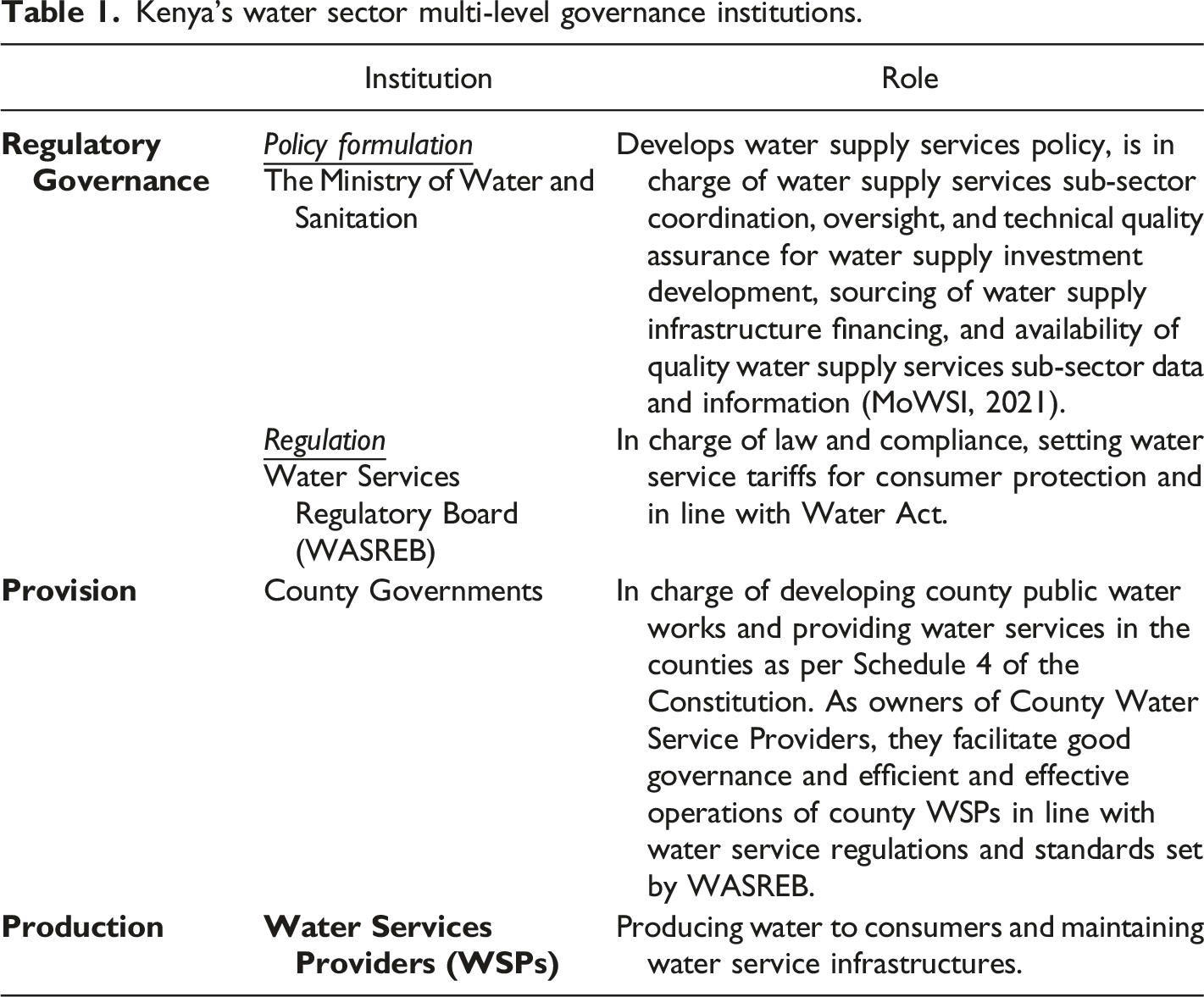
WASREB, the licensing authority, categorizes utilities according to size and ownership, that is, large, medium, and small, and public and private. Public utilities are those owned by the county governments, holding and maintaining public infrastructure, while private utilities own and manage their infrastructure. Eighty-seven public WSPs and three private WSPs are so far licensed in the country, with a population of approximately twenty-six million within their coverage area
In this study, a wide range of non-public utilities form the subject of research and are referred to as user-owned urban water service producers (UWSPs). In urban areas, these utilities emerge to fill the water services gap for the remaining population. Adapting from Adams et al. (2020), that otherwise refer to this arrangement as community water governance, user-owned UWSPs comprise an institutional structure, administrative process, and course of action through which communities articulate their interests around water, make or implement collective decisions to improve water-services delivery or hold decision-makers accountable in the management and delivery of potable water.
In Kenya, user-owned UWSPs mainly operate on a small scale (below 5000 connections) as private companies, cooperatives, community-based organizations (CBOs), or water vendors responding to individual or small-group needs in the community, often emerging in areas not covered by public WSPs or where such services are unreliable or insufficient. Most operate unlicensed and unregulated, except Runda Water, Kiamumbi Water Project, and Tatu City Water and Sanitation Company (TATUWASCO), the only licensed private WSPs. The Runda Residents Association holds the majority of shares in Runda Water, the Kiamumbi Farmers’ Cooperative owns the Kiamumbi Water Project, and Tatu City Limited, an investment company, owns TATUWASCO.
Private utilities are often part of real estate development companies. They are incorporated to supply water to new housing and commercial area. Water cooperatives and CBOs are generally referred to as community water projects in many contexts. Water Cooperatives are run by cooperatives that often have other objectives besides water supply, for example, farmer cooperatives. They are primarily in rural areas and peri-urban areas that were previously agricultural zones. CBOs vary widely in their formulation, goals, and scope of activities, are registered under the Society’s Act, and are primarily associated with non-governmental organizations (NGOs).
On the other hand, water vendors buy water from private borehole owners or water kiosks and supply it through hand- or donkey-driven carts. Water vending dominates the supply for a significant population. According to Kenya’s 2019 national census report (KNBS, 2022), 16.7% of urban households depend on water vendors as their main water source.
Nevertheless, as user-owned UWSPs do not benefit from government or other external support, the need for more material resources is often a significant limitation. Numerous studies also suggest that a significant number of them rely on volunteers, who may lose interest or leave when offered more lucrative jobs. Moreover, these organizations require a greater level of technical expertise and teamwork to effectively manage and operate water systems (Leclert et al., 2016). These, along with a lack of management capacity, non-reflective tariff systems, lack of accountability, and inadequacy of material resources, affect the quality of service they offer.
Previous studies
Many assessments indicate that Kenya's urban water and sanitation services are poor and inadequate based on high rationing levels, poor coverage, low-quality delivery, and massive losses (Mwihaki, 2018; Nzengya, 2017). This is especially so in informal urban settlements. The problem is primarily perceived as that of inequality and injustice. Wamuchiru (2015) terms informal urban settlements as ‘beyond the networks’ and at the sidelines of city development. This has also been termed the urban divide. The urban divide phenomenon of imbalance in the development of urban cities is evidenced in the rich living in well-serviced neighborhoods, gated communities, and well-built formal settlements, while the poor are confined to inner-city or peri-urban informal settlements or slums with limited basic services. It is the face of injustice and a symptom of systemic dysfunction (UN-Habitat, 2008). The genesis of this divide is, in multiple studies, attributed to the colonial past, where locals, moving to commercial centers as servants, had to live in squatter settlements that were undeveloped even then. Water and sanitation infrastructure was reserved for the settler areas. Following the country’s independence, these developed areas were bought or inherited by a few, while the squatter areas continued developing as they were to the present extensive low-income settlements. The inequality problem remained unsolved (Nzengya, 2017; Nyanchaga, 2016).
This colonial legacy, however, lingers. Leclert et al. (2016) note the promotion of the interests of formal water services and shallowness in addressing the low-income, informal populations as the downsides of Kenya’s reformed water policies. Adams et al. (2020) similarly note that the privatization models in the quest for cost recovery or profit, as the Kenyan public WSPs were modeled, have led to private and public water utilities ignoring peri-urban and informal settlements. The commercial viability requirement for licensing water utilities in the Water Act 2016 seems to promote rather than reduce this divide. The 90 licensed WSPs in Kenya only prove this viability in the middle- and higher-income urban areas and not in the low-income and lowly-populated new areas, limiting their services to sixteen million people, approximately 25% of Kenya’s population. The low-income, peri-urban, and rural areas thrive under informal or unlicensed water supplies whose quality of service is unguaranteed. Pro-poor measures required of formal WSPs and county governments’ support for commercially unviable areas are yet to bear a significant impact. Kemerink et al. (2016) find that in water resources management, the water policy secures water for large-scale investors and groups in agricultural areas but marginalizes most people. They argue that the test of the reforms’ success should be against individual access to water rather than the strengths of new institutions developed.
Therefore, only solving inequality would catapult the country to near-universal access. Yet, multiple other challenges have been cited as limiting service delivery across the urban spectrum. For example, water demand surpasses the supply by more than 150,000 and 100,000 cubic meters per day in Nairobi and Mombasa, the two largest cities in Kenya, leading to unreliability of services. Similarly, only sixteen percent of the population in the country have access to piped sewerage. In comparison, 70 percent rely on septic tanks and latrines, with the rest having no sanitation services, primarily because Kenyan authorities and utilities have long avoided bringing infrastructure services to informal settlements, either because of unclear land ownership or because it appeared unprofitable without subsidies or innovative billing practices (The World Bank, 2016).
Informal urban settlements also tend to develop in areas unsuitable for urban development, i.e., poorly drained lowland areas, on very steep terrain that developers have avoided because of high development costs, and in swampy areas (Nzengya, 2017). According to Werchota and Nordmann (2015), there is a lack of implementation of affordable technologies by WSPs and an unspoken approval of informal service delivery by political decision-makers, development partners, and utilities. These issues are further compounded by uncontrollable factors such as unregulated urbanization and population growth, which contribute to the perpetuation of the current state of urban LIAs. Yet, the most important bottleneck, as variously highlighted by the government, is financial. This was raised in the important Sessional Paper (The Republic of Kenya, 1999) that guided the most recent Water Acts 2002 and 2016. In order to meet universal access by 2030, the current investment level is inadequate. The Water Sector Development Reports and the WASREB Impact Reports reveal that the estimated government’s annual budget deficit is 60 billion Kenya shillings, i.e., 60% of the total needed (WASREB, 2019, p. 30).
It is, however, also the case that extensive means have been tested to advance water coverage. This includes various phases of water sector reforms since independence to bring water closer to people. The goal is to ensure access to basic services and safe and affordable water and sanitation by 2030, in line with Sustainable Development Goals (SDG) 1 and 6. The latest reforms starting with the Water Policy 1999, had mainly succeeded in moving towards improved governance, accelerated services, overall higher performance, and adherence to human rights standards in water supply and sanitation services delivery (Leclert et al., 2016).
The prospects for thriving user-owned urban water utilities are not farfetched. The liberty to operate different forms of organization in the community in the form of self-help organizations, community-based organizations, religious organizations, non-governmental organizations, private organizations, and donor organizations has led to a wide array of intervention types with varied outputs but, overall, significantly aided the sector. With active citizen involvement, water and sanitation projects run by these organizations have been the primary mode of service provision in unserved areas. Adams et al. (2020) concur in their critical review of the literature on community water services that although outcomes from community water governance are varied and significant challenges remain, these arrangements have expanded water and related sanitation supply and access to cities and informal settlements in the Global South and increasingly become an important component of a pluralistic approach to urban water and sanitation supply. In Finland as well, for example, where analysis showed that 99.9% of drinking water supplied was of good to excellent quality, 700 out of 1100 WSPs operating under the Water Services Act were user-owned water associations, which serve approximately 13% of the population (Laitinen et al., 2020).
Furthermore, the complexity of operating water utilities and services is not unique to specific models of water services production. Optimal results can be achieved in many ways, but no handbook solutions exist. The political, environmental, social, technical, economic, and legal dimensions need balancing while struggling toward the optimal goal (Katko et al., 2012). Andreah (2022) similarly emphasizes that there are no “one size fits all” solutions to water supply challenges. Instead, he cites the importance of context-specific solutions in bridging the gap in access to safe water.
Additionally, cases of utilities collaborating with consumers in a delegated management model, where the utility company delegates part of the service provision to individual service providers or groups, have been tested, for example, in Kenya’s Kisumu City (Nzengya, 2017). Partnerships generally offer win-win outcomes for communities and water utilities (Adams et al., 2020). Therefore, exploring alternative approaches to formal water services production is warranted to circumvent the limitations of only a few options foreseen, for example, in Kenya’s Water Act.
Methodology
A qualitative research approach was used for this study in addition to a literature survey in the problem formulation. To establish the viability of user-owned UWSPs to supplement services in underserved urban areas, including newly developed residential areas and low-income and peri-urban areas, face-to-face interviews with urban water utility managers using semi-structured questionnaires were conducted. The study targeted respondents from licensed WSPs because, being licensed by WASREB, their quality of service met the required service levels. Utility managers, as respondents, were considered the most informed on the practicality of operating water utilities due to their understanding of the utilities’ technical and economic aspects. In one of the sampled utilities, Nzoia Water Services Company Limited (NZOWASCO), the interview was conducted remotely by the author, and the respondent was a technical professional in the utility. A qualitative analysis software application, Atlas.ti, was used to conduct a thematic analysis of the script developed from the interviews. The themes guided the discussion in this article.
Sample selection
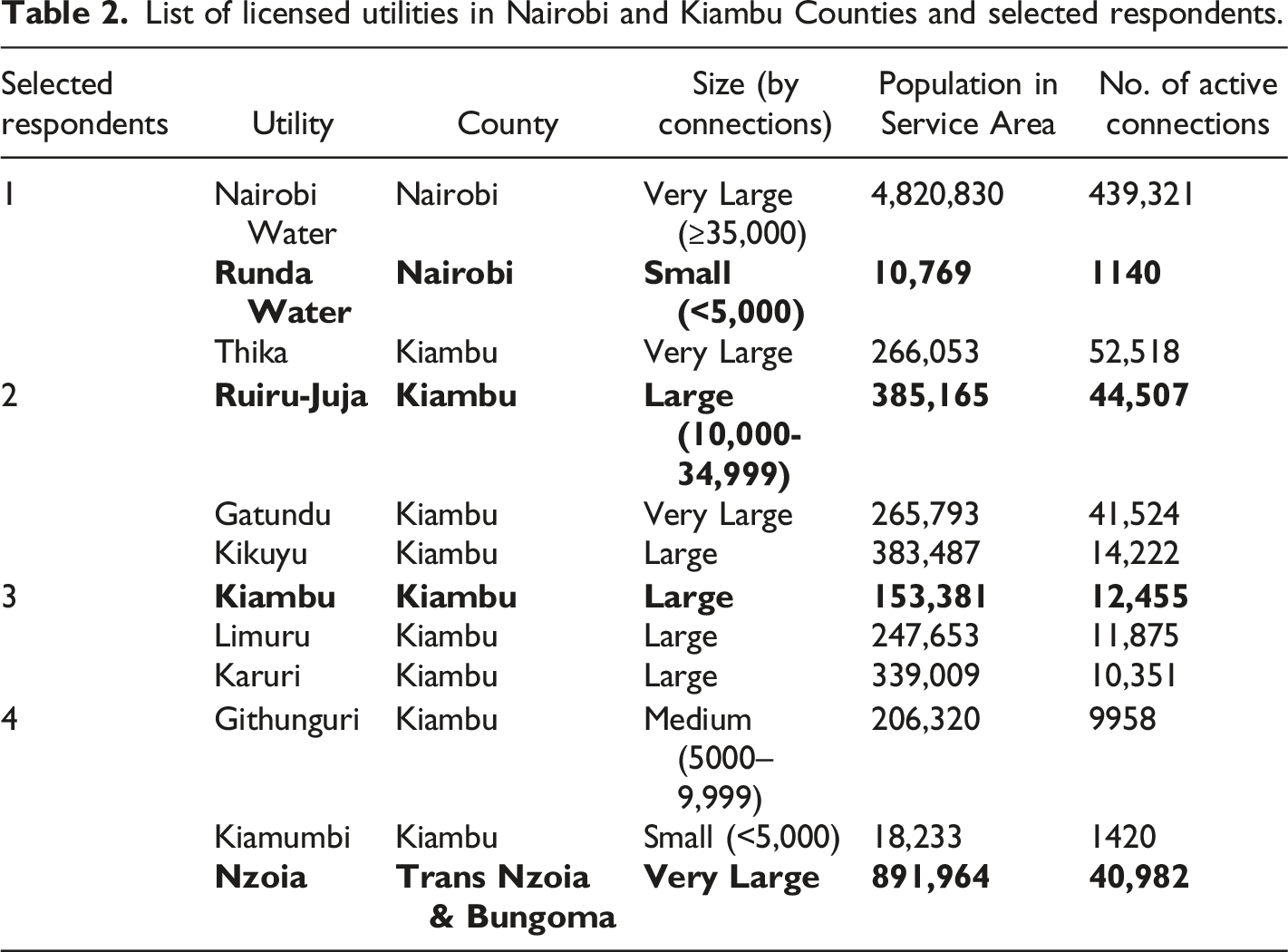
Utility managers of four urban water utilities in Kenya’s Nairobi, Kiambu, and Trans Nzoia Counties were identified for interviews. Nairobi, with a population of 4.25 million people, is host to 80% of the informal settlement population in the country, the population segment most affected by limited water utility access. This aspect informed the selection criteria for the first respondent. As a result, the utility manager of Runda Water, a private utility serving 10,980 people, was selected. Although it does not serve low-income areas, Runda Water was selected for its user-owned model and high performance.
Two utility managers were randomly selected from Kiambu County. The County neighbours the capital city, Nairobi City, and hosts a significant urban population mostly working there. Altogether, nine public utilities serve it: Thika Water and Sewerage Company Limited, Gatundu South Water and Sanitation Company, Ruiru-Juja Water and Sewerage Company Limited, Kikuyu Water and Sewerage Company, Kiambu Water and Sewerage Company, Limuru Water and Sewerage Company, Karuri Water and Sewerage Company, Githunguri Water and Sewerage Company and Karimenu Water and Sanitation Company (operating under the same license as Gatundu). These are all owned by the County Government of Kiambu. The areas out of the service areas of these companies have either no infrastructure or are being served by community water projects. Utility managers from Kiambu Water and Sewerage Company (KIAWASCO) and Ruiru-Juja Water and Sewerage Company (RUJAWASCO) were selected for the interviews.
A technical professional from Nzoia Water Services Company Limited was also interviewed. The utility serves four urban towns in Trans Nzoia and Busia Counties.
List of licensed utilities in Nairobi and Kiambu Counties and selected respondents.
Data collection
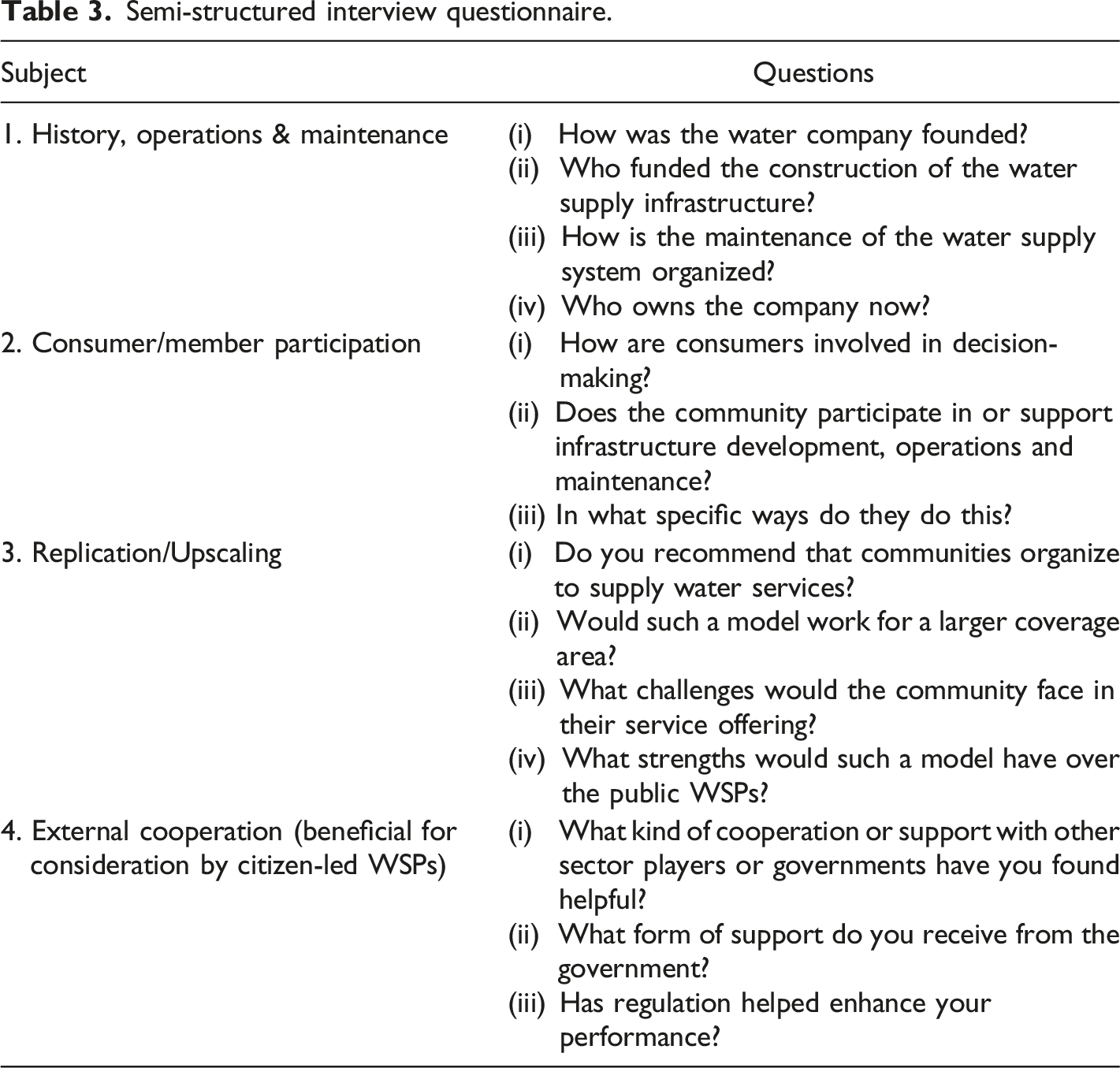
Interviews were conducted in August and November 2022, including one done remotely via Microsoft Teams and three face-to-face interviews with the utility managers. Semi-structured interview questionnaires with open-ended questions were used to conduct the interviews.
Semi-structured interview questionnaire.
Data analysis
A thematic analysis approach was applied in analyzing the interview data. The analysis involved, first, transcribing voice notes from recordings of the interviews and compiling notes from non-recorded interviews. Second, the transcribed data and notes were compiled onto a table alongside each related question and then scripted into a single document along subheadings. Third, the script document was uploaded into Atlas.ti 22 Windows Application (ATLAS.ti Scientific Software Development GmbH, 2022), a software package for qualitative analysis, for analysis. The analysis using the software involved, first, splitting the responses into meaning units, each of which was assigned a code. Through this coding process, responses with similar meanings were assigned similar codes, after which 12 codes emerged. The codes were further condensed into four themes that are described in the analysis section of this paper. These steps are illustrated in Figure 1. The analysis process.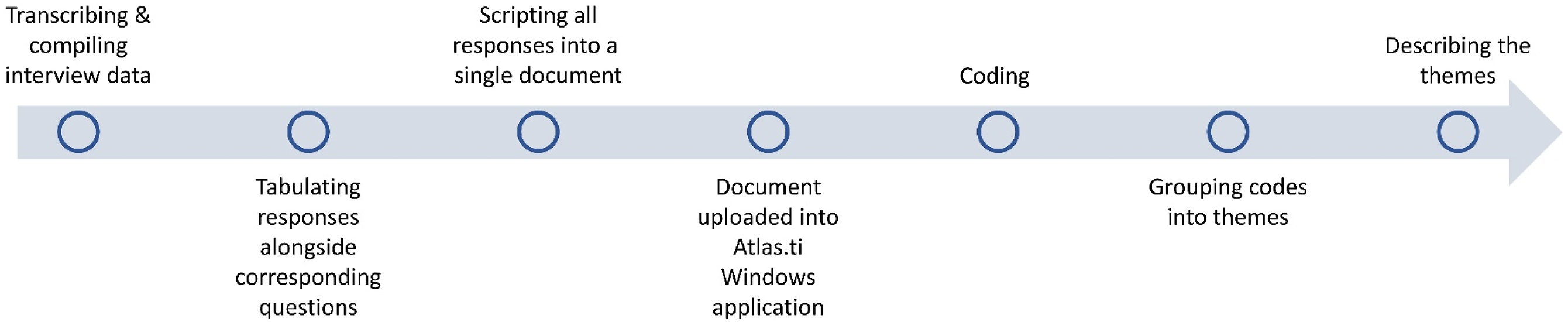
The codes and themes are indicated in Figure 2 and are described in this paper’s analysis section. Codes and emerging themes from the data analysis.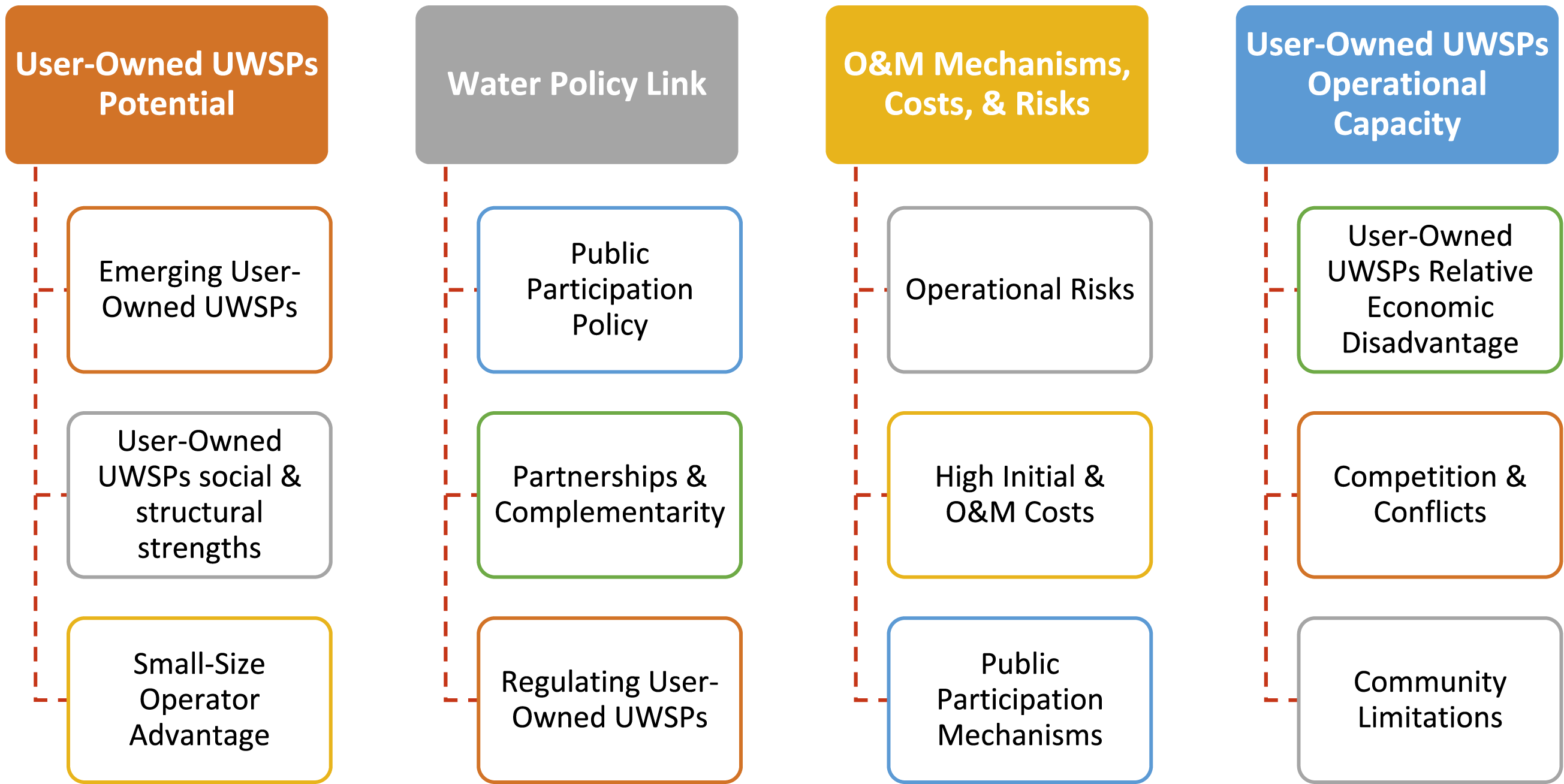
Limitations of the study
There are close to eight hundred community water projects in Kenya that are yet to qualify for licensing by WASREB as WSPs. Only three of such utilities meet the criteria and are licensed as private water utilities, and only one interview was possible in this study. The perspective analyzed is thus less representative of the private WSP perspectives.
Results
This section highlights the direct responses of the respondents. The utility managers for Runda Water, Kiambu Water and Sewerage Company (KIAWASCO), Ruiru-Juja Water and Sewerage Company (RUJAWASCO), and Nzoia Water Services Company Limited (NZOWASCO) will be referred to in this section as Respondents 1, 2, 3 and 4, respectively.
Utilities’ Histories, Operations, and Maintenance
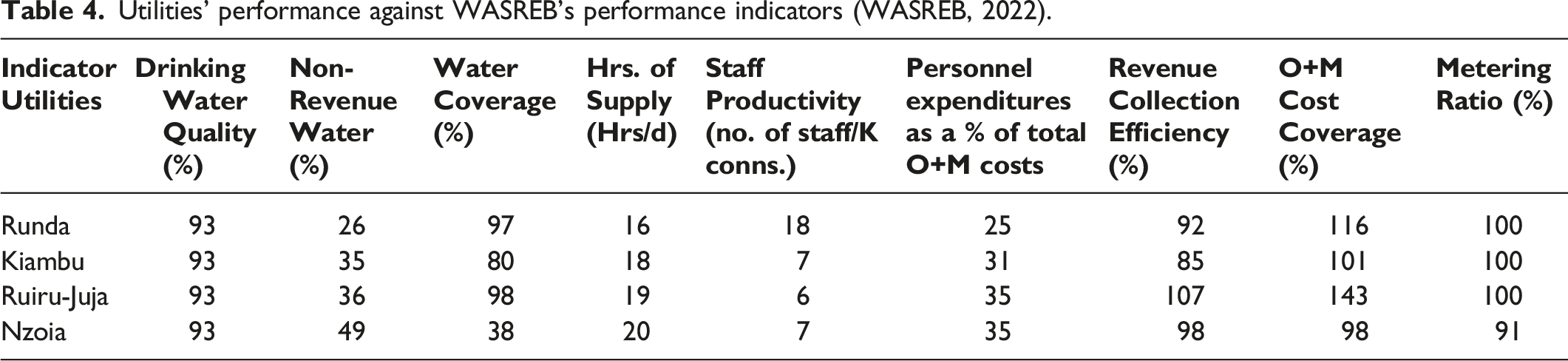
Utilities' performance against WASREB's performance indicators (WASREB, 2022).
Runda Water was founded in 1973 by MAE Properties Limited, a real estate development company that developed what is presently Runda Estate and where the utility was operating its services. Nairobi City Water and Sanitation Company (Nairobi Water) had limited capacity then to produce water services to the newly developed area and agreed to have the developer establish a private supply. A third-party agreement between Nairobi Water and Runda Water is still in place, since Runda Estate is located within Nairobi City, which is, by license, Nairobi Water’s service area. MAE Properties Limited developed the initial approximately 100 connections. However, new legislation by the Water Act 2002 required stakeholder representation in utilities’ ownership and management to reflect social accountability. This led to a transfer of 75% ownership of the utility to the Runda Resident’s Association, and the initial investor, now Sanlam Limited, retained 25% ownership.
On operations and maintenance (O&M) management, it was established that KIAWASCO and RUJAWASCO inherited part of the infrastructure from the municipalities but had since grown them through their revenues and other facilities. However, KIAWASCO could only produce 9000 m3/day of the 15,000 m3 /day demand, so Nairobi Water was servicing a section. The O&M is all managed by full technical teams, differing with the utility sizes. For instance, Runda Water has a full staffing of 20, including 10 plumbers, meter readers, and plant operators, while KIAWASCO has sixty-six and NZOWASCO two hundred and seventy-nine.
Additionally, NZOWASCO involved the community in various ways from the production stage. For example, it engaged community members to help clear silt at the inlets of abstraction points and desludging and desilting the intakes at the treatment plants. Likewise, the Company gave out short-term contracts to community members for carrying out manual tasks during maintenance projects when inputs were needed and for larger projects like pipe-laying, short-term contracts for the project period. Additionally, the utility encouraged contractors to employ a percentage of locals in projects. The community was equally involved in Environmental and Social Impact Assessments at the inception of every project.
Table 4 shows the individual performance of the selected utilities against WASREB's performance indicators.
Consumers’ participation in decision making
For Runda Water, the owners, that is, Runda Residents Association and Sanlam Limited control the company. A committee constituting the association’s members oversees the daily operations, and its board of directors, constituting six directors drawn from the Association, makes the key decisions. The committee members and directors are elected during the Associations annual general meetings (AGMs). KIAWASCO, RUJAWASCO, and NZOWASCO also have community representation in the board membership. Respondent 2 indicated that the recruitment for that position was conducted through open advertisements, and the most qualified candidates were offered a fixed-term position on the board. Similarly, the directors made the key decisions of the utility.
Communities’ participation in or support for infrastructure development was rather diverse. Each utility had unique approaches to engaging consumers. For instance, Runda Water organized annual open days at the plant where the management and staff familiarized the consumers with the utility operations. Respondent 1 also added that besides participation in the annual event, the plant and office location within Runda Estate offers convenient access for clients on other days. Clients can walk into their offices anytime and have the manager’s phone contacts for easy reach. As a result, Runda Water has a high level of ownership from its members.
For KIAWASCO, invitations were broadcast to customers via broadcast SMS whenever important decisions were to be made, for example, tariff adjustments and license renewal. Additionally, the company’s strategic plan fed into the County Integrated Development Plan (CIDP), which was subjected to public participation and required the county assembly’s approval. The county assembly constitutes elected ward representatives. The aspect of public participation and county assemblies’ approval of the strategic plan similarly applied to RUJAWASCO and NZOWASCO. But additionally, KIAWASCO held consumer forums and regular clinics at shopping centers, churches, and on the radio in vernacular stations.
In RUJAWASCO, Respondent 3 stated that his office was publicly accessible. If an estate in their area were challenged, they would visit the utility as a group or appoint representatives. In addition, members of the county assembly (MCAs), or sometimes the Member of Parliament, often visited the utility’s office to raise their constituents’ concerns or the utility would be asked to respond to the county assembly or Parliament. In NZOWASCO, the community participated in stakeholder consultations, especially when the company wanted to introduce new tariffs. They also participated in the utility AGMs and were often part of the consultative groups and customer identification surveys.
Upscaling user-owned urban water utilities
This question sought to establish whether the respondents recommended user-owned UWSPs, their perceptions of their viability in large areas, strengths, and potential challenges. On their strengths, Respondent 1 considered it an advantage to be small, as is Runda Water, being a private WSP. In addition, they had the advantage of knowing their consumers and had effective control. They also had more friendly and cooperative consumers because of the company’s model (consumer-owned). Therefore, Respondent 1 recommended the model, adding that similar models as Runda Water existed, the examples of Tatu City and Two Rivers water utilities. However, the respondent indicated that the Runda community, Tatu City, and Two Rivers were high-income communities capable of managing the operational costs of the utilities.
Respondent 2 indicated that the private citizens had resources that could complement what the government could not do entirely. Nevertheless, they did not recommend the model. In their view, private water producers had a high failure rate and low accountability to their members and the public. Further, running that model would indicate that the government was failing. User-owned UWSPs should only have operated where the government was entirely unable. If the area was extensive, they should do it in a private-public partnership. In the respondent’s view, private entities may set high tariffs and do not consider water a common good; the government needs complete control.
On their part, Respondent 3 stated that the user-owned UWSPs’ water losses would be lesser because the community would monitor it, being a small area covered. Additionally, user-owners had a stronger sense of ownership of the infrastructure and the facility compared to public facilities to which the community was less concerned even when a neighbor was vandalizing or was illegally connected. However, the respondents noted that in the short run, the user-owned UWSPs charged less than the public utilities because they were not looking into renewing their assets or expanding and did not plan for emergencies; instead, most communities considered transferring the capital expenditure elsewhere, such as to donors and in-kind support, e.g., electricity bills, when such contingencies came up.
Respondent 4 did not recommend the model. In their view, the scarcity of water resources needed much more professional intervention, that was, in managing distribution, treatment, and other engagements. Declustering utility services would make them like tribal resources, potentially raising conflicts from the transboundary water transfers. Furthermore, they foresaw potential problems of non-regulation and competition for wayleaves (including with other utilities like road and electricity) and indicated that private utilities were inadequately resourced. They believed that water should be centrally managed (by public utilities).
Additionally, all four respondents concurred that user-owned UWSPs could not manage large coverage areas. According to Respondent 1, the most challenging part was setting up the infrastructure. Runda Water was worth approximately 70 million Kenya Shillings (equivalent to approximately 700,000 US Dollars), which is too high for low-income users to raise. Respondent 3, however, questioned how that (managing a large coverage area) would be managed, reiterating that they were progressively covering the areas not covered. In their view, the user-owned UWSPs could only cover smaller areas because a larger population required high administrative costs and more complicated systems, such as billing systems. Higher technical competence would also be required. Respondent 4 stated that unless the user-owned UWSPs were supplied with already treated water from public utilities for redistribution, they would not manage larger areas due to a lack of resources.
They also highlighted multiple potential challenges for service production by user-owned UWSPs. In Respondent 1’s views, they would be similar to those faced by public utilities: illegal connections, selling water on credit, delayed payment of bills, water losses, dwindling freshwater availability, and, additionally for them, non-government funding. However, these would be lesser in scale because the user-owned utilities were small. In Respondent 2’s view, the user-owned utilities were more opaque and less accountable than the government. They also had more quality control issues than the government, which cared about quality. In addition, the private providers needed a lot of control and regulation. KIAWASCO had been approached regarding taking over multiple mismanaged community water projects.
Similarly, compared to the government, Respondent 3 stated that user-owned UWSPs could not implement multi-billion-shilling projects, even if they were well organized. Furthermore, a small community project was not insulated from petty local politics, unlike a large public entity. Also, in terms of the turnaround time, a small community project would struggle to raise, for example, five hundred thousand (Kenya) shillings to address a problem of a broken pump causing the community to go for months before raising the money as they awaited a Harambee (fundraising event) or political goodwill from an MP or the Governor. At the same time, a similar situation would be solved the following day by a large entity. As an example, an NGO-operated community water project had recently collapsed in the RUJAWASCO zone due to an accumulated electricity bill running into hundreds of thousands, resulting in power disconnection and the project’s collapse. However, due to RUJAWASCO’s capability, it quickly laid pipes where the project was operating. For the NGO, a minor distraction put them off business, leaving people without water.
Respondent 4 similarly cited limited access to public resources, grants, and important agencies that may be useful in financing infrastructure development. However, the respondent added that a policy allowing them access to similar resources as public utilities was missing.
External Cooperation
This question aimed to identify the respondents’ perception of user-owned UWSPs’ need for networks and cooperation with other stakeholders, specifically the water services regulator, WASREB. Due to their small operational area, respondent 1 stated that the utility had not extensively engaged with external organizations or needed support. They received no financial support from the government but participated in events, training, information sessions, and forums organized for licensed utilities in the country. Their perspective on regulation was that they were over-regulated, having to prepare multiple reports, for example, to WASREB, Water Resources Authority, Kenya Revenue Authority, etc., which strained their operational capacity and had financial implications.
Respondent 2 recommended collaborating with the county government and the Kenya Water Institute for capacity development, working with equipment sales companies for improved equipment and technologies, and joining networks for continuous learning. Respondent 3 indicated that RUJAWASCO had cooperated with the public, especially on sewer, and earlier on with water supply, where the company bought the pipes and did the excavations. In that case, the company owned the pipeline. The cooperation was such that the community hired the excavator to do the trenching, and the utility bought the pipes and laid the lines. In that way, the community received the service and would maintain the line. At times, the utility supplied the services free of charge for a period to let the community recover from the expenditure. RUJAWASCO had implemented several such projects and was implementing another one worth 32 million (about 320,000 US Dollars).
On the role of regulation, Respondent 2 stated that WASREB was not able to get down to the low-level supply; the county government would be better positioned to regulate such providers. Respondent 3 explained that WASREB was already trying to regulate those community projects. This information would be available on WASREB’s website. He also stated earlier that the larger utilities regulated private water suppliers operating within areas, but this had changed as WASREB planned to regulate them through an alternative framework. Respondent 4 indicated that regulation helped ensure that a regulated product was distributed to the consumers and that all information on their performance was available to the public.
Analysis and Discussion
The four main themes emerging from the analysis of the interviews, as indicated in Figure 2, including operations and maintenance mechanisms, costs, and risks, user-owned UWSPs’ operational capacity, user-owned UWSPs' potential, and the water policy link, are discussed in this section.
O&M Mechanisms, Costs, Risks
From the analysis, involving consumers in the utilities’ operations and maintenance is highly valued by both publicly owned and user-owned utilities. Various mechanisms for achieving this emerged from the analysis. More formally, both publicly owned and user-owned utilities have community representation in the board of directors involved in making the key decisions. Having community representation is a legal requirement. In the user-owned UWSPs, community members comprise the entire board and are also co-owners of the WSPs. Therefore, in this case, decision-making is entirely a citizen’s role, differentiating it from the publicly owned WSPs.
Yet, in both cases, various mechanisms were applied to engage the community in decision-making, utility operations and maintenance activities. Deliberations on tariffs and license renewal were most mentioned. The consumers, however, were also involved in customer identification surveys and were part of consultative groups on other subjects. Nzoia Water, a publicly owned utility, engaged the public in short-term maintenance and installation projects, encouraging independent contractors to employ residents. The utilities also invited them to the annual general meetings where progress and performance are reported and discussed by the stakeholders. In the case of user-owned UWSPs, the members were also involved in electing new members to committees and the board of directors.
Furthermore, the utilities proactively disseminate information to the customers through annual open days, regular clinics at shopping centers, churches, and local vernacular stations. The public and their leaders also have access to the utilities. The political representatives frequent the publicly owned utilities, and the utilities account to the county government assemblies. Their plans are approved through the county integrated development plans open for public deliberation. The user-owned UWSPs, on the other hand, have an active board of directors and committees made up of community members that oversee the daily operations. The community members also have a significantly higher stake in the user-owned UWSPs; their decisions thus influence the utility’s actions.
The costs of operating a water and sanitation utility are high and a significant deterrent, influencing both the capability of communities and the progress of public WSPs. This includes the infrastructure costs, which were determined as affordable only for high-income communities in the case of user-owned UWSPs. Runda Water and Tatu City, two of the three licensed private WSPs in the country, are in high-income locations and were developed by private investors as part of broader real estate development projects. The Runda Residents’ Association is now the majority stakeholder of Runda Water and can afford to maintain the utility. Kiamumbi Water Project, the third licensed private WSP, also well-performing, was formed by a farmers’ cooperative that still maintains it. The publicly owned utilities benefit from high turnovers due to their relatively large size but benefit from the government-developed infrastructure. However, lacking external support for user-owned UWSPs, they are limited in the speed and extent to which they can expand their coverage. Multiple cases were cited of NGO-run and community water projects that failed due to high electricity bills, incapability to repair or replace equipment, etc.
Securing the infrastructure from vandalism and illegal connections poses a significant and costly challenge. Coupled with non-cost reflective tariffs, limited planning, and inadequate technical staffing, user-owned UWSPs are often exposed to considerable commercial risks. Insecurity was also cited as limiting progress with regard to, for example, the high probability of vandalism of solar systems or sophisticated measuring equipment. Investors wanting to support user-owned UWSPs need evidence that planned infrastructure is not at risk of vandalism. In multiple ways, therefore, high costs and insecurity limit user-owned UWSPs.
Higher-income populations have a high potential to respond to emergencies. They agree to cost-reflective tariffs, and thus, the viability of user-owned UWSPs is higher in high-income urban residential areas or as part of real estate development budgets.
User-owned UWSPs’ Operational Capacity
This aspect mainly refers to the UWSP’s financial and technical capacity and main challenges. The lack of government resources to cushion user-owned UWSPs against the high costs and risks that they face is a significant disadvantage compared to the publicly owned WSPs that have more significant resources. Additionally, factors such as low accountability, opaqueness in their operations, quality control issues, petty local politics, short-term planning (only), and overreliance on external support such as donations and in-kind support are significant risks causing a high failure rate of user-owned UWSPs. These factors also arouse mistrust and skepticism from public sector counterparts and investors.
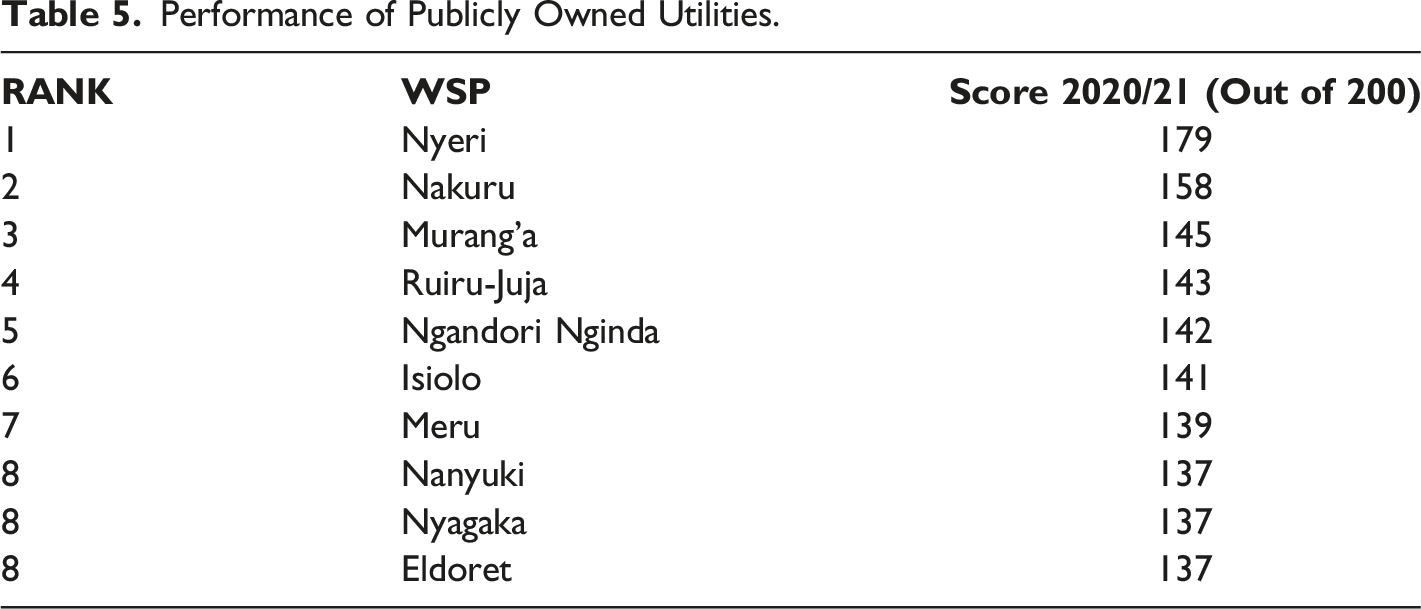
Performance of Publicly Owned Utilities.
Performance of Privately-Owned Utilities.

Yet, if uncontrolled, the establishment of many user-owned UWSPs may potentially lead to conflicts and competition for service areas with publicly owned WSPs, resulting from a scramble for limited wayleaves, problems with sharing of water resources, for example, communities resisting requests for cross-border transfers of water resources from their locations. Therefore, fragmenting the service production to multiple small user-owned UWSPs is considered disadvantageous compared with the more centralized publicly owned WSPs.
User-owned UWSPs’ Potential
Nevertheless, there is a growing tendency towards more decentralized urban water and sanitation services models. This is indicated by three private WSPs licensed by the national regulator, Water Services Regulatory Board. Attaining the license indicates meeting all required standards for producing safe water and sanitation services. Furthermore, these utilities’ performances are significantly high, as indicated in Table 6.
The small size of the urban user-owned UWSPs reduces the scale of the challenges that are otherwise standard in all utilities. It also reduces the distance between the customers and the utility, thus enabling better information exchange. Information exchange emerged as an essential management aspect from the utility manager’s perspective. They emphasized the utilities’ efforts in engaging users on what they are doing through different mediums. The fewer customers that the user-owned UWSPs need to engage is thus an advantage.
Ownership of the utility is also a significant factor as this determines how much the users are willing to participate in the management of the service, primarily through direct contributions to address emergencies and securing the infrastructure from physical losses. The concept of users as stakeholders of the private utilities enhance ownership.
More user-owned UWSPs are emerging. Tatu City Water and Sanitation Company (TATUWASCo) in Kiambu County was only recently licensed. The Two Rivers Water and Sanitation Company in Nairobi County was also cited. Both are owned by real estate investment companies. TATUWASCo was established in 2018 (TATUWASCo, 2022) and serves a population of 399 (WASREB, 2022). Two Rivers has a regulated tariff from Nairobi City Water and Sewerage Company. It is equipped with a reverse osmosis water treatment plant with a capacity to treat 2000 cubic metres of water per day, a sewerage treatment plant (MBBR) with a capacity to treat 1500 cubic meters of wastewater per day, fully equipped state-of-the-art laboratory, water reticulation, and sewer lines, BlueScope water tanks, and a SCADA monitoring system. In addition, 80% of gray water is recycled and treated to World Health Organization standards (Two Rivers Development Limited, 2022).
Collaborative arrangements were also cited where homeowners collaborate with public WSPs serving in their areas to fast-track water and sanitation infrastructure development. The arrangements involved part contribution by each party and further arrangements for future management of the services. Other beneficial examples are listed by KIWASCO (KIWASCO, 2022).
The user-owned UWSPs and collaborative arrangements with the publicly owned WSPs aim to accelerate access to water and sanitation services that would have otherwise been delayed under the regular prioritization and public infrastructure development processes.
Water Policy Link
Kenya’s public participation policy, a strict constitutional requirement, has been a significant driver for public WSPs’ engagement of consumers in decision-making. Participation of the people is a vital tenet of Kenya’s constitution. Indeed, it is among the national values and principles of governance in Kenya to which all state organs, state officers, public officers, and all persons in Kenya are bound whenever they apply or interpret the constitution, any laws, or make or implement public policy decisions (The Republic of Kenya, 2010; The Republic of Kenya, 2012). Mwongozo, The Code of Governance for State Corporations, cited by Respondent 1, emphasizes the responsibility of state corporations (utilities included) to stakeholders and the stakeholders’ rights and responsibilities. As a requirement, utilities must have representatives of consumers as independent board members.
In advancing water users’ participation, the sole proprietors of Runda Water, for example, relinquished a 75% stake to the residents’ association. The public WSPs, in compliance, also have their doors open to their clients, have directors from among the clients, have their plans publicly vetted and approved, engage them in decision-making on tariffs and important decisions, and organize events for information dissemination. The public policy to reform public WSPs to commercially oriented corporations and more autonomy from the central government, beginning with enacting the Water Act 2002, catalyzed stakeholder engagement. The utilities had to respond to client needs to attain cooperation and feedback, secure their infrastructure, improve collection efficiency, and reduce non-revenue water. Measures such as improved regulation have raised and maintained service production standards and kept utilities competitive.
More relevantly for user-owned UWSPs, these aspects of public policy narrow the gap between the public WSPs and communities, paving the way for agile collaborations and partnerships that enable the examples of homeowners and public WSPs joining forces. The government’s advances toward innovative sector financing (WASREB, 2022) further incentivize such collaborations. This gives impetus for further community involvement in water and sanitation services provision. Moreover, regulation is a potential tool for enhancing the accountability of user-owned UWSPs to the general public, thus lessening the suspicion of profit-seeking and compromised service quality. Yet, over-regulation overburdens small-size utilities by consuming a significant amount of time and resources available for their limited staff. The capacity of WASREB to regulate the small-size WSPs was questioned as well. The county government is more proximal to the communities and thus to their organizations, such as the private utilities or water projects. Therefore, in the case of small WSPs, county government could have more advantages than WASREB.
Conclusions and Recommendations
The inherent gaps in access to urban water and sanitation services in Kenya are vast. While significantly advantaged in size, having access to government support, and significantly higher turnovers, public utilities still fail to adequately meet the urban demand for safe drinking water and sanitation. In many ways, user-owned UWSPs are a means to close this gap. Various examples of such models exist in Kenya. These are relatively high-performing, obtaining higher scores in service level indicators provided by WASREB compared to public WSPs.
The advanced quality of service, ownership, and active participation by clients make them ideal and complementary in closing the gaps left by public WSPs. Kenya’s public participation and policy reforms for autonomy and commercial approach to water service provide an impetus for developing user-owned UWSPs. Regulation lessens profit-seeking and compromises service quality suspicions. Collaborations between homeowners and public WSPs also emerge as a viable alternative, with the active involvement of the citizens in addressing urban water sanitation supply problems.
Nevertheless, high infrastructure costs constrain the viability of user-owned UWSPs to high-income residential areas or real estate project budgets and less for lower-income residential areas, which can hardly mobilize adequate capital or respond aptly to emergencies. They are not ideal for addressing the problem of inequality. Furthermore, the risks of low accountability, opaqueness in their operations, quality control issues, petty local politics, short-term planning (only), and overreliance on external support such as donations and in-kind support may limit user-owned UWSPs’ performance and lead to high failure rates and takeovers.
In order to finance major capital investments, for example, establishing a revolving fund targeted at low-income areas should be considered in Kenya. It is highly recommended that full cost recovery (FCR) should be a key policy objective. FCR through tariffs is considered a paramount driver of the financial sustainability of any viable water utility since other financing instruments (taxes and transfers) are volatile and often beyond the reach of the water and sanitation services sector. It is clear that the sustainability of any investment will depend on the capacity to mobilize financing from local users, including lower-income users. Pricing structures that imply cross-subsidization between rich and poor households need to be carefully designed – also reconciling the objectives of cost recovery and affordability - to ensure that sufficient revenues are generated and that the cross-subsidy is well-targeted which means that all poor households and no rich households benefit from it. Finally, the viability and performance of the user-owned UWSP could be enhanced and secured through contractual collaboration arrangements with the public utilities having more human and technical resources and also through a reciprocal and responsive relationship with other user-owned UWSPs to better benefit from shared human skills and technical resources.
Footnotes
Declaration of Conflicting Interests
The author(s) declared no potential conflicts of interest with respect to the research, authorship, and/or publication of this article.
Funding
The author(s) disclosed receipt of the following financial support for the research, authorship, and/or publication of this article: The authors would like to acknowledge the support received from the Erkki Paasikivi Foundation (2021-0003), Tampere University Foundation, Vepatuki Research Cluster, and the Nordic Africa Institute, as part of its thematic focus on climate change and sustainable development.
