




Abstract
Using the lens of a transnational urban political ecology of water infrastructures in Vietnam, this article contributes to the understanding of the intersections between urbanization patterns, socioecological problems, financial schemes, and the power relations embedded in Hanoi’s urban water supply through politics of scale that aim to ensure safe drinking water. With the analysis of global water policies and their implications in the Southeast-Asian context, the objectives of this work are to (a) reveal the scalar nature of Hanoi’s water infrastructures by situating water management processes in a broader context of developmental issues, and (b) review lessons and prospects of past and future global targets of access to safe drinking water. The evidence of multilevel water governance processes and cross-sectoral challenges of safe water provision emphasizes the need for global networks of cooperation to achieve the Sustainable Development Goal 6 and contribute to other sectors aiming to “transform our world.”
Keywords
Introduction
Water supply, as all infrastructural networks, depends on a web of interrelated actors with weighing political interests to maintain and invest in the systems that support them. Considering water as an urban process, the deconstruction of urban water supply serves to unveil power relationships and understand the origin of socioecological problems. Thus, problematizing the supply of water may explain broader patterns of urbanization, sociospatial fragmentation, and socioecological interactions. In view of the “globalized societal relationships with nature,” (Keil, 2012) it is more and more relevant to recognize cross-national networks which shape development at a local and regional level (Armitage, 2007; Balsiger & Debarbieux, 2011; Stephenson, 2013). Based on existing literature of environmental governance and multilevel governance, this study explores the scalar politics and the relationship between environmental problems, scale, and governance (Balsiger & Debarbieux, 2011; Bulkeley, 2005; Meadowcroft, 2002; Newig & Fritsch, 2009; Paavola, 2007). Defined as the “cooperative intergovernmental relations between subnational and national authorities, or between national and supranational organs” (Papadopoulos, 2007, pp. 478-479), multilevel governance aims to “provide a simplified notion of what is pluralistic and highly dispersed policy-making activity, where multiple actors (individuals and institutions) participate, at various political levels, from the supranational to the subnational or local” (Stephenson, 2013, p. 817). Nonetheless, because one of the critiques on multilevel governance is that it has been mistaken for multilevel involvement, failing to explain the differences of power between levels (Stephenson, 2013), the present analysis will be aided by a framework coined as “transnational urban political ecology of water infrastructures.”
The “transnational urban political ecology of water infrastructures” framework is used in this article to explain the interaction between water infrastructures in Hanoi, water management in Vietnam, and global water policies. The logic of this framework is built on three theoretical conglomerations. At the core stands urban political ecology (Angelo & Wachsmuth, 2015; Heynen, Kaika, & Swyngedouw, 2006; Swyngedouw & Heynen, 2003), which, in essence, serves to reveal power relations embedded in urban processes. Secondly, this article considers water as a material flow which embodies the dynamic processes of cities (Bakker, 2012; Gandy, 2004; Kaika, 2005). By analyzing infrastructural systems through the lens of urban political ecology, and specifically of those related to water (Monstadt, 2009; Swyngedouw, 2004, 2009; Swyngedouw, Kaika, & Castro, 2002), we are able to trace power relations mediated through water supply in cities. Water, combining the political and economic power of both public and private entities, mirrors the interactions between international, national, regional, and local levels (Swyngedouw, 2004). The relationships between actors at different levels evidences the intertwined political and economic processes which direct water provision. And finally, the multilevel governance approach and the lessons learned from studying the political and ecological characteristics of water supply reveal the complexity of urban water planning and the existing interactions of various scales of organization and management. A transnational urban political ecology (Keil, 2012), and more specifically, a transnational urban political ecology of water infrastructures will aid the discussion of global trends of water governance and water management in cities where populations face challenges to access safe drinking water.
To begin with, the next section will elaborate on the “transnational urban political ecology of water infrastructures” framework and its application, as well as the current article’s hypothesis, objectives, and methodology. The “Urban Water Infrastructures in Hanoi” section will describe the development of water infrastructures in the city of Hanoi and the ownership models of existing water distribution companies. The “Multilevel Water Governance in Vietnam” section analyzes the multilevel water governance processes directing the management of national- and city-level water supply development strategies and their interaction with transnational actors. The “Politics of Scale to Ensure Safe Drinking Water” section discusses global targets of access to safe drinking water and the results in Vietnam, since the measurement of the Millennium Development Goal (MDG) Target 7C and the current prospects for the Sustainable Development Goal (SDG) Target 6.1, as well as the discrepancies in the definition of indicators of water quality. The “Disscussion” section focuses on the issues brought up in each level, from Hanoi’s water infrastructure development and the lessons learned regarding Vietnam’s national water management strategies, to transnational financing mechanisms and the country’s actual progress toward global targets of access to safe drinking water. The understanding of multilevel water governance processes and cross-sectoral challenges of safe water provision will emphasize the need for global networks of cooperation to “transform our world.” And more specifically, this case can be used to exemplify the challenges of attaining sustainability, universality, and equity of safe and affordable drinking water to reach global targets by 2030.
Hypothesis, Objectives, and Methodology
The transnational urban political ecology of water infrastructures framework is applied to the case of Hanoi, Vietnam. The research will answer how a transnational urban political ecology lens can help evaluate the sustainability of the development of local water infrastructures and the equitable distribution of safe drinking water. The working hypothesis is that water provision cannot be viewed independently from global trends of water governance. Through the analysis of global water policies and their implications in the Southeast-Asian context, the study of Hanoi’s development of urban water infrastructures will achieve the following objectives: (a) reveal the scalar nature of Hanoi’s water infrastructures by situating water management processes in a broader context of developmental issues, and (b) review lessons and prospects of past and future global targets that seek to ensure universal and equitable access to safe and affordable drinking water for all. By understanding cities as complex systems, this work will highlight the socioecological problems specific to water provision in Hanoi while evidencing scalar arrangements of power and global urbanization processes. In this process, not only do we locate the opportunities for improvement of decision making and policy-formulation concerning water infrastructure development at different levels, but also justify the role of global frameworks that protect water security.
The empirical analysis referenced in this work is based on primary data collected in 2014 through a project commissioned by the Chair of Spatial and Infrastructure Planning of the Technical University of Darmstadt. The article is informed by interviews to local and international organizations, government offices, water-related enterprises, financial organizations, and academic institutions in Hanoi, Vietnam, including UN Habitat Vietnam Office, the Ministry of Construction (MOC) and the Ministry of Agriculture and Rural Development (MARD) of Vietnam, Hanoi Water Limited Company (HAWACO), Vietnam’s General Company of Construction and Export (VINACONEX), the Joint Stock Commercial Bank for Foreign Trade of Vietnam (Vietcombank), the National University of Civil Engineering (NUCE), and the Hanoi University of Science and Technology (HUST). The knowledge gained from the interviewees informs the user-related, environmental, technical, institutional, and financial challenges of water provision in Hanoi.
Urban Water Infrastructures in Hanoi
Located in the Red River Delta, the worlding city (cf. Haila, 2006) of more than 7 million people (General Statistics Office of Vietnam [GSO], 2015) and capital of Vietnam has faced technological, user-related, environmental, financial, and institutional challenges in urban water supply. Hanoi’s current centralized systems of piped-water distribution networks started with the construction of the Yên Phụ water treatment plant by French colonists in 1894, under the Hanoi Water Department, now HAWACO (Ngo, 2014). After Vietnam’s independence from France in 1954, the city increased the water treatment plant’s capacity from 4,000 m3/day to 11,000 m3/day (Ngo, 2014). As a result of funding from the government of Finland, from 1987 to 1997, the Yên Phụ water treatment plant was modernized and the existing pipelines were expanded, increasing capacity to 60,000 m3/day (Ngo, 2014). Currently, Yên Phụ water treatment plant is one of HAWACO’s 12 main water treatment plants which supplies residents in the inner-city area with 90,000 m3/day (HAWACO, 2014b, p. 3; Ngo, 2014). The total demand of water in Hanoi amounts to approximately 1 million m3/day; officially, piped water is accessed by 100% of the inner-districts and nearly 42% of the suburban and rural districts, and the total percentage of population with water supply is 55% or 3.6 million (HAWACO, 2014a, p. 17).
Previous to 1982, water supply technologies in Vietnam relied mainly on dug-wells and rainwater catchment tanks at household level (National Centre for Rural Water Supply and Sanitation [NCERWASS], 2014). Villagers would also use surface water from ponds for domestic use. From 1982 to 1990, the use of hand-pump tube wells and hand-pump dug wells facilitated access to water (NCERWASS, 2014), aiding the supply to the increasing number of Vietnamese households. During the decade of the 1990s, the introduction of hand-electric pumps for tube-wells and dug-wells increased accessibility, although rainwater continued to be an important source (NCERWASS, 2014). It was also then that the adoption of gravity flow systems and small-size piped-schemes provided households with a direct connection to water from public sources (NCERWASS, 2014).
Due to the overexploitation of groundwater, Hanoi’s 2030 plan and 2050 vision conceives surface water as the main natural water resource. Already, there is a surface water treatment plant which extracts water from the Đà River, supplying 300,000 m3/day and projected to supply 600,000 m3/day by 2020 (HAWACO, 2011; see Figure 1a). Two new surface water treatment plants are planned to draw water from the Hồng River and the Đường River, each with an initial capacity of 300,000 m3/day in 2020 (HAWACO, 2011). The construction of these two surface water treatment plants will require the investment of US$273 million and US$450 million, respectively (HAWACO, 2014a, pp. 1-3, 22). The city also plans to expand the drainage network and build new wastewater treatment plants (see Figure 1b). At least (comment by author) 90% of urban sewerage is discharged into rivers (Le Van, 2012, p. 4), thus affecting the city’s urban water cycle and contaminating the primary source of water.
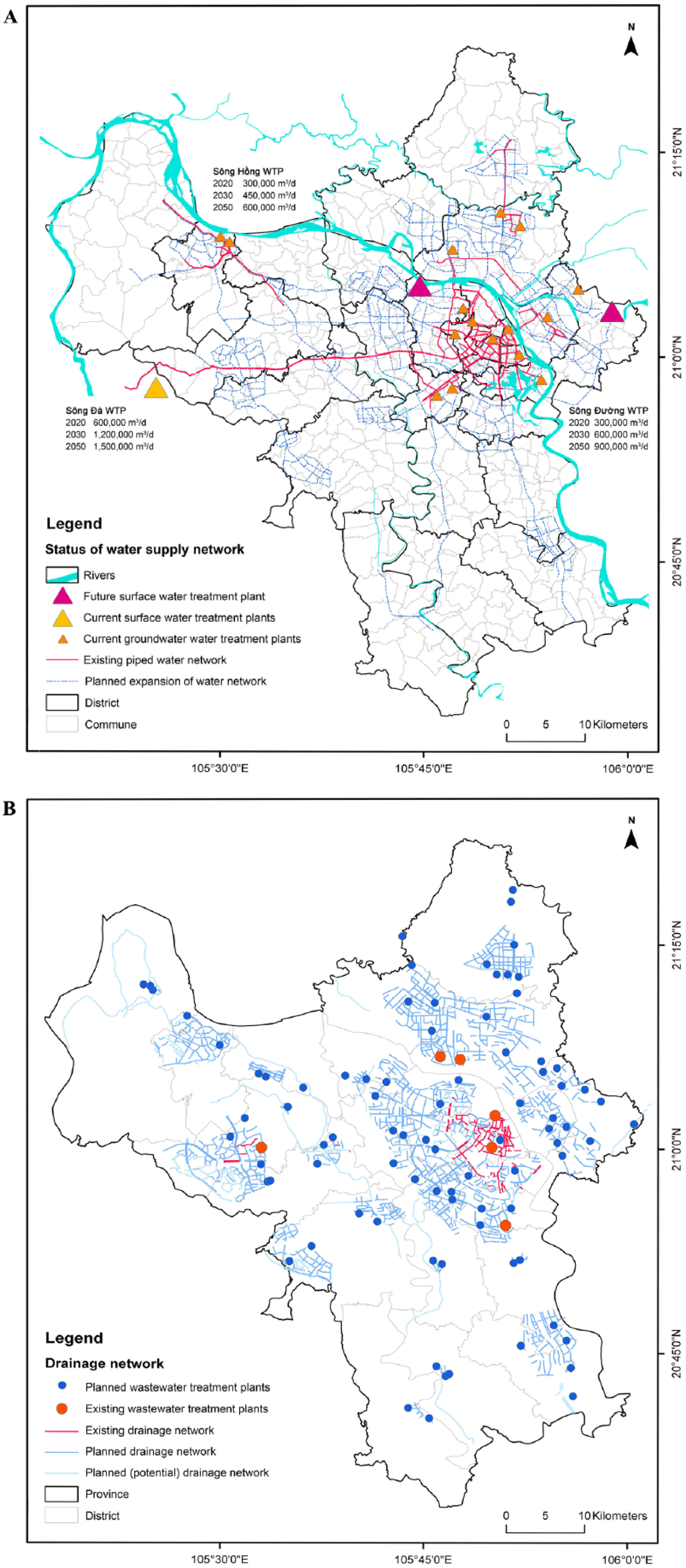
Map of status of Hanoi’s water supply network (a), and drainage network (b).
At the city-level, the companies responsible for the production of water for urban and rural areas are VINACONEX Water Corporation (VIWASUPCO), HAWACO, Ha Dong Company, and Son Tay Company (Wright-Contreras, March, & Schramm, 2017). The first is a Joint Stock Company (JSC) and the remaining three are one-member Limited Liability Companies (LLCs). Responsible water distribution are Vietnam’s Freshwater Business and Construction Investment Joint Stock Company (VIWACO) (Figure 2a), HAWACO (Figure 2b), Ha Dong Waterworks (Figure 2c), and Son Tay Waterworks (Figure 2d). HAWACO and VIWACO distribute most of the water in the inner-city and suburban districts (as shown in Figure 3), accounting for 72% and 17% of the total water supply, respectively (Wright-Contreras et al., 2017, p. 67). Ha Dong Waterworks and Son Tay Waterworks supply the remaining percent of water in the districts they are named after; Ha Dong district is located south-west of the inner-city and Son Tay district is located north-west of the city (not included in Figure 3).
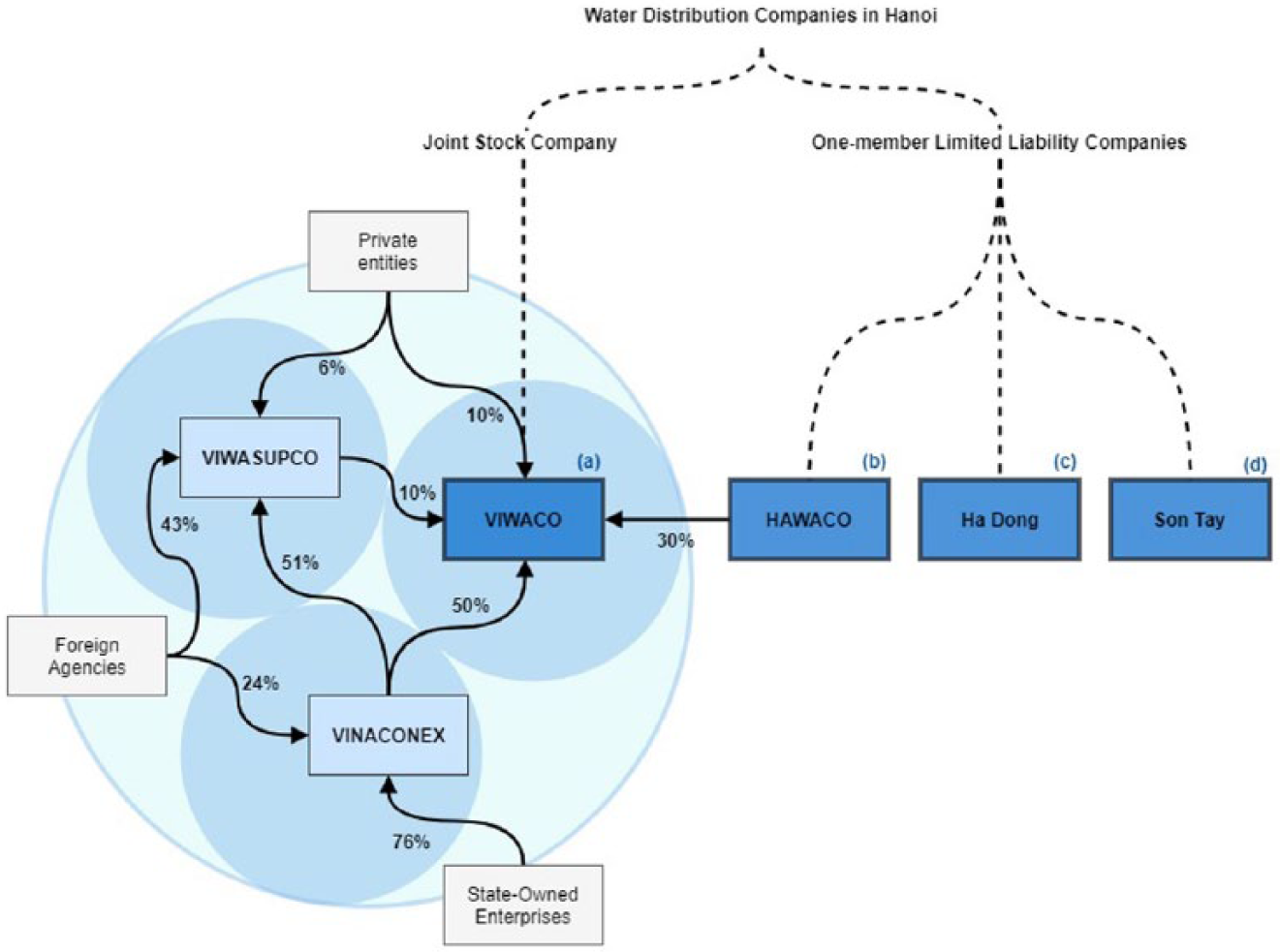
Conceptual diagram of ownership of water distribution companies in Hanoi.
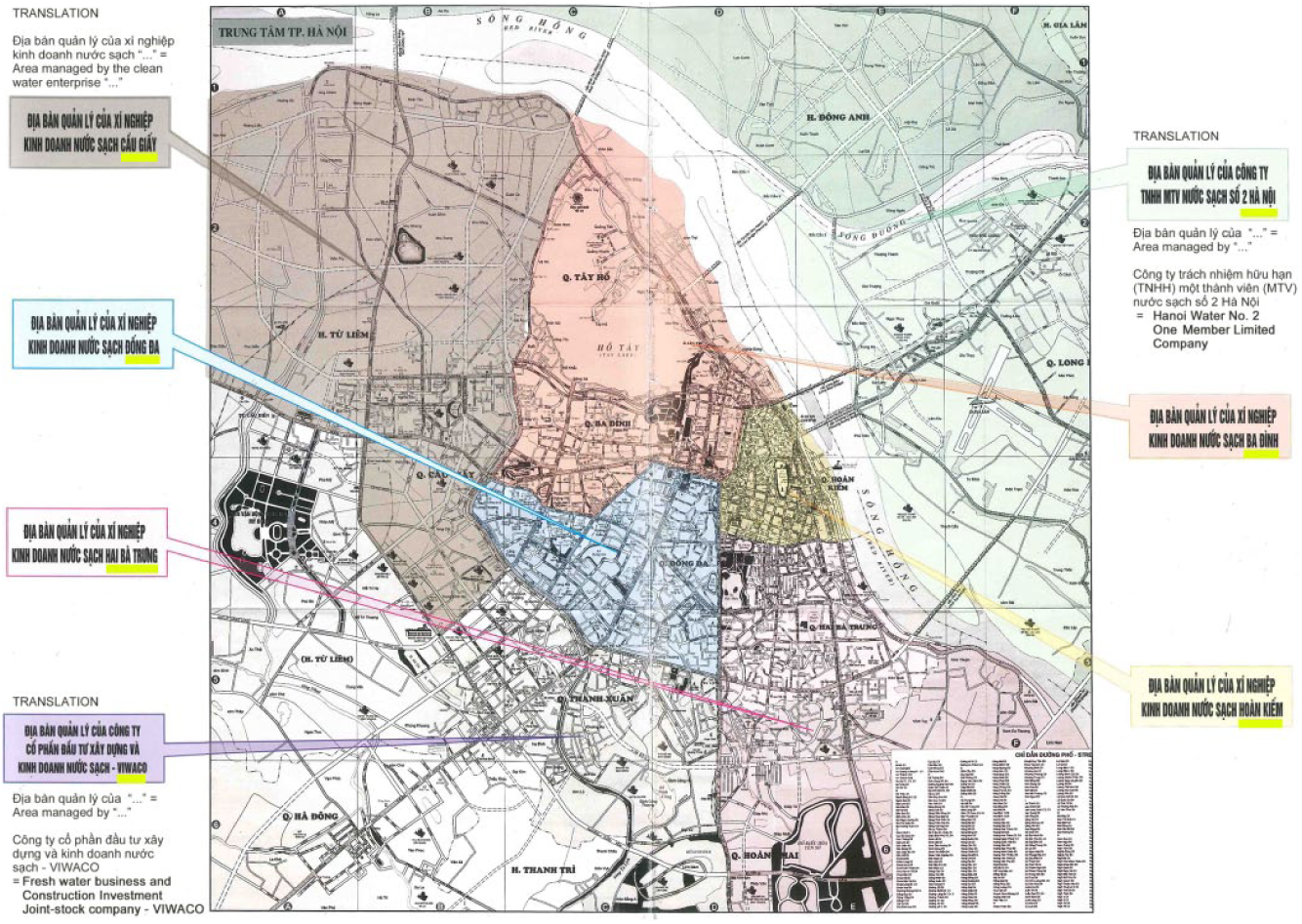
Water supply zones managed by HAWACO and VIWACO.
HAWACO is not only considered major distributor, but also plays a larger role in the water supply scene acting as shareholder of VIWACO. Besides the one-member LLC, HAWACO, VIWACO is also owned by VIWASUPCO and VINACONEX. VIWASUPCO is owned by the Singapore-based Acuatico Private Limited Company (Pte Ltd), and VINACONEX is owned by SOEs such as Vietel (a mobile phone company which belongs to the Ministry of National Defense) and the State Capital Investment Corporation (SCIC). All three JSCs, VINACONEX, VIWASUPCO, and VIWACO, are also owned by private investors and foreign agencies in the ranges of 6% to 43%.
The responsibilities to coordinate the supply of water for urban, suburban, and rural populations in Vietnam are shared mainly by MOC and MARD; the first with jurisdiction over the urban areas, and the second with jurisdiction over the rural areas. In addition, there is increasing development of new urban areas which normally extract groundwater and control privately managed water treatment facilities (cf. Wright-Contreras et al., 2017). In turn, periurban villages caught in between the developing areas and the former rural areas receive water from the piped-distribution network, in some cases managed by cooperatives (cf. Schramm & Wright-Contreras, 2017), and complement their intake of drinking water from private vendors. The technological and administrative challenges to supply urbanizing villages with water are, first, the expansion of water distribution pipes to reach the villages and, second, the organization of users to invest in the subsequent distribution of water from the entrance of villages into each household, which will be addressed in the next section.
Multilevel Water Governance in Vietnam
As 60% of Vietnam’s rivers flow originate outside its borders (Asian Development Bank [ADB], 2013, p. 4), water security is difficult to assure within regional and local water resource management plans. On one hand, 80% of Vietnam’s surface water is used for agricultural purposes and vast amounts of water are lost through inefficient rural and urban water management (ADB, 2013, p. 4). And on the other hand, water use is expected to increase from 80 billion m3 in 2008 to 120 billion m3 in 2020, affecting the productivity of agricultural, industrial, and energy sectors (ADB, 2013, p. 8). Because of the overexploitation of groundwater, at a regional level, aquifer levels have decreased as much as 30 meters (e.g., in Hanoi) (ADB, 2013, p. 5) and, in the Red River Delta, users are exposed to naturally forming arsenic and other heavy metals when accessing water through privately owned tube or dug wells (Le Van, 2012; Wright-Contreras et al., 2017).
Although there is tendency to decentralize the management of water supply in the country (NCERWASS, 2014), there is still a central-level involvement which exercises control over water utilities (Water and Sanitation Program [WSP] & World Bank, 2014). Vietnam’s MOC and MARD set the guidelines for urban, rural, and suburban safe water delivery at provincial and city-levels. MARD’S program labeled National Target Program (NTP) for Rural Water Supply and Sanitation (RWSS), from 2012 to 2015, or Phase 3 (NTP3), is carried out through a results-based planning and financing approach which promotes the piped-water scheme. For implementation, at the central level, MARD establishes a Program Steering Committee (PSC) and a Standing Office to aid the project management of the PSC (Socialist Republic of Vietnam [SRV], 2012). At the provincial level, the Provincial People’s Committee (PPC) also establishes a PSC (SRV, 2012). Both levels of PSCs include representatives of MARD, the Ministry of Health (MOH), and other ministries and cooperating agencies related to water supply and sanitation (SRV, 2012). In 2013, community-based models made up 55% of Vietnam’s piped-water scheme management models (NCERWASS, 2014). Other models managed by the provincial Centre for Rural Water Supply and Sanitation (pCERWASS), cooperatives, private entities, and enterprises, account for another 36% and are steadily increasing; while the remaining 9%, considered the least effective model of piped-water scheme management through Commune People’s Committees (CPCs), is decreasing (NCERWASS, 2014).
As People’s Committees correspond to the state and are not considered civil society organizations (Parenteau & Thong, 2005, p. 247), decisions concerning water supply mainly rely on government authorities, following the Clean Water Supply and Environmental Sanitation program launched in 1995 by the National Environmental Agency of the Ministry of Science, Technology, and Environment (MOSTE) (Owen, 2012). MOH indicates water quality standards and the Ministry of Planning and Investment (MPI) must approve large-scale projects (Owen, 2012). In addition to MOC, MARD, MOSTE, MOH, and MPI, actors involved in the definition of policies for the implementation of projects related to development of water supply in Vietnam’s localities are Ministry of Information and Communication (MOIC), Ministry of Finance (MOF), Ministry of Education and Training (MOET), Ministry of Natural Resources and Environment (MONRE), Ministry of Science and Technology (MOST), Ministry of National Defense (MOND), Ministry of Public Security (MOPS), Committee for Ethnic Minority Affairs (CEMA), Vietnam’s Academy of Science and Technology, Vietnam Women’s Union, and Vietnam Farmer’s Union (SRV, 2012). In Hanoi, for example, MONRE and the National Board of Water Resources are responsible for the management of water resources, while MOC and the Transport and Urban Public Works Department (TUPWS) decide of the construction of infrastructure in urbanizing areas and the quality of water is regulated by MOC and MOH (Schramm, 2014). This illustrates a parallel process of recentralization of Vietnamese cities within national policies.
Within MARD’s NTP3, the central government provides subsidies to water supply projects which prioritize piped-scheme network systems (SRV, 2012). In rural areas, MARD will support the building of the piped-scheme when 60% of the community commits to connecting to the system. To achieve this, MARD’s department of Information, Education, and Communication (IEC) assists users in selecting the “appropriate” technology to ensure the financial sustainability and the operation of water treatment plants and water distribution networks to their maximum capacity, using “behavior change communication,” modeled from the United Nations Children’s Fund (UNICEF) approach of Communication for Development (C4D) (Interview MARD, 2014). Because of the importance of IEC’s activities, 5% of the Vietnam’s total investment for water supply and sanitation is allocated to this section (Interview MARD, 2014). The total budget of 27.6 billion Vietnamese Dong (VND), equivalent to US$1.2 million, for MARD’s NTP3 is made up from central and local budgets, donors’ funds, preferential credit, and private investments (SRV, 2012, p. 3). According to the Ministry of Foreign Affairs of Denmark (DANIDA, 2014), Australia, Denmark, and the United Kingdom have contributed to 90% of NTP3’s program budget.
Altogether, the development, upgrading, and upkeep of water infrastructures in Vietnam is supported by foreign aid or official development assistance (ODA), bank loans, foreign direct investment (FDI), and private sector participation (PSP) (for the definition of types of foreign capital flows see Chang, 2008, p. 86). International organizations related to the aforementioned are ADB, Australia’s Aid Program (AusAID), Danish International Development Agency (DANIDA), Department for International Development of United Kingdom (DFID), German Agency for International Cooperation (Gesellschaft für Internationale Zusammenarbeit—GIZ), Japan International Cooperation Agency (JICA), UNICEF, World Health Organization (WHO), World Bank, among others. To exemplify, with a close cooperation between Vietnam’s national ministries, operations, and investments in water supply systems are discussed through the Vietnam Water Supply and Sewerage Association (VWSA). VWSA partners with organizations such as the World Bank, ADB, JICA, and GIZ and encourages cooperation among agencies, institutions, and individuals to promote the sustainable development of water supply and sewerage in Vietnam, while encouraging socioeconomic development and modernization (VWSA, 2014). An example of a product of one of VWSA’s cooperation efforts is the Development of the Vietnamese Water Sector (DEVIWAS), supported by the German Water Partnership (GWP) and financed by the German Federal Ministry for Economic Cooperation and Development [Bundesministerium für wirtschaftliche Zusammenarbeit und Entwicklung—BMZ] via Sequa (VWSA, 2014), a nonprofit development organization which promotes private sector business development (Sequa, 2015). Furthermore, the Association of Southeast Asian Nations’ (ASEAN) Strategic Plan of Action on Water Resources uses a regional approach to formulate the management and coordination of activities based on the United Nations Environment Programme (UNEP) framework (ASEAN, 2005). The document calls for consistent monitoring through a cost-effective national water management to ensure water quality and the management of natural resources (ASEAN, 2005, p. 19). The implementation of projects guided by the technical working body or Asian Working Group on Water Resources Management (AWGWRM) indicates the further development of potential partnerships with the World Bank, ADB, and AusAID to implement the project concepts (ASEAN, 2005, p. 11).
In regard to private and foreign investment, the involvement of the private sector and international organizations has made up for a large percentage of water development projects. Officially, PSP in water management in Vietnam was determined at 2% in 2012 with an expected increase to 12% in 2025 (Owen, 2012, p. 46). In Hanoi, PSP was initiated in 2010 through Acuatico Pte Ltd (joint venture between Pt Recapital Advisors and Pt Glendale Partners based in Singapore) with the construction of water networks in the southwest of the city (Owen, 2012, p. 408). Additionally, the World Bank determined to minimize the current water loss of 160,000 m3 by half through a regulated tariff calculation based on water meters, and by identifying consumer contracts and illegal connections (Owen, 2012, p. 219, 221). Investments are planned to be recovered in the long term (e.g., 10 years) through tariffs which are monitored and reviewed periodically by the People’s Committee of each corresponding district, which is why water tariffs differ slightly from district to district. According to the WSP and the World Bank, the annual investment for water supply and sanitation in Vietnam from the government and donors, between 2009 and 2011, amounted to 0.2% of 2011 Gross domestic product (GDP) and was expected to rise to 0.4% from 2012 to 2014, still insufficient to meet the 2020 targets (WSP & World Bank, 2014, p. V). Although Vietnam has sought to attract US$1 billion to increase access to “safe” water (Owen, 2012, p. 219), the Joint Monitoring Program (JMP), led by WHO and UNICEF, estimated that increasing safe water coverage would require capital expenditures of US$1.562 billion per year (WSP & World Bank, 2014, p. V).
Politics of Scale to Ensure Safe Drinking Water
Derived from the Millennium Summit in New York, in September of 2000, under Secretary-General Kofi Annan, the UN Millennium Declaration set a series of milestones to be met by 2015 known as the MDGs (Millennium Project, 2006). Within MDG 7, Target 7C specifies to halve the proportion of the population without sustainable access to safe drinking water and basic sanitation by 2015 (United Nations Statistics Division, 2017). As the conclusion of the MDGs in 2015, the post-2015 development agenda was issued by the United Nations General Assembly, under Secretary-General Ban Ki-moon’s mandate. The document titled Transforming our World, the 2030 Agenda for Sustainable Development (United Nations, 2015) lists 17 SDGs. The goal directly related to water is SDG 6 which aims to ensure availability and sustainable management of water and sanitation for all. Within SDG 6, the specific target related to drinking water is 6.1 By 2030, achieve universal and equitable access to safe and affordable drinking water for all. The document was followed by the New Urban Agenda (United Nations Habitat, 2016), adopted in Quito, Ecuador, in October of 2016, serving as a plan for effective implementation, follow-up, and review of the SDGs.
In 2015, WHO and UNICEF’s JMP indicated the achievement of the drinking water target (benchmarked at 88%), as the report estimated 91% of the world’s population to have access to an improved water source (UNICEF & WHO, 2015, p. 4). Although MDG 7C aimed to halve the proportion of the population without sustainable access to
Discussion
Considering it was not until the 1990s that gravity flow systems and small-size piped-schemes replaced hand pumps and hand-electric pumps in Vietnam, the country has proven to modernize in a relatively short amount of time. Cities such as Hanoi have faced the challenge of achieving a “modern ideal of progress” (McGee, 2013, p. 20), framed by competing world cities. In the meantime, the involvement of the private sector has been sought as a solution to reach a modernization of systems which would otherwise seem economically unviable to state governments. Large-scale water infrastructure development plans, including the building of water- and wastewater treatment plants, strive to achieve modernity but also echo the failure of this modern ideal (cf. “incomplete modernity;” Gandy, 2004, p. 363; “modernization myth;” Healey, 2012, p. 188; and “instance of failed or lapsed modernity;” Kooy & Bakker, 2008, p. 1845).
The narrative of the study of water supply in Hanoi reveals the relationships between city- and national-level decision-making bodies, and macro initiatives (such as the New Urban Agenda) embedded in supranational structures; as well as the role of public and private entities contributing to the development of the water sector at different territorial levels and administrative scales (cf. Bon & Kennedy, 2014; Bulkeley, 2005). A few of the lessons learned from the case of Vietnam are that (a) national water management strategies prioritize the piped-scheme network over other technologies; (b) local water infrastructure projects are financed by a web of transnational actors through foreign aid, ODA, bank loans, FDI, and PSP; and (c) global targets of access to safe drinking water do not reflect the actual status of countries’ progress toward the MGDs and SDGs.
So far, this article has woven a more complex understanding of water governance, including the multilevel relationships between actors involved in the management of Hanoi’s water supply system and the monitoring of Vietnam’s past and future global water targets. As Vietnam becomes a growing part of the global agenda, the investment of foreign capital and knowledge to support technological advances becomes more evident. In this sense, cooperative efforts between government dependencies, public and private entities, and transnational actors are illustrated in the supply of water. A closer look on how to improve water utility performance through existing global networks of water operator partnerships may also help ensure the sustainability of these systems. As SDG Target 6A and 6B indicate, by 2030, there is a need to expand international cooperation and capacity-building support to developing countries in water- and sanitation-related activities and programs, including water harvesting, desalination, water efficiency, wastewater treatment, recycling and reuse technologies, and support and strengthen the participation of local communities in improving water and sanitation management (United Nations, 2015, p. 23).
Based on the lessons learned from the MDG targets on sustainable access to safe drinking water for 2015 and the prospects of the SDGs for 2030, it is important to have a holistic understanding of the country’s potentials, the availability of water resources, and how multilevel governance and transnational structures can aid national and regional policy-making. Being that the presence (or lack) of safe water in cities is quite evident, the study of water infrastructures, with emphasis on their management, can contribute to a better reflection of the achievement of parallel SDGs. Due to the cross-sectoral dependence of water to sustain human life, concentrating on Goal Number 6 may undoubtedly contribute to many other sectors aiming to “transform our world.”
Conclusion
This article has contributed to the understanding of the intersections between urbanization patterns, socioecological problems, financial flows, and the power relations embedded in Hanoi’s urban water supply through politics of scale aiming to ensure access to safe drinking water. The information derived using the transnational urban political ecology of infrastructures framework has informed the article in three ways. First of all, water has been viewed as a material flow that evidences the mediation of power through water supply in cities. In the section of urban water infrastructures of Hanoi, the article describes the evolution of infrastructures and the context-specific technological, user-related, environmental, financial, and institutional challenges in urban water supply. The analysis of the current status of Hanoi’s water supply clarifies the roles of the companies responsible for production and distribution of water, their respective water supply zones and ownership structures. The information derived from this section evidences the interplay between different actors at local, regional, national, and transnational levels as well as the cross-scalar political, economic, and institutional processes which direct water provision in Vietnam. Secondly, the combination of the study of water infrastructures through the lens of urban political ecology has provided insights on relations of power embedded in Hanoi’s urban water supply. The section of multilevel governance in Vietnam describes the interaction between national ministries and city-level decision-making marked by a combination of decentralized and centralized management influenced by supranational IEC strategies. Also, the expansion of the piped-scheme network and modernization of water infrastructures evidences cross-border financial flows of ODA, loans, FDI, and PSP; highlighting large investments required to increase safe water coverage in Vietnam. This information provides an insight on the roles that public and private entities exercise in the development of Vietnam’s water sector, as well as a glimpse of the country’s financial shortcomings to reach global water targets. Finally, the transnational approach to an urban political ecology of water infrastructures has been used to explain global trends of water governance and water management in Hanoi. The section which elaborated on politics of scale to ensure safe drinking water clarifies the transition from the MDGs to the SDGs and the differences between “safe,” “improved,” and “hygienic” water. At the same time, country and city-level records of progress toward access to “improved,” “safely-managed,” and actual “safe” water are presented to assess the country of Vietnam and its capital. The data suggest an overestimation of the progress made toward the MDGs and leads to the discussion of a failed ideal of modernity. However, with the evidence of the flows of resources and the interplay actors across borders already in place, global networks of cooperation are proposed as means to enhance knowledge sharing and capacity-building in the water sector. Having shown the interdependency of global trends of water governance and the local development of urban water infrastructures, this article has bridged political ecology with public works management and policy in order to contribute to the improvement of water infrastructure development, safe water provision, and the much-needed inclusiveness, and social and environmental justice in cities.
Footnotes
Declaration of Conflicting Interests
The author(s) declared no potential conflicts of interest with respect to the research, authorship, and/or publication of this article.
Funding
The author(s) disclosed receipt of the following financial support for the research, authorship, and/or publication of this article: German Academic Exchange Service (Deutscher Akademischer Austauschdienst, DAAD) funding programm number 57214224.
