




Abstract
Corruption is a social evil that resonates far and deep in societies, eroding trust in government, weakening the rule of law, impairing economic development, and exacerbating poverty, social tension, and inequality. Each phase of infrastructure development life cycle has peculiar vulnerabilities to corrupt practices. Pre-emptive identification of avenues for corrupt actions at each phase can serve as a starting point for new initiatives or for renewed reinforcement of existing corruption mitigation programs. The existing literature on corruption does not address the issue from an infrastructure life cycle perspective. The objective of this paper is to identify opportunities at each phase of the infrastructure life cycle where stakeholders and actors can help undertake specific actions to mitigate corruption. The paper’s methodology characterizes corruption and mitigation measures in a framework based on the phases of infrastructure development life cycle and then connects these measures to the relevant actors and stakeholders.
Introduction
Civil infrastructure systems, including transportation of all modes, water and wastewater plants and distribution networks, are developed with the intention of satisfying some specific objectives. These objectives can be traced back to overarching goals (including human welfare and well-being, quality of life, and livability,) within the social, economic and ecological environments, in which the infrastructure is situated or has an influence (Khisty et al., 2012). The development of civil infrastructure, which directly promotes the quality of life of people, is inherently a noble and selfless endeavor, and its far-reaching and longstanding societal benefits are a source of great pride to the civil engineer. Unfortunately, in the development of civil infrastructure, corruption often occurs and causes significant reduction of the intended societal benefits of the infrastructure. It has been noted that “corruption erodes trust, impairs democracy, slows economic growth and exacerbates the extent of poverty, inequality and social discord” (Tl, 2020). Every year, more than 5% of the world’s GDP ($2.6 trillion) is lost due to collusion, corruption, and fraud (Irisova, 2014). Given that 1.2 billion people live on $1.25 or less per day, the magnitude of these losses represents a stark reminder of the far-reaching impacts of corruption. Furthermore, these losses are not only diverted from development but also often used to support criminal activities including drug trade and human trafficking (Integrity Vice Presidency, 2016). Over the years, the nature of corrupt practices has changed and what was prescribed in earlier studies may not necessarily work now or in the future. As such, there is a clear motivation to continue investigations into corruption and corruption mitigation. This motivation is accentuated by the sheer volume of financial resources that continues to be lost through corruption.
Several publications and research methods have been applied to address corruption. For example, interviews, surveys and focus groups are widely used to measure the prevalence or propensity for corruption (Bowen et al., 2012, 2015; Owusu et al., 2019, 2021; Vee & Skitmore, 2003; Zou, 2006). Also, data analysis of contract bids has been carried out to detect collusion (Clark et al., 2018; Signor et al., 2020). However, these quantitative and qualitative methods are often specific to a type of project or to a region. The literature suggests that innovative ways are always needed to further fight the corruption problem. In this paper, we posit that each phase of infrastructure development has peculiar vulnerabilities to corrupt practices where fraudulent actions of individuals in the quest of personal gain can occur. These phases are generally distinct across time, involve different levels of cash outlay, engage different sets of stakeholders and actors, and are exposed to public scrutiny in different ways and to different extents. Examining infrastructure corruption from a perspective of the life cycle phases of infrastructure development can offer insights into the opportunities for preventing and mitigating corruption. As such, pre-emptive identification of avenues for corrupt actions at each phase of infrastructure development can serve as a starting point for new initiatives or for reinforcement of existing corruption mitigation programs. The existing literature on corruption does not address the issue from an infrastructure life cycle perspective.
In this paper, we seek to identify the corruption propensity at each phase of infrastructure development. The paper presents a methodology to characterize corruption and corruption mitigation measures. The methodology, which is based on the phases of the infrastructure development lifecycle, connects these measures to the relevant actors and stakeholders as a mechanism for understanding who is responsible for implementing the corruption mitigation measures. The work draws on a comprehensive review, synthesis and discussion of related past work, and our experience working with the phases of the life cycle of infrastructure development. From a theoretical perspective, the paper’s discussion provides a platform for further inquiry on phase-related attributes that influence corruption. From a practical perspective, the results can facilitate identification and comprehension of the roles of actors and stakeholders that are responsible for (or have a stake in) the implementation of specific corruption mitigation measures at each phase. These include policy statements, guidelines, and codes, organizational and political structures, monitoring and penalties, and advanced technologies.
The paper is organized as follows: first, in this section, we present the broad background concepts for the study and the motivation for the paper. Then we define corruption and identify its impacts and provide an introduction to the phases of the infrastructure development lifecycle. We then provide an overview of our methodology followed by a discussion of the corruption propensity at each phase of infrastructure development. This leads to the next section where we make recommendations on corruption mitigation from strategic, tactical, and operational perspectives. In the last section, we offer some concluding remarks, list the study limitations, and present possible avenues for future work.
Study Background
To provide a background for the subsequent discussions in this paper, we revisit the definition of corruption and recount its effects. Then we discuss the phases of the infrastructure development lifecycle, and we identify the actors, stakeholders and activities at each phase.
Corruption Defined
A review of the literature over the past 55 years reveals the diverse ways in which corruption has been defined (Ghahari, 2022). The etymology of the word is rooted in Latin. Com, means “with, together,” and rumpere means “to break.” Therefore, a corrupt act by an individual means breaking the trust with others. Reverting to the use of the word in the context of willful human behavior, we collectively term as “corruption”, any self-serving behavior at the expense of the societal good. In the literature, common words and taxonomical threads across the definitions include: willful, fraudulent, or illicit act; selfish intent; personal gain; misdirection of public funds to inappropriate destinations; overlooking anti-social behavior of others; and loss of public trust.
In one of the pioneering studies on this subject (Nye, 1967), corruption is defined as “... behavior that deviates from the formal duties of a public role (elective or appointive) because of private-regarding (personal, close family, private clique) wealth or status gains.” Werlin (1973) characterized corruption as “… the use of public office for private needs”, and Blackburn et al. (2004) considered public sector corruption as the “illegal, or unauthorized, profiteering by officials who exploit their positions for personal gain.” In a narrow context tailored to the specific manner of corruption, Shleifer and Vishny (1993) defined corruption as “… the sale by government officials of public property for personal gain”. In echoing Nye’s definition, Khan (1996) defined corruption as “... behavior that deviates from the formal rules of conduct governing the actions of someone in a position of public authority because of private-regarding motives such as wealth, power, or status.” Treisman (2000) offers what is consistent with what is probably the most common definitions of corruption: “... the misuse of public office for private gain.” Given these definitions, we use a broad notion of corruption: the exploitation of public authority with the intention of achieving personal benefits. When shared public goods are transformed into private settlements, corruption happens at the level of private and public entities (Corvellec & Macheridis, 2010; Heidenheimer et al., 1989). Corruption is generally motivated by personal gain which may be monetary but can also be power and prominence. Corrupt acts can be seen as either a cultural or moral issue. The misuse of public power, bribery, and unlawful or inappropriate transfer of tangible or intangible resources from public to private ownership can all be considered corrupt acts.
The Effects of Corruption
Corruption remains a global scourge. As discussed, corruption causes massive losses to governments some of which already struggle to fund essential services for their citizens. The effects of corruption are certainly not felt uniformly across the various socioeconomic groups; the low-income population is most affected. For example, investigations in developing countries, such as Paraguay and Sierra Leone, reveal that the rich pay a lower proportion of their income to bribes compared to the poor (World Bank, 2018). The World Bank has identified corruption mitigation as a task critical to achieving its dual goal of “ending extreme poverty by 2030 and boosting shared prosperity for the poorest 40 percent of people in developing countries” (World Bank, 2018). Lowering corruption is at the core of the United Nation’s Sustainable Development Goals, and is key to attaining the objectives set for Financing for Development (UN, 2017, 2020). In addition, corruption wears down faith in government, weakens social bonds, exacerbates social disparities and foments disgruntlement, and ultimately, leads to social strife (Menkhaus, 2010).
The multifaceted nature of corruption is evidenced by its multiple forms, contexts and spheres of influence. As evidenced in fairly recent major scandals in the financial and political world, it has been argued that there is a connection between corruption, political illegitimacy and instability (Heywood, 2014). Often manifest at the interface of the public and private sectors (Rose-Ackerman, 1978), corruption causes inter-sectoral conflict, reduced investment and stunted economic growth (Mauro, 1995; World Bank, 1997).
Phases of Infrastructure Lifecycle and Actors/Stakeholders at each Phase
Infrastructure agencies are observing that sustainable development, infrastructure resilience, and cost-effectiveness are promoted when investment decisions are made from a long-term perspective (Hall et al., 2014). As such, the desired scope of investment decision-making has evolved from initial considerations only (construction) to the entire life cycle of the infrastructure (Dowall & Ried, 2009; US Department of Transportation, 2002). The phases or stages of infrastructure development may be categorized differently by different authors depending on the purpose, for example, corruption prevention (Sohail & Cavill, 2008), project management (Lenferink et al., 2014; South et al., 2018), or life cycle assessment (Alaloul et al., 2021). The differences lie in the level of detail and the focus. We use the following. phases: needs assessment, planning and financing, design phase, construction phase, operations (concurrent with monitoring and maintenance), and end of life (Figure 1). Examining corruption and its mitigation from the perspectives of development phases is useful as each phase is distinct with clear boundaries across time, and the peculiar attributes of each phase provide different opportunities for corruption and challenges for their mitigation. Phases of infrastructure development.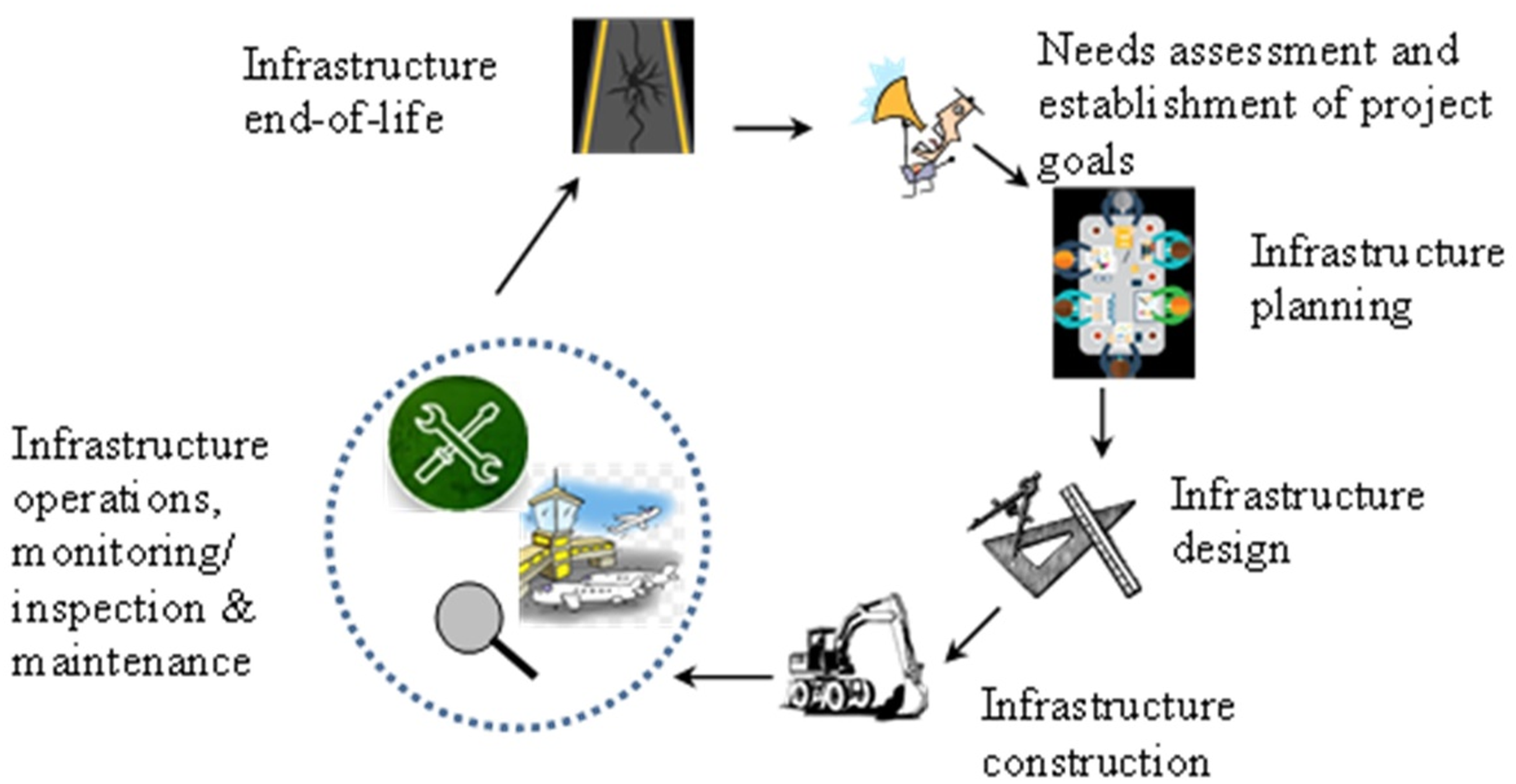
In this paper, we focus on connecting corruption opportunities and mitigation measures, with the phases of infrastructure development. Recognizing that infrastructure development has a life cycle from “conception to cradle to grave” helps to identify opportunities to make efficient investments, ensure that these investments can be maintained and operated, and the costs associated with the end of life of the facility are understood. The economic analysis of road investments over the life cycle can be traced back to 1847 (Mikolaj et al., 2019) and subsequently supported by the work of Vickrey and others (see for example, Vickrey, (1967)), the development of tools such as the World Bank’s Highway Design and Maintenance Standards (HDM) model (Harral et al., 1979), and the emergence of management systems that seek to optimize decisions while accounting for planning, construction, maintenance and operating costs (Haas & Hudson, 1978). More recently, this approach is supported by work in industrial ecology and sustainability (Hendrickson & Horvath, 2000). Demolition, recycle, and reuse (end-of-life activities) are receiving greater attention (Bocchini et al., 2014) because of interest in resilience and sustainable development. Furthermore, while infrastructure provision was largely a public sector activity for much of the twentieth century, constrained budgets and distrust of government have led to widespread use of public-private partnerships and innovative contracting mechanisms ranging from design, build, operate and maintain (DBOM) to outcome and performance-based contracts (Dowall & Ried, 2009).
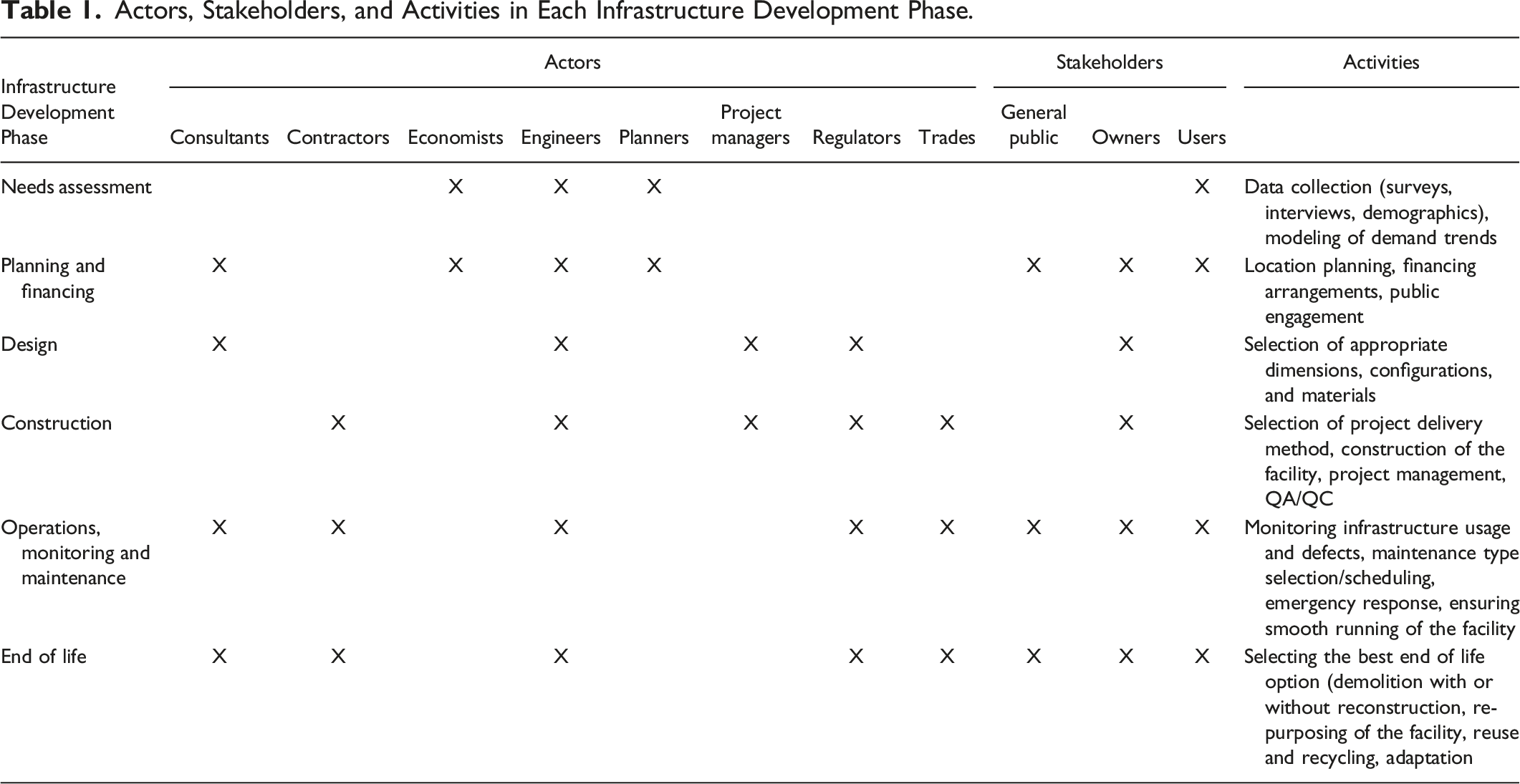
Across the development phases, there are common processes, such as tendering and contracting, political influences, and openings for individuals to realize gains or avoid losses, that present avenues for corrupt practices, but also corruption mitigation strategies. Using the phases of the infrastructure development life cycle as a structure, this work connects not just the processes but identifies the actors and stakeholders engaged in each phase to better tailor mitigation strategies to address the problem of corruption. In a later part of this section, we identify actors as the disciplines involved in implementing the activities in each phase, and the stakeholders as those with an interest or stake in the outcomes of each phase. Here, we briefly describe each of the phases represented in Figure 1 including the actors and stakeholders.
The Needs Assessment Phase
At this phase, the infrastructure agency determines whether an infrastructure deficit exists, ascertains the magnitude of the deficit, identifies the stakeholders of the infrastructure, and establishes the infrastructure goals and objectives of the system. Such considerations are helpful in the subsequent phases of system planning and design. De Neufville (1990) and Voland (1999) stated that a prerequisite to any engineering design process is to identify as clearly as possible the existing needs that can be addressed using available resources. An infrastructure need or deficit may arise from a concern to protect the health and safety of the public or to improve the quality of life for residents or travelers. The need may be related to new infrastructure where none existed hitherto (greenfield project) or, for an existing infrastructure, demolition and rebuilding, or expansion (brownfield project). The needs assessment task, which includes demand modeling, surveys and interviews of prospective users, and town hall meetings with the general public or area residents, is often carried out by professionals of different disciplines, depending on the developmental sector and infrastructure type in question.
The Planning and Financing Phase
The responsibility for systems planning is often borne by agencies that have been granted statutory authority for a specific type of infrastructure. In many countries, a formal and distinct unit of the national government carries out or supervises planning for public infrastructure systems. In other countries, such as the United States, most public infrastructure planning is carried out by regional, state, or local governments, and the federal government’s role is to provide the funds and to ascertain that all the subsequent phases of the system development are consistent with legislation. In any case, the planning task is carried out in-house or is outsourced to consultants. The infrastructure planner liaises with other engineering professionals in the transportation, water, energy, and environment sectors, and also solicits input from other professionals and stakeholders including the general public (Goodman & Hastak, 2006; Parkin & Sharma, 1999).
Planning includes assessment not only of the infrastructure impact (to the environment, economic development, air quality, noise, land-use, social equity, and so on) but also of the impact of the natural and built environment on the infrastructure. Also, in this phase, the technical and financial feasibility of the proposed infrastructure are determined; the latter is done by comparing the costs and benefits of the infrastructure that are expected over a planning horizon that is often a function of the infrastructure design life. Stakeholders of the planning process include the infrastructure owner or agency, the infrastructure financiers (such as financial institutions, non-governmental organizations, and governments of all levels, national, regional, and city), residents of the area of the infrastructure location, and the general public.
The Design Phase
Engineering design may be defined broadly as a creative problem-solving process in which the engineer works within the budget, time, legal, institutional, and other constraints to convert data, information, and technical know-how to translate ideas into a product or service. Ullman (1992) categorized civil engineering design as: (a) configuration design (makes a creative decision on the location of each component or arranging them in some innovative manner so that the overall system performance is maximized or the cost minimized, (b) selection design (the designer selects standard components supplied by a vendor and then designs an assembly of these components to yield the final product), (c) parametric design (the designer chooses the design parameters – material type, component dimensions (lengths, thicknesses, and widths), shapes, and orientations. Often, the design is made to conform to government regulations such as codes and standards, protection of the environment, access by disabled persons, and ease of evacuation in disaster situations.
The Construction Phase
The construction phase can be defined loosely as the process of “translating the design into reality” and involves the physical assembly of the infrastructure system. This phase engages contractors, engineers, project managers, regulators, and trades. Regulators are responsible for site safety, and government requirements such as the use of local labor or materials. This is by far the most costly of the development phases.
Operations, Maintenance and Monitoring Phase
In this phase, the activities of the triad – operations (use of the infrastructure), monitoring (assessing changes in condition of the infrastructure, threats imposed by the natural and built environments, and opportunities for a change), and maintenance (carrying out physical repairs to address imminent defects or to correct existing ones) – are carried out synchronously.
End-of-Life Phase
One cannot refer to infrastructure end of life without specifying what constitutes end of life. Lemer (1996) defined system life as the time between construction and its subsequent replacement, due to any of several reasons including technological obsolescence, substandard performance, regulatory changes, or changes in consumer behavior and values. Therefore, the reasons for demolishing an infrastructure system (and in many cases, rebuilding it) could include the need to accommodate the changing nature, patterns, or levels of user demand; to mitigate user or community safety or security problems associated with the infrastructure operations; or to avoid excessive maintenance or operating costs associated with its current infrastructure. In many cases, infrastructure systems provide service during their design lives, and may even be doing so at a cost of economic efficiency and safety. The key stakeholders are the general public, and the infrastructure investors, owners, and users.
Actors, Stakeholders and Activities in Each Phase
Actors, Stakeholders, and Activities in Each Infrastructure Development Phase.
Methodology
Building on this background presented in the preceding sections, the paper seeks to characterize corruption and corruption mitigation measures in a framework based on the phases of the infrastructure development lifecycle and then connect these measures to the relevant actors and stakeholders as a mechanism for understanding who is responsible for implementing the corruption mitigations measures. The study methodology is as follows. First, we provide a framework that connects the actors and stakeholders at each phase and activities, to serve as a background for subsequent discussion on corruption traps at each phase (Study Background). Second, we identify and discuss the corruption traps at each phase of infrastructure development (Corruption Propensity at Each Phase of Infrastructure Development). Third, we establish a connection between anti-corruption initiatives (Policy Statements, Guidelines and Codes, and Organizational and Political Structures) and strategies (Monitoring and Penalties, and Leveraging Advanced Technologies) to the phases of infrastructure development.
The sections on corruption and corruption mitigation are based on an extensive and comprehensive literature review. The initial search used Google Scholar and the keywords infrastructure and corruption, and a review of reports and websites from the World Bank, Transparency International, and OECD. Searches were further refined using keywords related to the phases of infrastructure development. The refined searches did not uncover additional sources and examples. Other refinements focusing on examples and case studies did yield some additional sources. The search was repeated using Web of Science and the same sources were identified. The discussions and sources were reviewed, associated with the relevant phases and critiqued for relevancy. There are also examples of corruption related to a process (for example, tendering and contracting) that could apply to any phase. The following synthesis draws on this literature review and the synthesis of relevant literature.
The synthesis (Prospective Mitigation Initiatives at Each Phase) uses the structure of the phases of infrastructure development and associated corruption issues and the actors and stakeholders involved and then connects this structure to categories of corruption mitigation initiatives to provide a proactive approach to exploring opportunities to stem corruption.
Corruption Propensity at Each Phase of Infrastructure Development
An examination of infrastructure-related corruption through the lens of the development phases helps to identify opportunities for mitigating corruption. As stated in a recent report (World Bank, 2020), “Every phase in an infrastructure project involves distinct combinations of institutions and stakeholders, each with their own vulnerabilities to particular types of misconduct.” Building on the work of Sohail and Cavill (2008), we discuss the specific areas where corruption could occur within each phase, and present examples.
The Needs Assessment Phase
The pursuit of new proposed (re)construction projects, in and of itself, could be indicative of corruption, particularly where other alternatives such as maintenance of the existing infrastructure would have been a far more cost-effective option (Kenny, 2006). Corruption at the needs assessment phase could be motivated by tribal, partisan, or pecuniary reasons. For example, a government decision-maker may decide that a need exists to build infrastructure at a location not in response to a genuine socio-economic need, but because the elected official or decision-maker seeks to curry favor with residents of the area or to show that the decision maker has not “forgotten his roots”. An example is the infamous “Bridge to Nowhere” in Alaska, a proposed bridge that was earmarked for funding but was never built as it did not really serve any real need (Egan, 2004). Or it may be a conflicted effort to support the operations of a business venture located near the proposed infrastructure site that would benefit from proximity to the infrastructure. Cases at other countries include election campaign promises where vote-seeking politicians initiate infrastructure projects just before the election (often, only to abandon these projects subsequently irrespective of the election outcome). In such cases, the need is identified not by an appropriate professional but by some vote-seeking politician (often, a member of the ruling party who is in a position of power to allocate or disburse funds). In certain cases, consultants are hired to assess the existence and magnitude of the infrastructure deficit; however, they too could be influenced to skew the results to what a self-serving politician seeks. Such influence may be in the form of promises, rewards, or blacklisting regarding future consulting jobs.
The Planning and Financing Phase
The planning process is an interplay of the relevant stakeholders (owner or agency, financiers, residents, and the general public), and a great deal of trust and integrity is required. However, any one of these stakeholders, or faithful or unfaithful agents acting on their behalf, may gain some financial advantage (at the expense of other stakeholders and more critically, at the expense of the infrastructure quality or longevity). Examples include (a) a financial institution, seeking to be selected as the financier of the infrastructure, which may influence monetarily, a decision maker at the infrastructure agency, (b) an official employed by the infrastructure agency may secretly purchase land at the location of the intended infrastructure’s right of way, and later sell it to the agency at a profit, (c) an official employed by the infrastructure agency may purchase stocks associated with the proposed infrastructure after receiving inside information regarding the project.
Other areas of potential corruption at this phase include: planning-related permits, regulations, rules, and authorizations, public expenditure decisions, provisions of services and resources at below-market prices, discretionary foreign investments, and financing political party operations (Tanzi, 1998). Indirect factors that promote corruption in the planning phase include low quality of bureaucracy, low levels of public sector wages, absence of or unenforced penalty systems, the absence of institutional controls, lack of transparency of rules, laws, and procedures, and leaders not setting good examples (Sadiqi et al., 2017; Tanzi, 1998). In certain countries where several different permits and licenses are needed for land development or natural resources exploitation associated with infrastructure construction, bribery to facilitate the planning process, may be common. Public officials may deliberately delay official approvals in hopes of obtaining monetary incentives to speed things up.
The Design Phase
The design phase is vulnerable to corrupt practices in a number of ways. For example, (a) the designer selects specific materials to favor certain suppliers, particularly where there exist superior materials from the other suppliers, (b) the design company deliberately submits incomplete designs with the expectation that at the construction phase, the client will return to the designer to carry out additional design work for a fee, designs tailored to a specific contractor, or an overly sophisticated design (GIACC, 2008), (c) influencing (monetarily or in-kind) the public official responsible for design-related permits to approve designs that do not conform to government regulations. It has been reported that in certain countries including India and Cameroon, the acquisition of licenses, construction authorizations, and labor inspections represent significant sources of corruption (Kenny, 2007).
The Construction Phase
The large expense associated with this phase, coupled with the multiplicity of contractual parties involved, renders this phase a fertile ground for corrupt practices. For this reason, this phase is often considered the most corruption-vulnerable phase, and the construction industry in general, is regarded as the most corrupt sector (Kenny, 2009; Kottasova, 2014; Locatelli et al., 2017; Suen et al., 2007). Stansbury and Stansbury (GIACC, 2008) provide forty-seven hypothetical examples based on “real occurrences” of corruption related to construction. Their examples are organized by construction-related activities: 1) pre-qualification and tender, 2) project execution, and 3) dispute resolution. Each example identifies possible offenders. Here, we reinforce the opportunities for corruption in this phase with instances from the literature.
Indeed, the propensity for corrupt practices is manifest at each stage of the construction phase. At the bidding and contract award stages, there could be collusion in the selection of the contractor with kickbacks paid to the client’s personnel responsible for that stage of the work. Other potential areas of corruption include: (a) the client’s personnel, seeking to favor a specific bidder in return (or in expectation) of a monetary or in-kind illicit payment, leaking confidential information (such as the engineers’ estimate) or imposing unduly strict and unnatural requirements in the bidding process that can be met by that bidder only, (b) collusion between bidders, where the bidders (often including ghost bidders) bid collaboratively such that one of them wins the contract, (c) in order to win the contract, the bidder submits false bidding data, such as much reduced unit prices of certain items, with the expectation that they can make up for such “losses” through change orders or other ways during the construction process. An example of exposure of corrupt practices at the pre-construction stage was the 2009 conviction of a major U.S. construction firm of foreign bribery charges regarding bidding for the construction of a liquefied natural gas plant in a developing country and the imposition of a $402 million criminal fine. According to court documents, the firm “pleaded guilty to conspiring with its joint-venture partners and others to violate corruption legislation by authorizing, promising, and paying bribes to a range of government officials of that country to obtain contracts (United States Department of Justice, 2009). Another example is the alleged payment of kickbacks to the Chief Executive Officer of the Lesotho Highland Development Authority (Darroch, 2003).
The Odebrecht case in Brazil is particularly notable as the identified corruption occurred in three phases (planning and financing, construction, and operations) but was found to be most impactful during the construction phase (Morales & Morales, 2019). Another example is the corruption exposed by the Lava Jato (Car Wash) investigation in Brazil (The Economist, 2019). Other examples of alleged corruption at the construction phase were discussed by several authors Bowen et al. (2012 and 2015), Oyewobi et al. (2011), Sichombo et al. (2009), and Ling et al. (2014). In several developing countries, relatively large construction companies are typically owned by government-related corporations. Comprehensive research in Vietnam found that 60% of the construction sector’s revenue comes from 900 construction firms owned by the states, and about 40% of the revenue is made by 7000 private firms (Copplestone, 2006). Corruption, particularly in international projects and foreign transactions, is mostly driven by the host country’s conditions. According to a comprehensive survey of international firms, the fear of losing contracts is the main reason for firms to attempt bribery (Søreide, 2006).
Technical challenges in the actual process of construction, for example, decision-making and planning with insufficient information, design inadequacies and uncertainties, project change of scope, incomplete estimations, and unreliability in price forecasting increase the vulnerability to corrupt actions. Examples of corrupt actions at this phase include: (a) the project owner’s site representative is influenced by the contractor to (i) issue a not-needed scope change, (ii) sign a payment certificate for a work that is not done, not completed, or not carried out to material or workmanship specification, (iii) approve an extension of time for the wrong reason or to state falsely that the delay is not the fault of the contractor; and (b) potential deviations from specification (with regard to material or workmanship quality) may be associated with defective finished surfaces, use of low-quality materials, and incorrect dimensions (widths, thicknesses, heights, depths) of the final product.
Operations, Monitoring, and Maintenance Phase
In situations where the infrastructure operations, monitoring, and maintenance are carried out in-house, inefficiency, rather than corruption, seems to be the bane (Kenny, 2007). On the other hand, where these tasks are contracted out, the nature of the corruption and the instance of corrupt activities may take forms similar to those of the construction phase. Tangible evidence of the cost of corruption in this phase is presented in an analysis of asphalt road rehabilitation and reconstruction costs based on data from Europe and Central Asia. The level of corruption was shown to have a substantial impact on the cost of these materials and processes (Cirilovic et al., 2014). Renegotiation of Public-Private Partnerships (PPP) for infrastructure operations, monitoring, or maintenance also has the potential for fraud at this phase, particularly where the contracting process is not transparent (Ling et al., 2014; Wang et al., 2019; World Bank, OECD, & UNODC, 2020).
The End-of-Life Phase
The lack of agreement on what end-of-life really means may lead to opportunities for corrupt practices. At the end-of-life phase, the infrastructure material may be reused, modified, repurposed, recycled, dismantled, sold, upgraded, and/or integrated with the proposed new replacement infrastructure, if any. Examples of corrupt activities at this phase include: (a) representatives of the infrastructure owner declaring that an infrastructure system or component thereof, has reached its end-of-life because of their expectation of receiving prospective illicit benefits associated with the reuse or recycling of the physical infrastructure, or to make way for alternative developments, (b) the infrastructure owner’s representatives specify the disposal of construction waste to unapproved sites for their personal gain. For example, Doshi and Ranganathan (2017) document the premature demolition of housing in Chennai and Bangalore, and the subsequent land grabbing.
Corruption Mitigation Initiatives
Explicit international attention to anti-corruption attempts – particularly, in developing countries – is a fairly new development that started with the delivery of the “Cancer of Corruption” speech in 1996 by the 9th World Bank President (Wolfensohn, 2020). Since then, international financial institutions and development organizations have been less shy in openly mentioning the “c-word,” and billions of dollars have been spent to assist governments to tackle corruption challenges (Wang, 2020). This investment in corruption mitigation is relatively small compared with the investments in development. For example, the World Bank finances 20,000 to 30,000 contracts worth more than $60 billion per year (World Bank, 2016). These fund infrastructure for transportation, energy, agriculture, education, and health in countries with low and middle incomes. In many of these countries, particularly those with unstable governments, contracts are often susceptible to collusion, corruption, and fraud (Integrity Vice Presidency, 2016).
The Business Environment and Enterprise Performance Survey (BEEPS) indicates that 14% of all firms attempted to secure government contracts through unofficial payments to public officials, and the median amount spent by firms from all sectors for this purpose represented about 7% of the contract value (Kisunko & Ponomariov, 2014). For example, in Indonesia, losses due to employee theft were reported to be 24% of expenditures for road construction projects overseen by heads of the villages (Olken, 2007). Strategies and initiatives to mitigate such corruption include policy statements, guidelines and codes, organizational and political structures, monitoring and penalties, and the application of advanced technologies. These are discussed below, followed by examples of initiatives that could help reduce corruption specifically at each phase of the infrastructure life cycle.
Policy Statements, Guidelines, and Codes
Concern about corruption has an international scope and is not limited to developing countries. For this reason, efforts to fight corruption, at least from a strategic perspective, have largely been international in nature. Several international organizations have published policy statements, guidelines, codes, and manuals on the issue. One of the earliest was when the International Chamber of Commerce (ICC) published Rules and Recommendations to Combat Extortion and Bribery in 1977 and revised this document in 2005 (International Chamber of Commerce, 2005, 2011, 2015). The ICC encourages enterprises to self-regulate themselves in the drive to fight corruption, bribery, and extortion, and provides critical perspectives from the business sector, toward international corruption-fighting programs, policies, and initiatives (International Chamber of Commerce, 2011). In 2004, the World Economic Forum (WEF), Transparency International, and a collection of engineering and construction firms initiated a “zero tolerance” policy on bribery (WEF, 2016). The policy promotes the monitoring of all payments, donations, gifts, and charitable payments, to individuals associated with projects. The policy also protects the rights of the firms that refuse to give bribes, and encourages strict audits and penalties for violators and more auditing for those firms. In addition, the WEF runs a Partnering Against Corruption Initiative (PACI), a multi-national and multi-industry private sector-driven platform where organizations create, maintain, implement and monitor their anti-corruption initiatives (International Chamber of Commerce et al., 2008; WEF, 2007, 2009).
In 2004, the United Nations published its Global Compact to include a 10th “principle” that sent a powerful message to the private sector that is partially responsible for fighting corruption (Brun et al., 2011; UN Global Compact & Transparency International, 2009). The principle stated that “Businesses should work against corruption in all its forms, including extortion and bribery.” The United Nations continues to encourage the private sector to not only prevent bribery, extortion, and other forms of corruption, but also to cultivate strategies and solid programs to tackle it (Brun et al., 2011; UN, 2018). In 2009, the Organization for Economic Co-operation and Development (OECD) released the “Recommendation for Further Combating Bribery of Foreign Public Officials,” or Anti-Bribery Recommendation (OECD, 2009), and made efforts in 2019 to review this policy through broad public consultation (OECD, 2019). Transparency International has worked with multi-stakeholders and a global operating committee of firms, business organizations, scholars, union commissioners, and civil society associations to issue an anti-corruption code entitled Business Principles for Countering Bribery (TI, 2010). This code created the foundation for the Partnering Against Corruption Initiative (PACI) Principles, developed in conjunction with the World Economic Forum (WEF, 2007). Transparency International organizes workshops in various countries to develop and train individuals on tools that support the development and implementation of anti-corruption policies and to monitor the effectiveness of these tools.
The World Bank Group (WBG) has in place procedures that scrutinize all prospective projects and collaborates with member countries to reduce the risks of corruption. The WBG has established a Sanctions System (which includes an Integrity Vice Presidency) that investigates any reports or allegations of corruption and fraud in the projects they support (Integrity Vice Presidency, 2016). WBG is a leader in this effort (World Bank, 2016) insisting on zero-tolerance toward corruption in the infrastructure projects it supports. Their corruption-fighting approach consists of proactively anticipating risks and avoiding them. Avenues are available for the public to register complaints about planned, ongoing, or completed projects, and the project implementation receives rigorous oversight and is supervised by WBG-financed consultants with satisfactory records. The World Bank, OECD, and UNODC (2020) UN (2020) published principles for avoiding and controlling conflicts of interest in the public sector.
Organizational and Political Structures
Institutional and organizational structures are regarded as part of strategic initiatives to mitigate corruption. Montinola and Jackman (2001) found that partisan rivalry, a feature of democracies, can help lessen corruption: scrutinizing public officials is a staple of multiparty democracies. With freedom of information, such scrutiny is facilitated. Moreover, potential power reversal at the ballot box ensures that politicians involved in corruption may lose the election, and will become subject to probes and conceivably, trial and imprisonment following their election defeat. Kunicova and Rose-Ackerman (2005) asserted that a viable electoral procedure can provide politicians a motivation not only to divulge the corrupt activities of their rivals but also to make certain that they themselves are truthful. The researchers addressed issues of honesty and trust in relation to the operation of the parliamentary government and markets.
Corruption in the infrastructure construction industry is generally associated with reduced quality of work, cost overruns, and time delay. In other words, there seems to exist a strong two-way correlation between within-budget and on-time delivery, and low corruption. For these reasons, tools, methods, and interventions that help promote good-quality, on-time delivery, and zero cost overrun, can be considered anti-corruption tools. Overall, improving planning and budgeting processes and the transparency of the project cycle, raising awareness and civil society contribution and financial auditing agencies, and reducing the unrestricted power of individual bureaucrats and unnecessary regulation, have been found to be helpful in significantly reducing corrupt behaviors (Lederman et al., 2005; Svensson, 2005; Van Rijckeghem & Weder, 2001).
Government ownership of construction firms adds more complexity to the transparency of contracts and bidding process. Governments that function as the regulatory sector and do not participate in construction activities can institute a more merit-based selection and less politically influenced environment of contract award, and more importantly, quality monitoring. Government ownership of projects could foster corruption; it has been reported that in Indonesia, local government employees on road construction projects had engaged in materials theft (ILO, 2005; Mkenda & Aikaeli, 2015)).
The process of privatization of firms working in infrastructure development could also open avenues for corruption, particularly where there is lack of transparency, as was experienced in Vietnam (Copplestone, 2006). Where bureaucratic values are not merit-based, government processes are not transparent, the media is repressed, and civil society is less engaged, the capacity for corruption control is severely diminished (Johnston, 1998).
The Infrastructure Transparency Initiative (CoST) is a multi-stakeholder effort that leverages earlier efforts (for example, Integrity Pacts), and tools (such as Open Government Partnership and Open Contracting Partnership) to enhance public accountability (World Bank et al., 2020). CoST supports governments to implement a multi-stakeholder approach toward transparency. The World Bank (2020) describes the experiences and results of the CoST program in Thailand, Ukraine, and Honduras. In each case, there have been success stories (World Bank et al., 2020) in the form of savings (Thailand), more projects for less money (Ukraine), and additional smaller projects with significant social impacts (Honduras).
Monitoring and Penalties
For corruption mitigation, it is essential to establish effective organizations and institutions that can moderate anti-corruption programs in any country. Monitoring and penalties are a part of tactical measures for mitigating corruption. For example, South Korea’s road administration has a sanction policy on the firms that had broken laws against bribery or collusion, and subjected them to comprehensive oversight by a self-regulating inspector with access to classified, internal documents (Kenny, 2007). Such open access to detailed contract award information can help reduce corruption, and has been espoused by countries including Argentina, Turkey, the Philippines, and Uganda (Kenny, 2007), and generally is expected to include the contract price, the project details, and the government officials responsible for auditing and monitoring the project quality.
Contractors and private firms experience several different types of issues related to financing, building, and/or operating highways (and other infrastructure). Further, the provision of well-established contract agreements that have pricing flexibility, a sound debt structure, and transparency, can reduce project risks faced by contractors, and consequently, the risk of corrupt practices. In addition, a reduction in the number of construction licenses can help reduce corruption. On average, developed countries require 16 licenses, and developing countries require 20 (Djankov et al., 2002).
It has been shown that government incentives including lump-sum subsidy, concession period extension, fee subsidy (e.g., shadow toll), and revenue guarantees can reduce private partner investment risks (Li & Cai, 2017). Therefore, offering private partners, during the bidding phase, a wide range of government incentives related to investment timing, capacity, and pricing, may reduce corruption. However, flexibility and incentives can reduce efficiency, open other opportunities for corruption, or increase other risks. Their implementation requires caution.
Audits intended to mitigate corruption are helpful, however, too many audits could have the opposite effect as firms could be motivated to circumvent the process through illicit payments to audit officials. Simplifying the health and safety regulations, and working closely with labor syndicates, consumers, and industry to craft an enforceable code can lower the likelihood of corruption. Other simple but crucial cultural changes need to be established and initiated with the reform of government agencies overseeing construction affairs. These changes include rapid detection of ghost-workers, the definition of specific roles, responsibilities and the levels of staffing, institutional budgeting in a transparent way, and digitized tracking and auditing expenses. For example, in 1999/2000, Tanzania’s national treasury changed the way of transferring funds from central to local government after discovery of considerable leakage in the system (Sundet, 2004).
Leveraging Advanced Technologies
Evidence from the literature suggests that advanced technologies can be used as an effective tool in the fight against corruption. These technologies include information and computer technologies, blockchain, artificial intelligence, big data analytics, and civic technologies (OECD, 2021). Each of these technologies and their potential role in corruption mitigation, are presented below.
Blockchain Technology
Blockchain is a database technology for storing verified and trusted financial transactions. This technology provides transparency and helps build trust in financial systems. Also, by reducing the need for intermediaries, it lowers the risk and opportunities for corruption in the financial system (Mackey & Cuomo, 2020; Rangel et al., 2019). Nevertheless, because it generally does not disclose the identities of the sender and receiver, blockchain could be misused for money laundering, illicit trade, and criminal activities (Adam & Fazekas, 2018; OECD, 2021).
Artificial Intelligence (AI)
The reduction of corruption starts by identifying corruption, as demonstrated in the preceding sections of this paper. AI has been identified as a promising anti-corruption tool in development settings (Aarvik, 2019; Köbis et al., 2021). AI can be leveraged to help learn from past corruption incidents, improve the accuracy of financial and technical inspections and reviews, and detect loopholes within project finance procedures. Yet still, AI could lead to biased predictions (and hence, decisions), and therefore fine-tuning and careful training of the AI algorithms are vital.
Big Data Analytics
As a preliminary resource for corruption mitigation, data analysis can help in detecting and measuring corruption in several ways (Ghahari et al., 2021, 2022). Analysis of corruption-related data can provide oversight agencies a holistic view of the efficacy of their policies (Silveira, 2016). On the other hand, the platforms that run big data and its associated analytics, could be vulnerable to hacking thereby jeopardizing the privacy and threatening personal security (Ashenden et al., 2018).
Civic Technologies
E-governance can enhance communications between governments and citizens, and provides a platform for greater participation of citizens in government decision-making and activities, and citizen involvement in infrastructure development. These ultimately increase transparency. Examples of involvement include crowdsourcing of infrastructure data collection (via digital platforms such as cell phones) regarding infrastructure-related performance (Garcia-Molina et al., 2016; OECD, 2021).
Information and Communication Technologies (ICT)
Defined by the international federation of global and green information communication technology (IFGICT) as the integration of telecommunications and computers (IFGICT, 2020), ICT has helped not only facilitate government and citizen interaction but also educate citizens and reduce barriers in information delivery to and from governments (Köbis et al., 2021). Accordingly, ICT has helped citizens to become more engaged in bureaucratic processes and more aware of public service schedules and levels of service (Vrasidas et al., 2009). Other potential benefits of ICT in combating corruption are: automation (which reduces chances of corruption in repetitive processes), transparency (which reduces the probability of discretion), anomaly detection (including identification of corruption-related underperformance of jurisdictions), passive defense (through networks of monitoring individuals), reporting systems, raising awareness (educating citizens) and deterrence (through public announcement of corruption cases) (Grönlund et al., 2010; Wickberg, 2013; Zinnbauer, 2012). However, despite all the benefits of ICT, some citizens with limited access to technologies, due to a lack of knowledge of using devices, may be unable to effectively report any infrastructure development irregularities. In addition, some limitations from political environments may inhibit citizen attempts to access ICT capabilities and functionalities (Hellström, 2010). One other important challenge is the potential misuse of such technologies; the 2007/2008 presidential election crisis in Kenya is cited as an example of the misuse of ICT against citizens (Goldstein & Rotich, 2009). ICT may be associated with the risk of reduced security and confidentiality and protection from malicious individuals or repressive governments (LaFraniere, 2010).
The Christian Michelsen Institute (CMI) and TI (2012) provided some insight on how mobile phones could help detect or deter corruption. The report suggests ways in which mobile phones and camera/satellite technologies could help corruption reduction by facilitating social accountability and mobilization (Mexico), communication and citizen-to-government interaction (South Africa), budget tracking (Kenya), whistleblowing and reporting (Panama and Georgia), and land transfer transaction monitoring (Pakistan) (Bailard, 2009; Fung et al., 2010; Hellström, 2010). Examples include “community monitoring of health and education services, public monitoring of budgets, and contrasting performance between government bodies in different districts (TI, 2012).” In addition, smartphone applications, e-tools, and e-procurement systems are now being used more for anti-corruption purposes (Mackey & Cuomo, 2020; Wellisz, 2018; Wickberg, 2013).
Information and communication technologies corruption mitigation potential exists at all phases of infrastructure development. During the construction phase, for example, connectivity (communication) capabilities between the infrastructure being constructed and a central monitoring office (or construction inspector’s mobile device such as a cell phone) could be established. Through such connectivity, the inspection engineer could carry out a variety of activities in data collection (using image-processing, GPS, GIS, remote sensing) and analysis (using machine learning, heuristics, and mathematical models) to monitor the quality and quantities associated with the construction project in real-time (Wellisz, 2018). In addition, data on the dimensions and quality of in-progress or completed work could be collected using sensors installed in intelligent construction equipment or connected and automated vehicles during post-construction use of the facility.
Sensing
The sensors that could be used in construction inspection fall into two categories: active and passive. Active sensors send out energy in the form of a wave and characterize the features of the target based on the returning information. Examples of sensor technologies include radar, LiDAR, and ultrasonic (Dubayah & Drake, 2000; Massaro et al., 2014). An example is a ground penetrating radar (GPR) which can be used to measure the quality and thicknesses of constructed layers of soil, aggregate, or asphaltic concrete. Passive sensors, on the other hand, take in information from the environment without emitting waves, such as regular cameras (Reindl et al., 1996). Sensing could facilitate real-time monitoring of physical construction (work in progress or completed). They are typically fitted on tall structures overlooking the construction site, mounted on drones, or fitted on construction equipment or passing traffic vehicles to collect data on the construction as it progresses or when it is completed.
Integration of Advanced Technology
An integrated system to mitigate corruption at the construction phase would typically consist of several of the technologies described above. To provide the contexts and the applications of this integrated system, some practical examples related to infrastructure construction are discussed herein. For example, aerial photos of the project site could be taken before the construction starts, and before and after each day’s activities. In addition, the entire construction process (not only the overall site but also areas of specific tasks) could be recorded on video. These tasks include excavation, filling or embankment construction in layers, concrete pouring, asphalt laying, assembly of steel or precast concrete members, and so on. Using artificial intelligence techniques, the construction images can be processed to ascertain the quantities of materials used, the dimensions of the constructed product, and in certain cases, the quality of the material used in the constructed product, such as the level of soil compaction and moisture content of fresh concrete. The aerial photos can be used in conjunction with photogrammetric techniques to ascertain the dimensions and positions (heights, depths, angles) of constructed elements. Ground Penetration Radar (GPR) can help verify the quality and the as-built dimensions of materials used in the construction including asphalt and concrete. Remote sensors installed in the crane buckets and trucks, used with GPS (Teizer et al., 2007) can measure the exact amount of soil that is hauled from one site to another. Intelligent compactors can help ascertain if the appropriate compaction levels have been achieved.
Concrete and asphalt mixer trucks equipped with GPS systems can alert the engineer at the laying site if they encounter undue delays between the batching plant and the site. Sensors installed inside their rotating drums report to the central monitoring office, the amount of concrete they are carrying, any changes in the concrete properties along their haul trip, and the mixture design of their load. Connectivity features also enable the comparison of material specifications and in-situ properties of the materials after construction, and any deviations can be addressed. In such an integrated autonomous and connected system for construction inspection, the collected and analyzed data can be stored in a data cloud, processed according to established standards and guidelines that are consistent with a secure cyber environment, and given access to all relevant stakeholders including corruption mitigation personnel.
Prospective Mitigation Initiatives at Each Phase
In this section, we discuss examples of mitigation initiatives applicable to specific phases of project development. These are based on the corruption traps at each phase of infrastructure development (discussed in Corruption Propensity at Each Phase of Infrastructure Development), the strategic and tactical corruption mitigation initiatives (discussed in Corruption Mitigation Initiatives), and the roles and activities of actors/stakeholders at each phase (discussed in Phases of Infrastructure Lifecycle and Actors/Stakeholders at Each Phase).
The Needs Assessment Phase
It is recommended that assessments of the need for specific infrastructure should be carried out directly by professionals in this area of work, not by politicians. Often, this is done by more than one consultant. Sensors should be deployed to collect requisite data related to demand or deterioration, which often justify the need for projects, and AI could be used to facilitate the data analytics. The results of the needs assessment including charts and visualizations, should be made publicly available for public scrutiny and debate via e-government platforms.
The Planning/Financing and Design Phases
Of all the phases, the planning phase is that which lends the greatest opportunity for public input. In addition, any corruption at the planning or design phase (particularly, the latter) reverberates into all other subsequent phases and has long-term impacts in terms of infrastructure maintenance and durability. As such, it is critical to ensure corruption-free planning and the design of infrastructure. The agency should raise awareness of the proposed infrastructure and should facilitate the participation of the general public in the decisions made at this phase through ICT technologies. All the planning alternatives and design options, as well as their merits and demerits, should be made available to all stakeholders using a common dissemination platform such as e-Government websites or social media. In addition, as much as possible, the discretionary power of individual government officials in choosing a plan or design, should be jettisoned in favor of consensus decision-making. Other initiatives could include procurement reform in the rules and audit processes, mechanisms for competitive and transparent selection of planning and design consultants and infrastructure financiers and the reasons for selection should be shared with the general public. Also, any infrastructure planning or design effort includes an assessment of outcomes, both ex-ante and ex-post evaluations (of the technical, economic, social, and environmental outcomes) are needed to verify whether the chosen plan or design was indeed optimal, and this information could help guide the selection of plans and designs for similar future infrastructure systems. As such, the use of sensors and ICT-facilitated crowdsourced collection of data on infrastructure usage and defects, could help the planner monitor and measure ex-ante conditions of the infrastructure, use data analytics to predict ex-post conditions, and help the planner make objective and transparent decisions regarding any specific infrastructure plan or design. All inputs, decision mechanisms and outputs at the planning and design phases should be made available to the citizenry via E-government websites of ICT-enabled designation mechanisms.
The Construction Phase
WEF and TI’s project cash monitoring system tracks all payments, including donations and gifts in all directions, to ensure they are not part of a corruption scheme. The Colombia Society of Civil Engineers supports “open contracting” using standard documents (World Bank, 2020). This concept leverages ICT to make project construction information more publicly available resulting in more competition at the bidding stage, and greater scrutiny at the peri- and post-construction stages. Projects that had used this approach have slashed costs by 50%–66% in competitive bidding strategies for a community-based construction of schools in Zambia and Mauritania (Theunynck, 2002). In addition, transparency of the contract bidding process, fostered through the use of ICT platforms, can reduce bidder collusion and fraud. To reduce vulnerability to corruption traps at the construction phase, ICT, data analysis, and AI could help resolve certain technical challenges and knowledge gaps at the project site that have roots at the pre-construction phases (planning and design) but are encountered during the construction phase. These include insufficient site information, unpredictable geotechnical conditions, inability to locate existing utility lines (power, gas, water, sewer, telecom), design errors, inaccurate estimation of quantities, and unreliability in material cost forecasts. Finally, the use of new technologies including ground penetrating radar, global positioning systems, drones, lidar scanning, and remote sensing by the contractor or the owner’s representative during construction, could help identify deviations from specification (with regard to quantities of material, and the quality of workmanship and materials) for example, excessive tolerances and incorrect dimensions (lengths, widths, heights/depths, thicknesses, and volumes) of the final product.
Operations, Maintenance, Monitoring, and End-of-Life Phases
Using well-documented best practices for operations, maintenance, and monitoring are the most obvious tactical and operational corruption mitigation measures. There is also evidence that digital reporting of infrastructure usage, defects, or operational hiccups helped foster accountability and improved road conditions in Moscow (Gorgulu et al., 2020). Using clear and explicit language in contracts and taking cognizance of market response through data analytics has proved effective in the administration of PPPs in Brazil, Colombia, Peru, India, Australia, and Chile (World Bank et al., 2020). Corruption at the end-of-life phase may be symptomatic of larger issues. Premature demolition is often driven by new development, and audits and mitigation strategies are required accordingly. Similarly, the improper management of materials can be addressed through regulation and best practices (Yeheyis et al., 2013). The deployment of new technologies (automation of functions and connectivity among infrastructure components and users, global positioning systems, and drone-mounted sensors), analytics of collected data, and information dissemination to infrastructure users and the general public, can promote transparency and cost-effectiveness of infrastructure monitoring repairs, and operations.
All Phases
At all phases, decisions involving significant capital outlay should be preceded by in-person public meetings with the citizenry and the minutes should be made publicly available. The role of the media and watchdog/oversight of non-governmental organizations is critical. In addition, the establishment of an anonymous complaint system implemented through, for example, cell phone apps, can be helpful in fostering transparency and reducing corruption. The applications of ICT and other new technologies can help foster efficiency and transparency of the agency’s motivations, actions, and outcomes, thus boosting public trust.
Summary of Congestion Mitigation Measures
To help connect the mitigation measures in each phase of infrastructure development to the corruption problems, Table 2 provides examples of the problems addressed by the mitigation measures. How the mitigation measures are applied differ as the infrastructure progresses through the life cycle. For example, in the needs assessment phase, the problems are more conceptual, and the mitigation measures must be address the concepts rather than more concrete instances of corruption such as faulty workmanship or inferior materials. To further these connections, Table 3, drawing on the information in Table 1, provides a summary of corruption mitigation measures as they relate to actors and stakeholders by the infrastructure development phase. The table highlights items relevant to the implementation of mitigation strategies: • Policy statements, guidelines and codes, and organizational and political structures, apply to all relevant actors and stakeholders in each phase. Policy statements, guidelines and codes, and organizational, and political structures range from general guidelines to specific requirements but are aimed at influencing the behavior of the actors and stakeholders. • Advanced technology also applies to all relevant actors in all phases. However, not all stakeholders are influenced by advanced technology in all phases. Advanced technology is used to support the task required in that phase, supporting e-governance, enhanced communication, transparency, and data. • Monitoring and penalties are critical to enforcement and apply to relevant actors. The actors may be in the position of carrying out the monitoring and imposing the penalties. For example, government agencies may be audited or monitor contractors. Interestingly, regulators were not considered actors in the needs assessment phase. Similarly, regulators do have an active role in planning but are heavily involved in financing. Stakeholders also experience monitoring and penalties differently by a task. The general public and users generally have no direct relationship with monitoring and penalties. • Advanced technology plays an important role by supporting the other three types of strategies and initiatives to mitigate corruption. Problems Addressed by Infrastructure Development Phase. Corruption Mitigation Measures, Actors, and Stakeholders by Infrastructure Development Phase.
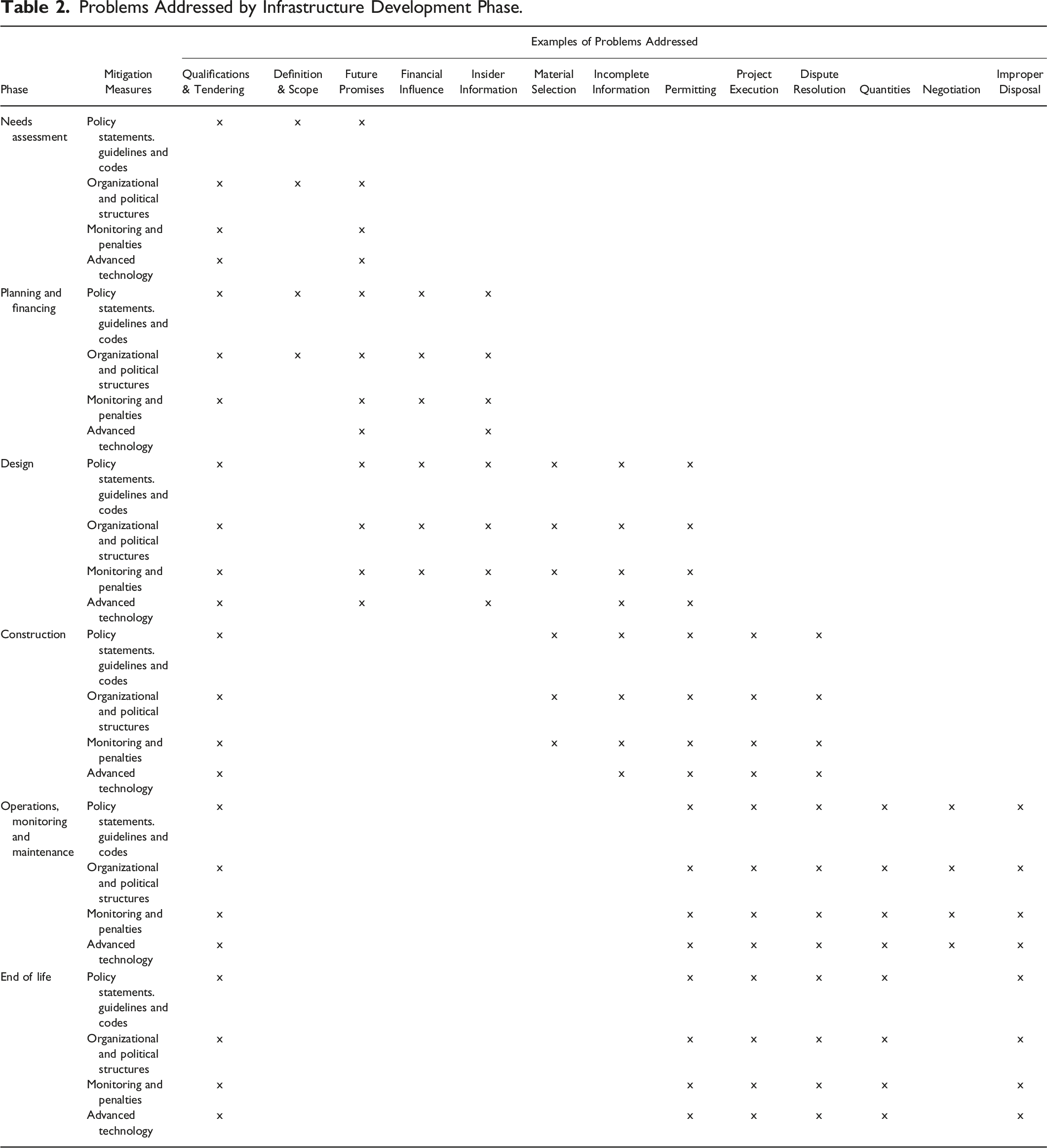
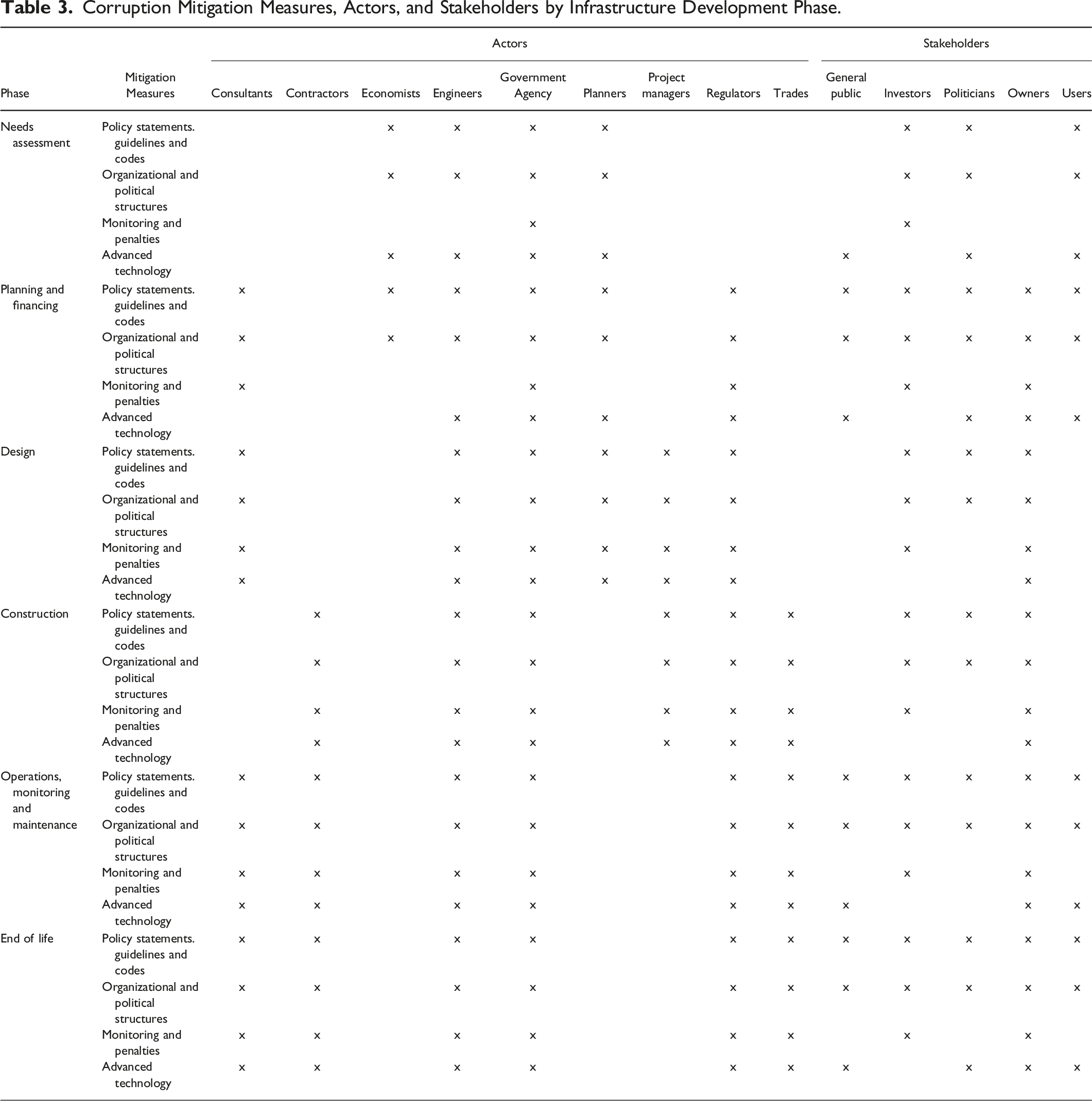
To illustrate how this framework could be applied, consider a transportation agency concerned with corruption related to land development during the planning and financing phase of the project. Specifically, insider information may be used by individuals seeking profits from land development. Table 2 suggests that all four types of mitigation measures can be used to address this corruption issue, and Table 3 recognizes the actors and stakeholders that must be engaged. This example underscores the multiple opportunities for insider information as there are many different players. Furthermore, the example highlights the opportunities for more detailed analysis looking at specific mitigation issues.
Conclusions
Corruption continues to erode trust in government, impair economic development, and exacerbate poverty, social tension, and inequality. In the infrastructure development sector, specific impacts of corruption may include reduction of funds used for projects, poor quality of work, and reduced longevity of the infrastructure. This paper is predicated on the premise that each phase of infrastructure development has peculiar vulnerabilities to corruption and these phases are generally distinct across time, involve different levels of cash outlay, and engage different actors and stakeholders. The ex-ante identification of areas of corrupt practices at each phase of infrastructure development serves as a starting point for new initiatives or for renewed reinforcement of existing corruption mitigation strategies and policies. The study was motivated not only by the sheer volume of financial resources lost through corruption but also by the changing nature of corruption across the years (earlier initiatives may not always work at the current time and in the future).
In addressing our objective of analyzing corruption propensity and opportunities for mitigation at each phase of infrastructure development, the paper addresses the gap in the existing literature on corruption from the infrastructure life cycle perspective. The paper identifies corruption issues and corruption mitigation opportunities, at each phase of infrastructure life cycle where stakeholders and actors can help undertake specific actions to mitigate corruption. The paper’s methodology included a characterization of corruption and mitigation measures through a framework that is based on the phases, and a connection of the mitigation measures to the relevant actors and stakeholders identified in the paper. The framework offers a structure for more detailed analysis that could review how to target actors and stakeholders to address specific corruption issues in each phase of infrastructure development, building on analysis similar to that presented in the example of corrupt land development.
A limitation of the paper is the lack of quantitative data analysis to examine, at each phase, the probability that a particular type of corruption occurs and its magnitude. Also, future work could examine the efficacy of mitigation initiatives (policy statements, guidelines, and codes, organizational and political structures, monitoring and penalties, and advanced technologies) in the short- and long-term. Research could also investigate the conditions and attributes that promote or inhibit such efficacy, and any interactions between them. For this, it will be needed to collect data, for each instance of corruption, the type, scale, assigned causes, risk indicators, project type and size, phase in question, and so on. Such a dataset could help answer several other questions on corruption, for example, how corruption in one phase influences corruption in another phase, how the efficacy of mitigation in one phase influences the efficacy of mitigation in another phase, and so on. Future work could address these questions. In sum, it is hoped that the paper’s analysis provides a platform upon which further research investigations can be carried out into identifying the patterns between phase-related attributes and corruption.
From the standpoint of infrastructure providers and managers, the analysis results can throw more light on the identification and measurement of the roles of actors and stakeholders relevant to the quest for corruption mitigation at each phase, and this could help guide the establishment of offices or positions within the agency dedicated to this mission. The contribution of the framework is a structure that helps to target classes of corruption mitigation methods to problems in specific phases of infrastructure development and identifies the actors and stakeholders that must be engaged to begin implementation of such mitigation measures.
Footnotes
Acknowledgments
The authors are grateful to Dr. Andrew Tarko, Dr. John Haddock, and Dr. Philip Dunston for their suggestions and comments. Also, the authors wish to express their gratitude to the editor Richard G. Little and the reviewers for their constructive input and kind feedback. The contents of this paper reflect the views of the authors (who are responsible for the facts and the accuracy of the data presented herein) and do not necessarily reflect the official views or policies of any organization, nor do the contents constitute a standard, specification, or regulation.
Declaration of Conflicting Interests
The author(s) declared no potential conflicts of interest with respect to the research, authorship, and/or publication of this article.
Funding
The author(s) received no financial support for the research, authorship, and/or publication of this article.
Data Availability Statement
The datasets used in this study are available upon request.
