




Abstract
The use of public–private partnerships (PPPs) for infrastructure provision has not always been based on their promise to deliver value for money (VfM). PPPs have also been applied to keep investments off governments’ annual accounts. This article links that motivation to particular modes of practice. It depicts the case of the Belgian region of Flanders. In this jurisdiction, a long-term PPP policy strategy, central coordination mechanism, and application of VfM assessment tools have remained absent. PPP has been used in an ad hoc way, which has granted government departments leeway in closing partnership deals. The result has been a fragmentation of both knowledge and practices. It will be challenging to realize reforms that include a more critical stance toward PPP and foster learning processes: Actors have become used to their ways of dealing with PPP and seek to pursue their own fragmented trajectories.
Introduction
As governments have increasingly come to see public infrastructure as an asset class and, therefore, welcomed private financiers and investors to take care of its provision, the popularity of public–private partnerships (PPPs) has grown over the past few decades. A PPP is a specific approach to the construction and maintenance of infrastructure in which the private sector finances a project; takes on an expanded role for facility design, construction, operations, and/or maintenance; and bears a considerable amount of risk (Grimsey & Lewis, 2004). Although it remains difficult to present a generally accepted definition of PPP (Donahue & Zeckhauser, 2011), in this article, it is seen as a form of project finance wherein the private sector handles the upfront costs for the provision of public infrastructures and facilities, and also takes care of their design, construction, and maintenance. Arrangements such as these are typically laid down in design–build–finance–maintain (DBFM) contracts (Little, 2011).
Across the globe, PPP projects have been packed with governance challenges. They require governments and private sector partners to exert major efforts in terms of preparation, procurement, management, and operation, leading to high transaction costs (De Schepper, Haezendonck, & Dooms, 2015; Dudkin & Välilä, 2005). Questions have been posed about such issues as the actual achievement of value for money (VfM; Pollock, Prince, & Player, 2007; Siemiatycki & Farooqi, 2012) and excessive private returns on investment (Shaoul, Stafford, & Stapleton, 2006; Vecchi, Hellowell, & Gatti, 2013). Although the literature on public–private endeavors has covered a lot of ground, scholars have particularly addressed matters that play at project level, including inter alia the challenges of risk management, financing, contractual negotiations, democratic accountability, and performance and evaluation (see, for instance, Bel, Brown, & Marques, 2013; Boyer & Newcomer, 2015; Cruz & Marques, 2013). Much less attention has been paid to macro-level issues. For instance, little is known about the hows and whys of formulating, implementing, and monitoring PPP policy at central government level. International organizations have distributed many (advisory) reports on PPP policy (Organization for Economic Co-operation and Development, 2008; United Nations Economic Commission for Europe, 2008; World Bank Group & PPIAF, 2015), but scholarly research is lagging behind, particularly when it comes to general analyses of specific countries or regions (for some exceptions, see Mouraviev & Kakabadse, 2014, on Russia; Siemiatycki, 2015, on Canada).
The aforementioned literature gap is striking given the high degree of politics involved in and related to decision making on PPP, as illustrated by Teisman and Klijn (2002) and Hodge and Greve (2010, 2017). They refer to the potential of PPP as a helpful tool of political rhetoric. Moreover, as PPPs have a significant long-term impact on government budgets and generations to come, they require a profoundly motivated and solid policy model. The contribution of this article lies in addressing PPP policy in light of the long-term impact it has vis-à-vis the motivations behind it, and the modes of practice as they unfold. PPP policy is not always clearly formulated, let alone based on a long-term strategy aimed at delivering goods and services against a better VfM ratio. PPP has long been popular due to the opportunities it creates for developing infrastructures and facilities on a “credit card” basis (i.e., off–balance sheet financing; Hodge & Greve, 2013). Following this motivation to take a PPP route, there is no real need to define a clear official policy strategy, organize a central coordination mechanism, or establish objective ex ante evaluation assessment techniques that help determine whether a PPP approach to an infrastructure project pays off in the end in terms of value for taxpayers’ money; PPP is simply seen as a measure for cash-strapped governments that seek a “buy now, pay later”–type delivery of infrastructure, so that they can uphold or improve the quality level of their facilities.
The risk of the credit card rationale is that PPP becomes an obvious, if not the only approach to be applied toward infrastructure provision, and that a critical review of possible procurement options is no longer considered by policy makers and public managers—even though it would be in the interest of the general public that all options are assessed. The implications of this bias in PPP practice may not become manifest in the short run, but there are budgeting and maintenance consequences for other policy sectors and future generations, because long-term infrastructure contracts are closed for several decades and significant contractual variations are costly and rare. Therefore, to better safeguard the public interest, reforms are required so as to strengthen both the structure and clarity of PPP policy. PPP should not be seen as an apolitical phenomenon that is “business as usual.” Decision makers and public officials should engage critically with the subject, because as a tool that allocates values, PPP is by all means a political instrument that deserves attention in the public debate.
This article provides a critical reflection of PPP policy in the Belgian region of Flanders. In this jurisdiction, off–balance sheet financing has been an important driver of PPPs, which is indicated by the fact that a number of infrastructure projects that were initially developed as mere public projects were reengineered as PPPs after the government had stumbled upon a lack of public funding (De Boeck & Van Horenbeek, 2015; Martens, 2015; Willems & Van Dooren, 2016). I argue that the impact of this motivation is reflected in the Flemish modes of PPP practice, which depict a fragmented implementation of PPPs among various government departments. Although I explicate a number of practical recommendations on reforming Flemish PPP policy and practice toward a longer term orientation and more efficient ways of making and implementing policy, it is important to acknowledge that it will be difficult for government departments to abandon their trusted paths for the sake of a more critical and realistic position of the government relative to PPP procurement. The findings are based on a dissertation project about Flemish PPPs for public infrastructure.
Why Governments Make PPPs—And the Implications for PPP Policy
Governments have developed PPPs for various reasons, and their motivations have evolved over time (Greve & Hodge, 2013; Hodge & Greve, 2017), but ideological and political reasons have been dominant. One of the main rationales supporting the use of PPP is that the private sector is assumed to act more efficiently than the public sector. Private companies, with their own money at stake, are believed to have a strong incentive to manage projects properly; involving them in all stages of infrastructure provision would help governments achieve better value for taxpayers’ money (Grimsey & Lewis, 2005; Ortiz & Buxbaum, 2008). Many governments have officially presented their PPP policies to taxpayers as VfM drivers, that is, as governance tools that eventually serve state treasuries by delivering a better (or equal) product for the same (or a lower) price. In addition, the risk transfer mechanism is argued to lead to improvements in the on-time and on-budget delivery of projects (Greve & Hodge, 2013).
But PPP is not only appealing ideologically. It also has a political attractiveness to it, which brings us to an important, but often latent, political motivation behind formulating PPP policy: off–balance sheet financing and the opportunity to build big now and pay the bill in the future. The payment system of a DBFM agreement is usually based on availability fees: A government need not pay the private concessionaire until a product has been delivered and operates in compliance with predefined specifications. Therefore, to a great extent, the government pays for the services delivered on a credit card basis: Infrastructure can be bought now and paid for later. Thus, public infrastructure decisions that are taken today do not burden the government’s current balance sheet. In addition, as long as a sufficient amount of risk is being transferred to the private concessionaire, the outstanding payments need not be marked as public debt. The government is not officially considered as a debtor because the private concessionaire takes care of the financing. The government may be tied to a fee payment system of several decades’ length, which covers the full cost of the project of concern, but this cost will not appear on the annual books as such. This could lure governments into the direction of closing partnership deals for mere budgetary reasons. It is here that the risk of poorly defined and implemented PPP policy comes in.
Scholars have addressed the importance of a number of aspects relative to building and implementing solid, long-term PPP policies. They emphasize the need for a clear vision, a centralized coordination structure, sufficient institutional support, and knowledge codification (Rachwalski & Ross, 2010; Verhoest, Petersen, Scherrer, & Soecipto, 2015; Vining & Boardman, 2008). Based on their extensive analysis of the governmental support for PPP in 20 European countries, Verhoest et al. (2015) argue that a combination of specific policies and laws, public support through specialized institutions, and procedures for project appraisal is a necessary factor to explain PPP activity. On a more specific note, Rachwalski and Ross (2010) are particularly clear on the advantages of PPP policy in terms of the opportunities it creates for economics of scale and scope, for instance, by having the same people involved in multiple projects, thereby enabling cross-sector learning and reducing redundancy.
The policy components put forward by the aforementioned scholars can be established in various ways, for instance, by formulating a clear policy document, creating a project pipeline, setting up a capable procurement agency, and developing decision-making support instruments that objectively determine whether PPP is the appropriate route to the delivery of a project or not. This article argues that when off–balance sheet financing is a key rationale behind a government’s decision to take a PPP route, a PPP policy will likely lack a solid basis for its existence and implementation. If the most important objective is to deliver public projects without burdening the current public accounts, the general approach will be to do just that—and possibly even show a bias toward delivering public projects through PPP models. This will result in a mode of practice of project delivery that hardly involves any of the policy aspects mentioned above, simply because these are not considered to be necessary for the achievement of the objective of delivering projects now and paying for them later. Furthermore, I foresee a piecemeal approach that is characterized by various individualized modes of practice among government departments who can do as they please as there is no overarching strategy or philosophy other than the off–balance sheet argument, and consequently limited learning across departmental borders. Due to the narrow objective, there will be limited consideration of the “shadow of the future” that is cast by PPP deals, limited focus on creating better projects in terms of value for taxpayers’ money, and limited attention for building a sustainable, comprehensive strategy. In addition, as PPP is “sold” to government departments as a tool for infrastructure delivery in times of limited public financial resources, the risk of embracing the PPP model without reservations is that other procurement models no longer receive proportionate attention—even though they are most often appropriate for the delivery of a project. This is a relevant issue, for only objective analysis allows decision makers to see what works and what should be avoided, and to act accordingly.
Method
The results discussed in this article are based on a study of the use of PPP in the Belgian region of Flanders. Unlike pioneering countries such as the United Kingdom, Australia, and Canada, Belgium embraced the PPP concept relatively late and only to a limited degree. In the Brussels-Capital Region and the Walloon Region, PPP never became the subject of a policy program. Only in the northern federated region of the country, Flanders, some sort of policy strategy has been implemented. The use of PPP was explicitly promoted in a 2004 document, which set out the Flemish Prime Minister’s policy strategy (Flemish Parliament, 2004), and the first PPP deals procured by the Flemish government were not closed until 2005. However, during the past decade, Flanders has seen investments in PPP programs and projects in a wide range of sectors, for instance, road infrastructure, light rail, and social facilities (Flemish Parliament, 2015), giving the Flemish Region an edge over the other two regions, as well as over the Belgian Federal Government—which has only limited legal authority and decision-making power when it comes to large-scale infrastructure development. According to the 2015 annual government report on alternative financing, the total annual amount spent on availability fees for DBFM contracts in Flanders that were closed before mid-2014 is 286 million euros (Flemish Parliament, 2015). The fees for the contracts closed in school infrastructure (“Schools of Tomorrow”), road infrastructure (“Via-Invest”), and a road toll system (“ViaPass”) comprise 90% of this total amount. All in all, its status as late, but committed PPP adopter made the case of the Flemish Region particularly interesting to scrutinize as one would expect ample opportunity for policy learning on the basis of experiences in other, early-adopting jurisdictions.
The data analyzed for this article were drawn from three main sources: government documents and other publicly available material, nondisclosed project documents, and interviews. Among the gathered public material were parliamentary proceedings, parliamentary questions and ministerial answers, annual government reports on alternative financing, policy notes, evaluation studies, project websites, and press releases. I studied these documents to generate a systematic overview of Flemish PPP policy, and as part of two longitudinal, retrospective case studies of Flemish PPP programs: the “Flemish Sports Infrastructure Program” (FSIP), which was aimed at resolving Flanders’ severe shortage of sports facilities, and “Via-Invest,” an extensive plan of the Flemish Government to improve the region’s road network. As for nondisclosed project documents, I consulted a limited number of model and signed DBFM agreements that have been procured over the past decade. Finally, I conducted face-to-face interviews with 39 experts to unravel further the whys and hows of Flemish PPP policy. The public sector was represented by 21 respondents, the private sector by 17 respondents, and there was one respondent from a nonprofit organization. Table 1 provides an overview of their backgrounds. Except for two respondents who objected to being interviewed on the record, all interviews were taped and fully transcribed. Finally, besides the three main data sources, I attended public seminars and events on PPP in Flanders and kept in touch with the Flemish PPP Knowledge Centre about ongoing developments.
Background Information About Interview Respondents.
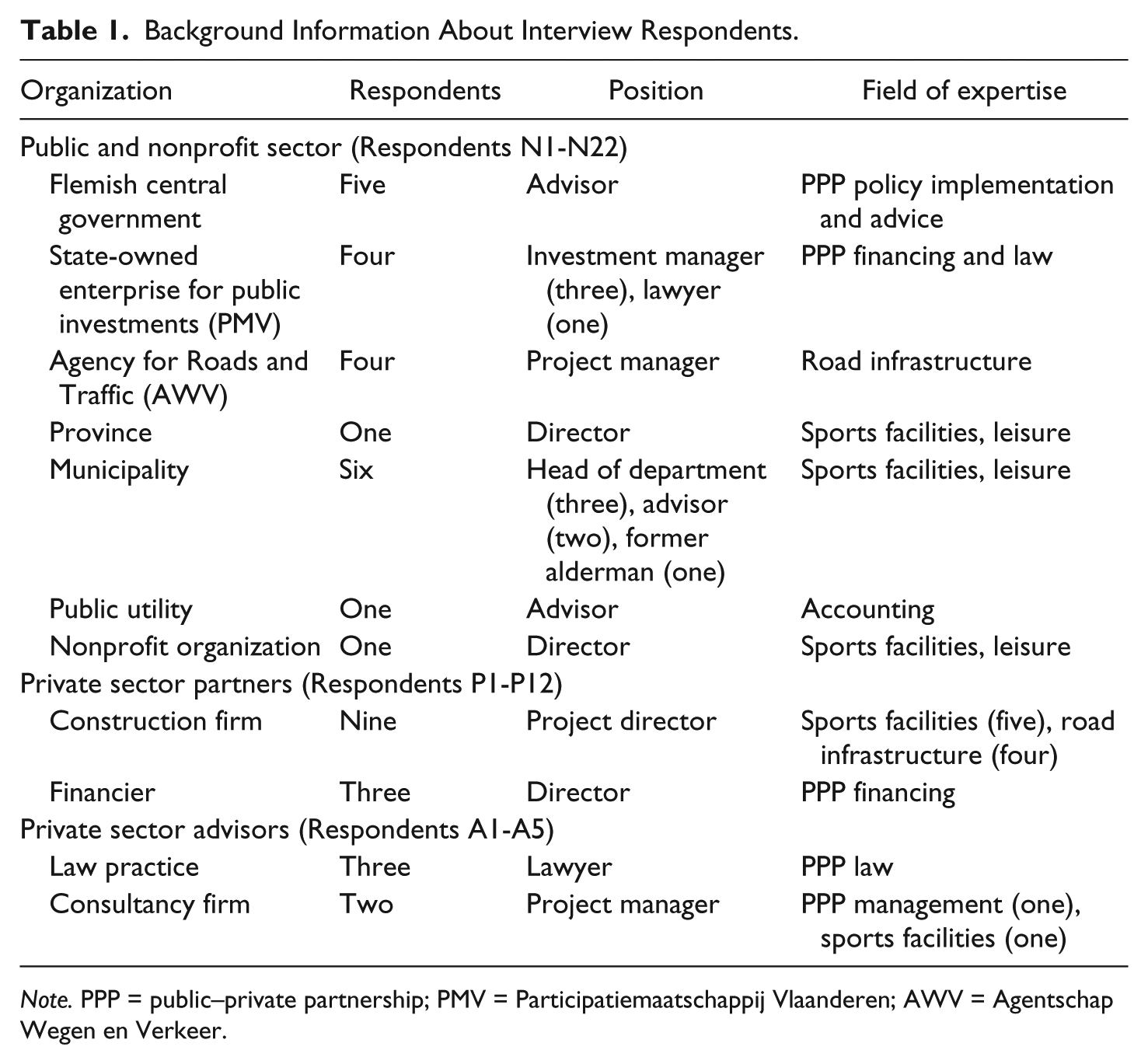
Note. PPP = public–private partnership; PMV = Participatiemaatschappij Vlaanderen; AWV = Agentschap Wegen en Verkeer.
I reconstructed the policy by composing an overview of main events and dates, as well as project-specific information. I used QSR NVivo, a software package that assists in the analysis of qualitative data, for the analysis of the interviews (Bazeley, 2007). Once I had familiarized myself with the interview data by thoroughly reading and rereading the transcripts, I started a systematic two-phase coding process. First, I arranged the large amounts of data by labeling the statements of the interviewees and categorizing them into themes (Gibson & Brown, 2009). Second, I conducted assignments querying the aggregated data to uncover specific patterns, co-occurrences of themes, and recurring issues (Boyatzis, 1998). I used the results of these queries to interpret the collected views. Table 2 offers an overview of the data collection and analysis that were part of this dissertation project.
Overview of Data Collection and Analysis.
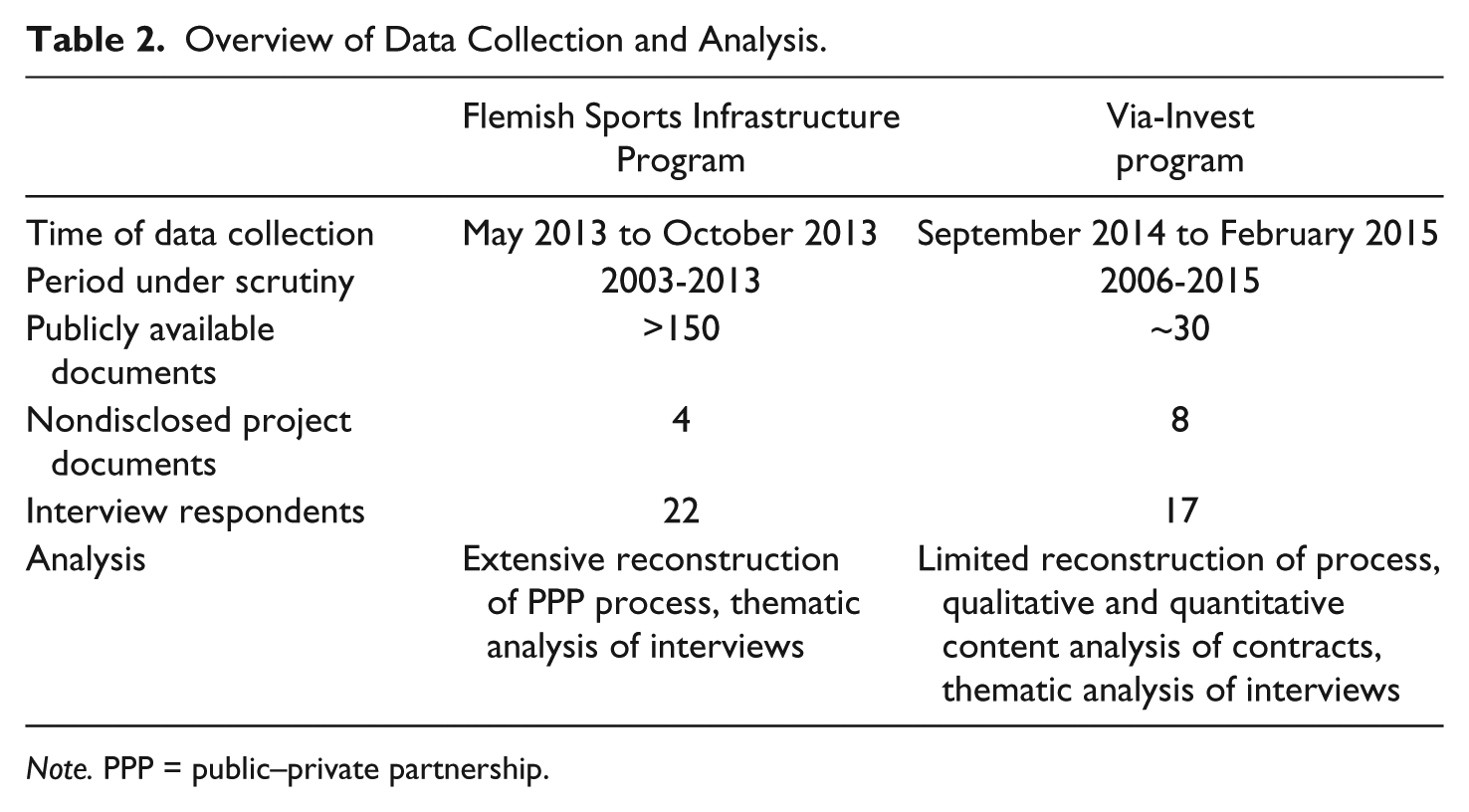
Note. PPP = public–private partnership.
PPP Policy in Flanders: A Specific Case
In the early 2000s, the Flemish government formulated legislation—the Flemish PPP Decree—which enabled the stimulation and facilitation of PPP initiatives. Following that, it established the Flemish PPP Knowledge Centre, a government entity falling under auspices of the Prime Minister, which was to support the introduction and implementation of PPP in its function as an advisory entity. In the following years, PPP received considerable attention in Flemish government documents, particularly in sector-specific policy briefs (see, for example, Peeters, 2007, 2008). Although a clear, exhaustive overview of PPP projects that are under construction or in operation in Belgium does not exist, Verhoest, Van Garsse, van den Hurk, and Willems (2016) estimate that the total volume amounted to seven billion euros in 2016. The lion’s share of this volume concerned projects in Flanders.
Off–balance sheet financing has long been the main driver for the development of PPP projects in the Flemish Region (Willems & Van Dooren, 2016), and as public budgetary resources have remained limitedly available over the years, the Flemish government has continued to fall back on the private financing of public infrastructure provision. The attractiveness of the PPP approach was further strengthened by the urgent need for improvement of the state of Flemish economic and social infrastructure (see, for instance, Van Hecke et al., 2008, on sports facilities). Private financing, thus, did not only create an opportunity to circumvent treasury limits but also fostered the launch of programs aimed at renewing and refurbishing infrastructure. Over time, the Flemish PPP practice has become one of a specific character. I explain this by elaborating on three of its peculiarities: hybrid partnerships, bundled procurement trajectories, and the application of PPP in relatively uncommon sectors.
Hybrid Partnerships
Soon after PPP was embraced by the Flemish government, several public limited companies (PLCs) were established that were to launch partnerships in specific sectors. For instance, in the road infrastructure sector, a PLC called “Via-Invest” was founded with the aim of initiating PPPs and resolving missing links in the Flemish road network (Decrem, Caestecker, & Polen, 2009). In these PLCs, a significant role is typically played by “Participatiemaatschappij Vlaanderen” (PMV), a state-owned enterprise that supports economic investment initiatives and contributes financially to these PLCs. The PLCs in turn participate in Special Purpose Vehicles (SPVs) that are responsible for the construction of PPP projects. According to Verhoest and his co-authors (2016), PMV sets up and invests in PPP projects, and helps other entities make their projects operational. It provides financial levers if the market needs support and if desirable private initiatives fail to evolve.
The role of PMV brings us to a first peculiarity of Flemish PPP policy and practice: The Flemish government does not only act as the contracting authority in PPP projects (i.e., as the referee); as a publicly owned entity, PMV indirectly has a stake in the SPVs that are responsible for project realization. As such, one could say that the government wears two hats: Not only does it, as a principal, close a DBFM agreement with a private sector partner (i.e., the SPV), it also actually has a stake in that very SPV—as a minority shareholder, through its state-owned enterprise PMV (Van Gestel, Voets, & Verhoest, 2011). A considerable number of Flemish PPPs are built on these so-called “hybrids,” which include a double control and steering structure: (a) mixed public–private SPVs to execute the program and (b) strict DBFM framework agreements between the SPVs and the Flemish government (Van Gestel et al., 2011). Private sector respondent P5 articulated his perspective on this as follows: The thing is that—and I have to mention this—you are negotiating with a party you like cooperating with, but that very party wears two hats . . . They have to represent municipalities, but they also have to represent their own interests within that SPV.
Many other private sector respondents echoed this view on the potential conflict of interest that is at play.
The trick in hybrid partnerships has long been to shift just enough risk from the public sector to the private sector partner for the contract to be qualified as a private endeavor that would not need to be incorporated in the public budget. In fact, as respondent N7 explained, “the projects were tendered under the specific condition that they had to remain budget neutral”—that is, not affect the public balance sheet. Little is known about foreign examples of hybrid partnerships, which lay somewhere in between mere contractual PPP models (in which there is a clear distinction between the principal and the agent) and joint venture models (in which the public and private sector typically bear an equal amount of risk, on a 50–50 basis).
Bundled Procurement
The specificity of Flemish PPP policy and practice also comes to the fore in a repeated use of bundled procurement: procuring multiple similar projects in groups. In this type of procurement, the Flemish government negotiates large PPP contracts on behalf of local authorities based on a mandate agreement. Within such a large contract, the winning private bidder then concludes separate contracts with all local authorities involved and for which the infrastructure will be built (van den Hurk, 2015). This, too, is an approach that does not have many parallels in Europe. A similar approach was applied in the Building Schools for the Future Program in the United Kingdom, yet after being criticized for failure, this program was scrapped by the British Government (National Audit Office, 2009). It was said to be characterized by “massive overspends, tragic delays, botched construction projects and needless bureaucracy” (Richardson, 2010).
It is argued that bundling creates opportunities for economies of scale—both for the government and the builder. In Flanders, bundling the procurement of projects was useful as a way to attract the private sector’s attention and be able to deliver as many projects as possible in a relatively short time frame. However, bundling procurement also brings in aspects of uncertainty: Many different actors become involved in the same deal, and all of them have to agree on which i’s to dot and t’s to cross before contracts can be signed. “In the contract you need to determine that a number of clauses in one local agreement cannot be changed unless it is changed in all local agreements,” said respondent N6. For instance, it would be too much hassle to work with payment regimes that vary in terms of the payment intervals. Tailoring agreements such as that would complicate the deal and create a form of uncertainty, which would eventually lead to higher financing fees because banks would have to incorporate those elements of complexity and uncertainty in their pricing.
PPP in Uncommon Sectors
A third illustration that indicates the somewhat odd character of PPP in Flanders is the fact that the Flemish government has made major investments through PPP programs in small public facilities, such as day-to-day sports facilities. This approach is uncommon as seen from an international perspective. Public–private investments in complex, large-scale sports infrastructure related to major sports events and sports leagues are common phenomena; they attract the interest of private financiers because they can be turned into lucrative investments due to their size (often larger than 100 million euros; see, for instance, Cabral & Silva, 2013; Long, 2013). The largest projects in day-to-day sports facilities in Flanders barely exceeded a total value of 40 million euros, though. In projects of this size, the costs are relatively high compared with the revenues that are generated. Other than that, given the relative simplicity of sports facilities, there are various other ways of making structural, sustainable investments in this sector. Following the comments of many respondents, a full-fledged system of subsidization and strict maintenance contracts would have done the job too—without burdening inexperienced local public executives with complex, comprehensive contracts.
Complex Landscape, Dispersed Knowledge
The former three characteristics of Flemish PPP policy provide an indication of its specificity. In addition, the Flemish PPP landscape has often been said to be particularly complex. Belgian scholars have condemned the use of novel organizational structures and procurement strategies (De Schepper, Dooms, & Haezendonck, 2014; Van Gestel, Willems, Verhoest, Voets, & Van Garsse, 2014; Willems, 2014). Although PPP is complex by definition, in Flanders, this complexity worsened due to the use of relatively untested governance structures that fit neither the context nor the characteristics of the infrastructure assets that were constructed (van den Hurk & Verhoest, 2015).
Next to the impression that the Flemish approach has been complicated and different from approaches applied in other jurisdictions, within the Flemish government, a variety of modes of PPP practice has evolved. The knowledge and expertise relative to PPP are fragmented across the wide range of Flemish public authorities, both at regional and local levels. For instance, the Flemish public transit company “De Lijn” has procured a number of light rail PPPs, and PMV has built experience with its direct involvement in PPPs in road infrastructure, sports facilities, and a couple of other ventures. Government bodies such as the Agency for Roads and Traffic (“AWV” by its Dutch acronym) and the autonomous agency for the maintenance, operation, management, and commercialization of the eastern waterways (“nv De Scheepvaart” in Dutch) have also become involved in PPP programs and projects. Some of the larger cities in the region, such as Antwerp and Ghent, have become familiar with the PPP formula as well. A considerable number of actors have thus acquired partial knowledge, and they could help each other in trying to move forward by engaging in a cross-sectorial learning process.
The Flemish government has taken measures that indicate that it recognizes and acts on the need for intersectorial and interdepartmental learning. Various initiatives were launched over the past few years, including events and workshops aimed at knowledge sharing and the standardization of instruments and contracts by the Flemish PPP Knowledge Centre (Flemish Parliament, 2011b, 2013b; Flemish PPP Knowledge Centre, 2014). Also, several model contracts have been developed by a number of public actors, on the basis of earlier model contracts that had been used in other sectors. Furthermore, Respondents P4, N7, and N9 explained that the origin of the model contracts was in documents written by “Rijkswaterstaat”, which is the executive agency of the Dutch Ministry of Infrastructure and Water Management (formerly known as Ministry of Infrastructure and the Environment), and documents written by English public agencies working on infrastructure deals.
Nevertheless, some government initiatives toward learning processes have been more successful than others. For instance, in 2012, the Prime Minister of Flanders mentioned that there was a lack of awareness among local governments regarding the availability of PPP instruments (Flemish Parliament, 2012b). In addition, according to the respondents, some opportunities for capturing lessons learned may not have been (fully) used, and some initiatives have been struggling to get off the ground, as I will explain later. Similarly, based on a case study of two railway tunnel projects in Belgium, Aerts, Dooms, and Haezendonck (2017) notice that “inter-project learning remains quite troublesome” (pp. 14-15). Thus, there is (or sometimes was) room for improvement here. I argue that these missed opportunities trace back to the fragmented character of the administrative constellation, and the lack of a long-term PPP policy strategy at the regional level, which incurred a particular mode of PPP practice.
Coordination Issues
One way to foster structural improvements among a range of public departments, and to instigate a learning process, would be to arrange regular meetings or establish a taskforce that systematically evaluates past experiences and formulates lessons learned. However, although some Flemish actors have undertaken such initiatives to bring parties together, knowledge sharing and distribution are easier said than done. Public actors such as PMV and De Lijn are inclined to stick with their own agendas and their own approaches. They are not necessarily willing, let alone obligated, to share information with their peers. According to the interview respondents, the Flemish PPP Knowledge Centre has been trying to get the different departments together with the aim to create some sort of convergence by comparing and revisiting the contractual clauses that are used in different departments, but this process has been difficult and time consuming. It is argued that some parties do not see the usefulness of a generic approach. One of the respondents who belonged to the latter group of skeptics argued the following with regard to the use of standardized DBFM contracts: What is the point of creating a generic contract? We have based our model on an international standard . . . We benchmark regularly with new standards in the United Kingdom. We work with lawyers that are active at an international level . . . What else should we do? . . . Other departments have their own contracts . . . Every department has a certain degree of freedom and applies a certain approach. (Respondent N9)
Respondent A5, who has been involved in many Flemish PPP projects as an SPV manager, acknowledged that in PPP practice, there is widespread skepticism on the question of knowledge sharing: “We see very few exercises being conducted in ‘lessons learned.’ Actors reflect either slowly or hardly on previous projects as they move on toward future projects.” Although public agencies do show interest in each other’s experience, that is, in listening to each other’s stories, they do not show any interest in actively cooperating toward universal solutions or formulae to common or returning problems with particular contractual clauses (Respondent N5).
In comparing Flanders with other jurisdictions, one of the interview respondents emphasized the administrative exceptionalities of Flanders, including the high degree of compartmentalization of knowledge and expertise. He pointed to the fact that within the Flemish government, different contracts are used although there are many opportunities for savings in terms of time, negotiations, and project studies if the contracting authorities come together and try to learn from each other. However, it would be too easy to blame the variety in PPP approaches merely on the fragmented institutional landscape of Flanders. This is where the lack of a long-term PPP policy strategy comes in.
Many interview respondents commented that, had a structured and centralized Flemish PPP policy approach been followed from the very beginning, a great deal of the aforementioned diversification and learning challenges would have been avoided. However, instead of following a prescribed, centralized trajectory, departments were given significant leeway to apply an individual approach and call in the help of different external advisors, and that is where the diversification started. The main, if latent, objective was clear: Build infrastructures and facilities in such a way that they do not burden today’s public budget. Although VfM has always been announced as the official reason for the Flemish government to embrace the PPP concept, the general mode of practice shows no objective, quantified assessment of VfM, but an approach in which PPP is basically considered the only way to deliver projects without burdening the public budget right away. Therefore, some interview respondents argued that in Flanders, a policy on PPP has hardly taken off; it is generally seen as a solution for cash-strapped governments to continue or improve their delivery of services to the public.
The fact that the current initiative of the Flemish PPP Knowledge Centre to get departments together is progressing slowly suggests that these departments have always been working independently and do not see the necessity of this exercise at this point. Several respondents argued that departments have become confident with their own standard models, which makes it difficult to find a generic model at this stage; departments prefer to “stay on their own island” (Respondent A5). One could argue that it is now too late to try to converge the approaches. Flanders’ late uptake of PPP initially offered ample opportunity to learn from other jurisdictions, but in many cases, the Flemish government invented a specific approach, and departments within the Flemish government have arguably been reinventing the wheel by trying to find their own routes and due to a lack of knowledge sharing across sectorial boundaries.
Pathways for Practice
While summing up the observations on Flemish PPP policy, it becomes clear that there has been limited centralized coordination. By lack of a strong vision on PPP policy and a related pipeline of projects, and due to the key motivation of delivering goods and services without burdening today’s public budgets, government departments tackled PPP issues on their own. However, times have changed since the early 2000s. Eurostat 1 has been condemning the way Flanders has treated its PPP projects in the public budgets for a couple of years now. It seems that the long-been motivation for PPP of off–balance sheet financing is no longer valid, and the Flemish government has been put under pressure to get rid of the approach it applied ever since it started using PPPs (De Boeck & Van Horenbeek, 2015; Van Horenbeek & De Boeck, 2015). If Flanders wants to continue developing infrastructures and facilities through PPPs, it has to find a different motivation to use them, change the spirit of the contractual deals it signs, and abandon its old PPP delivery model altogether. Reforms are thus required.
If Flemish experiences with PPP are to be improved, I suggest a number of policy options for policy makers and public managers, the bottom line being that an investment needs to be made in professionalization. This investment consists of two steps: the development of a generic policy strategy for public infrastructure that applies a different motivation for the use of PPP and the establishment of a public organization that takes responsibility for procurement tasks, centralizes relevant competencies and activities, and educates public managers.
Toward a Generic Policy Strategy
The process toward better PPP starts with a generic, clear, and structured long-term policy strategy on public infrastructure provision that abandons any form of motivation related to off–balance sheet financing. By shifting to achieving VfM as the key motivation for PPP, carefully calculating how much is risk transferred from the public sector to the private sector, and drawing a proper comparison with public alternatives, the decision making on whether to use a PPP approach or not becomes more thorough. Comparative endeavors have been undertaken in other PPP-minded jurisdictions, such as the United Kingdom (HM Treasury, 2013; HM Treasury Infrastructure, 2010), the Netherlands (Dutch Ministry of Infrastructure and the Environment, 2015), and some Canadian provinces (Government of British Columbia, 2015; Ontario Ministry of Infrastructure, 2011).
By developing an integrated policy strategy on public infrastructure provision in general and not on PPP as such, the Flemish government would create an opportunity to remove any bias toward favoring PPP solutions to infrastructure problems. Furthermore, a long-term-oriented, programmatic way of working that integrates all relevant departments of the Flemish government creates a better financial overview of current and future expenditures on infrastructure projects. It enhances opportunities for interdepartmental collaboration by bringing proposals, plans, and projects together. In addition, this integrated approach could help avoid situations in which different departments hear about their plans to develop infrastructure in the same geographical area at rather late notice. An apt example of this is the combined construction of the “Diabolo” railway tunnel and the improvement of the northern access road to Brussels International Airport (“Via-Invest Zaventem”). Although the two responsible contracting authorities (railway provider Infrabel and road agency AWV) eventually merged activities to benefit their projects and limit the nuisance to residents, they only became mutually aware of their plans when their project plans were about to enter the tender phase. By that time, a significant amount of community money had already been spent on two different tendering procedures instead of one—that is, twice the amount of legal fees, staff wages and benefits, and administrative costs, to mention but a few expenses.
Organizational Support
Professionalization also thrives on the establishment of an organization with competent, high-caliber staff who know the ins and outs of public infrastructure deals. A new public agency could serve as a procurement agent on behalf of the Flemish government and embody a centralization of procurement tasks and competencies. The involvement of this agency could be mandatory, for projects above a certain threshold, and voluntary, where the project value remains below a predefined level. In both cases, it should be able to deliver top-class process management teams that help public executives move forward in the process toward the construction and operational phase of a public infrastructure project.
Although I have earlier referred to PMV, De Lijn, and a couple of other organizations as relatively experienced public actors when it comes to PPP, others are lagging behind even though they have also been closing DBFM agreements or other PPP contracts—for instance, small municipalities that have closed long-term deals in bundled procurement procedures. The challenge for these smaller entities is that they only build up marginal experience with PPP; they do not have sufficient financial resources to procure many projects, and as a result, they will struggle to maintain, let alone improve, their level of experience-based PPP knowledge. To avoid that the same mistakes are repeatedly made by different actors, the proposed procurement agency can assume an active role in guiding public actors through procurement processes. By working side by side with local public executives, the agency staff can improve the transfer of knowledge and protect the element of locality during the procurement process.
Project proposals beyond a threshold value of 50 million euros typically generate interest from the private sector and make PPP a viable option. 2 In these cases, the proposed agency should conduct systematic, quantitative VfM assessments and help the government decide whether to go PPP or not. This type of assessment is currently nonexistent in Flanders; by implementing it, the government would come one step closer to getting a better sense of why it is actually taking the PPP route toward a project or not. However, I am formulating with caution here, as the performance and sometimes even meaning of VfM assessment tools have been subjects of heated debate. Morallos and Amekudzi (2008) list a number of weaknesses regarding the calculation methods used to determine VfM, and some scholars argue that VfM assessment is susceptible to the manipulative strategies of policy cheerleaders (Flyvbjerg, 2009; Pollock et al., 2007) while “dispassionate, objective analysis” is required (Ortiz & Buxbaum, 2008, p. 136). Their skepticism is understandable, because the details of VfM calculations are usually not publicly available and often remain a black box. Therefore, although the development of a quantitative VfM assessment tool would essentially be a step toward better PPP policy, it remains important to keep an eye on transparency.
The establishment of an agency would also create opportunities to build a proper overview of activities in the development of public infrastructure. There is no such clear and exhaustive overview in Flanders. Although the Flemish Parliament receives annual reports on the Flemish government’s involvement in alternatively financed projects, these reports lack modularity and oversight, and they only provide insight into a selection of projects at the regional level (see annual government reports on alternative financing; for example, Flemish Parliament, 2009, 2010, 2011a, 2012a, 2013a, 2015). The many PPPs that have been implemented at the provincial and local levels are not listed. The proposed agency should have the resources to improve both the collection and distribution of PPP knowledge by setting up an online database that gives basic information about projects (cf. The Canadian Council for Public-Private Partnerships, 2017). The Flemish PPP Knowledge Centre used to publish project information in a project overview on its website, but these data can no longer be found; also, it never provided complete and up-to-date information. It could also manage a knowledge repository on the tools, procedures, and best and worst practices of public infrastructure provision that are available in Flanders. Although the Flemish PPP Knowledge Centre sees it as its task to gather this kind of information, it strongly depends on the goodwill of public departments whether it will receive the data.
Finally, establishing a central procurement agency with a strong position in the Flemish institutional setting may be necessary to bring public departments together and set up a systematic trajectory of learning. Partnership deals require greater vigor in risk assessment, and private financing brings along an extra layer of due diligence that is undertaken by equity investors and lenders. Furthermore, it requires the government to fulfill a role that is significantly different from its role in traditionally procured projects. Public officials, thus, need to acquire new competencies and focus on other considerations than usual (Brown & Potoski, 2003; Joaquin & Greitens, 2012). I recommend investing in resources to train public managers and make them more aware of the nitty-gritty of PPP and other types of major infrastructure projects so that they are better able to recognize specific situations and handle them effectively. This task, too, could be appointed to the new public agency. Themes that deserve thorough attention here are project and process design, output specifications, risk allocation, and contract management, to mention but a few key topics.
With the PPP Knowledge Centre and PMV, the Flemish Region already has two actors that are active at the central government, so one might wonder why continuing with these two actors will not do. There are a number of issues with these actors, though. As for the PPP Knowledge Centre, unless it goes through considerable reforms, it does not have the resources or the mandate to assume a role as a centralized procurement agency. At this point, its manpower consists of not even a handful of full-time equivalents. Other than that, as a mere advisory entity the PPP Knowledge Centre is not entitled to lead tender procedures. As for PMV, bearing in mind its role as coinvestor in PPPs, it would be inappropriate to appoint the role of procurement agency to this organization. The proposed agency should only act as a procurement agent and should not be able to acquire a stake in infrastructure projects through equity capital. Its main job should not be to boost PPP but to better accommodate the procurement of public infrastructure projects (cf. Vining & Boardman, 2008). The objectivity of the proposed agency can only be guaranteed if it is placed at a distance from political decision makers and if the board of the organization is not politically appointed.
Conclusion
Early PPP practices have circled around promises of keeping major public investments off governments’ annual accounts. The Flemish case as presented in this article is a case in point. It shows how the promise of off–balance sheet financing may have lured decision makers into a bias toward PPP solutions. It is explained that due to the focus on using a credit card for public investments, the Flemish PPP practice has become characterized by a particular mode of practice: There has been no central coordination of the policy, and as a result, a fragmentation of knowledge and expertise has risen that is difficult to resolve—even though that would be important in helping public actors move forward in terms of procuring sound infrastructure deals. Other than that, the Flemish government has applied unusual procurement methods and contractual structures, which has triggered complexity.
The problems and challenges encountered in the largely ad hoc use of PPP solutions call for reforms if PPP is to remain a viable option in the future. What is needed is a well-thought, long-term policy that abandons the practices of muddling through which have been noticeable for more than a decade. This renewed policy provides an opportunity not only for more efficient ways of implementing and managing PPP or other approaches to infrastructure provision but also for reforms that ignite better accountable, more representative, and more elaborate solutions to infrastructure problems. It is recommended that future policy includes a stronger sense of the long-term impact and coordination of PPP, which can be achieved through the development of a clear policy vision and respective project plan, and by making available the resources to professionalize government departments, for instance, by setting up a procurement agency. However, as various government departments have developed their own habits and codes of conduct over the past decade, a form of path dependence has come to exist, which makes them reluctant about possible reforms for the benefit of a more critical and realistic approach to PPP.
This article extends the understanding of the dynamics of PPP policy, a research area that has hitherto received limited scholarly attention. Its focus on the sometimes odd, if not unique, modes of PPP practice in Belgium offsets this study against various strands of academic work that have been delivered either on analyses at project level or jurisdictions that can be considered early adopters of PPP, such as Australia, Canada, and the United Kingdom. The particularity of PPP in Flanders emphasizes that even though countries may have moved away from off–balance sheet financing as their motivation for the use of PPP models in infrastructure provision (cf. Siemiatycki, 2015), this short-term orientation remains attractive to policy makers and public managers, and continues to affect the way PPP is implemented—for example, a fragmented implementation pattern in the case of Flanders. As this study reports on a relatively small PPP arena within a small country, it does not represent the experiences of larger (Anglo-Saxon) countries that have shown major amounts of PPP activity. However, the Belgian case study sets the stage for research focused on improving our understanding of PPP policy and practice in countries of similar size, countries that are late adopters of PPP policy as well, and countries with a relatively low PPP volume. Analyses of this kind create an opportunity for theoretical generalization.
Footnotes
Author’s Note
The views expressed herein are those of the author and not those of the Flemish government.
The author conducted this study at University of Antwerp, Belgium.
Declaration of Conflicting Interests
The author(s) declared no potential conflicts of interest with respect to the research, authorship, and/or publication of this article.
Funding
The author(s) disclosed receipt of the following financial support for the research, authorship, and/or publication of this article: This text is based on research conducted within the frame of the Policy Research Center on Governmental Organization—Decisive Governance (SBOV III, 2012-2015), funded by the Flemish government.
