




Abstract
The use of human variable heavy (VH) domain antibodies has been on the rise due to their small scaffold size and simple folding mechanism. A highly diverse library is largely dependent on the diversity introduced within the complementarity-determining region (CDR) cassettes. Here we introduced diversity with the use of a single framework diversifying all three CDRs using tailored codons consisting of degenerate trinucleotides (NNK). The length of the degeneracy in the CDRs was also taken into consideration based on the most frequently occurring length of CDRs and the canonical confirmation for each antibody subfamily. The semisynthetic human VH domain genes were assembled in a single pot using a temperature cascading process. The affinity selection process with Mycobacterium tuberculosis (MTb) α-crystalline was done using a semiautomated process. Enrichment of target-specific clones was observed with successful identification of monoclonal VH domain antibodies for MTb α-crystalline. In short, the semisynthetic library generated was able to select monoclonal VH domain antibodies against full MTb α-crystalline protein with complete semisynthetic CDRs displayed on a single scaffold. The library has the potential to be applied for the isolation of antibodies against other pathogenic proteins.
Introduction
Complete IgG antibodies have a molecular mass of 150 kDa. 1 Smaller formats of antibodies are proven to be beneficial in both diagnostic and therapeutic applications. This can be seen in the study with the human immunodeficiency virus envelope glycoprotein, whereby the bulk size is only accessible by smaller molecules. 2 For the past 20 years, a substantial amount of work has been dedicated to developing alternatives for smaller novel scaffolds. Generally, smaller antibody formats such as fragment antigen binding (Fab), single-chain fragment variable (scFv), and domain antibody are extensively used in library generation.3,4 Variable heavy (VH) domain antibodies (DAb) are favorable scaffolds for phage display due to their relatively small size and efficient binding capacity. The small size of DAb is well suited for phage display library generation since it meets the size limitation for Escherichia coli folding machinery and also allows the antibody to be displayed on the phage surface. In addition, VH DAb are comparable to domain antibodies from camelids and sharks in terms of cell penetration. Nevertheless, human-derived antibodies are more favorable for therapeutic applications, as opposed to animal-derived antibodies, due to the fear of immunological rejection. 5
The diversity and functionality of an antibody library are two main contributing factors in the library generation for successful isolation of target-specific antibodies. The complementarity-determining region (CDRs) of the VH DAb play a dominant role in antigen binding specificity. Previous studies on VH DAb sequence analysis suggest that aggregation is more likely to occur at the regions in or adjacent to the CDRs. 6 Therefore, designation and the use of highly stable frameworks are required in semisynthetic VH DAb library generation to stabilize the structure of VH DAb in order to retain the original binding specificity and functionality.
Naïve antibody repertoires via semisynthetic platforms are not biased for any particular antigen. Hence, a semisynthetic antibody library provides a similar diversity against various types of target antigens with natural naïve repertoires. Several approaches have been proposed to improve the diversity of libraries. One of the classical methods for in vitro antibody production derived from the natural antibody genes is via PCR, in which the domain antibody genes are assembled from chemically synthesized domain DNA fragments during the PCR. In addition, the use of a degenerate trinucleotide in the design of semisynthetic domain DNA fragments allows the developer full control over the amino acid composition and length distribution in the CDRs. This is similar to the diverse synthetic phage display library successfully generated by Yan and colleagues by introducing diversity through randomization of synthetic trinucleotide cassettes in the CDR3 region. 7
Previously, a semisynthetic human domain antibody library was generated where the diversity was introduced in all three CDRs in the heavy variable region. 8 In this study, the human domain antibody library was constructed based on a known antibody framework that was reported to have good solubility and stability. 9 The method used in this study applied a novel gene assembly approach to assemble the antibody gene with the multiple randomizations in a single pot. The CDR lengths were determined based on the average length of naturally available CDRs to provide an average representation. The proposed single-pot synthesis method allows for a single-step assembly of the VH domain with degenerate oligonucleotides. This allows for a rapid and simple assembly process without the hassle of multiple cloning steps of conventional methods. The method takes advantage of the DNA reannealing kinetics to locate the most accurate sequence pair for hybridization before synthesis to double-stranded DNA (dsDNA). 10 The collection of assembled genes will form the combinatorial repertoire to be used in the library generation.
Tuberculosis (TB) is an airborne disease caused by Mycobacterium tuberculosis (MTb). It causes severe lung disability and high mortality rates in MTb epidemic countries such as Southeast Asia and Africa. A variety of MTb virulence factors were suggested to have potential roles in diagnostic, therapeutic, and vaccine development. Thus far, many antigens have been reported and elaborated for their importance in MTb biological pathways. MTb α-crystalline (Rv2031c) is a heat shock protein that functions as a molecular chaperone to aid the assembly and disassembly process of protein complexes. This function of MTb α-crystalline makes it a valuable antigen with many potential roles in diagnostics and therapy. The expression of MTb α-crystalline is increased during latency to protect MTb from macrophages. Notably, it is highly synthesized during latency but not during the exponential phase of MTb infection. 11 Therefore, MTb α-crystalline may play an important role in early diagnosis, as well as be an antigenic vaccine candidate and used for drug development. Therefore, the generation of human VH domain antibodies against MTb α-crystalline could provide an interesting alternative for the treatment of TB. Moreover, the nature of VH domain antibodies to be applied as intrabodies provides added advantages as a therapeutic agent with low-immunogenicity issues, as it is of human origin as opposed to animal-derived domain antibodies.
As more disease-specific biomarkers are being discovered, one of the major bottlenecks for the development of diagnostic tests or even for basic research is the availability of specific antibodies against these targets. Here we propose the generation of a semisynthetic VH DAb library in a single pot using temperature manipulation for gene assembly. The semisynthetic library would be used to isolate monoclonal VH DAb against MTb α-crystalline to serve as preliminary evaluation on the quality of the constructed library. This library can also be applied for future selections of binders against a wide range of disease-specific antigens that can potentially be used for diagnostics or therapeutics.
Materials and Methods
Materials
All the oligonucleotides used in this study were chemically synthesized by Integrated DNA Technologies (IDT, Coralville, IA). The streptavidin magnetic beads were purchased from Chemicell (Berlin, Germany). The plasmids pRSET-BH6 and pRARE3 were kind gifts from Dr. Zoltán Konthur of Max Planck Institute for Molecular Genetics (Berlin, Germany).
Methods
Bioinformatic Analysis
The semisynthetic antibody library generation was initiated by the design of the framework and CDRs for the human VH domain. The most suitable individual germline gene usage for VH domains based on solubility and stability was used. The VH3-23 DP47 gene was reported to exhibit good solubility and stability in comparison to other V-genes. The basis of this framework design was obtained from VBASE2 12 and IMGT. 13 The length of the CDR was designed based on the most frequently occurring CDR length and the conical confirmation for each antibody subfamily (shown in supplemental material). The average length distribution was determined and used as the preferred length. The determined CDR length was first designed to contain the preferred degeneracy of NNK, where N is an equimolar representation of A/G/T/C and K is for G/T. The oligonucleotides representing the CDRs were designed as a reverse complement sequence that contains a short overlap region with the framework. Therefore, the NNK degeneracy was designed as a reverse complement to contain the MNN degeneracy, where N is an equimolar representation of A/G/T/C and M is for A/C.
Domain Gene Assembly
The semisynthetic VH DAb repertoire assembly process was carried out using the temperature cascade assembly method. 10 Seven oligonucleotides consisting of four frameworks and three CDRs were assembled together in a single reaction to generate a full VH DAb region. Each fragment was mixed at equimolar concentrations and was subjected to heating at 95 °C before the temperature was slowly cascaded down to 25 °C at a temperature ramp rate of 0.1 °C/s. This was followed by a final amplification step using the outermost primer pair of VH-OP-Nco1-Fw and VH-OP-Not1-Rv to generate multiple copies of the assembled gene. The expected size of the amplicon was estimated at 380 bp. The design of the oligonucleotides is shown in the supplemental material file.
Semisynthetic Domain Library Generation
In this process, the VH DAb assembled was digested with restriction enzymes (NcoI and NotI) and ligated to the pLABEL vector. pLABEL is the phagemid vector derived from pFAB1 phagemid. 10 Optimization of the cloning process was carried out to improve the transformation efficiency. The optimum condition for cloning was 50 ng of vector to 500 ng of insert at a ratio of 1:10 vector to insert. The library size generated was 6.6 × 10⁹ cfu/mL based on the number of colonies obtained after taking into consideration the dilution factor.
Antigen Preparation
MTb α-crystalline and ubiquitin were used in biopanning to evaluate the enrichment patterns. These proteins were cloned using the pRSET-BH6 plasmid with two important tags that allow simple purification and to accommodate in vivo biotinylation. E. coli cell BL21(DE3) with pRARE3 was used for protein expression and in vivo biotinylation for both antigens.
Phage Library Selection
The semisynthetic domain antibody library was cultured and infected with M13KO7 helper phage for phage antibody library preparation, followed by phage precipitation using the PEG/2.5 M NaCl method. For semiautomated panning, the method was adapted from Konthur et al. 14 with some minor modifications. In short, the phage domain antibody library was selected against streptavidin bead-loaded MTb α-crystalline antigen with the use of King Fisher Magnetic Processor Flex (Thermo Scientific, Waltham, MA) for automated incubation and washings. The following steps, including infection of antigen binding phages with TG1 E. coli for amplification of bound phages, removal of antigen beads, and retrieval of amplified phages by centrifugation, were performed manually. The selection process was repeated three times. Polyclonal enzyme-linked immunosorbent assay (ELISA) was used to determine the phage enrichment patterns after four rounds of selection with the use of the anti-M13 horseradish peroxidase (HRP) conjugated antibody (GE Healthcare, Little Chalfont, UK) as the secondary antibody. A monoclonal plate was prepared from the selection round of highest enrichment of antigen binding phages. Single colonies were placed in each well of a Greiner (Monroe, NC) 96-well round-bottomed plate, cultured, and infected with M13KO7 helper phage. The prepared phage monoclonal antibodies were used in ELISA by using anti-M13 HRP conjugate as the secondary antibody. Soluble monoclonal antibody expression was carried out using a method similar to phage monoclonal packaging. The infection process was replaced by induction with 1 mM IPTG. The binding of a soluble monoclonal antibody against target antigens was evaluated by ELISA with the use of streptavidin-HRP (Thermo Scientific) as a secondary antibody. 15
DNA Sequencing
Prior to sequencing, the plasmid DNA was prepared by culturing the plasmid in a DH10B host cell for 16 h, followed by plasmid extraction using a Qiagen (Hilden, Germany) mini-prep kit. Samples were sent to 1st Base Ltd. (Singapore) for DNA sequencing. The sequencing results were obtained electronically and analyzed using Contig Express software of the VectorNTI software package (Invitrogen, Grand Island, NY).
Results
Generation of Heavy-Chain Variable Region Repertoire
The domain antibody gene assembly was carried out using the temperature cascade assembly method where seven fragments of the VH3-23 DP47 consisting of four frameworks and three CDRs were assembled in a single pot. Optimization of the amplification annealing temperature was carried out using gradient PCR with a range of temperature from 60 °C to 70 °C. The expected size of the amplicon was estimated at 380 bp. Figure 1 shows the agarose gel electrophoresis analysis of the gradient PCR. Lanes 7–11 of the gel show a thicker band of the expected size, together with an increase in nonspecific amplified bands. The best annealing condition was determined to be 62.6 °C, as the amplification product gave less background with a substantial amount of target product.
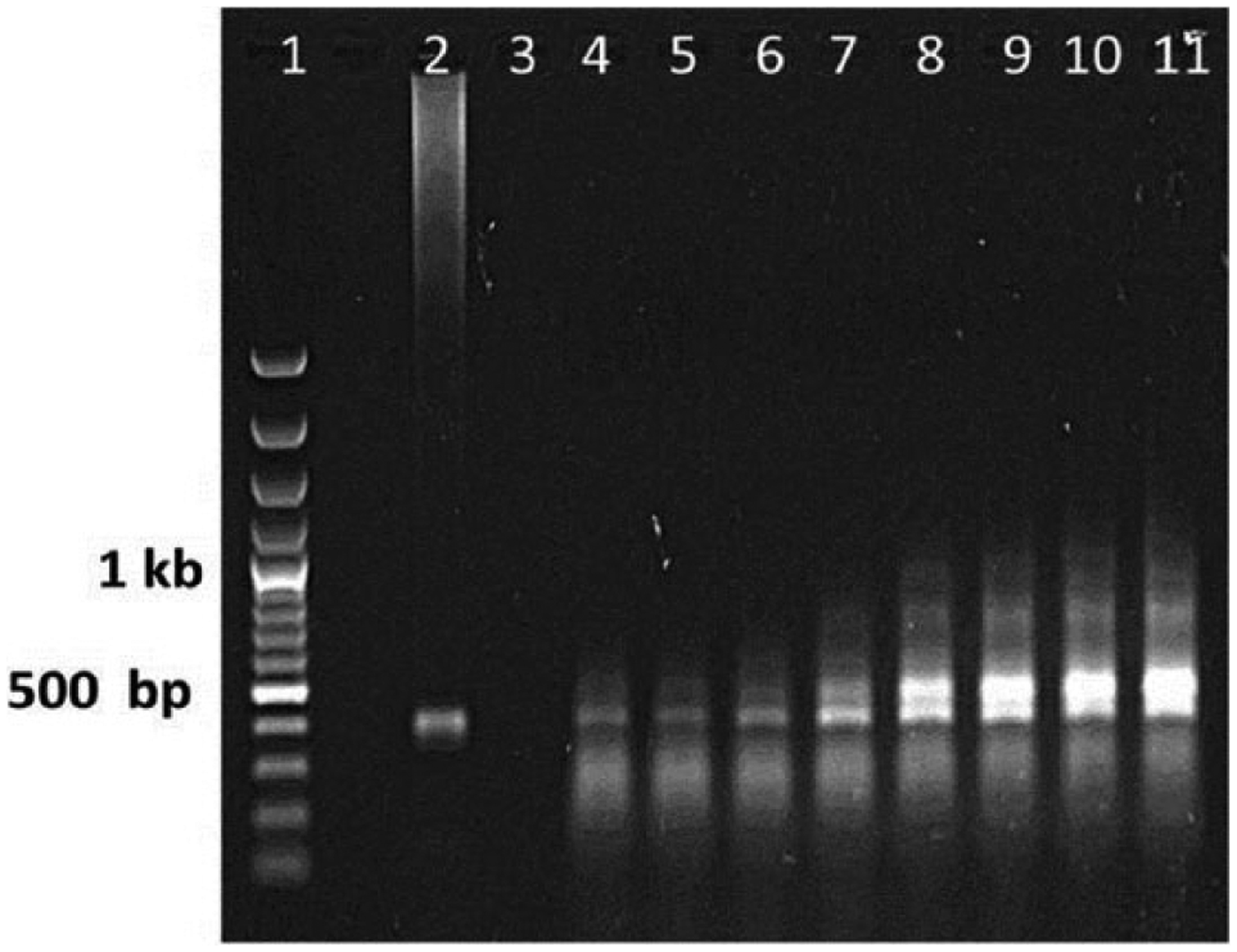
Gradient PCR amplification of heavy chain after temperature cascade gene assembly. Lane 1, 100 bp Plus DNA ladder; lane 2, positive control; lane 3, negative control; lanes 4–11, 60 °C, 61.8 °C, 62.6 °C, 63.3 °C, 64.0 °C, 66.4 °C, 68.9 °C, and 70 °C.
Semisynthetic Domain Library Generation
After PCR assembly, the VH DAb genes were digested with restriction enzymes, followed by ligation into the pLABEL vector by T4 DNA ligase. The size of the semisynthetic VH DAb library generated was calculated to be 6.6 × 10⁹ cfu/mL. Initial evaluation of the library clones was carried out by randomly picking 32 colonies, followed by colony PCR and agarose gel analysis (result not shown). It was found that out of 32 colonies, 29 colonies were amplified with the correct size. This suggests that successful cloning of the VH DAb gene was approximately 90%. For further evaluation of the library cloning efficiency, 18 clones were sent for DNA sequencing. DNA sequencing of random antibody clones during the cloning process showed that the diversity of 18 clones was conserved (refer to Table 1 ). This was a quality control check to ensure randomization occurred during the assembly process for a diverse library. The overall percentage of the fully ligated transformation was calculated and estimated to be approximately 65%. In this library, the CDRs were fully randomized with a fixed length at each CDR. The CDR3 length was predetermined to be five amino acids. However, one clone was found to have a unique CDR3 with only four amino acids in length. The introduction of stop codons in the CDRs is expected, as the NNK codon is able to encode for a single TAG stop codon. However, the amber stop codon that is encoded by the NNK degeneracy can still be used in phage display. The distribution of the amber stop codon was found to appear in different positions throughout the sequenced clones.
CDR Diversity Sequencing Analysis of Colonies from Library Cloning.
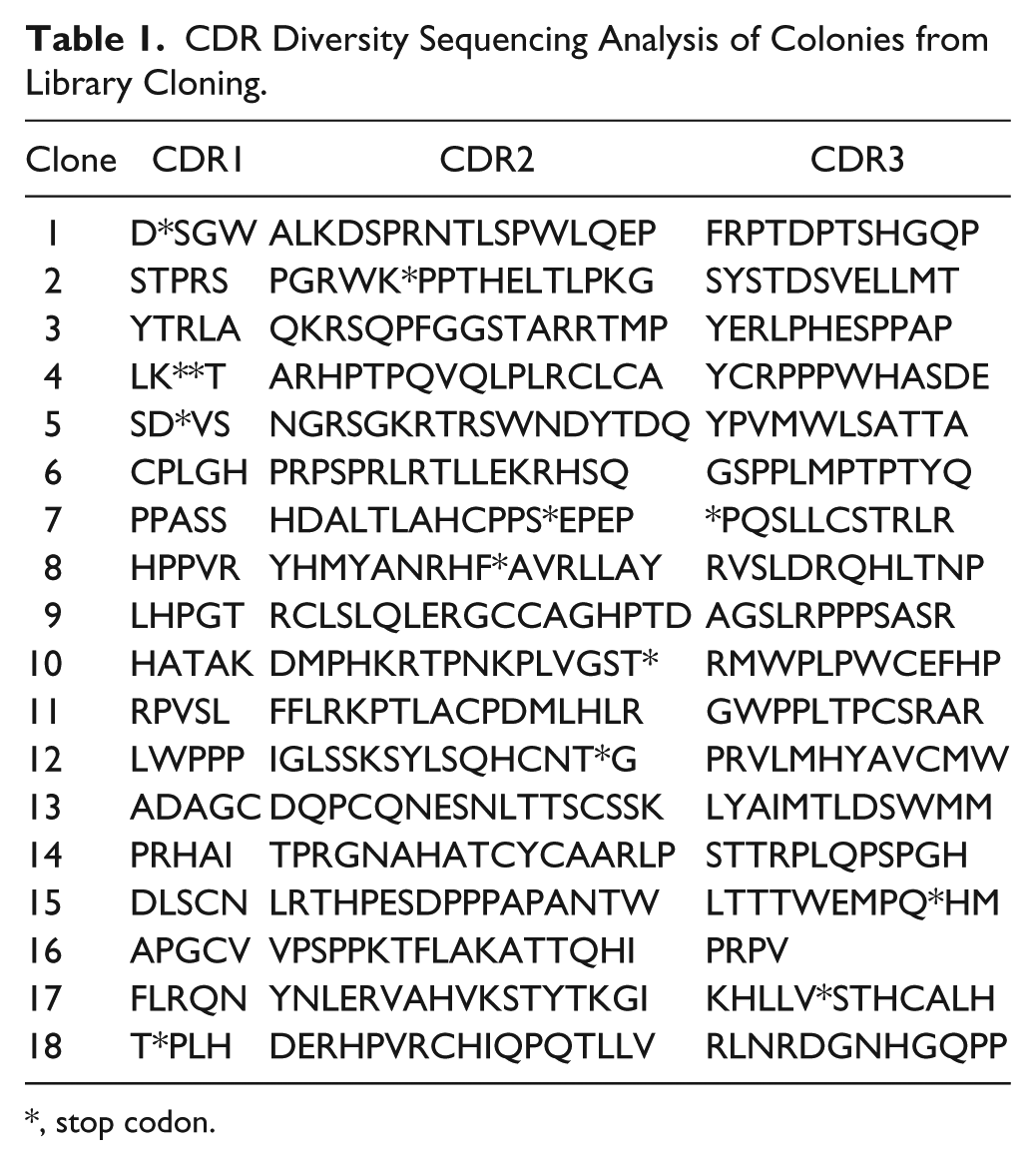
, stop codon.
Polyclonal ELISA Evaluation of Selection
High-throughput panning is useful to streamline and reduce the time for antibody generation. However, this would require different panning conditions to achieve an optimum panning process. The semiautomated selection strategy requires target antigens to be mounted on streptavidin magnetic beads prior to selection. The selection process was carried out simultaneously using ubiquitin as a control antigen and MTb α-crystalline. The panning for ubiquitin was carried out for four rounds, with the enrichments showing a similar pattern from round 1 to round 3. However, an increase in OD for round 4 was recorded. The polyclonal result shown in Figure 2i depicts the enrichment profile for ubiquitin selection. At round 4, the OD reading at 405 nm of above 2.0 showed significant enrichment of ubiquitin binding domain antibodies. The MTb α-crystalline selection showed a lower enrichment pattern from round 1 to round 4, with a slight increase in OD readings. The OD reading for MTb α-crystalline panning was slightly higher at round 4 at 0.3 (refer to Fig. 2ii ).
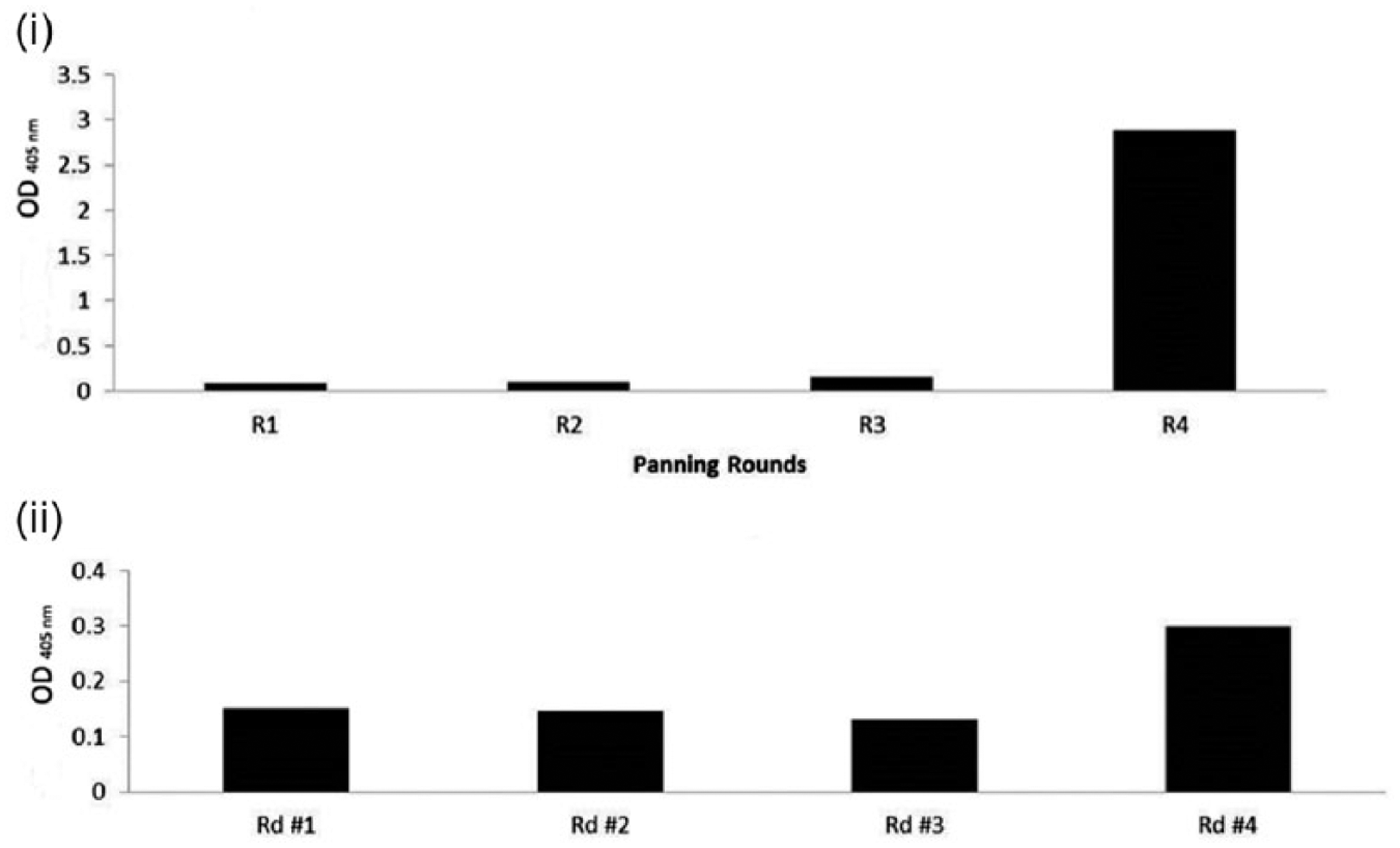
Polyclonal ELISA analysis. (
Monoclonal ELISA Evaluation of Selected Clones from Semiautomated Panning
Monoclonal ELISA was carried out to identify monoclonal VH DAb. From the polyclonal ELISA results, enrichment of monoclonal antibodies for both antigens was observed. The ubiquitin monoclonal ELISA result ( Fig. 3i ) shows the presence of several positive clones. The OD readings for MTb α-crystalline panning rounds were rather low in comparison to ubiquitin for polyclonal ELISA. Even so, monoclonal screening for MTb α-crystalline was also carried out. Figure 3ii shows the MTb α-crystalline monoclonal ELISA result, in which most of the OD readings for α-crystalline VH DAbs were above 1.0. This indicates a stronger binding signal than that for the polyclonal rounds.
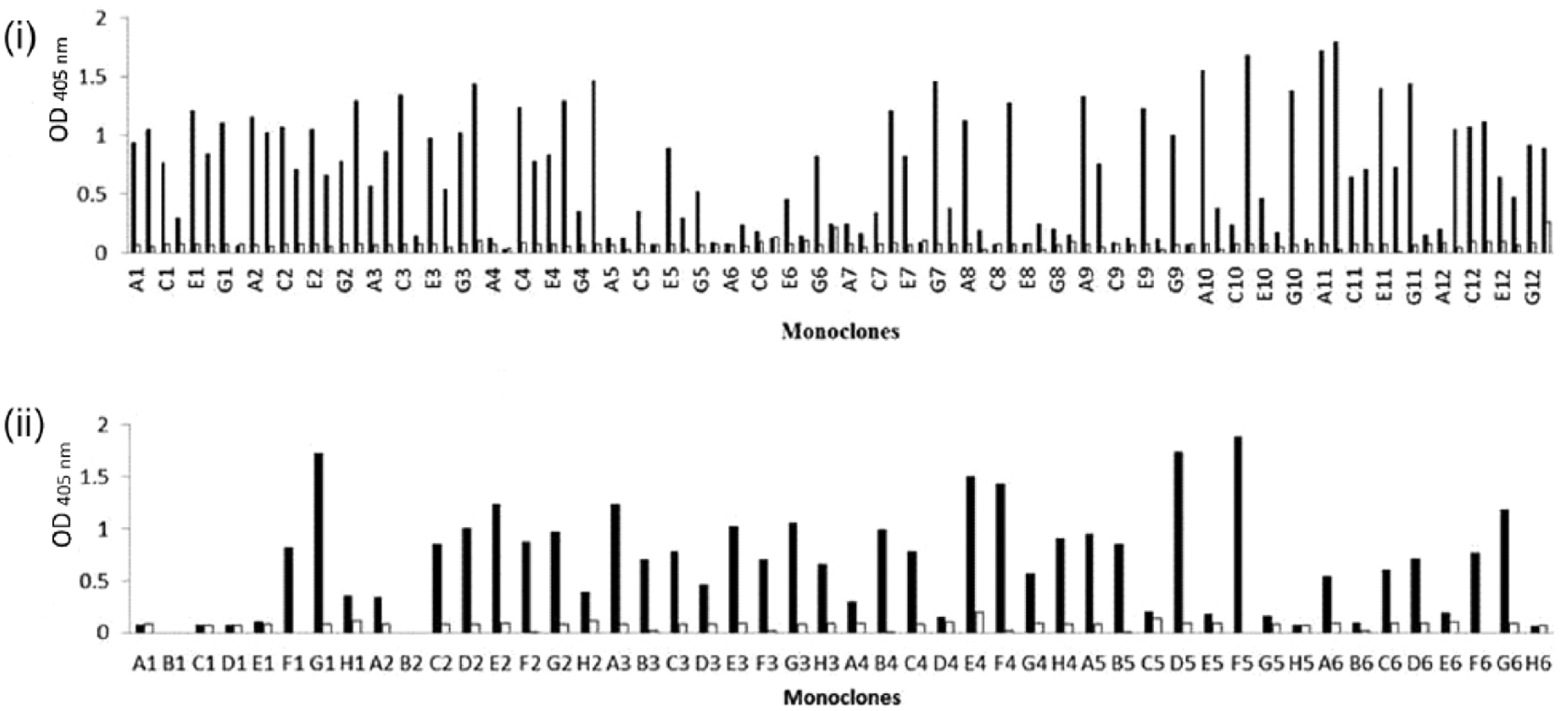
Monoclonal ELISA analysis. (
Sequencing Analysis of MTb α-Crystalline-Specific Monoclonal VH Domain Antibody
Sequencing was carried out for each individual monoclonal antibody identified by ELISA. A total of 10 MTb α-crystalline monoclonal VH DAbs were identified after ELISA. However, only 5 of the 10 clones showed in-framed VH DAb gene sequences. Out of the five clones, three clones showed the presence of a stop codon. Clone C2 had a stop codon in CDR1, whereas clones B4 and E2 had stop codons at CDR2 and CDR3, respectively ( Table 2 ). Clones E3 and F1 were used as potential monoclonal VH DAbs to be further tested in soluble form. However, the sequencing results for clone F1 showed a point mutation that occurred in frameworks 1 and 3. The mutations did not cause any frameshift to the gene sequence.
Sequence Analysis of Monoclonal Anti-MTb α-Crystalline Human Heavy Domain Antibodies.
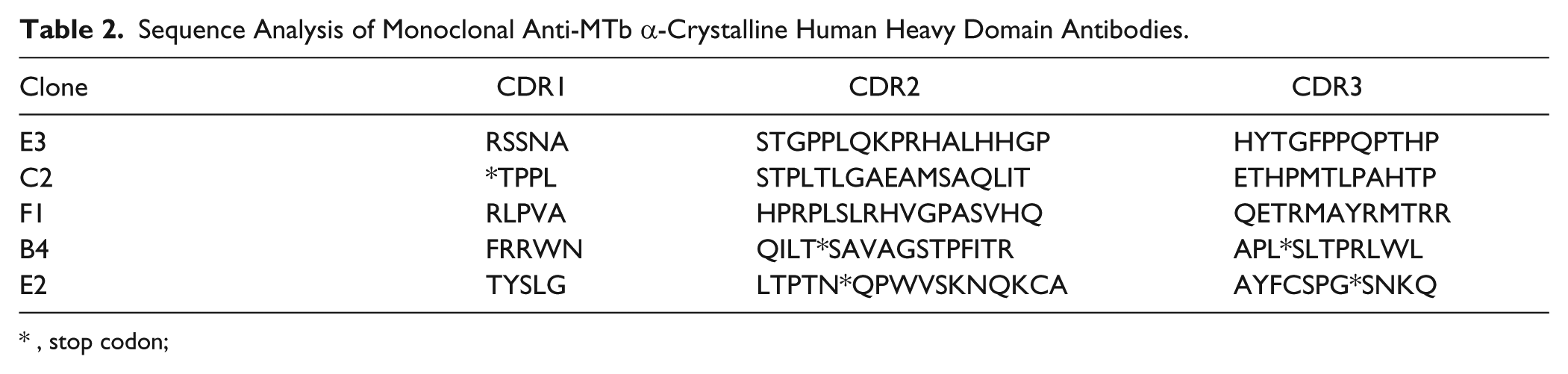
, stop codon;
Western Blot and ELISA Analysis of Soluble Monoclonal Antibody Expression
After confirming with sequence analysis, only clones E3 and F1 were expressed for evaluation as soluble proteins. Monoclonal antibodies E3 and F1 were further evaluated with Western blot using MTb α-crystalline protein ( Fig. 4i , ii ). The transferred membrane was incubated with Poncheau S to confirm successful protein transfer onto the membrane. The MTb α-crystalline antigen was introduced on the blot for binding to the monoclonal antibodies. Streptavidin-HRP was used to confirm binding of the biotinylated MTb α-crystalline to VH DAb clones E3 and F1. The expected molecular weight for the soluble domain antibody is about 16 kDa and can be seen as highlighted in the black box in Figure 4 . Soluble antibody-based ELISA confirmed that both clones were able to show good binding with MTb α-crystalline with low background binding ( Fig. 4iii ). In comparison to the OD values of the same clones in phage format ( Fig. 3ii ), the higher OD values for the soluble preparation ( Fig. 4iii ) confirm the functionality of the clones to bind to the target antigen when expressed in soluble form. This indicates successful binding of VH DAb clones E3 and F1 to the MTb α-crystalline antigen.
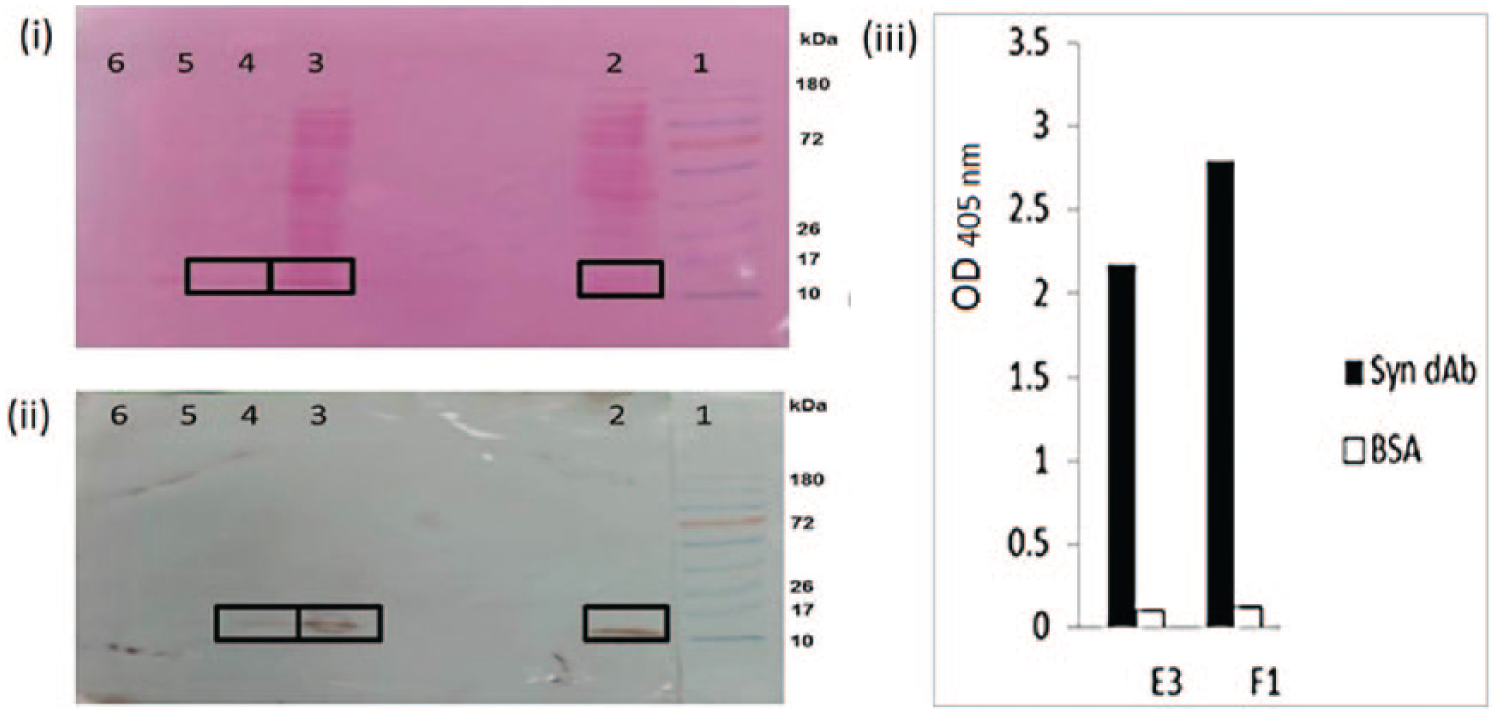
Western blot and ELISA analysis of soluble semisynthetic domain antibody against MTb α-crystalline. (
Discussion
VH Domain Antibody Gene Design
The choice of a suitable framework for a semisynthetic library is an important factor for library design. The VH3-23 framework used in this study is the most commonly found framework in human antibodies and is known for good expression in bacteria and can display well on phages. It is a commonly used framework in semisynthetic library construction.9,16 Early reports on semisynthetic human antibodies showed that the antibody (predominantly VH1 and VH3 family) selection process exhibited preferences for certain VH genes. 17 The abundance of these genes obtained from phage display selection could be due to their sequence preference and stability. 18 In addition, according to the VBASE2 sequence directory, a comparison among all seven VH families showed that the VH3 family scored the highest percentage of 43.1% to contain the highest number of known functional VHDHJH recombination genes. 19 The VH3-23 DP47 gene was reported to exhibit good solubility and stability in comparison to other V-genes. 20 Taking these advantages into consideration, the VH3-23 DP47 framework was used in the library design. 13
For this study, the strategy used to create a diverse semisynthetic domain library involved rapid sequence randomization at the CDRs of the VH3-23 DP47 genes during the gene fragment assembly process. To do so, the first effort required the designation of several highly degenerate oligonucleotides that represent different blocks of diverse genes that would make up the complete sequence of the VH genes. To mimic the naturally occurring diversity in the human immune system, semisynthetic diversity is well suited to regulate combinatorial randomization with absolute control over amino acid distribution and composition in the CDRs. 21 Therefore, a fixed CDR length was designed to incorporate the NNK degenerate trinucleotide for each of the CDRs with two complementary overlaps of 18 bp at the 5′ and 3′ ends. The trinucleotides in general encode all 20 amino acids and eliminate two out of three stop codons. 22 In addition, the variations of 20 amino acids present diversity in terms of charge and size to the flexibility of the CDR loops. 23
VH Gene Assembly
The proposed strategy adapted the temperature cascade method to use a set of varying annealing temperatures to allow highly diverse genes to find their complementary strand at their own specific annealing temperature and hybridize with greater accuracy in a single-pot gene assembly process. 10 The concept of temperature cascade was based on the temperature kinetics theory, in which higher temperature allows the single-stranded degenerate oligonucleotide genes to have great mobility. As the temperature decreases gradually, the oligonucleotide mobility decreases gradually and eventually allows the complementary strands to edge closer to one another at their respective thermal equilibria and hybridize at higher accuracy. After hybridization, the DNA polymerase starts to fill in the gap generated by hybridization. The following PCR amplification with the outermost primers that contain the restriction site sequences would provide a sufficient number of assembled genes for subsequent processes of domain library generation. At the initial step of gene assembly, a proofreading DNA polymerase was introduced to assist in the formation of dsDNA templates via sequence elongation at higher fidelity. This measure was taken to reduce errors in the newly synthesized nucleotides for improved accuracy. Even so, the assembly process does not ensure 100% accuracy in gene assembly. This is expected, as the error could have resulted during the assembly process due to the complexity of the oligonucleotides’ degeneracy to anneal.
Phage Display Selection
It is of paramount importance for the generated library to undergo the selection process to determine its quality. In order to streamline the overall panning process, a semiautomated method using a magnetic bead processor was used. Unlike the conventional microtiter plate method, the target antigens were mounted on streptavidin magnetic nanoparticles as the solid phase. 14 The control ubiquitin and MTb α-crystalline antigen were used for phage panning. The MTb α-crystalline antigen plays a crucial role in MTb infection and contributes to humoral and cellular response. 24 It is also a potentially important candidate in facilitating MTb survival during the latent infection. 25 Both antigens were expressed using an in vivo biotinylation system to generate biotinylated antigens for immobilization onto the streptavidin beads for panning.
The use of magnetic particles has an advantage over the use of conventional polystyrene microtiter plates in terms of efficiency in the phage panning process due to the larger surface area on the magnetic bead. Although the overall semiautomated panning process does have a drawback in terms of phage rescue, as it requires the process to be conducted manually, it provides the user control over parameters such as time, position, frequency, and strength of shaking movement. 26 The robust transfer of magnetic particles from vessel to vessel reduces enrichment of nonspecific binding to the surfaces. The magnetic particle processor can also be applied for ELISA experiments to ensure that the experiments are more reproducible.
Monoclonal Domain Antibody Analysis
The junctional diversity in the CDR-H3 is known to have the most diverse length and amino acid sequence variability for many antibodies compared to other CDRs. Extensive analysis demonstrates that other than the simple framework and CDR design, the CDR-H3 brings the biggest contribution to the antigen binding site. 27 Structural analysis of the antibody–antigen complex shows that bulky tyrosine side chains mediate most of the interactions with antigen. 28 However, the presence of a glycine residue in CDR-H3 plays a greater role in terms of providing a conformation suitable for high-affinity binding. 27
It was observed that most of the MTb α-crystalline-specific monoclonal VH DAb obtained exhibited some parallel similarities corresponding to overall CDR amino acid composition. For both clones, it was observed that the presence of tyrosine residue in CDR-H3 was in line with previous studies in relation to the prevalence of tyrosine positioned in the CDR-H3 region, 23 and also, the presence of a glycine residue in CDR-H3 was observed in one of the clones. Although the role of CDR-H1 and CDR-H2 is not naturally attributed to antigen binding, the presence of alanine and serine residues in both clones at CDR-H1 and CDR-H2 may suggest their possible role in spatial and conformational flexibility, which could facilitate the positioning of the large tyrosine side chains to be in contact with the antigen. 28 Despite serine residues not being well known to play a significant role in direct antigen binding, they were found to be abundant in natural antigen binding sites. 29
From a total of eight monoclonal antibodies selected for DNA sequencing, only two showed satisfactory sequencing results. It was observed that the unsuccessful clones had at least one stop codon inserted in the CDR. However, these results are expected due to the use of the complex degenerate sequence to generate the library repertoire. Although the expression of such clones could still be possible by using amber suppressor strains, using clones with complete sequences is desirable, as doing so omits the need for further modifications. A common modification would be the direct substitution of amber stop codons to glutamine for expression. 15
The expression levels of the E3 and F1 clones were relatively reasonable, with protein concentrations of 0.32 and 0.45 mg/mL, respectively, at elution 3 after Ni-NTA column purification. This is because the library design was based on the germline sequence that was reported to produce satisfactory yields of soluble and stable domain antibodies. 20 The expression yield of these monoclonal proteins was comparable to that of other reported monoclonal proteins. The expression level of these monoclonal proteins can potentially be improved with further optimization of the expression and purification conditions. The soluble antibody assay confirmed the production of functional clones that could capture the MTb α-crystalline. Western blot analysis further confirmed the size of the soluble antibodies expressed. As the Western blot analysis was carried out at denaturing conditions, the capacity of the two clones to maintain their binding ability reflects the stability of the clones. The binding ability of these two clones at denaturing conditions reflects a potential role of these clones to function as intrabodies. 30 The stability and solubility properties observed in the clones highlight the importance of framework design to ensure that the antigen binding antibody can be selected and produced efficiently. The enriched anti-MTb α-crystalline VH DAb clones E3 and F1 are specific and soluble clones that can be applied for further downstream tuberculosis diagnostic and therapeutic applications.
Footnotes
Acknowledgements
The authors would like to acknowledge support by the Malaysian Ministry of Higher Education through the Higher Institution Centre of Excellence (HICoE) (grant 311/CIPPM/44001005) and Fundamental Research Grant Scheme (FRGS) (grant 203/CIPPM/6711381).

Declaration of Conflicting Interests
The authors declared no potential conflicts of interest with respect to the research, authorship, and/or publication of this article.
Funding
The authors disclosed receipt of the following financial support for the research, authorship, and/or publication of this article: The authors would like to acknowledge support by the Malaysian Ministry of Education through the Higher Institution Centre of Excellence (HICoE) (grant 311/CIPPM/44001005) and Fundamental Research Grant Scheme (FRGS) (grant 203/CIPPM/6711381).
References
Supplementary Material
Please find the following supplemental material available below.
For Open Access articles published under a Creative Commons License, all supplemental material carries the same license as the article it is associated with.
For non-Open Access articles published, all supplemental material carries a non-exclusive license, and permission requests for re-use of supplemental material or any part of supplemental material shall be sent directly to the copyright owner as specified in the copyright notice associated with the article.
