




Abstract
ADHD is complex neurodevelopmental disorder that causes considerable individual and social difficulties, creating significant parental stress. This study aimed to examine the indirect associations between parental stress and child irritability through two sequential parenting mechanisms: experiential avoidance and negative parent–child relationship, within a sample of school-aged children with ADHD (ages 6–12). Using a two-wave longitudinal serial path analysis based on parent-reported data collected at two time points 1-month apart (Time 1 and Time 2), the study investigated whether early parental stress predicted subsequent child irritability via its influence on experiential avoidance and the quality of the parent–child relationship. Findings supported the hypothesized model. More precisely, higher parental stress was associated with greater experiential avoidance, which in turn predicted more negative parent–child relationship, ultimately resulting in elevated child irritability. Longitudinal serial mediation effects confirmed that all Time 1 variables significantly predicted corresponding Time 2 outcomes across the proposed sequential pathway. Notably, the model explained 41.1% of the variance in child irritability at Time 2, underscoring how stress-related disruptions in experiential avoidance and parent-child relationship can affect child irritability even over a short period of time. Taken together, these findings provide empirical support for a stress-driven sequence of parental mechanisms through which parental stress may contribute to child irritability in ADHD. In this context, interventions targeting parental experiential avoidance and improving the quality of parent–child relationship may help mitigate the early development of irritability in children with ADHD. Clinical implications are discussed.
This is a visual representation of the abstract.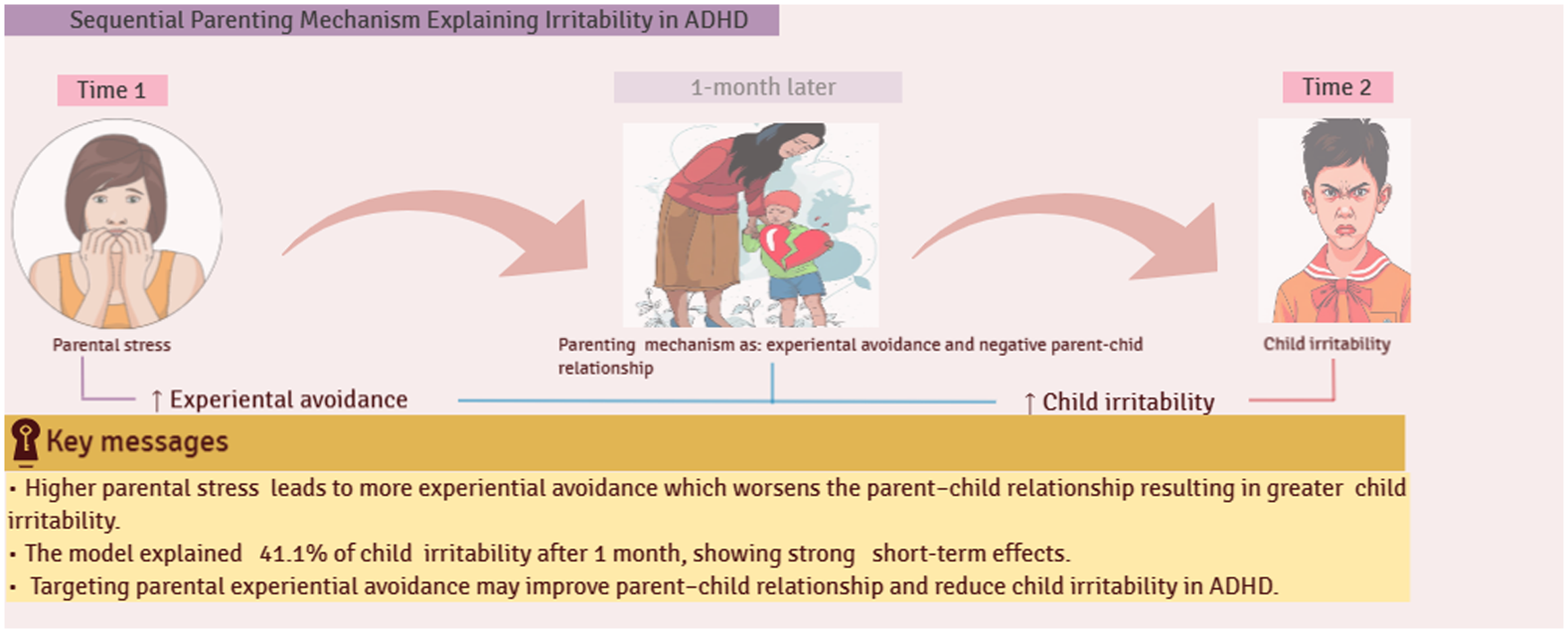
Keywords
Get full access to this article
View all access options for this article.