



Abstract
We were drawn to this topic largely because of our own experiences as first-year doctoral students of color (DSOC) in PhD programs. Struggling during our first year, we often questioned our ability to navigate academia. Through our study, we found that other first-year doctoral students had similar experiences. Doctoral education is a critical pathway for advancing knowledge and expertise, but for DSOC, it often comes with racialized challenges that affect academic success and career trajectories. Doctoral education is a critical pathway for advancing knowledge and expertise, but for DSOC, it often comes with racialized challenges that affect academic success and career trajectories.
Although higher education institutions (IHEs) have grown more diverse, DSOC continue to face racism and discrimination. These experiences impact their persistence, retention, and achievement. For example, the National Center for Educational Statistics found that the six-year completion rate for Black doctoral students is 42%, compared to 64% for White students. Research also shows that racial microaggressions lower DSOC's persistence rates, while many perceive their programs as inequitable and unwelcoming. The existing literature explores these racialized challenges, but few studies examine the first-year experiences of DSOC through an asset-based lens. Understanding these experiences is essential to better supporting DSOC in their academic journeys. We use Yosso's community cultural wealth and critical race theory (CRT) as lenses in our analyses. Our research questions were: (1) What are the racialized experiences of DSOC? And (2) what are the assets of DSOC as they navigate the first year of their doctoral programs?
The First-Year Doctoral Experience
The first year of a doctoral program can be daunting. It is a critical period that often determines whether students persist or drop out. Research highlights that advising relationships are pivotal, yet frequently limited to technical and professional support rather than personal connection. Other stressors for first-year DSOC include finances, supervisory relationships, and life transitions. Studies have also found that fostering care and social–emotional learning can help DSOC recognize their strengths and build self-confidence. However, the racialized experiences of first-year DSOC remain underexplored, particularly from an asset-based perspective. The first year of a doctoral program can be daunting. It is a critical period that often determines whether students persist or drop out.
Participant Background
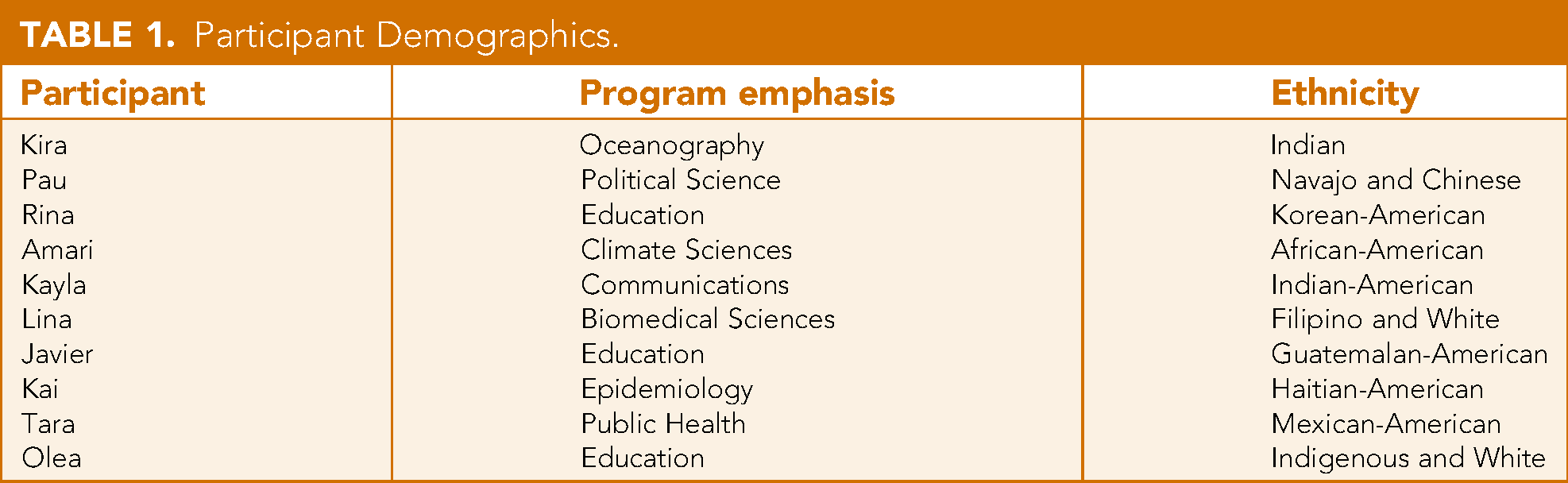
We interviewed 10 first-year self-identified DSOC from diverse fields, including political science, climate sciences, communication, oceanography, public health, biosciences, and education. Participants’ self-identified ethnic identities included Chicanx/Latinx, Asian American, African American, and Indigenous backgrounds. Recruitment focused on Southern California IHEs during the COVID-19 pandemic. To counter deficit narratives, we intentionally posed asset-based interview questions (Table 1).
Participant Demographics.
The Resilience of First-Year DSOC
Our findings reveal that while most participants faced systemic inequities, they demonstrated significant resilience. Emerging themes include sense of belonging, support networks, and the need for systemic change. Many of the participants employed self-preservation strategies that allowed them to continue in their studies. Additionally, most of our participants utilized external support systems, such as family, friends, and communities, to help them persevere in their programs. Although the resilience of these students is remarkable, it is important that systemic inequities are addressed on a structural level to better support all DSOC. Emerging themes include sense of belonging, support networks, and the need for systemic change.
Sense of Belonging
Participants described feelings of exclusion within their programs, often tied to racial microaggressions. Faculty frequently misnamed students or tokenized them by asking them to represent their racial group. Intersectional identities—such as gender and orientation—added further complexity. Financial challenges compounded this sense of alienation, as program stipends often failed to meet the needs of students supporting family members. Kai, an epidemiology student, shared that when administrators design these programs, they are not considering BIPOC students, those who are working to support family or communities. These programs are designed for students who don’t have to think about these things. Kai's experience with the program stipend exemplifies CRT tenets of whiteness as property and interest convergence. Whiteness guarantees the possession of privilege, which is shown through the stipend. The program stipend is designed with White students in mind, those who do not have extraneous financial responsibilities or are not financially caring for others in their communities. Additionally, interest convergence suggests that change is contingent on the convergence of interests for White people. Therefore, the reluctance of the program to change the program stipend aligns with this tenet and suggests that they may not be willing to change unless it benefits the dominant racial group.
Despite these challenges, many DSOC sought to create their own spaces of belonging. Pau, a political science student, started a Slack channel for their cohort to foster connection and reduce isolation. Others, such as Tara and Kayla, joined institutional affinity groups or volunteered with like-minded organizations. These efforts exemplify counter-storytelling and offer an alternative perspective to the typical deficit perspective of DSOC. This ability to create community and a support network is an asset that DSOC bring into their programs. These assets are ones that they share with other peers and organizations. It is important for programs to highlight and encourage these assets in DSOC. This ability to create community and a support network is an asset that DSOC bring into their programs.
Participants also fought to make academia a place where they belonged by advocating for themselves. Kai shared that they voiced their concerns about finances to program faculty in order to bring about change for future students. Kayla also shared about their experience advocating for more culturally responsive curriculum and readings in their program, which she describes as “really uncomfortable and not something I was expecting to do” (Kayla, Interview, 7). Although many of the DSOC in our study did not feel as though their programs were truly created for them, they utilized strategies to find and create spaces where they belonged. This contributed to their overall satisfaction with their doctoral programs. However, it is important to note that the role of being an advocate was sometimes thrust upon the student without their willingness. As shared by Kayla, this became an extra burden. It is important for programs to not only listen to the voices of DSOC, but also to help them find spaces to belong.
Support Networks and Needed Support
External, peer, and faculty support emerged as crucial assets for DSOC's success. Participants relied heavily on family and community networks to compensate for program limitations. Several students emphasized the importance of family support and feeling encouraged or comforted by family members to help them navigate the doctoral experience. Participants also shared that their siblings and friends moved with them to their school location to support them in their programs. Tara, a public health student, shared about the importance of having the support of family. During finals week, she felt overwhelmed, so she went home. Her mother cooked for her and did her laundry. And it was helpful to be home and receive support from family members. Participants relied heavily on family and community networks to compensate for program limitations.
Peer support also played a vital role. Participants expressed comfort in knowing that they were not alone and that their experiences were shared by others. Kira, an oceanography student, shared about the value of meeting with other students of color and that it could “make or break your entire academic experience” (Kira, Interview, 11). Many participants also shared their willingness to support other DSOC and share their resources, tools, and advice. Most participants noted their desire for more spaces on campus or in their programs for communities of color. The external support participants received helped validate their racialized experiences in the academy and aid their development as professionals. These powerful experiences of encouragement and support from family and community groups are an important aspect of counter-storytelling. DSOC and their communities provide powerful support for each other. It is important that DSOC find communities of support with other students of color. However, some participants noted a lack of awareness about existing support systems, which underscores the need for programs to better publicize these resources. Programs should encourage and help facilitate these spaces so that DSOC are supported to thrive in their programs. Participants expressed comfort in knowing that they were not alone and that their experiences were shared by others.
Faculty support was another critical factor. Although many participants described a disconnection with faculty in their program, they shared that faculty support was still crucial for their success as first-year graduate students. Access to faculty and cultivating a caring relationship were key themes that participants shared. However, gaps in knowledge—such as how to build faculty relationships or pursue research—highlighted the need for more proactive mentorship. The data also revealed a hidden knowledge gap amongst the participants. Many of the students understood the components of success in academia, such as publishing, conducting high-quality research, making connections with faculty, or excelling at coursework. However, many participants expressed confusion about how exactly to achieve these components. Faculty advocates who supported DSOC's academic and personal growth were instrumental in their success. Supportive faculty serve as an asset and help relieve the stress of program climates that were not designed with DSOC in mind.
Systemic and Structural Changes
While DSOC showed resilience, systemic inequities remain barriers to their success. It is imperative that systemic inequities are addressed so that barriers are removed for DSOCs’ success. Financial difficulties were a recurring theme. Many participants shared that finances were tough during the first year due to external circumstances, such as supporting family members or having other financial burdens to think about. Participants also shared that many of their programs discouraged finding outside work, but that they needed to do so to make ends meet. Kai shared that on top of their coursework and program job, they took on additional employment outside of the program on weekends. This was necessary to cover moving expenses, support family back at home, and ensure that they would not go into debt. This meant that on top of their full-time program, they were working weekend shifts to meet their financial needs. Like Kai's experience, many participants shared the desire for a larger program stipend and that finances were a large barrier to entering a doctoral program. This again showcases CRT tenets of whiteness as property and interest convergence. The program is not designed for DSOC, and whiteness privileges those in doctoral programs who are able to complete the program without significant barriers.
Participants also called for more faculty of color, increased admissions of DSOC, and meaningful implementation of their feedback. Many students felt their programs celebrated diversity superficially but failed to address structural inequities, which is also referenced in other studies with DSOC. As doctoral students often operate within program silos, participants emphasized the need for targeted, program-specific changes rather than broad institutional initiatives. Despite facing immense challenges, most participants persevered until the end of the year and are continuing in their doctoral studies with determination to finish. Regardless of the lack of support from their academic programs, DSOC formed support systems and shared resources to help each other succeed in both academic and personal contexts. Regardless of the lack of support from their academic programs, DSOC formed support systems and shared resources to help each other succeed in both academic and personal contexts.
Discussion
The first year of doctoral education is challenging, particularly for DSOC navigating racialized environments. While participants demonstrated resilience through family support, peer networks, and self-advocacy, systemic changes are essential. Programs must address financial barriers, increase representation, and create intentional spaces for DSOC. Findings show that students felt a lack of sense of belonging in their programs. However, they found support networks through their families, other students of color, or community groups. Additionally, many of the participants shared that systemic changes are needed, whether it be better financial support, programmatic changes, implementation of student feedback, or better faculty support. Using CRT as a lens, our findings highlight the persistence of systemic inequities in graduate education. Whiteness as property and interest convergence remain evident in program structures, such as stipends designed without consideration for DSOC's financial realities. Programs must prioritize structural changes to create equitable environments.
Programs should also shift from a single-mentor model to a tiered support system that incorporates family, peers, and community networks. By valuing the assets DSOC bring, programs can foster a more inclusive and supportive academic environment. Many of the participants shared the importance of faculty and advisor relationships. However, they also noted that their specific faculty mentor was unable to fully provide the support they needed to feel successful in their programs. Instead, the participants found other avenues for support, whether it was through peers in their cohorts, students of color, or outside support. Programs can acknowledge the assets that DSOC bring to their programs and help them fully utilize their support networks to be successful in academia. This could mean that programs offer space for DSOC to incorporate support networks such as family or friends. Programs can consider the many tiers of support that are part of DSOCs’ success. Programs can acknowledge the assets that DSOC bring to their programs and help them fully utilize their support networks to be successful in academia.
There is a need for a more cohesive approach to support. Many of the participants shared that they did not know that certain supports existed, such as groups for DSOC. However, participants shared that after much searching or forming these groups themselves, they were able to find the support they needed with other like-minded people. Many programs and institutions may offer these support systems, but they remain unknown to DSOC. Programs should make a cohesive approach to support DSOC so that they are aware of the supports that exist and can utilize them if needed.
DSOC bring and utilize many assets during their experience in doctoral programs. It is important for programs to value and utilize their feedback and voice in the structures of the programs. Also, it is important for programs to consider the extended networks and support systems of DSOC that contribute to their success in their programs. Oftentimes, DSOC and their respective communities are viewed through a deficit lens. However, our study highlights the many assets they bring and the need for systemic change to better support DSOC in their studies. DSOCs are resilient, resourceful, and committed to advocacy, which offers pathways to reimagining graduate education for future scholars. They are valuable assets in graduate education and should be seen as co-collaborators in graduate education instead of boxes to check when it comes to diversity and equity. They are valuable assets in graduate education and should be seen as co-collaborators in graduate education instead of boxes to check when it comes to diversity and equity.
Footnotes

We love feedback. Send letters to executive editor Z Nicolazzo (AboutCampusMag@gmail.com), and please copy her on notes to authors.