



Abstract

Extreme weather and wildfires around the globe, and increasingly sobering assessments about projected futures by researchers, activists, and global leaders have led to a growing consensus that we are at a turning point when it comes to the social and ecological impacts of climate change. UN Secretary-General Antonio Guterres (2022a) has observed that, when it comes to climate change, humanity has a stark choice to make: “collective action or collective suicide.” He also warned we are facing a “biodiversity apocalypse” (Guterres, 2022b).
This sense of alarm is shared by many students. According to a recent survey, 39% of US students said climate change is “the biggest issue facing the world today” (Cambridge International, 2020). Another survey of young people across 10 countries found that 59% of respondents felt “very” or “extremely” worried about climate change, and over 45% said it negatively affected their daily lives (Hickman et al., 2021). These findings are echoed in my own experience as a faculty member, as many students have expressed to me that they feel highly distressed by the state of the world they are inheriting. They also say they feel betrayed; they believe that previous generations have not done enough to prevent climate catastrophe, and that their university education is not preparing them to confront proliferating ecological crises. Many students have expressed to me that they feel highly distressed by the state of the world they are inheriting
Students are not only raising questions about the relevance of their education, but also bringing attention to the fact that education itself is entangled with and dependent on the same unsustainable political-economic system that has led to climate change in the first place. In a recent op/ed, Jonathan Juarez-Alonzo (2022), an Indigenous student from the Pueblos of Laguna and Isleta, reflected on the fact that New Mexico's generous new tuition-free higher education program is funded by oil and gas revenues. He emphasized the paradoxical position students find themselves in as we reach the limits of our existing system. He writes, “Students like myself feel our futures are being held hostage: Do we invest in ourselves and take advantage of free higher education? Or should we even be wasting these last fleeting years of our youth in a classroom when our elected leaders are leading us down a path toward total climate collapse?” Education itself is entangled with and dependent on the same unsustainable political-economic system that has led to climate change in the first place
As Juarez-Alonso makes clear, and as Jessica Ostrow Michel and colleagues (2023) recently observed in this publication, when students today arrive on campus, “they expect to find cultures of sustainability and climate awareness in place; further, they are ready to advance their own learning accordingly, transforming ideals into reality” (p. 4). If we want to be more responsive to the needs, concerns, and challenges faced by today's students, and to fulfill our intergenerational educational responsibilities in the context of a rapidly warming, unequal world, university educators will need to invite deepened engagement with the realities of climate change on and beyond our campuses, and create more opportunities for climate education across all areas of the university. However, there is more than one approach to climate education. University educators will need to invite deepened engagement with the realities of climate change on and beyond our campuses, and create more opportunities for climate education across all areas of the university
Growing evidence suggests that if we want to ensure the continuity of human life on the planet, we will need to rethink mainstream efforts to sustain the existing political-economic system and the approach to education that accompanies it. In the context of climate education, this would entail inviting students to consider how this system has brought us to an ecological crisis point, and to assess the extent to which different possible responses to this crisis are likely to reproduce or interrupt ecological unsustainability and social injustice. To illustrate this approach, in this article, I make a distinction between mainstream climate education and critical climate education, and then offer an extended engagement with the latter, given that it remains marginalized within most colleges and universities. Specifically, I elaborate on one version of critical climate education, Critically Engaged Climate Education (CECE). A guiding assumption of CECE is that we will need to expand our individual and collective capacity and stamina in the present to confront difficult realities and learn from past mistakes if there is to be any possibility for more socially and ecologically accountable futures. I conclude by proposing five starting points for faculty and staff in higher education seeking to offer a critical climate education that can support students to navigate complex social and ecological challenges without feeling overwhelmed, immobilized, or seeking “quick” fixes.
Before I proceed, I note that the terminology in this area of research and practice is contested and constantly evolving. For instance, speaking about climate change alone does not adequately capture the range of ecological changes we face, including biodiversity loss, species extinction, and many other forms of pollution and degradation. Sometimes these crises are collectively referred to as the “climate and nature emergency” (CNE). In this article, I use “climate education” as shorthand to refer to education that is focused on the CNE more broadly.
Not Just Any Climate Education
Over the past 30 years, scholars, policymakers, and practitioners have emphasized the central role of education in responding to climate change (Reid, 2019). According to Rousell & Cutter-Mackenzie-Knowles (2020), it is “widely acknowledged that innovative and effective forms of climate change education are needed for children and young people worldwide, who will be forced to grapple with the uncertain effects of climate change brought forth by previous generations” (p. 192). While interest in climate education has grown, especially over the last decade, there is no consensus about what kind of climate education is needed. It is up to us as educators to determine what is most relevant and responsible in our contexts. We will need to rethink mainstream efforts to sustain the existing political-economic system and the approach to education that accompanies it.
However, some have noted that traditional approaches to education, as well as educational institutions themselves, are not only ill-suited for preparing students to face today's ecological challenges, but are also implicated in the creation of the challenges themselves (Derr, 2019; Machado de Oliveira, 2021; Orr, 1991; Stein, 2019; Stein et al., 2022; Verlie & Flynn, 2022). In this section, I outline a distinction between mainstream climate education and critical climate education. I offer a more detailed unpacking of critical climate education, as this approach remains marginalized in existing literature and practice. Yet this distinction between the two types of education is itself provisional and pedagogical, rather than representational of all possible approaches. In practice, educators will often borrow elements from both approaches (and more), depending on what is relevant and intelligible in their context. I also note that, apart from the differences between the two approaches, there is also significant diversity within these approaches. Finally, it is important to note that some people still dismiss the idea that the CNE should be addressed in education at all, or even deny the role of humans in causing the CNE altogether. Although these stances are increasingly marginal, we must account for them as well.
Mainstream Climate Education
Mainstream climate education presumes that it is both possible and desirable for us to reform existing social, political, and economic systems and institutions in ways that balance “people, planet, and prosperity.” The “education for sustainable development” frameworks widely promoted by the United Nations are grounded in mainstream climate education. Many universities have oriented their climate action around this approach, with some even organizing their strategic plans around the UN Sustainable Development Goals.
Mainstream climate education has a few interrelated assumptions that orient its pedagogies and curricula. The first assumption is that the CNE is primarily a technical problem that can be solved with more western scientific innovations (e.g., renewable energy, carbon capture, and geoengineering) and policy changes (e.g., carbon trading and emission caps). The second assumption is that these solutions will enable us to enact “green” reforms of existing institutions to continue enjoying and expanding their benefits while minimizing ecological costs (Nightingale et al., 2020). The third assumption is that education should ensure students feel hopeful about the existing system and an idealized future, as it is believed that a lack of hope will lead to “climate doomism” and a lack of motivation for action (Andreotti et al., 2022).
Thus, according to mainstream climate education, the primary role of education in addressing the CNE is to provide students with awareness and accurate knowledge (especially western scientific knowledge) about climate change and other ecological crises (Rousell & Cutter-Mackenzie-Knowles, 2020). It is expected that with this knowledge, students will be inspired to adjust their individual behaviors (often described as ideally moving toward “pro-environmental” behaviors, such as recycling and saving energy), and also feel empowered to seek solutions and advocate for social change that will ensure the current system remains viable but more sustainable. This has led some to describe mainstream climate education as seeking the continuity of “business as usual, but greener” (Baskin, 2019). Some versions of mainstream climate education also seek to address—to a limited extent—social inequity, which is understood primarily as a product of exclusion from the benefits offered by the existing system. This approach can therefore be described as seeking “business as usual, but greener and a bit more inclusive”, while the overall continuity of the system and its institutions remains unquestioned.
Critical Climate Education
In contrast to mainstream climate education, critical climate education starts with the premise that the CNE is embedded within a wider system of violent and unsustainable social, political, and economic relations that currently organize institutions, including schools and universities. Many Indigenous and Black thinkers have long held that ecological crises and colonial violence have the same point of origin: the global imperial system that was initiated with European colonization and chattel slavery in the fifteenth century (Davis & Todd, 2017; McGregor, Whitaker & Sritharan, 2020; Whyte, 2020; Wynter & McKittrick, 2015). This system is organized by (1) anthropocentrism, which asserts that humanity is separate from and superior to nature; (2) racism, which asserts that white people are separate from and superior to Black, Indigenous, and people of color; and (3) capitalism, which asserts the imperative of unlimited economic growth, consumption, and accumulation, and is premised on the domination and dispossession of communities of color, the exploitation of workers, and the commodification, extraction, and degradation of nature. It is up to us as educators to determine what is most relevant and responsible in our contexts
In this sense, critical climate education diagnoses irresponsibility and injustice as the root causes of the CNE: the normalization and naturalization of colonial hierarchies and capitalist imperatives have led us to neglect our responsibilities to each other and to “nature”/the Earth as a living entity (a metabolic system) that we are also part of. Thus, critical climate education suggests the need to go beyond making our existing system more sustainable and encourages people to consider possible futures not premised on the continuity of this system. While it recognizes that (western) climate science is an important part of climate education, it emphasizes that this is just one element of what is needed to support students in grappling with the CNE.
Critical climate education is informed by conversations about climate justice. Climate justice is a term mobilized in both scholarship and activism that “has been used to account for and contest how climate change is having the most severe effects on those with the least responsibility for causing it, and who, at the same time, are often excluded from decision-making processes regarding responses to the problem, whether with regard to climate mitigation or adaptation” (Newell, 2022, p. 916). Thus, climate justice seeks to identify and interrupt how climate injustice is reproduced not only through the CNE itself, but also in many responses to it. However, there is no universal definition of “climate justice” and it is mobilized in multiple different ways, particularly as it becomes more widely used. It is therefore important to recognize the significant diversity within critical approaches to climate education.
Despite the range of climate justice approaches, there is nonetheless a broad consensus that wealthier parts of the world have contributed most to the CNE (Fanning & Hickel, 2023), and further, that this wealth has been accumulated at the expense of the rest of the world, including both human communities and other-than-human beings. For instance, the US alone is responsible for 40% of excess global CO2 emissions from 1850 to 2015 (Hickel, 2020). Meanwhile, the Global South and marginalized communities in the Global North that have contributed the least to the CNE tend to suffer the worst impacts and have the fewest material resources and least institutional power to mitigate and manage those impacts (Deivanayagam et al., 2023; Táíwò, 2022). For instance, in the United States, the Environmental Protection Agency (2021) found that “racial and ethnic minority communities are particularly vulnerable to the greatest impacts of climate change.” Many climate solutions and mitigation efforts also treat these communities’ lands as “green sacrifice zones” that enable wealthy communities to maintain their high-resource and energy-intensive lifestyles (Hickel & Slamersak, 2022; Whyte, 2020; Zografos & Robbins, 2020). Examples include the extremely exploitative and ecologically destructive mining of minerals like lithium and cobalt used in electric vehicle batteries (Climate and Community Project, 2023; Kara, 2023), and the “carbon offsets” that displace Indigenous communities from their territories (Huni Kui, 2022). These have been deemed “false solutions” that not only reproduce colonial dynamics but also fail to interrupt the root causes of the CNE and deflect responsibility for the “climate debt” that is owed to these communities.
Whereas previously more critical perspectives on the CNE were marginalized, growing research documents the connections between racism, colonialism, capitalism, and climate change. For instance, the latest Intergovernmental Panel on Climate Change (IPCC) report (2022) recognized colonialism as a driver of climate change, and a recent report from the UN Special Rapporteur on contemporary forms of racism, racial discrimination, xenophobia and related intolerance concluded, “there can be no meaningful mitigation or resolution of the global ecological crisis without specific action to address systemic racism, in particular, the historic and contemporary racial legacies of colonialism and slavery” (Achiume, 2022, p. 2). Critical climate education suggests the need to go beyond making our existing system more sustainable and encourages people to consider possible futures not premised on the continuity of this system
A CECE Approach to Critical Climate Education
Mainstream climate education generally frames education as a source of solutions to the CNE and fails to consider how educational institutions have also contributed to the CNE. By contrast, critical climate education traces how mainstream educational institutions have socialized students to invest in the same system that is creating the CNE, and how these institutions have become entangled with and dependent on this system as well. Thus, it proposes the need for a different kind of education and gestures toward other horizons of hope and possibility, including the possibility of repurposing existing institutions (Robinson & Laycock Pedersen, 2021). Sterling College in Vermont offers one example of an effort to enact critical climate education at an institutional level. In 2019, then-President Matthew Derr stated “Higher education is addicted to and promotes extractive economic growth and consumption…If we continue to be the training ground for extractive economies––capitalist or socialist––that rob graduates of the livelihoods they promise, we will betray this and future generations. Instead, we must offer the education they need to contend with the ecological crises ahead.” Critical climate education seeks to support people to identify and address the limits and costs of our existing system and institutions, and encourages them to consider other possibilities for existence.
Growing research documents the connections between racism, colonialism, capitalism, and climate change
Table 1 summarizes mainstream and critical approaches to climate education, and Table 2 considers some of the questions that guide each broad approach. However, as noted above, there is more than one way to conceptualize each approach. For the remainder of this article, I focus on one specific approach to critical climate education, “Critically Engaged Climate Education” (CECE). This is the approach to critical climate education mapped in Tables 1 and 2.
Basic elements of mainstream and critical climate education.
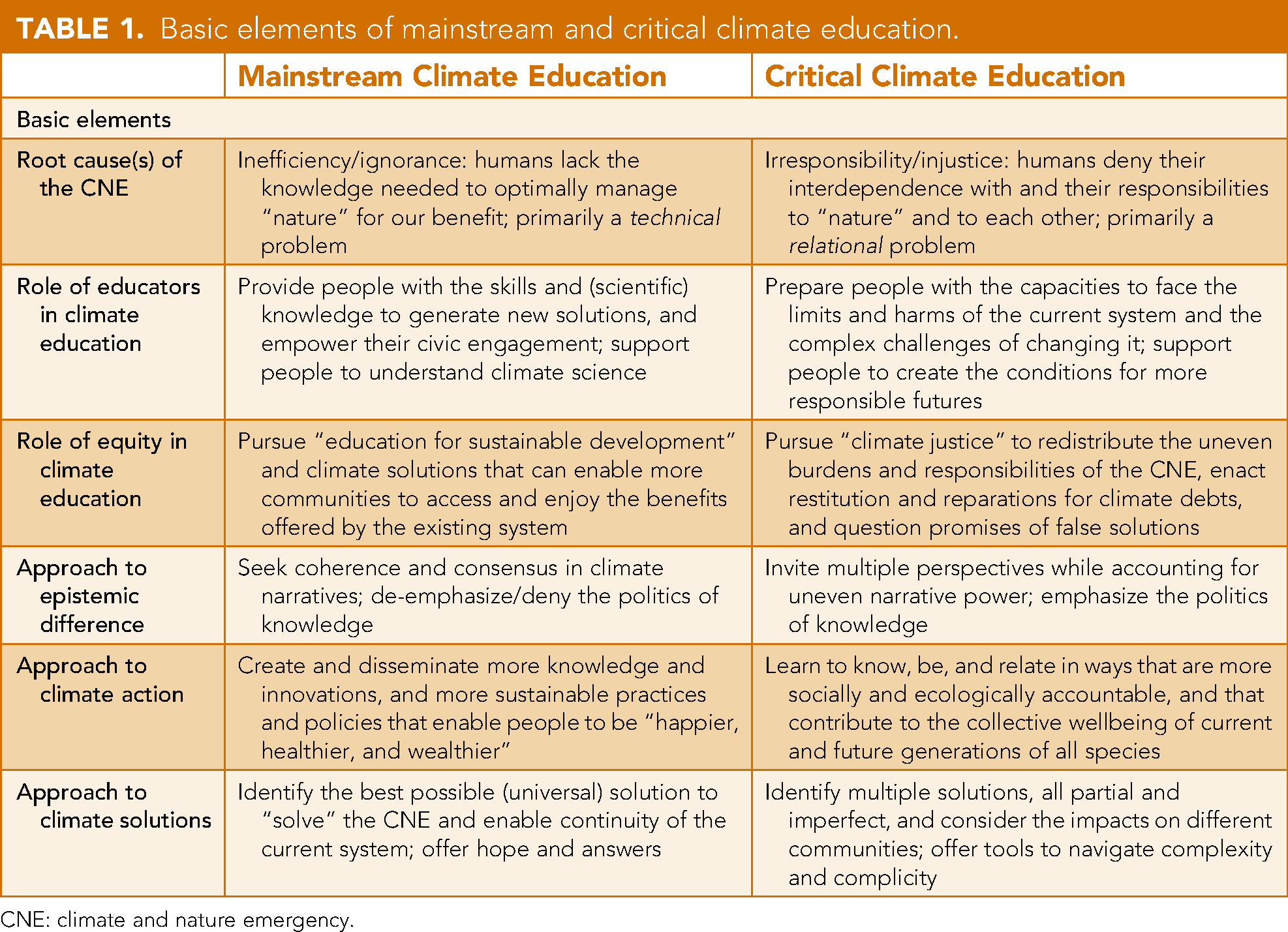
CNE: climate and nature emergency.
Guiding questions of mainstream and critical climate education.

CNE: climate and nature emergency.
Critically engaged climate education is being developed by the Gesturing Towards Decolonial Futures Collective, of which I am a founding member, in partnership with the University of the Forest of the Huni Kui Indigenous People of Acre in the Brazilian Amazon (see Andreotti et al., 2022; Huni Kui, 2022; Stein et al., 2022; Stein et al., 2023). A CECE approach to critical climate education seeks to offer an alternative to the promises of guaranteed solutions and hope for the continuity of the existing system that are offered by mainstream climate education. While these promises may be well-intended, they are not aligned with or responsive to current realities and thus, they do not adequately prepare students to hold the full weight and complexity of the CNE. These promises also fail to consider the impacts of proposed climate solutions on the human communities and other-than-human beings that pay the highest price for the continuity of the existing system.
Thus, CECE gestures beyond what is offered by mainstream climate education. Specifically, CECE seeks to support people to develop the intellectual, affective, and relational capacities to confront the difficult, complex, and uncertain realities of the climate and nature emergency, and to cultivate the stamina and resilience that are required to keep moving and learning with these realities in relevant and responsible ways, rather than feeling overwhelmed, immobilized, or seeking easy fixes. This does not mean CECE encourages people to reject all solutions or embrace nihilism. Instead, it encourages people to rethink dominant approaches to problem-solving and problem-posing, and to recognize that all possible responses to a complex “wicked” problem like the CNE will be partial, provisional, contextually situated, and can give rise to new problems. Critical climate education traces how mainstream educational institutions have socialized students to invest in the same system that is creating the CNE
CECE is inspired by the insights of many Indigenous scholars and activists who emphasize the importance of reactivating a sense of relational responsibility that has been impaired through the currently dominant anthropocentric, white supremacist, and capitalist system that is premised on separation, domination, and consumption (Huni Kui, 2022). Potawatomi environmental philosopher Kyle Whyte (2020) suggests that most discussions of climate change focus on averting an ecological tipping point, the crossing of which “threatens alarming dangers…including more severe droughts, sea-level rise, disruptive precipitation patterns, ocean acidification, and more intensive extreme weather events” (p. 2). With all of these possible dangers, concerns over the ecological tipping point are very real, and valid. However, Whyte suggests that many efforts to avert this ecological tipping point risk further entrenching another tipping point that we crossed long ago with the onset of capitalism, colonialism, and later, industrialization: a relational tipping point. Whyte further argues that these two tipping points are connected, as this relational tipping point is a root cause of climate change, particularly the denial of human interdependence with and responsibility to what western culture calls “nature.”
Thus, Whyte's analysis suggests that if we focus solely on technical innovations that seek to avoid the ecological tipping point without addressing the relational tipping point, we will continue to seek simplistic solutions to climate change that reproduce ethnocentric imaginaries of sustainability, justice, responsibility, and change. This, in turn, will reproduce the same exploitative relationships between dominant and marginalized communities, and extractive relationships between humans and the earth, that created the conditions that led to the CNE in the first place. As a result, we will be poorly equipped to respond collectively to existing and emerging ecological challenges. Whyte proposes that what is needed is the difficult, often slow work of mending relationships according to the principles of trust, respect, accountability, reciprocity, and consent. Part of this relational repair includes enacting material forms of reparation for stolen lands, labor, and wealth. Having enacted this repair, we might be better prepared to face the challenges presented by climate change through more justice-oriented coordinated responses. Critical climate education should invite students to consider the limits and the costs of the current system, while also acknowledging the challenges, complexities, and contradictions involved in trying to interrupt and disinvest from this system
Although CECE has clear orientating principles, it also seeks to avoid the common tendency in both mainstream and critical education to prescribe what students should do and think and instead emphasizes preparing them to make their own critically engaged, complexity-informed, inquiry-based and socially, and ecologically accountable decisions. I briefly review the basic elements of each of these dimensions below (for more information on CECE, see Andreotti et al., 2022; Huni Kui, 2022; Stein et al., 2022; Stein et al., 2023).
Critically engaged means encouraging students to identify the systemic root causes and drivers of the CNE. This includes tracing structurally uneven responsibilities and burdens for the CNE, and developing critical literacy around proposed solutions. For instance, students might be encouraged to assess the extent to which different solutions consider the rights of nature, human rights, Indigenous rights and sovereignty, and the potential impacts on systemically marginalized communities, especially those on the front lines of the climate and nature emergency. They may also be encouraged to ask questions about the extent to which their own imagined climate futures would interrupt or reproduce existing structures of social and ecological violence. Indeed, many students are already asking these questions, and expecting educators to do the same.
Complexity-informed means supporting students to understand that the present is characterized by volatility, uncertainty, complexity, and a cacophony of competing perspectives and meanings that resist meta-narratives and preclude the possibility of consensus both within and between different social groups and generations (Stein, 2021). Even if students are aware of this complexity, it can nonetheless be difficult and uncomfortable to accept, given that mainstream education has socialized us to desire continuity, coherence, certainty, and predetermined solutions. However, by learning to interrupt these desires and hold space for complexity, students may be prepared to more effectively and accountably navigate the tensions, contradictions, and paradoxes that characterize contemporary social and ecological challenges.
Inquiry-based means instead of providing students with answers, encouraging them to approach the CNE as an open-ended, nonlinear process of inquiry with a commitment to consistently ask relevant and self-reflexive questions and engage in responsible experimentation. Recognizing that there are no simple, universal solutions, this approach encourages people to develop the humility, discernment, and stamina to continuously approach the CNE and other complex wicked problems with curiousity, compassion, and accountability. In this way, students are supported to identify partial, provisional opportunities for (inherently imperfect) interventions that seek to expand possibilities for livable futures on a shared, finite planet. Further, they are encouraged to integrate the learning and unlearning that emerges from both the successes and failures of these interventions.
Finally, socially and ecologically accountable means inviting students to reflexively acknowledge their individual and institutional complicity in the reproduction of racial and colonial violence and ecological degradation (Bryan, 2022; Machado de Oliveira, 2021; Stein, 2019). This is not about making students feel guilt or shame, but rather inviting them to accept responsibility for our “obligations and ethical relations with peoples and ecosystems” (Sultana, 2022, p. 121). Ultimately, this would require interrupting conditioned (and often unconscious) investments in the colonial hierarchies and modes of consumption that have been imprinted on our imaginations, so that we might learn to relate differently—including relating differently to ourselves, to other people, and to the planet—in ways that are grounded in trust, respect, reciprocity, consent, and interspecies and intergenerational accountability (Whyte, 2020).
Five Starting Points for Critical Climate Education
There is no one way to undertake climate education, and both mainstream and critical climate education have significant internal diversity. As the CECE framework suggests, climate education should be developed for the specific context in which it occurs. To close this article I offer five starting points for faculty and staff to consider if they seek to implement critical climate education in their college or university. These starting points are not prescriptions for specific actions, but possible points of departure, reflection, and discussion for those interested in this work.
The climate and nature emergency is a symptom of an inherently violent and unsustainable system. Therefore, critical climate education should invite students to consider the limits and the costs of the current system, while also acknowledging the challenges, complexities, and contradictions involved in trying to interrupt and disinvest from this system, especially given that this is the same system that currently sustains our colleges and universities. Both educators and students would need to develop enough honesty, humility, and hyper-self-reflexivity to ask difficult, self-implicating questions about how we arrived at the current situation, how we can learn from and enact repair for previous and ongoing mistakes, and how we might gesture toward potentially wiser futures through the process of repairing relations and repurposing institutions. In our complex, uncertain world, climate education cannot offer promised futures or prescribe fixed solutions, but it can support people to develop relevant capacities for navigation. There is no fixed content that can prepare students for an uncertain future, and there is no set of facts or strategies for climate action that will be pertinent across all contexts. However, educators can support students to develop the intellectual, affective, and relational capacities that would prepare them to discern the most relevant and responsible intervention in their own context. This entails considering multiple perspectives on and responses to the CNE, and tracing where these responses are coming from, what they assume, what they enable, and what they foreclose. This also means attending to the uneven epistemic and political power of different perspectives and emphasizing systemically marginalized perspectives in order to counter that marginalization. Educators must do our own self-work if we seek to offer relevant climate education. While climate education might have been about raising basic awareness in previous generations, today many students are acutely aware of the realities of the CNE. If we are going to invite students to develop capacities to confront difficult realities in generative ways, educators will need to develop these capacities ourselves. This includes the capacity to step back from our own position and recognize that coming generations are inhabiting a different reality from the one we grew up in, as well as the capacity to question our own investment in the futurity of existing systems. Climate solutionism and climate doomism are both irresponsible. Neither nihilistic nor idealistic projections about the future are generative responses to the CNE, as both ultimately operate as a form of escapism that defers the difficult work that needs to be done in the present. Climate education should pluralize different kinds of hope and futurity—for instance, the joy and un/learning that can come from the struggle to collectively weave different futures, even when these efforts fail. There are no simple solutions to the CNE, this is long-haul work: While the complexity and magnitude of the challenges we face can be overwhelming, this is the reality. It is tempting to look away or seek clear answers, but in the long run, this will not serve us. We will need to develop the stamina and resilience to stay with this work and continually ask: How can we identify, interrupt, and “compost” the harmful and unsustainable habits of being that lead us to deny our responsibilities to enable the well-being of current and future generations of all species?
Students are seeking more support for facing current and coming storms as they anticipate that much of what they are learning is unlikely to be relevant in a world that will be largely unrecognizable from the world our universities were created to serve. Will educators rise to the challenge of preparing students to responsibly navigate a complex, warming world?
Educators can support students to develop the intellectual, affective, and relational capacities that would prepare them to discern the most relevant and responsible intervention in their own context
Footnotes

We love feedback. Send letters to executive editor Z Nicolazzo (AboutCampusMag@gmail.com), and please copy her on notes to authors.