



Abstract

The ideal student tackles all their readings before class, creating concept maps and summaries of the learning materials. They attend every lecture and actively participate during tutorials, taking notes and then color-coding them after class to highlight key ideas. Whenever they come across something that remains unclear, they go online to find additional explanatory videos and readings. Our ideal student is thus organized and efficient, managing not just their time and effort, but also their space to ensure that they are free of distractions and noise.
Yet, despite all these efforts, procrastination still rears its ugly head, confusion about abstract concepts and theories lingers, and motivation to study almost inevitably nosedives throughout the term. Even the ideal student ends up leaving their work to the last minute and then frantically cramming into the wee hours. Every now and then, disappointment seems inevitable: Despite feeling as though they are taking all the right actions toward learning, low exam results or assignment grades are occasionally still there. Even the ideal student ends up leaving their work to the last minute and then frantically cramming into the wee hours. Every now and then, disappointment seems inevitable: Despite feeling as though they are taking all the right actions towards learning, low exam results or assignment grades are occasionally still there.
This fictional “ideal student” emerged from our research into how media and communication undergraduates describe and conceptualize their own learning practices. These students are part of an international bachelor program at Erasmus University Rotterdam, The Netherlands. Cohorts are usually young (18–25 years old) and international, with half of the students coming from The Netherlands and the other half coming mostly from within the European Union, as well as Asia and Latin America. When analyzing 815 student reflection assignments from a mandatory research methods course, we were struck by the tension between students’ own approaches to learning and the challenges, uncertainties, and frustrations accompanying their efforts. Students’ ideas about what constitutes learning, how learning is to be done, and how they themselves learn collectively inform their adjustment to the educational setting.
Pedagogical research has proposed three broad learning approaches, clustering students into deep, surface, or strategic learners. In practice, however, students often concurrently draw from all three approaches throughout a course, as modeled by our ideal student who incorporates intensive interaction with material (deep learning), superficial memorization (surface learning), and tactical time management (strategic learning) into their routine. This, we argue, is best understood as an act of bricolage where students negotiate and apply tactics and strategies to tackle the course material in idiosyncratic ways. Yet, this process remains fraught with tensions that can potentially discourage students from more intensive interaction with the material (deep learning). In this article, we propose several ways in which educators can use these tensions to constructively help students engage with the difficulties inherent in their own learning processes. This, we argue, is best understood as an act of bricolage where students negotiate and apply tactics and strategies to tackle the course material in idiosyncratic ways.
Learning Approaches: How Students Orient Themselves Toward Course Content
Student views about what constitutes learning and how learning is to be done inform their own actions during a course. As Paul Bélanger explains in his book, Theories in Adult Learning and Education, learning always takes place in “situated activities” and as such, students’ own learning approaches cannot be divorced from the context of the course and the program (2011, p. 31). The notion of learning approaches draws attention to the importance of students’ own views on how to learn within a particular context. The concept itself stems from the work of different scholarly groups carried out in the mid-1970s, most notably, educational psychologists John Biggs (Australia), Noel Entwhistle and colleagues (UK), and Ference Marton and Roger Säljö (Sweden) (Biggs, 1979; Entwistle, Hanley, & Hounsell, 1979; Marton & Säljö, 1976).
The notion of learning approaches draws attention to the importance of students' own views on how to learn within a particular context.
Learning approaches were initially classified into three discrete categories: surface, deep, and strategic. When taking a deep approach, students were seen as orienting themselves toward conceptual understanding and meaning-making; they would try to relate concepts and ideas to existing ones, to examine the logic of arguments, and to capture the big ideas within a text. In contrast, surface approaches to learning were generally seen as limited to memorizing the facts in order to complete the task at hand. In this case, students tended to concentrate on discrete elements of the text, with little integration or comprehension. Finally, some students mixed deep and surface elements to obtain the most satisfactory grade with the least amount of effort. The strategic approach was thus seen as relying upon forms of deep learning only when necessary for assessment purposes.
Are learning approaches, however, inherent to an individual's orientations to learning (e.g., innate preferences and styles), or do they emerge as a response to the particulars of the learning context(s)? If the former, then there is little educators can do to help students develop higher-level cognitive skills such as conceptualization, synthesis, and so on. Fortunately, learning approaches are influenced by constellations of factors ranging from educators’ approaches to teaching and the forms of assessment, to students’ own views of what constitutes learning, their intentions to learn and perform in a degree, their learning preferences, and their perceptions of the learning context (Beausaert, Segers, & Wiltink, 2013). Are learning approaches, however, inherent to an individual's orientations to learning (for example, innate preferences and styles), or do they emerge as a response to the particulars of the learning context(s)?
Secondly, are deep learning approaches necessarily better and more desirable in all situations? The simple and catchy metaphorical language of the model may suggest so, but as educational researchers, Peter Howie and Richard Bagnall, argued in their critique of the model, the “semantic slippage” from deep to desirable, and from surface to undesirable may actually be counterproductive (2013, p. 396). It is likely that most educators can identify instances when learning requires memorizing facts and attention to detail—actions that tend to be associated with a surface learning approach. Furthermore, as Rebekah Nathan (2005) found out in her own ethnographic study My Freshman Year, students often have to juggle competing demands on their time—some academic and some not. Those who cannot strategize, prioritize, and plan—actions associated with a strategic learning approach—are likely to fall behind. Are deep learning approaches necessarily better and more desirable in all situations? The simple and catchy metaphorical language of the model may suggest so, but the ‘semantic slippage’ from deep to desirable, and from surface to undesirable may actually be counterproductive
Students thus have to be versatile in terms of their approaches to learning, adapting them in relation to their educational context. Yet, such versatility may not be within reach for all students, as both personal life and educational contexts remain permeated by systemic inequalities. Unfortunately, systemic inequalities remain largely unaddressed in studies on student learning approaches, where power lines such as age, gender, or race are often understood as demographical aspects of the individual (surprisingly, ability seems to be completely absent from such research, while socioeconomic class is often proxied by parental education and income). For instance, Douglas et al. (2020) confirmed existing arguments that age is positively associated with deep learning techniques. The role of gender, however, is more elusive: where survey-based studies find differences in learning approaches between male and female students, others such as de Lange and Mavondo (2004) cautioned that “many of these differences are an artefact of data reduction techniques rather than any substantive gender difference” (p. 437). An interest of this literature is in the role of culture in (allegedly) favoring deep or surface learning, particularly in the context of Asian higher education. Yet, as Tian and Low (2011) explained in their own discussion of critical thinking among Chinese students, culture is often approached in simplistic and homogenizing ways. Similarly, in the conclusion of their own study on international students in Chinese higher education, Ma and Wen emphasized the need for “not assuming that students are necessarily the same and not categorizing them but rather recognising that students come to higher education institutions with a range of experiences, prior knowledge, motivations and agency” (2018, p. 1197). Students thus have to be versatile in terms of their approaches to learning, adapting them in relation to their educational context. Yet, such versatility may not be within reach for all students, as both personal life and educational contexts remain permeated by systemic inequalities.
Studies on the role of power dimensions in education suggest that these likely matter in terms of students’ approaches to learning—yet, more research is needed to understand how. Recent research on the attainment gap amongst black and minority ethnic (BME) students by Bunce, King, Saran, and Talib (2021) discussed BME students’ aspirations toward relatedness, competence, and autonomy in their learning process, and the institution's failure to help fulfill them. Demotivated and disengaged, these students “shifted their focus to doing the minimum amount of work necessary to achieve their degree” (p. 543).
Where a comprehensive review of power dimensions in education falls beyond the scope of this paper, one thing is certain: whether and to what extent students adopt deep, surface, and/or strategic approaches to learning is governed by a multitude of complex, intersecting dimensions, as well as (often competing) intrinsic and extrinsic factors. Learning approaches and patterns are not mutually exclusive, therefore, subgroups of students may reveal unique combinations of learning behaviors that bestride the tripartite model. Likewise, educators can best help students only when moving their own understanding of student learning approaches beyond the dichotomous nature of the deep/surface learning paradigm. Learning approaches and patterns are not mutually exclusive, therefore subgroups of students may reveal unique combinations of learning behaviors that bestride the tripartite model. Likewise, educators can best help students only when moving their own understanding of student learning approaches beyond the dichotomous nature of the deep/surface learning paradigm.
Teaching and Learning Methodology: The Student Perspective on Learning
To understand how students approach their own learning processes, we opted for the student view. Indeed, recent research by Lindblom-Ylänne et al. published in Studies in Higher Education draws attention to the lack of “person-oriented approach” in learning approaches research, which has historically relied heavily upon survey data (Lindblom-Ylänne, Parpala, & Postareff, 2019, p. 2191). We thus set to examine undergraduates’ own perceptions of the learning process in the context of a mandatory second-year course on qualitative research methods in the department of media and communication at Erasmus University Rotterdam.
For many of our students, learning about qualitative methodology is oftentimes experienced as a nebulous process. Although our department delivers qualitative research courses in the first year of our programs, students struggle with its interpretive aspect. Our faculty have observed students lacking confidence in their qualitative analysis skills, describing the process as “confusing” and “subjective,” and often coming back to us for a “stamp of approval.” For many of our students, learning about qualitative methodology is oftentimes experienced as a nebulous process.
Empirical research, premised upon a social science approach that emphasizes clarity and transparency in research design, is an important dimension of our curriculum. The course introduces students to the main forms of qualitative data collection (observation, interviews, focus groups, and creating corpora of texts and objects) and analysis (rhetorical, semiotic, narrative, thematic, discourse analyses, along with constructivist grounded theory-informed coding). In this sense, the learning content of this course is firmly rooted in a social scientific approach to qualitative research emphasizing argumentative rationality. In other words, systematicity and soundness of justification are important values underpinning the course. In turn, students relate to them in different ways: While some quickly adjust to making their research design decisions explicit and to weighing their justification, others may find this process difficult.
The course has weekly optional lectures held by two faculty members who explain the relevant methodological concepts. The weekly tutorials (capped at 25 students) are, however, mandatory as they clarify the lecture material and apply it to small cases. Such practical activities take different formats, from going outside the classroom to collect data, to role-play and group work on small data sets. Assessment in this course is conducted through a combination of individual and group assignments, an in-tutorial mid-term quiz, and a final examination worth 50% of the final grade. Both the mid-term quiz and final examination consist of multiple-choice questions, as well as short- and long-answer questions. Overall, assessment is an important personal and institutional driver of student learning. For instance, the maximum grade (10) is almost never awarded in social sciences and the humanities and institutional culture often invoke the Dutch assessment tradition as strict but fair. Indeed, the latter is often a source of anxiety, particularly among internationals, who find themselves needing to adjust their expectations around grades.
After obtaining approval from the faculty's Ethics Board, we drew data from three written assignments collected in weeks 1, 6, and 8 of an 8-week term (November 2019–January 2020). This produced a corpus of 815 assignments. The assignment, entitled “Reflective Response,” was part of students’ overall participation grade. Students were instructed to summarize in approximately 100 words their learning practices up to that point in the course, assess their usefulness, and indicate what they could improve upon over the following weeks. We subsequently analyzed the assignments by means of a thematic analysis on a random sample of 10% of the assignments from each week. In the second stage, we read and compared all remaining assignments to the existing coding to capture noteworthy repetitions and anomalies. The results thus capture themes that emerged from the entire data set.
Findings
Our data clearly revealed that learning approaches were a process of bricolage: Students combined deep, surface, and strategic elements of learning in novel combinations, albeit shifting these elements within the context where learning took place. In fact, such a bricolage is consistent with the idea of self-monitoring, where students are recognized as active learners reflecting on what works for them and what does not, and deliberating points of improvement. For example, students may approach their study routine with the intention to understand (a feature of the deep approach), but at the same time, they may also need to memorize facts (a feature of the surface approach).
Our data clearly revealed that learning approaches were a process of bricolage: Students combined deep, surface, and strategic elements of learning in novel combinations, albeit shifting these elements within the context where learning took place.
Students conceptualized learning as a set of actions meant to tackle the learning material (which we refer to as tactics) and a set of actions oriented toward creating a study-conducive environment (which we refer to as strategies). Where students developed, borrowed, and tried out different tactics and strategies, these actions remained steeped in tensions and uncertainties. Many openly wondered why doing all the “right things” did not yield the expected results. Unfortunately, our research design does not allow us to probe whether all students were equally skilled bricoleurs. While we cannot say if mixing and matching tactics and strategies came easily to all of our students, it is likely that prior cultural capital may nurture not just the flexibility of trial and error, but also the resilience in coping with the ensuing tensions and uncertainties. Where students developed, borrowed, and tried out different tactics and strategies, these actions remained steeped in tensions and uncertainties.
Tensions Surrounding Learning Tactics
Unsurprisingly, students’ own understanding of the learning process was structured by the core components of a course: the required readings, the assignments, and the moments of interaction with faculty (in lectures and tutorials). The tactics described by the students in our project consist of specific actions that students undertook in approaching the topics and content they were asked to engage with (Table 1)
A list of learning tactics mentioned across our sample.
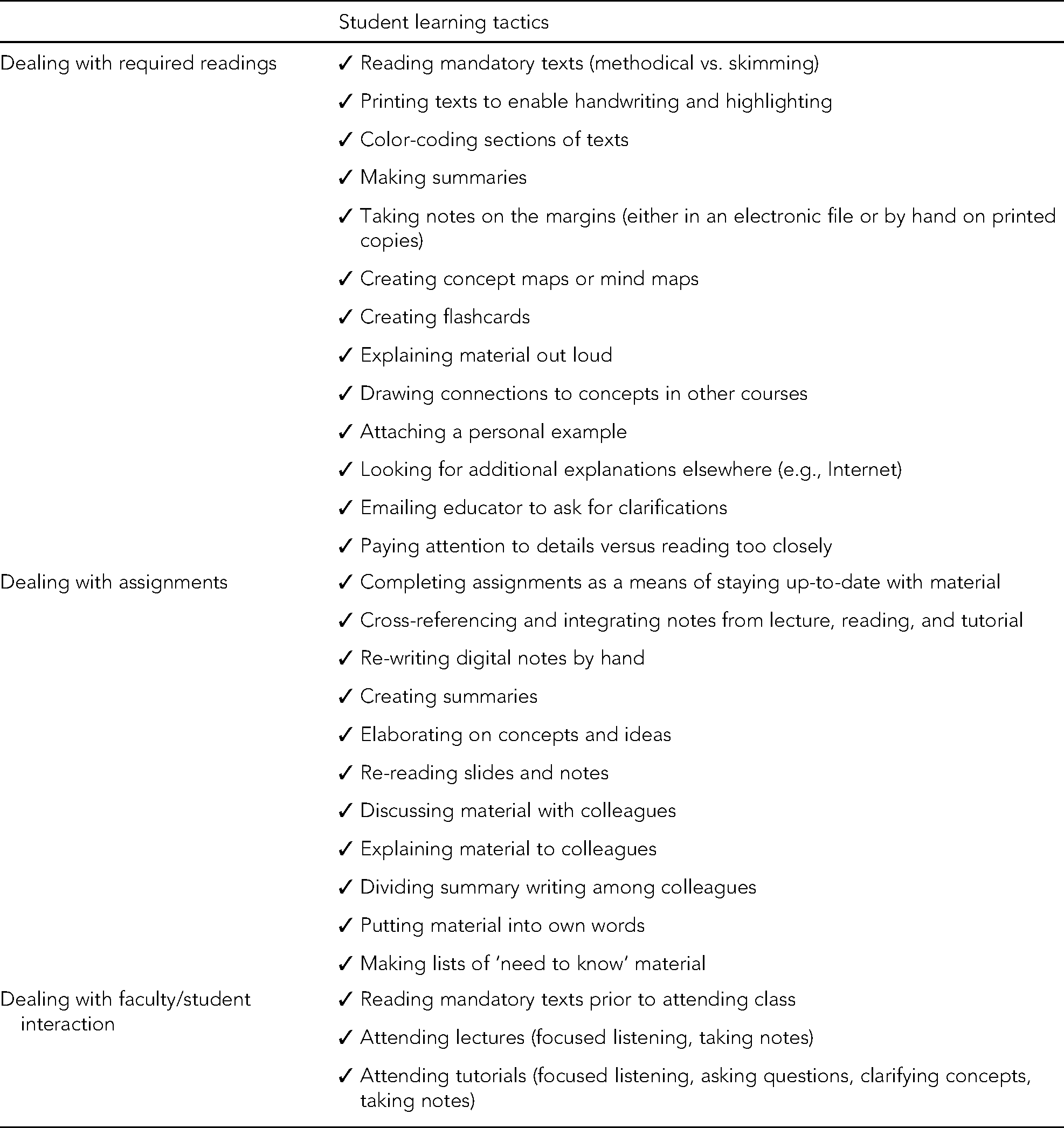
Dealing With the Required Readings
While “doing the readings” was widely recognized as a key learning tactic, its implementation was not always problem-free. First, the moment of engagement with the readings mattered. Although some confessed to looking at the readings only after class (or, more likely, before an exam), everyone professed the importance of reading before class. “Staying on top of the readings” or “keeping up with readings” were frequently mentioned as areas of improvement. Procrastination, distractions, and time management were cited as barriers to completing the readings, particularly before the lecture. I prepare the mandatory reading before the lectures, and try to make summaries of the important points, which I use to study for the exam. However, I find this difficult sometimes, as I struggle to determine what concepts and definitions are most important.
Second, where some students approached the readings in a systematic manner, others simply skimmed through them. Comprehension remained the most significant challenge. Here, it is possible that the assessment structure of the course, as discussed in the previous section, skewed students’ approach to reading the texts, with some students adopting a surface approach to retaining content. For those engaging with texts in a systematic manner, reading was accompanied by additional actions such as: working with printed copies, highlighting key terms, making notes in the margins, creating concept/mind maps, and writing summaries. As one student explained:
While students had an array of tactics to break down the readings into smaller—and presumably more manageable—pieces, this was not automatically accompanied by an understanding of their content. Indeed, as the quote above illustrates, students remained unclear on what is important, as well as on what conclusions to draw based on the different concepts they had identified. students remained unclear on what is important, as well as on what conclusions to draw based on the different concepts they had identified.
Dealing With Assignments
Some students described “doing the assignments” as a task that required “keeping up” with, thus “forcing” them to do stay up-to-date with the course content. Assignments were further described as useful for clarifying and enriching understanding of course material, as well as pushing students to actively engage with the course content. Yet, assignments were also a source of anxiety with students feeling that solid preparation was a prerequisite for success. This was often achieved by breaking down course content into small, manageable, concept-based elements. This tactic was seen as enhancing memorization. For example, one student explained: I formulate each [reading] into a form of story, and create concept maps that I write repetitively. Formulating sequence of concepts, and understanding concepts in my own words have helped me learn faster. Often, if I forget one of the concepts it is likely that I wouldn't be able to recall the subsequent one because the concept chain is broken. I will counter this problem by revising weekly and divide the reading material into small parts and formulate smaller concept maps thus I won't have an information overload just before the exam.
Revising notes, summaries, concept/mind maps, and lecture slides were also a commonly cited learning tactic. Only a few students (approximately a dozen overall) opted for a social approach to rehearsal, such as explaining concepts to friends in their own words, reviewing information orally, and going over material with classmates.
Despite underscoring the significance of revision and repetition, students did not always put it into practice. For those struggling with time management or feeling unmotivated to study in this course, assignments represented a source of stress. Feeling unclear about an assignment also led some to postpone working on it. Once again, students brought up difficulties in taking good quality notes during the lecture or summarizing in a productive way that distinguished between key concepts and superfluous details. Comprehension of “important concepts” remained a challenging task for some. For those struggling with time-management or feeling unmotivated to study in this course, assignments represented a source of stress. Feeling unclear about an assignment also led some to postpone working on it.
Dealing With Faculty/Student Interactive Moments
Attending lectures was frequently cited as both a productive way to learn and a component of students’ learning routine throughout the course. Some identified active participation as a productive way to learn, while others defined it as coming to class prepared, really listening to what was being taught, and taking notes during lectures.
Yet, this ideal scenario was often not put into practice. Some students confessed to preferring to rely on the lecture slides instead of attending the lecture. Others realized that active attendance was thwarted by the fact that they had not completed the readings in advance. Furthermore, others felt the tutorial (mandatory in our program) rendered the lecture redundant. On the other hand, as one student explained, redundancy was an important component of learning: “The most productive way for me to learn in a course is through repetition. When I hear, see, study something multiple times, I get to know it better.” Yet, as the student further confessed, this still did not motivate them enough to attend the lectures.
“The most productive way for me to learn in a course is through repetition. When I hear, see, study something multiple times, I get to know it better”. Yet, as the student further confessed, this still did not motivate them enough to attend the lectures.
Strategies for Creating the Right Study Environment
Contrary to the specific actions associated with learning tactics, strategies refer to more generic practices that students engaged with to create an optimal study environment. As Nancy Perry and Philip Winne report in Educational Psychology Review, self-regulated students “evaluate alternatives in their repertoire, and choose and coordinate tactics to create a strategy they believe is best suited to the task” (Perry & Winne, 2006, p. 212). Many of the students in our sample described such strategies as part of their approach to learning, reflecting on what they could improve and how. In our sample, we found three major types of strategies: management of one's environment, management of the self, and adapting to the constraints imposed by the course structure (Table 2).
A list of learning strategies mentioned across our sample.

Managing the Environment
Some students discussed the need to create an optimal environment to facilitate their learning process. Whether at home or on campus, this environment had to be quiet and free of distractions (e.g., shutting off one's smartphone or even using an antidistraction app). Still, some of them struggled as creating the optimal environment was not, in and of itself, sufficient to avoid procrastination completely: “Studying is where one dives into content, and in essence, devours it. I cannot do that, I get distracted by every single distraction, be it my thoughts, guitar, phone or any surroundings.”
Some students discussed the need to create an optimal environment to facilitate their learning process.
Managing the Self
Self-management practices were often brought up as important strategies in facilitating the learning process. Perhaps unsurprisingly, time management was a commonly mentioned point of improvement among students in our sample (e.g., not leaving things to the last minute). Interestingly, leaving things to the last minute was a deliberate strategy for a few individuals: “[I] habitually learn the content required for my courses near the deadline, which provides a sense of urgency that enhances my focus.” Yet, this form of “stress studying” was not necessarily sustainable long term and could fail when the course contained a lot of new content.
Structuring one's study sessions was also a time-management strategy. Some students planned such sessions ahead and organized them in a way that would ensure in-depth engagement with the material. Taking regular breaks as a form of self-management was described as refocusing one's attention, facilitating information intake, and making the amount of content to study more manageable. For example, one student talked about their “45/15 rule,” entailing 45 min of study followed by a 15-min break.
Finally, some students talked about playing upon their own “learning style,” by which they meant that they found certain media formats (e.g., audio and visual) more conducive to understanding the material than others. The idea of learning styles remains debated, with educational psychologist Paul Kirschner referring to it as a “myth” that “pigeon-holes” learners in his article in Computers & Education (2017); however, students felt that integrating videos or audio material while studying was helpful. Some described themselves as “visual learners,” thus watching videos and/or creating concept maps or mind maps to visualize the content.
An additional point of self-management was the idea of “forcing” oneself. For one student, they could “force” themselves to process and understand the material by making an effort to take notes. For another, using an antidistraction app “forced” them to concentrate. An additional point of self–management was the idea of ‘forcing' oneself. For one student, they could ‘force' themselves to process and understand material by making an effort to take notes. For another, using an anti–distraction app ‘forced’ them to concentrate.
Being Managed
Students also identified ways in which being managed—or being “forced” to do something—by the structure of the course itself played a role in their learning routine. For example, assignments and deadlines “forced” students to stay on top of readings: “I tend to not read the readings, but this course actually forces me to [do the readings] and I feel like this also might help me be more productive in learning.” In such cases, being “forced” to do something presented itself as a good thing. Yet, even in such cases, students felt that procrastination and the feeling of lacking time represented significant barriers. As one student explained: I always procrastinate and start only a few days before the exam. […] I do still pass everything and this is partly because I study best when I’m under stress. An improvement point would be to procrastinate less and start with the summaries earlier. I need to have a shift in mind set.
Indeed, the frequency with which the final exam was mentioned throughout students’ reflections suggests that the way in which they manage their personal learning routines is governed by the precedent set by the course itself. In other words, students self-monitor and self-regulate within the confines of the course structure. At the same time, being part of the learning community provided by the course was identified as a crucial aspect of the learning process. As one student explained: “The sense of community is very important when learning new theories/concepts because it helps me acquire new perspectives and understand things that were still blurry in my mind.” Students self–monitor and self–regulate within the confines of the course structure. At the same time, being part of the learning community provided by the course was identified as a crucial aspect of the learning process.
Final Reflections
The fact that students actually appreciated being “forced” to engage with the course content was surprising to some extent. Students often tell us via course evaluations or personal encounters that they want to have a choice and be left to their own devices. Yet, when asked about their own learning practices, some degree of structure and a sense of accountability within the parameters of the course clearly have their advantages. Students often tell us via course evaluations or personal encounters that they want to have choice and be left to their own devices. Yet, when asked about their own learning practices, some degree of structure and a sense of accountability within the parameters of the course clearly have their advantages.
A second surprise was that our students tended to approach learning as a solitary endeavor. Räisänen et al. recently reported in Active Learning in Higher Education on the value of group work as both a source of learning and a source of improving self-monitoring practices (Räisänen et al., 2020). Indeed, group work is a valued component of learning in our course and program. Yet, the benefits of learning through interaction with others were only marginally mentioned in our sample, suggesting educators could explicitly point out when and how peer learning and peer support could enhance learning. While we can only speculate on the reasons behind this finding, it is important to note that group work is a widely employed assessment tool in our program. Particularly among competitive students, group work is negatively viewed as a precursor for lower grades due to unequal contributions or unequal level of knowledge/skill among team members. This is compounded by the international character of our programs, where students often collide on perceptions of time and quality.
Notably, the process of bricolage consisted of selecting and combining different tactics and strategies to adapt to the course in response to one's own performance. Students often self-monitor, trying out different combinations to meet their goals and self-expectations. This, however, is further enhanced when educators explicitly ask them to reflect upon their learning practices and to engage with what worked/did not work so well from their own perspective. Students often self–monitor, trying out different combinations to meet their goals and self–expectations. This, however, is further enhanced when educators explicitly ask them to reflect upon their learning practices and to engage with what worked/ did not work so well from their own perspective.
One limitation of our project stems from being unable to distinguish between the different factors—personal, institutional, or cultural—that may affect students’ bricolage of learning tactics and strategies. This, we think, prevents us from being able to capture how and why the act of bricolage may vary across different student populations, but also how and why it may vary for one individual depending on time and circumstances.
Moving Forward
The pedagogical affordances of the tensions underpinning the bricolage of learning approaches deserve attention. Our data shows that the reflexive act of scrutinizing learning processes was marked by differences between expected and actual learning outcomes. We analytically distinguish here between two such tensions, showing how this may be fruitful for subsequent pedagogical interventions.
The first tension relates to a “cognitive dissonance” between what should be done and what is actually being done during the learning process. Students were generally aware of the importance of certain tactics (e.g., “doing the readings”), yet they prioritized other activities. This, however, needs to be understood in a wider context where students often have to juggle competing demands on their time—some academic and some not—as Ella Kahu and Catherine Picton discuss in their recent research on the challenges and stresses of the first-year experience (Kahu & Picton, 2020). Furthermore, the nature of these competing demands is likely to also vary with the position of students in terms of race, class, gender, etc. For instance, even though some of our students take on part-time jobs, both their reasons and (flexibility of their) employment arrangements can variously affect their learning approaches. The first tension relates to a ‘cognitive dissonance' between what should be done and what is actually being done during the learning process.
The second tension relates to a dissonance between the application of certain strategies and tactics (e.g., doing the readings, participating in class, being prepared) and performance outcomes. Despite applying what appear to be clear steps to success, the anticipated “return on investment” is not guaranteed, thereby revealing itself as a frustration in many of our students’ reflections. The second tension relates to a dissonance between the application of certain strategies and tactics (e.g. doing the readings, participating in class, being prepared) and performance outcomes.
Different student circumstances and abilities are likely to affect these tensions. Our research design did not allow us to probe into this, but it is not far-fetched to assume that individual, institutional, and contextual aspects matter. Furthermore, as previous scholarly research has shown, age, gender, ethnicity, race, etc., can all shape a student's approach to learning in powerful ways. Likewise, prior cognitive abilities, such as the ability to connect different concepts or to integrate new ideas within existing conceptual models are crucial to one's performance in a course. On the other hand, the degree of self-awareness and the ideal model of performance that individuals uphold are also likely to influence their perception of the difficulty or ease of their own efforts to learn in a course.
Importantly, further research could consider the ways in which the systemic inequalities connected to students’ race, ethnicity, socioeconomic status, gender, disability, or cultural familiarity with the educational model shape not only the bricolage of their learning processes, but also the availability and affordability of certain learning tactics and strategies. The tactics and strategies mentioned by students—as well as the ability to mix and match these approaches in a fruitful way—are invariably imbricated with overarching power structures. Moreover, students occupy a position of dependency and compliance, thus reacting to instruction from faculty in positions of superiority as the “knowledge keepers,” albeit without necessarily questioning how their best interests will be served. This idea is echoed by French philosopher, Henri Lefebvre, for whom academic knowledge is institutionalized, administered, and gatekept by the “ruling classes” (2002). To this end, inequalities are invariably reproduced, particularly where students from “other” or marginalized backgrounds are concerned. These dynamics deserve further attention. Further research could consider the ways in which the systemic inequalities connected to students' race, ethnicity, socioeconomic status, gender, disability, or cultural familiarity with the educational model shape not only the bricolage of their learning processes, but also the availability and affordability of certain learning tactics and strategies.
Recovering the two tensions of “cognitive dissonance” and “application/outcome dissonance” revealed in our data as an opportunity for pedagogical intervention entails explicit showcasing of learning tips, but also drawing attention to—and guiding students through—the process of constructively reflecting upon these tensions. While students actively self-monitor, they may not fully recognize the value of self-reflexivity in their own learning process. Indeed, Keith Thiede et al.'s research on the effects of metacognitive monitoring on study regulation and overall learning has already pointed out that students’ learning improves when they are taught metacognitive skills, such as reflection (Thiede, Anderson, & Therriault, 2003). This, we suspect, is even more so the case in assessment-driven courses and programs that communicate meta-values such as time management, planning, meeting deadlines, and grade-driven performance. Yet, even in such contexts, educators could still encourage explicit reflection on learning approaches. We offer a few such suggestions here: Recovering the two tensions of ‘cognitive dissonance' and ‘application/outcome dissonance’ revealed in our data as an opportunity for pedagogical intervention entails explicit showcasing of learning tips, but also drawing attention to - and guiding students through - the process of constructively reflecting upon these tensions. Explore with students the different tensions outlined here to identify what resonates with them and how. Steer students away from a dichotomous approach to learning wherein tactics and strategies are presented as good/bad or effective/ineffective. Instead, position learning as a long-term process that entails experimentation and navigating roadblocks. Elicit discussions on the collaborative aspect of closing the individual knowledge gap by asking students to pay attention to how their interactions with one another facilitate what Cindy Hmelo-Silver's research on problem-based learning calls the “social construction of knowledge” (2004, p. 243). Discuss with students the differences between deep, surface, and strategic learning, prompting them to explore which approach they rely upon most and why. Finally, incentivize students to participate in these discussions by rewarding “thinking about their thinking” through specific elements in your rubrics or through small self-reflexive assignments such as learning diary entries. These suggestions can easily be translated into short pedagogical interventions.
These suggestions can easily be translated into short pedagogical interventions such as, for example, a 5-min brainstorm on what constitutes learning, or a brief homework or intensive writing class activity on the student's learning approach that week. Educators can also enhance the importance of self-reflection by sharing their current learning processes and predicaments, for instance, when writing grant applications or developing new courses. Just as the students in our sample disclosed their vulnerabilities, insecurities, and points for improvement when it comes to learning, it is important for educators to remind them that their struggles are universal. This then showcases the importance of uncertainty as a catalyst for asking questions and creating a space where uncertainties and anxieties can be brought to the fore.
Footnotes

We love feedback. Send letters to executive editor Ryan Evely Gildersleeve (aboutcampus@du.edu), and please copy him on notes to authors.