




Abstract
The purpose of this study was to determine the most prevalent African American Language (AAL) phonological and grammatical features in slavery- and Civil Rights–themed children's literature. Seventy-six books were initially selected to determine if they used AAL in dialogue or in narration. Of the 76 books, only 39 included AAL. The 39 books were analyzed further to categorize the specific AAL features used. The results revealed that the reduction of the final g (e.g., thinkin’) was the most prevalent phonological feature. Moreover, phonological features were used more often in slavery-themed texts than in Civil Rights texts. Additionally, the most frequently used AAL grammatical features were negation tense markers (e.g., didn’t and neither) and subject-verb agreement (he listen). Grammatical features of AAL appeared more often in slavery-themed texts than Civil Rights themed texts. Implications for practice include suggestions for selecting, evaluating, and reading the books from this study with students. Implications for research include investigating other AAL features in slavery- and Civil Rights-themed books, authenticating the storylines of slavery- and Civil Rights–themed books, and analyzing other books with AAL that do not use these themes.
Keywords
For decades, Black scholars (e.g., Ladson-Billings, 1998; Lee, 2007; and Smitherman, 1977) have demanded equitable language experiences in classrooms for African American Language (AAL) speakers. While most African Americans speak AAL, which is a systematic and rule-governed language with its own linguistic features, most schools do not support the genius of AAL (Muhammad, 2020). The result of this exclusion is that children are not allowed to use their home language in the classroom (Johnson, 2018). Instead, many teachers require AAL speakers to leave their language at home or on the playground; instead they require them to learn White Mainstream English (WME), the dominant language of power and privilege.
Our interests in and research objectives concerning AAL were threefold. First, we wanted to provide a counter narrative to the dominant language ideology (Metz, 2018) by employing a language ideology (Razfar et al., 2023; Smitherman, 2021b) that insists that AAL is equal to WME. In doing so, we intended to elevate AAL as a language of rich expression (i.e., writing and dialogue) that can and should be used for educational purposes. Second, we wanted to explore AAL in literature because of the proliferation of AAL usage in recent mainstream discourses, media, and other public outlets by Black and especially non-Black folk. Third, we sought to determine the authenticity of the linguistic portrayal of African Americans in terms of AAL used in children's literature.
To meet the first objective of creating a counter narrative, it is important to understand that AAL has been passed down through cultural transmission (Taylor & Thoth, 2011), thus allowing African Americans to use this same language throughout generations. In academic settings, teachers should embrace and incorporate AAL's cultural wealth into classroom teachings. Applegate and Applegate (2004) and Binks-Cantrell et al. (2012), however, insisted that people cannot be expected to offer what they do not possess. There have been increased efforts for teachers to understand the science of reading, which is an interdisciplinary body of knowledge about evidence-based research concerning how reading and writing develop; how reading and writing should be assessed and taught; and the problems some students face with learning how to read and write (Moats, 2020; The Reading League, 2022). For students in the United States to become proficient readers and writers of WME, teachers must understand the science of reading, along with a firm understanding of the linguistic features (phonemes, morphemes, syntax, etc.) of WME. Unfortunately, decades of research have shown that many teachers do not possess this knowledge (Bos et al., 2001; Binks-Cantrell et al., 2012; Cunningham et al., 2004; Moats & Lyon, 1996; Pittman et al., 2020; Pittman et al., 2023; Spear-Swerling & Brucker, 2003).
Further, if teachers are not knowledgeable about the linguistic features of WME, the language of instruction in U.S. schools, we firmly believe that they also are not aware of the linguistic features of AAL, mainly because instructors in educator preparation programs do not provide content on AAL (Pittman et al., 2022). Educators as teachers (see Pittman et al., 2023), as teacher educators teaching the teachers (see Pittman et al., 2022), and as school administrators (see Razfar et al., 2023) must understand the differences between the linguistic features of AAL and WME. Without this knowledge, for example, the literacy assessment scores of AAL speakers can be inaccurate because the directions of most literacy assessments state that points should not be deducted for language variation. However, if a teacher conducts a phonemic awareness task with an AAL speaker and the AAL speaker counted three phonemes in the word nest, it is most likely due to the fact that AAL speakers often reduce the final consonant in a consonant blend. Educators must understand that this phonemic feature is a linguistic difference in the pronunciation versus it being an error. Additionally, without this teacher knowledge, it will appear as though African American students perform lower than their counterparts on many literacy measures that include linguistic subcomponents. Researchers, therefore, must understand what knowledge of AAL teachers possess as well as their ideological stance toward AAL because, unfortunately, teachers who are not fully aware of the linguistic features of AAL will set low expectations for students who speak AAL (Delpit, 1995). Moreover, although some teachers might be familiar with AAL, they may not have the resources to support the literacy development of AAL speakers.
To meet the second objective of exploring AAL in literature, all educators must understand that AAL is an authentic representation of the historical gift of language that has been passed down from generations with roots in Africa (Smitherman, 2021b). As a starting point, we sought to determine if a connection could be made between AAL and generations of African Americans using children's picture books of historical fiction. We chose to examine two historical eras—that of slavery and the Civil Rights movement—because of the richness of the language that was developed by enslaved Africans and how this language has continued in African American families throughout history (see Lanehart, 2015, for a thorough historical overview of AAL).
These two periods were also selected because in children's literature they are the two most written about eras in which African Americans were oppressed. As all African Americans’ lineage experienced slavery and the Civil Rights’ movement, we wanted to determine how (and if) the richness of the language was celebrated in children's literature centered on these themes. Although not all African Americans speak AAL, we sought to track AAL usage from slavery through the Civil Rights era to determine if authors portrayed African Americans as speaking the language that the majority of African Americans speak or if the authors style shifted the language to WME, as more African Americans began to receive formal education, even though it was segregated. Additionally, the language that began during slavery as a way for African Americans to communicate with one another continued post-slavery, as African Americans were forced to communicate with White people (e.g., in labor situations) and with their lives being in constant view of White people during the Civil Rights’ era. Thus, we were interested in knowing if this communication integration would cause authors to style shift the language.
We also wanted to determine if and how authors represented AAL in these literary texts. We sought to ascertain whether the authors attempted to use AAL as the language of the uneducated (e.g., during slavery) and WME as the language of the educated. Further, we wanted to know if the authors followed AAL's systematic and rule-governed language in their texts, or if they adopted negative language ideologies to represent the language of African Americans.
Although state governments (e.g., in Florida and Texas) are suppressing historical truths in education by banning books, our third objective—determining the authenticity of the linguistic portrayal of African Americans in terms of AAL used in children's literature—explored whether teachers must include many of these authentic texts for students to affirm their identity (Bishop, 1990; Heineke & Papola-Ellis, 2022; Heineke et al., 2022) with authentic or real-life books. Scholars, such as Bishop (1990) and Brooks and McNair (2007), have provided a roadmap on how and why educators must implement culturally authentic texts into the classroom, especially African American children's literature. Even when students may not be African American, a teacher should, as a best practice, incorporate culturally authentic texts so that students can learn about African American culture and language (Piper et al., 2017).
Given the need to incorporate authentic African American children's literature into the classroom, our question was whether the language used in such books is authentic. For our study, the concept of authenticity meant that readers who speak AAL will identify with the language and know whether the language usage is accurate in the texts and thus be affirmed by the texts. Also, readers from other cultures will feel that the text is true, and they will identify and learn something of value from it (Howard, 1991). For this study, therefore, we focused on authentic language usage because it is possible that some of the language and dialogue usage may not be authentic to African Americans. In addition, because our focus was on language usage in slavery- and Civil Rights–themed literature, we preferred to use the term AAL as opposed to African American English or other hyphenated uses of the word English. Lanehart et al. (2015) adopted this former approach, using “African American Language” due to the “problematic implications of ‘English,’” noting that “African slave descendants in the United States,” despite the possible contesting of a language connection to their homeland, may have used “rhetorical and pragmatic strategies that might not be associated with English” (p. 3).
In summary, we wondered how authentic the AAL linguistic portrayal of African Americans was in elementary-aged picture books that addressed slavery and Civil Rights. Our research questions therefore were: RQ1: How many of the focal texts published between 1995 and 2022 used AAL? RQ2: What are the most prevalent phonological and grammatical AAL features used in the focal texts? RQ3: Who used AAL in the focal texts? Did the characters style-shift between AAL and WME? If so, when and with whom?
Theoretical Perspective
We viewed this research through the lens of a language ideology (Razfar et al., 2023; Smitherman, 2021b). Silverstein (1979) defined language ideology as “any sets of beliefs about language articulated by users as a rationalization or justification of perceived language structure or use” (Silverstein, 1979, p. 193). Razfar et al. (2023) suggested that language ideology can determine the decisions we make regarding language, whether explicitly or implicitly stated. In both instances, language ideology can also indicate whether certain languages are upheld in educational policies and educational settings (Razfar & Rumenapp, 2013), while others are not.
African American Language can be understood as slang, as a dialect, or as a language (Razfar et al., 2023). Those WME speakers who view AAL as slang often do not understand the systematic, rule-governed nature of AAL. Even for those with this knowledge, it is possible that they view AAL from a deficit perspective, mistakenly believing that AAL speakers do not know how to speak “correctly.” From this negative ideological stance, AAL is seen as substandard to standard WME. African American Language can also be viewed as a dialect, in that it is a code that differs from other codes, such as Southern English, Boston English, and so forth (Razfar et al., 2023). Washington and Seidenberg (2021) suggested that the term dialect is “falling out of favor” (p. 28) in the education field because many educators view dialect as “nonstandard”—a term that is interpreted as meaning substandard or nonmainstream, meaning that the people who speak it are not in the mainstream. When AAL is viewed as a language, however, it resists the language hegemony of WME and is equal to WME.
State education agencies and school districts require teachers to follow state standards (i.e., objectives, guidelines, etc.) while teaching. Unfortunately, many of these standards foster WME only. Based on these standards, curriculum providers and publishing companies create lessons and develop textbook readings centered around WME, especially in the elementary grades. According to Metz (2018), WME has endorsed the hierarchy that privileges the “current social, economic, and political hierarchies” (p. 463). Metz (2018) also found that dominant language ideology insists that WME is the “one correct form of English and all other varieties of English are deficient and subordinate” (p. 463).
In a podcast entitled “Who's afraid of Ayesha Roscoe,” McWhorter (2023) shared how language ideology can ensue from this ideology. In response to this episode, listeners of the National Public Radio's weekend news had posted negative comments online about the host, Ayesha Roscoe, focusing on her use of AAL and the tone of her voice (e.g., stress, pitch). In this example of how language ideology plays out, it was clear that the listeners had a preconception about which language should be heard and upheld on news radio and which language was subordinate or substandard. McWhorter (2023) explained that language ideology can also be classist and sexist in that Ayesha Roscoe, who is educated, was speaking AAL, which some viewers deemed the language of the uneducated. This negative reaction implied a classist viewpoint. Ayesha Roscoe is an African American woman; however, she can be viewed negatively compared to an African American man, such as Stephen A. Smith, who uses AAL when discussing sports on ESPN. Clearly, in academic settings, AAL is viewed as a deficiency.
In our research, we centered African American students and their ability to use their language, as well as hear and read their language in children's literature; thereby we adopted an antiracist language framework (Baker-Bell, 2020c; Lee, 2022) for teaching, curriculum, and in this case, usage of AAL in children's literature. It was our intent to provide teachers with literature that uses AAL to help support the language identity of African American students. We believe that students using their own language is a matter of justice (Baker-Bell, 2020b), as students should have a free license to communicate (Lee, 2022).
African American Language
It is crucially important to examine AAL, because in the U.S. most African American children enter school speaking AAL (Washington, 2001). African American Language is rule-governed and “has a set of phonological, morphological, syntactic, semantic, and lexical patterns” (Green, 2002, p. 1).
For this study, we focused on the most prevalent phonological and grammatical (morphological and syntactic) features of AAL. For a list of these features, see Tables 1 and 2.
AAL Phonological Features.
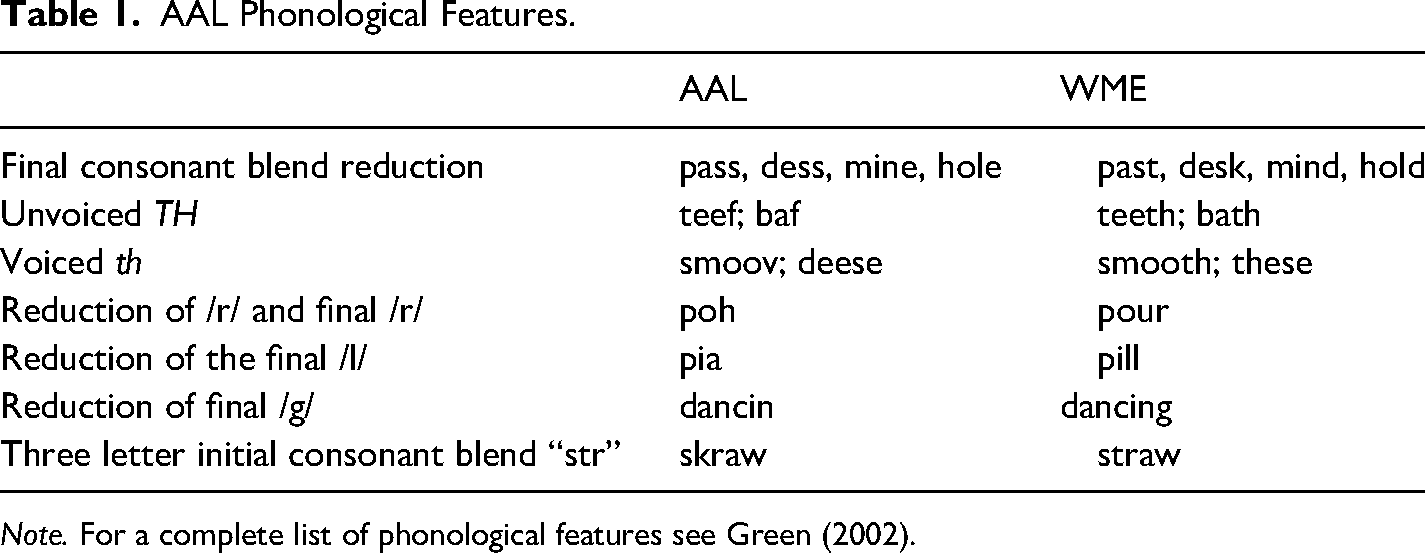
Note. For a complete list of phonological features see Green (2002).
AAL Grammatical and Syntactical Features.
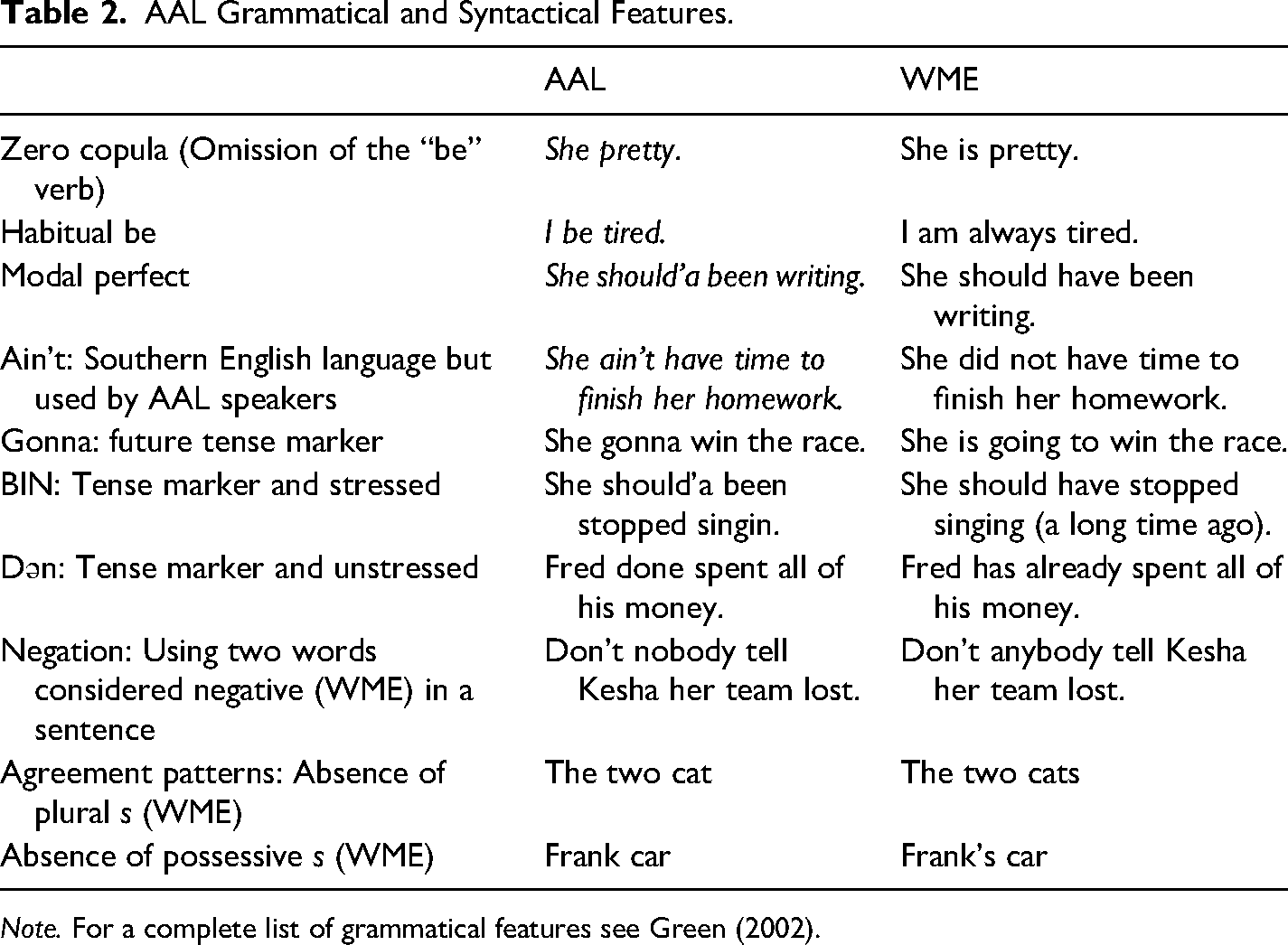
Note. For a complete list of grammatical features see Green (2002).
These AAL features are also used in common majoritarian narratives to position African Americans as less intelligent or uneducated. Although there are several hypotheses about why and how AAL originated (see Lanehart, 2015), the Creole origins hypothesis has been the most widely adopted; one thing is clear, however: Africans were enslaved and brought to the United States. In this process, the enslaved Africans, who spoke different languages within their homeland, created ways to communicate with each other and creatively used language for their own purposes (Smitherman, 1999; 2021b), passing this language down for generations. It is also important to know that non-African Americans who live or work in close contact with a large population of African Americans may also use AAL.
In contrast, WME is an ideology that asseverates English in the United States as the dominant language. It is the spoken and written language required for public communication, academic, business, and government purposes. Although many other names for WME exist, such as Standard English, Mainstream American English, and so forth, we chose to align our work with Baker-Bell (2020a) to show the hierarchy of the English language. That WME is centered in whiteness is shown by the fact that schools require students to learn only this language, leaving aside the languages of other races, ethnicities, or cultures.
Cultural Authenticity in Children's Literature
The definition of authentic literature often contains multiple perspectives concerning what makes a text authentic. In our research, we followed Howard (1991) who argued that an authentic book is one in which a universality of experience infuses a story that is true for its setting and characters. This definition of authenticity or cultural authenticity allows for a given range of experiences among readers within any cultural group and explains the understanding of how authenticity is defined in relation to language within children's literature (Gultekin & May, 2020; Piper, 2015). Furthermore, using this concept of authentic literature, Rosenblatt (1995) argued for its powerful potential to foster the sensitivity and imagination needed in a democracy—meaning that students can foster a sense of acceptance and tolerance in an ever-changing global context. Given this definition and understanding of the role of authentic literature, it is important to recognize how teachers utilize such literature within their own classrooms (e.g., reading aloud), given the standardized Eurocentric curriculum in schools (Hedrick & Pearish, 2003; Morrow, 2003).
African American Language and African American Children's Literature
We found it critical to interrogate the presence of AAL in children's literature because of the high percentage of African Americans speaking AAL. With only 10% (Huyck & Dahlen, 2019) of children's books depicting characters from African American backgrounds (23% for all books with characters of color), many of the titles of children's books, according to Huyck and Dahlen (2019), denote imprecisions and inequities. If the goal of multicultural education is to design educational opportunities for students from varied backgrounds and to assist students in developing affirmative mindsets toward diverse racial, ethnic, and cultural groups (Banks, 1993), the accurate portrayal of African Americans must be included in texts.
The linguistic portrayal of African Americans must be also handled with care; therefore, a teacher should be knowledgeable of the rule-governed nature of the AAL. African American Language can be seen as a negative portrayal of African Americans, as evidenced by the work of Desai (1997) and presented by Brooks and McNair (2009). In many instances, as Desai demonstrated, it was the African American students who were not affirmed in their language and felt uncomfortable with language usage during shared reading experiences.
Moreover, in a comparative analysis of The Brownies Book (1920–1921), a magazine written for African American children from ages 6–16, McNair (2003) found that the books favored a more standardized version of English and some of the passages seemed to indicate a somewhat negative bias toward AAL and a pro-bias for WME.
Classrooms should elevate the use of children's literature whose characters speak in AAL (McCreight, 2011). Although Boutte (2015) provided five examples of children's literature that incorporated AAL, McCreight (2011) highlighted the scarcity of authentic representations of African Americans in picture books throughout history and the damage this can cause students who speak a language at home that differs from classroom book choices. A student who speaks AAL and has difficulty style shifting to WME will face more difficulty learning to read and write in WME since school book choices and curriculum are written in WME (Washington & Seidenberg, 2021). Washington et al. (2023) indicated that students whose language usage is 35% to more than 50% of AAL utterances are high dialect speakers, and high dialect speakers will experience more difficulties in WME spelling (Patton-Terry & Connor, 2010) and WME reading and writing (Puranik et al., 2020) than their peers who speak less AAL.
Lastly, critical race theory or CRT (Crenshaw et al., 1995) also informed this research, recognizing the racial systems that keep AAL from being acknowledged as a legitimate language. CRT critiques the legal and civil movements’ victories and addresses the relationship of race, racism, and power structures in the U.S. society (Bell Jr., 2005; Delgado & Stefancic, 2017; Ladson-Billings, 1995). Specifically important to this study were three of the five tenets of CRT: (1) the permanence of racism, which holds that race is a permanent constant that controls social, political, and economic mobility in our society; (2) whiteness as property, which from the inception of slavery has allowed only Whites to own property, making it difficult for Blacks to gain financial and economic growth; and (3) counter-storytelling, which encourages us to value the perspectives and voices of People of Color and their narratives (Delgado & Stefancic, 2017; Ladson-Billings, 1995).
Methods
The Authors’ Positionality
The authors have brought their personal and academic experiences to this research. The first and third authors are two educated, Black females who were born and raised in the southern U.S. Both authors speak AAL and have previously taught African American students who spoke AAL. Based on their experience as teachers, both authors felt that there were few children's books that incorporated AAL. As Black female scholars, they also felt the need for the authentic voices of African American children to be uplifted. The second author is a non-Black, female scholar who does not speak AAL but who has conducted research on African American children's literature. The second author also felt that AAL should be promoted in classroom settings. The fourth author is a non-Black, Latina doctoral student who does not speak AAL but who believes AAL should be elevated in the classroom.
Data Collection
The data were collected utilizing books that centered African Americans. Books were chosen from the following sources: the authors’ collections; from the main library in one of the top ten largest cities; books purchased from big box retailers; and electronic books viewed through public libraries. Book selections were based upon the books being either slavery- or Civil Rights–themed. When searching for books, we used a variety of keywords such as “slavery,” “children's literature,” “children's books,” and “slavery-themed children's books.” We used the same combinations for Civil Rights books by changing slavery to Civil Rights in the search menus. Books that did not depict these eras were not included. We used all of the books that were available to us. The book selections are a sample and did not include every children's book published with these themes.
When selecting the data, we compared AAL words and phrases to WME in the children's books. Our purpose in doing so was to ascertain the language ideology of the authors by determining which authors used AAL versus WME to portray the language usage of African American characters. Our specific rationale for employing this comparison method was to question whether African American characters could use their authentic language through dialogue or if the authors themselves could use AAL in narration.
To begin, 76 children's picture books were first selected. Exclusion criteria were books that fit the themes but did not have AAL present in them. To determine if AAL was present, each word and sentence was analyzed before the book was excluded. This process excluded 37 books: seven were slavery-themed with no dialogue; 12 were slavery-themed with WME only in the dialogue; four were Civil Rights–themed with no dialogue; and 14 were Civil Rights–themed with WME only in the dialogue. (See Supplemental Table 1 for a list of these books.)
Inclusion criteria were books that had AAL in their narration or dialogue. These books were sorted into four categories: (1) slavery-themed books with dialogue; (2) Civil Rights–themed books with dialogue; (3) slavery-themed books with AAL in the narration only; and (4) Civil Right–themed with AAL in the narration only. If a book covered both topics (e.g., started discussing slavery and ended with Civil Rights), we sorted these books into the slavery-themed category. All the books belonged to the genre of historical fiction; and within the genre, we divided the books based upon whether they were narrative or poetry. In all the books selected, African Americans were the protagonists and their oppressors were the antagonists. As previously mentioned, our focus was on language usage; therefore, we did not authenticate the information presented in the text nor the storyline of the text. (see Figure 1 for an exclusion and inclusion flow chart.)
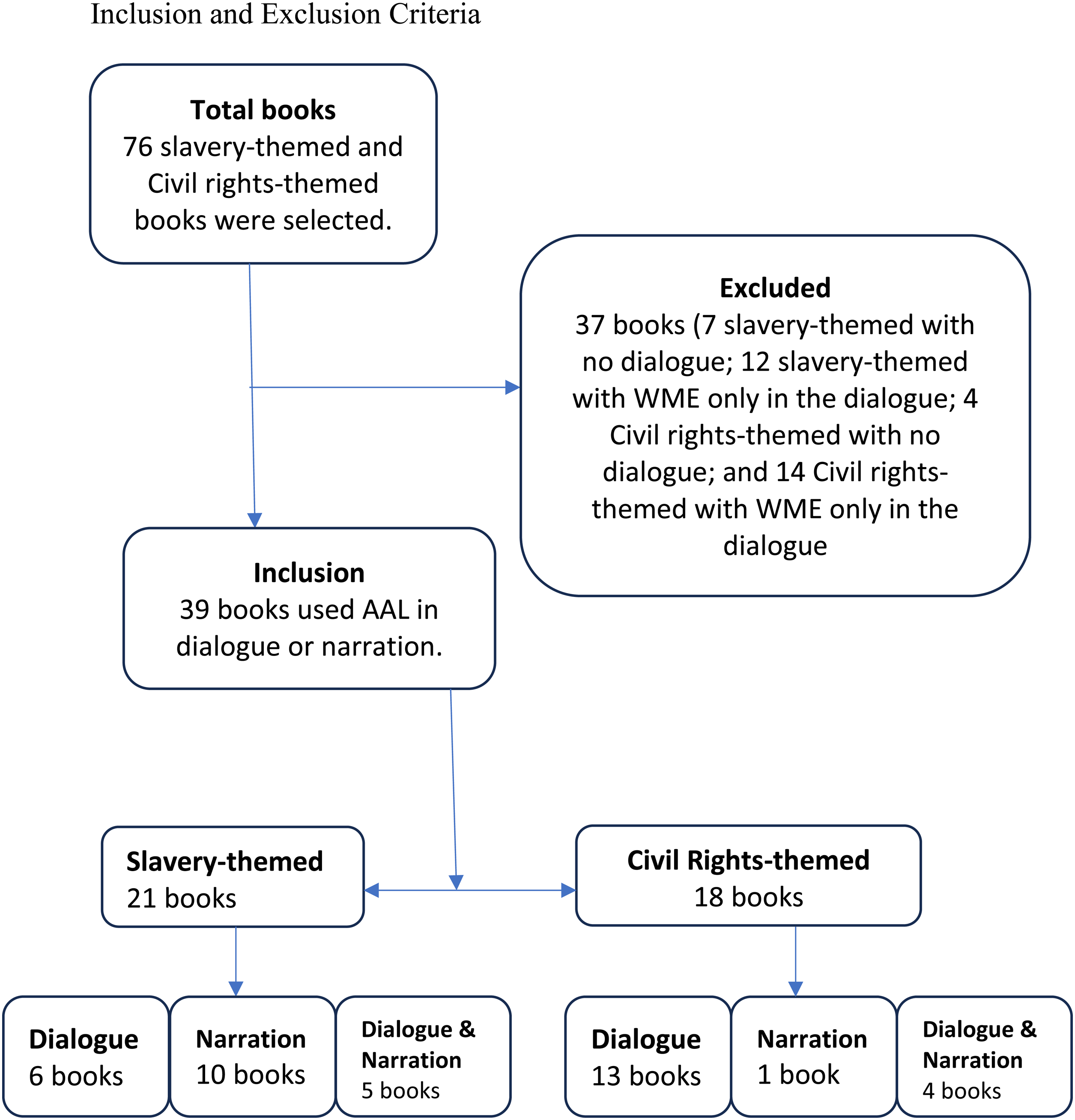
Inclusion and exclusion criteria.
Data Analysis
Language ideology informed our data analysis in that we viewed AAL as a language and coded only the features that were AAL features versus slang, for example. African American Language words and phrases were viewed as equivalent to WME. Similar to the approach of Razfar et al. (2023), we framed this research by adopting a lens sensitive to the linguistic differences between the two languages, AAL and WME, and noting how authors used the language within the texts, whether through dialogue or narration. When analyzing the texts, the first author read the texts looking for AAL features, while the second author read the texts examining any features that did not coincide with WME. The second author marked all features that were not WME and shared the results with the first author. The first author then verified the results to ensure they were AAL. The books that had AAL phonological and grammatical features were hand coded by the first author and verified by the second author using the aforementioned AAL features (Green, 2002; Rickford & Rickford, 2000). Each book was twice examined for AAL features. Next, two charts were created for the two eras. We created codes to symbolize phonological (P), grammatical (G), dialogue (D), and narration (N). We added the phonological and grammatical features to a chart. Then we added a “D” or “N” next to each feature to signify dialogue or narration. The items were tallied each time they appeared in a text and then tallied across all texts used.
We focused only on the phonological and grammatical features of AAL. Kynard (2008) observed that theorists have researched discourse strategies used by African American rhetorics, such as call-response and field-dependent strategies: signifying, tonal semantics, and directness. These strategies were vitally important in understanding the semantics and pragmatics of AAL. We wanted, however, to focus on phonology and grammar so that we could elaborate on the data and analysis of the 39 remaining books.
Research Questions
To address our first research question—How many of the focal texts published between 1995 and 2022 used AAL?—we determined that of the 21 books that were slavery-themed, six used AAL in dialogue, ten used AAL in narration, and five used AAL in dialogue and narration. Moreover, of the 18 books that were Civil Rights–themed, 13 used AAL in dialogue, one used AAL in narration, and four used AAL in dialogue and narration. (see Supplemental Tables 2–4 for a list of these books.)
Prevalent AAL Phonological Features Across Books.
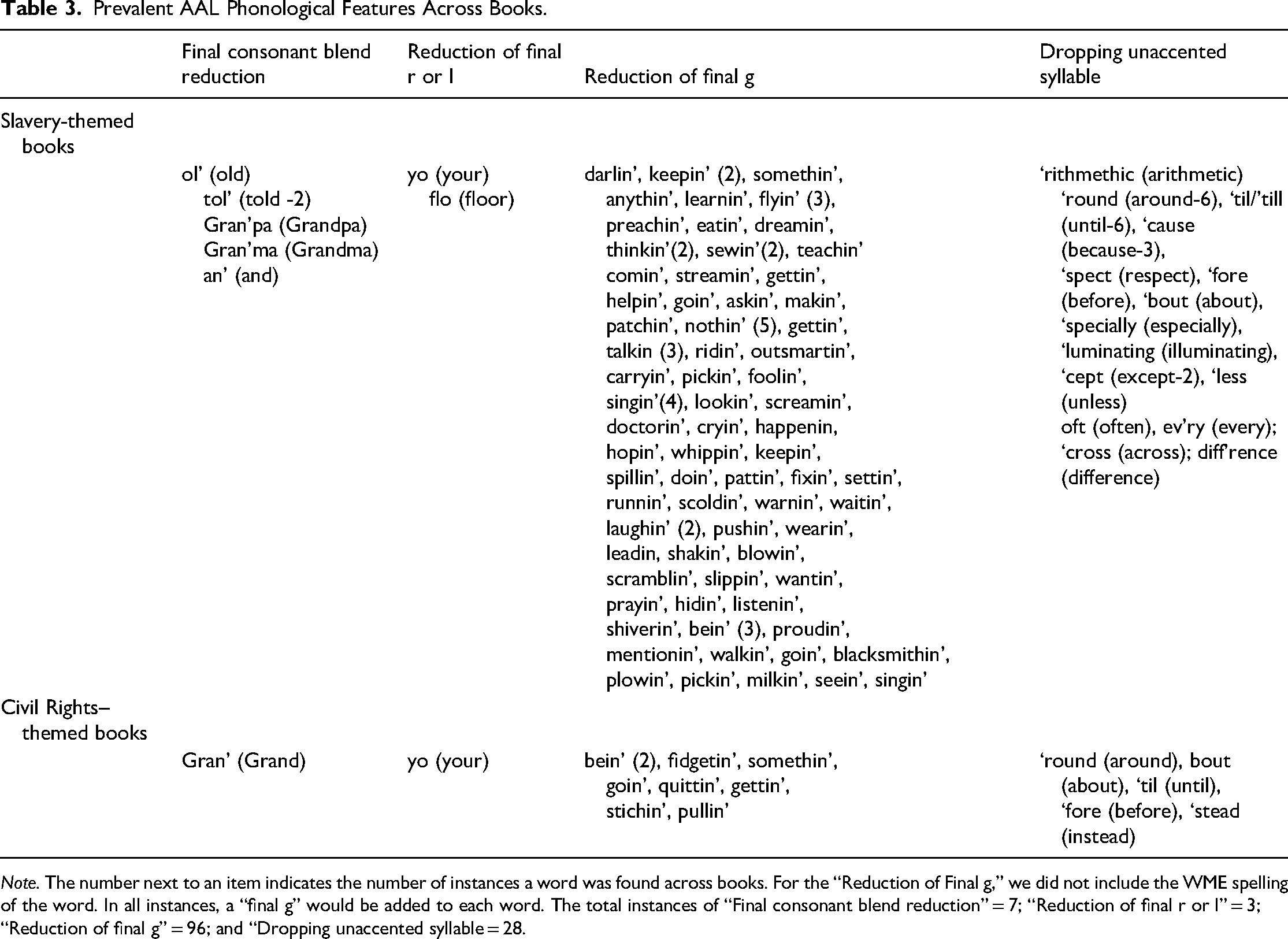
Note. The number next to an item indicates the number of instances a word was found across books. For the “Reduction of Final g,” we did not include the WME spelling of the word. In all instances, a “final g” would be added to each word. The total instances of “Final consonant blend reduction” = 7; “Reduction of final r or l” = 3; “Reduction of final g” = 96; and “Dropping unaccented syllable = 28.
Prevalent AAL Grammatical Features Across Texts.
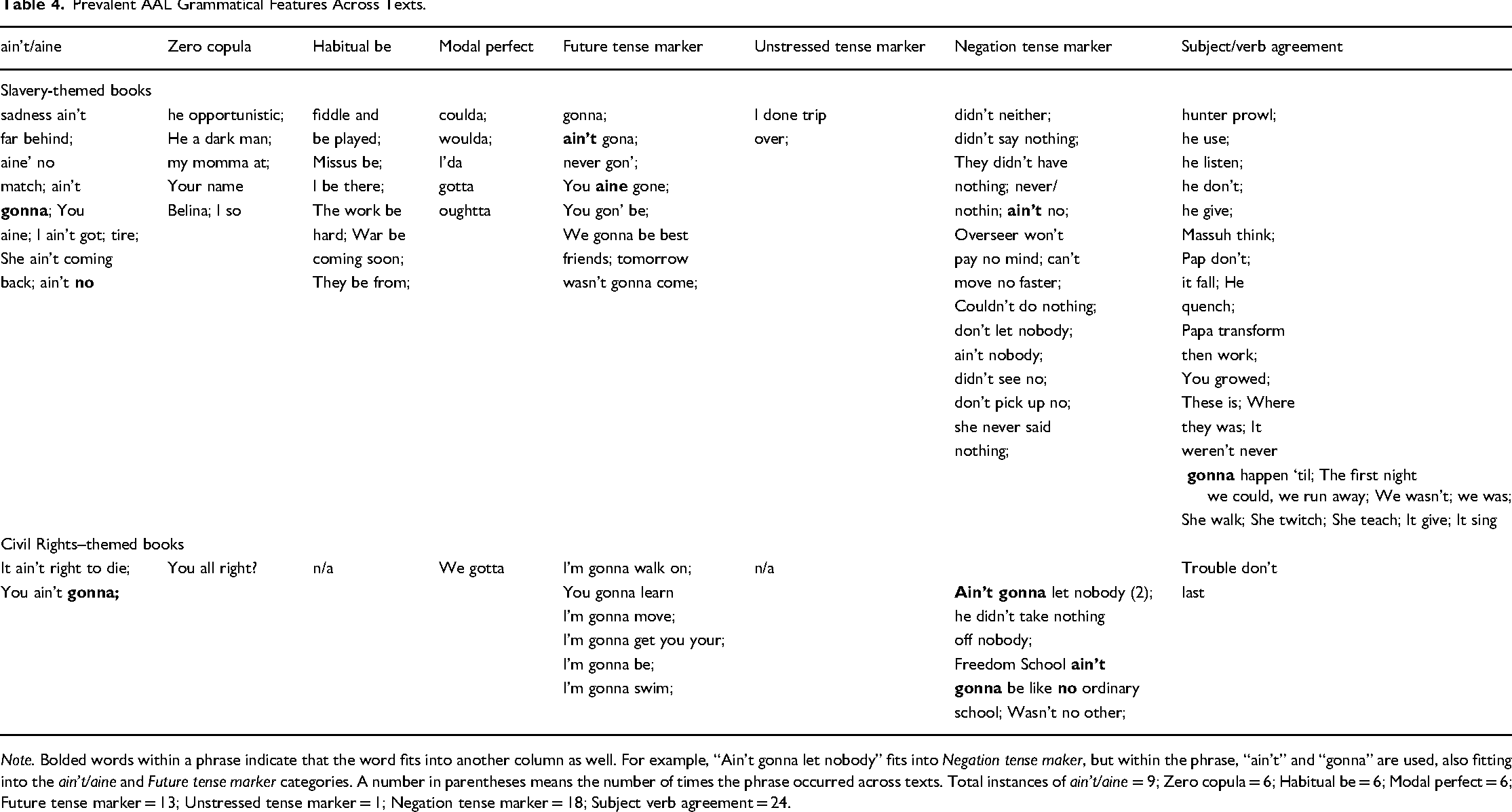
Note. Bolded words within a phrase indicate that the word fits into another column as well. For example, “Ain’t gonna let nobody” fits into Negation tense maker, but within the phrase, “ain’t” and “gonna” are used, also fitting into the ain’t/aine and Future tense marker categories. A number in parentheses means the number of times the phrase occurred across texts. Total instances of ain’t/aine = 9; Zero copula = 6; Habitual be = 6; Modal perfect = 6; Future tense marker = 13; Unstressed tense marker = 1; Negation tense marker = 18; Subject verb agreement = 24.
To address our second research question—What are the most prevalent phonological and grammatical AAL features used in the focal texts?—we followed the work of Pittman (2017), comparing the two languages in the selected books. When dialogue was used, we confirmed who the speaker was (e.g., was it an African American character, was the speaker young or old) to determine if the authors chose only to allow older speakers to use AAL or only young speakers to do the same. When examining dialogue and narration, we were interested in knowing which AAL features were most often used across the books and whether any phonological and grammatical features were used at all.
We categorized the AAL phonological and grammatical features based upon the work of Green (2002). Across all texts, Table 3 provides the categorization for the phonological features, while Table 4 provides the categorization of the grammatical features. The numbers in parentheses indicate how frequently a word or phrase was used.
To address research question 3—Who used AAL in the focal texts? Did the characters style-shift between AAL and WME? If so, when and with whom?—we further analyzed the dialogue to determine which characters used AAL. Seventy-two percent of the books (11 slavery- and 17 Civil Rights–themed books) used AAL in dialogue.
Lastly, through prolonged engagement with the 39 books over two years, we established trustworthiness (Brooks & McNair, 2015) by reading through the books several times and using both the first and second authors to confirm the AAL features. We found features that were not listed in the aforementioned phonological and grammatical list (Green, 2002; Rickford & Rickford, 2000), which then required us to verify them using additional resources from Baker-Bell (2020b) and Lanehart (2015). The fourth author of our study finalized the tables to ensure the words were placed in the correct categories (i.e., phonological and grammatical) and were coded correctly as dialogue or narrative. The goal in using a fourth author was to establish trustworthiness so that words and phrases were not incorrectly or arbitrarily placed in categories without other experts agreeing on their phonological and grammatical features.
When the tables were completed, the second and fourth authors counted each instance of AAL from Tables 3 and 4 to match Supplemental Tables 4 and 5. The frequency of the words and phrases appears in parentheses in Tables 3 and 4. With the first count, the second and fourth authors were in 87% agreement. Both authors conducted a second count, as one of the authors unintentionally excluded some features. After the second count, the authors were in 96% agreement.
Finally, we asked four undergraduate researchers, who were trained in AAL phonological and grammatical features, to adjudicate any differences in the scores. Using Supplemental Tables 4 and 5, they determined how many words or phrases were used in dialogue and narration in both slavery-themed and Civil Rights–themed children's literature. Additionally, they determined the accuracy of the frequency of the phonological and grammatical features. Similar to the second and fourth authors, the undergraduates conducted their counts separately and submitted their numbers to the first author. After five rounds of counting, one undergraduate kept getting lower numbers, and the undergraduates were 100% in agreement. These numbers were shared and discussed with the second and fourth authors for a final 100% agreement on both the instances of AAL (Supplemental Tables 4 and 5) and the frequency of words and phrases (Tables 3 and 4).
Results
Based on our analysis, we found that the phonological and grammatical features of AAL were more prevalent in slavery-themed books than in Civil Rights–themed books. Across all texts, there were 139 instances of AAL phonological features (Table 1) and 106 instances of grammatical features (Table 2). For phonological features in slavery-themed books, there were 45 instances of AAL in dialogue and 74 instances of AAL in narration; for Civil Rights–themed books, there were 15 instances of AAL in dialogue and five instances of AAL in narration. For grammatical features in slavery-themed books, there were 37 instances of AAL in dialogue and 41 instances of AAL in narration; for Civil Rights–themed books, there were 23 instances of AAL in dialogue and five instances of AAL in narration.
The results indicated that the most dominant AAL phonological features were the reduction of the final g and dropping unaccented syllables. When examining all books, the reduction of the final g (e.g., sittin’) was used frequently. Ninety-six reductions of final g occurred, and authors like Hopkinson (1995) and Nelson (2003) in each instance reduced the final g. Although dropping unaccented syllables was not on our initial list of prevalent phonological features, it is worth noting that the feature was used regularly in the selected books. According to Rickford and Rickford (2000), this feature is generally used with older AAL speakers in that the first syllable (e.g., ‘bout) or medial syllable (e.g., gov’ment) is omitted when it is unaccented.
The least frequently used AAL phonological features included a final consonant blend reduction (e.g., pass for pas in six slavery-themed books and one Civil Rights–themed book) and the reduction of the final r (e.g., foe for four in two slavery-themed books and one Civil Rights–themed book). Only a few instances appeared across the texts. We found no instances of the reduction of the final l (e.g., toe for toll). Additionally, there were no instances of the voiced TH (e.g., bave for bathe) and the unvoiced TH (e.g., baf for bath) or the three letter initial consonant blend “str” (e.g., skring for string).
Likewise, we examined prevalent AAL grammatical features. We found examples of each of the grammatical features except for two features. We did not find any instances of BIN as a stressed tense marker where been was used with an AAL feature modal perfect word (e.g., should’a been). Additionally, we did not find any examples of the absence of the possessive s in the texts. We found only one instance of the unstressed tense marker, dən, in the sentence, “I done trip over” located in Grady (2012).
Ain’t or aine are often used by AAL speakers. These usages were found in several texts to indicate what someone was not going to do or whether something was not going to happen. Ain’t or aine was used with other AAL grammatical features, such as a future tense marker (e.g., ain’t gona) and as a tense maker (e.g., ain’t gonna let nobody). Nine occurrences of ain’t or aine appeared in both texts (seven slavery-themed and two Civil Rights–themed books). The future tense marker, gonna, behaved similarly to aint or aine in that it was mostly paired with other AAL grammatical features.
Moreover, the zero copula was occasionally used in five slavery-themed books and one Civil Rights–themed book. Although more prevalent in the slavery-themed books, only one occurrence appeared in the Civil Rights’ themed-book, Littlesugar (2001). Although the habitual be is a common feature for AAL speakers, we did not find any instances of it in Civil Rights–themed books.
Another frequent AAL grammatical feature that appeared more often in slavery-themed books than in Civil Rights–themed books was agreement patterns (24 slavery-themed books and one Civil Rights–themed book). Examples of AAL agreement patterns include hunter prowl; these is; they was; and growed.
Other examples of AAL that were used included the indignant come. In Shabazz (2014, para. 12), young Malcolm asked, “How come we don’t have windows?” This use of come signifies a “connotation of disapproval” (Green, 2002). Likewise, in Grifalconi (2007), come was used with the same type of question, How come.
The results revealed that authors who wrote slavery-themed books (200 instances) included three-fourths more instances of AAL features than authors who wrote Civil Rights–themed books (49 instances). Additionally, authors of slavery-themed books were more likely to use AAL phonological features in narration (76 instances) than they used in dialogue (47 instances). In Civil Rights–themed books, authors used more AAL in dialogue (16 instances) than in narration (five instances). For AAL grammatical features, authors of slavery-themed books used three more instances of AAL in narration (40 instances) than in dialogue (37 instances); the opposite was true for Civil Rights–themed books, in which more AAL appeared in dialogue (23 instances) than in narration (five instances). These AAL features were used in accordance with Green (2002) and Rickford and Rickford (2000).
In answering research question 3—Who used AAL in the focal texts? Did the characters style-shift between AAL and WME? If so, when and with whom?—we found that AAL was predominately used by the African American characters. There was one instance of the antagonist speaking AAL, which was the one unstressed tense marker, “I done trip over,” found in Grady's (2012) poem “Broken Dishes.” In the slavery-themed books, AAL was used by adults and children. For example, in Hopkinson's (1995), Sweet Clara and Young Jack use AAL, in Nelson (2003), Willa, the young girl who finds the doll speaks AAL, and in Schroeder (2000), young Minty uses AAL. In most other instances, the speakers were adults. In the Civil Rights–themed books, older persons used AAL. For example, AAL was used by the grandfather (Bandy & Stein, 2019), the dad and mother (Duncan, 2018), and Mama Frances (McKissack, 2008). However, we found one book (Wiles, 2005) with AAL spoken by children (I’m gonna be a fireman, and I’m gonna swim).
In most books, the characters were able to switch between AAL and WME. For example, in Grimes (2015), Tubman style shifts during her conversation with Anthony; however, we found few instances of a character style shifting because they were holding a conversation with someone of a different race or age. In most instances, the characters remained grouped within their own race. Many of those who spoke to other races used WME in dialogue throughout the book regardless of the listener.
Discussion
The purpose of this study was to determine whether slavery- and Civil Rights–themed texts are truly authentic regarding the language used in them. We do not know what specific language(s) the characters would have spoken while they were enslaved in the slavery-themed books; however, it is unlikely that it would have been WME. This research, therefore, questioned whether these texts represented the characters as their authentic selves, and whether some of the authors could write as their authentic selves.
In these books, many authors frequently chose to use the same AAL features, while omitting other features. When a book was slavery-themed versus Civil Rights–themed, authors included 151 more instances of AAL. It is unclear whether this was because during the Civil Rights era, African Americans were allowed to attend school, although segregated, while during slavery, African Americans were not allowed to read and write. It is uncertain whether authors’ use of AAL more in slavery-themed books and less in Civil Rights–themed books was stereotyping AAL as being a language for the uneducated, while WME is a language for the educated. If so, this type of stereotype upholds the dominate language ideology. Additionally, the authors’ choice to portray older characters as AAL speakers in Civil Rights–themed books compared to younger characters may indicate that during that era, it was easier to assimilate and remove the cultural identity of those who were more impressionable. If portraying older characters as AAL speakers versus younger characters as AAL speakers is true, this could indicate racial permanence and whiteness as property to control and change cultural norms within the African American culture.
Furthermore, in slavery-themed books, AAL was used more in phonological and grammatical narration than in dialogue. It is possible that the authors wanted to tell the story of slavery through narration versus giving the enslaved a voice, since technically, during that time, the enslaved were silenced. Another interpretation could be that the authors wanted to refrain from determining what language the enslaved characters might have used since some were just arriving in the U.S., and they spoke the language of their homeland and not AAL. As we previously noted, AAL developed over time so that enslaved people could communicate with one another (Smitherman, 2021a). Further, concerning AAL phonological features, the authors might have wanted to refrain from impeding the comprehension of young readers by providing words with AAL spellings that might appear to be other words (e.g., as in the reduction of r in foe for four).
On the other hand, the Civil Rights–themed books used more AAL phonological and grammatical features in dialogue than in narration. In situations where characters were speaking to other African American characters, the authors might have felt more comfortable using AAL. The authors of these books might also have understood that if readers were not aware of AAL, they might think that using AAL in dialogue with White people during these two eras might stereotype Black people as not speaking “correct” English, which would convey a negative language ideology. As previously mentioned, for readers without knowledge of AAL, it might appear as though a character suffers from a WME deficit—a conclusion which is inaccurate.
Because we can only make inferences regarding authorial intentions from our data, we cannot know why an author chose to use WME or AAL; what determined the frequency of use of AAL; or which features of AAL they chose to use. For example, Supplemental Table 1 provides books from these eras in which AAL was not used at all. Interestingly, 12 slavery- and 14 Civil Rights–themed books included WME dialogue only. Did their authors speak AAL? If they did not, was that the reason AAL was not used in the text? AAL might not have been used because of other aforementioned reasons. We would only be able to know the answers to these questions by interviewing the authors, something that was beyond the scope of this study. Although we do not know the rationale for and frequency of AAL usage, we do know that schools require students to learn to read and write in WME regardless of our opinions on the matter. We acknowledge that authors might have chosen to use WME for this reason, especially when African Americans were speaking to other races, and we also acknowledge that publishers might require WME to be used in the texts.
Similarly, most academic journals require all authors to write in WME, regardless of the home language of the author. Being able to style shift or adjust language by syntax, grammar, or structure should be seen as an asset or form of cultural capital compared to the form of control that is used based on racial permanence that designates white dominant perspectives that lead to educational mobility. Most authors accept this challenge and style shift to publish so they can thrive in the professorship. We also acknowledge the difficulty in being our authentic selves via AAL usage as authors across various journal platforms, while asking teachers to uplift students’ usage of AAL during instructional time. We also know that African Americans are not monolithic, and about 20% may not speak AAL (Rickford, 1999).
Historically, African Americans were educated people who spoke in their own languages prior to being forced to disregard their own heritage, values, speech, and culture in slavery. That WME was spoken more in Civil Rights–themed books falsely indicates that African Americans gained more knowledge or were better off once they assimilated into white culture and were given more rights, especially after Brown v. Board of Education, which had bittersweet implications among Black students, teachers, and communities due to the disregard of Black culture (Bell Jr., 2005; Lash & Ratcliffe, 2014). The representation of WME as an educated form of speech compared to AAL as an uneducated form of speech also has upheld dominate language ideology, Whiteness as property, and racial permanence in our society, even though enslaved people were not allowed to be educated.
Further, with such a small percentage of books portraying characters from African American backgrounds (Huyck & Dahlen, 2019), it is important that books include authentic language experiences that are relatable to most African American students, as AAL is not inferior to WME, and should be viewed as a form of counter-storytelling and cultural capital when teaching through mechanisms such as language ideology. Also, we must question the reasons why WME continues to be the standard in schools. When we interrogate, we can then seek linguistic justice (Baker-Bell, 2020b) and equitable literacy experiences and education.
Limitations
Several limitations exist for this study. First, we were not able to access every slavery- and Civil Rights–themed book; therefore, our sample size is small. Additionally, we included books that used any instance of AAL. Some books might have had one instance while others may have had over 20 instances. These varying numbers could pose a problem in that a teacher or reader might want to examine AAL features in a book, and the person might only see one or two instances. However, see Supplemental Tables 4 and 5, as these tables provide all the AAL features within each book. Additionally, we did not count the total number of words per books; thus some slavery-themed books might contain more overall words than Civil Rights–themed books. In coding our data, we only examined the phonological and grammatical features of AAL. We did not code for semantic, pragmatic, mood, or aspect instances of AAL; therefore, the analyses present an incomplete understanding of AAL used in the texts. Also, because we did not authenticate the storylines of the books, some of them may not be authentic in their historical representations. Finally, although the framing for our study was about authenticity, we did not evaluate the authors of the texts; therefore, we were unsure if there would be a difference in the authenticity of a text that incorporated AAL if the author was non-Black. In this instance, we reframed from determining the identity of an author without being able to interview each author to determine how the author self-identified.
Implications for Practice
We have provided a list of books that can support students’ AAL literacy development. It is our hope that teachers develop a language ideology (Razfar et al., 2023; Smitherman, 2021b) that supports AAL when using these texts. (Supplemental Tables 2–5 provide teachers a list of books that feature AAL.) To assist teachers in evaluating which books to choose, we have provided a breakdown of all the AAL features per book. When selecting books for read-alouds, teachers should choose books that are one-to-two grade levels above the students’ reading abilities. Although we did not analyze the books based on Lexile levels, we provide the Lexile levels to support students’ independent reading of the books.
We suggest that using slavery- and Civil Rights–themed literature with AAL also allows teachers to approach these texts through a CRT lens (Freire, 1973; Stevens & Bean, 2007). A CRT lens is needed because shifts in the language have occurred over time. Smitherman (1991), for example, explains the shift in racial semantics from Black Americans being called Black to African Americans (not Caribbean people) including being previously called Colored and Negro. As noted in CRT through law, there was a “preference for whiteness” (mulatto/Black) and all those outside of this were deemed Black (Reece, 2019). In slavery-themed and Civil Rights–themed books, students may encounter language that is no longer being used, especially when referring to these two eras.
Therefore, teachers should employ critical conversation practices (e.g., truthful conversations about racism, stereotypes, exclusion, and hatred, and who benefits from each of these) for elementary age students to explore the historical, social, and political contexts of AAL used in these books. Teachers can ask students to question the language usage in both eras of books and encourage students to think critically about the reasons why AAL was used more in one era versus the other, or why certain features were used and others omitted. They can also question why some authors chose not to use AAL at all. Providing students with the historical contexts of these two eras and why it has been and is important to preserve AAL can affirm students’ cultural and language identity (Bishop, 1990).
Furthermore, when using these texts to affirm students’ identity, teachers must understand the culture and language themselves. The first author of this study has completed several professional development (PD) workshops for elementary teachers from all backgrounds. In each PD, most teachers were unfamiliar with the linguistic features of AAL. Participants asked, “Is that when African Americans (or Black people) say, ____” (fill in the blank); however, whatever word was selected, it is usually a stereotyped or slang word or phrase. Many African American participants tended to know the language features but had not determined how AAL usage in the culturally responsive classroom can support students’ learning, which in turn builds cultural capital and confidence. Teachers must utilize the fund of language that African American children bring to the classroom and expand upon it by setting high expectations for academic success, thus ensuring that teachers are implementing culturally relevant pedagogy (Ladson-Billings, 1995) and using a language ideology lens that supports AAL (Razfar et al., 2023).
Lastly, states are providing a plethora of PD to teachers on the science of reading and evidenced-based reading instruction. Within these learning opportunities, AAL must be addressed. Educators must understand the differences between the linguistic features of AAL and WME. Educators must approach AAL from a language ideology that considers AAL equivalent to WME. Currently, instruction happens in WME; however, teachers must embrace AAL and use the students’ language as a language asset in the classroom. This asset-based use of language has been supported in bilingual classrooms; yet, many teachers view the language that many African American students bring to the classroom as a linguistic deficiency as opposed to being a linguistic difference.
As next steps, policymakers and education agencies must employ standards and guidelines to ensure that teachers are affirming the students’ identity. Illinois, for example, has developed and adopted Culturally Responsive Teaching and Leading Standards (Illinois State Board of Education, n.d.), which includes affirmation of students’ language, culture, and experiences, and makes connections between academic learning and students’ culture and home language. Such stances can be undertaken by other states as well.
Implications for Research
Our research serves as a springboard to the types of research that can be completed to interrogate AAL usage in children's literature. Only when we seek and question why AAL is not widely accepted can we pursue equitable research studies that examine AAL with the purpose of increasing the research community's understanding of AAL for the betterment of education and society through a language ideology that supports AAL. Our research was limited to examining slavery- and Civil Rights–themed children's literature. To update our list of the books we examined, researchers can analyze books that were not included, or they can code other AAL features. Researchers can also authenticate the storylines of these books through a counter-storytelling lens.
Researchers should also analyze other themes within children's literature and other genres to see how prevalent AAL is. Another study, for example, could focus on the difference between slang and AAL, and how each is depicted in children's, young adult, and media literacy, and how slang, oftentimes is more acceptable than some features of AAL, even though some features from both intersect. African American Language, moreover, is often heard in mainstream commercials and spoken in television programming and is seen as a cool way of talking, yet, when spoken by African Americans in educational or business settings, it is generally viewed negatively.
As African American authors have often articulated constraints on what publishers are requesting versus what publishers are actually publishing, a next step would be to determine if there are any AAL patterns in relation to publishers. Additionally, it would be important to know whether such a pattern exists based upon an authors’ race and backgrounds. What patterns exist in relation to the age of the authors or the year of publication of the text? These questions might help understand the rationale for the language used in the books.
Conclusion
There are several children's books centered around slavery and Civil Rights that can be read to affirm the identity of AAL speakers. African American Language is important to amplify and center in elementary contexts. Furthermore, in many aspects of the literature, race is the main construct that is omitted, or racism is not addressed. Many researchers do not discuss how race and systems of oppression have led to reduced opportunities and affirmation for African Americans even in literacy. We hope this work challenges language ideologies that believe that young children must learn WME only, or that children's home language is inappropriate for school. For students to be their authentic selves, teachers must encourage students to use their own language. Resources to support and affirm students’ language must be authentic. African American students should not only be able to see themselves in authentic literature, but they must also be able to hear themselves in authentic literature.
This research is important because prior work has focused mostly on adolescents. Young AAL speakers can be encouraged to use and read AAL and still be fully competent and literate. It is our hope that more early childhood language and literacy educators and scholars become more willing to evaluate their curricular and instructional materials and make room for bidialectism/multilingualism as it relates to African American children. Methodologically, this research is important because it provides a list of authentic literature that can promote AAL usage in and out of the classroom. Not many studies focus on authentic literature for young AAL speakers. By using language ideology, we provide a starting point; however, our list of children's books is not exhaustive. Therefore, more research should be conducted on this topic to provide equitable opportunities for African American students and the cultural capital they bring to literacy classrooms.
Supplemental Material
sj-docx-1-jlr-10.1177_1086296X241244702 - Supplemental material for African American Language in Children's Literature
Supplemental material, sj-docx-1-jlr-10.1177_1086296X241244702 for African American Language in Children's Literature by Ramona T. Pittman, Rebekah E. Piper, Whitney McCoy, and Melody Alanis in Journal of Literacy Research
Supplemental Material
sj-docx-2-jlr-10.1177_1086296X241244702 - Supplemental material for African American Language in Children's Literature
Supplemental material, sj-docx-2-jlr-10.1177_1086296X241244702 for African American Language in Children's Literature by Ramona T. Pittman, Rebekah E. Piper, Whitney McCoy, and Melody Alanis in Journal of Literacy Research
Supplemental Material
sj-docx-3-jlr-10.1177_1086296X241244702 - Supplemental material for African American Language in Children's Literature
Supplemental material, sj-docx-3-jlr-10.1177_1086296X241244702 for African American Language in Children's Literature by Ramona T. Pittman, Rebekah E. Piper, Whitney McCoy, and Melody Alanis in Journal of Literacy Research
Supplemental Material
sj-docx-4-jlr-10.1177_1086296X241244702 - Supplemental material for African American Language in Children's Literature
Supplemental material, sj-docx-4-jlr-10.1177_1086296X241244702 for African American Language in Children's Literature by Ramona T. Pittman, Rebekah E. Piper, Whitney McCoy, and Melody Alanis in Journal of Literacy Research
Supplemental Material
sj-docx-5-jlr-10.1177_1086296X241244702 - Supplemental material for African American Language in Children's Literature
Supplemental material, sj-docx-5-jlr-10.1177_1086296X241244702 for African American Language in Children's Literature by Ramona T. Pittman, Rebekah E. Piper, Whitney McCoy, and Melody Alanis in Journal of Literacy Research
Supplemental Material
sj-docx-6-jlr-10.1177_1086296X241244702 - Supplemental material for African American Language in Children's Literature
Supplemental material, sj-docx-6-jlr-10.1177_1086296X241244702 for African American Language in Children's Literature by Ramona T. Pittman, Rebekah E. Piper, Whitney McCoy, and Melody Alanis in Journal of Literacy Research
Supplemental Material
sj-docx-7-jlr-10.1177_1086296X241244702 - Supplemental material for African American Language in Children's Literature
Supplemental material, sj-docx-7-jlr-10.1177_1086296X241244702 for African American Language in Children's Literature by Ramona T. Pittman, Rebekah E. Piper, Whitney McCoy, and Melody Alanis in Journal of Literacy Research
Supplemental Material
sj-docx-8-jlr-10.1177_1086296X241244702 - Supplemental material for African American Language in Children's Literature
Supplemental material, sj-docx-8-jlr-10.1177_1086296X241244702 for African American Language in Children's Literature by Ramona T. Pittman, Rebekah E. Piper, Whitney McCoy, and Melody Alanis in Journal of Literacy Research
Supplemental Material
sj-docx-9-jlr-10.1177_1086296X241244702 - Supplemental material for African American Language in Children's Literature
Supplemental material, sj-docx-9-jlr-10.1177_1086296X241244702 for African American Language in Children's Literature by Ramona T. Pittman, Rebekah E. Piper, Whitney McCoy, and Melody Alanis in Journal of Literacy Research
Supplemental Material
sj-docx-10-jlr-10.1177_1086296X241244702 - Supplemental material for African American Language in Children's Literature
Supplemental material, sj-docx-10-jlr-10.1177_1086296X241244702 for African American Language in Children's Literature by Ramona T. Pittman, Rebekah E. Piper, Whitney McCoy, and Melody Alanis in Journal of Literacy Research
Footnotes
Declaration of Conflicting Interests
The author(s) declared no potential conflicts of interest with respect to the research, authorship, and/or publication of this article.
Funding
The author(s) received no financial support for the research, authorship, and/or publication of this article.

References
Supplementary Material
Please find the following supplemental material available below.
For Open Access articles published under a Creative Commons License, all supplemental material carries the same license as the article it is associated with.
For non-Open Access articles published, all supplemental material carries a non-exclusive license, and permission requests for re-use of supplemental material or any part of supplemental material shall be sent directly to the copyright owner as specified in the copyright notice associated with the article.
