




Abstract
This paper jointly considers syntactic, semantic, and phonological/phonetic factors in approaching an understanding of BIN, a remote past marker in African American English that has been described as “stressed.” It brings together data from the Corpus of Regional African American Language (CORAAL) and a production study in a small African American English-speaking community in southwest Louisiana to investigate the use and phonetic realization of BIN constructions. Only 20 instances of BIN constructions were found in CORAAL. This sparsity was not simply due to a dearth of semantic contexts for BIN in the interviews, since 122 instances of semantically equivalent been + temporal adverbial variants were also found. These results raise questions about the extent to which BIN constructions and been + temporal adverbial variants are used in different pragmatic and discourse contexts as well as in different speech styles. The production study elicited BIN and past participle been constructions in controlled syntactic and semantic environments. The phonetic realization of BIN was found to be distributed over the entire utterance rather than localized to BIN. BIN utterances were distinguished from past participle been utterances by having higher ratios of fundamental frequency (F0), intensity, and duration in BIN/been relative to preceding and following material in the utterance. In both studies, BIN utterances were generally realized with a high F0 peak on BIN and a reduced F0 range in the post-BIN region, with variability in the presence and kinds of F0 movements utterance-initially and utterance-finally, as well as in F0 downtrends in the post-BIN region.
1 Introduction
This paper brings together different approaches in linguistics in investigating the phonological and phonetic properties of BIN in African American English (AAE) that are linked to its semantic and pragmatic interpretation. The marker BIN, which has been described as “stressed” (Rickford, 1973, 1975), situates an eventuality or part of it in the far past. The previous research on BIN has established that the “stress” on the marker indicates the far past, and the investigation in this paper clarifies what “stress” might refer to and raises further questions about the influence of the utterance surrounding BIN on the remote past interpretation. This paper continues the description of tense and aspect properties of BIN and how the marker interacts with different types of predicates; it also lays the initial phonetic groundwork necessary to move toward a phonological analysis of the intonation of BIN constructions. One topic that is commonly associated with AAE is variation, and the work in this paper provides an opportunity to consider other ways of expressing long-time meaning in AAE and assessing data to determine whether present perfect constructions with temporal adverbials might be considered to be variants of BIN constructions. In addition, as noted in work such as Lavandera (1978), the linguistic variable has been used extensively in phonology, and the research in this paper raises questions about the extent to which it makes sense to talk about syntactic/semantic variation in expressing long periods. Along the lines of other research on AAE, this paper leads naturally to questions about the AAE continuum and what speakers’ uses of different constructions to convey the far past tell us. Finally, in the consideration of BIN and adverbial phrases, this paper also shines the light on possible approaches that speakers who have some familiarity with AAE might take in avoiding features that mark them as speakers of the linguistic variety or as speakers of a stigmatized variety. In effect, the study of BIN contributes to the discussion of perceptions of “sounding black” and strategies speakers might use to avoid stereotypical features.
In this paper, African American English (AAE) refers to a linguistic variety spoken by some—not all—African Americans that has set syntactic, morphological, phonological, semantic, pragmatic, and lexical properties that are intertwined with properties of General American English (GAE). More recently there has been a move to use the label African American Language as a means of including all variations of language in African American communities. Owing to overlap between properties of GAE and AAE, speakers of AAE also use features that are associated with GAE. In such cases, AAE speakers are using properties that are also part of GAE; they are not codeswitching into GAE. For instance, in AAE, zero auxiliary forms are acceptable, and in some contexts overt forms are obligatory. As such, when speakers use overt auxiliaries in certain contexts, they are not codeshifting to GAE; they are using variant forms that are also in the AAE grammar. In some situations, however, AAE speakers do code shift between AAE and GAE. Given speakers’ varying use of AAE properties owing to regional influences as well as other extralinguistic factors, it is useful to view AAE on a continuum. This avoids assumptions that all speakers are alike and that there is no variation in the linguistic variety. Not only can different speakers be thought of as occupying different places on the continuum, but, also, some speakers might move along the continuum given different situations—even closer to AAE-speaking communities or farther away. (See Baugh, 1983 for more discussion of the continuum.) Even in light of AAE on a continuum, it is still important to note that there are quite likely core structural properties that unify the different subvarieties.
1.1 Background
Three verbal markers have been shown to have similar pronunciations but subtly different meanings in some contexts in some varieties of AAE. In this paper, we use a different orthographic representation for each marker: been, bin, and BIN. The marker represented as been occurs in contexts in all varieties of American English. The marker bin, which is unstressed, also occurs in some different regions and varieties of AAE but not in others. Winford (1998) reports that AAE speakers in Columbus, Ohio, do not accept the marker. Not only is there variation in whether or not the marker actually occurs in some varieties of AAE, but there is also variation in its distribution in varieties of AAE in which it does occur. For instance, Spears (2017) records a number of linguistic environments for bin. On the other hand, in the variety of AAE on which this paper is based, bin’s occurrence is limited: It occurs mostly preceding the main verb had (and some other verbs with past reference). In addition, it has been observed in the speech of older speakers in southwest and northern Louisiana (Green, 2002). Finally, in all of its occurrences, it is unstressed. The question about whether been and bin are the same markers with different uses is not addressed in this paper, but see Spears (2017) for more discussion related to that issue. BIN, known as stressed been, has been referred to by a number of labels, such as remote phase, remote past, and remote perfect: (1) been: I been to Jamaica five times./I been watching tv./I been a bus monitor before. “I have been to Jamaica five times” / “I have been watching TV” / “I have been a bus monitor before” (2) bin: I bin had this necklace ’bout fifteen, or sixteen years. (Green, 2002, p. 58) “I have had this necklace for fifteen or sixteen years” (3) BIN: Bruce BIN in the kitchen. “Bruce has been in the kitchen for a long time”
The sentence in (1) is similar to been present perfect sentences that occur in other varieties of English: I’ve/I have been running. The difference is that for some AAE speakers, the auxiliary have (or the contracted form ’ve) is not produced in this context, or it is produced variably. Henceforth, we will refer to been as it occurs in present perfect contexts as the past participle been, abbreviated as beenPPART. A number of factors may influence a speaker’s production of “have” (or ’ve), including the speaker’s place(s) on the AAE continuum and inter- and intra-community networks as well as phonological processes that might affect different varieties of English. The marker bin does not occur with preverbal auxiliary have (or ’ve) (in the variety on which this research is based), so it also differs from beenPPART constructions (1) in this way, which occur with main verbs, prepositions, and nouns. In addition to questions about syntactic/semantic and phonological properties of the been-types (1, 2, and 3), questions about the extent to which all of these markers occur in speakers’ grammars and what social factors influence the occurrence and distribution of these markers remain unanswered. As research with AAE corpora increases (Kendall, 2019), and as more different methods in addition to the sociolinguistic interview are being used to collect data from AAE-speaking communities, we will move closer to answers to these questions.
Previous research on BIN has addressed questions about meaning, origin, and perception of the marker. For instance, Labov (1972) characterizes the marker as a remote past perfect marker, and in Rickford (1973, 1975), the earliest extended study of the marker, BIN is defined as indicating that the initiation of a process is at a point in the remote past. In addressing questions about the origin of the marker, Rickford (1977), Winford (1993), and Mufwene (1994) suggest that it may be linked to the anterior marker in Guyanese Creole and Gullah. In his work on the origins of AAE, Winford (1998) labels the marker remote perfect BEEN, which occurs with stative and nonstative predicates. Winford links BIN to American English varieties and creoles by explaining the semantics of the marker as the result of the reanalysis of the continuative perfect been under the influence of “an earlier creole past marker bin” (p. 128).
Building on the description in Rickford (1975, 1999) in which the label “remote phase” is used to capture BIN’s function of positioning the “initiation of a process at some point in the remote past” (p. 24), Green (1998) characterizes BIN as situating an eventuality or some part of it in the remote past. In this paper, we refer to BIN as a remote past marker to capture its common property in all of its tense-aspect uses, including non-perfect constructions—that of situating some part or all of an eventuality in the far past. 1
The description of BIN presented here builds on that in Green (1998, 2002) but makes one refinement in relation to the use of the resultant state. There is one BIN, which combines with different predicates, resulting in two different uses. The uses of BIN are labeled simply as a way of conveying the types of meanings that are associated with the marker—not to argue for distinct BIN’s in AAE. In the previous limited research on BIN, Rickford (1975) took a similar approach and labeled uses of BIN. In one use, which we label as BINSTATE, BIN combines with predicates that refer to an eventuality that started in the remote past and continues to the moment of utterance. BINSTATE captures non-progressive and progressive forms, and further delineation might be unnecessary, but it is useful because it helps to underscore the BIN readings that have either been ignored or undetected in previous literature. Constructions in the BINSTATE type are undoubtedly compatible with the present perfect, and, in fact, they can be paraphrased in terms of present perfect “has/have been . . .for a long time,” as shown in (4) below. This BIN type is delineated into two sub-uses, continuousness (BINSTATE—Continuous, abbreviated as BINSTATE-CONT) and habitual (BINSTATE—Habitual, abbreviated as BINSTATE-HAB). The non-habituals constitute the subdivision BINSTATE-CONT and the habituals constitute the subcategory BINSTATE-HAB. According to Comrie (1976), The feature that is common to habituals, whether or not they are also iterative, is that they describe a situation which is characteristic of an extended period of time, so extended in fact that the situation referred to is viewed not as an incidental property of the moment but, precisely, as a characteristic feature of a whole period. (pp. 27–28)
In the other use, which we label BINCOMPLETE (abbreviated as BINCOMP), BIN combines with predicates referring to a complete eventuality in the remote past. The BIN uses BINSTATE and BINCOMPLETE are similar to Rickford’s function labels Remote Phase Continuative (cf. BINSTATE) and Remote Phase Completive (cf. BINCOMPLETE).
The subcategorization of types of states in the BINSTATE category into continuous and habitual is not trivial. When BIN combines with progressive verbs, stative verbs, adjectivals (including adjectives and verbs with adjectival readings), adverbs, nouns, and prepositions, the resulting reading is the BINSTATE—Continuous reading (4a).
(4) BINSTATE a) BINSTATE—Continuous (BINSTATE-CONT) i. Bruce BIN running. “Bruce has been running for a long time” ii. Bruce BIN knowing/knew the answer. “Bruce has known the answer for a long time” iii. Bruce BIN married. “Bruce has been married for a long time” iv. That food BIN cooked. “The food has been in its cooked state for a long time” v. Bruce BIN in the kitchen. “Bruce has been in the kitchen for a long time” vi. Bruce BIN the teacher for that program. “Bruce has been the teacher for that program for a long time”
A common characteristic reported in previous descriptions of BIN (e.g., Green 1998, 2002; Rickford, 1975) is that there is a restriction on temporal modification such that, although BIN refers to a long period, temporal adverbials cannot be used to describe the long period. As such, the sentence #Bruce BIN running for 30 minutes is unacceptable on the reading “Bruce has been running nonstop for a long time, for 30 minutes, in fact.” A strategy that can be used to include modification of the long period is a pause right before the modifier “for 30 minutes,” so the sentence Bruce BIN running
When BIN combines with non-stative V-ing predicates (4b), another possible reading (in addition to BINSTATE-CONT) is habitual, such that the event expressed by the verb is understood as a habit that began in the distant past. 2
(4) BINSTATE (b) BINSTATE—Habitual (BINSTATE-HAB) Trina BIN running. “For a long time, Trina has had the habit of running” Literally: Trina started running a long time ago, and she runs from time to time.
One way the habitual constructions differ from the continuous constructions is that the latter allows adverbial modification without a pause before the temporal adverbial, so the sentence Trina BIN running for 30 minutes is good; however, the adverbial still cannot modify the long period. As Comrie (1976) notes, iterativity and habituals are not the same, but iterativity is not excluded from habituals. As illustrated in Green (1998, 2002), these BIN habituals can be described as iterativity over an extended period—on different occasions. Consider the diagram below:
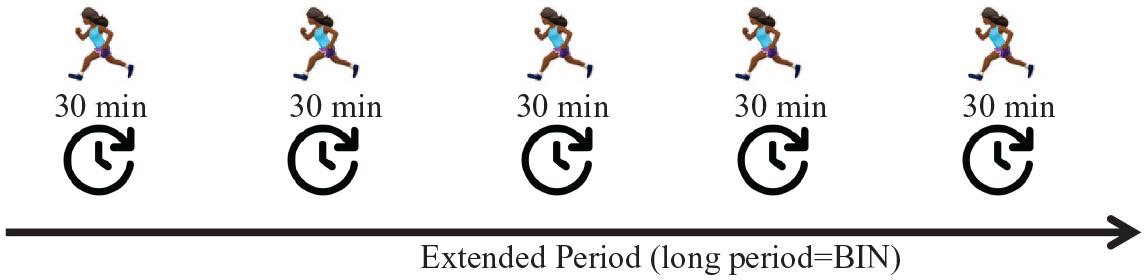
Each running segment occurs for 30 minutes, and the eventuality is well established, having taken place over a long period. The BIN construction that can be uttered given the scenario in the figure is in (4c): (4) BINSTATE (c) Trina BIN running for 30 minutes. “Trina has had the habit of running for 30 minutes for quite some time”
This sentence refers to a situation such that Trina runs for 30-minute segments, and she has been doing this for quite some time. We do not know what the long period is, but we have some idea about what it takes for a habit to be established. The length of the long period might very well be revealed during the conversation, but it cannot occur in the same utterance as the BIN construction without a pause. On the other hand, there is no such requirement on the adverbial (“for 30 minutes”) in (4c) because it is not describing BIN (BIN VP); it is only describing the length of the activity running, the 30-minute running segments. The conclusion is that temporal adverbials can occur in BIN constructions without a pause; they cannot modify BIN or the long period, but they can modify the lower VP structure: Trina [BIN [running for 30 minutes]]. Highlighting BINSTATE-CONT and BINSTATE-HAB constructions helps to explain why temporal adverbials can occur in some constructions but not others.
The BINSTATE-CONT and BINSTATE-HAB perfect uses refer to states that have held for a long time, thus the paraphrase “for a long time.” The subtle difference is that BINSTATE-HAB refers to a habitual state. There is some overlap between these uses and the present participle been, and this overlap can be illustrated in AAE and GAE. For instance, consider the Crest commercial in which the tag question is “Forget about the way you’ve been brushing your teeth” (with a pitch accent on been). The sentence means something along the lines of “Forget about the way you’ve been brushing your teeth up to now.” This sentence could also occur in AAE, especially without the auxiliary (’ve) for some speakers. In both varieties brushing teeth can be construed as having taken place periodically over a period of time. Nothing in the sentence suggests that the time is particularly long, but it could be construed in that way. On the other hand, in AAE, the sentence Forget about the way you BIN brushing your teeth necessarily indicates that the period is long. Pragmatically, the BINSTAT-HAB reading would be natural, but that is not to say that there are no contexts for the BINSTAT-CONT reading. Due to the overlap between BINSTATE and beenPPART uses, “watering” in “Faye been watering the plants” can be construed as having taking place periodically during the past along the same lines as Faye BIN watering the plants. 3 The difference is that in the latter the long period is explicitly marked. In some cases, pragmatics and conversational context in which the BIN utterance occurs can disambiguate the BINSTATE construction. In other cases, the lexical aspect of the verb determines the BINSTATE use. For instance, the verb put would automatically have the BINSTAT-HAB use in the sentence I BIN putting my eyeglasses on this table given that the event of putting someone’s glasses in a certain spot takes place in an instant. The BINSTAT-CONT use indicating that one started to try to put her eyeglasses on the table and is still trying to put them there is anomalous because the putting event is not drawn out; it happens instantaneously.
BIN combines with non-stative verbs generally marked with V-ed/-en morphology (5) to indicate that the eventuality expressed by the verb is interpreted as having ended in the far past, a long time ago’ (BINCOMPLETE). 4
(5) BINCOMPLETE (BINCOMP) Bruce BIN grew out that shirt. “Bruce grew out of that shirt a long time ago”
In addition, Winford (1998) notes that when the marker occurs with non-stative predicates “it conveys the sense of some event completed in the more or less distant past” (p. 128). It should be noted that the BINCOMP constructions differ from BINSTATE constructions in that they are not always compatible with the perfect. As it turns out, it is possible to use beenPPART in BINSTATE environments, such as Trina BIN running and Trina been running for a long time, but it is not possible to use beenPPART in BINCOMP environments. Compare the grammatical Trina BIN ran (“Trina ran a long time ago”) to *Trina has been run/ran a long time ago, which is unacceptable in GAE and AAE. The BIN construction can be trivially described as indicating that the running event is in its resultant state.
A brief summary should be given about the characterization of BIN as a perfect marker. Winford (1998) refers to the marker as a remote perfect although he does not dwell on the label “perfect.” Instead, he underscores the historical origin, noting that the marker “represents a type of partial semantic shift, with transfer (retention) of semantic features from the creole past category and incorporation of features of continuative been” (Winford, 1998, p. 128). In a more recent study, Spears (2017) spends some time relating BIN to the perfect: “BIN’s semantic range includes the present perfect and past perfect, but its semantics are not fully equivalent to the English Present Perfect and Past Perfect due to BIN’s always expressing remoteness. . .” (p. 160). Spears goes on to note that Remote Perfect captures the fact that BIN refers to a situation whose instantiation began a long time ago (in the case of stative predicates) and continues in effect up till the present. In the case of active predicates, the situation occurred a long time ago in the past, and there is posterior time relevance (in the case of the past perfect) or present relevance (in the case of the present perfect). (p. 162)
Given the description in Comrie (1976), BIN overlaps with the perfect reading in that a subset of its constructions also indicate “present relevance of some past situation.” More specifically the constructions in the BINSTATE class (including the habitual readings) categorically refer to the present relevance, which is captured by its description: started in the far past and continues to hold until the moment of utterance. Some uses of BIN are unquestionably compatible with the perfect uses, in particular, perfect of persistent situation. These are the uses that Labov (1972) refers to as the remote present perfect and glosses as “have for a long time”; however, not all of its uses are present perfect. That is to say that not all of its uses link a past situation to the present. For instance, in some of their uses, BIN constructions refer exclusively to a past situation without any continuity to the present, as indicated in (6): (6) Remember when you said you would give Sue that blue dress for her birthday back in 2018? Did you do that? BIN response: Yeah, I BIN gave her that dress. “I gave her that dress way back in 2018 (i.e. a long time ago)” #done response: Yeah, I done gave her that dress. “I have given her that dress”
The BIN utterance is a better response to the question about an event 3 years ago than the perfect marker done (often pronounced as dən) in AAE.
Data from auxiliary support also provide some evidence that shows that not all of the uses of BIN are perfect or at least not in the most obvious sense. It has been shown in previous research that auxiliary have and ain’t support BIN in negation and ellipsis contexts, as in (7): (7) Auxiliary support for BIN in negation and ellipsis a. Bruce haven’t BIN running; he just started. b. Bruce ain’t BIN running; he just started. “Bruce hasn’t been running for a long time; he just started”
Note, also, that the auxiliary did (i.e., past do) can support BIN in “a long time ago” contexts, as in (8): (8) A: Bruce went ahead and opened his gift a long time ago. Yes, he BIN opened his gift. B: I know he didn’t! #I know he ain’t/haven’t!
This is a case in which haven’t and ain’t, which occur in perfect contexts of present relevance, cannot support BIN. Although marked for past, hadn’t cannot support BIN in (8), either.
The preceding example (8) is presented to show that BIN is felicitous in the environment referring to a period in the past not including the present. We accept that BIN has some present perfect uses; however, not all of its uses are present perfect. It is clear from the literature that a number of researchers who have studied the marker land on calling it a remote perfect marker. In fact, one of the authors of the paper attempted to capture all of the BIN readings under a present relevance umbrella, signaling the perfect (Green, 1993), but that account remains unsatisfactory. The description in Klein (1994) in which perfect is defined as topic time after the situation time and perfective as topic time at situation time is useful in helping to present a picture of the BIN constructions that have perfect readings and the ones that do not. A full overview goes beyond the scope of this paper, but see Klein (1994) for a discussion of tense and aspect. The property that is shared by
In addition to meaning and contexts of BIN, some syntactic properties should be noted. BIN is negated by ain’t (and haven’t for some speakers): (9) Bruce ain’t BIN running; he just started. “Bruce hasn’t been running for a long time; he just started running”
The sentence in (9) shows that BIN occurs in a position higher than the main verb but lower than the negator ain’t. If it is assumed that ain’t is in a higher position in the domain for auxiliaries (AUX), BIN can be construed as occurring in a position that is higher than the main verb (or other predicates, such as preposition) but lower than AUX. On the other hand, sentences in which BIN takes scope over modals, for example, (10), show that, in some cases, the remote past marker can occur higher than some modals: (10) Bruce BIN could walk on stilts. “For a long time, Bruce has been able to walk on stilts”
5
The positions of BIN and the modal in (10) are fixed such that BIN obligatorily precedes the modal; however, in some modal constructions, BIN can occur to the left of (higher than) the modal (11) or to the right of (lower than) the contracted modal (12): (11) Bruce BIN could’a went to Jamaica. “Bruce could have gone to Jamaica a long time ago” (12) Bruce could’a BIN went to Jamaica. “Bruce could have gone to Jamaica a long time ago”
The sentences in (13) and (14) are included to show that progressive verb forms cannot occur following the modal complex (could’a) presumably because of the selection properties.
(13) *Bruce BIN could’a buying discount shoes. (14) Bruce could’a BIN buying discount shoes/in Texas. “Bruce could have been buying discount shoes for a long time/Bruce could have been in Texas for a long time”
Finally, BIN can occur higher than auxiliary verbs marked for Tense: (15) A: Bruce is just paying the water bill now on his phone. B: What! Bruce BIN was supposed to pay the water bill.
The usage and meaning of BIN constructions have received some detailed examination, as reviewed in the first part of this section. But the phonological/phonetic characterization of BIN has received almost none. Rickford (1973) characterized BIN in terms of being “stressed” or receiving “emphatic stress” and Baugh (1983) described this as “phonemic stress.” BIN has also been described as receiving a “high tone” (Spears, 2017) and being “marked by a high pitch intonational contour” (Weldon, 2019, p. 117). Spears (2017, p. 162) also states that BIN is “not always stressed” and that there are varieties of AAE in which “BIN always receives high tone (Spears, 2004a), which occurs with stress usually, but not always.” To our best knowledge, the only previously published acoustic analyses of BIN are Beyer et al. (2015), which provides a quantitative acoustic analysis of BIN, and Weldon (2019, 2021), which includes two sample fundamental frequency (F0) contours (i.e., pitch tracks) of Sound Files 5.1 and 5.2 in Weldon (2021). In shadowing of spoken BIN and been constructions, Beyer et al. (2015) found that 23 self-identified AAE speakers in Puget Sound, Washington, pronounced BIN with relatively longer duration and intensity than been. Specifically, they found that in productions of 9 BIN versus 9 been sentences, the ratios of duration and intensity of BIN to duration and intensity over the entire utterance it appeared in were greater than for been. While Beyer et al. (2015) did not analyze F0, Weldon (2019) displays sample F0 contours of “She BIN told me that” and “She BIN married” in Figures 13.1 and 13.2; speaker characteristics are unspecified. Both examples show an utterance-initial high F0, dropping immediately into a small F0 peak on BIN (consistent with a high pitch accent on BIN), followed immediately by a drop into a low plateau that extends across the remainder of the utterance. The lack of discernible F0 peaks in the post-BIN region is consistent with a phonological analysis of deaccenting following BIN. Also, the F0 peak on BIN in both examples is about half the height of the utterance-initial F0, showing that the F0 peak on BIN need not surface with the globally highest F0 peak in the utterance.
While there is a small (but growing) body of work on AAE intonation (Cole et al., 2008; Holliday, 2016, 2019; Jun & Foreman, 1996; Loman, 1975; McLarty, 2011, 2018; Tarone, 1973; Thomas, 2015), to our knowledge, there is no work that situates the pronunciation of BIN and been within the context of intonational and prosodic phonology beyond Weldon’s (2019) remark that BIN is “marked by a high pitch intonational contour” (p. 117) and Rickford’s (1973, pp. 14–15) remark that temporal adverbials cannot co-occur with BIN as part of a “single sentence intonation pattern” and must be separated from BIN by a pause and “falling intonation.” It isn’t even clear what past literature has meant by describing BIN as “stressed.” Based on Weldon’s (2019) sample BIN F0 contours, perhaps “stressed” refers to sentential prominence or stress, so BIN has been described as “stressed” because it receives a pitch accent. It also isn’t clear what Rickford’s (1973) claim that a pause must separate BIN from temporal adverbials modifying the long period implies about the prosodic structure for such utterances. Could this imply that BIN must be separated from the temporal adverbial by a high-level prosodic juncture? If so, what kind of juncture? In fact, Dayton (1996) argues that while pauses can occur between the BIN phrase and adverbial, this is not a requirement (p. 750). Dayton does not provide oral recordings of the examples, but it could be that in her examples, there are prosodic junctures of some kind, but ones that do not get realized with pauses.
1.2 Research questions
Both Beyer et al.’s (2015) results and Weldon’s (2019, 2021) examples indicate that understanding the sound of BIN necessitates analyzing BIN within the context of the utterance it is part of, including phrase-level intonational phonology and phonetics. In addition, the effect of intonation on the acceptability of BIN constructions with a temporal adverbial underscores the need for jointly considering syntactic/semantic and phonological factors in approaching an understanding of BIN. This paper takes that joint perspective and builds on past empirical work on the use of BIN in AAE-speaking communities (Rickford, 1973, 1975; Weldon, 2019, 2021) with two interconnected studies: (i) an investigation of the use and production of “been”-types in the publicly available Corpus of Regional African American Language (CORAAL) (Kendall & Farrington, 2020) and (ii) a production experiment of different BIN/been types in a small-town community of AAE speakers in Southwest Louisiana (SWLAT).
The two studies complement one another in the kind of data they provide: semi-spontaneous sociolinguistic interview data from multiple regions in the United States versus elicitation data in carefully controlled semantic/syntactic/discourse contexts within an isolated, homogeneous AAE-speaking community (see Section 3.1.1 for more on the community). The large collection of over 140 sociolinguistic interview recordings in CORAAL offered opportunities for us to explore when and how “been”-types surface in the wild—even the chance to discover how been-types are used and produced in ways we might not have thought of previously. However, there is no direct control over how frequently the specific contexts required for different BIN types might happen to occur, potentially leading to a risk of a paucity of such contexts (Rickford, 1975, p. 99). In contrast, the SWLAT production experiment allowed us to manipulate the context of utterances directly and precisely to elicit the production of the different BIN types and beenPPART within a single AAE speaker community. The researcher interference involved raises questions about how naturalistic the elicited speech is but allows us to create the specific conditions necessary for teasing apart subtle semantic differences and for making fine-grained phonetic comparisons.
Our first research objective was to characterize range in the use and meaning of BIN. For the CORAAL study, this meant determining to what extent BIN constructions and their semantically equivalent variants occurred in remote past contexts as well as looking for patterns of use conditioned on the rich demographic information available about the speakers. For the SWLAT study, this meant determining to what extent speakers produced BIN and beenPPART utterances in different contexts, including ones designed to target the different semantic BIN types described in (4) and (5). We hypothesized that speakers would produce BIN utterances in the BIN contexts and beenPPART ones in the beenPPART contexts and that the frequency of BIN utterance production in “obligatory” BIN + modal and BINCOMPLETE contexts would be higher than in the other BINSTATE environments.
Our second research objective was to build on Beyer et al. (2015) to phonetically characterize the difference between BIN and been utterances, and also to lay initial phonetic groundwork for building on previous characterizations of BIN receiving a high tone (reviewed in Section 1.1), toward a phonological analysis of the intonation of BIN constructions. (See also Clopper & Smiljanic, 2011, sec. 2.4 for a similar approach toward other varieties of American Englishes for which intonational fieldwork is still in initial stages.) While Jun and Foreman (1996) presented a preliminary proposal of a tonal inventory for AAE intonation based on MAE ToBI conventions developed for “Mainstream American English” (Beckman & Elam, 1997; Beckman et al., 2005), we take a different approach to avoid analytic biases of MAE ToBI, which reflects only one particular phonological analysis of American English (Jun, 2022; Ladd, 2022).
Rather, we adopt the more general consensus view of the set of assumptions in Autosegmental-Metrical theoretic approaches to the intonational phonology of varieties of Englishes (Beckman & Pierrehumbert, 1986; Clopper & Smiljanic, 2011; Grabe, 1998; Gussenhoven, 2016; Jun & Foreman, 1996; Ladd, 1996; Pierrehumbert, 1980; Veilleux et al., 2006): (i) tones are arranged in a linear sequence; (ii) phonological structure is organized in a prosodic hierarchical structure with an Intonational Phrase (IntP) 6 root node; (iii) tones can be characterized by how they are phonologically aligned/associated to the prosodic tree: either as pitch accents, which are associated to stressed syllables, or as prosodic boundary tones, which are aligned/associated to prosodic constituents (and some tones could be associated/aligned to both stressed syllables and constituents); (iv) pitch accents and prosodic boundary tones can be diagnosed based on how they phonetically align: pitch accent tones typically align close to a stressed syllable, while prosodic boundary tones typically align close to the edge of a prosodic constituent; and (v) F0 transitions between tones are approximately linearly interpolated, and unless there is a high or low boundary tone at an IntP edge (or an unspecified boundary tone, with F0 determined by a immediately flanking tonal event), then F0 at the IntP edge is expected to be mid-level in the speaker’s F0 range.
Under this consensus view—besides the more general question of whether BIN and been differ in their phonetic realization—a first question to ask is: Can we find acoustic evidence in CORAAL and the SWLAT production data to confirm that the high tone that has been described for BIN arises from a pitch accent? To do so, we would be looking for a clear local F0 peak (by local we mean that the peak need not be the absolutely highest F0 peak in the whole utterance) on BIN, cf. the F0 peaks on BIN clearly visible in Figures 13.1 and 13.2 of Weldon’s (2019) BIN examples. In addition, recall the pattern observed in the Weldon’s (2019) BIN examples of (i) an utterance-initial high F0 and (ii) a lack of discernible F0 peaks in the post-BIN region, consistent with a phonological analysis of deaccenting following BIN. Based on that observed pattern, another question to ask is about the realization of BIN and been relative to preceding and following material in the utterance. Is there acoustic evidence from the F0 contour that supports the presence and/or absence of pitch accents and/or prosodic boundary tones preceding or following BIN? And a third question is: building on Rickford’s (1973) comments about a pause separating BIN from adverbials, is there acoustic evidence that speakers choose to produce BIN constructions followed by long-time adverbials with a high-level prosodic juncture? (pp. 14–15) The presence of an audible pause is often taken to be a phonetic signature of a prosodic domain edge high up in the prosodic hierarchy, for example, the IntP. As a rule of thumb, pauses have long been used to diagnose IntP boundaries (see, for example, Beckman & Elam, 1997, p. 19; Jun & Fletcher, 2014, pp. 501–502; Selkirk 1978, p. 135, Ladd 1996, pp. 315–317). This suggests that one reasonable interpretation of Rickford’s comments is that BIN utterances with temporal adverbials must have a high-level prosodic juncture (e.g., an IntP boundary) to separate the temporal adverbial from the prosodic constituent with BIN.
Finally, a methodological research question underlying the two studies was comparing how the two methods/data sources helped to develop our understanding of BIN. The CORAAL study is presented in Section 2 and the SWLAT production study in Section 3.
2 CORAAL study
2.1 Materials and methods
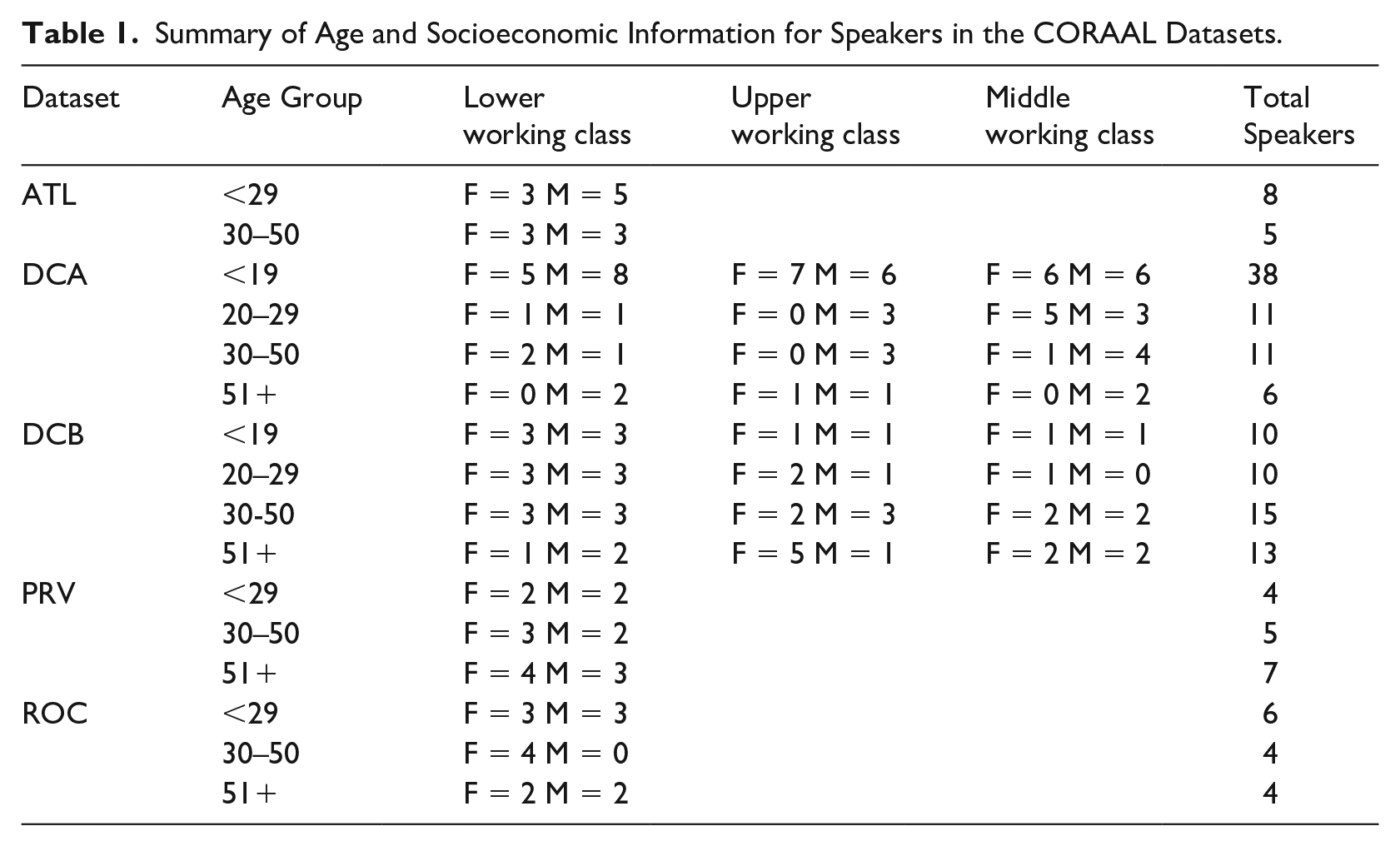
We used CORAAL to complete a corpus study of BIN occurrences in a variety of contexts. The corpus contains speaker conversations from three regions: Washington, DC (DCA, DCB), the rural community of Princeville, NC (PRV), Rochester, NY (ROC), and Atlanta, GA (ATL). The earliest interviews come from the Washington DCA files, which were recorded in 1968 as part of data for Ralph Fasold’s study (Fasold, 1972; Kendall et al., 2018a). The 68 speakers cover a wide variety of ages, with dates of birth ranging from 1891 to 1958. The DCB dataset was recorded in 2016 and contained 48 primary speakers. Several speakers were added to this dataset in 2018 (Kendall et al., 2018b). Both datasets from Washington, DC, contained socioeconomic status information. The Princeville dataset contains 16 primary speakers and was recorded in 2004 as a component for the North Carolina Language and Life Project (Rowe, 2005; Rowe et al., 2018). This dataset does not contain information regarding the socioeconomic status of the speakers. Data from Rochester contain 14 primary speakers and were collected in 2017 by Sharese King for her dissertation research (King, 2018; King et al., 2020). Like PRV, this dataset does not contain socioeconomic status information. Finally, the Atlanta dataset has interviews from 13 speakers collected from 2017 to 2018 by Patrick Slay Brooks, a music producer (Farrington et al., 2020). A summary of the distribution of ages and socioeconomic status for speakers in each of the CORAAL datasets is shown below in Table 1.
Summary of Age and Socioeconomic Information for Speakers in the CORAAL Datasets.
Through the CORAAL Explorer online interface, there is access to both a sound file and a paired transcription. Specific details about the transcription conventions of CORAAL can be found in their online user guide, and most of the transcription conventions followed those established by the Sociolinguistic Archive and Analysis Project (SLAAP). CORAAL transcriptions were done by undergraduates and checked by a linguistics graduate student; no information is given about whether the transcribers had experience with AAE. The transcriptions represented reduced forms (i.e., have reductions such as musta and coulda) and discourse markers but did not systematically distinguish forms that may appear orthographically synonymous but are linguistically distinct. In particular, there was no orthographic difference between the types of “been”s investigated in this study. With CORAAL’s online interface, the user has the ability to search through all the speaker files using specific search terms. The search function also accepts regular expressions to expand search capabilities and capture more complex patterns of interest. The search outputs the matched search item with pre- and post-match context. It also returns the file in which the match was found in with the utterance number, speaker, and start and end turns of the matched result. A search for the orthographic “been” was done using CORAAL’s online interface, and each returned instance was classified for been-type. The corpus contained over 140 interviews at the time of this study.
Initial classifications of the different been-types were made by Green, a native speaker of a variety of AAE spoken in Southwest Louisiana. Some classifications were made in collaboration with graduate student Ayana Whitmal, who also has intuitions about AAE. She listened to each been-type construction, including the utterances preceding and following the construction for semantic and discourse context, and labeled it “BIN” (for the remote past marker), “beenPPART” (for the past participle form of be), or bin (for the unstressed marker). If Green perceived that the been-type, and together with the semantic and discourse context, signaled a remote past interpretation, it was labeled “BIN.” All other been-types in present perfect contexts were classified as the past participle form of be (beenPPART). If a beenPPART token was perceived as prominent, or (rarely) if there was ambiguity between a beenPPART and a BIN classification, then that property of the beenPPART was also noted. The one unstressed been-type preceding a verb in the past/past participle that did not occur in a present perfect context was labeled “bin.” Predicate types (e.g., verb, noun, preposition, adverb) following each been-type were recorded. In addition, temporal adverbials that occurred with all been-types were noted. In instances in which Green heard the utterance differently than it was transcribed, she listened to it repeatedly. If she could be certain about the difference, she revised the transcription. If she could not, she did not change the transcription. In most cases, questions related to whether the participant actually produced the auxiliary have or the contracted form ’ve before “been.” Four transcriptions of beenPPART constructions with the marker “done” in the ATL database were revised.
To better assess the usage of BIN throughout CORAAL, we also collected counts of beenPPART and bin in addition to the actual BIN counts. The beenPPART utterances generally contained unstressed perfect “been” and a durative adverbial. If the adverbial explicitly gave a long-time reading but didn’t quantify the duration (e.g., “all my life,” “always,” “for a long time/many years,” “a long time ago”), the construction was tagged as “unspecified long time.” Given that BIN signals an unspecified long period, structures in the unspecified long-time category can be thought of as the true BIN variants. That is, “He’s been out here for a long time” (DCB_se3_ag_2_f_01) can be taken to be an alternative way of saying “He’s BIN out here.” It should be noted, however, that true variants for BINcomp that include temporal adverbial modifiers would not be captured with the search parameters used in this study. In general, beenPPART does not precede V-ed/-en in general American English unless it is passive BE (e.g., The cookies have been eaten.) In AAE, preceding a V-ed/-en, we expect BIN or bin, so “She been grew out of that” is more than likely “She grew out of that a long time ago.” To capture variants of this BIN, a search for environments containing “a long time ago” would need to be done. Utterances that contained “Since + [explicit duration]” were tagged as “specified since,” and all other utterances that contained an adverbial that gave the explicit duration were tagged as “specified other” (e.g., “for 13 months,” “9 days ago”). Instances in which the adverbial was the predicate that immediately followed “been” or which expressed frequency as opposed to duration were not counted. Instances in which the eventuality in the beenPPART construction was delimited (e.g., “for just/only 2 years”) were also omitted. Full details about the observed BIN exemplars, including links to sound files of each utterance, as well as the starting point of the utterance both in the transcript and in the sound file, can be found in the OSF repository, https://www.doi.org/10.17605/OSF.IO/MRQBV.
Recordings of each BIN and bin example and selected beenPPART examples were extracted from CORAAL audio files and segmented into individual utterances in Praat (Boersma & Weenink, 2019) and then segmented into words by hand. Owing to the small number of examples scattered across speakers, as well as the varying quality of the audio signal and the disparate surrounding context around “been” across the examples, we decided not to perform a quantitative, fine-grained statistical analysis to infer aggregate acoustic patterns. Instead, we took the collection of examples as an opportunity to discover representative exemplars showcasing the range of variation across renditions of “been” constructions. The second author, a trained phonetician and prosody specialist, used acoustic properties of the F0 contour, spectrogram, and waveform to code the pre-BIN region as having an initial high F0 or not; the BIN region as having an F0 peak higher or lower than the pre-BIN region; and the post-BIN region as either: (i) having no clearly observable F0 peaks, (ii) having an F0 peak on the verb lower than the preceding F0 range (which would be consistent with a downstepped accent on the verb), or (iii) rising to a final mid or high F0. In cases where there was insufficient acoustic information to determine how to code a region (e.g., the region had a very low acoustic amplitude), the region was simply labeled “unclear.” In addition, it was noted if there were laryngealized spans outside of BIN. The goal of the annotation was not to transcribe intonation using MAE ToBI conventions developed for “Mainstream American English” (Beckman & Elam, 1997; Beckman et al., 2005). Rather, the goal was to document acoustic features or “cues” that could contribute to the percept of contrastive intonational categories (Cole & Shattuck-Hufnagel, 2016). The F0 contours shown in Section 2.2.2 were extracted in Praat using the autocorrelation algorithm, with speaker-specific ceiling and floor values and otherwise default settings. These were then hand-corrected to remove ill-defined F0 points affected by unvoiced regions and segmental perturbation (Gussenhoven, 2004, Ch. 1), and in one case, modified to best represent perceived low pitch under laryngealization (Figure 4). All extracted audio files, annotated TextGrids, and original and edited F0 contours can be found in the OSF repository.
2.2 Results
Section 2.2.1 presents results on the usage and distribution of “been”-types found in CORAAL. Section 2.2.2 explicates the phonetics of representative utterances of BIN found in CORAAL, as well as some sample beenPPART utterances.
2.2.1 Remote past “been” examples found in CORAAL: BIN and beenppart + adverbial
The search for the orthographic “been” returned a total of 1,410 results. These results included instances of “been” used by both the speaker and the interviewer. After removing the interviewer productions, a total of 1,210 utterances remained. Of that number, only 20 (1.7%) were determined to be instances of BIN. The majority of these 20 instances had VP predicates. Of the BIN types, there were 15 coded as BINSTATE-CONT,
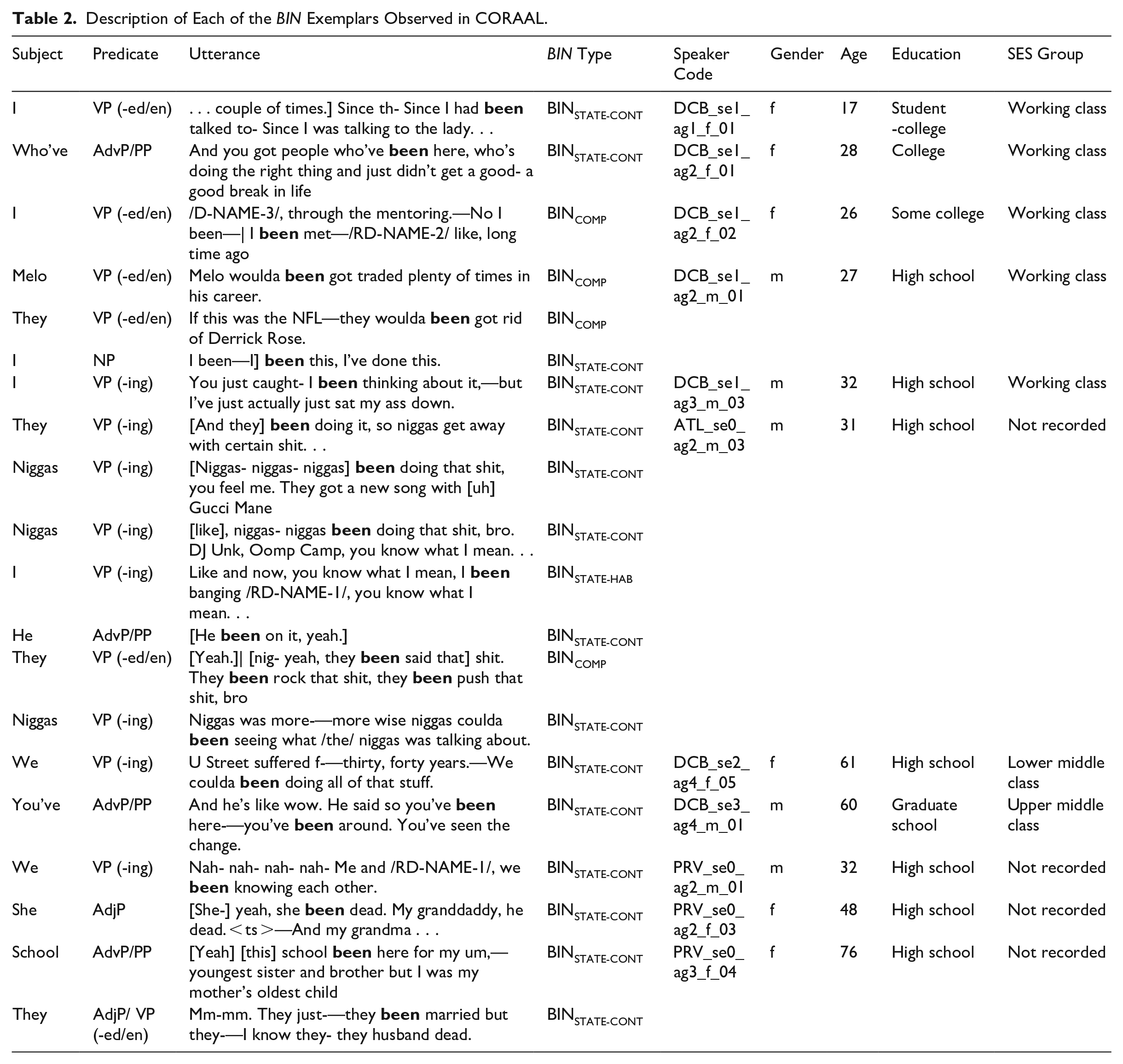
Table 2 presents the subject and predicate of the utterance for each of the BIN exemplars found, along with a transcription of the full utterance (sometimes revised from the original by Green, as noted in Section 2.1) and some surrounding dialogue. It also contains demographic information such as age, gender (f for female, and m for male), education level, and socioeconomic status. The speaker code is the unique identification code used in CORAAL for a specific speaker, and the first three letters specify what database the speaker came from. All speakers are native to the location in which they were recorded, except for the Atlanta speaker (ATL_se0_ag2_m_03), who has lived in Atlanta for around 15 years but grew up in New Orleans, LA. A full description of the transcription guidelines can be found in the CORAAL User Manual. The relevant transcription conventions for the examples below are as follows: brackets ([ ]) indicate overlapping speech, names of other people are redacted (e.g., /D-NAME-3/), slashes (/ /) indicate unintelligible speech, < ts > indicates teeth sucking, single dashes (-) indicate restarts, and vertical bars (|) indicate pauses. Some of the transcriptions below have been edited by the writers to more accurately represent auxiliaries and verbal morphology.
Description of Each of the BIN Exemplars Observed in CORAAL.
While there were only 20 instances of BIN, there were many more beenPPART instances—a total of 1,125. This excludes 65 tokens that included false starts, inaudible material, or were mistranscribed. 675 beenPPART tokens lacked temporal adverbials and this includes 5 instances of “done been” constructions, which we are also treating as perfect-like. Among the 446 beenPPART + temporal adverbial constructions, 140 were incompatible with BIN semantics, including one token that was doubly modified with both a “never” and an unspecified long time adverbial. The compatible subclass was made of “unspecified long time” cases and specified cases. There were 128 “unspecified long time” cases, including another doubly modified token with an unspecified long time adverbial followed by a specified other adverbial. There were 178 specified utterances. Within the specified subclass, 86 used the “specified since” construction and 92 were marked as “specified other.” Across all adverbial categories the type of VP predicate that follows “been” was overwhelmingly progressive (VP-ing), though a few were past forms. For the “unspecified long time” category, 3 of 29 VPs were of the VP-ed/en form. For “specified since,” 5 out of 27 were VP-ed/en forms, and for “specified other,” 6 out of 40 were VP-ed/en forms. Even among the VP-ed/en forms that were present, many of them were more adjectival in function than true past tense.
2.2.2 The phonetic realization of BIN constructions in CORAAL
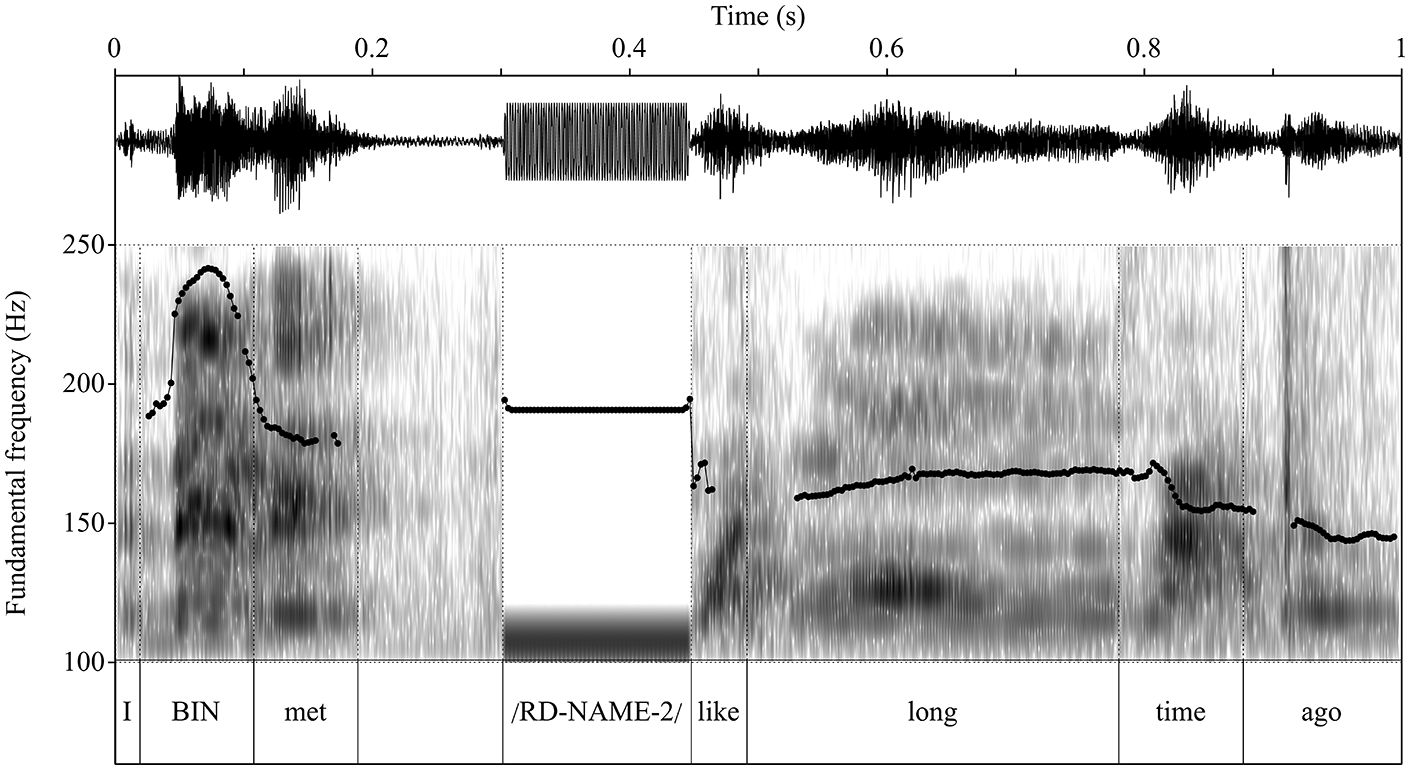
Although there were 20 BIN utterances, there were 23 prosodic phrases containing BIN since two of the BIN utterances contained multiple prosodic phrases with BIN: three within ATL_se0_ag2_m_03_1, utterance 1162 and two within DCB_se3_ag4_m_01_1, utterance 233 (Figure 4). In the pre-BIN region, 6 began with an initial high F0 on a pronoun (e.g., Figures 1 and 4) and 5 had a high F0 peak on a content word preceding BIN showing evidence for a pre-BIN high pitch accent (Figure 5). Eight of these 11 instances with initial high F0 had an F0 peak on BIN lower than F0 in the pre-BIN region. The remaining 12 BIN instances that did not begin with high F0 in the pre-BIN region either began with a lower F0 that rose to the F0 peak on BIN (8 in total) or did not have enough segmental material and/or sufficient amplitude preceding BIN to assess F0 in the pre-BIN region (4 in total, e.g., Figure 2). In the BIN and post-BIN region, 19/23 showed an F0 peak on BIN (evidence of a pitch accent on BIN) and no clearly discernible F0 peaks in the post-BIN region (evidence of F0 range reduction and potential post-BIN deaccenting) and ended with low F0. While the phonetic features are suggestive for potential phonological analyses, the phonological analysis of the contours is outside the scope of this paper.
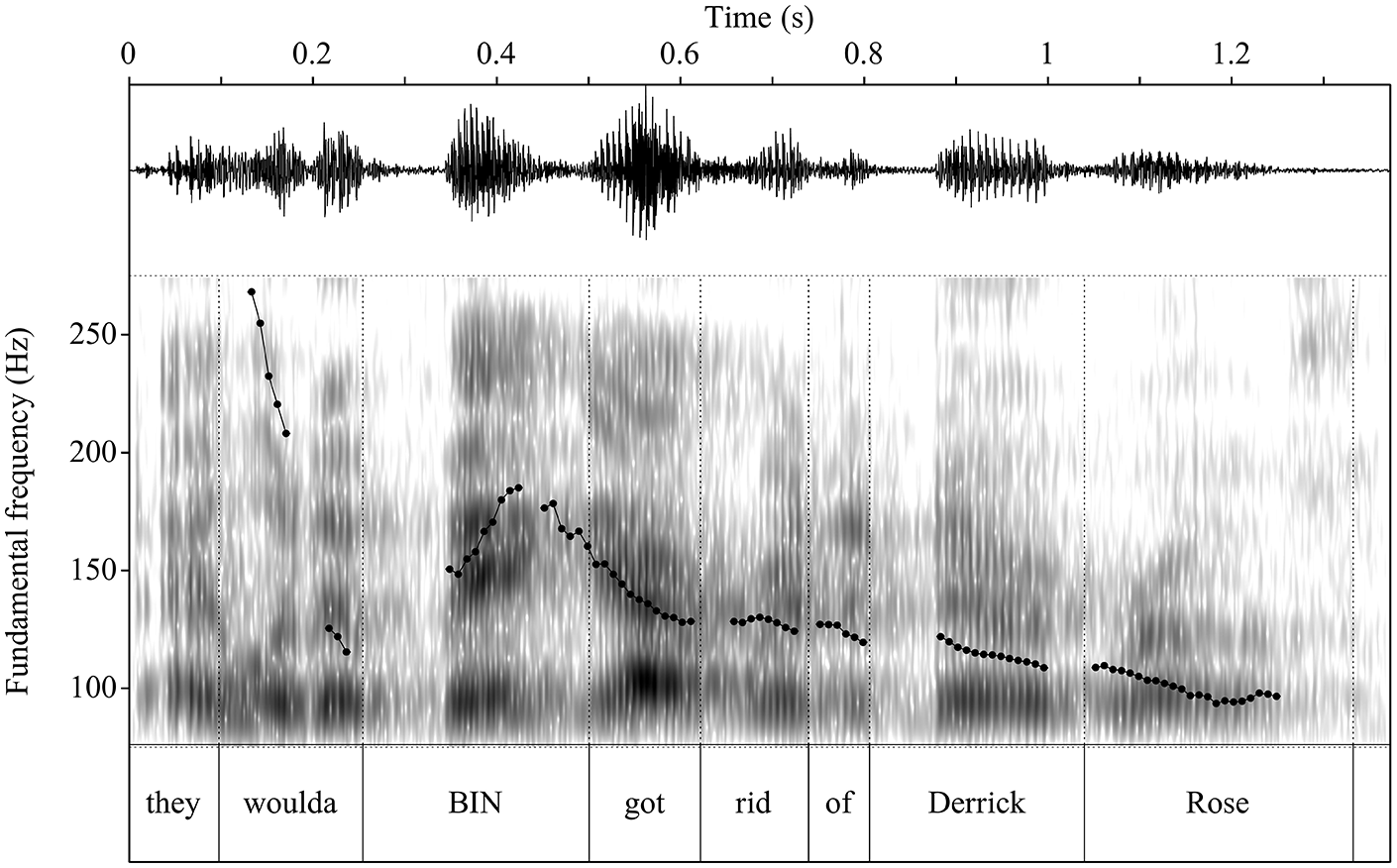
F0 contour, waveform, and spectrogram of DCB_se1_ag2_m_01_1, utterance 1629, showing a BIN + VP (-en/ed) construction with acoustic evidence for a high initial F0 followed by a lower (but nevertheless high) F0 peak on BIN followed by post-BIN F0 range reduction and potentially deaccenting.
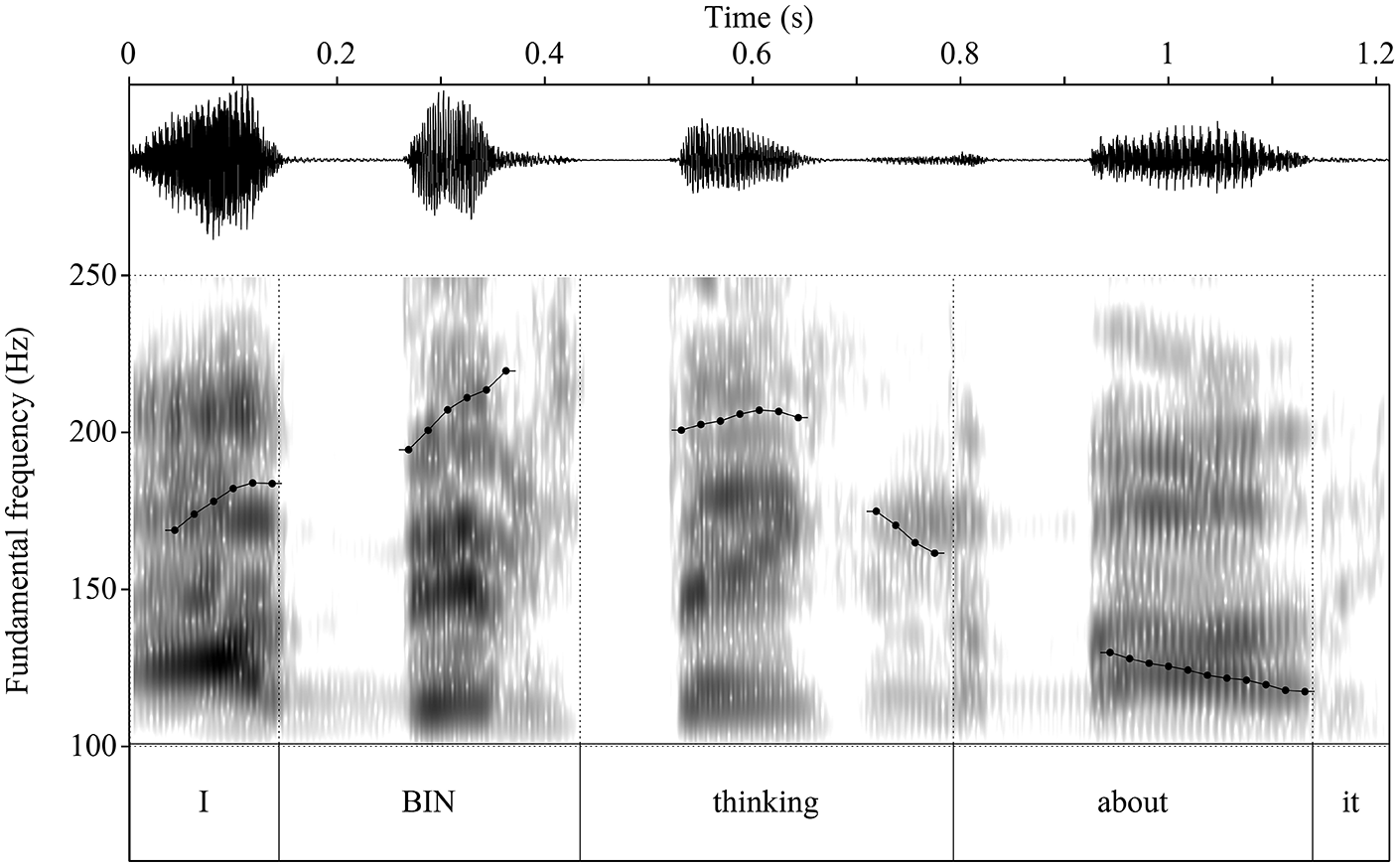
F0 contour, waveform, and spectrogram of DCB_se1_ag2_f_02_1, utterance 1275, showing the one BIN construction that was followed by a temporal adverbial. A 293 ms silent pause precedes the adverbial phrase.
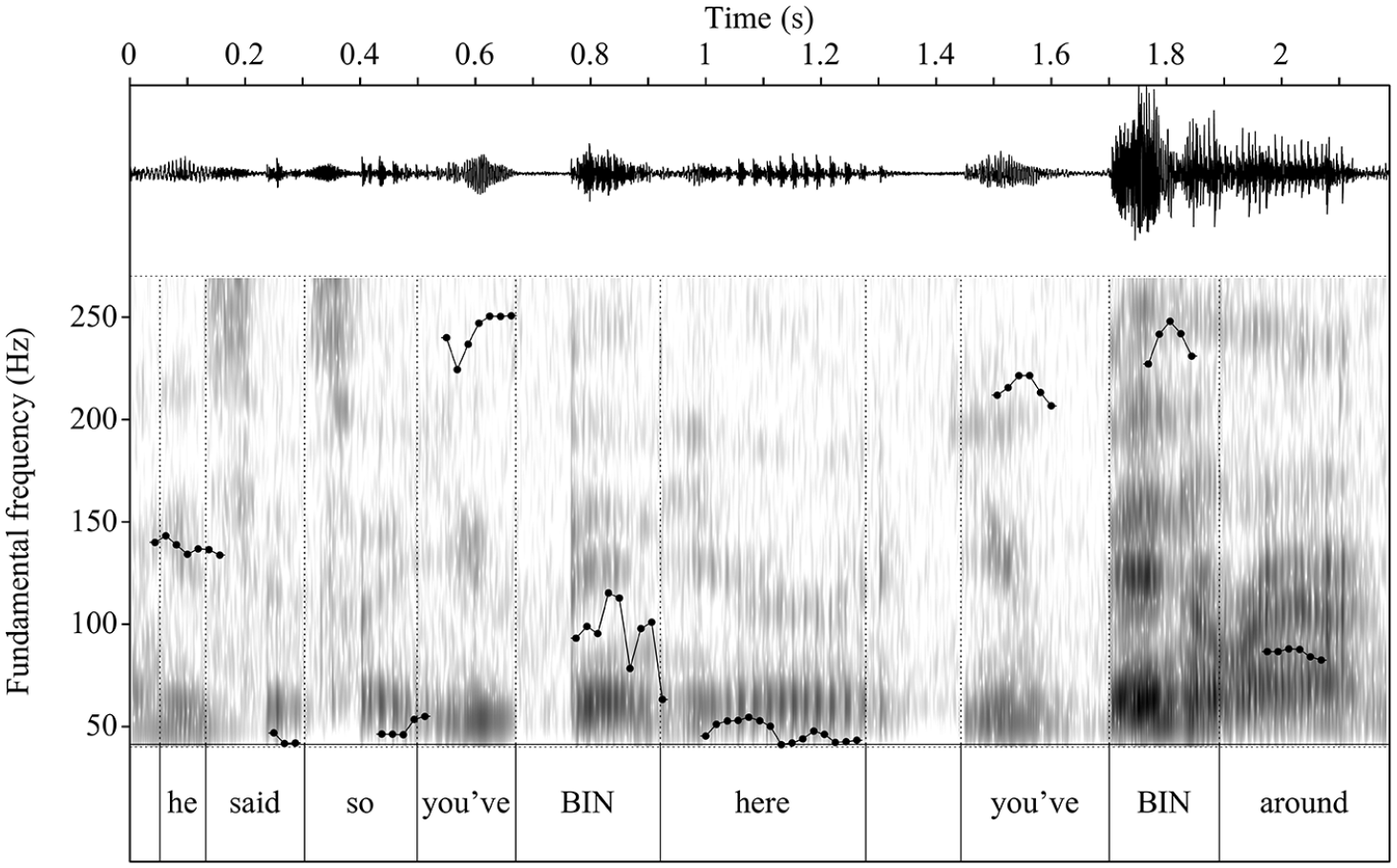
F0 contour, waveform, and spectrogram of DCB_se1_ag3_m_03_1, utterance 1370, showing a BINSTATE-CONT. This is the one example found where BIN is clearly followed by another F0 peak (consistent with a pitch accent, e.g., a downstepped high tone) on thinking.
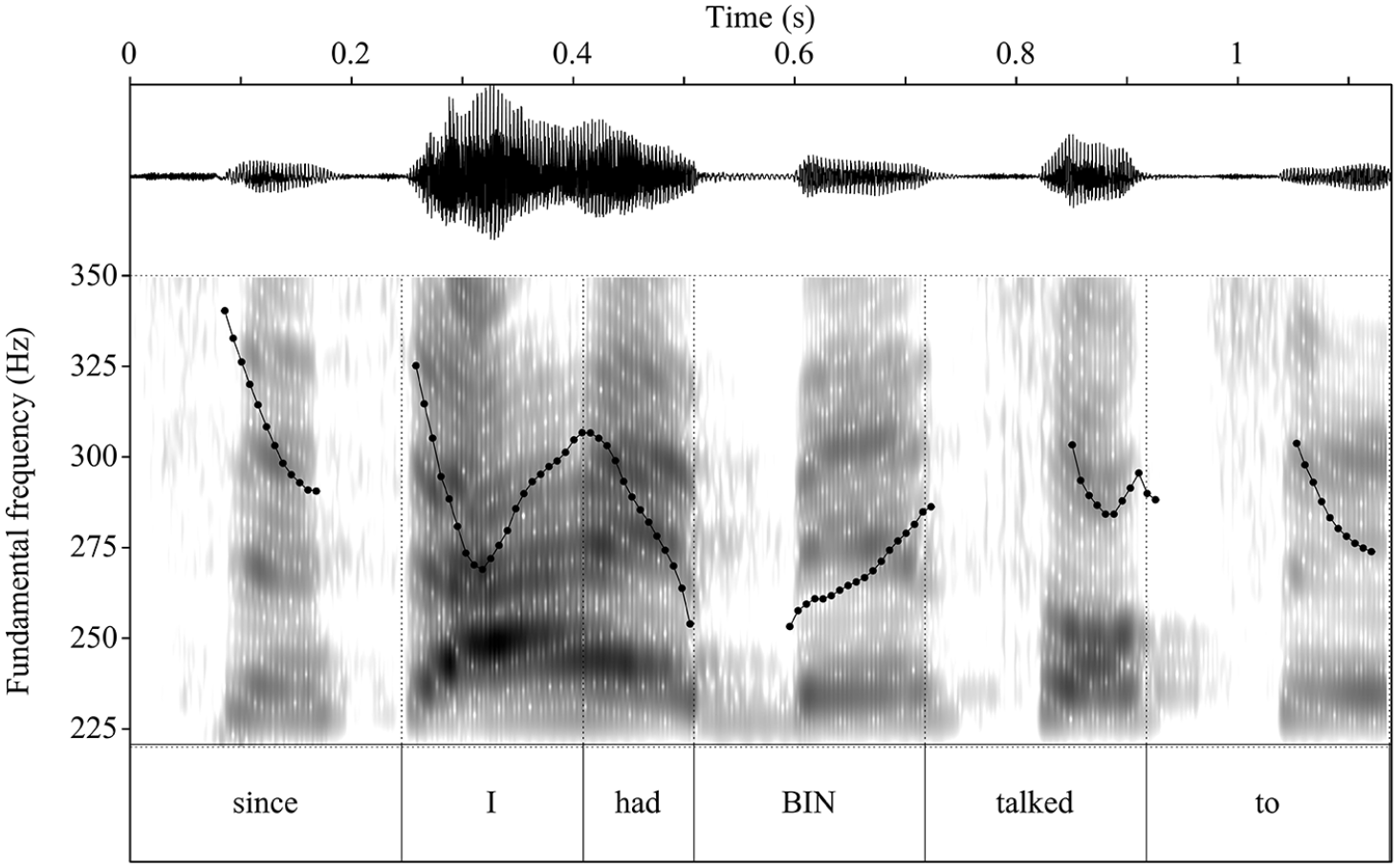
F0 contour, waveform, and spectrogram of DCB_se3_ag4_m_01_1, utterance 233, an utterance with two BIN PP constructions, each with a different pattern of phonetic realization. The gray background in the spectrogram is due to a low signal-to-noise ratio in the recording.
Three (DCB_se1_ag2_f_01_1, utterance 1603, PRV_se0_ag3_f_03_1, utterance 1348, and DCB_se1_ag1_f_01_1, utterance 1436) ended with non-falling F0 consistent with a phrase-final mid or high boundary tone. While DCB_se1_ag2_f_01_1, utterance 1603 ended with a low F0 inflection point preceding the final high F0, so that there was a clear F0 peak in BIN, it was unclear that there was an F0 peak on BIN in the other two cases. In PRV_se0_ag3_f_03_1, utterance 1348, “she BIN dead,” there is an initial high F0 on she and then a mid F0 phrase-finally on dead, and BIN has an intermediate F0 in between those (consistent with a downstepping pitch accent sequence); in addition, the recording happens to be at low amplitude with significant background noise. It is thus difficult, especially in such a short utterance, to find acoustic evidence for an F0 peak on BIN. The other case where the presence of an F0 peak on BIN is in question is explicated in the discussion of Figure 5. A single instance showed clear phonetic evidence from the F0 contour of accenting after BIN: DCB_se1_ag3_m_03_1 utterance 1370, which had another, lower, F0 peak on the verb immediately following the F0 peak on BIN: see Figure 3. Representative F0 contours, waveforms, and spectrograms showcasing the observed range of variability in the realization of BIN utterances are shown in Figures 1 to 5, and the one bin utterance found is shown in Figure 6.
F0 contour of DCB_se1_ag1_f_01_1, utterance 1436, showing a BIN VP (-en/ed) construction where it is unclear that there is an F0 peak on BIN because BIN is preceded by a high pitch accent on “I” and rises to a final high/mid boundary tone. This utterance was incomplete and followed by a disfluent restart.
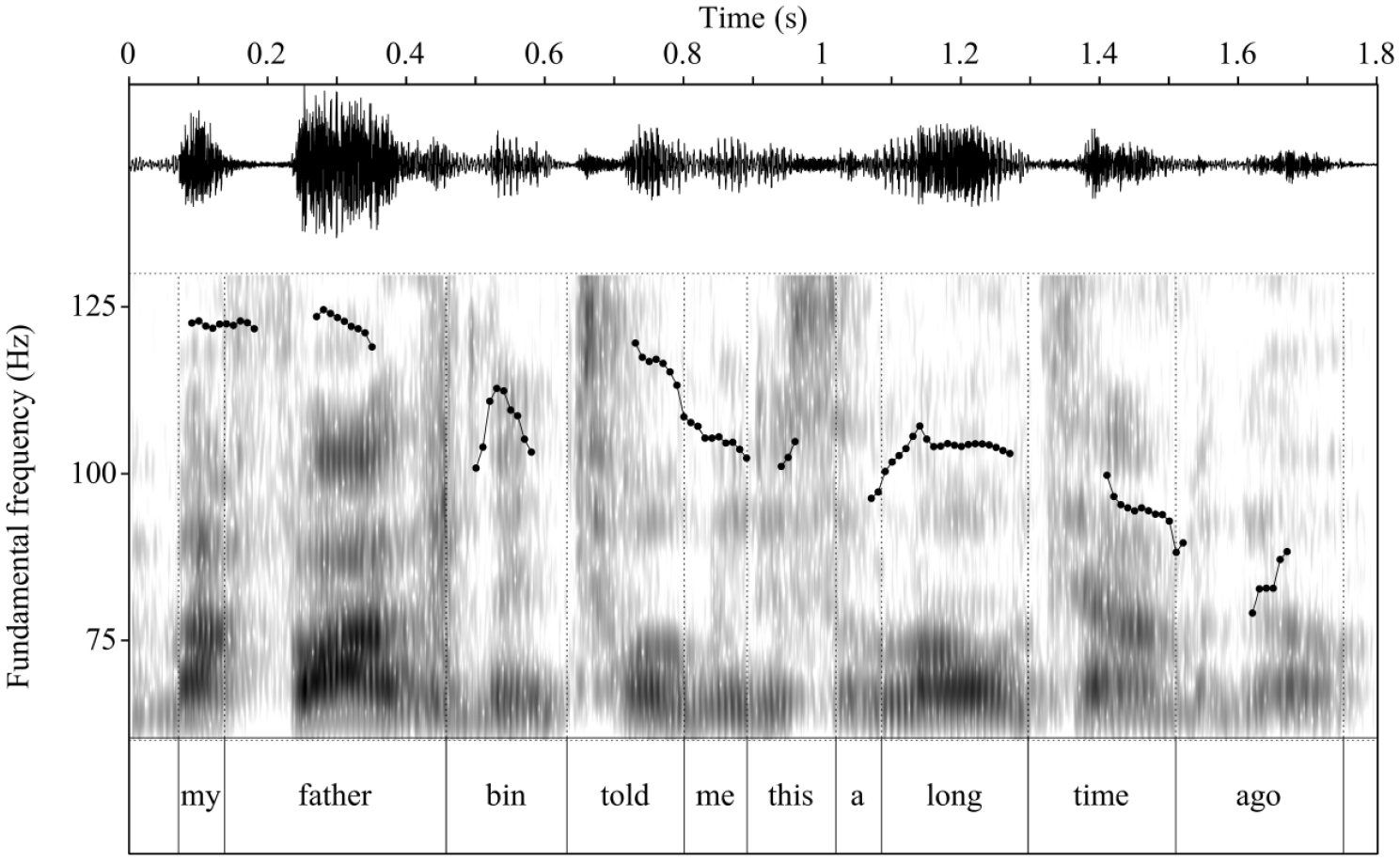
F0 contour of DCB_se3_ag3_m_02_1, utterance 2650, showing a bin construction. F0 on bin is lower than on the immediately following verb told.
Figure 1 shows DCB_se1_ag2_m_01_1, utterance 1629, “They woulda BIN got rid of Derrick Rose” which is realized with a pattern much like the sample BIN F0 contours in Weldon (2019, 2021) of Sound Files 5.1 and 5.2 in Weldon (2021): it begins with a steep falling F0 contour onto BIN, which is followed by no other visible F0 peaks. These features of the F0 contour, coupled with the lack of percept of prominence on the pronoun they or woulda by Green, 7 are consistent with: (i) an initial (super)high boundary tone followed by a (downstepped) high pitch accent on BIN, or no initial boundary tone and a bitonal downstepped high or low pitch accent with a leading high tone on BIN, and (ii) reduced F0 range and/or deaccenting in the post-BIN region.
As noted in Section 1.1, BIN is not expected to co-occur with temporal adverbials modifying the long time period—unless it is separated from the adverbial by an intonational phrase boundary. Just one BIN example, DCB_se1_ag2_f_02_1, utterance 1275, occurred with a temporal adverbial and is shown in Figure 2, and it occurred with a silent pause of 293 ms between the phrase with BIN and the temporal adverbial.
The one example found where an F0 peak clearly appeared in the post-BIN region, DCB_se1_ag3_m_03_1, utterance 1370, is shown in Figure 3. It begins without an initial high F0, rises to a high F0 peak (220 Hz) on BIN, drops slightly to a lower F0 peak (207 Hz) on immediately following thinking, and then declines to a phrase-final low.
Figure 4 shows a series of two BIN phrases with different patterns of realization between the phrases. Both have initial high F0 that surface on prosodic phrase-initial you’ve (with a falsetto voice quality especially noticeable in the first you’ve), as well as an absence of F0 inflection points following BIN that is consistent with post-BIN deaccenting. However, in the first phrase, the F0 peak on BIN is much lower than that initial high, while in the second phrase, BIN has an F0 peak that is higher than that initial high. The first BIN phrase also exemplifies another phonetic pattern we observed among 7/23 BIN examples: laryngealization in low F0 regions pre- and/or post-BIN. This non-modal voice quality is observable via the widely spaced glottal pulses visible in the waveform and the spectrogram during the utterance of here. The presence of widely but regularly spaced glottal pulses (about 48 Hz) is an acoustic signature indicative of vocal fry, in the sense defined in Garellek (2019).
In three cases, the BIN phrase did not exhibit a falling F0 to the end of the phrase but ended with a mid to high F0. An intriguing example of this pattern occurs in DCB_se1_ag1_f_01_1, utterance 1436, shown in Figure 5. Following a delayed F0 peak over I, F0 rises over BIN, but there is no evidence of an F0 peak on BIN, because F0 continues to rise to a high-mid phrase-final boundary tone in talked to. This particular BIN is singular among the ones we found in CORAAL because it is the only one where BIN is preceded by an overt, full auxiliary, that is, had. The auxiliary must be overt to mark tense as a pluperfect or the preterite had. In addition, this BIN example is the only one that ends in a disfluency followed by a restart: “Since th- Since I had
Finally, Figure 6 shows the one bin example observed (DCB_se3_ag3_m_02_1, utterance 2650). The F0 contour starts high at 123 Hz on father, drops to an F0 of 112 Hz on bin, and then rises to an F0 of 117 Hz on told before declining to a low on this. No cases like this—of a higher F0 on an F0 peak on the following verb than in BIN—were observed in BIN constructions. BIN constructions with rising F0 in the post-BIN region rose until the end of the phrase, consistent with a boundary tone rather than a pitch accent. There is no intervening pause before the following adverbial phrase a long time ago.
A representative example of a beenPPART utterance, utterance 402 from DCB_se1_ag2_m_02_1, is shown in Figure 7. The F0 on beenPPART is lower than the F0 on immediately preceding that’s and immediately following popular in a way that is consistent with beenPPART being unaccented.
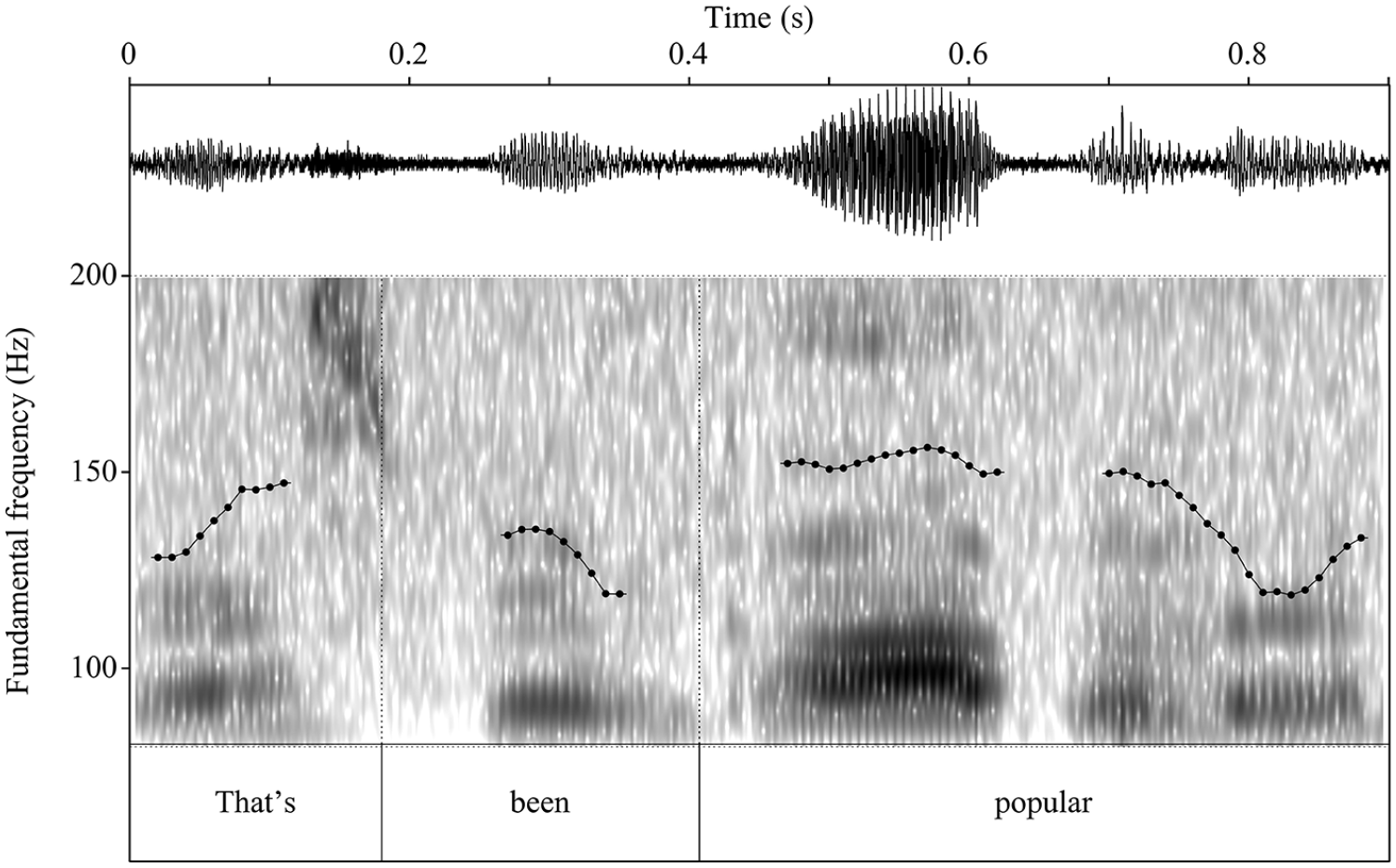
F0 contour of DCB_se1_ag2_m_02_1, utterance 402, showing a representative beenPPART utterance. F0 dips low on unaccented beenPPART between high F0 on that’s and popular.
In addition to the BIN and beenPPART utterances, Green also identified at least seven beenPPART utterances that she perceived as having a prominent beenPPART and at least two utterances that were ambiguous between beenPPART and BIN. A representative utterance with a prominent beenPPART is shown in Figure 8. For Green, despite the auditory prominence of beenPPART, the temporal adverbial immediately following the been ruled out any possibility of a BIN percept. Like most of the BIN utterances, and characteristic of other utterances identified as having prominent beenPPART, beenPPART shows a high F0 peak while surrounding material is in a much reduced F0 range relative to the beenPPART. However, this particular example has an additional point of interest in that the F0 peak on beenPPART is aligned particularly late, such that there is a clear low F0 region during the vowel in beenPPART. We did not observe this kind of alignment consistent with a “scooped” pitch accent in BIN examples in CORAAL.
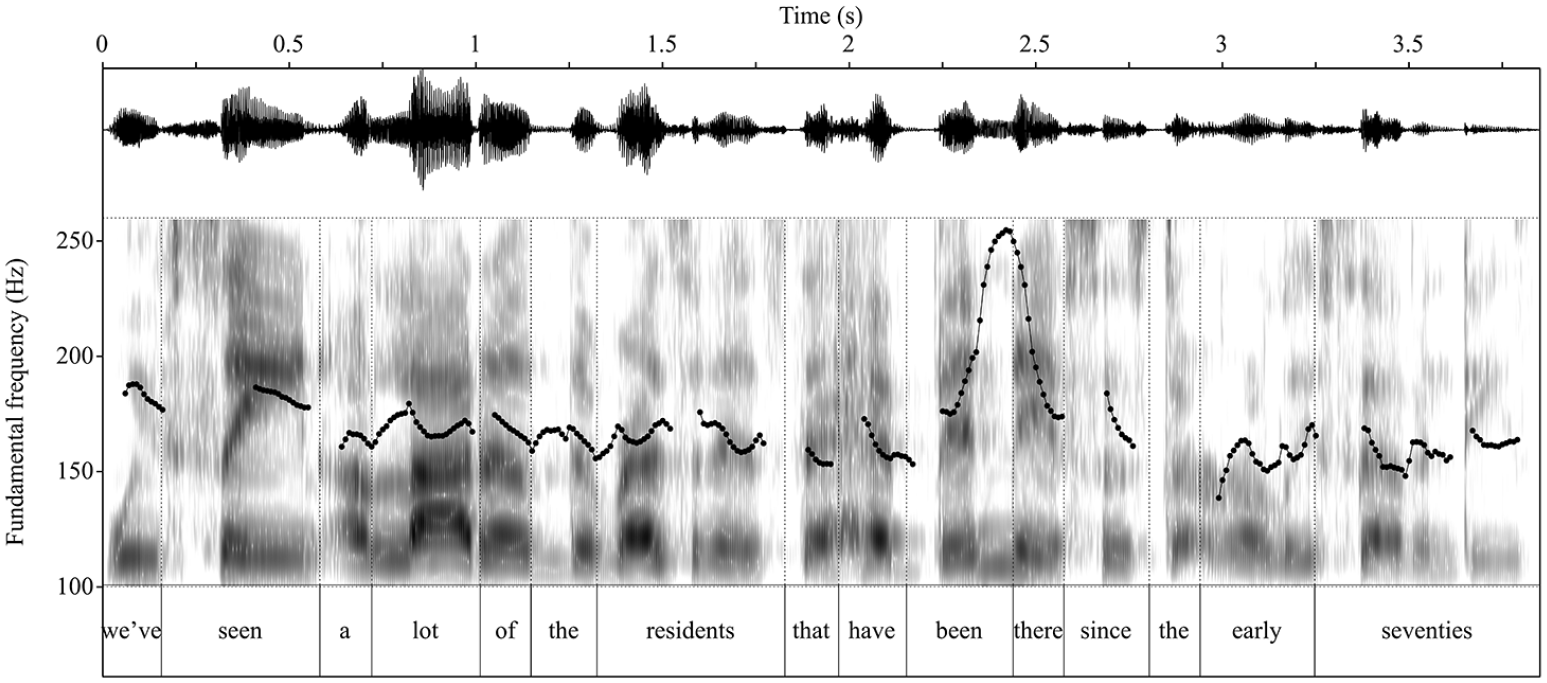
F0 contour of DCB_se1_ag3_f_01_1, utterance 177, showing an example of a beenPPART that was perceived as prominent.
The two utterances Green classified as being ambiguous between BIN and beenPPART demonstrate two distinct sources of ambiguity: syntactic environment and auditory percept. Like DCB_se1_ag3_f_01_1 in Figure 8, the “been” example in utterances 1294 to 1297 in PRV_se0_ag3_F01 had a very high F0 peak on BIN/been and an adverbial phrase that co-occurred with been: “And < laugh > from—then—through present, I BIN/been there.” The adverbial, although preposed, led to ambiguity between a BIN and beenPPART classification of the utterance for Green. Despite the high F0 peak on the BIN/been token following the preposed adverb, Green found that a beenPPART reading is strong in that the been phrase can be construed as further explaining not just a long period, but the speaker’s consistency of being there throughout the period from then to the moment of speaking. That is, a straight perfect reading, as is associated with beenPPART constructions. The source of ambiguity for the other example, PRV_se0_ag2_f_01_1 utterance 1092, was not syntactic but rather the percept of weak prominence on BIN/been, as shown in Figure 9. It is unclear if there is any F0 peak on BIN/been, but the whole region surrounding BIN/been is in a reduced relative F0 range, so relative to other words within that reduced F0 range, BIN/been might still have F0 (and other acoustic) properties leading to some prominence. As a point of contrast, note the clear F0 peak on is later in the utterance, which is in a much larger F0 range.
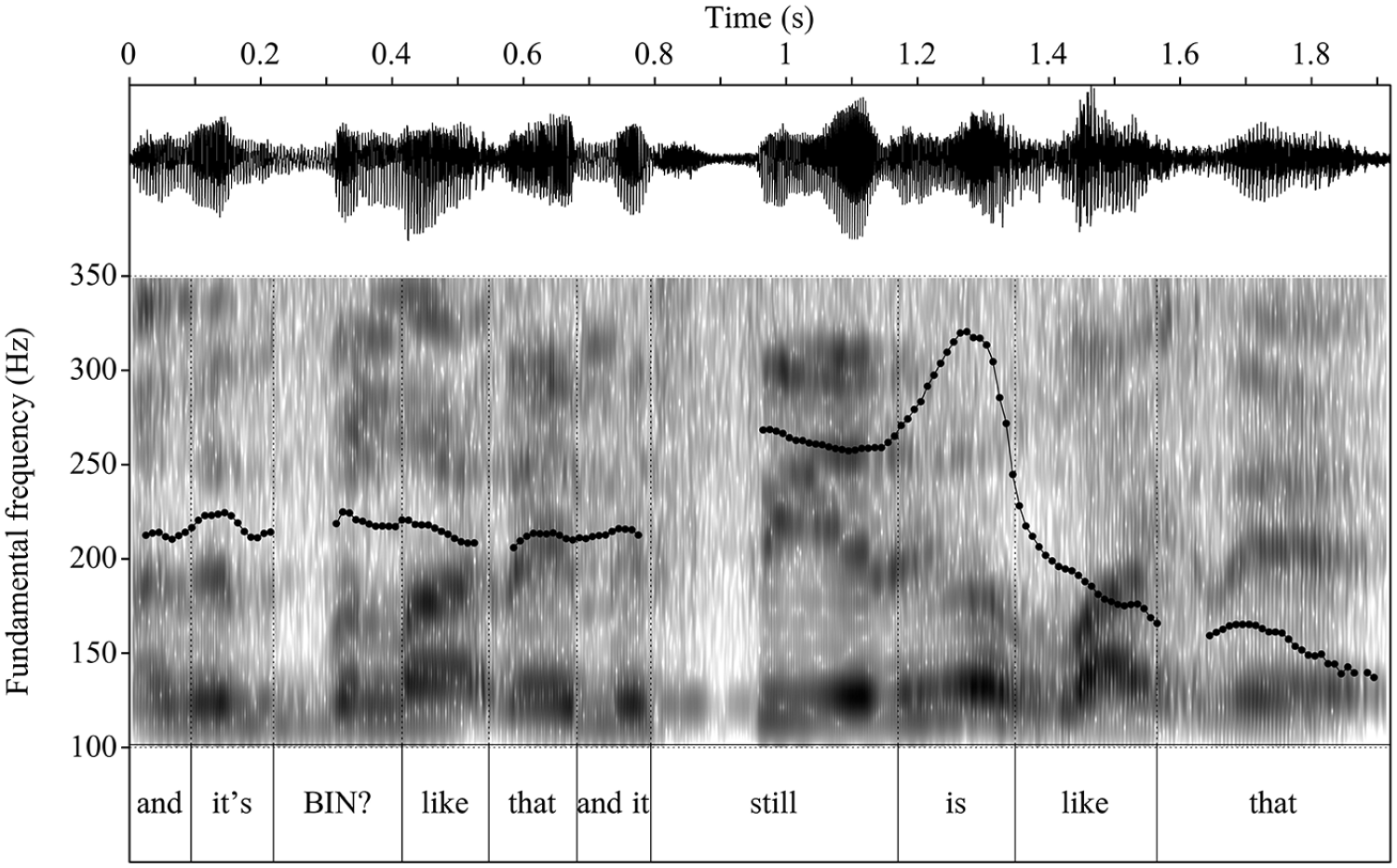
F0 contour of PRV_se0_ag2_f_01_1 utterance 1092, an utterance perceived to be ambiguous between BIN and beenPPART due to the auditory percept of BIN/been.
2.3 Discussion
2.3.1 Been-type distribution in CORAAL
Overall, there does not appear to be any systematic demographic pattern that determines when a speaker will produce a BIN. As seen in Table 2, speakers come from different age groups, educational backgrounds, and socioeconomic statuses. While the DCA and ROC databases did not contain any instances of stressed BIN it is not clear what this means for the databases where they do appear. This is not to say that a larger pattern is not present, simply it suggests that given the limited sample size, describing an overall demographic pattern is not currently possible.
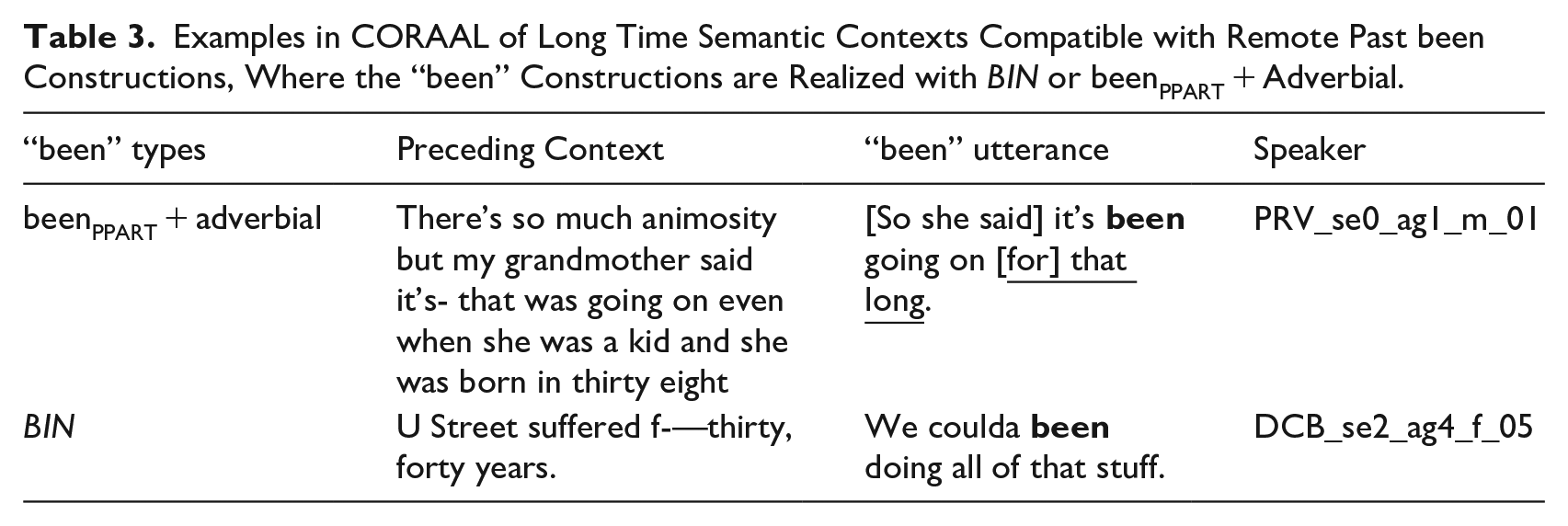
For BIN to be felicitous there must be an established long time context so that the information is explicitly stated or implicit in the context. For instance, long time is explicitly stated in the discourse in Table 3. For the beenPPART containing a temporal adverbial, context is needed on an item-by-item basis to determine whether specified time periods are intended to convey long time readings. The examples in Table 3 show that the context surrounding the utterance refers to a long period, so the adverbial conveys a long time reading. Along similar lines, the BIN construction also occurs in an environment in which the context establishes a long time reading.
Examples in CORAAL of Long Time Semantic Contexts Compatible with Remote Past been Constructions, Where the “been” Constructions are Realized with BIN or beenPPART + Adverbial.
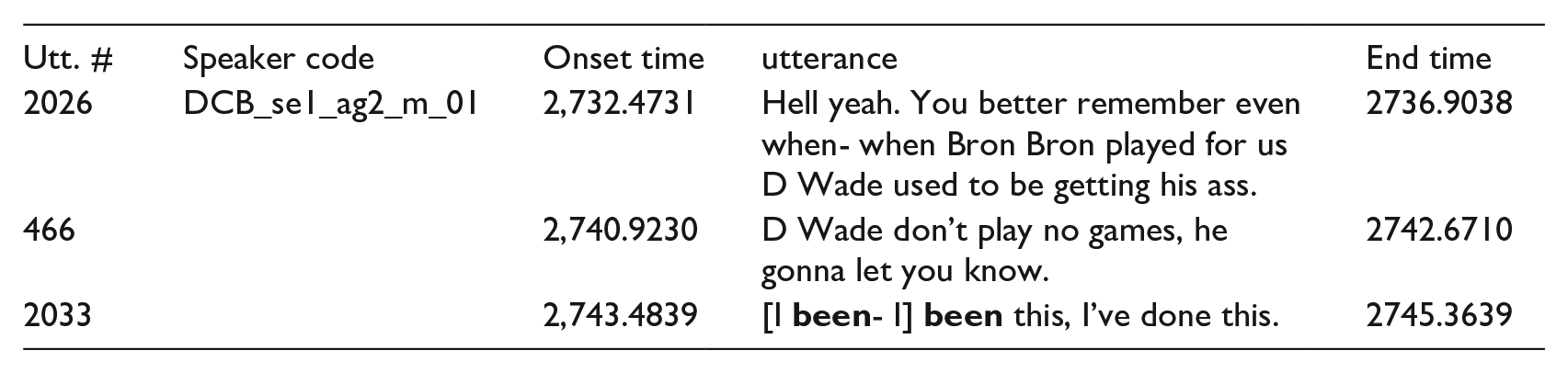
In some cases, it is necessary to rely on discourse context and rhetorical strategies to understand the long-time reference. In the following example, the speaker begins by describing a situation in the past in which LeBron James and Dwyane Wade played professional basketball during the same time period. The speaker rhetorically takes the role of D Wade and establishes that Wade had a history of taking the lead. The speaker (as Wade) responds by saying “I been this” to mean that he’s played that role for quite some time—thus BIN, as in I BIN this.
In the unspecified category, all the adverbials are explicitly long-time. The durative adverbials in this category were varied, but adverbials like “for a long time” were common. Where “for a long time”-type adverbials occur is important. Specifically, when the predicate following beenPPART is a VP, certain adverbials co-occur with certain VP forms. Recall that constructions in the unspecified long-time category are treated as true BIN variants. An unspecified beenPPART + adverbial construction with a progressive VP following “been” goes with a “for a long time”-type adverbial. These are functionally equivalent to the portion of BIN uses that line up with perfect uses as discussed in Section 1.1. The VP can also carry past tense morphology as well, as seen with BINCOMP constructions. The semantics of these constructions is not part of the perfect overlap that BIN as a whole exhibits. In the case of VPs referring to a complete event in the past, adverbials like “a long time ago” are felicitous. As a result of searching for orthographic “been,” we do not have any BIN-alternative constructions that make use of “a long time ago”-type adverbials. This is because this class of adverbials is not felicitous with beenPPART. We know that VP-en/ed + “a long time ago” is a valid BIN alternative because of examples like the one below. It should also be noted that there were 6 VP-en/ed instances (roughly 29% of BIN instances) found in CORAAL, compared to the few found among the BIN alternatives (ranging from 10% to 18% of an already small pool).

In the example above, the adverbial “long time ago” follows BIN. The adverbial is allowed to follow BIN because it is uttered after a pause. This sentence can be paraphrased as “I met /RD-NAME-2/ a long time ago.” Past tense VP + “a long time ago”-type adverbials situates the VP event in the remote past and makes no comment about present relevance. Furthermore, environments with past tense VPs like the one above are not compatible with beenPPART. This explains why there are so few past tense VP examples of “been” + adverbial constructions.
In comparing the unspecified time period tokens, we find 20 tokens of BIN and 128 tokens of unspecified temporal adverbial cases. Further research is also needed to determine why speakers prefer to use these BIN “variants” in place of BIN itself. According to Rickford (1975), AAE tense/aspect markers occur with low frequency in tape-recorded speech. His assessment is that low-frequency occurrence may not only be because “speakers have some awareness of the stigmatized nature of such forms, but also because the semantic conditions which they are normally introduced to express may occur rarely, if at all, in the course of the sociolinguistic interview” (p. 99). If BIN constructions and the unspecified adverbial constructions occur in the same environments, one question is whether the stigmatized nature of BIN accounts for the twenty occurrences or 13% of the overall unspecified cases compared to the 128 unspecified adverbial variants. We do find overt evidence in the database to reveal that speakers are indeed avoiding stigmatized properties. When discussing her own accent and certain features of her Southern/Rochesterian dialect, one speaker says:

Despite the fact that the interview is structured to elicit natural speech, interviewees are still cognizant enough of the setting that it affects their speech. This could also contribute to why BIN occurs so much less frequently than “been”+ adverbial does. Along the lines of the BIN occurrences, the unspecified long-time adverbials only occur in a subset of the databases, in DCA, DCB, and PRV. Given that the use of BIN is also argued to be linked to certain pragmatic and rhetorical contexts, it is also necessary to raise questions about the extent to which such environments are most conducive to BIN occurrence in the corpora.
The unspecified adverbial constructions are semantically equivalent to the BIN constructions, but it is not always clear how adverbials specifying explicit time periods relate to BIN constructions. Without some indication that a time period is intended to refer to a long period, it is not always clear when explicit times actually refer to the distant past or to a long period. That is “five years” might or might not reference a long period. One final observation is that unspecified adverbials occurred in only three of the databases, but the specified adverbials occurred in all of the databases. We speculate that BIN production might be limited in the interview setting—not just because the marker might be construed as a stigmatized feature by some speakers, but also because speakers might try to be as informative, cooperative, and specific as possible in answering questions about time periods, such as “How long have you lived in Maryland?.” Neither BIN nor the unspecified adverbials provide the level of specificity of the explicit temporal adverbs, which also outnumber the unspecified temporal information provided by BIN and its alternates. Below are a couple of examples of more direct exchanges in which the interviewer asks for the duration.


Through analyzing both interviewer cues and the discourse surrounding the “been” + adverbial utterances, we found that very few interviewer cues were directly addressing a question about duration. Of the 86 specified since cases, there were 6 such cues; there were 13 of 92 such cues for specified other cases, and 10 of 128 cues for unspecified long-time cases. That is, the majority of the time, “been” + adverbial is used unprompted.
BIN occurs productively in AAE, so, at first glance, it is surprising that there are relatively few tokens of the marker in the corpus. Instead of expressing long periods by using BIN, speakers choose to use been + temporal adverb. The only difference between BIN and been + temporal adverb is that the latter explicitly expresses the time associated with the long period while BIN simply conveys that the state or activity expressed by the predicate has held or been in progress for a long time or ended a long time ago according to the speaker’s view. That is, the exact amount of time associated with the long period remains unexpressed. Nothing in the data suggests that there has been a change over the years in the meaning of BIN. In addition, there are many syntactic and semantic contexts in the corpus for BIN, but speakers chose to be explicit about time periods instead of using the remote past marker to make a general point that the event was in the far past or continued for a long time.
One suggestion here is that in the interview setting, the speaker is in the position to talk about the past and give as much information and as many details as possible that will characterize the past event accurately. As such, speakers give information about time as much as possible. A clear case in support of this is the example in Figure 2, in which the speaker uses BIN to indicate that the time she met someone is in the far past. Instead of simply using BIN, she further modifies the marker with long time ago. There is some cost in using a further modification of BIN given that the marker does not generally occur with temporal adverbials that modify the length of the long period. In the case of the example in Figure 2, in which the marker does occur with a temporal adverbial, the modifier occurs in a separate IntP. Two goals are achieved: (1) In the interview setting, it is possible to adhere to the goal of providing as much information as possible and (2) by putting the modifier in a separate phonological phrase, it is possible to avoid the clash with BIN and the temporal adverbial in the same phrase. The corpus is useful in providing insight into the use of BIN and been + temporal adverbials in the interview setting. It may be that a number of factors, such as eschewing the use of stigmatized features and intent to be as explicit as possible, conspire to limit BIN occurrences.
2.3.2 The phonetic realization of BIN constructions in CORAAL
There were both consistent acoustic properties as well as loci of variability among the BIN-containing utterances in CORAAL. BIN showed a clear F0 peak in 21/23 cases—acoustic evidence for a high pitch accent. What kind of high pitch accent—with or without a trailing or leading low tone, for instance—we leave to further research. In addition, the post-BIN region showed no discernible F0 peaks—evidence for post-BIN deaccenting—and ended with low F0 in 20/23 cases. A clear locus of variability was the initial F0 pattern in the pre-BIN region. Sometimes the prosodic phrase started from a high F0—potentially from an initial boundary tone or a preceding pitch accent (cf. Jun and Foreman’s, 1996, note that “AAE more often has a sentence-initial high tone (%H or H*)” than GAE)—and the majority of these cases showed a pattern like that of the sample F0 contours in Weldon (2019), in which the F0 peak on BIN was lower than the F0 in the pre-BIN region. Sometimes the prosodic phrase started from a low to mid-range F0, in which case the BIN F0 peak was higher than the F0 in the pre-BIN region. Two probable loci of variability hinted at were: the presence or absence of an F0 peak consistent with a pitch accent on the word immediately following BIN and phrase-final F0 movements in the post-BIN region. The one example with a clear post-BIN F0 peak, DCB_se1_ag3_m_03_1, utterance 1370, showed an F0 peak on thinking that was lower than the F0 peak on BIN, after which no further F0 peaks were discernible (Figure 3). Three examples ended in the post-BIN region with a mid to high final F0 consistent with a non-low final boundary tone. And one of these cases, DCB_se1_ag1_f_01_1, utterance 1436 (Figure 5), hinted that BIN might in certain contexts appear with a low rather than a high pitch accent. In this utterance 1436, BIN is preceded by a high F0 from a preceding pitch accent or boundary tone and then followed by phrase-final high F0. (The unusual realization of BIN in that utterance could also be related to the presence of an overt auxiliary immediately preceding BIN and/or the disfluent ending.) If the phonological analysis of a low pitch accent on BIN is indeed tenable, then the example in Figure 5 could be an instance of an Obligatory Contour Principle effect, like the classic case in Bengali in which an underlying high tone may surface as low when adjacent to another high tone (Hayes & Lahiri, 1991; Khan, 2008, 2014).
The sampling of contexts in which BIN happened to appear in CORAAL helped reveal a range of variability in the phonetic realization of BIN constructions. What conditions this range of variability remains an issue for further research. However, the different realizations of BIN constructions one after the other in DCB_se3_ag4_m_01_1, utterance 233 suggests that some variability occurs within-speaker. Some aspects about the realization of BIN constructions could not be addressed by the CORAAL sample. One is how realization (and usage) might vary by the different semantic BIN-types. Another is the further characterization of the post-BIN region, such as if a low F0 plateau begins immediately following BIN (or the verb) or if the F0 gradually declines to the end of the phrase. Most of the CORAAL BIN examples had only one or two words in the post-BIN region, so these downtrends could not be assessed. There was also only one case of the word immediately following BIN being accented, so further data are needed to investigate this possible class of renditions of BIN constructions. Similarly, there was only one case of BIN co-occurring with a temporal adverbial, so more data are needed to investigate previous claims that BIN can only co-occur with a temporal adverbial if there is an intervening pause. In addition, a quantitative, fine-grained acoustic characterization was not possible due to the uncontrolled contexts and small sample size, which also made a systematic comparison between the realizations of BIN and beenPPART utterances difficult (and one we did not attempt here). One important point about BIN and beenPPART already raised by the CORAAL sample, though, is that “stressed BIN” is a bit of a misnomer, since beenPPART can be “stressed” (i.e., perceived as prominent and/or marked with a pitch accent) too. Finally, while there were a few utterances in CORAAL perceived as being ambiguous between BIN and beenPPART, there were too few to begin to disentangle what might lead to such an ambiguity. The production experiment described in the following section builds on the CORAAL study and makes advances toward addressing these issues.
3 Southwest Louisiana production experiment
To complement the CORAAL corpus data, we carried out a more narrowly focused, controlled elicitation task in a small town AAE-speaking community in southwest Louisiana. 8 This task allowed us to further investigate the usage and realization of different semantic BIN types and been + adverbial constructions, as well as compare fine-grained acoustic measures between BIN and non-BIN, that is, beenPPART, across the utterance.
3.1 Materials and methods
This section describes the speakers who participated in the production experiment (Sec. 3.1.1), stimulus construction in context of the experimental design (Sec. 3.1.2), the experimental procedure (Sec. 3.1.3), and data analysis (Sec. 3.1.4).
3.1.1 Speakers
Speakers came from a small-town community in southwest Louisiana (SWLAT) in Jefferson Davis Parish. This community has a population of 2,800, which is predominantly European American and 11% African American. The community has been historically segregated by railroad tracks and streets, so African Americans live on one side of the town and non-African Americans on the other with a few exceptions. While residents live in separate areas, the groups are in contact in schools and several small shops. The members of the African American community are predominantly native AAE speakers who share some language patterns with the local European Americans, some of whom identify as Cajun. In fact, the history of the community records that the citizens are a mixture of Acadians, French, and Anglo-Americans, but there is no mention of the citizens of African descent. There is one elementary school (pre-kindergarten–6th) and one high school (7th–12th), which children in the town attend unless they attend one of the Christian schools in the neighboring city. There are also two small grocery stores, a discount store, and a few other businesses, such as convenience stores with fuel stations. The schools and businesses are on the non-African American side of the town. There are two amusement parks in the town, one on the traditionally non-African American side and a smaller one on the traditionally African American side.
Nine speakers—six women and three men between the ages of 25 and 67—participated in this study in August 2019. Their gender, age, education, and employment are given in Table 4. The speakers, who are natives of SWLAT or a neighboring town which is 8 miles north, were recruited to participate in an advertised pilot study “The sound of aspect in African American speech” through a community consultant. In this small-scale pilot study, the goal was to elicit data from adults in the community with the understanding that in a larger BIN study, considerable focus should be placed on a more well-rounded participant pool from the perspectives of age and gender as much as possible in the small community. Eight participants grew up and attended elementary school and graduated from high school in the town. The other participant grew up in the neighboring town in which all African Americans in SWLAT attended high school before integration in the 1960s. Six participants spent their entire lives in the community, and the other three participants who attended college or received vocational training grew up in the town but spent a portion of time away from the area before moving back. All of the participants have high school diplomas, and two attended college. One of the participants spent 2 years in college, and the other earned a BS degree in biology and a nursing degree. The latter participant travels between towns and cities in south and north Louisiana. The other participants live and conduct their day-to-day activities in SWLAT.
Summary of Demographic Information of Louisiana Speakers Recorded.
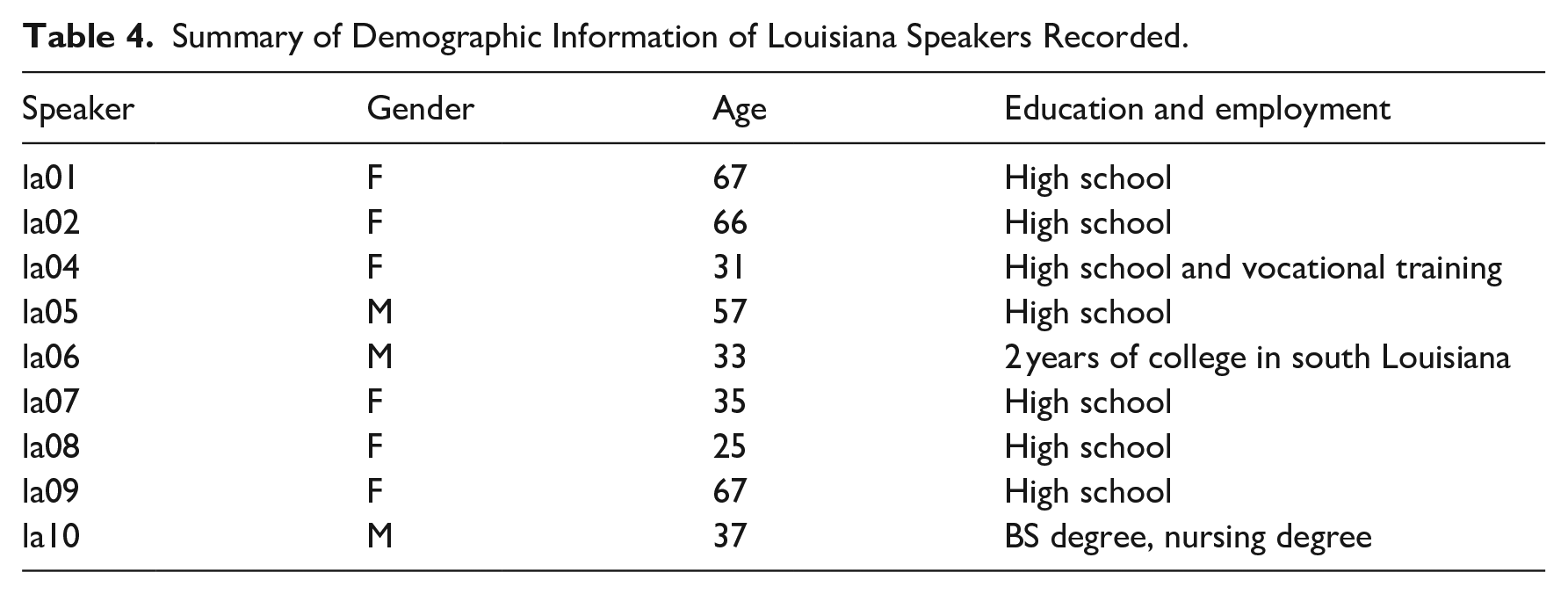
3.1.2 Stimuli
In total, there were 71 stimuli with BIN/beenPPART. They consisted of 11 items with BIN/ beenPPART introducing a VP and 8 items with BIN/beenPPART introducing a PP. Each VP item was presented in three BIN environments (BINCOMP, BINSTATE-HAB, BINSTATE-CONT) and the non-BIN beenPPART environment. Each PP item was presented in the BINSTATE-CONT environment and the beenPPART environment (the other two BIN environments are not possible with PPs). In addition, 6 of the VP items were also presented in the BIN + modal environment (BIN could or BIN supposed to, e.g., Aw, the workers
(16) Target utterance: The maintenance workers been number-ed/ing those tables. a. BINCOMP: The tables are lined up neatly and ready to be cleaned. The maintenance workers really did a good job of putting numbers on all of those tables and getting them ready to be hauled away. Did they just finish? I wanted to catch them before they left the building. b. BINSTATE-HAB: At the end of every year, they have to take inventory so they know how many tables are in that big reception hall. Those same maintenance workers come every year to count and number them. They didn’t just start coming to number the tables. c. BINSTATE-CONT: The maintenance workers arrived early this morning to get this room ready. They haven’t taken a single break and they still have quite a bit of work to do. I see they are working with the tables, putting numbers on them. Did they just start that project? d. beenPPART: The maintenance workers are just leaving the building. They came in to work on the tables—to put numbers on them and get them ready to be painted. We know what they were just doing. e. beenPPART +long time adverbial: Target utterance: The maintenance workers been numbering those tables for a long time (using the BINSTATE-HAB context and illustration)
Fifteen fillers were also constructed, which included grammatical structures of AAE such as existential it, tense-aspect marker done (dən), multiple negatives, negative inversion, and embedded auxiliary inversion. These were included so we could validate that our task successfully elicited AAE from our speakers.
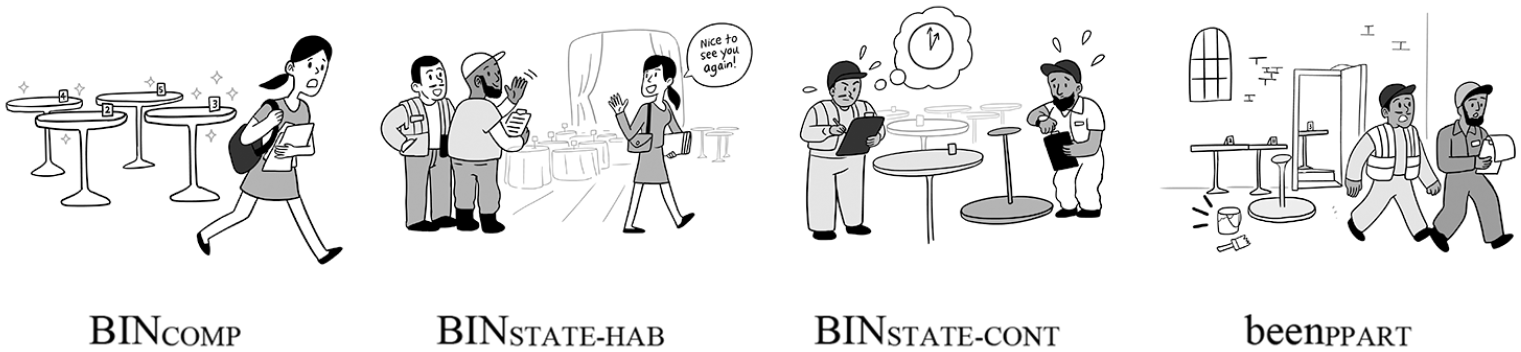
Illustrations for BIN/ beenPPART + number-ed/ing environments that accompanied the auditory prompts given in (16).
3.1.3 Procedure
Participants were recorded by the first author in a quiet room within the community with a Shure SM35 head-mounted condenser microphone on a Zoom H5 digital recorder at a 16-bit bit depth with a 44.1 kHz sampling rate. At the beginning of the experiment, the participant was read instructions for the task and completed three practice trials. For each stimulus during the experiment, the participant saw a slide showing the accompanying illustration and listened to the context. (See slides in OSF repository). After the auditorily presented context finished playing, the target sentence to be uttered appeared on the slide for the participant to read. BIN/beenPPART was orthographically represented as “been” regardless of whether the context presented a beenPPART or BIN environment. If the participant’s utterance was disfluent, they were asked to repeat the utterance again. Speakers also sometimes produced more than one repetition of a stimulus without prompting. It was necessary to have participants read written stimuli to ensure that they would produce the exact utterance targeted. This forced them to use the BIN constructions of interest for this study rather than, for example, choosing the alternative variant unstressed beenPPART + long time adverbial, and it also controlled for potentially confounding phonological differences within an item set that would affect acoustic measurements.
Stimuli were presented in five blocks of 16–17 stimuli each, where no more than a single stimulus from an item set appeared within a block. Stimuli were pseudorandomized to avoid the same BIN/beenPPART environment appearing consecutively within a block. The whole experiment took about 30 minutes.
3.1.4 Analysis
Recordings were segmented into individual utterances in Praat (Boersma & Weenink, 2019). Individual utterances were segmented into words with the Montreal Forced Aligner (McAuliffe et al., 2018) using the pretrained model for English, and then the word boundaries were hand-corrected. Two kinds of analyses were then performed: listener judgments and acoustic analysis. Results were then statistically analyzed.
Each recorded utterance was played together with its accompanying auditory context and illustration for listener judgments by Green and Whitmal. Listener judgments are a standard way to characterize AAE and other varieties of Englishes (Oetting & McDonald, 2002; Wyatt, 1991). Two kinds of judgments were made: (i) the acceptability of the utterance, given the context and (ii) an auditory classification of the
As described in Section 1.1, we expected potential cases of beenPPART usage in BINSTATE environments if speakers were choosing not to explicitly mark a long period of time. Thus, for consistency, all utterances perceived to be beenPPART in BINSTATE-HAB and BINSTATE-CONT environments were labeled as “accommodated.” In addition, six beenPPART environment items were detected during analysis to have had ambiguous contexts, so perceived non-beenPPART utterances for those items were similarly marked with “accommodated” labels (see Section 3.2.2). The
For fine-grained acoustic analyses, mean F0 and energy (i.e., intensity) measurements were taken over 10 evenly spaced subsections over each word using VoiceSauce (Shue et al., 2011), a program for automated voice analysis. The TANDEM-Straight F0 algorithm was used (Kawahara et al., 2016), with speaker-specific values for F0 floors and ceilings. Listener judgments and acoustic measurements were processed in R (R Core Team, 2018) using dplyr (Wickham et al., 2019), tidyr (Wickham & Henry, 2019), and ggplot2 (Wickham, 2016) packages. Durations were computed for each word, and mean and maximum F0 and energy values over the 10 subsections within a word were also computed. Then, the ratios between these measures over BIN/beenPPART were computed with respect to the immediately preceding word, immediately following word, and the stretch of all following words not including the immediately following one. Taking ratios within an utterance controlled for local F0 range and speech rate variation across utterances and speakers. Mixed-effects regression models were used for inferential statistics as there were unbalanced numbers of items across speakers and environments. Logistic and linear mixed-effects models were built using lme4 (Bates et al., 2015). All fixed effects were centered and coded with treatment contrasts. Models including fixed effects were compared against null models (which included only random effects) using likelihood ratio tests. Significance was evaluated with an α level of .05; bootstrapped 95% confidence intervals were computed using the confint.merMod() function in the lme4 package, with 500 resamples.
3.2 Results
The results from the SWLAT production task are presented in four parts. Section 3.2.1 concerns task validation, and Section 3.2.2 integrates presentation of the results of perceived BIN/been type and acceptability ratings. The beenPPART + long time adverbial environment results are presented in Section 3.2.3, and then the phonetic realization of BIN/beenPPART utterances is covered in Section 3.2.4.
3.2.1 Task validation
AAE is a spoken variety with no standard writing conventions, but our task relied on participants reading written English. To assess how well our task elicited natural AAE speech, we examined participants’ utterances of the fillers and their utterances of constructions that would be acceptable only with BIN utterances (BIN + modal, BINCOMP). We found that participants had no difficulty producing AAE structures in the fillers: no speakers produced any unacceptable renditions of fillers. However, Speaker la01 produced only 57% of 21 filler utterances that were rated good, while the rest were judged only marginal. Excluding la01’s utterances, the 135 remaining utterances of fillers were all rated good (96%, 129 utterances) or marginal (4%, 6 utterances), and every speaker had 93%–100% of filler utterances rated good and no more than 1 filler judged only to be marginal. Most speakers also produced only utterances perceived to have BIN in the obligatory BIN + modal and BINCOMP environments. All speakers (including la01) produced only BIN renditions in the BIN + modal environment. Six of the nine speakers also produced only BIN utterances in the BINCOMP environment, and Speaker la02 produced 13/14 BIN utterances and one beenPPART utterance in the BINCOMP environment rated as unacceptable. Unacceptable utterances in the BINCOMP environment were also produced by Speaker la01 (4/15) and Speaker la09 (5/17). In addition to difficulties with the fillers and BINCOMP environment, Speaker la01 also had the lowest proportion of BIN/been utterances rated good across speakers (52.7%) and the highest proportion of accommodated BIN/been utterances across speakers (26.4%). Given the consistent indications that Speaker la01 had considerably more difficulty with the experimental task than other speakers, she was excluded from the rest of the analyses.
3.2.2 Distribution of perceived BIN/been type and acceptability ratings across environments
We hypothesized that speakers would produce BIN utterances in the BIN environments and beenPPART utterances in the beenPPART environments. Moreover, we hypothesized that speakers would produce BIN utterances most frequently in the obligatory BIN environments, BIN + modal and BINCOMP. Mean percentages across speakers of perceived BIN/been type in different BIN/been environments are given in Table 5. As mentioned in Section 3.2, almost all utterances in the obligatory BIN environments were perceived as BIN utterances—100% of the BIN + modal utterances and 94.7 ± 7.1% (1 SE) of the BINCOMP utterances. However, only 82.7 ± 8.5% (1 SE) of the BINSTATE-HABIT utterances and 69.7 ± 13.2% of the BINSTATE-CONT were perceived as BIN utterances. Moreover, only 41.1 ± 15.1% (1 SE) of the beenPPART environment utterances were perceived as beenPPART utterances. (The beenPPART + long time adverbial environment results are presented in Section 3.2.3.)
Mean (± 1 SE) Percentages of Different Perceived BIN/been Types Across Speakers (Excluding Speaker la01) as a Function of BIN/beenPPART Environment.
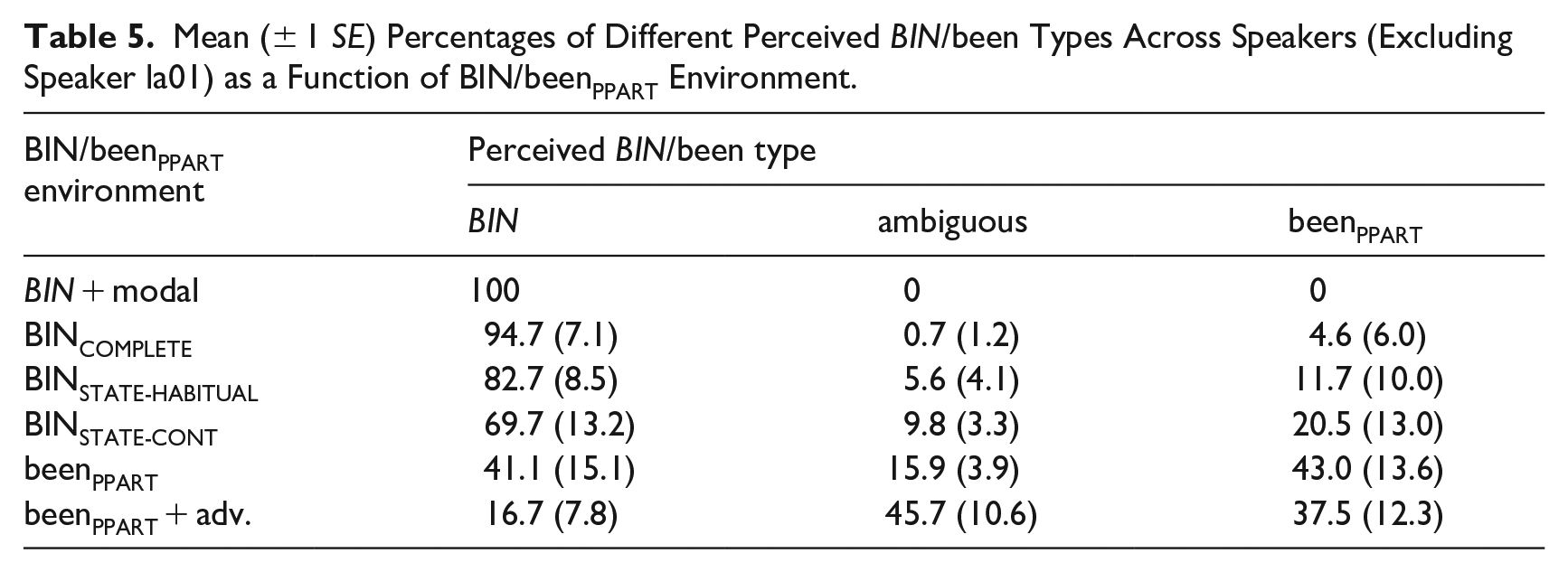
These results can be better understood in the context of the distribution of acceptability ratings across environments, as shown in Table 6. Although they elicited a high proportion of beenPPART utterances, the BINSTATE-HABIT and BINSTATE-CONT environments yielded 0% and 1.2 ± 0.8% (1 SE) unacceptable ratings, respectively, because beenPPART utterances were accommodated. As described in Section 1.1, beenPPART utterances could be accommodated in BINSTATE environments as cases where the long time period was not made explicit but could still be construed. Similarly, while 41% of utterances in the beenPPART environment were perceived to be BIN utterances, only 23.1 ± 6.1% (1 SE) of utterances in this environment were rated unacceptable. This is because Green and Whitmal discovered during listening to productions that there were a handful of beenPPART items that could conceivably accommodate BIN utterances. Namely, for the items with target words remind, lower, water, on, near, and away, the auditory prompt or illustration did not completely rule out a long time context. Three speakers produced accommodated away utterances, 5 produced near and lower ones, and 6 remind, water, and on ones. For instance, for the near the cabins beenPPART environment item, the illustration could have conceivably been interpreted as supporting a long time context by the speaker if the speaker considered the bear to still be close enough to the cabins to be “near.”
Mean (± 1 SE) Percentages of Different Acceptability Rating Categories Across Speakers (Excluding Speaker la01) as a Function of BIN/beenPPART Environment. The Category “good + accom.” Combines the Good and Accommodated Rating Categories.
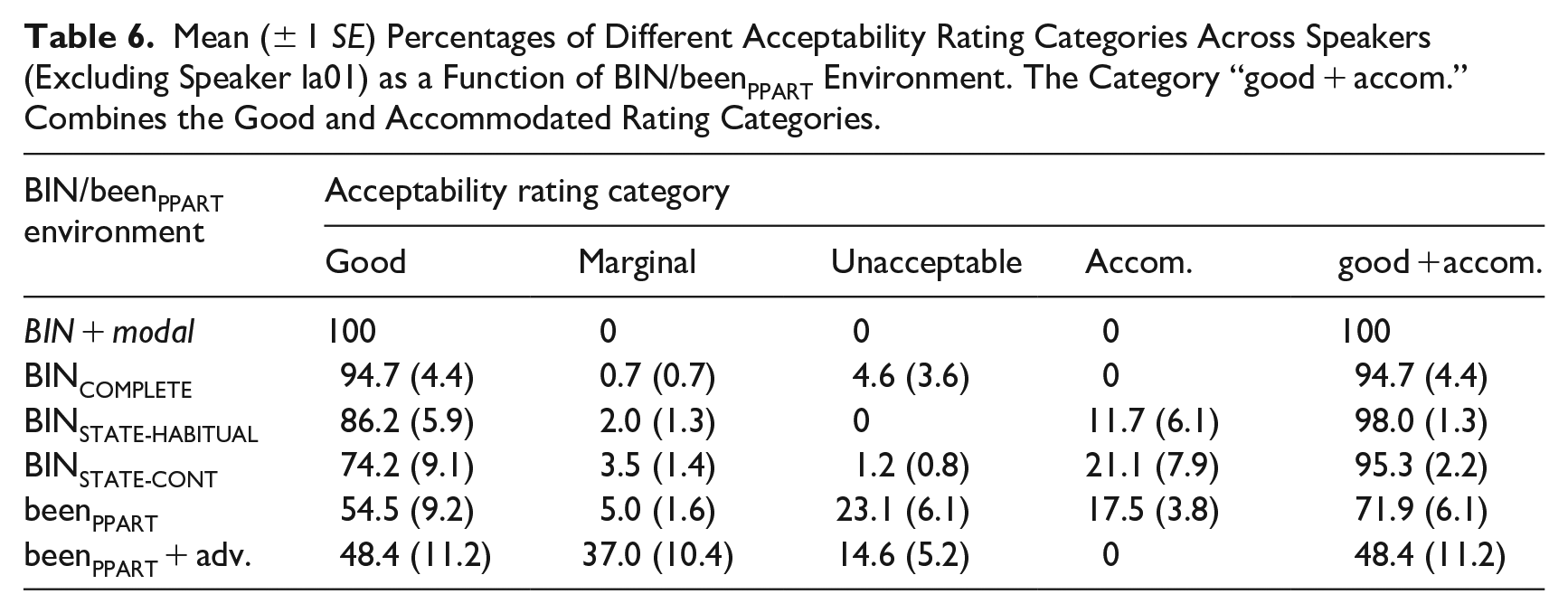
Despite the complication of the accommodated cases, regression analyses nevertheless showed that perceived BIN was much more likely in BIN than non-BIN environments, as expected. A logistic mixed-effects model was built with an indicator variable for whether or not
Logistic Mixed Effects Model Output for the Effects of BIN Versus Non-BIN Environments and Obligatory BIN Versus Other BIN Environments on Whether the Utterance Was Perceived as One With BIN or Not.
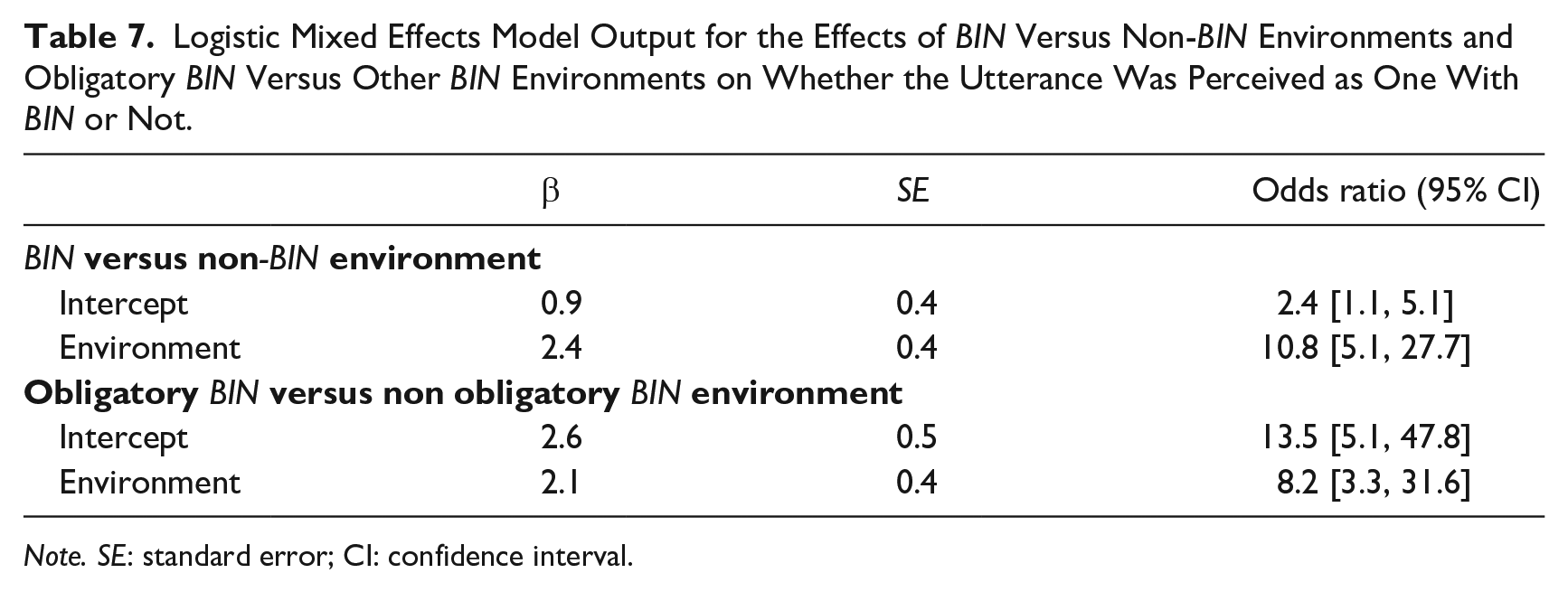
Note. SE: standard error; CI: confidence interval.
3.2.3 Usage and acceptability of BIN/ beenPPART utterances in the beenPPART + long time adverbial environment
The remaining environment not yet discussed, the beenPPART + long time adverbial environment, was expected to elicit beenPPART utterances. However, as shown in Table 5, only 37.5 ± 12.3% (1 SE) of utterances in this environment were perceived as beenPPART utterances. 16.7 ± 7.8% were perceived to be BIN utterances, and nearly half—45.7 ± 10.6% (1 SE)—were perceived as ambiguous between the two types of utterances. Five of the 13 utterances perceived to be BIN utterances were judged to be “good” because a prosodic juncture intervened between BIN and the temporal adverbial (see Section 1.1); the rest were judged unacceptable. 24 of the 29 utterances perceived to be ambiguous between BIN and beenPPART were rated as “marginal” and the remaining 5 were rated as “good.” A number of the utterances perceived as ambiguous were reported by Green as initially sounding like a BIN utterance in the early part of the utterance, but then having prosodic properties in the adverbial phrase near the end of the utterance that prompted a reanalysis toward a beenPPART percept. A few of the ambiguous utterances were reported as containing a BIN/beenPPART that seemed intermediary in perceived prominence between a BIN and a beenPPART.
3.2.4 The phonetic realization of BIN utterances in the SWLAT production task
There was a total of 3,416 perceived BIN utterances, 1,252 beenPPART utterances, and 643 ambiguous utterances elicited from the constructed stimuli in the Louisiana production experiment. Complementing the small, semi-spontaneous sample of CORAAL BIN utterances, the much larger sample and controlled manipulations between the BIN/beenPPART utterances enabled a fine-grained acoustic comparison between the BIN and beenPPART utterances. Data analyzed here for phonetic analysis included utterances from all speakers and all utterances, including utterances judged unacceptable given the context, for example, utterances perceived as BIN constructions were produced in response to a beenPPART context were included. What matters for the acoustic analysis is simply whether an utterance was perceived to be a BIN utterance, beenPPART utterance, or ambiguous between them. For the purposes of an initial acoustic analysis comparing BIN and beenPPART utterances in the pre-BIN/been region, over the BIN/been, and in the post-BIN/been region, we excluded the ambiguous utterances. We come back to them later on when we follow this acoustic comparison with a presentation of a sample of some representative SWLAT F0 contours.
As described in Section 3.1.4, mean/max F0, mean/max intensity, and duration were measured over each word within an utterance. Then, the ratios of the acoustic measure over BIN/beenPPART to the acoustic measure over the immediately preceding word, the immediately following word, and all following words not including the immediately following word were taken, within the utterance. Figure 11 shows how these ratios compared between perceived BIN and non-BIN utterances on average, within an item. For instance, the first point on the left shows the following: On average over the 19 items, within an item (e.g., VP align), the ratio of mean F0 over BIN to the immediately preceding word in perceived BIN utterances was 1.1 ± 0.01 (SE) times the ratio of mean F0 over beenPPART to the word immediately preceding beenPPART in perceived beenPPART utterances. All ratios were much greater than 1, indicating that, compared to beenPPART, BIN had higher mean/max F0, mean/max intensity, and duration relative to immediately preceding, immediately following, and all following words not including the immediately following word. Output from linear mixed-effects models with the different measures as dependent variables,
Linear Mixed-Effects Model Output for the Effects of Whether the Utterance Was Perceived as BIN or Not on Acoustic Measures.
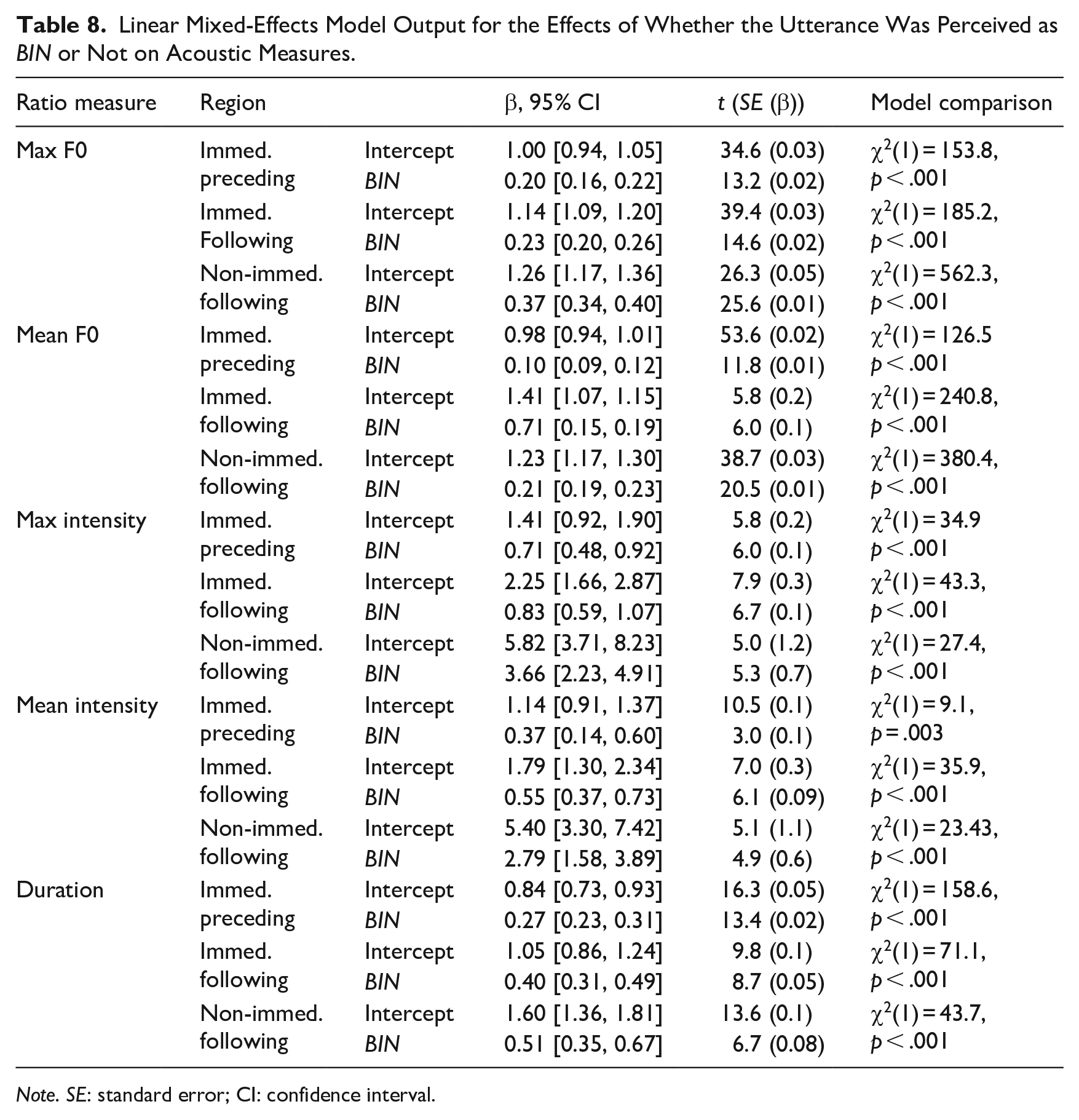
Note. SE: standard error; CI: confidence interval.
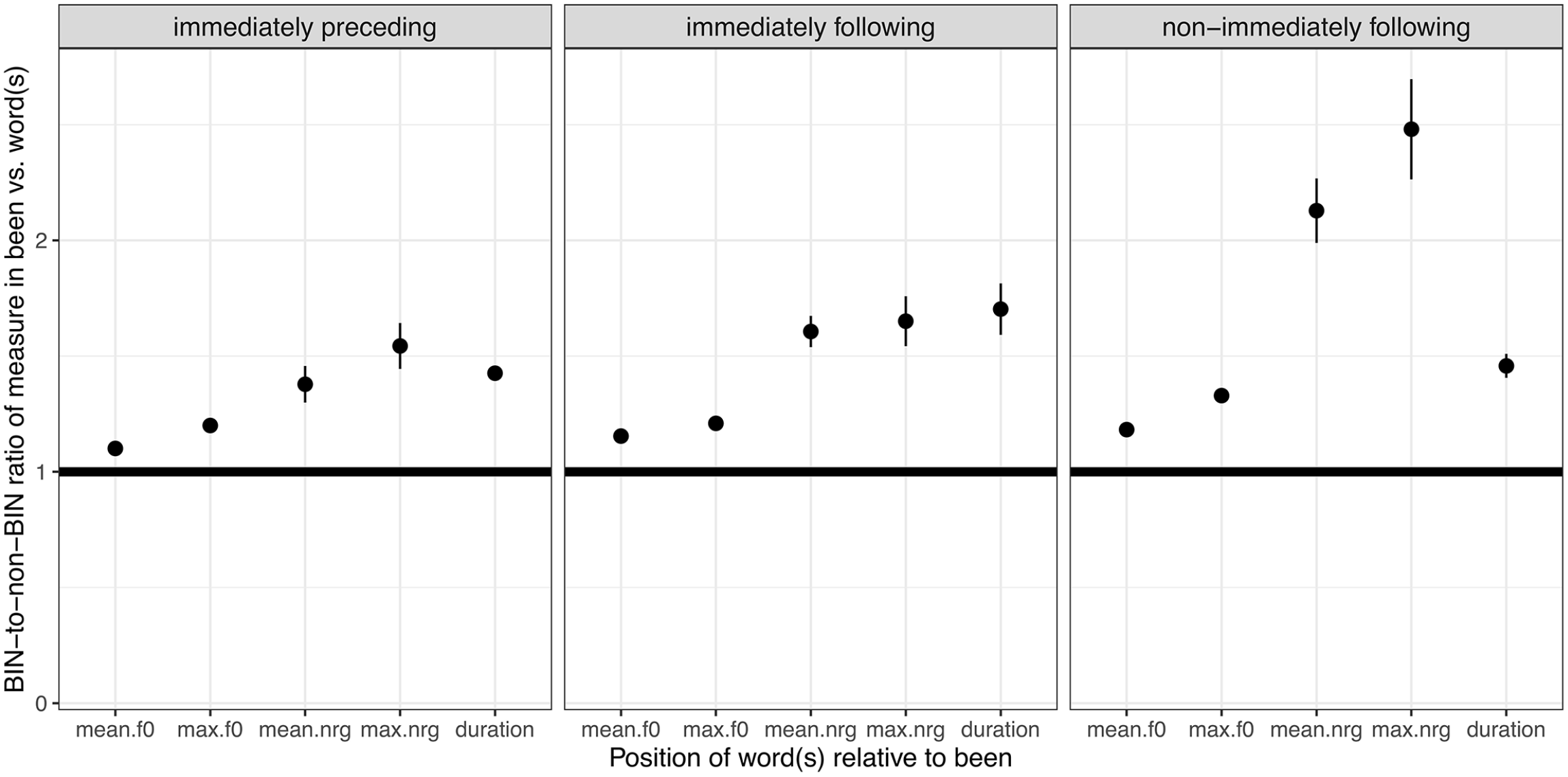
Distribution of within-item ratios of F0, intensity (“nrg”), and duration measures in perceived BIN versus beenPPART utterances for BIN/beenPPART relative to the immediately preceding and following word and (non-immediately) following words. Points show means over items (n = 19) and ranges show ± 1 SE. All ratios fall well above the dark line at 1, indicating that all measures were higher in perceived BIN than beenPPART utterances.
Nine of the 20 CORAAL BIN examples had only a single word in the post-BIN region, in which case it was not possible to disentangle phrase-final effects from more general downtrend patterns in the post-BIN region. Overall, although, it seemed that F0 dropped quickly after BIN and settled into a low F0 plateau. Acoustic results for the post-BIN region in the larger sample of SWLAT BIN utterances—where the post-BIN region consisted of a minimum of 3 and up to 10 words—confirmed that in comparison with beenPPART utterances, the post-BIN region had reduced F0, intensity, and duration, not only in the word immediately following BIN, but over the longer stretch of the post-BIN region. Among the CORAAL BIN examples, we also identified an example where F0 in the word immediately following BIN stayed high and did not drop to a low plateau (Figure 3). As shown in Figure 12, the distribution of the ratio of maximum F0 in BIN/ beenPPART to maximum F0 in the immediately following word in the SWLAT utterances shows that relative heights of F0 between BIN/beenPPART and the immediately following word showed a gradient distribution. The gradient distribution suggests that SWLAT BIN utterances did not always immediately have F0 drop to a low F0 plateau after BIN and include among them cases such as the CORAAL example in Figure 3. Figure 12 also shows that the vast majority of BIN utterances had a higher F0 on BIN than the immediately following word—sometimes approximately equally high, sometimes as much as twice as high—while F0 in beenPPART utterances often had a lower F0 on BIN than in the immediately following word.
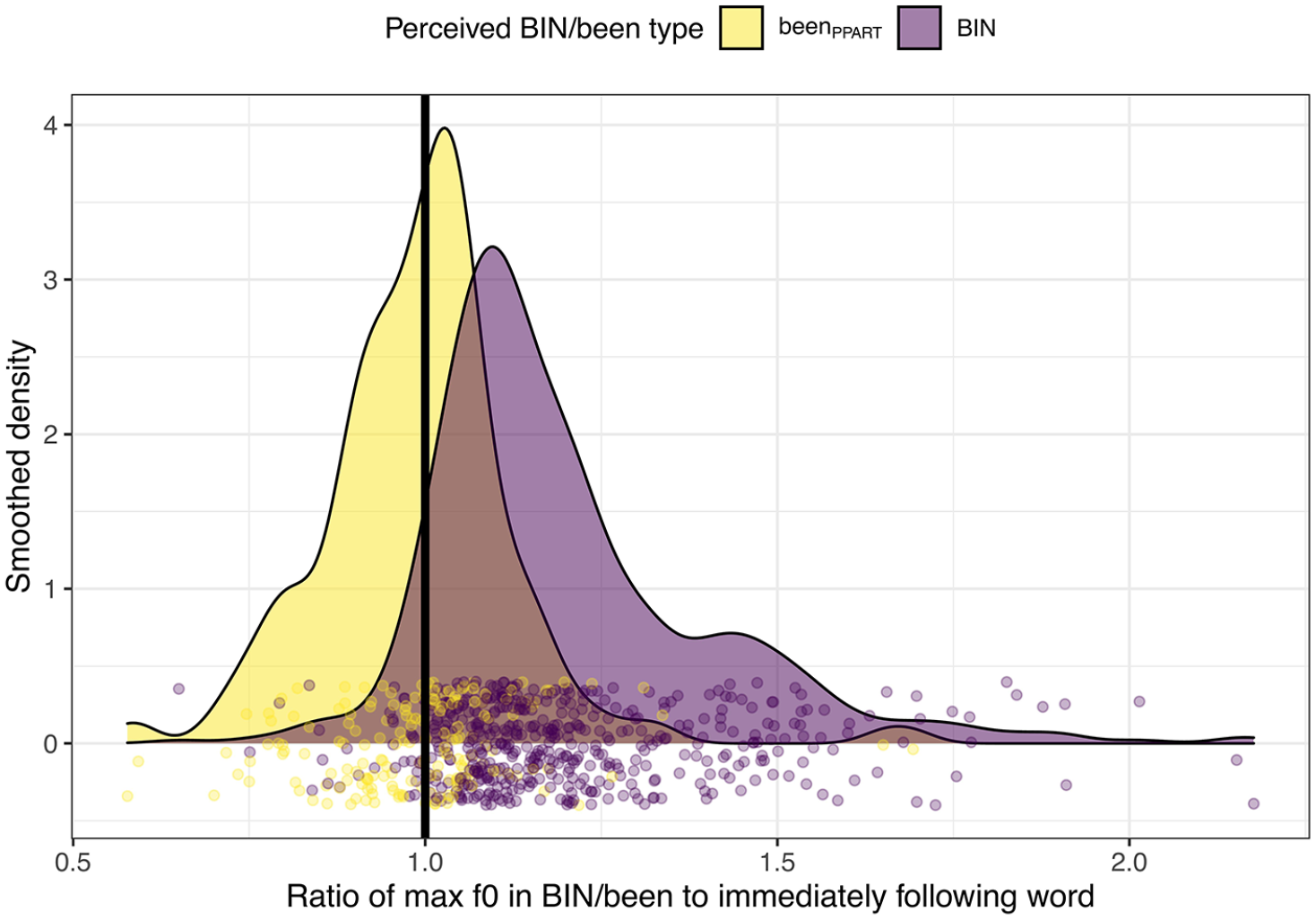
Smoothed density plot comparing the ratio of max F0 in BIN/ beenPPART to max F0 in the immediately following word in perceived BIN versus beenPPART utterances. A ratio of 1 (indicated by the black vertical line) indicates that max F0 was the same in both words.
What the purely acoustic analysis described in this section thus far cannot capture is variation in the phonological intonational tone choices and how those condition acoustic measures—this analysis aggregates across those phonological choices. An item-by-item intonational phonological analysis of the data is beyond the scope of this paper, but we show some representative F0 contours below, with reference to F0 contours observed in CORAAL.
The contrast between BIN and beenPPART utterances in the post-BIN/beenPPART F0 contour can be observed in the representative F0 contours in Figure 13 (perceived BIN example) and Figure 14 (perceived beenPPART example). As in most of the CORAAL BIN examples, the post-BIN region shows a flat, low F0 plateau with no clear F0 peaks, or potentially F0 peaks in a very reduced F0 range relative to the F0 of BIN. The dramatic F0 range change following BIN in Figure 13 is reminiscent of the drop in F0 after initial high F0 on a pronoun observed in a number of CORAAL examples as well as in Weldon (2019). Many CORAAL BIN examples also had only one or two syllables in the post-BIN region, so F0 trends were difficult to discern. The longer stretch of segmental material in the post-BIN region in the SWLAT data clearly shows that the flat, low F0 plateau continues to the end of the utterance. In contrast, the post-beenPPART region shows a gradual rise up until a sudden jump to very high F0 peak on the utterance-final word. The very high F0 peak on table appears to occur in the initial stressed syllable, which would be consistent with its being the realization of a pitch accent, but further phonological analysis is needed. The BIN/beenPPART F0 contour comparison also exemplifies the presence of a high, steep F0 peak in BIN and the lack of such a peak in beenPPART.
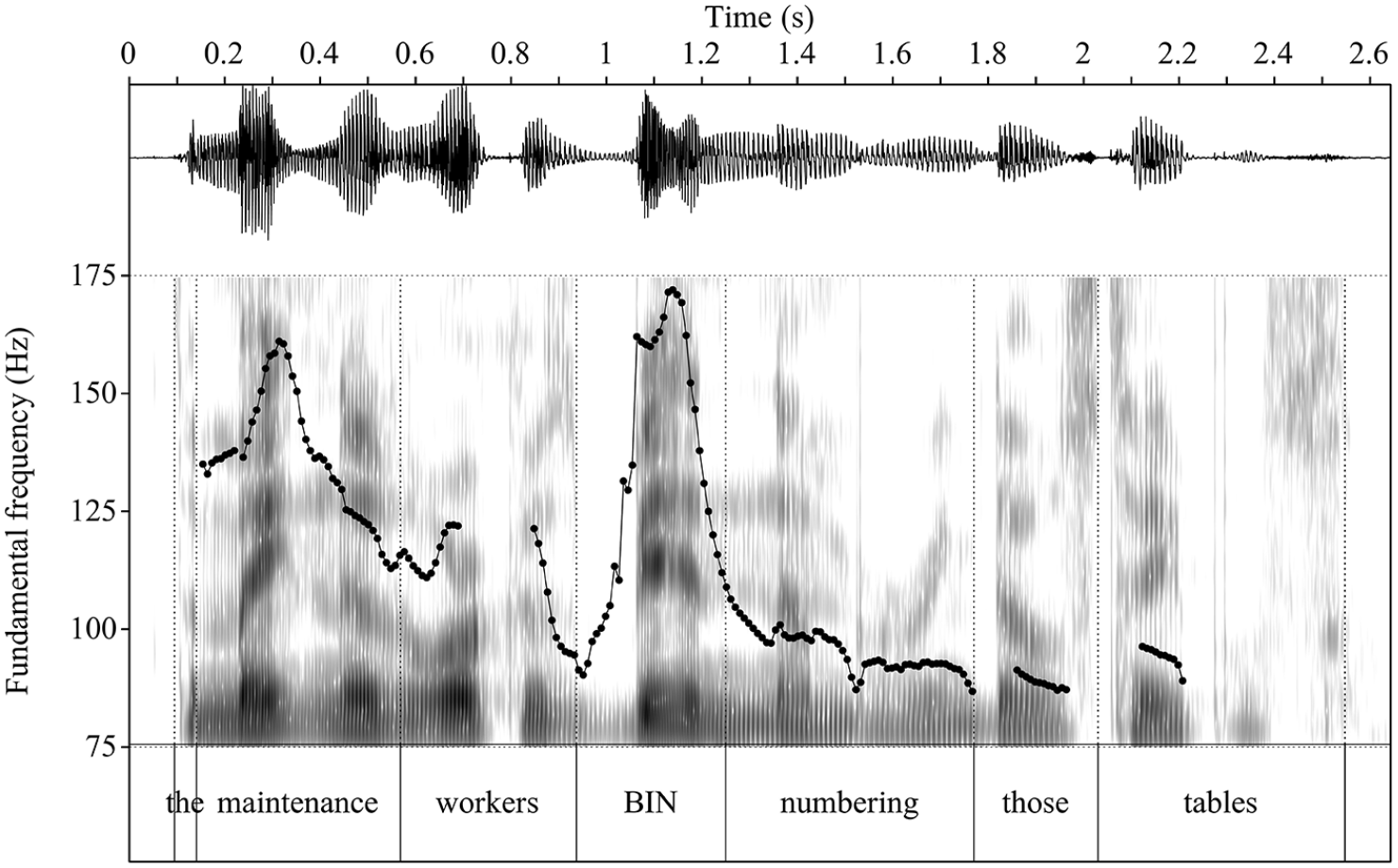
Representative F0 contour of perceived BIN in number VP item in BINSTATE-CONT environment from Speaker la05. Note the high F0 peak over BIN and the following much reduced F0 range.
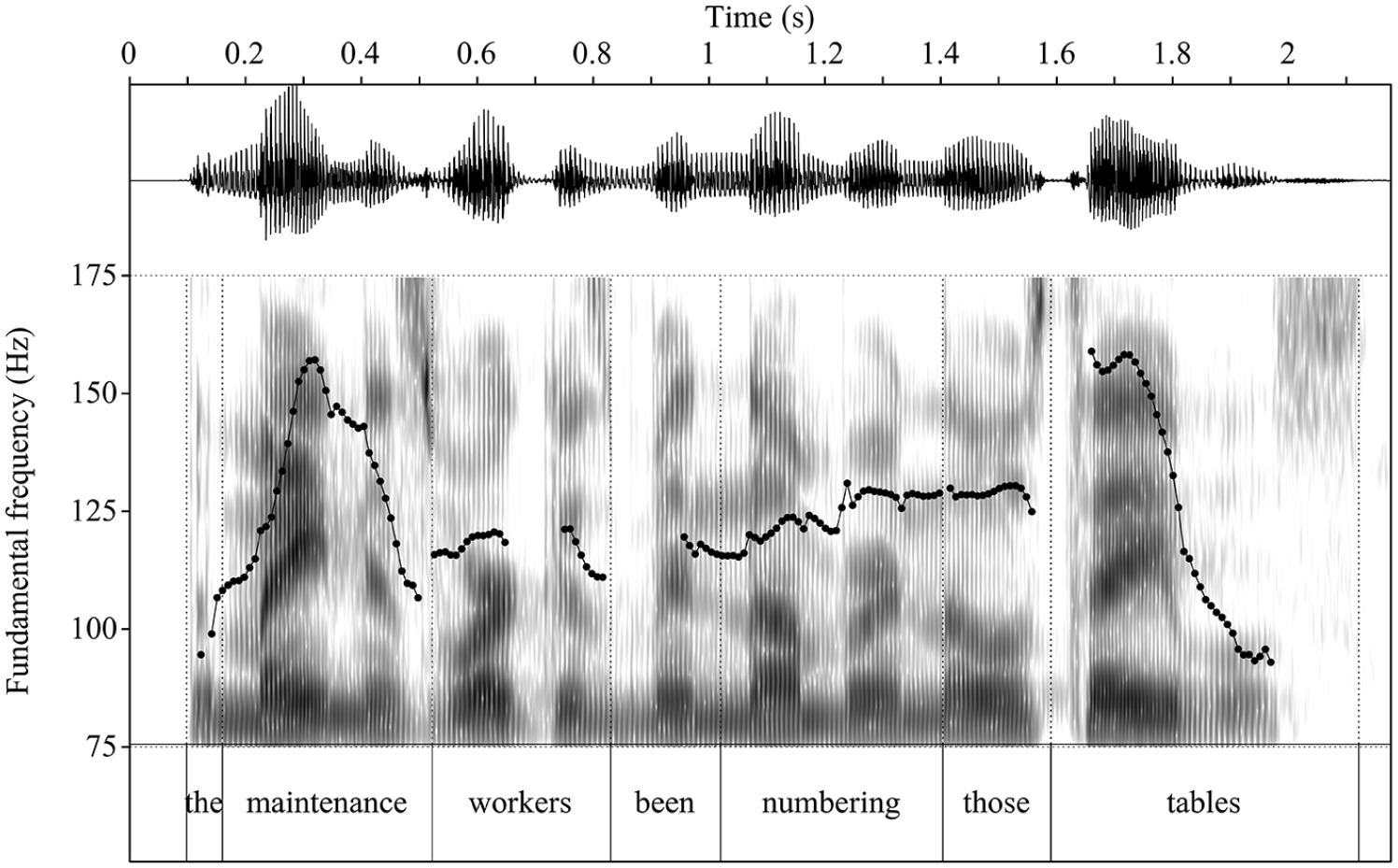
Representative F0 contour of perceived beenPPART in number VP item in beenPPART environment from Speaker la10. Note the lack of a steep F0 peak over been and the steady increase in F0 after been to an extremely high F0 peak over utterance-final tables.
The SWLAT productions revealed another prosodic parameter that could contribute to a BIN percept that we did not observe in the CORAAL examples: via a prosodic juncture immediately preceding BIN. Figure 15 shows an example of this from Speaker la08 in a production of the around his neck item in the BINSTATE-CONT environment. Whether or not there is a pitch accent on BIN is unclear, but the extreme preboundary lengthening in chain and long /b/-closure in BIN indicates a prosodic juncture at the left edge of BIN. This example also shows F0 movement in the post-BIN region; here, a steady F0 rise up to his.
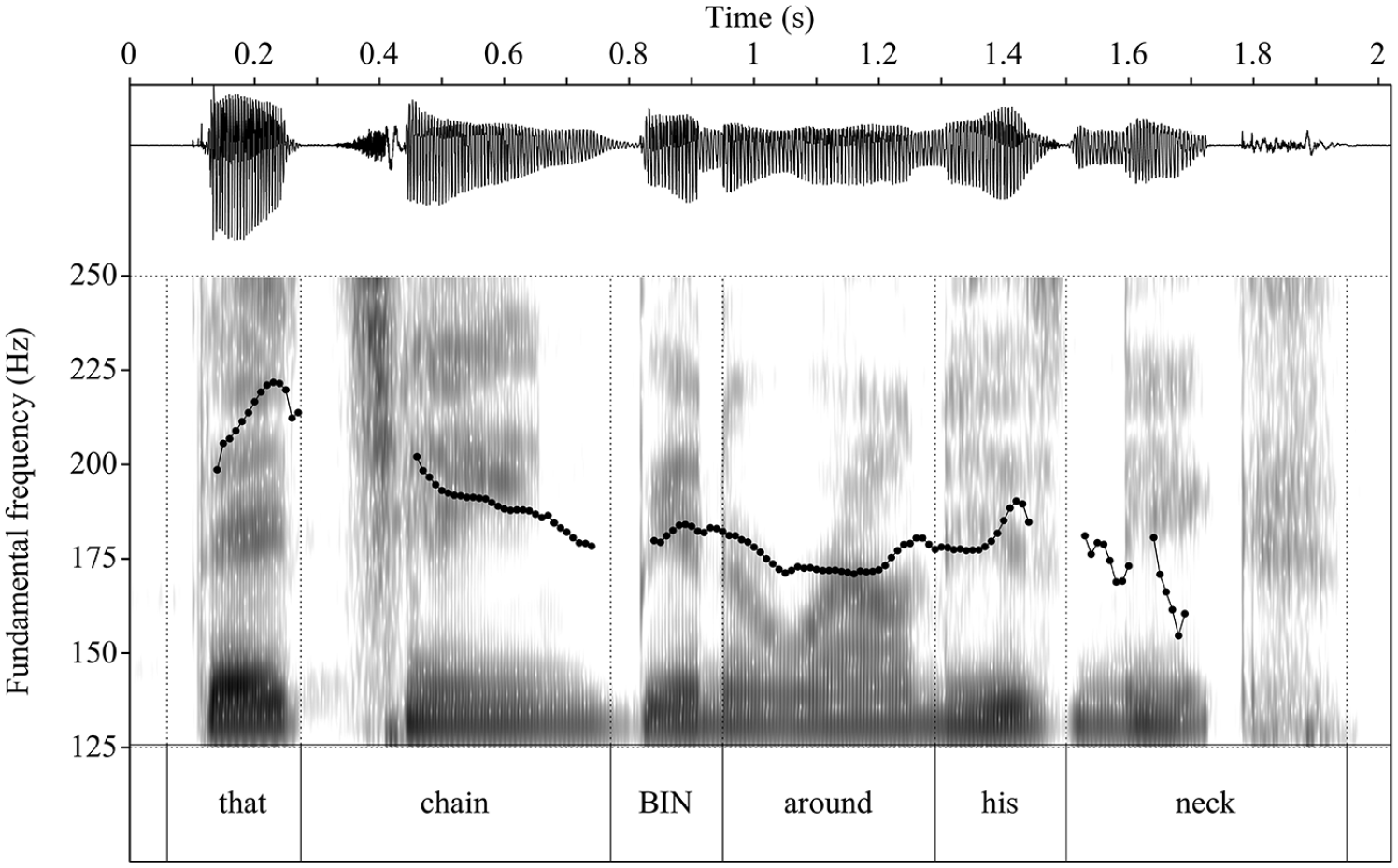
Representative F0 contour of perceived BIN in around his neck PP item in BINSTATE-CONT environment from Speaker la08. While it isn’t clear that there is an F0 peak on BIN, there is a prosodic juncture immediately preceding BIN, as is evident from the preboundary lengthening on chain.
For comparison, Figure 16 shows another utterance from the same speaker (Speaker la08) where BIN/beenPPART is clearly immediately preceded by a prosodic juncture, just like in the Figure 15 utterance perceived as BIN. This utterance was perceived to be ambiguous between a BIN and a beenPPART utterance, rather than a BIN utterance, due to utterance-final intonational characteristics. Comparing the ambiguous percept in Figure 16 to the BIN percept in Figure 15, we find that one clear difference is that the ambiguous percept shows the same globally highest F0 peak at the end of the utterance that can be also be seen in the Figure 14 utterance that was perceived as beenPPART.
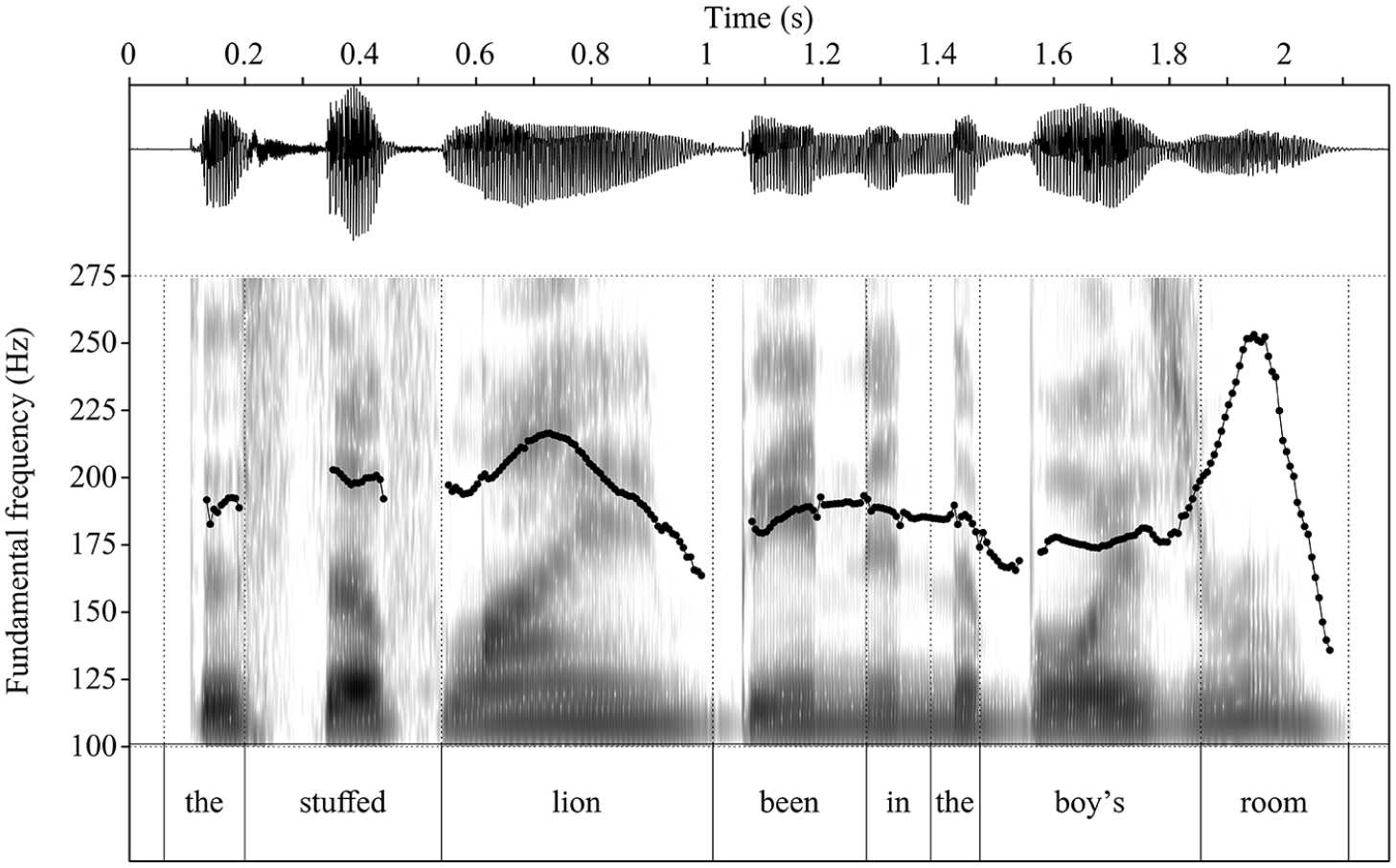
Representative F0 contour of an utterance perceived to be ambiguous between BIN and beenPPART in the in the boy’s room PP item in the beenPPART environment from Speaker la08. A prosodic juncture at the end of lion is visible in the lengthening of lion and fall to a low boundary tone. Although there is a small F0 peak on beenPPART, there is a much bigger one on utterance-final room.
Another exemplar of an utterance perceived as ambiguous between BIN and beenPPART is shown in Figure 17. This example is representative of a number of utterances which Green initially perceived as a BIN utterance but then reanalyzed toward a beenPPART due to prosodic properties in the adverbial phrase. This reanalysis toward beenPPART then allowed for a marginal rather than unacceptable rating, since otherwise we would have BIN and a long time adverbial together without an intervening pause. As in the ambiguous utterance in Figure 16, there is a high F0 peak in the post-BIN/been region. In Figure 17 it is on long, which also has a relatively long duration.
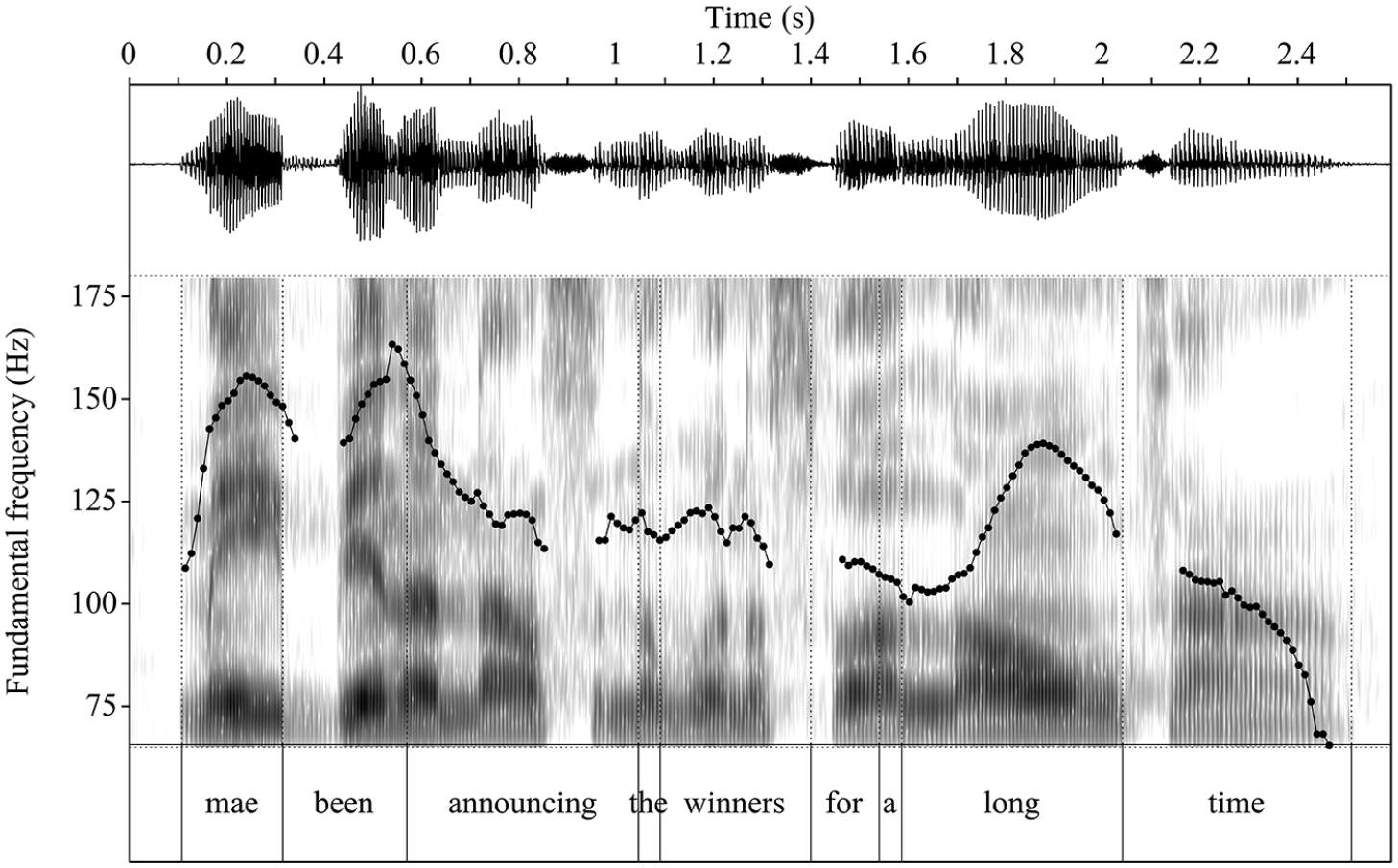
Representative F0 contour of an utterance perceived to be ambiguous between BIN and beenPPART and rated as marginal acceptable in the announce item in the been + long time adverbial environment from Speaker la07. Although there is a low F0 plateau after a high F0 peak on been, there is also a high F0 peak on long in the adverbial phrase.
A final representative utterance, also from the been + long time adverbial environment, is shown in Figure 18. Like the utterance in Figure 17, this one also was classified as ambiguous between BIN and beenPPART, but unlike that one, this one was rated with a “good” acceptability rating. Of particular note in this example is the presence of a prosodic juncture between flowers and the adverbial phrase, realized via preboundary lengthening in flowers and also an F0 reset at the beginning of the adverbial phrase, that is, the downtrend in the F0 contour at the end of flowers is broken to start the adverbial phrase (some of the F0 raising is due to perturbation from the preceding voiceless fricatives, but not all). This kind of prosodic juncture—potentially smaller than one with a silent pause, which would typically be considered an IntP juncture—was present in a number of the ambiguous been + long time adverbial cases that were acceptable. This example also shows an utterance-final rising boundary tone.
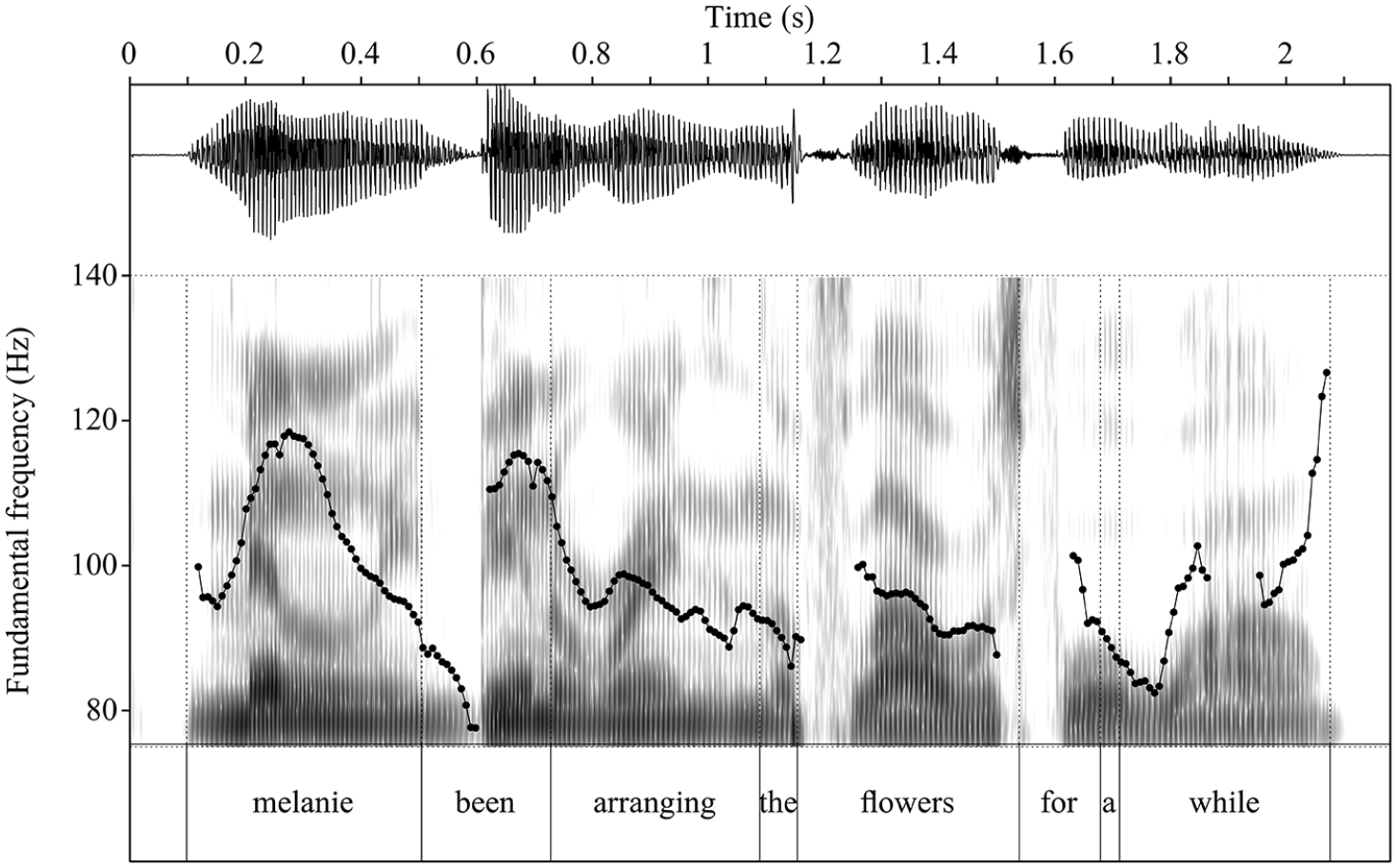
Representative F0 contour of an utterance perceived to be ambiguous between BIN and beenPPART and rated as “good” in the arrange item in the been + long time adverbial environment from Speaker la06. There is a prosodic juncture between flowers and the adverbial phrase, but one smaller than one with a pause.
3.3 Discussion
Overall, results indicated that the production task was successful in eliciting AAE structures, and in particular, BIN constructions. Excluding Speaker la01, speakers had no trouble producing the fillers with AAE structures. Regression models indicated that environments designed to elicit BIN were 8.2 times more likely to elicit utterances perceived as BIN than beenPPART. Within BIN environments for verbal predicates, speakers were 10.8 times more likely to produce utterances perceived as BIN in the obligatory BIN + modal and BINCOMPLETE environments than in the BINSTATE environments. However, the SWLAT productions showed an overall bias for BIN utterances, even in environments designed to elicit beenPPART utterances (41.1% perceived BINs), and the high proportion of perceived beenPPART utterances in the BINSTATE environments (11.7% in BINSTATE-HAB, 20.5% in BINSTATE-CONT) was also unexpected. These mismatches between the environments and resulting productions can be in large part traced to pragmatic factors and highlight the importance of pragmatic factors beyond the semantic context in BIN usage and comprehension. These pragmatic factors are discussed later in this section and also more extensively in Neal et al. (2020).
The SWLAT productions also provided further information on the realization of BIN utterances, building on what we learned from CORAAL. First, it became clear that the cues in the speech signal relevant for identifying a BIN utterance are distributed over the entire utterance rather than localized to BIN/been. BIN utterances were found to be distinguished from beenPPART utterances by having higher ratios of F0, intensity, and duration in BIN/been to the immediately preceding word, immediately following word, and entire span of the post-BIN/been stretch after the immediately following word. The duration and intensity results show the same pattern as those in Beyer et al. (2015), which did not analyze F0. Ambiguity between BIN and beenPPART classifications was also associated in many cases with prosodic properties in the post-BIN/been region: an utterance that was classified as BIN up through the pronunciation of BIN/been could be reanalyzed as a beenPPART utterance if a large F0 peak was present in the post-BIN/been region near the end of the utterance.
Besides drawing attention to the importance of the post-BIN/been region, the SWLAT data also expanded beyond what we learned from the CORAAL by elucidating the role of prosodic junctures in BIN utterances. SWLAT results suggested that the presence of a prosodic juncture immediately preceding BIN might contribute to the percept of a BIN, presumably as another way to increase the relative prominence of BIN besides manipulating the height of the F0 peak on BIN. Inserting prosodic junctures as a way to make something prominent within its prosodic domain is common cross-linguistically (Büring, 2010). SWLAT results for been + long time adverbial constructions also suggested a more nuanced view on the unacceptability of BIN co-occurring with a long time adverbial without an intervening pause indicative of a large prosodic boundary, that is, the edge of an intonational phrase. Smaller prosodic junctures such as phonological or intermediate phrase boundaries might also lead to acceptability, and these may be correlated with other cues than durational ones, such as F0 reset. Perhaps smaller junctures of this kind were present in Dayton’s (1996) examples that she reported as having no pauses.
The SWLAT data also built on the CORAAL data by allowing us to begin to get a sense of the range of variability in BIN productions. While a full characterization of the variability will require phonological analysis of the utterances that is beyond the scope of this paper, acoustic results already suggest that the relative F0 peak height on BIN to F0 of surrounding material can vary gradiently (Figure 12). Prosodic renditions of BIN constructions ranged within and across speakers from ones with steep F0 rises followed by an extremely reduced F0 range, more like the two F0 tracks shown in Weldon (2019), to ones like Figure 3 from CORAAL, where F0 height was similar between BIN and in the immediately following word. What may underlie prosodic variability like this in BIN renditions awaits further research. For instance, the pattern of an utterance-initial high F0 before dropping into a lower F0 range in BIN and following material observed in Weldon (2019) and some CORAAL examples such as Figure 1 was not a pattern characteristic of the SWLAT BIN data. Further work would be needed to disentangle if the absence of this utterance-initial high F0 pattern in the SWLAT data was due to an absence of pronoun-initial sentences in the stimuli, an absence of the relevant pragmatic factors associated with the F0 pattern, and/or task effects.
Beyond the characterization of the realization of BIN utterances, perhaps the most striking lesson we learned from the SWLAT results—via the large proportion of mismatches between BIN/beenPPART environments and the elicited BIN/been type perceived—was the importance of pragmatic factors in influencing BIN versus beenPPART readings in the speakers, as well as the listener. The subset of mismatches that were coded as “accommodated” draw attention to two kinds of pragmatic issues: (i) the difficulty of crafting short, contrived scenarios that make a long time context completely unmistakable to the speaker, and (ii) even if the long time context is unmistakable, inherent variability in BIN versus beenPPART usage due to the speaker’s choice of whether or not to make the long time period explicit. The first type of issue could be addressed in revisions of the stimuli and a task re-design to provide richer contexts. The second type of issue raises questions about what factors might contribute to whether or not a speaker chooses to make the long time period explicit. Finally, some proportion of the mismatches undoubtedly was related to experimental task issues. The overall bias toward BIN productions may have been due in part to the high proportion of BIN environments among the experimental stimuli, relative to the non-BIN environments and fillers. While we kept the total number of items limited in this first pilot study to keep the experiment short, we would want to include more fillers in future studies.
4 General discussion and conclusion
Two characteristics of AAE that are often mentioned in general descriptions of the linguistic variety but not extremely well researched are its intonational patterns and tense/aspect properties. Following up on the call in Rickford (1975) to employ multiple methods in conducting research on constructions in spoken AAE that might not occur in data from interviews, we consulted corpus data and also elicitation tasks, yielding a wider data source and a study that can be replicated. These methods yielded data that provide insight into the phonology and semantics of AAE, and the contributions of the study go beyond descriptions of properties of AAE in those disparate areas and begin to provide information about the interplay between the two areas. In addition, a number of questions are also raised about the syntax of AAE and the structure of BIN constructions. For instance, given the restriction on the occurrence of adverbial modification of BIN, further research should address the issue of the structural placement of lexical items that are allowed to modify the verbs in BIN constructions but are prohibited from modifying BIN.
Since the first observations about the meaning and use of BIN, the presence versus absence of “stress” on the marker has been noted as indicating the meaning contrast with beenPPART. The findings from this study raise questions about this characterization given the overlap in the phonetic realizations of BIN and beenPPART—as well as the role that the rest of the utterance and the pragmatic context outside of the utterance play in the interpretation of BIN. In varieties of English with stress, only a syllable of a word that is stressed can bear an accent (see e.g., Gussenhoven, 2018). There were examples of pitch-accented BIN/been in both CORAAL and SWLAT that had acoustic realizations that could be perceived as BIN. Yet a number of these were interpreted as either ambiguous between a BIN or beenPPART—or as clearly a beenPPART when the semantic, pragmatic, and/or syntactic context ruled out a BIN interpretation. That is, both BIN and beenPPART can surface as being pitch accented. 9 The difference between BIN and beenPPART is not that one is always stressed and the other is never stressed, but rather that the contexts in which they are accented differ. There is a restricted set of contexts, such as focus contexts, under which beenPPART is accented. But, based on our study, it seems that in most syntactic, pragmatic, and semantic contexts for BIN, the marker is in general produced as accented with a high F0 peak and followed by a reduced pitch range, possibly deaccenting—although the tone that is associated to accented BIN and the implementation of the following downtrend may vary. The SWLAT data showed this general trend quantitatively and also that a high F0 peak in the post-BIN region shifts the interpretation of the utterance toward (and sometimes all the way to) a beenPPART utterance. Further work will be needed to determine if/how the intonation of BIN is distinct from the intonation of focused contexts for beenPPART. The CORAAL data showed one utterance interpreted as BIN which suggested that perhaps, while BIN is accented, what tone associates to BIN might not always be a high one. The discovery of such unexpected examples is a strength of the naturalistic and broad coverage of sociolinguistic interviews: they can result in contexts that give rise to uses and realizations of BIN that we have not yet conceived of and thus have not included in experimental designs.
There are a number of factors that should be addressed in future BIN experimental studies. Owing to the fact that AAE is predominantly a spoken variety and most of the data on it are based on interviews, there are not yet any established methods for using controlled reading tasks, such as the one discussed for the SWLAT participants. This method of elicitation is new, so a number of questions remain. The results from the SWLAT tasks confirmed that speakers certainly could produce BIN in different contexts that corresponded to the reported uses of the marker, but one question is about the naturalness of the data prompts designed to elicit BIN/been. One direction is to keep some of the control of the elicitation task and still precisely manipulate contexts to elicit different BIN/been types, but to enrich the contexts and reduce restrictions on what the speakers produce in those contexts, such as in a discourse completion task (Vanrell et al., 2018).
This study has also uncovered some possible areas of ambiguity in the perception and interpretation of BIN/been-types, so further investigation is needed not only in the perception of been/BIN tokens across varieties of AAE in the United States but also in sentence processing. In this research, we have shown that the entire BIN utterance—not just the “sound” of BIN/been itself—influences how the marker is understood, and psycholinguistic studies that provide insight on how speakers process different parts of the utterance leading to and following the BIN/been token would be useful. Studies that control the acoustic properties of the utterance and examine the effect of syntactic factors and discourse context on the interpretation of the utterance would also be useful to illuminate how non-“sound” factors play a role. Previous studies have shown that the prominence of the same acoustic stimulus is perceived differentially depending on discourse context, for example, Bishop (2012). Finally, the question about variable occurrence of BIN constructions and adverbs denoting the far past is underscored in this research. In addition to questions about the extent to which certain adverbial phrases are actually equal variants for BIN constructions, this paper shines light on factors, noted in Rickford (1975), such as the interview speech style, which might explain why some speakers choose to use beenPPART + long time adverbial in certain linguistic situations instead of the aspectual marker BIN. Phonological variation has been a common theme in the study of AAE; however, variable production of BIN has not been considered but certainly should be, given the different factors that might influence the perception of been/BIN. This topic remains unexplored from the angles of both intraspeaker variation and variation within speech communities and across regions.
Footnotes
Acknowledgements
We gratefully acknowledge our southwest Louisiana community speakers and our funding sources. We are also grateful for feedback and discussion from Meghan Armstrong-Abrami, Alejna Brugos, Seth Cable, Alessa Farinella, editors Cynthia Clopper and Holger Mitterer, guest associate editor Shelome Gooden, four anonymous reviewers, and audiences from ETAP4 and NWAV 49.
Funding
The author(s) disclosed receipt of the following financial support for the research, authorship, and/or publication of this article: This material is based upon work supported by the National Science Foundation under grant BCS-2042939, a UMass Amherst Faculty Research Grant/Healey Endowment Grant, a UMass Amherst Institute of Diversity Sciences Seed Grant, and the UMass Amherst Center for the Study of African American Language. Any opinions, findings, and conclusions or recommendations expressed in this material are those of the author(s) and do not necessarily reflect the views of the National Science Foundation (or other funding sources).
