




Abstract
In this article, we—three Asian MotherScholars in the field of language and literacy education—conducted a collaborative self-study to examine how our individual and shared experiences as transnational mothers of emergent bilinguals have shaped our ways of promoting bilingualism and biliteracy. Our study drew on transnational feminist perspectives and used multimodal data and narratives shared in an online inquiry group. We highlighted ways we leverage our strengths and make conscious efforts to navigate burdens rooted in monolingual ideologies and linguistic hegemony as we raise our bilingual children. We also found how inquiring collectively into our experiences has helped us cultivate critical consciousness and build transnational solidarity. Through our stories, we emphasized the urgency of challenging inequities and pervasive monolingual ideologies within U.S. schools, as well as the necessity of creating a space for immigrant mothers to inquire into their experiences and to support each other.
Keywords
Many children from immigrant households in the United States, who are exposed to languages other than English at home, eventually transition to speaking only English as they adapt to schools, where English is considered the normative language (Wong Fillmore, 2000). Language shift and language loss frequently occur among immigrant children, especially those with Asian heritage (Pew Research Center, 2012), despite the exhaustive efforts of immigrant parents to pass down their heritage language and culture at home (Kwon, 2017). When children of immigrants attend school and realize that English is prioritized and valued, they often struggle to recognize the value of maintaining their home language and eventually give up on it (Wong Fillmore, 2000). Consequently, immigrant parents encounter complex tensions and doubts when nurturing their children's bilingual potentials, further burdened by navigating monolingual ideologies and English hegemony (Choi, 2018; Kwon, 2022).
Immigrant motherscholars in the field of language and literacy education, who are expected to be knowledgeable about the benefits of bilingualism and biliteracy, also face significant frustrations and tensions when raising their children in the United States, particularly concerning bilingual learning. Several Asian motherscholars in the field have published papers that discuss their experiences in confronting the privileged status of English, the static and monolithic view of language, and deficit perspectives on multilingual learning in the United States (Kim et al., 2017). Mother scholars like Choi (2018) also have emphasized the burdens they face when defending their choice to use one language over another with their children. Existing research, though scant, has suggested that immigrant parents must recognize and validate the flexible and dynamic ways in which they and their children cross languages and cultures, regardless of their educational, linguistic, and cultural backgrounds (García & Wei, 2014).
In this article, we—three Asian teacher educators specializing in language and literacy education—report how we engaged in a collaborative self-study to explore our personal and shared experiences as transnational scholars and mothers of emergent bilinguals. We refer to ourselves as “MotherScholar” in this study, signifying that our identities as mothers and scholars are inseparable (Choi, 2024; Yu et al., 2022). We consider ourselves transnational MotherScholars, given the strong social connections we continually forge and maintain with our countries of origin (Skerrett, 2015). Our homelands (Korea and China) are far from where we reside in the United States (Michigan, Utah, and New York), yet they hold emotional significance to who we are. Despite our different linguistic and cultural backgrounds and migration histories, we have found common ground as mothers of U.S.-born children, teacher educators, and researchers who strive to elevate the voices of immigrant children and their families. In our roles, we have faced monolingual ideologies, linguistic racism, and racialized stereotypes in various settings (Jang, 2017), and we continue to see the harm caused by such perspectives to emergent bilinguals and their families (De Costa, 2020). As first-generation immigrant mothers, determined to pass down our heritage language and culture to our children (ages 2–5), we recognize the importance of examining our own experiences and providing narratives that challenge monolingual ideologies and deficit perspectives on emergent bilinguals (Flores & Rosa, 2015).
We refer to our children as “emergent bilinguals” (García, 2009), a term that underscores our strength-based perspective on bilingualism. The term highlights that being able to speak multiple languages is a strength rather than a deficit and emphasizes language learning as a dynamic continuum of growth and navigation rather than a fixed state (García, 2009). By using the term, we intentionally counter viewpoints that have focused on the limitations of bilingual children, often implied by terms such as “limited English proficiency” students, which bear negative connotations or stigmas linked to challenges and difficulties. As our children continue their bilingual and biliterate journey both within and beyond their home environments, we strive to emphasize the potential benefits of bilingualism.
In this paper, we employ transnational feminist perspectives (Enns et al., 2020) and adopt a collaborative self-study approach (Bullock & Ritter, 2011) to examine the following questions: (a) What have we, as transnational MotherScholars, experienced, and what do we continue to encounter as we raise emergent bilinguals? (b) How have our experiences as transnational MotherScholars shaped our ways of promoting bilingualism and biliteracy? (c) What emerges when transnational MotherScholars engage in collaborative self-reflection? The language and literacy experiences and perspectives of Asian and Asian American and Pacific Islanders (AAPI) are often absent from or invisible in academic discourse due to the model minority myth and perpetual foreigner stereotype (Jang, 2017; Kim, 2020). As Zhu (2020) noted, “immigrant mothers’ ways of learning, mothering, and knowing have been overlooked” (p. 378), and little attention has been given to the experiences of MotherScholars in education (Lapayese, 2012) and teacher educators with Asian heritage (Kim et al., 2017). Thus, reflecting on our experiences as Asian immigrant mothers raising emergent bilinguals becomes vital. We have aimed to amplify the often-unheard voices of Asian MotherScholars, and we hope that this study will enrich the limited existing literature on how immigrant mothers support their emergent bilingual children.
Transnational Feminist Perspectives
Our study was framed by transnational feminist perspectives (Enns et al., 2020) that focus on the voices of women who “live within, between, and at the margins or boundaries of nation-states around the globe” (p. 1). These perspectives enabled us to examine our experiences as mothers and teacher educators who transcend linguistic, cultural, and geographic borders. They also inspired us to consider how our voices and experiences, which are often silenced and marginalized, may contribute valuable insights to the dialogs concerning teacher education, language and literacy education, and diaspora.
Transnational feminist perspectives challenged us to think beyond geographic and national boundaries, directing our focus to our experiences of crossing borders and the multifaceted connections we maintain with our homelands (Lam & Warriner, 2012). These included linguistic, cultural, and physical border-crossing experiences that we, as immigrant MotherScholars, encounter in our everyday lives, as well as the specific beliefs, knowledge, and practices that arise from them. We view ourselves as multilingual agents: We draw on expansive linguistic repertoires in every interaction with others, and we are committed to passing down our heritage language and culture to our children and supporting them as they cultivate their bilingual potentials. Transnational feminist perspectives also guided us to share our experiences and advocate for multilingualism-as-a-resource orientation (de Jong et al., 2019) in our practices as teacher educators. Our language ideologies, transnational connections and affiliations, and advocacy have helped us challenge the Westernized concept of feminism and the monolithic, taken-for-granted view of being. Our identities as Asian transnational mothers have added complex layers to our experiences as MotherScholars of emergent bilinguals. The stories that we have shared can inform theory and practices, ultimately challenging dominant White and Eurocentric epistemologies (Iftikar & Museus, 2018; Nuñez, 2021), and offer transformative and meaningful implications for language and literacy education.
Self-reflexivity has been emphasized as a critical practice among scholars who embrace transnational feminist perspectives. We believe in Yoon and Llerena's (2020) assertion about the power of “opening up our experiences, relating to one another's struggles, and constructing a coalition around shared visions” (p. 874). Collaboratively engaging in self-reflexivity, we shared a reflexive account of our assumptions, views, literacy practices, and experiences. This allowed us to examine and deconstruct the dominant monolingual, White discourses that influence our language and literacy practices with and for our children. Through self-reflexivity, we revisited our experiences and reconsidered our roles and practices to produce insights that enhance our practices as teacher educators. As we engaged in collaborative self-reflexivity, we paid attention to intersectionality (Enns et al., 2020), as our multiple identities intersect and inform each other. For instance, our positions as MotherScholars and teacher educators cannot be separated; we bring a unique lens shaped by our intersecting experience as mothers of emergent bilinguals and Asian immigrant MotherScholar to the courses we teach and the interactions we have with teacher candidates. What we observe and hear in schools and teacher preparation programs also impacts our mothering practices and inspires us to support children and families from diverse backgrounds through research and teaching.
Building solidarity and fostering collaborative partnerships among transnational women are important tenets of transnational feminist perspectives. For instance, in Meacham et al. (2021), four transnational Asian female teacher educators engaged in discussions and collaborative reflections on their transnational identities, which led them to move beyond “dominant, White middle-class norms” and produce “counter discourses to recognize different ways of living, knowing, and doing early childhood education.” Similarly, the current paper has arisen from our shared belief that researchers and teacher educators should reflect on how their “social identities and cultural affiliations may influence their understandings or biases” (Enns et al., 2020).
The Voices of Asian MotherScholars
Enns et al. (2020) proposed that exploring the experiences of marginalized women could unveil opportunities to address complex issues, especially in today's context characterized by growing diversity, mobility, and fluidity. The narratives of Asian MotherScholars, for example, offer invaluable insights and knowledge for reshaping practices in K-12 and teacher education (Lapayese, 2012). However, existing research has often overlooked the voices of Asian mothers, scholars, and educators in the field of language and literacy education (Kim, 2020).
Asian immigrant mothers have been frequently characterized as possessing high levels of collectivism, humility, and emotional self-control (Wong et al., 2012), while their ideas of mothering were treated as “different, incorrect, and uncivilized” in the United States (Zhu, 2020, p. 382). Racialization has further pressured Asian MotherScholars to conform to female stereotypes and maintain high achievement. In reality, however, they often encounter situations where their linguistic, cultural, and experimental knowledge are disregarded and silenced. Furthermore, those with emergent bilingual children confront challenges posed by monolingual ideologies and deficit views of immigrants and bilingual individuals. Thus, understanding the interplay of multiple forms of oppression among Asian Americans is crucial (Hsieh et al., 2022; Iftikar & Museus, 2018; Kim et al., 2023).
To challenge dominant narratives and create counterstories about Asian and Asian American experiences, MotherScholars with Asian heritage in the field of education have documented their experiences as mothers and teacher educators using self-study and by employing the parent-as-researcher approach, individually and/or collaboratively. For example, MotherScholars have contributed to expanding researchers’ and teachers’ understanding of immigrant mothers’ and children's experiences across various subfields of education, including early childhood education (Kim et al., 2017; Kim et al., 2021; Meacham et al., 2021), special education (Kim, 2017), and social studies education (An, 2020). These MotherScholars’ narratives and lived experiences have served to counter the single narrative about Asian mothers while expanding the dialogs around immigrant children, families, and educators (Hsieh et al., 2020). In addition, when MotherScholars share their diverse stories and experiences, they “dismantle sharp binaries—namely, the sharp divide between the intellect and the maternal, the public and the private” (Lapayese, 2012, p.17). Our study is uniquely situated within the body of literature on Asian MotherScholars (Yeh et al., 2022) as we addressed our experiences in fostering young children's bilingualism and biliteracy amidst hegemonic monolingual ideologies using online inquiry groups.
Mothers and Teacher Educators Raising Emergent Bilinguals with Asian Heritage
In the field of language and literacy education, there is a small body of literature on the voices and experiences of teacher educators raising emergent bilinguals, particularly those of Asian heritage. (Kabuto, 2011). In an article by Choi (2018), the author, a teacher educator whose children speak Korean, Farsi, and English at home, recounted her experience raising a trilingual child in the United States and revealed that her efforts to support her child's home language and literacy learning were often portrayed as confusing her child and neglecting the importance of mastering English in U.S. society and schools, where English is privileged as a medium of instruction. Choi (2018) further acknowledged that, despite being a language and literacy educator and researcher, she frequently confronted situations in which she had to defend her language decisions against the privileged and powerful status of English (Pennycook, 1998). In Kim et al.'s (2017) article, three Korean immigrant MotherScholars reflected on their struggles in raising their children bilingually. Despite understanding the benefits of heritage language maintenance and striving to foster their children's Korean language learning, they encountered doubts and challenges stemming from dominant discourses that perceive immigrant children and families as deficient.
Though research on Asian immigrant MotherScholars of emergent bilinguals is scant, there is a substantial body of work on Asian immigrant parents’ beliefs, attitudes, and practices to support their children's heritage language and English learning (e.g. Kwon, 2017; Song, 2016). Many of these studies have described the various strategies that parents employ to help their children maintain the language spoken at home. These efforts included enrolling children in heritage language schools (Brown, 2011), implementing mother tongue-only policies at home (Kang, 2015), utilizing transnational literacy resources such as ethnic media (Kwon, 2017), and holding strong commitments for their children to develop heritage language and literacy skills (Hashimoto & Lee, 2011). However, the pervasive monolingual ideologies within U.S. schools (Song, 2019) make it challenging for immigrant parents to sustain these efforts. The challenges become even more pronounced if parents reside in regions with few heritage language programs and resources or if children lose interest in or resist learning the heritage language (Hsieh et al., 2020; Kwon, 2022).
Methods
The Three Transnational MotherScholars of Emergent Bilinguals
This study examined the experiences of three transnational MotherScholars raising emergent bilinguals in different parts of the United States. Although we have known each other since our graduate school days and share similar roles and responsibilities as mothers, researchers, and teacher educators in the field of language and literacy education, each of us brings unique transnational and multilingual experiences to the study. Jungmin is a Korean-English bilingual from Korea, and her U.S.-born daughter, Saebyeol, was 3-year-old at the time of data collection. Her family resides in a college town with a predominantly White population in Michigan. Wenyang is a Mandarin Chinese-English bilingual from China, and a mother of a 2-year-old U.S-born daughter, Keke. They live in a suburban town Utah, part of a metropolitan area that is predominantly White with a growing population of immigrants. Minhye, who speaks Korean and English and is originally from Korea, resides in a community with a high population of Asian Americans in New York. She has two U.S.-born children: Boxy, a 5-year-old son, and Diana, a 3-year-old daughter. While the authors’ real names are used in this paper, the children have chosen pseudonyms for themselves, which serve as a safeguard to protect their privacy.
We came to this study with the belief that our stories and experiences, deeply rooted in transnational identities, can serve as “a source of knowledge that can lead to more accurate understandings about our shared world” (Ghiso & Burdick-Shepherd, 2020, p. 16). However, we recognized that these narratives come from our privileged positions as documented and employed female Asian academics. While we believe that our stories contribute to the field of language and literacy education, a field in which the voices of AAPI women are seldom represented (Kim, 2020), we emphasized that further attention should be given to Asian American mothers outside of higher education and their children, whose voices are historically and continually marginalized and silenced. We hope this paper will invite other AAPI mothers to explore their own experiences and provide counternarratives.
Data Collection
Online Mother Inquiry Group
We began our study by reflecting individually on the moments and experiences that have shaped us as transnationals, MotherScholars, and teacher educators. After writing our individual narratives, we read one another's narratives and formed an inquiry group to further explore our MotherScholar experiences. Taking inquiry as our stance (Cochran-Smith & Lytle, 2009), we created an inquiry group on Slack (Lee et al., 2021), a widely used online collaborative software programs. Using Slack, we shared photographs, reflection journals, related literature, short personal memos, voice recordings, and video recordings of child–parent interaction during play. Engaging in the Slack channel helped us to create a repository of experiences and resources, recall our memories connected to the artifacts, and collectively view and inquire into each other's experiences. For a year, each author uploaded about 30 posts and comments (104 in total), in addition to written narratives. These posts included data sources, such as videos (e.g. recordings of the researcher–child interactions), photographs (e.g. children's artwork and books), and written texts (e.g. our questions and thoughts). As each author posted their artifacts to the group, we all contributed notes about what we observed and experienced and how we felt about the moments captured in the artifacts.
As suggested by Pahl and Roswell (2010), we believe that collecting and examining objects that we interact with in our everyday lives inspires us to share our stories, identities, and cultures. For example, the children's books in our homes, written in English, Mandarin Chinese, and/or Korean, encapsulated our connections with people (e.g. families and friends who sent and lent books to us); experiences (e.g. the different ways we read stories to our children); and represent countless thoughts we have put into them (e.g. what kinds of books to choose and in what language to read them aloud). These books, along with other objects in our homes like toys, letters, and recipes, were invaluable as they told and retold our stories and helped us create space to reflect on our experiences as mothers.
Informal Dialogs
Over the course of the study, we held eight informal meetings via Zoom, during which we discussed our experiences. Each meeting lasted between 90 and 120 minutes, and the recordings of our dialog and our notes from the meetings served as key data sources. Our conversations were often guided by the artifacts that we posted in our Slack group, but in most cases, the conversations “shifted organically with the goal of simply being there for each other” (Yu et al., 2022, p. 4). As the majority of these online meetings and conversations took place during the pandemic and amidst weeks of unexpected school closures, many of our conversations were interrupted and invigorated by our children, who remained at home. These moments served as reminders that our roles as teacher educators and researchers cannot be separated from our roles and responsibilities as mothers. As Lapayese (2012) argued, these moments, when the boundary between home and work blurred, fostered “creative synergy” among us. By collaboratively sharing and making sense of our experiences, we identified recurring patterns shared across our stories while creating a space to share counterstories (Delgado & Stefancic, 2017). In our shared space, we developed and shared commitment to increasing the visibility of unnoticed stories and experiences.
Data Analysis
After collecting and organizing data, we engaged in initial open coding, wherein we applied a set of codes to our data, guided by the three research questions and existing research on emergent bilinguals. Descriptive codes (e.g. “dominant ideologies” and “utilizing linguistic repertoire”), in vivo codes (e.g. “burdens” and “It becomes a problem at school”), and process codes (e.g. “heritage language learning”) were used. In the second round of analysis, we viewed the data through the lens of transnational feminist perspectives and assigned codes such as “solidarity,” “collective inquiry,” and “creating counterstories.” We then grouped the codes into categories, collectively reviewing them and revisiting the various sources of data (e.g. written narratives, videos, and artifacts) (Merriam & Tisdell, 2016). Among the different themes we identified, we chose to highlight the three findings that best addressed our research questions. Analyzing the data and discussing the findings allowed us to continue exploring our own experiences, build on each other's perspectives, and share counterstories. The process helped us recall memories and identify additional artifacts that supported the key themes. In other words, our data analysis was a circular, dynamic, and dialogic process, and our strengths as transnational MotherScholars became more visible through the process.
Findings
This study unveiled our diverse strengths and connections to multiple languages, cultures, and countries that positively shaped our children's bilingualism and biliteracy. However, we also uncovered the doubled burdens of navigating systems, resources, and expectations across the various contexts and countries to which we belong. In this section, we have detailed our daily efforts to cultivate bilingualism and biliteracy in our children, along with the challenges we face. Additionally, we have discussed how fostering community and solidarity among us helps us in navigating these difficulties. This study provided insights into the daily experiences of transnational mothers and underscored the necessity of advocating for multilingualism in partnership with emergent bilinguals and their families.
Leveraging Strengths and Making Conscious and Deliberate Efforts
Throughout our collaborative self-study, we often reflected on our experiences and ongoing challenges as transnational MotherScholars raising emergent bilingual children. Our dialogs were often initiated by the artifacts we posted in our Slack group, which showcased the various language and literacy practices we engage in at home. By collectively examining these artifacts and sharing our stories, we explored how our own transnational experiences and linguistic strengths shape our mothering, as well as our language and literacy practices, and the ways in which these practices influence our children.
Transnational Mothers Passing Down Mother Tongues
One of the salient and recurring themes we identified was our constant, deliberate, and explicit efforts to pass down our mother tongues—Korean for Jungmin and Minhye and Chinese for Wenyang—to our children at home. We use only our mother tongues at home intentionally, and having spouses who speak the same language and share similar language ideologies regarding home language use facilitated the implementation of family language policies (King et al., 2008) for all three authors. We communicate consciously and frequently to our children about the importance of cultivating their multilingual potentials. We manifest these beliefs through various strategies, such as reading books aloud in English and Korean (Jungmin and Minhye); reciting nursery rhymes in Chinese and English (Wenyang); and intentionally responding to our children in our mother tongues (all authors). Our family language policies align with existing studies on the experiences of first-generation Asian immigrant parents and how they leverage their multilingual assets in teaching their children (Kwon, 2020; Song, 2016).
The strong beliefs we hold towards raising our children to be bilingual and teaching heritage languages at home stem from our concerns, fears, and anxieties about language loss and shifts toward monolingualism. In our informal dialogs, we often discussed our fear that our children might lose their heritage languages one day, which might deteriorate their connections with our home countries, as well as with the people, histories, cultures, and stories connected to them. We found that some of these fears are based on what we, as researchers, have observed and heard from linguistically and culturally minoritized children and families in the United States and our home countries.
As we reflected on our language beliefs and practices, we were drawn to our past and ongoing experiences as transnationals who cross languages, cultures, and countries. For instance, when Wenyang shared her commitment to teaching Mandarin Chinese to her 2-year-old, she linked it with her own childhood experience in China, where she was judged and excluded for her use of Zibo dialect of Chinese. As she recounted this, she expressed her hope that her child would not encounter similar experiences; instead, she wants her child to embrace all the different linguistic resources that her family holds. After further reflection on being linguistically minoritized in China and the United States, Wenyang noted, “I want her to know the beauty of her home language, to communicate with her parents and grandparents in a language we all cherish, and to be proud of her cultural heritage.” Jungmin and Minhye who are originally from Korea reflected on their mobile childhoods and articulated that maintaining bilingual assets is essential for their children's identity and learning.
More Than Home Artifacts: Sustaining Transnational Connections
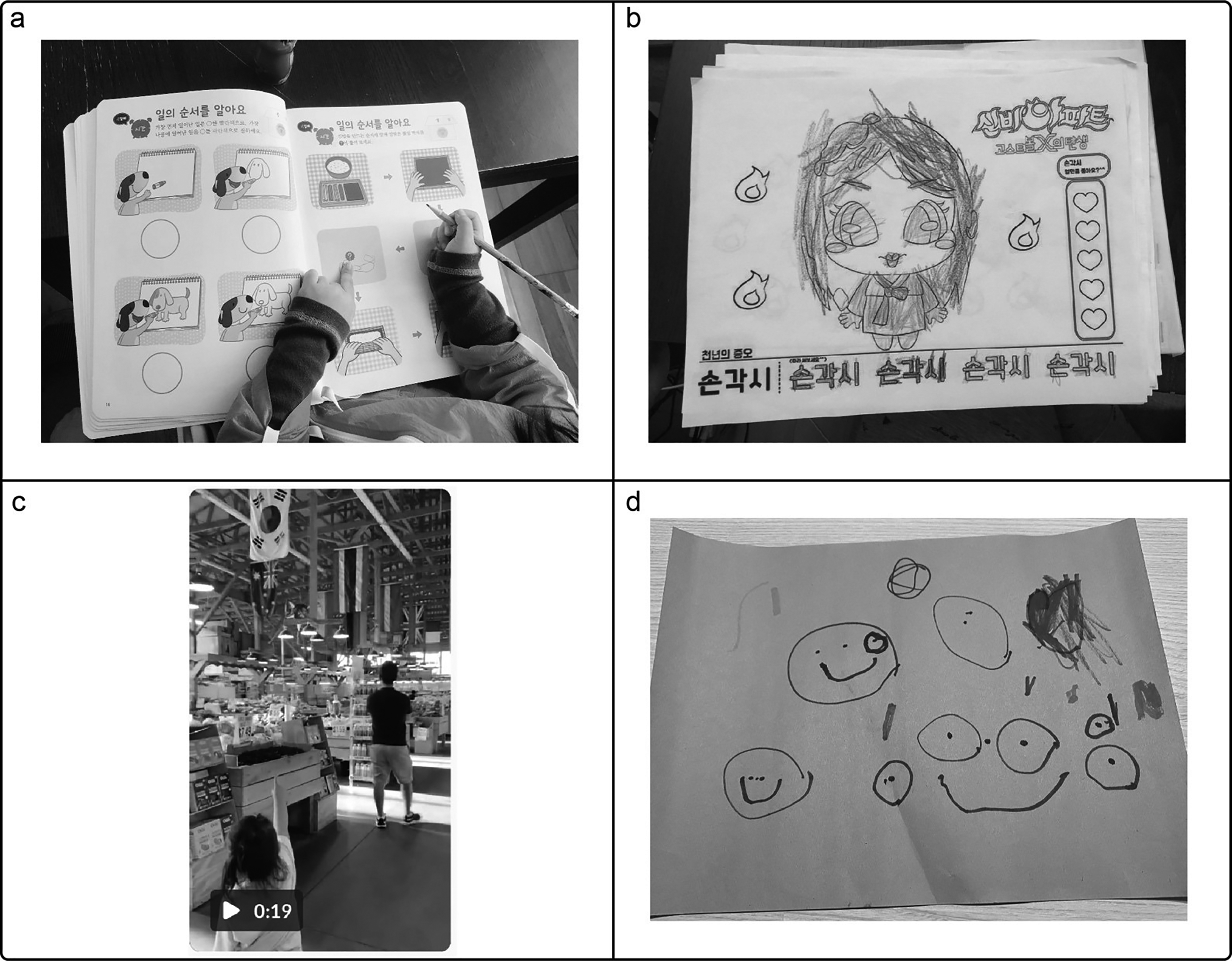
Our belief in and dedication to maintaining heritage languages led us to create home environments that foster our children's heritage language and literacy learning. Most of the photographs and videos we uploaded to Slack showcased an array of literacy materials written in our mother tongues, along with our children's interaction with children's books, writing materials, and cartoons at home (Figure 1a). Engaging in a collaborative self-study, we discovered that these materials and other home artifacts played a crucial role in sustaining transnational connections and fostering heritage language and literacy learning. Yet, we had never previously considered these items as “resources” or “literacy materials.”
Children's home and community literacy practices.
Furthermore, our children's home language and literacy practices revealed the transnational connections and attachments that both we and our children maintain. For instance, Minhye's children, Boxy and Diana, communicate with their grandparents weekly via Kakao Voice Talk (a mobile messaging application widely used in Korea) and send photographs and video recordings regularly. The grandparents occasionally send packages containing children's clothes, toys, and Korean food that may be hard to find in the United States. On one occasion, the grandparents sent Diana a jacket that depicted a cartoon character from a Korean animation. This sparked Boxy and Diana's interest in the character, which motivated them to watch the cartoon and find online literacy worksheets written in Korean related to the show (Figure 1b). In other words, their home language and literacy practices, influenced by popular culture and multimedia content in Korea as well as the children's transnational connections, are simply part of their everyday routines.
Similarly, Wenyang noted that even at the age of two, Keke communicates with her grandparents in China on a weekly basis via WeChat audio chats, which serve as a mediator for cross-border communication. Wenyang even created a poster with photos and Chinese characters representing paternal and maternal grandparents for her child to take to daycare. Later, she noticed Keke pointing at those pictures and pronouncing the names in Chinese, although her child had not yet begun to speak conversationally. These weekly interactions with grandparents, including listening to them speaking Chinese and observing cultural rituals and artifacts, helped the child learn their heritage language and culture even before conversational speech had developed.
During the data collection year, Jungmin visited her home country with her 3-year-old daughter, Saebyeol. Many conversations with her daughter before and after the trip revolved around Korea, the people (e.g. grandparents living in Korea), and the places that she or her daughter felt attached to. After the trip, Saebyeol began more frequent cross-border communication with her relatives and grandparents. During the virtual calls, she crossed languages and discussed places she wanted to visit. Jungmin also observed that when she intentionally introduced different aspects of her culture, Saebyeol quickly picked up on them and shared them, such as pointing at a Korean flag at a market (Figure 1c).
Jungmin also noticed that after visiting Korea, Saebyeol began drawing pictures of extended family members she had met in Korea and integrating them into various multimodal compositions at her preschool. She titled the drawing shown in Figure 1d “Family.” As she narrated the drawing, she explained that she included her grandparents, who live in Korea, in the picture and shared a special moment she enjoyed with her grandmother during the transnational visit. She realized that Saebyeol had also talked about her experience visiting Korea at her preschool, as the teachers mentioned that the drawing “has grandparents in Korea.” Additionally, Jungmin observed that her child began to ask questions or make comments about her extended family in Korea more frequently, even discuss plans for future visits. On one occasion, upon spotting an airplane in the sky, she pointed to it and exclaimed, “엄마, 우리 비행기타고 할머니 보러 갈까?” [Mom, shall we take a flight to see grandmother?”]. These three different cases illustrated how our deliberate efforts to foster transnational connections influence our children's transnational ways of being, knowing, and belonging (Compton-Lilly et al., 2009). As a result, the children learn, draw, and write about their parental homelands, and they imagine themselves in those countries and initiate conversations about the family living there.
Navigating Doubled Burdens and Institutions Rooted in Monolingual Ideologies and English Hegemony
Existing studies on Korean and Chinese immigrant mothers have highlighted the struggles they face in supporting their children's learning and involvement in American schools (Kwon, 2017). Frequently, attention is given to their limited proficiency in English, lack of understanding of the US school systems, or a dearth of skills and information to effectively collaborate with teachers (Sohn & Wang, 2006). However, through this study, we sought to shift that attention towards institutional failure to provide adequate support for immigrant mothers and their emergent bilingual children. During our yearlong study, we discovered that many of our burdens stemmed from having to navigate systems rooted in monolingual ideologies and English hegemony.
Monolingual Ideologies and English Hegemony
As MotherScholars, we are deeply concerned that our children might lose their heritage language and transnational connections, a fear further intensified by prevailing monolingual ideologies and the dominance of English. We are well aware of the numerous benefits that bilingualism and biliteracy can have on children from immigrant households (García & Wei, 2014), and have witnessed these benefits through our own research (Kwon, 2022). However, we also feel an overwhelming burden to foster our children's bilingual potentials, given limited institutional support, such as the scarcity of bilingual books in schools and libraries. We also have struggled to navigate the complex landscape of raising bilingual children amidst the prevailing deficit ideologies on emergent bilinguals and immigrants that permeate U.S. schools and society. As we engaged in conversations about the discrepancies between what we know about bilingualism and how we feel about raising emergent bilinguals, we agreed that “life is more than academic literature,” and that it was important to take a closer look at what immigrant mothers experience in their everyday lives.
The careful examination of our experiences revealed that the beliefs and practices we hold toward supporting emergent bilinguals have been constantly challenged by the dominant monolingual ideologies and prevalent deficit views that continue to marginalize children who speak languages other than English at home. During our study, we shared many examples related to this point, including ones that affected our views in significant ways. Jungmin, for example, recounted how her daughter's childcare teacher actively encouraged her to use English at home and recommended that she take the child to a doctor to ask if her use of Korean at home was causing a language delay. Although this interaction did not stop her from speaking Korean at home, we know that such messages, particularly from schools and teachers, cause many parents with vast linguistic knowledge to avoid using their multilingual resources. After experiencing that moment, in which her child's use of Korean at home and limited fluency in English were viewed as deficits that needed to be remedied, Jungmin sought information in an online community of Korean immigrant mothers in the United States. Reflecting on her experience, She said, “I wanted to know what other immigrant mothers actually do rather than what all this literature says about heritage language learning.” As Wenyang stated, “Life is more than academic literature.”
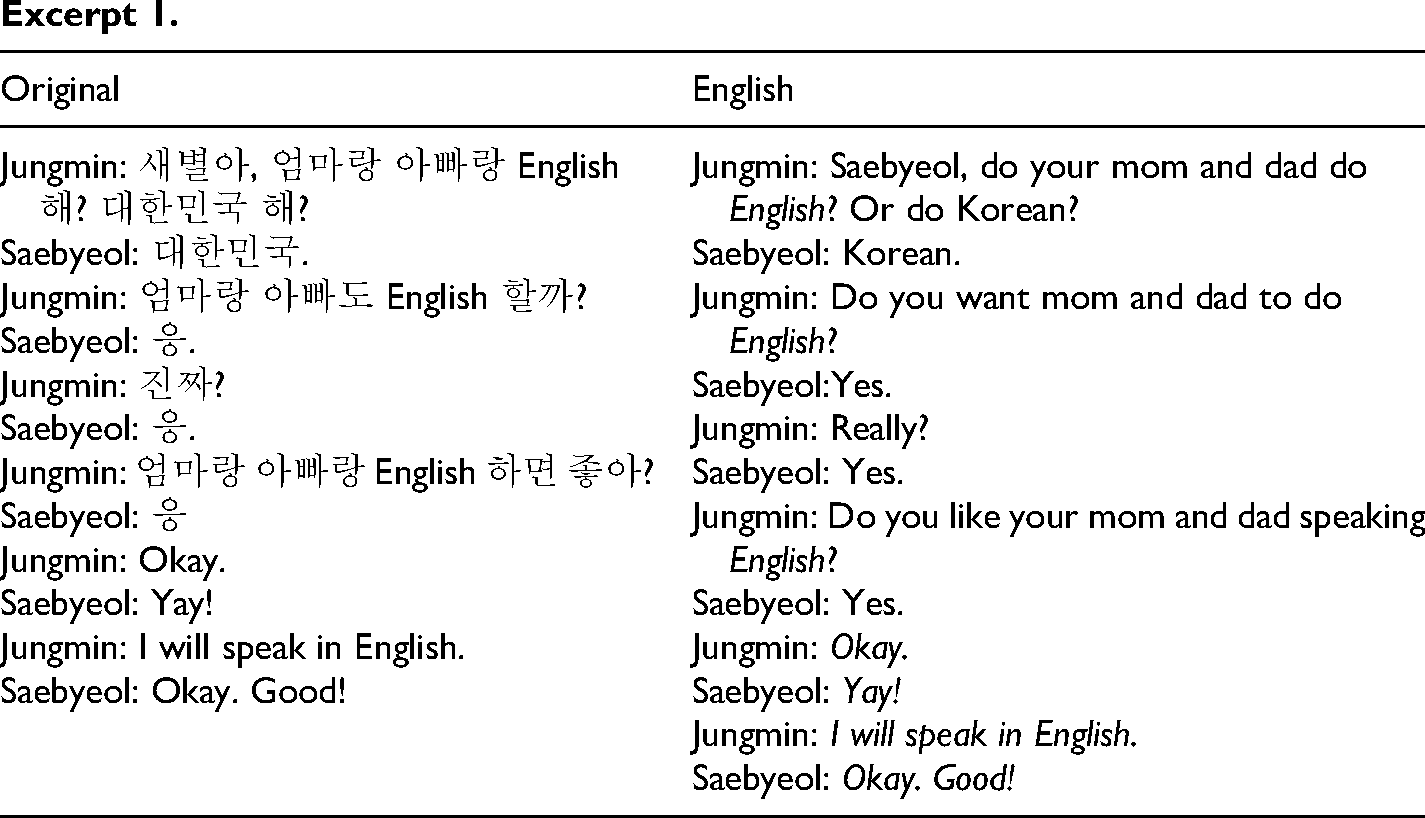
As we closely observed our children and their language and literacy practices, we also noticed that the prevalent monolingual ideologies in schools affected our children's emerging language ideologies. The mother–child conversation data that Jungmin and Wenyang uploaded to the Slack group showed similar patterns: Even at the ages of two and four, our children were prioritizing English over the language that their parents speak at home, which suggested that their language ideologies were influenced by their schooling experiences. For example, Jungmin shared an audio recording of a mother–child interaction (Excerpt 1) that took place during bedtime. This excerpt revealed how Saebyeol favored English over Korean and expressed excitement for her mother to use English, as evidenced by the expressions “Yay!” and “Okay, Good!”
A similar conversation (Excerpt 2) took place between Minhye and her 5-year-old son, Boxy, after Minhye noticed that Boxy seemed to feel embarrassed speaking Korean to his mother in a public space. After noticing the child's refusal to converse in Korean in public, Minhye engaged him in the following dialog about his views on speaking Korean:
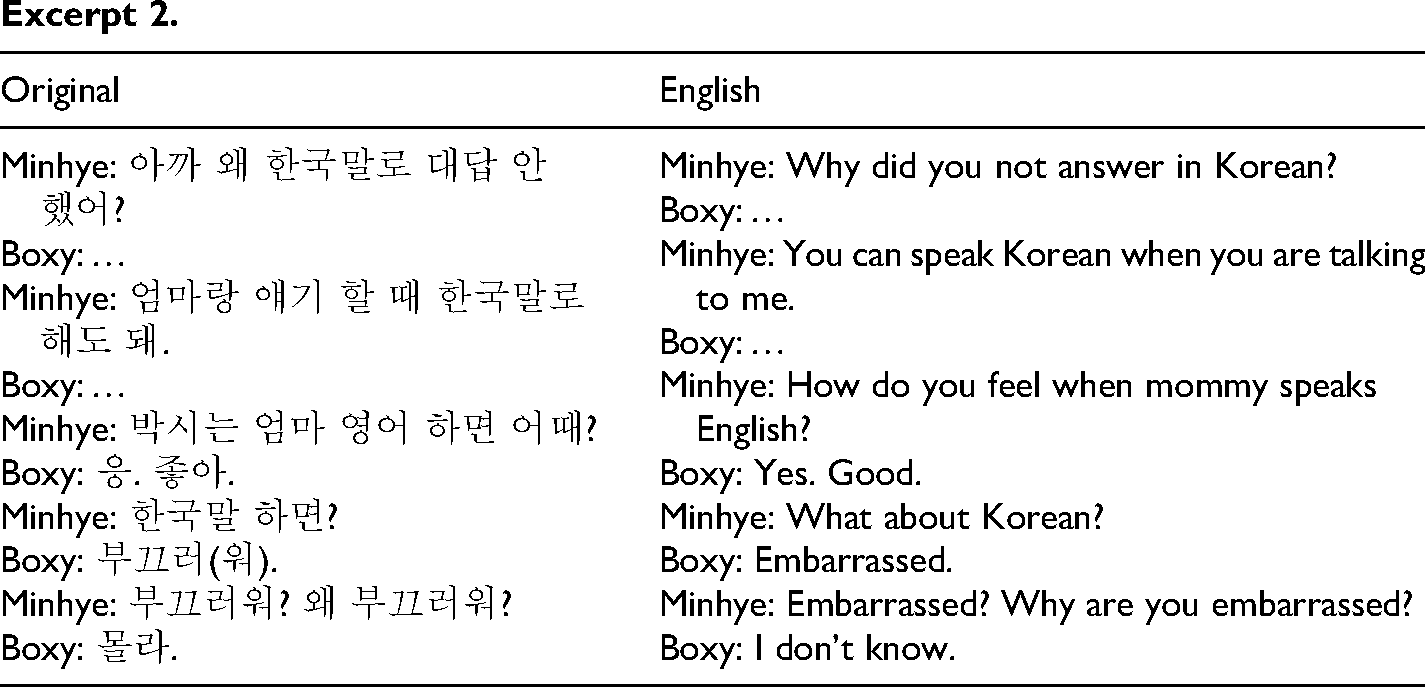
Boxy's use of the word “embarrassed” signaled his emerging language ideology as well as the emotions associated with his use of Korean. In fact, Choi's (2021) paper on her trilingual child included a similar vignette in which her child used the word “embarrassed” to describe his feeling of shame, embarrassment, and shyness toward his mother, who read a bilingual book in Korean in a school space.
A few months later, as shown in Excerpt 3, Saebyeol suddenly asked Jungmin, “Mom, I can’t speak Korean at school?” (Excerpt 3). Her question revealed that she was critically thinking about the monolingualism promoted by her teacher, who seemed to consider monolingualism as the norm. Saebyeol articulated the message that she had received from school, which denied her fluid languaging practices. The way she crossed languages when describing the incident— “학교는 English라고” [school is English]—showed her active utilization of linguistic resources as an emergent bilingual.
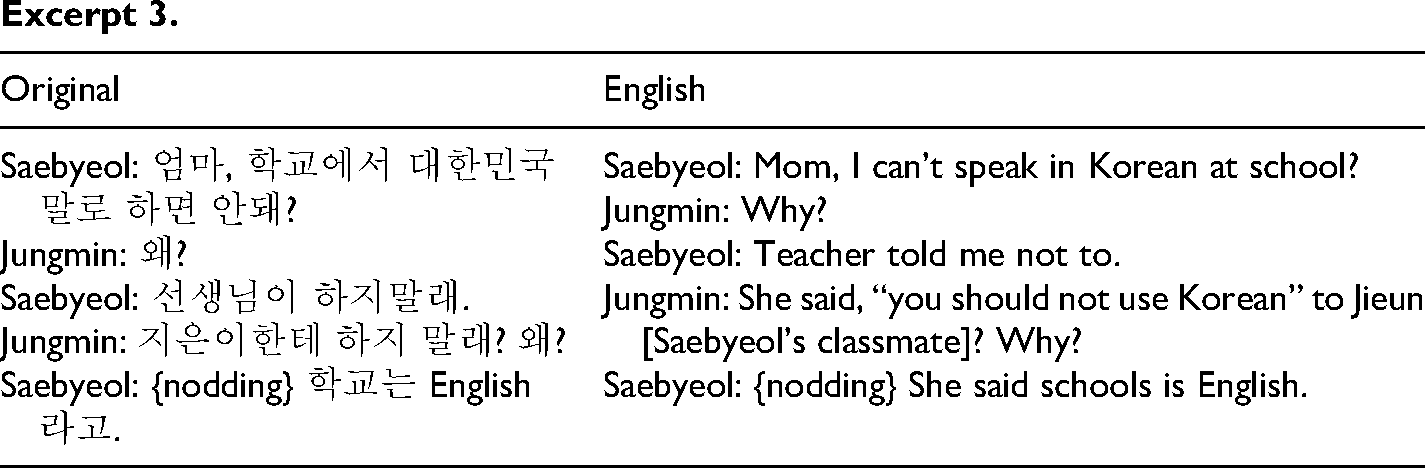
Excerpt 3 served as significant evidence to support earlier conversations among the three authors. In one conversation, Minhye noted that speaking languages other than English became a problem only at school. Our findings also aligned with Song's (2019) argument that the language ideologies that govern educational practices in U.S. schools contested immigrant parents’ strong beliefs and practices about their children's bilingualism.
Navigating Limited Resources for Emergent Bilinguals
Existing studies have emphasized that schools often fail to provide adequate multilingual resources and support (i.e. interpreter services) for immigrant children and families, which are important for children's learning and well-being (Sohn & Wang, 2006). In our study, we discovered that the English-only childcare centers where our children are enrolled offer limited resources for emergent bilingual children and families. As a result, the responsibility and burden fall on us, immigrant parents, to locate multilingual resources such as books and programs for our children outside school. Taking an inquiry approach to our everyday lives enabled us to recognize that we are each surrounded by varying degrees and kinds of multilingual resources in our communities.
In the New York/New Jersey area, Minhye easily found and accessed a substantial number of multilingual books and events at a local public library. These materials were thoughtfully organized for Asian immigrant families. Her photographs of the libraries (Figure 2a) demonstrated the availability of books written in Korean spanning different genres and age levels, as evidenced by sections labeled “Korean Fiction” and “Korean Biography Fiction.” The library even displayed a welcoming message in multiple languages, including one in Korean that said, “이용자가 누구든, 어디에서 왔든 관계없이 정보, 기회 및 발견의 즐거움으로 따뜻하게 맞이할 준비가 되어 있습니다.” [No matter who the visitors are and where they are from, we are ready to welcome them with the joy of having information, discovery, and opportunity.]
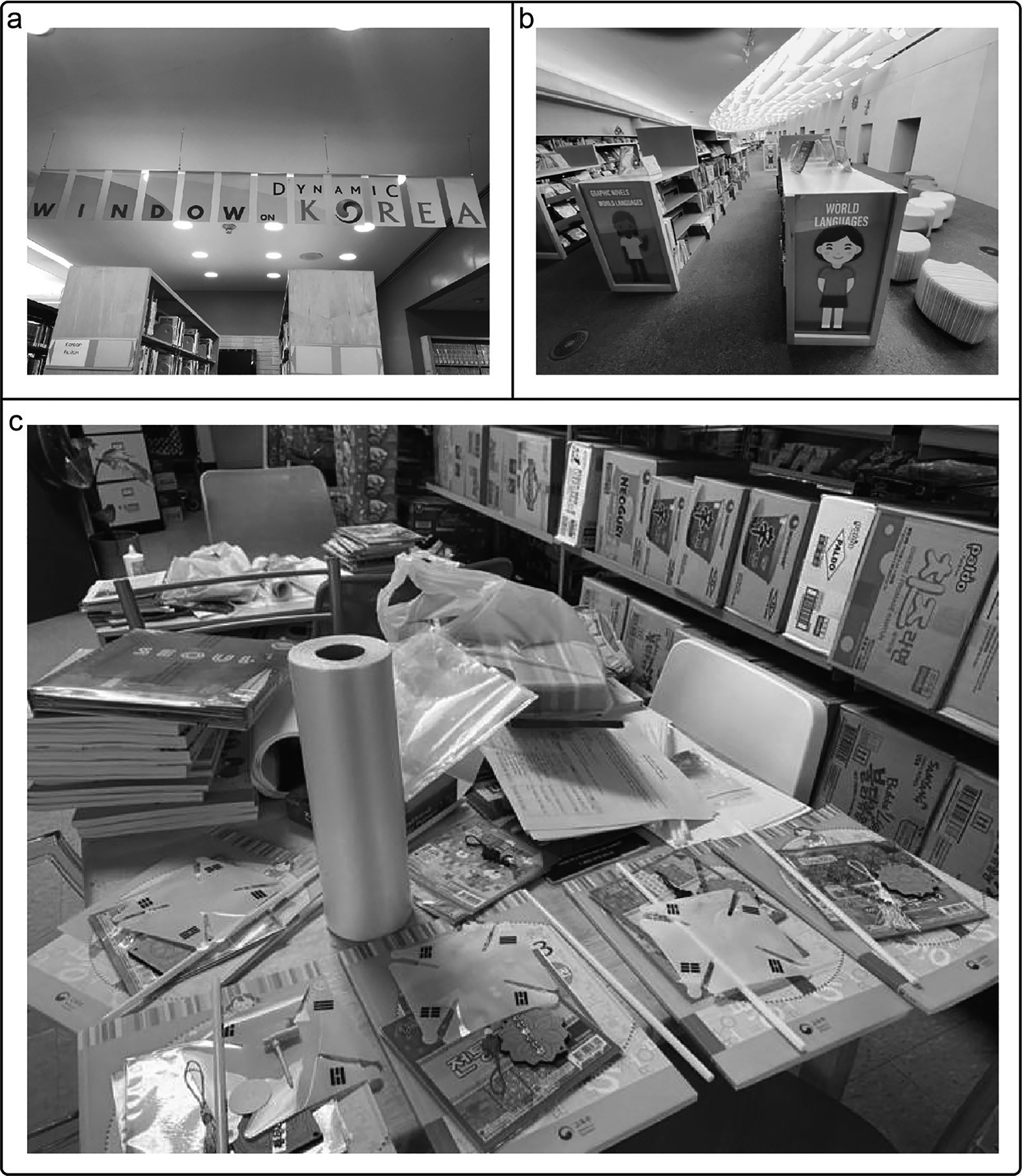
Community transnational and literacy resources.
In contrast, Jungmin and Wenyang, who reside in predominantly White areas with smaller Asian populations, faced challenges in finding multilingual books or literacy resources for teaching Korean and Mandarin Chinese at public libraries. Both found a section in their local libraries labeled “world language,” which combined all books written in non-English languages and about other cultures into one category (Figure 2b). Labeling these books as “multicultural” or “world language” suggested that the section targeted readers from monocultural and monolingual backgrounds. The need to find bilingual resources, coupled with the lack of publicly available options, adds an extra burden for immigrant mothers, like Jungmin and Wenyang, who are endeavoring to encourage bilingualism in regions with small immigrant populations.
Wenyang's experience at her child's 18-month doctor visit further intensified these challenges. The doctor stated that her child showed signs of autism, and that this often occurs in children growing up with two or more languages. In her individual written narrative, she reflected, “Was her inability to speak caused by her exposure to different languages, or was it an indicator of her speech delay? The limited literary resources in Chinese added to my anxiety, and my lack of time reading in Chinese to her made me turn to Chinese songs and cartoons. Yet, the excessive screen time added to [my] guilt as well.” This narrative underscored the problems linked to the limited resources for emergent bilinguals in medical facilities, and it also highlighted the challenges that parents face in enhancing their child's language and literacy learning at home.
One powerful aspect of this collective self-study was that it led us to recognize the various resources that immigrant parents and immigrant communities create and distribute. Although local public libraries had limited resources for emergent bilinguals related to the Korean language and culture, Jungmin observed that Korean immigrant parents in Michigan voluntarily exchanged books at a local ethnic supermarket. When community-based heritage language schools closed due to the global pandemic, these parents even gathered at the store to create and share Korean learning materials (Figure 2c). Additionally, during the data collection year, a Korean immigrant mother in Michigan started an online chat group for Korean immigrant parents. Within the first 2 days, this group attracted over 80 Korean parents living in Michigan, and it served as a key space for parents to discuss and share bilingual resources and school-related issues. Similarly, Wenyang frequently engaged with an online community of Chinese immigrant mothers who share language resources, including bilingual books and instructional materials.
Navigating Mothering Through Transnational Collaborative Partnership and Critical Consciousness
Our analysis identified three significant actions that have helped us navigate our experiences as transnational MotherScholars of emergent bilinguals: engaging in an inquiry group, learning from other transnational mothers, and cultivating critical consciousness. We found that navigating a doubled burden has required us to foster critical consciousness (Palmer et al., 2019) to deliberate our efforts in decolonizing home literacy practices. As Palmer et al. (2019) explained, critical consciousness is connected to our abilities to understand the world and “to reflectively discern the differences in power and privilege rooted in social relationships that structure inequalities and shape the material conditions of our lives; to read the world also includes recognizing one's role in these dynamics” (p. 123). Participating in regular, in-depth conversations about our practices, vulnerabilities, and uncertainties (Bullock & Ritter, 2011) allowed us to recognize our privileges and power as middle-class MotherScholars and urged us to examine our shared struggles and contextualize them within a broader power structure. This structure encompassed White supremacy, English hegemony, and monolingual ideologies. Through this reflective process, we gained political and ideological clarity regarding the production of knowledge. We also learned to challenge the deficit thinking towards minoritized communities concerning their heritage, language, and culture. Cultivating critical consciousness empowered us to continuously interrogate this power structure, and it liberated us from the guilt and low self-efficacy in parenting.
Furthermore, by taking an inquiry stance and collaboratively viewing, remembering, and validating our experiences, we were empowered to increase visibility regarding our children's language and literacy practices. This approach also highlighted the meaningful opportunities that we create for our children and helped us recognize the importance of challenging deficit-based views of bilinguals and stereotypes associated with Asian immigrant mothers. Sharing our experiences against various forms of oppressions such as White-centric culture in academia, English native speakerism, and the model minority myth (Chang, 1993) allowed us to heal our wounded selves (hooks, 2003; Kim, 2020). Our collective inquiry process was liberating and healing, in part because it enabled us to share and acknowledge the seemingly insignificant stories related to raising our children bilingual and biliterate; within this group, we were recognized, affirmed, and validated. However, we recognize that such opportunities are rarely available to immigrant mothers outside of academia. Thus, we argue that creating these opportunities is crucial for all mothers who are raising emergent bilingual children.
Discussion
Through this collaborative self-study, we realized that we, as transnational MotherScholars raising emergent bilinguals, continually harness our multiplied assets and navigate doubled burdens as we “live within, between, and at the margins or boundaries of nation-states around the globe” (Enns et al., 2020, p. 1). Our transnational connections and multilingual backgrounds equip us with the knowledge and tools needed to nurture our children's bilingual potentials and enhance their transnational understanding. However, we also realized that the practice of mothering emergent bilinguals is a constant battle. Schools often view our children's home language as a deficit and as a result, our children may internalize monolingual ideologies and resist using languages other than English. We also found that despite our educational backgrounds and expertise in language and literacy education, fostering our children's multilingual learning is challenging, especially when resources are limited. This obstacle was particularly significant for Jungmin and Wenyang, who reside in areas with low populations of immigrants and bilingual families. One powerful aspect of our study is that examining our experiences through a researcher lens enabled us to uncover overlooked and ignored aspects of our mothering experience and to recognize each other's transnational, multilingual experience and knowledge as assets. Sharing our unique experiences of mothering as transnational bilinguals, we came to realize the rarity of exploring voices and experiences like ours. This study also enabled us to challenge dominant and Eurocentric systems of oppression through “an identity of opposition, the enactment of voice, and the creation of agentic spaces” (Cervantes-Soon, 2018, p. 858). The space we created for this research became a platform for listening, liberation, solidarity, and empowerment; it enabled us to establish transnational solidarity and make space for “an active coalitional resistance grounded in radical love” (Hsieh et al., 2022).
Concluding Remarks
This paper contributes to the field of language and literacy education by showcasing the voices of transnational MotherScholars and the relentless efforts that they make to sustain their children's bilingual potential. It also highlights the complex and rich language and literacy practices that we and our Asian American children engage in. Such insights and contributions, which are often absent and unheard in the field (Jang, 2017; Kim, 2020), made this work a significant addition to the literature. However, it is important to recognize that neither transnational MotherScholars nor immigrant mothers of emergent bilinguals are monolithic groups. Each mother had her unique experiences and stories, interwoven among her multiplied assets and doubled burdens. We acknowledge that our findings may not apply to other immigrant mothers, which underscores the need for further research on transnational mothers from various backgrounds and experiences.
This study provides implications for K-12 teachers, teacher educators, and literacy researchers. As the findings demonstrated, young children receive seemingly simple messages from school and society that English is superior to their home languages. However, these messages can be detrimental to them and their development of bilingualism and biliteracy. Hence, it is critical for teachers to understand that the ways in which emergent bilinguals dynamically use multiple languages are their ways of being and making sense of the world (García & Wei, 2014). Educators should also leverage the children's linguistic repertoire in teaching. Understanding emergent bilinguals’ and their families’ funds of knowledge (Moll et al., 1992), especially their language and literacy practice at home and how parents support their children's bilingualism and biliteracy, is crucial. Learning more about immigrant parents’ language ideologies, family language policies, and migration histories can deepen educators’ understanding of their students and identify ways to better support the children's language and literacy learning. Inviting emergent bilingual children to share their home artifacts and the stories behind them is another way to learn more about the children and to send a clear message that being bilingual and biliterate is a strength.
As teacher educators, we feel an urgency to create a space for pre- and in-service teachers to challenge monolingual ideologies and deficit perspectives that continue to marginalize emergent bilingual children like ours. In our teacher preparation classes, we often share home artifacts, such as our children's bilingual work and drawings. By pairing them with our stories, we urge teacher candidates to resist English hegemony and reimagine language and literacy education. We have also invited our teacher candidates to design and conduct interview activities with emergent bilinguals to identify children's funds of knowledge and to document the agential work that their parents do to sustain their home languages. We argue that providing learning opportunities and clinical experiences that build on asset-based perspectives and humanizing approaches (Martínez-Álvarez, 2023) is critical in preparing future teachers to support emergent bilinguals and transnational families.
This study indicates that future literacy research should position immigrant mothers as experts and knowers, and create a space for them to share their knowledge as well as the “stories of pain, trauma, violence, and also love” (Nuñez, 2021, p. 320). Encouraging immigrant mothers who are raising emergent bilingual children to participate in a collective inquiry space, either in-person or through an online platform, is one way to “build alliances through opening up our experiences, relating to one another's struggles, and constructing a coalition around shared visions on teaching and learning” (Yoon & Llerena, 2020, p. 874). Immigrant mothers can not only learn from each other about how to navigate U.S. school systems, which are inherently rooted in monolingual ideologies and English hegemony, but they can also provide counterstories about what immigrant mothers can do for themselves, their children, and each other. We hope that the counterstories we presented in this study will motivate educators and institutions to recognize and tap into the vast resources and insights that immigrant mothers possess in supporting emergent bilinguals.
Supplemental Material
sj-docx-1-jlr-10.1177_1086296X241226478 - Supplemental material for The Voices of Transnational MotherScholars of Emergent Bilinguals
Supplemental material, sj-docx-1-jlr-10.1177_1086296X241226478 for The Voices of Transnational MotherScholars of Emergent Bilinguals by Jungmin Kwon, Wenyang Sun, and Minhye Son in Journal of Literacy Research
Supplemental Material
sj-docx-2-jlr-10.1177_1086296X241226478 - Supplemental material for The Voices of Transnational MotherScholars of Emergent Bilinguals
Supplemental material, sj-docx-2-jlr-10.1177_1086296X241226478 for The Voices of Transnational MotherScholars of Emergent Bilinguals by Jungmin Kwon, Wenyang Sun, and Minhye Son in Journal of Literacy Research
Supplemental Material
sj-docx-3-jlr-10.1177_1086296X241226478 - Supplemental material for The Voices of Transnational MotherScholars of Emergent Bilinguals
Supplemental material, sj-docx-3-jlr-10.1177_1086296X241226478 for The Voices of Transnational MotherScholars of Emergent Bilinguals by Jungmin Kwon, Wenyang Sun, and Minhye Son in Journal of Literacy Research
Supplemental Material
sj-docx-4-jlr-10.1177_1086296X241226478 - Supplemental material for The Voices of Transnational MotherScholars of Emergent Bilinguals
Supplemental material, sj-docx-4-jlr-10.1177_1086296X241226478 for The Voices of Transnational MotherScholars of Emergent Bilinguals by Jungmin Kwon, Wenyang Sun, and Minhye Son in Journal of Literacy Research
Supplemental Material
sj-docx-5-jlr-10.1177_1086296X241226478 - Supplemental material for The Voices of Transnational MotherScholars of Emergent Bilinguals
Supplemental material, sj-docx-5-jlr-10.1177_1086296X241226478 for The Voices of Transnational MotherScholars of Emergent Bilinguals by Jungmin Kwon, Wenyang Sun, and Minhye Son in Journal of Literacy Research
Footnotes
Declaration of Conflicting Interests
The authors declared no potential conflicts of interest with respect to the research, authorship, and/or publication of this article.
Funding
The authors received no financial support for the research, authorship, and/or publication of this article.

References
Supplementary Material
Please find the following supplemental material available below.
For Open Access articles published under a Creative Commons License, all supplemental material carries the same license as the article it is associated with.
For non-Open Access articles published, all supplemental material carries a non-exclusive license, and permission requests for re-use of supplemental material or any part of supplemental material shall be sent directly to the copyright owner as specified in the copyright notice associated with the article.
