




Abstract
Using frame analysis, the present study examined the intersections of science of reading research, media coverage, and state literacy policy to explore how Colorado policy and media documents have defined reading achievement. It also analyzed the values, assumptions, and agendas within these definitions. It identified diagnostic frames that defined a state-level problem with reading education and prognostic frames that proposed curriculum and teacher training mandates as solutions. Underlying these frames were assumptions of objectivity, agendas of top-down accountability, and a binary separation between effective and ineffective methods for the teaching of reading. Implications include the development of a critical pragmatism in which researchers, teachers, school leaders, and other practitioners can collaborate to navigate shifts required by legislation while reflecting on the ways in which such shifts are situated in larger narratives. The authors argue that such analyses are essential for implementing reading reform in ways that are equitable and responsive to local contexts.
Introduction
Since the publication of A Nation at Risk: The Imperative of Educational Reform (1983), U.S. policymakers have responded to a sense of educational crisis through increased oversight of instructional practices, curricular materials, and student assessment, often with a particular focus on literacy. Since policy affects instructional practice, it is critical that we understand how policy interpretations and decisions by multiple actors shape this impact on literacy instruction. Only with this understanding can the agendas of researchers and the actions of practitioners successfully change instructional practices. In this study, we examined the framing of problems and solutions in one state's literacy policy and media documents in order to elucidate a critical, yet pragmatic way, for practitioners, researchers, and policymakers to collaborate within contemporary policy mandates.
Since journalist Emily Hanford released her first documentary on reading instruction, “Hard Words: Why Aren’t Kids Being Taught to Read?” (APM Reports, 2018), attention to the science of reading, or SOR, has multiplied in academia, journalism, and state legislation. The SOR body of research has emphasized the use of the scientific method to plan and justify solutions to improve student reading; furthermore, it has often focused on the brain basis for learning to read, with research supporting explicit systematic phonics instruction (Shanahan, 2020). Researchers and SOR advocates have argued for a broader definition of the SOR, as namely, “a vast, interdisciplinary body of scientifically-based research about reading and issues related to reading and writing” (The Reading League, 2021, p. 6), although the emphasis on phonics associated with SOR has remained prevalent. Reflecting the broad reach of the movement, national media coverage has been integral to the dialogue and rhetoric surrounding SOR (MacPhee et al., 2021). In this paper, we have attempted to interrogate the fluctuating meanings of the SOR in elementary reading reform efforts by studying policy implementation from broad sources, including media.
Despite the recent prominence of SOR in media, the research cited by SOR advocates spans several decades. A focus on key components of reading and the use of practices supported by scientific evidence was prominent in the National Reading Panel (NICHHD, 2000) and subsequent accountability movements. Since Hanford's (2018) documentary, however, SOR research has inspired reading policy in over 30 states, especially targeting teacher training and approved curricula (Peak, 2022; Schwartz, 2022). The state of Colorado has provided one example of this lineage from past policies to new SOR-influenced legislation. For example, a 2019 update to Colorado's 2012 Reading to Ensure Academic Development Act, or READ Act, built SOR concepts into law, and media coverage in subsequent years provided a nuanced yet representative example of the interplay between the research and ideologies of lawmakers, journalists, and educators.
Literacy policies and their implementation have the potential to deeply impact the lives of children, and the Colorado law, like other SOR legislation across the U.S., particularly affects students who score low on reading tests. These are students whose needs are often the least well-served by schools in the first place, including emergent bilingual students (Hopewell & Escamilla, 2014). During contentious times, without careful and deliberate examination, literacy researchers, teachers, practitioners, and school leaders may fail to fully grasp the dynamics at play within the life of a policy. As educational policies often purport to address a perceived problem, identifying these problem definitions in policy and media is a critical first step for researchers and practitioners.
In this paper, we conducted such an analysis by examining Colorado's legislative response to SOR in order to explore how policy and media documents have invoked definitions of problems, causal explanations, and solutions, as well as how those documents have reflected politicized agendas, values, and assumptions about literacy education. We followed the policy's after-effects, its interpretation and re-interpretation in the media coverage of a local outlet, analyzing documents with the following research questions: RQ1: How do Colorado policy documents and local media reports define reading instruction and achievement? What problems and proposed solutions are represented in policy and media documents? RQ2: What agendas, values, and assumptions underlie these articulations of problems and their proposed solutions?
SOR Reading Legislation: The Example of Colorado
There are a number of reasons why Colorado is useful for understanding how SOR-related policy and media interact to define problems, propose solutions, and appeal to values, agendas, and assumptions. Colorado is a geographically central and politically mixed state that has likewise hosted a mix of education policy movements. For example, Denver received national attention for embracing school choice and competitive incentives in the 2010s, but has rolled back many of these reforms under new superintendents and a union-backed school board (Brundin, 2022). Colorado's implementation of SOR-based literacy reforms situated it as an early initiator of these changes, but not as an outlier. Although eight states preceded it, Colorado was part of the first large group of states to pass SOR-related legislation in one year, immediately following the 2018 Hanford documentary (Schwartz, 2022). At least 24 more states have passed similar laws in the years since, states for whom Colorado's journey will have implications.
Just as SOR-inspired policies were preceded by accountability policies from the 1990s and 2000s, the 2012 READ Act was passed amid the growth of the Common Core State Standards and built on the Colorado Basic Literacy Act, or CBLA, which shared some of the same objectives as the READ Act, and which strived to “avoid the ‘Great Reading Wars’” (Quate, 1998, p. 3)—a hope that reflected the contentious atmosphere of the 1990s, the predecessor of today's political attention to literacy. The 2012 READ Act did not lead to intended changes in reading performance across the state, so the 2019 updates reflected the rise of SOR policies in the intervening years and imposed mandates about teacher training and curriculum selection. Thus, for over twenty-five years, Colorado lawmakers intervened in early literacy instruction with legislation focused on proficiency by third grade; the legislation's relationship to national accountability and media trends provided a useful context for our inquiry regarding policy and media.
Relevant Literature
Priorities in Policy Analysis
We recognized that studying policy does not involve merely reading the text of a document to decide whether a policy is inherently good or problematic. Instead, as Cochran-Smith (2021) explained, analyses should surface the impacts of policy by excavating larger goals, agendas, and power relationships. Cochran-Smith et al. (2018) analyzed four national teacher education policies as a study of accountability, arguing that such an examination can elucidate a society's dominant values. In a 2021 article, Cochran-Smith extended this idea by situating teacher education policies as accountability tools that are consequential because of their capacity to elevate a set of assumptions about what accountability is and means; this is an important consideration amid SOR debates that focus so intensely on content of research and instruction. Similarly, McCarthey (2008) studied how the No Child Left Behind (NCLB) legislation of 2001 shaped teachers’ attitudes toward writing instruction and how teachers resisted, critiqued, or complied with it. Like Cochran-Smith (2021), McCarthey (2008) attended to not only what a policy says, but also to how it creates a landscape of values and assumptions about what is most important in teaching, learning, and schools. Our analysis built on these arguments and found that critical examinations of policy can reveal more than the text of the policy itself, including the deeper values of a society.
Other researchers have focused on the unfolding and implementation of literacy-related policies in the wake of NCLB. Coburn (2006) conducted a yearlong ethnographic study of a school's response to the California Reading Initiative, concluding that how a school framed reading instruction as a problem significantly impacted the realities of how the policy unfolded. Coburn's (2006) study provided a foundational insight, one that remains relevant today, informing our current approach which attends to problem framing as a key element in the evolution of a literacy accountability policy.
With similar attention to local implementation, Wright (2005) analyzed Arizona's Proposition 203, which restricted the instructional models available to English language learners and essentially mandated English-only instruction. By considering the text of the policy as well as its promotional campaign, its role in the race for a new superintendent, and how it was implemented under the new superintendent, Wright (2005) was able to describe how the policy unfolded as a political spectacle (Smith, 2004). Relatedly, Gabriel and Woulfin (2017) reviewed the texts of state policies related to dyslexia, reading achievement, and reading difficulty, in addition to transcripts of testimony in legislative sessions. They analyzed how the policy-making process constructed reading policy problems and solutions by exploring how language and discourse build policy across time and contexts; they found that problem frames tended to direct the solutions that appeared in policies and shaped implicit blame, in this case, toward schools and teachers. These studies guided our choice of broader data sources around literacy policy and moved us to examine evidence of the policy's later impact.
Studying Policy Implementation Through Language and Media
One methodological avenue for analyzing policy implementation has involved attending to language in policy documents, policymaking conversations, and media. For example, in a study that explored the language of policy-making conversations within transcripts of the Tennessee's Teacher Evaluation Advisory Committee, Gabriel (2017) held that the target construct of an education policy (e.g., teacher effectiveness) was socially constructed and could reveal not only what a policy says, but what is at stake and whose interests are represented. Similarly, in a critical policy analysis of Reading First, Stevens (2003) examined handouts and speeches from the U.S. Department of Education-sponsored Reading Leadership Academy; she asserted that although discussions of policy occurred in a specific time and place, their messages had implications for schools, classrooms, and teachers across many contexts. Our choice to study media documents related to the Colorado READ Act and SOR built on the finding of these studies that policies hold implications stretching far beyond the discrete moment when someone reads them.
Studies have also identified the media as highly salient for local actors as they make sense of policy, a pattern that is particularly relevant to the current SOR context. Anderson (2007) synthesized theories and studies regarding the role of media in education reform, including the use of cognitive frames to generate perspectives, anxieties, and support, or to question an educational policy. In the time of NCLB, Anderson (2007) called on researchers and the general public to build awareness of the necessity of media to provide a narrative that would allow critical evaluation and understanding of these constructions. This call to be aware of media-driven narratives is especially pressing in an era of SOR reform, given the ongoing preponderance of media messages about reading failure. Malin and Lubienski (2015) also analyzed the role of media in education reforms. They found that media played a significant role in disseminating information with an impact on policy, and they called for caution in both contributions to and interpretation of information in media about education, a perspective that continues to inform our choice to attend to media as essential to a research engagement with policy.
Indeed, narratives from news and other media have figured prominently in locally constructed understandings of the READ Act, mirroring the role of national media coverage in shaping public perception of the SOR. MacPhee et al. (2021) analyzed metaphors as rhetorical devices which communicate a sense of crisis around reading instruction, illustrating the key role that journalism plays in building problem definitions and reflecting the values, agendas, and assumptions of a policy and community; this approach motivated our analysis of media, especially in relation to an SOR-inspired policy.
Theoretical Framework
To understand the interplay between state laws and media coverage, we retained a theoretical perspective that (a) foregrounded the political nature of policy and (b) reckoned with the complexity of local implementation. Together, these concepts necessitated an approach that analyzed policy by attending to the political, non-neutral elements in policy-making and recognizing the role of local actors in interpreting policy.
The Political Nature of Education Policy
We understand educational policy-making, and its relationship to research as a political—and not a rational—activity, which means that enacting effective policy is not as simple as applying objective research findings to guarantee positive results (Allington, 1999). This does not mean that literacy policies follow trends in partisan politics, but rather that translating research into policy recommendations is far from a seamless or automatic process. Allington (1999) demonstrated these complexities of research and policy-making by providing examples of topics with broad research consensus that nonetheless failed to consistently correlate with state policy decisions. This insight remains salient in the reading policy landscape today: Allington (1999) and other critical policy analysts have urged that the sense of research consensus cited in SOR-inspired legislation should not be uncritically accepted.
Because policy must be interpreted, different actors tend to interpret information differently based on their positions, perspectives, and motivations. Policy is a tool for action and an important way to put research findings into practice, but political strategizing is also a key part of making policy, as various groups and stakeholders mobilize to shape policy by elevating their specific version of what a problem is, why it exists, and the best way to solve it (Allington, 1999). Driving such political strategizing are distinct agendas, values, and conceptions of the purpose of education (Allington, 1999; Labaree, 1997), which we sought to uncover as an inextricable part of both reading policy and state media coverage. Thus, in reading the texts from our dataset, we remained grounded in a perspective that directs attention toward the political, value-laden complexities that underpin all policy, especially SOR-based policies like the READ Act that claim to be neutral or commonsensical. Our methodological choice of frame analysis, which we will discuss later, was guided by this theoretical understanding of policy.
The Complexity of Local Implementation
While the translation of reading research into policy documents is one area of state and local legislation analysis, the translation of policy implementation at the local level is another. Spillane (2004) critiqued the assumption that local actors, such as school district officials, directly enact the text of a policy by simply deciding whether or not to abide by policy-makers’ directives, arguing instead that they interpret laws and mandates through a process of interactive policymaking. As Spillane (2004) put it, “To decide whether to ignore, alter, or adopt policy makers’ recommendations, local officials must construct an understanding of the policy message” (p. 6). Local actors have used multiple sources of information to make decisions about educational practice, and the text of state policy is only one of these sources. To understand how a policy leads to change, we must understand what those most connected to policy implementation—district officials and teachers—think the policy means (Spillane, 2002).
Echoing the role of local sensemaking in policy implementation, Woulfin and Gabriel (2022) likened reading reform, especially in the age of SOR, to a telephone game in which individuals at federal, district, and state levels enact policy by (a) interpreting messages from legislation and from leaders’ framing of the policy, (b) strategizing how to make change using resources or people, and (c) beginning to facilitate change. Our theoretical approach built on this insight that implementing policy involves a process of interaction between state-level mandates and individual districts, schools, leaders, and teachers as they construct an understanding of what the policy means for them, drawing on much more than the policy itself. Indeed, we can view all who interpret and implement policies as policymakers themselves (Spillane, 2004). Media reports provided one example of how a policy changes and is distilled in the local implementation process, as well as insight into a source of policy information that reaches local practitioners. Our decision to analyze media and policy documents to explore how they defined problems and imply certain agendas, values, and assumptions was thus shaped by a theoretical perspective on the local sensemaking of policy, which may be informed and influenced by media, and on the political dimensions of policy, which are elucidated by a critical read of policy documents.
Methodology
Our analytic approach drew on frame analysis, which offers a methodological means for illuminating the implied problems (diagnostic frames) and proposed solutions (prognostic frames) in Colorado reading policy documents and media coverage.
Frame Analysis
As we approached our research with an understanding of policy as political and the complexities of local implementation, we used frame analysis (Goffman, 1974) to articulate how policy ideas connected to individual ideas and their implementation by organizations (Gabriel & Woulfin, 2017). As Entman (1993) explained, “to frame is to select some aspects of a perceived reality and make them more salient in a communicating text, in such a way as to promote a particular problem definition, causal interpretation, moral evaluation, and/or treatment recommendation for the item described” (p. 52). This approach followed from an understanding of policy as political and shaped by interpretation on a local level. Frame analysis can thus reveal the strategies used by policymakers to create a sense of continuity between their position on a given problem and the commonsense way their constituents may think about that problem (Cochran-Smith et al., 2018; Entman, 1993).
The components of framing—selecting certain aspects of reality and increasing their salience—were especially relevant in analyzing narratives about reading, reading instruction, and reading achievement in Colorado. Frames were further divided into two subcategories. Diagnostic frames were used to diagnose a current situation; in this case, these frames referred to explanations of why perceived problems within state reading achievement existed. Prognostic frames, in contrast, were solutions hypothesized to address those problems (Cochran-Smith et al., 2018; Gamson, 1992). Both diagnostic and prognostic frames connected and built upon each other in the writing of a policy and its interpretation on a local level. By directing our attention to the dimensions of reading achievement that authors of policy and media documents chose to emphasize, we identified a set of motivating ideologies and worldviews that were neither neutral nor value-free.
Data Sources
We began by collecting documents relevant to our research questions in two categories: policy documents (three total; see Appendix A) and media documents (31 total; see Appendix B). To assemble policy documents, we explored the state legislative records and the Colorado Department of Education (CDE) website, selecting three documents to analyze: (a) the signed Senate Bill for the 2012 READ Act; (b) the signed Senate Bill for the 2019 READ Act with updates; and (c) a two-page summary of the READ Act updates. We included the first two legislative texts because they represented primary sources often referenced by media articles that reported on what the READ Act required; as such, their inclusion formed a basis for studying how legislation and media have interacted to shape the interpretation of policy. The third document, a CDE-published briefing for an audience of districts and practitioners (CDE, 2019), created an important bridge from the lengthy legislative text to the reports of the READ Act in media discourse. While the CDE website included other resources for educators and information about the READ Act implementation, we chose to limit our policy document data sources to these three documents to increase the depth with which we could examine each. This dataset held both affordances and limitations, which we will discuss later.
To collect documents in the second category related to media, we explored Colorado media coverage related to the READ Act, the SOR, and literacy education from 2011 (the year before the READ Act was passed) until 2022. After searching online coverage by several local outlets (e.g., The Colorado Sun, Colorado Public Radio, The Denver Post), we found that only the nonprofit news organization Chalkbeat had devoted consistent, long-term attention to the READ Act. Chalkbeat Colorado dates back to Chalkbeat's early days as a news startup in 2009, when it had offices only in New York City and in Colorado. As Green et al. (2014) explained, Chalkbeat has grown into a non-profit that promises to provide “essential education reporting across America.” We decided to study the Colorado branch of Chalkbeat and its coverage as a coherent example of a media narrative over time, authored by one primary reporter and other contributors. Chalkbeat's reporting on the READ Act drew from real-time policy events, such as state board of education meetings, and allowed us to trace the evolution of the law from the source that most consistently translated it for the public.
We used the Chalkbeat website to locate articles from 2011–2022 that directly mentioned the READ Act, the science of reading, and/or related mandates like curriculum shifts. The eleven-year time frame included brief initial reporting on the 2012 READ Act, such as a 2011 article about lack of growth in reading scores on the state standardized test at the time (Mitchell & Hubbard, 2011), and detailed coverage of the years 2019–2022 as the updates unfolded alongside increased conversation related to SOR.
Data Analysis
To identify explanations of the problem (diagnostic frames), as well as proposed solutions (prognostic frames) in the documents, we used a collaborative, iterative coding process that recognized, as Saldaña (2021) pointed out, that coding is a cyclical activity in which multiple rounds crystallize relevant dimensions of the data for the generation of themes and categories. In our first round of coding, we coded deductively for instances where documents evoked diagnostic and prognostic frames by stating some problem and proposing a solution (RQ 1), or an implied a set of agendas, values, or assumptions (RQ 2). In this and subsequent coding cycles, each author coded individually on electronic copies of the documents, followed by a meeting to discuss coding decisions and to resolve disagreements.
During the second round, we further refined codes that served as organizational categories (indexing whether the document was pointing to a problem, solution, or set of agendas, values, and assumptions), and transitioned to substantive categories that captured the content of a given problem definition, a proposed solution, or an agenda/value/assumption (Maxwell, 2012). To do so, we considered every instance of a first-round code and generated specific keywords that preserved what was salient while connecting to a larger analytic issue (Emerson, 1991). Table 1 provides an overview of the general, organizational categories with which we began and how we decomposed them into more detailed, substantive subcategories.
Round 1 and 2 Codes with Examples.
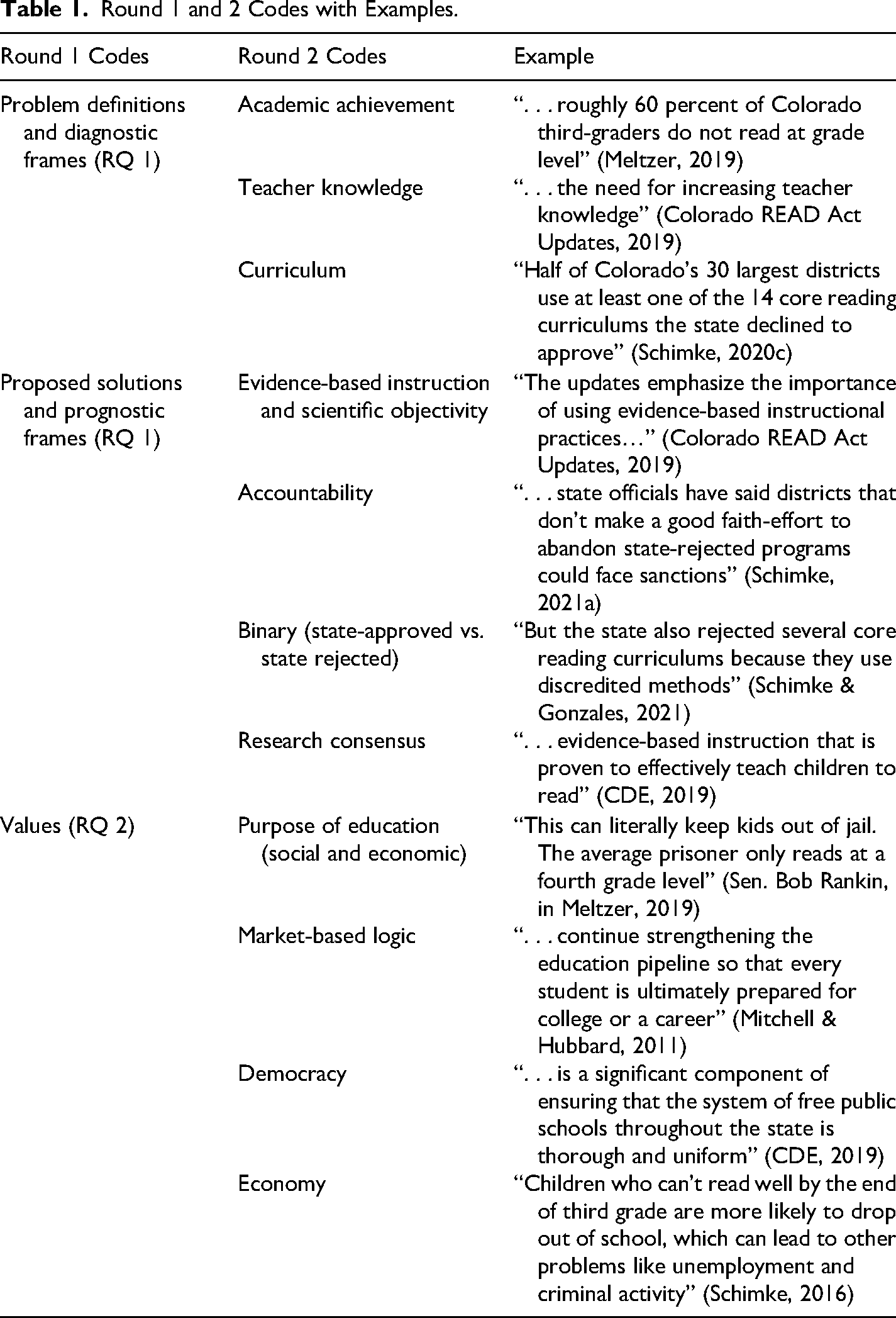
We then added a new set of media articles, published after our second round of coding between March and October 2022. These articles represented ongoing coverage of the 2019 READ Act updates, so we absorbed them into our dataset, applied our identified codes to these documents, and repeated our processes for collaborative, iterative coding. Following the pattern from previous rounds, we made the transition from organizational categories to substantive categories that indexed larger analytic issues related to our research questions. This allowed us to add the following new codes: struggling reader and distress, pandemic, and equity. While we considered adding additional policy documents to our dataset, including READ Act updates in 2021 and 2022, these later updates clarified aspects of the 2019 law without making substantive changes related to the science of reading, so we chose to maintain the focus of our analysis on the original policy documents.
In their commentary on coding dilemmas in a study on children's literacy, Sipe and Ghiso (2004) reflected that “all coding is a judgment call,” as “our subjectivities, our personalities, our predispositions, [and] our quirks are all brought to bear on the process” (p. 482–483). Recognizing this aspect of qualitative coding, we have acknowledged our own subjectivity and positionality. Both researchers identify as white and have worked with culturally and linguistically diverse learners as elementary educators. One author taught in a different state under similar but distinct accountability policies, and the other author was a teacher in Colorado under the original 2012 READ Act. These recent experiences in schools influenced both the coding process and our perceptions of the connection between research and policy that affect the daily lives of students and teachers. We particularly attended to how teachers and students were positioned in the value-laden framings of problems and proposed solutions in policy and media documents, as well as to themes that impacted our university-level work, such as training requirements for teachers. We note, then, that our coding of policy interpretation reflected our own interpretation as researchers and stakeholders.
Findings
Our research questions asked how Colorado policy documents and local media defined reading instruction and achievement, including problems and proposed solutions (RQ 1) and the agendas, values, and assumptions that underlie them (RQ 2). We began our findings with RQ 1, describing the problem definitions evoked in policy and media documents, how those problems were diagnostically and prognostically framed, and how recent media coverage shifted to emphasize particular issues related to the problem. Next, for RQ 2, we outlined examples of agendas, values, and assumptions that undergird these definitions.
Framing Reading Instruction and Achievement in Colorado (RQ 1)
Problem Definitions
We found distinctions in the way each type of document named reading achievement as a problem, which we conceptualized as different problem definitions. These are attached to diagnostic frames that described the source of the identified problem and prognostic frames that proposed solutions for addressing the problem. Problem definitions in media articles commonly consisted of a concise opening statement about low reading proficiency as measured by statewide test scores. For example, an October 2020 Chalkbeat article reported “only about 41% of Colorado third-graders can read well, according to the most recent state test results” (Schimke, 2020b). The CDE's two-page summary of the READ Act updates defined the problem as lack of growth, specifically minimal progress in statewide standardized test scores (CDE, 2019). In contrast, the text of the 2019 revised READ Act focused on the value of literacy and the goal of ensuring necessary support “so that [students’] academic growth and achievement is not hindered by low literacy skills in fourth grade and beyond” (Colorado READ Act Updates, 2019, p. 3). Looking at these three sources thus revealed three related but distinct problem definitions: a) low scores on state achievement tests; b) lack of student growth over time; and c) the implicit academic stagnation caused by low literacy skills. As a discourse-oriented theoretical approach, frame analysis elucidated something important about each of these articulations of the problem with reading achievement in Colorado: namely, that the problems do not exist as uncontested entities waiting to be discovered by policymakers but are instead defined and given meaning through rhetorical strategies employed in policy documents like the ones we reviewed.
Diagnostic and Prognostic Frames
Entman's (1993) definition of framing highlighted the capacity for texts to elevate not just certain problem definitions, but also certain “causal explanations” (p. 56), or reasons why the problem exists, which we analyzed by asking to what each document attributed the problem(s) with reading education in Colorado? READ Act documents from 2019 suggested that the problem of continued reading underperformance derived from (a) ambiguous guidance on use of state funds; (b) lack of clear reporting that could help identify the most effective curriculum materials; and (c) perceived deficits in teacher knowledge about evidence-based practices for teaching reading (Colorado READ Act Updates, 2019). The CDE's two-page summary document described these issues as “challenges” that have “contributed to [the READ Act's] lower-than-desired impact” (CDE, 2019), and listed four broad areas as avenues for strengthening the READ Act. These four areas represented prognostic frames, or proposed solutions, and included unified improvement planning, an external evaluation of the law, accountability for use of per-pupil funds, and K-3 teacher training in evidence-based practices. In framing the problem with reading in Colorado and proposing solutions, this 2019 policy briefing selected and made more salient (Entman, 1993) certain elements of reading education reform, focusing less on individual schools or teachers and instead attributing shortcomings to broad categories that four interrelated initiatives would address.
Media articles tended to diagnostically frame reading curriculum quality and teacher training as the most salient issues driving lower-than-expected reading outcomes, even though these factors were only two of the four issues that received attention in policy documents. For example, one 2020 Chalkbeat article reported on the State Board of Education's decision to impose “tougher rules around teacher training on reading instruction” in the hopes of improving “Colorado's persistently low reading scores” (Schimke, 2020a). Another Chalkbeat report (Schimke, 2021b) referenced a state-initiated “crackdown on schools using weak reading curriculum,” publishing the names of 26 Colorado districts that should replace their discredited instructional materials in order to be compliant with the law. Both articles highlighted this quality control role of the state as a prognostic frame, promoting it as a solution to ensure schools were selecting high-quality curricula and teachers were receiving appropriate training.
Evolving Emphases in Problem Definitions, Diagnostic Frames, and Prognostic Frames
In addition to problematic reading curricula and assumed gaps in teacher knowledge, later media coverage of the READ Act updates incorporated the COVID-19 pandemic as an explanation for low reading proficiency, which was now portrayed as more dire than before. One 2021 Chalkbeat article opened with the statement that “fewer young Denver students were reading at grade level this fall than in the previous two years—a concerning trend district officials attribute to unfinished learning during the pandemic” (Asmar, 2021). These effects of interrupted schooling emerged in media reports as an additional layer of perceived underperformance in reading, framed in connection with insufficient teacher training and the use of debunked reading curricula. Comparing this recent media coverage with policy documents from 2019 revealed a shift in diagnostic and prognostic frames over time, a shift characterized by an increased focus on not only oversight of teacher training and regulation of school curricula, but also mitigation of COVID-19 impacts.
As a methodological and conceptual tool, frame analysis has situated policy-making within “ongoing struggles over ideas, ideologies, and world views among multiple actors and at multiple levels” (Cochran-Smith et al., 2018, p. 448). In more recent (2021–2022) media coverage of Colorado reading policy, these ongoing struggles began to more centrally involve dyslexia. The policy documents analyzed contained no direct mention of dyslexia, but rather issued broad requirements for supporting any student with a “significant reading deficiency” (Colorado READ Act Updates, 2019). While policy documents thus reflected a more general treatment of reading difficulty, media articles reported on policy with explicit emphasis on dyslexia. For example, an August 2023 Chalkbeat article lauded a number of Colorado districts that planned to “exceed” state requirements for curriculum and teacher training by implementing universal screening programs to identify children with reading challenges early (Schimke, 2022c). This attention to dyslexia increased over time with the word “dyslexia” appearing in 12 of the 19 articles published from 2021–2022, demonstrating that while local actors interpreted and implemented the READ Act, dyslexia screening and services arose as crucial elements of the state's ongoing efforts to strengthen reading instruction. In prognostically framing dyslexia advocacy as a solution to Colorado's problem with reading achievement, media reports shifted the READ Act's impact, elevating dyslexia awareness as a specific “treatment recommendation” (Entman, 1993, p. 52).
Underlying Values, Agendas, and Assumptions (RQ 2)
Our second research question asked what agendas, values, and assumptions underlie the identified articulations of problems and their proposed solutions? Our interest in agendas, values, and assumptions, constructs foregrounded in a frame analysis by Cochran-Smith et al. (2018), arose from the capacity of frames to promote a particular “moral evaluation” (Entman, 1993, p. 52). We identified the following key themes in response to RQ 2: (a) assumptions about the objectivity of science-based instructional practices, (b) an agenda of accountability in teacher training and curriculum selection, and (c) valuing literacy as a symbol of economic health.
Assumption of Objectivity
When they evoked the diagnostic and prognostic frames described so far, policy and media documents repeatedly assumed reading problems and solutions could be objectively deduced from quantitative data; this assumption was also prevalent in SOR conversations. One example of this was how data were used in relation to framing a broad problem versus attention to equity among students. In media coverage through early 2021, the use of statewide test scores and READ Plan statistics to define a literacy problem implied that aggregate data was the most relevant measure of success, rather than data specific to student sub-groups or regions, and that the most important skills were those that tests measured. The media interpretation of the rationale for the law involved the success of all students on average, rather than a focus on, for example, equity for emergent bilingual students or students with disabilities.
Beginning at the end of 2021, articles began to mention reading performance of student sub-groups with a focus on equity. A December 2021 article noted gaps between broad student groups in the context of pandemic inequities, still using general test scores and demographic data without attention to the limitations of assessments. According to Asmar (2021), “The drops were even more pronounced for Black students, Hispanic students, students whose first language is not English, and students with disabilities” (para. 8). A subsequent article in 2022 noted continued gaps between racial groups in post-pandemic test scores. Yet, even with shifts toward attention to more disaggregated data and contextual factors, media articles treated these large-scale data as triggering logical state-level action in an objective way, rather than as one way of measuring learning status.
Further, by drawing on prognostic frames that selected and made salient issues of teacher and curriculum quality, READ Act texts have assumed that making science-based instructional practices available will improve performance on reading assessments. For example, the 2019 Colorado READ Act Updates defined the term “scientifically based” as an instructional resource or material “based on research that applies rigorous, systematic, and objective procedures to obtain valid knowledge that is relevant to reading development, reading instruction, and reading difficulties” (p. 4). This definition omitted how to decide and who should decide on the meaning of “rigorous, systematic, and objective” (p. 4), a complexity widely discussed by educational researchers prior to and within the rise of SOR (e.g., Shanahan, 2020). The phrase “reading curriculum backed by science” appeared in eight Chalkbeat articles from November 2021 through October 2022, while curricula not on the state-approved list were named as “state-rejected” or on the wrong side of a “bar” dividing effective from ineffective (Schimke, 2022a). The growing focus on better curricula as a prognostic frame in later articles reinforced the assumption that the objectivity conferred by scientific evidence makes it possible to form binary categories of effective and ineffective. Thus, one consequence of this assumed objectivity, which we will explore further in our discussion, is a stark dichotomization of reading curricula and methods for teaching reading.
Agenda for Accountability in School Curricula and Teacher Knowledge
We found a tension in policy and media documents between valuing teachers’ individual professional expertise versus imposing accountability measures to standardize literacy practices. One Chalkbeat article elevated teacher knowledge as an obstacle to the success of other solutions: “Even as more than half of Colorado children read below grade level . . . many teachers report that their own training programs did not equip them to help children learn to read” (Schimke, 2019). Another, from August 2022, reported the results of a state evaluation of a university teacher education program, explaining the program earned only partial approval due to issues such as teacher candidates failing to “list signs of dyslexia or name the five essential components of reading” (Schimke, 2022b). The proposed solution to address this was for the state to assume a larger role in the content of teacher preparation. Thus, prognostic framing in policy and media documents involved not just pragmatic recommendations, but also an assertion that state control over teacher preparation was appropriate, valid, and necessary to pursue the larger agenda of bolstering student achievement.
The READ Act also argued for curriculum oversight to ensure equitable public education, despite acknowledging that the state constitution “prohibits the general assembly and the state board of education from prescribing the textbooks to be used in public schools” (Colorado READ Act Updates, 2019, p. 2). However, the state did not technically prescribe specific curricula under the READ Act; rather, schools were required to select materials designated as evidence-based if using per-pupil intervention funds—which, in effect, included virtually all public schools in Colorado (Colorado READ Act Updates, 2019). One Chalkbeat article observed the rarity of this pivot from district-level to state-led decisions in Colorado: “Given Colorado's local control ethos and the wide latitude schools have long enjoyed in choosing curriculum, the state's oversight effort is unprecedented” (Schimke, 2021b). The state's choice to depart from precedent communicated the assumption that teacher knowledge and agency do not ensure literacy success without policies of accountability, and further indicated the belief that the urgency of a reading crisis justified this shift away from Colorado's tradition of local autonomy.
However, the expression of these values within an accountability agenda was complex. Although districts were now required to choose state-approved curriculum materials, they would do so from a list and could negotiate with the state (Schimke, 2021b). Districts and teachers also retained flexibility among several ways to fulfill the K-3 teacher training requirements. Indeed, the choice to emphasize teacher training may have been an effort to position educators as professionals who, with a state-guided knowledge foundation, would then be trusted to make instructional decisions for their own contexts. Both policy actions moved toward accountability reforms while preserving the value of tailoring education to local communities.
Valuing Literacy as a Symbol of Economic Health
The justification of the state's increased role in literacy oversight also built on the READ Act's assumption of the relationship between literacy, the economy, and employment; media articles, moreover, expressed this assumption as a motivating value for action to support literacy achievement. Statements throughout both policy and media documents focused on preparation for the workforce, or what Labaree (1997) called the social efficiency goal of education, which has conceptualized education as a public good designed to mold young people into workers who “fill structurally necessary market roles” (p. 42). Echoing this conceptualization, the READ Act asserted that “A comprehensive approach to early literacy education can improve student achievement . . . and produce a better educated, more skilled, and more competitive workforce” (Colorado READ Act Updates, 2019, p. 1). This statement explicitly linked reading education to a social efficiency perspective on schooling by positing that comprehensive early literacy education would create skillful, competitive workers who contribute to economic stability.
Media coverage amplified these values about reading, the workforce, and the economy through statements about the consequences of reading failure, such as the claim that “Children who can’t read well by the end of third grade are more likely to drop out of school, which can lead to other problems like unemployment and criminal activity” (Schimke, 2016). While the READ Act policy text pointed to the positive outcomes of early literacy education (for example, improved student achievement and a stronger workforce), this line from a 2016 Chalkbeat article drew connections between reading difficulty and society-wide economic and social problems. In both cases, reading education was positioned as an instrument of overall economic health. When these documents connected reading proficiency with economic conditions, they communicated that literacy's value derives from its role in creating a competent workforce and a healthy economy, not from its capacity to prepare democratically-minded citizens (Labaree, 1997) or to sustain the identities, cultures, and literacies of non-dominant students (e.g., Muhammad, 2020). In linking literacy to economic health, the documents provided an implicit but decisive statement about why public education exists and what it should achieve. In this case, media articles during policy implementation did less to co-construct the ideology expressed in the READ Act than to further develop and promote prognostic and diagnostic frames rooted in the value that literacy should serve a society's economic wellbeing.
Discussion
As former teachers, and as current literacy teacher educators and researchers, we aimed to understand the READ Act itself and how a policy develops. While the SOR body of research and media coverage has aligned with some key ideas advanced by and cited in the READ Act 2019 updates, we wished to resist the polarity frequently forming on social media and in local contexts. While we understand the imperative for a critical stance in research, we also have found much in the scientifically-based updates to the READ Act to be valuable, well-supported by research, and important for student learning.
Indeed, the importance of policy provisions that can lead to positive outcomes for students and communities is one reason for studying policy through careful analysis of both legislative documents and an unfolding conversation about them in media coverage. A more expansive analysis of the READ Act revealed framing that was not explicit in the law but which had significant influences on students, teachers, and schools. By applying frame analysis across and within document types, we found that policy documents and media coverage co-constructed and built diagnostic and prognostic frames, as demonstrated by the appearance of dyslexia interventions and post-pandemic recovery years after the original policy updates. Analyzing these shifts in frames, and how documents tended to diagnose, evaluate, and prescribe (Entman, 1993), allowed us to also analyze shifts in the concepts foregrounded in public discussions, which became apparent when we attended to local implementation. As Spillane (2004) and Wright (2005) found in studies of how local actors interpret and carry out a policy, the insight Chalkbeat provided regarding this unfolding allowed us to trace changes in emphasis, including, for example, the focus of local dialogue on only two of the 2019 READ Act's list of provisions to improve the law's effectiveness.
As emphasized in critical studies of policy (e.g., Cochran-Smith et al., 2018), policy problems are not decontextualized entities waiting to be rationally solved. Instead, they become imbued with contestable, complicated meaning through frames that define a problem, diagnose its cause, issue moral judgments about the cause and effects, and submit possible remedies (Entman, 1993). Attending to these functions of frames in texts made it possible for us to discern the agendas, values, and assumptions that fueled instructional changes since the passage of the 2019 updates to the law (RQ 2); these included a preponderance of binary language, which emerged as one consequence of the assumption of objectivity underlying the emphasis of policy and media documents on evidence-based instruction. These binaries were intertwined with assumptions about scientific objectivity, which also served the accountability agenda of the policy's “crack down” on the framed reasons for lack of growth in test scores (Schimke, 2022a).
We contend that the purpose of researchers understanding the rhetorical separation between discrete categories is to reflect on how they are connected to a statewide priority to improve literacy education. This perspective, drawn from Cochran-Smith (2021), reminds us that the most important accomplishment of policy analysis is not a judgment of a law's inherent goodness, but rather is an excavation of the “larger policy and political agendas to which [the law] is attached, how it is used, the goals, values, and purposes it serves, and the assumptions it makes about who should be accountable for what, to whom, and for what purposes” (Cochran-Smith, 2021, p. 9). Analyzing policy documents and media articles revealed that the READ Act made assumptions about objectivity and valorized an accountability agenda that created neatly constructed binaries.
Binaries like this were consequential and helpful for local actors, including the teachers, administrators, and families reading Chalkbeat, as they made sense of the status of literacy education. In recognizing the power of binary language and its propensity to shape people's sense of what is wrong with reading instruction, we call for a critical pragmatic approach that aims to critique policy while creating a balance between criticality and functionality (Brenner, 2007). Beginning with the central theoretical recognition that policy is political and not rational (Allington, 1999), and that certain aspects of policy become foregrounded over time through framing (Entman, 1993), we found it vital to consider policy in a more holistic way. However, we have asserted that the purpose of analyzing policy as we did here—by considering official policy documents alongside media coverage—is not to discount legislation like the READ Act as either problematic or beneficial. Instead, the utility of understanding the READ Act in this way is the type of support it makes possible for teachers. When researchers identify how a policy's agendas, values, and assumptions serve dominant frames in literacy reform, new opportunities open to analyze the sway held by those binaries while collaborating with teachers in ways that acknowledge and support their expertise in the complexity of their own contexts and classrooms.
Conclusions and Implications
In this paper, we have leveraged a theoretical view of policy as political, and of local implementation as multifaceted, to analyze problem framing at the intersection of media, policy, and research related to the SOR. This movement is a current focus of attention in the field, but it also represents long-term patterns of fluctuation between popular narratives, scientific evidence, and legislation. We examined policy and media documents to articulate how materials related to the READ Act defined reading instruction and achievement as a problem. Understanding the various depictions of the problem enabled us to consider political perspectives surrounding this policy, and to discern agendas, values, and assumptions about teachers, schools, and literacy which emerged as the policy was implemented over time and amid challenging societal circumstances, including the COVID-19 pandemic.
As similar SOR-inspired policies take effect in other states, we propose this process for researchers as a form of engagement that moves toward dialogue and away from polarization. While Spillane (2004) described the policy sense-making process as “fraught with opportunities for understandings to develop that do not reflect those intended by policymakers” (p. 7), we found evidence in media coverage for ongoing dialogue that reflected evolving input and sense-making from multiple participants. The shift from multiple proposed solutions to two main areas of focus (curriculum selection and teacher training) provided one example of how the directives within a policy, as well as its underlying ideologies, can change. In the case of the READ Act, that attention toward state control of curriculum selection resulted in sweeping changes to the materials and methods used in Colorado classrooms; these shifts can and should significantly affect the content of teacher education programs and the questions that researchers pursue. Research agendas, following such an analysis, might examine the use of these new curriculum materials, particularly for historically marginalized student groups, or for partnerships with teachers to support culturally responsive implementations of new curricula. Another shift in policy focus after 2019 was a focus on teacher training in practices labeled, in binary terms, as objectively evidence based. Identifying this ideology with teachers can support a critical implementation of practices, and teachers’ negotiation of these tensions might fuel important questions for exploration in future research.
While studying SOR legislation alone would have provided some connection to lawmakers’ agendas, the implementation of the READ Act was a valuable example of how the original tenets of a policy are not the final narrative nor its only material effects. Rather, by following the discussion of a policy, whether in media or other spaces, university-based researchers are positioned to more fully understand the context of a partnership and to design a research agenda that aligns with the realities of local educators, while interrogating and critiquing the values that a policy enacts. It is also crucial to consider which narratives are not present. Our data sources only lightly alluded to considerations of culturally relevant pedagogy, and rarely if ever to biases in assessment practices or systemic racial and socioeconomic injustice as factors affecting educational opportunity. We view a broad and ongoing analytical analysis of policy as critical to understanding how policies and media articles—in doing their jobs of communicating information succinctly and clearly—may create binaries and narratives that shift attention in one direction.
This study had several limitations, which hold possibilities for future research explorations. While we found Chalkbeat to be the media source with the most consistent coverage of the READ Act, our use of only one outlet limited our power to generalize about all media coverage in the state. In particular, since one lead reporter for Chalkbeat Colorado was the author of most media articles, we acknowledge that a broader media sample might yield other findings. The majority of Chalkbeat's readers are people who work in or have particular stakes in education (Steussy, 2016), as opposed to a news outlet with a broader scope and audience, like The Denver Post or Colorado Public Radio. Other media sources might have revealed different depictions of reading achievement as a problem, the shaping of other proposed solutions, and attention to varied agendas, values, and assumptions. To deepen and focus our analysis, we also limited our sample of policy documents, but a larger sample might have uncovered additional patterns and implications; accordingly, we note the subjectivity of our data source choices. We hope that future research on ever-expanding literacy policies informed by SOR will add to the findings of this study by using larger bodies of media and policy documents.
As a wave of SOR legislation sweeps the country, in the more than 30 states that have passed similar laws (Peak, 2022), it is especially important to appreciate the complexity of how policy unfolds, including the diagnostic and prognostic frames it promotes. By approaching literacy education policy in this way—insisting that it cannot be decontextualized from its embedded agendas, values, and assumptions—researchers and other stakeholders can work toward more equitable educational practices and goals. Maintaining this criticality within goals of pragmatic collaboration with teachers, school leaders, policymakers, and other stakeholders is essential for navigating the ongoing shifts and changes from policies that will impact students’ educational experiences and lives.
Supplemental Material
sj-docx-1-jlr-10.1177_1086296X241226475 - Supplemental material for Media, Legislation, and the Science of Reading: Understanding Policy Narratives for a Path to Collaboration
Supplemental material, sj-docx-1-jlr-10.1177_1086296X241226475 for Media, Legislation, and the Science of Reading: Understanding Policy Narratives for a Path to Collaboration by Olivia J. Cox and Emily Johns-O’Leary in Journal of Literacy Research
Supplemental Material
sj-docx-2-jlr-10.1177_1086296X241226475 - Supplemental material for Media, Legislation, and the Science of Reading: Understanding Policy Narratives for a Path to Collaboration
Supplemental material, sj-docx-2-jlr-10.1177_1086296X241226475 for Media, Legislation, and the Science of Reading: Understanding Policy Narratives for a Path to Collaboration by Olivia J. Cox and Emily Johns-O’Leary in Journal of Literacy Research
Supplemental Material
sj-docx-3-jlr-10.1177_1086296X241226475 - Supplemental material for Media, Legislation, and the Science of Reading: Understanding Policy Narratives for a Path to Collaboration
Supplemental material, sj-docx-3-jlr-10.1177_1086296X241226475 for Media, Legislation, and the Science of Reading: Understanding Policy Narratives for a Path to Collaboration by Olivia J. Cox and Emily Johns-O’Leary in Journal of Literacy Research
Supplemental Material
sj-docx-4-jlr-10.1177_1086296X241226475 - Supplemental material for Media, Legislation, and the Science of Reading: Understanding Policy Narratives for a Path to Collaboration
Supplemental material, sj-docx-4-jlr-10.1177_1086296X241226475 for Media, Legislation, and the Science of Reading: Understanding Policy Narratives for a Path to Collaboration by Olivia J. Cox and Emily Johns-O’Leary in Journal of Literacy Research
Supplemental Material
sj-docx-5-jlr-10.1177_1086296X241226475 - Supplemental material for Media, Legislation, and the Science of Reading: Understanding Policy Narratives for a Path to Collaboration
Supplemental material, sj-docx-5-jlr-10.1177_1086296X241226475 for Media, Legislation, and the Science of Reading: Understanding Policy Narratives for a Path to Collaboration by Olivia J. Cox and Emily Johns-O’Leary in Journal of Literacy Research
Supplemental Material
sj-docx-6-jlr-10.1177_1086296X241226475 - Supplemental material for Media, Legislation, and the Science of Reading: Understanding Policy Narratives for a Path to Collaboration
Supplemental material, sj-docx-6-jlr-10.1177_1086296X241226475 for Media, Legislation, and the Science of Reading: Understanding Policy Narratives for a Path to Collaboration by Olivia J. Cox and Emily Johns-O’Leary in Journal of Literacy Research
Supplemental Material
sj-docx-7-jlr-10.1177_1086296X241226475 - Supplemental material for Media, Legislation, and the Science of Reading: Understanding Policy Narratives for a Path to Collaboration
Supplemental material, sj-docx-7-jlr-10.1177_1086296X241226475 for Media, Legislation, and the Science of Reading: Understanding Policy Narratives for a Path to Collaboration by Olivia J. Cox and Emily Johns-O’Leary in Journal of Literacy Research
Footnotes
Declaration of Conflicting Interests
The authors declared no potential conflicts of interest with respect to the research, authorship, and/or publication of this article.
Funding
The authors received no financial support for the research, authorship, and/or publication of this article.

References
Supplementary Material
Please find the following supplemental material available below.
For Open Access articles published under a Creative Commons License, all supplemental material carries the same license as the article it is associated with.
For non-Open Access articles published, all supplemental material carries a non-exclusive license, and permission requests for re-use of supplemental material or any part of supplemental material shall be sent directly to the copyright owner as specified in the copyright notice associated with the article.
