




Abstract
We explored (a) emergent bilingual students’ talk-turns during read-alouds, (b) how earlier talk-turns were related to later talk-turns, and (c) how talk-turns varied across more versus less culturally relevant books. One teacher and her four students’ read-alouds across two sessions each were video-recorded and transcribed. Emergent coding was used to identify talk-turn codes. Codes were categorized using Zone Theory constructs (Zone of Free Movement, Zone of Promoted Action, Zone of Proximal Development, Zone of Actual Development). Statistical discourse analysis showed that several Zone of Free Movement mediations (book/lesson/off-task) predicted comprehension talk-turns (developed connections/comparisons/contrasts). Zone of Promoted Action mediations predicted subsequent talk-turns: (a) reiteration/modeling were related to children expressing developed factual knowledge, (b) clarification/extension were related to children expressing developed opinions, (c) clarification/agreement were related to children expressing developed inferences, and (d) 11 talk-turns supported children expressing vocabulary knowledge.
Emergent bilingual students (EBSs) use a wide range of language resources that support the development of both their first and emerging languages (Ascenzi-Moreno, 2018). EBS is an asset-based term that refers to the child's ability to acquire two languages simultaneously (García, 2009). In this study, EBS is used to describe heterogeneous language learners from diverse cultural/linguistic backgrounds who engage with English instruction already knowing some English and another language system.
Opportunities for comprehension and vocabulary engagement are often provided for young EBSs through read-alouds (Martin-Beltrán et al., 2017). Particularly, qualitative studies have explored how EBSs express their comprehension and vocabulary knowledge during culturally relevant read-alouds, which mirror their cultural and linguistic repertoires (Cho & Christ, 2021; Lohfink & Loya, 2010). While a few studies have quantitatively explored how, within a read-aloud, teacher talk-turns are related to later student talk-turns (Mascareño et al., 2017; Zucker et al., 2010), there is a paucity in the research regarding the following: (a) quantitative analysis of talk-turns during read-alouds with EBSs, (b) how student talk-turns during the read-aloud might be related to later student talk-turns, (c) how talk-turns might vary across more versus less culturally relevant books, or (d) how talk-turns multiple turns earlier might affect subsequent talk-turns. A talk-turn begins when a particular speaker in a conversation begins talking and ends when someone else in the conversation begins talking.
We explore these issues using statistical discourse analysis (Chiu & Lehmann-Willenbrock, 2016) to identify specific talk-turns that can promote EBSs’ expressions of comprehension or vocabulary knowledge during read-alouds. Further, we shift from the earlier research (Mascareño et al., 2017; Zucker et al., 2010), which focused on just one prior talk-turn (previous talk-turn→current talk-turn) to explore how multiple previous talk-turns may be related to the current talk-turn (previous talk-turn, two talk-turns earlier, three talk-turns earlier, etc.→current talk-turn). This may provide a broader and more complex perspective on how talk-turns can support EBS expressions of comprehension and vocabulary during read-alouds.
Valsiner's Zone Theory
Our study is framed using Valsiner's zone theory (1997), which builds on Vygotsky's (1978) concept of the Zone of Proximal Development (ZPD), which refers to the space in which a child is capable of learning, but requires someone more experienced to support that learning. The ZPD is distinct from the Zone of Actual Development (ZAD), which reflects a child's accomplished learning what they know and can do independently. Valsiner (1997) proposed two constructs that shape children's learning from the ZPD to the ZAD: (a) the Zone of Free Movement (ZFM, or the freedom or restriction on children in the environment, such as being able to interact with others, use tools, or engage in particular behaviors, and (b) the Zone of Promoted Action (ZPA), or mediation by others in the environment who help the student learn in particular ways.
The ZFM and the ZPA focus on the contextual constraints and opportunities that could affect the learners’ development (Valsiner, 1998). The teacher opens or closes the ZFM by imposing restrictions about how children can participate in the read-aloud. For example, she might open the ZFM by allowing children to spontaneously participate in the discussion, or close the ZFM by making children wait to participate until they are called on to respond. The ZFM “canalizes the direction of development for the child, [by] providing a framework for cognitive activity” (Blanton et al., 2005, p. 6). Likewise, the teacher or other children mediate the ZPA to persuade others to focus on learning in a specific way (Valsiner, 1997). For example, a teacher or child might ask a question about a vocabulary word meaning with the intent of focusing others’ attention on that vocabulary meaning as well. Thus, the ZFM and the ZPA provide a framework for what kinds of mediations that are occurring in the read-aloud context. This provides a framework for exploring which mediations best support EB students’ expressions of comprehension and vocabulary.
A burgeoning body of research has applied Valsiner's (1997) zone theory to explore mathematics teachers’ pedagogical development and teacher–student interactions (Bennison, 2020; Goos & Bennison, 2019). Emphasis on the interconnection between a child's developing abilities and the interactive context made zone theory a useful exploratory framework for the microgenetic analysis of developmental contexts dominated by interpersonal interactions, such as mathematics (Blanton et al., 2005). However, despite the Valsiner's (1997) broad understanding of the developmental contexts regarding the zones, previous studies either (a) focused on teacher development, not student development; (b) explored only teacher–student interactions, not student-student interactions; or (c) did not include ZAD in their coding or analysis. Thus, they did not account for all the moment-by-moment talk-turns in conversations (Blanton et al., 2005; Goos & Bennison, 2019). Our study expands these applications of Valsiner's theory to (a) capture the microgenetic, moment-by-moment (talk-turn by talk-turn), dynamic environment occurring during the read-aloud; (b) explore all interactions among all theoretical constructs in one analysis; and (c) use statistical discourse analysis (Chiu & Lehmann-Willenbrock, 2016) to explore how both teacher and EBSs’ talk-turns predict EBSs’ engagement with comprehension and vocabulary across one, two, and three previous talk-turns.
Interactions During Read-Alouds
Dialogic read-alouds are particularly important for EBSs, as they need opportunities to both hear and use language in meaningful ways to support their English-language development (Giroir et al., 2015). Interactions during read-alouds can occur between a teacher and students or among students. Thus, we review research about teacher-talk and student-talk and how they are related to students’ subsequent talk-turns or literacy test outcomes to inform our study's talk-turn analysis.
Since more culturally relevant texts align better with EBSs’ language and lives (Ebe, 2010), they may provide unique opportunities to engage in dialogic conversations, such as using their first language or culturally situated knowledge. While studies in which talk-turns have been statistically analyzed have not previously considered the cultural relevance of the text, we present research focused on how the cultural relevance of texts is related to students’ comprehension engagement or outcomes to hypothesize how the cultural relevance might be related to talk-turns in our study.
We note the imbalance of power in dialogic conversations between teachers and EBSs and underscore the importance of teachers sharing power with students in these conversations (DiGiacomo, 2020; Wong, 2015). For example, creating space for students to initiate topics in the conversation and explain meanings and concepts from their first language/culture supports their identities and educational agency (Christ & Cho, 2021).
Teacher Talk
Past studies identified several categories of teacher–student interactions: questioning, feedback, comprehension building, and behavioral management. During read-alouds, teachers often asked many questions—literal, inferential, clarification, connection, or vocabulary (Christenson, 2016; Wright & Gotwals, 2017). These mediated the ZPA. Teachers in two studies asked more high-cognitive-demand questions (open questions) than low-cognitive-demand questions (closed questions; Price et al., 2012; Zucker et al., 2010), but teachers in other studies asked primarily low-cognitive-demand questions (Hindman et al., 2019; Mascareño et al., 2017). Further, two studies showed that the type of teacher question (ZPA) was linked to the type of student response (ZPD, ZAD); for example, inferential questions often evoked inferential responses, and literal questions often induced literal responses (Mascareño et al., 2017; Zucker et al., 2010). Teachers also provided multiple kinds of feedback (confirmations, elaborations, evaluations, and hints) during read-alouds (Mascareño et al., 2017). These also mediated the ZPA. How teachers used these kinds of feedback varied greatly across teachers (Mascareño et al., 2017). Further, many teachers’ responses did not directly address any book content (e.g., nonspecific praise, ambiguous responses; Hindman et al., 2019).
Teachers also use comprehension-building talk, but less often than questions or feedback (12% in Christenson, 2016). Comprehension-building talk also mediates the ZPA. It includes low-demand (e.g., direct recall, repeating) and high-demand (e.g., predicting, analyzing, connecting) supports (Gómez et al., 2017). When teachers use more high-level talk, students have better vocabulary standardized assessment outcomes (Gómez et al., 2017). In another study, both low- and high-level teacher talk yielded higher student vocabulary scores (Zucker et al., 2013). In a third study, students had better vocabulary and comprehension outcomes when their teachers used both low- and high-level talk rather than only low-level talk or only high-level talk (Mascareño et al., 2016), perhaps because a teacher who adapts the demand level of questions to students’ needs helps them acquire deeper target vocabulary knowledge (Blewitt et al., 2009).
Teachers’ behavioral management talk is related to students’ on-task behavior (Christenson, 2016). It mediates the ZFM. Behavioral management talk includes explaining rules and procedures and asking questions (Christenson, 2016; Gómez et al., 2017; Zucker et al., 2010). Such talk accounts for 13% to 15% of teachers’ talk (Christenson, 2016; Price et al., 2012).
Of these studies, none focused specifically on EBSs, and only two studies focused on children learning in Spanish, which was their first language in a Spanish-dominant country (Gómez et al., 2017; Mascareño et al., 2017). Only three studies explored how teacher talk-turns were related to subsequent student talk-turns (Hindman et al., 2019; Mascareño et al., 2016; Zucker et al., 2010). The rest focused on how teacher talk-turns were related to gains on subsequent tests of student knowledge. Our study aims to extend this emerging body of research that explores teacher talk-turns to provide broader understanding of which teacher talk-turns are related to subsequent EBSs’ expressions of comprehension and vocabulary.
Student Talk
Read-alouds can also include interactions among students, which can potentially support subsequent student engagement (Williford et al., 2013). When students talk proportionally more during read-alouds, they have higher standardized vocabulary test scores (Hindman et al., 2019). Specifically, students’ questioning, explaining, interpreting, co-reasoning, gesturing, connecting, comparing, observing, describing, or inferencing with one another (interthinking; Pantaleo, 2007) might mediate the ZPA and hence support subsequent student expressions of comprehension and vocabulary. Likewise, EBSs’ cognitive (e.g., information) and linguistic (e.g., clarifications or word meanings) supports for one another might mediate the ZPA and support subsequent student expressions of comprehension and vocabulary (Martin-Beltrán et al., 2017). Further, a student repeating a target word to create a phonological imprint or using a target word in the discussion might mediate the ZPA and students’ subsequent expressions about vocabulary (Wright & Gotwals, 2017). However, a student's talk does not always improve other EBSs’ outcomes—children often ignore one another's linguistic errors, thus reducing their likelihood of detection and correction (Philp et al., 2014).
We found no previous studies that analyzed sequences of students’ talk-turns to determine whether they were linked to subsequent students’ expressions of comprehension and vocabulary. Our study aims to extend existing talk-turn research by exploring this.
Text Cultural Relevance and Students’ Comprehension Engagement and Outcomes
Qualitative research shows students’ readily make inferences and connections when books are more culturally relevant (Cho & Christ, 2021; Worthy et al., 2013). This is because culturally relevant books have dimensions (characters, settings, events, and language) that align with students’ identities so that they can use their language and lived experiences to support their meaning-making (Cho et al., 2022; Paris & Alim, 2017). Likewise, quantitative research with older students showed that they had better comprehension test outcomes when they independently read more (vs. less) culturally relevant texts (Christ et al., 2018; Ebe, 2010). Based on these studies, we expect that EBSs in our study may have more talk-turns that reflect their comprehension in their ZAD when the text being discussed is more culturally relevant for them. However, we acknowledge that more culturally relevant text does not necessarily mean more culturally relevant pedagogy (Ladson-Billings, 1994). For an analysis of how culturally relevant the pedagogy presented in this article was, see Christ and Cho, (2022).
Research Question
This study aims to answer the following research question: How does a teacher's or EBSs's talk-turn (reflecting mediation of the ZFM or ZPA, or expressions of comprehension or vocabulary in their ZPD) predict a subsequent student's expression of comprehension or vocabulary in their ZAD?
Based on prior research, we expect to find relations between the teacher's kind of question on a talk-turn (e.g., an inferential question) and the student's kind of subsequent talk-turn response (e.g., an inferential response). However, previous research does not suggest how multiple previous talk-turns might affect a later talk-turn, or how talk-turns other than questions might affect subsequent talk-turns. Our investigation of these aspects of read-aloud talk-turns is exploratory.
Methods
We used qualitative coding and quantitative analyses in this study. Qualitative, emergent coding (Corbin & Strauss, 2014) allowed us to capture the kinds (codes) of talk-turns that existed in our data set. Quantitative, statistical discourse analysis (Chiu & Lehmann-Willenbrock, 2016) allowed us to identify the relations between each kind of talk-turn and subsequent child talk-turns.
Setting and Participants
Our study took place in a midwestern elementary school. It was chosen due to its high numbers of EBSs (47%), of which 50% had refugee backgrounds.
The focal teacher in our study, Ms. Mason (all names are pseudonyms), was chosen because she was a teacher of EBSs whose level of English proficiency was appropriate for read-alouds. She said that her students enjoyed read-alouds, and she was interested in integrating culturally relevant books. Ms. Mason was a white, bilingual (English/Spanish) second-grade teacher. She had a master's degree in elementary education and an emergent bilingual endorsement, and she had taught students who had emerging English skills for five years (across elementary grades).
Student participants included the four children who were in Ms. Mason's second-grade, small, pullout literacy group. Fawzia was a Muslim girl from Somalian descent whose family immigrated to the United States 5.3 years earlier and spoke Somali at home. Bashiir was a Muslim boy from Somalian descent whose family immigrated to the United States 4.0 years earlier and spoke Somali at home. Amisha was a Buddhist girl of Nepalese descent whose family immigrated to the United States 1.3 years earlier and spoke Nepali at home. Juddha was a Buddhist boy of Nepalese descent whose family immigrated to the United States 1.6 years earlier and spoke Nepali at home. He sometimes helped translate for Amisha. The school provided each student's World-Class Instructional Design and Assessment (WIDA) score, which is used to assess English proficiency (WIDA, 2016). WIDA scores for Fawzia (3.3), Bashiir (3.1), Amisha (2.1), and Juddha (2.9) were in the range of emerging (2) and developing (3) English proficiency.
Researcher Positionality
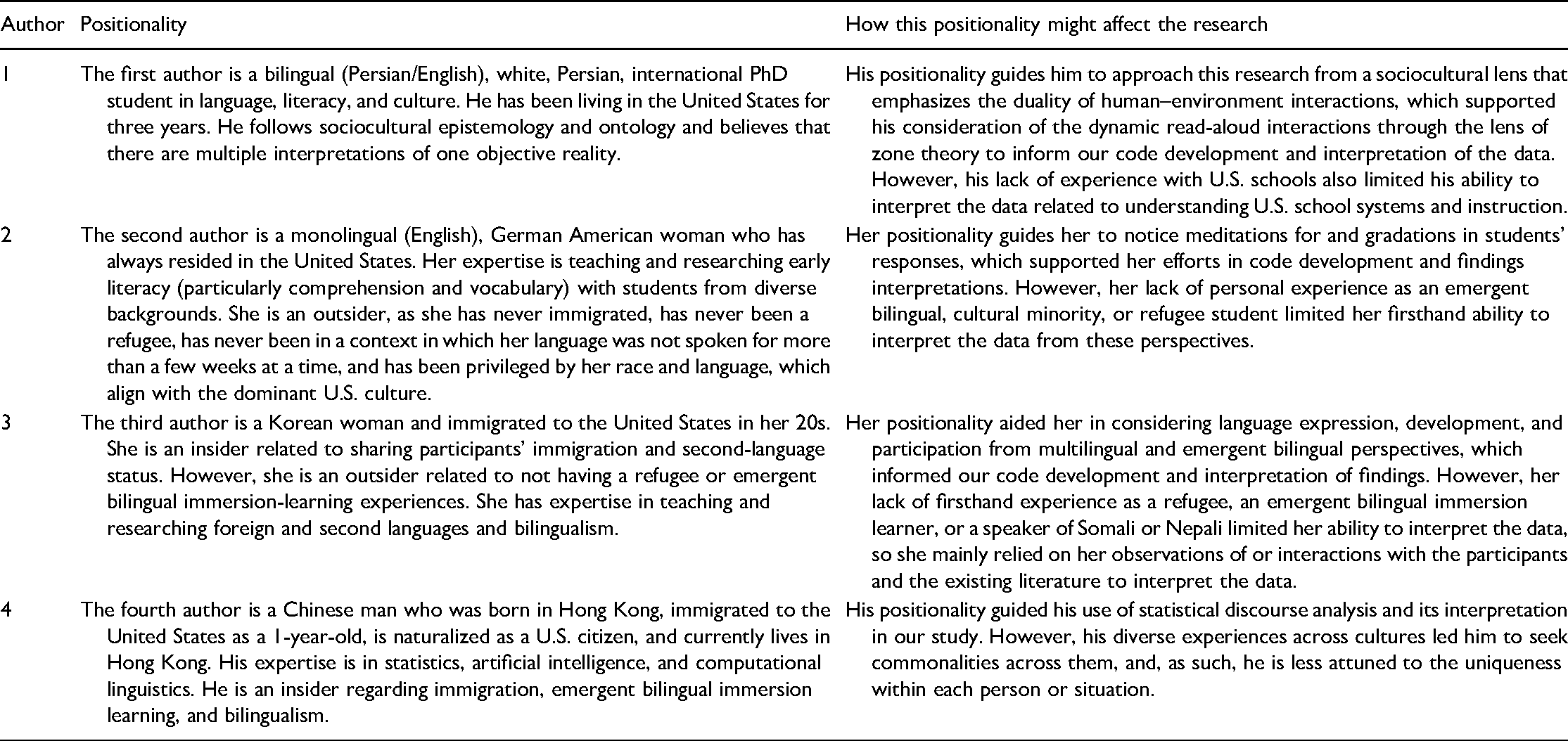
Table 1 presents our positionalities and how these potentially affected the research. Our diverse positionalities allowed us to collaboratively engage in the research, considering a wider range of perspectives than if any one of us had conducted the research independently.
Researcher Positionalities.
ReadAloud Books and Sessions
The second and third authors, in collaboration with Ms. Mason, selected four picture books. First, the second and third authors used a culturally relevant text rubric (Sharma & Christ, 2017) to guide selecting several books from each of the following categories, to represent a range of cultural relevance to this group of students: books that represented Somali culture, books that represented Nepali culture, books that represented cultural differences (but not Somali or Nepali culture), and books that represented European American middle-class culture. This range allowed us to explore how cultural relevance might intersect with talk-turns. More culturally relevant books were used first to potentially increase students’ comfort and engagement, and less culturally relevant books were used later. We also considered conceptual and linguistic complexity and book length in deciding if books might be appropriate for this group based on their WIDA scores.
Second, Ms. Mason considered the possible books we provided and decided which books she wanted to use. She also considered the conceptual and linguistic complexity and book length in her selection process, and whether these were appropriate given her students’ English-language skills.
The final books selected represented the following:
Somali culture and a refugee experience: My Friend Jamal (McQuinn, 2008), hereafter Jamal, read in Week 1; Nepali culture: I See the Sun in Nepal (King, 2010), hereafter Nepal, read in Week 2; cultural differences, but not a Somali or Nepali refugee experience: The Sandwich Swap (Queen Rania, 2010), hereafter Sandwich, read in Week 3; and European middle-class culture that is often overrepresented in classrooms (Currie, 2013): Lilly's Big Day (Henkes, 2014), hereafter Lilly, read in Week 4.
Ms. Mason read the books aloud in English (as she could not read in Nepali or Somali), and the students discussed each book with her using predominantly English, but also words and concepts from their home languages (Nepali or Somali). Students also helped the teacher with pronunciations and meanings for words relevant to their culture and home language. Each book was read and discussed across two 20-min sessions (2 h and 40 min in all).
Conceptually, the books and sessions (first vs. second) reflect the Zone of Free Movement, as they can restrict or expand the availability of educational tools and activities. As the content of the books or the session might affect the teacher's and students’ talk, we entered these book titles and session numbers as control variables in our analyses.
Data Collection and Preparation
The eight read-aloud sessions were video recorded by Author 4. She mostly observed during sessions, but occasionally supported Ms. Mason with tasks, such as helping the children complete the culturally relevant text rubric after they completed each read-aloud. Based on the videos and transcriptions, both Ms. Mason and the children seemed comfortable having her in the classroom. A transcriptionist transcribed the videos organized into talk-turns (designated by when speakers changed), so that each turn was on one row of a database, and the speaker (all names are pseudonyms), book, and session number were identified. Author 4 checked and corrected the transcription. Talk-turns were counted in the database by the statistical program. The dataset had 3,315 talk-turns, including 1,806 by students.
Power analysis
With 1,806 student talk-turns, statistical power for talk-turns at ≤ .05 for an effect size of 0.1 is 0.99 (see Cohen et al.'s 2003 appendix Table G; Konstantopoulos, 2008). Thus, we can be confident in the results at the talk-turn level. However, with just four students, statistical power at the student level is negligible, so student-level results (i.e., differences between students, such as age, race/ethnicity, WIDA scores, etc.) will not be discussed.
Data Coding
Coding talk-turns
Three of the authors engaged in the following iterative process of code development, each time with two samples of about 30 talk-turns from each session. First, we identified the construct from Valsiner's (1997) zone theory that seemed to align with each turn of talk: ZFM, ZPA, ZPD, or ZAD (Valsiner, 1998). Then, we used open coding and constant comparative analysis to identify codes for each talk-turn within each construct (Corbin & Strauss, 2014). For example, we identified “Can you please look up here, so I know you’re listening,” as mediating the ZFM, and the code “request to behave in a certain way” was developed to indicate such responses. Then, we grouped related codes within a construct together. For example, within ZFM, the codes were classified as either restricting ZFM (e.g., “request to behave in a certain way”) or expanding ZFM. How related codes are grouped within each construct is presented in Table 2. Note that the ZAD codes were our dependent (outcome) variables. Other codes were our independent (explanatory) variables.
Constructs, Categories, Codes, and Examples From Transcripts.
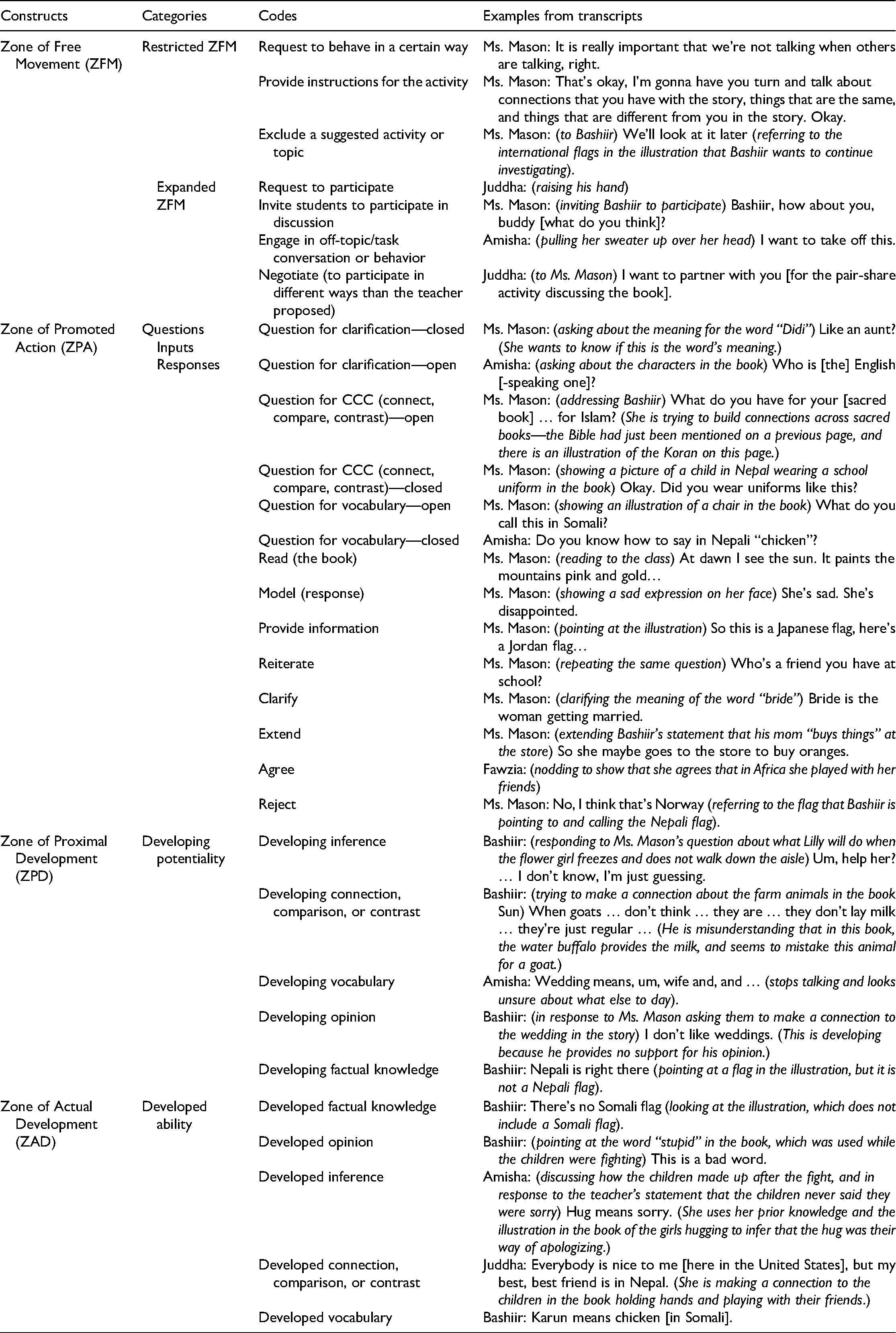
After the coding development was complete, and the constructs, codes, and categories were consistently applied by the first two authors, two graduate assistants each separately coded the entire data set (all 3,315 talk-turns) using the final codes. The coding results showed high inter-rater reliability for all zone variables (Krippendorff's [2012] ≤ .807; agreement = 82%). Discrepancies were discussed until consensus was achieved, then the consensus codes were used for analysis.
Coding the cultural relevance of books
After the first session with each book, both the child and their teacher individually rated how culturally relevant each book was for the child using a rubric (see Figure A in the online supplementary archive). Past research showed that children's and teachers’ ratings can predict different aspects of student comprehension test outcomes after independent reading (Christ et al., 2018), which is why we used scores from both teachers and students. So, each child had their own self-rating and teacher rating for the cultural relevance of each book, which were used in the analysis (see the ratings in Table A in the online supplementary archive). Aligned with previous research, a cultural relevance rubric asked the scorer to rate whether the student and the main character in the story shared the same: ethnicity or religion, gender or age, talk, places they had been, or experiences (Christ et al., 2018; Ebe, 2010). The content validity of the rubric is based on its alignment with other scholars’ theoretical support for considering these aspects of cultural relevance, which reflect students’ multiplicities of identities across a spectrum of very relevant to irrelevant narrative text characteristics (Ebe, 2010; Ladson-Billings, 1994). For each dimension, the scorer rated the criterion as “the same as me,” “kind of like me,” or “isn’t the same as me.” These multiple criteria and gradations helped capture students’ multiplicities of identities (Paris & Alim, 2017). Test-retest reliability for culturally relevant book ratings was not established. Cultural relevance ratings for each book, by both the student and teacher, were entered into a database for analysis.
Data Analysis
We used statistical discourse analysis (Chiu & Lehmann-Willenbrock, 2016) to model how the teacher's and students’ earlier talk-turns (explanatory variables: ZFM, ZPA, ZPD) affected students’ later talk-turns (dependent variables: ZAD, N = 1,806 student turns of talk). (||The 1,509 teacher talk-turns were captured as lag variables within each student turn observation; e.g., “teacher_agree [−1]” indicated that the teacher agreed in the previous turn before the current student turn.) Information about analytic issues and how we addressed them using statistical strategies is presented in Table B in the online supplementary archive.
To determine the factors linked to specific students’ ZAD talk-turns, statistical discourse analysis modeled discrete dependent variables at the talk-turn level (Chiu & Lehmann-Willenbrock, 2016) via MLwin 3.05 software (Charlton et al., 2020). A 4-level (dependent variables within turns within students within sessions) Logit variance components model (Goldstein, 2011) tested for significant differences in the dependent variables across talk-turns, students, and sessions.
P(
The probability, P(
P(
As the researchers considered students’ language abilities and interests in selecting read-aloud books, we entered student demographic variables before book cultural relevance ratings. As structural variables might affect process variables, we entered demographics and book ratings before student talk-turns. We entered the talk-turn three turns ago, followed by the talk-turn two turns ago, and then in the previous turn (chronological order).
The vector
As omitting nonsignificant isolated variables does not cause omitted variable bias, we safely removed them to increase precision and reduce multicollinearity (Kennedy, 2008). We applied this procedure to all vectors of variables.
Next, we added the
Afterward, we added variables from three turns ago (3) (teacher [vs. student], ZFM [request student behavior, give activity instructions, exclude suggested topic/activity, narrows ZFM, request to participate, off-task, negotiate], ZPA [closed clarification question, open clarification question, open connection/comparison/contrast question, closed connection/comparison/contrast question, open vocabulary question, read, model response, give information, reiterate information, clarify, extend idea, agree, reject], ZPD [developing inference, developing connection/comparison/contrast, developing vocabulary, developing opinion],
Path analyses estimate direct and indirect effects via mediation tests in forward chronological order: (4) → (3) → (2) → (1) → dependent variable (Kennedy, 2008). We examined the residuals for significant outliers. To test whether these results were robust to distribution assumptions, we repeated the above analyses with the Probit link function rather than Logit (Kennedy, 2008).
Results
The variance components model showed that the students’ five types of performance within their ZAD (i.e., expressing developed factual knowledge, developed opinion, developed inference, developed connections/comparisons/contrasts, and developed vocabulary) all varied mostly across turns (∼77%) and less across sessions (∼23%). All results discussed below describe the first entry into the regression, controlling for all previously included variables. All variables and interactions that are not reported were not significant or reflect student demographic variables that we cannot report with confidence. Analysis of residuals showed no significant outliers. Probit and other robustness tests showed similar results. Ancillary regressions and statistical tests are available upon request. Summary statistics are provided in Table C and D in the online supplementary archive.
Factual Knowledge
EBSs’ expressions of comprehension or vocabulary in their ZPD and mediations of the ZPA were linked to a subsequent student's expression of developed factual knowledge—that is, evidence of performing in their ZAD (see Table 3, top section). When a student expressed developing factual knowledge (ZPD) three turns earlier (3), they were 49% more likely than otherwise to show developed factual knowledge (ZAD) three turns later (49% was computed from the odds ratios [Kennedy, 2008] of regression coefficient 4.501 in Table 3, model 4). This reflects student development across read-aloud talk-turns.
Summary of Multivariate Outcome, Multilevel Cross-Classification Results With Regression Coefficients.
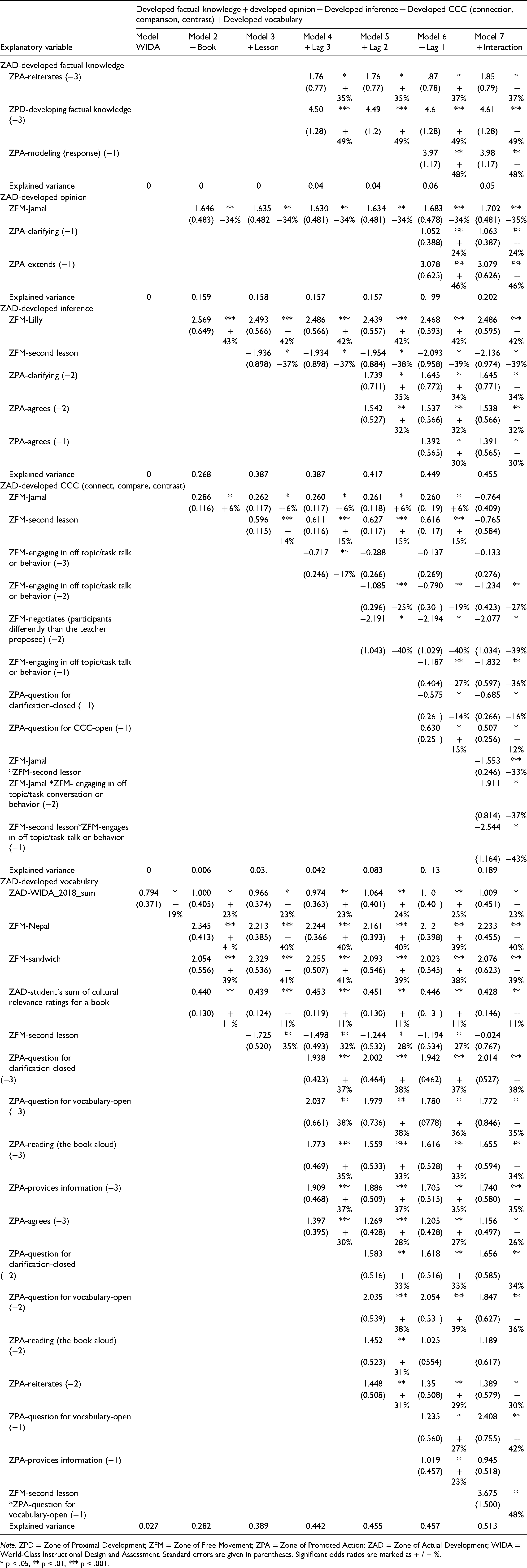
Note. ZPD = Zone of Proximal Development; ZFM = Zone of Free Movement; ZPA = Zone of Promoted Action; ZAD = Zone of Actual Development; WIDA = World-Class Instructional Design and Assessment. Standard errors are given in parentheses. Significant odds ratios are marked as + / − %.
* p < .05, ** p < .01, *** p < .001.
Further, when a teacher or a student reiterated information three turns earlier (3), this mediated the ZPA so that the student was 35% more likely than otherwise to express developed factual knowledge three turns later (35% = odds ratio of 1.766 in Table 3, model 4). Additionally, when a teacher or student modeled a response in the previous turn (1), this mediated the ZPA so that subsequently a student was 48% more likely than otherwise to express developed factual knowledge (ZAD) in the next turn of talk. This model accounted for nearly 6% of the differences in developed factual knowledge (see Table 3, top section, model 7, explained variance = .059).
Developed Opinion
Mediations of the ZFM and ZPA were linked to an EBS subsequently expressing a developed opinion (ZAD, see Table 3, second section from top). Using the book Jamal restricted the ZFM with regard to expressing a developed opinion, as compared to other books. When reading Jamal, students’ developed opinion in a talk-turn was 34% less likely, accounting for nearly 16% of its variance (see Table 3, developed opinion section, model 2, explained variance).
In contrast, talk-turns such as a teacher or student clarifying or extending an idea in the previous turn mediated the ZPA so that a student's developed opinion in the next turn was 24% and 46% more likely than otherwise, respectively. This model explained over 20% of the variance in developed opinions.
Developed Inference
Mediations of the ZFM and ZPA were linked to a student expressing a developed inference (ZAD; see Table 3). When discussing the book Lilly, rather than other books, the ZFM was restricted, so a student was 43% less likely to express a developed inference, accounting for nearly 27% of the variance in developed inferences (see Table 3, developed inference section, model 2, explained variance). Likewise, a student was 37% less likely to express an inference when discussing a book during its second session (restricted ZFM), which accounted for nearly 12% of the variance (∼12% = 0.387–0.268; see Table 3, models 2 and 3, explained variance).
After a student mediated the ZPA by clarifying two turns earlier, agreeing two turns earlier, or agreeing one turn earlier, the student in the current turn was, respectively, 35%, 32%, or 30% more likely than otherwise to express a developed inference. Overall, this model explained over 45% of the variance in developed inference.
Developed Connection, Comparison, or Contrast
Mediations of the ZFM and ZPA were linked to a student expressing a developed connection, comparison, or contrast with the book (hereafter, connection/comparison/contrast)—evidence of performing in their ZAD. When discussing Jamal, rather than other books, a student was 7% more likely to express a connection/comparison/contrast. Also, a student was 14% more likely to express a developed connection/comparison/contrast when discussing a book in its second session rather than the first. By contrast, after a teacher's or student's off-task behavior one, two, or three turns ago (expanded ZFM), a student's developed connection/comparison/contrast was 27%, 25%, and 17% less likely than otherwise, respectively. After a teacher's or student's off-task behavior three or two turns earlier, off-task behavior in the next turn was, respectively, 45% or 46% more likely, both mediating 60% of the link with a student's developed connection/comparison/contrast in the current turn (z = 3.56, p < .001; z = 2.88, p = .004). Also, after a student's attempted negotiation two turns earlier with the teacher (expanded ZFM), a student's developed connection/comparison/contrast in the current turn was 40% less likely than otherwise.
When a teacher or student mediated the ZPA by asking a closed clarification question in the previous turn, a student was 14% less likely than otherwise to express a connection/comparison/contrast in the next turn. However, when a teacher or student focused the ZPA by asking an open connection/comparison/contrast question one turn earlier, a student was 15% more likely than otherwise to express a connection/comparison/contrast in the next turn.
These variables also showed significant interactions. When discussing Jamal in its second session, a student's developed connection/comparison/contrast was 33% less likely than otherwise. Also, when a teacher or student was off-task two turns earlier while discussing Jamal, a student's developed connection/comparison/contrast in the current turn was 37% less likely than otherwise. When a teacher or student was off-task in the previous turn, while discussing a book in its second session, a student's developed connection/comparison/contrast in the current turn was 43% less likely than otherwise. These interactions accounted for over 7% of the variance in developed connection/comparison/contrast (see Table 3). Altogether, this model accounted for nearly 19% of the variance in developed connection/comparison/contrast.
Developed Vocabulary
An EBS's expressions of vocabulary in their ZAD, and teacher or student mediations of the ZFM or ZPA, were linked to students’ subsequent expressions of developed vocabulary (ZAD). A student who rated a book as culturally relevant (ZAD) was 5% more likely than others to express developed vocabulary in each talk-turn (i.e., equivalent to 94% greater likelihood of one additional instance of developed vocabulary in each session; computed from the mathematical union of independent probabilities for the 56 mean turns by a student in a session; 94% = 1 – [100% – 5%]56).
When discussing Nepal or Sandwich rather than other books (ZFM), a student was 41% and 39% more likely, respectively, to express developed vocabulary (ZAD). Books and book ratings accounted for over 25% of the variance in developed vocabulary (∼25% = 0.282–0.027; see Table 3, developed vocabulary section, models 1 and 2, explained variance). In contrast, when discussing a book during the second session (ZFM), a student was 35% less likely to express developed vocabulary (vs. in the first session). Session accounted for nearly 11% of the variance in developed vocabulary (see Table 3).
When a teacher or student mediated the ZPA by asking a closed clarification question three or two turns earlier, a student was 37% or 33% more likely to express developed vocabulary (ZAD), respectively (see a transcript example in Table E in the online supplementary archive). Likewise, when a teacher or student mediated the ZPA by asking an open vocabulary question three, two, or one turn earlier, a student was 38%, 38%, or 27% more likely to express developed vocabulary (ZAD), respectively (see a transcript example in Table F in the online supplementary archive).
Also, when a teacher mediated the ZPA by reading three or two turns earlier, a student was 35% or 31% more likely to express developed vocabulary (ZAD), respectively. Additionally, when a teacher or student mediated the ZPA by providing information three turns or one turn earlier, or reiterating information two turns earlier, a student was 37%, 23%, and 31% more likely to express developed vocabulary (ZAD), respectively. Finally, when a teacher or student mediated the ZPA by agreeing with an idea three turns earlier, a student was 30% more likely to express developed vocabulary.
Some of these variables also showed significant interactions. In the second session with a book, a teacher reading three turns earlier was 33% less likely to occur (because more of the book reading occurred in the first session), and a teacher or student providing information three turns earlier was 27% less likely (because more new information was provided in the first session)—these mediated 13% of the link between the second session and a student's expression of developed vocabulary (z = −2.63, p = .009; z = −2.93, p = .003, respectively). Further, in the second session with a book, a teacher was 44% less likely to read two turns earlier, which mediated 17% of the link between the second session and a student's expression of developed vocabulary (z = −2.27, p = .023). Also, after a teacher reading three turns earlier, an open vocabulary question was 40% more likely, which mediated 12% of the link between reading three turns earlier and a student's expression of developed vocabulary (z = 2.96, p = .003). After a teacher or student provided information three turns earlier, providing information in the previous turn was 34% more likely, which mediated 10% of the link between providing information three turns earlier and a student's expression of developed vocabulary (z = 2.10, p = .035). After a teacher reading two turns earlier, an open vocabulary question in the previous turn was 44% more likely and providing information in the previous turn was 37% more likely, so these mediated 29% of the link between reading two turns earlier and a student's expression of developed vocabulary (z = 2.07, p = .039; z = 2.09, p = .037). This model explained over 51% of the variance in developed vocabulary.
Discussion
Pedagogical Contributions
Our findings underscore the importance of dialogic interactions to support EBSs’ participation in read-alouds, and inform how teachers might adjust both the ZPA and ZFM to support EBSs’ expressions of developed comprehension and vocabulary during read-alouds.
Zone of promoted action
Our findings show that specific mediation of the ZPA supported EBSs’ expressions of specific aspects of comprehension or vocabulary. First, teacher and student reiterations and modeling were related to students’ expressions of developed factual knowledge. This extends previous research, which found teacher low- and high-level comprehension-building talk is important to supporting students’ comprehension and vocabulary test outcomes (Gómez et al., 2017; Mascareño et al., 2016; Zucker et al., 2013), by identifying specific prior teacher comprehension-building talk-turns (reiteration, modeling) that are related to specific subsequent student comprehension talk-turns (factual knowledge). Further, it extends previous research on student talk, which focused on the kinds of interactions students contributed (Williford et al., 2013), by identifying how specific kinds of student talk-turns facilitated subsequent student talk-turns that demonstrated particular aspects of comprehension.
Second, clarifying and extending were related to students’ expressions of developed opinions, clarifying and agreeing were related to students’ expressions of inferences, and providing more information was related to students’ expressions of developed vocabulary knowledge. This extends previous research, which noted that multiple kinds of teacher feedback occurred during read-alouds (Hindman et al., 2019; Mascareño et al., 2017), but did not explore how these were related to subsequent students’ comprehension talk-turns. Further, it extends previous research that showed EBSs provide cognitive and linguistic support for one another (Martin-Beltrán et al., 2017), by showing the specific mechanisms by which these support students’ comprehension.
Third, many mediations of the ZPA predicted developed vocabulary outcomes. Particularly when the teacher read more, or the teacher or students asked more open-ended vocabulary questions, then students were more likely to express developed vocabulary knowledge. This extends previous research, which focused on the extent to which teachers asked low- versus high-cognitive-demand questions (Price et al., 2012; Zucker et al., 2010) and the connection between the type of teacher question and the type of student response (e.g., inference) (Mascareño et al., 2017; Zucker et al., 2010), by identifying the connection between a particular kind of question (open-ended vocabulary) and the subsequent quality of a student's response (developed vocabulary knowledge). Further, it extends previous research that underscores the importance of student talk for increasing their standardized vocabulary test scores (Hindman et al., 2019) by demonstrating the specific importance of students asking questions and providing information to support subsequent students’ developed vocabulary talk-turns.
These findings highlight specific conversation moves that teachers can use and encourage their students to use, to support EBSs’ expressions of comprehension and vocabulary during read-alouds. They also demonstrate the need to shift away from the predominant focus of previous research on teacher questioning (Blewitt et al., 2009; Christenson, 2016; Zucker et al., 2010) to further explore the important roles of teacher feedback and comprehension building and student talk-turns as well. Further, these findings highlight the importance of teachers sharing power with students during read-alouds to initiate talk and respond to one another (see Christ & Cho, 2022) for further discussion about sharing power with students related to this data set).
Zone of free movement
Three critical aspects of the ZFM were related to several talk-turn outcomes: book, session, and off-task behavior variables.
Our findings underscore the importance of careful book selection to support EBSs’ expressions of comprehension and vocabulary. A particular book was not simply better or worse. Instead, it supported some outcomes but hindered others. For example, Jamal (ZFM) predicted subsequent student expressions of developed opinions and developed connections/comparisons/contrasts (ZAD). Lilly (ZFM) predicted subsequent student expressions of developed inference (ZAD). Nepal and Sandwich predicted subsequent student expressions of developed vocabulary (ZAD). As different books support different particular outcomes, we suggest that teachers should consider choosing books accordingly. These findings extend previous research, which predominantly focused on how students were engaged or had better comprehension outcomes during culturally relevant read-alouds (Christ et al., 2018; Ebe, 2010; Worthy et al., 2013), by highlighting the complexity of how different books offer different engagement opportunities across more and less culturally relevant texts.
Further, the cultural relevance ratings for books was a significant predictor of students’ expressions of vocabulary. This extends previous research, which showed that cultural relevance text ratings were related to students’ comprehension test outcomes after independent reading (Christ et al., 2018; Ebe, 2010), by showing that cultural relevance text ratings are also related to students’ expressions of vocabulary knowledge during read-alouds. Thus, we provide evidence that more culturally relevant text, which aligns better with EBSs’ language and lives, provides unique opportunities to engage in dialogic conversations, such as using their first language or culturally situated knowledge.
Likewise, the session (the first vs. second time they discussed the book) was related to EBSs’ expressions of comprehension and vocabulary. For example, students made significantly more inferences in the first session, but significantly more connection/comparison/contrasts in the second session. Interestingly, more vocabulary was introduced in the first session, but more vocabulary expressions occurred in the second session, possibly reflecting how predominantly native-English-speaking students learn vocabulary via repeated exposures to vocabulary words across classroom settings (Christ & Chiu, 2018). We found sessions also affected predominantly native-English-speaking and underserved kindergarten students’ talk-turns as well; however, these students made more inferences in the second session. These differences may have to do with the students’ age and language differences across the two studies. These findings provide empirical evidence of the benefits of reading a book across sessions.
Finally, opening ZFM to include off-task talk or negotiations of discussion content often diminished connection/comparison/contrast outcomes, but not other outcomes. This extends previous research, which identified the kinds of teachers’ behavior management talk (Christenson, 2016; Gómez et al., 2017; Zucker et al., 2010), the amount of this talk that occurs during read-alouds (Christenson, 2016; Price et al., 2012), and that this talk is related to more on-task talk (Christenson, 2016), by showing that off-task talk affects different aspects of comprehension talk-turns differently. Possibly, connection/comparison/contrast outcomes required more global attention to the text and meaning-making, rendering it more vulnerable to interruptions. Thus, depending on the discussion focus, the importance of ZFM restrictions may vary.
Theoretical Contributions
This study extended previous empirical applications of zone theory (Blanton et al., 2005; Goos & Bennison, 2019) in three ways. First, we explored all the theoretical constructs in one statistical model, thereby reducing omitted variable bias (Kennedy, 2008). Second, unlike past studies’ post-instruction assessments of students’ ZAD via static, product-oriented instruments (e.g., Daniel et al., 2016; Lenhart et al., 2020), our study modeled students’ dynamic ZAD (moment-by-moment by using talk-turns) from within the temporal and social context of their read-alouds. Third, unlike past studies that only examined teacher mediations of students (Mascareño et al., 2017; Zucker et al., 2010), our study examined mediations by both teacher and students. This was also the first application of zone theory to explore a literacy learning context (see Bennison, 2020; Goos & Bennison, 2019).
Methodological Contributions
Most past studies only focused on one previous talk- turn's link to a focal talk-turn, but our results showed that earlier talk-turns (up to three turns earlier) can influence children's expressions of comprehension or vocabulary in their ZAD. Thus, future studies should consider statistically modeling longer sequences of turns beyond two talk-turns using analyses such as statistical discourse analysis. Multiturn analysis aligns with Valsiner's (1997) theory, which suggested focusing on moment-by-moment analysis.
Further, our study demonstrated the importance of considering how both student and teacher talk-turns might mediate student ZAD responses. Past studies mostly focused on how teacher talk mediated student outcomes (Deshmukh et al., 2019; Hindman et al., 2019; Mascareño et al., 2017), or how peer-peer turns were qualitatively related (Martin-Beltrán et al., 2017). In contrast, our findings showed that student talk-turns, as well as teacher talk-turns, mediated students’ expressions of comprehension or vocabulary in their ZAD. These results suggest the importance of understanding and modeling interactions among all participants in read-alouds.
Limitations and Future Research Directions
This research has three important limitations that future studies can address. First, our study only included four child participants. While our statistical power for analyzing talk-turns was adequate, our power for drawing comparisons across students was not. While comparing students was beyond the scope of our study, future research might gather data with a larger group of students so that comparisons across students would be possible. Second, as our study focused on the context of EBSs’ read-alouds with their teacher, the findings cannot be generalized to other contexts. Future research might apply zone theory to explore other contexts. Third, our study only coded students’ externalizations (i.e., their verbalizations and gestures) but did not capture their intra-psychological states. This might explain our finding only one relation between ZPD and ZAD (i.e., for opinions). Future studies can collect intra-psychological states and include these in the analysis as well.
Conclusion
Our study underscores the importance of EBSs’ talk-turns during read-alouds, as they contribute to subsequent students’ expressions of comprehension. Thus, teachers should create space for student talk, beyond just answering teachers’ questions.
Additionally, our study highlights what kinds of teacher or EBS supports facilitate particular subsequent expressions of EBSs’ comprehension during read-alouds. This information can be used to guide teacher and student mediation, as follows.
Use reiterating information and modeling responses to support EBSs’ expressions of developed factual knowledge. Use clarifying and extending information to support EBSs’ expressions of developed opinions. Use clarifying information and agreeing to support EBSs’ expressions of developed inferences. Use open-ended vocabulary questions to support EBSs’ expressions of developed vocabulary knowledge.
Further, our findings underscore the importance of using culturally relevant texts (see Sharma and Christ [2017] for how to select these texts). Particularly, more culturally relevant texts provide more opportunities for EBSs to use their linguistic repertoires to share developed vocabulary knowledge during read-alouds. Finally, our findings support engaging in read-alouds with EBSs across multiple days, as their kinds of responses can shift across time (e.g., more inferences on Day 1, and more connections on Day 2).
Supplemental Material
sj-docx-1-jlr-10.1177_1086296X221140859 - Supplemental material for Teacher and Emergent Bilingual Student Read-Aloud Mediations
Supplemental material, sj-docx-1-jlr-10.1177_1086296X221140859 for Teacher and Emergent Bilingual Student Read-Aloud Mediations by Iman Bakhoda, Tanya Christ, Ming Ming Chiu, Hyonsuk Cho and Yu Liu in Journal of Literacy Research
Supplemental Material
sj-docx-2-jlr-10.1177_1086296X221140859 - Supplemental material for Teacher and Emergent Bilingual Student Read-Aloud Mediations
Supplemental material, sj-docx-2-jlr-10.1177_1086296X221140859 for Teacher and Emergent Bilingual Student Read-Aloud Mediations by Iman Bakhoda, Tanya Christ, Ming Ming Chiu, Hyonsuk Cho and Yu Liu in Journal of Literacy Research
Supplemental Material
sj-docx-3-jlr-10.1177_1086296X221140859 - Supplemental material for Teacher and Emergent Bilingual Student Read-Aloud Mediations
Supplemental material, sj-docx-3-jlr-10.1177_1086296X221140859 for Teacher and Emergent Bilingual Student Read-Aloud Mediations by Iman Bakhoda, Tanya Christ, Ming Ming Chiu, Hyonsuk Cho and Yu Liu in Journal of Literacy Research
Supplemental Material
sj-docx-4-jlr-10.1177_1086296X221140859 - Supplemental material for Teacher and Emergent Bilingual Student Read-Aloud Mediations
Supplemental material, sj-docx-4-jlr-10.1177_1086296X221140859 for Teacher and Emergent Bilingual Student Read-Aloud Mediations by Iman Bakhoda, Tanya Christ, Ming Ming Chiu, Hyonsuk Cho and Yu Liu in Journal of Literacy Research
Supplemental Material
sj-docx-5-jlr-10.1177_1086296X221140859 - Supplemental material for Teacher and Emergent Bilingual Student Read-Aloud Mediations
Supplemental material, sj-docx-5-jlr-10.1177_1086296X221140859 for Teacher and Emergent Bilingual Student Read-Aloud Mediations by Iman Bakhoda, Tanya Christ, Ming Ming Chiu, Hyonsuk Cho and Yu Liu in Journal of Literacy Research
Footnotes
Acknowledgments
We are grateful for the generous support of the Oakland University Research Committee, and the teacher and students for sharing their learning with us.
Declaration of Conflicting Interests
The author(s) declared no potential conflicts of interest with respect to the research, authorship, and/or publication of this article.
Funding
The author(s) disclosed receipt of the following financial support for the research, authorship, and/or publication of this article: This work was supported by the Oakland University.

References
Supplementary Material
Please find the following supplemental material available below.
For Open Access articles published under a Creative Commons License, all supplemental material carries the same license as the article it is associated with.
For non-Open Access articles published, all supplemental material carries a non-exclusive license, and permission requests for re-use of supplemental material or any part of supplemental material shall be sent directly to the copyright owner as specified in the copyright notice associated with the article.
