




Abstract
Numerous scholars have called for young adult literature (YAL) to be a pedagogical avenue for educating secondary and postsecondary students about sexual violence, who are often socialized into harmful beliefs about victims. In this study, we draw on Manne's theorizing of “himpathy” and “herasure” to explore the ways in which YAL considers the ideological and systemic dimensions of misogyny leading up, during, and after incidents of sexual assault. The results of our critical content analysis of eight contemporary novels reveal several themes that offer insight and implications for English educators who want to use YAL to unpack misconceptions about sexual violence.
Acts of sexual violence and rape, as well as the ensuing treatment of survivors and those who perpetuate the crimes, have increasingly become depicted in the pages of young adult literature (YAL). These fictional accounts of real violence were called by National Public Radio a “parent's best friend” when discussing sexual assault and rape with young people (Ulaby, 2016, para. 15). Indeed, YAL provides a generative space for extending real-world experiences to support learners in taking emotional and mental risks and building empathy without experiencing trauma firsthand (Gee, 2017). Scholars have interrogated how YAL featuring sexual assault and violence is taught within secondary and postsecondary classrooms (Adams, 2020; Alsup, 2003; Colantonio-Yurko et al., 2018; Jackett, 2007; Malo-Juvera, 2014a; Park, 2012). This article turns its attention to various YAL titles that feature sexual assault and violence as main plot points to consider how ideological forces like misogyny and sexism operate in the texts themselves through a critical content analysis. We position our analysis and findings as advocacy for text selection within secondary curricula, in the vein of other scholars who have turned to critical content analysis of young adult (YA) and children's literature (Braden & Rodriguez, 2016; Cleveland & Durand, 2014; Crisp et al., 2018; Durand & Jiménez-García, 2018; Rodriguez & Braden, 2018; Rodríguez & Kim, 2018). In doing so, we argue that the content of such YAL titles deserves equal scholarly attention in education scholarship as the pedagogical decisions educators make when teaching such books.
In this article, we use Kate Manne's (2019) recently theorized conception of misogyny to analyze how systems uphold violence against women in the YAL “sub-genre of sexual assault narratives” (Moore, 2018, p. 145). This theory, originating in philosophy, is garnering increased interest from literacy scholars, who take it up to consider implications for YAL pedagogy (e.g., Boehm et al., 2020, 2021; Chappell, 2022). Specifically, we situate Manne's (2019) theorizing of “himpathy” and “herasure” as concepts to think through the ways YAL considers the ideological and systemic dimensions of misogyny leading up to, during, and after incidents of sexual assault and rape. While there has been an increase in sexual assault narratives (Altrows, 2019), there has not been a content analysis of this subgenre of YAL through a systemic theoretical perspective. A critical content analysis of such texts can inform how teachers and scholars develop curricular choices when teaching sexual assault in secondary classrooms while also illuminating how ideologies that perpetuate sexual violence operate in texts marketed toward young people. This study responds to calls from literacy scholars (e.g., Rogers, 2017; Vasquez, 2014) to position texts as vehicles for making connections to our broader world with the aim of fostering critical questioning. The following research question guided our analysis and exploration of the implications for teaching these texts: How do himpathy and herasure operate in YAL texts narrated by victims of sexual assault?
YAL, Sexual Assault, and Secondary Classrooms
Pattee (2004), extending the work of Cart (1996), saw the power of YAL to “‘shatter shibboleths’ and affect change” (p. 251). Writing about the book When Jeff Comes Home (Atkins, 1999), groundbreaking for depicting sexual violence against a male character, Pattee argued that the book serves as a “successful piece of fiction as well as a political statement” about gender dynamics, power, and violence (p. 253). Noting the power of YAL, numerous scholars have called for YAL to be a pedagogical avenue to discuss and ultimately end sexual assault, harassment, and violence (Alsup, 2003; Cleveland & Durand, 2014; Colantonio-Yurko et al., 2018; Jackett, 2007; Malo-Juvera, 2014a; Park, 2012; Ulaby, 2016). With a focus on language, meaning, and texts, Johnson and Kerkhoff (2018) argued English education holds a unique position in secondary content areas for addressing the #MeToo movement and the “nuance between unethical and illegal behavior” (p. 14). This scholarship largely focuses on the pedagogical and curricular potential of YAL that features sexual assault as sites for critical inquiry.
The potential of YAL in developing students’ understanding of assault and rape can be considered a curricular intervention to the literary canon, which perpetuates ideological justifications for violence against women, including assault and rape (Spampinato, 2018a, 2018b). Some literacy scholars have called for pairing YAL with canonical texts to address how sexual assault and violence manifest across different time frames and literary genres (Colantonio-Yurko et al., 2018; Malo-Juvera, 2014b). This body of scholarship also considers further splintered genres of sexual assault in teaching secondary students using YAL. For instance, scholars have considered how fictional athletes perpetuate sexual assault (Boehm et al., 2020), how genres like fantasy address sexual assault (Boehm et al., 2021; Herb, 2021), and how YA film adaptations impact families’ and caregivers’ understanding of contemporary conversations about assault (Walter & Boyd, 2019).
YAL remains an avenue for addressing key ideas and terminology surrounding sexual assault with secondary and postsecondary students, who are often socialized into harmful beliefs about survivors. Students may have internalized victim-blaming myths, which results in a view that blames individuals who are victims of sexual violence rather than critiquing the system that upholds sexual violence. For instance, in Park’s (2012) study of middle schoolers reading Speak (Anderson, 1999), she found that many female students voiced the belief that “sexual violence is the result of individual girls making poor decisions” (p. 202). In another study of Speak, Malo-Juvera (2014a) demonstrated the possibility that YAL can be used with intentional pedagogy to challenge a prevailing rape myth that rape victims are “asking for it.” These studies demonstrate how students can shift their thinking and disrupt rape myths regarding individuals’ actions and behaviors. While considering individuals is important, students also need to understand how systemic forces uphold and give credence to these dangerous misconceptions regarding sexual violence and victim-blaming (Adams, 2020), especially since YAL featuring rape frequently reifies neoliberal beliefs about the individuals rather than addressing feminist concerns about the systemic issues (Altrows, 2019).
It's important to note the limitations of this scholarly body. The bulk of scholarship relating to depictions of sexual assault in YAL has focused on assault victims who are mostly White, cisgender, and heterosexual females. In writing about a lack of representation in YA rape novels, Hubler (2017) argued that “narrators who are Black, poor, gay, or intellectually disabled articulate the experiences and insights of disadvantaged social groups” that shed light on the “ways in which gender interacts with other social institutions to structure violence” (p. 115). We agree that this genre needs to center on the experiences of victims outside of White, middle-class, cisgender, heterosexual characters.
We attend to the teaching considerations of YAL that includes sexual assault and violence because it is an important component of secondary education scholarship. Our study departs from and expands on the literature we cite by turning our analytical focus directly to the YA titles. How teachers make sense of and teach such YAL titles is important, and given the proliferation of YAL that includes sexual assault and violence in recent years, we seek to unearth gendered dynamics that animate the emerging collection of such books. Understanding the gendered undercurrents of YAL can inform which texts teachers select for curricular purposes (Cleveland & Durand, 2014) and what pedagogical moves teachers make when positioning and teaching books (Alsup, 2003). Manne’s (2019) theoretical concepts of himpathy and herasure guide our illumination of these undercurrents.
Misogyny, Himpathy, and Herasure
Manne’s (2019) work was selected for this manuscript because her theory provides two new concepts—himpathy and herasure—that scholars, particularly those in educational contexts, can use to analyze the ways sexual assault and violence are depicted in literary texts for young people. Additionally, Manne's theory provides distinctions between misogyny and sexism, which provides new language to understand the multifaceted ways social, political, and cultural forces normalize and excuse sexual assault and violence. Finally, the theoretical concepts of himpathy and herasure offer insight into how sexual violence in YAL operates through literary concepts like plot and character, which shape the messaging of stories that center sexual assault in their narratives.
First, it is important for us to establish our understanding of gender and identity. Like Manne, we reject binary notions of gender that are inherently oppressive. Indeed, a litany of harmful ideologies is necessary for misogyny to be upheld, including a “commitment to gender binarism,” an “anti-trans metaphysics of gender,” a “heteronormative view of human sexuality,” and compulsory monogamy (Manne, 2019, p. 27). We must recognize and understand these ideologies, even in “morally gory detail,” in order to challenge them (Manne, 2019, p. 27). Additionally, we need to consider other social categories and identities in discussing misogyny. Theorizing out from Crenshaw (2012), Manne (2019) argued that “vulnerabilities can augment one another” or “alternatively be mitigated by privilege” (p. 65). For instance, cisgender White women are protected from certain manifestations of misogyny because of their racial and cis identities. Manne offered a “common ‘folk’ criterion” for misogyny: A woman is subject to misogyny if her “male counterpart in an otherwise comparable social position (so holding fixed, e.g., race, class, sexuality, cis/trans status, disability, age, and so on) wouldn’t plausibly be subject to such hostility” (pp. 69–70).
Misogyny
Manne (2019) splits the difference between sexism and misogyny: The former is an “ideology that justifies and rationalizes a patriarchal social order,” while the latter is the “system that polices and enforces its governing norms and expectations” (p. 20). Manne focused on the experiences of women rather than the feelings of men. Her conceptualization of misogyny moves beyond the individual to look at how systems shape power dynamics that sustain male dominance and perpetuate sexual violence. A failure to observe systems perpetuates the false belief that violence against women is caused by men who suffer “psychological ill health, or perhaps irrationality” rather than a “predictable manifestation” of “social power relations” (p. 49).
Thus, we position a selection of YAL that Moore (2018) aptly named the “sub-genre of sexual assault narratives” (p. 145) as avenues for understanding the ways that misogyny impacts individuals and their social contexts. We sought to understand how fictional characters rationalize and think about the social order that places men above everyone else (sexism) and how the systems and institutions within a text enforce the social order (misogyny). Subsequently, Manne's concepts of himpathy and herasure are valuable analytical concepts in understanding the unexamined facets in everyday life that construct the “banality of misogyny” (Manne, 2019, p. 211). In other words, these two concepts provide language to describe the justification of everyday, seemingly mundane injustices women experience. These two concepts operate as “down girl moves,” which are social and political maneuverings used to “put women in their place” when they threaten the power of men (Manne, 2019, p. 69).
Himpathy
At its core, himpathy is the “flow of sympathy away from female victims toward their male victimizers” (Manne, 2019, p. 23). Himpathy, an idea founded on sympathy, is fundamentally about power and whose narrative will be centered and believed in the wake of sexual violence. Tolentino (2018), writing about the career resuscitation of men who have been accused of sexual violence, illustrated the role of himpathy best as the “gravitational pull of male power” that turns “our attention back to the place where it has been trained to linger: the hero's journey of men” (para 1). Calling the imbalance of gender power dynamics the “laws of patriarchal physics,” Tolentino (2018) argued that the metaphorical laws require that “for every act of sexual assault or harassment a man deserves an equal and opposite second chance” (para 2). This notion of second chances for many male offenders in each of the selected texts is apparent. While the female protagonists confront their attacks and wade into their trauma and social isolation, the male characters are often pitied, forgiven, and believed.
Herasure
Manne (2019), calling it the “disappearing woman trick,” argued that herasure allows for men's stories to be rewritten in order to “uphold certain men's innocence, to defend their honor, and to grant them a pardon prematurely” (pp. 178–179). The rewriting of the assaulter's narrative provides a “good” public image while simultaneously erasing the victim of assault from the narrative and thus negating their experiences. Manne called the narratives that are structured to uphold men's innocence and erase women's experiences “exonerating narratives” (p. 179). Herasure ensures that gendered hierarchies remain unmoved by erasing any evidence that would suggest a man with socially dominant identities would be anything other than innocent. In this landscape, the “abuse of women is not the problem—naming it, and giving it consequences, is the problem,” as Tolentino (2018) illustrated: “Women's careers and psyches have been torpedoed by male exploitation for centuries, but it is a shame, apparently, for the men who exploited them to have to answer for what they’ve done” (para 10). Claiming victimhood, according to Manne (2019), requires placing “oneself at the center of the story” (p. 225). Herasure removes the victim from the narrative entirely. Simultaneously, herasure punishes the female victim, as Manne (2019) illustrated that the “tendency to forgive privileged men their sins … is connected with our hostility to female victims” (p. 193). We see this transaction happen in the YAL examined within this study.
Methodology
We conducted a critical content analysis in order to understand the relationship between misogyny and sexual violence in YAL. Drawing on Beach et al.'s (2009) definition of critical content analysis as a “conceptual approach to understanding what a text is about, considering content from a particular theoretical perspective” (p. 130), we sought to understand a variety of YAL addressing sexual assault through the theoretical framework of misogyny as explicated through himpathy and herasure (Manne, 2019). Botelho and Rudman (2009) noted that as a methodology, critical content analysis offers researchers a way to understand power across various texts and examine the “web of sociopolitical relations” while deconstructing “taken-for-granted assumptions about language, meaning, reading, and literature” (p. xv). A critical content analysis sharpens our reading to attend to the ways power and subjugation operate within a text, which echoes our theoretical framework's concern with domination, oppression, and power as shaped by gendered social systems. Constructing a critical content analysis of YAL meant aligning our attention to questions relating to “whose story is told, how the story line concluded, and issues of power” and examining “characters’ actions, dialogue, intent, relationships, ideological evidence, and family and cultural connections” (Mathis, 2015, p. 209). We took up these questions as understood through the theoretical concepts outlined in the previous section.
Building on Botelho and Rudman's (2009) assertion, Mathis (2015) noted that critical content analysis is a valuable methodology for educators who wish to advocate for particular texts and literature pedagogies in their classrooms. This appeal certainly echoes our positionalities as teacher educators who work with future and practicing English and childhood education teachers. Our study is informed by other former teachers-turned-education scholars who conducted critical content analyses of children's and YA literature for K-12 curriculum purposes (Braden & Rodriguez, 2016; Cleveland & Durand, 2014; Crisp et al., 2018; Durand & Jiménez-García, 2018; Rodriguez & Braden, 2018; Rodríguez & Kim, 2018). We want students to understand sexual violence beyond singular definitions and statistics in order to address deeper sociopolitical issues maintaining the systems that perpetuate sexual violence. A critical content analysis of sexual assault YAL narratives unearths the ideologies that underpin the texts teachers can incorporate into their curriculum.
Thus, our analysis of YAL that addresses sexual violence was guided by the following research question: How do himpathy and herasure operate in YAL texts narrated by victims of sexual assault? We approach this research question as four able-bodied, cisgender, White teacher educators who have incorporated YAL that features sexual assault as a major plot point across the spectrum of courses we have taught, ranging from high school English to graduate teacher education. As educators inside and outside of classroom spaces, we advocate for the inclusion of affirmative consent in sex education, shifts in dress codes to address victim-blaming mentality, inclusion of LGBTQ topics in human development units, and other measures we believe could challenge the logics of sexual assault in our educational institutions. All authors understand that sexual violence and assault are an abominable product of a sociocultural and political landscape that views the lives of non-cisgender men (as well as those with other marginalized identities) as less dignified. Rape is pervasive and normalized, and it has been documented for decades, including the material impact on people's lives. There is a culture of silence around discussions of sexual assault that prevents victims from learning the language of critique necessary to challenge rape culture, perpetuating oppression. This research stems from our own teaching practices as well as how we position ourselves as advocates on our respective campuses. Our work must also be reflective and contested. Thus, we must habitually interrogate how systems of oppression such as racism, ableism, classism, homophobia, transphobia, and other forms of harm shape how we conceptualize our work in teaching and researching about sexual assault and YAL.
Text Selection Process
Our criteria for selecting texts for analysis were YAL that (a) included sexual assault or rape as defined by the Rape, Abuse, and Incest National Network (RAINN), (b) was published in or after 2017, (c) focused on a protagonist who was the victim of an assault or rape committed by another adolescent, and (d) was realistic fiction set in the United States.
It was important to us that our findings about sexual assault and rape depicted in YAL be situated in contemporary legal and social realities. We relied on RAINN's (n.d.-a) definitions because the organization delineates different types of sexual violence and attends to questions of physical, emotional, legal, and social power. They note that “rape is a form of sexual assault, but not all sexual assault is rape” (RAINN, n.d.-a, p. 3). The term “sexual assault” can include a large number of sexually violent acts, while the term “rape” is considered to include unwanted sexual penetration. All of the assaults depicted in our selected texts fit within these definitions. These distinctions were important to make when constructing our text list. There are several YAL texts that feature sexual violence in different legal and temporal contexts. For instance, Sharon Draper's (2008) Copper Sun includes scenes in which enslavers rape enslaved people, while Patricia McCormick's (2008) Sold revolves around the personal journey of a young Nepali girl who is sold into sex trafficking. These depictions of fictional sexual violence are based on very real forms of sexual violence both historically and contemporarily and have been folded into other conversations about teaching sexual assault in secondary classrooms (Colantonio-Yurko et al., 2018). However, for the focus of this study, we specified legal and social forms of sexual assault that were not tied to other legal and power structures such as slavery, human trafficking, and incest.
Our decision to focus on YAL published during and after 2017 is predicated on the public attention (and ensuing backlash) to the #MeToo movement. Coined by activist Tarana Burke in 2006, “Me Too” or #MeToo became a political rallying cry in 2017 in response to a tweet by actor Alyssa Milano (Garcia, 2017). A year of survivors sharing their stories in various public outlets resulted in Time magazine naming the “Silence Breakers”—mostly women actors, public figures, and everyday people, who spoke out against the systemic sexual abuse in multiple industries—as their person of the year in 2017 (Zacharek et al., 2017). We do not necessarily see these texts as explicit responses to the #MeToo movement's ubiquity throughout 2017. Rather, we recognize these texts were published, consumed, and discussed in a sociopolitical landscape where public and scholarly discussions showed a fleeting interest in centering the victims of sexual assault and considering what a reckoning could look like in the public sphere (Tolentino, 2018). Such public and scholarly discussions included a critical reevaluation of long-standing popular culture artifacts ranging from books commonly read in schools (Cummins, 2019; Spiering & Kedley, 2019) to film and television (Dorsi, 2017; Freeman, 2018). As evident by Time's annual distinction, Me Too was a pivotal cultural and sociopolitical force in 2017. Thus, we pinpoint 2017 as the starting location for our text selection. And while our texts take place in the United States, we recognize that the #MeToo movement is part of a global conversation.
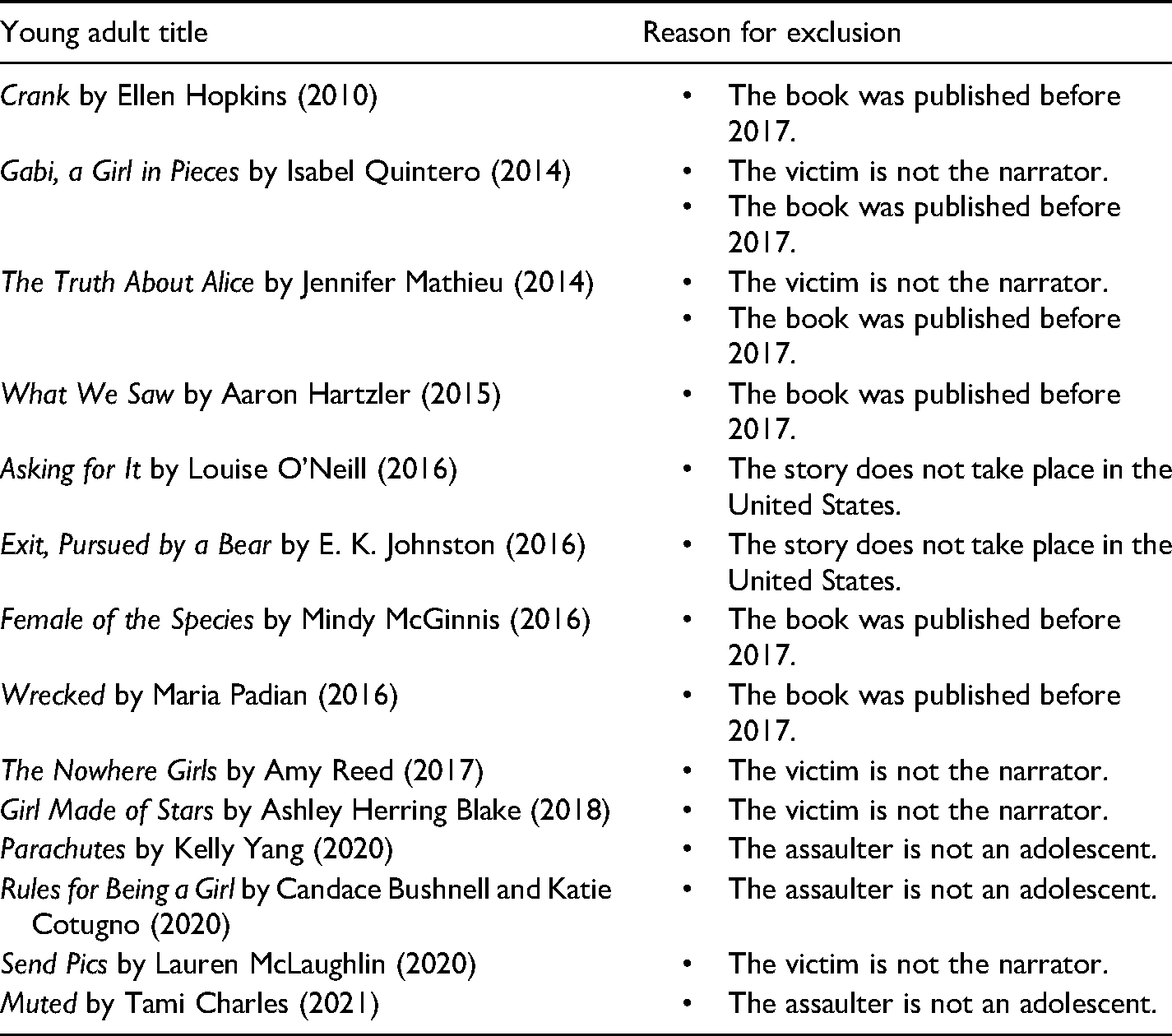
Additionally, we selected texts where the protagonist of the story is the victim of assault and is assaulted by another adolescent. Several YA texts feature non-narrating characters being assaulted and protagonists responding to the assault through emotional and political processes (e.g., Gabi, a Girl in Pieces by Isabel Quintero [2014], The Nowhere Girls by Amy Reed [2017], and Send Pics by Lauren McLaughlin [2020]) or feature assault being enacted by an adult figure, whether familial or institutional (e.g., Muted by Tami Charles [2021] and Parachutes by Kelly Yang [2020]). While these subjects are important for research and teaching practices, the criteria for our study put these texts outside the parameters of our critical content analysis.
Finally, we used the genre as a criterion in our selection of texts. We selected YAL based in the United States which is categorized as realistic fiction, which rules out genres like fantasy, science fiction, and horror. Other scholarship has attended to how genres like fairy tale (Boehm et al., 2021), folklore adaptations (Osman, 2021), and horror (Herb, 2021) address sexual assault and rape in their narratives. We focused on realistic fiction in part due to the fact that most YAL that addresses sexual assault is realistic fiction. Moreover, the focus on specific genres allowed us to further narrow our list and tighten the focus of the critical content analysis.
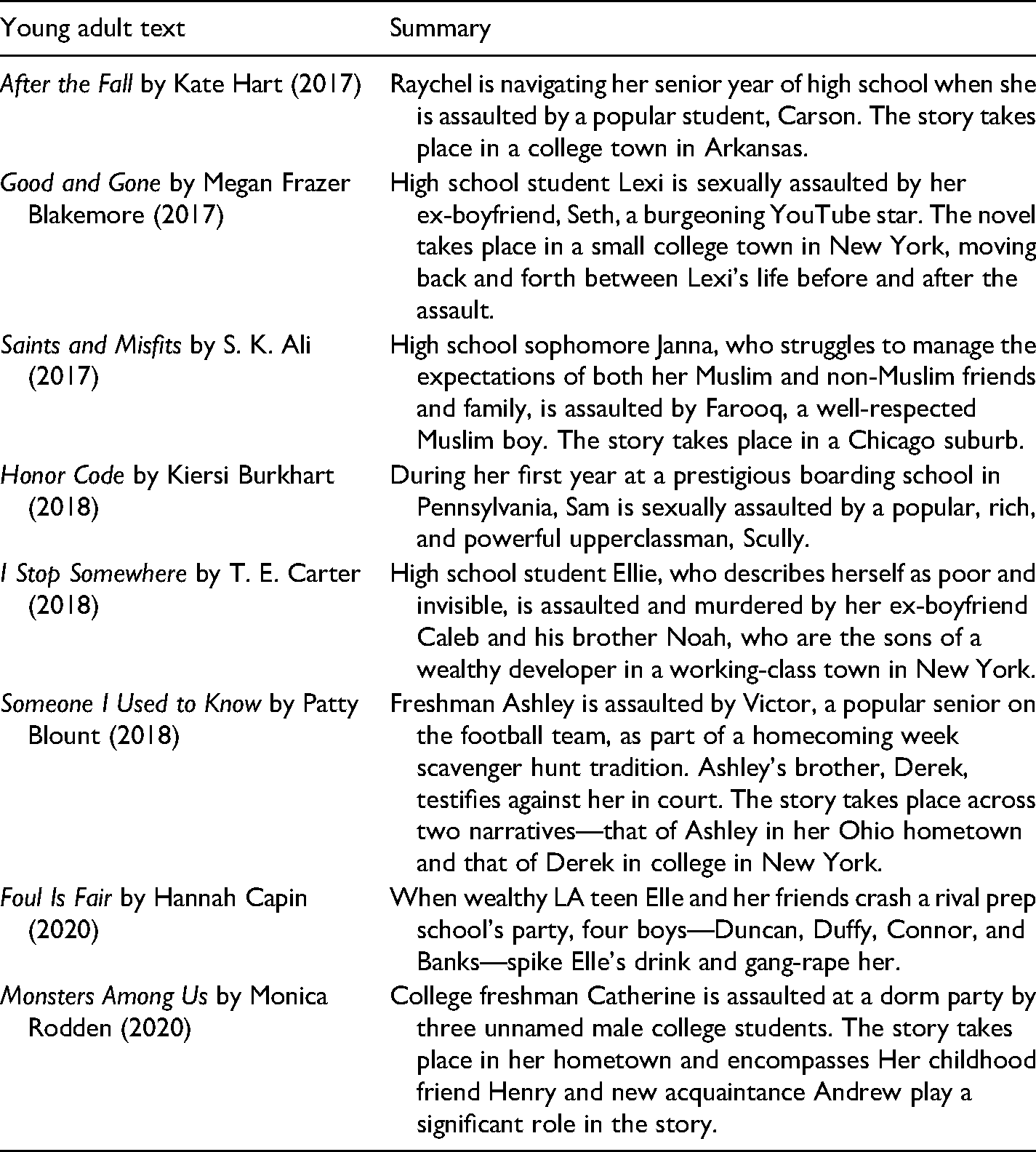
We began the process of selecting our texts after establishing the above criteria for our study. We consulted lists compiled by major news publications and bookstores—such as Barnes and Noble (Adler, 2017) and Publishers Weekly (Corbett, 2019), among others—that framed YAL texts as valuable for discussing the #MeToo movement and teaching about consent. Through this process, we initially identified 22 possible titles for analysis. We each reviewed the summary of all 22 books, including descriptions online. Then, we divided up the 22 titles to individually review. We convened afterward to compare notes and found that after applying our four criteria, only eight of the 22 titles merited further analysis. Reasons for excluding texts included depictions of sexual assault that fell outside of the RAINN (n.d.-a) definitions (e.g., human trafficking, incest); a publication date prior to 2017; a focus on a protagonist who was not an adolescent or a perpetrator who was not an adolescent; a genre outside of realistic fiction; and settings outside of the United States. We also drew on our own previous scholarship to consider texts for our study. At the end of our text selection process, we constructed a list of texts to study (Table 1).
List of Selected Texts.
Fourteen of these titles fell out of our analytic scope (Table 2). We detail the reasons for exclusion in this study to highlight our text selection process.
List of Excluded Texts and Reasons for Exclusion.
Data Analysis
Our analysis of the texts moved through two major phases. In the first phase, we read the books individually to familiarize ourselves with the major ideas and plots of the novels. During the first reading, we used Buehler’s (2016) elements of text complexity as a priori codes: (a) language, (b) structure, (c) other stylistic elements, (d) characters, (e) settings, (f) plot, (g) literary devices, and (h) topics and themes. These codes helped us to frame our initial analysis by attending to the data (i.e., the books) through a framework of recognized literary elements. At least two researchers read and annotated each text. Our responses to each text were shared in a collaborative document and each author had access to the data throughout the reading process. Each author documented their annotations while engaging in the recursive process of revising ideas in relation to the research question (Johnson et al., 2017). This meant that a priori codes such as “characters” helped us to identify critical moments of the texts (i.e., portions of text annotated by multiple authors) that were relevant to our research questions. For example, our understanding of the female protagonists’ framing in the novels as victims or survivors was discussed and debated throughout our coding process. This was a sticking point in our coding process as we debated which term to use to recognize the characters’ experiences in the texts. Additionally, researchers dialogued about the recurrence of codes to determine their relevance in answering our research questions. We also shared our developing understanding of the texts during research meetings and through informal modes of communication, which were documented through group meeting notes and researcher reflections. Such practices throughout the reading process existed as a form of “theoretical memos” (Johnson et al., 2017, p. 13). Our theoretical memos and annotations became our initial codebook.
The second phase of our analysis involved constructing themes and subthemes from annotations we compiled during the coding phase of our analysis process. We met and discussed conflicting interpretations and consolidated our codes (O’Connor & Joffe, 2020) (see Figure 1 for an example of collapsing codes).
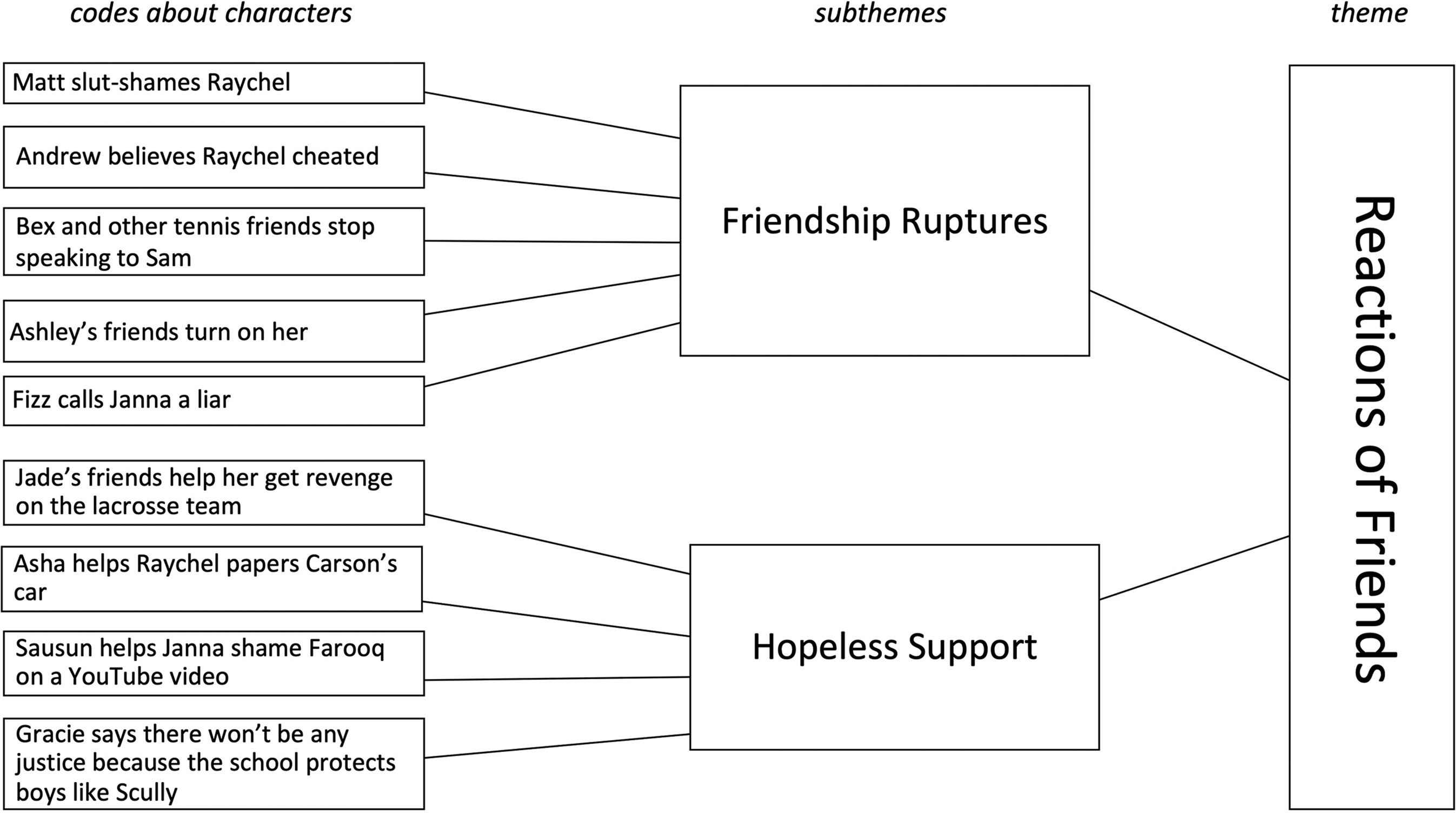
Code consolidation.
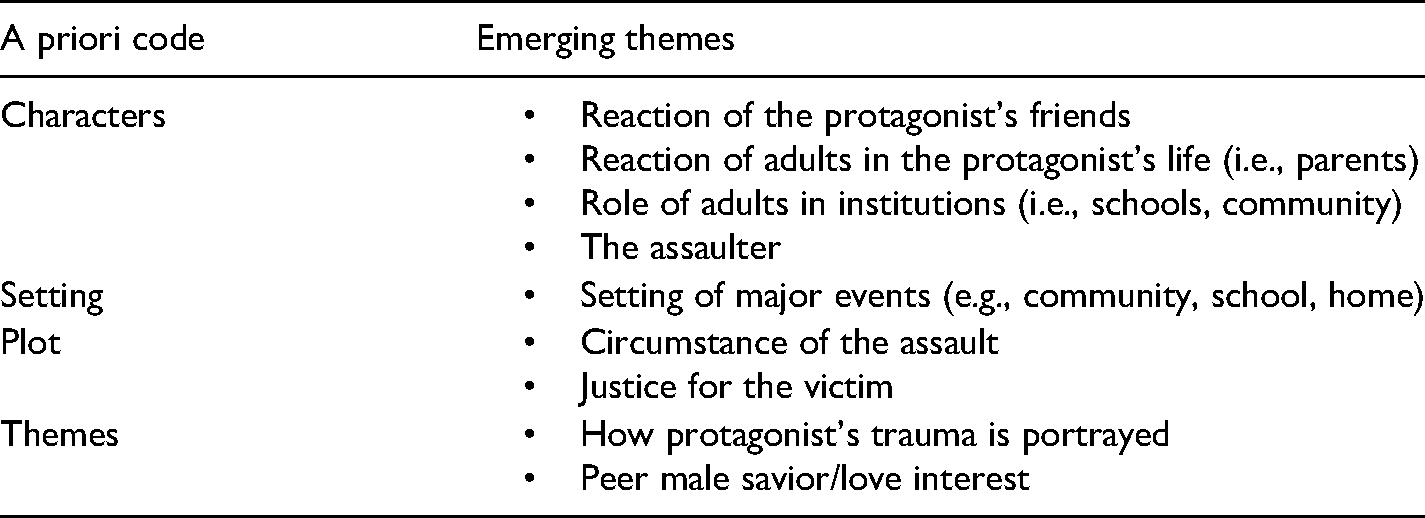
In keeping with best practices for analysis (Saldaña, 2015), we revisited Manne’s (2019) notions of himpathy and herasure to guide our analytical process. For himpathy, we looked for moments where characters who were assaulters were given credibility or empathy after an assault. Herasure was attended to in coding by highlighting moments where a character who was assaulted was criticized, minimized, or removed entirely from the narrative around the assault. We narrowed our focus to themes emerging from codes related to characters, setting, plot, and themes because they are most closely related to our research question. For example, after looking at text moments identified with the “character” a priori code, we identified characters who functioned as the victim, the assaulter(s), friends of the victim, adults in the victim's life, and adults in positions of institutional or community leadership as foci for understanding how himpathy and herasure operated within the texts (Table 3). We continued the recursive process of developing themes, returning to the texts, a priori codes, and annotations, and comparing the themes against the data until we were confident that our themes were accurate and comprehensive.
Example of Emerging Themes.
Findings
In the following section, we present the findings derived from our critical content analysis. Analysis revealed central themes across the eight novels related to consent, intent, friendship, reputation, justice, and notions of being human and monster. All but one of the themes have their own subthemes, which provide further answers to our guiding question of this project: How do himpathy and herasure operate in YAL texts narrated by victims of sexual assault? Both himpathy and herasure operate within and animate the aftermath of the assault, the reaction of friends to the narrator's assault, the way the assaulter is socially positioned and legally responded to, and the way survivors seek their own understandings of justice. These themes were identified within each text to varying degrees, but when taken together, the findings clearly demonstrate the ways in which himpathy and herasure are broadly present across YAL that addresses sexual assault. Given that these texts are ostensibly written to depict the lived realities of victims of sexual violence and illuminate them so as to undermine rape culture, it is essential that we understand how and when misogyny presents itself. Doing so empowers teachers and adolescent readers to directly engage with and challenge the ideological assumptions implied by such instances. We detail these operations and animations below.
Circumstances of Assault
Himpathy and herasure (Manne, 2019) exist within the tapestry of events surrounding the sexual violence in each novel. In four of the eight selected YA novels, female protagonist characters are sexually assaulted at parties. In the remaining four novels, sexual assaults happen in private spaces. For example, in Someone I Used to Know (Blount, 2018), Ashley is raped as a result of a “team-bonding” scavenger hunt completed each year by the football team leading up to homecoming week. Her rape is assigned 200 points in the game. The circumstances of each assault reveal the character's and community's stance on who is to blame for each act of sexual violence. We view these fictional plot points as evidence of the authors’ rejection and critique, rather than approval, of the societal circumstances that lead to assault. These findings suggest that sexual violence and assault are acts that are situated in sociocultural contexts and not isolated to one instance. Rather, there are communal factors and social norms that structure the events leading up to and following sexual assault and violence. Within this theme exist two subthemes that further make apparent the ways in which himpathy and herasure malign female character experiences.
How could he know?
We define this subtheme as the broader way in which himpathy operates across the contexts of the assaults, as observed in Good and Gone (Blakemore, 2017), I Stop Somewhere (Carter, 2018), Someone I Used to Know (Blount, 2018), Saints and Misfits (Ali, 2017), and After the Fall (Hart, 2017). In many of the novels, male characters argue that it was hard to know whether or not there were lines crossed around consent. In I Stop Somewhere, Ellie is raped at a hook-up spot by her ex-boyfriend Caleb. During her assault, Ellie becomes compliant out of fear. Similarly, in Good and Gone, Lexi describes her assaults as Seth constantly putting “pressure” on her to have sex (Blakemore, 2017, p. 102), then thanking her for “agree[ing] in the end” (p. 176). In After the Fall, assaulter Carson even attempts to woo Raychel after assaulting her. These instances build an argument across texts that it is understandable for assaulters to misunderstand consent, which is a form of himpathy. By centering the male assaulters as unknowing and unaware, these narratives embedded within the context of the assaults make the case that male confusion is more valid than female violation and bodily autonomy.
What Was She Wearing?
All of the novels question the ways the victim assumes risks by meeting with male assaulters, drinking, or attending a party, thus (her)erasing their ability to be innocent when they experience sexual violence. In Monsters Among Us (Rodden, 2020), Catherine wears a short yellow dress and drinks to excess. This also happens in Foul Is Fair (Capin, 2020) when Jade accepts a drink from a boy and passes out. In After the Fall (Hart, 2017), Raychel wonders if her experience constitutes assault because she agreed to go in a car with Carson, who forces her to perform oral sex. In Good and Gone (Blakemore, 2017) and I Stop Somewhere (Carter, 2018), female characters meet male assaulters in isolated places. Thus, because female characters either attended social events with alcohol or assumed the risk of meeting a male character in an isolated space, their consent in the narrative is invalidated and they forfeit the right to their own bodies.
Reactions of Friends
Across the texts, the friends of victims react to the assaults by abandoning and discrediting the victim to participate in himpathy, or by supporting the victim emotionally but discouraging them from formally reporting their assault due to a flawed justice system, which contributes to herasure. These reactions point to the ways in which YAL authors critique responses to assault by providing fictional examples to be engaged with and discussed by readers who may or may not have had these experiences. Our analysis resulted in two subthemes—hopeless support and friendship ruptures—which provide further insight into how female characters who are victims of sexual assault face disbelief (himpathy) and narrative domination (herasure) even from those closest to the victims. In this sense, the role of friends of victims in the selected YA novels is often to illuminate the systemic obstacles that occur due to himpathy for the assaulter and herasure of the victim's experience after a sexual assault.
Hopeless support
Friends of victims of sexual assault in each of the YA novels we read are often part of discussions around what happens after an assault. While emotionally supportive, these friendships show a type of hopeless support that acknowledges the systemic barriers that exist for victims, ultimately leading to the erasure and delegitimizing of victims’ experiences (herasure). For example, in After the Fall (Hart, 2017), Mrs. R. tells Raychel that reporting her assault will go nowhere. Similarly, Catherine's college roommate, Amber, in Monsters Among Us (Rodden, 2020) encourages Catherine to report her assault while acknowledging the social ramifications of doing so: “It will suck majorly and maybe nothing will happen to the guy and people will hate you anyways, but at least you get to say what happened” (p. 56). We noted hopeless support systems for the victims of sexual assault in five out of the eight novels analyzed: Honor Code (Burkhart, 2018), Monsters Among Us, After the Fall, Saints and Misfits (Ali, 2017), and Foul Is Fair (Capin, 2020).
Friendship ruptures
A number of novels tell the story of victims who experience ruptured friendships after being assaulted. Ashley's friendships in Someone I Used Know (Blount, 2018) change because of her assaulter's social status and power within the school community. In Honor Code (Burkhart, 2018), Sam's friends from the tennis team abandon their shared lunch table in an effort to distance themselves from her. In Saints and Misfits (Ali, 2017), Janna is told to “watch [her] mouth” when she accuses Farooq, because she is “talking about an innocent guy” (p. 234). Victims lose friends after their assaults in four out of the eight novels studied: After the Fall (Hart, 2017), Honor Code (Burkhart, 2018), I Stop Somewhere (Carter, 2018), and Someone I Used to Know. In these situations, the assaulters’ statuses always mattered more than the violence they committed, ultimately pointing to the systemic force of himpathy that devalues the experience of the victim in favor of the power of the assaulter.
A specific type of friendship rupture occurred with male friends of victims. These friends tended to decenter the experiences of the victim as they processed their own understanding of the assault. In After the Fall, Matt and Andrew do not initially realize Raychel was raped and ultimately respond by focusing on their own misconceptions rather than Raychel's trauma. Henry in Monsters Among Us (Rodden, 2020) becomes frustrated with Catherine once he learns that she was assaulted from another friend, Andrew. Henry tells Andrew not to tell Catherine about the assault (which she was unconscious for) in an attempt to take control of Catherine’s own assault narrative. Possibly most egregious, Ashley's brother, Derek, in Someone I Used to Know testifies against her in court. Overall, these male figures purport to know better about what happens to the victims than the actual victims themselves, participating in himpathy at the expense of the victims’ experiences.
The Long Golden Shadow of the Assaulter
A theme that ran across many of the texts was how the broader community treats the assaulter's social standing as superseding the harm inflicted on the victim, positioning the assaulters as promising boys with too much potential to punish. Much like Brock Turner's father argued that jail time was too steep a price to pay for “20 minutes of action out of his 20 plus years of life” (Miller, 2016), the sum total of the assaulters’ lives is seen to outweigh the contemporary reality of their victims. We observed that this community response manifested in two distinct ways, depending on whether the assaulter was a known or unknown predator. Regardless, the larger community, and often the victims themselves, go to great lengths to offer the assaulters himpathy and invalidate the victim's experience. We also noted that many of the victims refer to their assaulter as a “monster,” which is an understandable response to trauma but ultimately undermines important patterns in misogyny that must be disrupted.
Boys with reputations
In half of the stories, the assaulters are known predators but operate as larger-than-life figures due to seniority, family wealth and connections, and athletic ability. In Honor Code (Burkhart, 2018), it is an open secret that Scully targets freshmen girls by offering to tutor them. He doesn’t need to intimidate his victims into silence because the student body does the work for him, developing the school's honor code that mandates keeping the community “sacred” (i.e., insular). When Sam violates the honor code by publicly accusing Scully, many students express devastation and confusion that Sam would hurt Scully in this way. His father describes the multiple rape charges against Scully as “some high school drama” (p. 304) that has ruined his son's life. While Sam is deluged with death threats, the public readily offers Scully's himpathy for the retraction of his invitation to Berkeley and likely the end of his water polo career. The lacrosse team in Foul Is Fair (Capin, 2020) is similarly known for drugging and gang-raping girls at parties. Herasure is quite literal in the narrative, as the boys celebrate the nights they’ll never forget “but she will” (p. 62), and girls who date the lacrosse players shrug off their victims as “roofied sluts” (p. 30). The rest of the student body perceives the boys as too powerful to be stopped and the popularity gained from proximity to them too great to sacrifice.
But He’s Such a Nice Guy…
In other texts, the assaulter is the requisite golden boy on campus, beloved by students and teachers alike. These assaulters have the added benefit of shock and doubt when accused; their reputation for good behavior shields them from presumed guilt. For example, in After the Fall (Hart, 2017), multiple characters comment on what a nice guy Carson is. Raychel's assault is witnessed by multiple people, but witnesses assume it is consensual. Even Raychel herself is so convinced of Carson's goodness that she engages in himpathy, telling herself that he didn’t know he was forcing her. In Saints and Misfits (Ali, 2017), Farooq's status in the book's Muslim community shields him from criticism because someone pious enough to memorize the entire Quran could not possibly be a rapist. As with Carson in After the Fall, characters seem to go out of their way to praise Farooq and Janna is met with aggression when she suggests that he is not what he seems.
When a boy becomes a “Monster”
In five of the eight YA novels, the victims use specific language to label their assaulters as a “monster” (Ali, 2017; Blount, 2018; Burkhart, 2018; Carter, 2019; Rodden, 2020). One novel is even titled Monsters Among Us (Rodden, 2020). The rhetorical positioning of the assaulter as a “monster” echoes other YAL that focuses on rape, namely, Laurie Halse Anderson's Speak (1999). Yet, we argue that the framing of assaulters as “monsters” is a perverse manifestation of himpathy.
By calling their assaulters “monsters,” the narrators of the texts focus on the individual's acts rather than the systemic forces that shape and allow such acts. Additionally, a label like “monster” marks the assaulter as outside the bounds of humanity; “monster” identifies the assaulter as a type of unique evil, which can obscure the banality of misogyny that Manne (2019) theorized. While victims of assault have the right to process their trauma however they choose, the label of “monster” ignores that it is regular humans who commit these crimes and other humans who allow these violent acts to be perpetrated. The assaulters in these novels are young men whom the protagonists meet in the course of their daily lives; they are not some mysterious and evil aberration. The label of “monster” overlooks the ways social and political systems create and sustain a culture where sexual assault and rape are quotidian facets of life for women.
However, a few examples of characters in the text challenge this dehumanization of the assaulter through the “monster” label. For instance, the narrator in Someone I Used to Know (Blount, 2018) informs the reader, “The monster doesn’t put on a scary mask and hide in the bushes, waiting for his opportunity. No, he doesn’t hide at all. He lives in plain sight” (p. 377).
Adjudicating Justice
For many readers, the satisfaction of a full court scene in which the assaulter is brought to trial and must atone for his violent acts is desirable. However, the victims in these novels reflect national statistics in how few choose to report their assaults to the police. Victims who do not report their assaults express awareness of many barriers to justice—awareness that is frequently affirmed by their support systems, as mentioned above. Instead, characters opt to glean a sense of justice through (a) naming that they were assaulted, (b) relying on the community to hold the assaulter accountable, or (c) engaging in acts that could be viewed as vigilante justice. The analyzed texts suggest an understanding of how misogyny and sexism underpin the American justice system, thus casting doubt on the processes that allegedly seek to redress harm in the legal landscape.
Barriers to justice
In two of the novels, victims rely on the court system to hold their rapists accountable, yet none of the assaulters are successfully convicted for rape. In Someone I Used to Know (Blount, 2018), Vic is found guilty of sexual assault and is sentenced to two years of jail time instead of the 10-year sentence that a rape charge carries. In Honor Code (Burkhart, 2018), Scully is charged with sexual exploitation of a minor and sentenced to “thirty days in minimum security detention and an addition of his name to the Sexual Offender Registry” (p. 303). In a third novel, I Stop Somewhere (Carter, 2018), Caleb and his brother are found guilty of murdering Ellie, but they are still not charged for rape despite allegations from multiple other girls.
Each of these outcomes is a result of himpathy for the accused, of the herasure woven into the fabric of the justice system. Across all eight novels, there are conversations about how the legal system fails victims of sexual violence. For example, in After the Fall (Hart, 2017), Mrs. R. tells Raychel that pressing charges will likely be a dead end. In Foul Is Fair (Capin, 2020), a friend's suggestion to go to the police is met with ire from Jade and others because they know each of her attackers has a lawyer who “doesn’t want to know if they did it, he just wants to know who can stand up and put one hand on the Bible and swear that he's a fine young man” (p. 9). In Monsters Among Us (Rodden, 2020), Catherine decides to report her rapists to the police but expresses, “I don’t think anything will happen. I’m kind of expecting it not to” (p. 388).
A less tangible barrier to justice relates to how victims are socialized to feel shame over their assault, engage in victim-blaming, and offer himpathy to their assaulter, thus enacting their own herasure. As mentioned above, Raychel in After the Fall spends the first half of the novel denying that Carson's assault was in fact an assault. Similarly, Lexi in Good and Gone (Blakemore, 2017) tries to convince herself that returning Seth's aggressive kiss is the “same thing as saying yes” (p. 224). In Honor Code (Burkhart, 2018), Sam is so embarrassed that she thought Scully was a good guy that she doesn’t tell her best friend, who then unknowingly attends one of his “tutoring sessions” and is raped. Janna in Saints and Misfits (Ali, 2017) is extremely reluctant to combat Farooq's reputation, even if it means no one knows about his behavior or her experience. Ellie in I Stop Somewhere (Carter, 2018) believes she caused her assault because she wasn’t a good Catholic girl and pursued Caleb. Overall, these examples point to the nuance within victims’ experiences when bound by systemic and social barriers around sexual assault.
Vigilante justice
Many of the victims who recognize that justice will never be served by the system take justice and accountability mechanisms into their own hands in various forms. In Saints and Misfits (Ali, 2017), Janna films herself confronting Farooq about his assault and also tells her imam to have Farooq shunned by the community. In After the Fall (Hart, 2017), Raychel and her friend paper Carson's car with flyers about consent. An acquaintance later reveals that Carson's mom saw his car and enrolled him in a women's studies class at the local university. Finally, in Foul Is Fair (Capin, 2020), the most literal example of vigilante justice, Jade and her friends successfully scheme to have every person connected to Jade's gang rape killed. While Foul Is Fair operates as a more symbolic narrative than the rest of the novels, their actions exemplify how victims of sexual assault can reclaim their power amid structural barriers that perpetuate herasure.
Implications
Our findings reveal the many ways in which himpathy and herasure are broadly present across YAL that depicts sexual assault. Our findings show how adolescent readers, literacy educators, and researchers can examine recent novels that center sexual violence through key elements of the narrative and plot using feminist readings. In teaching feminist theory to secondary students, Appleman (2015) argued the most important aim is for students to “read gendered patterns in the world” through attending to the “cultural imprint of patriarchy as we read” (pp. 70–71). Appleman's work, crucial in the field of secondary literature pedagogy, can be deepened with Manne's (2019) philosophical understanding of misogyny, which is bifurcated from conceptions of “sexism.” We believe that this bifurcation is important in supporting students’ analysis of texts. Appleman (2015) provided students the language to understand gendered patterns in literature; Manne's (2019) framework can be used with literature teaching to analyze power structures that uphold those patterns and are used to perpetuate sexual violence against women.
Manne's (2019) conceptualization of misogyny, with its braided theoretical pillars of himpathy and herasure, could provide teachers and students with the language of understanding rape and sexual assault on sociocultural and political levels. Literacy teachers at the secondary and postsecondary levels could explicitly teach himpathy and herasure as analytical tools for classroom discussions and activities regarding reading literature. Such classroom activities could expand students’ understanding of sexual assault beyond individual beliefs and actions, which were core findings of previous scholarship on classroom discourse reading sexual violence in YAL (Malo-Juvera, 2014a; Park, 2012). Subsequently, the focus on systemic and social forces could unearth and then challenge neoliberal beliefs about individuals’ actions that are often reified in YAL that contains sexual violence (Altrows, 2019). Teachers could position the YA titles outlined in this article in conversation with real-life news articles and popular headlines to consider the dimensions of himpathy and herasure as they operate in our broader public. Our suggestions can also be applied to literacy teacher education coursework to support teacher candidates in addressing gendered power dynamics within curriculum and schools broadly (Johnson & Kerkhoff, 2018). Again, we believe Manne's ideas can expand upon the foundational work of Appleman (2015) in teaching feminist theory with literature in literacy classrooms.
Additionally, the findings we outlined earlier have implications for which titles teachers select to engage in conversations about rape and sexual assault with their students. The titles outlined can build upon work that has been done with the perennial YA title containing rape and sexual assault: Speak by Laurie Halse Anderson (1999), which has ascended to the YAL pantheon and remains a frequently taught and banned book in classrooms across the country (Doll, 2012). Speak's status is well cemented, and the book has been the focus of countless YAL and English education studies (Alsup, 2003; Cleveland & Durand, 2014; Colantonio-Yurko et al., 2018; Jackett, 2007; Malo-Juvera, 2014a; Park, 2012). Additionally, Speak celebrated its 20th anniversary in 2019, which was commemorated with a special edition rerelease of the book. The book's scholarly and curricular significance, cultivated over the two decades since its publication date, should not limit it to the singular book addressing rape and sexual assault. We want educators and students alike to examine and analyze literature that has been published and arguably influenced in the shadow of Anderson's pivotal literary work. The YAL that addresses sexual assault published after the field's introduction to the fictional character of Melinda and her story that is outlined in this piece can be valuable for curricular considerations. Still, the criteria we outlined in our text selection process leave out several contemporary titles that could be valuable for classroom discussion. We urge scholars and practitioners alike to apply the concepts of himpathy and herasure to YA titles that were not folded into our analysis.
Conclusion
As rationales for teaching YAL continue to proliferate—to meet reading standards; as model texts to have students meet writing standards; to have students explore the adolescent experience; to build social and emotional skills (Djikic et al., 2013; Malo-Juvera & Hill, 2020; Mar et al., 2009)—so too does the necessity to interrogate how these texts are socializing young readers to particular ways of being, especially if texts are perpetuating dominant ideologies (Sarigianides, 2012; Thein et al., 2013). Critical content analysis, such as the study described in this article, reveals the narrative structures and messages inherent in YAL that bear identity-formation implications for readers (Trites, 2000). However, textual analysis, while valuable, reveals only one dimension of this work. Future research that focuses on adolescents reading these YA texts can augment our understanding of how they make sense of these stories so that we might better harness the power of YAL to effect social change. Human subject research that examines how teachers take up this practice, the efficacy of Manne's (2019) theories to analyze English curriculum, and perceptions of secondary students will lend new perspectives and understandings to how curriculum and text choice shape students’ conceptions of sexual violence in secondary spaces.
Additionally, our analysis surfaced a serious limitation of the subgenre of sexual assault narratives. Manne (2019), writing about sexual violence against Black women, noted that racism shapes our “moral attention” (p. 214). Focusing on news stories and media emphasis, Manne argued that silence from White feminists implicitly allows violence against Black women to be reproduced. Similarly, YAL's “moral attention” has been focused on cisgender, heterosexual, White, able-bodied young women (Hubler, 2017). Sexual violence is a part of narratives written by and centered on women of color, LGBTQ people, and people who embody multiple marginalized identities. However, the “sub-genre of sexual assault narratives” (Moore, 2018, p. 145) frequently limits its moral attention to women with dominant gender, racial, and sexual identities. Dotson and Gilbert (2014) called the erasure of Black women from media stories about sexual violence “curious narrative disappearances.” The subgenre of sexual assault narratives suffers from similar curious narrative disappearances of sexual assault victims who are not cisgender, White, and female. Future research must closely examine what depictions exist within the scholarly body and the messages therein.
A year after Time magazine declared the “Silence Breakers” as the Person of the Year, a Supreme Court confirmation hearing received elevated national attention when nominee Brett Kavanaugh was accused of sexually assaulting professor Christine Blasey Ford when both were adolescents. Noting her whiteness, elite education, class status, and accommodating demeanor during the hearing, several major media outlets described Blasey Ford as the “perfect” or “ideal” victim (Carroll, 2018; Chapin, 2018; Moscatello, 2018; Peterson, 2018). In many ways, the protagonists we study based on our criteria echo characteristics of Blasey Ford: They are mostly White, are frequently wealthy, and often have social connections to institutions. Given the “curious narrative disappearances” (Dotson & Gilbert, 2014), it should not be a surprise our criteria produced a collection of characters resembling Dr. Christine Blasey Ford. The narrowness of which characters are studied represents a serious limitation of this work and the broader subgenre of YAL. Still, not even the “perfect” or “ideal” victim could overcome the forces of misogyny, even when such forces are “mitigated by privilege” (Manne, 2019, p. 65).
At the end of Down Girl, Manne (2019) reminded us that poisonous manifestations of misogyny and sexual violence are ubiquitous: from news headlines to social media stories, from national organization statistics to trending hashtags, from the lips of world leaders to “popular children's poems and beloved bedtime stories” (p. 300). Himpathy and herasure operate in tandem to sustain and normalize sexual violence across institutions and domains in public and private life. Educators can and should play a vital role in removing the venom of misogyny from the body collective. We acknowledge that this role, like misogyny itself, is not straightforward or simply defined. Rather, identifying and challenging misogyny is a “long-term project of moral and social overhaul” (Manne, 2019, p. 29) that can begin in our classrooms with YAL.
Footnotes
Declaration of Conflicting Interests
The author(s) declared no potential conflicts of interest with respect to the research, authorship, and/or publication of this article.
Funding
The author(s) received no financial support for the research, authorship, and/or publication of this article.

Young Adult Literature Cited
Ali, S. K. (2017). Saints and misfits: A novel. Salaam Reads.
Anderson, L. H. (1999). Speak. New York: Farrar Straus.
Atkins, C. (1999). When Jeff comes home. Putnam Juvenile.
Blake, A. H. (2018). Girl made of stars. Clarion Books.
Blakemore, M. F. (2017). Good and gone. HarperCollins Publishers.
Blount, P. (2018). Someone I used to know. Sourcebooks Fire.
Burkhart, K. (2018). Honor code. Carolrhoda Lab.
Bushnell, C., & Cotugno, K. (2020). Rules for being a girl. Balzer + Bray.
Capin, H. (2020). Foul is fair. Wednesday Books.
Carter, T. E. (2018). I stop somewhere. Feiwel and Friends.
Charles, T. (2021). Muted. Scholastic.
Draper, S. (2008). Copper sun. Atheneum Books for Young Readers.
Hart, K. (2017). After the fall. Farrar Straus Giroux.
Hartzler, A. (2015). What we saw. HarperTeen.
Hopkins, E. (2010). Crank. Margaret K. McElderry Books.
Johnston, E. K. (2016). Exit, pursued by a bear. Dutton Books for Young Readers.
Mathieu, J. (2014). The truth about Alice. Roaring Book Press.
McCormick, P. (2008). Sold. Hyperion.
McGinnis, M. (2016). Female of the species. Katherine Tegen Books.
McLaughlin, L. (2020). Send pics. Dottir Press.
O’Neill, L. (2016). Asking for it. Quercus.
Padian, M. (2016). Wrecked. Algonquin Young Readers.
Quintero, I. (2014). Gabi, a girl in pieces. Cinco Puntos Press.
Reed, A. (2017). The nowhere girls. Simon & Schuster Books for Young Readers.
Rodden, M. (2020). Monsters among us. Random House USA.
Yang, K. (2020). Parachutes. Katherine Tegen Books.
References
Supplementary Material
Please find the following supplemental material available below.
For Open Access articles published under a Creative Commons License, all supplemental material carries the same license as the article it is associated with.
For non-Open Access articles published, all supplemental material carries a non-exclusive license, and permission requests for re-use of supplemental material or any part of supplemental material shall be sent directly to the copyright owner as specified in the copyright notice associated with the article.
