




Abstract
This article reports on one undergraduate student’s journey toward critical literacy about rape culture as a result of reading and discussing a young adult novel in a book study with peers. Using ethnographic and case study methods, the author examines the personal and cultural resources the student brought to the experience, the critical stance she developed, the critical social practices in which she engaged, and the contextual resources that supported her critical literacy growth. The study described herein brought together research about critical literacy and young adult literature to better understand the nature of critical literacy in practice and its effects upon young adult students, with the goal of providing literacy educators with a rich description of what it looks like as a student develops critical literacy. This study also demonstrates the potential of young adult literature as a lens for contending with complex social issues in a college classroom.
Introduction
In the fall of 2018, Paula (a pseudonym) was one of 12 undergraduate freshmen who signed up to take part in a book study of a young adult (YA) novel focused on rape culture and the #MeToo movement. The book study was part of a series sponsored by the university’s honors program, which offered students one college credit in exchange for time committed to personal growth. Throughout the semester, students read, discussed, and wrote about the YA novel each week. I undertook a study of what occurred in order to explore how young adult literature (YAL) might be employed in the college classroom to support students’ development of critical literacy about contemporary social issues.
Paula and several others joined the study with little understanding of what the term rape culture meant but a desire to be more informed. For many, rape culture evoked loosely connected ideas about “slut shaming,” “victim blaming,” and “sexual harassment.” Yet as the semester came to a close, Paula used quite different language to talk about rape culture: “Before this, I really thought rape culture meant what happens after you’re assaulted, but now I see it everywhere, in everything.” What happened to Paula as she participated in the book study is the subject of this article. Specifically, the article explores these questions:
How does reading and discussing a YA novel about sexual assault support an undergraduate student in developing critical literacy about rape culture?
What does that developmental process look like?
The article concludes with a discussion of the implications for educators seeking to enhance students’ critical literacy about challenging social issues.
Conceptual Framework: Critical Literacy and YAL
This study brought together theories around critical literacy and YAL. Critical literacy broadly refers to the ability to interpret the complex social powers at play in texts, think critically, and take action to change inequitable situations in one’s environment (Freire, 2014; hooks, 1994; Janks, 2000; Lewison et al., 2015; Luke, 2012; Rogers, 2018). Educators dedicated to critical literacy use literary and cultural analysis and critique to question systems of power, inequality, and the status quo; to understand our own participation in these systems; and to reframe our understandings about the world around us. Luke and Woods (2009) identify key tenets of contemporary critical literacy pedagogy as (a) analysis and critique of ideology and culture to challenge domination and marginalization; (b) emphasizing the voices and lived experiences of marginalized and disenfranchised groups; and (c) engaging with the significance of ideology, discourse, and text in all aspects of life (pp. 11–12).
It is well established that YAL can function as metaphorical windows, mirrors, and sliding glass doors through which readers might access views and experiences of the world that they would otherwise never know; YAL can help readers understand their own experiences as part of a larger human experience (Alsup, 2015; Bishop, 1990; Ivey & Johnston, 2017). Gee (2017) similarly advocates for stories as “important means for extending real-world experiences,” as they are types of “vicarious experiences” (p. 38) where students can find their perspectives on the world expanded. Using stories as an entry point for understanding the experiences of others is particularly important for sensitive topics. Reading a story about police brutality or sex trafficking lowers the “cost of failure,” so students can explore, take mental and emotional risks, and empathize with others without experiencing trauma firsthand (p. 71). Furthermore, literature that focuses on or highlights social issues can benefit students by creating space for critical dialogue and exchanging ideas, enabling them to unpack the roles of power and privilege in society and their own lives (Alsup, 2015).
However, there is still limited research connecting reading YAL to a critical stance or prosocial behavior due to highly tested K–12 classroom environments, systemic devaluation of YA texts by educators, and rampant careerism in higher education (Lau, 2012; Rury, 2016). Scholarship in this area is slowly accumulating, yet Rogers and Mosley-Wetzel (2014) outline how adult education continuously calls for more critical literacy work (e.g., Brookfield, 2005; Demetrion, 2005). In addition, Perry (2012) cites Lewis et al.’s (2007) call for versions of critical literacy pedagogy that “better address the issues of power, identity, and agency” (p. 2). With this study, I sought to heed these repeated calls to “promote pedagogy and scholarly curricula that instruct students in civic and critical literacy” (National Council of Teachers of English, 2019).
Scholars such as Lewison et al. (2015) have spent many years exploring the utility of children’s literature for developing critical literacy in young readers. A lack of similar research with YAL impedes our understanding of how these texts can be utilized with more advanced learners to move them toward critical and prosocial behavior (Alsup, 2015). To continue to build on their good work, I employed Lewison et al.’s (2015) framework for critical literacy as the theoretical and interpretive frame of this study. It is one of the most well-developed frameworks for critical literacy pedagogy, having been tested out in a variety of educational contexts. However, those educational contexts have mainly been in elementary and middle grades. This study complexifies their framework by considering whether and how it can be used with young adult readers. Their framework views critical literacy as a transaction among three components: the personal and cultural resources readers draw on during reading (e.g., personal experiences, prior knowledge); the critical social practices readers enact during reading (e.g., disrupting commonplace thinking, interrogating multiple viewpoints, focusing on the sociopolitical, and taking action to promote social justice); and the critical stance that readers are able to demonstrate while reading and when out in the world (e.g., reflexivity, inquiry, considering alternative perspectives).
In this study, undergraduate students read and discussed a YA novel to explore issues of rape culture and sexual violence in the United States. Rape culture is a sociological concept that describes a setting in which rape is pervasive and normalized due to societal attitudes about gender and sexuality (Smith, 2004). Specific to the United States, the concept posits that rape is common and normal in American culture and that societal misogyny and sexism encourage sexual aggression and support sexual violence (Buchwald et al., 2005).
While rape culture is just one of many inequitable conditions in contemporary society, the topic is timely. The phrase “me too” was originally coined in 2006 by activist Tarana Burke as a way to show other survivors of sexual violence just how pervasive rape culture is, particularly for women of color living in poverty (Burke, 2018). However, the explosion of sexual assault allegations in 2017 against powerful men—from Hollywood to the White House—triggered a global phenomenon and the #MeToo hashtag, which brought conversations about the ubiquity of rape, assault, and sexual harassment to the forefront (Gilbert, 2017). Teachers and students were asking for help in discussing and understanding the complexities of rape culture (Jacobs, 2018; Will, 2017). This article contributes to research that educators can use to help students critically approach complex social issues like rape culture.
Many of the findings within this article focus, as the #MeToo movement itself has focused, on the gendered dimensions of violence, specifically violence against women. While I personally object to binary conceptions of gender and sexuality and believe that sexual violence affects people of any and all gender and sexual identities, participant discourse maintains the historical binary and explores the gendered dimensions of sexual violence. The challenges I encountered with supporting my participants in queering some of the historical research and contemporary discourse about sexual violence is further explored in a forthcoming article.
Method
Study Context and Participant Sampling
This study took place at a large university in the southeast United States during the fall semester of the 2018–2019 academic year. The course under study was offered as part of a series of one-credit, discussion-based courses around a single book (essentially, book clubs) sponsored by the university’s honors program. The courses were not required and were graded as pass/fail to mitigate GPA padding, so those who signed up did so by choice. They were popular with first-year and sophomore students who were adjusting to college life and taking general education courses.
The course used Amy Reed’s (2017) YA novel The Nowhere Girls to analyze how sexism, misogyny, and rape culture shape experiences in the United States. The novel focuses on three protagonists who lead a sex strike among the girls at their high school to fight the sexist culture in their school and community. The text captures a variety of perspectives and experiences and explicitly explores how intersectional issues like race, ability, and sexuality impact sexual violence. Every Thursday from 3:00 to 3:50 p.m., 15 students from a wide variety of majors and I met in a small classroom to discuss the novel, tell stories, and share perspectives.
All 15 students were invited to participate in the research study. Paula was one of 12 who consented to participate. A Latinx woman from south Florida, Paula’s first language was Spanish, but she “lost it” once she entered primary school. She came from a military family and self-identified as conservative. Paula had just moved out of her family home and was eager to learn about and connect with others. Throughout the study, Paula was lively and engaged. She could always be counted on to speak up in weekly meetings, to ask a question or share her feelings. As she began to make connections in her daily life, she brought stories to share and unpack with the group. As a result of talking about the book study with friends, she learned that many of her close friends were victims and survivors of sexual harassment and assault, which seemed to have an impact on her experience in the study.
Paula entered the book study with little understanding of the major concepts with which she was subsequently asked to grapple, and she reported feeling transformed by the end of the study. At the conclusion, she expressed her commitment to remaining vocal about issues related to rape culture, to breaking the culture of silence around the topic. I do not claim that Paula’s situation is representative of the outcomes of the book study or of the experience of other participants. Instead, I see Paula’s experience as remarkable, as a picture of what is possible.
Data Collection
The research described herein was designed as a qualitative case study (Stake, 2005) of individuals in the book study, with this article focusing specifically on Paula. Data collected included field notes from weekly group meetings, journals that participants kept throughout the book study, and transcripts from one approximately 60-min semistructured interview with each participant after the book study concluded. Field notes were recorded by hand during each book study meeting. Journal entries were submitted to the university’s digital learning platform by participants every week prior to group meetings. Interviews took place at the end of the semester and focused on participants’ experience during the book study and their perspectives at its conclusion. Interview conversations were audio-recorded and transcribed by a third-party transcription service. Audio recordings were not feasible during book study meetings because the large number of participants created significant cross-talk that made transcription and participant identification a challenge. I was the primary instrument of data collection, recording field notes in real time and conducting the one-on-one interviews.
Data Analysis
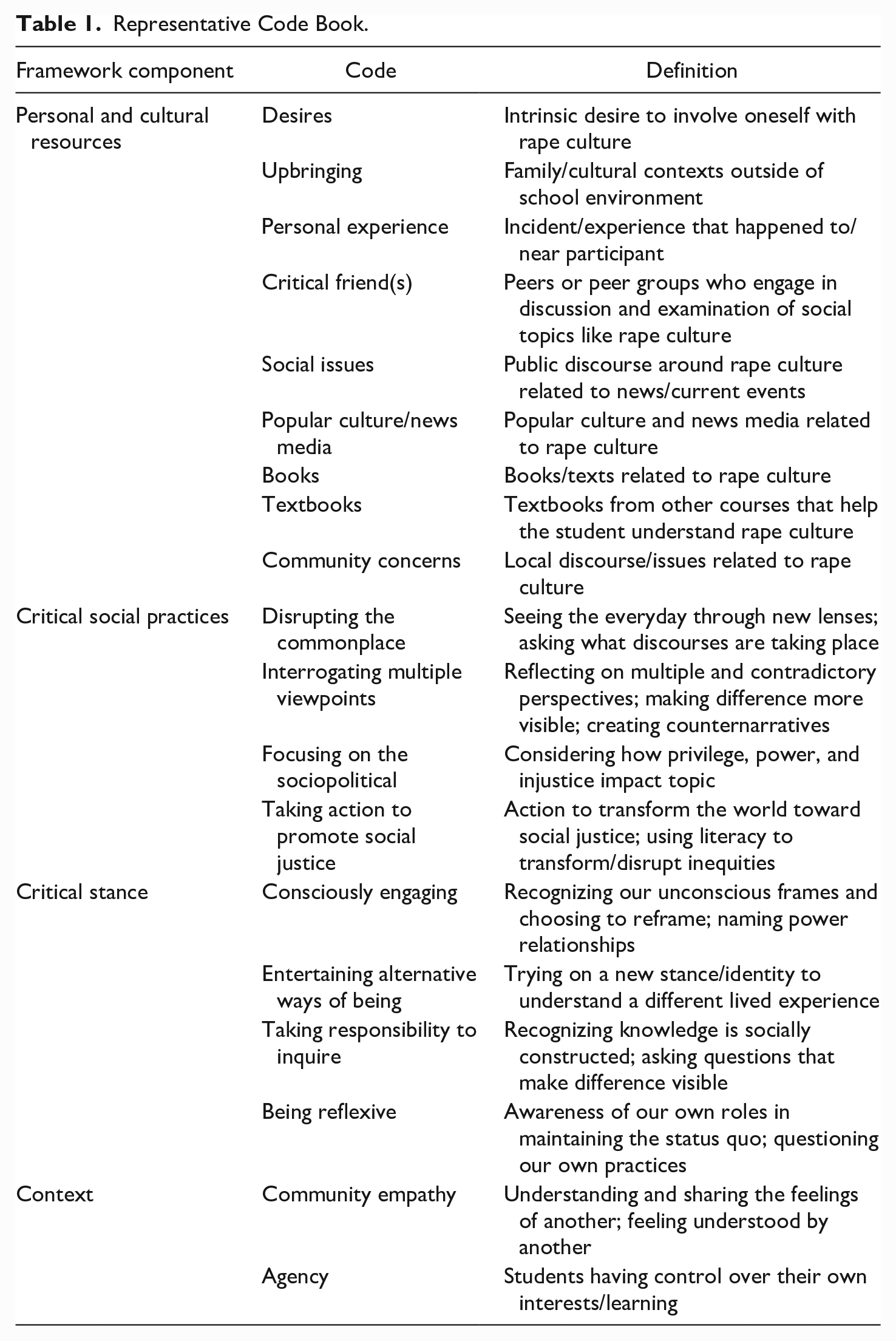
To begin analysis, I maintained a researcher journal as a running record of all data collected in chronological order. The journal contained recorded field notes for each group meeting, followed by memos to document my initial interpretations, and journal entries written by participants, followed by their respective memos. I used a combination of deductive and inductive coding. I coded according to a preliminary code book informed by Lewison et al.’s (2015) model of critical literacy. Then, I returned to each data source to generate a list of open codes rooted directly in the data (Creswell & Poth, 2018). For inductive coding, I employed the data analysis spiral (Creswell & Poth, 2018) of reading and memoing, defining codes and identifying thematic patterns, critically assessing my interpretations of these codes, and representing the data in writing. As data analysis concluded, my code book (Table 1) sorted themes into the major categories from Lewison et al.’s (2015) framework, as well as one additional category that focused on the specific context of the study. As this article examines a subset of data from the multicase study, I explore only the themes pertinent to Paula.
Representative Code Book.
Subjectivity
In qualitative research, the researcher’s experiences and personal theoretical frameworks inevitably impact interpretation. In the interest of transparency, I should disclose my belief that rape culture is a real phenomenon. I believe that rape is pervasive and normalized due to societal attitudes about gender and sexuality. It has been documented for decades (Buchwald et al., 2005; Smith, 2004) and has material impacts on people’s lives. I believe there is a “culture of silence” (Freire, 1970) around discussions of sexual assault that prevents victims from learning the language of critique necessary to challenge rape culture, perpetuating oppression. As a result, the common conception of rape remains binary and episodic. My commitment to this issue is both personal and political. Research is never neutral, and I believe I have an ethical obligation to challenge inequitable systems. I align myself with researchers like Fetterman (1987), who argues, “There is a difference between being an academic and an activist; however, academic study does not preclude advocacy. In fact, often anything less represents an abdication of one’s responsibility as a social scientist” (p. 101). My research is not only in the pursuit of knowledge—it is in the pursuit of social change.
Trustworthiness
As outlined in my data analysis section, I triangulated data across multiple sources, including field notes, journal entries, and transcripts of interviews. I compared what I saw and heard in group meetings against what participants were saying in their journals, and then again against transcripts of their respective follow-up interviews to ensure my findings were consistent across data sources. In addition, I confirmed my interpretations with member-checks and maintained an audit trail throughout the study for rigor and transparency.
Limitations
A key limitation lies in the time frame of this study. The construction of critical literacy is a lifelong developmental process, which cannot be accomplished or captured by this study alone. Rather, this study provides a snapshot of Paula’s critical literacy development about rape culture. Future research may explore the long-term implications of using YAL for critical literacy. In fact, doing so would be a potentially powerful way to collect rich data about the long-term effects of critical literacy education.
A second limitation relates to me being the sole designer and instructor of the course as well as the sole researcher of this study. As such, there was no barrier to prevent me from prioritizing my research and data collection over student interests. To mitigate this possibility, I consulted with peers and mentors to ensure that the curriculum was what was best for the students, rather than for my research. It was also important to me to not use my position as the instructor to unduly influence the research setting. Employing a problem-posing and relational pedagogy enabled me to remain open to negotiating power so as to not overstep boundaries with my participants.
Finally, because I was the only analyzer and interpreter of data, the findings are undoubtedly influenced by my world views. Although I sought to constantly center and re-center my goal of documenting, valuing, and legitimizing the lived experiences of my participants, rather than measuring their perceptions against some objective truth, my voice is undoubtedly present in the findings. As a social constructivist, I do not believe this is an inherently bad thing, but it is important to acknowledge the subjective nature of such research.
Findings
Paula’s critical literacy development is presented below in accordance with the framework developed by Lewison et al. (2015). I explore the personal and cultural resources she brought to the experience, followed by the critical stance she developed and the critical social practices she engaged in.
Personal and Cultural Resources
An energetic woman with a big smile, Paula was transparent about her positionality from the start, sharing, “I’ve lived in a place where everyone has the same mind-set and perspectives for the last 10 years.” She came from a “strict” military family and felt that her parents had sheltered her from a lot of social issues. In her interview at the end of the semester, she divulged that her parents would be mad if they knew she was participating in something like this. “They’re really worried about how liberal college is and that my professors are going to, like, poison my mind,” she told me, laughing. Regardless of her parents’ concerns, Paula was eager to learn about and understand other perspectives. Comments she made seemed to indicate that this book study wasn’t the only time she was learning about new perspectives, that college was exposing her to many ideas she had never encountered before. For example, she once commented, “I didn’t even know Hispanics were considered people of color until I got here,” to which another shocked Latinx student in the book study replied, “Girl, really?”
Echoing sentiments expressed by several other students, Paula wrote in the first week of the study, “Rape culture has not affected my life personally, but it may influence the way I see the world and treat others.” However, this stated belief changed within the next week. She came to the next group meeting after having completed a few chapters of the novel and marveled, “I didn’t realize that ‘rape culture’ meant so many things.” That week she wrote in her journal about a recent incident, A friend recently started sending me inappropriate text messages, asking for photos of me and saying things that made me uncomfortable. When I told him to stop, he said a bunch of things like I was a tease and made me think that I was the problem. I was feeling really upset about the whole thing but then when I talked to some of my friends I found out he was doing the same thing to them!! He made me feel like I had done something wrong and I had been carrying around this secret for days wishing someone knew what I was going through and would help me. That’s rape culture!!!
After this initial recognition that rape culture possibly did affect her daily life, Paula had a new story to share every week. During one discussion about the novel, another student questioned whether it was realistic that the school principal, a woman, would side with the boys and attempt to shut down the girls’ sex strike. In response to this query, Paula shared an illustrative story about her advisor. In high school, Paula participated in a competition offered by the Future Business Leaders of America, a program for K–12 students interested in business careers. Her proposed business model for a delivery service for feminine hygiene products won the competition. Since she was majoring in finance in college, Paula listed the award on her résumé. During a meeting with her faculty advisor, also a woman, Paula was told to remove the award from her résumé because “men won’t want to read about feminine hygiene products.”
Stories like these were an important part of Paula’s sense-making process and literacy development during the study—more so than other resources, though she would occasionally reference books and media in group meetings. In particular, she was taking a history class during the same semester as the book study and was making some historical connections. For example, she made a passing comment about Pocahontas during a discussion about “male entitlement” to possess and use people and resources. On another day, Paula excitedly asked if she could read us a passage from her history book, an excerpt from the letter Abigail Adams wrote to John Adams and the Continental Congress in 1776 about including women’s rights in the U.S. Constitution. After she finished reading, she added, “Somehow, it took another 150 years for women to gain the right to vote and another 20 years after that before women could petition to divorce.”
Yet Paula consistently relied on the stories she wrote about and brought to group meetings as a resource for her sense-making. Taking concepts in the novel and making connections to her lived experiences or the experiences of those she knew was her main tool for understanding sexual violence as a systemic issue. She repeatedly used the phrase “opened my eyes” to express the impact the book study had on her understanding of the world. In her interview, she reiterated, “This book study opened my eyes to a lot of things in my own life that maybe I was either just not paying attention or maybe I was just numb or used to it.”
However, the stories were only half of the equation; she also wanted to collaboratively negotiate these stories, from the novel and her life, with her peers. When she brought stories to each meeting, she relied on feedback from other students to verify her reactions and feelings. Gasps, groans, and comments of “That’s not right!” and “How dare she!” echoed by the group as Paula shared the story about her résumé gave Paula validation that she had a right to be upset.
In addition, a meaningful part of her experience related to sharing what she was learning in the book study with her friends who were not in the book study. The incident where she realized that many of her friends were being harassed by the same boy who was harassing her compelled her to establish an open line of communication with her friends about similar issues. As a result, she learned that many of her close friends were victims and survivors of sexual harassment and assault. In one journal entry, Paula wrote, This weekend, I learned of more and more people close to me who have been victims of sexual assault. Yet most of them never report because of fear or because they think it will make no difference. I am so angry.
By drawing from her daily life, making connections to the texts she read, collecting stories, and relying on peers and friends to help make sense of those stories, Paula was growing more apt at moving between her personal experiences and larger social contexts. This allowed her to begin engaging in critical social practices and to develop a nascent critical stance.
Critical Social Practices and Critical Stance
As data analysis progressed, I began to understand critical social practices and critical stance as corresponding manifestations of the same practice. That is, the features of a critical stance identified in Lewison et al.’s (2015) framework—consciously engaging, entertaining alternate ways of being, taking responsibility to inquire, being reflexive—are the internal processes necessary to independently engage in critical social practices (disrupting commonplace thinking, interrogating multiple viewpoints, focusing on the sociopolitical, and taking action to promote social justice).
Because Lewison et al.’s (2015) framework was created to facilitate critical literacy through curriculum, it situates critical social practices as what moves students toward a critical stance. In terms of scaffolding students toward critical literacy, this makes sense. Teachers model the critical stance, through think-alouds and questioning, that would lead to engaging in critical social practices. Then, curricular prompts and teacher scaffolding support students in engaging in critical social practices with the hope that it will foster an internal critical stance.
The ultimate goal is for students to carry that newly developed critical stance with them beyond the classroom and out into the world. However, when out in the world, without the curricular prompts and scaffolding, before one can take action toward social justice, one must be aware of one’s own role in maintaining the status quo. Thus, I found the categories to be bidirectional, and this relationship guided my analysis and subsequent findings.
From the start, Paula demonstrated a budding awareness that her world view was unique to her. She signed up for the book study to hear about perspectives different from her own. The first few weeks proved to be a steep learning curve for her. In a journal entry she wrote, “I didn’t know what to expect from The Nowhere Girls. The author really doesn’t beat around the bush at all. She’s not afraid to tell hard truths or talk about topics considered to be ‘tough.’” Confronting the notion that she might be living in a culture of rape came as a challenge, she shared: “I don’t want to ignore reality or continue living in a bubble, but this is a lot to take in.” She also confided to the group how “naïve” she felt because “coming from a small town . . . being outspoken about unpopular ideas can be dangerous.” Other students assured her that they shared her insecurities. One student even admitted, “I’m woke as hell and I still feel like I don’t know anything.”
This community empathy bolstered Paula. Instead of retreating into her comfortable “bubble,” she felt more confident about examining assumptions she had previously taken for granted. As she listened to students in group discussions problematize everyday occurrences, she started to examine her daily interactions. She slowly gained reflective distance from her experiences and perspectives. During one conversation about gender norms related to sexual activity, another female-identifying student complained, “No one believes [my male-identifying friend] and I are actually just friends. Everyone thinks one or the other of us wants more.” To this, Paula nodded vigorously and said, “I was taught that boy and girl friendships couldn’t work because boys will always be open to sex with any girl. But now I know that, like, that’s so not true.”
Paula was only just growing to understand the systemic ways rape culture puts individuals at risk in the United States. Leland et al. (2018) believe that reading fiction about an issue encourages students to read information-based nonfiction about the same topic more actively and critically. This was true for Paula, whose U.S. history textbook aided in her burgeoning understanding of the historical roots and political systems that maintain rape culture. However, Paula struggled to progress beyond a basic understanding. The sheer complexity of the politics and intersecting sociopolitical systems that are tangled up in rape culture were daunting. At the end of one group meeting, she cried, Every day this is becoming more complicated. I’m only just figuring out how bad rape culture is and then today we talked about how legal definitions of rape exclude male victims and that women play a big role in keeping rape culture going? How can we overcome all of this? Where does it end!
But once again, peer empathy encouraged Paula to continue questioning how power and privilege impacted different topics. As another student put it, “We just go one step at a time.”
For the rest of the semester, Paula grappled with nuance. She spent a lot of time mulling over the sex strike in the YA novel, writing about it in her journals and soliciting opinions from others in the book study. She asked, “Is a complete sex strike the best way to get the attention of the male students? Isn’t it still, like, using sex as a weapon?” Other students agreed to varying degrees, with comments like “It feels like it will just further alienate the boys from their cause” and “What if a complete strike causes more rapes, now that no one is giving it away willingly?” These discussions continued for several weeks as the novel, and the sex strike within it, continued. Eventually, it was generally agreed that withholding sex was, in the long run, a step toward eliminating the commodification of sex and women’s bodies—or as Paula phrased it, “I buy you dinner, you give me sex.” Furthermore, the ongoing negotiating led the students to conclude that the strike was about more than rape; it was also about gender equality and challenging double standards. While many students, including Paula, felt that the sex strike was an imperfect strategy, every alternative they considered has similar drawbacks.
This recurring topic led to other discussions about situations with no obvious recourse. In a conversation about the mixed messages society sends women about sex, Paula exclaimed, If you have no sex, you’re a prude. If you have too much sex, you’re a slut. So, make sure to have sex, but not too much! How much sex should we be having? Is there a specific number society can give us?
Although she was open to entertaining the viewpoints of other women, Paula sometimes struggled to understand how men might also feel restricted by gender norms. In the same discussion, Paula said, It seems like girls are expected to be good at sex without ever actually getting any experience. How can I make the right “moves” when I don’t know what they are? Why are boys all on the same page while we’re left to figure it out on our own?
Several students, both male- and female-identifying, objected to her assumption that boys aren’t just as confused about sex as girls. One male-identifying student shared, “At least girls can say they’re ‘saving themselves’ if they’re a virgin. Boys are just losers who can’t get laid.” A discussion ensued about the pressures of hegemonic masculinity, at the end of which Paula agreed, “Yeah, I guess I hadn’t thought about how things might be for boys.”
Through the weeks, Paula was figuring out how to navigate her world now that she was unpacking how these issues affected her life. She continued to try her hand at challenging commonplace thinking. She asked questions like, “Why are single girls supposed to always be looking for their next significant other? Can I not just be happy being by myself and living my life?” In her interview, she joked, “I can’t help questioning everything now. I’m probably super annoying about it.”
In response to all the things she was noticing in her life and learning about her friends and peers, Paula began to take action. She shared a story with the group about approaching a visibly intoxicated woman in a nightclub and checking in with her. Paula ended up spending over an hour trying to help the woman find her friend group. She commented, “Unless I saw someone in, like, obvious trouble, I would never have done that. Like, I would have thought it’s rude or not my place. But this has made me so much more aware.” Other students shared similar experiences of being more observant in public spaces and with their own friends. When another student shared, I have one friend who always wants to know that I made it home safe if I leave her dorm at night. I used to think it was really annoying and now I’m just so grateful to have a friend that cares about me like that.
Paula enthusiastically agreed, “Now, I always ask all my friends, guys and girls, to text me when they get home. Looking after one another should be something everyone does.”
At the end of the book study, Paula felt that she had learned more than she could ever have expected. She wrote, I honestly think that if I had read this book before this semester, I would not have gotten out of it what I did. I wouldn’t have realized that these issues are in my own life. I would have just thought it was an interesting but exaggerated story.
She aspired to become more outspoken about rape culture, telling me, “I’m comfortable talking about these issues in, like, our group meetings and with my close friends. But I’m still nervous to say things to people when I don’t know how they will react to my opinions.” Her big takeaway from the book study was to continue disrupting the culture of silence around sexual assault. She wrote that she wished she could tell every victim, “Do not be ashamed. You are not alone.”
Interpretations
My research sought to understand how reading and discussing a YA novel about rape culture would help an undergraduate student develop critical literacy about rape culture and what that process looked like. Analysis revealed that Paula was able to draw from personal resources, developed a critical stance, and demonstrated critical social practices. This is perhaps unsurprising, given the years of success that Lewison et al. (2015) have documented using their framework. What is more interesting is how Paula was able to do this. She demonstrated her growth through an exploration of her experiences and perspectives to better understand herself in relation to others and to the social and political environment. She relied on peers and friends to support her exploration, validate her feelings, negotiate tricky quandaries, and affirm her progress. She also demonstrated her critical growth through external acts, such as instigating dialogue and positive habits with her friends and intervening to help individuals she perceived as being at risk of harm. Furthermore, Paula explicitly expressed a desire to move beyond merely understanding rape culture to disrupting it.
What Paula got out of the book study was inextricably tangled up in the personal and cultural resources she brought to the experience, her previous understandings of systems of power in society, and her role or position within those systems. Because critical literacy is always so dependent on what an individual brings to a given experience, it is important to examine how resources provided by the book study and the context in which the book study occurred afforded and impacted Paula’s literacy learning. The features or characteristics of the book study that appeared most significant to Paula’s critical literacy development were the novel, the group discussions, and having critical friends to discuss her sense-making with. This section will examine what it was about these resources that supported Paula’s growth. I will also discuss points at which the data deviated from the critical literacy framework and possible implications for using the framework with more advanced learners.
The YA Novel
Findings from this study support the idea that students may gain more understanding of the complexities and material implications of a social issue from reading fiction than from traditional research-based nonfiction (Alsup, 2015; Bishop, 1990; Gee, 2017). Even though the novel contained no facts or statistical data, the narrative format made students receptive to and curious about the challenging concepts the book explored. During her interview, Paula admitted, I wanted to sign up for one of these because I only needed one more credit to be full time, so I narrowed it down to two that fit my schedule best, and when I saw that this was a YA novel I was like, ‘That’s the one!’ [laughs].
Throughout the book study, Paula’s journal entries revealed understandings she gleaned specifically from the novel. She was particularly affected by what students came to call the “Us” chapters. These were short chapters interspersed throughout the novel that would include brief perspectives of a dozen or more nameless girls at the school. The chapters were used to highlight the range of experiences and perspectives of students across the school. Reading realistic fiction often enhances students’ understanding that people are “products of their time and their own intricately woven value systems” (Leland et al., 2018, p. 129). This seems to be the case with The Nowhere Girls, as Paula wrote: “The ‘Us’ chapters have been the most educational. Getting to see a variety of opinions all lined up made me realize just how complex rape culture is.”
Paula used the novel to better understand herself and her role in rape culture. It is perhaps unsurprising that the novel was so important to Paula, given how valuable stories were for her sense-making. Most weeks, she would select a quote from the book that resonated deeply with her. Early in the study, she wrote, “Grace asked, ‘What’s worse? Lying about who you are, or not knowing who you are at all?’ I feel like I am constantly changing and finding myself, so knowing who I am is a constant struggle and journey.” Another week, she commented, “I got fired up when Rosina said ‘Lucy never asked us to do this. It’s not our responsibility.’ Then whose responsibility is it?”
Paula expressed that the novel frequently “brought up issues that were, like, so close to home” and forced her to think about beliefs and experiences she had never before thought to question. Ivey and Johnston (2017) report that students want to talk about difficult issues and enjoy reading texts that feature characters who are dealing with serious problems. This seemed true for Paula, who instead of shying away from the discomfort of making her history strange, embraced it. She attributed this in part to her personal disposition—“I am someone who appreciates the hard truth and not beating around the bush”—but also to an early line in the book that she used to hold herself accountable: “The thing is . . . people don’t want to hear something that makes their lives more difficult, even if it’s the truth.” Paula did not want to be the type of person that ignored the truth just because it made her feel uncomfortable.
Ivey and Johnston (2017) note that “reading about characters experiencing phenomena at the far edges of the students’ own experiences is quite useful because it creates the opportunity to think through the consequences before they encounter similar situations head on” (p. 161). Paula felt that she better understood the behavior of victims during and after an assault as a result of the novel. In a small-group discussion, she commented, Seeing girls from the book like Lucy and Cheyanne deal with assault has helped me understand, like, why someone might not report. Especially when [another character] said ‘They’ve already been forced to do something they didn’t want to’ I was like wow, yes.
In another discussion, Paula said, “I think we all like to think that we would fight back, when in reality a very common reaction is to freeze.” The novel also helped her to think about sexual assault in terms of power, rather than simply as a violent physical act. Referring to a letter published by the characters in the novel, she shared with the group, “When they said ‘Rape is not about sex. It is about power and violence and control’—I never thought about it that way. Like that it could be about something other than sex.”
In addition to using the novel as an information resource to understand rape culture in personal and political terms, Paula relied on the novel as a pivot into critical conversations with her peers about the social issues around sexual assault. While some students entered the book study positioned as already engaged in social discourse about rape culture, Paula used the novel as a point of entry into these discussions. In her follow-up interview, Paula shared, I wanted to learn about rape culture, but I felt insecure that everyone in the group would already get it and I wouldn’t. Using a novel to talk about it created like a base point for the conversation. Like, even if some of us had more knowledge than others, we were all at the same spot in the book and could talk about it. I feel like it was an equalizer.
Later she reiterated, “I didn’t feel confident talking about this issue. I didn’t feel like I knew enough about it, but I knew I could talk about a book.”
The novel served not only as a pivot for Paula, who felt insecure about her positioning, but as a tool to expand conceptions of rape culture. Paula noted how the novel brought up topics that might otherwise never have been covered in group discussion, explaining, I think that the book was like a stepping stone. I started to notice things in my life because of what I was reading in the book. And I might not have noticed those things or shared them at meetings if not for the book. And I feel like I complained a lot about the book during the semester [laughs] because it had some issues . . . but honestly it might have been OK that it wasn’t perfect because we got to talk about those things too.
As described in the previous section, Paula struggled to believe that a sex strike was the best approach to eradicating rape culture on the high school campus. This led to weeks of meaningful conversation about the best avenues for challenging all the systems of power implicated in rape culture. In large part because of the novel, students were able to take part in discussions that helped them develop an understanding of how complex rape culture is, consider their relationship to it, and begin to recognize some actions they could take in their localized environment to disrupt it.
Group Discussions
Along with the novel, group discussions seemed to play an important part in Paula’s critical literacy development. Leland et al. (2018) believe that good books lead to good conversation. They advocate for giving students time to discuss texts with one another because, even after just one conversation, “our understanding is never the same because we have been introduced to new perspectives and alternate interpretations” (p. 18). In educational terms, text talk enhances students’ comprehension. Furthermore, knowledge that they will have the chance to talk about what they read has been shown to motivate students to engage more deeply with texts (Ivey & Johnston, 2017).
Similarly, Peterson and Eeds (2007) advocate for the “grand conversations” that occur during shared literature experiences. While different interpretations and disagreements may take place, that adds to the richness of conversations. As Janks (2005) observed, “When we are confronted by a text that we agree with, it is easy to imagine its positive effects, and hard to see its negative effects” (p. 34). Thus, conflicting interpretations and disagreements can be a springboard for digging deeper into issues and perspectives (Van Horn, 2015).
While students who understand that reading is transactional (Rosenblatt, 2004) can read critically on their own, Kucer (2008) notes that those transactions “are enhanced by hearing what others have been thinking about any given text” (p. 188). Furthermore, discussing texts with other readers forces students to support their points of view, strengthening their ability to use language to achieve their goals (Gee, 2017). When Paula struggled to understand the purpose of the sex strike, group discussions helped her to understand alternative perspectives. “Through conversation and dialogue, readers have the opportunity to explore their own half-formed ideas, to expand their understanding through hearing others’ interpretations, and to become critical and inquiring thinkers” (Short et al., 1996, p. 479). Discussions compelled Paula to either successfully defend her interpretations or to revise her opinions about the novel or issues brought up in the novel, as she did when arguing about gendered expectations around sex.
Paula, for whom human connection seemed so important, made some explicit statements that seem to hold with this interpretation. For her, discussions were her favorite part of the study because “I was able to get so many different perspectives from people that I would never have gotten otherwise because maybe you wouldn’t have been friends outside of the book club, but that made it better.” Later in the interview, she observed, “Learning about other people’s experiences makes you learn from your own experiences, because maybe you’ve not ever thought about your experiences too much and it just really teaches you about how you view the world.”
There were also some specific characteristics of the group discussions that were important to Paula: that they valued personal stories, were student-driven, and felt like a safe space in which she could be vulnerable. After a couple weeks of getting to know each other, the group established a practice of opening up the floor to share personal stories at the start of every meeting. Because Paula was starting to pay attention to how the themes of the novel connected to her own life, she had a story to tell each week. Often, she couldn’t wait for the meeting to officially start and would just begin sharing with nearby students as the rest of the group trickled in to the room. Her stories ranged from conversations she had with family and friends; to things she had witnessed on and around campus; to social media, popular culture, and news stories. These stories, along with those shared by others, set the tone of the group meetings as student-driven discussions that valued and affirmed individual experiences.
Paula felt that these personal stories were essential in establishing the overall ethos of the study. While she was often just excited to share the connections she was making, she sometimes relied on the group to talk through her feelings and think about how to respond to interactions in the future. In her interview, she explained, It was a comfort to hear other people react and just like know that it’s not just me. It was, like, cathartic not only to talk about it with other people but also to just hear other people talk about it.
Paula also made comments about the meetings being a “safe space,” a concept that refers to spaces in which individuals can come together to talk about an issue without fear of retribution (Amenabar, 2016). She expressed surprise at how much empathy and community they felt by the end of the study, sharing, “When I signed up for the study, I was like . . . can I have these discussions in an academic setting? With people I don’t know?” The community empathy built by the group seemed to be essential to Paula’s critical literacy development. Having personal experiences validated can be an important factor in beginning to appreciate perspectives that differ from one’s own. This is especially important for sensitive and controversial topics.
Paula agreed, “I was worried that it was going to be a thing where I was going to be like forced to think a certain way and agree with the liberal perspective. And then it was the complete opposite of that.” She elaborated, “We were all on our own personal journeys, like we were all there to learn and focus on our own personal growth, not to police what anyone else says or thinks. That really put me at ease.” Finding ways to create spaces for young adults to have “dangerous” conversations—a term used by Nieto (2009) and echoed by Paula when she described how being outspoken about unpopular ideas in her hometown can be dangerous—results in more mindful individuals who consider the ways sociopolitical issues impact the human condition. Paula felt this clearly, sharing, “Everyone felt like we could just talk about our actual feelings or what we’ve been going through or, like, what we think about certain topics without having to worry.”
Deviations From the Framework: Agency, Community Empathy, and Critical Friends
Three resources emerged from my analysis that were not overtly part of Lewison et al.’s (2015) framework. Two of the resources are described in the section above: agency and community empathy. Both concepts emerged after I completed interviews at the conclusion of the study. Comments from students about the discussions being guided by student interests and the deep feelings of empathy and understanding the group shared were so ubiquitous that I returned to my field notes to ascertain whether these comments could be triangulated with my other data sources.
In terms of agency, the student-led direction of discussions is quite obvious. It was a weekly challenge to know when to step in, to redirect or encourage the group to go deeper. Looking back, I can clearly see a few missed opportunities, particularly related to challenging some of the binary and gendered perspectives around sexual violence that were prominent throughout the study. However, students perceived this freedom to navigate the novel and its themes as a delightful aberration from their usual classroom experiences.
The concept of student-led discussions and student-inquiry-driven curriculum is not new. Freire (2014) suggests student-centered inquiry is an ideal a way to develop students’ critical perspectives about their lives and the world around them. Furthermore, there is general agreement that for YAL to be a tool for critical literacy learning, students themselves must have some sort of choice in the matter (Glenn & Ginsberg, 2016; Ivey & Johnston, 2017). Critical literacy cannot manifest if it is compulsory. Thus, some degree of agency over the experience—whether that be choice in text, in discussion topics, in questions asked, or in how students show their literacy learning—is necessary to be successful.
Community empathy as a resource was more challenging to quantify. It was present in every nod of agreement, affirmative comment, and sympathetic murmur. It was even more obvious when students would follow up with one another in later weeks, to ask about the outcome of a conflict or just about their general wellness. This quality seemed tied to the vulnerability required to understand oneself in relation to violent and oppressive systems of power. It can be an uncomfortable internal process, and being asked to present that process to others can be a frightening endeavor. However, in Paula’s case, we see that discomfort can be made productive within a critical literacy framework.
The final unexpected resource revolved around friends outside the book study. Paula repeatedly referenced talking to her friends about concepts that came up in the novel and group discussions. These conversations occurred at various times and for various purposes (e.g., in attempts to educate them, to elicit their opinions, to seek insight, to confront them about problematic behavior), but they appeared important to her sense-making and experience in the study. Paula’s engagement in the study was bolstered by stories her friends told her about their own experiences with rape culture. This was true for many other students, and, conversely, those students who did not have friends or family that were willing to engage in conversations about rape culture expressed frustration at having no one to share with outside of group meetings.
I suspect that the resources of critical friends and community empathy are not part of Lewison et al.’s (2015) critical literacy framework because their work has been employed primarily with elementary and middle-grade students. The authors do note that reading is a social event. Even when reading is completed alone, most people look forward to sharing their feelings or thoughts with another person—hence the popularity of book clubs and discussion forums. The authors also mention that observing this behavior in students is a strong indicator that critical literacy development is taking place. But the social and emotional needs of young adults, their identity and sense of self in relation to the world, the psychic and embodied trauma they harbor, their need to understand and be understood, and the depth of their friendships are all significantly different from those of elementary-aged readers. Additional targeted research that looks closely at these features is necessary to augment our understanding of how this framework can be used with young adults.
Conclusion
Situating Critical Literacy in Context
Because the critical literacy development is so dependent on what an individual brings to a literacy experience, it was important to explore how different resources and characteristics of the book study afforded and impacted Paula’s learning. For Paula, the novel was a key source of information about rape culture. It helped her understand the lived experiences of others, generating empathy. It was also an essential pivot into critical conversations about rape culture. Using the novel to engage in discussions helped her develop a deeper understanding of how complex rape culture is and her relationship to it.
Discussions about the novel presented her with even more perspectives to consider. Discussion topics were student-driven, giving Paula and other students agency over their learning and ensuring that time was spent on what mattered to them. The group meetings felt like a safe space in which Paula could be vulnerable and ask questions. Her personal stories were treated as valuable contributions to the discourse, which created a community of empathy and support in which her critical literacy flourished.
Paula demonstrated a sense of responsibility to inquire by signing up for a voluntary study of an uncomfortable topic. A major factor in her transformation was her intrinsic willingness to unlearn her biases and socialized ways of being. She signed up to learn about other perspectives on rape culture to better inform her opinions. She initially did not believe her personal life worth examining but quickly began to make connections to her own experiences. She often asked disruptive questions about commonplace thinking that pertained to her life, such as ideas around virginity, being single, and whether men and women can have platonic friendships.
Because Paula was only just beginning to investigate things in her life that she had theretofore taken for granted or never questioned, her focus remained primarily on herself and her friends. As a result, she did not do as much work to understand the ways systems of power manifest in daily lives. This was apparent in her struggle to understand what the sex strike in the novel represented. Furthermore, while she expressly sought out and sympathized with the perspectives of other female-identifying students and friends, she had a harder time understanding the perspectives of male-identifying individuals, both real and imagined. While nascent reflexivity occurred simply due to all the unpacking she was doing, Paula needed more time and support to understand the connections between her experiences and her intersecting identities. However, she did start to take action in response to her budding critical literacy by making more efforts to look after her friends and even check in on strangers who seemed distressed.
Future Research
Morrell (2005) argues that there is no higher social calling than to teach critical approaches to the consumption and production of language. This study’s aim is to better understand the nature of critical literacy in practice and its effects upon young adult students, with the goal of providing literacy educators with a rich description of what it looks like when a student develops critical literacy. This study also demonstrates the power of YAL as a lens for contending with complex social issues in a classroom context. This research adds to the understanding of critical literacy that Lewison et al. (2015) continue to refine through exploring how it can be employed with young adults, and how we might connect the windows, mirrors, and sliding glass doors (Bishop, 1990) that YAL offers students with opportunities for critical praxis in today’s society.
Future research must consider ways to embed literacy experiences, such as the book study described herein, into college classrooms to encourage students to explore difficult social issues. Gee (2017) purports that having critical conversations grounded in goodwill, even when students have “clashing [moral and social] frameworks,” leads to a better society, and that it all must begin in the classroom (p. 156). If students are not provided with the tools to look deeply within themselves and at the world in which they live, they are significantly less likely to recognize issues when they confront them (Hess, 2004).
In acknowledgment of finite resources and various contextual restrictions, critical scholars unequivocally support the idea that there is no prescriptive formula for incorporating critical literacy into the classroom (Behrman, 2006; Luke, 2012). Approaches to critical literacies must be “continually redefined in practice” (Comber, 2001, p. 100). However, this study reveals how critical literacy can manifest with little time and few resources. The students in this study only spent about 12 hr talking together, with some additional time dedicated to reading the novel and writing journal entries. Still, in that limited time, Paula was able to advance her critical sociocultural understanding of rape culture and her critical stance by leaps and bounds. The outcomes of this study support the idea that classrooms can serve as spaces that acknowledge issues of power and privilege and explore pathways toward social equality, especially if educators are willing to adjust the terms of what success looks like. Furthermore, it can be done without overhauling entire courses or programs by integrating mindful experiences such as literature readings and group discussion.
Supplemental Material
915489_Translated_Abstracts_Adams – Supplemental material for “I Didn’t Feel Confident Talking About This Issue . . . But I Knew I Could Talk About a Book”: Using Young Adult Literature to Make Sense of #MeToo
Supplemental material, 915489_Translated_Abstracts_Adams for “I Didn’t Feel Confident Talking About This Issue . . . But I Knew I Could Talk About a Book”: Using Young Adult Literature to Make Sense of #MeToo by Brittany Adams in Journal of Literacy Research
Footnotes
Declaration of Conflicting Interests
The author(s) declared no potential conflicts of interest with respect to the research, authorship, and/or publication of this article.
Funding
The author(s) received no financial support for the research, authorship, and/or publication of this article.

References
Supplementary Material
Please find the following supplemental material available below.
For Open Access articles published under a Creative Commons License, all supplemental material carries the same license as the article it is associated with.
For non-Open Access articles published, all supplemental material carries a non-exclusive license, and permission requests for re-use of supplemental material or any part of supplemental material shall be sent directly to the copyright owner as specified in the copyright notice associated with the article.
