




Abstract
Most refugees in countries of permanent resettlement arrive from first-asylum countries – countries where refugees initially move to escape crisis in their homelands. Their pre-resettlement educational experiences have largely been undocumented. This qualitative ethnographic study describes the literacy practices of four elementary-aged Afghan refugee children in Pakistan. The findings revealed rich and various literacy practices these children and their families engaged in at home and beyond, such as practicing religious supplications or engaging in storytelling, trying to read and write in Urdu and English, reading the Quran or religious supplications, and helping others with their own literacy development. The parents and guardians highly valued literacy and believed it instilled manners, morals, and essential skills in their children. This research includes important implications for teachers working with refugee students.
Keywords
Purpose of the Study
For much of Afghanistan's modern history, conflict has limited its children's access to education. A 2019 report by the Institute for Economics and Peace described Afghanistan as the world's “least peaceful country” (p. 2), and continuous conflict has resulted in Afghans fleeing to neighboring Pakistan and Iran. Pakistan hosts the largest number of Afghan refugees—about 1.5 million registered and another million unregistered. In brief, Afghan refugees are “one of the largest and longest displaced populations in the world,” causing “the education of successive generations of Afghan refugee children [to be] disrupted, discontinued or forgotten” (Jenner, 2015, p. 3).
Little is known about the literacy practices of refugees in pre-resettlement countries—countries where refugees move initially to escape crisis in their homelands. This study offers a unique perspective on the literacy practices of four Afghan refugee children in Pakistan, their country of first asylum. For educators to better support Afghan refugee children's literacy practices in both first-asylum and permanent resettlement contexts, it is important to understand the literacy practices they already engage in. This article shows the various literacy practices children engage in across different settings, and it challenges the deficit perspectives that may exist, such as believing that some refugees do not practice literacy or are literacy impoverished. The following question guided the study: What are the literacy practices of four elementary-aged Afghan refugee children in their first-asylum country of Pakistan, at home, at school, and in the community?
Background and Literature Review
A refugee is “someone who has been forced to flee his or her country because of persecution, war or violence” (United Nations, 1951, p. 14). The United Nations High Commissioner for Refugees (UNHCR) declared: “We are now witnessing the highest levels of displacement on record” (USA for UNHCR, 2020), with nearly 26 million refugees having left their country of origin, almost half of them under the age of 18. Most refugees initially move to countries neighboring their country of origin. In fact, 86% of refugees arrive in a resettlement country only after staying in a first-asylum country (UNHCR, 2021), sometimes for years or even decades. Many Afghan refugees, including the families in this study, have lived in Pakistan for decades without receiving citizenship.
Given that more than half the world's refugees are children, their education is an important issue. However, refugee children's educational opportunities are limited, particularly in first-asylum countries. Refugee children are five times more likely than nonrefugee children not to attend school (UNHCR, 2016), and in Pakistan, the percentage of refugee children attending primary school is “half of that of their host country peers” (p. 11).
In this section, I briefly review the literature on the educational experiences of refugees in first-asylum and resettlement countries. The educational experiences of refugees in first-asylum countries is underresearched (Dryden-Peterson, 2016; Guo et al., 2019). While some studies have documented these experiences (e.g., Chatty et al., 2010; Chatty & Crivello, 2005; Hampshire et al., 2008; Hinton, 2000; Lowicki & Pillsbury, 2004), most of these limited studies on refugee students’ educational experiences in first-asylum countries focus on their broad educational experiences, rather than focusing specifically on their literacy or language practices. Experiences in first-asylum countries impact refugee students, including how they approach their education in their permanent resettlement countries. These experiences are not uniform since some students live and study in refugee camps, while others are more integrated into the country's mainstream schools and neighborhoods.
Bellino and Dryden-Peterson (2019) explored the experiences of Somali refugees in Kenya and found that students knew their teachers were less qualified than teachers outside the camp. Erwin et al. (2020) also found that the education available to refugees was inferior, and it was common for many students to be taught by untrained teachers. Mareng (2010) reported on his own and other refugee students’ experiences at a refugee camp in Kenya, finding that some students were happy with their educational experiences, but others were more concerned about not having enough to eat, and some had to walk long distances in extreme weather to reach their school. In Bellino and Dryden-Peterson's (2019) study, refugee students also experienced verbal abuse from other students and teachers in the government schools.
Uptin et al. (2013) and Tandon (2016) investigated the first-asylum-country educational experiences of refugees who eventually settled in Australia and the United States, respectively. The 12 youth in Uptin et al.'s (2013) study described classrooms with few educational resources and underqualified teachers. However, some indicated they had positive experiences, particularly with practices such as storytelling. Tandon (2016) examined the experiences of five Burmese refugee parents in first-asylum countries such as Thailand and Malaysia, finding that those experiences continued to affect the parents and children after resettling in the United States. Since the parents had no formal schooling in their country of origin, most felt intimidated by the teachers in the United States. Some parents were suspicious of the U.S. schools, partly due to the violence they experienced in Thailand. Tandon (2016) noted that parents’ fears hindered their children's academic progress because it limited their contact with people outside their families. For example, the students were not tutored and did not interact much with English speakers.
Another factor referenced in the literature is that the host country's language is often a barrier for refugee students. In their study of teachers and principals of Syrian refugee students in Turkey, Aydin and Kaya (2019) noted the schools were generally welcoming, but learning Turkish was the main obstacle preventing Syrian students from participating in class. Similarly, Dryden-Peterson (2003) reported that Congolese refugees’ language barriers in Uganda hindered their educational progress, leading them to repeat grades or to be placed in a lower grade with younger students to improve their English proficiency. Wofford and Tibi (2018) argued that educators and speech-language pathologists need to draw from second-language learning concepts that are relevant to refugees in order to resume and promote language and literacy development. They suggested focusing on cross-linguistic differences between languages (in their case, Arabic and English).
In addition to language barriers, attending school may not even be an option for refugee children in some first-asylum countries. Lowicki (2002) noted the barriers Afghan refugee families encountered with schooling in Pakistan. She interviewed more than 60 participants, including children, adults, and government representatives, observing that a “main barrier to education was a lack of money to cover basic living expenses and school-related costs” (p. 15). Many children had to collect plastics for recycling or make bricks to support their families. Kanso (2018) reported that more than three-quarters of the Syrian refugees in Lebanon survived on less than four dollars per day. To help their families, children worked rather than attend school.
While almost all refugee children in resettlement countries come with previous educational experiences, very little is known about these pre-resettlement experiences. The limited literature in this section has focused on refugees’ educational experiences in first-asylum countries and indicated that many refugees struggled with accessing quality education and faced language barriers. Refugees’ experiences in first-asylum countries are also hidden from teachers in resettlement countries due to stereotyping, cultural differences, and language barriers (Bigelow, 2010; McBrien, 2011; Taylor & Sidhu, 2012). This lack of awareness has “implications for the continued educational experiences of refugee children upon resettlement” (Dryden-Peterson, 2016, p. 133) because refugee children have already been negatively assessed on their knowledge and abilities. Thus, teachers need to understand refugee children's pre-resettlement experiences to better meet their academic and psychosocial needs (Dryden-Peterson, 2015).
Studies in resettlement countries have shown that a lack of understanding of refugee students’ backgrounds impacts how teachers regard them (Davies, 2008: Mendenhall et al., 2017). Mendenhall et al. (2017) found that teachers do not differentiate between immigrants and refugees, which affects the services refugee students receive. Gahungu et al. (2011) noted that the Burundian students in their study could not answer certain questions the way other students did, and the teachers therefore thought the students were mentally challenged. Similarly, Nykiel-Herbert (2010) found that some refugee students lacked the background knowledge that teachers assumed they had, such as the “concept of the earth as a planet…[as they] had never seen a map or a globe” (p. 5).
Researchers have also found a mismatch in the way refugee families view curriculum and pedagogy in resettlement countries. In their study of four refugee mothers from Ethiopia, Liberia, Sudan, and Somalia, Tadesse et al. (2009) found differing expectations for children's learning between teachers and parents. The mothers preferred a structured learning environment, while the teachers encouraged learning through play. Some of the mothers also believed teachers assessed their children incorrectly due to lack of cultural understanding. For instance, one mother taught her child to avoid eye contact with adults, but this was misinterpreted by the teacher as the child possibly being abused at home. In their research with immigrant and refugee families, Anderson and Morrison (2011) suggested that educators be cognizant of the myriad ways that parents/guardians support their children's learning, noting that learning is culturally situated.
Another underappreciated dimension of refugee children's experiences is that they often play essential roles assisting with translating, teaching, and brokering language and literacy for their family members. Perry (2014) highlighted the role a 6-year-old Sudanese refugee played for her family, noting that she was an “active literacy broker” (p. 318), helping her parents complete their English as a second language (ESL) homework and showing them how to sign a permission form. However, at school, her literacy brokering attempts were curtailed by the school's practice that students work independently. Millikin-Lynch (2009) found that the siblings in a Somali refugee family supported each other's learning: The older siblings helped their younger siblings by correcting their homework and using their first language and environmental print such as posters for learning.
Storytelling is a common practice in several cultures and in refugee families’ lives (Strekalova-Hughes & Wang, 2019). Geres’s (2016) study focused on teachers who used storytelling in their classroom, including with refugee students in Canada. Through storytelling, the teachers learned about the students’ interests and used those in the classroom. Another teacher realized that some of the stories were relevant to school topics, particularly the history curriculum. Geres (2016) found that teachers discovered that storytelling “encouraged literacy development” (p. 81) for refugee students. This is in line with Dantas and Manyak’s (2010) suggestion that immigrant children's out-of-school experiences be integrated into the curriculum. Strekalova-Hughes and Wang (2019) noted that refugee children in the United States used storytelling to connect with others from their linguistic community. The children believed that students at their school would enjoy some of the stories they told at home, but they did not share these stories at school because they could not translate some words into English. However, the children were telling school stories at home. Strekalova-Hughes and Wang noted that this one-sided communication, where children told school stories at home, but not home stories at school, could be “perpetuating language loss” (p. 17) in refugee communities, as their home languages were not sufficiently valued at school.
Gender is also an important factor. Studies generally show that females do better than males in academic tasks (Ferguson, 2016; O’Grady et al., 2016). Some note that gender, among other factors, plays an important role in refugees’ educational progress. Berthold (2000) looked at the relationship between Khmer adolescent refugees’ exposure to war and their behavior and academic and psychological well-being in the United States. The author noted that the school marked 56% of the students as having limited English proficiency, but “females were significantly more likely to be classified as being fluent in English” (p. 27) and had higher grade point averages. The male students had more exposure to violence in their countries, and frequently had more behavioral problems than female students. Mosselson (2007) also focused on adolescent refugee females from Bosnia in the United States, finding that while the students were happy to be attending school and did well academically, many suffered from depression due to their memories of war in their home country.
These studies show the variety of educational experiences refugees encounter in their first-asylum and permanent resettlement countries. Due to the lack of literature on the educational experiences of Afghan refugees, the review drew on studies from various refugee groups. However, much of this literature focuses on educational experiences in permanent resettlement countries, rather than first-asylum countries. This study thus attempts to help fill this gap to improve the learning experiences of refugee students in Pakistan and beyond.
Theoretical Framework
This study is informed by sociocultural theories, funds of knowledge, and literacy brokering. From a sociocultural perspective, culture plays an important role in cognitive functions and ways of learning (Rogoff, 2003), as the historical, social, and cultural contexts in individuals’ lives shape learning and teaching. Different cultures support children's learning in different ways and notions of apprenticeship may differ significantly across cultures (Rogoff, 2003).
Sociocultural theories describe literacy as a set of practices, rather than skills that one does or does not have, that are embedded in specific contexts. Thus literacy “is conceived of and practiced in different ways by different peoples” (Purcell-Gates, 2005, p. x), and these practices can be shaped by social, cultural, and social domain contexts, such as home or religion. Barton and Hamilton (2000) highlighted that “in the simplest sense literacy practices are what people do with literacy” (p. 7), which includes more than just texts, extending to values, social relationships, and attitudes. They stressed literacy practices as being cultivated “in the relationships between people, within groups and communities, rather than as a set of properties residing in individuals” (p. 8).
Through the lens of literacy as a social practice (Barton & Hamilton, 2000), it is important to recognize that literacy is also practiced outside of official places (e.g., schools) and used throughout daily activities in homes and communities (Street, 1995). Thus, it is important for educators to understand the “funds of knowledge” (Moll et al., 1992) different students bring into the classroom and to recognize “households as containing ample cultural and cognitive resources with great, potential utility for classroom instruction” (Moll et al., 1992, p. 134). Funds of knowledge are largely connected to classroom learning, and teachers should recognize the valuable skills and knowledges they bring into the classroom from students’ homes and cultural communities. Funds of knowledge are also “broad and diverse” (Moll et al., 1992, p. 133) and can range from “moral knowledge” and “animal management” to “herbal knowledge.” Recognizing these funds of knowledge is also key to teachers establishing a rapport with their students and their families based on the family's valuing of literacy as part of their vision for their children's future.
In other words, as children engage in literacies in their homes and communities, they learn not only the conventions associated with reading and writing but also “the sociocultural values that are attached to their particular literacy practices” (Li, 2009, p. xvii). By focusing on the social aspect of literacy and utilizing funds of knowledge, educators can realize that home literacy practices are multiple and various, going beyond storybook reading and including “storytelling, rapping, shopping, cooking, participating in religious rites, dancing, acting, drawing” (Souto-Manning & Dice, 2009, as cited in Cairney, 2011, p. 115).
Literacy brokering (Mazak, 2006) describes the ways “individuals seek informal help with the texts and literacy practices they encounter on an everyday basis” (Perry, 2009, p. 256) as they adapt to a new culture and language, such as the support siblings provide one another (Gregory, 2005) or children translating for adults if they are more proficient in English than their parents.
Together, these theories emphasize understanding the rich and various literacy practices that individuals engage in as part of their social, cultural, linguistic, and political contexts. At the core of these theories is also the need to recognize that the different literacy practices one engages in is a result of their sociocultural contexts, rather than a deficit. As Purcell-Gates (1995) asserted, “conceptualizing literacy as a cultural practice denies any notion of deficit. A cultural perspective on behavior implies the study of difference rather than deficit” (pp. 185–186).
Methodology
Role of the Researcher
It is important to describe my role and positionality as an ethnographer in the research. I am a former Afghan refugee who settled in Pakistan for five years before resettling permanently in the United States. I have the same ethnicity, country of origin, first language, and religion as my participants. Therefore, I was positioned as an insider, as I knew and understood the cultural and social practices of the participants.
After receiving ethical approval from the university, I recruited participants. The sampling was purposive in that I sought Afghan families with children between the ages of 4 and 11 who spoke Pashto at home, came from low-income homes, and had limited schooling (e.g., from elementary to high school graduates). These inclusion and exclusion criteria were chosen because they reflected the context of most Afghan refugees in Pakistan. As Jenner (2015) reported, children “below the age of 14 account for half of the 2.45 million Afghan refugees in Pakistan” (p. 3). In addition, the participants were Pashtuns, the largest ethnic group in Afghanistan and the major ethnic group of Afghan refugees in Pakistan. For example, 85.1% of the Afghan refugees in Pakistan are Pashtuns (European Resettlement Network, 2013).
Notices were sent to all qualifying families (in Pashto and English), and I also explained the points in the notices to the students in Pashto. After one week, notices were collected, with 13 families responding. I met with all 13 students to learn more about them. Some came to school in a van, and knowing that I could not follow these students from school to home for observations, I decided not to include them. Some mentioned that their male guardian would not be easily available to meet, and I excluded them also. The coprincipals advised me not to include two of the six remaining families, as one child had a disability and the other was leaving the school. In the end, I was left with four students—two males, two females—from different families. I explained to them (in Pashto) the points in the consent form and had each parent/guardian briefly explain the points back to me, to ensure they understood what the study entailed. I explained the main points in the assent form to the focal children in Pashto and that they could opt out at any time.
Participants
While the study centered on the four children, participants also included the children's parents/guardians and teachers. All the children were born in Pakistan. In fact, while Pakistan was technically their first-asylum country, they had been living there for decades, a reflection that in some cases, first-asylum countries become de facto permanent settlement countries, although without the benefit of being granted citizenship. The four student participants are described briefly below.
Safa Noor was 11 years old and in the third grade. Her family included eight people. Her father was a laborer and the family's only full-time wage earner. He had completed up to the third or fourth grade (he could not remember precisely), while her mother did not attend school at all.
Seemena Angar was 10 years old and in the second grade. Her family included her father, mother, and 12 siblings. Her father had health issues, so her brothers worked as laborers. Neither parent had attended any formal school.
Harun Sabr was 9 years old and in the first grade. In 2015, his immediate family moved back to Afghanistan due to financial difficulties, leaving Harun with his uncle, a laborer, so that he could attend school. In addition, Harun took care of the livestock daily. The uncle completed the 12th grade.
Arman Khushal was 7 years old and in kindergarten. His family included his father, mother, and six siblings. His father managed his own business selling hay. Arman's father had completed up to fourth grade, while his mother did not attend formal school.
Data Collection
Data were collected from January to May 2018 and included participant observation, semi-structured interviews, reflection journal notes, and photos. I observed each of the focal children weekly in their immediate environment at home, at school, and in the community, for a total of 18 weeks. In addition to field notes, I kept a reflection journal. I also conducted semi-structured interviews: three with each of the focal children, two with their parents/guardians, and two with their teachers. Interviews with the children and their parents/guardians were conducted in Pashto and translated by me into English. Interviews with the teachers were conducted in English and Urdu. While I speak Pashto fluently, I do not speak Urdu, and the coprincipals at the school served as interpreters for the Urdu-language interviews. I also took photographs of the focal children engaging in literacy activities such as their schoolwork.
Data Analysis
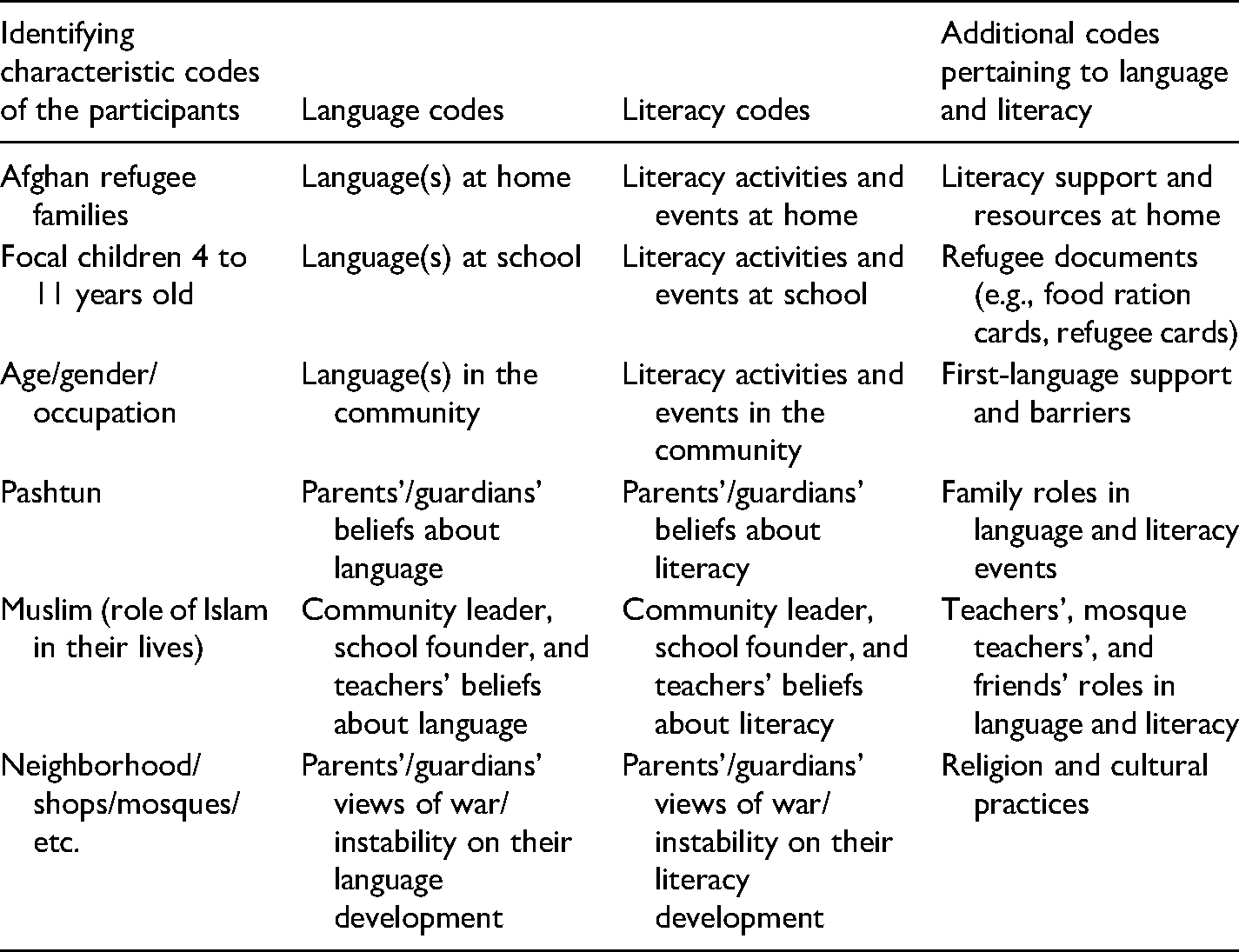
I followed Miles et al.’s (2014) strategy for qualitative data analysis. After transcribing the data, I reread the materials multiple times and began deductive coding. Since my research question focused on understanding the language and literacy practices of the children in three settings, I developed the following codes: Language(s) at home, Language(s) at school, Language(s) in the community, Literacy events at home, Literacy events at school, and Literacy events in the community. In addition, I included other codes that related to the children's’ and families’ language and literacy practices. For instance, the code “Language(s) at school” centered on the language(s) the children spoke and in which they were spoken to while at school. Table 1 lists the deductive codes pertaining to language(s) and literacy and other essential factors.
Deductive Codes.
After deductive coding, I worked on field notes and interview transcripts and engaged in “first cycle coding” (Miles et al., 2014, p. 73), a way to “initially summarize segments of data” (p. 86). I identified codes inductively and tried to capture the main points of the field notes and interviews. During the first cycle coding, I strove to follow Merriam and Tisdell’s (2016) advice that researchers be “as expansive as [they] want in identifying any segment of data that might be useful” (p. 204).
After the first cycle coding, I proceeded to “second cycle,” or pattern coding, “a way of grouping those summaries [from first cycle coding] into a smaller number of categories, themes or constructs” (Miles et al., 2014, p. 86). During this stage, I reviewed my data and initial codes and looked for patterns or recurring “behaviors, actions, norms, routines, and relationships” (Miles et al., 2014, p. 88). I then grouped the data into categories and subcategories, and under the subcategories, I applied subcodes. Each subcode included the codes from first cycle coding. For example, one of my categories was “English print at school” and under this category, one of the subcodes was “classmates/teacher reading and writing in English print.” An example from my field notes listed under this subcode was “She then writes ‘tooch’ and again Mrs. Madinah says in Urdu, ‘Saheeh hey?’ meaning ‘Is it correct?’” I shared interview transcripts with the teachers and provided oral summaries to parents and guardians (parents/guardians preferred this to written transcripts) as a member check.
Findings
In this section, I provide a detailed description of the six major themes, focusing on the children's literacy. I begin with the prominent theme of faith and then describe the various literacy practices across the children's homes. Next, I describe the children's literacy practices at school.
Faith Literacy at Home
The prominent literacy practice in Safa's, Seemena's, and Arman's homes related to faith. The children used religious texts that helped develop their overall literacy skills. This meant reading or practicing the Quran, the Separah (Quran primer), or other texts relating to faith, such as a prayer book. For example, Safa regularly used a Duas (supplication book) at home to teach those around her. She used the Duas book to teach her brother and the neighbor's child the six prayers that Muslims should know. When she asked one of the children to recite the first prayer from memory, he did not answer, so she began to recite it for him. As soon as she did, he was able to complete the prayer. I also observed her use a Separah to teach her brother the Arabic letters (field notes, May 9, 2018). In addition, she read and reread certain chapters of the Quran to improve her recitation and pronunciation. I observed her reread a chapter from the Quran, focusing on pronouncing letters that had distinct but similar sounds (field notes, January 23, 2018).
Like Safa, Seemena also used a book to engage in her faith. She practiced her prayers and used a Salah (prayer) book regularly at home. Praying five times daily is a requirement in Islam, and the prayers consist of reciting memorized passages or chapters from the Quran in Arabic. Seemena was not yet required to perform the prayers, but she practiced them diligently at home. Seemena also regularly used a Salah book, written in Urdu, to remind her of the steps of the ablution and the prayers. When asked whether she used the pictures or notes to help her with the ablution, she said “she used the pictures, as she forgets the order of the ablution” (field notes, February 1, 2018), but otherwise knew how to perform it. During the interview, she stated, “My mother also helps me with saying some words correctly” (May 22, 2018), meaning she listened to her as she performed her prayers out loud. As a result, Seemena needed help from her family members and referenced the book frequently to perform the prayers. With respect to print in the Salah book, Seemena understood and read the instructions in Urdu without difficulty and demonstrated this by reading one page of instructions in Urdu and translating it for me into Pashto (field notes, February 1, 2018).
Arman also used his Separah at home in preparation for his daily Quranic class. He told me he was practicing the letters (field notes, March 14, 2018). When he read me his lesson, I noticed that he was able to read most of the letters when they were used by themselves and in their ending form, but he struggled when they were used at the beginning or in the middle of a word. Since Arabic letters change slightly in their beginning and middle form, it can be common for a novice reader like Arman to make this mistake.
Arman's father and brother regularly checked on him to ensure that he attended his Quranic classes. The father and brother were mostly occupied with their hay business and I rarely saw the father at home. While they inquired about his attendance at Quranic class, I did not notice any instances of his father or brother helping him read the Separah, although they both played an important role in making sure that Arman took his Quranic class seriously. These glimpses of the children's homes indicate that their interaction with print was mainly for faith purposes, such as being able to perform prayers, practice words or letters, or teach supplications to others.
Faith Literacy in the Community
Faith also played a major role in the children's lives, and most of their literacy practices in the community centered around their Muslim identity. Safa's literacy practice revolved around her recitation of the Quran. She attended a daily Quranic class and the teacher explained and gave instructions in Urdu, but read the Quran in Arabic. I observed Safa preparing for her lesson by reciting a chapter of the Quran, and wrote, “She reads in it in a careful rhythmic manner, while pointing her finger to each word on the page” (field notes, January 23, 2018). In addition, it is common for learners of Arabic to experience difficulty with letters that are pronounced similarly. To be become proficient, Safa reread the chapters repeatedly. At this stage, Safa's Quranic class focused on the performative aspect (pronouncing and reciting correctly) and not on comprehension. Therefore, Safa was able to read the Quran fluently (and had done so in its entirety more than once) but could not understand the meaning of what she read.
Seemena had also read the Quran and tutored children in her community with Quranic reading and their homework. She said proudly, “I help them with schoolwork and the homework” (interview, May 22, 2018). During the week, between five and seven Afghan children from kindergarten to third grade came to Seemena's home, where she tutored them. The children read or worked on their assignments until Seemena called on them. The child would then show her their assignment and she would guide them. I observed Seemena help a child with Quranic reading and noted, “Seemena listens and corrects her, and [the student] then repeats the correction…then she asks her to go back to her sitting spot and practice the page” (field notes, February 28, 2018). Seemena also helped a kindergartener with reading the Arabic alphabet in the Separah. On one occasion, I noted that she read each letter to him and afterward asked him to “read each letter three times” (field notes, May 22, 2018). When he forgot one of the letters, he asked Seemena for assistance.
While Safa and Seemena read the Quran, Harun and Arman practiced the Separah. For Harun this consisted of reading, listening to, and reciting passages from the Separah. The Separah focuses on the discrete skills of naming, sounding out, and identifying letters and simple sentences from the Quran. The goal is to read and sound out the letters correctly, but not necessarily to comprehend the meaning of the text. Harun attended a Quranic class daily with boys of various ages, and the teacher called on each to read their lesson aloud. The teacher spoke in Urdu, but the texts were read in Arabic. I observed Harun practice his lesson and read the letters accurately (field notes, March 9, 2018). Harun sometimes sought his classmates’ help at the mosque to read the Separah. I noted, “He is struggling with the silent letters in the words and turns to the boy [who] helps him read the words” (field notes, April 26, 2018).
Arman also attended a Quranic class to practice the Separah. He informed me that the teacher punished students who did not practice their lessons (field notes, March 7, 2018). He also mentioned that the teacher rewarded students with stickers if they practiced their lesson and that students read and reread their lesson several times to become fluent.
In addition to formal lessons, Arman's faith-based literacy practices in the community included looking for papers on the streets to see if they had the name of Allah on them. He would pick up papers to see if they bore the name of Allah. If they did, he would take them home because “it's a sin to throw away a paper with the name of Allah” (field notes, February 13, 2018). Arman was also observant of texts at school that contained the name of Allah. For example, I observed him trying to hang his classmates’ backpacks on the chairs, and he told me “the Urdu books has Allah's name” (interview, March 12, 2018). Throughout my time observing Arman, he showed great respect for the name of Allah and did what he could to ensure it was not sullied. Living in the first-asylum country of Pakistan supported these families’ and children's literacy practices as they related to faith. These resources may have not been available to Afghan refugees in non-Muslim first-asylum countries. For instance, many Pakistani children in the community attended Quranic classes after school, and there were many centers that offered Quranic classes. In their research with Syrian and Burmese refugee families, Cun and Kfouri (2022) found that faith literacy was a sustaining practice for refugees across contexts, including in the United States, their permanent resettlement country. Faith played a major role in these children's and families’ literacies, both at home and in the community, as faith and religious texts can “provide significant spaces for children's literate, often biliterate or multiliterate development” (Compton-Lilly, 2016, p. 24).
Literacy Brokering at Home
Both Safa and Seemena engaged in literacy brokering at home. Safa's father was unable to read or write in any language and relied on Safa to read and translate Urdu and English texts. As with her sibling and the neighbor's child, Safa taught her father the Duas, which he enjoyed, stating, “At night when [I] am going to sleep, I say, ‘Child can you please read me the Dua for sleeping?’” (interview, May 13, 2018). Safa read him the supplication in Arabic, followed by Urdu, finally translating it for him verbally into Pashto. She could read the Duas in Arabic fluently, but could not understand it without reading the Urdu translation. Her interaction with Arabic consisted of being able to read the Quran and the Duas fluently with correct pronunciation. Safa also translated television news headlines from Urdu or English into Pashto for her father.
Seemena similarly assisted in translating print at home. She was the only person in her family who could read, and therefore reviewed all printed materials that arrived at the home, including bills, wedding cards, and school notices. Her father valued Seemena's excellent ability, and told me that she was the one who “led us” (field notes, May 10, 2018). Like Safa, Seemena provided essential support to her family through brokering, and as a result both children regularly referenced print and translated it at home.
Naseehath (Moral) Storytelling at Home
Seemena and Harun engaged in Naseehath (moral) storytelling. I categorize this as a literacy event because it reflected the parents’/guardians’ understanding of literacy and has been shown to promote children's literacy development (Kanaya & Santiago, 2019; Luo & Tamis-LeMonda, 2019). Naseehath can consist of telling a story, giving advice to teach a lesson, sharing events from one's life, and incorporating Islamic values. The practice may differ from home to home. For instance, Seemena's father explained the purpose was to emphasize academics for his daughter, and not household chores: “The Naseehath is that she is now in this school, we want absolutely nothing from her in terms of chores or other type of work from her at home” (interview, April 17, 2018). He stressed that he wanted Seemena to learn with “nar twoob” (“male confidence”), encouraging her to be confident and strong like a man in pursuing her studies. To encourage her, he and Seemena's brother regularly asked Seemena about her studies. For example, one day Seemena was playing and her father asked her, “Daughter, did you do writing?” (field notes, May 22, 2018). Another time, her brother asked about her social studies test, and she told him that one of the questions was hard. Although her father and brother were not able to read or write, both of their conversations with Seemena centered on her schoolwork.
Harun's literacy practice at home also involved the Naseehath, but only when he was available. I never observed Harun read or write at home, as he was busy running errands, caring for the livestock, or attending Quranic class. When he had time, Harun spent it with his grandfather and cousins. The grandfather often told Naseehath stories that highlighted good manners or taught the children about Allah or the Prophet Muhammad. For example, he told Harun and the other children a moral story that illustrated that a gift from God cannot be taken by others (field notes, March 5, 2018).
Other times, the grandfather used the Naseehath in lecture-like talks on specific topics, such as informing the children that when they obeyed their elders, they “got good points from Allah” (field notes, April 11, 2018). Naseehath was a great literacy event in the household, and being “morally good” closely aligned with Harun's uncle's definition of literacy: “A literate person is a person of many things, but I say, literacy enables good manners in one, from animal to human” (interview, May 13, 2018). Thus, literacy helped one become a morally better human being, and the Naseehath storytelling was what the family used to help the children in this regard. Harun's uncle described Harun, saying, “Before he was in the village and was very naughty…before he didn't understand the difference between an older and younger [person] and the respect owed to one, and now he understands it.” Thus, in both Seemena's and Harun's homes, the Naseehath was used to emphasize the importance of education, having good manners, and being a good Muslim.
Below, I separate the findings on children's literacy practices at school by gender because of the differences in their achievements and literacy practices.
Safa's and Seemena's Success with School Literacy
The school's languages of instruction were Urdu and English. Safa spoke, read, and wrote in Urdu fluently and could read, write, and understand basic English as it related to her schoolwork. One common activity in her English and Urdu literacy classes was the Make Sentences lesson. In this activity, the teacher wrote a list of vocabulary words and asked students to construct sentences that included each word. Safa was an active participant. For instance, on one occasion a student wrote “There are many girls” (using the vocabulary word “girls”) and the principal asked if any corrections were needed. Safa volunteered and added “in our class,” so the sentence became “There are many girls in our class” (field notes, April 24, 2018). Another student wrote “four walls in my class,” and Safa added, “There are four walls in my class,” to which the principal said, “Good job.” Safa also participated regularly in the Make Sentences lesson in her Urdu literacy class. When the teacher asked for a sentence with the word “town,” Safa stated in Urdu, “Next to my home, there is a small town.” Her classmates regularly turned to her for help, such as when a classmate asked Safa for help during Urdu literacy class and “showed Safa two words written on her hand and asks her which word goes in the sentence and Safa shows it to her” (field notes, April 12, 2018).
Seemena also read and wrote in Urdu and English every day. Like Safa, she participated in the Make Sentences activity in her Urdu class. For example, Seemena used the word “happy” and orally supplied the phrase “I am happy that I am fine” (field notes, January 30, 2018), which the teacher then wrote on the board. In another example, Seemena correctly wrote sentences using the words “lie” and “trust” as “Allah does not like a person who lies” and “I trust my mother and father” (field notes, April 10, 2018).
In English class, Seemena engaged in reading comprehension activities that centered on providing factual answers rather than giving an opinion about the text. One day the students read a story and the teacher asked what the grandfather was doing. I observed Seemena had underlined “Grandfather is in the living room reciting the holy Quran” (field notes, February 1, 2018). Similarly, another day the class read a story from their textbooks. One of the questions asked, “Why was the red rose upset?” and Seemena had written “Because the boy tried to pluck it” (field notes, May 10, 2018). However, the English teacher had the students answer comprehension questions together as she believed the students were not able to answer them on their own. She attributed this in part to the school's lack of consistency in using English.
Safa and Seemena were successful students according to their teachers. Safa's teachers often used her work as exemplars for other students. On one occasion, the English teacher asked the students to “fill in the blanks with the rhyming words” (field notes, February 22, 2018). After students copied the sentences and completed the exercise, she called on Safa to complete it on the board. When she finished, the teacher asked the students to look for any mistakes and they found none. Safa's social studies and mathematics teacher commented on her abilities in both Urdu and English, noting that she is a “position holder in our class” (interview, February 12, 2018) due to her high marks on the year-end summative exams.
Seemena was also considered a successful student by all her teachers. Her social studies teacher was surprised to learn that she was an Afghan (field notes, February 1, 2018), in part because some teachers had lower expectations of Afghan students and believed that they came from families that did not support their learning. Students like Seemena challenged their assumptions. While both students did well in English and Urdu at school, they were much more invested in English. Safa's English teacher specifically stated that Afghan students “are not interested in Urdu, they are interested in English” (interview, January 24, 2018). Similarly, Safa's father felt that the family's stay in Pakistan was temporary, so Urdu had few long-term benefits (interview, May 13, 2018).
Harun's and Arman's Struggle with School Literacy
Harun read and wrote in Urdu and English each day at school, and while he could speak Urdu fluently and spoke some English, he struggled to read and write in both languages. Harun relied on classmates to complete his schoolwork. For example, I observed that “Harun changed [his] seat back and forth and attempts to copy from an Afghan boy.” When this did not work, he tried again, and I noted, “Now he is copying from another girl to his left” (field notes, January 22, 2018). Finally, Harun sat next to another classmate and completed the rest of the assignment and handed it in. Since Harun could not complete the assignment on his own, he sought help from one classmate after another and physically moved around the classroom. Similarly, on another occasion, the Urdu teacher asked the students to turn statements into questions. Harun completed the questions that he could read on his own, and when he could not, he again turned to his classmates for help (field notes, January 12, 2018).
Harun also used classroom resources such as posters to complete some assignments. In one instance, the teacher wrote, “Show a mind map about profession.” After copying the assignment from the board, Harun used the “Different Profession” poster that the students had made, along with pictures (field notes, March 5, 2018). In another instance, Harun worked on a practice social studies test, which asked students to write the months of the year, and Harun copied the answer to the question from the “Months of the Year” poster (field notes, March 8, 2018). However, once the teacher noticed, she removed the poster.
When Harun was able, he did his assignments on his own. For example, in the science class, the teacher asked the students to draw and write the names of some vegetables. Harun wrote the directions carefully from the board and then began drawing tomatoes and carrots. I observed that “after he draws the tomatoes, I see him attempting to spell but then erases it and writes it again” (field notes, May 25, 2018).
Arman also used Urdu and English at school and spoke Urdu fluently, but he struggled with reading and writing in both languages. Like Harun, Arman relied heavily on his classmates to complete his Urdu and English assignments. One day, he sang a phonics song with the class on the letter “s.” Afterward, the teacher distributed a worksheet on which students were supposed to color the objects that began with that letter. I watched Arman look at the objects and color the objects he recognized right away: snake, star, and sun. When he could not identify more objects, he looked at his classmates, and “as Fadi has colored in a picture of a spoon, Arman started coloring the spoon as well.” Arman continued to color in whatever else Fadi colored until the worksheet was completed (field notes, February 26, 2018). I asked him to name the objects that he colored and he named the objects he colored initially on his own. The only other object he could name was the spoon. However, he had also colored a picture of a jar, which Fadi had done as well.
Arman engaged in similar behavior in his Urdu literacy class. One day, the teacher asked the students to open their notebooks for a dictation quiz. She asked them to write the Urdu word for “pomegranate.” Arman wrote the first letter but could not write the rest. Throughout the quiz he tried hard to look at his classmates’ papers, but the two students sitting near him kept their papers away from his gaze. At the end of the quiz, the teacher asked the students to turn in their notebooks. While the rest of the class rushed to do so, “Arman, instead, put the notebook in his bag” (field notes, January 16, 2018). Another time, Arman worked on writing the Urdu names for objects pictured on a worksheet. The words were listed at the top of the page and students had to write their names under the appropriate picture. Arman recognized two of the words and wrote them under the corresponding pictures. When he realized he could not read or complete the rest of the assignment, he waited until a classmate left the classroom and copied from that classmate's paper (field notes, May 22, 2018). To summarize, Arman could do some assignments on his own, but most tasks were too difficult for him to complete independently.
Harun's and Arman's teachers were aware that they struggled with school literacy. Harun's teachers believed he was not receiving much support or assistance at home. His English teacher believed that Harun's uncles were not prioritizing his education and that “he may be here to help his uncles [with the livestock, running errands, etc.] rather than study” (interview, February 27, 2018). She noted, however, that his literacy skills had improved and could progress further if he received more support at home. His Urdu teacher also mentioned that certain Afghan students struggled with reading and writing. Using Harun as an example, she said, “Harun don't write and good learn something” (interview, January 22, 2018). She recalled that, despite her efforts, students like Harun struggled because they lacked basic reading and writing skills.
Arman's teacher was also aware that Arman struggled to complete most assignments that required him to read and write in Urdu and English. When asked about the challenges Afghan students faced in school, she answered, “Only one Afghan student [has challenges]…Arman” (interview, February 6, 2018). This was in a classroom where almost half of the class of 18 students were Afghans. Arman's teacher assumed that Arman was the only Afghan student because of the learning struggles he faced. Like Harun's teachers, she believed a lack of involvement at home was the issue, stating, “I don't know that there is no one at home to help him in studies.” She had never met his parents but highlighted that his homework was usually incomplete. Both Harun and Arman, unlike Safa and Seemena, struggled with school literacy and had to rely on their classmates or other resources to complete some assignments. In addition, their teachers had assumed, without meeting the children's families, that they generally did not prioritize their education.
Discussion
The four focal children's literacy practices were not grounded in autonomous literacy skills, but were embedded in the social and cultural practices of their homes, school, and community (Street, 1995). Reading and writing at home was for functional purposes, not for pleasure. Most prominently, reading occurred in relation to their faith. Three of the children also attended Quranic school and read or recited religious texts at home. The results of this study emphasize the important role religion and religious texts play in families’ literacy practices. The link between literacy and religion has been well documented (Graff, 1987; Luke, 1989), such as in Gregory et al.’s (2013) study on four faith communities in the UK, which showed that children's engagement in religious practices enriched their literacy learning. Volk and de Acosta’s (2001) study on Latino kindergarten children similarly showed how engaging in religious practices contributed to their literacy practices. One mother noted that reading the Bible with her child was “a reading lesson as well as a religious event” (p. 206).
Naseehath storytelling also featured prominently in two of the children's homes. These stories emphasized the themes of doing well in school and the importance of literacy. While Harun's time was limited during the day because he cared for the livestock, when he had free time, he listened to Naseehath storytelling. Naseehath reflected Harun's family's understanding of literacy: becoming a morally better Muslim and person. Similarly, in Seemena's home, the Naseehath storytelling was used to emphasize the importance of doing well in school. Roy and Roxas’s (2011) study of Somali refugee families in the United States also highlighted that families used storytelling to pass on the value of education to their children.
At school, the female children succeeded in school-based literacy practices, but the male children could not independently complete most assignments that required reading and writing in Urdu and English. Although both boys spoke Urdu fluently, it was of little help when it came to reading and writing in that language, and they copied from classmates and used posters when facing an especially challenging task. Since the schoolwork was mostly beyond their abilities, both Harun and Arman felt they had no choice but to copy or cheat from their classmates to complete assignments. When they knew the content, neither of them resorted to copying but focused intently on their own assignments. In addition, when Harun engaged in the valuable practice of using resources around him, such as posters, his teachers mostly did not value it. Furthermore, Harun also used his first language to have classmates explain the assignment to him. However, most of the time, these efforts were curtailed when the teacher noticed.
One reason for the difference between the male and female students’ success could be that the female children had more time at home to focus on their homework and were supervised by the adults, while the male children were not. While the male children's parents/guardians supported the children's literacy, the families’ circumstances and lack of communication may have affected their literacy achievements. For example, when the adults in Harun's home conversed with him, most of the time this was limited to attending to the needs of the livestock, and he could only participate in Naseehath storytelling after fulfilling those responsibilities. In Arman's case, his father and siblings spent most of their time running the family's hay business. I did not see Arman or Harun working on school assignments, even when they had free time.
Since most refugees spend years in first-asylum countries, it is imperative that teachers in first-asylum and resettlement countries better understand refugee students’ experiences in these contexts. Specifically, teachers need to understand refugee children's day-to-day experiences. Many refugees face barriers and disruptions to schooling in first-asylum countries (Dryden-Peterson, 2015), including language barriers and even discrimination. These experiences will impact students’ schooling in final settlement countries. As seen in this study, some of the teachers and parents acknowledged that Afghan children are not very invested in learning Urdu and preferred English. However, at school, although most print materials were in English, the instruction took place in Urdu. For example, students would read a science text in English, but the discussion was mostly in Urdu. Harun's uncle mentioned that school was difficult for Harun as he had to learn Urdu the first few years. This means that children like Harun may arrive in a permanent resettlement country being far behind in content mastery, due not to their abilities but to language barriers.
Teachers need to collaborate with their refugee students and parents to understand the students’ experiences in first-asylum countries and support their learning. For example, if teachers understand that most refugee students in first-asylum countries experience teacher-centered pedagogy (Dryden-Peterson, 2015), such as teachers lecturing and asking factual questions, they can more effectively help students learn new ways of participating, such as asking questions and offering opinions on a text. Otherwise, teachers in resettlement countries may mistake refugee children's lack of participation as their not having much to contribute, when refugee students may just be following what they learned from their pre-resettlement experience about the proper way to behave at school.
As seen in this study, most of the focal children's literacy activities at school centered on small elements of text, with a focus on letters, words, and sentences. For instance, the students were asked to come up with sentences with vocabulary words or to read, write, and pronounce them correctly. They were not asked for their opinions or thoughts on the characters or plot of a story. If these children resettle in countries like the United States, they may need to be explicitly taught certain pedagogical practices that are valued in Western nations. Otherwise, “past experiences with teacher-centered pedagogy may leave resettled refugee children unaware of the behavior and approaches to learning required of them” (Dryden-Peterson, 2015, p. 2).
Teachers in both first-asylum and permanent resettlement countries should also respect refugee children's first language and bilingualism. The teachers in this study mostly did not value or capitalize on the students’ bilingualism, emphasizing speaking English and Urdu at school and discouraging them from using their first language. Teachers need to understand that first languages can be an important resource for second-language learning (Cummins, 2013) and connect refugees to their culture and form stronger bonds between families (Wong-Fillmore, 2000).
Finally, teachers in first-asylum countries and permanent resettlement countries need to learn more about their refugee students’ literacy practices. Teachers must acknowledge that families have a wealth of “funds of knowledge” (Moll et al., 1992) that they can integrate at school. One way to bridge the school–home gap in understanding literacy practices is to invite parents/guardians to the school to share some of their literacy practices, such as the Naseehath storytelling. In such encounters, parents can talk about their own learning, the learning of their children, or other topics. Teachers can also share some of the learning activities the children are engaged in at school. These dialogues can challenge some educators’ deficit views of parents’ support for their children's learning.
Sociocultural theory, funds of knowledge, and brokering guided my analysis of the literacy events across the different settings and helped me understand what literacy meant and the role it played for the participants. Funds of knowledge helped me understand the support each family provided to their children's learning. Also, some of my findings were inconsistent with some theories. For example, sociocultural theory mostly emphasizes the important role that adults play in children's learning, such as mothers teaching their children. However, the parents in this study were not able to support their children in this way, as most of them could not read or write. Except in the case of Harun, whose uncle had completed high school, the children were more competent than their parents/guardians in print literacy. Furthermore, some of the children guided the adults’ learning, such as Safa teaching her father the Duas.
Limitations and Future Directions
Despite its empirical contributions in shedding valuable light on a major refugee population in a first-asylum country context, the study has some limitations. First, the four Afghan families in this study may not be representative of all Afghan refugee families, although I strove to include families that differed in composition. Second, due to cultural protocols, the female parents’ perspectives are missing. Future research could benefit from including a large number of participants in order to further understand Afghan refugee children's literacy practices. In addition, further research could involve female and male researchers to work collaboratively in situations where cultural norms may present barriers.
Footnotes
Acknowledgments
I wish to thank the participants and the school for participating in this research. Thank you also to The Public Scholars Initiative [PSI] at The University of British Columbia for supporting this research. In addition, thank you to Drs. Jim Anderson and Laura Teichert for their thoughtful suggestions during the revision process, which greatly enhanced the manuscript.
Declaration of Conflicting Interests
The author(s) declared no potential conflicts of interest with respect to the research, authorship, and/or publication of this article.
Funding
The author(s) disclosed receipt of the following financial support for the research, authorship,and/or publication of this article: This research was supported by The Public Scholars Initiative [PSI] at The University of British Columbia, Vancouver, Canada.
