




Abstract
Research indicates that feeling is fundamental to the multilayered experience of literary interpretation. However, despite great strides in U.S. high school classrooms, discussions about literature are still often characterized by known-answer discourses that exclude feeling. This article builds on small-scale studies of affective evaluation, an interpretive approach in which readers attend to and reflect on their feeling-based responses to texts. Those studies, focused on individual students, showed that when responding to texts with feeling, students were more likely to build multilayered interpretations as opposed to summary or one-dimensional thematic interpretations. The current study explores affective evaluation in the more complex arena of class discussion, where known-answer discourses are particularly entrenched. We compared the same teachers and students using affective evaluation in one discussion, but not the other. Discussions using affective evaluation were correlated with increased multidimensional interpretation, adding to evidence that feeling enriches students’ literary sense-making and disrupts known-answer discourses.
The Power of Feeling in Students’ Interpretive Discussions of Literature
The Problem of Known-Answer Discourses in Language Arts Classrooms
While the field of English language arts (ELA) in the United States has made great strides toward student-centered instruction, classroom discussions of literature are still too often characterized by one-dimensional, “known-answer” discourses (Nystrand et al., 2003), where teachers focus on literal details, or move discussion in a straight line toward the unveiling of a predetermined central message (Nystrand, 2006; Olson & Land, 2007; Swanson et al., 2015).
Reznitskaya and Glina (2013) offered an example of a known-answer discussion of a Lakota tale in a fifth-grade classroom:
Did [a character in the story] see the color, the red color on the eagles’ feathers? Yes or no, Donna?
Yes?
No, he actually didn’t, because…because very what? Very few people what?
See it.
“See it,” right… Only a few people see red. (p. 52)
Such known-answer exchanges belong to a larger set of social, ideological, behavioral, and linguistic ways of interacting, often called discourses, that still define what it means to be a student in conventional schools in the United States (Gee, 2001; Gutiérrez et al., 2009; Schleppegrell, 2004). These discourses, rooted in more than a century of white, Western norms, have often framed literary reading as the study of fixed themes, moral meanings, or structural coherence (Applebee, 1974; de los Ríos et al., 2019; Levine, 2019). As members of classroom communities of practice (Lave, 1991), students and teachers have become acculturated to these known-answer frames (Addington, 2001; Andringa, 1991; Beck, 2006; Fish, 1980; Gutierrez, 1995; Kirkland, 2011; Lee, 2007). Thus, when students approach literary reading, they may consider only a single route to meaning-making: “What does the teacher want me to understand from reading this?” (Wilhelm & Smith, 2016, p. 28).
Research in ELA classrooms indicates that such known-answer discourses often—though not always (see Boyd, 2015 for a counterexample)—constrain rich literary reading practices, such as considering multiple meanings (Chick et al., 2009; Chinn et al., 2001), developing connections and coherence in interpretation (Almasi et al., 2001), or gaining independence as literary readers (Nystrand et al., 2003). Notably, known-answer discourses are especially entrenched in high-poverty schools and lower-tracked classes, which often serve students of color (Lenski et al., 2016; Oakes, 2005; Watanabe, 2008).
The Suppression of Emotional Responses to Texts in Language Arts Classrooms
Further, known-answer discourses can suppress students’ authentic emotional responses to texts and each other (e.g., Levine, 2014; Thein et al., 2015). Consider the current trend in U.S. high-stakes standardized tests of literary reading, which draw from New Critical paradigms: Identify a central idea in the text. Analyze how the author's use of one writing strategy (literary element or literary technique or rhetorical device) develops this central idea. Examples include: characterization, conflict, denotation/connotation, metaphor, simile, irony, language use, point-of-view, setting, structure, symbolism, theme, tone. (New York Regents Exam, 2016)
These exams reinforce conventional ELA classroom discourses first by implying that ideas are embedded in literary texts, to be “identified” by readers, as opposed to developed through readers’ transactions with texts (Rosenblatt, 1993), and second by implying that readers’ emotional responses are not germane to literary reading and response.
This neglect of feeling is a problem, because, as literary theorists and writers have consistently argued, affect and emotion are fundamental to literary creation and response on many dimensions (Booth, 1983; Feagin, 1996; Morrison, 2007; Rosenblatt, 1993). These dimensions include the personal, when a reader feels nostalgia for their own grandmother when reading about someone else's; character, when a reader experiences sympathy or disgust for Daisy from The Great Gatsby; worldview or theme, when a reader senses both despair and a glimmer of hope at the end of Beloved; aesthetic pleasure at a turn of phrase in a Li-Young Lee poem; and critical, as in a reader's condemnation of a character's overt racism in To Kill a Mockingbird, or of the author's more subtle racism in her construction of a white savior in that novel.
A Feeling-Based Approach to Literary Discussion
Our concern is the degree to which the socially constructed norms of the conventional classroom might flatten feeling. Teachers and students need supports to disrupt these known-answer, one-dimensional discourses so they can engage in discussions about literature that move beyond literal sense-making to interpretation, and invite rich, multidimensional discussion. This study explores a feeling-based approach to literary response called “affective evaluation” (Levine, 2014). Previous studies have found this approach to be correlated with increases in students’ individual interpretive sense-making in writing and individual think-alouds. In the current work, we investigate the degree to which affective evaluation acts as an interpretive support in students’ text-based discussions, and as a potential disruptor of known-answer discourses in the ELA classroom.
Background
Defining Affect
It will be useful to define affect for the purposes of this study, as the term is taken up differently in different realms. For example, in the realm of affect theory, affect is not a synonym for individual feelings or emotional responses. Instead, affect is pre-emotional. It is “the registration on the body of being affected by something, whether consciously or unconsciously” (Boldt et al., 2015, p. 432), a “flow of intensities that catches things up, brings things together, breaks things apart, and can be expressed as possibility, momentum, and emerging directions of force” (Boldt & Leander, 2020, p. 518). In the realms of cognitive poetics and literary psychology, affect can be synonymous with many types of feeling that an individual or group might experience. It is an umbrella category for sensory and emotional responses (Eva-Wood, 2008, p. 569), including general states of arousal, and “emotions...…moods, preferences, beliefs, attitudes, motivations, and evaluations” (Fleckenstein, 1991, p. 448). In this study, we use this second definition of affect.
Defining Affective Evaluation, or UDBW (Up/Down/Both/Why)
We are specifically interested in affective evaluation, a feeling-based instructional approach to literary interpretation that draws both from cognitive poetics (e.g., Miall and Kuiken, 1994) and sociocultural theories of literacy in education (Gee, 2001; Rosenblatt, 1993).
Affective evaluation involves the following:
Attending to language or textual events that the reader finds especially affect-laden or has an emotional response to; Ascribing valence (a range of positive or negative values) to those responses; and Explaining those evaluations.
When using affective evaluation, teachers and students often made thumbs-up and thumbs-down gestures to embody their initial responses to texts, and then reflect on their valenced responses. As a result, they use the term “up/down/both/why,” or UDBW, to describe affective evaluation.
Here is an example of UDBW: In one study in a high school ELA classroom (Levine, 2014), students read a version of the fairy tale “Cinderella.” One paragraph of the story ended with this sentence: “Cinderella was left at home, weeping by the ashes.” Using UDBW, many students found this final sentence to be especially full of feeling as compared to other sentences. They evaluated it as “down,” or negative, and pointed specifically to the words “left,” “weeping,” and “ashes” as being especially depressing. Finally, they explained their negative responses by describing their personal and context-based associations with those words. To them, the line created a sense of hopelessness and abandonment.
When using UDBW, students may make differently valenced evaluations of language. For instance, not all students responded in the same way to the language of the sentence from “Cinderella.” Ultimately, some found this line to portray Cinderella as a more unsympathetic character who perhaps did not stand up for herself. A few viewed the story through critical lenses, writing, for example, “The only way a woman succeeds is through a man.”
Although UDBW is anchored in recognition of basic negative and positive feelings, the approach does not seem to reduce students’ interpretations to binaries. Instead, it seems to provide a foundation for more nuanced interpretation. For example, in the reading of “Cinderella” above, students began with an initial “down” response to a particular line, but then moved from the basic negative evaluation to more shaded associations with hopelessness and abandonment, as well as concerns about independence and gender roles.
Prior research on UDBW
Previous studies of UDBW show that in comparison to control classrooms or pretest responses, students using UDBW were less likely to focus on literal meaning and more likely to build literary interpretations. They were also more likely to engage in multiple levels of interpretation, such as making judgments about character, exploring symbols, and connecting patterns or unusual details to broader themes or moods (Levine, 2014; Levine & Horton, 2013). The approach also seemed to support students’ attention to interpretively salient elements of short stories and poems (Levine & Horton, 2015), such as endings, patterns, and shifts in tone—elements that literary theorists suggest are especially important to engaging with literary texts (Culler, 2002; Rabinowitz, 1987).
These studies indicate the promise of UDBW. However, they were limited in reach. They included four participating classrooms and two grade levels, analyzed individual student written or think-aloud responses, and used only short stories or poems as experimental texts. In the current study, we sought to broaden the research and test the flexibility of the approach, comparing a larger number of classrooms and grade levels, using a wider range of text genres, and focusing not just on individual responses but on the more complex arena of class discussion.
We looked across these varying contexts to ask the following questions:
Were student discussions in the UDBW condition more likely than the non-UDBW condition to include interpretive turns of talk, as opposed to literal turns of talk? Were student discussions in the UDBW condition more likely than the non-UDBW condition to include multidimensional literary response (e.g., responses that moved between connotation, character judgment, and critical lenses), as opposed to one-dimensional interpretation?
Conceptual Frame: Literary Response Is Situated in Personal Feeling and Social Context
In positing a feeling-based frame for literary reading, we draw from literary theory as well as sociocognitive and sociocultural theories of meaning-making.
Literary Theory
First, UDBW is based on the literary theory of defamiliarization (Shklovsky, 1965), defined as the art of representing something conventional in a new way, so that the representation disrupts a reader's typical understanding of that thing. In this theory, figurative language or other literary elements may violate readers’ conventional expectations, leading readers to experience an affective jolt when they encounter such elements. For example, in Beloved, Toni Morrison compares a character's heart to a rusted tobacco tin. Encountering two familiar images (heart and tobacco tin) in this unfamiliar way might lead a reader first to a heightened affective response, and then to an attempt to interpret figurative meanings.
Affective evaluation guides students to read with attention to those initial affective jolts, and then draw on their everyday, feeling-based evaluations and emotions to make sense of what they read. Feelings or emotions have valence—a range of negative and positive charges—and varying degrees of intensity. Affective evaluation helps readers use their negative and positive feelings as jumping-off points for moving beyond a traditional focus on surface features of a literary text and toward interpretive sense-making.
Sociocognitive and Sociocultural Theories of Meaning-Making
A feeling-based frame for literary reading also draws from sociocognitive theories of meaning-making. This study analyzes individual and group literary sense-making, which to some degree locates meaning-making within individual students as they interact with one another and their teacher. Rosenblatt's reader response theories (1938, 1993) might be seen as sociocognitive as they focus on an individual reader's internal experiences of “private feelings, attitudes, sensations, and ideas” in transaction with a text (1993, p. 382).
At the same time, this study draws on sociocultural theory, arguing that individual meaning-making is inextricably intertwined with broader social contexts, including the institutional discourses of the traditional classroom. From this perspective, meaning-making can be said to take place not just within an individual student, but “in the space between” individuals and settings (Glăveanu, 2011, p. 480).
Rosenblatt (1938) voiced concern about known-answer discourses, where the student has learned “that there are proper ways to react, certain things to look for…that his remarks on the work must satisfy the teacher's already crystallized ideas about it” (pp. 76–77). Other scholars have built on these concerns, further exploring the influence of school-based discourses, or norms of “behaving, interacting, valuing, thinking, believing, speaking, and often reading and writing that are accepted as instantiations of particular roles” (Gee, 1996, p. viii). They have found that such discourses often give authority to white, middle-class interactions over those of other minoritized groups; to school learning practices over everyday learning practices; and to academic knowledge over everyday knowledge (de los Ríos et al., 2019; Heath, 1982; Moje et al., 2004).
This study of UDBW takes up these concerns by exploring the degree to which a feeling-based approach to classroom discussions of literature might support interpretation while disrupting conventional known-answer discourses.
Literature Review: Literary Interpretation
Literary Interpretation Is Feeling-Based
UDBW builds on studies of literary processing that indicate an interaction between readers’ affective responses and particularly “literary” features of a text, such as sensory imagery or fresh metaphors. In mostly lab-based experiments, readers have found such language to be more striking or emotional than other language (Dijkstra et al., 1995; Goetz et al., 1993; Sadoski et al., 1988; van Peer et al., 2007). In school-related settings, several classroom studies show that high school students drawing on their emotional responses to texts make more nuanced, transactional interpretations of literary texts (Kinloch, 2012; Luttrell & Parker, 2001; Morrell & Duncan-Andrade, 2005).
At the college level, several comparative studies show a relationship between feeling and rich discussion. College students who were prompted to speak about their thoughts and feelings while reading poems were more likely to identify literary devices and speak more frequently than students who were not prompted to speak about their feelings (Eva-Wood, 2004a, 2004b). Fialho et al. (2011) reported that when feeling was included in a prompt about a short story, college students participated more frequently in class discussions, as compared to the control group that focused more on traditional literary interpretation. At the high school level, Thein et al. (2015) found that an individual student's emotional response to textual ideas elicited uptake from other students with similar emotional responses. Such student uptake, defined as a comment that incorporates and builds on previous responses (Nystrand, 1997), helped the discussants construct new understandings of the text.
Literary Interpretation Is Multidimensional
Likewise, UDBW builds on epistemic accounts of literary reading and response, which argue that complex literary interpretation includes attention to a range of textual dimensions, including “figurative language, themes, rhetorical strategies, literary text structures, [and] character types” (Lee et al., 2016, p. 171). Judith Langer (e.g., 1998) framed dimensions of literary reading in terms of stance and position. One could be immersed in the world of a text, perhaps responding to a character's motivations (e.g., “Why is Cinderella's stepmother so mean?”). Readers might also “step out” of a text, considering textual worldviews (e.g., “Love conquers all in Cinderella's world”) or espousing personal worldviews (e.g., “Women should not need marriage to be happy”).
Empirical work also identifies levels or dimensions of literary reading. A single interpretation may build on and move between several dimensions, including constructing connotations of a particular word, attending to a textual pattern, considering symbolic meaning, judging characters, and interpreting and critiquing textual worldviews, or themes (e.g., Goldman et al., 2015; ; Rabinowitz, 1987; Sosa et al., 2016). Some evidence suggests that affective response could contribute to the multidimensionality of interpretation. For example, Kuiken et al. (2004) laid out different dimensions of feeling in response to literary reading, including sympathy for characters in a story or personal pleasure in the aesthetic experience of reading.
The Study
Context: A Professional Development Program
The study draws on four years of data from a practice-based professional development program (Grossman et al., 2009) designed by a team of teachers, researchers (including two of the four authors), and staff at a university's graduate school of education. The professional development (PD) program served early-career high school teachers of ELA, history, math, and science, who worked in high-poverty schools across the United States. Each year, a cohort of 20 to 25 teachers in each content area were admitted, with an acceptance rate of about 50%. The PD comprised a two-week, in-person workshop for two consecutive summers. In each of the two years following the summer PDs, the teachers participated in monthly video-based instructional coaching. For three of those meetings, coaches asked teachers to film themselves as they practiced one or more pedagogical strategies learned during the PD. Teachers could choose any strategy they wished for filming. Teachers shared those videos with their coach to reflect and get feedback.
The first year of the PD for ELA teachers was designed to support them in building rich classroom learning environments for literary reading and response. Teachers learned about and practiced UDBW and other discipline-specific pedagogical approaches, along with more general discussion facilitation strategies, such as learning to use “wait time” or helping students talk to one another as opposed to the teacher. Though some PD activities changed from year to year, these basic foci and activities remained the same. For a more detailed description of the PD, see Levine and Trepper (2019).
Participants
Teachers
From a total of 101 ELA teachers who participated in the PD over four years, we selected for the study 15 teachers who filmed class discussions in both UDBW and non-UDBW conditions. Thirteen teachers identified as women; two identified as men. Three identified as African American, one as Afro-Latinx, one as Latinx, one as Middle Eastern, and nine as White. Their professional experience ranged between three and seven years, and ages ranged between 24 and 35 years.
Teachers taught in public and public charter schools across the United States, mostly in cities. School size ranged from 500 to 2,500 students. In all but one school, at least 70% of students were eligible for free and reduced-price meals. Class sizes ranged from 14 to 33, with an average of 27 students per class.
Students
Each ELA teacher designated at least one so-called target class where they would implement teaching approaches learned in the PD. In total, 405 students participated in these classes, although attendance varied from day to day. The classes ranged from Grade 8 to Grade 12 and were both tracked and untracked, along with one “self-contained” special education class. Three target classes included mostly students labeled as English learners. Across schools, the majority of students identified as African American or Latinx (see the appendix for more information about each teacher and school context).
Data Sources: UDBW and Non-UDBW Discussions
To explore the potential effects of the UDBW approach on classroom discussions, we compared pairs of literature-based discussions taught by the same teacher to the same students in the same academic year. In one discussion, the teacher and students explicitly used UDBW; in the other discussion, they did not.
To identify these discussions, we reviewed videos submitted by members of four cohorts of ELA teachers (N = 101) who participated in the PD. Some teachers submitted only UDBW-based videos; others submitted videos focused on more general discussion strategies, small-group work, or student questioning practices, either text-based or not.
Each video captured a 10-to-12-min class discussion, beginning with a teacher's initial discussion question or prompt.
UDBW condition
We defined UDBW discussions as those that fulfilled two criteria: First, the teacher launched the discussion by explicitly asking a UDBW question or offering a UDBW prompt, such as “Do you think this character is portrayed more sympathetically or unsympathetically, or both?” or “Does this photo seem more ‘up,’ ‘down,’ or ‘both,’ and why do you say so?” Second, students had to make explicit reference to UDBW at least three times over the course of discussion (e.g., “That word seems more ‘down’ to me”).
Non-UDBW condition
In non-UDBW discussions, teachers did not explicitly use UDBW either to launch or guide talk, and students did not explicitly use UDBW during discussion. Non-UDBW launching questions included “Compare and contrast the themes of both texts” and “What are your thoughts about what we just read?”
Some non-UDBW discussions arguably invoked affect or emotion. For example, one discussion began with this question about August Wilson's Fences: “Which character do you think struggled the most?” However, because we were interested in the effects of the explicit use of UDBW on discussion, we classified this discussion as non-UDBW.
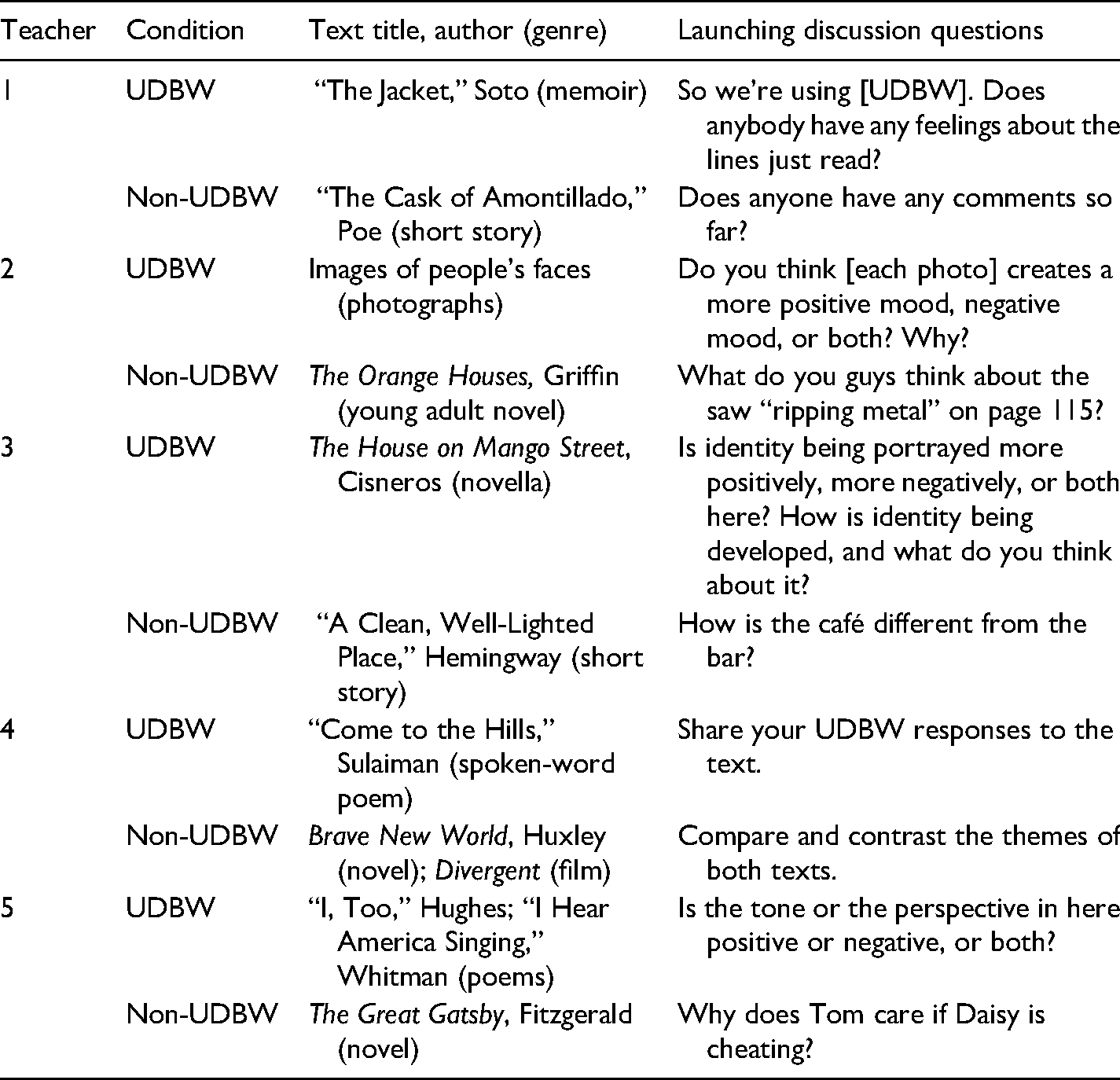
Ultimately, we found 15 pairs of discussions (30 discussions total) that fulfilled our requirements. Each teacher's pair of discussions took place between October and April of the same school year. The discussions involved a wide range of texts, including pictures, political speech, plays, short stories, and novels. In our opinion, almost all of the texts that participating teachers chose were rich enough to support sustained interpretive discussion on many dimensions (e.g., characterization, critical analysis, personal response). Fewer than a third of chosen texts held a spot in the White Western canon (e.g., The Great Gatsby, Brave New World). Many texts would be considered high interest for high school students, including young adult novels such as The Hate U Give, images depicting families from the 1950s, plays such as August Wilson's Fences, and spoken-word poems.
Table 1 shows sample selected texts and launching questions in both conditions, by teacher.
Texts, Genres, and Launching Discussion Questions in UDBW and non-UDBW Discussions.
Methodology
Our methodology was guided by our interest in the possible relationship between UDBW and interpretation in classroom discussions. We used a comparative study design, pairing a UDBW discussion with a non-UDBW discussion led by the same teacher with the same students. We made a qualitative analysis (Groeben & Schreier, 1998; Hsieh & Shannon, 2005) of student talk in these discussions.
Data Analysis
Following the approach of other studies of literary discussion (e.g., Boyd & Markarian, 2011; Chinn et al., 2001), our unit of analysis was a complete turn of talk. We chose this unit for two reasons. First, interpretation can spread over multiple sentences. A student might begin a statement by summarizing part of the text, and then build on that summary to make a judgment about a character or articulate an authorial worldview. Focusing on an entire turn of talk allowed us to capture that interpretation. Second, because we set out to examine the extent to which students might develop multidimensional interpretations, it was important to analyze an entire turn of talk as opposed to a smaller unit. Ultimately, many turns of talk were double or triple coded, so we were able to capture different levels of interpretation within one turn.
The 30 discussions included 1,661 student turns of talk. About 54% of these turns were excluded from coding because they were procedural (e.g., questions about assignments, repetitions of prior questions or answers, or instances in which students read aloud). Ultimately, 764 turns of talk were eligible for analysis. At least two of the four authors collaboratively coded (Smagorinsky, 2008) half of those turns of talk. Next, at least two authors individually coded the remaining half and then met to discuss differences. We used Cohen's kappa to measure inter-rater agreement (k = 0.76). All disagreements were resolved in discussion.
Coding literal and interpretive sense-making
Earlier studies of UDBW showed increased interpretation in student think-alouds or writing, as compared to control groups or conditions. We were interested in whether UDBW would be correlated with increased interpretation in the context of class discussion, where known-answer norms might be especially powerful. To explore that question, we used measures from past small-scale studies of affective evaluation, as well as other studies of literary interpretation (e.g., Lehr, 1988; Svensson, 1987), to create a priori codes for literal and interpretive talk. Literal turns did not leave the “overt topic domain of the text” (Holyoak, 1982, p. 108). In order to be coded as literal, the entire turn of talk, no matter how long, had to focus solely on surface features of a text, such as details of setting or names of characters.
Interpretive turns moved beyond the topic domain of the text. These turns of talk included inferences, judgments, abstract associations, personal connections, critiques, and any other comment beyond the literal. If a turn of talk included both literal and interpretive sense-making, it was coded as interpretive.
Coding dimensions of interpretive talk
We were also interested in the degree to which UDBW might be correlated with multidimensional interpretation, where students might incorporate, for example, connotation and character judgments in the same turn of talk, as opposed to one-dimensional interpretive discussion. Looking only at interpretive turns of talk, we first used emergent coding and constant comparison to develop subcodes describing different dimensions of students’ interpretation. We then returned to the research on the multidimensional nature of literary interpretation in and out of the classroom to refine the subcodes. Dimensions included interpreting connotations of words and phrases, attention to character, interpretation of overall textual worldviews, and personal connections. See Table 2 for descriptions and examples of all dimensions of interpretive talk.
Descriptions and Examples of Codes for Literary Responses.
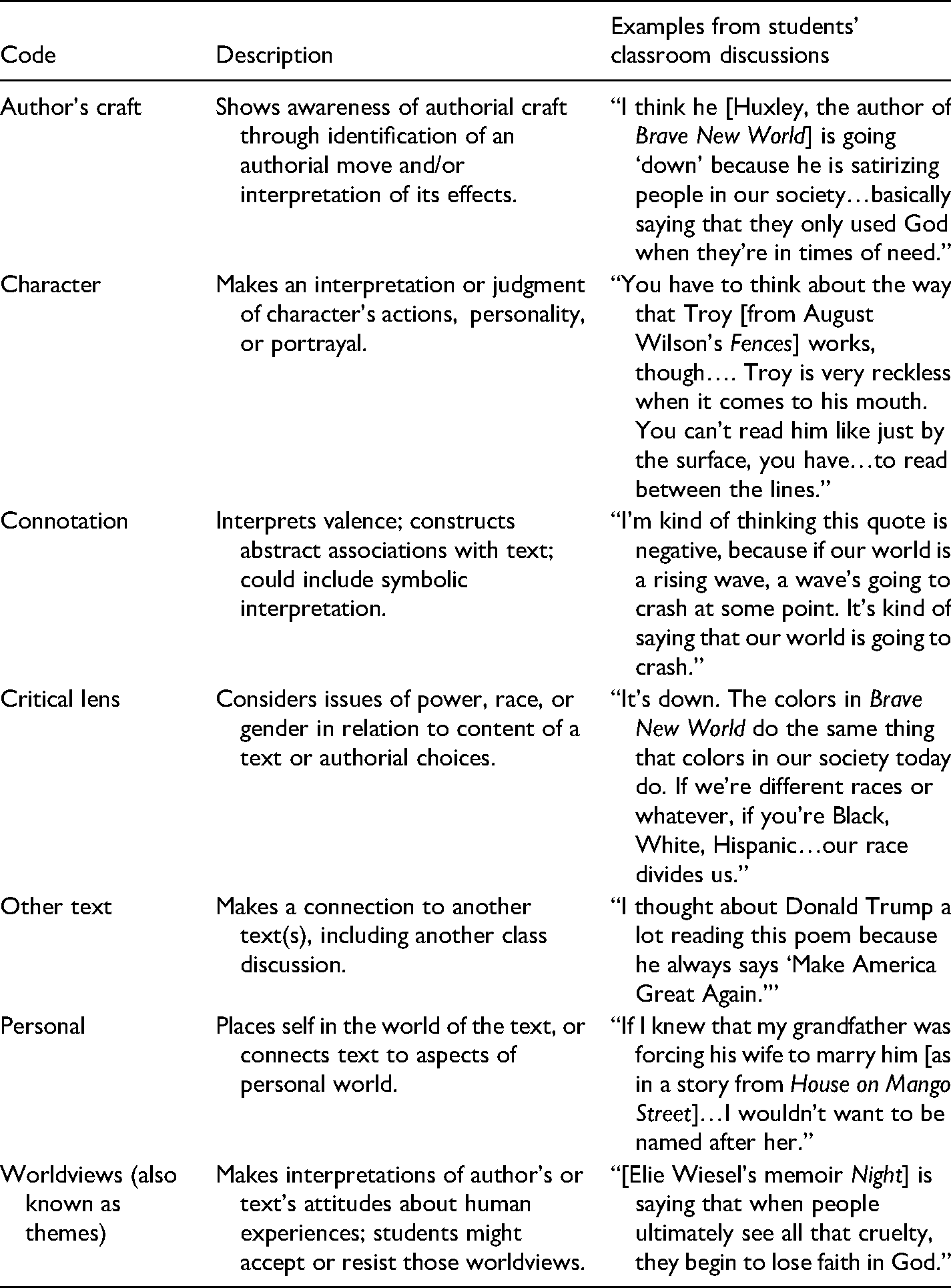
Again, coders could apply multiple codes to a single interpretive turn of talk. Any turn of talk that included more than one subcode was also given an additional code called multidimensional.
Statistical Measures
We calculated the percentage of comments in each discussion that were coded as a particular category (such as interpretive or literal). Then, we conducted quantitative analyses of these coding percentages. A repeated measures design was used, such that each classroom had available data for one UDBW discussion and one non-UDBW discussion. Due to the nonindependence of repeated observation (i.e., each UDBW discussion is paired with a non-UDBW discussion in the same classroom), we used paired-samples t tests. We then compared the mean percentage of turns of talk matching each code in the UDBW condition with the mean percentage of turns of talk matching each code in the non-UDBW condition.
Results
This study explored the degree to which UDBW, a feeling-based approach to literary interpretation, helped support students in multidimensional interpretive discussion.
Overall, students in the UDBW condition were more likely than students in the non-UDBW condition to engage in interpretive talk and multidimensional interpretation. Table 3 breaks down comparative percentages and statistics for each code and subcode.
Percentage Occurrence of Codes in 15 UDBW and 15 Non-UDBW Discussions.
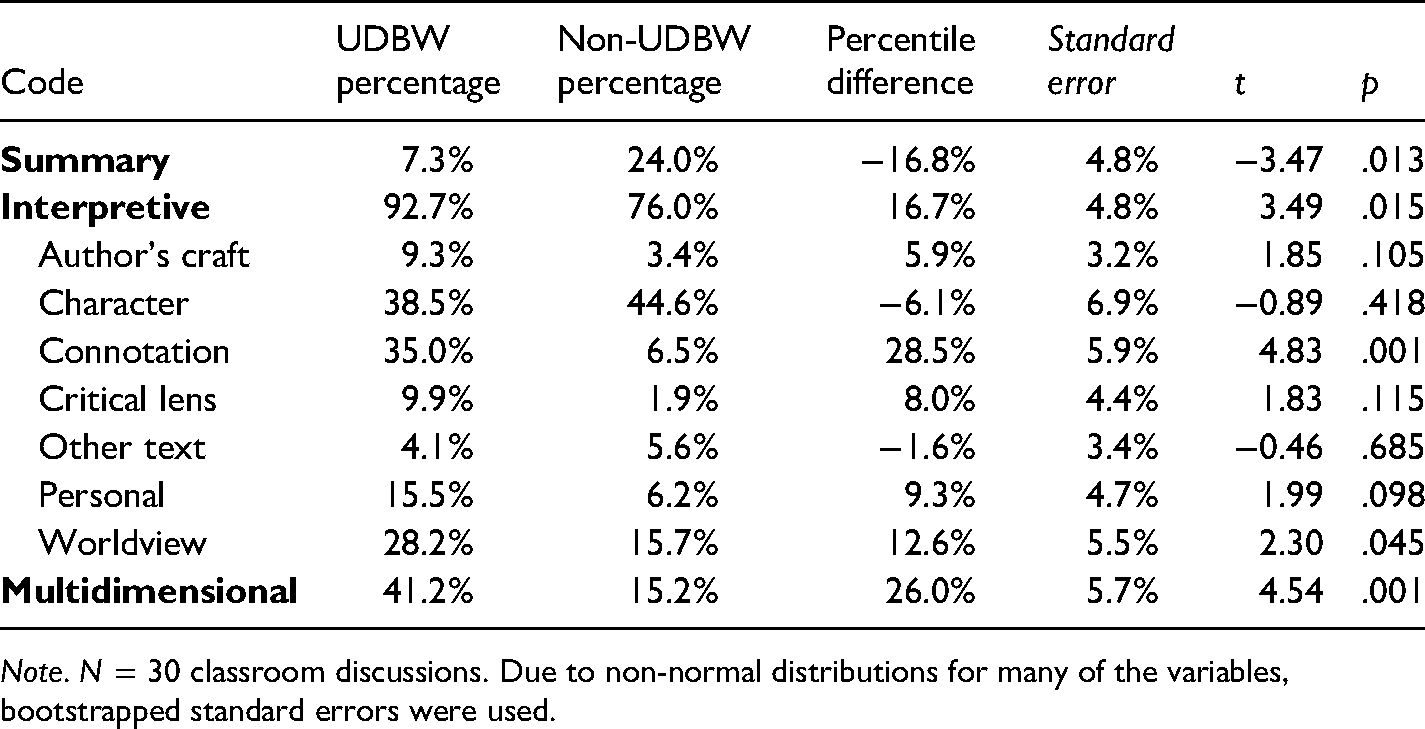
Note. N = 30 classroom discussions. Due to non-normal distributions for many of the variables, bootstrapped standard errors were used.
Literal and Interpretive Sense-Making
In UDBW discussions, about 93% of turns of talk included interpretation, and about 7% were solely summary. In non-UDBW discussions, about 76% of comments included interpretation, and about 24% were summary. These differences were statistically significant.
A comparison of two classrooms discussing details of poems help illustrate the effects of UDBW in supporting students’ moves from literal to interpretive response. In both cases, students discussed the effects of a specific detail in a poem.
Non-UDBW discussion
In the non-UDBW classroom, students read Sonia Sanchez's poem “To Anita,” which begins: high/yellow/black/girl walken like the sun u be.
After reading the entire poem, the teacher asked students to comment on the effects of the slashes in the poem's first line:
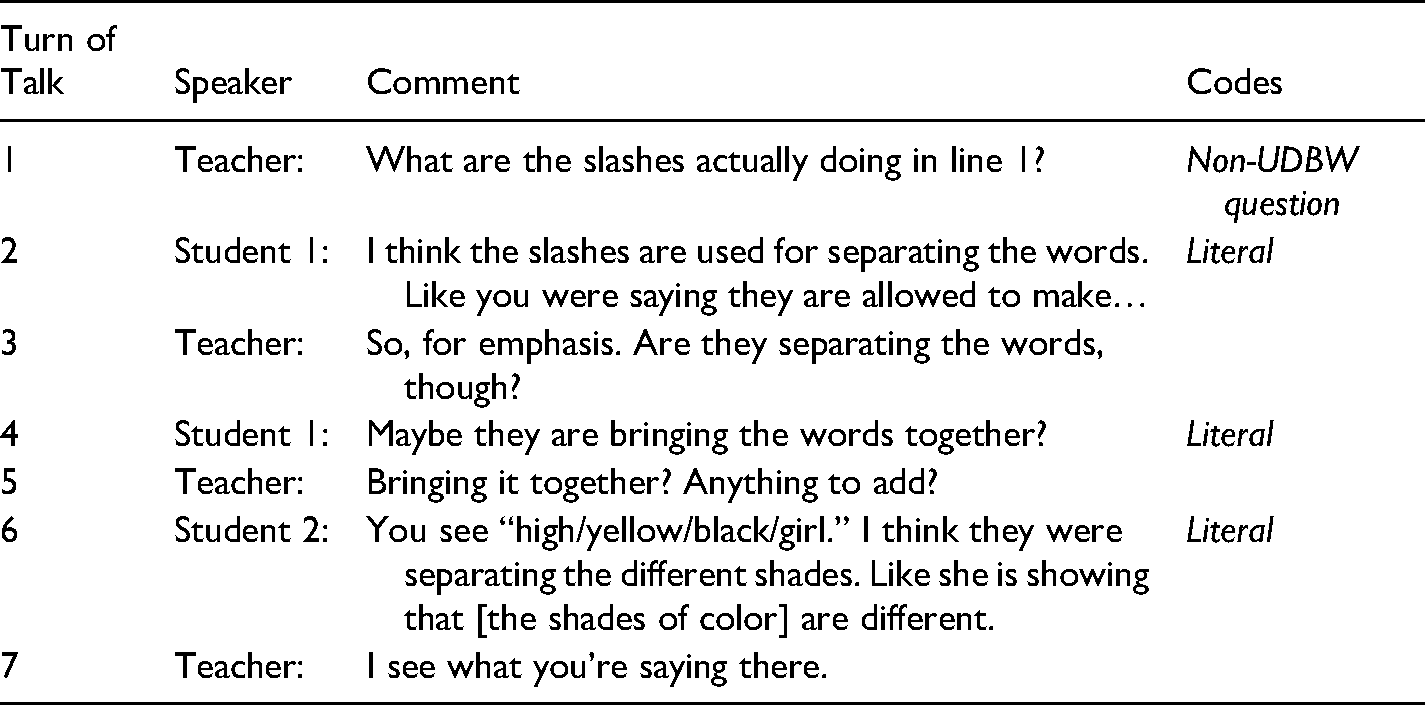
In this excerpt, students’ responses remained at the literal level. In the second turn of talk, Student 1's first response to the question about slashes basically defined the function of slashes in writing (“the slashes are used for separating the words”). When the teacher questioned this response (turn 3), the student changed their answer, saying that maybe the slashes were not for separating the words, but for bringing the words together—still discussing the functionality of the slashes, but not moving to an interpretation of their potential effects (turn 4). Student 2 also stayed at the literal level when pointing out that the slashes separated the different colors in the speaker's description of a girl (turn 6). Student 2 may have had an interpretation in mind, but they did not explicitly articulate it. Thus these comments were all coded as literal.
UDBW discussion
The UDBW classroom discussion also focused on a poem. Students read Jane Hirshfield's “It Was Like This,” which begins: It was like this: You were happy, then you were sad, Then happy again, then not.
After the class read the entire poem, the teacher began discussion with an overarching UDBW question:
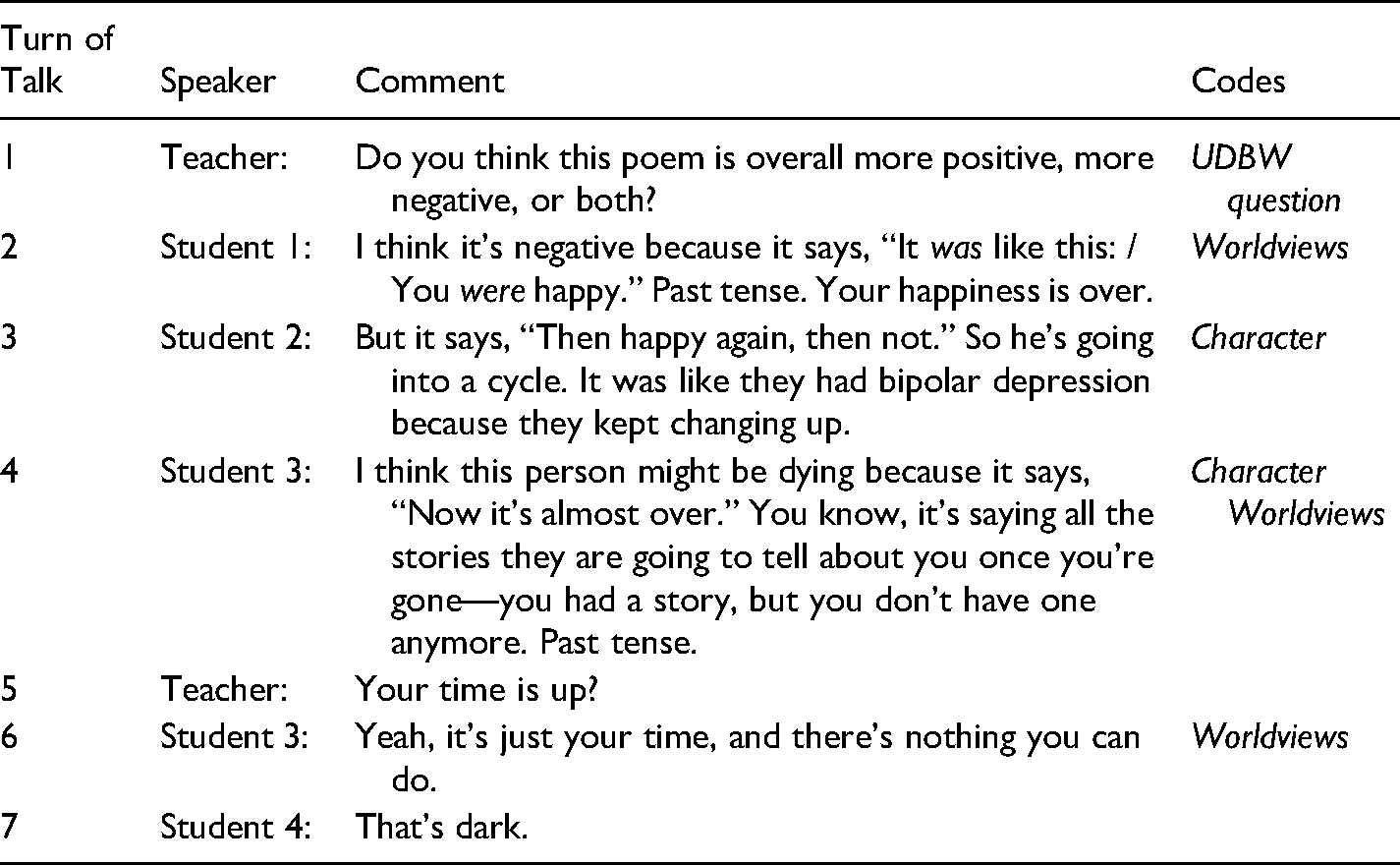
In this excerpt, most responses were coded as interpretive. In turn 2, Student 1 responded to the UDBW question first by making a general assessment of valence, then moving to specific details that supported their initial response—in this case, a comment on verb tense—and then articulating a more nuanced interpretation of an overall negative worldview: “Your happiness is over.” Student 2 pushed back against Student 1's affective evaluation, and then reflected on the character of the speaker (turn 3). Student 3 continued that reflection and returned to the verb tense of the poem as evidence to support their interpretation of both the state of the character and the worldview of the poem (turn 4). Then, in response to the teacher, Student 3 built an interpretation of a textual worldview (turn 6), which moved another student to comment on the overall tone of the text, saying, “That's dark” (turn 7).
Dimensions of Interpretive Sense-Making
We also analyzed subcategories of interpretation, or different dimensions of literary response. Notably, three of those categories (author's craft, critical analysis, and other texts) occurred in 10% or less of classroom discussions in either condition (Table 3). For example, comments using critical lenses occurred in 10% of UDBW discussions and 2% of non-UDBW discussions.
Three categories—character, connotation, and worldview—made up the majority of coded turns of talk.
Character
The subcode character made up large percentages of turns of talk in both conditions (about 39% in UDBW and 45% in non-UDBW). Differences were not significant. When discussing character, students most often commented on character motivation or offered judgments about characters’ actions or personalities.
Connotation
UDBW discussions were significantly more likely to include comments coded as connotation (35%) than non-UDBW discussions (7%). Students built connotations of words and phrases, motifs, and other aspects of literary texts. For example, in a classroom discussion of Huxley's dystopic Brave New World, students using UDBW discussed negative connotations of clothing colors that groups like the elite “Alphas” wore: “I thought that [Huxley] used gray specifically for the Alphas, because they were technically supposed to be the leaders in society, and especially in our culture, I don’t know about others, but gray is usually seen as down, a serious color, that it's not really jovial.”
Worldviews
UDBW discussions were also significantly more likely to include comments coded as worldviews (42%) than non-UDBW conditions (21%). Within this category, students sometimes made authorial readings (Rabinowitz & Smith, 1998), where they inferred what they believed to be an author's positive and negative perspectives about the world. Sometimes, they aligned themselves with those authorial views, and other times, they resisted authorial worldviews and articulated their own. For instance, one teacher asked her 11th-grade class to compare their own perspectives on America to their interpretations of worldviews in Walt Whitman's “I Hear America Singing.” Students mostly interpreted Whitman's perspective on America to be positive and joyful, but then some resisted Whitman's worldviews. One student remarked that Whitman had “sugar-coated America” as a “great community and everybody is oh, so happy here, but the sad reality of when you come into America is…basically like it's nothing what you expect it to be.”
Multidimensional Turns of Talk
Multidimensional turns of talk are those that contain more than one interpretive code. UDBW discussions were more likely to contain such turns of talk (41%) as compared to non-UDBW discussions (14%).
Below we share the first four student turns of talk in non-UDBW and UDBW discussions. In both cases, teachers asked their students to choose and be ready to discuss key lines in a text. In the non-UDBW class, the teacher asked students to choose a “strong” passage. In the UDBW classroom, the teacher asked students to use UDBW to choose a passage.
Non-UDBW discussion
This non-UDBW discussion came from a ninth-grade untracked class discussing Zora Neale Hurston's short story “Sweat.” In the story, Delia is abused and cheated on by her husband. She gets a quiet revenge when he is killed by the poisonous snake he planned to kill her with. The first student chose the following lines, spoken by Delia to her husband:
Then the teacher asked the student to comment on the choice.
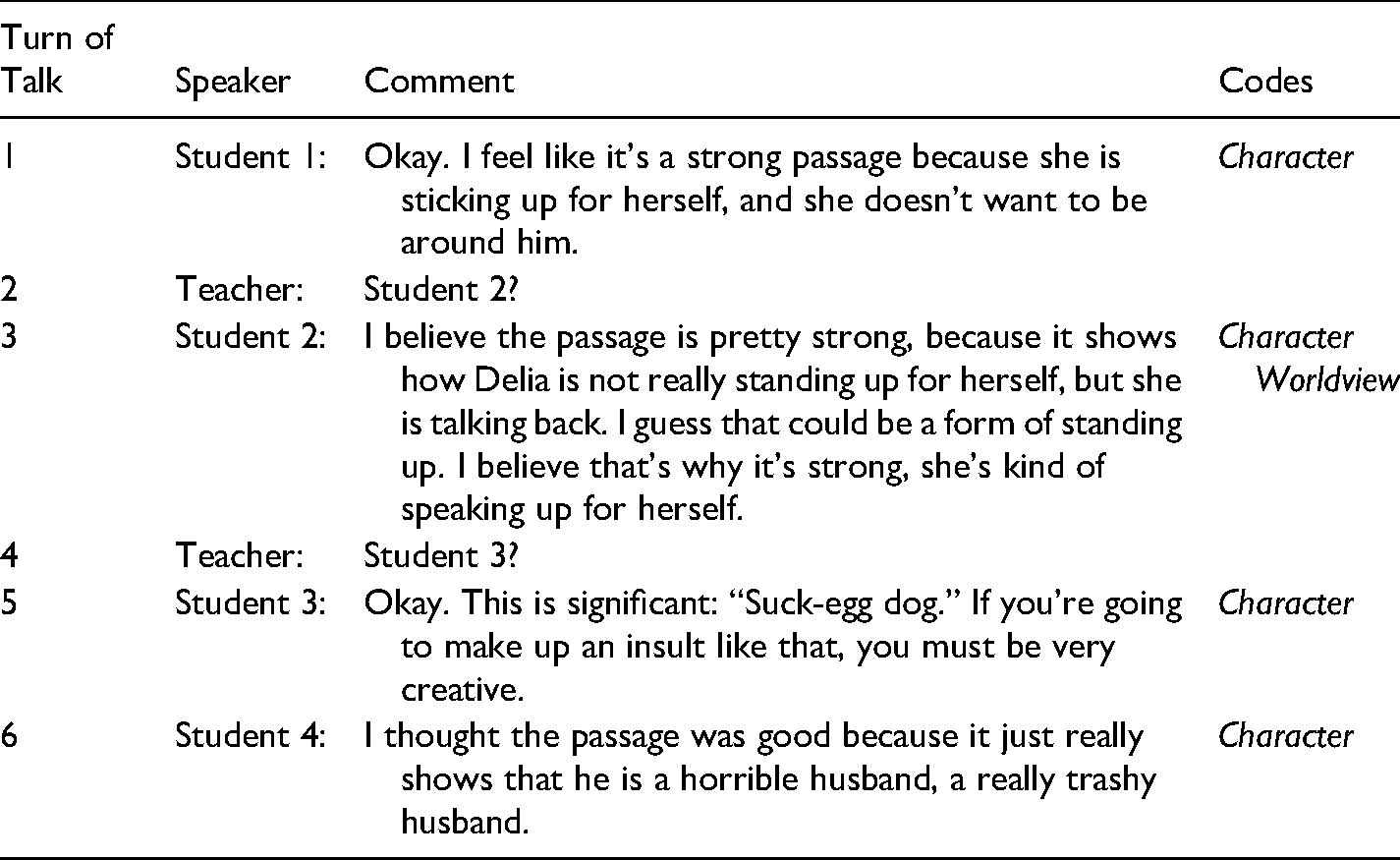
All lines in this discussion were coded as character, with the exception of Student 2's turn of talk, which was coded as both character and worldview (“I guess [talking back] could be a form of standing up [for yourself]”). In this exchange, as with other non-UDBW exchanges, students’ comments were less likely to include interpretations on multiple dimensions, instead pursuing a single interpretive track.
UDBW discussion
This UDBW discussion came from an eighth-grade untracked class discussing Elie Wiesel's book Night, a memoir of survival in Nazi death camps during the Holocaust. To prepare for the discussion, the teacher asked students to use UDBW to choose a line to discuss. Student 1 chose the phrase “Free at last,” which Wiesel speaks with bitter sorrow and an ironic tone after the death of his father.
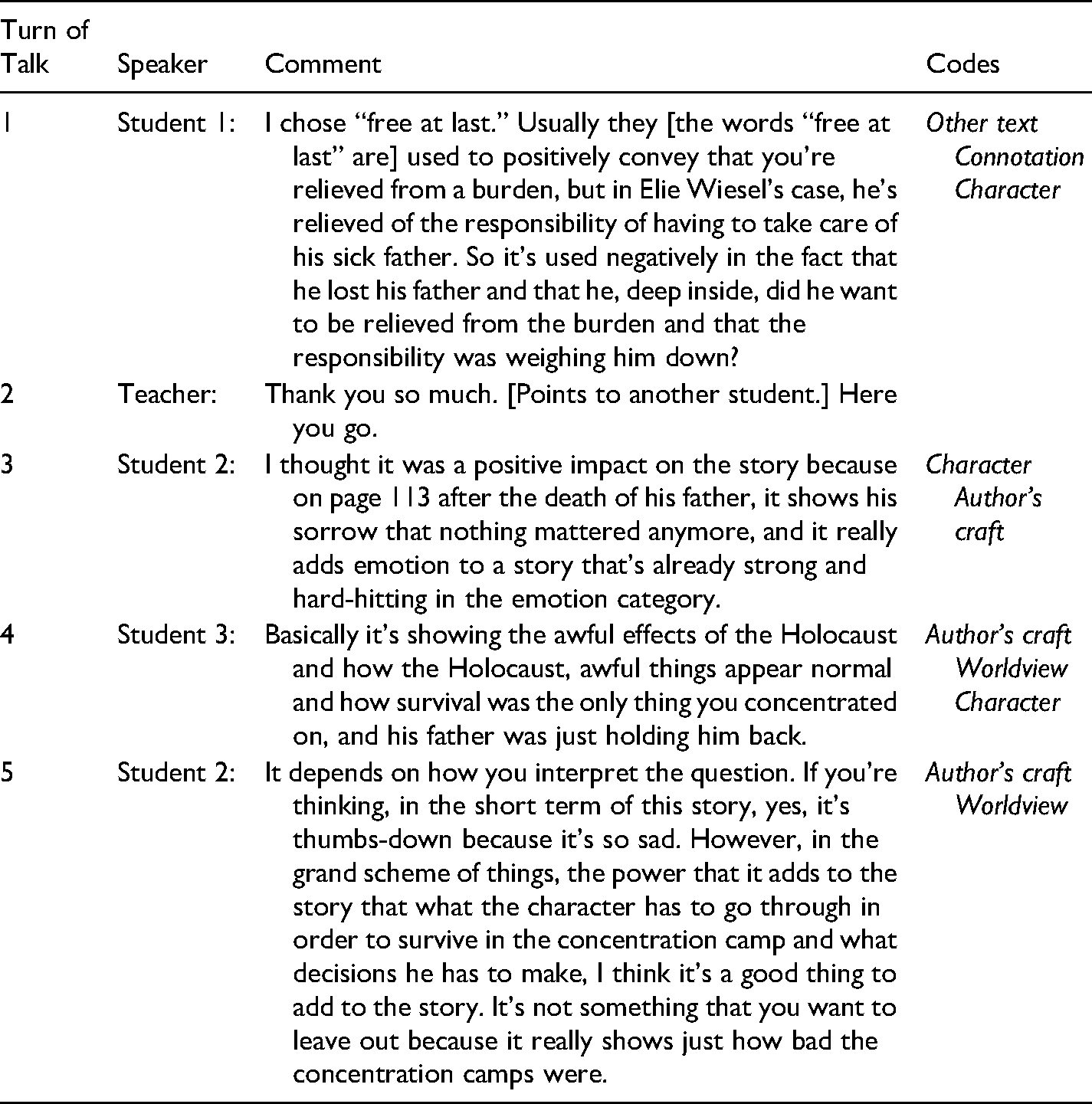
In the UDBW discussion, most turns of talk were coded as addressing several interpretive dimensions. For example, in turn 1, Student 1 built connotations of the phrase “free at last” first in more general contexts, and then in the specific context of Wiesel's memoir. Then the student connected those connotations to the pain that the character experienced. Student 2 addressed another aspect of affective evaluation, discussing not the character's experience, but the author's craft in using that phrase to add “emotion to a story that's already strong and hard-hitting” (turn 3). Student 3 moved to a meta-level consideration of UDBW, making the key point that affective evaluation might change depending on the focus within or outside a text world—a point that students made in several UDBW classrooms. Overall, students took up and expanded on others’ comments, using UDBW as a jumping-off point for their multidimensional interpretations.
Discussion
This study represents an expansion of previous studies of UDBW, testing its flexibility as an interpretive approach in classroom discussions across a range of contexts. Overall, our analysis indicates that UDBW may have helped support students’ multidimensional interpretive discussions in various grade levels and with various text genres. UDBW discussions were significantly more likely than non-UDBW discussions to include interpretive turns of talk, as opposed to solely summary, as well as multidimensional turns of talk.
Interpretive Dimensions
The interpretive dimensions of character, connotation, and worldview dominated students’ turns of talk. Students in both conditions talked about character, with no significant difference between groups. This result suggests, not surprisingly, that character may be the easiest element for students to discuss, perhaps because questioning motivations and making judgments of others is an everyday practice for many people.
Students in UDBW discussions made significantly more turns of talk involving connotation and worldview, suggesting that when readers consider language and story through feeling-based lenses, they give themselves a jumping-off point for abstract association and interpretation.
Percentages of comments involving authorial craft, other texts, critical lenses, and personal responses were low across conditions. Given the participating teachers’ general commitment to social justice, we were surprised at the low frequencies of students’ critical interpretations.
Feeling as a Disruptor of Known-Answer Discourses
In their out-of-school lives, readers draw on their own experiences and feelings to make meaning with a text. Our concern, along with that of many scholars, is that institutional, known-answer discourses limit students’ opportunities to engage in such transactional readings.
We see the non-UDBW classroom discussion about Sonia Sanchez's poem “To Anita” as an example of the narrowing influence of known-answer discourses. The teacher asked what the slashes in the poem's first lines were “actually doing.” Here, the word “actually” might suggest to students that the teacher was looking for a specific answer to what is already a challenging interpretive question. Students’ responses were mostly literal in nature, and in one case, a student changed his first response (“I think the slashes are used for separating the words”) to another (“Maybe they are bringing the words together”) after the teacher questioned his response.
We hypothesize that students lack a framework to build an interpretation of the effects of authorial moves like those in “To Anita.” Students might not yet have the schemata to establish criteria for “strength” or “significance” in a literary text, or to discuss what a line is “doing.” Relatedly, they may not have the confidence to make such assertions in the classroom, where known-answer discourses prevail.
But they have vast experience with ascribing valence to objects, ideas, and language in various contexts. Feeling-based scales provide a familiar framework on which students can build interpretations. When students used UDBW to read the poem “It Was Like This,” they were able to move from literal sense-making to a discussion of the “dark” effects of the past tense in the poem. Likewise, when students considered the words “free at last” in a discussion of Night, they were able to move from Wiesel's words to an examination of character, worldview, and the aesthetic power of that text. In doing so, they disrupted the known-answer, one-dimensional discourses that still hold sway in many ELA classrooms.
We argue that UDBW contributed to that disruption in several ways. First, when asking to what degree a word (or phrase, motif, ending) seems positive and/or negative, students are necessarily reminded that many responses are available to them—not just one. Second, when students have permission to draw on their own feelings and experiences to build responses to texts, they may assume a level of interpretive authority usually reserved for teachers.
Implications for Teaching
These results suggest that UDBW can be a powerful tool that supports students not only in individual literary responses (e.g., in written work), but in whole-class discussion, and at different dimensions of literary response.
Results further suggest that UDBW can accommodate scaffolding and differentiation. For example, in some discussions, teachers guided the types of interpretation students made by asking UDBW questions specifically about character or critical evaluations, and using alternate versions of the positive–negative scale, such as “sympathetic–unsympathetic” when referring to character, or “optimistic–pessimistic” when referring to worldview. Others asked more general UDBW questions, leaving students to decide how to apply the approach. Some teachers chose excerpts of texts for students to apply UDBW, and other teachers asked students to use UDBW to choose excerpts.
Finally, UDBW seems to be robust enough to be used with a range of texts and genres. In this study, teachers asked UDBW questions to launch discussions about a political speech on gun control by Emma Gonzalez (“Which lines do you want to UDBW first?”), Norman Rockwell paintings (“Do these images show a more positive or more negative depiction of the American Dream, or both?”), and a series of inspirational quotes (“Organize the quotes from most positive to most negative, and explain why”). In each of these cases, the UDBW class saw higher percentages of multidimensional interpretation than the non-UDBW class. Our findings suggest that as long as texts have rhetorical purpose and power, many readers will experience affective and emotional responses, and thus can make feeling-based evaluations of those texts on any number of dimensions.
Limitations and Next Steps
Our study has several limitations on its claims. First, generally speaking, comparisons between classrooms are always messy—as they should be. While we attempted to zoom in on the influence of UDBW by separating discussions launched with UDBW questions from those that were not, it would be impossible to find a classroom exchange where affect and feeling were not present in some form. In addition, we did not focus on the interchange of UDBW with other approaches to teaching interpretation. In future research, we hope to more closely examine ways in which different approaches work together.
This study's teacher participants are probably not representative of teachers or discussions more generally. These teachers applied and were accepted to a relatively competitive PD program. They were committed to social justice in education and ready to take pedagogical risks; therefore, they may have been more motivated to experiment with new practices than other teachers. Additionally, the group received training in leading open-ended discussions and asking authentic questions during the PD. Thus, the level of interpretation even in the non-UDBW condition may be higher than that in an average class discussion.
Next steps in this research include in-depth exploration of defamiliarization theory as it relates to different dimensions of literary reading and different types of texts. In terms of literary processing, to what extent do students experience different kinds of feelings or affective jolts at the dimension of connotation, character, literary features, or critical evaluation? How do positive and negative responses differ when looking at political ads as opposed to poems? Further, what kinds of everyday schemata do students draw upon when it comes to noticing literary features and effects, and how does attention to feeling help make those schemata salient? In other words, in what ways might connections with positive and negative feeling act as a connector between everyday interpretation and school-based literary interpretation? Finally, what are other ways of measuring or identifying disruption in the discourses of schooling when looking at more than one or two classroom discussions?
Given the difficulty of resisting entrenched known-answer discourses that still dominate many classrooms, affective evaluation can be an accessible, flexible, and powerful support for students engaged in discussion about literary texts. We hope that readers, teachers, and researchers will continue to explore its power.
Supplemental Material
sj-docx-1-jlr-10.1177_1086296X211052249 - Supplemental material for How Feeling Supports Students’ Interpretive Discussions About Literature
Supplemental material, sj-docx-1-jlr-10.1177_1086296X211052249 for How Feeling Supports Students’ Interpretive Discussions About Literature by Sarah Levine, Karoline Trepper, Rosalie Hiuyan Chung and Raquel Coelho in Journal of Literacy Research
Footnotes
Declaration of Conflicting Interests
The author(s) declared no potential conflicts of interest with respect to the research, authorship, and/or publication of this article.
Funding
The author(s) disclosed receipt of the following financial support for the research, authorship, and/or publication of this article: This work was supported by the Spencer Foundation (grant number UAIFT/122631).

References
Supplementary Material
Please find the following supplemental material available below.
For Open Access articles published under a Creative Commons License, all supplemental material carries the same license as the article it is associated with.
For non-Open Access articles published, all supplemental material carries a non-exclusive license, and permission requests for re-use of supplemental material or any part of supplemental material shall be sent directly to the copyright owner as specified in the copyright notice associated with the article.
