




Abstract
This article draws on Philip Barnard's model of the interactions between theory and practice, between basic and applied research, to investigate the paradox of reading as an experience both private and public. It uses internal reader experience as a starting point for exploration, evoking the concept of a readerly sense of presence as a selection criterion. Investigating chapters in two novels for young readers, Northern Lights (The Golden Compass) by Philip Pullman and The Moffats by Eleanor Estes, and drawing on cognitive models of reading, it analyzes the textual constructs that set up a potential for the kind of enactive resonance that enables (though does not mandate) a sense of presence. It investigates the methodological implications of an enhanced sense of reading as a non-reproducible experience and considers the policy and pedagogical implications of not restricting public concepts of reading to what can be readily measured or repeated.
The act of reading is immensely complex. Wender (2017) describes “the mess of co-engagements: the intertwining of sensing and making sense, the blur between comprehension and interpretation, and the many objects of feeling and mixes of emotion that color in our experiences of reading” (p. 30). When we add the complications of teaching reading or researching reading, the challenges become even more demanding.
All teachers play multifaceted roles, but the mandate of an English teacher may be broader than most. The first priority, of course, is to improve students’ literate skills and capacities. This aim sounds straightforward, but it often involves an associated need to defend students against political interference, bad policies, corporate exploitation, and the many vagaries of public opinion. Such work engages teachers in public spaces. At the same time, they must find ways to shelter their classrooms, which are more ambiguous spaces: indubitably public but also one home (for some students, the only home) for private experiences of reading.
Similarly, the reading researcher may address private experience but turn the findings in a public direction. A richer understanding of reading is valuable in its own right, but it is certainly possible to argue that a researcher's obligation to society is not completely resolved by ever more elegant descriptions of this fascinating achievement if those accounts do not inform public discussion of social priorities.
In this article, I raise one extreme example of private reading experience and explore how protecting invisible student encounters with the printed word finds a place on the spectrum between private and public that all literature teachers and many reading researchers negotiate. I focus not only on enlarging our awareness of the potential for reading to be deeply personal, but also on finding ways to think about protecting this private response in a world of public involvement.
The basic research question that animates this article explores the nature of an occasional fleeting readerly impression of being intensely present in a text world, a momentary “soap bubble” flash, during which a reader feels temporarily and tangibly inside the world of the fiction. This example of the reading experience is purely imaginary, though it manifests in physical sensations. Cognitive processes say Caracciolo and Kukkonen (2021), “are shaped by the makeup and sensorimotor possibilities of human bodies” (p. 4). A sense of presence invokes these physical possibilities in particularly vivid form. Imagination, says Greene (1995), “permits us to give credence to alternative realities” (p. 3) and the “credence” provided by a moment of presence is particularly intense.
Sumara (1996), in his book about private and public facets of reading in the classroom, talks about the importance of “the interruption, the breach, the rupture of the familiar world” (p. 189) that is created when a reader interacts with a literary fiction. “[I]t is this interruption, this newly configured set of relations, that can help us to perceive what had previously not been perceived” (p. 189). The literary, cultural, and cognitive potential of such estrangement has long been argued, and I certainly value its substantial contribution to our relationship with the world. In this article, however, I make the case for a fiercely private and familiar form of intimate recognition and suggest it does not lead to an expanded sense of meaning or any other form of cultural improvement—it just is.
More than simply acknowledging this deeply personal element of reading, however, I hope to establish if or why it matters in a broader world. How does a greater understanding of presence affect literature teaching? Can teachers acknowledge the significance of what might be called a form of useless delight in the English classroom, and can they protect its validity under the pressures of narrow and restrictive mandates?
My text sample, investigated below, emerged from singular reading experiences. As I worked on this project, a singular (though unfortunately all too familiar) public test case arose with little warning in my home province of Alberta, Canada. Teachers and parents were presented with a draft K-6 curriculum that crowded out any space for a private experience with an excess of fragmented forms of accountability. On the subject of fiction reading, for example, Grade 6 students are expected to know 26 sub-category facts and labels about fiction and are expected to perform that knowledge through analytical exercises of “differentiating,” “describing,” “identifying,” and “determining” (the complete list of verbs in the “Skills and Procedures” column). About fiction reading itself, the document has only a single comment: “Engaging with fictional texts can help students develop empathy and can inspire creativity” (https://curriculum.learnalberta.ca/curriculum/en/c/laneng6). The tension between instruction and delight has been resolved entirely in favor of instruction. In what ways can my exploration of private pleasures of reading inform a political setting in which children's reading is diminished by such a damaging rubric?
In the context of clinical psychology, I found a useful aid to thinking about the public impact of research about the private experience. Barnard (2004) offers an illuminating graphic on the interchanges between what happens in the real world and how we represent it as a research problem, in order to improve our theoretical understanding, and then, crucially, feed that newly informed awareness back to the world of practice. His graphic, reproduced below, helps us keep track of the complexity of bringing basic awareness to applied actions. To reduce any risk of ambiguous reference, I label the four sides of his diagram with the letters A–D (Figure 1).
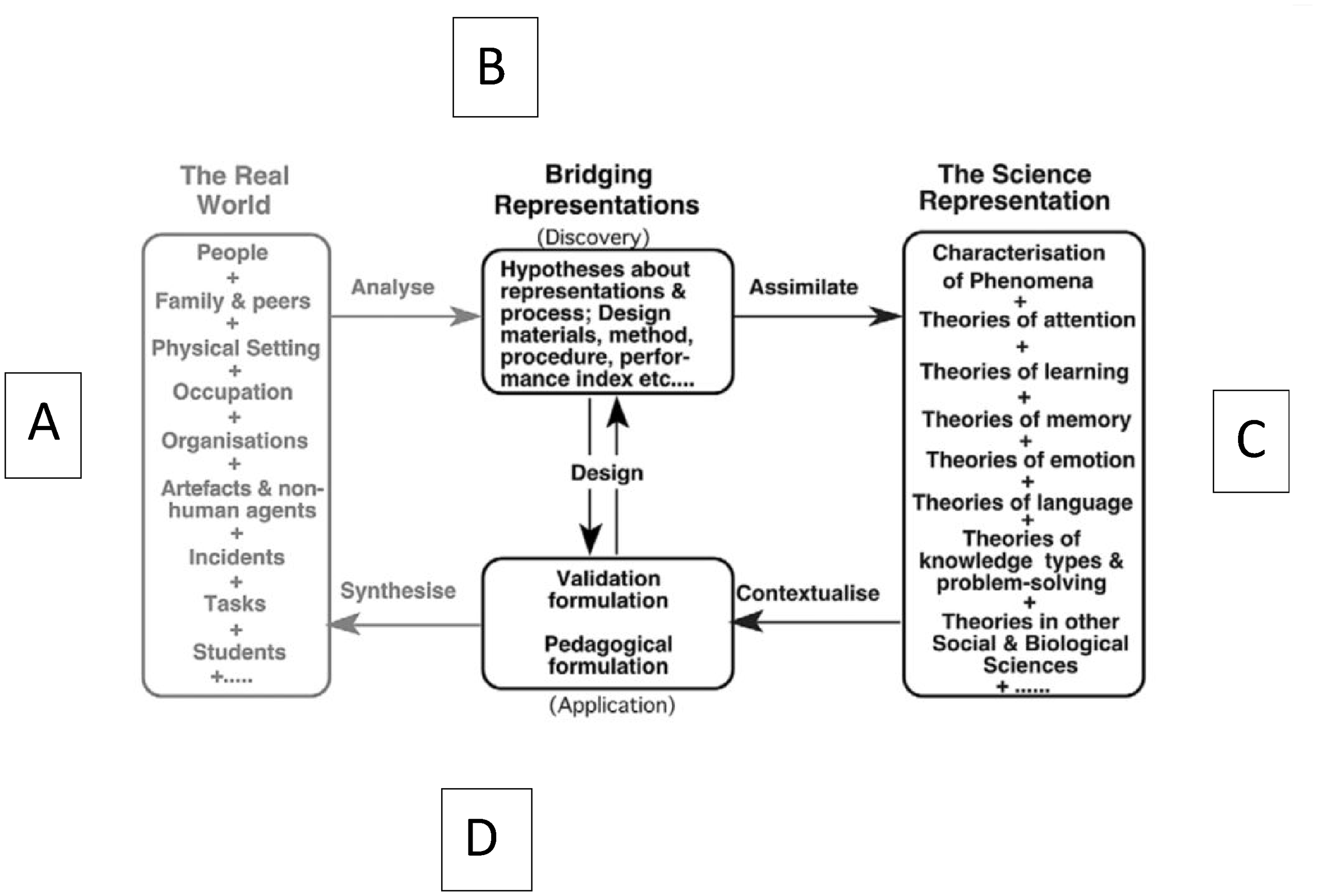
Barnard’s characterization of processes and representations used in the development of basic theory. Note. Letter labels have been added to the figure. From “Bridging Between Basic Theory and Clinical Practice,” by P. J. Barnard, 2004, Behaviour Research and Therapy, 42, p. 982. Used by permission of Elsevier.
The left-hand side of this diagram (A) represents elements of the world we live in. The act of reading takes place in the real world, rooted in material surroundings. Readers have bodies, those bodies exist in particular places, a real-life industry of text production supports the activity, a world of educators devotes itself to inculcating the skills and pleasures of literacy, and so forth. As we say, reading has a “place” in the world; it is a practice.
At the same time, the concept of the “literary” is more difficult to pin down. Books have a material existence, but their contents are immaterial, and any account of the practice of reading must also make room for its intimate and incorporeal elements. In this article, I focus on fiction in order to emphasize the non-material aspects of reading, but many of my observations may apply to broader reading as well.
People who read fiction are located in a physical setting, engaging with artifacts, undertaking interpretive tasks, being distracted by incidents, and more (A). All these elements must be taken into account as we develop representations that permit us to characterize reading adequately (B), so that we can explore theories of attention, learning, memory, emotion, language, and beyond (C). The final stage of the process (D) involves returning to the real world with an improved understanding. Barnard addresses clinical psychologists in his account of informing practice through representations developed into theories, yet his diagram overall works very well to discuss the following:
how reading is placed in the world (A), how we frame what occurs when we read (B), how we develop a theoretical understanding of this act (C), and how we make use of this more nuanced framework in the real world, in which we teach readers; provide physical and virtual access to texts in libraries, classrooms, retail outlets, and elsewhere; and develop policies for literacy education, text supply, research funding, and more (D).
I do not draw on Barnard's model for its insight into the act of reading itself; rather I suggest its utility for developing a full account of how we apply theoretical understanding of the act of reading back into the world of practices and policies. My conceptual article sets a very private and startling reading experience in the context of a policy-making process that seems to want to obliterate all traces of personal interest and pleasure in reading. Barnard's model reminds us of the vital importance of addressing both.
Readers inhabit the material world, but the invisible world of the reading experience is charged into life by imagination vivifying words in the mind, creating the literary event.
Unlike most of the left-hand list, an imagination represents an immaterial power. Its activities are essential to formulating any valid theories of reading. Rosenblatt (2005), in her generative analysis of reader behavior, talks about evocation and response: The words in their particular pattern stir up elements of memory, activate areas of consciousness. The reader, bringing past experience of language and of the world to the task, sets up tentative notions of a subject, of some framework into which to fit the ideas as the words unfurl (p. 73).
A moment of intense presence is vivid and memorable, but it vanishes quickly, and its contribution to the framework Rosenblatt describes is evanescent, though it may be potent. Why should we care about it? Will how we represent the impact of this extremely transitory and personal phenomenon help us develop a better theoretical understanding of reading? And, if the answer is affirmative, how may more capacious theories be fed back into practices and policies?
Understanding the effect of a reader's sudden sense of presence will not necessarily change anything about how we teach. It is swift and surprising, and very private—an instant of vivid life that evaporates almost as quickly as it develops. We cannot teach presence, though we may mention it, and we cannot call students to account for it. The phenomenon is too unreliable and surprising for classroom applications. The experience of presence is personal and intimate, not susceptible to elucidation under the headings of otherwise important social and public concerns such as equity. Registering its significance is a conceptual change, rather than an action plan. Protecting opportunities for presence may affect how robustly we create and defend reading spaces where the idiosyncratic response is permitted and valued, rather than dismissed if it cannot act as an index of accountability. When official policies about reading prioritize replicability, this extremely personal and ephemeral example of readerly response reminds us that the value of reading is more than institutional. This experience is so personal that it is not (and should not be) apparent to a teacher's gaze; instead, the teacher's unobtrusive role is to acknowledge the potential for moments of intimate response that can be cherished privately, even in a classroom setting—and to protect these opportunities.
Maybe a small enhancement of classroom practice would involve a teacher being open to a brief student retreat from public engagement to enjoy stillness and astonishment as an appropriate response at the moment. But I am not really looking to find short-term ways of operationalizing a greater awareness of presence. My intent is to investigate how our understanding of what reading entails more broadly affects how we act in the world. Can a personal and introspective description and a public textual analysis of an experience of presence in fiction enhance our understanding of reading processes in ways that may lead to public outcomes of practical utility? If so, how?
Walking Barnard's Quadrangle
To explore questions of reading, we will adapt what Barnard calls the real world, on the left of the graphic (A) by adding the element of imagination. Using Barnard's terms, the “bridge” to the world of representation consists of the questions raised by our awareness of readers’ occasional temporary experience of presence in reading (B). Can an exploration of transient readerly experience be productive for both theoretical understanding (C) and improved practice in the world (D)? I am interested in how real-world practice makes room for the insubstantial components of reading. Literary reading involves some inexorably internal qualities, and we need to consider ways of acknowledging and sheltering elements that are available only to introspection if we want our theoretical understanding and our public actions to approach completeness.
My journey through (B) takes one reader's very private experience of presence with two texts for young people. The right-hand column in Barnard's diagram (C) offers a number of pertinent theoretical approaches. Many rich classroom-based studies of contemporary literacies focus on collective and public work (see e.g., Compton-Lilly and Halverson, 2014; Kucirkova and Cremin, 2020; Levine et al., 2021). In contrast, my data set (selected and then represented as part of the [B] area of the schematic) involves a particular emergent form of very private psychological experience. Consequently, the theories I find most useful (C) involve cognitive and phenomenological approaches that explore what happens in the mind during reading, supplemented by a literary analysis of what the text supports in each case. After investigating the notion of presence by means of these theoretical approaches that address interior perceptions via different routes, I bridge back to the world of actions and decisions (D). How can we transfer a deeper understanding of some ephemeral aspects of reading into tools for reflecting on and maybe even improving conditions for reading in the real world? Are there ways we can shape the institutions that foster reading so that they protect what is private and unique about it, rather than asserting that only the social and/or replicable aspects of this complex mental process have any importance in public life?
Augmenting the Left-Hand Column With Imagination (A)
Cave (2016) makes the strong case for the significance of the imagination as a human tool for engaging in the world: Imagination is fundamental to human cognition from early childhood and remains so throughout adult life. Absorption in fictions (not only fictional characters but also imagined storyworlds and poetic modes of thought) is consequently not just a pastime played on the margins but one of the key strategies humans use in order to think creatively about other humans and about the world in general (p. 152).
The reading imagination is always in motion, as Parks (2011) eloquently testifies: [T]he excitement of reading is the precarious one of being alive now, intensely mentally silently alive, and reacting from moment to moment, in the most liquid and intimate sphere of the mind, to someone else's elusive construction of the precarious business of being alive now (p. 73).
The role of imagination in reading is particularly potent; unlike texts for viewing or for playing, printed words do not provide immediately relevant sensory stimuli. Its very fluidity makes the private imagination a slippery target to represent in the scientific study; drawing on a particular example may help to pin it down.
Selecting a Representative Example: Presence (B)
One vivid apotheosis of imagining ourselves in a story is experienced as a feeling of sharp presence in the world of a literary text. This feeling is intense and fleeting; it is physical and tangible in its vividness. It resists meaning, says Gumbrecht (2004), so some standard procedures like checking comprehension or recall are of little utility. This quality makes it even more challenging to specify in terms of design, materials, methods, and other categories included in Barnard's account of how we develop bridging representations that lead us into the world of theory development. Having selected one extreme example of imagination at work in the reading act, I must find a way to bridge (B) from the left-hand column (A) to the intriguing list of elements on the right (C).
There are many narrow and/or specific constructions of what constitutes a successful reading experience: virtuosity of recall, or conventionality and propriety, or a distinctively original interpretation, or a productive estrangement from normal assumptions. I invert this approach and begin with a very private and interior response. In Leander and Boldt’s (2013) terms, I choose to describe “literacy-related activity not as projected toward some textual end point, but as living its life in the ongoing present, forming relations and connections across signs, objects, and bodies in often unexpected ways” (p. 22). My version of an achievement, one that cannot be mandated or measured, is a readerly experience of a text world as something alive and large and unanticipated. Such amplifying moments often seem random in their effects, although the text may provide clues. Yet though, at crucial points of the text, authors may lay the textual groundwork carefully, they too are unable to guarantee success. Serendipity of this nature struggles to find a home in mandated reading activities, but this fact does not mean we can eliminate it from a properly commodious account of reading. A gratuitous moment of utter commitment to a text world is surplus to such requirements of meaning making as filling gaps left in the textual information (Iser, 1978) or creating and moving through an envisionment of the words (Langer, 1989). It is more introspective and unimportant than the socially learned forms of interpretation that Galda and Beach (2001) outline. It matters only to one reader, and perhaps only briefly, and yet it provides an instance of what Boldt (2020) calls “vitality” (p. 207). To set up a conceptual toolkit that combines such a unique response with any kind of capacity for generalization is an exercise rife with paradox and contradiction—all the more so because, as Boldt says, “We cannot manufacture vitality by our will; it cannot be quantified or turned into a program. It cannot and must not be reduced to a neoliberal calculus of measurement, assessment, or accountability” (p. 211).
The concept of a sudden and vivid sense of readerly presence in a text world is indisputably first-person in nature, and, for many readers, very rare. The excitement of presence is summed up in the subtitle of Gumbrecht’s (2004) book on this subject: “what meaning cannot convey.” Literary presence involves a living evocation of a scene. Gumbrecht says it feels physical: “What is ‘present’ to us … is in front of us, in reach of and tangible for our bodies” (p. 17). That sense of presence is fleeting—“it undoes itself while it emerges” (p. 113). Kuzmicova (2012) considers the concept of presence in terms of “spatial vividness,” which she defines as “an assumed intensity of the fragmentary, instantaneous, and mostly extremely short-lived spatial imagery prompted by a narrative passage” (p. 26). In a moment of presence, we feel ourselves as profoundly there, inside the world of the text.
This kind of transient epiphany is highly personal. It is barely describable for a single individual and refuses any potential for replication. Even the same reader, returning to a text, may never again experience that tangible flash of presence. To any outside observer, the experience of presence must be taken on trust; its existence can only be asserted by the reader concerned. Thus, even to consider this issue, I must bring my own reading self into the equation. Felski (2020) reinforces this choice: “aesthetics cannot forgo or dispense with the first-person response” (p. 52).
An extensive scholarly literature addresses readerly commitment to a textual world; terms such as immersion, transportation, absorption, all convey a sense of following the events of a world with a perspective set by the terms and conditions of that world, and with a reader's mind dominated by its internal assumptions (see e.g., Hakemulder et al., 2017). My experience of presence entails a state more intense and brilliant than any of these ongoing ways of subscribing to the norms of a textual world—and more ephemeral. I may be immersed, transported, absorbed, and yet still occupy a spectator role in this world, experiencing fictional events and people in motion from the stance of an observer. Presence entails an involuntary and overwhelming mental movement, however evanescent, into that world. It is a fleeting culmination of ongoing forms of absorption and immersion. It happens too swiftly for a reader to become a full participant in the scene that registers so sharply, but the observed world briefly becomes a sensory, tangible place. The thereness of presence is essentially inexpressible.
Readers vary in how they experience a sense of presence. For some, it is intensely visual; others hear voices. I am not a visual reader, and I hear the cadences of the written sentences rather than the character voices. In experiencing the passages described below, I enacted a kinaesthetic engagement with each text, virtually moving along with the characters and also following the rhythms of the words and sentences. A sudden cessation of these kinds of sympathetic mental movements jarred me into a livelier encounter with the story world, with sensory implications of feeling rather than sight. Other readers may sense presence in a fiction through different modalities or in distinctively other ways.
Despite its obvious drawbacks, an introspective investigation of my own experience can provide an entry point. I choose to elucidate two personal examples of a brief moment of presence in a fictional world, one from my childhood and one from my adult reading life, but both involving books written for young people. Gumbrecht (2004) says the phenomenon of presence dictates that “under such circumstances, we cannot help being our own intellectual environment, and we even have to be the frames of reference for the work we are interested in” (p. xvii). Kivy (2006), talking about the performance of reading, says, “It is, of course, always dangerous to trust one's own introspection as if it were transparent and incorrigible. However, it must count for something” (pp. 124-125). Although auto-ethnographic approaches play a valuable role in social sciences including education (Marx et al., 2017; Reed-Danahay, 2017; and see also my own comprehensive auto-ethnographic study of my literate youth [Mackey, 2016]), this small-scale study of a pair of tiny personal experiences represents something closer to an “auto-snapshot”: a brief instant of highly active response by a single reader, reported in the first person.
Accepting that an act of reception is necessary to constitute a text (Felski, 2020, p. 147), I begin with a readerly experience rather than a particular text, working from internal experience as a criterion for selecting texts to investigate further. I utilize my own reading experience as the selection filter and choose to investigate the workings of two texts that did offer me moments of an enhanced sense of being there in a different, imaginary world: The Moffats by Eleanor Estes (1959/1970), which I read as a child in a public library hardback edition, and Northern Lights (North American title, The Golden Compass), by Philip Pullman (1995/2005), which I read as an adult in the first paperback issue of this title. I describe my experience of particular moments of these books; I investigate what the texts themselves offer to our understanding of my singular encounters; I look briefly at how understandings from my life-world fed into these reading moments; and I reflect more broadly on what we can learn by starting with reader experience.
My specimen stories are both traditional print texts for young readers, one fantasy title and one of domestic realism. From Northern Lights comes Lyra's encounter with the severed child. A scene of different horror appears in The Moffats: Joey's realization that he has lost Mama's last $5 bill, the only money standing between the family and desperation. Both involve familiar forms of narrative suspense. As a reader, I was committed to following the developments of each plot but flashing into the story world for a moment was a more intense encounter. I briefly felt the cold on my skin, sensed the encroachment of the dark, and experienced a stomach-dropping sensation of utter dread and despair. In Gumbrecht's terms, it was strictly meaningless that I was briefly “there,” but that flash intensified my physical response to the story and enriched my reading life.
I am describing a personal relationship, manifested in concrete particularities of biography and text. I explore my selected passages in careful detail, but my approach offers no guarantee of objectivity. Neither the reader who felt that singular life-moment of being present in these stories for a moment nor the experience itself is replicable. I do not even know how often I actively felt a direct sense of presence as I reread these stories, nor the degree to which a subsequent reading merely evoked a memory of a previous encounter. My account, therefore, offers a merger of multiple readings. I supply a careful report of what I felt, to the best of my capacity to describe it, and a critical exploration of some life and textual factors that contributed. The surplus beyond our current forms of accounting for literary experience, the spillover effect of an ineffable moment of readerly astonishment, will have to be taken “as read”—and I propose that such experience should be taken as invisible “evidence” that reading is bigger than what can be counted or coded.
The chapters, “The Lost Boy” in Northern Lights and “The Coal Barge” in The Moffats, have some elements in common: a dark, cold and unforgiving winter environment; a dramatic realization of utter terror, a version of the worst the characters could possibly imagine; and active physical movement that draws in characters and readers alike and is then abruptly halted. For me, the halt is as vital as the forward momentum. How do these two writers manage the rhythm of their chapters to contribute to such an effect? How do they open their words to my participation? And what can we learn from these texts about how the act of reading can be indefinably magnified when a singular reader involuntarily cooperates with a particular text to flash it into a moment of extreme life?
The Right-Hand Column: Theoretical Explorations of the Idea of Presence (C)
For the paradoxical challenge of making sense of a unique reading event arising from private contact with a text publicly available to all capable readers of English, I draw on two different approaches: cognitive inquiry, which explores our developing understanding of how the mind works during reading, and literary examination of the texts in question.
In her analysis of how readers encounter the unpredictable moment of vividness she calls presence, Kuzmicova (2012) offers useful guidance to how authors invite the participation of readers in a created world. Creating the potential for presence is not a matter of offering a detailed pictorial description. Instead, “presence arises from a first-person, enactive process of sensorimotor simulation/resonance, rather than from mere visualizing from the perspective of a passive, third-person observer,” she says. “[O]our enjoyment of literature is embodied” (p. 24).
How do these chapters provide opportunities for that “first-person enactive process of sensorimotor simulation/resonance”? Textual analysis may refine our understanding of how our minds move into words when we read. Pullman works in a territory of high adventure and glamour; Estes moves in more mundane domestic territory. But both texts invite readers to move along with the words in a surprisingly similar fashion.
In the analysis of the two chapters that follows, I explore the authors’ choices of detail and language in orthodox ways. It is worth remembering, however, that this examination of the texts is undertaken to pursue a better understanding of a very private moment of stasis and recognition. The concept of presence is reactionary, in many senses of that term. I raise this point to emphasize that reading literature is not necessarily, or at least not only a progression towards greater and subtler enlightenment; sometimes a startled and powerful sense of recognition is enough. My investigation of the language that leads to these moments has singular value for these idiosyncratic experiences, but I believe that this exploration also illuminates the act of reading itself.
Accounting for What the Text Brings to the Reading Experience
My assessment of how the two chapters organize an invitation to readers to enter the world of the story is, in many ways, a very orthodox piece of literary analysis. My purpose, however, lies beyond the text itself; I am interested in what insights these chapters may offer into how readers’ minds connect with words. I enjoy exploring the work of the texts, but in the end, I want to learn about readers. I believe the craftsmanship of these consummate writers for young people may offer insight into that invisible alchemy that occurs when shaped words meet minds open to shaping.
Northern Lights/The Golden Compass (1995/2005)
The expedition of Lyra and her daemon Pantalaimon with Iorek Byrnison, the armored bear, to locate a mysterious “ghost” is initially cast as a kind of auxiliary to the main adventure. What they discover, however, represents the heart of the whole story—in plot terms and also in moral terms. The narrative of the lost boy is a skillfully created structure, full of forward movement haunted by confusion and dread. It abounds with potential for sensorimotor simulation and resonance.
Here are some examples of how Pullman invites readerly investment in enactive, bodily response: Lyra clambered onto the great bear's back, gripping his fur with her mittens and his narrow muscular back between her knees. His fur was wondrously thick, and the sense of immense power she felt was overwhelming. As if she weighed nothing at all, he turned and loped away in a long swinging run-up towards the ridge and into the low trees. It took some time before she was used to the movement, and then she felt a wild exhilaration. She was riding a bear! And the Aurora was swaying above them in golden arcs and loops, and all around was the bitter arctic cold and the immense silence of the North (p. 210). Iorek Byrnison was pacing swiftly, moving both legs on one side of his body at the same time, and rocking from side to side in a steady powerful rhythm. She found she couldn't just sit; she had to ride actively (p. 211).
Similarly, Lyra's approach to the fish-house is enacted in the words—and, from a reader's perspective, it is also mentally enactable: Lyra's heart was beating so fast she could hardly breathe. …
She lifted the strap of reindeer hide holding the latch in place, and tugged hard against the frost binding the door shut. It opened with a snap. She had to kick aside the snow piled against the foot of the door before she could pull it wide (p. 214).
I probably will not raise many eyebrows if I describe the chapter's final paragraph with the conventional term of “heart-stopping”: The little boy was huddled against the wood drying-rack where hung row upon row of gutted fish, all stiff as boards. He was clutching a piece of fish to him as Lyra was clutching Pantalaimon, with both hands, hard, against her heart; but that was all he had, a piece of dried fish; because he had no daemon at all. The Gobblers had cut it away. That was intercision, and this was a severed child (p. 216).
I would add another term here to describe how this devastating scene embedded itself in my psyche: “reader-stopping.” After the rhythms of the muscular movements, Pullman describes so consistently, and after the cadences of his forward-moving sentences, this little paragraph conveys the stillness of utter shock and complete horror. The final sentence explains what Lyra and we are looking at; the wording is very simple, even stark, but, for many chapters, connotations of evil and suspense have accompanied the terms of intercision and severing. The terse exposition of this single short sentence solves a mystery that has dominated much of the first half of the book. The explanation serves up terror and disbelief in such strong proportions that I, as a reader, found myself present in the dark and the cold, in the stinking fish-house, feeling the stiff deadness of the fish as an abominable substitute for my daemon's liveness and warmth and sympathy. The ruthless flat prosody of the final sentence stopped me in my reading tracks as I absorbed the nature of the atrocity.
The Moffats (1959/1970)
The Moffats provides a significant contrast to the compelling narrative drive of Lyra's quest. There is an ongoing question about if and when their home will be sold, and chapters build one upon the other in a modestly cumulative way, but the tenor of The Moffats overall is episodic.
As “The Coal Barge” opens, times are hard for the Moffats. Rufus, the youngest, has been very ill with scarlet fever, and quarantine has prevented their widowed mother from earning her regular income as a seamstress. Eventually, Mama receives a bulk order with payment to come later, after a huge investment of sewing time. Meanwhile, she is down to her last $5 bill. She gives it to Joe to buy a bushel of coal and tells him to count the change carefully. Jane decides to go too and they set out together, taking his sled to haul the coal home.
As with Lyra's hunt for the ghost, readers are invited to inhabit the bodily sensations of the protagonists. Estes emphasizes the physical impact of the encroaching cold and dark: Joe dragged Jane over the hard icy pavement on his Flexible Flier sled. She sat on the empty burlap bag that was to hold the coal. A strong wind had arisen and the going was difficult. The lamp-lighter was already making his rounds (pp. 170-171). The nearer they came to the water, the keener the wind howled. They talked little, keeping their noses buried in their mufflers. At last, they reached the coal yard. Here there was a little protection from the wind, but goodness, how cold it was! The cold crept inside their mackintoshes and made their bodies shrink into tight little balls (p. 174). Joe felt in his pocket for the money. It wasn't there! His heart leaped into his throat. Hadn't he put that five dollar bill in his coat pocket? The little pocket with the flap that buttoned? He felt again very carefully. There was no hole in it. But the money certainly was not there. His hands trembled as he began hastily to feel in all the other pockets.
Jane looked at him in helpless horror. The man stood there like a rock and said nothing. Joe gulped. In all his pockets, nothing! Could he have lost it? Lost all the money they had? (pp. 174-175).
That moment of nothing in the pocket, that second of disbelieving and horrified stasis before Joe urges his trembling fingers to investigate his other pockets, registers very viscerally with me every time I read this chapter. When I encounter this shattering moment, my mind is already sympathetically priming my body against the adversarial cold of the night as Estes presents it, but I am invariably chilled much further.
Their return home, searching desperately for the old black wallet on either side of their trail, is also embodied, and my engagement with the physicality of these moments is now intensified. [T]he wind was now on their backs and urged them up the street swiftly. It laid giant palms on their backs and tried to hurry them along. The empty sled kept knocking into Joe's heels. They fought the wind every inch of the way, trying to go slowly to look for the purse (pp. 176-177).
When they arrive, life is carrying on as usual. Mama is sewing. Sylvie is cooking supper. Rufus is playing with his marbles on the floor. When Mama comes into the kitchen from the sewing machine, Joe breaks the news. For a few seconds there was silence. A hot coal fell from the grate and rolled to the carpet where Mama swiftly scooped it up with the coal shovel before it had a chance to burn a hole. Joe knew he had never felt as miserable as this before in his whole life. … The other Moffats, knowing how miserable he was feeling as he stood there with his hands stretched to the stove and his face as expressionless as that doorknob there, felt scarcely less miserable (p. 182).
We are invited into the minds of the Moffats, standing so close to “that doorknob there.” Estes is very skilled at enabling her readers to inhabit the thought processes of her characters. As they huddle by the stove, paralyzed with wretchedness, Joe fixes his eyes on the mantel, trying not to cry. And there is the wallet; he suddenly remembers laying it there for a minute while he warmed his mittens. Relief spurs Joe into instant action. He leaps over every chair in the room, grabs the purse and his hat, and races out of the house. Jane catches him up, and we are invited to engage once more as their two bodies beat into the cold wind. Jane sat on the sled and Joe felt so good he ran like a racehorse, kicking bits of ice and snow into Jane's lap all the way to the end of New Dollar Street. When they turned the corner, the wind was too strong for this. So Joe gave the rope to Jane and pushed her instead by the shoulders. She bent over like the letter C and listened to the hard scrunching of Joe's heels in the hard snow (pp. 183-184).
The Moffats, aimed at younger readers than Pullman's trilogy, supplies a swift happy ending, and the later manifestations of physicality in the chapter invite us into the surplus energy charged by Joe's enormous relief that catastrophe is averted. Lyra is given no such reprieve. And yet, in many ways, the two authors invite the physical investment of readers with similar wording. Readers’ minds irresistibly activate the cells that govern corresponding muscles (Caracciolo, 2014; Cave, 2016); they react to the violating impact of the cold. In Kuzmicova’s (2012) terms, they supply a “first-person, enactive process of sensorimotor simulation/resonance” (p. 24). This process, at least in the case of my mini-example of one reader and two texts, also incorporates that sudden halt in the sympathetic engagement of mental muscles and movement, that moment of frozen horror when the forward rhythm jars to a standstill. My own experience is that the sudden cessation of my virtual investment of sympathetic movement supplied the most vivid sense of presence. For an instant, my whole body resonates with the sudden and jolting cessation of those advancing movements. The connotations of Lyra's shaky legs and Joe's trembling fingers linger, conveying the difficulty of setting a body back in motion after it has been shocked to a halt. My mind is temporarily “frozen” with all the literal and metaphorical associations that word calls forth.
Accounting for What the Reader Brings
Exploring how the text elicits a sympathetic bodily response to the words on the page is illuminating. But the text is not the only participant in the action, and my own life experience is relevant to the theoretical inquiry. The material reader is part of any experience of presence. In summary terms, I came to these texts well equipped with a repertoire of dark and cold, having grown up in eastern Canada and living now in Alberta. I respond viscerally to the glittering allure of a cold, clear winter night, and also profoundly recognize drearier winter landscapes. Throughout my east-coast childhood, every Friday dinner featured dried salt cod, and my engrained tactile knowledge of how extremely lifeless a dried fish feels in the hand is undoubtedly a readerly asset for Northern Lights. Estes’ winter scene is rather more quotidian in its detail, very recognizable to me with damp and penetrating winds and icy ground mercilessly chilling the feet. Our coal was delivered by the truckload rather than the bushel, but I was familiar with its domestic importance. Although we were not nearly as poor as the Moffat family, an awareness that my parents accounted carefully for every penny was part of my ordinary world.
In short, as a reader, I was well set up with acutely relevant and instantly available knowledge to invest in these two passages, and the readiness of my access to pertinent repertoire enhances my capacity to experience the key scenes through a frisson of vivid presence, rooted in and drawing on a personal and physical well of remembered sensations. These private associations cannot be subtracted from my reading experience. For example, my interpretation of the Pullman passage was not simply a matter of decoding the letters that compose “dried fish.” As well as my eyes discerning the words and my mind presenting their basic meaning, my hands immediately felt the rough flatness of that fish, and my whole being registered the smelly deadness of it. There is no way for me to “un-infuse” my visual, tactile, and olfactory knowledge of salt cod from how I decipher the words, “dried fish,” nor can I separate this understanding from memories and connotations of my childhood. Schemes of decoding that take the visual stimulus of the printed word on the page as the primary and sufficient starting point of the reading exercise are very partial in their account of how we make meaning out of print. Consequently, they risk shrinking our overall concept of what reading really entails.
My intense and fleeting response to these moments in these two stories feels raw and immediate for a brief minute—and yet my route to this instant flash of presence is itself filtered, mainly through the words and their cadences. The experience, current or remembered, is so transitory that is hard for me to tell if I momentarily lose awareness of that mediation. It seems truer to my own sense of the moment to suggest that the echoing rhythm of the verbal cadences hovers around the flash of the brief encounter. Dubbelman’s (2013) description, written to describe a sense of presence in engaging with computer games, sums up my experience very fully: “[t]he medium is no longer simply something we perceive but something that becomes part of our perceptual system” (p. 33). But this is only one way of experiencing such an instant, difficult to describe and certainly in no way prescriptive of how others might experience presence. My most intense moments, in each case, were felt more than seen. Readers vary in the degree of visual detail they supply. Other “present” readers may observe, for example, the limits of the light cast against the surrounding darkness in each scenario, or supply faces for the coal seller or the severed child. They may hear the voice of the merchant demanding money Joe does not have. Rather than seeing or hearing the scene, I felt the enclosure of the fish-house or the doorway to the coal shed; other readers will find vivid presence flashes through their minds via different sensory routes.
During these vivid reading moments, I did not leave my chair but my mind moved involuntarily into the story and enacted the muscular and mental responses of the characters in very intense ways. Years after my first encounter with these chapters, these moments linger in my memory. In an article full of unverifiable personal statements, the one that follows is perhaps the most unmeasurable: my awareness of my own life-world is larger for having experienced these fictional moments in the present tense (as we say)—and also for having occupied the carefully crafted shape of someone else's imagination in such a powerfully focused way. And that enhancement is one major reason why I value reading, not only for myself but also for all the young people I have worked with and read to. A description of the reading experience that makes no room for such apparently trivial private flashes, that focuses on decoding, comprehension, critique, and recall at the expense of vivid mental life is diminished to what we might call the point of no return. Even a theory of reading that largely values the progressive impulses set in play via literary estrangement is overly narrow if it makes no room for moments of intense but static and potentially regressive recognition.
Returning to the World of Consequences (D)
The singularity of my own story of reading, presenting (as we say) a “liquid and intimate” (Parks, 2011, p. 73) encounter, is self-evidently limited. Further in-depth accounts of moments of literary presence might clarify or contradict my own sense that two kinds of embodied engagement with textual expression (sympathetic mental movement and sudden stop) are important to the achievement of a sense of presence. Other readers may confirm (or not) the significance of combining that muscular involvement and resonance that Kuzmicova describes so convincingly with that startling halt in the forward motion that precipitated me as a reader into confronting the text world close up. Is that phenomenon just coincidence, or does it hold potential to be generalized more broadly? And does it matter? These questions affect how deeply we understand reading. But there are further questions that matter for anyone who works with readers. How can we take an enhanced awareness of presence from the theoretical conditions of the right-hand column and bridge back into the real world, which may be more precisely described as a world of consequences? Can we develop a better basic awareness of one element of the phenomenon of reading into more sensitive forms of practice in the applied world of education? And how do we protect that impulse in the sphere of policy?
If an awareness of presence matters, is its significance purely private or does it have a role to play in how we understand the teaching of literature? If it matters for how we teach, we must configure a pedagogy that respects the potential for presence without mandating it or assuming all readers do or should experience it in the same way, or even at all. Making room for the stasis of a moment of private imagination in the public classroom is a complex and sensitive endeavor, but denying and/or resisting any place for it is fraught with consequences that are no less damaging for being invisible. I argue that students are entitled to intimate encounters with a text that they never account for, and that they need not expose their innermost responses on demand. If so, how do teachers adjust their own conceptual framework of classroom life to make room for forms of inviolable student privacy in a public space featuring largely social forms of reading?
A second question involves text selection. Presence is not necessarily predictable. As an urban Canadian reader, I resonated to an American small-town story and a British fantasy; I can identify the crossover material in both books as the evocation of winter. Stories that open opportunities for deep connection belong in every classroom, but the links may be idiosyncratic. It is important, however, to consider what forms of ready repertoire particular students bring to their reading opportunities and to make thoughtful choices about what may speak to them. Too many students are closed out from such opportunities by the restrictions and limitations of the reading material chosen for classroom use.
Complex Questions Raised by the Experience of Presence
Its very nature as individual and profoundly transient makes the idea of presence extremely difficult to discuss except through personal examples. Nevertheless, the potential for presence is part of any invested reading. At the same time, the notion of readerly presence raises complex and uncomfortable questions about how we treat some literary experiences as absolute and unquestionable.
The simple act of substituting a capital letter is a reminder that some concepts of Presence are religious in nature. To a degree, my own secular example is also simply a given. I assert it; it cannot be interrogated. I am disconcerted that my little flash of presence should lead me to considering forms of reading that reject and/or are protected from interpretation, a spectrum that contains what Scholes (2001) calls “sacred reading” (p. 212). That the borderline is tenuous is perhaps reflected in the meanings of the word “epiphany,” a word that might apply to my fleeting sense of being in another world. The different definitions of this word indicate how the English language developed in association with Christianity, but, of course, the concept of “sacred reading”—interpretive work that involves only acceptance, never critique—is not exclusively Christian, nor even necessarily religious at all.
Capitalized, Epiphany is a religious occasion in the Christian story, marking the coming of the Magi to the manger. Merriam-Webster's second meaning shifts away from the church calendar but retains the religious implications: “an appearance or manifestation, especially of a divine being.” The third definition comes closer to what I am describing here:
3a: (1): a usually sudden manifestation or perception of the essential nature or meaning of something, (2): an intuitive grasp of reality through something (such as an event) usually simple and striking, (3): an illuminating discovery, realization, or disclosure. b: a revealing scene or moment (https://www.merriam-webster.com/dictionary/epiphany).
It makes me uneasy even to think of my flash of presence as related to an unquestioning kind of reading that may include divine revelation. Yet I know of no way to interrogate my assertion of presence in these two stories, even to myself. I declare that it happened. I provide extensive textual support for how these authors make room for the embodied, enactive readerly participation that Kuzmicova says is essential to a sense of presence, and that I certainly found to be an important element of my experience. But such scaffolding only opens up the potential for a sense of presence to occur; it is not a testimonial that it did present itself (as we say). Even acknowledging this limitation, I believe that if our accounting of reading does not make room for epiphany, we should rethink our definitions of the reading experience rather than simply deny what cannot be explained.
Does It Matter? and to Whom?
Felski (2020) sums up the potential for deeper exploration of the readerly experience of presence in her book about affective responses to texts: “Aesthetics” is a noun conjured in the plural, not just a matter or irony or artfulness but of affective intensities, spectacular effects, moments of transport or enchantment, different registers of perception and feeling. These value frameworks bear the imprint of education, class, gender, race, and other variables, but there is common ground as well as unpredictable variation (p. 35).
A response to Felski's observation also addresses the question posed by this article. Our greater understanding of reading would benefit from a deeper and more nuanced basic awareness of both the common ground and the unpredictable variation involved in the experience of presence. Our applied practices of literature teaching would be enriched by more explicitly acknowledging and respecting the massive degree of readerly diversity in any classroom and by clearing some intellectual and aesthetic space for the occasional private flash of a highly committed encounter. Our research into literary teaching can be enhanced by acknowledging that the end point of such work flourishes inside multiple internal reading spaces, in the heads of the students of literature, sometimes in fleeting and evocative flashes into another world. Ultimately, whatever they produce for assessment purposes, such forms of inner reading life belong to the student. Both practical methodological barriers and ethical concerns about readerly privacy limit how deeply any outsider can explore the personal experience of every reader in the room, either as a teacher or as a researcher. But it is important to make space in our working conceptual framework for this fact that relationships with a text include intimacy and silence as well as social expression.
My excavation of the unseen hinterland of my experiences of presence also raises another important question. What are research and teaching not observing? A more complete and subtle declaration of the limitations of any given project could serve as a ready reminder of the iceberg nature of all reading experience—most of it out of sight and inaccessible to easy viewing.
As we bridge back into the real world (D), it is important to take a broader and deeper perspective on reading to institutionally powerful venues. The value of a more nuanced understanding of acts of reading is significant in its own right. But even as academics and teachers and librarians refine their own awareness of reading as general and personal, text-based and visceral, all at the same time, they should also consider how they might bring a more capacious understanding of reading to the public domains where education policies, library budgets, research funding decisions, and curriculum priorities are developed. Some of the current restrictive assumptions that drive public accounts of the role of reading need to be contested by everyone with a stake in the enterprise. A broader view of the vast diversity of personal response not only equips us to challenge constricted public frameworks that reduce reading to what is replicable, but also endows us with a corresponding responsibility to do so. The current curricular crisis in Alberta serves to remind us that defending children's rights to a personal and private reading world is also a political act.
Not every reader will ever experience a full-bodied sense of presence. Many may feel such a fleeting sense of being there that it passes before they can fully register the impact. The potential for presence is important for my argument here, not because that temporary flash of profound but transitory investment in a story world is necessarily significant in its own right. Rather, this possibility supports a case against a sterile and reductive notion of what reading should entail, and also qualifies a subliminal notion that the most important value of literary reading is a progressive action that unsettles previous assumptions. Experiencing the intimate dynamics of a sense of presence may well be an exceptionally rare and relatively random return on reading, and not necessarily an experience of any lasting importance—but maximizing the scope and scale of how reading is defined is important at many levels and at all times. Sheltering reading's fleeting joys, protecting the bubble's little moment, is a much more important priority than it seems at first sight.
My moments of vivification while reading Northern Lights and The Moffats truly matter only to me, and are only one ephemeral element in my extended and complex experiences of reading and rereading these books. But a public definition of reading that includes scope for personal epiphany, private and unmeasurable, is a subject of major social significance. My moment of readerly excitement may be correctly treated as not anybody else's business. A socially validated characterization of reading that overlooks or actively rejects the private and ineffable and that provides institutional endorsement for only the reproducible and assessable elements of the act is everybody's business. In Alberta, many academics joined the vigorous public fight against the draft curriculum (see https://alberta-curriculum-analysis.ca for one major contribution), in both scholarly and lay environments—but that battle has not yet been won.
One model for successful application of research insights into public policies and practices lies in British research and an associated public campaign on the priority of reading for pleasure, a theme now incorporated into British policy documents (see Cremin et al., 2014, pp. 3-4, for a brief account of this encouraging story). The key issue of what counts as “evidence” in the making of policy offers one obvious entry point for changing the terms of the discussion.
That inchoate reading moment I have labeled as “presence” is not the only element in this article that often remains unarticulated. The processes by which we survey our real world, tease out a phenomenon worth investigating further and apply appropriate theories (A, B, and C, usually presented in deceptively coherent order) may be laid out relatively clearly in the academic literature. The practical and ethical imperative to address that enhanced understanding back to issues in the real world where we began our work (D) often remains implicit. In a paradigm of basic research, a better understanding may simply represent the greater good in relatively fundamental terms, and (C) is effectively the end of the story. Barnard's diagram reminds us of the importance of the final step of turning back to practice, of applying our new understanding to the world of action. When we better understand the complexities of private reading, what is our responsibility to the institutions that shape how people's reading lives are fostered and sheltered? All who care about how reading works should be part of the debate about a public definition of reading that makes room for intimate, invisible, and inexpressible delights.
Footnotes
Declaration of Conflicting Interests
The author declared no potential conflicts of interest with respect to the research, authorship, and/or publication of this article.
Funding
The author disclosed receipt of the following financial support for the research, authorship, and/or publication of this article: This work was supported by the Social Sciences and Humanities Research Council of Canada, whose assistance is noted with gratitude.

References
Supplementary Material
Please find the following supplemental material available below.
For Open Access articles published under a Creative Commons License, all supplemental material carries the same license as the article it is associated with.
For non-Open Access articles published, all supplemental material carries a non-exclusive license, and permission requests for re-use of supplemental material or any part of supplemental material shall be sent directly to the copyright owner as specified in the copyright notice associated with the article.
