



Abstract
This multiple case study is part of a larger investigation of literacy practices in “Our Home,” an after-school program that provides learning support to children from refugee backgrounds. I asked, “What happens when translingual children from refugee backgrounds respond to multicultural, transnational, and translingual picturebooks?” Informed by critical literacy theories, I illuminate the experiences and perspectives of four children as they interacted with and engaged in dialogic reading of picturebooks; these critical literacy practices, along with observational data, are reported in profiles. Findings from this study reveal the ways in which children from refugee backgrounds found problematic aspects of assumptions in stories, reflected on different and contradictory perspectives, articulated the power relationships between characters, and offered alternative thoughts centered on social justice. This research expands the field’s knowledge of what doing critical literacy work with young translingual students in an after-school program looks, feels, and sounds like.
Keywords
We are stories. We are two languages. We are lucha. We are resilience. We are hope. We are dreamers, soñadores of the world. We are Love Amor Love.
Translingual children from refugee backgrounds are “Love Amor Love” (Morales, 2018). As a variation of translingualism, the word “translingual” refers to the dynamic interactions between languages and communities as people use language varieties and navigate social boundaries (Canagarajah, 2013; Zheng, 2017). Using this term also resists promoting static notions of multilingualism as already achieved competence in named languages (e.g., “English,” “Spanish”) that are kept separate from each other (e.g., see García & Wei, 2014; Palmer & Martínez, 2013; Piller & Takahashi, 2011). As Marjorie Faulstich Orellana (2016) wrote, “love can serve as a driving force to connect people with each other across all kinds of borders, and to motivate children to engage powerfully with learning and life” (opening page). At such moments, children’s eyes light up with “a sparkle that glistens,” “kindled by things [they] know and love and want to share” (Orellana, 2016, p. 55). In particular, as a tutor and mentor of children from refugee backgrounds who also uses multiple languages in his everyday life and shares a refugee background, I recognize the importance of fostering literacy opportunities for these children as they interact with and engage in dialogic reading of picturebooks that, like themselves, represent different cultural and linguistic groups. (I use “picturebook(s)” as one word to convey that a multiplicity of signs and synergy between text and images provides opportunities for children to convey meaning and respond [Pantaleo, 2016; Sipe, 2008].) By approaching children from refugee backgrounds in ways that embrace “Love Amor Love,” it becomes apparent that we are stories, multiple languages, lucha, resilience, hope, and soñadores of the world.
Emerging multicultural, transnational, and translingual books in contemporary children’s literature depict the complex social networks and lived realities of diverse communities located across and between nations, states, and borders—including physical, cultural, linguistic, racialized, and gendered spaces (Brochin & Medina, 2017; Crisp et al., 2016; Wiseman et al., 2019). Multicultural picturebooks showcase how people navigate social conceptions of culture, language, race, gender, and other categories of difference, whereas transnational and translingual picturebooks disrupt notions that migration centers on a linear path and make visible the use of language varieties that people in diverse communities in the United States and beyond use in their everyday lives. These books create opportunities for critical conversations and fundamentally challenge notions of what it means to live, be, and do by drawing from one’s cultural background and language in contexts influenced by global politics of power. Therefore, it is essential to consider the ways in which children from refugee backgrounds interact with and engage in dialogic reading of picturebooks that depict characters who cross borders between nations and states, as well as those that surround physical, cultural, linguistic, racialized, and gendered spaces.
In this article, I focus on four children (Lion, Ayonna, Gloria, and Dawit) in Grades 1, 3, and 4, who were born in countries in Africa (Uganda, Tanzania, Democratic Republic of Congo, and Eritrea) and settled as refugees in 2016 and 2017 in a city in the southeastern United States. I use multiple case studies (Stake, 2006) to illuminate the experiences and perspectives of these four children as they interacted with, and engaged in, dialogic reading of picturebooks. The children attended “Our Home,” an after-school program administered by a nonprofit organization that received a federally funded grant through the Refugee School Impact Program. The grant is offered by the U.S. Division of Refugee Assistance to provide academic tutoring and homework assistance (Office of Refugee Resettlement, n.d.). Although only two children were required by their classroom teachers to document the amount of time they read each day, all four expressed a desire to interact with and engage in dialogic reading of picturebooks that specifically feature characters whose cultural backgrounds, experiences, and ability to draw from multiple languages mirror their own ways of being, living, and doing. Hence, the following research question guided this study:
Framework for Critical Literacy
Theorists and researchers in the field of education maintain that, “as a framework for doing literacy work, ‘critical literacy’ should look, feel and sound different in different contexts” (Vasquez et al., 2019, p. 300; also see Comber, 2016; Luke, 2014; Vasquez, 2010, 2014) Therefore, in this particular study, I make use of Comber’s (2013) understanding of critical literacy as relations of power that unfold when people navigate “the micro features of texts and the macro conditions of institutions” (p. 589). Moreover, using picturebooks within a critical literacy framework entails creating spaces and interrogating the ways in which texts and images are constructed and constructive (V. Vasquez, 2003). As children interact with and engage in dialogic reading of picturebooks, they use many communicative modes to articulate critical perspectives by drawing on their everyday experiences and the places and spaces that they encounter and occupy, and the languages they use (Freire & Macedo, 1987; Johnson & Vasudevan, 2012). Children also may have opportunities to unpack “myths and distortions and [build] new ways of knowing and acting upon the world” (Luke, 2014, p. 22). Specifically, their articulation of, or acting on, critical perspectives occurs when they disrupt the commonplace, interrogate multiple viewpoints, focus on sociopolitical issues, and foreground social justice (Lewison et al., 2002).
Disrupting the commonplace involves asking questions of text that problematizes historical knowledge (Shor, 1987) and taking an active stance toward text, such as recognizing one’s role as a reader who is impacted by the author’s use of language and literacy devices (Luke, 2000). As readers consider multiple and competing viewpoints of assumed knowledge, they are interrogating multiple viewpoints (Lewison et al., 2014). Furthermore, by focusing on sociopolitical issues, readers also identify relationships between culture, power, and language (Gee, 1990/2008). In addition, by foregrounding social justice, when readers reflect and take action on the world, they are provided possibilities to transform their individual ideologies (Freire, 1970).
Reading, Conversations, and After-School Programs
This section highlights scholarship in the field of education that pertains to the ways in which reading and culture are intertwined when translingual children from refugee backgrounds articulate critical perspectives while interacting with and engaging in dialogic reading of picturebooks in an after-school program.
Intertwining Reading and Culture
When children interact with picturebooks, which are a subset of children’s literature, they have opportunities to develop and reflect on their own cultural identity, as well as understand and appreciate other people’s cultures (Al-Hazza & Bucher, 2008). As they participate in a transactional process of reading, children have opportunities to respond in ways that build on their culture and background (Rosenblatt, 1978). Specifically, when children from refugee backgrounds who share African heritage interact with multicultural, transnational, and translingual picturebooks, they are able to see their lived experiences reflected back through these texts and to relate the experiences of characters to their own multiple and intersecting identities (e.g., Campano & Ghiso, 2011; Stewart, 2017). Moreover, they may examine their own emotions and feelings about particular topics (e.g., Short, 2011; Sipe & Bauer, 2001).
As they interact with literature, while drawing from their multiple identities, readers are influenced by, and have influence on, their cultural and broader societal experiences (Brooks & Browne, 2012; Stewart, 2017; Tatum, 2014). For instance, Stewart (2017) considered how a translingual refugee adolescent from Burma (Myanmar) responded to literature by drawing from her lived experiences as a refugee and adolescent girl. The participant identified with issues related to the refugee and immigrant experience, talked about romances, and noted elements of fashion, makeup, and hairstyles in the books she read. She responded to literature by drawing from the “heart of [her] own culture” (p. 241). When readers personally relate to literature through “cultural access points,” a story resonates and becomes meaningful for them (Brooks & Browne, 2012, p. 83).
Interacting with literature also provides opportunities for readers to contemplate their lived experiences. In her study, Sutherland (2005) described the ways in which six 16-year-old young Black women connected with characters who shared similar intersecting identities. She maintained that the young women used Toni Morrison’s (1994) The Bluest Eye as a launching point from which they analyzed their own life experiences, such as discussing perceived expectations by people in their school, community, and outside their community to behave in particular ways; questioning their experiences centered on a Eurocentric standard of beauty; and contesting others’ ascriptions of identity to act as boundaries in their lives (Sutherland, 2005). These findings coincide with Brooks’s (2006) case studies of three African American youth who experienced increased engagement with books when seeing their lived experiences and intersecting identities reflected back. Participants drew from their culture, African American linguistic patterns, and ethnic group practices to develop literary understanding (Brooks, 2006).
Articulating Critical Perspectives
Children who are developing abilities across English and their heritage languages are more likely to advance their reading abilities when they relate to the characters in literature (Araujo, 2013; Ebe, 2012). When these learners can relate to the characters, they have extensive opportunities to make meaning from the words on the page (Stewart, 2017; Van Lier, 2000). As they engage with the stories, children build on their strengths and extend knowledge as language users and participate in conversations that ultimately lead to independent reading (Adomat, 2009; Sipe, 2008; Vasquez & Vander Zanden, 2008; Wiseman, 2011). As they interact through conversations about literature, children are capable of employing a critical perspective in their reading, that is, they are able to disrupt the commonplace, interrogate multiple viewpoints, focus on sociopolitical issues, and foreground social justice (Lewison et al., 2002).
After-School Programs
After-school programs for children often provide academic tutoring and homework assistance. Morrison et al. (2000) and Beck (1999) have demonstrated that students interacted socially in after-school programs to solve problems and make decisions while developing a sense of commitment and responsibility to the immediate community; these programs also establish expectations for children around participation, which fosters pride, self-worth, and confidence about achieving goals, and encourages increased social interaction, cooperation, and self-efficacy (Bergin et al., 1992; Danish, 1996; Halpern, 1992; Pierce & Shields, 1998; Ryu et al., 2019). By using their stores of knowledge in activities that focus on cultural inclusivity, students have the potential to strengthen their sense of belonging and pride (Lee & Hawkins, 2008; Ryu et al., 2019).
Additional scholarship in the field of education has focused on students from refugee backgrounds who participate in learning and development activities in out-of-school educational contexts, such as after-school programs, summer camps, and writing workshops. These studies describe how, while navigating literacy practices in many different ways, participants talked and wrote about the past and their visions for the future (Daniel, 2019; Omerbašić, 2015), participated in science discourse (Ryu et al., 2019), cultivated a sense of belonging in the community while learning a new language (Symons & Ponzio, 2019), and challenged racially biased discourses around Asian identity (Kolano & Davila, 2019). Yet little is known in the field about the critical literacy practices of young children from refugee backgrounds, as they interact with, and engage in, dialogic reading of picturebooks in an after-school program.
Method
Characterized as humanizing research in an educational setting (e.g., Vehabovic, 2020), this project is part of a larger qualitative study in which I considered the ways in which translingual children and youth from refugee backgrounds and their tutors navigated literacy practices in an after-school program that received grant funding. The study also examined how students’ interactions with tutors helped them to navigate transcultural identities. In an effort to consider what Campano and Ghiso (2011) identified as a need for “researchers [to] understand the lives and learning of students” (p. 166), this article focuses on four children’s responses to picturebooks across 18 shared reading sessions, lasting approximately 40 min each. Most sessions involved children interacting with, and engaging in, dialogic reading individually; however, on one occasion, two students read together. These books highlight issues of bullying and racism, transnationalism, transculturalism, xenophobia, and Islamophobia.
To consider what happened when the children in my study responded to picturebooks, I used a multiple case study approach (Stake, 2006) to establish reader profiles that focused on their response and included observational data that I collected as part of the larger qualitative study. Hence, each participant’s profile is unique because it highlights their knowledge and response to picturebooks in an after-school program.
Context
Children from refugee backgrounds in elementary grades and youth in middle and high school grades arrived in an after-school program, which they referred to as “Our Home,” to receive academic tutoring and assistance with homework. The after-school program took place 2 days per week, for 2 hours in the afternoon, in a two-bedroom apartment unit within one apartment building. The children and youth, along with their families, lived in the same apartment complex in which “Our Home” was located.
The after-school program was facilitated by two employees who worked for a nonprofit refugee resettlement organization. In addition, volunteer tutors were recruited by the organization; they included undergraduate and graduate university students. My role in “Our Home,” which lasted from August 2018 to December 2018, began as a volunteer tutor. After my research proposal was approved by an internal review board, I began conducting research 2 hours per day, 2 days a week, for 19 weeks from January to June 2019. Although 14 elementary, middle, and high school students participated in a qualitative study to document their language and literacy practices within the after-school program, I regularly read children’s literature with four children. Ayonna and Dawit, who were third and fourth graders, were motivated to read for 20 minutes each day, as a way to keep a reading log and ultimately receive “school money” from their classroom teacher. Gloria, a third grader, was not required by her classroom teacher to document how many minutes she read each day; she came to participate in shared reading with me when I told her that she would love the books I have. Lion, a first grader, after rummaging through his book bag, handed me a note from his classroom teacher highlighting the benefits when parents read to young children. I explained to him that his parents must be tired when they come home from work late at night, and therefore, he could read with me, and that we would read really fun books. He agreed to read at that time, but only if he could play a little with the toy truck tucked away in a box stored in the closet.
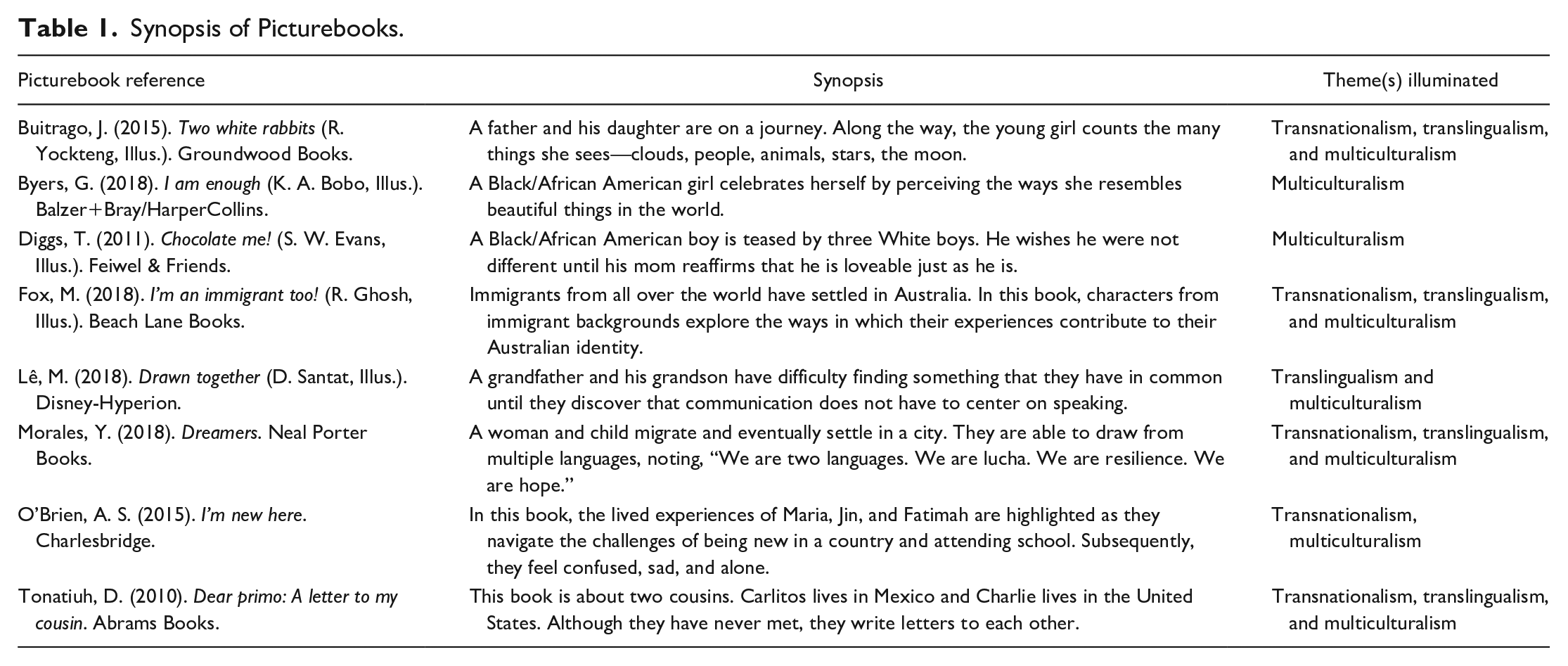
To select picturebooks that focus on topics such as multiculturalism, transnationalism, and translingualism, I utilized a search engine (NoveList Plus) that categorizes children’s literature by topic and age (i.e., suggested age group and corresponding Lexile level), websites that include lists of literature about refugees and immigrants (e.g., Colorín Colorado, I’m Your Neighbor Books), and scholarly publications highlighting culturally relevant children’s literature (e.g., Stewart, 2017). Ultimately, I chose eight books. Table 1 lists and includes a synopsis of each book to which children responded.
Synopsis of Picturebooks.
Participants
To highlight the ways in which four children (Lion, Gloria, Ayonna, and Dawit) drew from their knowledge and experiences as they interacted with, and engaged in, dialogic reading of picturebooks, I discuss relevant insight about each child whom I have come to understand through participant observations, informal or impromptu interviews, and the collection of artifacts (e.g., personalized notes and stickers, journal entries, and homework worksheets). I have asked all participants in this study to pick a pseudonym. Lion insisted that I refer to him by that name because he considers himself “a big lion from Africa.” All other names are pseudonyms that I selected because participants either requested that I use their real name or said, “Call me whatever.”
The children included in this study were born in Eritrea, Democratic Republic of Congo, Tanzania, and Uganda. Dawit’s parents identify as originally from Eritrea, while Ayonna’s, Lion’s, and Gloria’s parents say their families are from “Congo.” All children are learners of English and of their heritage language (Kinyarwanda, Swahili, and Tigrinya). Along with their families, the children settled in the southeastern United States in 2016 and 2017.
Data Collection
Each of the four children was a single case study, and data for this multiple case studies approach were collected twice per week for 19 weeks. To specifically understand what happens when four translingual children, with diverse lived experiences, cultural backgrounds, and linguistic backgrounds, respond to picturebooks, this study answers the guiding research question using thick description of the research setting and the children’s responses to picturebooks (Denzin, 2001). A total of 14 children and youth resettled as refugees and four after-school teachers (in addition to me) participated in my qualitative study that had a broader focus featuring a variety of data forms (participant-observation notes, researcher memos, collection of artifacts, interview and shared reading transcripts). From this group, I selected four children who were interested in reading multicultural, transnational, and translingual picturebooks and participated in interactive shared reading sessions with me. These children gave me permission to audio record. I transcribed verbatim all audio-recorded shared reading sessions. Thereafter, to add more thick description and triangulate the data (Creswell & Poth, 2018), I used three supplementary data-collection approaches: informal and impromptu interviews with children, observation notes during after-school program sessions, and artifacts of writing that were produced in response to shared reading.
Data Analysis
In this study, I engaged in first and second cycle coding using Atlas.ti, a qualitative data analysis and research software. To illuminate data that specifically speak to what happens when four translingual children from refugee backgrounds respond to multicultural, transnational, and translingual picturebooks, first cycle coding involved applying in vivo and process codes. In vivo codes are participant-generated words from the language found in the data record (Charmaz, 2014; Corbin & Strauss, 2015), and process codes focus on actions across time, such as things that emerge, change, occur in particular sequences, or are implemented through time (Charmaz, 2002, 2008; Corbin & Strauss, 2015). For example, process codes were assigned to data where children moved from a sitting position to standing, used gestures (e.g., pointing, clapping hands), and performed actions (e.g., dancing, singing) to articulate critical perspectives. For the second cycle, I grouped segments of data into smaller categories to establish pattern codes (Miles et al., 2014); these exploratory or inferential codes identify instances of when each child disrupted the commonplace, interrogated multiple viewpoints, focused on sociopolitical issues, and foregrounded social justice.
I also considered my own subjectivities and predisposition, which Sipe and Ghiso (2004) posited all qualitative researchers bring to the data analysis process. In my case, these subjectivities and predispositions are mostly centered on my intersecting identities as a Bosniak man (Bošnjak) from Bosnia and Herzegovina who, in the late 1990s, settled in the southeastern United States as a refugee. I identify as an insider in this research context in the sense that I associate with and continue to live the refugee resettlement experience; in other ways, as a man of European heritage, I am an outsider as I will never know what it is like to identify and live as a person of African heritage. However, just like the participants in this study, I am a translingual person from a refugee background, and therefore, I was determined to ensure that Lion, Ayonna, Gloria, and Dawit had access to picturebooks that represent different cultural and linguistic groups—enabling them to “engage powerfully with learning and life” (Orellana, 2016, opening page).
Findings
The following section describes findings in four case studies that detail what happens when translingual children from refugee backgrounds respond to multicultural, transnational, and translingual picturebooks that highlight issues of bullying and racism, transnationalism, transculturalism, xenophobia, and Islamophobia. Beginning with observational data documented in field notes that I collected as part of a larger study to draw attention to the life and learning of Lion, Ayonna, Gloria, and Dawit (e.g., Campano & Ghiso, 2011), I created a profile for each child that identifies the ways in which they articulated critical perspectives, such as disrupting the commonplace, interrogating multiple viewpoints, focusing on sociopolitical issues, and foregrounding social justice.
Lion
Lion was born in a refugee camp in Uganda to parents from the Democratic Republic of Congo. He has three older siblings (two brothers and one sister) and one younger sister. His heritage language is Kinyarwanda. When this study took place, Lion attended first grade at an elementary school. His mom and dad worked in a poultry-processing plant; they rotate their work shifts so that one parent is at home in the mornings and the other in the evenings. With neighbors, Lion’s parents carpool for an hour to and from their job, which is in a nearby rural county.
Recently, Lion joined his older brother and other children for an adventure that entailed biking more than a mile down a busy two-lane street. Without asking their parents for permission, the children wanted to go swimming in a lake situated within a 300-acre park. As swimming and wading is not allowed there, the children were pulled out of the lake by police officers, engaged in conversation about rules in the community, and ultimately were driven home.
While interacting with multicultural, transnational, and translingual picturebooks, Lion engaged with issues of bullying and racism, transnationalism, and translingualism. In doing so, he used particular words and phrases featured in the books we read and discussed. Specifically, he took an active stance toward the text by countering offensive and racist remarks—and, in that way, he disrupted the commonplace (Luke, 2000). In addition, as he engaged in conversations about crossing physical and linguistic borders, Lion considered multiple and competing viewpoints of assumed knowledge. In these conversations, he also recognized relationships between power and language.
As Lion responded to Chocolate Me! (Diggs, 2011), he recognized the depiction of power exerted by three boys pointing their fingers and saying derogatory language about a Black/African American boy’s appearance. Specifically, Lion used speech, gestures, and silence to respond to issues of bullying and racism.
Nermin: That’s great! I am glad you said something to the mean bullies. [Lion laughs.] [reading] They often stared at my hair. “Why do you look scared? It’s so poofy and big, like a wig. Not straight—don’t you hate to comb it?” Lion: [stands up and points index finger at illustration] Look at your hair. It looks like yellow, um, pudding. Nermin: [reading] As they pointed at my nose, I froze. “It’s so big and wide!” I tried to hide. [talking] Oh my goodness, that’s so mean. Lion: [After prolonged silence, Lion takes a deep breath and puts his head down.] He feels sad because they’re making fun of my nose. [Lion appears visibly upset and crosses his arms.] Nermin: I have to tell you that I think all people are beautiful and it doesn’t matter what your nose looks like. [I pat Lion on his back. He smiles and hugs me.] He is going home to his mom now. What do you think she is going to say? Lion: Don’t be sad. Make new friends that have, um, like you.
By countering the offensive and racist remarks of White characters, Lion disrupted the commonplace when he took an active stance toward text (Luke, 2000). Clearly, at that moment, he was impacted by the author’s use of language and literacy devices, such as the use of offensive remarks about a person’s race or ethnicity. In addition, by urging the Black/African American main character being chastised for his physical appearance to “make new friends that have . . . like you,” Lion foregrounded social justice to maintain that the character would find comfort in associating with friends who look like him. In doing so, Lion inferred that the character would avoid being bullied based on his intersecting identities as a Black/African American boy.
Lion also attended to the language of the picturebooks when he noticed that some words, such as the word frontera in Two White Rabbits (Buitrago, 2015), can be said in “their country but no after frontera.” After I asked, Lion confirmed that he meant that some languages (e.g., Spanish) are discouraged in countries where another language (e.g., English) is widely spoken and enforced. Hence, Lion used speech and gestures to respond to issues of transnationalism and translingualism, which reinforce the notions that people cross borders between nations and states, as well as those that exist in physical, cultural, and linguistic spaces.
Nermin: So, this sign says frontera. Any idea what that means? Lion: Oh, fronteta [sic] is a country. Nermin: Good guess! Frontera means “border” in Spanish. Do you think this is a border? Lion: [closes eyes and taps index finger on lips] Nermin: Do you know what a border is? Lion: It’s a big thing, that, um, goes all the way down the ocean and it has a road so the bus can go over it. Nermin: So, what are these people doing? Lion: They are going to frontera. [Another child says: “They can’t do that!”] They can do that because there’s no train coming. They are going back. Nermin: Oh, they are going to their own country? Lion: Mm-hm. They’re going to see a friend. They can say frontera in their country but no after frontera.
By engaging in conversation about what a border is and how it impacts people who are crossing physical and linguistic borders, Lion considered multiple and competing viewpoints of assumed knowledge. Furthermore, by focusing on sociopolitical issues, such as the movement of people across borders between nations and states, Lion recognized relationships between power and language. For instance, he articulated that borders, in addition to existing as physical barriers, determine which languages are enforced and, subsequently, can be used by the people who cross borders.
Lion also used his experiences to respond to picturebooks. Based on the things he knows and loves and wants to share, such as experiences in his homeland, Lion noted, “Africa trains are bigger, like, really big. My dad lets me go outside the train and play. I saw ten men, ten ladies, ten trees.” Moreover, it is significant that his spoken responses were expressed using phrases in English and languages (Spanish and Thai) featured in books that we read and discussed; these words and phrases included frontera (border) and chucho (dog) in Spanish and สวัสดี / “sawasdee” (hello) in Thai.
Ayonna
Ayonna enjoys writing in her journal and drawing flowers. She showed me a journal entry detailing an opportunity to eat lunch at school while sitting across from her boyfriend. Other entries were sketches of flowers and animals. Ayonna has five siblings (two older sisters, one older brother, and a younger brother and a younger sister). Although her dad said that the family is from “Congo,” Ayonna clarified, “I am from Tanzania. That’s where I was born [in a refugee camp]. My mom is from Tanzania, too.” Ayonna’s heritage language is Swahili, which she uses to communicate with her parents. When speaking with her siblings and friends, Ayonna uses either English or Swahili.
Ayonna’s dad worked at a poultry-processing plant and her mom recently started cleaning corporate business offices, which requires her to be away from the family in the evenings. Therefore, Ayonna’s older sister, who is in the eighth grade, prepares dinner and cares for a 3-year-old sibling. This circumstance allows Ayonna, as she says, “to play and act really crazy.” She describes her close friends, who live in the same apartment building, as a clique. “We like to talk about boys and gossip, and sometimes we are mean,” she says. Two of the girls who are part of the “clique” were born in the United States to immigrant parents from Mexico and Honduras. They teach Ayonna phrases in Spanish, such as rojo, amor, and hola chica. Yet, she says, “They make fun of my language just like kids at school.” She added, “And they make fun of my country—Africa.”
Recently, the apartment unit in which the after-school program took place was vandalized. A window was broken, and the front door was slightly dented. Appointing herself as a detective, the after-school program facilitator interviewed all the children enrolled in the program to see whether they might be aware of additional information. “I know everything, like, everything. That boy who did it is weird, but nobody asks me . . . so bye!” Ayonna blurted and then left. Later, she came back and said that a boy in middle school who lives down the street is part of a gang. She explained that he did it because of the “Y” symbol that was engraved in the front door of the apartment unit. “It’s his gang and he streaks us,” Ayonna said. Thereafter, she agreed, in the presence of a parent, to be interviewed by the police to provide additional information about the incident.
Ayonna responded to picturebooks by engaging with the following issues: transnationalism, transculturalism, translingualism, bullying and racism, xenophobia, and Islamophobia. In doing so, she used words and phrases in English and Spanish featured in the books we read and discussed. Specifically, Ayonna considered multiple and competing viewpoints of assumed knowledge as she questioned why people migrate and discussed the ways in which migrantes draw from their culture and language, and, by focusing on the topic of (im)migration, Ayona identified relationships between culture, power, and language. Furthermore, when responding to issues of bullying and racism, Ayonna disrupted the commonplace. She also provided multiple viewpoints in discussions that centered on issues of xenophobia and Islamophobia.
Responding to Dreamers (Morales, 2018), Ayonna suggested that a mother and her child dreamed to “came together” and then “appeared together” in the United States. Although there is no text in the book that identifies the characters as people migrating from Mexico to the United States, Ayonna pointed her index finger at the illustrated image and said, “Mexico doesn’t look like this. I am a hundred percent sure it’s prettier than this.” When I asked how she knew that the mom and her child are coming from Mexico, Ayonna said, “Because they, like, dream of coming here and the people here are not nice to them.”
We also discussed particular words and phrases featured in the book in English and Spanish. For instance, Ayonna mentioned, “Oh, migrantes. I know what’s migrante. That mean they go somewhere like butterflies.” When I mentioned that I am an immigrant, or migrante, because I came to the United States from another country, Ayonna smiled, pointed to herself, and said, “Me too.” Later, she asked a question about what the word caminates means, to which I responded “hikers.” Furthermore, Ayonna underscored that the characters cannot understand and are afraid to speak because they just came here. But at the same time, she clarified that for migrantes, “It’s more easy [to speak] in their language.”
These conversations illustrate that Ayonna recognized issues of transnationalism, transculturalism, and translingualism. She responded to depictions of settling in a new place while navigating culture and language. In addition, she considered multiple and competing viewpoints of assumed knowledge as she analyzed why people migrate and discussed the ways in which migrantes draw from their culture and language. By focusing on sociopolitical issues, such as (im)migration, Ayona identified relationships between culture, power, and language.
Ayonna also responded to Chocolate Me! (Diggs, 2011), and subsequently, saw problems with the text when responding to issues of bullying and racism.
Nermin: [reading] “Sitting on the stoop when I was five. Not like Johnny, Timmy, or even Mark. Though I wanted a name like theirs.” [talking] Why would he want a name like theirs? Ayonna: So, he can be like them and not different . . . Why are they so mean to him? If I am that boy, I would hit them. They are bullies.
Impacted by the author’s use of language and literacy devices, such as the author assigning Anglo names to White characters depicted as bullies and racists, Ayonna disrupted the commonplace. For instance, she said that she would respond forcefully to derogatory language directed toward her about her racial and ethnic identities. Such response requires taking action on the world to transform the ideologies of people who exemplify bullying and racist dispositions. Her response also recognized the need for social justice.
In addition, Ayonna responded to issues of xenophobia and Islamophobia while interacting with I’m New Here (O’Brien, 2015).
Nermin: Why would she be nervous? Ayonna: Because, um, she’s just new there. She doesn’t know the other people and feels sad. Nermin: How do you think the other people treat Fatimah? Ayonna: Not good because she looks like that. She’s from Africa, I think. I am Christian but she’s not. Some people I know look like that.
In discussions about the ways in which xenophobia and Islamophobia impact a newcomer person’s experience at school, Ayonna provided multiple viewpoints. She also identified ways in which newcomer people from immigrant and refugee backgrounds are sometimes mistreated in society. Such treatment is often based on aspects of culture, power, and language.
While interacting with multicultural, transnational, and translingual picturebooks, Ayonna articulated critical perspectives that center on recognizing problems in the commonplace, focusing on sociopolitical issues, providing multiple viewpoints, and identifying relationships between culture, power, and language. It is significant that her spoken responses were expressed using phrases in English and Spanish featured in books that we read and discussed. Words and phrases in Spanish that Ayonna said included adiós corazón (goodbye my love), rojo (red), and caminantes (hikers). She also responded in writing to I Am Enough (Byers, 2018). As Ayonna completed writing the phrase “It doesn’t matter what skin color you are,” which Gloria dictated, she shot back, “It matters!” Although she did not elaborate on what she meant by this remark, I perceived this reaction as Ayonna’s recognition that, in our society, race is not perceived as neutral. For instance, racism is pervasive in the United States—impacting where people of color live, the schools they attend, the food they eat, and the health care they have access to (e.g., see Compton-Lilly et al., 2020).
Ayonna also built on her experience to respond to picturebooks. Based on the things she knows and loves, and wants to share, such as experiences in her homeland, Ayonna talked about her “Africa school.” She recalled that kids from many grades sit in the same room with teacher . . . boys are on one side and girls on other side. But we sing songs, dance, laugh and play . . . and do math, reading and writing on green wall.
Thereafter, she juxtaposed this recollection with a claim that “it’s easier to talk to boys in here school.”
Gloria
Gloria is Lion’s older sister. She was born in the Democratic Republic of Congo and was a young child when her family settled in a refugee camp in Uganda. “I’m from Uganda Africa,” she says. Gloria’s heritage language is Kinyarwanda, which she uses when communicating with her parents. In her family, Gloria also engages in language and literacy brokering (e.g., see Orellana, 2009; K. Perry, 2014; K. H. Perry, 2009). When communicating with her siblings and friends, she uses either English or Kinyarwanda.
Gloria is expected to help her mom with cooking and household chores. She says that, as the oldest girl in the family, she has to carry food that her mom prepares the night before over to her grandmother’s apartment. When I noticed that Gloria carried two heavy pots placed in plastic bags across the courtyard of the apartment complex, I offered to help. “I got it. I always have to do this. It’s not fair,” she said. Gloria also takes it upon herself to keep an eye on Lion and a younger 5-year-old sister. “Sometimes I have to say bad words in my language to them. And they still don’t listen to me—damn it!”
During a basketball tournament in an elementary school, in which Gloria’s older brother participated, she sat next to me and whispered, “I don’t really want to play basketball next year. I want to play soccer.” Gloria clarified that she really enjoys playing soccer with the other kids at home. Later, her classroom teacher came to say hello; she told the after-school program facilitator that Gloria is “just lovely” and a pleasure to have in class. I also noticed that on Saturdays, Gloria patiently waits in front of her apartment building for church group volunteers to pick her up. At Arrow Church, she participates in a weekend program geared toward children and youth. Spread across several locations in a city in the southeastern United States, Arrow Church strives to point every person to Jesus. In addition to the summer camp for children, weekend services for families are provided in multiple languages (English, Spanish, Swahili, and Kinyarwanda). Although Gloria says that her siblings do not regularly attend weekend and summer programs at Arrow Church, she is always eager to go.
Responding to multicultural, transnational, and translingual picturebooks, Gloria particularly engaged with issues of bullying and racism. In doing so, she asked questions about words in English and languages featured in the books we read and discussed. But while responding, she did not use phrases in languages other than English. Gloria responded to Chocolate Me! (Diggs, 2011), noting, “They are making fun of his look because he is chocolate. But I am like that . . . chocolate!” She was impacted by the author’s use of language and literacy devices, which enabled her to recognize problems in the way the text portrayed the commonplace. She also drew on her understanding of social justice by wondering why the White characters would use derogatory language about a Black/African American boy’s appearance. She referred to the three White boys as “really mean.” “Why would they say that?” Gloria wondered. Ultimately, she and I decided that mean bullies (and racists) who make fun of people for the way they look should not be taken seriously. Gloria concluded, “All of them are enough. It doesn’t matter what they look like.” Gloria foregrounded social justice to suggest that such behavior should not be accepted in society—implying that we all deserve to be part of spaces and live in communities where “it doesn’t matter what [people] look like.” Ultimately, she articulated the need for our communities to be safe and inclusive spaces for all people, regardless of what they look like.
It is significant that Gloria dictated sentences that Ayonna wrote in response to I Am Enough (Byers, 2018). When Ayonna said that skin color does matter, Gloria did not respond; however, she tilted her head and appeared deep in thought. Yet, when I asked what she was thinking about, Gloria shrugged her shoulders and said, “I dunno.” Based on the things she knows and loves and wants to share, Gloria referred to herself as “chocolate.” In that way, she closely identified with a character.
It is also notable that Gloria asked me questions about the meaning of particular words in English and other languages featured in the books we read. She asked about the meaning of the English words swell, speechless, resplendent, ancestors, and improbable. Also, Gloria inquired about the meaning of the Spanish words adiós corazón (goodbye my love), caminantes (hikers), and migrantes (migrants). However, while interacting with picturebooks, she did not use any of these words and phrases, or any other words in Spanish featured in the books we read.
Dawit
When I first met Dawit, he told me, “I am going to buy a Lamborghini . . . in cash”—“that’s how rich I going to be.” He has two older brothers and one younger brother. Dawit was born in Eritrea. His family fled to Ethiopia to apply for refugee resettlement. Initially, they settled in the U.S. state of Minnesota. “The snow is so big—bigger than me!” Dawit recalled. After establishing contact with relatives, the family relocated to a city in the southeastern United States. When this study took place, Dawit’s dad worked at a car wash. According to the boy, his mom “cooks and stays at home.”
During an after-school program session, as he wrote a sentence, Dawit turned to Gloria and said, “Guess what my biggest fear is?” “I don’t know . . . school?” answered Gloria. “No! It’s reading and writing. That’s my biggest fear so much.” While Dawit refers to himself as a “human calculator,” a title that is synonymous with his preference for mathematics, he recognizes that he has difficulty with reading and writing. “Sometimes I go to help kids in second grade,” he said. But when Dawit realized that his classroom teacher sends him to participate in reading activities in a second-grade classroom, rather than volunteer as a helper, he said, “Now I act silly, and my teacher doesn’t send me to go there.”
Most recently, as I walked toward my car in the parking lot while chatting with Dawit, he called out to his mom. Thereafter, he asked me whether I have an air pressure pump. In that exchange, Dawit navigated varied “ways with words” and used his linguistic tool kit with versatility and flexibility (Orellana et al., 2014, p. 311; also see Orellana, 2009; K. Perry, 2014). By living and learning in settings where more than one language is spoken, Dawit shifts flexibly between languages as needed to do things for others, such as inquiring about a pump.
While responding to multicultural, transnational, and translingual picturebooks, Dawit engaged with issues of bullying and racism, as well as transnationalism. In doing so, he used phrases in English and in languages (Spanish and Thai) featured in books that we read and discussed. Dawit also responded to issues of transnationalism by recognizing details pertaining to the (im)migration and detention of (im)migrants. For instance, he hypothesized that a refugee girl might be forcefully kept in detention simply because “she is not from that place.”
Dawit articulated critical perspectives around issues of bullying and racism. For instance, I read, “Your skin is brown like dirt. Does it hurt to wash off?” (Diggs, 2011). “That’s bully,” declared Dawit. As I continued reading, he repeatedly exclaimed, “Chocolate me!” When I asked what he thinks about the message that it is important to love what we see in the mirror, Dawit reassured me that he loves what he sees—“chocolate me!” Dawit pushed back against the text, disrupting the commonplace, as he reacted to the author’s use of language and literacy devices. He called out the White characters as bullies for using derogatory language about a Black/African American boy’s appearance.
In addition, Dawit responded to issues of transnationalism in I’m an Immigrant Too! (Fox, 2018), which features depictions of newcomers from immigrant and refugee backgrounds.
Nermin: [reading] “Sadly, I am a refugee—I’m not Australian yet. But if your country lets me in, I’d love to be a vet.” [talking] So they won’t let her in, but she wants to be a veterinarian—an animal doctor—when she grows up. Dawit: They keep her in jail because she is not from that place. Maybe she has to wait for long time.
Responding in this way, Dawit recognized details pertaining to the (im)migration and detention of (im)migrants.
Dawit also built on his experience to respond to picturebooks, noting, “That’s like me. I run away from soldiers. They are bad.” He also said, “In my country we have donkey. Bad guys with knife steal him. They also get the food we have to make injera,” a sourdough-risen flatbread. In addition, when discussing issues such as racism and bullying, as well as transnationalism, Dawit used phrases in English and languages (Spanish and Thai) featured in books that we read and discussed; these words and phrases included amor (love), corazón (heart), adiós corazón (goodbye my love), caminantes (hikers), primo (cousin), and chucho (dog) in Spanish and สวัสดี / “sawasdee” (hello) in Thai.
Looking Across Cases: Critical Perspectives
When considering the cases of Lion, Ayonna, Gloria, and Dawit, it is evident that these translingual children who share African heritage and are from refugee backgrounds articulated critical perspectives in response to picturebooks. They each challenged the common assumptions behind the stories and were able to note multiple viewpoints. These children were also aware of sociopolitical issues underpinning the stories and had an acute sense of fairness and social justice. As they interacted with and engaged in dialogic reading of picturebooks that illuminate issues of bullying and racism, transnationalism, transculturalism, xenophobia, and Islamophobia, the children recalled occasions that occurred in their homeland. By building on their experiences, the children also referred to the many things they know and love and want to share, such as closely identifying with a character. Although they all asked about the meanings of unfamiliar words in different languages, Lion, Ayonna, and Dawit used phrases in English and other new-to-them languages (Spanish and Thai) featured in the books they read and discussed with me.
All cases provide insight into how shared reading sessions with picturebooks elicited critical perspectives from children who recently settled in the United States as refugees. A multicultural picturebook with which all four children interacted, Chocolate Me! (Diggs, 2011), provided opportunities for them to engage with issues of bullying and racism. Lion took an active stance toward the text by countering offensive and racist remarks uttered by characters depicted as three White boys. Ayonna, Gloria, and Dawit were affected by Taye Diggs’s use of language and literacy devices. For Ayonna, noticing and elaborating on the depictions of characters with Anglo names as bullies and racists enabled her to challenge the status quo. Gloria, on the contrary, disrupted the commonplace by wondering why the “really mean” boys would say derogatory and racist remarks. Subsequently, she called for social justice by suggesting that such behavior should not be accepted in society. Dawit called out the characters as bullies for using derogatory language about another boy’s appearance.
Lion also engaged with issues of translingualism and transnationalism. While interacting with Two White Rabbits (Buitrago, 2015), he suggested that some languages (e.g., Spanish) are discouraged in countries where another language (e.g., English) is widely spoken and enforced. In addition, he identified borders as physical and linguistic barriers that impact people who cross them. Similarly, in response to Dreamers (Morales, 2018), Ayonna recognized issues of transnationalism, transculturalism, and translingualism. She raised the question of why people migrate and discussed the ways in which migrantes draw from their culture and language. In addition, by focusing on sociopolitical issues, such as (im)migration, Ayona identified relationships between culture, power, and language. Dawit, on the contrary, engaged with issues of transnationalism as he interacted with the picturebook I’m an Immigrant Too! (Fox, 2018), which features depictions of newcomers from immigrant and refugee backgrounds—including a refugee child who is in detention. Saying that “they keep her in jail because she is not from that place,” Dawit recognized details pertaining to the (im)migration and detention of (im)migrants. In addition, for Ayonna, noticing and elaborating on depictions in I’m New Here (O’Brien, 2015) of a character from immigrant and Muslim backgrounds enabled her to engage with issues of xenophobia and Islamophobia. She noted that newcomer people from immigrant and refugee backgrounds are mistreated in society based on aspects of culture, power, and language.
Looking at the ways in which critical perspectives were articulated across all four cases provides insight into how, in response to picturebooks, translingual children who share African heritage and are from refugee backgrounds draw on their experiences and perspectives while interacting with and engaging in dialogic reading of picturebooks. In doing so, they unpacked “myths and distortions and [built] new ways of knowing and acting upon the world” (Luke, 2014, p. 22). They also participated in equitable learning opportunities involving interactions with text and visual resources (Lewison et al., 2008). These learning opportunities came about as children recognized and responded to important issues that address power and marginalization based on race and ethnicity, language, and immigrant and refugee backgrounds.
Coming Full Circle: Love as a Driving Force to Connect With and Motivate Translingual Children From Refugee Backgrounds
Beginning this article with a quote featured in Yuyi Morales’s (2018) book Dreamers, I focus on a belief that translingual children from refugee backgrounds are “Love Amor Love,” or more precisely, embody stories, multiple languages, lucha, and hope, and are soñadores of the world. As a translingual person from a refugee background myself, it seems familiar, if not effortless, to embrace “Love Amor Love” to connect with these children and motivate them to engage with literacy learning and life. By identifying multicultural, transnational, and translingual picturebooks, and then providing them to four children who recently settled in the United States as refugees, it became possible for them to access contemporary children’s literature depicting the complex social networks and lived realities of people from different backgrounds who live in diverse communities.
In considering the ways in which translingual children from refugee backgrounds draw on their experiences and perspectives to respond to picturebooks, and simultaneously engage with learning and life, I underscore the importance of adults—teachers, tutors, mentors, parents, or caregivers—reading picturebooks with these children to collaboratively unpack myths and distortions, build new ways of knowing, act upon the world, and participate in equitable learning opportunities involving interactions with text and visual resources (Lewison et al., 2008; Luke, 2014). Adults may provide opportunities for translingual children from refugee backgrounds to articulate critical perspectives by drawing on their everyday experiences and the places and spaces that they encounter and occupy, as well as the languages they use (Freire & Macedo, 1987; Johnson & Vasudevan, 2012). Unlike parents or caregivers who likely share the same heritage language and occupy many of the same places and spaces as children, it is important that tutors, teachers, and mentors embrace translingual children from refugee backgrounds as people who use multiple languages and have valuable everyday experiences across different places and spaces. This enables these children to articulate or act on critical perspectives that might entail disrupting the commonplace, interrogating multiple viewpoints, focusing on sociopolitical issues, and foregrounding social justice (Lewison et al., 2002). As we in the field of education continue to consider what it means to do critical literacy work with translingual children from refugee backgrounds in an after-school program, it is my hope that more children will have opportunities to participate in shared reading sessions with adults who recognize that these children are “Love Amor Love” (Morales, 2018).
Supplemental Material
sj-zip-1-jlr-10.1177_1086296X211030469 – Supplemental material for Picturebooks as Critical Literacy: Experiences and Perspectives of Translingual Children From Refugee Backgrounds
Supplemental material, sj-zip-1-jlr-10.1177_1086296X211030469 for Picturebooks as Critical Literacy: Experiences and Perspectives of Translingual Children From Refugee Backgrounds by Nermin Vehabovic in Journal of Literacy Research
Footnotes
Declaration of Conflicting Interests
The author(s) declared no potential conflicts of interest with respect to the research, authorship, and/or publication of this article.
Funding
The author(s) received no financial support for the research, authorship, and/or publication of this article.

References
Supplementary Material
Please find the following supplemental material available below.
For Open Access articles published under a Creative Commons License, all supplemental material carries the same license as the article it is associated with.
For non-Open Access articles published, all supplemental material carries a non-exclusive license, and permission requests for re-use of supplemental material or any part of supplemental material shall be sent directly to the copyright owner as specified in the copyright notice associated with the article.
