




Abstract
Guided by theories of racialization and through a decolonial analysis, we share findings on the examination of four children’s books written in Puerto Rico in the aftermath of Hurricane María. In engaging with these books, we situate our work in communal and research activist practices that foreground Puerto Ricans’ hidden stories and knowledges. Our initial analysis focuses on mapping the complex and contradictory constructions of diverse sociopolitical perspectives within a Puerto Rican imaginary around Hurricane María, communal and historical agency, and emerging resistance as decolonial literary acts. We then provide a more in-depth analysis of two texts, exploring the themes of estamos bien, delinking, one story/one people, and acción social. Findings highlight the need to engage with ruptures created by texts within decolonial imaginative spaces to improve literacy instruction.
Finalmente, Thiago abrió los ojos por completo y se dio cuenta de que el huracán ya había comenzado. No tuvo miedo. Él iba a resistir, él, sus padres, sus amigos, Puerto Rico entero. Finally, Thiago completely opened his eyes and he realized that the hurricane had already begun. He was not scared. He was going to resist, him, his parents, his friends, all of Puerto Rico.
Recently, in Puerto Rico, the word “combativo/a/e” has emerged to name and describe objects and actions that deliberately relate to national resistance during the last 4 years of major catastrophic events in the island—a hurricane, an earthquake, political upheaval, and a pandemic. To be combativo/a/e means to fully acknowledge and take an activist stance against the trajectories of colonial oppression that frame the island’s history and to use people’s multiliteracy resources (music, performance, storytelling, public arts, etc.) as tools for resistance. In this article, the phrase “cuentos combativos” serves as a metaphor to frame the work writers for young audiences contribute to the combative efforts of local resistance and decolonization on the island.
To that end, given the current social challenges we have witnessed as Puerto Ricans, it has become important in our work to foreground decolonial perspectives from the global South (Mignolo & Walsh, 2018; Quijano, 2000; Santos, 2016; Walsh, 2019). Our hope is to center historical and social absences in the ways partialities in social reality and knowledge get constructed from the global North. As Puerto Rican researchers and community advocates of these perspectives, we share our work with the goal of carving an opening in literacy research to bring visibility to the hidden knowledges and realities that emerge from Puerto Rican children’s literature authors on the island. More specifically, we focus on how the recent work by these authors adds to the social, cultural, and decolonial imaginaries that reflect and help mediate the consequences of Hurricane María as an environmental, humanitarian, and sociopolitical disaster within a colonized spaced (Bonilla & LeBrón, 2019). As Lloréns (2018) noted, In Puerto Rico, societal vulnerabilities result from a long history of colonial subjugation, economic hardship, environmental injustice, infrastructural neglect, and, at the local island level, a broken rule of law. Hurricane María’s winds exposed the vulnerabilities created by ubiquitous socioeconomic inequality and neglect of the island’s rural regions, like fault lines buried under shallow soils. (p. 156)
To grapple with this complexity, through an interrelated decolonial and racialization analysis, we share findings on the examination of children’s books produced in Puerto Rico by Puerto Rican authors in the aftermath of Hurricane María.
As a decolonial project rooted in Puerto Rican histories and stories, we share this work as a product directly related to our personal, familial, and community stories as Puerto Ricans that converse with and emerge through these books (Pérez, 1999). We focus on the overall construction of decolonial themes around the hurricane event that map the rich, complex, and contradictory constructions of diverse sociopolitical perspectives within a Puerto Rican imaginary around Hurricane María, communal and historical agency, and emerging resistance as decolonial literary acts. As such, the analysis presented in this article engages with two focal texts around the following question:
We begin this article by articulating key theoretical assumptions in decolonial theory and the concept of racialization guiding our analysis and reading of the texts. We then discuss how children’s literature has been taken up on the island, becoming a tool of resistance and reclamation during difficult times. We will then present a thematic exploration of four texts, two of which will be the subject of in-depth discussion. Finally, we will share the implications of our work.
Theoretical Frame
Decolonialities
The story of Puerto Rico can not be told without reference to Western modern catastrophe and coloniality. (Torres, 2019, p. 337)
The work of decoloniality as a social theory and social movement (Bhambra, 2014) is defined in relation to modernity’s unfinished democratic project and its existing colonial trajectories (Mignolo & Walsh, 2018; Quijano, 2000). According to decolonial scholarship, democracy as an ideal and a set of material actions has been co-opted by capitalist and neoliberal views of freedom that function to perpetuate marginalization, erasure, displacement, and exclusion based on social identity categories (e.g., race, class, gender). Furthermore, sovereignty, “el poder último de decidir sobre el territorio” (the ultimate power to decide upon a territory; Villanueva-Muñoz, 2019), is a key material goal in any contemporary decolonial project taken up by communities who still live under colonial settlers’ regimes (e.g., Indigenous communities and colonial territories such as Puerto Rico; Bhambra, 2014; Center for Embodied Pedagogy and Action, 2020; Tuck & Yang, 2012; Tuhiwai-Smith, 1999). Therefore, as Tuck and Yang (2012) indicated, a decolonial project has to be led by material actionings that move us closer toward the sovereignty of the land. Coss (2019) defined descolonizar, or “to decolonize,” as “conquistar una capacidad de acción y pensamiento que ha sido negada, deformada o suprimida de muchas formas por la intervención colonial” (conquering a capacity for action and thinking that has been denied, distorted, and suppressed in multiple ways by the colonial intervention; emphasis added). Of particular interest to our work is the notion that the consequences of coloniality are embedded within complex forms of material displacement and erasure of knowledges (Lugones, 2010; Mignolo, 2007; Said, 1978; Santos, 2016). In Puerto Rico, material forms of displacement occurred through military interventions, displacement of communities from their land for military and U.S. corporate tourist purposes, the risky experimentations of contraceptives on Puerto Rican women, and most recently, the imposition of a fiscal oversight board that took over most of the financial decisions on the island. This is significant in the articulation of a complex project of decoloniality that encompasses the disruption of both power relations with the colonizer and internalized forms of knowledge erasure that are produced within the matrix of modern colonial knowledge. Moreover, decoloniality also aims to explore how those knowledges are distributed to perpetuate the current social status (Mashau, 2018; Medina, in press). Models of how to live in communities are grounded on social constructs that are based on a White–Westernized “normal,” resulting in the dehumanization and invisibility of our communities (Pérez, 1999). These social constructs also shape the literary imaginaries or the ways in which texts create realities related to peoples, places, things, and so on (Mariani, 1992; Morrison, 2015; Pérez, 1999; Said, 1978).
In relation to literary studies, the works of Latinx scholars Pérez (1999) and Aldama (2009) inform our broader understanding of decolonial perspectives. Through them, we come to an understanding of how Latinx authors develop literary rupture by “reconfiguring realism” (Aldama, 2009, p. 49), generating narratives that are centered in the lived experiences of Latinxs and that move toward the production of “decolonizing imaginaries.” Pérez (1999) defined decolonial imaginaries as “a rupturing space, the alternative to that which is between the colonial and postcolonial, that interstitial space where differential politics and social dilemmas are negotiated” (p. 6). This means that histories are reconfigured and new politics established as realities are transformed through a “conscious effort to retool, to shift meanings and read against the grain” (Pérez, 1999, p. xvii). These transgressive literary spaces become new reconfigurations and imaginaries through ruptures and the establishment of new center and margin relationships. Agency then is recentered in texts on people and actions emerging from nondominant communities and not in the White–Western dominant construction of literary knowledges or imaginaries.
Decolonial and postcolonial approaches have also been explored in the field of children’s literature (Hartley, 2010; McGillis, 1999; Raina, 2009; Sahn, 2016; Xie, 1999). These works provide an understanding of how children’s literature can both reflect colonial ideologies and provide spaces for decolonial ruptures that disrupt normative Western ways of knowing. We concur with Thomas’ (2016) argument that “since troubling discourses of colonialism and supremacy are transmitted via childhood stories, it is absolutely critical that these functions of children’s literature are revealed, historicized, and interrogated” (p. 119). Our article contributes to this body of knowledge by including the perspective of Puerto Rican children’s literature. The literacy spaces discussed in this article, which are grounded in imagination, do not necessarily engage reclamation of land or sovereignty, but we believe that to imagine oneself beyond the colonial project is the first step in attempting to reclaim sovereignty and the self. As Anzaldúa (2007) observed, “Nothing happens in the ‘real’ worlds unless it first happens in the images of our heads” (p. 109). In their book, Medina and Wohlwend (2014) argued that “imagination is the antithesis of control” (p. 112), and it is with that frame in mind that we highlight how the decolonial ruptures and imaginations created in the texts we explore allow Puerto Rican readers to see a Puerto Rico disconnected from the colonial project and, in turn, to imagine beyond it.
Racialization
Decolonial theories challenge us to understand and examine the stories left unsaid and the knowledges that have been subverted in the colonial project. Racialization, or the process of othering based on race (Omi & Winant, 2014), gives us the language to discuss how one of the mechanisms of the colonial project is to make bodies of color or those on the “fringe” of a society “docile.” We understand race as a social construct with real ramifications for those deemed the “other” or “minority” (e.g., Bonilla-Silva, 2017; Lipsitz, 1995). This racialization process has created a second-class citizenry based primarily on a people’s racial background, as has been the case with the United States and Puerto Ricans. Through the work of the colonial project and racialization, one of its mechanisms of oppression, bodies of color have been positioned as docile. The term “docile” is drawn from Foucault’s (1977) work on the penal system and its attempts to remove bodies’ ability to resist those in power. He pointed out that “discipline produces subjected and practiced bodies, ‘docile’ bodies” (p. 138). Here, we are using the term “docile” to refer to the attempted end result of the colonial project and, in turn, racialization. However, we are not arguing that bodies of color are not agentive. Instead, we argue that the work of the colonial project and the racial project is to create docile bodies. For example, Cruz (2001), while discussing Brown and lesbian bodies, highlighted that “nothing provokes the custodians of normality and objectivity more than the excessiveness of a body” (p. 659). In that sense, the United States has gone through great lengths to make docile the “excessiveness” of Black and Brown bodies, especially those read as female, gender fluid, lesbian, gay, bisexual, transgender, and Queer. In literary texts, this is reflected in the portrayal of primarily White male characters as agentive, whereas characters of color are presented as docile or unagentic in the narrative (see Leonardo, 2013; Morrison, 2015; Thomas, 2016; Torres, 2019). In the case of literary analysis, the connection between decoloniality and the making of docile bodies for this study lies in the answers to the following questions: Who has the power to tell stories? Whose stories are being told? What does it mean to be left out of the popular imaginary of an experience? What is the impact on those excluded?
Decoloniality and racialization as lenses push us toward the call for more equitable, anticolonial practices within the literacy field across languages and geographical spaces. Haddix (2019) emphasized that literacy research has to “expand beyond the dominant tools and methods that have historically been used within literacy research if we intend to address broader issues impacting the children and communities we purport to serve.” As Puerto Ricans marginalized by the colonial status imposed by the United States, it is important for us to read and engage with island imaginaries on and off the island in children’s text through the lens of a decolonial practice.
Situating the Landscape and Puerto Rican Children’s Literature
The history of the Western conception of children’s literature in Puerto Rico can be traced back to the end of the 19th century and the beginning of the 20th (Jiménez, 2020; Piñeiro de Rivera, 1987). In contemporary times, the production of children’s literature is the result of multiple local initiatives by various stakeholders (individuals, local libraries, and universities) on the island. These initiatives have been driven by a desire to preserve and spread the local production of knowledge. One example is Puerto Rico’s strong commitment to local teacher-preparation programs that foreground the value of literature-based instruction (see the works of Piñeiro de Rivera, 1987; Sáez Vega et al., 1999; Torres-Rivera, 2014). An example of these initiatives is Centro para el Estudio de la Lectura, la Escritura y la Literatura Infantil, at the University of Puerto Rico (CELELI; see http://celeli.uprrp.edu).
Unfortunately, the production of scholarly work that could help us develop an understanding of children’s literature as part of a continuum of local intellectual, political, and cultural production on the island is very limited. Torres-Rivera’s (2014) scholarly work examines the lack of racial diversity in Puerto Rican children’s literature and argues that the lack of scholarship is directly related to our colonial experience. As she states in an interview, Torres-Rivera points out that [Colonialism] is one of the factors explaining the lack of formal documentation of the development of Puerto Rican literature. Since 1898, the United States has played an integral role in the educational policies established in our island. This relationship with American culture has overshadowed the contributions of Puerto Rican writers who are many times better known in the diaspora than in their homeland. (Edward, 2014)
These policies are apparent through the imposition of an educational system that is structured based on U.S. mandates and policies such as No Child Left Behind, Common Core, and testing-driven curricula, without consideration for the Puerto Rican population or the cultural and linguistic differences therein (see Medina, 2003; Walsh, 1991). Nevertheless, there is resistance to this assimilationist work. For example, Jiménez (2020) discussed the critical work Puerto Rican children’s literature has played in resistance and political movements throughout the 20th and 21st centuries, particularly influencing public pedagogies and providing tools for “confronting legacies of silence” (para. 3) in our colonial history.
One of the current efforts to reclaim the presence of afroidentidades and other forms of intersectional identities (e.g., gender, race, diasporic communities) is being led by Yolanda Arroyo-Pizarro, activist and director of La Cátedra de Mujeres Negras Ancestrales. Arroyo-Pizarro has created a collection of children’s books to promote “maravillosas lecciones que denuncian la justicia social y la igualdad entre todos los seres humanos. También visibiliza apasionados enfoques sobre la discusión de la afroidentidad y la derogación del racismo” (amazing lessons that denounce social justice and equality among all human beings. In addition, it makes visible passionate perspectives about Afroidentity discussions and the abolishment of racism; Arroyo-Pizarro, 2018a, pp. 26–27). This collection of books constitutes a strong voice within the island at the intersection of decolonialities, feminisms, queer identities, and Afroidentities in texts.
Understanding the processes of survival and recovery from colonialities within the literature published in Puerto Rico is complicated. As Zavala (2016) stated, “what decolonial education means and what it looks like will be defined by the particular colonialisms and sets of contradictions that make it possible” (p. 1). Within an acknowledgment of contradictions and particularities in colonial spaces, one clear point of departure is our belief that Puerto Rican children’s literature serves a key role in the recovery of local knowledges through the gathering of past traditions and histories and the articulation of present social realities through storying (Hartley, 2010).
After Hurricane María and other successive events such as the protests against Governor Ricardo Rossello, Puerto Rican children’s literature has once again emerged as a tool of resistance. It is because of that communal push toward the power in the “infantile” that we focus on children’s literature in this article (Jiménez, 2020; Lugo, 2018; Medina, 2020). Our goal is to analyze and unpack the complexity within these stories of resistance to the colonial project by focusing on children’s texts written in the aftermath of Hurricane María.
Method
Hurricane María’s Impact
Hurricane María, a Category 5 storm, made landfall on the island of Puerto Rico on September 20, 2017. With its passing, many of the island’s residents were forced to live without a cell phone signal, power, drinkable water, and any aid from the local or federal governments for months. As a result, more than 130,000 Puerto Ricans were forced to leave the island due to poor living conditions. At the time, Francisco, the first author, lived in Colorado and witnessed the complete devastation of the island he called home. He was unable to communicate with family for weeks and felt helpless, with no real way to support the island’s recovery efforts. Carmen, the second author, was born and raised in Puerto Rico but was living in Indiana at the time and went through a similar experience. Some of her family members had to leave the island either permanently or temporarily as a result of the catastrophic humanitarian crisis. These experiences led us to reread our wor(l)ds (Freire, 1996) from a decolonial perspective as Puerto Ricans. We also attempted to heal from this trauma and its continued effects through the centering of Puerto Rican voices on the island whose work pushes us to consider both the ramifications of such events on colonial subjects and the hope and power colonized subjects have to resist and reimagine through storytelling.
Storying as Decolonial Methods in Children’s Literature
Our research methods are informed by decolonial qualitative research in education generally (Paris & Winn, 2013; Patel, 2015; Zavala, 2016) and, more specifically, in decolonial imaginaries in literary methods (Aldama, 2009; Pérez, 1999). Within this approach to qualitative research, we agree with Dixon-Román (2019) that “empiricism is always-already haunted by power and empire” (p. 276). Therefore, our approach to children’s literature as “data” is “haunted” and wrestles with dominant ways of conducting research, such as whiteness, neoliberal ways of knowing and being, and so on.
In this work, we examined whose knowledge is foregrounded in the stories told and what ruptures those stories created. “The knowing subjects” (Mignolo, 2009), in this case the Puerto Rican authors telling their stories through books and the authors of this piece, no longer act as neutral storytellers or readers. Instead, there is an urgency for “decolonializing and de-colonial knowledges [to serve as] necessary steps for imagining and building democratic, just, and non-imperial/colonial societies” (Mignolo, 2009, p. 1).
As part of our research, we acknowledge the political, cultural, and social experiences and trajectories we bring to the interpretation of texts. In our work, we deliberately reclaim our families’, our Puerto Rican communities’, and our own right to “sovereignty” and “response-ability” (Patel, 2015) in relation to the roles we play in this research project. In this methodological journey, we are simultaneously speakers and listeners. Zavala (2016) described this in-between space, scholar/activist, listener/speaker, as a “kind of border thinking . . . grow[ing] out of a decolonization of coloniality that entails not just naming the world and the colonial matrix of power that is deeply embedded in everyday life but is also an embodied/situated praxis” (p. 2). As such, we foreground the decolonial imaginaries created by texts that can act as counternarratives, or cuentos combativos, against the colonial project as well as the authors’ restorying. We are also interested in the healing spaces these texts create as we humanize and establish through children’s literature a new relationship with our communities, our land, our language, and our practices. By doing so, we reclaim identities in the material and literary imaginary of Puerto Rico. It is not an anthropological discovery that grounds our work but rather the possibility of encountering new ways of knowing that help us commit to understanding, making visible, and engaging with decolonial imaginaries and social spaces through, with, and in children’s literature for and by Puerto Ricans.
Story Sources and Description of Analysis
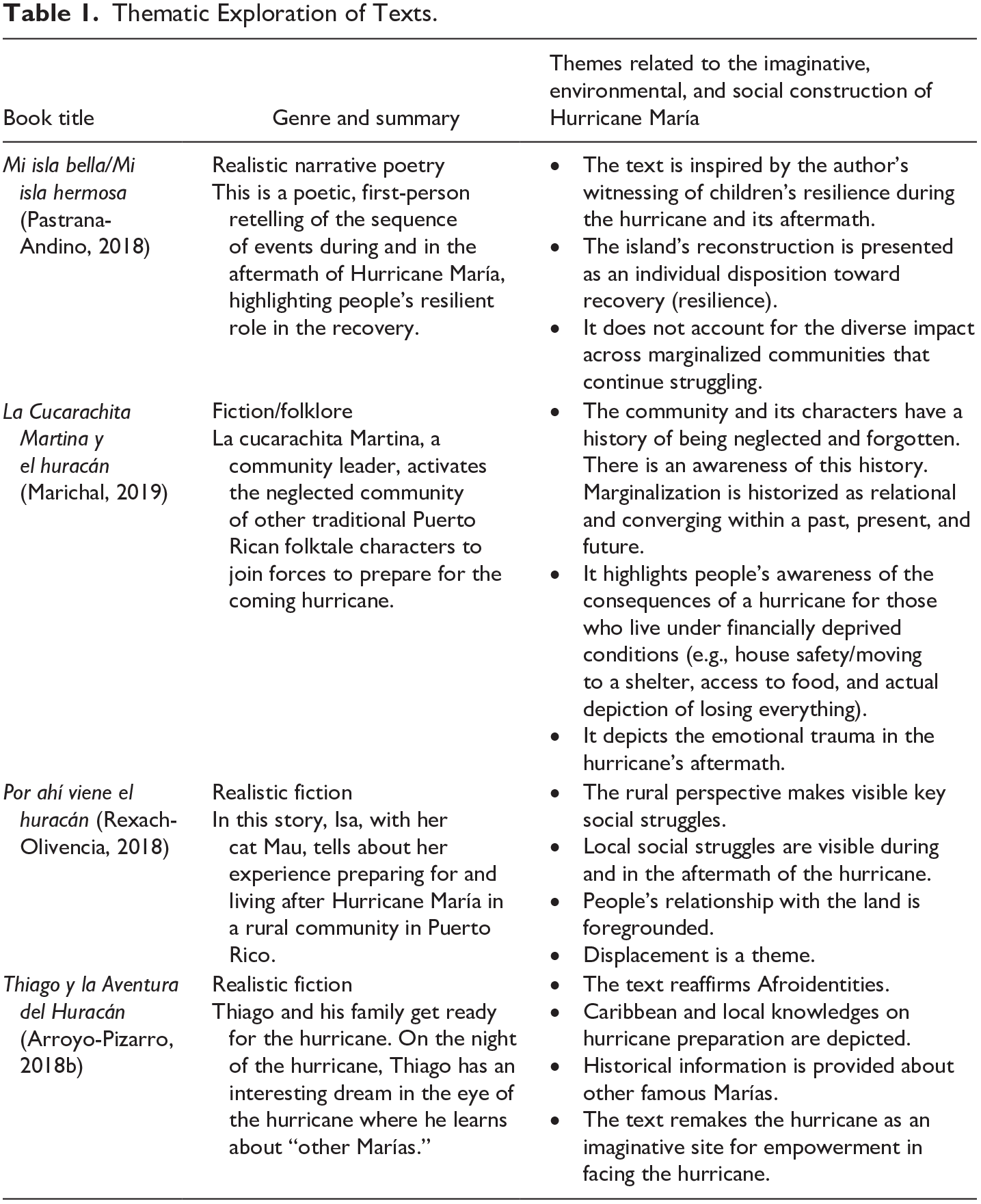
We worked together to identify children’s books written about Hurricane María’s landfall by Puerto Rican authors living on the island at the time. Through online searches and informal interviews with local experts in Puerto Rican children’s literature, educators, and children’s bookstore administrators in Puerto Rico, we were able to identify four children’s books published by the beginning of 2019: Mi isla bella/Mi isla hermosa (Pastrana-Andino, 2018), Por ahí viene el huracán (Rexach-Olivencia, 2018), La Cucarachita Martina y el huracán (Marichal, 2019), and Thiago y la aventura del huracán (Arroyo-Pizarro, 2018b). We individually approached each text inductively in search of themes across and within each text (Nowell et al., 2017), and as will be explained further on, focused our full analysis in this piece on two of the four texts because of their attention to Puerto Rican voices. In the first layer of analysis, we wanted to thematically identify how an environmental phenomenon (such as Hurricane María) and its social consequences are constructed within literary imaginaries across children’s books written by Puerto Rican authors. Recognizing the tensions inherent with thematic work in decolonial projects, we chose to allow the text to reveal its messiness and attempted to make sense of that “mess” from the standpoint of our own experiences, histories, and knowledges as Puerto Ricans living within the colonial project (Patel, 2015, p. 71). From the individual analyses, we came together to identify general themes across our findings of each text. Table 1 shows a summary of the consolidated thematic exploration of the four texts:
Thematic Exploration of Texts.
The social and economic conditions that existed before Hurricane María’s landfall;
The discourses of privilege and oppression (racial, economic, etc.) that circulate within the island;
The social conditions and positionings of those still suffering in its aftermath; and
The multiple forms of agency, resistance, and opposition that coexist and emerge as potential reclaiming of decolonial imaginaries found within, across, or absent from the texts.
Operationalizing Our Theoretical Frame
Our research question became the focus of our analysis: What kind of decolonial literary ruptures or breaks from the colonial project emerge across texts? In what follows, we focus on two key texts, Por ahí viene el huracán (Rexach-Olivencia, 2018), a picture book, and Thiago y la aventura del huracán (Arroyo-Pizarro, 2018b), an early reader chapter book. The focal texts were selected because they are told through the lens of Puerto Ricans on the island as a people, rather than through poetry such as Mi isla bella/Mi isla hermosa (Pastrana-Andino, 2018) or fictional characters as in La Cucarachita Martina y el huracán (Marichal, 2019). The two texts chosen also display a complex interplay between reality and fiction, which creates unique and powerful decolonial imaginaries for us to explore below.
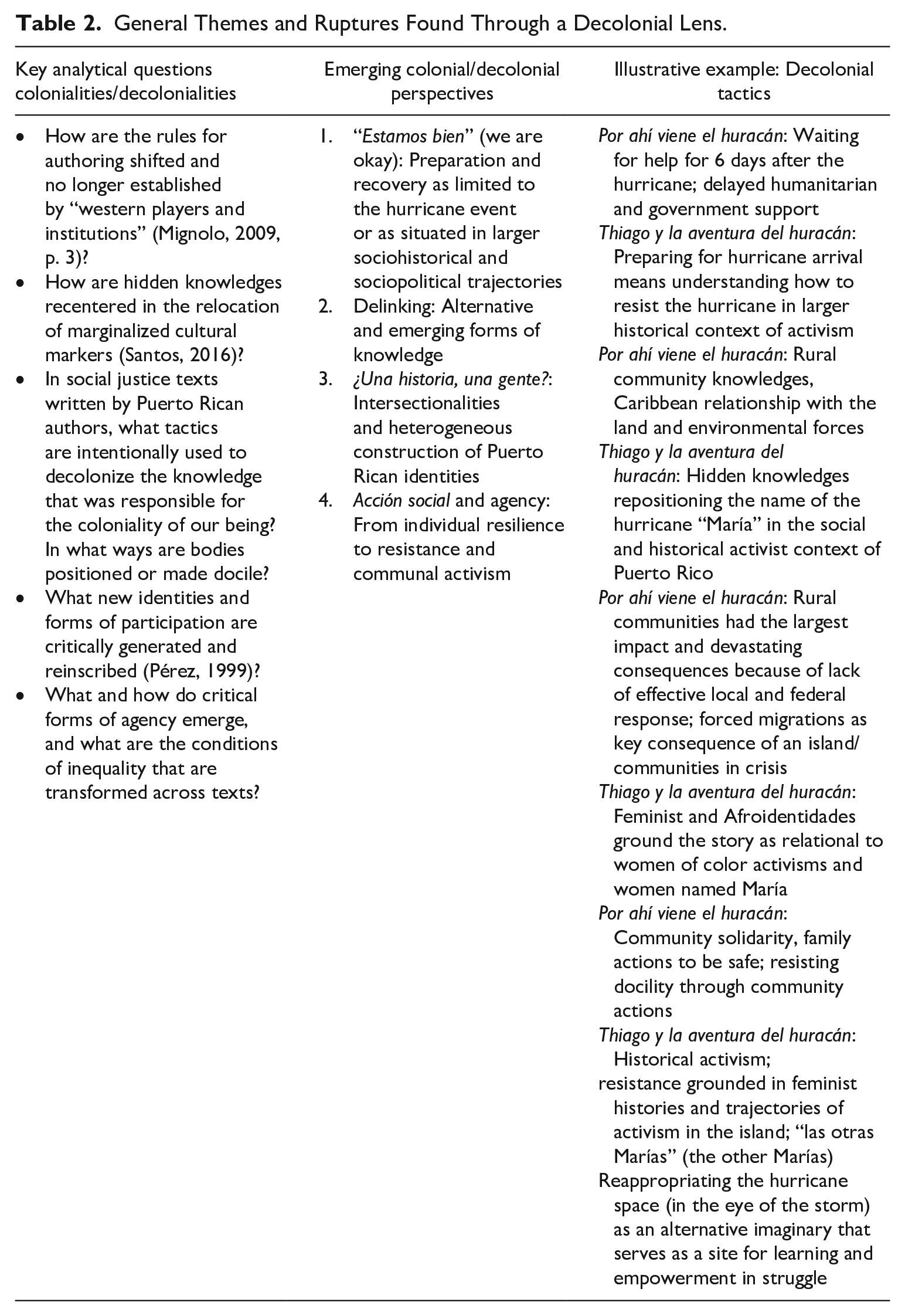
The decolonial imaginaries in the focal texts encompass the people of Puerto Rico as historical and agentic activist subjects, the storm itself, and the connection between the island and differing systems of power that affect future social conditions together. Our deeper analysis allowed us to draw out four macro-level themes across the two focal texts. Table 2 shows an example of the themes and how key questions from a colonial/decolonial analytical framework served as a lens to dig deeper into the stories.
General Themes and Ruptures Found Through a Decolonial Lens.
Based on our research question and guided by analytical questions derived from our theoretical approach, we identified four key themes across the two texts:
¡Estamos bien! (We are okay!): The books focus on a variety of representations of “recovery,” ranging from the portrayal of the hurricane’s landfall as a past event that Puerto Rico has recovered from (i.e., things are “back to normal”), to more complex portrayals of some of the sociopolitical challenges faced on the island before, during, and after the storm. Looking across the two focal texts, we perceive how survival and recovery are complex and need to be understood not just within a situated moment of crisis and oppression but as embedded in the recentering of local histories and trajectories after environmental and social disasters. Our title choice for this category is inspired by the popular song “Estamos Bien” by Bad Bunny, a Puerto Rican Trap artist who dedicated the song to the victims of Hurricane María.
Delinking: Delinking within a decolonial framework means constructing knowledge through alternative forms situated outside of Western zones of knowledge or the “colonial matrix of power” (Mignolo & Walsh, 2018, p. 4). In the analysis we did, this meant that social justice texts written by Puerto Rican authors enact tactics that are intentionally used to foreground local and Caribbean knowledges and other forms of knowledges from “within.” The Puerto Rican writers of these texts used storytelling that centers Puerto Rican advocacy and community, decentering the United States as the force for change in a colonial space. Furthermore, delinking relates to the ways bodies are repositioned from docility into activism.
¿Una historia, una gente . . .? (One story, one people . . .?): Intersectionality in the construction of Puerto Rican identities helped us complicate the construction of local counternarratives. The idea, for example, of a “common puertorriqueñidad” emerged in complicated ways in the books we analyzed. The notion of a homogeneous national identity is complex, and the books construct a range of experiences and identities that disrupts this dominant perspective.
Acción social as “cuentos combativos” (social action as “combative stories”): Across texts, agency was captured through individual resilience and communal activism. As a result, the local micro needs of individuals are centered as relational to communal activism and solidarity. Agency and activism are also historicized and brought to the contemporary moment.
The need to center the bodies of Puerto Ricans compelled us to focus on the two selected texts through a decolonial and racialization lens. Thus, we will begin with a short synthesis of each text, followed by a critical analysis through the lens of our theoretical frame. It is important to note that the themes discussed above do not drive this analysis. Instead, we opted for the theoretical frame and our research questions to drive this more thorough dive into these two texts, with the themes embedded but not necessarily named throughout the analysis.
Analysis of Focal Texts
Por Ahí Viene el Huracán
Rexach-Olivencia’s (2018) text describes the experience of one young girl, Isa, and her cat, Mau, as they prepare for, survive, and rebuild after Hurricane María with Isa’s family and community. The book begins with Isa leaving school to come home to her cat to prepare for the storm. As the hurricane approaches, the family huddles together to wait, but Isa keeps her spirits up by treating the situation as a pajama party. Throughout the storm, Isa is scared and worried about her home, her neighborhood, and her family, but she tries to remain strong and help her family.
After the storm, Isa and her family emerge from their home to find the neighborhood has been destroyed. The neighbors band together to help each other rebuild and survive without electricity or help from federal or local aid agencies. At the end of the story, Isa highlights that her home still has no electricity and her school remains closed 3 months after the storm, but she is hopeful. She sees community members supporting one another and focuses her attention on the beauty of her island. She is happy.
Analysis
Por ahí viene el huracán (Rexach-Olivencia, 2018) is the one book that attempts to situate itself as a realistic fictional depiction of the natural disaster, covering the time before, during, and after the hurricane’s landfall. We will explore how the book employs decolonial and sometimes contradictory tactics to tell Isa and Mau’s story.
In this narrative, Rexach-Olivencia (2018) foregrounds a relationship with the local land situated in a Caribbean landscape and geography. At the beginning, Isa, the protagonist, is portrayed as having an affective link to the land, nature, and local landscape, describing Puerto Rico as her home. She also demonstrates a complex relationship with nature as she simultaneously admires its beauty and respects its power. We interpret this as delinking actions constructed as knowledges outside of the “colonial matrix of power” (Mignolo & Walsh, 2018, p. 4). In this case, the idea of sharing a common landscape with the United States, which has devastating consequences on the local development of Caribbean models for environmental preservation, effective architectural designs, and local social infrastructure, is disrupted. Decolonialities within literary imaginaries, then, are partly constructed through ruptures of presences and absences, such as in the case of the land in Por ahí viene el huracán. A Caribbean decolonial rupture (Glissant, 2000) that delinks from Western colonial “single stories” (TED, 2009) honors our relationship to the land and provides new ways to experience the Puerto Rican landscape through literature.
Another delinking tactic or decolonial rupture in this text is the constant use of onomatopoeia as a way to bring the reader closer to the auditory experience of engaging with Caribbean nature and the hurricane’s sounds—the wind blowing, the rain falling, the doors and windows banging.
Mau se acomodó entre los pies de Isa y juntos escuchan el suave cantar de la brisa SUISHHHH SUISHHHH SUISHHHH entre las hojas nuevas de los árboles de su querido monte. A Isa le encanta volver a sentir la dulce brisa entre sus rizos revueltos. Mau sat between Isa’s feet and together they listened to the breeze’s soft singing SUISHHHH SUISHHHH SUISHHHH between the new leaves on the trees on her beloved mountain. Isa loved feeling the sweet breeze between her messy curls again.
At the end of the story, lines such as these rupture the narrative of destruction by recentering growth, possibility, and the popularized notion of estamos bien due to local activism and the reaffirmation of Puerto Ricans’ relationship with their land and space. Faith and power for a potential recovery rely on the strength of the land and the environment.
Isa also has a strong bond to her rural community in the mountains, allowing the author to move from the Una historia, una gente . . . trope to a story of those most affected by the storm due to lack of access to local and federal government aid. After the storm, recovery efforts were mostly geared toward the island’s major urban cities, leaving rural inhabitants to fend for themselves for weeks or months. A text for children that focuses on Puerto Rico’s vulnerable communities becomes a story that names the oppression experienced by rural communities and makes visible the island’s diverse social groups.
There is another overlapping decolonial rupture present throughout the text, centering the voices and experiences of rural communities that suffered through the storm, survived, resisted, and joined together for strength: acción social. For example, the protagonist states, “Todos los domingos, un grupo de vecinos se reúne en el patio de Isa y juntos cocinan una gran comida sobre un horno de leña para todo el barrio” (Every Sunday, a group of neighbors gather at Isa’s patio and cook a big meal over a firewood stove for the whole neighborhood). This example creates a decolonial imaginary of the storm that highlights how Puerto Ricans worked together, resisting notions of docility despite the media’s focus on devastation and Puerto Ricans’ need for aid. It also created a cuento combativo against the colonial storying of the experience on the island.
The reality of living in a U.S. colony relying on the federal government’s willingness to provide aid postdisaster does surface in the text when soldiers arrive to help the town Isa lives in. However, the narrative and pictures offer a blurred representation where it is unclear whether those arriving are the local National Guard or U.S. soldiers. The narrator states that “al final del sexto día de estar atrapados, Isa y Mau ven soldados por primera vez en sus vidas” (at the end of the sixth day of being trapped, Isa and Mau see soldiers for the first time in their lives). It is worth noting that although Puerto Rico does not have its own standing army or militia, the truck that arrived has a Puerto Rican flag on it, centering the Puerto Rican people rather than U.S. aid. This leads us to pose the following question: What does a flag mean for a people? In this case, it seems the image of the flag flying in the wind on the soldiers’ truck is another decolonial act by the author, a call to power asking Puerto Ricans to stand tall and resist notions of subservience or individualism.
The importance of the flag imagery as acción social is accentuated by the fact that the flag is light blue rather than navy blue. The latter color was imposed by the United States during the Cold War, because relations with Cuba, whose flag colors were the inverse of Puerto Rico’s, began to deteriorate. The illustrator’s color choice creates a decolonial imaginary for the reader, complicating the colonial relationship between the United States and Puerto Rico and highlighting the message of “Puerto Ricans for Puerto Rico.” Moreover, the narrator highlights that Isa’s town finally received aid after 6 days of isolation. Aid was slow to arrive to the island in general and to rural areas in particular post-María. The inclusion of the delayed response in the book may be an intentional critique lobbied against the most powerful country in the world. Furthermore, this inclusion begs the reader to consider whether this would have happened had the town residents been primarily White, wealthy, and powerful.
As mentioned above, one of the control mechanisms in the colonial project is to make bodies, especially bodies of marginalized peoples, docile. In Isa’s story, we see that Puerto Ricans, a colonized people, are not docile, actively moving to resist and survive the storm. The storm itself takes on an oppressive force in Isa’s eyes, trying to destroy her town and forcing her friend, Nico, to move to the United States due to homelessness. However, Isa’s father resists this notion, arguing that “la naturaleza funciona así, mi Isa. Por eso es tan importante cuidarla y conocerla bien. Es una fuerza a la vez hermosa y terrible” (nature works that way, my Isa. That’s why it’s so important to take care of her and know her well. It’s a force equally beautiful and terrible). In short, her father points out that the storm is not something to feel upset about or defeated by but rather something to learn from. Of course, this notion is a privileged one, because many Puerto Ricans lost their homes and lives in this storm, but the author highlights that Puerto Rico’s relationship with storms will not change. Thus, the need to reclaim and work with the land for our future survival is highlighted.
Thiago y la Aventura del Huracán
Thiago y la Aventura del Huracán (Arroyo-Pizarro, 2018b) is an early chapter book that introduces readers to Thiago, an Afro–Puerto Rican boy. Thiago’s mother picks him up at school due to an emergency early dismissal precipitated by the storm. At home, Thiago has many questions about the hurricane, and his mother suggests he look for answers online. He finds the meaning of the word meteoróloga (meteorologist) and learns to watch the weather report. He and his mom then read together about hurricanes.
A setting shift happens in Chapter 4, moving from Thiago’s home to his dream world. In his dream, Thiago finds himself and his friends in the eye of the storm, where they meet historical feminist activist María Cadilla. In the eye of the storm, Cadilla interacts with the children and provides historical and contemporary facts about significant “Marías” throughout Puerto Rico’s history. The story ends with Cadilla’s advice to resist and overcome fear of the approaching storm.
Analysis
We began this piece sharing Thiago’s thoughts when he awoke from the dream the night the hurricane arrived: Finalmente, Thiago abrió los ojos por completo y se dio cuenta de que el huracán ya había comenzado. No tuvo miedo. Él iba a resistir, él, sus padres, sus amigos, Puerto Rico entero. Finally, Thiago completely opened his eyes and realized that the hurricane had already begun. He was not scared. He was going to resist, him, his parents, his friends, all of Puerto Rico. (Arroyo-Pizarro, 2018b, p. 25; emphasis added)
Of the children’s books we analyzed, Thiago is the one book that creates an opening for a critical delinking. It also promotes a view of Hurricane María as situated in ruptures to engage in acción social. It centers agency, resistance, and decolonial imaginaries by engaging the past to inform the present struggle against the storm. The ruptures used by Arroyo-Pizarro (2018b) in writing the story become a powerful decolonial narrative that complicates the ways stories of the hurricane are told to children. Furthermore, in our analysis of texts, Thiago is the text that most explicitly disrupts the idea of una historia/una gente by foregrounding intersectional identities through the overlap of feminist and Afro–Puerto Rican reaffirmations.
One significant aspect in the analysis of decolonial perspectives in literature is the construction of the peritext as important in situating the identity politics that permeate the book. The peritext is the text at the periphery of the main fictional narrative (e.g., biographical notes, prefaces, epilogues) that helps situate stories (Aldama, 2009). For Aldama (2009), peritexts play a significant role in decolonial literature because they are “not totally arbitrary: they establish initial reader contract and cues that trigger in the reader’s mind important scripts . . . we anticipate encountering once inside the proper story” (p. 23). In the case of Thiago, the peritext maps a deliberate and conscious intertextual landscape of racialized bodies within a Puerto Rican decolonial literary imaginary. At the end of the story, the author’s biography reflects a long-standing commitment to social justice work on the island, with an explicit focus on “la discusión de la afroidentidad y la derogación del racismo” (the discussion of Afroidentities and the derogation of racism; Arroyo-Pizarro, 2018b, pp. 26–27). It is extremely important to bring visibility to this aspect in our analysis because it acknowledges that the author, as an Afro Latinx woman, was keenly aware of the colonial project and the racial marginalization of Puerto Ricans well before the storm. As such, Arroyo-Pizarro (2018b) situates this specific story as part of a long commitment to intersectional social justice practices in Puerto Rico that disrupt the idea of “una historia, una gente” (i.e., discourses that maintain the idea of common puertorriqueñidad). This is important to highlight because it disrupts the centering of White-passing Puerto Ricans in popular media and stories, instead highlighting connections to Black, White, and Indigenous knowledges and ways of being tied to local histories of racism, oppression, and discrimination within our communities.
The reclaiming of Caribbean geographies and knowledges as a delinking strategy is a significant decolonial rupture in this text. Thiago is an inquirer who actively questions the reality of his present moment and gathers relevant information about Caribbean ontologies, such as common material and communal and emotional preparations for a hurricane: Al llegar al hogar, Thiago escucha el sonido de alarmas. Se da cuenta que el teléfono celular de su mamá ha recibido una alerta de vigilancia de huracán. Unas horas más tarde, cuando ya ha llegado su padre, el teléfono celular recibe una alerta de aviso de huracán. Thiago aprende que eso significa, según lo explica la meteoróloga en la televisión, que será inminente el paso del huracán por su bella Isla del Encanto. When he arrived home, Thiago could hear the sound of the alarms. He realizes that his mom’s cell phone has received a hurricane watch alert. A few hours later, when his father has arrived home, his cell phone receives a hurricane warning alert. Thiago learns that means, according to the explanation by the meteorologist on television, that the passing of the hurricane through his bella Isla del Encanto would be imminent. (p. 8)
The first chapters of this book focus on the routine local knowledges involved in preparing for the hurricane. A communal sense of solidarity and resistance is key to the presentation of Puerto Rican society in the text, disrupting images of docility and passivity. This is made visible in the narrative when Thiago shows concern for people on the island and friends who live in houses with wooden roofs. It is also apparent in the mother’s attitude toward survival and resistance: “Todo Puerto Rico se prepara para resistir el huracán” (All of Puerto Rico is getting ready to resist the hurricane; p. 8, emphasis added).
The hurricane’s landfall reaffirmed the fact that Puerto Ricans are not part of a White Anglo North America geographical landscape (delinking) and that our lives and relationship with nature and the environment are part of a Caribbean geography that comes with a different conception of space, place, and history. Furthermore, Hurricane María’s aftermath made visible the repetition of historical oppression and erasure of racialized bodies. The text thus positions the reader and Puerto Rico itself as grounded in the knowledges from the Caribbean, communal work, and acción social (social activist) practices across communities. This powerful decolonial rupture, what we describe as the critical act of generating and mediating local ways of knowing within the storm’s eye, occurs in the final chapter of the text. In the dream world, Thiago finds himself and his friends, represented in the illustrations as a multiracial group of children, in the eye of the hurricane. In front of them they see a sign that reads “Bienvenidos al Pueblo Las Marías” (Welcome to the town of Las Marías), which is a local municipality in Puerto Rico. They seem confused as they make sense of their surroundings inside the hurricane, where they can see the wind walls strongly circulating around them. Inside the eye of the hurricane, they run into María Cadilla, who, after introducing herself, tells them she wants them to learn about the important Marías in Puerto Rico’s history.
María Cadilla, one of the first women to obtain a doctoral degree on the island, a teacher, poet, and advocate for women’s rights in Puerto Rico, initiates the framing and reclaiming of the storm’s name from an activist womanist point of view. Cadilla begins her talk with the children by discussing the year Las Marías was founded, and she mentions that Las Marías holds the annual “Festival de las Chinas” (The Oranges’ Festival) while offering an orange to each child in the dream. That first interaction between María Cadilla and the children through an offering of food creates a different location for a productive connection with the land, using a lens outside of the devastation and scarcity discourse produced by the hurricane. This womanist gesture suggests another way in which the Caribbean land gets reclaimed and honored beyond the immediate hurricane moment. Thiago then shares with her that in a social studies class, their teacher talked about Cadilla’s work and read her poem “Desde Abacoa.” The poem explores a connection to the land of Puerto Rico. Thiago then recites a piece of the poem. The inclusion of the poem “Desde Abacoa,” which is the Indigenous name given by the Taínos to Cadilla’s hometown, serves as another form of intersectional decolonial rupture that makes a connection with Indigenous languages and knowledges and the reclaiming of the land as a form of empowerment.
María Cadilla then proceeds to ask the children what other famous Marías they have learned about, and they mention historical figures such as María Inés Mendoza, Puerto Rico’s original first lady; Sila María Calderón, the first Puerto Rican female governor; and María Teresa Babín, the poet, playwright, and essayist. Cadilla adds other important historical Marías to this list, mentioning “mujeres aportando su talento a la educación, cultura, las artes, el folklore y la política de nuestra patria” (women contributing their talent to our country’s education, culture, arts, folklore, and politics; Arroyo-Pizarro, 2018b, p. 23). The author embraces a discourse of womanist empowerment through Thiago’s story as acción social, offering a different exploration of “María” as a name attached to other her-stories, trajectories, meanings, and cuentos combativos.
One of the children adds the names of what their teacher described as “unas Marías más nuevas” (newer Marías) who currently help with contemporary social struggles and attempt to craft spaces for the possibility of “mejores oportunidades, mejores estudios, [para] que logremos un mayor progreso como sociedad” (better opportunities, better education [to] achieve greater progress as a society) in Puerto Rico (p. 23). The diverse group of contemporary Puerto Rican women listed in the book includes advocates and activists focusing on antiracist work and the development of projects that reclaim and reaffirm Puerto Rican Afro-descendent communities and contributions. These communities and contributions are situated within larger transnational forms of Black feminist thought and activism (Adichie, 2014; Collins, 2002; Godreau et al., 2013). By focusing on the name “María,” the presentation of a past and present Puerto Rico in relation to the storm is constructed as an opportunity to create an intersectional narrative that disrupts homogeneous and docile views of a Puerto Rican society. Furthermore, the presentation of past and present womanist activist work on the island centers the reclamation of land, our ancestors, and our current struggles for social justice and equity, producing a narrative of local resistance. The imaginary of the storm as a defeating force gets repositioned and reclaimed as a decolonial force for empowerment, a reiteration that we will get through this like those before us, que estamos bien. Through the exploration of the contemporary and historical Marías, empowerment becomes relational to collective social, cultural, and political activism. In this story, survival is not about individual dispositions and sets of actions separate from larger social systems of power (such as colonialities and racism). In this case, the narrative is situated in an atmospheric phenomenon that interacts with other sociopolitical struggles related to forms of political and social marginalizations. As the repetitive use of the word “resistencia” in this book reaffirms, the overall construction of this text provides an alternative lens to resituate local critical knowledges in the eye of the storm. María Cadilla offers a powerful piece of advice as she concludes her dialogue with the children: Cuando sientan la fuerza de los vientos, el rugido de la lluvia, la vibración de las ventanas, el aullido del propio huracán, piensen en estas maravillosas mujeres y estos grandes hombres que fueron valientes. Sean valientes como ellos. When you feel the wind’s force, rain’s roar, the windows’ vibrations, the hurricane’s howl, think of these wonderful women and great men who were brave. Be brave as they were. (p. 24)
Implications: Learning From the Immediate Past, the Urgent Present, and the Hopeful Future
De los miedos nacen los corajes; y de las dudas las certezas. Los sueños anuncian otra realidad posible y los delirios otra razón. (Eduardo Galeano, 2000)
Through the lens of decoloniality and racialization, the texts we analyzed for this article encourage a space to reflect on recent tragic events that have consequences for how children access ideas around social responsibility, sustainability, and decolonial activism through literature and literacy. It is important to note that this analysis in no way attempts to minimize the very real displacements, tragedies, and collective trauma experienced by Puerto Ricans on and outside the island (see Hamm-Rodríguez & Sambolín Morales, 2018; Sambolín Morales & Hamm-Rodríguez, 2018). However, we want to highlight the decolonial ruptures these texts foreground.
Our analysis explored two essential ideas. The first is the construction of Hurricane María’s social consequences, whereas the second explores the forms of literary activism foregrounded through decolonial ruptures that reclaim local knowledges. The literary power of exploring the storm’s social consequences in these texts centers Puerto Ricans’ relationship to the Caribbean. El Caribe gets actively constructed by both authors as an essential part of who we are and how we live and act, delinking the island from a dominant colonial U.S. landscape and imaginary. Furthermore, community resistance and resilience are articulated in this relationship with nature. In Por ahí viene el huracán, it is perceived in Isa’s close appreciation of local nature; in Thiago, it is present in the reclaiming of the storm’s eye as a fictional site for local feminist and Afrocentric thought. In this sense, our analysis makes visible Maldonado-Torres’ (2019) argument that “thinking about catastrophe in the Caribbean leads to countercatastrophic responses such as decolonial thinking and decolonial aesthetics and poetics”(p. 340). Our claim is that imaginary spaces are spaces for resistance. In what follows, we articulate how these two books construct decolonizing literary imaginaries as new emerging locations where writers reclaim a space to imagine oneself outside of the colonial project.
In both books, el conocimineto cotidiano (everyday knowledges) and survival skills situate Puerto Ricans as active subjects and problem solvers, disrupting dominant portrayals of Puerto Ricans as docile, passive, lazy, and solely dependent on the United States’ aid. In Por ahí viene el huracán, the realities of what happened after the hurricane are actively explored in the preparations for the hurricane and the community and family networks supporting each other in the storm’s aftermath. Through these texts, resistance in everyday survival provides an opening to speak of the oppressive systems that position Puerto Ricans as second-class citizens in the United States, especially under the former leadership of Donald Trump.
Functioning within categories of everyday knowledges are conocimiento intelectual, or local intellectual knowledges. Although the main focus of this piece is on the connection between decolonization and race specifically, it is important to note that both texts produce histories of activism and an intersectional representation (e.g., the link between race and gender) of Puerto Ricans. This is done deliberately in Arroyo-Pizarro’s (2018b) story, where feminist knowledges from the island are centered in the reclaiming of an environmental phenomena, recentering our relationship with the land, our own history, and important legacies of knowledge production too often relegated to the margins.
As a whole, the authors grounded the current and historical activism and strength of Puerto Rico and Puerto Ricans, creating a decolonial imaginary of what Puerto Rico is and can be. Thomas (2016) asserted that “if today’s children grow up with literature that is multicultural, diverse, and decolonized, we can begin the work of healing our nation and world through humanizing stories” (p. 119). We provide this analysis to join the voices and work taking up decolonial and postcolonial approaches in children’s literature (Sahn, 2016). In our analysis, we are able to forefront the ways children’s literature from the island teaches children about facing adversity as a community, as a people, and in relation to place, history, and nature. It is also important to recognize the need to include the lost and erased stories of Puerto Ricans such as the Taínos, who have had their stories told and retold in relation to their colonial subjugation by Spain or have had their lineage erased altogether. The stories of those whom the colonial project has deemed unfit for scholarship can also act as ruptures and help us see beyond the single story of the Puerto Rican people.
When we discuss ruptures in the decolonial imaginary or in the racial paradigm set up by racialization, we are attempting to use literacy research for children to examine content, representation, and language and to create new imaginaries. Each children’s text has the possibility of opening an imagined space children can inhabit. When educators present texts to children, it is important that both students and teachers complicate the text by examining the local, historical context the imagined space is meant to represent. Ruptures in that imaginary occur when criticality, reflected in direct connections to the colonial or racial project in texts, is forefronted or when children and educators bring in their whole beings onto the journey. Only then can a more decolonial approach to literacy education come to fruition.
Supplemental Material
sj-zip-1-jlr-10.1177_1086296X211009294 – Supplemental material for Cuentos Combativos: Decolonialities in Puerto Rican Books About María
Supplemental material, sj-zip-1-jlr-10.1177_1086296X211009294 for Cuentos Combativos: Decolonialities in Puerto Rican Books About María by Francisco L. Torres and Carmen L. Medina in Journal of Literacy Research
Footnotes
Declaration of Conflicting Interests
The author(s) declared no potential conflicts of interest with respect to the research, authorship, and/or publication of this article.
Funding
The author(s) received no financial support for the research, authorship, and/or publication of this article.

References
Supplementary Material
Please find the following supplemental material available below.
For Open Access articles published under a Creative Commons License, all supplemental material carries the same license as the article it is associated with.
For non-Open Access articles published, all supplemental material carries a non-exclusive license, and permission requests for re-use of supplemental material or any part of supplemental material shall be sent directly to the copyright owner as specified in the copyright notice associated with the article.
