




Abstract
When I look back before 2020, before the murder of Mr. George Floyd in particular, and think about this special issue, “Black Lives Matter in Literacy Research,” a question comes to my mind: Are we, the field of literacy research, sure that we want to include literacy research among the incalculable responses (already in progress) to racist killings, anti-Blackness, Black living and dying, and ongoing injustices in the United States of America? In other words, will Black human beings matter to our field? With the hope that our field of literacy research is finally taking this racial turn as an institution, I introduce the post-White orientation as well as practice of race theory (PRT) and argue for the lifelong development of racial literacies among fellow literacy researchers. In short, this article is designed to support the development of racial literacies in the field of literacy research with the aim of affecting research, practice, and policy.
Keywords
Do we have any reason to doubt that both Mr. Scott and the Charlotte-Mecklenburg Police officers, one who killed him on that fateful day, were all able to read and write? Did these particular literacies—print literacies—even matter as Mr. Scott’s Black life came to its end?
In December 2016, I published an article with Medium.com that linked Black Lives Matter and literacy research (Croom, 2016a). At the time, I did not see a way to publish this kind of article in any of the literacy research journals of our field. Therefore, I published this work independently and disseminated it myself by e-mail and social media (see author information). As recent Literacy Research Association (LRA) president Marcelle Haddix mentioned in her 2019 presidential address, you might say that I started building my own table once I didn’t see a seat for me at the other tables of our field. Today, after the life-altering events of 2020, particularly the murders of Ahmaud Arbery (May 8, 1994–February 23, 2020), Breonna Taylor (June 5, 1993–March 13, 2020), Michael Ramos (January 1, 1978–April 24, 2020), and George Floyd (October 14, 1973–May 25, 2020), among many others (Ater, 2020), our world has changed, and it seems that the field of literacy research is changing accordingly.
When I look back across these 4 short years since 2016 and think about this special issue, “Black Lives Matter in Literacy Research,” a question comes to my mind: Are we, the field of literacy research, sure that we want to include literacy research among the incalculable responses (already in progress) to racist killings, anti-Blackness, Black living and dying, and ongoing injustices in the United States of America? Hear this as an institutional inquiry, not as an individual inquiry. As the call for this special issue has already cited (Ladson-Billings, 2016), Black lives and literacy research are an old intersection (Croom, 2020). I ask fellow literacy researchers whether or not we are sure we want to include literacy research as an antiracist response in 2020 because much of our field, including LRA, missed the exits for this old intersection many miles ago, despite innumerable exit signs and a number of fellow travelers who repeatedly tried to point the field of literacy research and LRA in the right direction (e.g., Garcia & Willis, 2016; Haddix, 2019; Hoover, 1990; Lalik & Hinchman, 2001; Lee, 2008; LRA, 2016; Luke, 2017; Rex, 2006; Rogers, 2018; Willis, 2015). For example, former LRA president Arlette Willis included in her presidential address an examination of the intersection of race and literacy in literacy research. Discussing the classic First Grade Reading Studies (Bond & Dykstra, 1967), Willis (2015) highlighted the fact that “the Final Research Report characterized the U.S. school population of beginning readers as White, six-year-olds, middle-class, and English dominant,” despite “selective research proposals that clearly identified racialized students—students who were Spanish dominant and African American students who attended underresourced schools” (p. 32). Her point was that the intersection of race and literacy requires responding to the “need to make structural economic (Willis & Harris, 1997) and social changes that potentially could improve beginning reading efficiency” (Willis, 2015, p. 32; see also Gray, 1969 p. 9). As another example, literacy researcher Allan Luke (2017) highlighted the likelihood of education research as a whole to miss the mark if we do not diverge from the institutional status quo: In this welding of traditional science with neoliberal policy making, post-hoc empirical truths are put to work modeling and prognosticating the impacts of policy change on everyday reality and on educational futures. In itself, this contemporary logic of practice creates huge issues of time-lag in the addressing of urgent problems in schooling, youth and communities. Whatever its rationalist and liberal intentions, the collateral effects of this approach to educational change and reform are: that it necessarily slows, constrains or precludes local responses to pressing social and educational phenomena; it moots the power of local community knowledge and experience; it narrows the scope for more immediate local innovation; and, this is most troubling, any narrowing of its methodological doxa risks missing or misrecognizing new lived realities and experiences altogether. The risk is silence about what matters when it matters most. (p. 108S)
I mention this quote to relate Luke’s general point to literacy research specifically and current movements like Black Lives Matter (https://blacklivesmatter.com/herstory/) in particular. In addition, a decade before Luke, literacy researcher Carol Lee (2008) exposed “the hidden games of racialization in literacy studies and school reform”: Just as we make inherent value judgments about people and communities informed by our folk beliefs about race, so do we similarly make judgments about knowledge, what is worth knowing, what is worth reading, worth understanding about language that are informed by the same set of beliefs we have about race. That was certainly the case with Rousseau. His views about learning that have been very influential on notions of constructivist learning, learning by doing, were never assumed to be of any value for the Negroes with half a brain and other so-called natives. In fields of literacy research, we are still very much grounded in hierarchical notions of what narratives count. Classical literature may now include both European, Asian, and African examples (although non-European literature is still on the margins in both the high school and the college-level English course content) (Applebee, 1993); but contemporary rap or classic rap from the past 20 years [before 2008] is not. We continue to use the terms mainstream academic English as the dialect of privilege to which we want to apprentice youth in school (Stotsky, 1999). I don’t question its existence or its utilitarian functions. But I also know that there are many circles in which the obtuse “It is I” is not particularly useful and such sites are not simply the street corners in the low-income neighborhoods, but in fact the boardrooms of corporations. So I want to play around with what is often hidden, masked in what we privilege in terms of the literacies that schools teach. (p. 159)
Lee goes on to discuss literature and cultural modeling, but the enlightenment of her racial observation should have hipped our institution to ongoing literacy research games, especially those racial games which continue to chokehold the teaching and learning of multiple literacies. As this special issue demonstrates, somehow our institution seems none the wiser. Looking back beyond the last 4 years, then, the institution of literacy research has been mighty, mighty quiet about race for as far back as we can see (in contrast to significant individual or group work by fellow literacy scholars and “race critical” scholarship within and beyond our field [Croom, 2020]; see a review of multimodal literacies by Mills & Unsworth, 2018; also consider literacy research historically with Alexander & Fox, 2004; Gray, 1969; Lalik & Hinchman, 2001; Hoffman, Hikida, & Sailors, 2020; Martin et al., 2013; Morrison et al., 2011; Parsons et al., 2020; Pearson, 1984; Shanahan, 2020; Shanahan & Neuman, 1997; Willis, 2019).
To extend my travel metaphor: If our field of literacy researchers do indeed want to include literacy research as antiracist work now, we must go back to long-standing landmarks that were missed to get there. That is to say, our field can’t just be there now. The field of literacy research must travel there over the same hard roads that many have already taken thus far. To use a term from my scholarship, the field of literacy research must develop racial literacies (Croom, 2016b).
Racial literacies means the critical, human cultural toolkit, developing and accumulating since the invention of race, that supports human well-being amid the social thought and practice of race (i.e., the human creation and consumption of race); [and] enables the reading, critiquing, and rewriting of race. (Croom, 2020, p. 24)
As the term itself suggests, racial literacies enable us to critically recognize and re-engineer the “embeddedness and effects of race [practice]” as involved with literacies and, mutually, literacies as involved with race practice (Croom et al., 2019, p. 31; see also Table 1, p.12). Thus, racial literacies are necessary in the field of literacy research for at least three reasons: (a) Consequential racialization is ongoing in human societies; (b) racial meaning involves multiple modes and situated processes that routinely transpire unstated, unexamined, or unaccounted for; and (c) a growing body of scholarship uses the term racial literacy in various ways (e.g., Guinier, 2004; Sealey-Ruiz, 2011; Skerrett, 2011; Stevenson, 2014; Twine, 2004), which indicates that the concept of racial literacies provides coherence to some conceptual clumping in this body of scholarship. Very importantly, racial literacies are not new (Bolgatz, 2005; Brown, 2017; Croom, in press; Croom et al., 2019; Du Bois, 1940/2007; Epstein & Gist, 2013; Fanon, 1968; Greene & Abt-Perkins, 2003; Guinier, 2004; Hoover, 1990; Horsford, 2014; J. E. King, 1991, 1992; L. J. King et al., 2018; Pinder, 2012; Rogers & Mosley, 2006; Sealey-Ruiz, 2011; Skerrett, 2011; Stevenson, 2014; Twine, 2004; Woodson, 1933; Wynter, 2003). As the definition above mentions, there is a long and varied race critical tradition that interrogates racialization and counteracts antihuman race practice in various contexts. My research and experience carries forward late Duboisan race theory (1940s and following) as well as a practice view of race that carries forward the work of Du Bois (e.g., Wilson, 1999), Woodson, Hoover, Wynter, Pinder, and others (e.g., Mirón & Inda, 2000; Pascale, 2008; Schatzki, 2001).
With the hope that our field of literacy research is finally taking this racial turn, I will take the risk of offering some supportive travel tips and encouragement, based on my research and experience, for the journey that the field of literacy research is only beginning. Obviously literacy instruction is a major focus in the field of literacy research, and the particular need for liberatory outcomes through child and adult instruction is well established in the archives of education and literacy research (e.g., Ball, 2009; Clark, 1990; Delpit, 1992; Dillard et al., 2000; Freire, 1970; Gutierrez, 2008; J. E. King, 1991, 1992; Ladson-Billings, 1992; Lalik & Hinchman, 2001; Lee, 2001; Morrell, 2008; Murrell, 1997; Payne & Strickland, 2008; Rex, 2006; Van Heertum & Share, 2006; Willis, 2002; Winn & Behizadeh, 2011). However, this article is addressed to a wider focus that includes and yet goes beyond literacy instruction to affect research, practice, and policy. As such, I designed this article more for showing than telling, meaning rather than limiting discussion of methodology and sources of data to a headed section of this article (telling), I demonstrate race critical methodology throughout this article and feature multiple points of evidence throughout this article (showing). I offer support and encouragement in this manner so that whoever is willing can make this journey together. As I will explain further, we are all participants of ongoing racialization, and therefore everyone should be included—in their own way—with developing racial literacies. Our racial past, present, and future call for racial literacies instead of any form of post-racialism. For this special issue, then, I will introduce the post-White orientation as well as practice of race theory (PRT) and argue for the lifelong development of racial literacies. In short, from the premise that Black lives matter in literacy research, this article is designed to support the development of racial literacies in the field of literacy research with the aim of affecting research, practice, and policy.
Update Your Racial Positioning System: The Post-White Orientation
The field of literacy research routinely considers theory, but far less attention is given to worldview or philosophy (Almasi, 2016). With regard to this racial turn, I cannot overemphasize how important it is for our field to interrogate its orientation to race. According to literacy researcher Mary Rhodes Hoover (1990), there are two enduring orientations toward hyperraced human beings: deficiency philosophy and vindicationist philosophy.
Parenthetically, I use the term hyperraced as an alternative naming (Paris, 2019) that includes multiple racial groupings such as Black, Indigenous,
Returning to the two enduring orientations toward hyperraced human beings, Hoover (1990) characterizes deficiency philosophy as follows: The view that the genes, language, history, and/or cultures of Black and most other people of color are deficient in some way due to cognitive deficit, inferior genes, childlike intelligence, worthless ethos/worldview, dialect/language simplicity, low self-concepts and attitudes, nonsubstantive ideas, lack of ability to think for themselves, or [due to] exotically different, almost nonhuman folkways or learning styles. (p. 251)
In other words, from the standpoint of the deficiency philosophy, the hyperraced are viewed as inherently flawed, deficient or pathological and are inferiorized relative to Whites, the hyporaced.
Categorically contrasting, Hoover (1990) characterizes vindicationist philosophy as follows: A second philosophy, vindicationist, considers Blacks to be as capable of academic achievement as any other students. This model is based on the vindicationist perspective that Drake (1987) endorsed, that is, that we must adopt a positive perspective on people of color. The model is research-based and contends:
Students of color have the ability to acquire lower-to-upper levels of literacy as well as or better than any other students—from preschool to the college level—if taught.
Students of color come from cultures that have made vast contributions to world civilization.
There are strengths in the current cultures of people of color.
There are strong values in the cultures [of people of color] that endorse education, self-esteem, and fearlessness (p. 256).
Restating, the vindicationist philosophy views both Whites and BIPOC as racial groups, but this philosophy also recognizes the full humanity of the hyperraced. From this standpoint, BIPOC are vindicated from all the false and harmful notions that deficiency philosophy perpetuates simultaneously to the detriment of the hyperraced and to the benefit of Whites.
However, Hoover’s categories have a limitation that should be addressed. Vindicationist philosophy carries the possibility of re-centering Whites and Whiteness as normative by using either as a point of reference (e.g., the White gaze) rather than unequivocally and fully demoting the false racial hierarchy that places the hyporaced (White) above the hyperraced (non-White or BIPOC). To address this limitation of vindicationist philosophy, I have articulated the post-White orientation. I have characterized the post-White orientation as a rejection of “racially White superordinate terms [i.e., stipulations and language]—terms that make Whiteness normative” (Croom, 2016b, p. 21).
Furthermore, I have also articulated the following: By post-White orientation, I mean a racial understanding and practice characterized by (a) unequivocal regard for “non-White” humanity, particularly “Black” humanity; (b) demotion of “White” standing (i.e., position, status); (c) rejection of post-racial notions; (d) non-hierarchical racialization; and (e) anticipation of a post-White sociopolitical norm. (Croom, 2016b, p. 18)
In sum, this racial turn involves updating the racial positioning system by which our field would be guided as we journey to various race intersections. That is, the field of literacy research would racially reorient itself away from all forms of deficiency philosophy and instead toward the post-White, vindicationist philosophy. The post-White orientation to race is foundational to PRT.
Pay Attention to What You Are Doing: Practice of Race Theory
Assuming that our field of literacy research is now making lane changes for this racial turn, there are institutional, group, and individual implications as well as theoretical matters to clarify. Institutionally, among groups, and individually we must begin by defining race.
The “common sense” view of race categorizes the typical historical and current understandings of race. From the common sense view, race is defined as biological, self-evident, natural, and indicative of capacities, characteristics, culture (Croom, 2020, pp. 2–3). An example of the common sense view of race is the notion that one’s epidermis or blood relations certify one’s race. The common sense view of race, to some degree, can be noted across education and literacy scholarship even when different race frameworks are used and even when race is regarded as a social construct. Prior to PRT, at least five race frameworks have circulated in education (and literacy) research: critical race theory (CRT), Marxism, Whiteness studies, cultural studies, and various post-racialisms (Croom, 2016c; Leonardo, 2013). Among these, CRT should be highlighted for its routine perpetuation of the common sense view of race because CRT is so widely used and cited in education research and literacy research (Ledesma & Calderón, 2015; Mills & Unsworth, 2018). Certainly, racisms are exposed and challenged in CRT, yet race itself is rarely theorized or defined in CRT (Croom, 2016c; Ladson-Billings & Tate, 1995; Leonardo, 2013). With space limitations in mind, forthcoming elsewhere is a fuller discussion of CRT as it contrasts with PRT (Croom, in press).
Alternatively, PRT defines race as consequential social practice. From the “consequential social practice” view, race is thinking and doing as if we or others have race for good or ill consequences (Croom, 2020, p. 2). An example of the consequential social practice view of race is recognizing that nothing about race itself, Black folks, or Blackness necessitates value losses in Black-owned real estate (Kamin, 2020) or Black earned credentials relative to White-owned real estate or White earned credentials, for instance. Eddie S. Glaude Jr. raises this “value gap” in his latest book Begin Again: James Baldwin’s America and Its Urgent Lessons for Our Own: Baldwin’s understanding of the American condition cohered around a set of practices that, taken together, constitute something I will refer to throughout this book as the lie . . . The lie is more properly several sets of lies with a single purpose. If what I have called the “value gap” is the idea that in America white lives have always mattered more than the lives of others, then the lie is a broad and powerful architecture of false assumptions by which the value gap is maintained. These are the narrative assumptions that support the everyday order of American life. (Glaude, 2020, p. 7)
The American lie is rehearsed in our field of literacy research. For instance, many of our fellow travelers have experienced this exact value disparity as reflected in publication citations, institutional appointments, research funding decisions, compensation, tenure, promotion, and leadership selections of all sorts (see Flaherty, 2020).
Furthermore, our research and interpretations of research also rehearse the American lie. For example, Shirley Brice Heath’s (1983/2008) classic study, Ways With Words: Language, Life and Work in Communities and Classrooms, is widely read as only contrasting Black Trackton and White Roadville. I mention Heath’s (1983/2008) work to draw attention to a commonly held racialized reading of her research, not to debate her accurate conclusions about the connections between language socialization, culture, and schooling (p. 344). An example of the racialized reading that I have in mind is at Mary Kalantzis and Bill Cope’s website, NewLearningOnline.com. There we observe that the racial label black only occurs in the sections that summarize Roadville and Trackton. In the section where the townspeople are mentioned, there are no occurrences of racial labeling (see the discussion of genres of race in the following section), leaving the reader with descriptions that are racially unmarked (Guzzetti et al., 1999, p. 74). From racially unmarked descriptions such as this, readers must then infer the race of the townspeople in Heath’s work (especially if they have not yet read her book). Importantly, Heath’s book does not leave the Black townspeople unmarked as Kalantzis and Cope’s website does. One example of Heath’s description of the Black townspeople follows: In the massive reshuffling of students and teachers during desegregation in the South, I became a part of the communities and schools described in this book [Ways With Words]. I was both ethnographer of communication focusing on child language and teacher-trainer attempting to determine whether or not academic questions could lead to answers appropriate for meeting the needs of children and educators in that [Piedmont Carolinas] regional setting. Described here are two communities—Roadville and Trackton—only a few miles apart in the Piedmont Carolinas. Roadville is a white working-class community of families steeped for four generations in the life of the textile mills. Trackton is a black working-class community whose older generations grew up farming the land, but whose current members work in the mills. Both communities define their lives primarily in terms of their communities and their jobs, yet both are tied in countless ways to the commercial, political, and educational interests of the townspeople—mainstream blacks and whites of the [same] region. The [racially Black and White] townspeople are school-oriented, and they identify not so much with their immediate neighborhoods as with networks of voluntary associations and institutions whose activities link their common interests across the [Piedmont Carolinas] region. (Heath, 1983/2008, p. 1)
As this example shows, Heath racially marked her description of the Black townspeople and their lifeways in her book.
By comparison, Figure 1 is a screenshot of what readers are offered about the townspeople at NewLearningOnline.com. Note that the racial labels white and black are used (highlighted in blue) just before the townspeople paragraph begins.
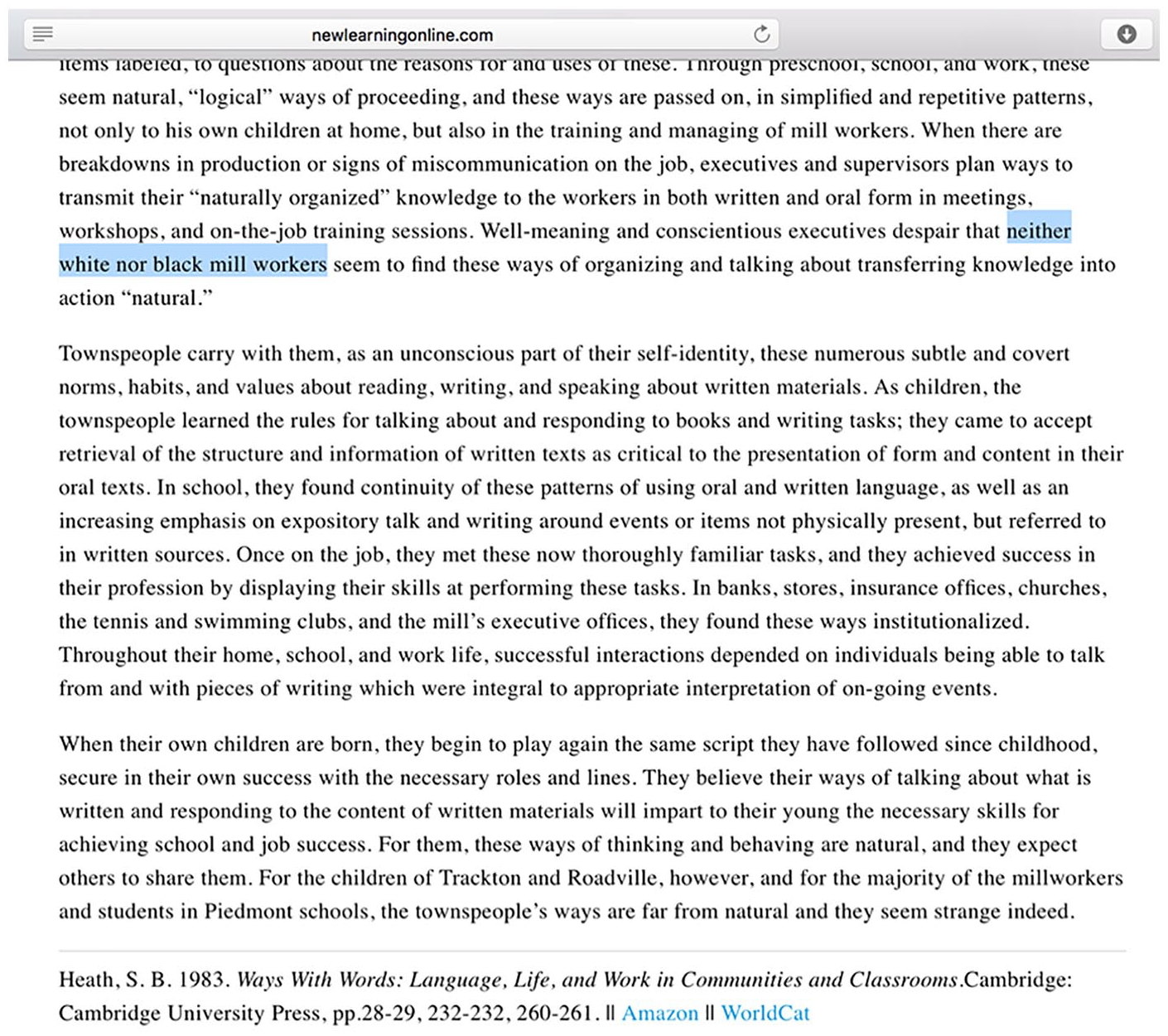
Screenshot from “Heath on Work and Community Literacies” at Mary Kalantzis and Bill Cope’s website, NewLearningOnline.com.
Even with the best intentions, if most literacy research (or other) readers have already been socialized into the White, anti-Black orientation as well as the common sense view of race, then it is simply wrong to conclude that most readers of this web page would imagine a racially unmarked description of the townspeople as being about racially Black adults and children. This point is reinforced by implicit association test research on racial bias (Banaji & Greenwald, 2013). Indeed, this website’s unmarked description of the townspeople is about Black townspeople. Yet without racial labeling (and apparently even with it), many are not likely to correctly infer this. Figure 1 illustrates an instance when it would be helpful to practice race by using racial labeling and harmful to not practice race by “colormuteness” (Pollock, 2004).
This website example accomplishes a few things: It (a) illustrates a broadly uninterrogated racial orientation in the field of literacy research, (b) documents a widely accepted race practice in the field of literacy research (unmarked racialization, colormuteness), and (c) indexes a wider reading of Ways With Words. Often overlooked are the “Black townspeople” discussed in Chapter 7 of Ways With Words (Heath, 1983/2008, p. 237). Despite Heath’s repeated use of racial labeling in her ethnographic description of the townspeople, many readers in the field of literacy research have come away from Heath’s classic study of language socialization, culture, and schooling with the false idea that Trackton is the only Black community mentioned in Heath’s work. But why? Apparently, the description of Trackton’s ways with words and ways of living are more recognizable as “Black” than the explicit description Heath provides of the Black townspeople’s ways with words and ways of living. In one paragraph, Heath wrote: Black townspeople also believe family experiences qualify them to place a high value on schools, but theirs is a more recent and perhaps a more cautious view [here call to mind the generations of Black experiences with U.S. schooling that preceded Heath’s investigation; see Bell, 1983; Boateng, 1990; Ogbu, 1990]. Several local black families have been in the [Piedmont Carolinas] region for years, having come there as free blacks and having established in the early twentieth century the few local black-owned businesses—shoe shops, laundromats, groceries, print shop, and trophy center, for example. Some have owned small plots of land for decades. Though they may have left [the Piedmont Carolinas region] to work up-North temporarily or to serve their twenty years in the [U.S. military] service, they have now [in the 1970s; p. 5] retired to the region to build a new house on the old farmland and to set up a business in town [as townspeople]. Other black townspeople are the children of teachers who taught in the black schools. They have high hopes for education and a long-standing commitment to the view that schooling does make a difference. They are graduates of the [Piedmont Carolinas] region’s black colleges and universities [known also as historically Black colleges and universities, or HBCUs], and though they may have spent periods of their life out of the area, they are now [in the 1970s] back to stay, to build, and to show their children the advantages of the South as home. Some have built brick homes in the black suburbs of the region’s towns, or they live in Alberta in integrated condominia or apartment complexes. Local, state, and regional [Black] sorority activities keep many of the [Black] women involved: planning scholarship drives for black students, scheduling regional conferences, or planning the food and decorations for the next reception for new members and installation of officers. They also give their time as [Black] church deaconesses or as members of the church ladies’ auxiliary or choir. Both [Black] men and [Black] women financially support their college alma mater, and homecoming (an annual football game which all alumni are encouraged to attend) and other athletics events bring together alumni from all over the region [see Alexander, 2020, for more about homecoming at HBCUs like North Carolina Agricultural & Technical State University]. Though many of their [Black] children will not go to black colleges but rather to regional universities or state colleges [of the Piedmont Carolinas], [Black] parents do not forget their own allegiance to their alma mater. (Heath, 1983/2008, pp. 239–240)
Reading only this paragraph about the Black townspeople in Ways With Words makes it impossible for a reasonable literacy researcher to conclude that Trackton is the only Black community in Heath’s analysis. However, as Fanon (1967) long ago discovered, “reason” (p. 119) stands ready to retreat once race is present. Racial literacies help “reason” to be reasonable with race (see Gordon, 2007).
In short, Heath’s classic ethnography compares at least three “ways with words”: Black Trackton ways, White Roadville ways, and Black and White townspeople ways. How our field has typically read the Black lives in Heath’s work demonstrates the deeply unexamined ways that race is conceptualized and practiced in the field of literacy research.
Returning to the “value gap,” the assumed or enacted inequivalence of value between Black- and White-owned real estate or earned credentials, for example, as well as this same logic in the field of literacy research as a whole, along with the particular example of how Black lives are (not) read in Heath’s classic work and other widely known studies, are all typical consequences of anti-Black (antihuman) inequities as carried out at multiple levels of analysis and across multiple modes including unstated meanings.
Our theorization and definition of race is important to this racial turn, then, because the common sense view of race limits and undermines critical examinations of race in research, practice, and policy. For example, if White supremacists and antiracists (e.g., Kendi, 2019; Pollock, 2008) were both to understand race according to the common sense view, then how far would antiracists go with critiquing and disrupting White supremacy? Contrastingly, if antiracists could account for the common sense view of race without being trapped by this erroneous view and, further, understand race as consequential, human cultural thinking and doing (i.e., race as lacking natural, biological, or inherent substantiality), how far would antiracists go with critiquing and disrupting White supremacy then? In other words, taking this racial turn requires that we theorize and define race in ways that comport with the actual history and fact of race as invented and practiced, from macro- to microlevels. This means that institutionally, among groups (e.g., racial, gender, class, national, affinity, etc.), and individually the common sense view of race should be thoroughly rejected. Instead, the consequential social practice view of race more accurately accounts for race in human histories and cultures (Croom et al., 2019).
This race practice framework has historical antecedents. For example, W. E. B. Du Bois gestured toward a practice account of race late in his career. Du Bois’s (1897, 1940/2007) conceptualization of race changed across his lifetime, shifting from a biological view of race early in his career to a historical and political view later. By 1940, Du Bois had made clear this precursor to PRT: Thus, it is easy to see that scientific [biological, essentialist] definition of race is impossible; it is easy to prove that physical characteristics are not so inherited as to make it possible to divide the world into races; that ability is the monopoly of no known aristocracy; that the possibilities of human development cannot be circumscribed by color, nationality, or any conceivable definition of race; [yet] all this has nothing to do with the plain fact that throughout the world today organized groups of men by monopoly of economic and physical power, legal enactment and intellectual training are limiting with determination and unflagging zeal the development of other groups; and that the concentration particularly of economic power today puts the majority of mankind into a slavery to the rest. (Du Bois, 1940/2007, pp. 69–70)
As Du Bois clarified long ago, the common sense view of race is falsified. Yet consequential practices carried out within racialized human cultures result in lived differences. Human development does not depend on race in itself; rather, developmental differences and outcomes are historically, materially, politically, and intellectually done along the lines of human racial meanings. Relatedly, Du Bois also preceded contemporary discursive frameworks toward race (Wilson, 1999), which PRT carries forward as well. Taking antecedents like these further, PRT accounts for race in these ways and more.
When race is understood as practice, or according to PRT, we can pay closer attention to what we are doing as accountable participants in ongoing racialization. For example, what are we saying, doing, or construing in a given racial situation or across racial situations? Following is a brief discussion of these three strands of practice with examples from some public evidence.
Saying: Watch Your Language
To introduce monitoring and examining our own language choices, I provide an example of publicly documented language that allows us to learn by monitoring and examining someone else’s choices. Keep in mind that whatever critiques you might offer up about this example of language should also be as skillfully applied to your own written or unwritten language choices. New York University professor Lawrence M. Mead (2019, 2020) recently published an article from his book, Burdens of Freedom: Cultural Difference and American Power in the Springer journal Society. The book argues that America’s “deepest problems derive from groups and nations that reflect the more passive, deferential temperament of the non-West,” which is framed as contrasting with the inner-driven culture of Western individualism (Mead, 2019). Thousands have responded to Mead’s article by rejecting it as unscholarly and as yet another example of racist violence toward the hyperraced (Retraction Watch, 2020), and the publisher and editor-in-chief have now retracted this article (Springer, 2020). Although petitioning and protesting have proven to be an important and impactful response to this publication, I opt to respond by using Mead’s public language choices to advance the development of racial literacies among literacy researchers (and perhaps a wider readership as well). Let’s begin by reading the abstract and key words from Mead’s five-page article: Poverty persists in America even amidst the world’s richest nation. Attempts to attribute longterm poverty to social barriers, such as racial discrimination or lack of jobs, have failed. Some scholars now attribute poverty to culture in the sense that many poor become disillusioned and no longer seek to advance themselves. More plausible is cultural difference. The United States has an individualist culture, derived from Europe, where most people seek to achieve personal goals. Racial minorities, however, all come from non-Western cultures where most people seek to adjust to outside conditions rather than seeking change. Another difference is that Westerners are moralistic about social order, demanding that behavior respect universal principles, while in the non-West norms are less rigid and depend mostly on the expectations of others. These differences best explain why minorities—especially blacks and Hispanics—typically respond only weakly to chances to get ahead through education and work, and also why crime and other social problems run high in low-income areas. The black middle class has converted to an individualist style and thus advanced, but most blacks have not. Government has recently reduced crime and welfare in poor areas, but the ultimate solution to poverty is for the poor themselves to adopt the more inner-driven individualist style.
In this case of written language, there is much that could be discussed. However, I will only note a few things for the purpose of this article: (a) the genres of race used, (b) the implied theory of race evidenced, and (c) the racial worldview this discourse advocates.
In this abstract, one of the ways that race is done with language is by using genres of race, that is, “recognizable forms of racialization with or without race-obvious words” (Croom, 2020, p. 25). For instance, racial labeling occurs as “blacks and Hispanics,” as “black middle class,” as “most blacks,” and as “Minorities.” Other genres of race also occur in this abstract, but pointing out the use of racial labeling in this abstract is enough to illustrate genres of race in this discussion.
An implied theory of race is evident when you compare the use of “cultural difference,” “Europe,” and “individualist culture” with the use of “Racial minorities” and “non-Western cultures.” In this brief race critical discourse analysis (Croom, 2020, p. 288), the language and sequencing point out the conflation of race and culture. By Mead’s own logic, if “cultural difference” and “individualist culture” are the key to understanding poverty in the United States, this raises the question: What is racial about culture and what is cultural about race? Mead says, “Racial minorities, however, all come from non-Western cultures.” Therefore, non-Western and BIPOC are the same thing, just as Western and racially White are also the same thing. This means that in this abstract, race is theorized according to the common sense view that I have already described, particularly race as defining capacities, characteristics, and culture (see above).
The racial worldview advocated with the language of his abstract is quite clear: The racial worldview is the White normative, anti-Black, deficiency philosophy (Hoover, 1990) orientation, or the White, anti-Black orientation for short. Here’s how Mead tells us that this is his worldview: “The black middle class has converted to an individualist style and thus advanced, but most blacks have not.” As we have seen above, the individualism that is attributed to the United States is wholly a racially White cultural norm. Therefore, this argument suggests that racially Black advancement came at the cost of White conversion. In other words, White conversion is argued to be the only proven prophylactic against Black deficiency. This publication is saying in 2020: Be White and live or be Black (or BIPOC) and die, after undeservingly leeching off of the U.S.’s (meritocratically) well-deserved riches.
Beyond these basic facts, as obtained through this brief race critical discourse analysis of what this publication is saying, this abstract also offers lessons related to doing and construing from a PRT framework.
Doing: Actions Speak Louder Than (No) Words
Does this abstract use racial labeling for “most people” from Europe, “Westerners,” or to describe the “individualist style” advocated? As we see, the answer is no. The racial label “White” is never used at all in this abstract, and so White folks and Whiteness are literally invisible in this written race practice. Therefore, if we were to count the occurrences of “White” in this analysis, the result would be zero. Yet omitting the racial label “White,” and thus the count result of zero, heightens the significance of the race practice that is occurring in this abstract. Mead’s act of omission speaks louder than the written language we can clearly see in his article abstract. Given the transdisciplinary genre expectations that specialists have for scholarly abstracts, this omission cannot be insignificant: Publication abstracts are supposed to explicitly offer what is most important about the entire article, in this case namely the view that racially White ways of living in the world are ranked above, and preferable to, BIPOC ways of living in the world. Accordingly, why not use “White” in this abstract if indeed the entire point is to advocate racially White ways of living in the world as the solution to poverty, especially BIPOC poverty, in the United States? Said in terms of literacy research: White ways of living in the world are not “marked” in this abstract, just as White participants are obscured in many literacy research publications because they are “considered ‘normal’—European American and middle class” (Guzzetti et al., 1999, p. 74).
Construing: What Do You Have in Mind?
So what is Mead thinking? Here’s what he has in mind: “The ultimate solution to poverty [in the United States] is for the [hyperraced, especially Black and Hispanic] poor themselves to adopt the more [racially White] inner-driven individualist style.” Therefore, as construed: (a) BIPOC are their own problem, (b) BIPOC are a problem that American Whites have long endured, and (c) BIPOC are a problem that (White) scholars, (White) American policy makers, and (White) wage payers have all worked tirelessly, but fruitlessly, to solve. Accordingly, every possible thing that could be done for “the problem” (compare with Du Bois, 1903) has already been done, and from now on, it is acceptable not to intervene in the experiences and outcomes that the hyperraced are continually creating for themselves. This race critical analysis exposes a consequential racial storyline (Nasir et al., 2012) that is (falsely) construing poverty in the United States and is also (falsely) construing those who are living in poverty in the United States.
We see from this brief race critical discourse analysis that PRT allows us to pay attention to what we ourselves or others are saying, doing, and construing as participants in ongoing racialization. By critically recognizing the ways that we are doing race, individually and through interaction, we can advance “human well-being amid the social thought and practice of race” (Croom, 2020, p. 24).
Get Used to Hearing “Recalculating . . . ”: Developing Racial Literacies for the Rest of Your Life
It is to be expected that literacy researchers (or even scholars within other fields) will have varying responses to a special issue like this one and specifically to this post-White-oriented article. In previous sections, I have discussed and illustrated how this racial turn might be entered by the field of literacy research. Here, I offer some discussion of what this racial turn would involve for the long haul.
In short, the journey ahead will be filled with recalculations. This means that our field should expect to recursively make shifts in our race practices away from harmful ways of practicing race (e.g., racism; “not racist” as in Kendi, 2019, p. 9) and instead toward helpful ways of practicing race in all of our endeavors (e.g., antiracist as in Pollock, 2008, or Kendi, 2019; post-White as anticipated in Du Bois, 1940/2007 and as shown in the sections above). For the long haul, the studies and publications that we generate will have to be reconsidered and reevaluated to determine whether the philosophies, theories, methodologies, and analyses are supporting human well-being or undermining human well-being in our racialized societies. However, to reconsider and reevaluate the knowledge we generate, our own lives and interactions with fellow human beings will also require reorientation. Who we imagine others as depends a great deal on who we imagine ourselves to be. Thus, for the long haul, we must also rethink and redefine what it means to be human and what it means to be ourselves in our own racialized lives and in our own racialized interactions with others. For our work and for our lives, we start this journey with the expectation of developing racial literacies for as long as we live.
Conclusion
I do not know of a more significant factor than consequential race practice when it comes to developing or not developing various literacies, especially in the life span of racially Black and racially White human beings who live intersectionally in the United States. These two racial categories, Black and White, usually frame all other possible racial classifications in U.S. society and often results in a bifurcation of U.S. social life that creates the choice to be either closer to or farther away from White folks and Whiteness (e.g., racially assimilate or racially sustain?). The post-White orientation breaks this binary while dismissing the false racial hierarchy of the White racial group as above all other racial groups.
PRT demystifies the common sense view of race and provides a reliable account of our racial past, present, and future. According to PRT, once humans began to think and do race, varying customs of race practice evolved and resulted in various consequences for human beings. Where Black lives are concerned, it is mind-boggling to think that there could ever have been a time in the field of literacy research when race was not a core consideration of literacy researchers. For example, how could our field ever have hoped to understand and advance the languages (Alim et al., 2016; Baker-Bell, 2020; Green, 2011; Power-Carter, 2020), cultures (Boateng, 1990; Gadsden, 1992; Ogbu, 1990; Paris & Alim, 2017), text interests (G. Muhammad, 2020; Parker, 2020; Tatum, 2009), literary and literacies traditions (Belt-Beyan, 2004; Fisher, 2009; Harris, 1992; McHenry, 2002; Ntiri, 2014; Power-Carter et al., 2019; Richardson, 2003; Willis, 2002), digital tool uses (Lewis Ellison, 2017; Lewis Ellison & Solomon, 2019; Tichavakunda & Tierney, 2018), reading and writing practices (Asher, 1978; Austin, 1972; Guillory & Gifford, 1980; Guthrie et al., 2009; McHenry & Heath, 1994; G. E. Muhammad et al., 2017; Tatum, 2009), gifts, talents and high-achievement (Ford, 1995; Ford et al., 2018; Grantham et al., 2011), assessment data indicators (Anderson, 2007; Cohen et al., 2012; Ferguson, 2003; Flowers, 2016; Irvine, 1990; Smith et al., 2019; Thompson & Shamberger, 2015; Willis, 2019), family and community literacies (Edwards, 1993; Gadsden, 1992; Heath, 1983/2008, especially the often overlooked “Black townspeople”; Johnson, 2010; Lewis, 2013), youth literacies (Carter, 2007; Kinloch et al., 2017; Kirkland & Jackson, 2009; Morrell, 2008), or racial literacies (Croom, in press) of Black children and adults without accounting for and examining the historical and current practices and consequences of race? For that matter, in the United States (and other racially Westernized contexts), how does “literacy” of any kind, for any racially classified group, make sense without accounting for the ongoing racialization of human beings that began in Western Europe? I hope these two questions make it clear that literacy research is shockingly incomplete without rigorous racial analysis, and also, that these questions leave no doubt that taking this racial turn in the field of literacy research is a good direction for our scholarship. All knowledge generation is partial, but offerings in our field that do not account for the multileveled, multimodal, intersectional, consequential social practice of race in ongoing racialized human experience is not worthy of being regarded as knowledge. Within our racialized existence, it is deadly to just read and write without accurate accounts of race.
Supplemental Material
967396__Marcus_Croom – Supplemental material for If “Black Lives Matter in Literacy Research,” Then Take This Racial Turn: Developing Racial Literacies
Supplemental material, 967396__Marcus_Croom for If “Black Lives Matter in Literacy Research,” Then Take This Racial Turn: Developing Racial Literacies by Marcus Croom in Journal of Literacy Research
Footnotes
Declaration of Conflicting Interests
The author(s) declared no potential conflicts of interest with respect to the research, authorship, and/or publication of this article.
Funding
The author(s) received no financial support for the research, authorship, and/or publication of this article.

References
Supplementary Material
Please find the following supplemental material available below.
For Open Access articles published under a Creative Commons License, all supplemental material carries the same license as the article it is associated with.
For non-Open Access articles published, all supplemental material carries a non-exclusive license, and permission requests for re-use of supplemental material or any part of supplemental material shall be sent directly to the copyright owner as specified in the copyright notice associated with the article.
