




Abstract
The study examines how a white elementary educator used discursive practices I refer to as “race talk moves” to support students’ racial literacy during whole-class read-alouds. This case study found that the teacher used four moves that have been previously documented in literature discussions: listening, participating, synthesizing, and challenging. Significantly, however, the teacher drew upon these moves in ways that were responsive to students’ racialized identities and emergent understandings of race. Moreover, the analysis identified a new, fifth move, what I call “anchoring,” that supported students in moving from surface-level conceptions of race to a deeper understanding of systemic racism. By actively responding to and deepening students’ racial literacy contributions, anchoring moves illuminate how teachers and students can co-construct critical race knowledge. This study diverges from previous research on the drawbacks of white teachers talking about race to demonstrate the moves teachers can make to support students’ racial literacy development.
Discussing race and racism can help young learners develop racial literacy—the knowledge and skills to confront unjust realities and foster social change (Sealey-Ruiz, 2021b). Research has demonstrated that young students come to school already talking about race and have questions about why racial inequities exist (Falkner, 2019). In the elementary classroom, reading and discussing shared texts is a common instructional method that has potential for developing racial literacy. A challenge for many educators, however, is knowing how to facilitate literature discussions or whole-class read-alouds in ways that create opportunities for students to share and learn about how race and racism impact their lives and communities. Many teachers feel unprepared to engage in critical conversations about race with students, while others express discomfort in leading discussions on topics they are unknowledgeable about or did not personally experience (Milner, 2017). Recent legislation either passed or proposed in 35 states that silences teachers’ speech on race, along with attempts to ban books written by Black authors or about people of color, have created fear and confusion about what educators can say when teaching and talking about race and racism in the classroom (Alfonseca, 2022; American Library Association, 2021).
Challenges about when and how to facilitate race talk are often exacerbated by white teachers who benefit from white supremacy and currently make up the majority of elementary educators. Much research has documented white teachers’ failures to contend with their racism and the harm that students of color, particularly Black students, can experience in poorly facilitated discussions (e.g., Wetzel & Rogers, 2015). More research is needed to explore what it is that teachers say and do to facilitate learning within a literacy curriculum that centers on issues of race and, in particular, how white teachers can navigate the tensions of their identities and systems of white supremacy to foster healthy and productive conversations about race.
We are currently living through a global pandemic with increasing health and economic inequalities along racial lines and persistent acts of racial violence in the forms of hate crimes, domestic white terrorism, and police brutality. Given this context, elementary teachers need to be talking about race while reading and discussing literature to empower students of color and white students with knowledge and tools for understanding, analyzing, and disrupting racism (Sealey-Ruiz, 2021a). Developing these skills, or racial literacy, is a social process that involves participating in ongoing critical conversations (Price-Dennis & Sealey-Ruiz, 2021). While previous research has focused on curricular and instructional methods used to initiate critical race talk, few studies illustrate the discursive and pedagogical moves teachers make to sustain these conversations over time. Therefore, the purpose of this study was to examine how one elementary teacher employed multiple discursive practices to scaffold students’ racial literacy development during whole-class read-alouds. The following research question guided my analysis: How does a white in-service teacher facilitate race talk while reading and discussing shared texts with students in the elementary classroom? This study diverges from previous research on the drawbacks of white teachers talking about race to identify the moves teachers can make in read-alouds to sustain conversations and support students’ critical understandings about race.
Theoretical Framework
Race, Racism, and Whiteness
This project draws upon critical race theorists who identify race as a social construct with material effects across all aspects of institutional and interpersonal life in U.S. society (Bell, 1992). Racism involves individual and systemic forms of discrimination that protect and maintain racial categories and the hierarchical power structures that follow (K. D. Brown, 2017). The construction of racial categories emerged from a need to produce “white” people and thereby justify an economic and geopolitical system that consolidates rights, resources, and personhood to those “in possession of whiteness (e.g., skin, ways of being, knowledge, etc.)” (K. D. Brown, 2018, p. 110). Omi and Winant's (2015) theory of “racial formation” explains how constructs of race and whiteness hold their power through a process of subjugation where “everybody learns some combination, some version, of the rules of racial classification” (p. 127). Multiple structures contribute to this process of racial socialization. In this study, I employ a discursive framework that rests on the assumption that ideologies of whiteness are actively constructed in the everyday ways people talk, silence, and interact with issues of race, which includes when children and teachers read and discuss shared texts in the classroom.
Discourses of Whiteness
To analyze how the teacher and students in this study constructed meanings of race, racism, and whiteness, I employ Gee's (2015) concept of Discourse (capital “D”). Discourses are socially stable and socially accepted ways of being, using language, and interacting that transmit messages about who belongs and what is normal. In contexts such as the United States, where racism is endemic to society, discourses of whiteness uphold “ideological beliefs that underpin processes used to hierarchize humans and justify oppressive disciplining tactics deployed in the maintenance of social stratification” (Ohito, 2020, p. 187). In the classroom, these discourses often take shape as racial stories and narrative frames that explicate whiteness as invisible and therefore not responsible nor accountable for the violence it engenders. It is important to keep in mind, however, that such discourses are also socially constructed, suggesting that whiteness can also be named, challenged, and abolished with specialized critical and racial analytic tools.
Racial Literacy
Racial literacy is one such analytical tool deployed to develop critical understandings of how race, whiteness, and racism operate in American society and thus move closer toward greater justice and equality. Guinier (2004) defined racial literacy as “the capacity to decipher the durable racial grammar that structures racialized hierarchies and frame the narrative of our republic” (p. 100). A theory of racial literacy suggests that these hierarchies can be understood and unmade through talk and action. Guinier (2004) outlined three tenets of racial literacy development: (a) learning about race as contextual rather than universal; (b) acknowledging the ways race and power are inextricably linked; (c) accounting for intersections between race and other social positions, including gender and class (p. 115). Price-Dennis and Sealey-Ruiz (2021) and others have applied these tenets to K–12 settings and argue that students who demonstrate racial literacy are able to engage in critical discussions even when they are new or uncomfortable, recognize racism as structural rather than individual, and develop a sensitivity toward racial (in)justice (Vetter & Hungerford-Kresser, 2014). In this study, I use racial literacy theory to interpret how the teacher and students developed meaning-making practices to understand the history and persistence of racism across multiple texts and sociopolitical contexts.
Literature Review
There is an extensive body of literature that has examined the intersections of race, dialogue, and literacy learning. In this review, I focus on a subset of “curricular” conversations about race, meaning that race talk was intentionally introduced by teachers who created lessons, selected texts, and/or determined goals for student learning in advance of the discussion (A. F. Brown et al., 2017, p. 462).
Tools for Classroom Race Talk and Racial Literacy
Reading and discussing multicultural literature is a common curricular tool used to initiate race talk in the elementary classroom (Vlach, 2022). While many studies report the use of a singular text to initiate conversations, Price-Dennis et al. (2016) discovered that revising this approach to include supplemental texts was beneficial in supporting fifth-grade students’ discussion of racism as both historical and contemporarily relevant. In partnership with the teacher, the researchers developed a critical literature unit that incorporated multiple texts (e.g., poetry, informational texts) to the class's reading of Taylor's (2004) Roll of Thunder, Hear My Cry. Price-Dennis et al. (2016) reported high levels of participation, which they attributed to the new curriculum that created multiple access points for the students to discuss the topic. They also acknowledged that, prior to the start of the unit, a classroom culture had been created that encouraged open and ongoing racial dialogue. This research thus suggests that while curriculum and texts most certainly matter in facilitating race talk, equally important are the instructional choices teachers make with texts to support students’ sense-making of issues around race.
Rather than address racism in a stand-alone unit or occasionally across the school year, racial literacy theory suggests that critical conversations about race must be ongoing in order for students to develop the knowledge and skills needed to interrogate how racism and whiteness are perpetuated through texts, language, and social norms (Price-Dennis & Sealey-Ruiz, 2021). In the secondary English classroom, Skerrett (2011) found that teachers enacted varying stances toward facilitating classroom discussions to support racial literacy development. For some, their approach was “incidental and ill-informed,” meaning conversations were sporadic and teachers were unprepared to navigate moments of conflict or discomfort. Other teachers were “apprehensive” to disrupt race-evasive silences and only initiated race talk when “authorized” to do so. A third group took a “sustained and strategic approach” where teachers used texts that invited students to interrogate white supremacy and examine relationships between race, power, and other social identities (Skerrett, 2011, p. 318). Significantly, Skerrett's study was one of the first to document actionable instructional methods secondary teachers could use to sustain a focus on race in their teaching. Given the fact that elementary teachers have different instructional demands to meet the literacy needs of younger students, similar accounts are needed to understand the specific structures of racial literacy instruction in elementary classrooms.
At the same time, accounts of the micro, moment-by-moment decisions teachers make are also needed to understand how teachers build critical knowledge with students through talk and interaction. Research shows that race talk in schools is a significant disruption to race-evasive ideologies and white-normed social discourses that leave “little space for socially sanctioned speech about race-related matters” (Bonilla-Silva, 2006, p. 55). In their review of more than two decades of research in early childhood through secondary settings and teacher education, A. F. Brown et al. (2017) found that classroom conversations about race often get off track as teachers and students negotiate and sometimes clash in making sense of race. E. E. Thomas’s (2015) study is one of the few that illustrates how two experienced in-service teachers navigated moments of conflict and confusion with discursive practices such as humor, modeling how to use racial identity labels, and guiding students through a predetermined set of questions. Despite the teachers’ experience and advanced preparation, Thomas still found that teachers used evasive “sidestepping” or silence during particularly tense moments (p. 171). This study, along with A. F. Brown et al.'s (2017) review, highlights the need to equip teachers with discursive moves to persist through pressures to not talk about race. This is especially urgent for white teachers, who currently represent the majority of elementary educators.
White Teachers and Dialogic Pedagogy
Classroom race talk is often difficult to sustain, especially for white teachers whose racial identities influence how they resist or comply with dominant social and political discourses that silence conversations about race. Research consistently shows that white teachers often fall short in talking critically about race by drawing on ideological frameworks of neutrality and race evasion that minimize the history and continued impacts of racial oppression (e.g., King, 1991; Yoon, 2018). Beneke and Cheatham (2020) found that in the context of field-based teacher education, white preservice teachers employed a range of strategies that silenced race-based discussions, including “turning the page” to limit conversation and employing humanist discourses of “sameness” that avoided race- and ability-based discrimination (p. 255). Even in research where white teachers attempt to critically enter into discussions with students, whiteness appears to obstruct the depth of criticality students achieve through dialogue. Borsheim-Black (2015), for example, found that a white in-service teacher who identified as antiracist struggled to acknowledge the systemic realities of racial oppression and challenge her white students’ persistent centering of whiteness in whole-class discussions.
White teachers can also have difficulty responding to students who draw on racist discourses (e.g., pejorative terms, stereotypes) in conversations about race. Rogers and Mosley (2006), two white teacher researchers, discovered that in their second-grade classroom, white students’ use of racist and antiracist language created confusion and unexpected challenges to understanding the civil rights movement. Rogers and Mosley noted their discomfort and lack of preparedness to disrupt students’ racist talk when several children agreed that racial segregation was tolerable and that African Americans living during Jim Crow “should be happy even if they are on the back [of the bus]” (p. 477). These studies raise questions about how white educators can talk about race in ways that attend to whiteness without centering it, suggesting the need for “positive discourse models” that illuminate different kinds of discursive interventions needed to foster literacy in supportive learning environments (Beneke & Cheatham, 2020).
Teacher Talk
Teacher talk has long been studied to understand the discursive moves teachers make to support student participation and meaning-making in read-alouds (Michaels & O’Connor, 2015). Numerous studies have demonstrated the important role teachers play in guiding and supporting students as active participants in student-led discussions (e.g., Aukerman & Boyd, 2019). Teacher-education scholars have examined how power influences social relationships in the classroom and the ways teachers apply talk moves to disrupt silences around race. For example, Dávila (2011) found that teacher candidates facilitating racial dialogue served as “critical guides” who took on different roles (e.g., manager, encourager) to support student participation. Schieble et al. (2020) used the term “critical talk moves” to specify discursive strategies teacher candidates used to disrupt oppression and consider emancipatory alternatives for literacy teaching and learning. While these studies in teacher education and secondary classrooms suggest the potential of using critical talk models, a closer examination of how in-service teachers apply discursive moves is needed to understand how facilitating critical conversations about race, whiteness, and racism can support students’ racial literacy development in the elementary classroom.
Methods
Data for this article were collected as part of a 10-month study on race talk in elementary literacy instruction with two teachers, one of whom identified as multiracial (Ms. Perez) and one of whom identified as white (Ms. Allen; all names are pseudonyms). For this study, I selected Ms. Allen's classroom because it offered an illustrative view of a white teacher using a dialogic approach to engage a multiracial class of elementary students in sustained conversations about race and racism. Qualitative case study methods were employed to develop a contextualized account of when, where, and how Ms. Allen and her students discussed race during read-alouds (G. Thomas, 2016).
Context and Participants
This study took place at Honeybee Elementary, a public pre-K–5 school located in a suburban, affluent neighborhood near a midsized city in the southwestern United States. The school serves a predominantly middle- to upper-class community of Asian American and white families. In Ms. Allen's fourth-grade class, eight students identified as South Asian and Vietnamese, four identified as Latinx, and 11 identified as white. Forty-three percent of students were multilingual in Spanish, Tamil, Telugu, Gujarati, Marathi, or Vietnamese.
Ms. Allen identified as a white, cisgender woman and was in her 11th year of teaching. At the time the study took place, Ms. Allen had developed a yearlong literacy curriculum focused on culture, race, and equity. Ms. Allen was an active member of her district and school community, participating in diversity training, founding the school's equity committee, and mentoring new teachers in culturally responsive practices. Outside of her professional duties, Ms. Allen actively sought opportunities to expand her knowledge of Black and Indigenous histories and interrogate her whiteness through self-study and participation in Black- and Brown-led community groups. Ms. Allen regularly invited Black, Latinx, and Asian American parents and community members to co-teach with her.
Across the school year, I observed Ms. Allen facilitate 31 conversations about race and racism, 16 of which occurred during whole-group read-alouds and are the focus of this analysis (Appendix A). On average, the discussions lasted approximately 13 min, ranging from just a few minutes to more than half an hour. Ms. Allen addressed a range of historical topics, including how white “founding fathers” enslaved Africans and African Americans, the possibilities and challenges of the Reconstruction era for Black liberation, and child activism during the civil rights movement. Ms. Allen also addressed contemporary issues, including Colin Kaepernick's protest of police brutality, immigration, and the Black Lives Matter movement.
Data Collection
Data were collected using participant-observation methods. Primary data sources included video recordings of literacy instruction, ethnographic field notes, and transcriptions of classroom race conversations. Prior to March 2020, I observed and recorded Ms. Allen's reading instruction approximately twice a week. Due to the pandemic and early closures of schools, data collection took place remotely during the last 2 months of the 2020 school year. During that time, the school district permitted me to attend a small number of live Zoom classes. I also conducted interviews with Ms. Allen and students at the beginning, middle, and end of the school year. I collected artifacts related to lesson planning to gain insight into curriculum design processes (see the online supplementary material appendixes for additional data sources and analytic tools).
Data Analysis
Data analysis took place across three phases. Phase 1 occurred throughout the collection phase because of the study's longitudinal design and large data corpus. I reviewed classroom video footage, selectively transcribed conversations that addressed race, and wrote analytic memos to generate a working hypothesis and guide future data-collection decisions (Corbin & Strauss, 2015).
In Phase 2, I used inductive analysis to describe and categorize the forms of teacher talk used during read-alouds. I conducted a line-by-line analysis describing discursive actions in the form of individual codes. Examples from this initial round of coding included moves such as “signaling understanding with repetition,” “naming racism in the text and/or world,” and “questioning negative reactions to perceived racial differences.” Next, I used the constant-comparative method to group codes with similar characteristics and tentatively named each group using talk moves identified in previous research on read-aloud facilitation (Sipe, 2008) and critical conversations in teacher education (Schieble et al., 2020). For example, individual codes related to how Ms. Allen responded to students by repeating, rephrasing, or asking follow-up questions were grouped together as “clarifying” moves. After all relevant data were accounted for, I began an inductive and iterative process of constructing categories, which involved identifying patterns, comparing data against the groups, and abstracting conceptual themes from the categories. For example, three types of moves—“clarifying,” “elaborating,” and “building context”—were consolidated as one larger category (synthesizing) because together, they offered a more precise description of the discursive practice and were “conceptually congruent” such that the category could be abstracted further for theorizing a relationship between talk moves and developing racial literacy (Merriam & Tisdell, 2016, p. 213). I continued this process until I arrived at five categories that I labeled holistically as “race talk moves,” which I define as recurring teacher speech patterns used in the context of classroom race talk.
In Phase 3, I turned to critical discourse analysis (CDA) to expand and clarify my understanding of race talk moves by examining patterns of talk and interaction that emerged when Ms. Allen used these moves during whole-class read-alouds. While the constant comparative method allowed me to identify forms of moves, I used CDA to examine the function of race talk moves in mediating student learning situated within local and macro contexts. I elaborated upon the initial field note transcriptions by constructing an utterance-by-utterance verbal and nonverbal (gestures, pauses, and overlapping talk) transcript. Following Gee (2015), I organized transcripts into speaker lines, and each line was further segmented into clauses that included an action verb and noun to narrow my analytic focus on idea units. I conceptualized meaning-making practices as social practices used to mediate social structures (e.g., the dominant race ideologies) and social events (e.g., the reading of a text). Fairclough (2004) proposed that social practices can be analyzed discursively using genre (ways of interaction), discourse (ways of representing), and style (ways of being). As I moved line by line through each transcript, I described each order separately with individual codes, asking how shared social and discursive practices were expressed, represented, and communicated (Rogers & Wetzel, 2013). I created a table to look across the orders of discourse and compared it with an existing coding chart first developed by Rogers and Mosley (2006) for analyzing forms and functions of white talk in elementary classrooms. While many codes were applicable, I removed codes that were irrelevant to Ms. Allen's multiracial classroom and added new codes identified in recent scholarship on racism, whiteness, and discourse. For example, I expanded the genre code of “humor” to “telling jokes” (Yoon, 2018) or “giving compliments”‘ (Kohli et al., 2018) to more specifically account for the interactions I observed and to expand my analytic frame with research from critical race scholars (Appendix B).
Positionality
As a white cis woman studying issues of race, I do not and cannot understand the realities of racism that this research intends to confront. Indeed, there is a history of white women using schooling institutions to justify and profit from perpetuating racial terror and violence against Black, Indigenous, and other people of color. Given this history and my position within it, I entered into this project with humility, partnering with and learning from Black and Brown scholars, teachers, and activists in academia and the community. I received invaluable feedback from scholars of color on my initial analysis and used critical reflexivity to examine how I saw the data in, through, and against a lens of whiteness. My position was further complicated by the identities I shared with Ms. Allen, another white teacher. I was uneasy about contributing to critiques of white teachers facilitating racial dialogue because Ms. Allen generously invited me into her classroom and I was appreciative of how she confronted whiteness in her pedagogy. Presenting the findings through an asset-based lens risks uplifting Ms. Allen's discursive practices without acknowledging the privilege she experienced in her teaching as compared to teachers of color, who are frequently reprimanded for taking the same pedagogic actions (Allen, 2019). However, because it is imperative for white teachers to support students’ racial literacy development, her pedagogical practices may serve as a starting point to understand how white elementary educators can sustain critical conversations about race over time.
Findings
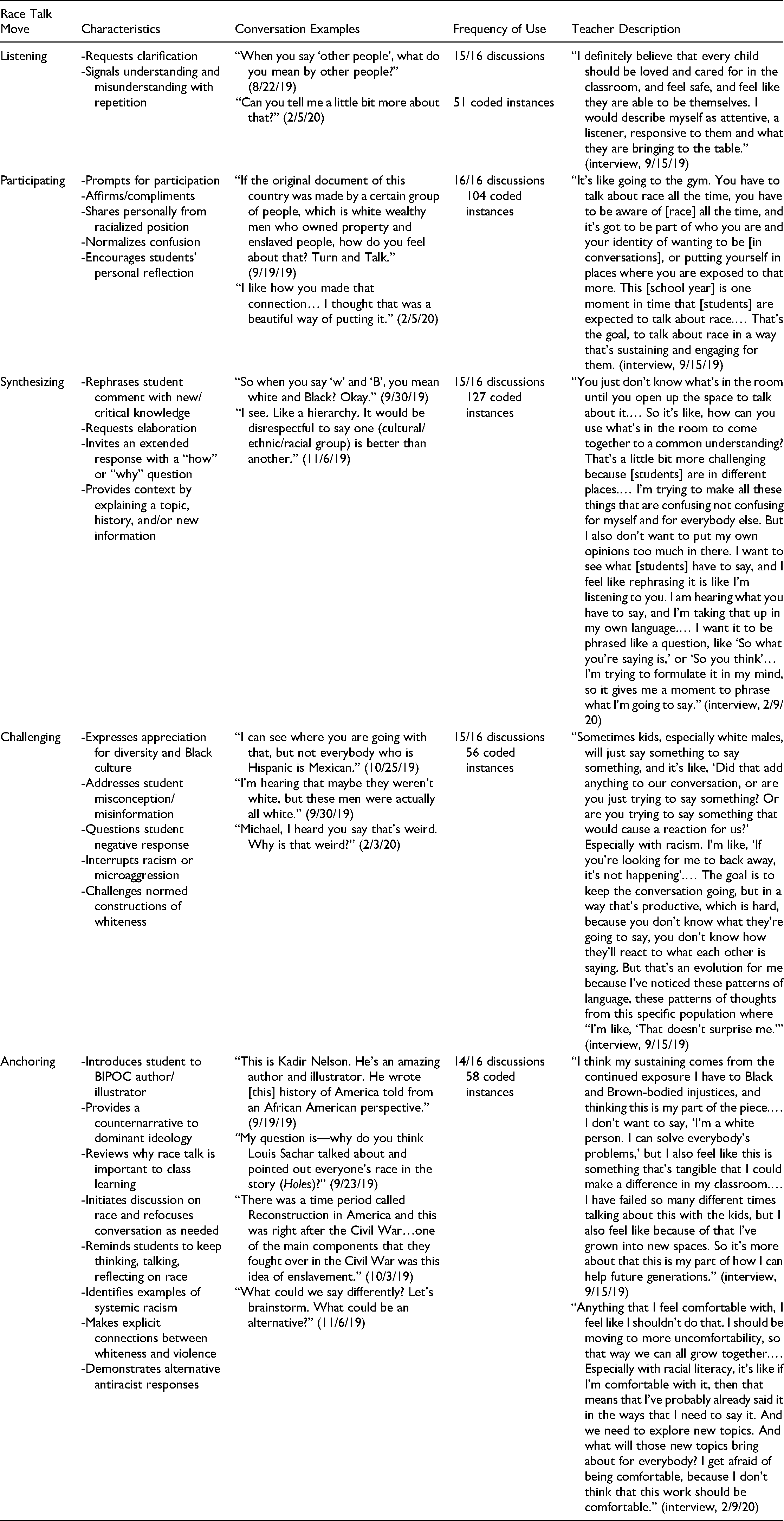
Across the year, Ms. Allen met daily with her students on the carpet to read and discuss texts, and these daily sessions were where most of her work around racial literacy occurred. During the 16 read-alouds that are the focus of this analysis, Ms. Allen provided multiple opportunities for students to respond to the text and discuss the issues and people presented in them. In my analysis, I identified five primary race talk moves that Ms. Allen employed to sustain conversations about race (Table 1). Four of these moves (listening, participating, synthesizing, and challenging) have been previously documented in the literature but not studied specifically in the context of race-based discussions. While the form of race talk moves (listening, participating) may appear structurally the same as talk moves discovered previously in conversations not necessarily about race, I argue that the function of these moves was distinct in that they were used to interrupt silences around whiteness and sustain discussions about race that are normally viewed as taboo in elementary classrooms. A fifth move emerged in my coding: “anchoring” moves that deepen surface-level conceptions of race to systemic racism. Because these moves occurred within complex discussions and in coordination with other moves, I present the findings below in the contexts of three representative conversations.
Descriptions and Examples of Race Talk Moves.
Supporting Students: Listening, Participating, and Synthesizing Race Talk Moves
The first conversation took place in early September. I selected this discussion because it represents a typical example of how Ms. Allen used listening, participating, and synthesizing race talk moves to center students’ voices and ideas in conversations about race. Ms. Allen twice read The Colors of Us (Katz, 1999), a children's book that uses words such as “color” and “skin” to portray multiracial and multiethnic characters (p. 3). In the first reading, Ms. Allen used the book to guide students in an art activity of mixing paints to match their skin tone and celebrate their multiracial community. Two days later, Ms. Allen reread The Colors of Us to bring attention to the author's omission of the word “race”: So thinking about skin tones There's a different word that people use when talking about skin tones or talking about physical appearance. And that word is “race.”
Quickly after Ms. Allen said the word “race,” students reacted visibly and audibly (shifting in their seats, smiling nervously, whispering to nearby friends), expressions that I interpreted as surprise because this was one of the first times Ms. Allen explicitly disrupted social discourses that silence the topic of race. Observing students’ reactions, Ms. Allen used a participating race talk move to invite them to join the discussion. Put your thumb on your heart if you’ve heard that word “race.”
Rather than take the next speaking turn, Ms. Allen turned the conversation back to students, inviting them to share knowledge with their bodies, an arguably more intimate and direct form of communication than the more traditional practice of raising hands.
Abril, who self-identified as Mexican American and bilingual in Spanish and English, interrupted this brief pause, asking, “Does this go with Martin Luther King?” Abril's response suggests that in her previous years of schooling, discussions of race were likely sanctioned at certain moments in the school calendar, such as Dr. King's birthday in January. Based on Ms. Allen's teaching plans, Dr. King was not a historical figure she planned to discuss, but she did not dismiss or evaluate Abril's response. Instead, she sought clarification, asking if Abril could “explain a little bit more” (Appendix C). This listening move signaled that Ms. Allen was attending closely to students’ comments and willing to shift her instruction. In this context, she gave the speaking turn back to Abril: Ah, so racism or race is whenever you’re judging or splitting people apart just on their skin color. Like how uh (.) MLK, he was protesting and everything like that because other people didn't believe (.) like Hitler didn't believe that a certain (.) ath---lete (quickens) I’m not going to go into that was better than the other athlete
Abril shared a range of ideas that she had working knowledge of, including racism and social justice movements, demonstrating how students of color like Abril often embody and bring an expansive repertoire of knowledge to classroom conversations about race (K. D. Brown, 2018). At the same time, Abril's hedged remarks and self-interruptions made it difficult to track a common line of reasoning, especially for those who did not share her background knowledge. During our interview, Abril shared that she had been the target of a verbal attack from a peer in first grade because she and her family spoke Spanish. Abril's hedging is a logical response to surviving classrooms that had been a place of violence and attack on her personhood.
Ms. Allen responded by employing a new move of synthesizing, bringing forward a few key ideas from Abril that the class could use to continue the discussion. So what I’m hearing is that, you hear “race” and you think of racism (nods) and you think of two different times in history, MLK and Hitler, they weren't at the same time, but you think of those things (nodding) Yes
Ms. Allen used synthesizing moves in 15 of the 16 read-alouds. In traditional read-alouds that do not involve race, synthesizing remarks are often “nondirective,” meaning that teachers may repeat or paraphrase a student's response as means to encourage their participation (Wells, 1995, p. 137). In contrast, Ms. Allen used the synthesizing move to build knowledge in the context of a race-based read-aloud, a move akin to Dávila's (2011) concept of a contextual mediator who “fill[s] in for students any missing information that may be needed” (p. 21). Rather than supply a neutral paraphrase, Ms. Allen restated Abril's remarks by incorporating her critical knowledge, supplementing quick bits of information to keep the conversation going (“MLK and Hitler, they weren't at the same time, but you think of those things”). Repeating back as a discursive strategy certainly has drawbacks, particularly for white teachers whose use of this move may override the contributions of students of color. However, it may also create new spaces for students who are marginalized by race in the classroom (Hikida, 2018). In this example and others like it, Ms. Allen continued to engage directly with students by actively listening (making eye contact, nodding) and confirming that she restated their ideas accurately (“So what I’m hearing…”), which created ongoing opportunities for students to practice discussing the complexities of race (Price-Dennis & Sealey-Ruiz, 2021). Ben, a white student, took the next turn. And you [Ms. Allen] talked about racism. That was like back then when MLK didn't do the protesting thing. Like they had like, they were racist. They said like, “Water for (.) white people” That was good water. And then like black water is like not that great of water. And they had to go to separate schools for white people and Black people. And the white people and the Black people couldn't be friends. So it was kinda hard.
During this brief turn of talk, Ben also shared a range of ideas. Yet in contrast to Abril, Ben's remarks reflect multiple discourses of whiteness that situated white violence and supremacy as banal (“it was kinda hard”) (Ohito, 2020). Rather than respond to each aspect of Ben's comment, Ms. Allen synthesized a few key ideas that could be generative to the class discussion. So then what I’m hearing you say is that you know two different races—white and Black And that at one time they were separated from each other
Here, Ms. Allen restated ideas from Ben that were developing in the conversation, namely that students associated race with two racial identities (“white and Black”) and historical knowledge of Jim Crow racial segregation (“they were separated from each other”). Ms. Allen's response could be critiqued as reinforcing a somewhat innocent rendering of white supremacy and systemic racism. However, in this particular moment when race talk was tenuous and new to the classroom community, Ms. Allen's practice appeared to be driven by a larger goal to engage students in talking about race rather than shy away from it.
Before the final student shared, Ms. Allen paused to acknowledge that “this is a lot we’re talking about,” a type of participating move used to affirm students’ engagement in race talk (Appendix C). Practicing racial literacy involves holding students accountable for learning how to talk about and examine race and racism, even when it is new or difficult (Sealey-Ruiz, 2021b). In her use of the participating move, Ms. Allen signaled a commitment to stay engaged with students as their conversations interrupted typical race-evasive silences. Although students initially reacted with surprise to the presence of race talk during read-alouds, Ms. Allen's invitations to participate and active engagement with students like Abril and Ben appeared to release some of the tension I observed at the start. After only three minutes, students appeared more eager to share, as evidenced by the increasing number of raised hands soliciting a speaking turn. Noticing that more students who hadn't had a turn wanted to contribute, Ms. Allen explained that they would “continue talking about it [race],” cueing students into the broader classroom goals for ongoing dialogue (Guinier, 2004).
Scholars have argued that the way to build racial literacy and get better at talking about race is by talking about race often (Vetter & Hungerford-Kresser, 2014). Ms. Allen supported student dialogue by centering their voices and understandings about race, which required her to strike a delicate balance between welcoming students’ responses (participating), listening closely and clarifying student remarks (listening), and infusing her critical knowledge into the discussion (synthesizing) to maintain an accessible and focused discussion. Indeed, this work was not easy, and there were instances when students’ remarks were harmful, to which Ms. Allen responded with challenging race talk moves.
Interrupting Harmful Talk: Challenging Race Talk Moves
Similar to previous research, this study found that white students sometimes drew on discriminatory and racist discourses during discussions (Rogers & Mosley, 2006). Rather than view this as remarkable or atypical, Ms. Allen used challenging moves to respond. Challenging moves were not combative or punitive and instead took multiple forms to address misconceptions and interrupt racist ideas. In this section, I explore how Ms. Allen used challenging moves with Ben to address racism in ways that protect healthy learning environments for students of color while also furthering white students’ critical race learning.
The following excerpt begins during Ms. Allen's reading of Sulwe (Nyong’o, 2019), a children's book about a Black child who experiences colorism at school. The excerpt begins after Ms. Allen read about Sulwe using an eraser and eating brightly colored foods to try to lighten her skin. Sulwe is shown crying in her mother's arms, distressed about the color-based discrimination she is experiencing. [Reading “Real beauty begins with how you see yourself”] (shows illustrations) (whispering to peer, smiling) She's in a crib!
Ben's contribution could be interpreted as an innocuous remark indicative of his misunderstanding of the text. Yet CDA reveals how his microaggression—or insult that white people leverage against people of color in the form of jokes, subtle remarks, and overt statements (Sue, 2015)—was used to join the conversation. His statement infantilizes Sulwe, metaphorically placing her in a crib, and thus invalidating the pain she is experiencing. Ben phrases his utterance as a joke (as evidenced by his smile and tone), something white people often do to obscure micro-assaults as mundane even as they inflict harm. The racial narrative Ben tells is that Sulwe should be (i.e., if she were not so childish) impervious to pain, a discourse that has long justified violence and mistreatment of Black children and people (Bernstein, 2011). Absent in Ben's remark or analysis of the text is awareness of how whiteness creates conditions that cause injustices, and in Sulwe's case, trauma and harm.
Ms. Allen appeared to hear and register Ben's remarks as she glanced in his direction, yet she continued to read (Appendix D). In the next turn of talk, Ms. Allen modeled how to read and interpret the text from an appreciative standpoint for Black people, culture, and the Black author and illustrator of the text. This was one way Ms. Allen used challenging moves to refocus the class attention on the humanity, joy, and personhood of people of color when students used harmful talk. I really like this picture (overlapping) Yeah I know Yeah it's super cool (continuing) Something about it where I’m like “oh man!” It's very captivating (smiling) Yeah
While it is possible that Ms. Allen intended to shift her instruction at this point regardless of Ben's reactions, I attributed this move as a response to his remarks, as evidenced by Ms. Allen shifting her gaze to Ben during his utterance and changing the discussion focus to the text illustrations. This example demonstrates one way that challenging moves were used to disrupt negative interpretations of people of color in texts. Often, conversations about race are usurped by white people whose emotions and perspectives become the center of discussion (Borsheim-Black, 2015). Challenging moves like these were one way to disrupt this pattern by not centering the discussion around racist comments from white students. As evidenced by Dev and Amari, who identified as South Asian American, this challenging move created space for them to participate.
Ms. Allen's appreciative strategy was too subtle for Ben to change course. In the next turn of talk, Ben continued to participate, this time calling attention to the hairstyles of two Black women illustrated on the page. The hair looks like wavy Whoa! It's kind of like high-contrast mode The biggest Afro ever Uh huh high contrast (repeating) Biggest Afro ever
On the surface, Ben's statements could be viewed as evidence of his engagement with the text. However, the tools of CDA shed light on how he used racist ideologies to regain footing in the discussion. Here, Ben asserted the idea that the women depicted in the illustration had “the biggest Afro ever.” This assertion, punctuated with superlatives (“biggest” and “ever”), were repeated twice for emphasis. The form of Ben's utterance differs from those of his peers, who hedge their remarks (“the hair looks like wavy”), an indication of their concern about the perception of these remarks from the larger group (Gee, 2015). Ben's remark functions differently as he asserts (through his use of superlatives) that Black beauty, hair, and identity are “other” and outside white, European beauty norms.
In making a comment about an Afro, Ben drew upon discourses of normality that white cisgender men have used for centuries to control and inflict harm on the bodies and personhood of Black women (Patton, 2006). While it's unlikely that Ben knew this history or the continued politicization of Black hair, these ideas were discursively within his grasp. Prior to this moment, Ben had lost considerable footing in the conversation as a consequence of Ms. Allen's redirections. One interpretation is that he made a more direct bid by resetting the racial narrative to a more familiar one aligned to his (white) worldview.
This time, rather than redirect the conversation away from Ben's remarks, Ms. Allen used a new challenging move to engage directly with Ben. So Ben. You said something about an Afro? (breathes out a short chuckle) I don't know It just kind of looks like one I actually kind of agree with you I believe that is an Afro style Do you think there's a reason why the [characters] would have that hairstyle?
A common assumption is that challenging moves must be combative or aggressive to be effective. Here, Ms. Allen demonstrated that challenging moves can be generous while also intentionally disruptive. This strategy is akin to what others have described as “calling in” (rather than calling out), a strategy that engages students in “debates with words and action of healing and restoration” (Ross, 2019, para. 19). Ms. Allen began by engaging directly with Ben (“You said something about an Afro?”) to explore, rather than shame or silence, the ideas behind his thinking. Indeed, there may be circumstances for “calling out” when students use racist ideas and talk to attack their peers of color or violate classroom discussion norms. In this particular moment, however, Ms. Allen challenged Ben by investigating the lack of knowledge and awareness he brought to the discussion. In doing so, she met Ben where he was in his racial literacy development, affirming part of his observation (“I actually kind of agree with you”) while also extending the discussion toward a more critical and humanizing analysis of the text.
As this discussion continued, Ben struggled to recognize Afro hairstyles and perhaps the Black women depicted in the text as contemporary, everyday examples of beauty and excellence. Ben's participation in this example and other conversations during the year were problematic and disruptive. Ben frequently drew attention from his peers and Ms. Allen (and me) because he articulated those ideas rather than suppressing them—as most white people learn to do over time (Bonilla-Silva, 2006). After years of facilitating race talk, Ms. Allen wasn't surprised by remarks from white students like Ben. Unlike in previous research where white teachers “side stepped” or moved the conversation on from moments of racial tension (E. E. Thomas, 2015, p. 166), Ms. Allen used discussions as opportunities to reveal internalized racism so that these ideas could be challenged and changed.
Ms. Allen intervened with a final challenging move to address Ben's remark and provide information that he did not seem to possess or was unable to draw on to support his analyses. I kinda think because it's talking about someone specifically who is Black, Sulwe. It kind of reminds me of African American hairstyles. And this would be part of Black culture so it's celebrating how beautiful Black hair is
This challenging move addressed misinformation and offered students critical sociocultural knowledge of race by providing a counternarrative that Black hair is beautiful and an important part of Black culture (K. D. Brown, 2017).
In this conversation and others like it, challenging moves varied widely as Ms. Allen assessed and responded to students from an appreciative stance. Ms. Allen believed it was her responsibility to support students’ development of critical knowledge rather than discipline or shame them for their lack of it. In 15 of the 16 discussions, Ms. Allen used challenging moves, suggesting that in a multiracial classroom, continuous disruptions are necessary to facilitate productive conversations about race. Enacting challenging moves required Ms. Allen to be knowledgeable about the history of racism and critical of the ongoing impact of white supremacy (K. D. Brown, 2017). In the final section, I examine how Ms. Allen further applied her critical knowledge of race using anchoring moves.
Building Critical Race Knowledge: Anchoring Race Talk Moves
In this final section, I describe how Ms. Allen used anchoring race talk moves to focus (or anchor) the discussion on race, the systemic nature of racism, and truths about white supremacy from the perspectives of people of color. Anchoring moves were often delivered as micro-moments of direct instruction that lasted less than a minute and proved necessary for two reasons. First, race-based discussions sometimes veered toward other issues of identity (e.g., gender) or social topics that students were more familiar with discussing (e.g., poverty), and Ms. Allen used anchoring moves to refocus the conversation on race and create new opportunities for students to engage. Second, anchoring moves were used when students did talk about race but did so in ways that were not necessarily critical or reflective of how they could use knowledge about race to understand power, oppression, and justice (Muhammad, 2020). Unlike the other race talk moves, anchoring moves were used in response to students’ emerging racial literacies and created opportunities for Ms. Allen and students to co-construct critical knowledge of race through dialogue (K. D. Brown, 2017), as evidenced in the following discussion about the civil rights movement and the impact of white supremacy on Black activists.
On this particular day during Black History Month, Ms. Allen read two books to explore the contrasting experiences of Rosa Parks and Claudette Colvin, both of whom refused to obey segregationist laws on the Montgomery, Alabama, buses. Ms. Allen started by reading a profile of Parks from Little Leaders: Bold Women in Black History (Harrison, 2017), focusing students’ attention on the National Association for the Advancement of Colored People (NAACP): “Why do you think I’m pausing on that?” This preemptive anchoring move encouraged students to think beyond individual leaders and consider the impact of community organizations in effecting change. In response, Jaeden (South Asian/American) and Abril hypothesized how and why the NAACP was important because “no one there was white” (Jaeden) and “a lot of people…went to jail [like Parks] or had something done to them that wasn't right” (Abril) (Appendix E). Building upon their responses, Ms. Allen invited students to consider other people who might have advocated for equal rights during this place and time period. Do you think there were people who did the same things as Rosa Parks, like not give up their seats? I think they just weren't recognized as much (overlapping) Rosa was probably just the first one (continuing) I think she was the first one Rosa Parks probably brought it in and kind of made it famous What if I told you that there was someone who did this like months before Rosa Parks What? (interrupting) Then why is Rosa Parks so famous if she wasn't the first one to do it?
This is an example of how, when presented with truths about the history of race and racism, students can discursively pool together ideas and ask questions to deepen their analysis. In this excerpt, Ms. Allen used two anchoring moves, the first phrased as a question (“Do you think…?”) and the second phrased as a question but delivered with the elocutionary force of a statement (“What if I told you…”). Both allowed Ms. Allen to introduce new information that appeared to unsettle what students previously knew to be true, generating discussion not only about the history of the 1950s Montgomery bus boycott but also about why students, like Michael, did not have access to this history before.
As the conversation continued, students proposed additional reasons why Black Americans were not recognized for similar protests. Sarah, who identified as Vietnamese American, drew on the practices of racial literacy by analyzing the impact of race and gender: “Some people, even with segregation. Some people were also sexist… Some women couldn't vote or they couldn't join the military, men could” (Appendix E). In this instance, Sarah demonstrated how to examine race across intersecting identities to explain why Black women were not always represented or treated equally.
Building upon Sarah's contribution, Ms. Allen introduced students to Colvin, reading an excerpt from the text We Were There, Too!: Young People in U.S. History (Hoose, 2001). As Ms. Allen read, students were presented with a counternarrative that there were many people who worked in social movements for civil rights and that even within communities with shared goals for racial justice, individuals like Colvin experienced sexism and ageism. Thus, while Sarah first enacted a core tenet of racial literacy (intersectionality), Ms. Allen responded with a text that could further deepen students’ racial literacy by examining racism as “historically situated and materially relevant” (K. D. Brown, 2017, p. 87; emphasis added). Students were interested and engaged in Colvin's experiences, as evidenced by their frequent comments about the photos and comments to nearby peers. Victoria, who identified as biracial, asked in a whisper, “What?” after Ms. Allen read one section of the text where a Black man advised Colvin to “stay Black and die.” As soon as Ms. Allen finished reading, Victoria began speaking: There was one line that confused me because there was a guy who was Black who said that all she [Colvin] has to do is “stay Black and die” and I didn't understand that
Here, Victoria appeared to use her prior knowledge about race (white people violated the rights and safety of Black people) and the practices of racial literacy of asking questions to extend their analysis of racism (Bolgatz, 2005). In response, an eight-second pause followed, indicating that students were collectively puzzled. Several students attempted to explain the phrase literally using their available schema (Appendix E), yet each of their responses lacked criticality. In response to students, Ms. Allen used an anchoring move that shifted the conversation to power and a more critical interpretation of racism as violence against the body (Ohito, 2020). So what it means to me, […] I believe that the “and die” part had to do with how Black people were treated at that time. (mouths “ohhhh,” leans back) So if Black people didn't do what white people wanted then there was a higher chance of them (.) dying at the hands of the people in charge than white people. If that makes sense Because that's kind of illustrated right here when they took a 15 year old girl and (.) they dragged her off the bus. Multiple people [dragged her off the bus] (.)
In this example and others like it, Ms. Allen supported students’ understanding of the impact of racial segregation by bringing her critical race knowledge to the discussion (K. D. Brown, 2017). In this excerpt, she used knowledge about the realities of historical and contemporary forms of state-sponsored anti-Black violence to anchor the discussion to a critical analysis of how power and racism were operating in Colvin's arrest. She presented a new race discourse that white racial discrimination included violence that could be life-threatening (“I believe that the ‘and die’ part had to do with how Black people were treated at that time”) and used the social identifier “girl,” to counter dominant discourses that portray Black girls as adults that then subjects them to harsh treatment in schools and society. The verb “dragged” signified the physicality of this exchange, conjuring an image of white violence that contrasted sharply with the iconic images of Parks's calm demeanor upon her arrest. Ms. Allen's speech is punctuated with multiple pauses, a discursive style that brings the talk together with gravity and seriousness.
At the same time, race-evasive discourses are present in Ms. Allen's talk. Rather than directly name white people as the agents of violence, Ms. Allen uses coded language (“the people in charge,” “they”) that minimizes the impact of white supremacy and fails to hold white people accountable. In this moment, Ms. Allen's pedagogy falls short of an exemplary model for disrupting race-evasive discourses that harm communities of color. Yet, Ms. Allen's efforts demonstrate how anchoring moves were used to recognize and respond to students’ racial literacy contributions (e.g., applying an intersectional lens, asking questions to understand the history and impact of racism). Anchoring moves created space for an open exchange between Ms. Allen and her students, one that deepened the criticality of the discussion and allowed for the co-construction of new, critical knowledge about race and racism.
Discussion
Developing racial literacy requires teachers to create opportunities for students to practice conversational skills for making sense of the complexities of race and racism (Price-Dennis & Sealey-Ruiz, 2021). Teachers must engage students in ongoing, critical discussions and be proactive in noticing and naming racist ideologies as they surface in classroom talk and texts (Sealey-Ruiz, 2021a). While new research has examined critical conversations in teacher preparation (Daly, 2022; Schieble et al., 2020), less is known about how in-service teachers support young learners in moving from surface-level conceptions of race to a deeper understanding of systemic racism. Even though read-alouds are common instructional methods for literacy learning in the elementary classroom, few accounts illustrate what critical race conversations look like and what teachers should do to enact facilitation practices that directly support students’ racial literacies.
The five race talk moves analyzed in this article were employed in nearly every conversation, oftentimes more than once, as Ms. Allen responded to students’ emerging understandings, needs, and questions. Previous research has consistently pointed out that classroom race talk is complex, and Ms. Allen met these complexities with multiple moves that served different functions in support of larger classroom goals for racial literacy. Some of the race talk moves (listening, participating) appeared structurally similar to talk moves discovered previously in conversations not necessarily about race (Sipe, 2008), but functioned differently, with the distinct purpose to interrupt silences around whiteness and sustain discussions about race that are normally viewed as taboo in elementary classrooms. Analysis also identified anchoring as a new, co-constructive racial literacy move. As students engaged with issues of race, Ms. Allen provided counternarratives to dominant ideologies, made explicit connections between whiteness and violence, and modeled antiracist discourses and actions. In this way, students had opportunities to not only develop but also apply the tools of racial literacy to co-construct critical race knowledge across multiple texts and contexts. While previous research has identified the shortcomings of white teachers in talking about race, this study offers a “positive discourse model” of what elementary educators can do to initiate and sustain classroom race talk (Beneke & Cheatham, 2020).
Implications
This research has implications for future scholarship on elementary literacy education. First, racial literacy development and race talk have largely been examined in teacher education and secondary classrooms (Price-Dennis & Sealey-Ruiz, 2021; E. E. Thomas, 2015). Much more research, however, is needed at the elementary grade level to understand how children and teachers make sense of race, racism, and antiracism while reading and discussing shared texts. Research informed by critical theories of race and discourse is needed to illustrate how dominant racial ideologies and norms of whiteness are constructed, contested, and ultimately changed (A. F. Brown et al., 2017). A second area of research is teachers’ identities in relation to their facilitation practices as well as the sociopolitical contexts in which race talk occurs. For example, racism and anti-Blackness create hostile work environments for Black teachers and other teachers of color seeking to enact critical race conversations (Allen, 2019). Thus, while this study attended to the discursive practices of a white cisgender woman, there is much more to learn about the race talk moves that Black, Indigenous, and other teachers of color draw upon to navigate oppressive schooling contexts and facilitate conversations in support of elementary students’ racial literacies.
This study also has implications for practice. As the data for this study show, classroom conversations about race are complex interactions that do not unfold in a linear way that most teachers can fully plan for or anticipate. Thus, when conversations take new directions or appear to go off track, teachers can use race talk moves to identify discursive patterns and adjust their instruction. For example, teachers can notice puzzling moments as common features of race-based conversations and respond by seeking clarification (listening) or pausing the discussion to summarize students’ remarks with new pieces of information (synthesizing). Teachers can also expect that disrupting race-evasive norms may initially surprise students, who may react by withdrawing from the conversation or by discussing other identity positions or social issues. Recognizing this pattern, teachers can reassure students that it's okay to talk about race, refocus the discussion, and celebrate students’ contributions (participating and anchoring). Finally, teachers should be ready to interrupt white students, like Ben, who may initially resist pedagogical efforts to disrupt hegemonic norms of whiteness (challenging). In multiracial classrooms, teachers must remember that ignoring or dismissing racist language or actions creates unproductive and harmful learning environments for students of color (Borsheim-Black, 2015). Thus, teachers should plan to encounter and interrupt racism, knowing that these moves do not need to be combative, but rather educative so that classroom race talk functions to stop, rather than perpetuate, racism.
Finally, this study demonstrates that white teachers can contend with the tensions of their racialized identities and the structures of white supremacy to talk and teach critically about race. To do so, teachers must bring deep critical race knowledge and robust racial literacies to the classroom (K. D. Brown, 2017; Kohli et al., 2018). Tools such as Sealey-Ruiz's (2021b) “Archeology of the Self” can support teachers in conducting an ongoing analysis of their personal histories and biases to examine the impact of their racism on facilitating race talk. In-service teachers can also benefit from participating in same-race groups to examine whiteness without relying on the intellectual and emotional labor of people of color. White teacher educators and literacy researchers should support these efforts by engaging in this work with teachers and being transparent about their/our racism.
Conclusion
Across the United States, efforts to achieve greater racial equity in the wake of global protests for Black lives are being met with resistance and violence. Several instances in recent months illustrate how conversations about race and racism appear intolerable for white parents and politicians who want to ban books about racism, stop equity reforms by demonizing critical race theory, and pressure school districts to remove Black educators or other teachers suspected of indoctrinating students into pro-justice viewpoints (Morgan, 2022). These are the sociopolitical realities of students’ lives, making race an important and urgent topic for them to discuss, provided they have teachers to support them in this process. In this study, Ms. Allen viewed teaching and talking about race as a pedagogic duty rather than as a supplementary activity. By successfully sustaining conversations about race, she demonstrated how elementary educators can engage young students in developing racial literacy and thus be able to confront racism and make society less violent and more just for all.
Supplemental Material
sj-pdf-1-jlr-10.1177_1086296X221141391 - Supplemental material for Race Talk Moves for Racial Literacy in the Elementary Classroom
Supplemental material, sj-pdf-1-jlr-10.1177_1086296X221141391 for Race Talk Moves for Racial Literacy in the Elementary Classroom by Annie Daly in Journal of Literacy Research
Supplemental Material
sj-pdf-2-jlr-10.1177_1086296X221141391 - Supplemental material for Race Talk Moves for Racial Literacy in the Elementary Classroom
Supplemental material, sj-pdf-2-jlr-10.1177_1086296X221141391 for Race Talk Moves for Racial Literacy in the Elementary Classroom by Annie Daly in Journal of Literacy Research
Supplemental Material
sj-pdf-3-jlr-10.1177_1086296X221141391 - Supplemental material for Race Talk Moves for Racial Literacy in the Elementary Classroom
Supplemental material, sj-pdf-3-jlr-10.1177_1086296X221141391 for Race Talk Moves for Racial Literacy in the Elementary Classroom by Annie Daly in Journal of Literacy Research
Supplemental Material
sj-pdf-4-jlr-10.1177_1086296X221141391 - Supplemental material for Race Talk Moves for Racial Literacy in the Elementary Classroom
Supplemental material, sj-pdf-4-jlr-10.1177_1086296X221141391 for Race Talk Moves for Racial Literacy in the Elementary Classroom by Annie Daly in Journal of Literacy Research
Supplemental Material
sj-pdf-5-jlr-10.1177_1086296X221141391 - Supplemental material for Race Talk Moves for Racial Literacy in the Elementary Classroom
Supplemental material, sj-pdf-5-jlr-10.1177_1086296X221141391 for Race Talk Moves for Racial Literacy in the Elementary Classroom by Annie Daly in Journal of Literacy Research
Supplemental Material
sj-docx-6-jlr-10.1177_1086296X221141391 - Supplemental material for Race Talk Moves for Racial Literacy in the Elementary Classroom
Supplemental material, sj-docx-6-jlr-10.1177_1086296X221141391 for Race Talk Moves for Racial Literacy in the Elementary Classroom by Annie Daly in Journal of Literacy Research
Footnotes
Author Note
In this article, I capitalize the social identities Black and Brown but retain lowercase lettering for the identity white, as well as whiteness. This decision and deviation from APA style is reflective of recent discussions about whether differing conventions for racially grouped individuals worsen or improve existing inequities (Ewing, 2020). I understand the view that capitalizing both ‘White’ and ‘Black’ draws attention to the social constructed-ness of race (Appiah, 2020; Kendi, 2019). My own view, however, is that capitalizing ‘Black’ and not ‘white’ is about power and symbolizes a destabilization of whiteness through written conventions (Laws, 2020). As a white scholar, I elect to capitalize “Black” and “Brown” to center the voices and experiences of people of color. I juxtapose “white” with lower-case lettering to disrupt white supremacy and post-racial ideologies that suggest we are “past” race because we now share uniform capitalization conventions across racial groups regardless of inequality or injustice.
Declaration of Conflicting Interests
The author(s) declared no potential conflicts of interest with respect to the research, authorship, and/or publication of this article.
Funding
The author(s) received no financial support for the research, authorship, and/or publication of this article.

References
Supplementary Material
Please find the following supplemental material available below.
For Open Access articles published under a Creative Commons License, all supplemental material carries the same license as the article it is associated with.
For non-Open Access articles published, all supplemental material carries a non-exclusive license, and permission requests for re-use of supplemental material or any part of supplemental material shall be sent directly to the copyright owner as specified in the copyright notice associated with the article.
