




Abstract
This metasynthesis presents the collective findings based on a small corpus of studies (n = 28) that examined literacy coaching in elementary and secondary settings from a relational perspective. We frame our analysis using Lysaker’s notions of relational teaching and theorize that, like classroom teaching, powerful literacy coaching is grounded in dialogic, co-constructive interactions in which the coach and teacher jointly develop new knowledge and skills. Our analysis indicates that the realization of co-construction may be influenced by differential patterns related to positioning and dispositions toward coaching: (a) knowledge flow, (b) distributed expertise, and (c) vulnerability. To explicate these patterns, we present evidence of opportunities that enhanced co-construction and obstacles that reduced co-construction. We conclude by discussing how coaches and teachers can develop reciprocity in coach–teacher relationships and move toward more relational coaching approaches. Finally, we provide directions for future research.
For at least three decades, literacy reform and professional development initiatives in schools have called for refining teachers’ instructional practices to raise student achievement. Consequently, policy mandates at the local, state, and federal levels have appropriated substantial monies for professional development initiatives (Woulfin & Rigby, 2017). Yet, achieving positive changes in teaching and learning remains elusive. For example, Garet et al. (2008) noted that traditional professional development approaches (e.g., 1-day workshops) had mixed impacts on teaching and student achievement. Often, such opportunities “failed to produce systematic improvements” (Kraft et al., 2018, p. 548). Consequently, various coaching models have been used to support teachers’ instructional practices, but research has yielded mixed results (Sailors et al., 2017).
In this metasynthesis (Sandelowski et al., 1997), we review a small corpus (n = 28) of literacy coaching studies from a relational perspective (Lysaker, 2018) as a way to understand the discrepant findings. By relational, we mean contexts where the coach and teacher came together to dialogically (Bakhtin, 1981) examine genuine concerns and practices of the teacher and to reciprocally co-construct new knowledge and skills related to teaching or coaching. We first briefly review research on the mixed findings of literacy coaching’s effectiveness and describe our methods for synthesizing across studies grounded in relational understanding. We then present our findings and interpretations before concluding with implications for further research.
Literacy Coaching
We define effective coaches as knowledgeable educators who guide collaborative, site-based, differentiated professional learning experiences for teachers over extended periods of time. These coach–teacher interactions provide intensive follow-up support to teachers through modeling and facilitation of teachers’ implementation of new practices (Sailors et al., 2017). Since 1982, when Joyce and Showers described peer coaching as essential to staff development, coaching has been widely supported as effective in improving instructional practice and student achievement. Studies of literacy coaching have shown positive effects on teachers’ knowledge of and beliefs about literacy (e.g., Matsumura et al., 2013; Sailors & Price, 2015; Teemant, 2014) and implementation of more effective literacy instruction (e.g., Matsumura et al., 2013; Sailors & Price, 2015; Teemant, 2014; Walpole et al., 2010). Other studies have shown a positive relationship between literacy coaching and improved student literacy achievement (Bean et al., 2010; Biancarosa et al., 2010; Matsumura et al., 2013; Sailors & Price, 2015), and in some cases, improved achievement among particular groups of students (e.g., Elish-Piper & L’Allier, 2011).
Oftentimes, these examinations used a combination of workshops and ongoing coaching. In addition, initiatives that achieved robust positive findings (e.g., Matsumura et al., 2013; Sailors & Price, 2015; Teemant, 2014) often employed coaches who were external to the school context—that is, they were trained for the study or were the study’s researchers. Especially with literacy instruction, effective coaching has been thought to be instrumental in developing highly qualified teachers and meeting mandated accountability policies (No Child Left Behind [NCLB], 2002). Accordingly, state and local agencies often set policies including the development and employment of coaches as a component of strategic plans (e.g., Every Student Succeeds Act [ESSA], 2015).
Mixed Outcomes of Literacy Coaching
However, in a recent metasynthesis, Sailors et al. (2017) found that while some studies reported positive coaching outcomes, others yielded nonsignificant or small effects on positive instructional change or student achievement (e.g., Garet et al., 2008; Marsh et al., 2012). For example, Garet et al. (2008) examined the impact of two reading professional development interventions with 270 second-grade teachers. Results showed a positive impact on teacher knowledge of reading instruction at the end of the school year, yet found positive effects from the implementation of only one of three focal instructional practices. There were no significant differences in student achievement at the end of the intervention year, and no significant differences in teacher practices or student achievement among the three groups the following year.
Similarly, Marsh et al. (2012) examined factors associated with qualitative data from six middle schools. They found that less than half of the teachers reported that coaching interactions influenced changes to their instruction across the school year, and another third reported that coaching had no influence. Moreover, coaching had little impact on student achievement.
Even with evidence of successful small-scale efforts, attempts to scale up coaching interventions have been considerably less successful. In a meta-analysis of 60 studies designed to examine the causal effects of coaching on teaching and learning, Kraft et al. (2018) found coaching (most notably literacy coaching) had a significant effect on instruction (effect size [ES] = .49) and student achievement (ES = .18), with the magnitude of effects varying considerably (instruction between 0.17 SD and 0.92 SD; achievement between 0.03 SD and 0.24 SD). Even so, the authors found that the average effectiveness of larger interventions (100+ teachers) was roughly half that of smaller studies for both impact on instruction and student achievement.
The Complexity of Coaching
At the root of the mixed outcomes may be coaching’s complex nature. The coach’s experience and expertise, coach–teacher relationships, inherent aspects of social interactions between coaches and teachers, the length of coaching interventions, district mandates related to curriculum and participation in coaching, the “logics” (Woulfin, 2016) of reading that coaches and teachers espouse, and the level of difficulty or challenge of focal instructional practices all combine to potentially alter coaching’s effects. Findings of individual studies related to dosage, in particular, have found that more coaching yielded greater positive outcomes than less coaching (e.g., Bean et al., 2010; Biancarosa et al., 2010). Yet, Kraft et al.’s (2018) meta-analysis found no evidence that higher dosages of coaching were more effective. They concluded that outcomes were likely tied to quality and focus in coaching, highlighting the need to assess effects from a broader constellation of factors.
To better understand these discrepancies, some researchers have chosen to focus less on how coaching programs are structured (i.e., duration, exposure, content) and more on the complex positionings and power evident in coaching relationships (e.g., Jones & Rainville, 2014), and the nature of particular discourse moves and macro-level interactional patterns during coach–teacher conferences (e.g., Haneda et al., 2019). These studies explore the underlying values and assumptions held about teaching and learning (Hunt, 2018), allowing the field to more fully understand the constellation of factors to improve coaching. Accordingly, we set out to synthesize the findings of literacy coaching studies that provide explicit descriptions or evidence of relational perspectives. We aimed to answer these questions:
What do we know about literacy coaching as a relational enterprise?
In what ways does coach–teacher positioning influence coaching interactions and effectiveness?
How do coach and teacher dispositions toward coaching influence coaching interactions and effectiveness?
Theoretical Framework
We grounded our work on the premise that learning is inherently social, and as such, highly effective teachers are relationship builders (Cornelius-White, 2007; Lysaker & Furuness, 2012). We know teachers’ ability to reach students and co-construct higher levels of learning hinges on their ability to foster positive relationships (Quin, 2017), yet we have not fully explored this relational understanding in literacy coaching contexts. Although we know people make meaning through dialogic exchanges, most coaching research has examined the outcomes of what teachers and students did or did not do in relation to coaching rather than how they constructed meaning as they interacted.
Lysaker and Furuness (2012) explained teaching as a dialogic, relational process in which “students’ knowledge and experience are immediately important and brought directly into the curriculum through ongoing opportunities for personal and social dialogue” (p. 186). Extending these ideas, we theorized that powerful literacy coaching is also grounded in relationships, dialogic interactions, and teacher agency (Lysaker and Furuness, 2012). A relational perspective in coaching is one in which meaning-making is negotiated in a dialogic flow between coach and teacher, with both participants positioned as integral. Such a stance brings to the forefront both the individuality and the “relatingness” (i.e., the striving for connection; Lysaker, 2018) of the teacher and the coach. Outcomes of coaching are thus co-constructed in this relational space that is informed by each person’s individual sociohistorical (Bakhtin, 1981) and sociocultural (Vygotsky, 1978) identities. These identities also emerge in the positioning of knowledge about literacy learning and the extent to which reciprocity in learning develops between participants.
Relational coaching extends the importance of relationship-building and trust toward a complex idea of the lived experiences in coaching events. We define lived experiences as the interactions between the coach and teacher that intersect with and are influenced by issues of positioning and power, the “logics” (Woulfin, 2016) of literacy learning, and the tensions and vulnerabilities that surface therein. Furthermore, lived experiences honor both the coach’s and the teacher’s experiential knowledge; respond to the situated learning and contextual needs of teachers, their students, and coaches; and cultivate teacher agency that, when successful, flows through the coaching event into the teaching events and into students’ own relational meaning-making (Lysaker, 2018).
Relationships between coaches and teachers are fundamental to effective literacy coaching and can fuel pedagogical capacity-building (L’Allier et al., 2010). As such, examining relational aspects of coaching may uncover tensions between the oft-expressed ideals of collaborative coaching relationships and the need for immediate, positive instructional improvement driven by accountability mandates (Gibson, 2006). In addition, we may gain insight into how issues of positioning and competing logics for reading instruction (Woulfin, 2016) interface with, and sometimes confuse, the purpose, processes, and outcomes of coaching.
Method
With this research review, we were mindful of Suri and Clarke’s (2009) assertion that literature reviews should reflect the complementary diversity of theories and methods applied in educational research. We found this idea specifically important because the coaching studies we set out to understand are known to be especially diverse in methodological and epistemological foundations (Sailors et al., 2017). Although these studies mostly employ qualitative methods, with frequent inclusion of discourse analysis, some also use quantitative designs. This is likely because the constellation of factors influencing individual coaching contexts are themselves multiple and diverse, and thus, they defy the reductive analyses common to positivist and neopositivist synthetic efforts (Suri and Clarke, 2009). So, we sought a method that would allow us to include quantitative studies without requiring the reduction of qualitative findings to numerical data. This led us to identify metasynthesis as especially well-suited to understanding how literacy coaching is enacted in school settings. Sandelowski et al. (1997) defined a metasynthesis as “the theories, grand narratives, generalizations, or interpretive translations produced from the integration or comparison of findings from qualitative studies” (p. 366). With this approach, we could include studies that employed either qualitative or quantitative designs (or a combination of both). Common across all studies was a focus on relational coaching either as an integral part of the coaching design or, alternatively, as an analytic factor in understanding and interpreting coach–teacher interactions and the coaching outcomes.
We situate our analysis and interpretations in our professional backgrounds as literacy coaches in university contexts and our engagement in coaching as part of schoolwide professional development. The first author was also employed as a literacy coach in two elementary schools. We have researched and written on the role of coaching discourse in relation to teachers’ uptake of instructional suggestions (Robertson et al., 2019), as well as coaching more broadly (e.g., Robertson et al., 2014). We acknowledge our position as proponents of professional learning that foregrounds teacher and student agency as one way to increase the likelihood of influencing ongoing instruction.
Data Sources
Dillon et al. (2011) traced the research literature on coaching back to Joyce and Showers (1982) and their description of a “peer coaching model” (p. 645). In a larger research synthesis, we used this 36-year time frame as encompassing of research that represents the current status of the field. To execute the search, we implemented a three-step procedure including (a) a keyword search of electronic databases, (b) a citation search of relevant handbooks of research, and (c) a hand search of eight peer-reviewed journals. Terms and root words related to coaching (e.g., coach*, supervisory coach*, mentor*, peer coach*, instructional coach*) were used individually and in combination with literacy-related terms and root words. We defined coaching broadly as all in-service professional development and graduate practica that explicitly incorporated coaching as a key feature of the model. A keyword search was conducted in PsychINFO, Social Sciences Citation Index, and Academic Search Premier to locate studies published between 1982 and 2019.
The initial keyword search yielded more than 30,000 results. We accepted studies from peer-reviewed journals and technical reports that presented empirical research. We defined a relevant study as inclusive of literacy coaching in preschool through secondary school settings and an explicit link to at least one of these constructs: teaching practice, teacher learning, and student learning. The constructs were sometimes represented as teacher effectiveness, teacher behaviors, student achievement, or academic achievement. We excluded studies that solely defined the roles and responsibilities of coaches.
We conducted a citation search (White, 1994), combing references of all editions of research handbooks (Handbook of Reading Research, Handbook of Research of Teacher Education, Handbook of Research on Teaching, and Handbook of Research on Teaching the English Language Arts) to identify additional sources back through “generations” (Shanahan, 2000, p. 218). This citation search yielded 25 additional studies. A hand search of eight journals noted for literacy coaching contributions—The Elementary School Journal, Reading Research Quarterly, Journal of Literacy Research, American Educational Research Journal, Educational Researcher, Journal of Teacher Education, Professional Development in Education, and Teaching and Teacher Education—was completed for 2016 through early 2019; it yielded two additional studies. A total of 171 studies met the criteria for initial inclusion.
Coding Procedures
Accepting a broad range of methodologies, we approached our analysis of the larger research synthesis aware of the cautions that qualitative reviews “are more dependent on researchers’ judgment and insight” (Shanahan, 2000, p. 210). The full body of articles was read by three of the authors and entered into a matrix, 1 recording study aims, participants and methods, data sources, data analysis procedures, and study findings. Multiple meetings during this process ensured that all articles were read and record keeping was consistent. From this first reading, we excluded an additional 64 articles found to either not sufficiently focus on literacy coaching, to present analyses of data used in other included studies, or to provide conceptual descriptions of literacy coaching rather than original research.
We then divided the remaining 107 articles among three authors and completed a second reading to confirm the accuracy and completeness of information recorded by the first reader. Matrix entries were discussed and updated as appropriate, and the entire matrix was sorted according to categories. 2 This categorical analysis revealed patterns in study aims, the methodologies used, the type of coaching, and the coach’s relationship to the study context.
Metasynthesis coding procedures
As part of the aforementioned categorical analysis, we noticed that some studies placed particular emphasis on relational aspects of coaching. We next focused on this aspect of selected studies. Using collaborative coding (Smagorinsky, 2008), three authors reached consensus on relational studies (n = 28), that is, those that explicitly stated or foregrounded relational aspects in either the descriptions of the study design (i.e., coaching approach, analysis procedures) or the presentation of findings.
The three authors divided these 28 articles and implemented individual open coding of the methods, findings, and discussion sections to translate the reports of these studies based on the question, “What do we know about literacy coaching as a relational enterprise?” In keeping with procedures for metasyntheses, we qualitatively coded both quantitative and qualitative reports of study outcomes (e.g., statistically significant association, positive or negative teacher perceptions). Cross-comparing patterns in these data, this coding phase yielded a preliminary set of 18 codes. The fourth author read through the articles, confirming the presence of these ideas. The full team then met to discuss these 18 codes, collapsing and refining them into a set of 11 codes (Table 1). All four authors used these 11 codes to collaboratively recode the 28 articles. Finally, we synthesized the translations of the categorical matrix and relational coding into a “grand narrative” to holistically understand the themes that emerged.
Relational Codes.
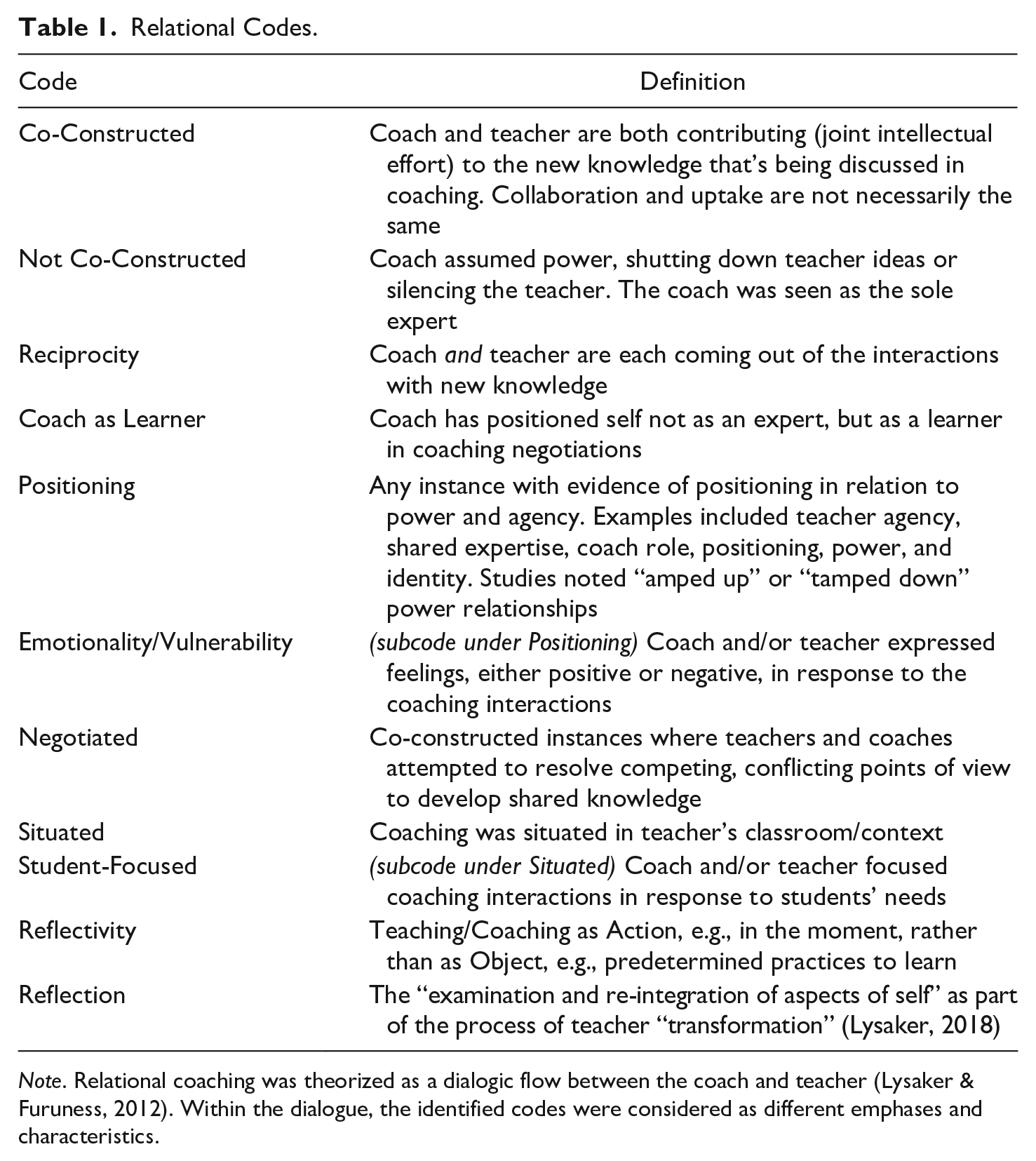
Note. Relational coaching was theorized as a dialogic flow between the coach and teacher (Lysaker & Furuness, 2012). Within the dialogue, the identified codes were considered as different emphases and characteristics.
Findings
To support understanding of the “grand narrative,” we first summarize the contextual information reported in the 28 studies. We then present our major finding synthesized from the reported findings: Coaching outcomes are related to opportunities and obstacles for co-constructed meaning, and such opportunities and obstacles are differentially created through coach–teacher positioning. To provide clarity for the finding, we explain our understanding of co-construction; to explicate the finding, we provide both examples and nonexamples reported in the 28 studies.
The Focal Studies
All studies examined teacher uptake of coached literacy practices and/or teachers’ social-emotional responses to coaching. Nineteen studies examined coaching in elementary settings, six in secondary settings, and three in K–12. 3 Most studies used qualitative (43%) and discourse analysis (32%) designs. The remaining 25% employed experimental (hierarchical linear modeling) and mixed methods (quasi-experimental or descriptive statistics coupled with qualitative analysis of interviews or surveys).
Nine studies examined coaches who were external to the coaching context (e.g., researchers, graduate students). In these studies, coaching related to particular approaches to literacy teaching: Standards for Effective Pedagogy (Haneda et al., 2019; Teemant, 2014; Teemant et al., 2011), Collaborative Strategic Reading (Jacobs et al., 2018), new literacies (Skinner et al., 2014), Targeted Reading Intervention (e.g., Varghese et al., 2016), and Questioning the Author (Kim & Silver, 2016). Fifteen studies examined coaches who were school- or district-based employees. Five studies explored coaching in supervisory or practicum contexts. Across these three contexts, studies examined coach–teacher interactions in one-on-one conversations (86%), small-group coaching conversations (25%), and seminar courses (11%), as well as coach-only reflections (7%).
Demographic information (i.e., gender, race/ethnicity, and years of experience) for coaches, teachers, and study sites was inconsistent and incomplete. Some studies provided this information just for coaches, while others noted only teacher demographics. Three studies provided no specification. The majority of coaches and teachers identified were White females. Of 16 studies that indicated coach experience, most examined novice and early career coaches. Eighteen studies described teacher experience, which was fairly evenly distributed across 0 to 10-plus years. The majority (68%) of school, district, and practicum sites did not specify socioeconomic status. Similarly, a majority (75%) did not provide students’ racial and ethnic backgrounds, relying instead on an overall description of a school or district as “diverse” (e.g., Parsons, 2018).
For both aspects of teacher outcomes (i.e., teacher uptake of coached literacy practices and teachers’ social-emotional responses to coaching), findings were mixed. Some studies documented limited instances of instructional change (e.g., Marsh et al., 2015), while others reported statistically significant evidence of instructional change (e.g., Teemant, 2014). Some studies found positive affective responses to coaching (e.g., Kim & Silver, 2016), while others were fraught with tense power dynamics (e.g., Hunt, 2016). Three studies (Varghese et al., 2016; Vernon-Feagans et al., 2013, 2015) noted student outcomes, reporting significant positive associations with students’ alphabetic, decoding, comprehension, and spelling skills. We did not interpret any outcomes as aligning with more or less relational approaches; rather, we sought to understand what constitutes relationality in coaching enactment.
A Relational Definition of Co-Construction
As we reviewed the studies, we found the concepts of collaboration and co-construction to be central, and yet we also found the use of the terms, at times, to be confounded. That led us to specify our terms and draw a clear distinction between these ideas. We defined collaboration as an expectation or realization of the coach and teacher working together in positive and trusting ways despite differential roles (e.g., Hunt, 2016; Ippolito, 2010); we further specified this idea as either participatory collaboration or co-construction.
In participatory collaboration, one party (typically the coach) shares knowledge and expertise, and the other party (typically the teacher) is positioned to either uptake or resist. Mutuality of sharing is not assumed, as the conversation is driven predominantly by a top-down hierarchical flow of information that often privileges teacher fidelity of implementation and aims to increase teacher uptake of coached material. In these instances, coaching commonly occurs around a predetermined concept that teachers are expected to implement, such as the Targeted Reading Intervention (Varghese et al., 2016), running records (Jones & Rainville, 2014), or the Standards for Effective Pedagogy (Teemant et al., 2011). We perceive participatory collaboration as a necessary, but insufficient, precursor to co-construction.
In contrast, we defined co-construction as a dialogic flow between coach and teacher that assumes equity in knowledge, experience, and emotional exchange. Associated meaning-making is built on shared expertise and knowledge-building (e.g., questioning, disagreeing, consensus building), and is intensely personal, contextualized by the unique human circumstances of the coach–teacher relationship. Lysaker (2018), in describing a relational perspective toward literacy, wrote, “Meaning happens in the in-between” (p. 6). In literacy coaching, we defined the “in-between” as mutuality in leadership and knowledge-building. As one example, Zoch (2015) presented Gina, a literacy coach, in this way: “Rather than ‘train’ teachers, she approached teacher learning through an inquiry approach where she positioned herself as a learner and engaged in inquiry with them, using their questions to guide learning opportunities” (p. 349).
Differential Enactments of Co-Construction
Whereas participatory collaboration was ubiquitous in the target studies (e.g., Hunt, 2016; Hunt & Handsfield, 2013; Ippolito, 2010), co-construction was rarer (e.g., Wilder, 2014; Wilder & Herro, 2016). Our analysis indicated that the realization of co-construction may be influenced by differential patterns of enactment related to positioning and coach–teacher dispositions toward coaching: (a) knowledge flow, (b) distributed expertise, and (c) vulnerability. In each section, we present evidence of opportunities that enhanced co-construction and obstacles that reduced co-construction.
Knowledge flow
In coaching interactions that support co-construction, knowledge and skills flow dialogically and horizontally (Marsh et al., 2015) between coach and teacher. Co-construction is disrupted, however, when the coach imparts knowledge almost exclusively from a position of intellectual authority, creating a hierarchical, or vertical, knowledge flow (Marsh et al., 2015). The first set of findings centered on opportunities and obstacles for knowledge flow.
We found evidence of horizontal flow in slightly less than half of the studies. In some (Haneda et al., 2019; Ippolito, 2010; Marsh et al., 2015; McGrath & Bardsley, 2018; Parsons, 2018; Rogers, 2014; Vanderburg & Stephens, 2010; Varghese et al., 2016; Vernon-Feagans et al., 2013, 2015; Zoch, 2015), horizontal flow was achieved through coaches’ attention to teachers’ context, engaging with the teachers’ literacy knowledge and skills with awareness of their classroom needs and responding with their equally specialized literacy knowledge. Coaches’ and teachers’ dispositions were those of “thinking together” (McGrath & Bardsley, 2018, p. 361). For example, Ellie, a novice teacher, shared her insights about Sabrina, an experienced coach, who, Ellie said, “made me think.”
Ellie attributed this to Sabrina’s persistent questioning: “I don’t know a nicer way to say but she was gonna push you to think, you know, or get it out I guess . . . she would question enough that you’re gonna figure it out. You’re gonna figure out if it’s you or this activity or, you know?” (Haneda et al., 2019, p. 169)
Horizontal flow was especially evident in studies in which the coach had specialized literacy knowledge and the teachers were content-area specialists (DiDomenico et al., 2018; Skinner et al., 2014; Wilder, 2014; Wilder & Herro, 2016). In these contexts, it seemed, coach and teacher perceived each other to have unique knowledge, necessitating reciprocity of knowledge sharing and skill exchange. DiDomenico et al. (2018) aptly described these participants as holding dispositions as a “partner in the process” (p. 96). Wilder (2014) highlighted the dispositions of a coach (Eric) and a teacher (Jackie) toward horizontal co-construction of teaching practices, as the coach provides suggestions and the teacher decides if and when to act on them:
Hey, I’ve been asking students about the larger purpose for factoring and they are pretty much confused. I’m not really sure what that purpose is but I’m wondering if we could . . . kind of like contextualize the inquiry process for them.
Oh, cool. Wait what do you mean? I am not sure we want to make it explicit because it will come naturally as we progress.
I guess. I was just thinking that I used a process for introducing essential questions in my English class at the start of the unit, and it might be a way to build inquiry here.
I’m not sure where to fit it. You think we should just stop and do it now? (p. 160)
In contrast, despite a stated intent in several studies to implement collaborative coaching, doing so was undermined by the structure of the coaching initiative itself. In the majority of studies, the literacy professional development framework was developed not by participating teachers but by university researchers (Gray & Myers, 2018; Jacobs et al., 2018; Teemant, 2014; Teemant et al., 2011; Varghese et al., 2016; Vernon-Feagans et al., 2013, 2015), governmental policy makers (Vanderburg & Stephens, 2010; Zoch, 2015), or district-level leadership (Gibson, 2006; Heineke, 2013; Hunt, 2016, 2018; Marsh et al., 2015). Although unintended, this top-down approach positioned coaches as literacy “middle men” (Zoch, 2015) situated between teacher interests and school or district leadership mandates; moreover, it positioned teacher knowledge as relatively unimportant in comparison with coach knowledge. Across these studies, there was evidence that coaches had particular curricular or instructional goals for teachers’ adherence.
The resulting vertical knowledge flow—from coach to teacher—is demonstrated with Hunt’s (2016) example of a coach (Grace) and teacher (Sophie): Sophie explained, “one thing I’ve had to do is cut down the amount of independent writing time because once they hit that, like, 20 min mark it’s, like, wandering eyes everywhere.” As Grace indicated in a later interview, she disapproved of Sophie’s decision to reduce independent writing time. Accordingly, at minute 19, she argued that most of the students could “handle a 30, 40 min structured independent time.” . . . Then, she made suggestions for extending independent writing time . . . Sophie interjected stories about recent successes in writing workshop . . . Grace briefly acknowledged Sophie’s success stories . . . before offering more suggestions for extending independent writing time. (pp. 339–340)
In sum, as we looked across the studies, we found a horizontal discourse flow most often associated with the occurrence of co-constructed meaning and understanding. We further found that some particular factors (e.g., a top-down evolution of coaching) were associated with a vertical discourse flow.
Distributed expertise
Whereas dialogic flow characterizes the hierarchical or nonhierarchical nature of the discourse, distributed expertise describes the perception of authority or equity in decision-making around which instructional practices can be implemented. As we analyzed studies, we found a pattern of interactions that we came to recognize as distributed expertise—a context in which there was space for coach and teacher to choose research-based practices specifically aligned with teacher or student needs (Marsh et al., 2015; Salas et al., 2015; Zoch, 2015). This context was less prevalent and differed quite clearly from those in which the coaching initiative was guided by a demand for fidelity of implementation to a particular set of practices (Jacobs et al., 2018; Teemant, 2014; Teemant et al., 2011; Varghese et al., 2016; Vernon-Feagans et al., 2013, 2015).
Distributed expertise enactments tended to necessitate dispositions toward negotiation by coaches and teachers around decision making. Skinner et al. (2014), Wilder (2014), Wilder and Herro (2016), and DiDomenico et al. (2018) each documented the sometimes tense, but ultimately successful, co-constructions of knowledge and skills between literacy and English language arts (ELA) coaches and disciplinary teachers of science, social studies, and mathematics wherein new literacy practices were brought to small-group or one-on-one coaching interactions and content-specific teachers negotiated how to take these practices up. The productive—but sometimes uncomfortable—context of distributive expertise is well described by Skinner et al. (2014): The tension that bubbled to the surface in combination with Margaret [the coach and co-researcher] and the school-based literacy coach’s explicit sharing of expectations around developing and sharing new literacies instruction in the professional learning community allowed participants to grow in their understanding of new literacies content and in their identities as teachers who integrate new literacies in their teaching. (p. 224)
However, the enactment of distributed expertise was not limited to disciplinary contexts, as is evident in this first-grade teacher’s interview reflection on her coaching experience: Most of our time is spent pow-wowing with each other, or sharing, and learning from each other . . . it’s not a lecture kind of informing us . . . it’s just a very informative, yet, “What do you think?” kind of setting. . . . She’s never said, “This is the right thing to do, what you’re doing is wrong.” . . . [and] it makes me reflect on my practice. (Vanderburg & Stephens, 2010, p. 151)
In contrast to reports of having “space” in coaching interactions, other studies examined coaching initiatives in which emphasis was placed on the coaches’ role in monitoring the implementation of a specific curriculum or predetermined “best practices” (Haneda et al., 2019; Jacobs et al., 2018; Jones & Rainville, 2014; Kim & Silver, 2016; Salas et al., 2015; Skinner et al., 2014; Teemant, 2014; Teemant et al., 2011; Varghese et al., 2016; Vernon-Feagans et al., 2013, 2015). In these cases, the coach’s purpose was to act as the expert, impart knowledge of these approaches to teachers, and then monitor teachers’ implementation. With the exception of Jacobs et al. (2018) and Jones and Rainville (2014), all of the studies found considerable teacher fidelity, suggesting that the coach’s expert stance did result in instructional change.
These positive findings notwithstanding, some studies also documented tension and resistance to target practices (Jacobs et al., 2018; Jones & Rainville, 2014; Marsh et al., 2015; Wilder & Herro, 2016). Teacher resistance was sometimes overt. Jones and Rainville (2014) found that a teacher, “Mr. Blue [teacher] interrupted Kate [coach] and rejected her suggestions, ultimately revealing the vision he had had for their work: that he would rather have her complete some running records for him so he could be compliant” (p. 279). Marsh et al. (2015) found that “one observer characterized the coach’s demeanor as condescending: ‘I have personally witnessed [it] and I thought it was a little bit of condescending behavior, like, “I am smarter than you”’” (p. 16). Sometimes, resistance was passive, manifest in a teacher quietly deferring to a coach’s dismissal of ideas, even when the teacher possessed greater content knowledge (Wilder & Herro, 2016, p. 543), or simply avoiding coaching sessions (Jacobs et al., 2018).
At times, embrace of a new curriculum conflicted with a teacher’s existing (and sometimes long-held) understanding and practice—the logics of reading instruction (Woulfin, 2016). This is evident in Hunt’s (2016) presentation of Katie, an experienced teacher, whose acquiescence to reading workshop is identity forming: She explained, “I find myself going to the same kids” . . . and “I need to be, um, more purposeful in my note taking and making sure I’m picking everybody.” . . . The phrase I find myself gave the interaction a confessional tone and implied that she had acted inappropriately. (pp. 338–339)
Hunt noted that Katie’s confession reduced her expertise as a literacy teacher, positioning her to seek absolution from her early career coach, and limiting her agency as a teacher. In another example of limited teacher agency, Hunt (2018) highlighted the coach’s stance of fidelity to a prescribed model of workshop implementation: Any deviation from the district’s framework for literacy instruction was considered a failure to implement workshop with fidelity. For example, in two interviews conducted near the end of the school year, Grace complained about teachers who used literacy centers or workstations during reading workshop or who had a separate independent reading time, because she did not consider these practices to be aligned with the district-sanctioned model of workshop. (pp. 273–274)
Notably, coaches are not always at the root of their positioning as experts, but instead struggle against a teacher’s predetermined expectation. Gibson (2006) highlighted this tension in this conversation with a coach about her relationship with a kindergarten teacher: I think he’s looking to me to have all the answers. For everything. And I don’t know all the answers, because I want him to be self-reflective. I want him to look at his own teaching decisions. And think about, was it a good choice and if it wasn’t, why? And what can I do better? (p. 304)
Marsh et al. (2015), too, found that when the coach did not present as a literacy expert, in keeping with teacher expectations, teacher enthusiasm waned to the point of developing negative feelings for the coach.
Overall, the issue of distributed expertise is itself complex. On one hand, in the few studies in which there was clear and consistent distribution of power and decision making, teachers responded to coaching positively and productively. Conversely, when either the design of the coaching initiative or the disposition of the coach tips the balance toward coach as expert, the findings are uneven, sometimes yielding positive instructional change and sometimes not. One might speculate that in the absence of teacher agency, instructional changes might be short-lived, but longitudinal evidence would be necessary to test this possibility.
Vulnerability
A third pattern in the data related to vulnerability (with embedded emotionality) and its role in enhancing or inhibiting co-construction and influencing coach–teacher positioning. We defined these contrasting views on vulnerability in two ways. Some studies demonstrated what we saw as affirmative vulnerability—“efficacy doubt” (Wheatley, 2002)—an opportunity for co-construction with teacher and coach reciprocally and critically opening themselves up to new learning. Other studies demonstrated what we termed destabilizing vulnerability, an obstacle to co-construction, as teachers’ reduced agency and increased fear in the face of coaching observations, feedback, and critique, especially in contexts in which fidelity of implementation was desired.
Affirmative vulnerability
We found cases of affirmative vulnerability, especially in the findings of Wilder (2014), Wilder and Herro (2016), and DiDomenico et al. (2018), in which literacy coaches and disciplinary teachers navigated the disequilibrium of their differing areas of expertise and co-constructed knowledge that integrated literacy practices and disciplinary content. Wilder and Herro (2016) provided one illustrative example:
What are you thinking? You are the science master. The content is not my thing. So, the essential questions . . . are you still OK with those?
Yeah, sounds great. And, we should have them read about matter before the change of state experiments, but I don’t know how to do that. I’m not a literacy guy . . .
Sure, but you know science, so it’s exciting. There are two brains to wrap around an idea. (p. 544)
Such instances of co-construction hinged on both conversational participants framing the relationship as reciprocal. Each included the coach’s acknowledgment of the emotionality of coaching, as well as the limits of one individual’s knowledge and skills, and the coach’s ability to create a “safe space” for affirmative vulnerability to take root. These explicit actions transcend typical discussions of “trusting” and “collaborative” coaching relationships (Hunt, 2016) or the coach as a “critical friend” (Salas et al., 2015). Rather, they require deeper understanding and recognition of the competing roles of emotion, power, agency, and identity than are typically found in coaches’ professional preparation.
Similarly, coach reflectivity about the emotionality of coaching emerged as a fundamental skill for exhibiting affirmative vulnerability in coach–teacher interactions. Collet (2012), Gibson (2006), Marsh et al. (2015), Rogers (2014), Wilder (2014), Wilder and Herro (2016), and Zoch (2015) all documented coaches engaged in reflectivity to understand coaching outcomes, focusing their reflections not only on teachers but also on themselves as key but equal players. Rogers (2014), in her case study of a practicum coaching context to develop critical literacy teaching practices, noted, In this turn, she [the teacher] attributed responsibility for Isaiah’s lack of progress to her teaching, an important realization. It was here that I noticed that Karen had moved out of her comfort zone, and she needed support. I wanted Karen to refocus her attention on her strengths as a literacy teacher. (p. 257)
Likewise, Gibson (2006) shared one coach’s perception of her own vulnerability: I guess I feel like I was scared to coach. I was scared to go in there. I think it’s really important to keep good rapport with your teachers. To make it a coaching situation and not an evaluation. You know, focus on the children. “What did the children do? How did you help to make that happen?” As opposed to, “This is right, this is wrong.” (p. 305)
Self-reflectivity prompted coaches to question (a) the nature and effectiveness of their scaffolding and questioning behaviors (Collet, 2012); (b) ways to maintain coach and teacher agency (Gibson, 2006); (c) ways to accommodate hybridity in ideas (Marsh et al., 2015; Wilder, 2014; Wilder & Herro, 2016); and (d) ways to “follow the teacher’s lead” in enacting pedagogical change (Rogers, 2014). Importantly, such self-reflectivity appeared necessary to both avoid destabilizing vulnerability and foster affirmative vulnerability, a fundamental step in opening the door to co-construction.
Destabilizing vulnerability
We also found instances where destabilizing vulnerability negatively influenced teachers’ interactions with coaches in several studies (e.g., Hunt, 2016, 2018; Jones & Rainville, 2014). In these instances, when coaching goals did not sufficiently consider teacher knowledge and needs, placing teachers in a vulnerable position of the coach being the sole expert, teacher resistance occurred. For example, Hunt’s (2016) analysis of the interactions between a coach (Sarah) and a teacher (Luke) highlights the destabilizing vulnerability that influenced coaching efficacy: Sarah encouraged Luke to continue trying out similar projects in his classroom. . . . She stated, “I’m glad to see that you’re not discouraged in that you’d want to give up and not try again.” . . . Although she phrased this statement positively, she implied that Luke had failed and, therefore, had reason to be discouraged. . . . Luke resisted this emotional label, asserting, “I know for sure we’re trying again” . . . but he did not invite Sarah to co-plan or co-teach with him again for the remainder of the school year. (p. 338)
Teachers’ and coaches’ competing ideas about roles, responsibilities, pedagogy, and relationships were also sources of destabilizing vulnerability for coaches and teachers alike, as were actions by coaches and teachers who initially struggled to validate their own and each other’s areas of expertise in the coaching process. For instance, Hunt and Handsfield (2013) noted, Some of the coaches began to share their frustrations with trying to coach in classrooms and with unclear expectations. Yvette added that it has been very difficult for her to build relationships with teachers. She began to cry as she expressed feeling “defeated” in developing an understanding of teachers and their practice. (p. 69)
During these interactions, coaches and teachers employed protective emotional mechanisms to maintain their senses of identity (Hunt, 2016; Hunt & Handsfield, 2013). Coaches sometimes chose not to take up teachers’ ideas not aligned to coaching protocols or mandates (Heineke, 2013), essentially silencing teachers. Heineke reported, “Ms. Talbot spoke figuratively of having ‘her hand slapped’ by her coach because it was Ms. Miller’s responsibility to monitor what teachers were doing and how long they were doing it during the reading block” (p. 417). Teachers also participated in coaching only superficially and actively protected themselves from “openness” to vulnerability and change (e.g., Jones & Rainville, 2014). Teachers (and most coaches) were universally uncomfortable in these situations, as relationships assumed a hierarchical exchange.
Discussion
In this metasynthesis, we set out to explore how reframing the behaviors and practices of literacy coaches relationally might bring us closer to understanding how effective coaches support teachers in developing ever-greater levels of teaching expertise. We identified a small corpus (n = 28) of studies that explored literacy coaching in elementary and secondary settings through mostly qualitative (e.g., case study, ethnography, phenomenology) and discourse analysis designs, with a predominant focus on teacher learning outcomes. Notably, many of the studies reported inconsistent or incomplete information related to participant demographics.
To understand how coaching interactions grow into relational experiences, we drew a distinction between participatory collaboration, which we defined as a commitment to working together to achieve positive change, and co-construction, which begins with a collaborative stance but extends the commitment to an equitable exchange of knowledge and decision-making. We found all studies fit the definition of a participatory collaborative experience, while only a few were viewed as co-constructive enterprises. We also found differential enactments of a relational coaching perspective grouped around three themes: knowledge flow, distributed expertise, and vulnerability. At times, these factors surfaced in positive ways as coaches and teachers positioned themselves or each other within a reciprocal, horizontal knowledge flow shifting between coaches and teachers somewhat seamlessly; distributed expertise relatively equally; and demonstrated affirmative vulnerabilities. At other times, the factors surfaced in detrimental ways as coaches and teachers positioned themselves or each other within a vertical, hierarchical knowledge flow from the coach to teacher, when expertise was attributed to the coach predominantly, and when coaching was met with destabilizing vulnerability and emotional tensions, at times by both the teacher and the coach.
Interestingly, although maybe not surprisingly, studies of disciplinary literacy coaching (e.g., Wilder, 2014) were far more co-constructive and relational than studies of literacy coaches and general classroom teachers. With clearer demarcations between coach–teacher knowledge and skills, it may be easier to see expertise in others and to work in co-constructive ways. Opportunities for co-constructive, relational coaching were also demonstrated when coaches approached their work with teachers in ways that expanded the horizons of teaching beyond the implementation of particular instructional practices toward promoting reflectivity, responsivity, and agency among teachers (e.g., Haneda et al., 2019). In other instances, researchers described a process in which coaches gently “prodded” (Skinner et al., 2014) teachers toward instructional change, balancing directive and responsive coaching actions (Ippolito, 2010), or engaged in heavy and light coaching (Wilder, 2014) in attempts toward equitable professional learning contexts.
In contrast, when a vertical, hierarchical dialogic flow characterized the coaching interaction, teachers who suggested alternative instructional practices were routinely viewed as resistant and as barriers to meeting external literacy teaching goals (Heineke, 2013). Coaching interactions took on win–lose overtones that positioned teachers as oppositional and requiring coaxing and cajoling from their coaches to perform (Skinner et al., 2014). Teacher refusal to take up particular practices was viewed as a coaching failure (Jones & Rainville, 2014), rather than as an opportunity for co-constructing a solution to a problem of practice.
The latter point is of particular importance when considering the flow of knowledge and skills. While in a few studies coaching conversations began at the student level (Marsh et al., 2015; Varghese et al., 2016; Vernon-Feagans et al., 2013, 2015), the majority began with predetermined literacy frameworks, practices, and processes. Thus, despite consistent claims across the literature that student-centered instruction was an anticipated outcome, coaching interactions promoting responsive teaching to the diversity of student needs in classrooms were infrequently reported in comparison with coaching interactions focused on teacher fidelity to a particular literacy strategy.
These findings prompted us to question the role of observational tools and fidelity-of-implementation stances and to consider the ways they position teachers in the role of compliance, with the risk of failing to “live up” to set standards. Reinking (2011) noted the intractability of the “laboratory metaphor,” which emphasizes fidelity, best practices, and effectiveness. He argued, instead, for a “lens metaphor” (p. 9) that recognizes the “inherent complexity of contexts for teaching and learning” and holds the potential to move educators beyond “perseverating on measurable achievement” (p. 9) to examine situated practices that will help teachers advance their teaching. We see this lens metaphor as particularly apt in considering how coaches might approach their work with individual teachers and collective faculty within schools.
Across the literature, coaches often had the challenging task of negotiating imposed positioning, whether from teachers or external leadership, that undermined more equitable relationships. Indeed, the coaches in the data set we analyzed generally expressed a stance of responsivity toward teachers, with frequent references to the importance of supporting teachers and promoting teachers’ self-efficacy, while challenging teachers and encouraging reflection. Yet, Collet (2012), Gibson (2006), Vanderburg and Stephens (2010), and Zoch (2015) each described teachers as holding perceptions of coaches as experts and sources of literacy knowledge, without extending these perceptions to themselves as teachers of literacy. This positioning occurred even when coaches took a stance toward teachers as agentive, knowledgeable professionals.
Understanding the limits of current notions of participatory collaboration between coaches and teachers might account for the mixed outcomes of coaching studies. By definition, there cannot be co-construction without teachers positioned as knowledgeable informants. We found that coaches tended to express dissatisfaction and frustration when coaching devolved into situations of destabilizing vulnerability (e.g., Hunt, 2016; Jones & Rainville, 2014). Spending valuable coaching time in negotiation to overcome teacher resistance represents lost opportunity. The resistance that surfaces during difficult interactions may stem from emotional defense mechanisms that reflect the humanness of coaching, and ignoring or minimizing this resistance reduces opportunities for learning. Vulnerability and emotionality, especially in response to teacher resistance, should be viewed not as failure but as a genuine step toward growth in the learning process. In this way, teachers and coaches may enter into “co-agential” conversations that lead to the design and implementation of practices that are intentionally responsive to research-based practices in the context of the focal classroom and student needs.
Toward a Relational Coaching Approach
Collectively, we believe these findings reflect a critical gap in the coaching literature, as a pathway toward understanding the uneven outcomes of coaching initiatives. Rooted in a Vygotskian perspective, Lysaker (2018) posited that knowing originates and is mediated in relationship with others. Humans are “dialogically constructed through language” and transform during “meaning making events.” Being in-relation offers “a context for being and becoming” (p. 6), as humans interpret ideas and experiences to build meaning. Coaching offers such a context, as coaches and teachers engage in a dialogically constructed, meaning-making event.
As previously defined, relational coaching is grounded in lived experiences between the coach and teacher, characterized by contexts in which a dialogic flow allows space for individuality and supports “relatingness” (Lysaker, 2018). When equitable positioning and power-sharing are evident in coaching interactions, the dialogic flow brings teachers into the planning process as partners in identifying important problems of practice, co-constructing instructional solutions in the context of the particular classroom and in relation to the observed students, and concentrating expectations for fidelity of implementation on those jointly constructed solutions. As part of this joint enterprise, there is a shared expectation and process for exchanging feedback. This means there is also an awareness, acknowledgment, and acceptance of the range of tensions, emotions, and vulnerabilities that may surface during these interactions, and strategies are developed for reflecting on and responding to these needs.
Lysaker and Furuness (2012) further argued that individuals are multifaceted and composed of many selves that have developed over time and through which individuals cultivate their worldviews and define what it means to be in the world. A goal of relational coaching is creating a space for dialogue between different aspects of one’s self that have developed over time, for instance, between past and present experience, to open dialogic space for reflection and the opportunity to assess one’s experiences objectively. By bringing these “selves” into dialogue, for example, “the self who teaches” and “the self who learns,” coaches and teachers prompt reflection and facilitate professional and personal growth (Lysaker & Furuness, 2012). This process of “examination and reintegration” (p. 185) of aspects of oneself is fostered through relational coaching wherein coaches and teachers encourage reflection and set in motion the process for both participants to incorporate new knowledge, skills, and insights. Such a process “fosters an empowered sense of purpose and agency more than a program of skills and knowledge alone can provide” (p. 184).
Implications
We acknowledge the interpretation of human interactions is a fundamentally subjective act, and the relatively small number of studies addressing relational aspects of coaching reflect only part of the picture. Yet, coaching relationships are inherently complex and cannot be easily sorted. Through this metasynthesis, we have identified some of the factors at play during these complex interactions, particularly the relational aspects of coaching and attendant issues of positioning and dispositions that influence coaching effectiveness. Moreover, the opportunities for dialogic flow and potential for professional growth that reside in these co-constructive spaces highlight the importance of including both coaches’ and teachers’ voices in the coaching process. Relational understanding thus calls for an interpretive approach that seeks insights into the “in-between” space and lived experiences of coaches and teachers as they work through the complexities of the very human experiences of teaching and learning.
Future research should continue to explore the lived experiences of coaches and teachers as they interact around situated problems of practice. Further studies employing discourse analysis can illuminate coaches’ use of language and the subsequent learning for both coaches and teachers. A focus on the interactions of gender, race, and ethnicity among participants—currently absent from many existing studies—can help us understand how socially constructed norms create realities, invite identities, and position knowledge within social contexts.
Considering coaching from a relational perspective means we need to rethink the efficacy of the top-down flow of professional development. While policies such as ESSA (2015) and state mandates call for professional development that incorporates coaching, top-down specification of instructional practices likely undermines the achievement of expected outcomes. Future studies should examine coaching initiatives in which instructional problems are jointly identified to respond to teachers’ genuine needs relative to their particular students. In turn, research should seek to understand how coaches and teachers cultivate contexts conducive to teacher inquiry, shared expertise, and equitable positioning to empower teachers to act agentively in finding solutions to these problems. Likewise, research should examine how to prepare literacy coaches to approach coaching as a fundamentally relational enterprise. What types of professional learning opportunities prepare coaches (and other school leaders) to place co-construction at the heart of coaching initiatives?
Finally, it is possible that the relational experience of coaching itself may influence the ways teachers teach. That is, perhaps teachers who experience coaching characterized by dialogic knowledge flow, distributed expertise, and affirmative vulnerabilities take a similar approach with their own students. If so, does the approach foster in their students a new willingness to act and take initiative, or other agentive behaviors, that open doors to students’ lifelong learning? Understanding the reach of relational coaching could significantly affect the resources policy makers and administrators dedicate to such efforts.
Supplemental Material
Copy_of_Robertson_Appendix_A_RSB_CCL_(Updated – Supplemental material for What Does It Mean to Say Coaching Is Relational?
Supplemental material, Copy_of_Robertson_Appendix_A_RSB_CCL_(Updated for What Does It Mean to Say Coaching Is Relational? by Dana A. Robertson, Lauren Breckenridge Padesky, Evelyn Ford-Connors and Jeanne R. Paratore in Journal of Literacy Research
Supplemental Material
Copy_of_Robertson_Appendix_B_RSB_CCL – Supplemental material for What Does It Mean to Say Coaching Is Relational?
Supplemental material, Copy_of_Robertson_Appendix_B_RSB_CCL for What Does It Mean to Say Coaching Is Relational? by Dana A. Robertson, Lauren Breckenridge Padesky, Evelyn Ford-Connors and Jeanne R. Paratore in Journal of Literacy Research
Supplemental Material
Translated_Abstracts_Robertson – Supplemental material for What Does It Mean to Say Coaching Is Relational?
Supplemental material, Translated_Abstracts_Robertson for What Does It Mean to Say Coaching Is Relational? by Dana A. Robertson, Lauren Breckenridge Padesky, Evelyn Ford-Connors and Jeanne R. Paratore in Journal of Literacy Research
Footnotes
Declaration of Conflicting Interests
The author(s) declared no potential conflicts of interest with respect to the research, authorship, and/or publication of this article.
Funding
The author(s) received no financial support for the research authorship and/or publication of this article.
Supplemental Material

Notes
References
Supplementary Material
Please find the following supplemental material available below.
For Open Access articles published under a Creative Commons License, all supplemental material carries the same license as the article it is associated with.
For non-Open Access articles published, all supplemental material carries a non-exclusive license, and permission requests for re-use of supplemental material or any part of supplemental material shall be sent directly to the copyright owner as specified in the copyright notice associated with the article.
