




Abstract
Growing numbers of scholars in composition studies support translingual orientations in their postsecondary writing classrooms. However, translingual orientations are rarely extended to elementary school writers, who are often asked to compose exclusively in Dominant American English. Drawing on theories of translingualism and emergent biliteracy, we use case study methods to examine children’s translingual writing in a highly linguistically diverse second-grade classroom. We pay particular attention to students who had not had formal instruction in languages they tended to use orally, documenting the creative and strategic ways in which they wrote. Among other strategies, students repurposed English sound–symbol correspondences in developmental spelling, composed strings of non-Roman symbols, and remixed multilingual environmental print. They also engaged in translingual writing for a range of purposes, such as expressing pride, connecting with audiences, and indexing identities. Our findings suggest the potential of moving translingual perspectives beyond postsecondary contexts and into elementary classrooms.
Throughout the last decade, composition scholars in postsecondary contexts have called for translingual approaches to the teaching of writing (see, e.g., Horner, Lu, Royster, & Trimbur, 2011). Translingual approaches position language as negotiated and synergistic and suggest that writers might draw on the fullest extent of their communicative repertoires (e.g., resources coded as named languages, dialects, phonologies, or symbols; see Rymes, 2010) in composition (Canagarajah, 2013; Zapata, Kuby, & Thiel, 2018). Translingualism meshes perceived boundaries between languages, symbols, and modes and urges writers to interrogate relationships between language and power (Guerra, 2016).
Despite increasing support for translingualism in postsecondary contexts, educators have less commonly extended translingual orientations to beginning writers in primary classrooms (Zapata & Laman, 2016). In fact, instruction in early writing classrooms tends to focus strongly on convention, with children expected to learn to write in prescribed genres, spell words correctly, and punctuate their sentences (Dyson, 2013). Multilingual students, and particularly those designated as “English learners” in schools, are especially likely to encounter this sort of instruction, and often “find themselves composing in language restrictive environments or within scripted, overly reductionist curricula that can significantly limit the repertoires of cultural and linguistic resources available to them” (Ranker, 2009, pp. 397-398).
We explore what happened when Paul Hartman (Author 2), an elementary school teacher, opened up his writing classroom to the breadth of children’s communicative repertoires. Drawing on theories of emergent biliteracy and translingual writing, we examined how students in a linguistically diverse second-grade classroom composed translingual poetry.
Although we positioned all students as agentive users of literacy and language, engaging in translingual writing felt challenging for some students who worried that they could not read or write in languages they tended to use orally with their families and in their communities. As we closely analyzed their writing, we found that these students creatively and strategically drew on practices associated with emergent literacy to write, such as repurposing (Durán, 2018) English letter–sound correspondences in multilingual developmental spelling, composing letter strings with non-Roman characters, and remixing multilingual environmental print. Despite an emphasis on mastering English conventions in primary writing instruction, our findings suggest that young multilingual children—even those who have not had formal instruction in languages other than English—can skillfully engage in translingual writing.
We begin by framing this study theoretically and situating it within existing research. Then, we describe our use of case study methods and highlight how consultations with translators helped us more deeply understand student writing in Urdu, Amharic, Chinese, Yoruba, and Tibetan. Next, we present findings that illustrate how and why students composed translingual poetry with resources coded as languages beyond English (LBE; we follow Cunningham, 2019, in using “languages beyond English” rather than alternatives such as “languages other than English” to position the use of these languages through an asset-oriented lens and recognize the expansive nature of children’s communicative repertoires). We conclude with a discussion of the affordances and tensions of this work and offer implications for teachers and researchers.
Theoretical Perspectives: Emergent Biliteracy and Translingual Writing
We framed this analysis with two theoretical perspectives: emergent biliteracy and translingual writing. Bringing these perspectives together illuminated how children wrote in languages they tended to use orally and drew our attention to children’s reasons for expressing written meaning using the fullest extent of their communicative repertoires.
Emergent Biliteracy
An emergent literacy perspective highlights how children notice, approximate, and appropriate literacy practices in their homes, schools, and communities (Teale, Hoffman, Whittingham, & Paciga, 2018). This perspective underscores the interconnected nature of reading and writing processes and describes how children’s scribbles, drawings, nonphonetic letter strings, and developmental spellings (e.g., “rit” for “write”) reflect literacy learning (Rowe & Flushman, 2013). However, emergent writing has historically been examined in monolingual contexts, with comparatively little attention to the writing of multilingual children (Rowe, 2009).
Emergent biliteracy, defined as the “ongoing, dynamic development of concepts and expertise for thinking, listening, speaking, reading, and writing in two languages” (Gort, 2019, p. 233), describes multilingual children’s literate meaning-making. Like emergent literacy, emergent biliteracy is supported through participation in and approximation of literacy practices in homes, communities, and schools. For many young children, however, opportunities to become biliterate through systematic instruction may be limited in schools, where dominant ideologies often frame their languages as barriers for learning (Morren López, 2012). These children may develop spontaneous biliteracy, or the “acquisition of literacy in two languages without prescribed instruction in both languages” (de la luz Reyes, 2012, p. 248) through participation in their homes and communities. Spontaneous biliteracy reveals how children engage in multilingual meaning-making, such as repurposing English letter–sound correspondences in writing (e.g., spelling the Spanish huele as “wele”; see Durán, 2018, p. 82).
One difference between emergent biliteracy and emergent literacy is attention to the ways that children construct hypotheses about the differences between languages. Kenner, Kress, Al-Khatib, Kam, and Tsai (2004) describe young biliterate children as having a “double metalinguistic awareness” (p. 140); they may express emerging understandings of linguistic difference by changing text shape, position, or case (Reyes & Azuara, 2008).
In summary, an emergent biliteracy lens helps us understand how young multilingual children construct understandings about text. Although emergent biliteracy details the how of children’s literacy development across languages, translingual writing, another perspective invoked in this study, explores why students might intentionally deploy languages, symbols, and modes to communicate in writing.
Translingual Writing
Translingual writing (Horner et al., 2011) is a theoretical perspective that emphasizes synergistic and hybrid ways of creating meaning through composition. Translingual approaches invite writers to draw on the fullest extent of their communicative repertoires, subverting dominant conventions that keep resources coded as named languages, dialects, symbol systems, and modes separate (Canagarajah, 2013). A translingual approach attends to intersections of language and identities (S. P. Alvarez, Canagarajah, Lee, Lee, & Rabbi, 2017) and encourages the use of multiple modalities and semiotic tools, including symbols and color (Pacheco & Smith, 2015).
Code-meshing, which Canagarajah (2013) defines as a merging of “diverse language resources with the dominant genre conventions to construct hybrid texts for voice” (p. 40), is a practice commonly associated with translingualism. Often, code-meshing involves blending two or more linguistic varieties within a single composition, intentionally disrupting language separation (Canagarajah, 2013) and offering students “a more realistic, humane, and useful means of experiencing and profiting from composition” (M. E. Lee, 2014, p. 318). It is important to note, though, that scholars such as Matsuda (2014) and Guerra (2016) have critiqued the field’s emphasis on code-meshing, arguing that translingualism should encompass a broader range of communicative practices, including the choice to write exclusively in Dominant American English (DAE).
Translingualism shares much in common with translanguaging, a theoretical perspective and pedagogical approach focused on languaging and meaning-making in multilingual communities (García, Johnson, & Seltzer, 2016). García (2009) defines translanguaging as “the act performed by bilinguals of accessing different linguistic features or various modes of what are described as autonomous languages, in order to maximize communicative potential” (p. 140). Like translingualism, translanguaging shares a “view of language as a social resource without clear boundaries, which places the speaker at the heart of the interaction” (Creese & Blackledge, 2015). However, while translingualism is rooted in the field of composition, with a strong (though not exclusive) focus on writing, translanguaging encompasses a broad range of communicative practices. In fact, Velasco and García (2014) argued that translanguaging “has met the most resistance in the area of writing” (p. 8), which is often perceived to be less flexible than other communicative practices. By turning to translingualism in our analysis, we drew from a theoretical perspective focused specifically on writing, with attention to its nature as “performative, transformative, ideological, context bound, and indicative of difference as the norm” (Cushman, 2016, p. 234).
In this study, we brought translingualism into conversation with emergent biliteracy. Emergent biliteracy helped us understand how children wrote in LBE when they had not experienced school-based instruction in these languages and worried about their own proficiencies in reading and writing. Moreover, an emergent biliteracy perspective positioned their writing as a valid and deeply meaningful literacy practice, even when it appeared to be unconventional. At the same time, translingualism helped us understand why children took up an invitation to write in LBE, with attention to ways that their writing intersected with their identities and disrupted dominant language ideologies in elementary school classrooms. Translingualism also helped us attend to the ways that children used drawings, symbols, and color not as scaffolds, but as communicative resources that amplified meaning-making. Through our use of these two perspectives, we suggest that young children—even those who position themselves as nonreaders and nonwriters in LBE—can engage in translingual writing, a practice often reserved for youth and adults.
Language and the Writing Classroom
Children’s writing—even in school contexts—is deeply interwoven with social and cultural influences. Dyson (2003) described how children recontextualize these influences, weaving references to popular culture and media into and across their compositions. While all children bring cultural ways of knowing to their writing, multilingual children often recontextualize robust linguistic resources as well.
A long-standing body of literature has demonstrated that children’s languaging practices are visible in/through their school-based storytelling and writing. For example, Solsken, Willet, and Wilson-Keenan (2000) described how, in response to family classroom visits, a young student blended elements of a Puerto Rican cuento, or morality tale, as she told a cautionary story about a boy who threw rocks. Ranker (2009) examined students’ hybrid languaging in their individual and collaborative writing, documenting how, following an invitation from their teacher, students combined traditional school-based writing tools (e.g., pattern writing) with Spanish. Building on this tradition, A. Alvarez (2018) brought multimodal perspectives to her analysis of the Spanish writing and drawings of her first-grade students. She explored how, following an invitation to compose with text and image, children depicted their cultural funds of knowledge, including understandings of social dynamics and networks of family and community support.
Following translanguaging/translingual (García & Wei, 2014) turns in scholarship, a growing body of research documents how teachers support children to intentionally draw upon the fullest extent of their communicative repertoires in writing. For example, Durán (2017) examined bilingual children’s writing in an audience-focused curriculum, arguing that children made strategic languaging choices to connect with authentic audiences, including parents and a published bilingual author. In a before-school writing program designed to support the languaging practices of young bilingual students, Axelrod and Cole (2018) similarly found that children demonstrated an awareness of audience as they chose when and where to use Spanish in their writing to Mexican pen pals. They also found that young children noticed orthographic differences between English and Spanish as they composed, strategically choosing where to deploy features like consonant digraphs.
A smaller number of these studies examine children’s written code-meshing, most often following explicit invitations from teachers. Michael-Luna & Canagarajah (2007) documented how a bilingual first-grade teacher encouraged children to code-mesh in their speech and writing, leading a student named Leo to compose the code-meshed sentence, “The bug está muerto,” rather than “The bug is dead,” because the Spanish phrase “had a more profound network of meaning for Leo and his multilingual audience” (p. 68). A. Y. Lee and Handsfield (2018) explored code-meshing in a fourth-grade classroom, describing how students collaboratively wrote in the style of a published bilingual picturebook, with attention to their bilingual audience. In an analysis of three elementary school classrooms, Zapata and Laman (2016) found that when teachers drew on community knowledge, modeled and discussed language use (including code-meshing), and showcased linguistically diverse children’s literature, students felt empowered to bring languages such as Spanish, Japanese, Arabic, and Hindi into their compositions.
Taken together, these studies suggest that when teachers open up classroom spaces, children bring a wealth of resources to their writing, including expanded vocabularies, heightened metalinguistic awareness, increased attention to audience, and rhetorical and stylistic writing moves inspired by published bilingual texts. However, there is still much to be learned about multilingual children’s writing in U.S. schools. First, because many of the aforementioned studies examined students’ writing in English and Spanish, we need additional research on young multilingual children’s school writing in other languages, including those that use non-Roman or nonalphabetic scripts. Along the same lines, we know comparatively less about how and why young children in linguistically diverse, English-medium classrooms engage in such writing, especially when they may be the only speaker of these languages among their peers, who constitute the primary audience for their school-based writing.
We situate this study within these areas for future research. We examined how children in a linguistically diverse classroom engaged in written code-meshing in a unit focused on translingual poetry. Unlike many preceding studies, we focused on a context that was highly linguistically diverse, but where English was the medium of instruction. Moreover, we explored the writing of children who said that they did not know how to read or write in LBE or had not experienced formal instruction in these languages in school.
We framed this research with the following questions: (1) How did multilingual children who had not experienced formal instruction in LBE engage in written code-meshing in a unit designed to cultivate translingual writing?; (2) Why did multilingual children take up their teacher’s invitation to compose translingual poetry in this unit?
Context and Methods
We used a qualitative, single-case study design (Dyson & Genishi, 2005) to examine children’s literacy practices in a linguistically diverse elementary school classroom where Paul was a teacher. We met in a semester-long inquiry group for teachers and researchers interested in culturally sustaining (Paris & Alim, 2014) writing pedagogies (see Taylor et al., 2019). This study occurred during the final 3 months of that semester.
In this study, Paul, a White male who speaks English, was responsible for modifying and enacting his classroom instruction. Emily (Author 1), a White Cuban American female who speaks English and Spanish, was responsible for data collection and initial analyses. However, in some ways, our collaborative professional relationship blurred traditional binaries between “teacher” and “researcher.” While the unit was ongoing, we both conferred with students as they wrote. We also engaged in informal debriefing sessions after lessons to share noticings and examine student work. Following the unit, we both conducted member-checking interviews with students and engaged in secondary analyses. We believe that our collaboration contributes one example of the ways that teachers and researchers might productively engage in shared research.
Context
Harris Elementary School (all student and school names are pseudonyms) is a linguistically diverse public pre-K-8 school located in a large midwestern city. According to district records, at the time of this study, approximately 29% of Harris students identified as Black, 42% as Hispanic/Latinx, 19% as Asian, 8% as White, and 2% as multiracial/other. More than 60 languages were represented across the student body.
At the time of data collection, Paul was a second-grade teacher with 13 years of experience, National Board Certification, and an endorsement in teaching English as a Second Language. He had recently earned his PhD in curriculum and instruction and was recognized by Harris faculty and staff as an outstanding educator. As a departmentalized teacher, he saw two groups of second-grade students (58 total) for English language arts and social studies each day, and data were collected across both classes. We confirmed 16 different languages and dialects spoken across these classes. However, despite the linguistic diversity in this classroom and in the school community, students had never officially used LBE in school writing activities until the unit explored in this study.
Writing workshop and the focal unit
Throughout the school year, Paul utilized the writing workshop approach popularized by Calkins’s (2011) Units of Study curriculum. Rooted in process-oriented writing pedagogy (Graves, 2004), the workshop model includes whole-group instruction (a mini-lesson), independent writing with teacher conferences, and opportunities for peer sharing. Although writing workshop was not a mandated curriculum in his district, Paul selected the Units of Study for its emphasis on writerly processes and dispositions rather than mastery of conventions. However, he also recognized how it might be adapted to cultivate the linguistic diversity in his classroom.
Paul made strategic modifications to his class’s unit of study in poetry (Calkins, Parsons, & Vanderwater, 2016) to invite students to compose using LBE. Paul modified the unit in two major ways. First, he replaced many of the mentor texts suggested in Units of Study with bilingual poetry. These texts primarily featured Spanish and English, though some also used Nahuatl or African American Language (for a list of mentor texts, see Hartman & Machado, 2019). Second, Paul added a series of additional mini-lessons to the unit that positioned code-meshing as a poetic craft move. In total, the 9-week unit consisted of 27 poetry lessons, eight of which incorporated bilingual mentor texts.
Methods of Data Collection
Emily engaged in participant observation (Spradley, 1980) for the 9-week unit, using audio recording, still photographs, and field notes for documentation. She attended Paul’s classes 2 to 4 days per week, though during 1 week, the class had a substitute teacher, and neither author attended. Observations lasted between 3 and 6 hr, including all subject areas for Paul’s morning class, and at least writing for his afternoon class.
During each observation, we collected artifacts from each class, including all handouts and scanned copies of student work produced in or brought into the writing workshop. In total, we collected 597 samples of student poetry writing from the 44 students who provided informed consent and assent to participate in this study.
Emily interviewed Paul at the beginning and middle of the poetry unit. Interviews lasted approximately 55 min and focused on Paul’s writing pedagogy (e.g., Which resources have been most helpful in your writing instruction?), classroom context (e.g., Which languages are present in your classroom?), and the focal unit (e.g., From your perspective, which mini-lessons have been most successful?). During the final 3 weeks of the unit, Emily conducted semistructured interviews with 20 of the 44 total student participants. She selected students for these interviews who had used LBE or other semiotic resources in their writing throughout the unit. These interviews, which ranged in duration from 5 to 21 min, focused on three areas: the poetry unit (e.g., What are some things you have learned in this unit?), student poetry writing (e.g., Did you use any LBE in your poem?), and student writing processes (e.g., Tell me about how you revised this piece). All interviews were transcribed.
Methods of Data Analysis
We examined these data through multiple cycles of qualitative analysis. In analysis of the broader data set, we read and reread the corpus of field notes, transcripts, and writing samples and engaged in descriptive (e.g., “family,” “child cultures”), process (e.g., “hybridizing,” “supporting linguistic diversity”), and in vivo (e.g., “cool,” “make it interesting”) coding (Saldaña, 2012) to generate 51 codes. Using focused coding (Saldaña, 2012), these codes were collapsed into seven categories: “translingual,” “cultures,” “texts,” “genre,” “bilingualism,” “transnationalism,” and “criticality.” We also searched for disconfirming data, including instances in which students expressed reticence toward using LBE in their writing.
While we drew on multiple data sources, we focus on our analyses of student writing, which were foregrounded in the construction of themes in this article. While the unit was ongoing, Emily used descriptive coding (Saldaña, 2012) to catalog student writing samples based on their content and language. Of 597 poems, 65 were coded as “translingual,” denoting that they included some form of writing in languages or dialects other than DAE. Samples in this category included a range of practices associated with translingualism (e.g., code-meshing, writing entirely in LBE, collaboratively translating). This article is focused on code-meshing, as it (a) was the most widely used translingual practice in student writing (appearing in 39 of 65 samples), (b) was explicitly introduced by Paul, and (c) appeared in the writing of many students who had not had formal instruction in LBE.
Although we used conferences and interviews to ask students about their writing, we also sought the support of a local translation and interpretation service with expertise in educational materials to deepen our understandings. Emily compiled all samples composed in the five LBE (aside from Spanish) most frequently represented in student writing: Urdu, Yoruba, Chinese, Amharic, and Tibetan. She matched each phrase written in these languages with the child’s description of the text, often with an approximate transliteration. She asked each professional translator to provide detail on how student work might be interpreted more conventionally, and asked that the translators include conventional spellings and transliterations (where appropriate) of the words that students used in their compositions. In some cases, she also asked specific questions about student writing (e.g., “The student says that the ending part of the word, ch, makes the word plural. Is this accurate? Or close to accurate?”). In several instances, translators requested audio samples of students reading their poems to help them better understand student writing. The translators returned student work samples annotated with translations, transliterations, and brief explanations of how students had used particular languages in their writing (see appendix in the online repository for an example consultation of a student writing sample in Amharic).
Informed by these consultations, we analyzed the writing of students who told us they could not read or write in LBE or had not had systematic instruction in LBE at school (we excluded students who had attended school outside of the United States and those who had previously been enrolled in bilingual education programs). We examined the annotated translations and Spanish samples through the lens of emergent biliteracy, using analytic memos to explore student writing. For example, when a translator told us that a student’s Tibetan writing “actually . . . doesn’t mean anything; [it is] only some letters from the Tibetan alphabet,” we considered this information alongside this child’s deeply meaningful performance and discussion of her work. We noted resonances between this child’s writing and letter strings, an emergent literacy practice. We coded these memos, bringing them into conversation with the codes established in our analysis of the broader data set, including children’s reasons for engaging in translingual writing as articulated in observations and interviews.
We used our codes and categories to construct three themes featured in this analysis: drawing on phonological knowledge through developmental spelling, crafting aesthetic experiences through “letter” strings and memorized words, and remixing literate resources through copying print. We selected five writing samples that illustrate these themes, composed by five different children: Abdul, a Pakistani American male; Maya, a female student who identified as Ethiopian and Bosnian; Pema, a female student with Tibetan heritage; Susan, a female student who was born in China; and Alejandro, a male student who identified as Mexican American. We chose these samples because (a) they demonstrated multiple ways of and reasons for composing emergent translingual writing, (b) they were composed by five children who had not had formal instruction in LBE (though Susan had begun learning to read and write in a Chinese cultural school), (c) they included code-meshing, and (d) they showcased the linguistic diversity of this class.
Finally, we engaged in two forms of member-checking. We conducted follow-up interviews with 12 students approximately 1 year after data collection had ended, including four students whose work is featured here (Abdul, the fifth student, no longer attended Harris). In addition, we shared our findings with the same professional translators who had previously analyzed student writing samples to determine whether they agreed with our interpretations. These interviews and consultations helped to establish the trustworthiness of our interpretations, and particularly our portrayals of children’s experiences.
Findings
We begin with a vignette that illustrates how Paul invited students to code-mesh in poetry. Then, we share talk and writing from five students, with a focus on how and why each student engaged in translingual writing. These findings suggest that young children can creatively and strategically engage in translingual writing with attention to purpose, audience, and expression.
An Invitation Into Translingual Poetry Writing
On the fifth day of their poetry unit, Paul deviated from his Units of Study curriculum (Calkins et al., 2016). Previous lessons had encouraged students to look at ordinary objects like pencils and erasers through a poet’s eyes and to incorporate line breaks into their writing. On this day, Paul invited his students to draw on all of their languages as they composed. As he held up an anchor chart that listed poetic craft moves, Paul drew the students’ attention to a line that read, “Use words you know in any language.” He said, And this last part is what I’m going to show you today. It’s something you can do in your poems, but you don’t have to do it. Only if you want to. Because it makes your poems interesting. And it also shows who you are in your poems. Because if you speak another language with your family at home, or if you learned another language when you were a baby . . . you might want the world to know that . . . You can share who you are in your poems.
Paul continued, “Let me show you what I mean. I found these cool books about poets who write bilingual poems. That means they write poems in two languages. I want to show you that you can do that, too.” He placed a copy of Mora’s (1996) code-meshed poem “Abuelita’s Lap” on the classroom document camera and asked students whether they knew what the Spanish word abuelita (grandma) might mean. Then, Paul drew their attention to Mora’s meshing of the word cuentos (stories) within the poem. He suggested that students might use Mora’s poem as a model and bring their own languages into their writing.
Through this mini-lesson, Paul invited students to draw on all of their linguistic resources as they composed poetry. Students took up this invitation in varied ways, drawing on linguistic, orthographic, and environmental resources as they wrote.
“In the Accent”: Drawing on Phonological Knowledge Through Developmental Spelling
Abdul, a Pakistani American male, regularly discussed and wrote about his ethnic culture and religion (e.g., composing poems about Ramadan and Eid al-Fitr). While his culture and religion were deeply important to him, he told us in an interview that he did not know how to write in Urdu, a language he used at home. He said, “I don’t know how to write the way you actually do in Urdu. Like in a restaurant. They put Urdu stuff, but I can’t read it.”
In several poems, such as one titled “Fidget Spinners,” Abdul used English letter–sound correspondences to transliterate Urdu words, in a sort of multilingual developmental spelling (see Figure 1).
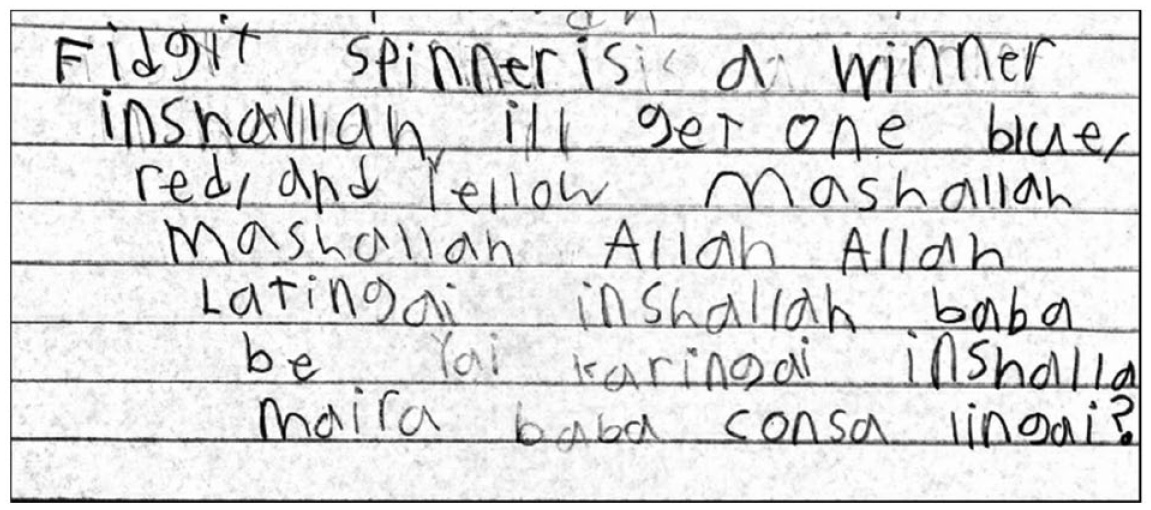
Abdul’s poem titled “Fidget Spinner.”
Abdul wrote (Urdu script / approximate English translation): Fidget spinner is a winner Inshallah (انشاء اللہ / God willing) I’ll get one. Blue, red and yellow. Mashallah (ما شاء اللہ / Whatever Allah wants) Mashallah (ما شاء اللہ / Whatever Allah wants) Allah, Allah (اللہ / God, God) Latingai inshallah (لائیں گے انشاء اللہ / He will bring for me, God willing) Baba be (بابا / my father) Yai karingai, (یہی کریں گے / will do the same) Inshalla (انشاء اللہ / God willing) Maira baba (میرا بابا / my dad) consa (کون سا / which one) lingai (گے ںی لائ / will he bring?)?
In one example of developmental spelling, Abdul drew on English letter–sound correspondences to write “lingai” for گے ںی لائ (lainge), which translates approximately to “will bring.” As he wrote, Abdul’s use of LBE became increasingly prominent, with the final four lines of his poem written entirely in Urdu.
When Abdul performed this poem for his class, he read aloud in Urdu, prompting acknowledgment—and occasionally laughs—from his Urdu-speaking peers. In an interview at the end of the unit, he discussed how audience reception influenced his linguistic choices: Emily: How did you decide to write in Urdu in this poem? Abdul: I wanted to write this poem in Urdu ’cause I think it would sound more funnier and more cooler and gooder.
In this statement, Abdul expressed an awareness of audience. Urdu was the most common language spoken across Paul’s classes, and many students were able to understand his poems. In the same interview, he addressed expressive reasons for composing in Urdu: Emily: How does it make you feel—being able to write in Urdu in these poems? Abdul: I think it feels really good. ’Cause if you don’t know how to write in English, you could just write your own, like, language. And that would actually be really good, because I felt so proud that I write in Urdu.
In this statement, Abdul expressed pride in writing in Urdu. By using English sounds to encode Urdu words, he showcased his expansive linguistic repertoire.
Like Abdul, many other students drew on phonological knowledge as they used English letter–sound correspondences to encode words in LBE. Maya, a female student who identified as Ethiopian and Bosnian, spoke some Amharic and Bosnian with her family. She said that she often watched Amharic videos on YouTube and liked to “mix” and “play around” with languages, including speaking in an Amharic accent. In one poem, she expressed a heightened phonological awareness as she “played around” with representing differences between languages.
Maya wrote (conventional Amharic script / English translation):
Z annoying brother is here! I run away saying Baca! Baca! (በቃ በቃ / Enough! Enough!) As I run to my Mozer When he talks about lhchoch (ልጆች / kids) Boy toys, I Say Baca! Baca! (በቃ በቃ / Enough! Enough!) I don’t want to hear it anymore!
In her poem, Maya code-meshed in Amharic, adding in “baca,” and “lhchoch,” which used developmental spelling to encode በቃ (beka / enough) and ልጆች (lijoch / kids). In parts of her poem, she also indicated how an Amharic speaker might sound when speaking in English, writing “z” for “the” and “mozer” for “mother.” In an interview, she discussed this choice: Emily: Could you show me the examples of where you did that? Maya: Over here, because they don’t add the T-H. That’s why I did that. Emily: So in Amharic there’s no T-H sound? Maya: No T-H. Yeah. Even [in] “mother.” Emily: So this one [mozer] is like “mother” here. So you’re writing English words but how they would sound if you were someone who speaks Amharic? Maya: In the accent.
In this excerpt, Maya expressed awareness of phonological differences between English and Amharic, stating in Amharic, speakers would not use “T-H.” In her poem, she strategically replaced letters to represent how an Amharic speaker might articulate these words.
Like Abdul, Maya reflected that Paul’s invitation to craft translingual writing was a positive experience: Emily: How did you feel about putting Amharic in your poems? Maya: I felt kinda relaxed. Emily: Relaxed? Maya: I felt like um, relief, that I could finally put my language in my poems. Emily: Tell me more about that. Maya: When there’s something that’s familiar to me, that I can use my language in . . . I could relax and know all of the words. All the words that I could understand in a poem.
In ways that resonated with developmental spelling and showcased their “double metalinguistic awareness” (Kenner et al., 2004), Abdul and Maya used English letter–sound correspondences to write in Urdu and Amharic. Their writing builds on existing research that suggests young Spanish/English bilingual children engage in this work (e.g., Axelrod & Cole, 2018; Durán, 2018), by demonstrating how children might repurpose English when writing in languages that use non-Roman scripts, such as Urdu and Amharic. Across their interviews, they expressed feelings of pride and relief as they experienced translingual writing instruction that made space for the breadth of their communicative repertoires.
“I Wanted to Show People My Language”: Crafting Aesthetic Experiences Through “Letter” Strings and Memorized Words
Like many of her peers, Pema, a female student with Tibetan heritage, used English letter–sound correspondences to write in a LBE. However, she also wrote poems using Tibetan script. In an interview, she told us, “I wanted to do something new. You know my Tibetan words? I usually write them in English . . . And then I was thinking, ‘I know how to write some words in my Tibetan letters.’”
Pema used Tibetan script in a poem titled “Mom’s First Chicken Soup” (see Figure 2).
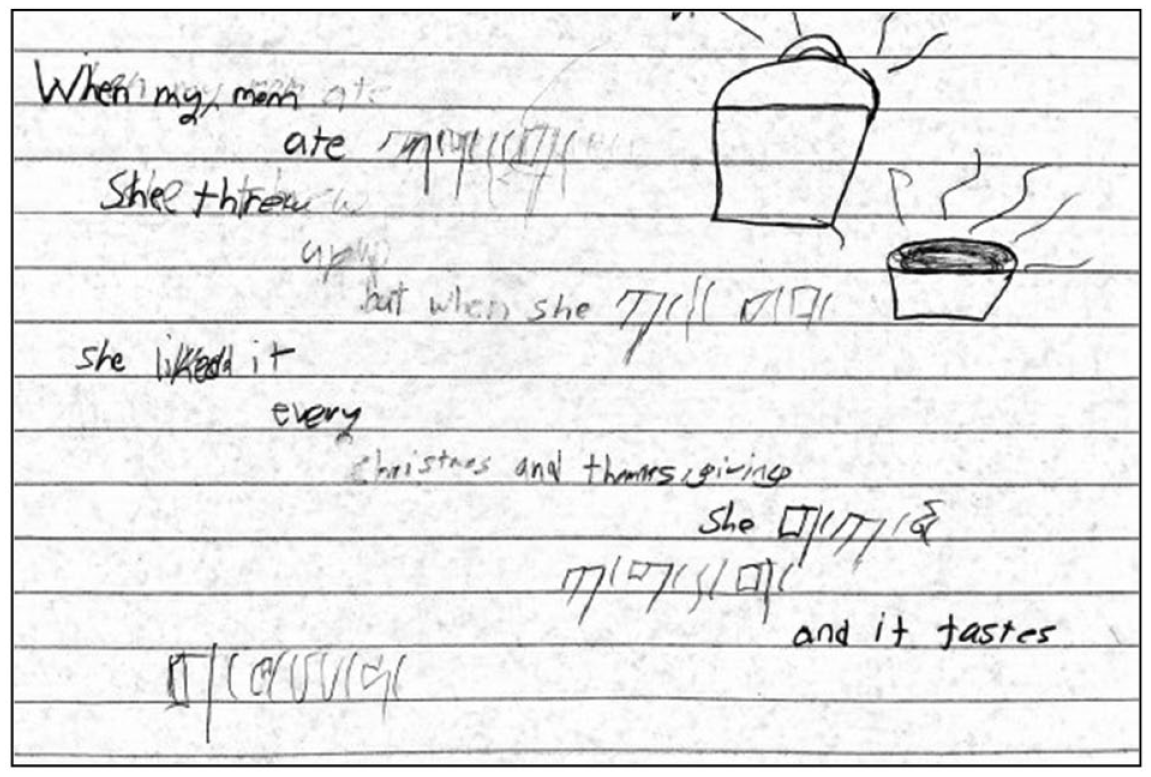
Pema’s poem titled “Mom’s First Chicken Soup.”
Pema wrote (conventional Tibetan script / approximate English translation): When my mom ate ཀ་ཞ་ད་ག་ (བྱ་ཤ་ཕྲུག་པ་ / chicken soup) she threw up. But when she ཀ་ད་པ་བ་ (བཟས་ / ate) She liked it. Every Christmas and Thanksgiving She ག་ཀ་ཝ་ (ཁ་ལག་བཟོ་བ་ / cooks) ཀ་ག་ད་ག་ (བྱ་ཤ་ཕྲུག་པ་ / chicken soup) And it tastes ག་ཝ་ཨ་ན་ (ངོ་མཚར་ཅན་ / wonderful)
Pema displayed her writing on the classroom document camera and wove between English and Tibetan as she read. However, consultations with a translator revealed that while Pema used Tibetan script in her poem, the way she had grouped and organized these characters resonated with “letter strings,” or groups of “random or patterned” letters that young children often use as they write, such as “BUPLOUBUPFG” (Kamberelis, 1992, p. 371). For example, Pema wrote ག་ཝ་ཨ་ན་ to represent ངོ་མཚར་ཅན་, or ngotsharcen (wonderful).
During a writing conference, Pema shared why she had chosen to write using Tibetan script, citing a desire to show her classmates Tibetan: Emily: How did you decide to put your language in your poem? Pema: I wanted to show people my language.
Pema’s peers also began to recognize her as a Tibetan expert in their class. In fact, toward the end of the unit, another student sought Pema’s help to write Tibetan in her own poem. Pema’s use of Tibetan letter strings, then, helped her to express her language and culture to her peers. She drew on her knowledge of Tibetan orthography to craft an aesthetic experience for her peers, “showing” them her language rather than simply discussing it.
Susan, a female student who was born in China and spoke Mandarin, attended a Chinese cultural school on the weekends, where she was in early stages of learning to read and write in Chinese. Throughout the unit, Susan composed multiple poems using simplified Chinese characters, including a poem titled “Eat Your Fruit,” inspired by a popular YouTube video (see Figure 3).
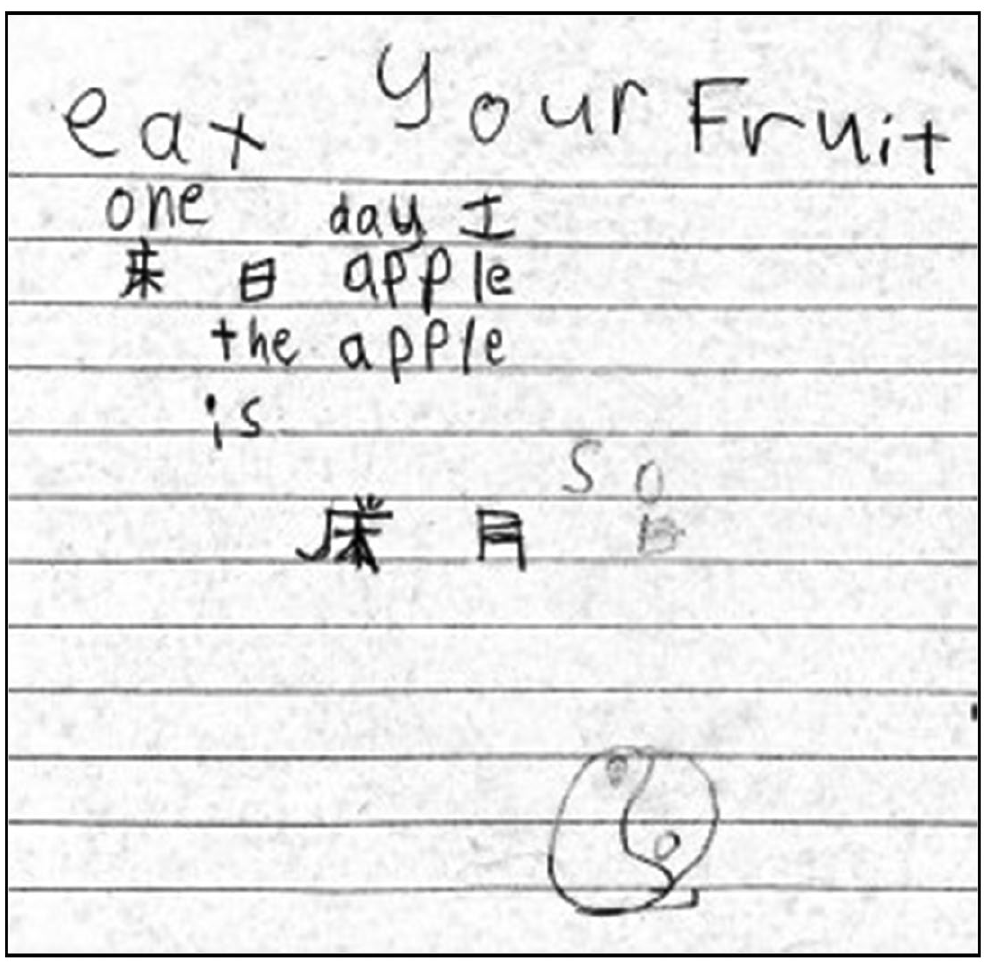
Susan’s poem titled “Eat Your Fruit.”
Susan read this poem aloud as: One day I 吃 (eat)一个 (an) apple The apple Is 好吃 (so good).
However, consultations with a translator revealed that Susan had drawn on her knowledge of particular Chinese words to write. While Susan read her poem using the words listed above, her Chinese writing more closely aligned to “bed,” “sun,” and “moon” than “eat,” “an,” and “so good.” In this example, Susan drew on Chinese words she knew and used them to represent others that she did not know how to write. Rather than limit the Chinese content of her poems to “bed,” “sun,” and “moon,” Susan repurposed (Durán, 2018) these words in ways that allowed her peers to experience Chinese script.
At the bottom of her paper, Susan drew yin and yang, which are significant symbols in Chinese philosophy. When asked in an interview about her drawing she said, Susan: That thing is like . . . my parents always like to see that. Because it looks special. Emily: And why did you choose to draw it in this poem? Susan: Because it’s from my country.
Here, Susan used a symbol to index her Chinese identity. Her drawing illustrates the notion that translingual writing moves beyond text, including multiple modes and semiotic systems (Canagarajah, 2013).
In an interview, Susan told Emily that she used Chinese in this poem because it would make it “interesting” for her audience. She also alluded to ways that writing in English and Mandarin asserted her bilingual identity: Emily: Why did you choose to mix English and Mandarin? Susan: So it looks interesting. Emily: To make it more interesting? Susan: And it looks like it’s from—that I know English and Chinese.
Like Pema, Susan created an aesthetic experience for her peers as she offered them an opportunity to see different writing systems. Although Susan’s Chinese writing may not have been conventional, she certainly met her writerly aims—her writing was interesting, and it provided an opportunity to learn more about her language.
Pema and Susan composed translingual writing in ways that resonate with emergent biliteracy. Both young authors drew on available resources, such as their orthographic knowledge and their memories of particular words, to compose. Although this writing was not conventional, it offered them an opportunity to show their languages rather than simply talk about them. Their writing contributes to and extends existing literature that describes young multilingual children’s audience awareness (e.g., Durán, 2017; A. Y. Lee & Handsfield, 2018). Like many children in the existing literature, these students made writerly choices to communicate with particular audiences. However, rather than using a shared language to connect, Pema and Susan used translingual writing and drawing to showcase their languages and assert their bilingual identities within their linguistically diverse class.
“I Looked at It and They Told Me”: Remixing Literate Resources Through Copying Print
Alejandro, a Mexican American male, often discussed his ethnic identity and linguistic heritage in class. For example, when Paul first introduced “Abuelita’s Lap” (Mora, 1996), Alejandro excitedly whispered to his writing partner, “I’m going to write about one time when I called my grandpa and I said some Spanish words!”
However, Alejandro also reflected on the limitations of his command of the Spanish language, telling a classmate, “I kinda do [know Spanish], but I don’t know how to read and write.” Throughout this unit, Alejandro drew on and remixed the literate resources in his environment to craft poems that expressed his linguistic heritage.
Like many elementary classrooms, Paul’s was a print-rich environment, with anchor charts, bold labels, and a well-stocked library. When students were not able to spell words on their own, Paul encouraged them to look around the room or in personal “dictionaries” kept in their desks. Alejandro took up and extended this spelling strategy as he wrote in Spanish, remixing environmental print to write.
After introducing “Abuelita’s Lap,” Paul presented the class with a copy of Sandra Cisneros’s “Good Hot Dogs” (Carlson, 1994, pp. 10-11), written both in English and a code-meshed Spanish/English version that he created using a translation in Carlson’s book. One section of the code-meshed poem read, We’d run Derecho desde la escuela (Straight from school) En vez de a casa (Instead of home) (Carlson, 1994, pp. 10-11)
As they read, Paul drew the students’ attention to English and Spanish correspondences by connecting the words on the whiteboard. Later that day, Alejandro wrote a code-meshed poem titled “How to Say Español.” To compose this poem, he lifted and remixed Spanish phrases from “Good Hot Dogs.” He wrote (conventional Spanish / English translation),
If You want to Say words in Spanish Read this poem Like In my title that’s how to say Spanish in Sponyol (español / Spanish) If you want to say love you so much This is how to say it [te quiero] mucho (I love you so much) If You want to say “straight from school” This is how you say it derecho (right) Desde la escuela (from the school)
Like many children, Alejandro drew on his surrounding environment to write. He lifted phrases from Cisneros’s poem (e.g., derecho desde la escuela) and remixed them in his own writing. He knew that Paul had encouraged his class to use the print-rich classroom environment in his writing, and he applied this strategy to another language. When asked about how he had composed this poem in an end-of-unit interview, Alejandro mentioned his use of Cisneros’s work. He stated, Some of these words I got was from a poem, like that Dr. Hartman gave us. . . . ’Cause I didn’t know how to say it in Spanish. So I checked the poem and I looked at it and they [the poem] told me.
Alejandro also talked about why he composed in Spanish, a language he found challenging to read and write. He stated, “Well, first off ’cause I’m like Mexican, but I was born in [this city]. . . . So, I was like, ‘You know what? I should write “How to Speak Español”’ and Spanish.” Here, using the classroom environment, Alejandro indexed his Mexican American identity in/through code-meshed writing. His talk and writing underscore how children who worry about their language proficiencies can skillfully engage in identity work through translingual writing (S. P. Alvarez et al., 2017).
Discussion
With Paul’s encouragement, Abdul, Maya, Pema, Susan, and Alejandro composed translingual poetry that showcased their languages and asserted their bilingual identities. Drawing on linguistic and environmental resources, they engaged in a process of recontextualization through writing (Dyson, 2003), bringing multiple languages and scripts into their school compositions. Their writing and reflections demonstrate how young writers—even those who worry that they cannot read or write in LBE—can creatively and strategically use the breadth of their communicative repertoires in translingual writing.
In this analysis, we asked how multilingual children in an English-medium classroom engaged in written code-meshing in a unit designed to cultivate translingual writing. We found that young children took up strategies commonly associated with emergent literacy (e.g., developmental spelling, letter strings) as they composed. Their emergent writing in LBE contributes to complicating conversations around what is often positioned as a dichotomy between students’ “first” and “second” languages. For these students, reading and writing tended to feel easier in English, which, according to school records, was their “second” (or third) language.
We also asked why students engaged in translingual writing. We found that students code-meshed for a variety of reasons, including expressing their ethnic identities, asserting their multilingualism, and showcasing their languages to their peers. Their compositions contribute to the existing literature on translingualism by suggesting that young children can intentionally and creatively bring LBE into their school writing with attention to purpose and audience (Horner et al., 2011), and need not wait to master conventions before engaging in such work.
In addition, this study demonstrates how bringing translingual writing and emergent biliteracy into conversation with one another can enrich our understandings of multilingual children’s writing. An emergent literacy lens helps us more deeply understand the writing of children who worry about their proficiencies in LBE. From a more traditional perspective focused on surface-level features such as spelling, such writing might seem to contain “mistakes,” and some outside observers might argue that students were not “literate” in the languages they tended to use orally. However, careful analyses through the lens of emergent literacy position such writing as a legitimate literacy practice and shed light on the creative and strategic ways that children interacted with text.
Similarly, employing a translingual lens in the elementary classroom can support understandings of multilingual children’s reasons for writing. A translingual pedagogical orientation empowers children to intentionally subvert dominant conventions, even if they have not yet mastered “the basics” of DAE writing (Dyson, 2013). In addition, utilizing a translingual lens in analysis draws attention to children’s use of multiple modes in composition. This lens positions children’s drawings and symbols not as a developmental stage or instructional scaffold, but as a valid form of communication that enhances expression.
Importantly, too, this study of children’s translingual writing speaks back to some existing critiques of translingualism and its application in writing classrooms. Problematizing translingual approaches, Guerra (2016) points to the importance of context in postsecondary students’ writing choices. He writes, The mistake I made—which is the same one so many proponents of code-meshing seem to make as well—is that I inadvertently assumed that students can ignore the circumstances they face in the new rhetorical situation (an assigned essay in a classroom) and can easily transfer their language practices from one site to another. In other words, I failed to acknowledge that I was asking students to do the same thing with language in two rhetorically different and highly situated settings. (p. 231)
Guerra’s attention to social contexts is critically important. At the same time, decades of research on beginning writing have shown that young children do transfer—or recontextualize—their linguistic practices across sites (Dyson, 2003). Children routinely bring literacies from their homes, communities, and social worlds into academic realms, blending languages, registers, and content across contexts. As Durán (2017) asserts, a translingual orientation resonates with the ways in which young children write.
In our analysis, we also surfaced tensions. First, despite Paul’s support for code-meshing, LBE appeared in only 65 of 597 poems collected across the unit. In addition, multiple students who spoke LBE chose to compose exclusively in English throughout the unit, and did not employ the strategies showcased in this article. We recognize that a hesitancy to mesh languages may reflect the dominant language ideologies present in children’s lives (Morren López, 2012). However, we also heed Matsuda’s (2014) caution that “restricting the scope of translingual writing to the end result can obscure more subtle manifestations of the negotiation as well as situations where writers make the rhetorical choice not to deviate from the dominant practices” (p. 481). We recognize that one limitation of this analysis is that its focus on writing products obscures students’ subtler translingual practices (e.g., using LBE in brainstorming and conferences with peers), as well as the decision-making processes of students who chose not to compose in LBE. At the same time, this study suggests that translingual writing is possible and can be powerful in a linguistically diverse primary classroom.
Implications
Implications for Teaching
Enacting a translingual orientation may be complicated in K-12 contexts, where teachers are often mandated to use standardized literacy curricula (McCarthey & Woodard, 2018). However, this study demonstrates how translingual writing might be possible within the confines of a curricular program. Specifically, Paul’s modifications to Units of Study illustrate the potential of small curricular shifts to support a more asset-oriented approach to literacy teaching. By selecting bilingual mentor poems and framing translingual writing as a craft move, Paul opened up space in his curriculum for his students to explore such writing. Like Paul, teachers might strategically select mentor texts that feature translingual writing. They might also model code-meshing in their own speech and writing (Machado, Woodard, Vaughan, & Coppola, 2017) or ask parents and community members to share their languages (Zapata & Laman, 2016).
This study also reinforces the notion that teachers need not speak all of their students’ languages to enact a translingual orientation in their English-medium classrooms (Pacheco, Daniel, Pray, & Jiménez, 2019; Zapata & Laman, 2016). Though Paul did not always fully understand his students’ writing in LBE, he trusted in their efforts. In powerful ways, Paul decentered himself as the sole source of knowledge in the classroom, acknowledging children’s robust understandings of language and culture. Although all teachers may not be able to help students encode using conventional characters in LBE, they can support multilingual students by suggesting meaning-making strategies (e.g., repurposing English letter–sound correspondences) and showcasing examples of writing in other languages.
Implications for Research
This study also suggests areas for future research. First, it suggests the need for research that examines translingualism beyond code-meshing, including practices that move beyond text-based literacies or decenter language in analysis (Zapata et al., 2018). Moreover, the study’s focus on poetry suggests the need for research on translingual writing with young children across text types, genres, and modalities. For example, we are interested to explore how children’s translingual writing might be facilitated through multimodal composition, such as the use of sound in digital stories (Pacheco & Smith, 2015).
Most importantly, this study suggests that in our writing research with young children, we might consider seemingly complex or critical rhetorical processes, looking for ways that children engage with these processes at emergent levels. Our findings reaffirm that young children are skilled communicators who make creative and strategic choices in their writing across languages.
Conclusion
This study showcased what happened when one teacher invited his students to draw on the breadth of their written languaging practices in a unit on poetry. While many elementary school writing classes focus on mastery of “the basics” in DAE (Dyson, 2013), Paul embraced what Zapata and Laman (2016) call the “creative, performative, emergent, and situatedness” of children’s communicative practices (p. 367). This study highlights how young children—even those who have not had formal instruction in LBE—can engage in translingual writing, strategically breaking writing “rules” through practices associated with emergent literacy. It also demonstrates the power of classroom-based writing experiences that cultivate children’s communicative repertoires. Ultimately, this study argues that young children need not wait to draw upon their languages in writing.
Supplemental Material
OL_SUPP_APP_Machado – Supplemental material for Translingual Writing in a Linguistically Diverse Primary Classroom
Supplemental material, OL_SUPP_APP_Machado for Translingual Writing in a Linguistically Diverse Primary Classroom by Emily Machado and Paul Hartman in Journal of Literacy Research
Footnotes
Declaration of Conflicting Interests
The author(s) declared no potential conflicts of interest with respect to the research, authorship, and/or publication of this article.
Funding
The author(s) disclosed receipt of the following financial support for the research, authorship, and/or publication of this article: The first author received funding from the University of Illinois at Chicago Dissertation Grant for partial support of this research.

References
Supplementary Material
Please find the following supplemental material available below.
For Open Access articles published under a Creative Commons License, all supplemental material carries the same license as the article it is associated with.
For non-Open Access articles published, all supplemental material carries a non-exclusive license, and permission requests for re-use of supplemental material or any part of supplemental material shall be sent directly to the copyright owner as specified in the copyright notice associated with the article.
