



Abstract
Background:
Situated in urban Philadelphia, Autores Fuertes was part of a network of nonprofit community writing centers that provided a free afterschool writing academy for children ages 7 to 17. With a full-time lead educator and assistant educator, alongside several volunteer community educators, this center promoted itself as a “bilingual” site. Most of the enrolled children had family connections to Mexico, Honduras, Guatemala, and El Salvador. As a teacher-scholar, I collaborated with the center to implement various translingual writing workshops.
Purpose:
In this study, I aimed to understand how the children mapped their translingual practices in and out of the center during the Community Language Mapping Workshop, which ran for seven weeks on Saturday mornings for two hours in April and May 2019. I drew on prior scholarship on linguistic landscaping and community language mapping to frame the pedagogical activities that scaffold the children’s abilities to observe their community’s linguistic practices through a researcher’s perspective and document them creatively and critically.
Research Design:
I used an engaged ethnographic case study approach coupled with micro-ethnographic analysis to collect and analyze data generated through observations, pedagogical pláticas, field notes, and the children’s multimodal compositions.
Conclusions:
Instead of mapping their linguistic practices like cartographers with precise lines, the children exhibited an assemblage of material interactions where language emerged during everyday play. Translingualism is a common experience for bilingual children; it is the norm rather than the exception. When educators examine these practices, they will see and hear translingual reality, encompassing even the simplest activities, such as riding a bicycle, playing a video game, or going to the beach. In educational settings that embrace this approach, bilingual learners will be empowered to integrate the authentic ways they already use language in their communities, challenging assumptions of language practices and linguistic repertoires, because there is no need to assume fluency or language preference.
Keywords
In popular media (McKenna, 2018; Mervosh, 2023) and academic discourse (Anwar, 2021), immigrant families’ and children’s language and literacy practices, particularly those used by families of color, have often been portrayed as deficient compared to the practices of White American, middle-class children. This framing not only permeates public narratives but also infiltrates pedagogical approaches within formal schooling environments, where linguistic correction and omission are pervasive, often to the detriment of children with marginalized linguistic practices. However, this study challenges such deficit perspectives by presenting findings that counter the claims of linguistic inadequacy and literacy failure among immigrant and minority children.
Through an ethnographic case study conducted within a community writing center—Autores Fuertes, in urban Philadelphia—I show how children’s linguistic practices in their home and community contexts are not only abundant but also insightful and playful, an assemblage of translingual expression (Pennycook, 2017). The Community Language Mapping Workshop was held at the writing center as part of an ongoing collaborative initiative between the center and me, a researcher affiliated with a public university. Initially conceived in 2015, I aimed to explore the translingual practices of children attending the center. However, despite the center’s bilingual intentions, I noticed a default to monolingual English practices and pedagogies in my observations. To disrupt this monolingualism, I co-planned with the center’s educators and taught writing workshops emphasizing critical, translingual pedagogies starting in 2017.
This workshop unfolded during spring 2019 and spanned seven Saturday morning sessions. It catered to children ages 8 to 12 and explored how the children “mapped” their community’s linguistic and literacy practices. From the outset of the workshop, the children’s responses to these pedagogical practices challenged my framing of their communal translingual practices, particularly their ability to easily “map” their linguistic practices like cartographers. Rather than clean lines of where and when they translanguage, the children shared a messy assemblage of material interactions where language emerged during everyday play.
The Theoretical Foundations of the Community Language Mapping Workshop
In the subsequent sections, I delve into the theoretical underpinnings that guided this inquiry, including a review of relevant literature on translingual orientations of language, and the intersection of translingualism, multimodality, assemblage theory, and play. Finally, I situate this project among other community literacy initiatives.
Translingual and Multimodal Orientations of Language and Literacy Studies
Translingual orientations of language originate from the authentic linguistic practices of multilinguals, as manifested in their day-to-day activities (Canagarajah & Dovchin, 2019). In line with prior scholarship, I use the term orientation to recognize how translingualism is a view or perspective of how language is practiced. Although translingualism as a theory may be a new “turn” in empirical studies, translingual practices are anything but recent. Long before the nation-state attempted to define languages within national and political borders, people defaulted to translingualism (Mullen, 2020), and it continues to be the normative, even mundane, practice of multilinguals everywhere (Horner & Weber, 2017). This translingual orientation departs from linguistic theories grounded in top-down structural views that constrain and strictly define the rules and boundaries of language (MacSwan & Rolstad, 2024). Instead, the “trans” perspective of language builds theory from the bottom up, conceptualizing language as a repertoire of practice—an activity rather than a possession (Li, 2018). Importantly, translingualism complicates notions of language proficiency, fluency, firstness, secondness, and even named languages such as English or Spanish (Li & García, 2022), presenting these constructs as societal creations shaped by monoglossic language ideologies (Horner & Alvarez, 2019). Translingual scholars also emphasize the inherent multimodality of translingual practice to underscore the intricate interplay between language and myriad modes of communication, such as sound, text, speech, gesture, image, and the body (Canagarajah, 2018; Mora et al., 2022; Tian & Lau, 2022). Likewise, the New Literacy Studies has revolutionized our understanding of literacy, expanding it beyond the confines of print-centric paradigms (Gee, 2023; Street, 2014). Similarly, New Literacy Studies scholars argue for a broader conceptualization of literacy as a social semiotic process encompassing diverse communicative modalities. This is crucial for understanding children’s linguistic and literacy practices in navigating multiple languages and cultural contexts. Scholarship in these translingual perspectives has repeatedly shown that when children and adolescents draw upon multiple modes when writing or composing, they construct nuanced stories that represent their transnational and cultural identities. In those stories, the children expand their temporal and spatial boundaries, which are often constricted by school pedagogies. In turn, they also challenge monolingual ideologies and demonstrate their linguistic competency (Cárdenas Curiel & Palmer, 2023; Smith et al., 2021).
Importantly, although many scholars of translingualism and translanguaging advocate for a unified linguistic repertoire within the language user (Li & García, 2022), more recent critiques of the linguistic repertoire have pushed the linguistic repertoire out and away from an individually held container of language to a mediated and affective assemblage, where language users come into the repertoire angled and with surprise (Abraham, 2024; Busch, 2021; Canagarajah, 2018; Pennycook, 2017). Moreover, assemblage theory positions agency, such as the ability to use language, as contingent, emerging among us in an assemblage of humans and things (Pennycook, 2017). The notion of assemblage is vital to this project because it furthered the disruption of the absoluteness of language, whether wholly contained within an individual or in a border space. In line with translingual views of language and literacy, assemblage theory suggests that language is a verb, something done and created, existing partly within us but also partly without and among us, and it emerges or assembles differently given space, time, people, and things (Abraham, 2024).
Play and Playfulness in Language and Literacy Studies
Although pedagogues have long advocated the play turn in early childhood studies (Beisly, 2024), integrating play within literacy studies is a more recent phenomenon (Thiel, 2021). In recent years, literacy scholars have explored play as a productive form of literacy for children. Wohlwend (2011), in her collective scholarship, argued that play is literacy, where children assemble a living text among each other while invested with materials and objects that they imbued with meaning, in turn relieving the “constraints of here-and-now realities” (p. 3). To illustrate, Brownell (2021) traced the case of Jairo, a student often construed as a “low” literacy learner at school. Jairo challenged this framing by adeptly using his knowledge of Minecraft to creatively approach and complete required writing tasks within the formal educational setting. Brownell contended that Jairo’s inventive use of Minecraft represented an act of agency, allowing him to flexibly navigate overly structured writing tasks, showcasing his competence as a skilled writer—an aspect unnoticed by his teacher.
Additionally, Honeyford and Boyd (2015) demonstrated how an afterschool program centered on play and visual literacies empowered children to enact and shape their literacy creatively and playfully. They argued that current concerns regarding children’s literacy achievement, particularly those attending places like Autores Fuertes, should be reframed to focus on how learning spaces can be reconfigured to allow for playful assemblages where children are free to engage multimodally with materials and each other to craft a literacy curriculum. They advocated broadening literacy and language arts into “creative, complex, and critical spaces for students to play, compose, and learn” to challenge the narrowing and simplifying of literacy tasks, texts, and purposes, as happens too often in schools (pp. 71–72).
Moreover, Ferreira, Kendrick, and Early (2022) proposed a play-based approach to sociocultural science education that challenged deficit views of the language and literacy learning of children from migrant and refugee backgrounds, emphasizing how play enabled children to learn, make sense of challenging science concepts, apply and innovate with their new understandings, contribute, belong, and leave a transformative legacy. Finally, the long-term ethnographic work of Marjorie Faulstich Orellana (2015) in a play-based afterschool program in Los Angeles showed how children leveraged linguistic play to cross language boundaries and invent new words while their simultaneous physical play enabled peer collaboration. Also, she noted how play allowed the children to demonstrate their perspective of their community, which showed that they built social relationships while appreciating the beauty of things and people in their lives. Extending that work, Franco, Orellana, and Franke (2021) closely explored the language and literacy practices of three children who attended the afterschool play-based program by analyzing an event when the children designed a three-dimensional castle onto a two-dimensional space. They found that as the children played to solve the castle design problem, they worked collectively and crossed language and disciplinary borders.
The intersection of playfulness in language studies has spurred studies around translingual play. Liang (2024) explored the translingual play of transnational YouTube users in Taiwan. She found that the users used humor, stylistic choices of languages, and parody to engage in translingual socialization on the site, demonstrating how new users learn and participate in the context. In a Head Start on the Texas/Mexico border, Bengochea, Sembiante, and Gort (2018) found that young children’s linguistic play was an opportune moment for learning language, using their languages, and appropriating their cultural and familial funds of knowledge into an official learning space. De los Rios’s collective scholarship, at the intersection of translingualism, transnationalism, and musicality, demonstrates how youth’s musical practices draw upon rich transnational funds of knowledge to be shown through their creative, multimodal, and translingual sonic play (2022, 2024). Regarding transgressive bilingual wordplay, Martinez and Morales’s (2014) study among middle schoolers showed how adolescents skillfully avoided using curse words in the classroom while using derivatives of the words to carry the same intent. Likewise, Ingram (2023) demonstrates how even young children from Latin@ backgrounds engaged in transgressive wordplay through translingual manipulation of words and sounds to create puns and albur or double meanings to express their linguistic adeptness and social identities.
Translingualism, Multimodality, and Translingual Play in Community Literacy Spaces
There is burgeoning research conducted within analogous community writing and literacy spaces, grounded in translingual frameworks, that suggests that these environments foster nuanced writing and language practices that fluidly integrate with the translingual and multimodal repertoires prevalent in a community. Moreover, other scholarship in spaces adjacent to formal schooling, such as before and after school programs, reveals that when children can draw upon their community’s repertoires more extensively, they exhibit heightened attentiveness to their writing audience (Axelrod & Cole, 2018). They also openly demonstrate their translingual capabilities, illustrating how translingual dynamics manifest in interactions with others and extend beyond linguistic communication to encompass multiple modes of expression (Kim et al., 2021). Notably, Alvarez’s collective body of work (2014, 2017; Alvarez & Alvarez, 2016) in afterschool homework spaces and public libraries has illustrated how these settings provide avenues for multilingual and often immigrant community members to challenge and transcend established language boundaries. Alvarez also underscored the exceptional linguistic competence of young bilingual children within their communities, showcasing their adeptness in handling intricate linguistic tasks such as translating homework to adults, young siblings, and their peers. Razfar (2012) found that while bilingual adolescents played a counter game in an afterschool mathematics club, they drew upon a wide range of linguistic resources and specific familial funds of knowledge to acquire new mathematics vocabulary. As in Alvarez’s studies, the children were adept language users who considered their audience when making linguistic choices, as demonstrated by their skilled translations for adult facilitators who lacked Spanish knowledge and younger participants who lacked mathematical knowledge. Other work, particularly in a library workshop framed in translingual and material orientations, has shown how families and children drew upon multiple modes and materials to assemble intergenerational storytelling. By sharing their stories, they playfully disrupted monolingual and monomodal notions of language and literacy (Machado et al., 2023). Finally, research within K–12 schools, where writing instruction was reoriented to be inherently “of” the community, provides evidence that community literacy spaces can cultivate collaborative advocacy among children and adolescents. One study achieved this by creating an environment where the children could speak and write without the apprehension of conforming to linguistic norms (Lee et al., 2021).
This scholarship indicates that when pedagogical spaces embrace children’s playful translingual and multimodal practices, they readily adopt and showcase their linguistic and literate proficiency in their composing endeavors. Given this, I intended to document what happened as I prompted the children in this project to “map” their linguistic practices across places, such as playgrounds or restaurants, and see how they construed their linguistic realities through their compositions at the writing center, manifested in pedagogical tasks such as language maps.
The Pedagogical Design of the Community Language Mapping Workshop
The Community Language Mapping Workshop was a seven-week workshop held on Saturday mornings for two hours during April and May 2019. It drew on prior scholarship on linguistic landscaping (Gorter, 2013) and community language mapping (Dunsmore et al., 2013; López, 2020) to frame the pedagogical activities, scaffolding the children’s abilities to see their community’s linguistic practices through a researcher’s eyes and document such practices creatively and critically.
On the first day of the workshop, I used a translingual mentor text (Machado & Flores, 2021), Dreamers, a picture book written and illustrated by award-winning author Yuyi Morales (2018), to help draw the children’s attention to how elements of place, time, and material were used in her translingual narrative and illustrations. (See Table 1 for the workshop session overviews.) Mentor texts have long been used to help young children find models and inspiration for their writing (Culham, 2016). I had hoped that this translingual mentor text, which incorporated translingual practices and realities into the multimodal narrative, would do the same and inspire the children to look around and within them, pulling from the experiential and place into their writing and creations. After an interactive read-aloud, I asked the children questions to note the illustrations and translingual writing. Then, we listened to an interview with Yuyi Morales, who advised young translinguals to tell their own stories through words and drawings.
Workshop Session Overviews.

During the workshop’s second session, I tasked the children to create a language map, which D’Warte (2019) defined as “a pedagogical task that engaged students in creating visual representations of their individual practices and experiences” (p. 666). To do so, I gave each child markers and a large piece of white poster paper and asked them to use images and words to illustrate the different places they go in their daily life and the words and phrases they used in each place. For the final pedagogical activity, which began during the fifth session, the children and I learned to use iMovie, and at first, we practiced filming within the center. During the sixth session, as a group, we walked around the neighborhood with iPods, filming and photographing instances of community speech and print. During the last workshop session, the children collated their pictures into a one-minute video using iMovie and annotated it with voiceover or written tags to represent the languaging of the neighborhood.
Moving forward, I sometimes use terms for named languages, “Spanish” and “English,” with quotation marks to recognize the socially constructed process of naming what a language is or is not. On the other hand, I also use the word language as a verb to better frame the translingual practices of the children and myself.
Autores Fuertes: An Engaged Study
Founded in 2013, Autores Fuertes is in urban Philadelphia in a community known for its cultural and linguistic diversity. It is one site in a network of nonprofit community writing centers that offers a free afterschool writing academy for children ages 7 to 17. During the 2018/19 school year, the center was staffed with a full-time lead and assistant educator, among numerous volunteer community educators. The center advertised itself as a “bilingual” site, and most of the children who enrolled there had familial connections to Mexico, Honduras, Guatemala, and El Salvador. The center served dozens of children each year through the yearlong writing academy, a Saturday morning toddler program, mentorship programs, and stand-alone workshops like the ones I taught.
I situated this project as an ethnographically grounded case study (Dyson & Genishi, 2005), bounded within the confines of the community writing center, its educators, child attendees, and the nearby community to illustrate a critical instance of pedagogical and linguistic practice. In turn, the current shifts to more critical ethnographic approaches (Cervantes-Soon, 2017; Majors, 2015; Mendoza-Denton, 2014) to research with communities rather than on communities has called researchers to refute and reframe “damage-based” research, or the documentation of failures, gaps, and deficits in communities (Tuck, 2009). Moreover, Ellen Cushman, a long-time scholar of community writing practices and social activism, argued that university faculty must “locate ourselves within the democratic process of everyday teaching and learning in our neighborhoods” (1996, p. 12, emphasis added).
To “locate” myself in this project, I am a tenured associate professor of language and literacy education and an elective multilingual who began a career in education as an American Sign Language educational interpreter for the Deaf. Later, I transitioned to elementary education, where most of my students had familial connections to Mexico, Guatemala, and Honduras and were emergent bilinguals. I grew up in rural North Georgia in a White, working-class family and spoke a combination of Southern American English and Appalachian English as my home languages. As an adult, and to better myself as an educator, I started learning Spanish, and eventually, I moved to Mexico, married a Oaxacan, and became a Mexican permanent resident. We raised our child as a dual citizen of Mexico and the United States and a bilingual speaker of Spanish and English.
Knowing I am typically racialized and gendered as a White, monolingual woman, I introduced myself to the children’s parents or guardians at the beginning of the workshops, explaining my language background and personal connection to Mexico as a means of establishing trust and ensuring parents and caregivers could communicate with me. Importantly, I lived in the same neighborhood where the center was located. As time passed, I befriended many families in these community spaces, such as on the playground and at the laundromat, further developing relationships between the families and myself. During my conversations with parents and caregivers, I learned they were concerned about their children’s “Spanish” language abilities or, in their words, that their children could not speak or read/write in “Spanish.” To address this, I assured the parents I would focus on using “Spanish” in both talk and writing during each workshop.
Moreover, considering these workshops’ theoretical and pedagogical design and my intent to foster a translingual space, I did not want to implement separatist language policies, such as “English” or “Spanish” only. Instead, I tried to lower the children’s anxiety around writing in general. I was concerned that if I asked the children to write or compose only in “Spanish,” they would become even more anxious and refuse to do so. To mitigate this, I overtly told them that we—they—could speak how they felt comfortable, and we were not focused on correctness in how we spoke or wrote.
Generating Data with Participants
For this article, I focus on data generated only during the Community Language Mapping Workshop. During this workshop, I collected data through participant observations, pláticas, field notes, and the multimodal compositions produced by the children. The children who attended the workshop ranged in age from 8 to 12 years old; at times, a younger sibling who was 6 attended, and at other times, the 15-year-old child of the cofacilitator attended the sessions. The number of children in attendance also varied, ranging from 6 to 10 children at each session. I did not ask the children to identify themselves according to race, gender, or language, so the descriptors presented here are my labeling of their demographics. The data is drawn from five children: Edwin, Daniel, Benjamín, Marco, and Amalia. Throughout this article, I gendered the first four children as boys and Amalia as a girl. The boys were nine years old at the time of the workshop, and Amalia, Edwin’s younger sister, was six. They all had familial connections to a nation-state in Latin America. The first three boys and Amalia were born in Philadelphia, but their parents were born in southern Mexico. Marco was born in El Salvador and immigrated to the United States just a few years before this workshop began. They all attended public schools in the neighborhood.
Importantly, I used “pláticas” as a pedagogical and methodological method inspired by the center’s lead community educator, Honduran-born, who used pláticas to begin every session to build relationships and trust with the children. Sitting in a circle with the children, they talked about their day as she drank her café. She told me that pláticando allowed the children to speak more freely without worrying about what might be perceived as language “errors,” and she said sharing life experiences also built relationships between the children and herself. As a research methodology and method, pláticas have a long history in Chicana feminist research to promote mutual dialogue and build relationships between the researcher and the researched (Flores & Morales, 2021). Notably, scholars (Fierros & Delgado Bernal, 2016) point out that pláticas should not be viewed as a precursor to the “real” interview or method, nor are they meant to be timebound by strict endings and beginnings; instead, they are flexible, dialogic, and ongoing approaches for talking with participants and learners. Mata-Villalta (2023), who used pláticas as pedagogy and method in K–12 history classrooms, argued that pláticas are full of linguistic “potential” to reconstruct oppressive historical narratives and, in turn, also reconstrue children who have been marginalized and minoritized in society as agentive, complex, and knowledgeable (p. 1695). De los Ríos and Portillo (2021) also used plática-inspired interviews with adolescents to “privilege” translingual practices and knowledge while recognizing how adolescents shape the meaning-making process during research. Given this history of pláticas as a methodological and pedagogical practice, I grounded each workshop session in a pedagogical plática. I used open-ended questions to promote mutual dialogue around the workshop’s themes. Typically, I asked the children about their school week and weekend plans. From there, I listened to their responses and followed with questions to expand on their stories and experiences.
Data Analysis
In this study, I employed a micro-ethnographic discourse analysis approach to examine the data (Bloome et al., 2022). Adopting a translingual framework that views language as a practice, I conceptualized discourse as a noun and verb, focusing on how the children engaged in discourse while languaging, acting, and reacting with one another.
To initiate the data analysis, I chronologically organized each source, including audio/video transcripts, field notes, and significant writing artifacts, in a qualitative data analysis software program, ATLAS.ti. Building on Alvarez’s (2017) concept of the translingual event and Bloome et al.’s (2022) emphasis on the social event, I focused on categorizing the transcripts into distinct translingual social events. To identify the beginnings of these events, I pinpointed moments of interactional shifts within the pláticas, noting instances of language-in-use or references to language-in-use until the events transitioned or concluded. Once I delineated several translingual social events, I cross-referenced these with relevant field notes and written artifacts produced by the children during those events.
In the subsequent analytical pass, I examined each parsed translingual social event with a broad lens, asking, “What is happening here?” (Bloome et al., 2022). This process revealed several recurring patterns, particularly during the pláticas, the creation of language maps, and the presentations of those maps.
The first pattern involved the children recounting prior events, including interactions at school and with their parents. In that reported speech, they frequently used imperatives such as “clean your room” and “sit down.” The second pattern emerged from the children’s recollections of interactions among friends, characterized by more agentive and dialogic speech. The third and most prominent pattern appeared when the children discussed events related to their own play, where their speech and compositions were notably longer, more child-initiated, and enriched with knowledge, linguistic skill, and, importantly, laughter. Figure 1 provides an example of this analysis.
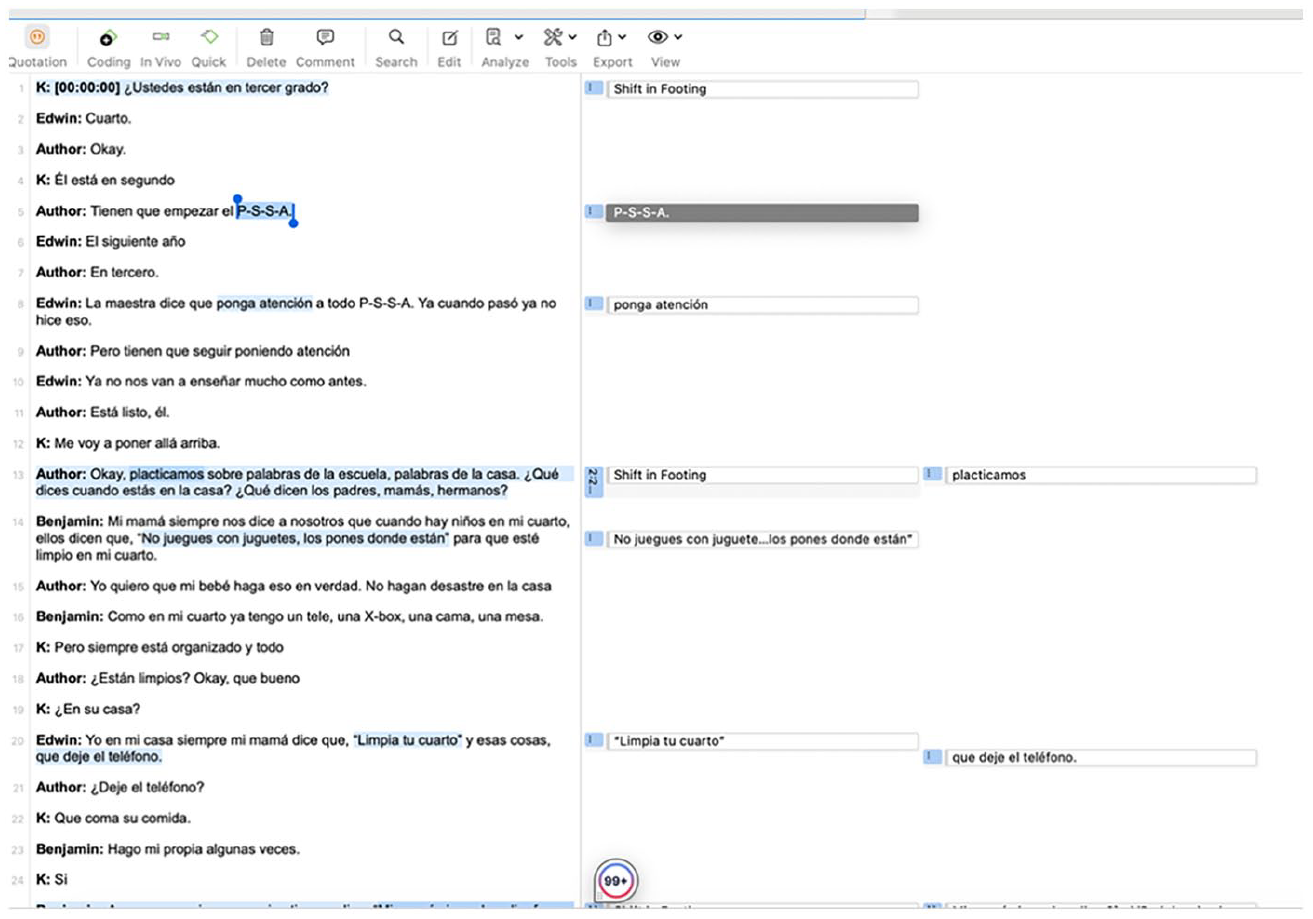
Screenshot from ATLAS.ti.
During this analytical phase, Joseph’s (2022) assertion that “every line is a lie” resonated with me. The children’s reflections on their previous linguistic experiences highlighted my pedagogical misjudgment in requesting them to map their language practices within clearly defined contexts, such as home or school. I had anticipated that the children would draw distinct boundaries between the places they frequented and the languages they used in those settings; however, they revealed the fluidity and multimodality of language use, illustrating that languages do not reside in fixed locations with neatly defined borders. The children’s accounts emphasized that, like them, languages exist in a dynamic interplay, forming messy and playful assemblages in their lives.
Following this pass, I selected four events closely related to the creation of language maps to examine in greater depth. I concentrated on meaning-making within these translingual social events—specifically, how meaning is constructed through individuals’ interactions (Bloome et al., 2022). I paid particular attention to who asked, answered, acted, and reacted and how each person did so. From there, I focused on the goal of the language map, to capture language in use, and I “thought with theory”—translingualism, multimodality, play as literacy, and assemblage theory—to make sense of the language the children reported using and the language they used while in the workshop (Jackson & Mazzei, 2023). It is important to note that each verbatim transcript is presented nearly exactly as spoken or written by the participants.
Findings
The data analysis showed that throughout the workshop sessions, the children’s translingual repertoires emerged in playful assemblages among other people, themselves, and the material things in their lives. I illustrate these playful assemblages in a series of four translingual events.
Translingual Social Event 1: Un Bicycle y Un Scooter and “¡Como, Oh My God!”
The following translingual event occurred at the beginning of the workshop’s second session. As a precursor to composing the language map, Benjamín, Edwin, and I are seated around a table pláticando about what the children did and said when they played outside. In line with pedagogical pláticas, I began this workshop session with the children by asking questions rather than giving imperatives, such as read this or write that. I attempted to focus the plática on places because I imagined places as significant contributors to how the children practiced and engaged with language. As the children shared places such as playing outside or going to the park, I asked questions to expand the plática to include how they spoke in those spaces (see Table 2). The children were apt to respond to these questions.
Transcript of Benjamín, Edwin, and Stephanie Discussing Playing Outside.

In turn 5, Edwin responded to my question and noted that when he goes outside, he plays with “un bicycle y un scooter.” Subsequently, in turn 6, Benjamín translated Edwin’s word choices to “una bicicleta y una patineta.” I ignored the translation, and Edwin also did not comment. In turn 7, I prompted Edwin with another question and provided some imagined speech while riding a bicycle. To make sense of this interaction within this translingual event, although I intended to foster a translingual space within the center, perhaps Benjamín took my initial languaging to mean “Spanish” only during this plática or perceived Edwin as not knowing how to say bicycle and scooter in “Spanish.” On the other hand, Benjamín’s translation may also be part of his broader language socialization to act as a language broker (Orellana, 2017), where he was accustomed to translating from language to language at home and in his community.
Also, Edwin’s silence in response to this translation is telling. Rather than recast his prior speech with these new terms that Benjamín offered, in turn 8, Edwin narrated a longer story of riding his uncle’s bicycle. During that narration, I transcribed Edwin’s speech just as he said it, and without a translingual lens, his speech may be viewed as incorrect “Spanish.” However, Edwin’s speech viewed through a translingual orientation is typical of an emergent bilingual nine-year-old learning the socially constructed “rules” of language. Additionally, in that same turn, Edwin skillfully avoided the words bicycle, bici, or bicicleta by turning to other modes, specifically gesture, to retell the event and convey the object he referenced. As he recalled the moment he attempted to ride his uncle’s bicycle, he stood up and mimicked riding a bike, possibly to avoid any need for translation or correction. Furthermore, while Edwin’s narration was mainly in “Spanish,” he ended his story with a mild expletive, “Oh, my God,” in “English” to imply his fear. By doing so, he reinscribed both the translingual orientation of the prior event and the translingual nature of the current pedagogical plática.
Overall, this event illustrated how language assemblages are contingent and shaped by who and what is brought to such an assemblage. For instance, Benjamin’s correction or translation of Edwin’s use of “un bicycle y un scooter” showed how some translingual practices might not be allowed in one space or may be subject to correction. In contrast, if Edwin’s reported speech represents how he spoke while riding his uncle’s bicycle, then his language may have been able to assemble in less restricted ways while trying to ride a bike on the street with his uncle. Also, prior scholarship has demonstrated that gesturing is a common and needed support negotiating meaning (Cárdenas Curiel & Palmer, 2023), so when Edwin resorted to gesturing to convey what he wanted to tell, he further illustrated this inherent multimodality of languaging.
Translingual Social Event 2: Solo, Duos, and What the F***!
During the workshop’s second session, I prompted the children to create a language map on a large white sheet of paper by listing places familiar to them, such as home, school, the dentist, and the park. After listing the places, I asked them to expand on the ideas they had previously shared during the pláticas regarding how being in those places shaped their language practices. They could show this by using words and drawings to represent those places and the language practices associated with each place. During the following event, Kate, an assistant community educator, Daniel, and Edwin discuss adding Fortnite language to their language map.
Instead of focusing on how a physical place shaped their language practices per my pedagogical instructions, Edwin and Daniel focused on a virtual and temporal space they often visited, Fortnite, a multiplayer online video game (see Table 3). Their collective recall of manipulating a virtual player and operating a mic illustrated how they used “multiple semiotic resources” to “mediate complex social and cognitive activities” while also using specific Fortnite vocabulary, such as duo and solo, “to act, to know, and to be” within this linguistic assemblage (García & Li, 2014, p. 22).
Transcript of Kate, Daniel, and Edwin Discussing Fortnite.

In line with a translingual orientation of language, Edwin’s and Daniel’s Fortnite assemblage disrupted the physical boundaries of languages, showing that not only physical places, such as home or school, dictate how people language. Instead, Daniel and Edwin further illustrated the complexities of how language can, or possibly cannot, assemble depending not only on where the assemblage occurs but on the who, how, what, and why of the assemblage. Their Fortnite play was apt for illustrating this contingency, showing how Daniel and Edwin were physically located in one “place.” In contrast, the agency of Fortnite play allowed them to take up playful assemblages, virtual or not, to expand and use their languages.
Moreover, Edwin and Daniel disrupted the boundaries between their language(s). For example, Edwin’s and Daniel’s micro-linguistic word choices, such as solo and duo, complicated the location of these terms in a singular language lexicon. Both words belong to an English and Spanish lexicon; however, Edwin and Daniel further relocated them to a Fortnite lexicon with new meanings within this assemblage. Finally, in line with prior scholarship on translingual practices in community learning spaces, Kate, Edwin, and Daniel also complicated notions of language proficiency and language learning by positioning Kate, an adult, and Daniel as the language learners in this assemblage with Edwin, a child, demonstrating his Fortnite language proficiency.
Translingual Social Event 3: Clean Your Room, Raise Your Hand, and $%@!
After completing the third workshop session, the children hung their language maps around the center. Then all of us, community educators and child attendees, toured the maps to read them and asked each map maker questions about the places on the map. All the language maps were creative and insightful representations of the children’s complex, translingual lives, capturing the translingual assemblages of their lives through words and drawings. One child, Marco, who worked diligently on his language map (see Figure 2), adeptly used drawings, symbols, and words to note how his language practices assembled differently given place, people, space, time, and material.
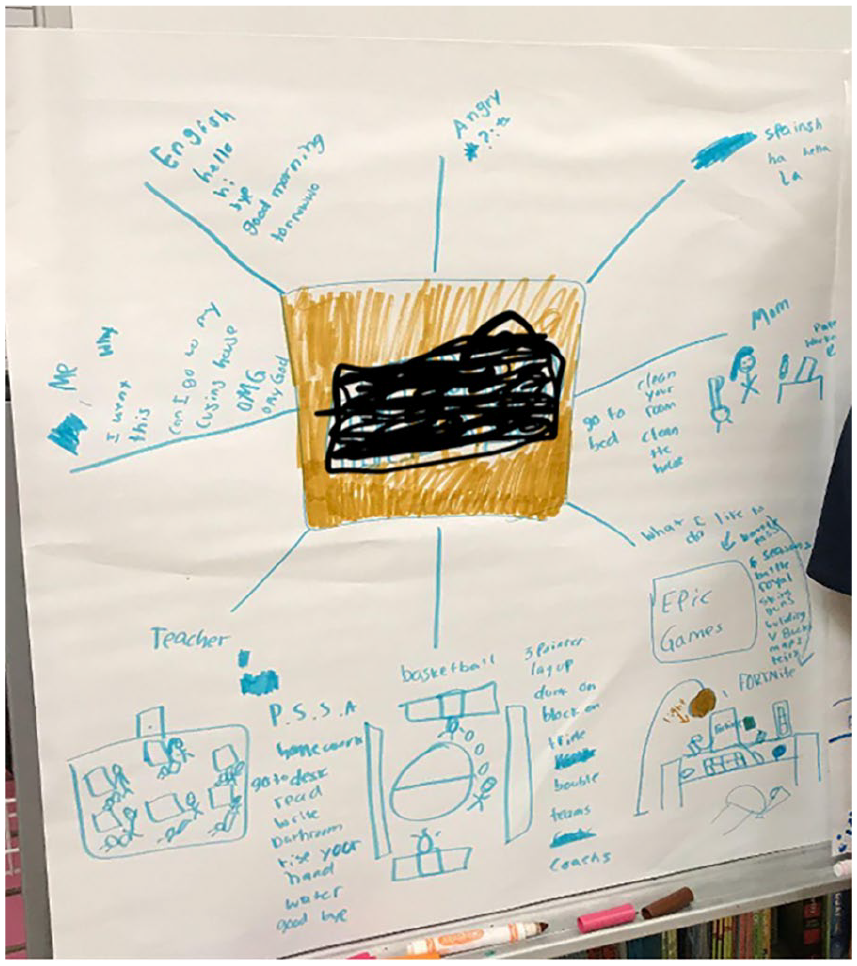
Marco’s Language Map.
Marco drew eight lines from the center of his poster, where he had written his name.
Beginning clockwise from the top, the following is a transcribed list of Marco’s language map.
Angry: *?:§
Spanish: ha, hella, la
Mom: (drawing of her standing in the kitchen) “Go to bed.” “Clean your room.” “Clean the house.”
What I like to do: Epic Games, Fortnite, V Bucks, Maps, Battle Royal (drawing of a desk with computer, mouse, and keyboard and “Fortnite” written across the screen)
Basketball: 3 pointer, lay up, dunk on block, triple, double, coaches (drawing of a basketball court)
Teacher: (drawing of students in rows of desks) P.S.S.A, homework, go to desk, read, write, bathroom, raise your hand, water, good-bye
Me: I want this, can I go to my cusins house, OMG, o my god
English: hello, hi, bye, good morning, tomowwo
Marco’s language map is rich with language assemblages illustrating the number of situations he negotiated. Although I had asked the children to focus on places, just as the physical place was complicated in the prior translingual event, Marco also insightfully showed that not only place shaped his linguistic interactions but also time, space, material, and other people assembled to allow or disallow his language to emerge. For instance, he clearly distinguished his linguistic choices in Epic Games from his mom’s language, although they would have occurred in the same place at home. He reported school language, labeling it “teachers,” and used acronyms such as P.S.S.A (the state-required testing) and several imperatives, such as “raise your hand,” “go to [your] desk,” and “read/write.” However, in spaces outside of school and home, specifically in video games and while playing, he noted more agentive practices as indicated by his micro-linguistic choices, “I want this” and “Battle Royal,” a concept in the player-versus-player game Fortnite.
Similarly, as in the second event where Daniel revoiced the expletive “What the Fuck!” that he heard while playing a duo on Fortnite, Marco noted cursing on his language map. When we were touring the language map, I did not understand Marco’s use of the symbols *?:§ represented at the top center of his map, next to the category he labeled “angry.” When I inquired, Marco elaborated that he used the symbols “like in comic books” or grawlix, which are symbols used to replace obscenities, to represent the curse words he said on the playground and while he played basketball. Finally, Marco was the only child in the workshop who was an immigrant to the United States and the newest English speaker. Nevertheless, his map illustrated that he engaged in English speaking in various ways, explicitly noting the breadth of his Fortnite and basketball vocabulary. Marco’s map is an apt illustration of how people, places, and things assembled, or did not assemble, in his life to allow him to freely engage his languages and show his linguistic dexterity and knowledge.
Translingual Social Event 4: The Beach and de Pla-lla
During the second session of the workshop, Edwin’s younger sister, six-year-old Amalia, attended. Amalia worked with Kate, who videoed their interactions, to create her language map (see Figure 3). Due to space constraints, Table 4 is a condensed multimodal transcript of an 11-minute translingual social event. To begin her language map, Amalia stuck her white poster paper vertically on the wall and composed directly on it with prompts from Kate.
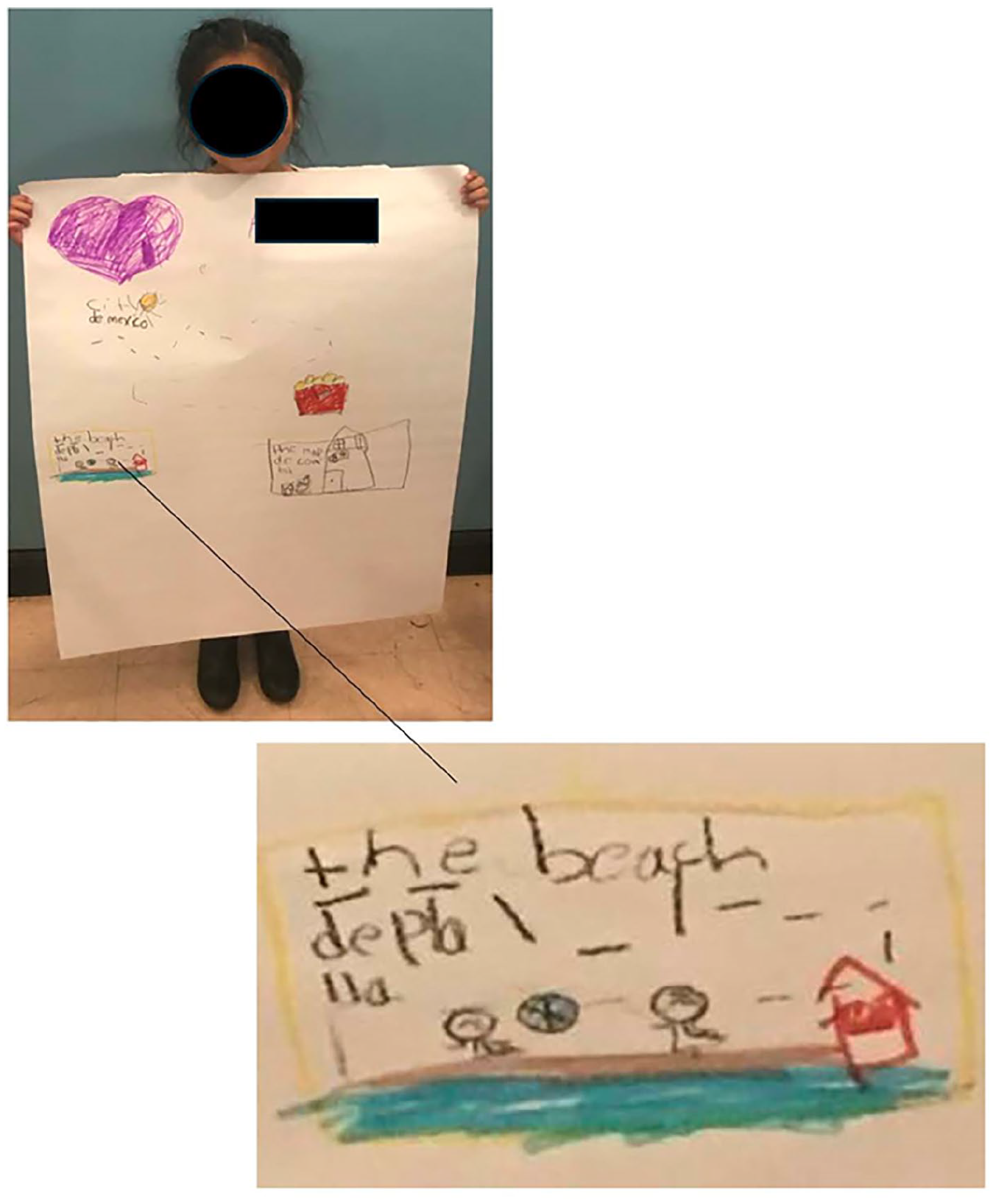
Amalia’s Language Map.
Transcript of Kate and Amalia Creating the Language Map.
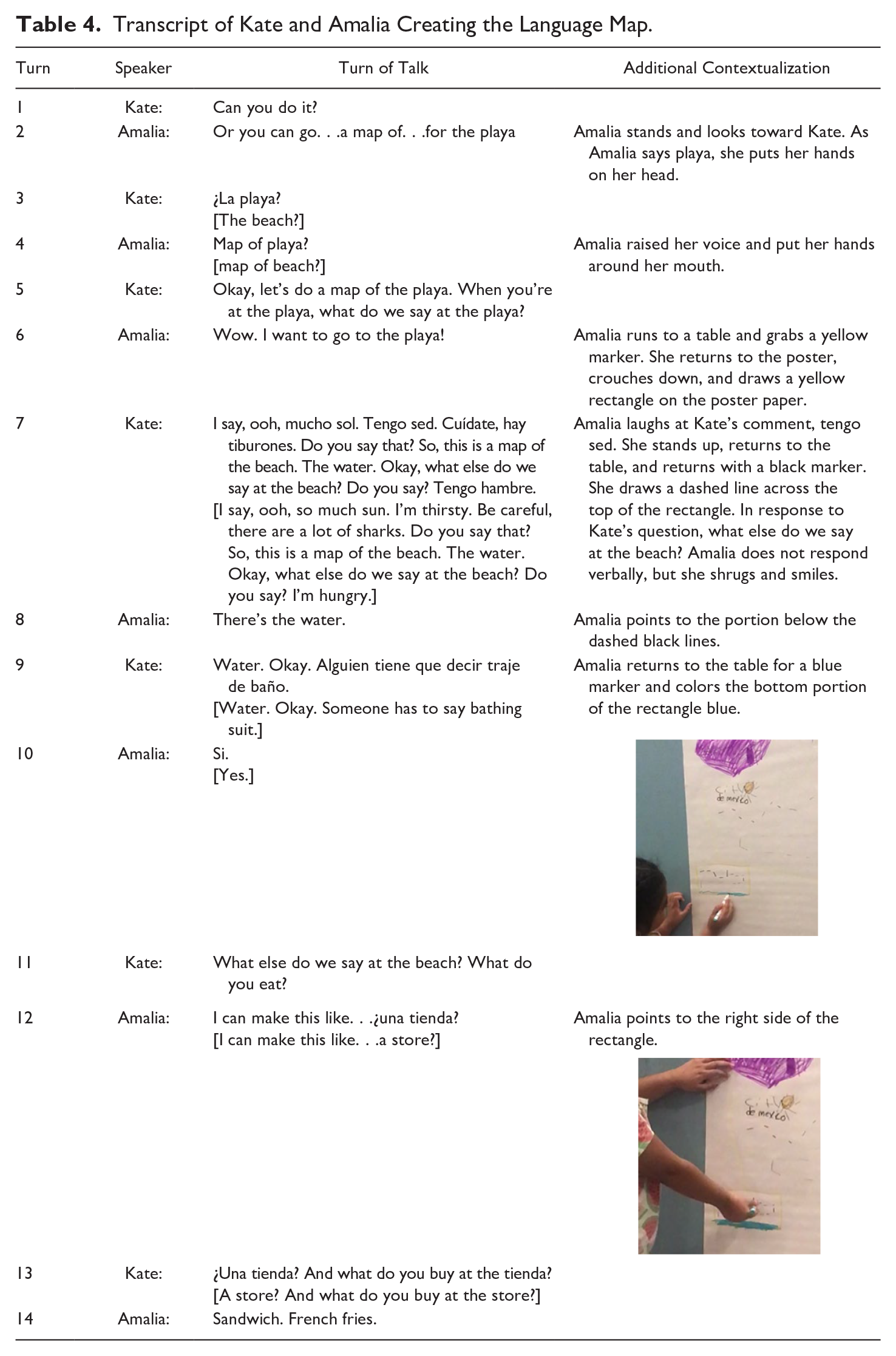
In turn 1, Amalia suggested that her map be of the playa—the beach. Kate confirmed and helped Amalia demonstrate her linguistic and social knowledge of the beach by asking questions such as, “What do we say at the playa?” Also, Kate maintained Amalia’s translingualism by using the “English” and “Spanish” words code meshed as they posed questions. When Amalia finished her language map, she wanted to title the drawing and turned to Kate for help spelling “the” and “beach,” but when she added the word playa just beneath it, she did not ask for help. Instead, she turned toward the poster to write “de pla-lla” confidently.
In her map-making, Amalia assembled her language using poster paper, markers, and help from Kate. By combining these modes, she provided more insight into her understanding and awareness of how the beach would shape language practices. Notably, Amalia’s completed language map (see Figure 3) may be perceived as containing few words. Yet, it was full of drawings or compositions representing objects, activities, and specific place-based facts, such as the shoreline found at the beach. Through these drawings, Amalia shared her awareness of how places, such as the beach, actors, and materials shape language practices. In Amalia’s completed drawing, she included the shore, the ocean, a store, and two people playing with a beach ball, a final drawing that emerged from the continued conversation not shown in the transcript. In sum, recalling the inherent multimodality of translingualism and literacy, Amalia’s talk, print, and drawings provide insight into what children can demonstrate when given autonomy in mode and materials, such as markers and paper, to share their full knowledge of their lives and world.
Cross-Translingual Social Event Analysis
Across these translingual social events, Daniel, Edwin, Benjamín, Marco, and Amalia described and participated in playful assemblages of multimodal and translingual practices during a community language mapping workshop. Across these playful assemblages, language was contingent on place, people, time, space, and material. Language was assembled based on a “template of their own experiences,” allowing the children to engage and appropriate various communicative resources (Arreguín-Anderson et al., 2018, p. 284). When retold by the children, their play served as moments where they were centered and agentive, contrasting with other reported linguistic assemblages at school and home, often governed by teachers’ and parents’ imperatives.
Representing Translingualism
In contrast to some previous studies (Melo-Pfeifer, 2015; Muller, 2022) of children’s representation of their translingualism, these children did not put forward separatist or monoglossic perspectives of their language. This contradiction may be because of the sustained and translingual nature of the workshop, coupled with pedagogical pláticas, which encouraged and allowed the children to draw up the larger, prior, and natural assemblages of language in their lives. Rather than asking them to create artificial representations of their languages, I prompted them to explore when, how, and where they languaged, leading to complicated and nuanced displays of this usage. For instance, Marco’s representations of where he used language showed a keen awareness of the appropriateness of linguistic codes, specifically in school language, and the use of grawlix for a curse word. Rather than take up hegemonic and monoglossic views of himself, Marco skillfully navigated these imposed societal rules of his language. In contrast, he took up translingual practices and views.
Furthermore, Amalia, the youngest child participant in the workshop, very freely pulled from her prior and imagined linguistic and multimodal assemblages to create a language map of the beach. Although my naming of the map as a “language map” carried with it the privilege of language, Amalia and the other children ignored this monomodalism and instead took up creative and more authentic modes, such as drawings and gestures, as Edwin did, to represent and compose how they readily practiced language.
Regarding language proficiency, Kate, the community educator, expressed confusion over Fortnite terms like duo, solo, and squad, acknowledging them as part of a “language” they did not know. This confusion underscored Edwin’s and Daniel’s role as language experts, which echoes Alvarez’s (2016) prior findings, which showed how bilingual children act as linguistic experts and brokers outside of school. In this event, Daniel and Edwin demonstrated their skills as listeners and translators for Kate. Edwin’s linguistic proficiency, evidenced by his corrections and definitions of Fortnite terms, contrasted with Benjamin’s earlier perceptions of Edwin’s Spanish proficiency. Their languaging also further supported the “trans” framing of language beyond named languages, suggesting that Fortnite may constitute a language of its own, as Kate claimed (Li, 2018).
Every Line Is a Lie
Returning to the pedagogical task of language mapping, Joseph (2022) claimed that “every line is a lie” to trouble the artificially placed border lines on physical maps that attempt to locate and possibly bind languages to certain geographic areas. The children also troubled these “lines” between and around their language practices. Their languages could not always be neatly mapped with distinct borders and in specific places because their practices were porous, dynamic, and overlapping. For instance, the children’s compositions, which consisted of talk, writing, and drawings, quickly disrupted physical borders, as seen in Daniel and Edwin’s discussions of their Fortnite experiences, which construed online gaming as a porous linguistic assemblage, not bound by places such as home or school.
Pedagogical Pláticas
Regarding method, pedagogical pláticas effectively privileged participants’ knowledge and translingual resources. In some ways, the children showed how their languages were controlled, policed, and possibly silenced. However, pláticas allowed children to use language freely, sharing outside language practices, including curse words. Although cursing among young children is under-researched, it reflected Marco’s and Daniel’s awareness of how different contexts and places permitted different linguistic choices. Likewise, Martínez and Morales (2014) also showed how adolescents “cursed” at school but avoided using the actual curse words by manipulating the word’s sound; similarly, Marco allowed himself to share his prior cursing outside the center by altering the letter shapes. Daniel attempted to curse by revoicing and attributing the curse word to another player in a prior Fortnite event. The children’s cursing may indicate that pláticas are apt for establishing more dialogic relationships between educators and students, and the children may have felt more comfortable sharing experiences and language practices deemed inappropriate in many educational settings.
On the Precarious Notion of Translingual Living
On the notion of play and precarity, Dovchin, Oliver, and Li (2024) have recently highlighted the importance of recognizing the precariousness, not only the playfulness, in the lives of transnationals, immigrants, and migrants, emphasizing that what is playful can also become precarious. For example, during the workshop, Edwin showcased his linguistic skill and playfulness with language through activities such as bicycling and playing Fortnite. However, Edwin’s mother had shared in a prior workshop that he was tested for special education, specifically speech services. Disagreeing with the assessment, she was concerned he was not receiving appropriate support at school, leading her to move him to a different school after this workshop ended. Moreover, while I viewed Edwin’s language practices as innovative and proficient, especially during interactions with Benjamín and correcting Daniel’s Fortnite language, I was concerned they might not be perceived positively in a school setting.
Concluding Implications
Pedagogically, all educators and learners would benefit from asking children to explore their community’s linguistic practices. Translingualism is pervasive in the lives of bilingual children; it is the norm, not the exception. Educators who inquire into these practices will easily see and hear the translingual reality. This reality will include even the most mundane practices, such as riding a bicycle, playing a videogame, or going to the beach. Within pedagogical spaces that do this, bilingual learners will have permission and encouragement to include the authentic ways they already use language in their community. Finally, this can help educators avoid assumptions about learners’ language practices and linguistic repertoires because they do not need to assume fluency or language preference. Instead, educators can allow children to pull from the practices they already engage in within their communities. However, educators must be open and accepting of those practices, avoiding correction and judgment, and affirm the way children use language as critical, creative, and playful. Finally, for scholars who use translingualism, multimodality, and playfulness as theoretical orientations, it would be helpful to acknowledge how playful linguistic assemblages contrast with moments when children cannot be playful, noting the precarity of these assemblages and their lives more generally.
Footnotes
Declaration of conflicting interests
The author declared no potential conflicts of interest with respect to the research, authorship, and/or publication of this article.
Funding
The author(s) disclosed receipt of the following financial support for the research, authorship, and/or publication of this article: This was funded by the Spencer Foundation.