




Abstract
Writing development is understood to be a multidimensional task, heavily constrained by spelling in its early stages. However, most available evidence comes from studies with learners of the inconsistent English orthography, so our understanding of the nature of early writing could be highly biased. We explored writing dimensions in each language by assessing a series of text-based features in children’s texts between mid-Grade 1 to mid-Grade 2. Results revealed that two constructs, writing conventions and productivity, emerged in both languages, but the influence of orthographic consistency started to be evident in the later time points. Other constructs of text generation seemed to emerge later and were less stable over time. The article thus highlights the language-general underpinnings of early text-writing development and the impact of orthographic consistency; furthermore, it strengthens the view that some writing components develop before others. We discuss implications for the assessment of early written products.
Writing is a multidimensional skill that involves multiple factors and processes (e.g., Alamargot & Chanquoy, 2001; Y. S. Kim, Al Otaiba, Folsom, Greulich, & Puranik, 2014; Y. S. Kim, Al Otaiba, Wanzek, & Gatlin, 2015; Puranik, Lombardino, & Altmann, 2008; Wagner et al., 2011). In particular, the execution of cognitive processes—that is, planning, translating, and revising (Hayes & Flower, 1980)—varies with time and writing experience (Berninger & Swanson, 1994). The translating process involves two subprocesses: text generation, during which ideas become linguistic propositions, and transcription, which comprises both spelling and handwriting (Berninger & Swanson, 1994). During transcription, the linguistic units created during text generation are put into written form (McCutchen, 1996). It is precisely this subprocess, transcription, that makes the greatest contribution to text quality in children’s early productions (e.g., Graham, Berninger, Abbott, Abbott, & Whitaker, 1997; Juel, Griffith, & Gough, 1986).
The translation process has received particular attention in developmental research because its two subprocesses are assumed to compete for the available cognitive resources in novice writers (Berninger, 1999). The challenge of spelling, especially, is thought to affect linguistic expression in early written products, because children’s attention span may be overloaded by their yet inefficient phoneme–grapheme coding skills (Berninger et al., 1992; Bourdin & Fayol, 1994). Accordingly, cross-linguistic studies of writing development in orthographies of differing levels of complexity provide useful, natural contexts for elucidating the specific effect of spelling constraints on the emergence and expression of the various linguistic dimensions of early written products.
Cross-linguistic studies of literacy are relatively rare, despite their importance for establishing whether developmental trends in reading and writing are similar across languages, or whether there are language-specific differences that need to be taken into account both for theoretical and for educational reasons. A major factor in cross-linguistic examinations of literacy development is the impact of the relative (in)consistency of phoneme–grapheme mappings, because it affects the rate of word-level—that is, reading and spelling—development (e.g., Caravolas, 2017; Caravolas & Bruck, 1993; Caravolas, Lervåg, Defior, Seidlová Málková, & Hulme, 2013; Landerl, Wimmer, & Frith, 1997; Seymour, Aro, & Erskine, 2003). Variations in orthographic consistency should have important effects in the text-writing domain, where development heavily depends on the automatization of low-level skills, such as spelling (e.g., Juel et al., 1986). Children who are learning to write need to allocate attention to spelling, potentially at the expense of sufficient cognitive resources for other aspects of writing (e.g., Berninger, 1999; Bourdin & Fayol, 1994; Juel et al., 1986; McCutchen, 2006). Indeed, there is some evidence that spelling poses fewer constraints on learning to write in more consistent orthographies (e.g., Babayiğit & Stainthorp, 2010; Hayes & Berninger, 2009; Lerkkanen, Rasku-Puttonen, Aunola, & Nurmi, 2004; Mäki, Voeten, Vauras, & Poskiparta, 2001), although none of these studies systematically compared a more inconsistent with a more consistent orthography.
Despite the well-attested effect of orthographic consistency on the rate of literacy development, there is evidence that the learning process may not be fundamentally different across languages, at least within alphabetic orthographies. For example, recent research has demonstrated that, regardless of orthographic complexity, early literacy development is underpinned by the same subset of cognitive predictors for at least the first 2 years of formal literacy instruction (Caravolas et al., 2013; Caravolas et al., 2012). In addition, a systematic, cross-linguistic (Spanish–English) examination of early text productions showed that, although Spanish children outperformed English children in spelling and spelling-related skills, such as capitalization and word separation, there were no differences in other text features, such as vocabulary sophistication, syntactic complexity, or productivity (Salas, 2014). To the best of our knowledge, no published study has yet examined whether the dimensions of early writing vary cross-linguistically. Arguably, if spelling poses different constraints in consistent and in inconsistent orthographies, it may affect the nature and emergence of the various dimensions. For example, if Spanish children attain proficiency in spelling earlier than their English counterparts (for whom this skill continues to create a bottleneck in writing development), this may allow higher-level dimensions to emerge earlier in Spanish than in English. To investigate these issues, in this article, we report a cross-linguistic, longitudinal comparison of the early (first and second grades) stages of writing development in English, a well-studied language with a complex, inconsistent orthography, and in Spanish, a less studied language with a much simpler orthography (Borgwaldt, Hellwig, & de Groot, 2004). Our main goal was to determine whether the emergence of writing dimensions in early text writing is characterized by strong language-specific trends or whether the same, language-general factors operate across languages.
Background
Assessing Children’s Written Productions
The assessment of writing has recently extended to a multidimensional perspective, where multiple, easy-to-measure, objective indicators of writing features and skills are obtained. Usually, these indicators are examined using factor-analytic techniques to establish the way in which they may be reflecting underlying dimensions of writing (e.g., Puranik et al., 2008; Wagner et al., 2011). For example, Y. S. Kim et al. (2011) assessed the writing products of kindergarten-level children and found evidence of a productivity dimension, whose indicators were the total number of words, the total number of sentences, and the total number of ideas. Similarly, Wagner et al. (2011) identified a handwriting fluency dimension, indexed by children’s (Grades 1 and 4 of elementary education) results on a timed alphabet writing task and a sentence copying task.
A multidimensional approach to the assessment of early writing is useful for at least two reasons. First, the field of early writing should benefit from a fine-grained, information-rich approach, at least until more research accrues. Such investigations should then inform the creation of standardized tests for assessing writing development with norms for children under the age of 8 years (or Grade 3), as these are currently not available (e.g., Wechsler Individual Achievement Test [WIAT-III]: Wechsler, 2009; PROESC: Cuetos, Ramos, & Ruano, 2004). Second, multidimensional, multitrait approaches allow for the examination of the underlying cognitive constructs or domains (e.g., Y. S. Kim et al., 2014; Puranik et al., 2008; Wagner et al., 2011). This approach is particularly relevant to the context of the present article, as it allows us to investigate whether the dimensions underlying a variety of text-based features are the same, and whether they emerge at the same points in development in two languages with contrasting orthographies.
Previous Studies on the Dimensionality of Writing
Only a handful of studies have assessed the dimensions of early writing in alphabetic orthographies. Most have been carried out with English-speaking participants and had a cross-sectional design (e.g., Puranik et al., 2008; Wagner et al., 2011). It should be noted, however, that although some of them focused solely on text-based features of writing (e.g., spelling accuracy, punctuation, and grammatical complexity, among others, as in Puranik et al., 2008), others focused on the component skills of writing, using measures that were not text-based, but obtained from independent tasks (e.g., spelling and handwriting, among others, as in Y. S. Kim et al., 2011). Still other studies have mixed the two types of measures (e.g., handwriting fluency, measured by a standardized test, and a series of text-based measures, as in Wagner et al., 2011). In this article, we confined our analysis to text-based features of early (from mid-Grade 1) text products across two languages: Spanish and English.
The small body of literature on writing dimensions in English has converged on a number of factors. There is robust empirical evidence of a productivity dimension that, by measuring the number of words or ideas generated, captures children’s skill to produce written output (e.g., Y. S. Kim et al., 2011; Puranik et al., 2008; Wagner et al., 2011). Spelling or transcription (i.e., spelling + handwriting) constitutes another domain that plays a role, especially in the early stages of learning to write (presumably due to its aforementioned constraining effect on early writing development; Y. S. Kim et al., 2014). In addition, support for the existence of a quality dimension has been reported, which usually taps the ability to organize and develop ideas coherently; notably, in these studies, quality has been measured either holistically or using qualitative scales. Thus, it is not entirely clear what specific text features might contribute to a quality dimension (Y. S. Kim et al., 2014; Y. S. Kim et al., 2015; Wagner et al., 2011).
Less is known about the linguistic makeup of early text productions. Although oral language skills, such as grammatical and vocabulary knowledge, are reported to affect the quality of children’s early written products (Y. S. Kim et al., 2014; Y. S. Kim, Al Otaiba, Sidler, & Gruelich, 2013; Puranik et al., 2008), very rarely has the early development of specific text features been addressed. However, there is evidence that syntactic accuracy and complexity may emerge as early as Grade 1 (Wagner et al., 2011), while aspects of vocabulary have been measured in Grade 2 children (Olinghouse & Leaird, 2009).
In sum, to date, studies on the dimensions of writing have been carried out primarily with English-speaking participants. The vast majority were cross-sectional, and the indicators of the investigated factors took into account a mixture of text-based features (e.g., number of words, spelling accuracy, punctuation) and component skills measured independently of writing. This article thus expands on extant research by conducting a longitudinal (first through second grade) examination of the dimensionality of writing, while contrasting English-speaking to Spanish-speaking children’s early writing development. In addition, in each language, we exclusively analyzed measures of text-based features.
The Present Study
We investigated the development of several text-based features in the early writing products of English- and Spanish-speaking children on three occasions from Grade 1 to mid-Grade 2. In using repeated administrations of a simple writing task, we expected this developmental window to provide insights into the phase during which spelling ability should exert the greatest impact on emergent writing skills (Berninger & Swanson, 1994; Juel, 1988). Our main aim was thus to establish the similarities and differences in the role of spelling and in the emerging dimensionality of writing in the early stages of writing development of English- and Spanish-speaking children.
Consistent with the multidimensional approach, a series of features, assumed to index various dimensions of writing, was identified and extracted from the text of each child at each time point and was scored or quantified for analysis. Our choice of features was motivated by previous studies (e.g., Puranik et al., 2008; Wagner et al., 2011), by the nature of the writing task (see the “Method” section), and by the developmental window under study. Features included multiple indicators of text spelling and the spelling-related skills of word separation and capitalization, as well as a number of linguistic indicators of the hypothesized domains of vocabulary, syntactic complexity, and connectivity. In addition, we measured text productivity, operationalized as the number of words per text, because it has been found to be a reliable proxy for the number of ideas and overall quality, and a robust measure of writing development (e.g., Berman & Nir, 2009; McMaster & Espin, 2007; Scott & Windsor, 2000).
Method
Participants
Altogether, 188 English-speaking children from the north of England and 190 Spanish-speaking children from Granada, Spain, who were drawn from a larger study on word-level literacy development across multiple languages, participated in this study. The English sample consisted of 98 boys and 90 girls, whose mean age at Time 1 (T1) was 60.27 months (SD = 3.67). The Spanish sample consisted of 104 boys and 86 girls, whose mean age at T1 was 66.72 months (SD = 3.57). The data reported exclusively in the present study, and derived from the first author’s doctoral research, were collected when children were at mid-Grade 1 (T1), end of Grade 1 (Time 2 [T2]), and mid-Grade 2 (Time 3 [T3]). Missing data in the English sample were 7.98%, 9.04%, and 11.70% at T1, T2, and T3, respectively; in the Spanish sample, they were 12.10%, 15.26%, and 10.53% at T1, T2, and T3, respectively. The main causes of missing data were participant absences on the date of data collection or children having left the school. Children in the Spanish group were, on average, 6 months older than their English counterparts. This is because in England children enroll in kindergarten (reception year) classes the September after their fourth birthday, but in Spain they start the equivalent class the year they turn 5. Not surprisingly, a significant age difference was found, t(376) = 17.11, p < .001, d = 1.76. Controlling for age did not alter the pattern of results reported below; in addition, age did not correlate with any of the target measures. For these reasons, age was not controlled for in subsequent analyses.
Teaching practices
Children in the English sample attended schools that followed the National Literacy Strategy, which adopted a phonics-based approach to literacy instruction. Children in the Spanish sample attended schools that followed the regional (i.e., Andalusian) framework for literacy instruction. Assessment of teacher practices was carried out through a series of questionnaires administered yearly to the teachers of all participating classrooms. We performed an analysis of the amount of time per week that the Grade 1 teachers devoted to a series of literacy activities (handwriting, spelling, and free writing) in each language. Mann–Whitney U tests indicated that in both countries, children received a similar amount of instruction on handwriting (U = 43.5, p = .449), spelling (U = 27.5, p = .247), and free writing (U = 20.5, p = .074). For this reason, teaching practices were not controlled for in subsequent analyses.
Task and Procedure
Writing recent past events
Data were collected around mid-Year 1 (November–December, T1), end of Year 1 (May–June, T2), and again around mid-Year 2 (November–December, T3) at the children’s schools. Children in both language groups were administered a text-writing task that required writing about recent past events. The administrator asked groups of five children about what they had done the day before after they had left school. Children wrote for 5 min and were encouraged to write as much as they could. They were praised for any efforts. No advice or more specific prompts were given. Once the 5 min elapsed, children were instructed to draw a picture illustrating their text. The administrator used that time to ask each child to read back the text he or she had produced. This procedure helped to elucidate each child’s intended message, especially for children with illegible handwriting or very poor spelling skills (similar procedures were reported by Juel et al., 1986 and Y. S. Kim et al., 2015). A number of text-based indicators were evaluated; they are described below, grouped according to the dimension they were hypothesized to index.
Writing conventions
This dimension was hypothesized to include aspects of children’s accuracy in spelling and spelling-related skills.
Spelling accuracy
The percentage of words that were spelled correctly was used as an index of the child’s text spelling skill. Numbers, symbols (e.g., 8, &, +), and loan words (e.g., Nintendo, for the Spanish sample) were excluded from this count. Incorrect word separation was not penalized, so a child writing Iwent was given credit for two accurately spelled words, I and went. The scoring was binary: 0, 1.
Word separation
The percentage of words that showed conventional boundaries was used as an index of children’s word separation skills, which are essential for applying some orthographic rules. When two words were written as one word (e.g., Iwent), both tokens were penalized, regardless of whether the words were spelled correctly. The scoring was binary: 0, 1.
Capitalization
Children’s knowledge and use of lowercase and uppercase letters was assessed calculating the percentage of words that showed conventional use of case. Words in which the uppercase version of a letter was used in an inappropriate context, for example, within a word as in hoMe, were counted as errors. The scoring was binary: 0, 1.
Productivity
This dimension was hypothesized to reflect children’s text-generation skills at the word and letter levels. The two different transcription units (words, letters) were considered to ensure that language-specific traits, such as average word length, did not bias the results (Cutler, 2012; Cutler, Norris, & Sebastián-Gallés, 2004).
Number of words
Children’s text-production skills were assessed by counting the total number of words written in the allotted time of 5 min. Incorrect spelling or unconventional word separation did not affect this count. For example, a child who wrote Iplaid for I played was given credit for writing two words.
Number of letters
Children’s text-production skills were also assessed by counting the number of letters they wrote. Words for which no parallel could be established between the intended meaning and the actual written string were excluded from all counts. Letters were counted automatically in Excel.
Connectivity
This dimension was hypothesized to estimate children’s skills to connect parts of the text they were producing, which is a key aspect of text organization and its resulting coherence.
Connectors
Conjunctions (e.g., and, or) and discourse markers (e.g., then, first) are fundamental to showing the links among parts of the text and thus contributing to text cohesion and coherence (Hickmann, 2003). Children’s use of connectors was assessed by identifying all interclausal connectors in the texts and then calculating the percentage these represented of the total number of words in the text.
Punctuation
Punctuation marks signal the boundaries of different discourse segments, and there is evidence that children acquire them in a predictable order (Ferreiro & Pontecorvo, 1999). All types of punctuation marks—periods, exclamation points, commas, question marks, and so on—were counted manually, directly from the original texts. To control for the effect of overall text length, whereby longer texts might contain more punctuation marks, the total number of punctuation marks was divided by the number of words in the text and multiplied by 100.
Syntactic complexity
This dimension assessed children’s grammatical skills, particularly the degree of density and embeddedness in syntactic constructions, which is a fundamental aspect of discourse elaboration and essential to the characterization of text composition skills across the life span (Berman, 2008).
Words per clause
This measure of syntagmatic syntactic complexity was obtained by dividing the total number of words by the number of clauses produced by the child.
Subordination
This measure of the degree of syntactic nesting or embeddedness consisted of calculating the percentage of subordinate clauses out of the total number of clauses, thus constituting an index of the amount of embeddedness in children’s texts.
Vocabulary
A set of measures was derived to estimate children’s lexical choices and evaluate the lexical precision and elaboration in their written products.
Adjectives and adverbs
Optional lexical elements such as adjectives and adverbs add to the elaboration and precision of the message (Ravid & Levie, 2010) and were therefore tallied in all texts. Adverbs of obligatory expression, such as those in phrasal verbs (e.g., take off), were not counted. The score consisted of calculating the percentage of adjectives and adverbs of all words in the text.
Lexical density
The percentage of content words or open-class lexical tokens (e.g., nouns, verbs, adjectives, adverbs), as opposed to the proportion of closed-class tokens (e.g., prepositions, determiners, pronouns), was used as an indicator of lexical density, based on the assumption that a greater proportion of “semantically charged” tokens results in a richer and more informative text (Halliday & Hassan, 1985; Malvern, Richards, Chipere, & Durán, 2004). All words in the texts were labeled for grammatical class. Then, all content words were counted and the resulting number was divided by the total number of words in the texts and multiplied by 100.
Lexical diversity
The type-token ratio 1 was calculated for each text as an indicator of lexical diversity in written composition (Malvern et al., 2004). Any modification to a word base, such as adding or subtracting inflectional endings or derivational morphemes, was interpreted as a different type.
Average content-word length
The average number of letters of all content words in children’s texts was measured as a proxy for lexical sophistication and use of low-frequency tokens, based on the assumption that longer words are less frequent (Bybee, 2007).
Reliability
All texts were transcribed and coded (tagged) according to the units of interest described above and evaluated (scored) by the first author. Reliability between the first author and two external coders (native speakers of Spanish and English, respectively), blind to the objective of the study, was calculated on 20% of the sample. The coders were first trained on the coding criteria with an initial sample of 10 texts, after which they each coded 10% of the texts in each language group. Texts were selected in a quasi-random fashion to ensure an equivalent number of texts from each time point. Agreement was r > .81 or higher for all measures—spelling accuracy (.96 for English, .99 for Spanish), word separation, (.97 for English, .99 for Spanish), capitalization (.95 for English, .97 for Spanish), number of words (.94 for English, .99 for Spanish), punctuation (.81 for English, .94 for Spanish), and number and type of clauses (.90 for English, .96 for Spanish).
For measures based on the tagging of texts for part of speech—that is, number of adjectives and adverbs, number of connectors, lexical density, and average length of content words—coding reliability was obtained by calculating the degree of agreement between the first author’s manual tagging of each word and an automatic part-of-speech analyzer (CLAWS4 for English: Garside, 1987; MACO for Spanish: Civit, 2003) on a quasirandom selection of 10% of the texts in each language (20% of the total sample). Agreement between the two types of counts always exceeded 80%.
Preliminary Analyses
Because the study dealt with very early text productions, it was necessary to check for the existence of floor effects, especially in the earlier time points, as well as ceiling effects, as children made progress on various measures. An assessment of the psychometric properties of the measures was carried out in two steps: First, outlier scores were identified and corrected and second, the normality of the distribution for each variable was evaluated. Following Kline (2011, pp. 54-55), the outliers assessment consisted of looking for cases that were more than 3.0 standard deviations (SDs) above or below the mean for all relevant variables. Outliers amounted to only 1.06% of all scores (133 out of 13,107 data points). The average number of extreme scores per variable was 3.69 (SD = 2.27; range: 0-9), that is, less than 1%. Twenty-five children showed two or more extreme scores. We decided to keep these participants as we aimed to recruit an unselected sample, representative of the population found at schools. To avoid extreme scores distorting the distribution of values within a given variable and violating assumptions of ensuing statistical tests, scores exceeding 3 SD were Winsorized (following Osborne, 2013) to the value equivalent to exactly ±2.99 SDs. All the analyses reported below were carried out with the corrected scores, and these replicated analyses with the original scores. The text-writing measures were next checked for the normality of the distribution for each variable. None of the selected measures showed skewness or kurtosis values outside the recommended cutoff points (Kline, 2011). Skewness values ranged from −1.72 to 1.86, whereas kurtosis values ranged from −1.58 to 4.63. In sum, no major deviations from normality were observed for the final set of measures.
Results
The descriptive statistics for each measure are reported in Table 1, and these raised no concerns regarding floor and ceiling effects. Prior to exploring the dimensional structure, we examined the pattern of relationships between the multiple indicators using Pearson product-moment correlations for each language and time point (see Supplemental Tables 1 to 3 for correlations at T1, T2, and T3, respectively).
Means and Standard Deviations of Text-Based Measures for Each Language Group at Three Time Points.
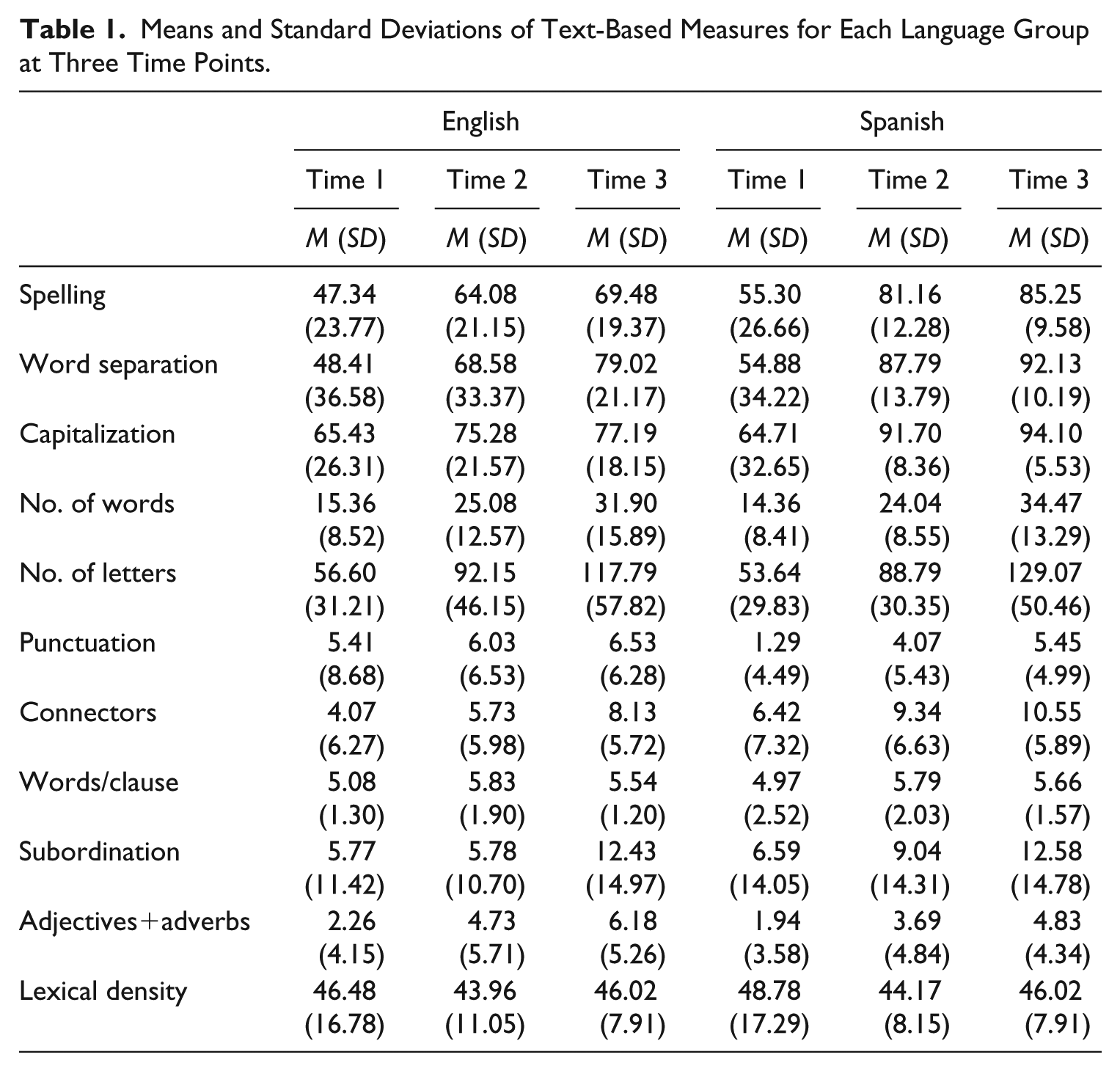
Writing conventions measures (spelling accuracy, word separation, and capitalization) were significantly associated throughout the study period in both languages. In English, the correlations between these three variables were consistently high, ranging from r = .56 to r = .77. In Spanish, they ranged from r = .32 to r = .61, with the exception of the correlation between capitalization and word separation at T1 (Supplemental Table 1). Therefore, although correlations differed slightly in size, both language groups showed these three indicators to be tightly related in the early stages of learning to write.
Productivity measures, that is, number of words and number of letters, showed very high correlations throughout the study period (r > .90). The close relationship between different measures of productivity was to be expected and has been found before (e.g., Berninger et al., 1992; Puranik et al., 2008; Wagner et al., 2011). It has been suggested that the number of words constitutes the most representative of these measures and, thus, it is the most widely used in studies measuring productivity (Puranik et al., 2008). It is also evident from Supplemental Tables 1 to 3 that number of words and number of letters were not only extremely highly correlated, but their pattern of correlations with other measures was virtually identical.
The dimensions of syntactic complexity, vocabulary, and connectivity did not show such clear patterns of relationships. With a few exceptions, correlations between the indicators of each dimension were in the low range and usually nonsignificant. Syntactic complexity measures were, as a rule, not significantly correlated with each other in either language, throughout the study. The measures of the vocabulary dimension were mostly unrelated at T1 (Supplemental Table 1), with the exception of content-word length, which was negatively associated with the proportion of adjectives and adverbs in English; in Spanish, lexical diversity was positively associated with lexical density. This pattern was also observed at T3, but not at T2. At T2 and T3, however, both language groups showed moderate correlations between the proportion of adjectives and adverbs and lexical density (Supplemental Tables 1 and 2). It is not surprising that these two measures were related, given that the adjectives and adverbs measure is a more refined count of lexical density (which includes the percentage of adjectives and adverbs, as well as of nouns and lexical verbs). Of interest was the consistently strong negative correlation between lexical diversity and productivity measures—number of words and number of letters. This may suggest that lexical diversity is more sensitive to text length rather than tapping aspects of written vocabulary richness (see Malvern et al., 2004).
Exploratory Factor Analyses
The hypothesized dimensions of writing conventions, productivity, syntactic complexity, vocabulary, and connectivity were examined by conducting exploratory factor analyses with a principal components factor extraction method. Analyses were run for each time point and language group separately to examine the longitudinal stability of the constructs. The Direct-Oblimin rotation was applied because it is the recommended approach when factors are likely to be correlated (Tabachnick & Fidell, 2007), as has been the case in previous studies of the dimensionality of writing (e.g., Y. S. Kim et al., 2015; Puranik et al., 2008). A principal components analysis (PCA) approach was chosen also due to the absence of previous studies of a similar scope—that is, that dealt with very early text productions across two language groups. All text-based measures were entered, and measures of sampling adequacy (MSA) were assessed for the model and for each individual variable. Variables with MSAs <.6 were dropped (Kaiser, 1974, as cited in J. O. Kim & Mueller, 1978), as well as those with communalities <.50 (Field, 2009), and the analysis was rerun with the remaining variables. In all cases, factors extracted were those with eigenvalues >1.
Dimensionality of writing in English
Table 2 shows the standardized factor loadings for English at T1, T2, and T3. At T1, a four-factor solution was found, which explained 76% of the variance. At T2 and T3, in contrast, a three-factor solution was found, which explained 80.08% and 79.27% of total the variance, respectively. At all time points, spelling accuracy, word separation, and capitalization loaded strongly on a common, writing conventions factor, and this factor accounted for a consistently high proportion of variance (approximately 40%–49%). Also across time points, number of words and number of letters loaded on a common productivity factor, together with lexical diversity. It should be noted that although lexical diversity was initially considered an index of vocabulary-related aspects, it was always strongly—and negatively—associated with productivity measures, suggesting that longer texts were characterized by less diverse vocabulary. We return to this finding in the “Discussion” section. The productivity construct itself consistently accounted for a significant proportion of variance, albeit lower than the contribution of writing conventions. At T2 and T3, two measures of vocabulary, percentage of adjectives and adverbs and lexical density, loaded on a common vocabulary factor. As predicted, punctuation and connectors loaded on a common connectivity factor, although this factor emerged only at T1; in addition, their loadings were of opposite signs, meaning that children chose either punctuation marks or interclausal connectors to link the different parts of the text. Percentage of subordinate clauses and percentage of adjectives and adverbs loaded on a common, unexpected factor at T1 only, perhaps because they were both tapping the relative degree of informativeness and precision that these measures contribute to. Finally, there was no evidence of a syntactic complexity factor at any time point.
Standardized Regression Coefficient Factor Loadings for English at Times 1, 2, and 3.
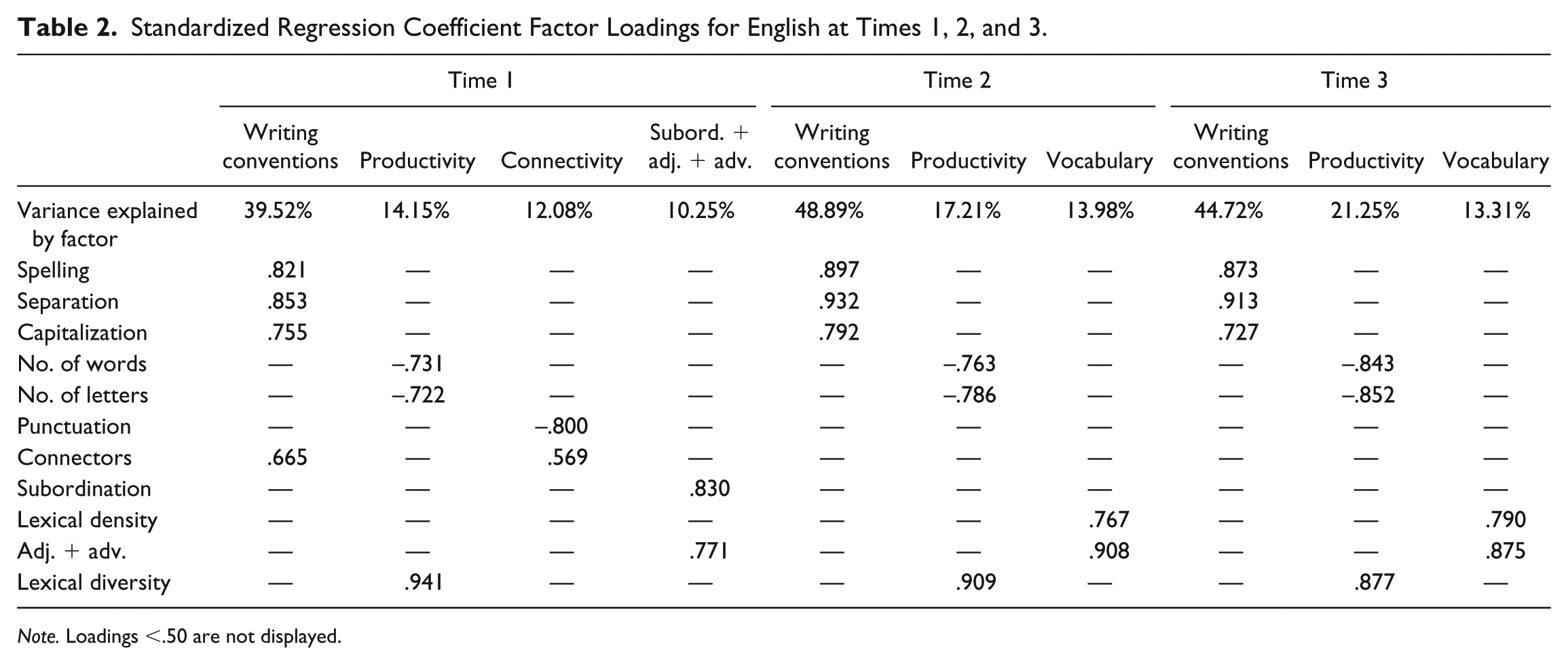
Note. Loadings <.50 are not displayed.
In summary, two factors were consistently obtained across time points in English: a writing conventions factor, composed of spelling accuracy, word separation, and capitalization, and a productivity factor, composed of number of letters, number of words, and lexical diversity (or type-token ratio). In addition, a vocabulary factor emerged at T2 and T3, composed of lexical density and percentage of adjectives and adverbs. The T1 factor of connectivity did not endure to the later time points. Moreover, there were small to moderate, negative correlations between the writing conventions and productivity factors of r = −.286, r = −.353, and r = −.210 at T1, T2, and T3, respectively. This suggests that even though writing conventions measures controlled for text length (i.e., they were calculated as a proportion of all words in the text), the more the children wrote, the less accurate they were across all writing conventions measures. The writing conventions factor was also moderately and positively correlated with the vocabulary factor (r = .372) at T2 and T3, whereas the correlation between the productivity factor and the vocabulary factor was r = −.154 at T2 and r = −.137 at T3, suggesting that as children wrote more, their vocabulary tended to be less sophisticated.
Dimensionality of writing in Spanish
Table 3 shows the standardized factor loadings for Spanish at T1, T2, and T3. At T1 and T2, a two-factor solution was found, which explained 81.74% and 76.69% of the variance, respectively. Spelling accuracy and word separation, but not capitalization, loaded heavily on the first, writing conventions, factor. Only at T3 did capitalization additionally load on this factor. As in English, the writing conventions factor accounted for the largest proportion of variance at each time point, but unlike in English, its contribution systematically decreased over time. Similarly to English, number of words, letters, and lexical diversity loaded on another factor, productivity, across time points, and the strength of this factor appeared stable over time. At T3, a three-factor solution was found, accounting for 77.85% of the variance. The third factor was akin to the vocabulary factor found for English, which was also composed of percentage of adjectives and adverbs and lexical density. Syntactic complexity measures and connectivity measures did not load on any factor. As in English, the writing conventions factor was moderately related to the productivity factor at T1 and T2, but not at T3 (correlations were r = .297, .220, and .043 at T1, T2, and T3, respectively). Note that, for Spanish, the correlations between these two factors were positive; thus, the more the children wrote, the more accurate they were in spelling, word separation, and capitalization. Finally, the vocabulary factor showed a correlation of r = −.108 with the writing conventions factor and of r = .052 with the productivity factor. In sum, also in Spanish, the writing conventions and the productivity dimensions were salient constructs throughout the study period. A vocabulary factor was also identified, composed of adjectives and adverbs and lexical density, but only in the last time point. In contrast to English, there emerged fewer factors while the relationship of writing conventions to other dimensions decreased with time. In both languages, the examination of the correlations (Supplemental Tables 1-3) across time points revealed some tendencies for other dimensions, but these did not surpass the loading thresholds of the exploratory factor analyses. This suggests that some aspects of text composition may emerge later in the development, and during their emergence they lack stability.
Standardized Regression Coefficient Factor Loadings for Spanish at Times 1, 2, and 3.
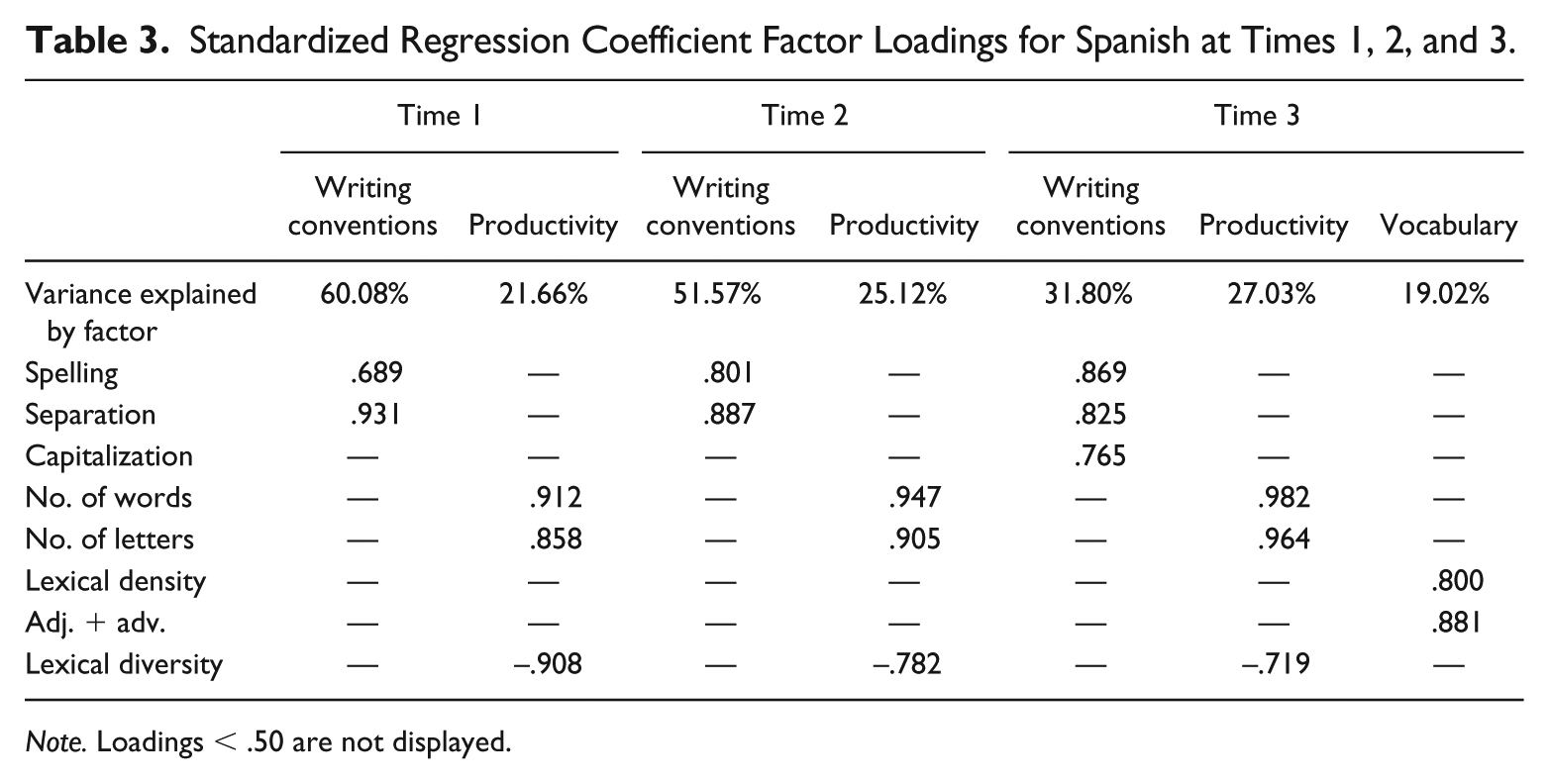
Note. Loadings < .50 are not displayed.
Discussion
This article set out to establish the nature and complexity of early text-writing development among children learning to write in English and those learning to write in Spanish. For this purpose, children’s text productions were systematically coded and evaluated on a large number of text-based measures at three time points in Grades 1 and 2. In previous studies, we found that Spanish children showed an advantage in single-word spelling accuracy and other spelling-related skills, such as word separation and capitalization, but that beyond these word-level features, children learning to write in both languages showed very similar trends (Caravolas et al., 2012; Salas, 2014). In the current study, the English and Spanish data from each time point were subjected to exploratory factor analyses to reveal the factor structure of text-generation skills, via an assessment of the various text-based features making up these early text productions. In addition, we aimed to determine the stability of these emerging constructs over the first year-and-a-half of formal literacy instruction.
Results showed that to a large extent, the same dimensions operated in both languages. Two dimensions stood out as well-established constructs already by mid-Grade 1 across the two languages: writing conventions and productivity. Other studies have also found support for a productivity construct and a writing conventions or “accuracy” construct (Puranik et al., 2008; Wagner et al., 2011). The identification of these robust, early emerging constructs is thus in line with previous studies and extends our current understanding of the dimensionality of writing to more consistent orthographies (e.g., Y. S. Kim et al., 2014; Puranik & Al Otaiba, 2012; Puranik et al., 2008; Wagner et al., 2011).
Over and above the two foundational constructs of writing conventions and productivity, other text-based indicators tended to group together as we had hypothesized, but they did so at later time points. A vocabulary factor emerged in English and Spanish by the end of Grade 1 and by the middle of Grade 2, respectively. Percentage of adjectives and adverbs and lexical density were the variables loading on this factor across languages. This is not surprising, because the percentage of adjectives and adverbs is a subset of the percentage of content words, measured by the lexical density measure. However, the fact that they were not consistently related in English until the end of Grade 1, and in Spanish until mid-Grade 2, suggests that some constructs of text-level performance may not consolidate until later stages of writing development. Taken together, the finding that writing conventions and productivity factors emerge and stabilize fairly early on, whereas other, more rhetorical aspects of text construction emerge later and are less stable constructs at these early stages can be considered to reflect children’s knowledge-telling processes of text composition (Bereiter & Scardamalia, 1987).
Of interest is the finding that lexical diversity, calculated as the type-token ratio, was not associated with any vocabulary measure, but loaded heavily on the productivity factor across time points and language groups. Other studies observed a similar behavior of the corrected type-token ratio measure (Olinghouse & Leaird, 2009). This result further substantiates previous observations about the nature of the type-token ratio as a measure extremely sensitive to text length, but that poorly captures vocabulary-related aspects of text construction (Malvern et al., 2004).
In contrast to previous studies assessing the dimensionality of early writing, we did not find support for a “complexity” factor. Syntactic complexity measures were characterized by their instability, both in terms of their lack of associations with one another throughout the study period and in their pattern of relationships with other measures, which was erratic. In addition, they were often excluded from factor analyses due to their lack of contribution to the models. Other studies measuring written syntax have reported inconsistent patterns in relation to measures such as these. For example, Beers and Nagy (2010) reported negative correlations between their measures of words per clause and of clauses per T-unit. The differences between the present results and those of Puranik et al. (2008), who obtained support for a complexity factor, may be related to the fact that participants in their study were older (starting at Grade 3 and up to Grade 6), and therefore their written syntactic complexity skills could have been more consolidated. Certainly, syntactic complexity in written composition has a protracted development (Berman & Nir-Sagiv, 2007; Berman & Verhoeven, 2002; Ravid & Berman, 2010). The differences between the present results and those reported by Wagner et al. (2011), who found that a measure of T-unit length (in words) and a measure of clauses per T-unit were individual indicators of a latent complexity factor in first and fourth graders, may be related to (a) the slightly different types of syntactic measures; (b) the use of a different prompt (explaining which animal they would like as a pet for their class) and hence a different genre, which may have affected syntactic complexity (Beers & Nagy, 2009, 2010); and (c) children having twice as much time to produce the texts. Finally, there was little support for a connectivity dimension. All in all, the lack of stability of the vocabulary and syntax factors could also be partially related to the fact that children were evaluated on a type of writing task that, while chosen to facilitate children’s opportunities to generate content and ideas, did not relate to a concrete or well-known discourse genre that children could have drawn on. Future research should strive to obtain multiple text samples from each child and at each time point to better estimate their text-writing skills.
Although the commonalities across languages far exceeded the discrepancies, some language-specific trends were identified. First, the writing conventions dimension was fairly stable in both languages, but it explained progressively less variance in Spanish. This contrast might reflect the more prominent and protracted role of spelling and spelling-related skills in English, given that it is a much more inconsistent orthography than Spanish (Caravolas et al., 2012; Salas, 2014). As Spanish children are closer to automatizing these skills, the construct itself may increasingly fail to capture individual differences. Second, but related to the above, the writing conventions dimension showed stronger relationships with other dimensions, such as vocabulary, in English than in Spanish. This could also be reflecting the more constraining role of spelling in English, as compared with the simpler Spanish orthography. In sum, writing conventions seems to be a common dimension operating across languages, although its weight will vary as a function of children’s progress on these skills (Juel et al., 1986), and therefore it will be subject to cross-linguistic differences. Productivity, on the contrary, appeared to have the potential for a robust, cross-linguistic dimension of writing development less affected by orthographic consistency (Salas, 2014), as it was fairly stable in both language groups and showed very similar patterns of relationships with other domains. Previous cross-linguistic studies with older children and adults had already pointed out that text length is an excellent developmental marker, both for writing and for oral text production (Berman & Nir, 2009; Berman & Verhoeven, 2002). As such, it may be a privileged indicator of text quality and of language development across languages and across the life span. This hypothesis, however, would require the validation of these exploratory findings through the use of confirmatory factor analysis techniques. A final note pertaining cross-linguistic differences is the inherent difficulty of conducting this type of research design, which involves participants across countries. Our decision that participants were matched in terms of the amount of formal literacy instruction was at the expense of a significant difference in chronological age. The confound between the variable of interest, language/orthographic consistency, and age is hard to fully disentangle with natural samples being recruited in different countries, although in our study age seemed to have little effect on the patterns of results obtained. Future research should endeavor to compare writing development across populations that start literacy instruction at the same chronological age—for example, comparing Spanish children with English-speaking children from education systems where literacy instruction begins later.
Overall, our results suggest that across languages, some constructs of text-generation performance may only be emerging during the first and second years in school, hence accounting for their instability over time. These findings are consistent with the view that some writing components develop before others (e.g., Berninger & Swanson, 1994; McCutchen, 2006) and should be taken into consideration for early writing assessment. This means that even very early written composition can be evaluated on at least these two dimensions (writing conventions and productivity). Arguably, testing at these foundational stages of writing development should enable early detection of writing difficulties and could possibly improve the effectiveness of the remediation strategies that are put into action. The striking cross-linguistic similarity in terms of writing dimensions contributes to a growing body of evidence proposing that, despite differences in orthographic complexity, teaching practices, and cultural contrasts, there exists a foundational literacy development stage that is characterized more by commonalities than by differences, at least in alphabetic orthographies. Moreover, where between-language differences are observed, these may usually be ascribed to the moderating effects of phono-graphemic consistency. This line of research has found robust evidence showing that although the rate of reading and spelling development is sensitive to variations in orthographic consistency, these skills draw on the same cognitive precursors (e.g., Caravolas et al., 2013; Caravolas et al., 2012). This study builds on that notion by proposing that writing dimensions may also be language-general and that, with the exception of writing conventions that depend on phoneme–grapheme mapping consistency, they develop at a similar pace.
Supplemental Material
supplementary_material – Supplemental material for Dimensionality of Early Writing in English and Spanish
Supplemental material, supplementary_material for Dimensionality of Early Writing in English and Spanish by Naymé Salas and Markéta Caravolas in Journal of Literacy Research
Footnotes
Acknowledgements
We thank Eduardo Onochie-Quintanilla and Sylvia Defior, from the University of Granada, Spain, for their help in collecting the Spanish text samples. We are very grateful to Mrs Samantha Crewe for her help and expertise in collecting part of the English data. We are also grateful to the schools, children, and parents who participated in the study.
Declaration of Conflicting Interests
The author(s) declared no potential conflicts of interest with respect to the research, authorship, and/or publication of this article.
Funding
The author(s) disclosed receipt of the following financial support for the research and/or authorship of this article: The research leading to this study was supported by funding from the European Community’s Seventh Framework Programme (FP7/2007-2013) under Grant Agreement No. ELDEL PITN-GA- 2008-215961-2 to Markéta Caravolas.

Supplemental material
The appendix referenced in this article and abstracts in languages other than English are available at online.
Notes
References
Supplementary Material
Please find the following supplemental material available below.
For Open Access articles published under a Creative Commons License, all supplemental material carries the same license as the article it is associated with.
For non-Open Access articles published, all supplemental material carries a non-exclusive license, and permission requests for re-use of supplemental material or any part of supplemental material shall be sent directly to the copyright owner as specified in the copyright notice associated with the article.
