




Abstract
This study describes the development of an observational tool, the Write Start! Writing Assessment, created to provide descriptive information on four features of preschoolers’ writing: forms, directional patterns, intentionality (ways of assigning meaning to marks), and message content. Observational categories were generated from a review of research and then refined through constant-comparative analysis of the writing of 139 low-income, African American children aged 2:6 to 5:11. Children participated in the study from 1 to 3 years. Fall and spring writing samples were collected as children responded to a standard task asking them to write a photo caption. Cross-sectional analyses across seven age bands show the range and relative frequencies of writing categories. A wide range of normal variation was observed within age groups. Growth curve analyses confirmed that children showed significant change in all four writing features over the preschool years. Data from a subsample of 10 children were analyzed longitudinally over 3 years to triangulate findings. Although children moved toward more conventional writing, inter-individual variability in initial starting points and pacing of transitions into more advanced categories was observed for all four writing features. Intra-individual variability was observed in back and forth movement between less and more advanced writing performances, concurrent use of multiple hypotheses, and differential development of the four writing features. The authors conclude that the descriptive information provided by Write! Start! measure provides a starting point for differentiation of instruction for young writers.
Young children’s early attempts at writing provide important opportunities to build understandings and skills that are foundational for later independent reading and writing (cf. Tolchinsky, 2006; Yaden, Rowe, & MacGillivray, 2000). Recently, results from the National Early Literacy Panel (2008) meta-analysis have provided additional support for the importance of early writing. Writing/name writing was one of six variables consistently associated with later reading achievement. This is not a new finding, but instead follows other studies with similar results (e.g., Levin, Share, & Shatil, 1996; Martlew & Sorsby, 1995). Overall, preschool writing, with its characteristically unconventional forms, has been shown to be an important steppingstone to conventional literacy.
Given the extensive base of seminal and contemporary research on early writing (cf. Rowe, 2009, 2013; Tolchinsky, 2006), we might expect to see children’s writing present and valued in early childhood classrooms, and perhaps even encouraged in preschoolers’ homes. Although there are, of course, classrooms, child care settings, and homes where this is the case, in the United States, early writing research has had much less practical and policy impact than might be anticipated. Note for example, at a national level, only the most recent Institute of Education Science–sponsored large-scale study of American children’s early childhood experiences (Early Childhood Longitudinal Study–Kindergarten, 2011; National Center for Education Statistics, 2010) has collected specific information about children’s writing experiences during kindergarten, and no specific information on writing was collected in earlier national studies of children’s home or preschool experiences (e.g., National Center for Education Statistics, 2001; 2011). Although read-alouds are widely incorporated as part of preschool curricula, writing activities are more often limited to name writing and practicing writing alphabet letters (e.g., Schiller, Clements, Lara-Alecio, Sarama, & Irby, 2003). Activities that require children to write other kinds of messages are infrequent. Few supports are provided to guide teachers’ observations of or interactions with young writers. Overall, recent research (Pelatti, Piasta, Justice, & O’Connell, 2014) shows that writing is only minimally included in many preschool programs, with all kinds of writing averaging just more than 2 min per day in their study.
One possible reason writing is not fully integrated as a regular part of preschool curricula is that without a clear idea of what to look for in preschoolers’ unconventional writing products, many teachers, family members, and policy makers may equate writing with correct letter formation and conventional spelling—literacy performances that are developmentally out of reach for most preschoolers. At present, the field lacks comprehensive and accessible answers to educators’ and researchers’ questions about the types of writing performances typical for preschoolers of a particular age or what to anticipate over time.
Compared with early reading assessments, very few standardized assessments include early writing tasks. Those that include 2-, 3-, and 4-year-olds’ writing or writing-related behaviors most often test children’s ability to copy/draw shapes and to write alphabet letters (Brigance, 2004; Woodcock, McGrew, & Mather, 2001). These writing/drawing samples are scored for conventional accuracy and combined with other literacy test items to provide a literacy achievement score. Although standardized screening and achievement tests of this type use the conventional sophistication of early writing as one indicator of children’s literacy understandings, they are not designed to provide descriptive information about children’s emergent approaches to writing.
When writing measures developed for research purposes are considered, an expanded array of checklists and rubrics are available for describing 2- to 5-year-olds’ writing, although very few provide data for the full age range. Most existing measures focus on 4- and 5-year-olds (e.g., Clay, 1993; Dyson, 1985; Ferreiro & Teberosky, 1982; Sulzby, 1990b; Tolchinsky & Teberosky, 1998). Only a few descriptive measures include 2-year-olds (Gombert & Fayol, 1992; Levin & Bus, 2003). Currently, there are no existing tools that allow users to describe multiple features of writing (e.g., writing forms and meanings) for the entire age range. The lack of a common descriptive vocabulary for early writing performances, differences in research tasks, and the narrow age bands of participants make cross-study and cross-age comparisons challenging (Puranik & Lonigan, 2011). Despite many points of convergence across studies, it is difficult to create a coherent portrait of early childhood writing.
This problem has practical significance. If teachers are to support young writers, they need to be able to “unpack the scribbles”—that is, to recognize the patterns in children’s unconventional writing and use them as indicators of what children notice and understand about print. For this reason, there is a pressing need to develop descriptive measures that can be used to construct multidimensional profiles of preschool writers beginning with their first scribbles and continuing through the production of texts with conventional print features. These tools need to be practical; that is, they need to be useful for noticing patterns in the writing children produce every day in the classroom, as well as in specially designed assessment tasks. Assessment tasks need to be authentic; that is, they need to be as similar as possible to the kinds of meaningful, holistic writing that children do in early childhood classrooms. Assessment outcomes need to be descriptive; that is, assessments need to provide specific information about the visual, graphophonic, and semantic features of children’s writing. Observational tools need to be comprehensive; that is, they need to describe the full range of children’s writing performances beginning with children’s first scribbles and continuing through the transition into more conventional writing. Finally, to be most useful, observational tools need to provide a basis for comparison across children and across time; that is, they need to provide standard tasks that allow comparison of children’s writing across time. The current study addresses these needs through the development of an assessment tool designed to provide descriptions of 2- to 5-year-olds’ writing. In this report, we describe the categories and standard writing task developed for the Write Start! Writing Assessment and then provide an initial look at age-related patterns in four features of writing: writing forms, directionality, intentionality strategies (assigning meaning to marks), and task/message match (message content) for study participants.
Descriptive Research on Young Children’s Writing
Methodological Approaches
Component skills approach
Researchers have taken two main approaches to studying preschool writing: component skills and emergent literacy perspectives. Researchers working from cognitive psychological perspectives have studied early writing using a component skills approach designed to identify and explore the contributions of cognitive skills (e.g., phonological awareness, letter identification) and foundational literacy knowledge (e.g., concepts about print, letter names) to children’s early writing (e.g., Drouin & Harmon, 2009; Puranik, Lonigan, & Kim, 2011). This has most often involved measuring children’s language and literacy skills outside the writing act and then studying their relation to a writing performance such as name writing, writing letters, or spelling dictated words. To obtain the numerical writing scores needed for these analyses, some researchers have scored children’s writing for the presence/absence of emergent writing patterns (Levin, Both-DeVries, Aram, & Bus, 2005; Levin & Bus, 2003; Tolchinsky-Landsmann & Levin, 1985) or as correct or not correct (Puranik & Lonigan, 2012). These measures typically have represented children’s writing with a composite score reflecting the overall sophistication of the writing as measured by the number of writing-like characteristics observed.
This work is making important contributions to our understanding of early writing processes. However, for classroom-based researchers and teachers, the assessment methods used in component skills studies are not easily adapted to everyday classroom use. They often require administration of separate tests that isolate component skills (e.g., phonological awareness tasks that assess children’s ability to orally blend word parts together; Puranik et al., 2011) and require literacy performances that differ from the kinds of writing children produce in holistic classroom activities such as labeling drawings, or writing a story. Composite writing scores are useful for studying relationships between language, reading, and writing skills (Molfese et al., 2011) and for tracking children’s overall growth in writing. The trade-off, however, is the loss of descriptive information about children’s emergent writing processes and products. Knowing a child’s composite score does not allow adults to easily envision what kinds of writing performances a child with a particular score would be expected to produce.
Emergent literacy perspective
Although component skills studies begin with the parts (i.e., cognitive skills) and infer the whole (i.e., target literacy performances), researchers working from an emergent literacy perspective have traditionally approached the problem from the opposite direction (e.g., Ferreiro & Teberosky, 1982; Harste, Woodward, & Burke, 1984; Teale & Sulzby, 1986). Studies in this second line of research have analyzed features of 2- to 5-year-olds’ writing in holistic events as a means of inferring children’s hypotheses about print (e.g., Gombert & Fayol, 1992; Levin & Bus, 2003; Sulzby, 1990b). The goal of this work has been to observe what children do as writers, regardless of the conventionality of the product. From this perspective, researchers assume that direct observation of children’s texts, how they put marks on the page, and what they say as they compose can provide a window into their thinking and learning about print (Goodman, 1980). A practical advantage of this research paradigm is that children’s writing can be observed during everyday writing tasks, providing a holistic description of writing that is potentially more applicable to classroom and home contexts. This approach has also allowed researchers to describe the beginnings of writing for very young children long before they produce conventional letters or words. At the same time, a disadvantage of naturalistic observation is that researchers have less control of the writing content and tasks, and therefore, are unable to purposefully explore children’s understandings about writing through carefully designed tasks and interactions with adults. Acknowledging both strengths and limitations, the current study adopts an emergent literacy approach to (a) synthesize and further refine existing research-based descriptions of preschool writing, (b) develop an authentic task for observing young children’s writing, and (c) use the resulting descriptive measure to generate initial data on age-related writing patterns for preschoolers in our study.
Writing Tasks
Name writing
Name writing is the task that has been used most frequently to collect samples of young children’s writing (Puranik & Lonigan, 2011). Although name writing is of great personal importance to children and the given name is often the first word a child learns to write, research shows that children may approach name writing differently from other words (Puranik & Lonigan, 2012; Puranik et al., 2011). Children appear to learn their names as a well-practiced string (Ferreiro & Teberosky, 1982), while using strategies such as letter-sound correspondence to spell other words (Levin & Ehri, 2009). As a result, name writing is frequently more conventional than the child’s writing of other messages (Levin et al., 2005; Puranik et al., 2011; Tolchinsky & Teberosky, 1998) and may not serve as a good assessment of children’s approaches to writing their own messages.
Naturalistic and researcher-structured writing tasks
To collect samples of children’s writing in situations where the messages have not been so well practiced and coached by adults, researchers have observed writing in three types of tasks: naturally occurring classroom writing events (e.g., Dyson, 1985; Kenner, 2000; Rowe, 2008b), adult-dictation tasks where children were asked to write words or sentences selected by the researcher to reveal particular characteristics of children’s print knowledge (e.g., Ferreiro & Teberosky, 1982; Levin & Bus, 2003; Luria, 1929/1978; Tolchinsky & Teberosky, 1998), and standard protocols where children responded to relatively open-ended requests to write stories, personal letters, or other specified genre (e.g., Donovan & Smolkin, 2002; Harste et al., 1984; Sulzby, 1985). Each approach has both strengths and limitations. As described earlier, naturalistic observations provide descriptions with strong ecological validity, but the great variation in observation contexts limits the opportunity for comparison between children. Adult dictation tasks, however, are less like everyday writing and, therefore, typically have lower ecological validity. However, they have the advantage of allowing researchers to purposefully select words for writing in ways that can reveal specific aspects of children’s knowledge about print. In the present study, we adopted the third approach by observing children’s responses to a standard task—an open-ended request to compose a caption for a photograph. We selected this task because it was authentic and because it allowed multidimensional observations of writing forms, directional patterns, intentionality strategies (assigning meaning to their marks), and task/message match (message content). In addition, the standard task provided opportunities for comparison between children and across time. Therefore, advantages of the assessment approach used in this study were high ecological validity and a consistent context for longitudinal and cross-sectional tracing of development. However, like naturalistic observations, the open-ended nature of the photo caption task limited our ability to explore specific research hypotheses about the relations between writing features.
Descriptive Categories
In an effort to better understand children’s hypotheses about print, emergent literacy researchers have devoted considerable attention to describing features of children’s unconventional texts including writing forms, differences between drawing and writing, speech–print links, spelling, grammar, concept of word, written language functions, and genre features (for reviews, see Rowe, 2003, 2008a, 2009, 2013). The current study focused on four features of writing that provide important cues to children’s emerging understandings about print: writing forms, directionality, intentionality (children’s approaches to assigning meaning to their marks), and message content. We began the study with an initial set of research-based categories drawn from 15 research reports presenting descriptive data on the four writing features that are the focus of this study (Clay, 1975; Dyson, 1985; Ferreiro & Teberosky, 1982; Gombert & Fayol, 1992; Harste et al., 1984; Hildreth, 1936; Kenner, 2000; Levin et al., 2005; Levin & Bus, 2003; Luria, 1929/1978; Martlew & Sorsby, 1995; Sulzby, 1985, 1990a; Tolchinsky & Teberosky, 1998; Tolchinsky-Landsmann & Levin, 1985) (see Online Supplementary Table 1). These key studies were selected from lists of seminal and contemporary research on early writing identified for two comprehensive literature reviews (see Rowe, 2003, 2008a, for procedures).
For the present study, we specifically looked for research on writing in alphabetic languages that reported sets of well-defined and well-illustrated categories describing 2- to 5-year-olds’ writing. Study selection began with seminal work, giving preference to research that asked children to write messages other than their names using traditional paper-based tools. Because many later studies built on earlier work, new studies were added only when they contributed new descriptive categories. Through this process, we developed an initial set of research-based categories representing the range of observations reported in existing research on preschoolers’ writing forms, directional patterns, intentionality strategies, and message content (see Online Supplementary Tables 2, 3, 4, and 5 for a summary of categories from the key studies). These categories served as the initial starting point for the Write Start! Writing Assessment categories that were developed and refined in the current study, and are presented in Tables 1, 4, 6, and 8.
Write Start! Writing Assessment: Writing Form Categories.
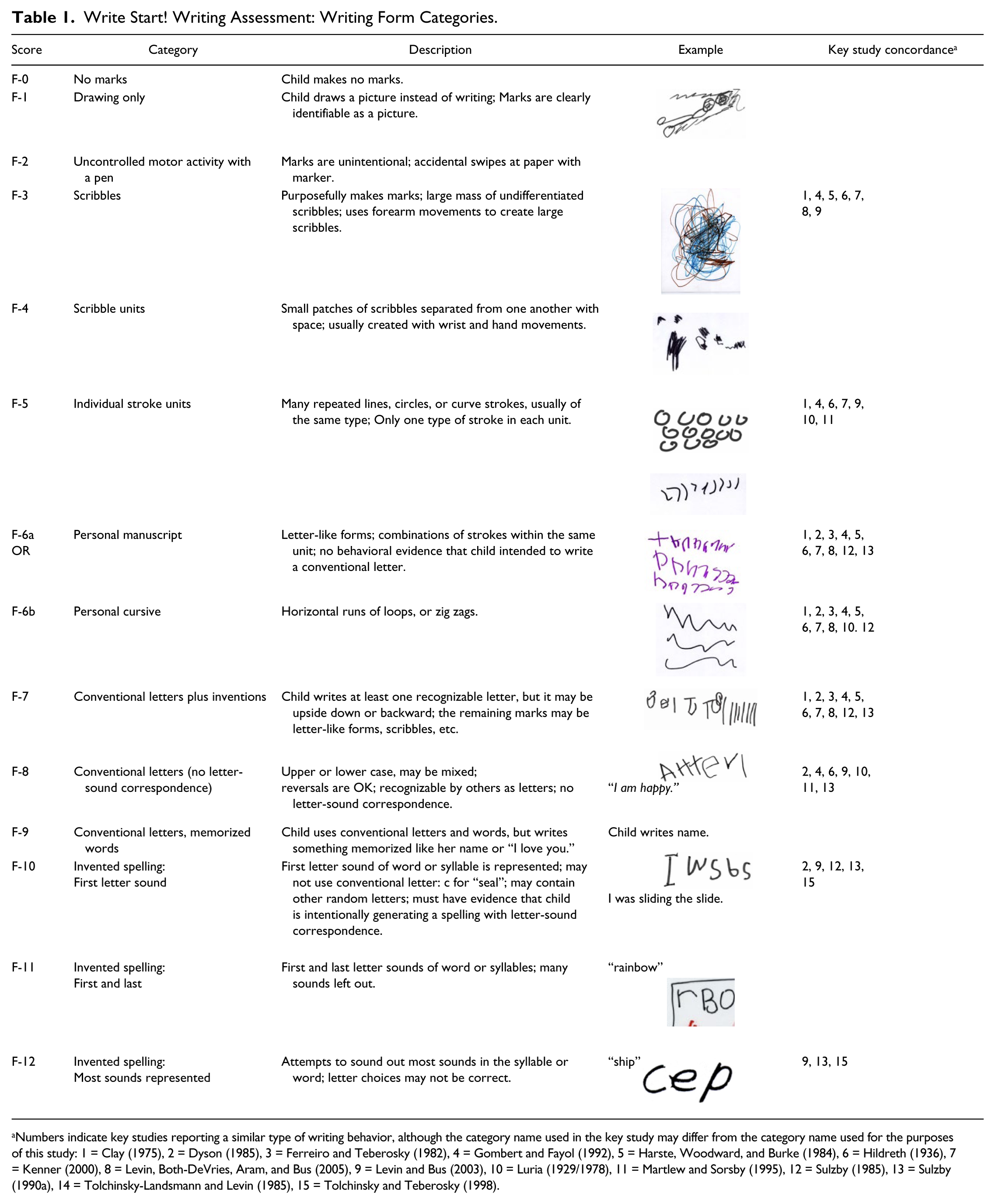
Numbers indicate key studies reporting a similar type of writing behavior, although the category name used in the key study may differ from the category name used for the purposes of this study: 1 = Clay (1975), 2 = Dyson (1985), 3 = Ferreiro and Teberosky (1982), 4 = Gombert and Fayol (1992), 5 = Harste, Woodward, and Burke (1984), 6 = Hildreth (1936), 7 = Kenner (2000), 8 = Levin, Both-DeVries, Aram, and Bus (2005), 9 = Levin and Bus (2003), 10 = Luria (1929/1978), 11 = Martlew and Sorsby (1995), 12 = Sulzby (1985), 13 = Sulzby (1990a), 14 = Tolchinsky-Landsmann and Levin (1985), 15 = Tolchinsky and Teberosky (1998).
Writing forms
The key studies show that, in the preschool years, children speaking a variety of alphabet languages (e.g., English, Spanish, Dutch, Russian, and Hebrew) explore the following visual aspects of print: complexity of forms (Levin & Bus, 2003), linearity (Levin & Bus, 2003; Tolchinsky-Landsmann & Levin, 1985), units (Levin & Bus, 2003; Tolchinsky-Landsmann & Levin, 1985), spacing between units (Tolchinsky-Landsmann & Levin, 1985), physical size of units (Tolchinsky-Landsmann & Levin, 1985), quantity of characters (Ferreiro & Teberosky, 1982; Levin & Bus, 2003; Tolchinsky-Landsmann & Levin, 1985), and variety of characters (Clay, 1975; Levin & Bus, 2003; Tolchinsky-Landsmann & Levin, 1985). Children combine their changing understandings of these aspects to create the unconventional and conventional graphic forms they use to write.
The convergence of findings across studies is remarkable, given the differences in languages, ages, and populations studied. However, there has been little consensus in the terminology researchers use to name writing patterns. For example, in the 15 key studies, researchers labeled the same kinds of small, unconventional letter-like forms with seven different terms including unrecognizable letter units (Hildreth, 1936), mock letters (Clay, 1975), personal manuscript (Harste et al., 1984), and pseudo-letters (Sulzby, 1990a). Researchers have also used the same term to label visually different forms. For example, the term scribbles has been applied to large masses of push–pull and circular strokes laminated on top of each other (Clay, 1975 and others), a single horizontal wavy line resembling cursive writing (Luria, 1929/1978; Sulzby, 1985), and letter-like units (Dyson, 1985). Although lacking a consistent vocabulary for common writing patterns, existing research shows that children learning to write in alphabetic languages produce many of the same writing behaviors.
Directional patterns
Many of the key studies contributed categories describing the unconventional and conventional directional principles children used to arrange print on the page (see Online Supplementary Table 3). Because basic left-to-right or right-to-left directional principles are well-specified for print in the languages studied, the observed writing behaviors (though not descriptive labels) were quite consistent across studies. They included random placement, reversed directional patterns, combinations of conventional and unconventional directional patterns, and conventional patterns.
Intentionality: Assigning meaning to the marks
In each of the key studies, researchers asked children not only to write but also to read their marks. Observations of intentionality (Harste et al., 1984), children’s willingness to assign meaning to their marks, and their strategies for doing so have been important for understanding very young children’s engagement in writing. Descriptive categories generated by the key studies were of two kinds (see Online Supplementary Table 4). In the first group of categories, researchers identified children’s general understanding that marks could function as signs and their beliefs in their own ability to write and read the marks they had written. When children asked someone else to read their marks (i.e., the sign concept), or read them themselves (i.e., the message concept), they demonstrated that they knew their marks could function as signs, and also they believed themselves to be the kinds of persons capable of composing readable marks (Clay, 1975).
The second group of categories described children’s strategies for assigning meaning to marks when they reread their work. Children’s reading strategies included undifferentiated memory helping writing (Luria, 1929/1978) where they used marks to remember their message but without any differentiation of the marks and pictographic writing (Luria, 1929/1978) where they used marks to represent physical features of the referent. Categories also described approaches to writing where children matched marks to the rhythm or length of the speech stream, to syllables, and to phonemes using letter-sound correspondence (e.g., Tolchinsky-Landsmann & Levin, 1985).
Message content
Learning to write involves learning not only about print processes but also about the kinds of meanings print is used to express as part of local practices of the child’s classroom, home, and community. Less research attention has been given to the kinds of messages preschoolers compose, than to writing forms, directionality, and intentionality. The key studies described four aspects of children’s messages: complexity, coherence, topic, and register (see Online Supplementary Table 5). Message complexity categories described the linguistic complexity of children’s messages and provided a rough measure of how much oral text was generated when children read their messages—a word, phrase, sentence, and so on. Message coherence categories described the task/message match and reflected researchers’ observations about the extent to which young writers related their messages to the event underway, or to images or text on the page. Message topic categories described general patterns in the topical content of children’s messages such as global descriptions of their writing processes (“I wrote.”), or naming alphabet letters. Message register categories reflected the extent to which children’s messages sounded like oral or written language.
Summary
Using a variety of different tasks and observation methods, the field of early writing research has collectively generated an extensive knowledge base describing young children’s writing in the preschool years. However, as seen in Online Supplementary Tables 1 through 5, most studies have confined their research to a 1- or 2-year age span, and there has been minimal attention to developing a shared vocabulary for describing children’s unconventional writing. A goal of the current study is to use this knowledge base and our own empirical observations to create an integrated set of categories and common vocabulary describing writing forms, directionality, intentionality, and message content for 2- to 5-year-olds’ writing.
Preschool Writing Development: Findings and Unresolved Issues
A good deal of attention has been devoted to establishing that children’s writing becomes more conventional across the preschool years, even without formal school lessons. Cross-sectional research has shown that group means for preschoolers’ aggregate writing scores (Gombert & Fayol, 1992; Levin & Bus, 2003) increase with age, and also that, as a group, older preschoolers use more advanced writing forms, directional patterns, and message content than younger children (Tolchinsky-Landsmann & Levin, 1985). Recent longitudinal work (Molfese et al., 2011) with 4- and 5-year-olds has shown progression in scores for name writing, letter writing, and letter formation across time. Overall, when measures of central tendency are used to describe age-group patterns in early writing, results generally support a developmental progression from less to more conventional writing across the preschool years.
At the same time, many researchers have presented data to show that wide variation in children’s writing and related skills exists at any particular age (Dyson, 1985; Hildreth, 1936; Sulzby, 1985). For example, Molfese and her colleagues (2011) conducted a longitudinal study of relationships between children’s alphabetic knowledge, name writing, and letter writing at three time points. Descriptive data showed that almost the full range of possible scores was observed for each measure at each time point. Describing features of children’s holistic writing performances, Clay (1975) also reported great variability in the writing of same-age peers. In her words, “what one child discovers about print at 4:11 another equally intelligent child may not learn until 6:0” (p. 7).
In addition to the inter-individual variability reported at various ages, researchers have also described intra-individual differences of several types. First, children often concurrently use more and less advanced writing strategies. For example, Bus and her colleagues (2001) reported that even after children demonstrated the alphabetic principle, they continued to use less advanced writing strategies such as letter-like forms. Similarly, Yaden and Tsai (2012) found that young, emerging English–Chinese bilinguals wrote with strategies reflecting multiple levels of understanding in both their languages, and these patterns of consistent variation were maintained for long periods of time. A second pattern of intra-individual variability involves differences in an individual child’s level of development across different features of writing. Describing both code- and meaning-related writing features, Dyson (1985) reported that some children wrote sophisticated stories and messages using unconventional forms, whereas others used conventional letters to represent less conventional content. Third, several researchers (Dyson, 1985; Sulzby, 1985) have reported that the path of development for individuals does not always move forward, but instead involves back and forth movement between more and less advanced writing strategies. For example, Luria (1929/1978) described writing “setbacks” occurring as children transitioned into new writing techniques. Yaden and Tsai (2012) also described “backward transitions” (Granott, 2002) in which students initially wrote Chinese using relatively more sophisticated syllabic or word-based interpretations of characters, whereas subsequent texts used an earlier and less sophisticated strategy of focusing on visual features such as the number of strokes or characters used to represent a word.
Finally, still under debate is whether there is a developmental ordering of children’s early writing performances and if so, what this may say about underlying developmental processes. Researchers observing young writers in the context of controlled tasks involving dictation of researcher-selected words have more often argued for an ordered sequence of phases through which children pass as they learn to write. An example of this perspective is Ferreiro and Teberosky’s (1982) five successive levels of writing, each organized by a central hypothesis about orthography. Several studies contend that children’s understandings of general features of print common to many languages (e.g., units, linearity) develop first, and then are followed by learning about language-specific features such as directional patterns and letter shapes (Puranik & Lonigan, 2011; Tolchinsky-Landsmann & Levin, 1985).
Alternately, researchers observing children’s writing in more open-ended situations have often argued against a strict linear sequence of writing development. Clay (1975) concluded, “I doubt whether there is a fixed sequence of learning through which all children must pass . . . the path of progress may be different for any two children” (p. 7). Using longitudinal case study methods, Dyson (1985) showed that the sequence in which children noticed and explored various features of print was influenced by their personal interests, styles of approaching writing, willingness to take risks, and purposes for writing.
Regardless of research approach, it appears that there is general consensus that young children’s writing becomes more conventional across the preschool years. However, beyond this general observation, researchers’ views about whether early writing development is sequential and progressive or variable and individually patterned is less settled. Despite many observations of the wide variation in children’s writing, the role of variability is undertheorized in existing models of early writing development. The current study addresses these issues by describing both variability and learning-to-write sequences for individual preschoolers and for groups of same-age peers.
Research Questions
The goals of the present study were to develop a research-based, descriptive measure for observing preschoolers’ writing and to use this assessment tool to provide an initial description of age-related writing patterns for one group of 2- to 5-year-olds. The present study addressed the following research questions:
Method
The Write Start! Writing Assessment (Rowe & Wilson, 2009) was developed as part of a 3-year study of the writing of preschoolers enrolled in two urban child care centers. The design of the larger study involved fall and spring administration of the standard Write Start! assessment task and qualitative observation of children’s writing in their classrooms (Rowe & Neitzel, 2010). As would be expected, the tasks, social groupings, and amounts of adult support varied widely in classroom writing events. To facilitate comparison across time, in the present analyses, we chose to hold the writing task constant. In this report, we analyze data collected in response to the standard task used in the Write Start! Writing Assessment, where preschoolers were asked to write a caption for a photo of themselves playing at school.
Research Sites
Data were collected at two child care centers providing full-day child care for children from birth through age 6. Both child care centers were located in a mid-sized Southern, U.S. city in the same urban neighborhood where most families lived in publicly supported, affordable housing developments or in other nearby apartments. These centers were selected because they were recognized in the community for providing high-quality child care to low-income, minority children (a selection criterion for the larger study) and because they were willing to collaborate with university researchers. Because of their participation in a U.S. Department of Education Early Reading First grant, instruction and daily routines in both centers were similar. Teachers of all age groups were required to use the DLM Early Childhood Express curriculum (Schiller et al., 2003). Each teacher implemented the same sequence of week-long, theme-based units, and a daily routine of large groups and play-based learning center activities. Language and literacy activities in all classes focused on learning to identify alphabet letters, phonological awareness activities, and developing oral language.
Data were collected in 11 classrooms over 3 years. The size of the study was increased each year as additional funding became available. Overall, we studied participants in four classrooms serving 2- and 3-year-olds, one classroom serving 3- and 4-year-olds, and six prekindergarten classrooms serving 4-year-olds. Each year, a new cohort of children joined existing study participants. In Years 2 and 3, we followed children who remained at the centers as they advanced to classrooms for the next age group. Because all children in the participating classes were included in the study, we also added new children to the study each year. These procedures created a layered data set with 1 to 3 years of data per child: 107 children participated for 1 year, 22 children for 2 years, and 10 children for 3 years.
Participants
This article analyzes data collected across 3 years in the Write Start! Study. A total of 139 children, ages 2 years 6 months to 5 years 11 months (2:6 to 5:11), 13 lead and assistant teachers, and five researchers participated in the study for 1 or more years. (Unless otherwise noted, throughout this report, children’s ages are reported in the years:months format.) Ninety-eight percent of the children participating in this study were African American, and 2% were Caucasian. All participants spoke English as their heritage language and lived in the same low-income neighborhood.
For analysis purposes, the children’s Write Start! assessment scores were divided into 6-month age bands as seen in Table 2. The number of data points included for each child ranged from one to six, depending on whether the child remained at the center for a full year to complete both fall and spring assessments, and on the number of years the child participated in the study.
Relative Frequency of Form Scores for the Photo Caption Task.
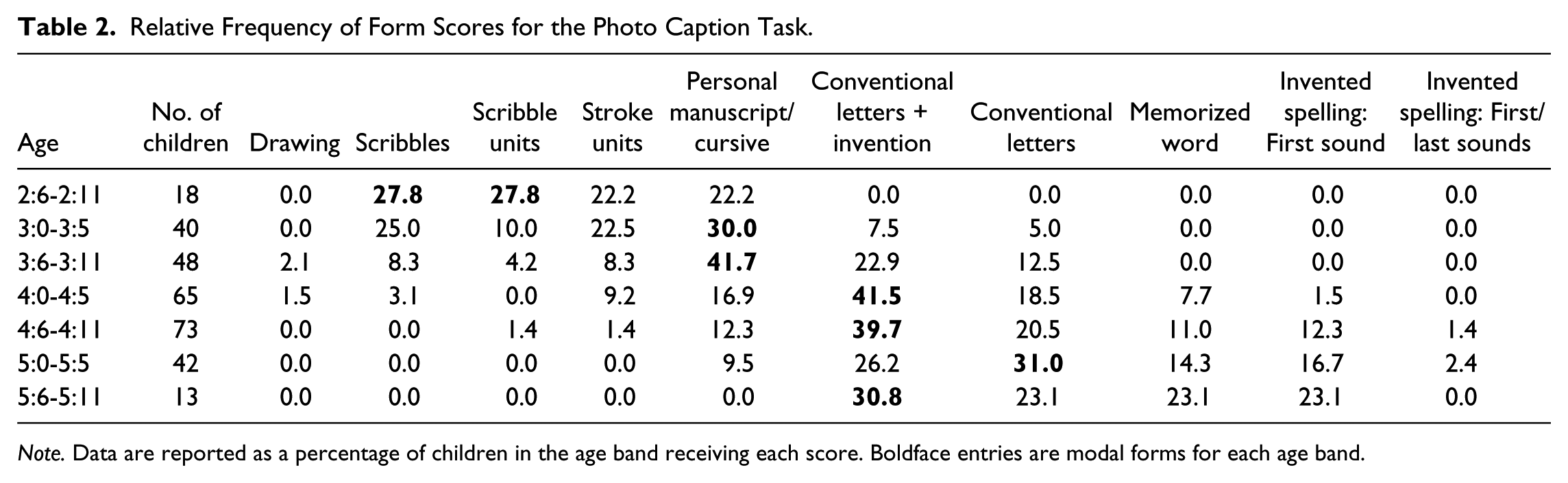
Note. Data are reported as a percentage of children in the age band receiving each score. Boldface entries are modal forms for each age band.
For the longitudinal analyses of individual learning trajectories, we examined data from the 10 children who began the study in Year 1 and continued through Year 3. We refer to these students as the Longitudinal Sample in this report.
Although their data are not directly analyzed in this report, participants in a second study, the Enhanced Language and Literacy Success (ELLS) project (Rowe & Dickinson, 2008; Wilson, Dickinson, & Rowe, 2013) helped us refine the administration and scoring procedures for the Write Start! Writing Assessment. Across 4 school years, we conducted fall and spring Write Start! Writing Assessments with 866 four-year-old prekindergarten students. The four cohorts were comprised of children from diverse backgrounds, including African American (range for Cohorts 1-4 = 48%-67%), Latino (range = 14%-34%), White (range = 7%-9%), and smaller numbers of students from several other minority backgrounds. Many children in each cohort were emerging bilinguals who were learning English at school (range = 22%-42%).
Data Collection
Participant/observation in classrooms
As part of the larger study, Rowe and four research assistants recorded children’s interactions at the classroom writing centers one to two mornings per week from September through May in each study year. In our roles as researcher/teachers, we invited children to write with us and provided needed support. Our aim was to engage children in open-ended writing activities where all forms of marks were valued. We used ethnographic methods of participant observation, field notes, audio/video recording, and collection of artifacts to record classroom writing events.
Photo caption task
The samples of children’s writing used for the current analyses were collected in October and May of each school year in response to an individually administered, standard task developed for this study—the Write Start! Writing Assessment (Rowe & Wilson, 2009) (see the appendix for the photo caption task protocol). Children were asked to write a caption for a photograph of themselves playing in the classroom and to label the page with their name. In this report, we focus only on the open-ended messages children composed as photo captions. The photo caption task required children to generate their own messages and record them in print in an authentic situation similar to classroom writing events. Photos were taken by a member of our research team during regular school activities. Although each child’s photo was different, all photos were framed to show the child engaged in a familiar school activity such as working a puzzle, or riding a tricycle. Photos were printed on white paper with blank space above for the child to write his or her name, and space below for writing a photo caption (see Online Supplementary Table 7 for examples).
Following a standard protocol, the researcher began the assessment session by showing the child a book with clear plastic pages and inviting him or her to help make a class book. Next, the researcher demonstrated the photo caption and name writing tasks on her own photo page. She first talked with the child about her photo, then thought aloud as she wrote a message in the white space at the bottom of the page (e.g., “I am reading a book.”). The researcher then wrote her name at the top of the page, reread both her photo caption and her name while pointing to the print, and placed her page in the class book. The child was given his or her photo page, and engaged in the same steps to compose a photo caption and write his or her name. The protocol allowed for two levels of prompts when the researcher asked children to orally compose a message for their photos. Researchers used the low-level prompt (“What are you doing in that picture?” “Why don’t you write about that?”) unless children were silent and seemed unsure how to proceed. In such cases, the adult used the high-level prompt suggesting a message in the form of “Why don’t you write: ‘I am playing with [pictured item].’” Once the child finished making her or his marks, the researcher pointed to the child’s caption: “Read that to me?” “What did you write?” Children were then invited to write their names in the white space above the photograph. When complete, the photo page was slipped into the class book and the book was later placed in the classroom library center.
Although other studies using open-ended writing tasks have asked children to write a story, compose a letter, or to write all the words the child can write (Clay, 1993; Harste et al., 1984; Sulzby, 1985), we chose a classroom photo as the task stimulus because it provided an authentic visual prompt for adult–child conversation (cf. Puranik & Lonigan, 2011). We assumed even our youngest writers would have basic vocabulary to describe themselves and their everyday experiences at school. The caption genre also had the advantage of being a short, meaningful text. The task demands were manageable for our youngest writers but also open enough that children could respond with longer texts if they chose. The caption task was introduced in the context of an authentic, familiar purpose for writing—making a class book.
The assessment protocol was designed to preserve as many aspects of usual adult–child interaction as possible. Specifically, we built in social supports for the child’s writing in the form of the adult demonstration, oral conversation about the child’s photo, and, where needed, prompts for message content. Different levels of message prompts were necessary to support these very young children in writing and reading their marks. Without these supports, less than 40% of 2½-year-olds would have been willing to try assigning a meaning to their marks. Relative percentages of children requiring high-level prompts decreased with age: 2½-year-olds, 61.1%; 3-year-olds, 35%; 3½-year-olds, 29.2%; 4-year-olds, 16.9%; 4½-year-olds, 10.9%; 5-year-olds, 2.3%; and 5½-year-olds, 0%. Our data show that high-level message prompts assisted the least experienced writers in getting started with the task, but most children, nevertheless, created their own message content. Of the 25 children in the 2:6-2:11 and 3:0-3:5 age bands receiving high-level prompts, only four read a message that completely or partly reproduced the adult’s model. Nevertheless, patterns of message content observed in this study reflect the differential scaffolding levels required to support children’s participation.
Scoring
Write Start! photo caption sessions were scored using the final set of Write Start! descriptive categories. Tables 1, 4, 6, and 8 provide the category names, operational definitions, and examples used to score our participants’ writing. Processes for developing the final scoring categories are described below as part of Phase 1 data analysis procedures. In this report, children’s writing performances will be referenced using the Write Start! category names (e.g., scribbles) and/or scores (e.g., F-3) provided in these tables. Alphabet letters (e.g., F, D, I, TM) preceding the numerical scores refer to the four features of writing tracked in the Write Start! Writing Assessment: writing form, directionality, intentionality, and task/message match (message content). Categories for each feature were initially sequenced from least to most advanced based on qualitative observations of children’s writing. The ordering of categories was supported by the cross-sectional analyses of group data and growth curve analysis reported in this article.
Children sometimes produced writing that could be scored using several different categories for a writing feature. For example, children created texts using both the writing forms of conventional letters without letter sound correspondence (F-8) and scribbles (F-3). In such cases, we scored only the child’s most advanced performance. As a result, the Write Start! Writing Assessment scores for each feature reflect the most sophisticated categories observed in children’s writing, rather than the full range of writing behaviors children used.
Data Analysis
Analysis of the Write Start! Writing Assessment data occurred in three phases. Phase 1 involved a review of existing literature and the constant-comparative analysis of children’ writing to develop a descriptive measure of preschoolers’ writing. Phase 2 involved cross-sectional and growth curve analyses of Write Start! data to examine age-related patterns in writing. Phase 3 involved longitudinal analyses of individual learning trajectories for children in the Longitudinal Sample.
Phase 1: Refining a descriptive measure of preschool writing
Phase 1 analyses addressed our first research question. As described earlier in this report, we developed the initial set of research-based categories from a review of existing literature and then refined them through constant-comparative analysis (Corbin & Strauss, 2008) of our participants’ writing. We initially began coding video recordings and children’s writing samples using the set of categories developed from previous studies (see Online Supplementary Tables 2-5). This compilation of categories included those used by researchers in more tightly controlled tasks such as asking children to write researcher-dictated words (e.g., Levin & Bus, 2003) and also in more open-ended tasks such as observation of naturally occurring, child-initiated writing during writer’s workshop (e.g., Dyson, 1985) (see Online Supplementary Table 1). Some categories in this initial set were not observed in the current study and, therefore, were eliminated. As part of the constant-comparative process, new categories were also created, as needed, to fit the kinds of forms, directional patterns, intentionality strategies, and message content children demonstrated in their photo captions.
Comparison of the initial (Online Supplementary Tables 2-5) and final categories showed that the final writing form (Table 1) and directionality (Table 4) categories were more similar to those from previous studies than were the final categories for intentionality (Table 6) and message content (Table 8). We found that a number of intentionality and message content categories used in previous studies were not easily observed in the photo caption task where children constructed their own content for written messages. For example, several researchers (Ferreiro & Teberosky, 1982; Luria, 1929/1978; Tolchinsky-Landsmann & Levin, 1985) observed the intentionality strategy of pictographic writing where children wrote by matching their marks to the quantity, size, or color of the object. This intentionality category was eliminated from the final set because it could not be reliably observed in the photo caption task where written descriptions of objects of contrasting size, color, or quantity were uncommon.
As we analyzed each fall and spring administration of the Write Start! assessment, we compared children’s writing responses with the current set of categories, then added and revised categories as needed to describe the full range of writing forms, directionality strategies, intentionality strategies, and message content produced by the preschoolers in the Write Start! study. Because we wished to comprehensively describe our participants’ writing behaviors, we included some categories that occurred only in low frequencies. Overall, the process of developing the Write Start! categories involved tentative application, revision, and elimination of categories generated in previous studies as well as construction of new descriptive categories to fit children’s responses to the relatively open-ended photo caption task. The concordance between the final Write Start! categories and the key studies is presented in the last column of Tables 1, 4, 6, and 8.
In a subsequent project, the Write Start! Writing Assessment was used for fall and spring assessment of the 4- to 5-year-olds participating in the Enhanced Language and Literacy Success (ELLS) grant (Rowe & Dickinson, 2008; Wilson et al., 2013). To describe the full range of writing behaviors observed for this group of young children, categories were added to code writing refusals—a response not seen in Write Start! classrooms. Scoring procedures were also refined to improve scoring reliability. Therefore, the categories used in the present study were revised based on data generated by children participating in the Write Start! study and the ELLS grant.
To allow for consistent comparison of data from Years 1, 2, and 3 of the Write Start! study, a trained research assistant, not involved in the original data collection, rescored all assessment sessions for the 139 participants using the final version of the Write Start! Writing Assessment categories (Rowe & Wilson, 2009) seen in Tables 1, 4, 6, and 8. Rescoring was completed using audio and video recordings of the assessment sessions, scanned copies of children’s texts, and the scoring sheets and field notes written by the researcher conducting the original assessment. Rowe and the research assistant achieved 95% scoring reliability at the time of training and 92% scoring agreement when 20% of each class’ assessments were scored by both assessors.
Phase 2: Cross-sectional and growth curve analyses of age-related writing patterns
Cross-sectional analyses were used to answer our second research question concerning the relative frequencies of writing form, directionality, intentionality, and message content categories for children of different ages. Children’s assessment scores recorded the most advanced category observed for each feature at each time point, and were grouped into 6-month age bands (see Table 2). To make cross-age comparisons easier, in this report, results are reported as relative frequencies—percentages of children receiving each score in the age band. Because of the timing of fall and spring assessments in relation to children’s birthdays, children sometimes had two assessment points in an age band. In these cases, to allow a straightforward accounting of the number of students contributing data to each age band, only the first assessment was included. Although all of the children had scores in at least two of the age bands, not all children were represented in each age band.
We visually inspected the cross-sectional data for each writing feature in two ways. First, we identified modal writing categories for each age group. Our goal was to describe typical writing performances and explore the progression toward more advanced/conventional approaches to writing as expected from both the emergent literacy (e.g., Ferreiro & Teberosky, 1982; Gombert & Fayol, 1992; Tolchinsky-Landsmann & Levin, 1985) and general developmental literature (e.g., Rose & Fischer, 2009; Siegler, 2006). Specifically, we identified the most frequent (modal) category for each age band and traced the changes in modal writing performances across age bands. Analysis of central tendencies provided a snapshot of typical writing forms, directionality, intentionality, and message content at each age, and mapped the typical progression across categories for each writing feature.
Second, we examined the variability of writing performances observed within age groups, and traced changes in relative frequencies of form, directionality, intentionality, and message content categories across age groups. In this second analysis, our goal was to identify the multiple categories used by our participants at each time point, and to track the trajectories of change for these categories as children grew older (Siegler, 2000). Specifically, for each writing feature, we examined age-related changes in the relative frequencies of each Write Start! descriptive category (see Online Supplementary Figure 1 for an example). For example, data in Table 2 reporting the relative frequency of children’s use of different writing forms allowed us to follow the declining trajectory of children’s use of scribbles (F-3) as they grew older: Scribbles were the most advanced category used by 27.8% of children in the 2:6-2:11 age band and 25% of children aged 3:0-3:5. The use of scribbles by children aged 3:6-3:11, 4:0-4:5, and 4:6-4:11 declined sharply to 8.3%, 3.1%, and 0%, respectively. This analysis allowed us to (a) describe the repertoire of categories used at each age point, (b) note the age at which each category was first observed, and (c) determine whether its use increased, decreased, or stayed the same as participating children grew older and gained more writing experience.
In a third analysis, we used multilevel growth curve analyses to address our third research question that explores the significance of change in writing patterns over time and inter-individual and intra-individual variability. To examine patterns of change in writing, individual growth curves were estimated separately for each writing feature (i.e., forms, directionality, intentionality, and task/message match) using age at assessment period as the predictor. Children’s scores in each age band were nested within individual children. In initial models, children were nested within classrooms. In all models, classroom-level variances were near zero and non-significant indicating that variability in individual scores was not associated with between-classroom differences. We, therefore, report only the two level models here, with individual scores nested within children.
Here, we describe, in general terms, how we interpret the coefficients reported for each of the growth curve models. In each model, the within-subjects parameters examine patterns within individual children; the intercept represents the mean initial status of the individual trajectories on the respective writing feature, whereas the slope represents the change in that writing feature associated with a 1-month change in age. Therefore, examination of within-subjects parameters allowed us to address the question of whether, as a group, children demonstrated significant movement toward convention on each writing feature over time. The between-subjects parameters provide information about the inter-individual variability in the growth curves, that is, whether initial status or learning rates differed among the children in the sample. The between-subjects coefficients for the intercepts index the inter-individual differences in initial scores on each writing feature; the coefficients for the slopes identify inter-individual differences in the learning rates. The covariance components index the relationship between the intercept and slope parameters; a significant covariance component would signal the presence of differential growth for individuals with different intercepts or initial status. Therefore, we examined the between-subjects coefficients to address the question of whether there was significant variability in individual children’s initial status and rate of learning for each writing feature.
In a fourth analysis of the cross-sectional data, we further explored our qualitative observation that writing forms and messages were not always equally advanced. Using Spearman rank order correlations, we examined relationships between writing form scores and task/message match scores (message content). This analysis addressed our fourth research question.
Phase 3: Longitudinal analysis of individuals’ learning trajectories
Each of the four writing features examined cross-sectionally and with growth curve analysis was also examined longitudinally using data from the Longitudinal Sample, the 10 children for whom five to six fall/spring Write Start! data points were available. For each child, changes in assessment scores for each writing feature were examined across time. These analyses answered our fifth research question and provided a way of checking whether the developmental trajectories identified cross-sectionally and by growth curve analysis held when individual children were followed across time from 2:6 to 5:11 years of age.
For the Longitudinal Sample, an additional analysis was conducted to explore children’s use of more and less advanced writing form categories within the same assessment session—a pattern first observed in the larger qualitative study, and later as we used standard Write Start! scoring procedures to score the children’s assessment sessions. Because standard scoring procedures recorded only the child’s most advanced writing performance, we returned to the video recordings and writing samples from each Write Start! session completed by children in the Longitudinal Sample. We rescored each session to describe the full repertoire of writing form categories used by each child at each time point. Descriptive analysis of these data addressed our sixth research question.
Findings
Cross-Sectional Patterns in Preschoolers’ Writing
Writing forms
The forms preschoolers use in their writing provide important clues to their understanding of foundational principles about written language including the following: Print is visually composed of marks surrounded by white space, alphabet letters have conventionally determined shapes and names, writing involves attention to both the sounds in spoken language and marks on the page, and letters represent the sounds of spoken language. When children put pen to paper, they leave visible traces from which we can infer their current understandings of these principles (Tolchinsky, 2003). Children’s unconventional writing provides a window on their learning and application of graphic transcription strategies, alphabet knowledge, and the alphabetic principle—understandings widely seen as instructional targets for beginning literacy instruction (National Reading Panel, 2000).
As seen in Table 1, children in our study used distinctly different kinds of writing forms in response to the problem posed by the request to write a photo caption. To participate as writers, children had to construct understandings about what writing marks look like and how writers choose which kinds of marks to make. In our study, some children initially renegotiated the writing task by drawing a recognizable picture of an object or person (F-1). Our qualitative observations suggested that drawing was often used as an informed refusal (Sulzby, 1990b) when children were aware they could not write and spell conventionally, and chose not to risk responding with writing. Most children, however, did participate as writers, despite the relative difficulty of the task.
Briefly, most children producing large-scale, undifferentiated scribbles (F-3) appeared to focus on exercising the physical-motor schemes learned in early childhood (e.g., push–pull, vertical arc, and horizontal arc movements; Matthews, 1984) and exploring the potentials of different kinds of writing tools. Although these same physical-motor schemes were used to produce scribble units (F-4), the smaller size of the scribble marks and their placement on the page surrounded by white space showed initial attention to individually bounded units of print. Other categories demonstrated increasingly fine-grained observations of the visual details of print including the kinds, variations, and combinations of strokes characteristic of English alphabet letters. When producing stroke units (F-5), children wrote with strings of small, individual lines, circles, and curves. In personal manuscript (F-6a), these strokes were combined within the same unit, creating marks with even more resemblance to alphabet letters. Children who wrote using long wavy lines of personal cursive (F-6b) demonstrated attention to the linearity of writing. Personal cursive usually appeared concurrently with personal manuscript for our sample, and so, both forms were assigned the same ordinal score. The appearance of conventional letters (F-7, F-8, F-9) showed children’s increasing recognition that writing required the use of a particular set of conventional notational elements (Tolchinsky, 2003). Finally, with the shift to invented spelling (F-10, F-11, F-12), children approached writing with an increasingly fine-grained ability to segment words into phonemes, and to use letter-sound correspondence as the basis for deciding which alphabet letters to write.
From these descriptive observations, we infer that, although initially children seemed more focused on the physical motor activity than the scribbles produced, with experience, they began to attend to reproducing some of the visual details of print, then specifically on writing conventional alphabet letters, and finally to selecting letters based on letter-sound correspondence.
To determine whether children’s use of writing forms changed across age bands, we first examined changes in modal writing forms. Table 2 displays the percentages of children in each age band scoring in each writing form category. The bolded entries are the most frequent (modal) writing forms used by children in each age band. Confirming previous research (e.g., Levin et al., 2005; Puranik & Lonigan, 2011), cross-sectional data showed that, across age bands, modal writing forms generally became more conventional with age. This pattern is easily seen by the way bolded modal performances are mostly arranged from left to right across the table’s columns, mirroring the left to right ordering of categories from less to more advanced.
The trajectory of change toward more conventional forms evident in Table 2 is also borne out by the results of growth curve analysis presented in Table 3. The slope parameter in the top half of the table is significant for photo caption form, confirming that the observed growth over time in children’s writing forms is statistically significant; that is, a 1-month change in age is associated with a growth of .14 in children’s photo caption form scores. Over the course of a 9-month school year, children’s writing forms grew by approximately one and one fourth points.
Multilevel Growth Curve Analyses for Four Writing Features.
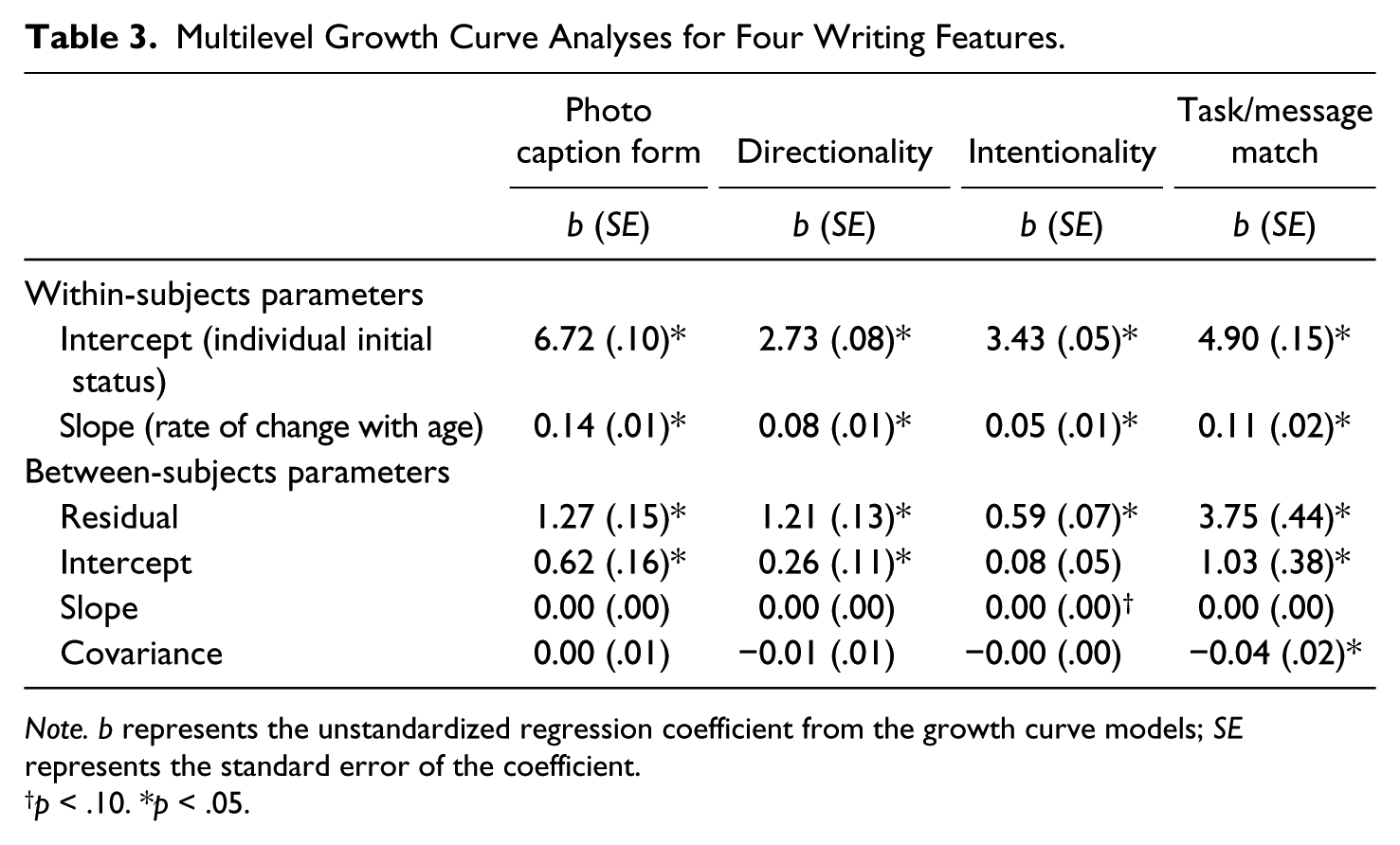
Note. b represents the unstandardized regression coefficient from the growth curve models; SE represents the standard error of the coefficient.
p < .10. *p < .05.
A second pattern also visible in Table 2 is the wide variability in form scores within each age band. Same age peers wrote with many different forms. Using the modal scores for each age band as an indicator of typical performance, we can see the range and relative frequency of normal writing variation by examining percentages of children whose scores are arrayed to the left or right of modal responses for the age band. For example, for 2½-year-olds, although scribbles (F-3) and scribble units (F-4) were most common, the children’s writing performances also showed attention to the visual details of letters. Nearly as many 2½-year-olds produced stroke units (F-5), or personal manuscript (F-6a). Examination of forms used by 3-, 4-, and 5-year-olds showed similar variability within age bands.
To determine whether between-student differences were statistically significant, we conducted the growth curve analyses reported in Table 3. The between-subjects coefficients in the lower portion of the table represent findings for the inter-individual differences between children in initial status (intercept) and learning rates (slope). The significant between-subjects coefficient for the intercept (b = .62, SE = .16, p < .05) indicates that children in the study varied in initial status on photo caption form. Again, these between-student differences are confirmed by visual examination of Table 2.
To further explore these patterns of variability, we examined the change in relative frequencies of writing form categories with increasing age (see Online Supplementary Figure 1). Although our analysis of modal writing forms used the most frequent category as a single performance typical of the age band, examination of patterns of variability allowed us to examine the full set of categories used in each age band.
This analysis showed that not all writing forms were used at every age. Forms used by the youngest children in our study were those that focused on physical-motor (F-3: Scribbles) and visual details of writing (F-4: scribble units, F-5: stroke units). Although some of these forms continued to be used by a few children as old as 4 years of age, the relative frequencies for each of these categories followed a rapidly declining trajectory and equaled zero for the oldest age groups.
Although the use of these less advanced forms was declining, new more advanced writing forms were added to the group’s writing repertoire. Writing forms containing conventional letters (F-7, F-8) first appeared in low frequencies in the writing of children in the 3:0-3:5 age band and then followed a rapidly increasing trajectory. Writing forms produced with attention to letter-sound correspondence (F-10) first appeared in low frequencies at age 4, and then increased slowly for children in the 4:0-4:5 age band and beyond.
Not all categories followed simple increasing or decreasing trajectories, however. Personal manuscript, (F-6a), was such a case. Relative frequency increased sharply for 3- and 3½-year-olds for whom it was the most frequent category. However, as 4-year-olds began to more frequently use conventional letters, the use of personal manuscript decreased sharply, then continued a more gradual decrease thereafter.
Overall, changes in modal categories showed a clear pattern of progress toward more conventional forms with increasing age. However, there was considerable variability in the writing forms used by children of the same age that was not captured in the modal analysis. Progress toward convention occurred not only as children added new and more advanced forms to their repertoires but also as they decreased the frequency with which they used less advanced forms.
Directionality
In the preschool years, children were also learning about the layout of print on the page and the left-to-right, return-down-left directional patterns used for writing and reading in English (see Table 4). Observation of the directional patterns in children’s writing provided additional clues to their understandings about the visual/temporal sequence of print and how they organized the motor activities of writing, and may also give clues to the visual scanning patterns they used for reading.
Write Start! Writing Assessment: Directionality Categories.
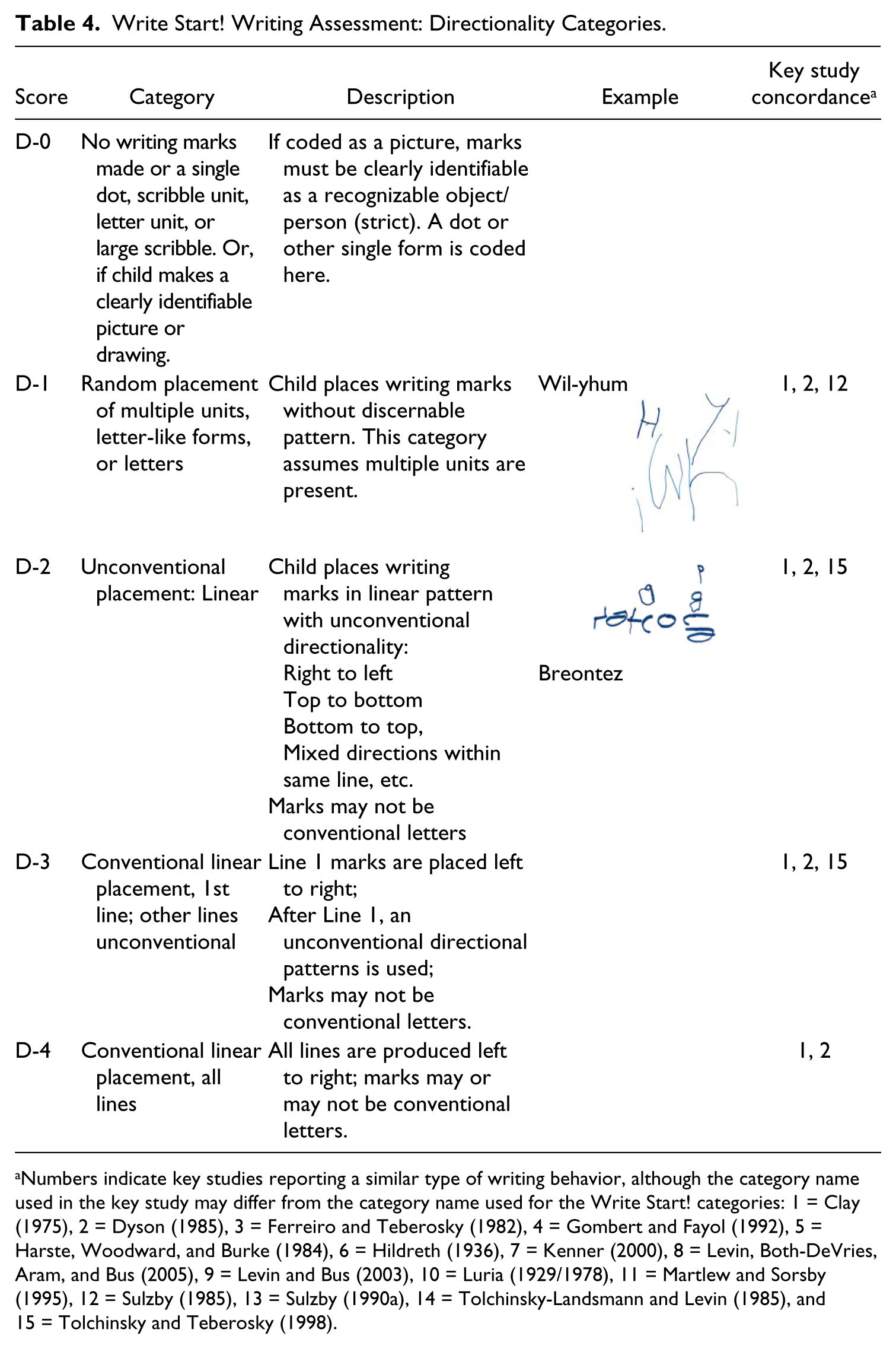
Numbers indicate key studies reporting a similar type of writing behavior, although the category name used in the key study may differ from the category name used for the Write Start! categories: 1 = Clay (1975), 2 = Dyson (1985), 3 = Ferreiro and Teberosky (1982), 4 = Gombert and Fayol (1992), 5 = Harste, Woodward, and Burke (1984), 6 = Hildreth (1936), 7 = Kenner (2000), 8 = Levin, Both-DeVries, Aram, and Bus (2005), 9 = Levin and Bus (2003), 10 = Luria (1929/1978), 11 = Martlew and Sorsby (1995), 12 = Sulzby (1985), 13 = Sulzby (1990a), 14 = Tolchinsky-Landsmann and Levin (1985), and 15 = Tolchinsky and Teberosky (1998).
Children who wrote by placing marks without an organized directional plan (D-1) were not yet using the directional system of English print. In our study, children’s initial use of print-like directional patterns often involved linear placement but with unconventional directional arrangements (D-2: right-to-left horizontal lines, top-to-bottom vertical lines). Reversals of the directional patterns often occurred when children used unconventional right-side-of-page starting points (cf. Clay, 1991). With more experience, children began to use conventional left-to-right directional patterns some (D-3) or all of the time (D-4).
Corroborating the findings of previous research (Puranik & Lonigan, 2011), conventional directional patterns were established relatively early in the preschool years for our participants (see Table 5). Overall, group data showed that children’s directional strategies became more conventional over time. Children in the 2:6-2:11 and 3:0-3:5 age bands typically arranged marks randomly on the page (D-1). Although random arrangement continued to be used by some children from all age bands, beginning at 3½ years of age, children most frequently used conventional directional patterns for all lines of writing (D-4). The percentage of children using conventional directional patterns increased steadily across the age bands, reaching 76.9% for children aged 5:6-5:11. At least within the constraints of the photo caption task where texts were fairly short, analysis of modal categories showed that some children controlled conventional directional patterns relatively early, even before they were typically using conventional letters in their writing.
Relative Frequency of Directionality Scores for the Photo Caption Task.
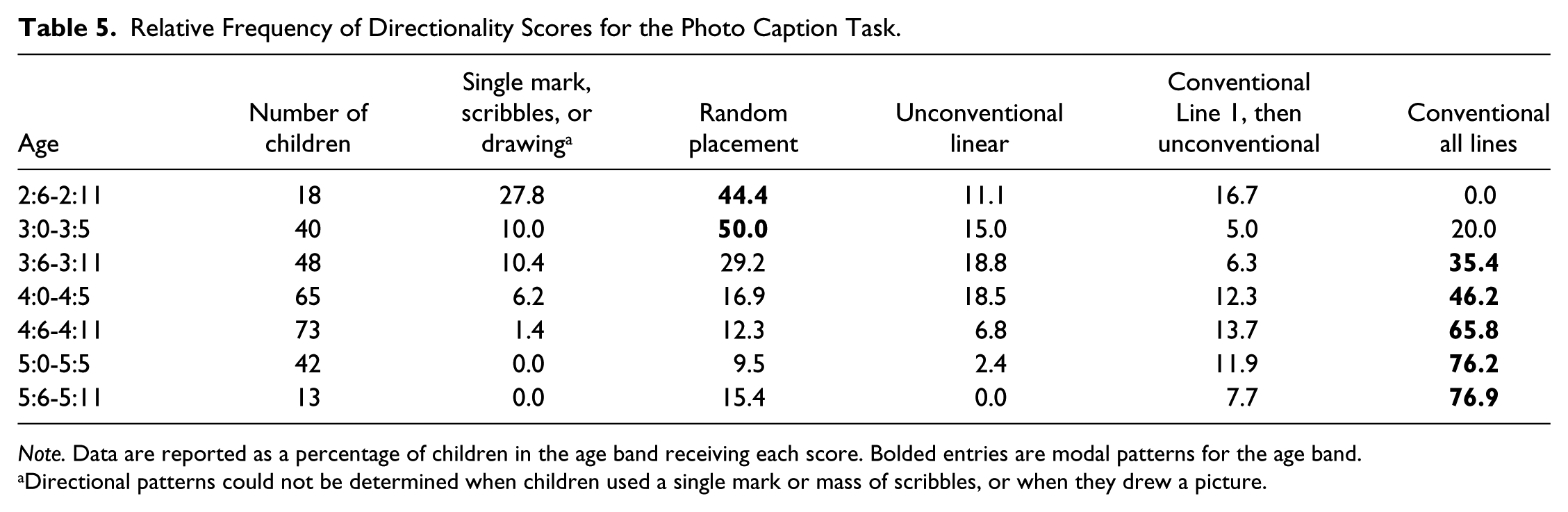
Note. Data are reported as a percentage of children in the age band receiving each score. Bolded entries are modal patterns for the age band.
Directional patterns could not be determined when children used a single mark or mass of scribbles, or when they drew a picture.
Although directionality categories showed a bimodal distribution when most frequent categories were examined for each age band, not all children moved so quickly to convention. Examination of the full range of variability in directionality scores showed that some children in most age groups used unconventional linear arrangements (D-2) and partially conventional arrangements (D-3), but at lower frequencies than the modal categories. The trajectories of change for these categories were relatively flat with small increases followed by small decreases. Our qualitative observations suggested that a small group of children used unconventional spatial arrangements for a longer period. Some children who continued to reverse the directional principles seemed to be influenced by individual factors such as persistent preference for an incorrect starting point on the right side of the page.
Growth curve analysis (see Table 3) confirmed that change in directionality patterns over time was statistically significant (b = .08, SE = .01, p < .05). In addition, there was statistically significant between-subjects variability in initial status on directionality (b = .26, SE = .11, p < .05), indicating that children’s entering skills differed.
When compared with writing forms, these data showed that conventional directional principles began to be established earlier in the preschool years. We propose that directional principles may have been easier to learn for two reasons. First, directional patterns were entirely visible in the actions of other writers. There were no unstated principles to be inferred, as in the case of understanding how letters are chosen to represent sounds. Second, the conventional directional principles for arranging print on the page were less complex than the many visual details and representational principles children had to consider when writing with alphabet letters.
Intentionality
Writing is much more than making marks and arranging them on the page. At its core, writing is about meaning. As children wrote photo captions, they also had to address the problem of intentionality—understanding that their marks represented linguistic messages (Harste et al., 1984). Elsewhere, one of us (Rowe, 2008b) has argued that when children demonstrate the message concept (Clay, 1975), the willingness to assign a linguistic message to their marks, they have reached a watershed point in preschool literacy learning. Observations of children’s intentionality strategies provide cues to the ways children see themselves as writers and their understandings about how print represents meanings. Once children see themselves as the kinds of persons who can represent their meanings with marks, they have added incentive to notice how print works in the demonstrations provided by people and texts in their environment.
One of the challenges of studying early writing is encouraging children to engage in a task some may believe they are not yet supposed to know how to do (Tolchinsky, 2003). The study addressed the problem of observing children’s intentionality strategies with a simple adult directive that communicated the adult’s belief that preschoolers could read their marks: “Read it to me.” In the photo caption task, intentionality was assessed by scoring messages children voiced during composing or messages they read in response to the adult directive to read their marks. As seen in Table 6, some preschoolers refused to assign meaning to their marks (I-1). Using our qualitative understandings of individual children’s approaches to writing, we inferred that low-level refusals occurred when children had not yet conceptualized their marks as representing meanings, whereas high-level refusals occurred when children were aware their writing was unconventional and were unwilling to risk assigning meaning to their marks (Sulzby, 1985, 1991; Sulzby, 1985; Tolchinsky, 2003). Beginning with Category I-3, children demonstrated the message concept (Clay, 1975), the willingness to assign a linguistic message to their unconventional marks. However, they provided no indication of the basis for linking marks to meaning. Subsequent categories demonstrated the global understanding that print is in some way linked to talk (I-4), followed by the specific understanding that words in messages are recorded using letter-sound correspondence (I-5).
Write Start! Writing Assessment: Intentionality Categories.
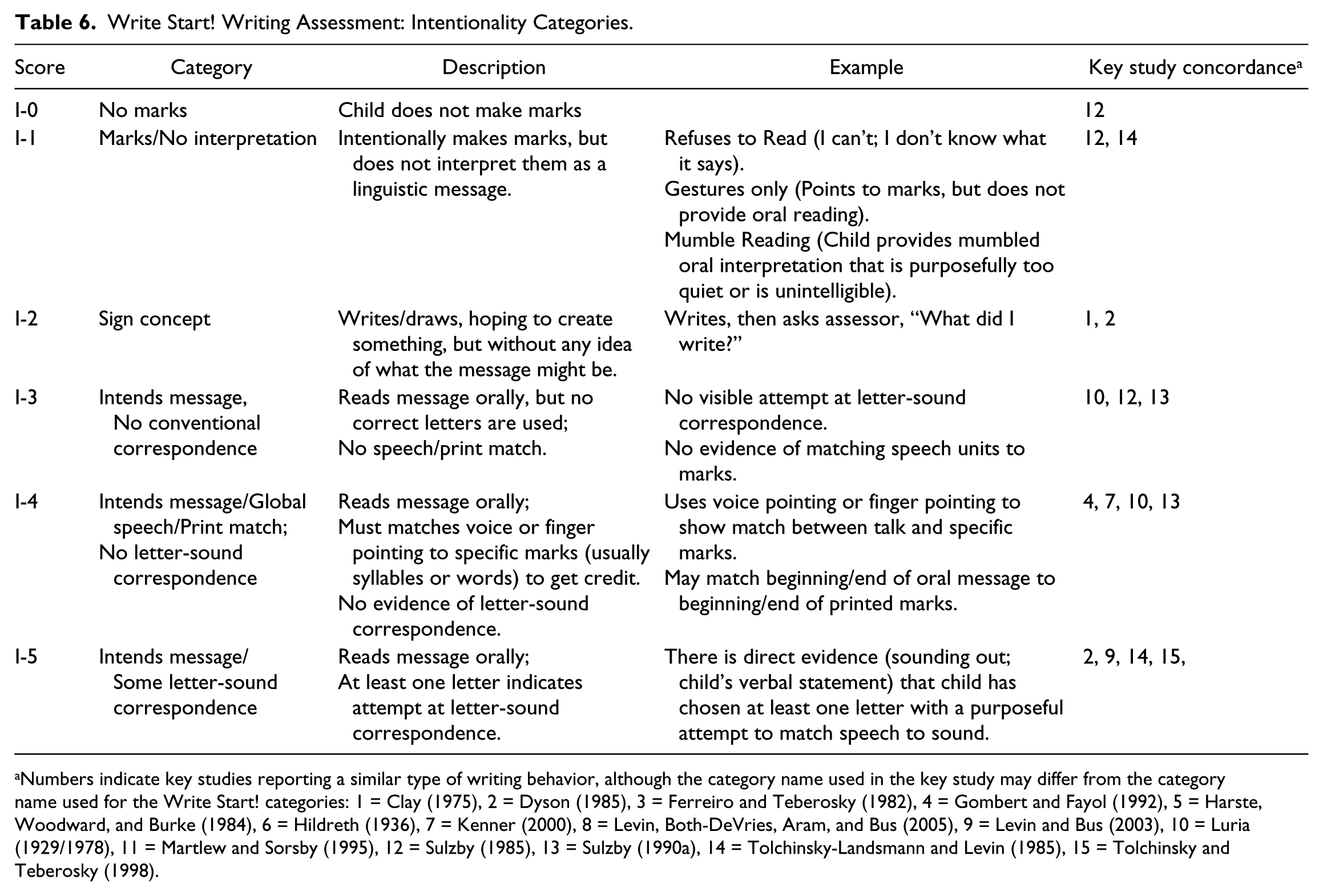
Numbers indicate key studies reporting a similar type of writing behavior, although the category name used in the key study may differ from the category name used for the Write Start! categories: 1 = Clay (1975), 2 = Dyson (1985), 3 = Ferreiro and Teberosky (1982), 4 = Gombert and Fayol (1992), 5 = Harste, Woodward, and Burke (1984), 6 = Hildreth (1936), 7 = Kenner (2000), 8 = Levin, Both-DeVries, Aram, and Bus (2005), 9 = Levin and Bus (2003), 10 = Luria (1929/1978), 11 = Martlew and Sorsby (1995), 12 = Sulzby (1985), 13 = Sulzby (1990a), 14 = Tolchinsky-Landsmann and Levin (1985), 15 = Tolchinsky and Teberosky (1998).
Modal intentionality categories bolded in Table 7 revealed a bimodal distribution. Children in the first three age bands typically read their unconventional marks when asked to do so by an adult, although they gave no recognizable indication of how the message was linked to the marks (I-3). Beginning with the 4:0-4:5 age band, the modal performance of all older participants involved reading their messages using finger or voice pointing to indicate a global match between speech and print (I-4).
Relative Frequency of Intentionality Scores for the Photo Caption Task.
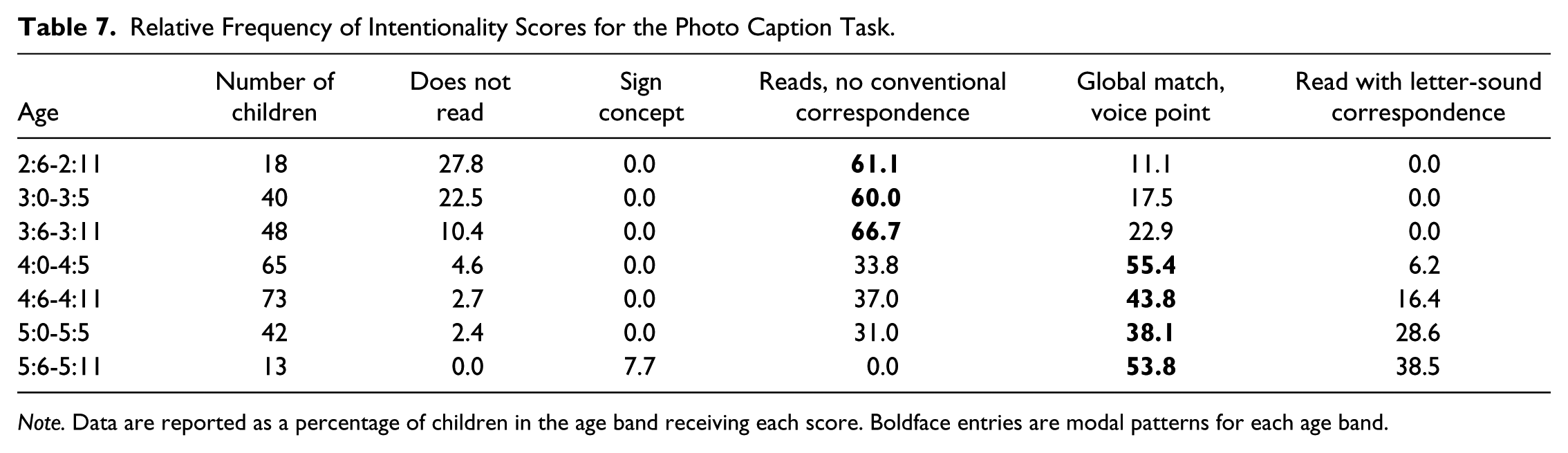
Note. Data are reported as a percentage of children in the age band receiving each score. Boldface entries are modal patterns for each age band.
Examination of changes in relative frequencies of the full range of categories provided a more nuanced understanding of the development of intentionality. Group data showed that substantial numbers of 2½- and 3-year-olds did not read a message when asked (I-1), but that this category declined rapidly in subsequent age groups, and disappeared entirely for the 5½-year-olds. As expected from modal analyses, the category of reading a message without indicating the link between speech and print was the most frequent response for the first three age bands and declined thereafter. Reading messages with global speech/print match was part of the repertoire of even the youngest age group, and followed an increasing trajectory, becoming the modal response for 4- and 5-year-olds. A more advanced intentionality strategy, reading messages by matching speech to print with some letter-sound correspondence (I-5), was first seen in the 4:0-4:5 age band, increased across the next three age bands, and was used by 38.5% of 5½-year-olds.
As seen in Table 3, growth curve analysis showed that the pattern of change in intentionality over time was statistically significant (b = .05, SE = .01, p < .05). The between-subjects slope was also marginally significant for this outcome, indicating differences between children in individual growth rates.
Overall, although a majority of children of all ages were willing to participate in writing by responding orally to the adult’s request to read their writing, understanding of how spoken messages are linked to marks developed slowly across the preschool years. As for other writing features, intentionality appeared to develop from global to more specific understandings with the alphabetic principle showing a slowly increasing trajectory beginning with the 4:0-4:5 age band.
Message content: Task/message match
Preschoolers are not only learning how the print system works, they are also learning about writing purposes, genres, and the style and content of messages expected in different social situations. When we asked children to write a caption for a photo of themselves, they faced problems not only of writing form, directionality, and intentionality but also of composing appropriate content for their written messages. Observing how children matched the content of their captions to the writing task allowed us to track their understandings about social purposes for writing in a familiar task. Because children composed their own messages, we were also able to observe the complexity of their messages.
For the photo caption task, the task/message match score was based on the content of the oral messages children read aloud during composing or in response to the adult’s request to read their writing. Therefore, task/message match scores described the orally rendered message apart from judgments about the marks used to represent it. Task/message match categories described the appropriateness of message content for the task (i.e., unrelated, globally related to the writing event or photo, or topically related to the content of the photo). For more advanced categories where children produced topically appropriate linguistic messages, categories also traced the increasing complexity of the messages (i.e., word, phrase, or sentence) children read for their marks.
Even when children began to demonstrate intentionality by assigning meaning to their marks, the content of their messages was sometimes related to neither the social event underway nor the image on the page (TM-1; message unrelated to the photo caption task; see Table 8). Children appeared to understand that reading their marks meant saying something verbally, but they did not fully understand how to connect their messages to social and material cues present in the writing event. Some children showed a global understanding that texts should be matched to the larger social situation (i.e., school) by producing a conventional school literacy performance (TM-2: reciting the alphabet or counting). Some children demonstrated understandings of the need for task-message links by reading a message related to the materials or processes used in the photo caption event (TM-3). Others demonstrated more conventional links to photo content by reading their writing as messages globally (TM-4) or specifically related to the objects and actions pictured in the photos (TM-5, TM-6, TM-7).
Write Start! Writing Assessment: Task/Message Match (Message Content) Categories.
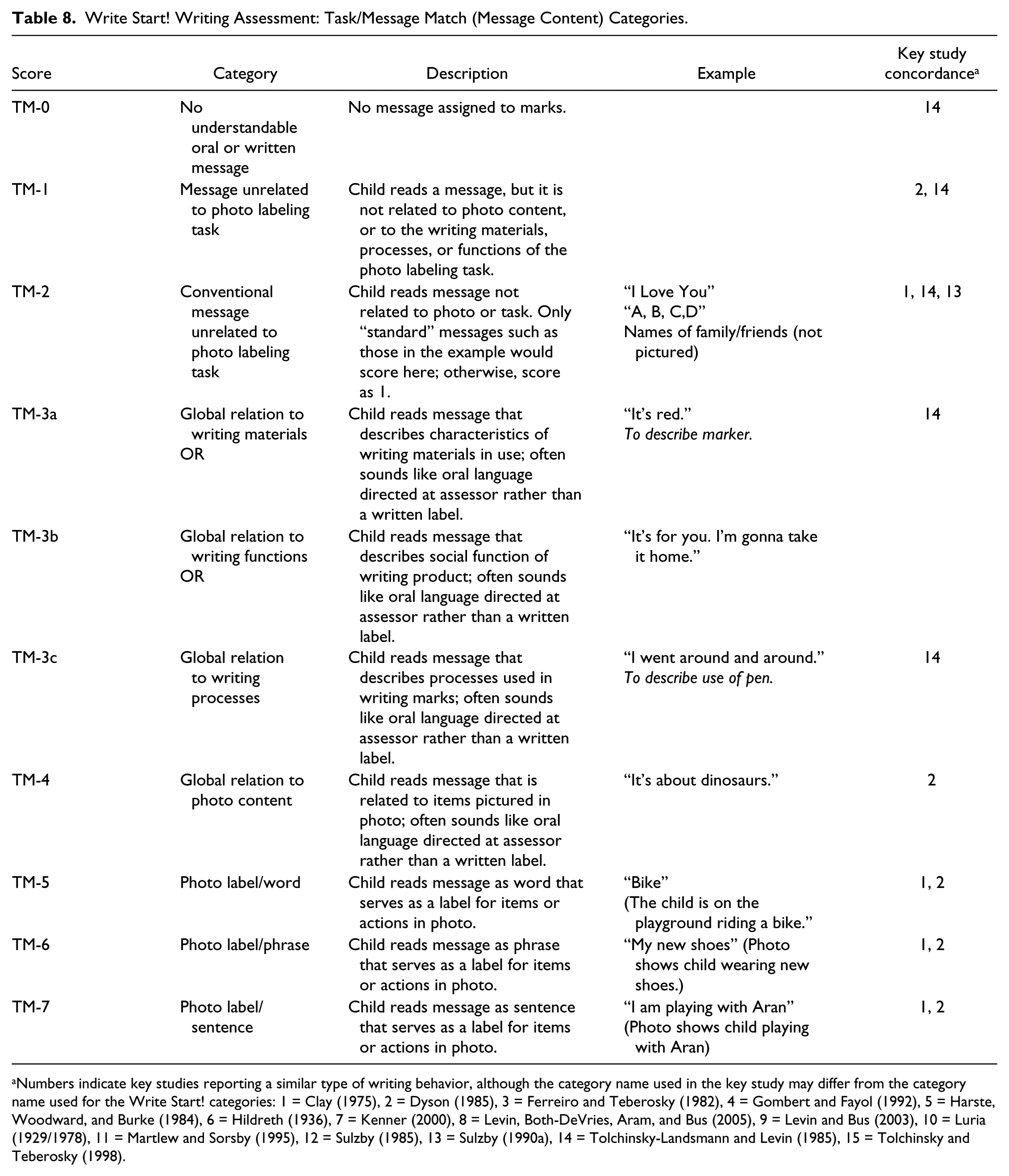
Numbers indicate key studies reporting a similar type of writing behavior, although the category name used in the key study may differ from the category name used for the Write Start! categories: 1 = Clay (1975), 2 = Dyson (1985), 3 = Ferreiro and Teberosky (1982), 4 = Gombert and Fayol (1992), 5 = Harste, Woodward, and Burke (1984), 6 = Hildreth (1936), 7 = Kenner (2000), 8 = Levin, Both-DeVries, Aram, and Bus (2005), 9 = Levin and Bus (2003), 10 = Luria (1929/1978), 11 = Martlew and Sorsby (1995), 12 = Sulzby (1985), 13 = Sulzby (1990a), 14 = Tolchinsky-Landsmann and Levin (1985), 15 = Tolchinsky and Teberosky (1998).
As seen in Table 9, for the two youngest age groups, the most frequent message was a refusal to read any message at all (TM-0). Beginning at 3½ years and increasing with age, the most frequent message type for all older age bands was a sentence related to the photo (TM-7)—the most advanced category developed for this study. Examination of the full range of variability at each age level showed children’s message types tended to be widely distributed across many different categories. Children between the ages of 2:6 and 4:11 produced almost the full range of message types in each age band.
Relative Frequency of Task/Message Match Scores for the Photo Caption Task.
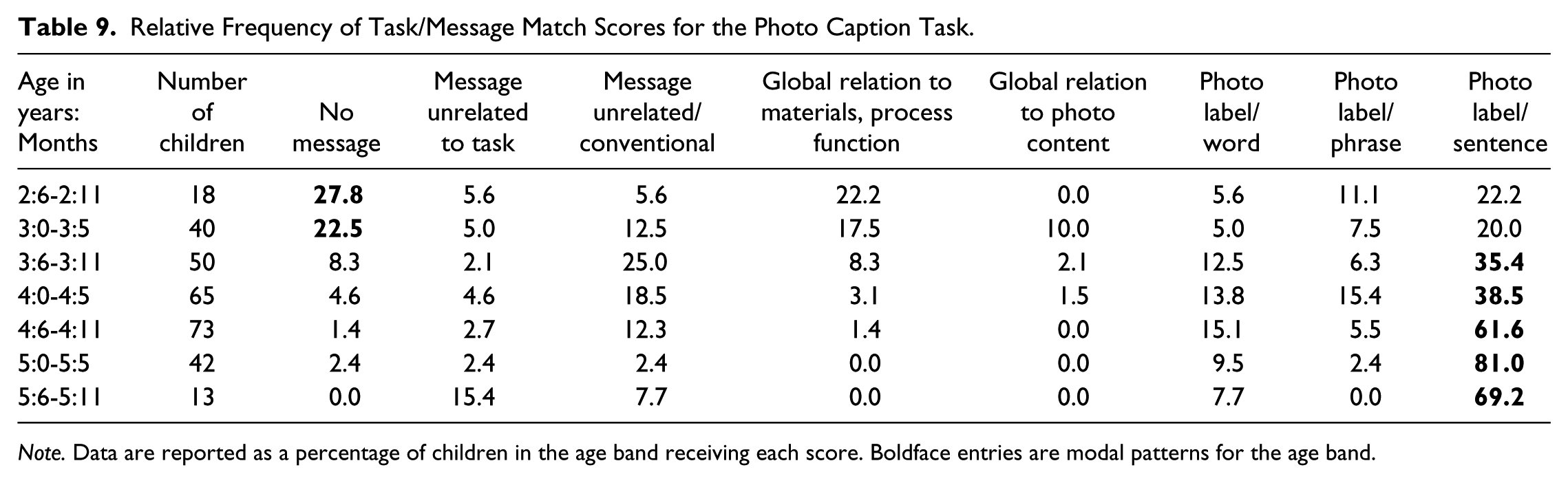
Note. Data are reported as a percentage of children in the age band receiving each score. Boldface entries are modal patterns for the age band.
However, message content categories had different trajectories of change. Viewing the data in this way confirmed the decreasing trajectory of the “no response” category (TM-0) and the increasing trajectory for photo caption sentences (TM-7). However, it also provided a more complex view of children’s approaches to message content. For example, in all age groups, children continued to produce messages unrelated to the task (TM-1), but the trajectory of change remained fairly flat. The relative frequency of messages globally related to writing materials, processes, and function (TM-3a, 3b, 3c) was fairly high for 2½- and 3-year-olds, and then declined as children began to more frequently produce captions with topically related words, phrases, and sentences. Another interesting pattern was seen in the increasing then declining trajectory of conventional literacy performances unrelated to the task (TM-2). This trajectory showed that a good number of 3½- and 4-year-olds used well-learned literacy and numeracy routines to solve the problem of composing their own written messages.
The growth curve analysis of children’s task/message match scores shown in Table 3 confirmed the patterns of change and variability observed in Table 9. The within-subjects slope parameter was statistically significant (b = .11, SE = .02, p < .05), indicating the children’s individual change in task/message match scores was significant. In addition, the between-subjects intercept was also statistically significant (b = 1.03, SE = .38, p < .05), indicating variability among the participants in initial status. The range of scores around each of the modal values in Table 9 illustrates this variability. The covariance parameter shown in the lower half of the table was statistically significant and negative (b = −.04, SE = .02, p < .05) for task/message message match. Significant covariance parameters identify different growth patterns for students with different initial scores. The negative coefficient suggests that children whose initial scores on task/message match were higher had slower individual growth. This is more likely a ceiling effect than an indication of slower change among these students; they reached the top score on this writing feature at a younger age and had no additional room to advance (see Table 9).
Overall, these findings confirm that, as a group, children moved fairly quickly to a modal performance of reading their messages as sentences describing the photo. Because all of these children were English speakers, once they formed an understanding that messages involved linguistic descriptions of the photo, they were able to use their well-developed oral language to read complex messages, or to provide the other kinds of verbal responses seen in each age band. We propose two possible causes for the wider dispersion of responses for message content as compared with form, directionality, and intentionality. First, task/message match scores may reflect the more open-ended nature of the problem posed by composing the content of written messages as opposed to other features where print conventions are relatively specified (e.g., the ways marks are arranged on the page, or letters represent sounds). Second, as described earlier, children’s message content scores reflected the differential prompt levels required to support children’s participation. Use of high-level prompts may have supported some of the younger children in producing more advanced responses than would have been expected otherwise, thereby increasing the dispersion of scores for the younger age groups.
Relationship Between Message Content and Writing Form
We conducted an additional analysis of the cross-sectional data to explore our qualitative observation that children using the most advanced writing forms did not always produce equally sophisticated messages, and vice versa. Spearman rank order correlations for photo caption form and task/message match scores were not significantly related (p < .05) in any of the age bands although correlations in several age bands were not trivial (see Online Supplementary Table 6). Visual inspection of the data showed wide variation in children’s links between writing forms and message content. Some children produced writing with conventional forms and topically appropriate messages or with less advanced forms and unconventional messages. However, in other cases, children used conventional forms but read messages unrelated to the task. Alternately, some children used unconventional writing forms, but read messages appropriately related to the photo content. This finding supports previous observations of intra-individual variability in children’s development across number of domains (Rose & Fischer, 2009; Siegler, 2000, 2006) as well as specific observations of young children’s variable control of different features of writing (e.g., Dyson, 1985).
Longitudinal Analyses of Individual Trajectories
To triangulate findings from cross-sectional and growth curve analyses and to further explore children’s individual learning trajectories, we conducted a longitudinal analysis of the Write Start! Writing Assessment data for the 10 children who were participants in the Write Start! study in Year 1 and continued through Year 3. Tracking individuals over time allowed us to compare their patterns with the group trajectories resulting from cross-sectional and growth curve analyses. We also were able to describe some learning patterns visible only when individuals were followed over time.
Individual trajectories
When looking at individual children’s trajectories over time, it is clear they moved from global to more specific and conventional understandings for all features of print, as would be expected from the results of cross-sectional and growth curve analyses. To illustrate this pattern, some of the children’s learning trajectories for writing forms are graphed in Figure 1. Only five students’ trajectories are included, to increase the readability of the display. Although children’s individual trajectories were clearly different, as seen by the differing slopes of their line graphs, each child’s learning trajectory shows an overall trend toward increasingly higher scores. Although the path of change for all children was generally toward more advanced strategies, when measured in 6-month intervals, children’s trajectories sometimes skipped categories in the Write Start! scoring sequence. Visual inspection of children’s directionality, intentionality, and task/message match scores across the 3 years of the study showed a similar pattern.
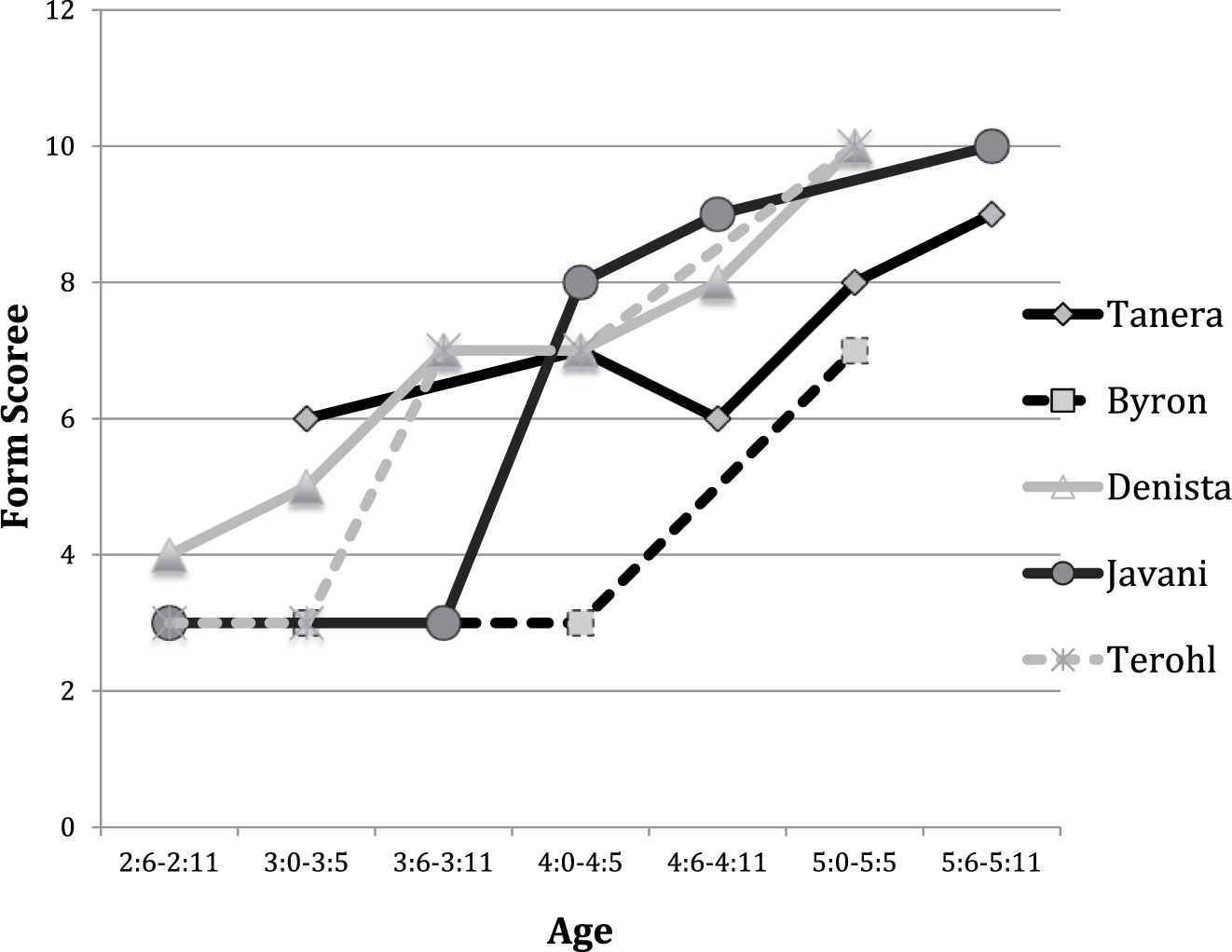
Individual trajectories in writing forms for five children in the longitudinal sample.
Inter-individual variability
Although progress toward convention appeared to be an important part of learning to write, variation between individuals’ personal trajectories was also typical. Tracking children’s writing over time provided additional insights into the variability seen for each age group in the cross-sectional analysis. Two types of inter-individual variability were observed when comparing the writing trajectories of the children in the Longitudinal Sample.
First, as 2½-year-olds, children in the Longitudinal Sample already approached writing quite differently. Figure 1 illustrates the variable starting points for writing form of five of the children in the Longitudinal Sample. Variations in starting points were also seen for directionality, intentionality, and task/message match scores, and were triangulated by findings of growth curve analysis.
A second type of inter-individual variability, the pacing of children’s transitions to new categories, is only visible when tracking the same children over time. The slopes of lines in Figure 1 illustrate the differential timing of children’s transitions to new print forms. For example, of the four children who invented spellings with letter-sound correspondence (F-10), by the end of the study, two (Javani and Terohl) continued to use scribbles (F-3) for an extended period into their third year. The other two students, Denista and Marise, were, as 3-year-olds, already producing forms with print-like appearance such as personal cursive (F-6b), stroke units (F-5), and combinations of conventional letters and invented forms (F-7). Children such as Javani and Terohl scribbled for a longer time than some of their peers, but by age 5, they were using the alphabetic principle to invent spellings (F-10). Differential timing in transitions to new, more advanced categories was seen for all four writing features.
Intra-individual variability
Our qualitative observations of study participants in their classrooms suggested there was important variability within each child’s learning that was not easily observed by separately tracking writing forms, directional patterns, intentionality strategies, or message content. To pursue this working hypothesis, we visually examined patterns from the longitudinal analysis, and conducted a correlational analysis of writing forms and message content. In addition, we analyzed children’s concurrent use of multiple writing forms. Together, these analyses showed that children’s learning was characterized by three types of intra-individual variability: (a) seesaw trajectories, (b) unevenness in their learning about different features of writing, and (c) concurrent use of more and less advanced categories of writing.
First, the longitudinal analysis showed that although the general trend for children in the Longitudinal Sample was toward more conventional understandings, many children seesawed back and forth between more and less advanced categories at one or more assessment points. As seen in Figure 1, children’s learning about print forms did not always proceed as forward progression through increasingly more advanced categories. Confirming previous research (e.g., Luria, 1929/1978), children moved back and forth between more and less advanced categories at some data points—a pattern also observed in their directionality, intentionality, and task-message match scores.
Second, in line with previous research (Dyson, 1985), we observed that writing features were not always equally well developed in the child’s writing. To further explore this pattern, at each time point, we created multidimensional profiles showing children’s most advanced hypotheses about writing forms, directionality, intentionality, and task/message match (see Online Supplementary Table 7 for an example). These profiles showed that it was often the case that one feature of the child’s writing was considerably more or less advanced than others—a finding also supported by the non-significant correlations between writing form and message content scores.
Finally, our analyses showed that children concurrently used both more and less advanced categories of writing; that is, within a single assessment session, children produced print that could be scored in more than one category for a particular writing feature. To explore whether children in the Longitudinal Sample concurrently used more and less advanced writing forms, we rescored each Write Start! assessment session to record all of the forms children used. Forty-eight percent of their photo captions were constructed using multiple writing forms. These findings confirmed that, for Write Start! participants, writing was not always conducted with a single hypothesis about each feature of writing. Instead, children often drew on a wider repertoire of more and less advanced hypotheses as they wrote—a pattern previously observed in studies of early writing (Dyson, 1985; Sulzby, 1985) as well as across other domains of development (Rose & Fischer, 2009; Siegler, 2007)
Discussion
A Descriptive Measure of Early Childhood Writing
The first goal in the current study was to develop a research-based, descriptive measure for observing 2½- to 5-year-olds’ writing in authentic writing situations where children were asked to compose their own messages. A common assessment approach for this age group (e.g., Levin & Bus, 2003; Puranik & Lonigan, 2011) has been measuring the quality or conventionality of young children’s writing using a composite score based on the number and variety of conventional print characteristics observed (e.g., linearity, presence of alphabet letters). Our approach in developing the Write Start! assessment differed in the type of information generated by the assessment, the nature and organization of the categories, and the scoring procedures.
Neumann and Neumann (2013) have recently pointed out that assessments scoring conventional writing characteristics as present or absent may underestimate children’s emergent understandings of print if there are no categories that reflect children’s unconventional understandings of these writing features. The Write Start! measure was designed to provide researchers and educators with descriptive information about what children do when they write, as a means of inferring their current understandings about print. To accomplish this, we created descriptive categories related to four important features of print—form, directionality, intentionality, and message content. Our results showed that it was possible to describe the writing performances of the 2½ - to 5-year-olds in our study using a small, manageable set of categories for each feature. Creating separate sets of categories for each feature allowed us to compare group and individual trajectories of change for each writing feature. The scores can also be used to create a multidimensional profile showing the relative sophistication of a child’s understandings of different print features (see Online Supplementary Table 7 for an example).
Sequences in learning to write
One of the unsettled issues in the literature on early childhood writing is whether there is an expected sequence of categories or hypotheses formed by young writers, and if so, what that might mean for a model of early writing development. There is no evidence from this study to support a strictly invariant sequence in children’s production of the forms, directional patterns, intentionality strategies, and types of messages described by the Write Start! categories. Instead, our data show that variability is a central characteristic of writing development for both individuals and groups. Nevertheless, when children’s writing behaviors were observed at 6-month intervals, as in the current study, the overall path of change for the group showed movement from less to more advanced writing categories. The Write Start! categories have been ordered to reflect the group trajectories observed in this study. Data supporting the match between the sequence of the Write Start! categories and children’s trajectories over time included changes in modal writing categories with increasing age, the order in which the group added new more advanced categories to their writing repertoires, and the changing relative frequencies of more and less advanced categories. Findings of growth curve analyses provided statistical support for the sequence of Write Start! categories. Significant findings indicated that children’s scores increased with age—a finding that could only be obtained if the order of categories was well matched to the actual trajectory of change.
Writing Development in Early Childhood Writing
The second goal of this research was to use the Write Start! assessment to construct a description of age-related patterns in the writing of one group of children from 2:6 to 5:11 years of age, and to describe children’s learning trajectories across the preschool years. This study provides data that are helpful in addressing the long-standing debate about whether early writing development is best characterized as sequenced and progressive (e.g., Ferreiro, 1990) or variable and individually patterned (e.g., Clay, 1991; Dyson, 1985; Sulzby, 1991). Results of the current study suggest it is both.
Progress and variability
Confirming previous research (e.g., Gombert & Fayol, 1992; Levin & Bus, 2003; Tolchinsky-Landsmann & Levin, 1985), all of the data examined here, whether cross-sectional comparisons of age group patterns, growth curve analyses, or longitudinal analyses of individuals, showed that, over time, children moved from global to more specific and conventional understandings of each of the print features studied.
However, our data also showed that variability was the rule rather than the exception. Looking cross-sectionally, same age peers used a variety of different categories of writing. Patterns of progress involved not only formation and increasing use of new, more advanced ways of writing but also decreasing use of less advanced categories. In our data, progress was not a singular, linear sequence where children moved from one consistent way of writing to a different more advanced one. Traced over time, writing development involved not only the addition of new more advanced strategies but also changes in the relative frequency with which children used existing writing categories.
Tracing the trajectories of the individuals in the Longitudinal Sample over time not only confirmed patterns of progress seen in cross-sectional data but also highlighted additional sources of variability between and within children. Inter-individual variability was seen in children’s differential starting points and the pacing of transitions from one category to the next. Within-child variability was seen in concurrent use of more and less advanced writing categories in the same writing event (cf. Bus et al., 2001), “setbacks” (Luria, 1929/1978) where children moved from more and less advanced categories for one or more features of writing, and differential control of the four features of writing studied (cf. Dyson, 1985).
Overlapping waves of writing development
To account for the patterns reported here, a description of learning-to-write in early childhood needs to forefront the normal variation in children’s writing, while recognizing that young writers do, over time, form hypotheses that bring their personal understandings of writing in closer alignment with those of their communities. Siegler’s (2000, 2006, 2007) overlapping waves theory of cognitive development is a theoretical approach we have found helpful for reconciling the role of progress and variability in our data. Consistent with our findings, Siegler (2000) has argued that children typically use a variety of ways of thinking, rather than a single one. Both more and less advanced strategies coexist in children’s repertoires over long periods of time (Yaden & Tsai, 2012). Variability in development is seen in the changing relative frequencies with which children rely on existing strategies across time, and also in children’s movement back and forth between more and less advanced strategies in their immediate attempts to solve problems. For Siegler, progress in development is visible as children construct new and increasingly more adequate strategies over time, their increasing reliance on relatively more advanced strategies, and their decreasing use of less advanced strategies. Although the trajectory of change involves a move toward more advanced ways of thinking when viewed over longer time frames, the path of progress “reflects a back and forth competition, rather than a forward march” (Siegler, 2007, p. 105). He concludes, there is often a good deal of consistency in the order in which children construct new, more advanced strategies, with sequences most visible when measured at longer intervals and variability most clearly observed within events or between events recorded at close intervals.
Interpreting Write Start! Assessment scores
Applied to our data, overlapping waves theory (Siegler, 2000, 2006, 2007) supports our finding of a broad sequence with which children construct new, more advanced writing behaviors. We propose that the sequence of categories developed from group data in this study can be useful for forming general expectations for sequences in which children add new more advanced writing performances to their writing repertoires. The Write Start! categories describe major waypoints and children’s expected direction of travel along the most common paths of development for writing forms, directionality, intentionality, and message content. At a practical level, the Write Start! categories can be used to tentatively predict the kinds of emergent writing performances children are likely to construct for each writing feature as they gain experience with writing.
However, we are not proposing that the sequence of the Write Start! categories can precisely predict which of their existing strategies children will use in the local context of a writing event or which more advanced category of writing will be added next to a child’s writing repertoire. Instead, variation is expected. Writing development in early childhood appears to involve not only addition of more advanced writing strategies but also concurrent use of multiple strategies and temporary backward transitions (Granott, 2002) as children move back and forth between categories in their writing repertoires.
Implications for Practice
The Write Start! Writing Assessment makes a significant contribution to practice by providing a set of research-based descriptive categories that give educators greater access to an extensive, but previously poorly integrated, body of research on early childhood writing. The categories provide a common vocabulary for describing and tracking four important features of young children’s writing across the preschool years. In our work with early childhood teachers (Rowe & Flushman, 2013), the assessment categories have proven readily portable to everyday classroom writing events because they describe writing features that are relevant to many composing events.
Although there is still much to be learned about the best ways for adults to support young writers, the Write Start! categories provide a base from which teachers can infer children’s current hypotheses and approaches to writing, and make informed conjectures about appropriate starting places for engaging them in joint writing interactions. Although this study’s results also emphasize the importance of expecting variation in children’s learning trajectories, the general progression outlined by the Write Start! categories provides a tentative starting point for individualizing teaching interactions that have the goal of supporting children in tackling a “just right” challenge intended to move them beyond their current understandings. Understanding the path of change for different writing categories at different ages can help teachers predict whether an observed writing performance is more or less frequent for the age group and whether it would be expected to increase or decrease with age.
In our own teaching practice, we use our observations of children’s current writing performances coupled with knowledge of general progressions in writing to make educated guesses about possible learning trajectories that fall within the child’s zone of proximal development (ZPD; Vygotsky, 1978). Scaffolding in the child’s ZPD requires not only the adult’s sensitive observation of children’s current abilities and interests but also an understanding of likely next steps in learning. Together, these insights allow the adult to manage the interaction so that children’s tasks are of a size and complexity just a bit beyond their ability to accomplish them on their own (Bruner, 1986). The descriptive categories provided by the Write Start! Writing Assessment provide teachers with the lenses needed for sensitive “kidwatching” (Goodman, 1996) as well as data on typical learning progressions that can guide conjectures about learning targets that are just beyond the child’s current level of understanding.
Limitations
Although the results of this study are informative, it is important to recognize the limitations of the current design. First, the observed patterns were shaped by the task demands of the Write Start! photo caption task. Results reflect the ways children approached an open-ended composing task requiring them to generate and write a short message they had not previously practiced. The reported writing patterns should be interpreted in relation to these task demands. Previous research has shown that children’s writing varies depending on the nature and difficulty of the task (Puranik & Lonigan, 2011). Descriptive research using other tasks is needed.
Second, this study describes the age-related writing patterns of one group of English-speaking, low-income, (mostly) African American children from one urban community in Southeastern United States. The findings of this study provide an initial look at young children’s writing across the preschool years in one community, and may not generalize to populations of children with different cultural backgrounds or different preschool experiences with writing. Children in Write Start! classrooms had weekly opportunities to write with the researchers and their teachers. Children became familiar with adult requests that they read and write their own messages, even if the resulting texts were not conventional. Future research should include a broader and more varied sample and collect information on children’s home and preschool experiences with writing.
Third, for the cross-sectional analysis, the subsamples of children in the youngest (2:6-2:11) and oldest (5:6-5:11) age bands were smaller, and therefore, may not have represented the full range of writing for these age groups. There is a special need for additional research with 2-year-olds, because there are relatively few descriptive studies with this age group (Lancaster, 2003). The Longitudinal Sample, composed of 10 students, was also small. Longitudinal studies of early childhood writing with larger samples are needed.
Fourth, although the current analyses focused on four features of children’s writing, there are other important writing features that were not analyzed here including children’s metacognitive activity during writing, multimodal composing, genre-specific features of writing, understandings of the social functions of writing, and patterns of social participation with teachers and peers. Descriptive measures for observing learning in these areas are needed to create a more complete picture of preschool writing.
Directions for Future Research
Results of the current study suggest several directions for future research. First, to better understand early writing development, there is a pressing need for longitudinal studies of the same children over time (Puranik & Lonigan, 2011). In the current study, based on cross-sectional data, we identified general sequences describing children’s addition of new approaches to their writing repertoires. Although we confirmed the general fit of these patterns for a small longitudinal sample, more longitudinal work is needed.
Second, the results of the current study suggest that research tracking individuals’ changing use of multiple approaches to writing over time may be a fruitful direction for increasing our understandings of early writing development. Most studies, including the present one, have been designed to track children’s development of new, more advanced strategies. In the current study, we have used group data to model the overlapping trajectories of change for the writing behaviors represented by the Write Start! categories. More research is needed to understand how individuals move between the strategies in their repertoires over short and longer periods of time. The Write Start! categories could provide a common descriptive vocabulary for such research.
Third, the results of the current study showed that children were developing many different kinds of understandings about writing simultaneously, and that writing form, directionality, intentionality, and message content had different paths of change when group data were considered. Future research is needed to explore the interrelations between children’s understandings of different writing features and the ways children differentially foreground and background these concerns as they write.
Supplemental Material
sj-zip-1-jlr-10.1177_1086296X15619723 – Supplemental material for The Development of a Descriptive Measure of Early Childhood Writing
Supplemental material, sj-zip-1-jlr-10.1177_1086296X15619723 for The Development of a Descriptive Measure of Early Childhood Writing by Deborah Wells Rowe and Sandra Jo Wilson in Journal of Literacy Research
Footnotes
Appendix
Acknowledgements
The authors gratefully acknowledge Carin Neitzel, co-principal investigator of the Write Start! Project; Kirsten Suer; Emily Bigelow; Sue Ganguly; and Jessica Waugh for assistance with data collection and Allison Matthews, Leah Kriz, and Mollie Phillips for assistance with data analysis.
Declaration of Conflicting Interests
The author(s) declared no potential conflicts of interest with respect to the research, authorship, and/or publication of this article.
Funding
The author(s) disclosed receipt of the following financial support for the research, authorship, and/or publication of this article: Funding for this research was provided by grants to the first author and Carin Neitzel, from Peabody College, Vanderbilt University, and from the National Council of Teachers of English.

Author Biographies
References
Supplementary Material
Please find the following supplemental material available below.
For Open Access articles published under a Creative Commons License, all supplemental material carries the same license as the article it is associated with.
For non-Open Access articles published, all supplemental material carries a non-exclusive license, and permission requests for re-use of supplemental material or any part of supplemental material shall be sent directly to the copyright owner as specified in the copyright notice associated with the article.
