




Abstract
This case study examines one third-grade teacher’s strategic participation in translingual practice and the ways that this participation shaped emerging bilingual students’ meaningful engagements with texts. Using a transliteracies perspective, we describe instances of emergence and resonance as students and their teacher leveraged resources coded in English, Arabic, and Spanish to co-construct meaning. Analysis of small-group guided reading, buddy reading, and an interactive read-aloud detail how the teacher used entextualizing, envoicing, and recontextualizing strategies to support students’ participation. Analysis of postinstruction interviews describes how resources, expertise, and emotion resonated within each literacy event and across time for this teacher. We conclude with recommendations for including translingual pedagogies in similar classroom contexts, arguing for the importance of recognizing and developing teachers’ translingual competence, as well as their emerging multilingualism.
Research in bilingual instructional strategies (Cummins, 2005), translingual practice (Canagarajah, 2012), and translanguaging (Garcia & Li, 2013)—despite differences in framing the use of multiple languages—shares the perspective that students’ literacy and language learning is enhanced when they can draw on the full range of their multilingual repertoires. This burgeoning area of scholarship is accompanied by growing linguistic diversity across the United States (National Center for Education Statistics, 2016), with new destination states in the South and the Midwest seeing nearly a 50% growth in immigrant populations between 2000 and 2009 (Marrow, 2011). Transnational flows of individuals, ideas, practices, and resources present rich learning opportunities for students and their teachers in such contexts (Noguerón-Liu & Hogan, 2017; Skerrett, 2018).
Hollins (2015) points out, however, even as classrooms change, the teaching force remains “largely white and monolingual” (p. 13), suggesting ideological, structural, and pedagogical challenges faced by teachers who do not share cultural and linguistic backgrounds with their students. Furthermore, though multilingual pedagogies can support students across content areas and grade levels, scant research has investigated how “monolingual” teachers might include resources coded in languages other than English in their instruction (see Iddings, Risko, & Rampulla, 2009; Pacheco & Miller, 2015; L. W. Rowe, 2018). The present study addresses a pressing need in multilingual scholarship and examines how one third-grade teacher leveraged resources coded in Spanish, Arabic, and English to shape emerging bilingual students’ participation in three different literacy activities.
Rather than framing this teacher’s emerging proficiencies with new linguistic resources as a deficit, we describe the strategic and productive ways she participates in translingual practice, or the negotiation of meaning across divergent semiotic resources (Canagarajah, 2012). Using a transliteracies perspective that foregrounds the emergence and resonance of meanings within literacy practice (Stornaiuolo, Smith, & Phillips, 2017), we describe how she strategically shapes opportunities to negotiate goals, tools, and relationships to power. While the use of linguistic resources is never isolated from other semiotic resources, we focus specifically on linguistic resources the teacher uses to (a) understand the strategies leveraged when diverse linguistic resources come into contact in classrooms and (b) explore how these strategies are responsive to the meanings that linguistic resources take up within interactions.
Similarly, while a confluence of actors, activities, contexts, and relationships to power shape the meanings that emerge and resonate within literacy practices, we focus our inquiry on teacher participation, acknowledging she is one part of a classroom ecology, but a powerful actor in shaping how and when and why linguistic resources can be used (Miller & Zuengler, 2011). To inform understandings of how the full range of teachers’ and students’ multilingual repertoires can be leveraged in English-centric classrooms, we ask the following research questions: (1) How does one teacher strategically participate in translingual practice across three literacy events? And, (2) How does this participation shape students’ meaningful engagements with texts?
Literature Review
We frame meaning negotiation between students and teachers as translingual practice, or bundles of activity that involve mobilizing and meshing divergent semiotic resources—including uses of the body, texts, shared understandings of context, and linguistic resources—to achieve communicative ends (Canagarajah, 2012). Meanings within translingual practice are negotiated between interlocutors, rather than transmitted from a speaker to a hearer. This negotiation can be strategic in that it affords individuals opportunities for orchestrating intentions across resources, asserting identities, framing contexts, and “persuading more powerful interlocutors to change their footing, renegotiate their norms, and reconstruct meanings and form” (p. 29). Below, we detail how three different macro-strategies can support individuals in aligning understandings and managing relationships to power when varied semiotic resources are meshed and mobilized.
Macro-Strategies in Translingual Practices
Canagarajah (2012) describes envoicing, entextualizing, and recontextualizing strategies as productive in facilitating translingual practice. The first, envoicing strategies, are those that establish roles and relationships, aspects of identity, and communicative norms. Envoicing is strategic in that individuals can communicate stances within complex power dynamics and broader linguistic hierarchies and, similarly, manage relationships to dominant beliefs or feelings about language (Kroskrity, 2004). For example, de Oliveira, Gilmetdinova, and Pelaez-Morales (2015) show a kindergarten teacher using Spanish to “relate to students” as an “active member” of their community (p. 16). Though English was privileged as the language of instruction, the teacher used Spanish to envoice a linguistic identity in which students recognized and responded. In turn, this created an affective proximity to students, who then “felt comfortable sharing their in and out of school experiences” (p. 16).
The second, entextualizing strategies, involve recognizing, reconfiguring, and redeploying resources to code intentions. Entextualizing is strategic in that it enables individuals to orchestrate how meanings are coded to ensure one is communicating clearly in relation to interlocutors, the space and time in which they communicate, and power dynamics. When teachers in David’s (2017) study could not understand students’ Bahdini, they leveraged flipchart paper, seating configurations, and student writing to support students in translating English texts. Students might entextualize resources to achieve esthetic and rhetorical goals by using Spanish in English-centric contexts (Pacheco & Smith, 2015; Zapata & Laman, 2016), establish procedural information (Iddings, 2005), and collaboratively construct text meanings through entextualizing personal experiences (Medina, 2010).
The third, recontextualizing strategies, help interlocutors establish shared understandings of communicative goals, processes, and topics. Recontextualizing is strategic in that individuals can signal which resources are in alignment or opposition to dominant language ideologies in a communicative context. Teachers are often powerful members of classrooms that can cue students about which resources can or cannot be used. Teachers might recontextualize linguistic resources as valuable by using specific translingual curricula (Escamilla et al., 2014; Jiménez et al., 2015; D. W. Rowe & Miller, 2016). They can also recognize and leverage students’ “spontaneous biliteracy” (de la Luz Reyes, 2012), valuing multilingual resources as they emerge within English-centric spaces. Rather than framing students’ uses of Spanish as markers of deficiency, teachers can recognize, praise, and investigate student language use to inform classroom meaning-making (Martínez, 2010).
Translingual Practice and Meaningful Engagements
While this brief review describes what strategies teachers might use in translingual practice, scant research has accounted for how translingual practice shapes student engagements with texts. How, for example, might a teacher recontextualize a student’s Arabic when engaging with an English-language text to signal expertise, rather than deficit? And could this same strategy constrain a student’s engagements given Arabic’s relationship to power in this interaction? Questions such as these might be addressed by describing how a teacher’s strategic participation can shape students’ meaning-making in texts, but moreover, their meaningful participation with texts. Investigating meaningful engagements with texts is important in understanding how students interact with classmates around an author’s message, how they access and assert important background knowledge, and how they perform identities as valued discussion participants, among other features. Moreover, examining engagements with texts draws attention to how translingual practice might support what Short (1999) calls “balanced” literacy, or instruction that includes opportunities for students to learn language, learn about language, and learn content through language. We frame meaningful textual engagements as interactions in which teachers and students collaboratively work toward Short’s three goals, and likewise, negotiate interactions with one another and with available resources (Aukerman, Schuldt, Aiello, & Martin, 2017).
A Transliteracies Perspective of Translingual Practice
A transliteracies perspective (Stornaiuolo et al., 2017) foregrounds emergence, or “ways meaning bubbles up in interactions among people, texts, and things” (p. 77), and resonance, or “how ideas, practices, symbols, objects, and the like become ‘shared’” (p. 80) to understand engagement with texts. Focusing on emergence helps trace the mobility of resources within practice. Rather than assuming how Spanish or Arabic can be used, this framework draws attention to resources in relation to context and “connections that emerge without predetermining the nature of those pathways” (p. 70). As individuals align understandings across languages, trajectories for meaning-making open and close as goals and tools emerge in “new, interruptive, and unexpected” ways (p. 79). Spanish and Arabic are not static tools for accessing background knowledge when reading texts, for example, but mobile resources whose utility takes shape in activity when recognized by participants, meshed with other resources, and leveraged to work toward participants’ goals.
A focus on resonance helps trace the “stickiness” of this meaning, or “how particular resources become meaningful and then are adapted, hybridized, and circulated” (Stornaiuolo et al., 2017, p. 82) over time. A student might recognize certain linguistic resources or ways of using them while ignoring others. Similarly, certain bundles of activity might resonate with a teacher over time and space while she abandons others. Resonance can be used as a tool for inquiry to address how a teacher participates in translingual practice, for example, asking what tools, forms of engagement, and goals resonate for her as she includes multilingual resources in instruction. This aligns with Canagarajah’s (2012) description of translingual practice as improvisational, where meanings within interactions are not predetermined, but emerge when individuals adapt and align resources to the context. The meanings that students construct in and around texts are shaped by resources they adopt, their goals, and their relationships with others. These engagements are shaped by language policies and ideologies (Razfar, 2012) and by contexts that extend across time and space. In this study, we emphasize that teachers play an important role in making translingual practice possible, and attend to one teacher’s translingual competence—or her successful use of envoicing, entextualizing, and recontextualizing to negotiate meaning (Canagarajah, 2014).
The Study
The case study (Stake, 2006) reported here is part of a larger ethnography conducted over the course of an academic year in three elementary classrooms (see Pacheco, 2016). While data from the larger ethnography are not reported on directly in this analysis, we relied on prolonged engagement from that setting and the thick descriptions of the classroom we reported elsewhere (see Pacheco, 2016) to triangulate our findings reported in this study and to establish the trustworthiness (Lincoln & Guba, 1985) of this study.
Research Context and Participants
The research site is a third-grade classroom in an urban elementary school in the southeastern United States. The city’s population of students identified as English language learners (ELLs) has seen a 50% increase over the last 3 years, and schools have implemented a variety of program models to support these students. With few teachers having an English-as-a-second-language (ESL) endorsement and approximately 120 home languages represented across more than 50 elementary schools in this district, the majority of ELL instruction involves sheltered English immersion, an instructional model where teachers scaffold language and content learning simultaneously. Our focus teacher, Ms. Gardner (all names are pseudonyms), like many of her colleagues, was working toward an ESL endorsement at the time of data collection.
Ms. Gardner was selected through purposeful sampling (Patton, 1990) from the 17 teachers participating in an ESL endorsement program led by this study’s authors. This program offered some instruction on translingual pedagogies—including our (Jiménez et al., 2015) use of strategic translation, Escamilla and colleagues’ (2014) paired literacy, and Orellana and Reynolds’s (2008) work with language brokering—but did not require Ms. Gardner to implement translingual instruction or participate in this study. We selected Ms. Gardner based on reported language proficiency, her expressed desire to leverage students’ multilingual repertoires in instruction, and evidence of competence in her practice, as indicated by her scores on the Sheltered Instruction Observation Protocol (Echevarria, Vogt, & Short, 2004) we gathered through prior observations.
Ms. Gardner teaches third grade at a K-4 school with a large population of African American and Latino students. In recent years, the school’s neighborhood has seen a growth in families from countries in northern Africa. The school serves 950 students, with 83% listed as economically disadvantaged. Students bring a wide variety of linguistic strengths to the school, and 34% of the students identified as ELLs. Their performance ranges from emerging to advanced English proficiency. Despite recent improvements on state assessments, the school received a 30% Approval Performance Framework Rating, which is below state average. The observed classroom had students proficient in Spanish and Arabic, as well as one student proficient in Uzbek.
Ms. Gardner was in her second year of teaching and was 26 years old at the time of this study. She is White, was born in Louisiana, and studied education at a small university. She describes herself as “monolingual,” but she took some French in high school and had exposure to French growing up. She took an introductory Spanish course in college and reported learning new language from her students. Our observations of Ms. Gardner before and during this study revealed her to be a dedicated and capable teacher of bilingual students. Her literacy instruction included regular opportunities for student interaction and inquiry, and she demonstrated practices to support content and language learning. She reported including Spanish and Arabic in her instruction on a few occasions prior to this study.
Our work with Ms. Gardner began in a year-long ethnographic study in her classroom and that of two other teachers as part of a larger study. While Pacheco began observing Ms. Gardner for one literacy block per week as part of the endorsement program in which she was enrolled, he extended these observations to a half or full day per week after Ms. Gardner consented for the study under discussion here. During data collection, Pacheco participated as a participant-observer (Spradley, 1980), video recording instruction and conducting semi-structured interviews across an academic year. At times, he also acted as an observer-participant, offering tools for teacher self-reflection and approaches to instruction before and after observations. Interviews were designed to learn more about Ms. Gardner’s pedagogical reasoning (Horn, 2007) and, furthermore, to encourage Ms. Gardner to evaluate, hypothesize, and transform aspects of her pedagogy.
Daniel and Pray also observed Ms. Gardner’s instruction over the course of the academic year, and Jiménez observed Ms. Gardner on three occasions in the year following this study’s conclusion. Pacheco, Daniel, and Pray met weekly during data collection to discuss Ms. Gardner’s instruction and the other classrooms in the endorsement program. All four researchers have some proficiency in Spanish. All Arabic interactions were translated and transcribed by a bilingual undergraduate assistant born in Egypt and checked for accuracy by a bilingual graduate student born in Saudi Arabia.
Data Collection and Analysis
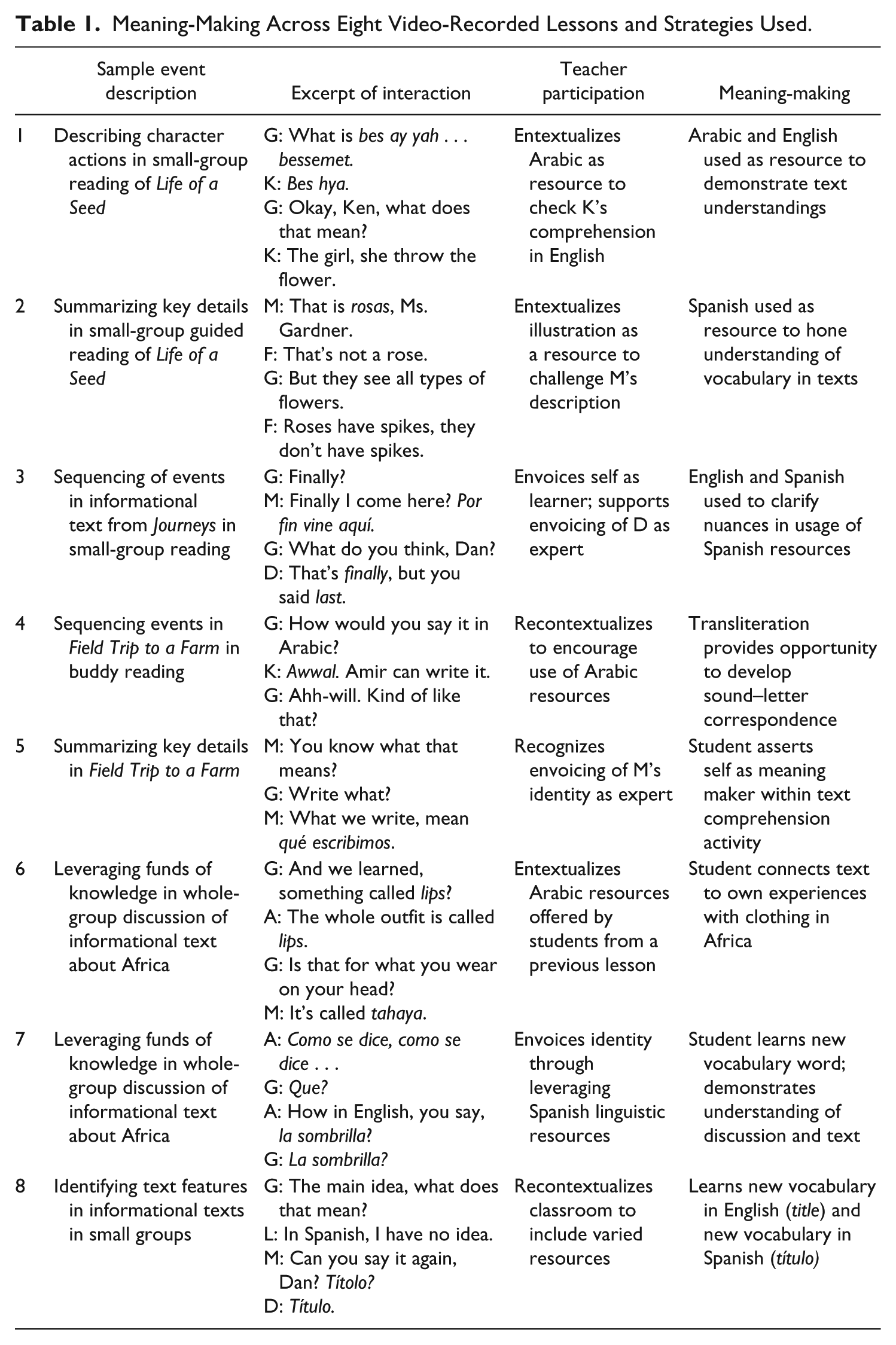
We relied on naturalistic inquiry (Corbin & Strauss, 2015) to explore relationships between language use, teacher participation, and student meaning-making. We video recorded 25 to 40 min of small-group or whole-class literacy instruction 1 to 2 times per month over the course of the academic year. After transcribing these eight separate video recordings, Pacheco identified 80 possible translingual literacy events, defined as “occasions in which written language is integral to the nature of participants’ interactions and their interpretative processes and strategies” where “participants follow socially established rules for verbalizing what they know from and about the written material” (Heath, 1982, p. 50). Pacheco used the constant comparative method (Corbin & Strauss, 2015) to identify ways meaning-making occurred when divergent linguistic resources were used (i.e., clarify linguistic resource, assert expertise, access background knowledge) and how Ms. Gardner participated strategically (i.e., offered tools, engaged as learner, shifted goal). Pacheco and Daniel then used Canagarajah’s (2014) description of macro-strategies to group these different forms of participation, identifying when Ms. Gardner entextualized, envoiced, and recontextualized. Table 1 details the eight video recordings, one literacy event within each recording, possible student meaning-making, and how Ms. Gardner participated. For more information about our analysis, see the supplemental online material for an extended transcription and coding of two sample literacy events.
Meaning-Making Across Eight Video-Recorded Lessons and Strategies Used.
After this initial phase of coding the eight video recordings, we selected three literacy events for a more fine-grained analysis. Events analyzed for the present study include a small-group guided reading (Fountas & Pinnell, 1996), buddy reading (MacGillivray & Hawes, 1994), and a whole-class interactive read-aloud (Trelease, 1989). We selected these events because they (a) included high frequencies of Spanish or Arabic, (b) varied in student language backgrounds, (c) varied in type of literacy event, and (d) suggested student engagement with the texts, as indicated by student utterances about text features, questioning, and cross-talk. We analyzed events in two interrelated phases.
Phase 1 addressed how participating in translingual practice shaped students’ meaningful engagements with texts. Consistent with our transliteracies framework, we attempted to describe how meanings emerged from the interaction of individuals, goals, power relationships, and resources. We used emergence as a tool for inquiry (Stornaiuolo et al., 2017) and looked for moments when trajectories or learning pathways emerged in interaction, paying attention to moments that were “surprising, new, interruptive, and unexpected” (p. 79). We identified instances when goals emerged (sample codes included describing a character, making connections across languages, and clarified vocabulary), when participants shifted in forms of engagement (sample codes included learner-to-expert and teacher-to-periphery), and when participants introduced or took up tools (sample codes included using illustration, leveraging prior learning, and display knowledge).
Phase 2 used resonance as a tool to examine Ms. Gardner’s strategic participation in translingual practice. First, we looked for resonance within the event and analyzed how she “adapted, hybridized, and circulated” resources (Stornaiuolo et al., 2017, p. 82). We asked how meanings resonated with her and how she responded to these meanings (sample codes included made comparisons to English syntax, learned/used languages other than English, elicited students’ expertise, and praised language use). Similar to our analysis of the larger data set, we then grouped these different forms of participation under Canagarajah’s macro-strategies. Second, we looked for resonance after the literacy event. We analyzed three postobservation interviews with Ms. Gardner, and then extended the time scale of this resonance by having Ms. Gardner share observations of transcripts at the conclusion of observations in May 2015 and in October 2017. We then looked for similarities and differences across the three events, identifying aspects of Ms. Gardner’s participation that resonated over time and across events.
Findings
We organize findings by presenting excerpts from three literacy events: small-group guided reading with Spanish and English, buddy reading with Arabic and English, and an interactive read-aloud with Spanish and English. We selected these excerpts for two reasons. First, each shows participants attempting to align understandings when deploying linguistic resources in Arabic or Spanish. While there were many instances in each event when this occurred, these excerpts show interlocutors interrogating resources and negotiating their use over multiple turns of talk. Second, we selected these excerpts as representative examples of the range of strategies Ms. Gardner leveraged across the larger data set (see Table 1). Examined individually, each demonstrates a different way she strategically participated in translingual practice. Examined alongside one another, they demonstrate the breadth of Ms. Gardner’s strategic participation. After describing Ms. Gardner’s participation and students’ meaningful engagements with texts, we detail how meanings, processes, and purposes resonated with her across time.
Entextualizing Resources in Small-Group Guided Reading
This section describes how Ms. Gardner recognizes the emergence of resources and uses an entextualizing strategy to coordinate their use in unfolding interaction. She entextualizes pesa, pesada, and crecen—resources offered by students—as valuable for clarifying misconceptions and learning about language. Her shifting forms of engagement demonstrate attempts to entextualize Spanish as a powerful tool in this English-centric classroom. In this event, she leads a 20-min small-group guided reading about a field trip to a farm. She checks for understanding through questioning, and students practice comprehension strategies, including predicting and visualizing. In the postobservation interview, she reported the goal for this literacy event was for students to summarize the text. Prior to this exchange, her questions included known-answer questions (“Who is going on the field trip?”) and questions that encouraged students to visualize (“What do they see at the farm?”). She then asked students to whisper-read two pages of text to themselves.
Students involved in this event included Miguel, Kimberly, Alan, and Frank. Miguel and Kimberly were born in Honduras and are at the entering stages of English proficiency. Alan was born in Mexico and has intermediate levels of English proficiency. Frank was born in the United States of Venezuelan descent and has advanced proficiency in English and Spanish.
During the event, Ms. Gardner asks the students to summarize what they whisper-read, and Miguel’s description does not correspond to the author’s written message (the pumpkins are big and heavy). She recognizes both Spanish and English as entextualizations of student understandings:
So, they see the pumpkins, and what about the pumpkins?
Um, crecen. (They grow.)
They grow.
Wait, hold on, let’s talk about this together, before we write. So, what does the author have to say about the pumpkin?
Um, that . . .
Uh, que . . . (that)
The class is taking pumpkins home.
Miguel draws from Spanish linguistic resources to participate in the discussion, and Alan, recognizing Ms. Gardner might not understand, translates crecen to they grow. He facilitates Ms. Gardner’s understanding and signals they might not have given an accurate paraphrase of the text, or what the author “[has] to say about the pumpkin.” While Ms. Gardner does not understand crecen, she entextualizes Miguel’s Spanish as a valued resource through her response and pursues a new learning trajectory (wait, hold on, let’s talk). She affirms Alan’s linguistic expertise in this language brokering event, and his translation emerges as a resource to check comprehension. She asks students to reread the text and reinitiates a request to display understandings. She then entextualizes another semiotic resource, the text’s illustration:
Okay, so we did see that, and on this page, what does the author say about the pumpkins? (points to pumpkin-patch illustration)
Y están, etán grandes . . .pesadas? (And they’re, they’re big . . . heavy?)
Pesadas? (Heavy?)
Si eran pesadas, that means they would (If they were heavy)
be como tres, que va a llevar tres . . . (like three, they would weigh three . . .)
It’s heavy.
Pesa, pesadas? (weighs, heavy)
Miguel, Alan, and Frank use Spanish to show that they do in fact understand the author’s message, and a discussion arises about whether to use pesa, a verb meaning “weighs,” or pesada, an adjective meaning “heavy.” Whereas the activity’s initial goal was to summarize, a new goal emerges with the introduction of Spanish—clarifying semantic differences between pesa and pesada. Ms. Gardner, not knowing this difference, asks:
So, you know how we talked about in reading the subject has to agree with the verb, we say “they are,” not “they is.” This form grande has to match pesa, or is it pesadas?
She entextualizes another semiotic resource—shared understandings of subject/verb agreement in English—to determine whether to use pesa or pesadas. When students are still uncertain about which word best describes the pumpkins, she reintroduces the pumpkin-patch illustration, asking if pesa or pesada is more appropriate based on count. Both words could describe weight, and unbeknownst to Ms. Gardner, count does not determine whether pesa or pesada should be used:
If I go back and I look at the text and I look at the illustrations and I match the illustration to your words, would it be pesa or pesada. . . . Kimberly, look at your illustration, look at your picture. How many do you see?
Ms. Gardner demonstrates translingual competence by entextualizing multiple resources, including students’ Spanish, text illustrations, and shared understandings of syntactic information, to correspond with the activity’s emerging goals. Her entextualizing is strategic in that new resources are leveraged as new goals emerge. Her entextualizing is also strategic in that she manages and reconfigures these resources’ relationships to power in the literacy event. While Spanish does not correspond with the text’s language or with Ms. Gardner’s own language use, she entextualizes Spanish as valuable for interrogating and for discussing the text.
At the conclusion of the event, however, the students and Ms. Gardner were still unsure of which word to use to describe their text. Finally, Ms. Gardner encouraged Miguel to entextualize his understandings from prior experiences with the two words:
So, Miguel, um, when do you say pesadas? (heavy)
My mom just say pesa, Ms. Gardner. It’s pesa. (weighs)
In response to our research question that asks how translingual practice shapes meaningful engagements with texts, we assert that using divergent linguistic resources facilitated students’ opportunities to learn about language and learn content through language. Using Spanish allowed Ms. Gardner to check student understandings in relation to the author’s intended message. When Miguel—a student at the early stages of developing proficiency in English—stated the pumpkins crecen, or grow, she further questioned whether that is what the author stated. When students began discussing whether to use pesa or pesada, Ms. Gardner asked them to leverage prior learning and their existing language knowledge as resources.
While the product of these interactions could have included accurate or inaccurate paraphrasings of the text, the process of engaging in translingual practice afforded opportunities for students’ meaningful engagement. We are not arguing students were uncertain of what heavy meant. We are arguing that the discussion of Spanish translations of heavy afforded students opportunities to make connections to background knowledge, clarify nuances in Spanish usage, and possibly deepen metalinguistic awareness. This excerpt also shows, however, how translingual practice shifted the goal of summarizing to one of linguistic problem solving. While students had opportunities to learn about and through language, we cannot claim that this engagement was more valuable than instruction focused strictly on developing and applying summarization strategies. Similarly, Ms. Gardner expressed concerns in her postobservation interview about time dedicated to problem solving, which we will discuss in greater detail in the second half of our findings.
Envoicing Identities in Buddy Reading
In this excerpt, we describe Ms. Gardner’s use of an envoicing strategy—or the use of resources to index different positions within the interaction and aspects of identity. While the above example shows Ms. Gardner strategically entextualizing students’ resources to engage with texts, she uses an envoicing strategy to position herself as a collaborator and affords students opportunities to position themselves as central participants in the event. Below, we describe how this strategy positions students to consider nuances in meaning and defend language choices as collaborators. This literacy event occurred 1 week after the previous example and used the same text about a field trip to a farm.
During literacy centers, students read and discussed texts with partners. While this was a stand-alone station within the rotation of literacy centers, Ms. Gardner often had two students sit near the guided reading group so she could monitor. Prolonged observation in the classroom showed this center to be challenging for students in terms of engagement with texts, with Ms. Gardner directing her focus on small-group guided reading. Before this interaction, Ms. Gardner told students they could use Arabic to discuss the text.
Ken, a student born in Egypt who was at the entering stages of English proficiency, is reading with Amir, a student also born in Egypt with advanced English proficiency. Ms. Gardner recognizes and encourages student identities as classroom meaning-makers and asserts her identity as a collaborator. Amir and Ken read “the pumpkin was covered in mud” and discuss a possible interpretation. Ms. Gardner sits to the side, listening to their discussion before joining:
El ‘ar al asal. el aar asal hoa (pumpkin; The pumpkin is very heavy.)
tageel awy awy w hoa mad’ook (and covered in mud)
Um . . .
Mad’ook, yabny. (It’s covered in, buddy.)
Ya’ny eh? (What does it mean?)
Ta’raf lama el [inaudible utterance] btkoon (Do you know when . . . is)
mad’ook?
(covered in?)
Mad’ook? (Covered in?)
Mad’oo’. (Covered in.)
Malyan teen? (Filled with mud?)
Malyan teen? (Filled with mud?)
Okay. So.
Whereas Amir suggests covered in, or mad’oo’, might be an accurate paraphrase of the author’s message, Ken suggests malyan teen might better describe the muddy pumpkin. The pumpkin is not simply covered in mud, but filled with mud or riddled with mud. While Ken, a student just beginning to learn English, might not have the linguistic sophistication in English to express the degree to which the pumpkin is covered in mud, he envoices his identity as a textual meaning-maker; he leverages his expertise in Arabic to demonstrate emerging understandings of the text and possibly support Amir’s interpretation.
While envoicing strategies can describe how individuals voice aspects of their own identities, this example shows Ms. Gardner listening to students and recognizing their emerging positions within the interaction. She demonstrates translingual competence in positioning them as competent meaning-makers, rather than deficient speakers of English or struggling readers. She then joins their discussion and envoices aspects of her own linguistic expertise by challenging Ken and Amir’s description of filled with:
He says the pumpkin is really heavy and it is filled with mud.
Is it filled? If something is filled, that means . . .
. . . He said filled.
Hold on, if something is filled, that means the inside is with mud. Is the inside, does the inside of the pumpkin have mud?
I said it is, there is mud on the pumpkin, but he said no, it’s filled.
Ms. Gardner presses Amir, asking if filled is an accurate interpretation, as it might suggest mud “inside of the pumpkin.” She presses Amir to support his assertion and asks if the inside of the pumpkin has mud on it, envoicing her identity as a collaborator alongside Ken and Amir in understanding the author’s message. As the students draw on Arabic linguistic resources, she offers her own understanding of the English vocabulary (Hold on, if something is filled . . .) and checks the students’ interpretation. In doing so, she not only attempts to understand Ken and Amir’s discussion in Arabic, but works alongside them to construct meaning.
Despite Ms. Gardner and Amir’s confusion when malyan teen (riddled with) is translated back into English as filled with, her participation in translingual practice afforded student opportunities to learn language and learn content through language. When students use Arabic to envoice identities as textual meaning-makers, they attend to nuances within and across English and Arabic that might remain unexplored if only using English linguistic resources (Hopewell, 2011). When Ms. Gardner joins their discussion, envoicing her identity as an English speaker with emerging proficiency in Arabic, Amir must then defend his choice for a translation. Ms. Gardner encourages him to continue interrogating the text (Does the inside of the pumpkin have mud?) to support his assertion. We do not claim that translingual practice fundamentally altered Ken’s and Amir’s text comprehension. We do assert, however, that using Arabic opened opportunities for meaningful engagement for Ms. Gardner and her students within this event. Similar to other language brokering activities (Orellana & Reynolds, 2008), the use of Arabic and English reconfigures relationships to power in the classroom, as expert–novice/teacher–student distinctions were challenged in this collaborative meaning-making.
Recontextualizing Interactions in a Whole-Class Interactive Read-Aloud
This final example shows Ms. Gardner leveraging a recontextualizing strategy to shift participants’ relationships to resources during a whole-class interactive read-aloud. In doing so, she offers opportunities for students to access and leverage background knowledge and demonstrate text comprehension. This recontextualizing also offers opportunities for multiple members of the classroom to negotiate how Spanish can be used in the event. In the following, students are sitting on the carpet as Ms. Gardner reads aloud from an informational text about Africa. Prior to this event, Amir, an extroverted student proficient in Arabic and English, described how weather in Egypt was different from the local climate. Another student, Maddy, also born in Egypt, described an article of clothing used to protect against hot weather. Miguel, a student at the entering stages of English proficiency, shares a personal experience and signals his understanding of the text discussion:
Okay, so you kind of experienced something similar to what Amir is talking about. Um, Miguel, did you have something that you wanted to say, your hand’s raised.
When I was with my mom. I was in, when I was in Honduras, I went alone, I was by myself, at home.
Miguel begins to make a personal connection but has difficulty expressing this in English. Ms. Gardner recognizes he has something to contribute to the class’s collaborative meaning-making and encourages him:
Do you want to say it in Spanish?
You not gonna understand.
You can say it in Spanish, someone will understand.
Cuando yo estaba en Honduras, (When I was in Honduras)
cuando yo fui en un avión
. . . (when I went on an airplane)
. . . What did he say?
Cuando yo estaba en avión, (When I was on the plane)
yo vi a mi tía y este, cuando
(I saw my aunt and, um, when)
vi a ella después, ella estaba (I saw her after, she was)
mirando la
. . . (watching the)
. . . Frank, what did he say?
He said when he was on an airplane he saw his aunt, and, that’s all I got.
Though Ms. Gardner is “not gonna understand,” she recontextualizes the interaction to include the entire classroom community, thus encouraging Miguel’s further participation. When she says “someone will understand,” she explicitly demarcates the classroom as a translingual space where Spanish is a valuable resource. Miguel describes a personal experience that connects to his classmates’ comments. While this connection in Spanish might support his own meaningful engagement, it also encourages classmates’ responses as they are uncertain of his meaning, with Amir asking Frank for a translation. In classrooms where promoting student-to-student talk can be challenging (Cazden, 2001), Spanish pushes students to engage in translingual practice and negotiate meaning in Miguel’s utterance. Ms. Gardner, confused at Miguel’s contribution, then responded:
So, you had something, you saw something similar to what Amir was talking about.
(inaudible utterance)
She told you something about Egypt?
(nods yes)
In relationship to our second research question, about how translingual practice shapes students’ meaningful engagements, this example highlights the challenges of leveraging Spanish in instruction. On one hand, Ms. Gardner is uncertain about how Miguel’s contribution connects to his classmates’ comments, and she attempts to infer that there is a relationship between his experiences with his aunt on an airplane and Amir’s comments about Egypt. She does not press him for details, and shifts the conversation back to Amir and Maddy, making us question the extent that Miguel constructed meaning in the text. On the other hand, Ms. Gardner recontextualizes the interaction to include Spanish resources as legitimate for meaning-making despite Miguel’s claim that it might not be valuable. Miguel—a student we did not previously observe participating in whole-class discussion—uses Spanish to entextualize his background experiences, and as a result, invites a response from his classmates.
This example illuminates how power affords certain linguistic resources and identities within the classroom at the exclusion of others. Miguel recognizes that Spanish—despite its utility in helping him access his background knowledge—is something that might not be useful to Ms. Gardner, a powerful member of an English-centric community. Though many of his classmates understand Spanish, Miguel recognizes Ms. Gardner’s central positioning in this community; he recognizes the importance of her understanding his utterance, thus indexing her relationship to power. Ms. Gardner, however, acknowledges that “someone will understand,” and that this resource is not only welcome in the classroom but useful for engaging with texts. She recontextualizes the interaction to respond to and manage ideologies about whose language counts and shapes an opportunity for Miguel to learn content through Spanish and English. This echoes Moses and Kelly’s (2017) findings that “demonstrate ways classroom communities can afford cultural tools that enable all students to experience a sense of belonging to the literacy community” (p. 418). Rather than limiting participation to those with advanced English proficiency, Ms. Gardner recontextualizes the interaction to include Miguel, an important contributor with valuable life experiences.
What Resonated With Ms. Gardner?
The strategies detailed above describe how Ms. Gardner participated in translingual practice and how this participation shaped students’ engagements with texts. She demonstrated translingual competence by leveraging these strategies in response to emerging goals, resources, and relationships to power. While each excerpt describes her use of a single strategy in detail, Ms. Gardner leveraged multiple strategies in each event. In small-group guided reading, for example, she entextualized multiple semiotic resources, including illustrations and analogies to English subject/verb agreements, to help her in accessing Spanish linguistic resources. She also recontextualized this interaction by explicitly welcoming the use of Spanish through her response to students’ contributions. Below, we describe how Ms. Gardner orchestrated the use of strategies by attending to instances of resonance, or how she recognized and responded to meanings within each literacy event.
Recognizing Expertise
In our interview with Ms. Gardner after her whole-class read-aloud, she articulated how student expertise was important. Whereas Miguel recognized that Ms. Gardner might not have a command of the lexical and syntactic structures of Spanish, saying “you not gonna understand,” Ms. Gardner recognized that his classmates’ linguistic expertise could be leveraged. While this might seem like a simple instructional move, Ms. Gardner struggled with framing this expertise, as Spanish could mark students as deficient in English-centric classrooms:
My Spanish speakers just don’t want, um, to speak Spanish, and I see that within class every day. So I’m hoping to see a lot more of them stepping outside of their comfort zone as we do it.
Why do you think they don’t want to speak Spanish?
I don’t know. I know Miguel gets frustrated if I’m saying something to him in English, he doesn’t understand it, I say okay. I’ll get someone to translate what I’m saying, and he’s like, No, I understand what you’re saying. And he gets frustrated and responds to me in English.
Okay=
=I don’t know if it makes him feel not smart enough, or you know, I don’t know, it’s interesting.
Ms. Gardner acknowledges that using Spanish resources might make Miguel “feel not smart enough” or like he is “stepping outside of [his] comfort zone.” Her perspective on student expertise in relation to language ideologies shapes her attempts to recontextualize classroom interactions. She is strategic in welcoming Spanish to support students’ meaning-making, and moreover, strategic in recognizing the relationship between Spanish and power in her classroom.
These tensions between Spanish, English, and student expertise continued to resonate with Ms. Gardner 2 years after our observations. She told us she continues to
find it fascinating the students I have this year prefer to speak in English even when they are playing on the playground. I wonder if it has anything to do with the population of students and how most are English speakers.
Again, she recognizes students’ linguistic expertise but observes that local contexts might constrain how this expertise is accessed. We emphasize Ms. Gardner’s strengths in her pedagogical decision making in response to students’ multilingual identities. Though she labels herself monolingual, she demonstrates translingual competence in understanding how, when, and why students’ multilingual repertoires can be leveraged to support their literacy engagement.
Recognizing Resources
As students used Spanish and Arabic resources to engage with each other, Ms. Gardner, and texts, Ms. Gardner described how she recognized and refashioned resources. In our postobservation interview after the discussion of pesa and pesada, she described her knowledge of French as helping her distinguish differences in meaning between the two words. While she did not know which was more appropriate, she was aware of the need for syntactic agreement. She recognized her French knowledge as a resource, and as a result, refashioned students’ Spanish as a resource she was familiar with. She told us,
No one speaks French. But it helps with the structure—Spanish and French have similar sentences—but it doesn’t really help with vocabulary. I grew up in Louisiana, that’s why I feel more comfortable with French.
We argue that she does not use the literal meanings of pesa and pesada as linguistic resources, but refashions them as familiar resources that represent parts of speech that must agree syntactically. Similarly, she described how familiar resources resonated with her during Ken and Amir’s buddy reading in Arabic. Though she could not monitor directly what the students were saying, she recognized how they were talking through “body language”:
You could just tell by their body language, you’ll hear them say another student’s name and he’s not in the group and they’re speaking their first language so that was probably the easiest way. You can definitely tell by just looking at their body language. . . . At first, it became, it was a little frustrating at first because I didn’t know if they were on task, but as I worked more with them and heard their language more, I could tell when they were on task and when off task.
While uses of the body could be described as paralinguistic cues, they also index Ms. Gardner’s material and embodied “entanglements” within translingual practice (Boldt, Lewis, & Leander, 2015). Student movements, student engagement with the task at hand, and her emerging understandings of meaning-making processes as she “worked more with them” all resonated with her after the literacy event. This reflection also demonstrates resourcefulness, and 2 years later, she affirmed that her knowledge of her students and effective literacy instruction supported her. She told us she “had very little language knowledge. . . .[So,] knowing my students and literacy allowed me to comprehend or understand students’ conversations about the text.” Despite labeling herself as “monolingual,” she negotiated meaning with students by recognizing familiar resources and refashioning new resources as students used Spanish and Arabic.
Recognizing Emotions
Across events, Ms. Gardner described her participation in relation to affect. She spoke about feelings of frustration, enjoyment, and pride when attempting to align understandings, and how feelings directed her to certain instructional decisions:
I just wanted to call it quits because I was so frustrated. I thought at the beginning, this isn’t going to work, but I think the important thing is to keep going . . . because you don’t know until you try something consistently long enough and grit your teeth and bear it.
Despite wanting to “call it quits,” she realized a need to continue engaging in translingual practice “consistently long enough” for it to “work.” Rather than her frustration deterring her, she decided to “grit [her] teeth and bear it” and maintain engagement in translingual practice over time to reap instructional benefits. This frustration was accompanied by uncertainty in the utility of translingual practice. Ms. Gardner could not predetermine how the classroom community would engage as they accessed their multilingual repertoires, and she questioned whether Miguel and Alan’s discussion of pesa and pesada was the best use of time. She reported she ultimately felt pride in her continued efforts in encouraging students to use Spanish over the year:
The biggest aha moment was not in the small-group instruction but it was when my small group carried over to my whole group and Miguel just said, for the first time ever, just—I think you were there—he just spoke in Spanish in front of everybody, he came out of his shell and used his first language to get across what he wanted to say.
This proud “aha moment” shows how Ms. Gardner recognized that participating in translingual practice was an opportunity for Miguel to come “out of his shell.” While she felt frustrated in early attempts when using Spanish and Arabic, she recognized how these resources offered opportunities for students to meaningfully engage with texts and their classroom community. Ms. Gardner’s recognition of her and her students’ emotional entanglements within translingual practice demonstrates ways in which “meaning and feelings are inextricable” (Lemke, 2013, p. 58). Her ongoing participation in translingual practice is meaningful, shaped by an awareness of her students’ successes and challenges, as well as her own frustration, uncertainty, and pride.
Discussion
Rolstad (2014) argues that “a major, perhaps the major, concern for language minority educators and researchers in the United States is how schools can facilitate children’s intellectual development when they are not already proficient in standard English” (p. 2). Our findings detail how one teacher began to address this concern, shaping students’ meaningful engagements with texts through translingual practice. In small-group guided reading, Spanish and English resources supported students in clarifying misunderstandings and deepening metalinguistic awareness. In buddy reading, Arabic and English resources supported students in engaging in extended dialogue, describing nuances within the author’s message, and leveraging evidence to support interpretations. In the whole-class interactive read-aloud, Spanish and English resources afforded access to background knowledge and offered opportunities for students to engage in collaborative meaning-making.
Ms. Gardner’s envoicing, entextualizing, and recontextualizing also opened opportunities for students to negotiate forms of engagement, resources, and goals. In small-group guided reading and buddy reading, students with emerging proficiencies in English participated in extended discussions about linguistic resources, and in doing so, engaged in the activity as competent meaning-makers. Similarly, using Spanish in a whole-class discussion offered opportunities for a student at the beginning stages of English proficiency to tap into his background knowledge, and for his classmates to learn from his contributions. While these opportunities might have arisen through using only English, we assert that when English, Arabic, and Spanish resources came into contact within each literacy event, new avenues for student and teacher meaning-making emerged. Our findings also demonstrate, however, challenges Ms. Gardner faced when engaging in translingual practice. While she showed resourcefulness in recognizing and refashioning resources, she was uncertain of how to connect certain contributions directly to texts and class discussion and was uncertain of the amount of time dedicated to linguistic problem solving. Moreover, while using “body language” and her own literacy and linguistic expertise to support meaning-making, she could not extensively model the use of Spanish or Arabic to interrogate texts, a practice that could support students’ bilingual identities and positive relationships to their own translanguaging (Palmer, Martínez, Mateus, & Henderson, 2014).
Our findings make three contributions to the burgeoning body of research on translingual practice. First, as the majority of translingual research focuses on writing in postelementary classrooms (see de Costa et al., 2017), this study suggests how translingual practice might be possible in elementary grades, and “educationally resourceful” in supporting students’ engagements with texts (p. 470). The classroom in this study reflects changing U.S. demographics, and our work sheds light on the possibility and productivity of creating translingual spaces in English-centric contexts. The three excerpts of literacy events illuminate three specific strategies that shaped productive translingual practice in Ms. Gardner’s classroom and that could be used in similar classrooms. Second, this study foregrounds how participants’ attention to power shapes translingual interactions. While theorists have emphasized the possibility of transforming language ideologies through translingual pedagogies (Garcia & Li, 2013), we emphasize the critical role teachers play in recontextualizing classroom interactions and managing power relationships. Ms. Gardner’s reflections about playground language use and how using Spanish might embarrass a student or take him out of his “comfort zone” demonstrate her awareness of language in relationship to power. Similarly, her central status within the classroom community afforded her opportunities to position students’ resources as legitimate classroom resources in each excerpt. Finally, though concerns about the pedagogical capabilities of non-native-English-speaking teachers have been challenged (see Ellis, 2004), this study begins to illustrate the capabilities of teachers who do not share linguistic backgrounds with their students. We explore this contribution below.
A Case for Translingual Competence?
When considering Ms. Gardner’s participation, we echo MacSwan (2017), who argues,
We are not all individually monolingual but rather multilingual, with rich internal diversity; as with any person in any community, the richness of the linguistic diversity of multilingual students should be viewed as a critically important resource promoting their educational success. (p. 190)
We extend his argument to include the linguistic diversity of multilingual teachers as being critically important as well. Despite claiming to be “monolingual,” Ms. Gardner demonstrated grammatical, strategic, and sociolinguistic competence (Hymes, 1972) across multiple languages. We frame how she strategically drew on and expanded her meaning-making repertoire as evidence of her emerging translingual competence (Canagarajah, 2014). She recognized and adapted semiotic resources within interactions, including texts and student expertise, to support her and her students’ participation. She leveraged understandings of English and French syntax to make sense of noun–adjective order in Spanish, and in doing so, began to develop new understandings of Spanish. Furthermore, she recognized the challenges of tapping into student expertise and the need to recontextualize their discussions in an English-centric classroom, and in doing so, demonstrated aspects of sociolinguistic competence.
Her translingual competence meets Coady, Harper, and de Jong’s (2016) demand for “specialized knowledge and skills in teaching and learning in order to respond to ELLs’ unique linguistic and cultural needs” (p. 344). We argue her “specialized knowledge and skills” are buttressed by underlying features of translingual competence—including metalinguistic awareness in recognizing issues of Spanish syntax during small-group guided reading, an understanding of her positioning during buddy reading in Arabic, and an awareness of relationships between Spanish, English, and power during a whole-group read-aloud. However, we do not frame this competence as a transferable set of skills to be applied to any classroom space; as contexts change, so do the ways that interlocutors construct meaning.
Aspects of this competence can be developed through approximations and investigations of translingual practice within pre- and in-service teacher education. Whereas research has described the importance of student explorations of their linguistic practices (see Martínez, 2010), we suggest teachers can act as ethnographers of their own language use, asking how, when, and why they participated in and facilitated translingual activities. Approximations of translingual practice in teacher education can also begin to develop aspects of translingual competence. Teachers might engage in translation activities between languages and between registers of speech that ask them to consider how certain codes index relationships to power and how understandings of the text, audience, and language can be mobilized as resources (see David, 2017).
While this competence is important for making translingual practice productive in the literacy classroom, Ms. Gardner demonstrates how persistence makes translingual pedagogies possible. Though supported in her endorsement program and interactions with Pacheco, she persisted in this challenging work over the year. She noted times when she was frustrated and uncertain if her pedagogy was productive. By engaging in translingual practice repeatedly and consistently over time, she had opportunities to hone her participation and develop competence. In her interview at the end of the year, she told us how she leveraged French and English, and over time, began to use Spanish with the assistance of her students, which was “kind of cool.”
I would think it in English, I would think it in French, and I would try and translate it over to Spanish. So, um, I did find myself speaking more in Spanish and my students were teaching me Spanish. So that was kind of cool.
Limitations and Future Research
As this work focuses on teacher participation, it does not address strategic ways students engaged in translingual practice. A thorough analysis of their entextualizing, envoicing, and recontextualizing is needed to understand the processes of collaborative meaning-making, as well as shifting relationships to power in the classroom. More work must explore student perspectives and practices, especially considering that the transformation of ideologies is a collective process, not an individual one (Hall, 1995). Furthermore, this work does not account for the ways in which Ms. Gardner’s racial positioning—and its relationship to power—shaped her participation in translingual practice. Motha (2006) and Flores and Rosa (2015) have argued convincingly that examining this positioning is critical for understanding how linguistic practices are enunciated and received. Future work must investigate how race and racialized ideologies shape translingual practice, as well as the ways in which Ms. Gardner’s experiences differ from those of racialized bilingual teachers.
Furthermore, though Ms. Gardner indicated relying on “body language,” we did not systematically address the extent to which the configuration of bodies, classroom tools, and linguistic resources supported meaning-making. Garcia and Li (2013) have emphasized that translanguaging involves leveraging semiotic resources across modalities, yet scant research explores the use of nonlinguistic resources (see Blackledge & Creese, 2017, for an exception). Finally, more work must examine how teachers and students participate within pedagogies designed specifically to leverage their full multilingual repertoires. While Ms. Gardner showed competence in supporting students across languages, her and her students’ meaning-making could be augmented in translingual pedagogies, including strategic translation (Jiménez et al., 2015), peer tutoring (Martin-Beltrán, 2014), and composing translingual texts (D. W. Rowe & Miller, 2016).
Conclusion
We reiterate that translingual practice is predicated on negotiation; meaning within interactions is not a fixed construct that is chiseled away at with comprehension tools. Instead, negotiation involves interlocutors co-constructing as they leverage existing semiotic resources and recognize and take up those that emerge within interaction. By describing Ms. Gardner’s participation in three literacy events, we hope that aspects of her translingual competence might transfer across settings as other teachers leverage their existing linguistic knowledge, recognize resources that emerge within interactions, and position students to access expertise. For pedagogies that attempt to leverage the full range of students’ meaning-making repertoires, we conclude by paraphrasing Short (1999), emphasizing that instruction must include opportunities for students—and their teachers—to learn languages, learn about languages, and learn content through languages.
Supplemental Material
OL_SUPP_APP_1_Pacheco – Supplemental material for Translingual Practice, Strategic Participation, and Meaning-Making
Supplemental material, OL_SUPP_APP_1_Pacheco for Translingual Practice, Strategic Participation, and Meaning-Making by Mark B. Pacheco, Shannon M. Daniel, Lisa C. Pray and Robert T. Jiménez in Journal of Literacy Research
Footnotes
Declaration of Conflicting Interests
The author(s) declared no potential conflicts of interest with respect to the research, authorship, and/or publication of this article.
Funding
The author(s) received no financial support for the research, authorship, and/or publication of this article.
Supplemental Material
Supplemental material is available for this article online.
References
Supplementary Material
Please find the following supplemental material available below.
For Open Access articles published under a Creative Commons License, all supplemental material carries the same license as the article it is associated with.
For non-Open Access articles published, all supplemental material carries a non-exclusive license, and permission requests for re-use of supplemental material or any part of supplemental material shall be sent directly to the copyright owner as specified in the copyright notice associated with the article.
