




Abstract
With recent decades showing an increase in educational literacy scholarship attending to Lesbian, Gay, Bisexual, Trans, and Queer (LGBTQ) people and texts with LGBTQ themes, we sought to extend this scholarship through examining collaborative composition for public audiences beyond a classroom and school. We explored these composing practices through our ethnographically informed qualitative study of a semester-long LGBTQ-themed literature course for high school juniors and seniors, which we cotaught and coresearched. Ultimately, we found, through collaborative composing for public audiences, students and teachers in the LGBTQ-themed literature course had opportunities for interrogating oppressive values. When students and teachers shared vulnerability in that they shared responsibility for oppressive values, they embraced these opportunities. However, when students and teachers failed to share vulnerability but, instead, imposed it on a single individual, they squandered these opportunities. These findings underscore the importance of sharing vulnerability when working to interrogate oppressive values through collaborative composition for public audiences.
Vulnerability. Vulnerability in writing. Vulnerability in composing, more broadly speaking. A writer, a composer, is made vulnerable merely in the putting of ideas on paper, in conversation, on video. But not just any ideas. His ideas. Her ideas. Their ideas. Our ideas. Our thoughts and feelings. Our values. Putting them out there allows for, if not invites, others to read, listen to, and view those values. Reading, listening, and viewing them sanctions a response—maybe praise, maybe critique, maybe even a distorted interpretation. Praise, critique, and distortion of their values, of our values. Of course, this makes them vulnerable. Of course, it makes us vulnerable.
In the spring of 2015, we taught and studied a Lesbian, Gay, Bisexual, Trans, and Queer (LGBTQ)-themed 1 literature course for high school juniors and seniors in which we composed texts collaboratively for audiences beyond ourselves, even beyond our school. We wondered about the role of vulnerability in collective composition for public audiences, but also what opportunities, if any, collective composition offered in terms of interrogating or reifying oppressive values. Ultimately, we found, through collaborative composing for public audiences, students and teachers in the LGBTQ-themed literature course had opportunities for interrogating oppressive values. When students and teachers shared vulnerability in that they shared responsibility for oppressive values, they embraced these opportunities. However, when students and teachers failed to share vulnerability but, instead, imposed it on a single individual, they squandered these opportunities, reifying rather than contesting oppressive values. In making this argument, we first delineate our theoretical framework and then review pertinent empirical work. We next describe the method we used before diving into the findings around collaborative composition and the interrogation or reification of oppressive values. Finally, we offer implications, at which shared vulnerability is the center.
Theoretical Framework
In seeking to understand collaborative composition in the LGBTQ-themed literature course, we draw on sociocultural notions of literacy, what Street (1999) calls an ideological model of literacy. Through this model, scholars highlight that literacy is a situated social practice, meaning that it “varies with social context and is not the same, uniform thing in each case” (Street, 1999, p. 37). In a complementary perspective that foregrounds the sociocultural, Freire and Macedo (1987) explain that reading and writing the word is always intertwined with reading and writing the world. They state, Reading the world always precedes reading the word, and reading the word implies continually reading the world. . . . This movement from the word to the world is always present. . . . We can go further and say that reading the word is not preceded merely by reading the world, but by a certain form of writing it or rewriting it, that is, of transforming it. . . . This dynamic movement is central to the literacy process. (p. 35)
In Freire and Macedo’s view, reading and writing are ongoing and recursive processes that are embedded in social actions and practices, meaning that literacy is always bound up with power relations (Collins & Blot, 2003; Freire, 2000).
Our focus here is on writing. Following Yagelski (2011), we do not conceptualize writing as simply a communicative technology or transparent process of encoding fixed meanings. Instead, we understand writing to be “a way of being in the world . . . an ontological act” (p. 3), meaning that “when we [i.e., people] write, we enact a sense of ourselves as being in the world. In this regard, writing both shapes and reflects our sense of who we are in relation to the world around us” (p. 3). Echoing Freire, Yagelski points to the transformative possibilities of writing, focusing on how writers can shape relationships and identities through the action of writing. Yancey (2004) similarly focuses on relationships—both within and through texts—as a defining quality of composing. She states, A composition is an expression of relationships—between parts and parts, between parts and whole, between the visual and the verbal, between text and context, between reader and composer, between what is intended and what is unpacked, between hope and realization. And, ultimately, between human beings. (p. 100)
However, where Yagelski and Yancey emphasize individual people engaged in composing as ontological acts constructing and expressing relations, we take up the phenomenon of collaborative composition, where a group of people participate in collectively authoring a text, meaning they actively negotiate and co-construct their relationships with one another and other people through their collective creation. Moreover, we are interested in these collaborative compositions when texts travel beyond social relationships among students and teachers in a classroom so that they have a broader public audience, an additional layer of relational negotiation. Because of the sedimentation of force through collective action and composing, we approach this phenomenon as offering unique affordances for understanding transformative possibilities of literacy.
While there are possibilities for transformation, it is important to remember that possibilities are exactly that, which means that uncertainty is always part of composing. In particular, writers are uncertain about how their compositions will be taken up by any audience. When a writer and audience have a shared history and an established interpersonal relationship, such as when a teacher has repeatedly read and responded to student writing across a school year, there might be less uncertainty, but it remains nonetheless. However, when a writer and audience are farther removed from each other, such as when composing for a relatively broad and unknown public, there is even more uncertainty. Because of this ever-present uncertainty, composing entails vulnerability. In instances of collaborative composing for a public audience, vulnerability exists not only between a writer and public audience but also among the writers themselves.
Just as we conceptualize literacy as situated in relationships and contexts, so, too, do we conceptualize vulnerability. Some scholars discussing vulnerability have foregrounded individual psychological and emotional qualities (e.g., Bullough, 2005; Kelchtermans, 2009; Lasky, 2005). We, instead, foreground sociocultural characteristics of vulnerability. We recognize that while vulnerability might at times entail individual experiences of emotions such as anxiety, such individual experiences are not the defining features of vulnerability as we conceptualize it. Rather, we understand vulnerability in terms of social relationships where people are open to some sort of risk.
Central to this risk is the uncertainty people experience (Anzaldúa, 2012, pp. 104-105; Lugones, 2003)—about how people will respond to them in interactions that unfold in often unpredictable ways, requiring trust between people. Writers encounter many vulnerabilities, and one is that they are responsible for or answerable to the values embedded in and woven through their compositions, whether humanizing and liberatory or dehumanizing and oppressive. Moreover, because composing is an ontological act, writers are responsible for being, or not being, in ways that might interrogate or reify oppression. While a writerly identity entails certain vulnerabilities, so, too, do other identities, and it is important to recognize that diverse people, especially in relation to identity and power, encounter different forms and degrees of vulnerability, which cannot be equated even as they share the quality of risk. For instance, some young people might experience momentary shame in a localized interaction and relationship because of a loss of face (Goffman, 1967). In contrast, in a societal context of cisheteronormativity, if not homophobia and transphobia, queer youth are vulnerable to dehumanization through structural and symbolic, if not physical, violence (Kosciw, Greytak, Giga, Villenas, & Danischewski, 2016; Žižek, 2008). Lorde (1984) writes about the tensions of such a situation. She explains, Of course I am afraid, because the transformation of silence into language and action is an act of self-revelation, and that always seems fraught with danger. . . . In the cause of silence, each of us draws the face of her own fear—fear of contempt, of censure, or some judgment, or recognition, of challenge, of annihilation. But most of all, I think, we fear the visibility without which we cannot truly live. (p. 42)
In her essay, Lorde reflects that her silence did not protect her from vulnerability. Instead, she argues for people to embrace such vulnerability as they transform their silence into language and action, which can be understood as a form of composing: writing and rewriting oneself, the world, and the relations among them.
We seek to understand the way that such dynamics of vulnerability unfolded in and through the relationships co-constructed through collaboratively composing in the LGBTQ-themed literature course. Thus, we are interested in the transformative possibilities of not only individual vulnerability through individual composing but rather shared vulnerability (Keet, Zinn, & Porteus, 2009) through collaborative composing for public audiences.
Literature Review
Recent decades have shown an increase in educational literacy scholarship attending to LGBTQ people and texts with LGBTQ themes. Within this scholarship, we focus on that featuring high school-aged adolescents, looking specifically at the work on writing, broadly construed, or composing. We are particularly interested in collaborative composition, whether in a small group or as a whole class. Our interests are further defined by audience, specifically external audiences—that is, audiences beyond the classroom and school. In conducting this review, other questions arose, such as the kinds of texts composed and the content in these texts. So, in reviewing scholarship, we focus on LGBTQ-themed adolescent composition and ask questions about collaboration and audience, primarily, but also about the kinds and content of focal texts.
We organize our review, roughly, according to context because of significant differences between that which happens in school- or teacher-sanctioned curriculum and pedagogy and that which happens beyond these contexts. While we use “in and out of school” as shorthand, we mean school- or teacher-sanctioned curriculum and pedagogy or beyond this because we recognize that there is plenty of reading and writing going on in schools, as well as out of them, that is not sanctioned by schools or teachers (e.g., Wargo, 2015)—that is not our focus. We are interested in literacy events and practices sanctioned by schools and teachers, but sometimes we need to look beyond schools to get at them because when those events and practices are LGBTQ-themed, they are often, but not always, severely constrained in schools (Blackburn & Schey, 2017; Clark & Blackburn, 2009). In other words, sometimes schools are too homophobic and transphobic to allow for the visibility of a full range of LGBTQ-themed literacy events and practices, whereas these events and practices flourish in queer-friendly contexts, which are often but not always outside of schools, particularly in spaces designed to meet the needs of LGBTQ youth.
That said, we offer a caveat. We know that no classroom, school, or even LGBTQ youth center is entirely homophobic, transphobic, or queer-friendly. Cruz (2013) reminds us of this by reporting on a school that explicitly strives to serve queer youth; Helmer (2016) highlights this by studying a lesbian-and-gay-themed literature class in a public high school in a queer-friendly community. These studies prompt us to recall many classrooms in which teachers create mostly queer-friendly spaces in their mostly homophobic and transphobic schools (e.g., Blackburn, Clark, Kenney, & Smith, 2010). In contrast, Blackburn and Clark (2011) observe that even in an LGBTQ youth center, in a group comprising queer and ally youth and teachers, people say some heteronormative if not homophobic things. Furthermore, Blackburn (2003) notes that even queer people in an LGBTQ youth center who are educated about the needs of LGBTQ youth can take transphobic stances. We know, from being in spaces such as these, both in and out of schools, that there are moments that belie the overall climate. Sometimes, those moments become the focal points of studies. In other words, we know, from scholarship and experience, that the divide we make, between school contexts that are homophobic and transphobic and contexts beyond schools that are queer-friendly, is an artificial one. We know that no context, including but not limited to classrooms and schools, is purely homophobic or queer-friendly or anything else, for that matter. That said, we pursue this divide, problematic as it is, because it helps us learn more about LGBTQ-themed adolescent composition, but we do so with care, caution, and a desire to understand.
In School
In studies that focus on adolescent composition and attend to LGBTQ people and themed texts in school and within teacher-sanctioned curriculum and pedagogy, adolescents typically composed individually for an audience of one—that is, the students wrote traditional texts, or alphabetic texts in print form, such as an expository journal entry, as distinct from videos, for example. They wrote traditional texts for their high school teacher about some LGBTQ-themed text, usually literature, that was a part of the teacher-sanctioned curriculum (Athanases, 1996; Blazar, 2009; Helmer, 2016; Hoffman, 1993; Kenney, 2010; Vetter, 2010). There are some exceptions, though. There are class conversations represented in all of these reports. One might argue that these are collaborative compositions; indeed, we do so later in this article. We argue that conversations can only be understood as compositions when there is some degree of preparedness, that is, some practice or rehearsal in preparation. None of these scholars, however, argues for the conversations they represent to be understood as compositions; therefore, we do not take them up as such.
Only Michell (2009) represents collaborative composition, in which a small group of students created a multimedia presentation that included role-playing, images, and videos about gay refugees. Michell also offers an exception in terms of audience in that these students presented to the class, not just to their teacher. In Gonzales (2010) and Helmer (2016), the classes were the audiences but for compositions of individual students. In the case of Gonzales, one student created and presented a multimedia adaptation of Romeo and Juliet featuring men kissing men and women kissing women. Helmer documents students conducting a media project where they analyzed popular culture representations of LGBTQ people, constructing a prose essay for the teacher and presenting one visual example to the class. Cruz (2013), however, shows students composing individual video poems for a school-wide audience. A key distinction in this project is that it took place in a queer-friendly high school. Aside from Cruz (2013), all of these projects analyze the content of students’ compositions rather than the dynamics of their composing. In that way, their efforts are distinct from ours. Furthermore, none of these projects considers an audience beyond the school, as we do here.
We are struck by the kinds and contents of the focal texts in all of these exceptions (Cruz, 2013; Gonzales, 2010; Helmer, 2016; Michell, 2009). All take a form other than traditional writing in that they at least included if were not entirely multimedia. Furthermore, none of them was inspired explicitly by LGBTQ-themed literature. In the case of Gonzales, for example, the provoking text was Shakespeare’s Romeo and Juliet, which is not typically understood as an LGBTQ-themed text, even though Gonzales, as the teacher, invited the interpretation. Most of the focal texts, though, were inspired by LGBTQ lives, including but not limited to the youths’ lives. The students in Mitchell’s report focused on other people’s lives, and those in Cruz’s report focused mostly on their own. Our work here includes collaborative compositions for audiences beyond the school, but it also includes both traditional and nontraditional texts, including an essay, a conversation, and a video. Furthermore, two of the three focal texts were more directly inspired by LGBTQ-themed texts, and one was more directly inspired by students’ lives.
Out of School
Although we are interested in LGBTQ-themed adolescent composition that happens in school and is teacher-sanctioned, we turn to that which happens beyond these contexts. We do so because we seek accounts, beyond Cruz’s (2013), of LGBTQ-themed adolescent composition that is nourished by queer-friendly contexts, and so that we can gain a more expansive understanding of collaborative composing, beyond Michell’s (2009). Furthermore, we seek examples of collaborative composing for audiences beyond teachers, classes, and even schools.
In making this turn, we focus on a handful of studies. Several came from Blackburn’s literacy ethnography with queer youth of color. One focuses on African American queer youths’ development and discussion of what they called a “gaybonics” dictionary (Blackburn, 2005). Another focuses on a report of a speakers’ bureau that created and used materials for conducting outreaches to youth and youth service providers so that they might better serve LGBTQ youth (Blackburn, 2003), and a third on a women’s group that created a flier to advertise itself at a local lesbian and gay film festival (Blackburn, 2012). Among the other studies is the work of de Castell and Jenson (2007), Halverson (2007), Lopez (2015), and Varney (2001). De Castell and Jenson wrote about queer street youth creating a video documenting their struggles in an effort to raise money for a shelter for these young people. Halverson reported on queer youth writing and performing a play about their experiences. Lopez documented queer youth of color creating a public media campaign, and Varney reported on queer Asian and Asian American youth creating a booklet collecting letters from Mandarin-speaking lesbians and their families. All of these reports show adolescents engaged in collaborative composition, understood broadly to include a dictionary, curricular-style materials, a flier, a video, a play, a media campaign, and a booklet of letters. Moreover, all of them focused on their lives as LGBTQ people, and all were composed for an audience beyond the adult facilitators and the youth working with them. Indeed, all but one of these reports focus on texts that were composed with a broad notion of public in mind.
What became apparent in these accounts of collaborative compositions for public audiences were the associated vulnerabilities. These were implied in Blackburn’s (2005) discussion with youth about their “gaybonics” dictionary; when a journalist asked to use it for an article in the local gay newspaper, the youth declined, explaining that white gay men should not have access to the language of Black queer youth. This is the one composition from out-of-school contexts that limited its audience, but even so, the young people shared their dictionary widely in the youth center beyond the group that created it. Similarly, some queer youth of color in Lopez’s (2015) study chose to not be featured in the photographs of the media campaign because of uncertainty regarding the public audience. Blackburn and Lopez remind us that when the audience shifts from private to public, the vulnerabilities defined by hate—whether homophobia and transphobia, as in Lopez’s account, or racism and ageism in Blackburn’s account—become significantly more pronounced. When the public audience is reigned in in some way, such as distributing women’s group fliers at the local gay and lesbian film festival (Blackburn, 2012) or performing a play for theatergoers who sought out the production (Halverson, 2007), the vulnerabilities can be more contained. But the vulnerabilities are there even when the audience is not a public one, limited or otherwise. Varney’s (2001) study shows the intensity of vulnerability when youth composed with intimate familial relationships among the intended audience. In this case, Mandarin-speaking lesbian youth used the approach of collective writing to respect and circumvent the cultural norm of not speaking about sexuality while still being able to come out to their families. These moves by youth as they considered public and familial audiences underscore the importance of context—that is, whether a context is homophobic and transphobic, queer-friendly, or, more likely, somewhere in between.
Across these studies, adults invited adolescents to reflect on LGBTQ people and their positioning in a cisheteronormative society. Sometimes, the young people responded to these invitations in ways that reified homophobia and transphobia, and, other times, in ways that interrogated these forms of oppression. How they responded depended in large part on the audience, particularly the immediate audience. That is to say, when it was made explicit that the adolescents in conversation with one another were LGBTQ (Blackburn, 2003, 2005, 2012; Cruz, 2013; Halverson, 2007; Lopez, 2015; Varney, 2001), young people challenged homophobia and transphobia. When they were not known to be among those in the conversation, however, there was more reifying than interrogating. Drawing on this body of literature, we are particularly interested in collective compositions designed for audiences beyond classrooms. For this exploration into collective compositions with public audiences, or at least audiences beyond the teacher and the class, we look to a queer-friendly class and school, but one that is not exclusively or even predominantly LGBTQ.
Data and Methods
The two of us undertook coteaching and coresearching a semester-long LGBTQ-themed literature course in January 2015. We did so at an arts-focused public charter high school that was located in a midsized Midwestern city. The school had a reputation for recruiting students who struggled to endure other public and charter schools, particularly LGBTQ youth. Administrators at the school estimated that 30% of the student population identified as LGBTQ, and school personnel communicated to the students an expectation that they not be homophobic or transphobic, contributing to what we would describe as a queer-friendly environment.
A little more than 300 students enrolled at the school during the year of this study. Approximately 56% received free or reduced-price lunch, a statistic commonly used as an indicator of economically disadvantaged and impoverished students. With regard to race and ethnicity, 56% of students were white, 26% were African American, 10% were multiracial, 6% were Latina/o, 1% were Asian, and 1% were Pacific Islander.
Leading up to January 2015, Mollie had worked with the school principal to establish the course by proposing it, designing the curriculum, and offering to teach it and research her experiences. These efforts resulted in a semester-long (18 weeks) elective English language arts course offered to juniors and seniors for the first time when we taught it. A total of 14 students enrolled altogether, 13 of whom participated in the study. All identified as white except for one who identified as biracial, white, and Asian. Five identified as both straight and cisgender, with the others being more fluid with their sexual identities and gender expressions. On average, the class met four times each week, with the last day of each week being an extended double-block period.
Teaching
We organized the course curriculum into five major units, which we summarize in Figure 1 by naming focal curricular texts along with the individual and collective compositions the class created. While students individually composed traditional and multimedia texts, in this article, we focus on the three instances of collective composition. (Instances of collective composition are not shaded in Figure 1.) The first collective composition was a review of a trans-themed nonfiction book. The class collectively authored this review, and it was subsequently published in a national journal focused on LGBT youth. Although most of the composing for this book review occurred in the first unit, the class periodically worked on revisions throughout the semester. The second collective composition was in the third unit, with the class collectively participating in an online video conversation with Steve Brezenoff, the author of Brooklyn, Burning (2011). The third and final collective composition was the central focus of the fifth unit, a video project where the class outlined why, how, and what LGBTQ-themed literature should be taught in schools. The seniors at the school left during the last month of the academic year to participate in internships, so the three juniors in the class worked with the two of us as teachers to compose the video.
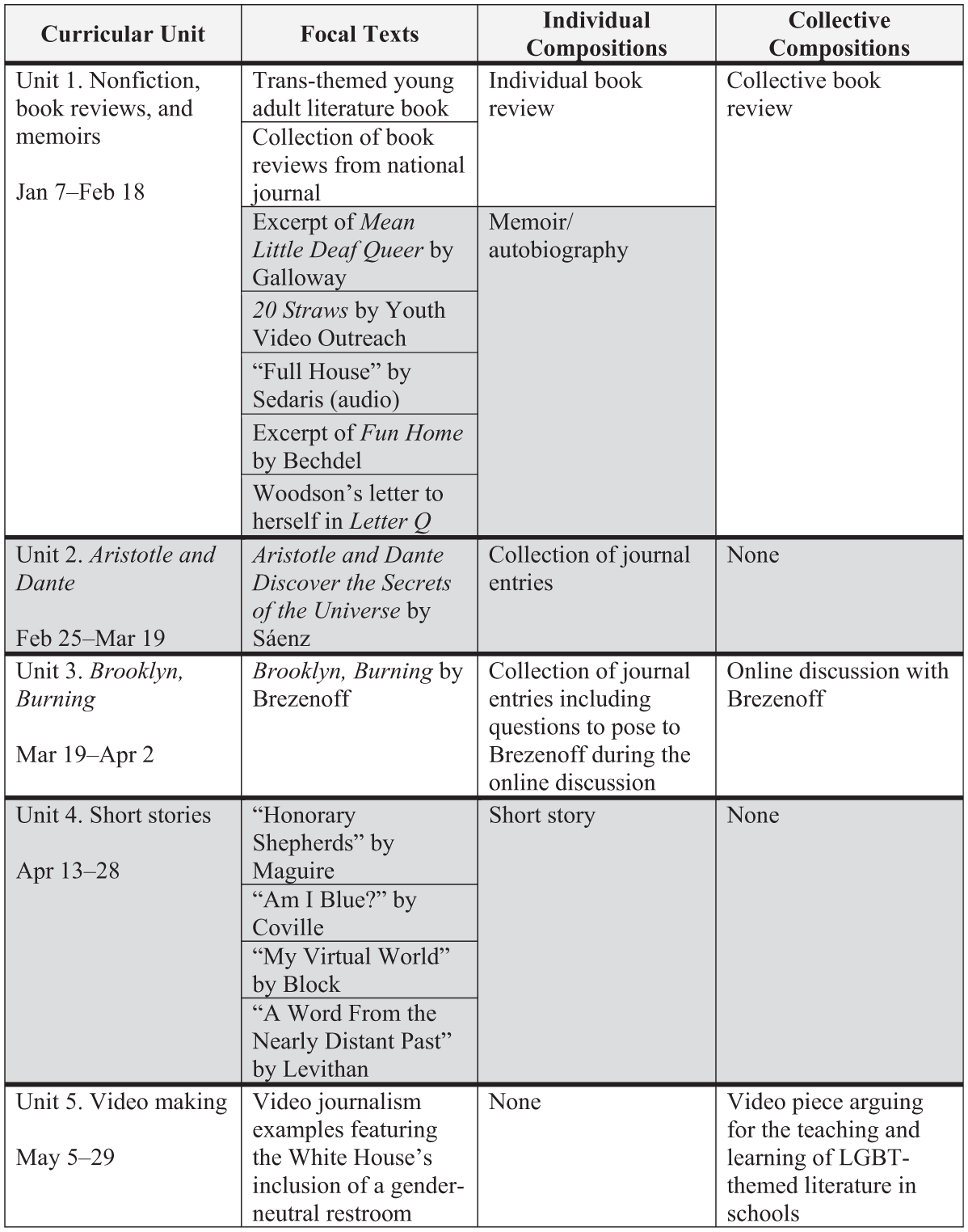
Overview of the curriculum of the Lesbian, Gay, Bisexual, Trans, and Queer-themed literature course.
Research
We approached this study through blending research methodologies, specifically ethnography and teacher research, a situation reflecting our different roles. Both of us are interested in the social and cultural practices around literacy, and so we draw on ethnographic approaches (Heath & Street, 2008). However, our roles in the classroom looked different. Mollie had designed the study, and she took primary responsibility for teaching the course, taking more of a practitioner inquiry stance (Cochran-Smith & Lytle, 2009). She had invited Ryan, who was her advisee in a university doctoral program, to join her, serving as a research apprentice. He typically foregrounded an ethnographic participant observer role. Both of us had previously worked together in a teacher inquiry group focused on combatting homophobia, heterosexism, and transphobia (see Blackburn et al., 2010), and so we understood that the study was not only about observing and documenting but also about our shared commitment to cultivating schools where LGBTQ people can learn, flourish, and contribute to the enrichment of others. In keeping with Blommaert and Jie’s (2010) notion of ethnography as “necessarily critical and counter-hegemonic,” with its primary purpose being to challenge hegemonies (p. 10), we were concerned with oppressive power relations. We sought to interrogate, disrupt, and transform inequalities, even if only in small ways with a small group of people for brief moments. Mollie, who identifies as a white queer cis woman, and Ryan, who identifies as a white straight cis man, approached this study seeking to work in solidarity with people who experience oppression.
During our coteaching and coresearching, both of us typically attended and participated in each class session, after which Ryan wrote field notes. We collected classroom documents, keeping track of curricular materials and lesson plans along with gathering all student-produced compositions. During the second month of the class, we began video- and audio-recording each session, selecting key strips of talk and submitting these segments to a transcription company after the school year ended. All 70 days were documented, 37 of them video-recorded, and another nine audio-recorded. We also collected classroom documents, including all of the texts listed in the second column of Figure 1; the curricular materials designed to explore these texts; and student work, which is listed in the third and fourth columns of Figure 1. In addition, we conducted semistructured entrance interviews with the 13 student participants and eight exit interviews.
For this project, in particular, we used structural coding (Saldaña, 2016) to identify three focal compositions that (a) involved collaborative rather than individual composition and (b) were for a public audience, not only beyond the classroom, but also beyond the school. We then identified all data—field notes, video- and audio-recordings, transcripts, and documents—related to each focal composition. These data comprised 12 video-recordings of class meetings, nine audio-recordings of class meetings, and field notes of those class meetings as well as 15 others. Of these recordings, 170 minutes and 2 seconds were transcribed. The data also included documents such as students’ individual book reviews, all of the drafts of the class’s collective book review, journal entries in response to Brooklyn, Burning, and the student-produced video.
With the larger set of data, we recursively reviewed the data via a constant comparative approach (Heath & Street, 2008), drafted analytic memos, and engaged in research conversations. In a team of two, this meant that we typically read the data individually, noting themes. Then, we came together to discuss these themes and the related data. Through our discussion, our understandings of the themes evolved. Some themes fell apart, some merged together, some became more precise, some gave way to codes. Then, we wrote analytic memos individually. These were sometimes focused on themes and other times on codes and still other times on categories of codes. We shared, read, and discussed these memos, and our understandings continued to grow. As is typical in ethnographic research, this analytic process was much messier and much less linear than this description conveys; still, it was systematic and intentional.
Emergent codes included identity markers such as race, class, sexuality, religion, and immigration status as well as themes such as family, violence, internalized hatred, and vulnerability, although family and vulnerability came to the fore later in the analytic process. These codes were visible within the subset of data central to this project. They did not propel this project but informed it. For example, our codes pertinent to identity markers, most clearly race, challenged us to pay attention to power dynamics shaped by race and racism. Similarly, our thematic code that focused on vulnerability was featured prominently in the subset of data for this project. They influenced our thinking as we studied the subset of data and wrote analytic vignettes (Miles, Huberman, & Saldaña, 2014) for each focal composition.
What drew our attention, initially, as we analyzed the subset of data for this project were the dynamics of collaborative composing, such as how we as teachers structured composing, how students responded, and constraints everyone encountered. Each of these concepts broke down into more specific observations. We examined, planned, and improvised teacher actions. Responses broke down into acceptance, rejection, and ambivalence. Constraints broke down into limitations of knowledge and time. Through ongoing constant comparative analysis and an effort to synthesize first cycle codes into broader analytic themes (Saldaña, 2016), we arrived at the centrality of shared dimensions of collaborative composing, focusing on shared vulnerability, which is most pronounced in our findings as we elected to examine the interrogation and reification of oppressive values. This examination, at times, required more fine-grained linguistic analysis as we paid attention to the linguistic forms and functions of utterances (Bloome, Carter, Christian, Otto, & Shuart-Faris, 2004), even sounds and pronunciation in some instances (Smitherman, 1977). As detailed in our section “Findings,” we did so when these linguistic features became salient for understanding the social actions accomplished by people in the classroom.
Limitations
Some limitations are defined by the study’s design. Ethnographies, while stellar at providing complexity and nuance, do not even strive for generalizability. This is also true for teacher research. Furthermore, teacher research is tied tightly to the focal pedagogy and curriculum, as it is in this study, and pedagogy and curriculum are, ideally, deeply human and, therefore, never uniform, much less perfect. This is the nature of documenting practice. So, the accounts we share are not images of perfect teaching. They are just teaching; real teaching, shaped by innumerable decisions made in split seconds among a group of adolescents within the constraints of the institution of schooling, including that teachers have power over students, if for no other reason than they assign students grades. So, there were times that as teachers, our planned action underscored the power differential. It was not our intention, but it was the reality.
Teacher research is also tied tightly to the focal students. Ideally, the class would have been more racially and ethnically diverse, at least as diverse as the school’s student body. This simply was not the case. Although we do not know why, we suspect that because students registering for the class knew nothing about it beyond the title, they assumed that it would center around white people, based on the stereotype of being gay being a white thing, thus, discouraging students of color from registering for the course. Although the subsequent offerings of the course were increasingly diverse in terms of race, the racial and ethnic homogeneity of this class is an absolute shortcoming of the study.
We also recognize that our analytic choice to focus on shared vulnerability in this manuscript has precluded an exploration of other dimensions of collaborative composition, and we encourage other scholars to extend our work by taking up other concerns. For instance, literacy scholars (e.g., Carter, 2007; L. P. Johnson, 2017; Schultz, 2009) remind us of the importance, and polyvalence, of silence, and we wonder about the dynamics of silence in collaborative, as opposed to individual, composition. We also wonder about teachers’ pedagogical and curricular practices and advocate for future research that explores how teachers might carefully negotiate vulnerability to sustain group and individual empowerment within the context of collaborative composition.
Vulnerability in Relation to Oppressive Values
Because our data collection was comprehensive with respect to the class, and our analysis was shaped by our conceptual interests rather than by one or more students, for example, it cannot be argued that this project is a case study. That said, the bulk of our findings, specifically the focal vignettes, concentrate on a single student, Oakley, and one of the three focal compositions, the book review. Both the student and the composition represent larger patterns in the subset of data.
We elected to focus on one student because of our commitment to represent students with nuance. In doing so, we can give enough background on her to represent her with complexity. This cannot be accomplished with three different students in an article-length report. We selected Oakley, in particular, because of her linguistic sophistication and experiential knowledge of LGBTQ communities. Oakley was a talker, a reader, and a writer; moreover, she was queer. When she spoke, her contributions were often developed, but just as important, they were taken up by her classmates. So, while others responded similarly to teacher invitations, as we saw in our analysis, her responses vividly illustrate what we are trying to get at in a way people outside of the classroom, indeed, readers of this manuscript, might be able to get their heads around without too much contextualizing.
Similarly, our findings focus on one of the three compositions: writing a book review. Our focus allows us to keep the curricular context consistent so that we can better illustrate how Oakley navigated opportunities to interrogate oppressive values. Focusing on the book review gives us a broader range of data, because the review was written across the semester and among all of the students, unlike the conversation with the author, which took place mostly on a single day, and the video, which was composed by three students and us. Moreover, focusing on one composition and student allows a clearer picture of our (in)actions as teachers, as we, at times, shared vulnerability in acknowledging our collective responsibility for oppressive values, while at other times, we imposed individual vulnerability on Oakley, refusing to recognize our own culpability in structures of domination. Therefore, we present three vignettes featuring Oakley focused on the book review that illustrate broader themes and findings of our analysis.
The first vignette illustrates when students interrogated oppressive values in the context of collaborative composition for a public audience. The second vignette illustrates when students were ambivalent about engaging in such work, and the third vignette illustrates when students reified oppressive values as they composed collaboratively for a public audience. Across all three vignettes, we examine the role of vulnerability, particularly whether it is imposed on an individual or assumed by a collective and the related consequences in terms of interrogating oppressive values.
Interrogation of Oppressive Values
The first focal vignette happened toward the end of the school year, and a small group of us—three students and two teachers—were working on revising the book review. All of us identified as white; the adults identified as cisgender, one of the students identified as trans, and the other two students were exploring pronouns and names in relation to gender. Both of the students who were exploring pronouns and names are represented as young women in this article, as that is how they both identified most recently. 2 This vignette builds on the initial time the class discussed the collective draft, where Mollie read a line that Oakley wrote, “[The author], then, politely punches readers in the face with the next few stories.” In response, Oakley smiled and nodded, proudly.
A few days later, outside of class, Mollie and Ryan talked about aspects of the review that concerned them. Ryan, in particular, did not like Oakley’s line about the author “punching [readers] in the face.” Based on this conversation and the previous class discussion of the review, Mollie revised and brought it back to the class, this time a small group. She shared the revision with two parts highlighted, one of which focused on Ryan’s concern. Mollie explained, “I need help.” After discussing the first highlighted part, the group addressed Ryan’s concern:
There’s also the question of whether we want the “punches” in the chapters that start with violence.
Yeah.
That [is,] are we helping to convey the violence?
Ah, yeah.
Or are we reifying the violence? Or what are we doing about that?
I was worried about that. Especially if we want to show that trans teens don’t just live lives of violence. To kind of use that metaphor kind of felt uncomfortable for me. But I didn’t know what you two would think.
Yeah. Get rid of it.
Yeah.
Oakley accepted our invitation, first by saying, “Ah, yeah,” suggesting that she understood, and then more firmly, “Yeah. Get rid of it,” conveying her support for the change. Her acceptance was affirmed by her friend Simon. And, thus, the revision was made.
Here, Mollie and Ryan planned together to create an opportunity for Oakley to consider the ways we might reify stereotypes about the lives of trans youth by using the metaphor of punching someone. The two of us had noticed the line, reflected on our own, and discussed it together. This time for reflection helped us better plan our actions and improvise in the moment as we shared our concerns with the students. The potential of reifying oppression was stated explicitly by Mollie and described by Ryan. In doing so, we as teachers did not only invite an interrogation of potential misrepresentations of trans youth by naming it but also offered an explanation of the consequences, that we might be “helping to convey the violence,” and gestured toward alternative possibilities, that we might “want to show that trans teens don’t just live lives of violence,” a move that pointed toward not only the collaborative nature of our writing but also a future public audience. Through this invitation, the two of us took up our shared vulnerability in relation to the broader public audience. Rather than the conversation ending without explicitly naming the oppressive values or with people agreeing to disagree, the discussion continued. This sustained interrogation was fostered by our class’s shared knowledge and history. We had been talking about gender and sexuality all semester, so students were experienced with engaging in such conversations. Moreover, Simon, Oakley’s very close friend and a young trans man, was in the class. Therefore, Oakley had a personal motivation for addressing oppressive values surrounding gender identities. As such, as a collective, we recognized our vulnerability as authors writing for a public audience and together interrogated oppressive values related to cisnormativity.
Ambivalence Toward Oppressive Values
The second focal vignette took place several weeks before the first, when the class was working on the first collective draft of the review. The entire class was there, and Oakley referenced this section of the document: [Kris] is the first, although not last, young person featured in the book who, as we read it, is white and from a more suburban context. As such, [Kris] seems to enjoy more privileges. This is, we imagine, not unrelated to their excitement about life, their positive perspective on being trans*, and perhaps even their fluid identification.
In referencing this section, Oakley said aloud to the group, I think we’ve gone about it a different way without talking about race. . . . I think more of Kris’s privilege is focused around how easily they passed so they experienced male privilege earlier on in their transition, and it’s less about being a white teenage kid. It’s about how they look male so they enjoy male privilege.
Here, Oakley communicated that one of the focal people in the book, whom we call Kris, has many privileges, but the draft suggested their primary privilege was defined by race, which she thought was wrong. Instead, she explicitly named that Kris’s primary privilege was defined by sex and implicitly by gender. At this point in the conversation, there was a lack of individual vulnerability involved in presenting the critique. Because the idea named was part of the collective book review, no single person in the classroom “owned” or was responsible for the idea. Everyone in the room was an author of the idea, so they shared responsibility for it. When Oakley critiqued the idea, then, everyone in the group shared a portion of the risk.
Oakley then explained that she understood what whoever wrote it was trying to do, and Mollie stated that she wrote it. She went on to defend this portion and challenge Oakley’s thinking:
So you don’t think Kris’s experience is different from [the biracial woman’s experience] because of race?
[shaking her head no] I think it’s completely about passing.
Really. Wow. I totally don’t buy that. I don’t think that it is ever not about race. I’m willing to, um, I agree with that, Kris wouldn’t see it.
Through this interaction, Oakley considered the importance of masculine privilege, specifically cismasculine privilege, but rejected an opportunity to examine racial privilege, either on its own or as it intersects with cismasculinity (E. P. Johnson, 2016).
As Mollie and Oakley interacted, the dynamics of vulnerability began to shift as authorship became individual rather than collective. When Mollie identified herself as the writer and Oakley disagreed, the entire classroom group no longer together shared the risk as the written line was critiqued. Instead, the disagreement shifted so that Mollie and Oakley both faced risk as individuals if the group perceived one of them as individually supporting, enacting, and ultimately being responsible for oppressive values. In response to Mollie’s statement that she “totally d[id]n’t buy that,” several students laughed, suggesting discomfort. Based on this discussion, Mollie subsequently revised this section of the draft to read, [Kris] is the first young person featured in the book who, as we read it, is white and from a more suburban context. As such, they seems to enjoy more privileges. We appreciate how [Kris] interrogates male privilege when it is unwittingly bestowed upon them.
The revision downplayed the impact of privilege, acknowledged male privilege, but still named racial privilege. When Mollie later presented this revision to the class, Oakley accepted the draft, tacitly agreeing to naming racial privilege.
In this event, Mollie initiated an opportunity for Oakley, and for the class, to think about racial privilege by naming Kris’s white privilege in the first draft of the review. This teacherly action was explicit and planned but without an explanation of the way racial privilege operated or the significance of (not) discussing it. Oakley took up the opportunity by disagreeing. However, both Oakley and Mollie explicitly named and briefly explored racial power dynamics. They did so in the context of shared vulnerability, where the class was collectively responsible for the ideas about race and gender. However, when this situation shifted, and Mollie and Oakley became individually responsible for competing ideas, the conversation ended. The class did not sustain a collective interrogation of racial and (cis)gender privilege or relationships between these two. Mollie attempted to continue the discussion by contrasting Kris’s experience with another of a biracial trans woman, but Oakley then rejected the comparison by restating, rather than reexamining, her position. Through this unfolding interaction, responsibility, including the responsibility for structural racism and white supremacy, became individualized rather than shared, which resulted in vulnerability being individual and imposed on Oakley rather than shared and embraced by all. When Mollie subsequently revised the review in a way that suggested a compromise—that is, by continuing to foreground privilege and to name racial privilege, but doing so more subtly—Oakley accepted the revision. Perhaps she just did not notice the section, perhaps she noticed it and did not feel like talking about it again, or perhaps she came to agree with it. Whatever the case, we characterize her response as ambivalent and relate this ambivalence to shifting vulnerability from a group to an individual.
Reification of Oppressive Values
The third focal vignette happened during the same class period as the first, just a brief time after. We were trying to figure out how to write about a teen in the book who uses they/them/their pronouns. Mollie asked, “Is it ‘they are’ or ‘they is’?” Oakley quickly answered, “Are.” Ryan was more tentative, saying, “Well, if we are going to be consistent, it should be ‘they is.’” Mollie and Ryan agreed that it did not sound right, but Oakley was adamant, insisting, “We can’t do that,” meaning the group could not use “they is” in the review. Oakley went on to mock the use of “they is,” once using an initial /th/ sound and then immediately repeating the phrase by using an initial /d/ sound, saying, “Dey is.” Her repetition of the phrase with the sound change underscored the contrast. She then mocked the phrase a third time again using the initial /d/ sound, stating, “The teen suggests dey is asexual.” In the moment, everyone laughed. Mollie then questioned Oakley, admittedly sarcastically, asking, “Really?” Oakley responded by reasserting the impossibility of writing “they is.” Within a few moments, Ryan reframed the question to be about grammatical consistency, first on the grounds of being consistent with a later sentence that used “they was” and “they is,” and then by saying, “I want to make the move to use the singular verb,” suggesting it would be more respectful of the person’s gender identity. Oakley then pushed back, too, saying, “No! . . . I’m not signing the permission slip, then,” and then, “My name ain’t going on this thing,” suggesting that she would not be willing to share responsibility for authoring the phrase in a publicly read book review. The group laughed, and Ryan and Mollie teasingly commented on the irony of her use of “ain’t” while criticizing the use of “they is.”
I love that you use the word “ain’t.”
Yes.
Me, too. That was cracking me up.
Again, the group laughed. Mollie was uncomfortable and ended the conversation by suggesting that the group move on to other parts of revising and agreeing to ask the editor about this issue. She said, “I want to honor the identity, and I’m just struggling there. . . . And it might be that our editor is more practiced at this and able to help.” (Mollie asked the editor, and the editor agreed with Oakley’s choice of verb conjugation.)
The assertion that we should have used “they are” instead of “they is” was most vehemently articulated by Oakley but implied by most, if not all, of us through our laughter and our statements about “they is” sounding “[not] right,” “terrible,” “awful,” and “clunky.” One could understand this assertion as racist in that a language structure associated with African American language—that is, where verbs are not necessarily marked such that they agree with the number of the corresponding subject (Smitherman, 1977)—is characterized in pejorative terms. The mockery, though, was unequivocally racist. In shifting from an initial /th/ to /d/ sound, Oakley stereotypically employed a pronunciation associated with African American language, thus, criticizing such speakers. The resulting laughter, too, could be understood as racist. We cannot tell whether the laughter pointed toward amusement or nervousness—likely some of both—but, regardless, it did not challenge the racist performance.
Let us be clear: We do not think Oakley had any conscious idea that her actions would be understood as racist. And we are not sure any of us—students and teachers—in the moment recognized what we were doing as racist. We—the authors—knew we were uncomfortable, and, thus, recall our laughter as nervous laughter, but it was only in the figuring out how to represent the different articulations of “they” in our transcript that we came to understand the racism, a delayed understanding undoubtedly rooted in our whiteness and dominant American English monolingualism.
In the moment, we were improvising but unable to formulate a direct and explicit response to open up dialogue so that Oakley and the rest of us could interrogate the racism we collectively enacted. Mollie tried to interrupt Oakley’s performance with a brief, “Really?” Ryan tried distraction by raising the issue of grammatical consistency. Both of us tried to squelch the performance by teasing Oakley about her use of “ain’t.” At best, our actions, as teachers, might be seen as indirect and subtle attempts to move toward interrogation, but we floundered and failed. Rather than questioning the group’s collective laughter as racist or exploring the ideologies embedded in language—whether in pronunciations or verb conjugation—and enacted by each one of us, the two of us focused on Oakley’s actions individually, refusing to share responsibility with her in the moment and, thus, rejecting, rather than taking up, vulnerability. We, instead, imposed it on Oakley. And rather than continuing along the same lines in the conversation, Mollie chose to close it down.
Discussion
In the first vignette, we as a class drew upon the unique affordances of collaborative composition to interrogate oppressive values through sharing vulnerability. As teachers who were composing alongside the students, we framed the conversation to be about everyone’s collective responsibility for the ideas in the book review. We, thus, shared vulnerability with students as we implied that all of us experienced risk if a public audience read the piece and questioned the use of metaphors of physical violence as potentially transphobic. The discussion focused on the broader structural oppression of trans youth and how all of us in the classroom might contribute to or interrupt these patterns. As teachers, we were clear and direct about our perspectives, explaining our rationale and offering a concrete way students could collaborate with us in challenging oppressive values. In this small moment, the two of us trusted students enough as we were uncertain about how they would respond, but they reciprocated our actions and also embraced vulnerability. By seeking to humanize trans youth by representing their lives beyond violence, we also humanized one another in the classroom interactions, composing different ways of being in relation to one another and the world.
Admittedly, this interaction might also be read as two students complying with the intellectual and institutional authority of two adult teachers. Undoubtedly, these power relations were at play; there is no way they could not be. Yet, across the semester, indeed, even across the three vignettes, our authority did not necessarily result in students accepting or agreeing with our statements. They often exerted their agency, frequently publicly disagreeing with the two of us and one another. While, of course, teachers can engage in “power over” students that reinforces harm and deepens oppression, we believe that there are also possibilities for people to enact “power with” (Kreisberg, 1992), where “power is viewed as having the potential to bring people together for mutual benefit, both with regard to social relationships and with regard to other accomplishments” (Bloome et al., 2004, p. 165). By sharing responsibility for the consequences of our compositions and sharing vulnerability with students as coauthors, we believe that we were able, in small moments and in small ways, to participate in power with students, such that we interrogated transphobia.
However, these results were far from consistent, and so these possibilities were unstable. In the second vignette, the dynamics were similar in some ways to the first, at least in the beginning. As students and teachers, we collectively shared responsibility for the ideas of the composition, which provided an opportunity for the group to consider the intersection of cissexism and racism. Yet, as teachers, we offered less clarity about the ways these intersections had consequences in people’s lives and even less clarity about what students might do in response to these oppressions. Furthermore, partway through the interaction, our shared vulnerability broke down. Instead of all of us drawing on the resource of the collective nature of our composing and, thus, our interdependency, we shifted toward individual responsibility for ideas. When Mollie and Oakley had individually claimed oppositional beliefs, shared vulnerability no longer existed. Instead, it was individual, with Oakley encountering greater risk. The significance of the public audience for our composition collapsed as the immediate interpersonal conflict coalesced, intensifying Oakley’s vulnerability.
In the third vignette, there was not even the ambivalence of the second. Instead, as a group, we reified oppressive values, particularly anti-Black racism, white supremacy, and cissexism. While, in some ways, this interaction began with teacher-initiated opportunities to examine oppressive values, specifically the cissexism of dominant American English, it quickly changed to also be about anti-Black racism enacted through pronunciation. However, at no point did we, as teachers, attempt to frame these dynamics around our collective collusion in racism. Instead, we remained indirect and implicit, at best, and mostly silent. Oakley was implicitly positioned as solely responsible for the racism of the group. When there was no shared vulnerability, we as a classroom group imposed vulnerability on a single student and, as a result, reified rather than interrogated these values. We foregrounded individual dynamics rather than the affordances of collectivity offered through collaborative composing, and we, thus, dehumanized ourselves and other people.
Conclusion
Collaborative composition for public audiences by students and teachers in an LGBTQ literature course provided opportunities for interrogating oppressive values, such as cissexism and racism. Whether those opportunities were taken up, though, depended on whether vulnerability was shared by the group or imposed on an individual. When it was shared by the group, vulnerability was embraced, and oppressive values were effectively interrogated. When vulnerability was imposed on an individual in the group, oppressive values were reified, not only by the individual but by other people in the group. When vulnerability shifted from the group to an individual, there was ambivalence toward the work of interrogating and reifying oppressive values.
Of course, the particular nature of the oppressive values matters. When we were talking about cissexism, we embraced collective vulnerability and interrogated oppressive values. Not only was the class designed to do this work and students opted to take this course with that in mind, but there were also people in the class who outwardly claimed non-cis identities. However, when we were talking about racism, we imposed vulnerability on a single student and, as a result, oppressive values were reified. This was not a class about race and racism that students elected to take, and almost everyone in the class claimed a white identity. In other words, both students and teachers were more prepared to discuss cissexism than racism. In fact, when Mollie initiated a discussion about racial privilege, the conversation was definitively changed, by students, to be about gender privilege instead. And, when she tried to attend to racism in a discussion initially focused on cissexism, she failed.
If, however, our practice has been guided by the notion of shared vulnerability, as we propose here, the conversation might have unfolded differently. If we had been less focused on distancing ourselves from the racism our students conveyed and more deliberate about connecting to it in an effort to interrogate it, then perhaps we, teachers and students, could have interrogated it together, rather than, as it turned out, reifying it together. We propose that teachers and students need to assume vulnerability together as they interrogate oppressive values and that collaborative composition for public audiences creates a unique opportunity for doing so because it requires shared vulnerability in terms of the ways their ideas might get taken up, or not, by those who read them. This is important to writers. But collaborative composition for public audiences that interrogates oppressive values requires shared vulnerability around issues of equity and diversity, and the importance of this work goes far beyond the writers.
Supplemental Material
Supplemental_Material_784336 – Supplemental material for Shared Vulnerability, Collaborative Composition, and the Interrogation and Reification of Oppressive Values in a High School LGBTQ-Themed Literature Course
Supplemental material, Supplemental_Material_784336 for Shared Vulnerability, Collaborative Composition, and the Interrogation and Reification of Oppressive Values in a High School LGBTQ-Themed Literature Course by Mollie V. Blackburn and Ryan Schey in Journal of Literacy Research
Footnotes
Acknowledgements
We would like to thank the youth who enrolled in the Lesbian, Gay, Bisexual, Transgender, Queer (LGBTQ)-themed literature course, particularly Oakley and Simon. It was a gift to learn from and with them as they were generous to share part of their lives with us. We are grateful to the adults who worked at the high school, especially the founder who created the space, the principal who facilitated the course offering, and the teacher who shared his classroom. Finally, we thank the editors and reviewers for their thoughtful feedback.
Declaration of Conflicting Interests
The authors declared no potential conflicts of interest with respect to the research, authorship, and/or publication of this article.
Funding
The author(s) disclosed receipt of the following financial support for the research, authorship, and/or publication of this article: The authors thank the Conference on English Education of the National Council of Teachers of English for their financial support for this project.
Notes
References
Supplementary Material
Please find the following supplemental material available below.
For Open Access articles published under a Creative Commons License, all supplemental material carries the same license as the article it is associated with.
For non-Open Access articles published, all supplemental material carries a non-exclusive license, and permission requests for re-use of supplemental material or any part of supplemental material shall be sent directly to the copyright owner as specified in the copyright notice associated with the article.
