




Abstract
This study explores how two high school English language arts (ELA) teachers leveraged disciplinary literacy practices in their classrooms to help students explore their identities as citizens and imagine a more just and equitable democratic society. Using a figured worlds framework, the study articulates a sociocritical approach to civic literacy learning that challenges neoliberal constructions of citizenship and literacy and situates ELA classes as crucial sites of civic education. Findings demonstrate how the intersection of teacher and student identities, literacy practices, and learning contexts create distinct classroom civic worlds in which civic dreaming can take place and democratic praxis can be enacted. The authors suggest a need for the field of ELA to consider the intersections of race, literacy, and citizenship to challenge social inequities through classroom learning.
US public schools have long been conceptualized as sites where young people learn about and prepare to shoulder the rights and responsibilities of citizenship (McDonnell, Timpane, & Benjamin, 2000). School mission statements and the broader policy discourse often rhetorically define classrooms as microcosms of democracy in which all learning is oriented toward the larger purpose of supporting the values and practices of shared public life (Dewey, 1916).
Yet, schools today often fail to embody this expansive vision of civic learning. Civics has largely been reduced to a discrete subject area, the responsibility for which is delegated to social studies teachers alone (Education Commission of the States, 2016). Other subjects are not explicitly characterized as contexts for civic education; this includes English language arts (ELA), even though literacy is necessary for engaging in civic behaviors, from learning about candidates who are pursuing elected office to staying informed about current events or organizing local volunteer efforts. Although the term civic literacy is used in mainstream civic education discourse, it is narrowly defined as knowledge about how the political process works and the skills to navigate it rather than as inclusive of any practices related to the discipline of literacy itself (Partnership for 21st Century Learning, 2013).
Of course, this does not mean that all teachers across every subject area are not transmitting messages about democratic life to their students—only that they have not been encouraged to actively consider the civic values and practices they are enacting in their classrooms. We suggest that becoming more conscious of these values and practices is crucial for two reasons. First, the prevalence of systemic structural inequities across public life exposes the unfulfilled promise of democracy for minoritized communities and demands redress (Alexander, 2010). Second, we are experiencing a moment at which educators are awakening to the unavoidable relationship between schooling and political life. A survey of 10,000 educators from across the country conducted by the Southern Poverty Law Center (2016) in the wake of the 2016 presidential election revealed that schools are experiencing a significant uptick in “incidents of bigotry and harassment that can be directly tied to election rhetoric” (p. 1) and that students—particularly those from minoritized groups affected by the Trump administration’s policy platform—are coming to class with heightened levels of anxiety and fear. News outlets and community activists have been disseminating resources that teachers can use to tackle current events they predict students will be asking about in class. Schools are becoming active sites of protest in the wake of recent campus shootings.
This “new normal” in classrooms complicates the commitment to objectivity and political neutrality that many school districts desire (and require) from teachers for fear of wading into controversial waters or unduly influencing students’ political views (Journell, 2016). In our work, we reject the possibility of neutrality, arguing that teaching is an inherently political act in which messages about what it means to be a “good citizen” are consistently being negotiated through choices in curriculum and instruction (Nieto, 2006).
To illuminate how this negotiation occurs specifically within the context of literacy instruction, this article analyzes the democratic landscapes that two high school English teachers (co-authors Jerica Coffey and Ashley Englander) consciously co-created with the students in their classrooms. By tracing the understandings about public life that these teachers co-constructed through explicit and implicit literacy practices, this study demonstrates how ELA educators can become more conscious of the messages they are sending in their classrooms and take agency in considering the kind of society they are helping students to imagine. We suggest that encouraging ELA teachers to interrogate the figured worlds of citizenship that they create through their everyday disciplinary practices could be just as transformative as any discrete civic learning opportunity at countering the deficit narratives about youth civic life, particularly for youth from minoritized communities.
In doing so, we articulate a sociocritical approach to civic literacy learning. Building upon Gutierrez’s (2008) concept of sociocritical literacy, this approach situates citizenship and literacy not as static bodies of knowledge and skills but as social practices influenced by cultural and historical contexts and oriented toward equity and justice. We advocate for a reimagining of ELA as a crucial form of civic education in which shared literacy practices serve as the foundation for the construction of collective democratic social futures (New London Group, 1996). Our approach does not seek to integrate specific civics programs into ELA classes or develop stand-alone “civics” units, but instead seeks to construct everyday disciplinary understandings of literacy education (Smagorinsky, 2015) that are inextricably linked to the enactment of democratic citizenship. We build upon the epistemological commitments of participatory design research by imagining learning environments in which students are positioned as civic agents of change who can transform society through their literacy skills (Bang & Vossoughi, 2016).
We begin by introducing the concepts of figured worlds (Holland, Lachicotte, Skinner, & Cain, 1998) and social dreaming (Freire, 1970) to operationalize Dewey’s charge to enact democracy in the realm of literacy research. We briefly discuss how the default messages transmitted by US schools about citizenship and literacy are influenced by neoliberal ideology. We then offer the new framework of sociocritical civic literacy to structure our empirical investigation of two teachers’ classroom practices.
Figured Worlds of Citizenship and Literacy in Classrooms
The idea of enacting realities has been translated into an analytic research tool through the concept of figured worlds. Holland et al. (1998) suggest that as we move through different social contexts, we inhabit various cultural “worlds” structured by particular ways of knowing and being. Within these figured worlds, participants take on particular roles and develop common understandings about contested concepts—including what it means to be literate or what it means to be a good citizen. Language plays a particularly important role in figured worlds as participants collectively create “narratives about individuals that are reifying, endorsable, and significant” (Sfard & Prusak, 2005, p. 16).
Within the figured worlds of classrooms, teachers play particularly important roles in structuring valued understandings and identities for their students. They facilitate the practices and purposes of these worlds through the interaction between their personal histories and beliefs, institutional contexts, and relationships with colleagues and students (Avraamidou, 2016). These figured worlds transmit meaning on multiple levels. Most explicitly, they construct disciplinary habits of mind about what it means, for example, to “think like a scientist” (Price & McNeill, 2013). They also operate on a slightly more implicit level by setting parameters about what it means to be intelligent or to be a “good student” in general (Rubin, 2007). And, at their deepest level, classroom figured worlds offer visions of what it means to live in a democracy and be a “good citizen.” Mayes, Mitra, and Serriere (2016) detailed the discursive practices and instructional strategies one elementary school social studies teacher used to define citizenship as “making a difference in the world” (p. 617), as well as the ways students embraced or resisted this definition through their behaviors and assignments.
The figured worlds of classrooms are also influenced by broader discourses that teachers consciously or unconsciously respond to through their practice. We first explore neoliberal discourse and then offer sociocritical civic literacy learning as an alternative framework for ELA.
The Neoliberal World of Civic Literacy Learning
Neoliberalism, which seeks to spread free market values through public institutions by equating personal agency with human capital development and promoting consumer choice, is especially prevalent across today’s educational landscape (Harvey, 2007). Carlos Torres (2011) asserts that neoliberalism has become the new “common sense” of postsecondary education (p. 183) as universities tailor their mission to boosting student competitiveness in a globalized economy. This “common sense” has trickled down into the K-12 sector through a focus on college and career readiness; David Hursh (2007) argues that neoliberal ideas have manifested themselves in education policy through discourse connecting schooling to economic success (or failure) and the use of “21st-century skills” rhetoric as a rationale for implementing reforms focusing on job preparation and “back to basics” approaches.
Neoliberal ideology impacts how civic education and literacy are conceptualized in schools. In terms of civic education, it casts good citizenship in economic terms. Joel Westheimer and Joseph Kahne (2004) dub this a “personally responsible” vision of citizenship, which largely involves embodying politically neutral personality traits such as honesty and responsible work and consumer habits while eschewing more collective or political forms of engagement. Civic standards largely offer encyclopedic coverage of details about government structures and focus on patriotic, triumphalist narratives that ignore the experiences of minoritized communities and “do not connect to their own identities as citizens” (Torney-Purta & Vermeer, 2006, p. 14).
ELA education is also cast in economic terms. In their review of 11 adolescent literacy reports, Faggella-Luby, Ware, and Capozzoli (2009) found that policy makers consistently focus reforms on isolated academic reading and writing skills aimed only toward preparing students for postsecondary school and work. Gutierrez (2009) argued that these policies fail to provide students with the literacy resources they need to become “globally competent citizens” (p. 477) and underutilize the language and literacy resources of students from minoritized communities. In his discussion of the core tenets of disciplinary literacy in ELA, Smagorinsky (2015) reminds us that traditional understandings of reading, writing, listening, and speaking must evolve to foster communication in a changing society. He defines disciplinary literacy in ELA as the curricular strands of composition (historically writing but now extended to include other semiotic sign systems), reading (historically, literature, although including other culturally important texts), and language (historically, conventional grammar instruction but now . . . with attention to linguistic diversity). (p. 143)
A sociocritical approach supports the evolution of civic and literacy learning in ways that embrace new expressive forms and diverse perspectives.
Dreaming of a Sociocritical Civic Literacy Framework
Gutierrez’s (2008) concept of sociocritical literacy represents the intersection of sociocultural and critical theories of literacy learning. Sociocultural theory is grounded in the premise that learning occurs through interactions at multiple, mutually constitutive levels—the personal, interpersonal, and institutional—amid particular social and historical contexts (Vygotsky, 1978). The concept of cultural practice captures the mediated, situational nature of learning within overlapping communities and activity systems (Engestrom, 2001). This theory rejects a “one size fits all” approach to instruction that fails to consider crucial differences in who students are, how they learn, or the contexts in which they are learning. Since these contexts are oftentimes unequal, the influence of critical theories (e.g., critical race theory, feminism, post-colonialism) encourages analyses of power, privileges the experiences of youth from minoritized communities, and advocates for equity and social justice.
We extend Gutierrez’s concept and offer the framework of sociocritical civic literacy to counter the aforementioned normative idea that civic literacy simply involves a functional understanding of traditional civic structures. Sociocritical civic literacy insists upon considerations of identity, contexts, and practices when defining civic engagement, as well as analyses of structural barriers to an equitable civic life. Enactment of sociocritical civic literacy requires a rejection of the neoliberal model of citizenship in favor of a justice-oriented one.
To construct figured classroom worlds that counter neoliberal understandings of civic literacy learning, teachers and students must be able to imagine alternatives that take into account issues of equity and power. Particularly important for our study is the Freirian concept of social dreaming (Freire, 1970). Freire argued that literacy learning involves not only reading the word (i.e., academic literacy) but also reading the world via critical social analysis. When students and teachers collaboratively engage in literacy praxis of reflection and action, they both read the world as it is and imagine a new and more just world into existence. From this perspective, literacy has a key role to play in civic development not as a functional tool, but as a discipline that encourages dreaming about potential democratic futures. Indeed, Maxine Greene (2000) argued that literacy and the arts have the power to release the “social imagination,” the ability to “invent visions of what should be and what might be in our deficient society” (p. 5). In this study, we modify “social dreaming” to “civic dreaming” to focus explicitly on applications to democratic community life.
Researchers and educators who we believe engage in sociocritical civic literacy learning with young people often turn to literacy practices that encourage counter-storytelling (Yosso, 2006) about the ways their experiences differ from what is considered the norm. These include photovoice (de los Rios, 2017), community organizing (Kirshner, 2015), and youth participatory action research (YPAR) (Mirra, Garcia, & Morrell, 2015). These practices are grounded in the tenets of sociocritical literacy, which views literacy as both a set of academic skills and as the use of language to analyze societal power structures, author personal and civic selves, and construct shared visions for democratic life (Morrell, 2008). This both/and construction of sociocritical literacy learning is key because it speaks to the way that the core tenets of disciplinary literacy are integral to the approach; while involving community resources and activities not traditionally associated with “schooling” is important, the very foundations of ELA give us the tools we need.
We turn now to a description of how we applied a sociocritical civic literacy approach to the study of classroom disciplinary literacy practice.
Method
All aspects of this study’s methodology, from the development of the research questions to the collection of data, drew upon the figured worlds concept.
Research Questions and Orientation
This study was grounded in a critical ethnographic framework focused on the in-depth, qualitative study of cultural practices that consider issues of power, inequality, and equitable social change (Carspecken, 1996). This frame was particularly suited to the study of civic literacy practices in the figured worlds of ELA classrooms because it allows researchers to focus on the shifting modalities of expression participants use and the identities they negotiate in the process (Heath & Street, 2008).
The research questions that we explored in this study included “How do students and teachers negotiate civic identities through shared engagement in everyday literacy classroom practice?” And, ““How do teachers’ civic experiences and attitudes relate to the civic literacy learning practices they introduce to their classrooms?”
Before presenting the data collection and analysis methods for the study, we first detail the context that brought the three of us together in this project.
Context and Participants
At the time that Nicole first conceived of this study, she coordinated a YPAR program that mentored high school students from five Los Angeles schools as they developed and conducted multimedia research projects to inform city decision makers about key educational challenges faced by their communities (Mirra et al., 2015). The program had a social justice orientation and operated from the premise that young people were the ones best positioned to contribute to discussions about ways to improve the schools they attended on a daily basis. Student participants attended a 6-week seminar over the summer in which they analyzed theories of critical pedagogy, community cultural wealth, and transformative resistance. The youth started projects that they would continue to work on in after-school and weekend meetings during the school year.
Students in the program, all of whom identified as Latinx or African American, told Nicole that they wished more of their teachers embodied the theories they learned about through YPAR. However, the students from Newton and McKinley high schools (schools and youth names are pseudonyms) repeatedly mentioned two teachers who they believed “got it”—Jerica and Ashley. Although not formal participants in the YPAR program, Jerica and Ashley were part of the informal network of teachers who helped students conduct their projects by participating in interviews or setting up visits to field sites. As a result, all three authors knew each other and had discussed teaching philosophies and commitments to civically engaged learning before Nicole decided to ask Jerica and Ashley to develop and participate in this study with her. Although the findings reported here largely draw from the ethnographic research of the teachers’ formal instruction, the origins of our relationship in student nomination and YPAR are important because they speak to the overlapping contexts that influenced the development of our co-researcher identities and to the commitments that shaped Jerica’s and Ashley’s classroom figured worlds.
Jerica, who hails from the San Francisco Bay Area and identifies as Chicana, had been teaching for 10 years at the time of the study (four years of them at Newton). She coordinated an after-school writing program and was active in a local teachers’ collective. She arrived at Newton as it was being transformed from a comprehensive traditional high school of 2,600 students to a collection of four academies run by a charter management organization. Overall, 65% of the student population was Latinx and 35% was African American. And, 60% of students qualified for free or reduced-price lunch and 29% were designated English language learners.
Ashley, a Los Angeles native who identifies as White, was in her sixth year of teaching at McKinley at the time of the study. She had just completed her administrative credential and managed grants for her learning academy in addition to teaching. McKinley, one of the oldest and largest high schools in Los Angeles, remained a comprehensive public high school, serving 4,700 students, nearly 100% of whom were Latinx. Overall, 80% of students qualified for free or reduced-price lunch and 36% were designated English language learners. A consistent target of reform efforts, McKinley had recently been restructured into seven small learning communities when the study began.
Key to the figured worlds framework is the concept of history-in-self, the idea that as individuals participate in various cultural contexts, the “sediment from past experiences” (Holland et al., 1998, p. 18) helps shape their actions and influence their perspectives. While experiences act upon individuals, individuals also possess agency to engage in self-authoring within figured worlds. Thus, we frame our positionalities as co-researchers in terms of our histories-in-self and acknowledge that these narratives serve as data alongside the classroom experiences we share.
Researcher Positionalities/Histories-in-Self
Nicole’s exploration of civic literacy learning was unavoidably influenced by her identity as a White, middle-class woman. Her racial and socioeconomic positioning placed her on the privileged side of the entrenched civic inequities that she was seeking to investigate alongside Jerica and Ashley. When she was a child, her parents moved the family from a city to the suburbs in search of well-resourced schools so that she could benefit from a high-quality public education (in the neoliberal sense), and she become the first in her family to attend college. Her story hews nicely to the dominant US civic narrative of success and progress; as a result, she needed to consistently deconstruct it from the sociocritical perspectives described above to uncover the many ways she benefited from privileges she inherited unearned as a result of her race and class. This interrogation occurred throughout the study as she sought to decenter dominant perceptions of civic identity and honor the practices and perspectives of Jerica and Ashley as co-researchers. She consistently engaged in methodological practices such as member-checking to ensure that the findings drawn from the data resonated with their views and experiences.
For Jerica, experiences of race and racism during her adolescence were formative to her developing understanding of herself as a citizen, teacher, and researcher. Her first high school was a very White space, in which she saw that students who looked like her were often not given opportunities to succeed; this made her feel unsafe and sparked a desire in her to learn more about race and culture. Chicana/o studies classes in college helped her understand the historical experience of her people and solidified her commitment to pursuing a politics of freedom and justice through becoming a teacher. During her first years of teaching, she joined communities that fostered her commitment to education as a means of collective empowerment, and she credited her relationships with students as informing her critical stance.
Jerica was drawn to literacy practice and research because she felt that ELA, compared with the discipline of social studies, was much more oriented toward the teaching of communication skills rather than particular facts and figures. She believed that ELA allowed her the freedom to work with students around texts and expressive forms that students would find empowering. This vision of literacy as a vehicle for self-knowledge and transformation in a society characterized by dramatic social and economic inequalities, combined with a commitment to community organizing, animated her inquiry and classroom practice.
Growing up in an affluent Southern California community, Ashley had little sociopolitical awareness about the privileges she enjoyed as a member of a White, middle-class family. Although she was aware of the abundance of material and social resources she possessed, she was not able to put her experiences into a civic or socioeconomic context until college, when she became involved in activism around labor and immigrant rights. Teaching first-time home owners about their rights through a community development corporation furthered her sociopolitical development and sparked her desire to become a teacher. While she was committed to teaching as a form of community investment, she constantly reflected on what it meant to be an outsider and how to build connections across differences without downplaying the importance of those differences.
Ashley turned to literacy research and practice because of her belief in language as the medium for personal, academic, and civic connection. She was drawn to exploring how students leveraged their linguistic resources to negotiate different environments, represent themselves, foster meaningful relationships, and experience the full depth of their own capacity. Especially because she worked with so many immigrant students who were learning English as a second language, she was deeply concerned with exploring ways that language could be used as a tool to translate (and alter) social realities.
Data Collection
To conduct the study, Jerica and Ashley each chose one of their 10th-grade class periods for Nicole to observe (class periods were 90 min each at Newton and 54 min each at McKinley), and Nicole visited those classes 3 to 5 days per week for one semester. During over 130 hr of classroom observations, she participated in every aspect of the classes as an active observer, taking note of teacher and student actions, speech, and body language and visiting with student groups during work time. She wrote down jottings (Emerson, Fretz, & Shaw, 1995) in her field notebook about all interactions that she later expanded to full-length, detailed field notes. She also audiotaped selected classes in consultation with Jerica and Ashley, creating logs for each recording that supplemented her field notes. She collected dozens of artifacts from each classroom, including copies of teacher-created assignment sheets and lesson plans, student journal entries, and student responses to formal writing prompts.
Nicole conducted three interviews (45 min each) with her co-researchers to learn more about their personal histories, trace the development and implementation of their teaching philosophies, and tease out the rationales for their classroom practices. At the halfway point and endpoint of the semester, all three authors met together (60 min each meeting) for the purposes of member-checking and data interpretation and analysis (Creswell & Miller, 2000). Nicole also conducted 30-min interviews with five students from each class to explore how they interpreted and responded to their teachers’ practices and how they viewed themselves as developing citizens within these figured worlds. She recruited student participants halfway through the semester after she had conducted enough classroom observations to note students who demonstrated seemingly high, medium, and low levels of outward engagement with the course, as evidenced through volunteering to speak and participating actively in group work. She created a sample of students who varied in terms of this engagement measure and who represented the gender and racial diversity of each class.
Data Analysis
To identify the salient features and themes of the figured worlds of Jerica’s and Ashley’s literacy classrooms, we utilized a constant comparative method to analyze data from field notes, artifacts, and interview transcripts (Strauss & Corbin, 1998). Our first round of coding focused on teasing out the disciplinary literacy practices common to ELA—reading, writing, listening, and speaking—that occurred in each classroom. We focused on the everyday interactions of teachers and students around common literacy practices to address the first research question.
Once the everyday literacy practices were identified, we used these parts of the data for the second round of coding, in which we introduced the analytic elements of the figured world literature: artifacts, discourse practices, and identities. Our analysis examined the ways that teachers’ civic experiences and beliefs influenced the understandings about democratic life that circulated in their classrooms to address the second research question. We analyzed the artifacts of each classroom—the texts the students were reading in class and the discussions and writing that revolved around those texts—to examine how students expressed particular understandings of democratic life through a process of world-making. Teacher and student discourse practices were analyzed for evidence of positionality—how individuals positioned themselves and how they were positioned by others. Of particular interest were participants’ self-authoring processes and how these emerged from their histories-in-self (see Table 1 for representative data samples and codes).
Representative Data Examples for a Sample of Codes.
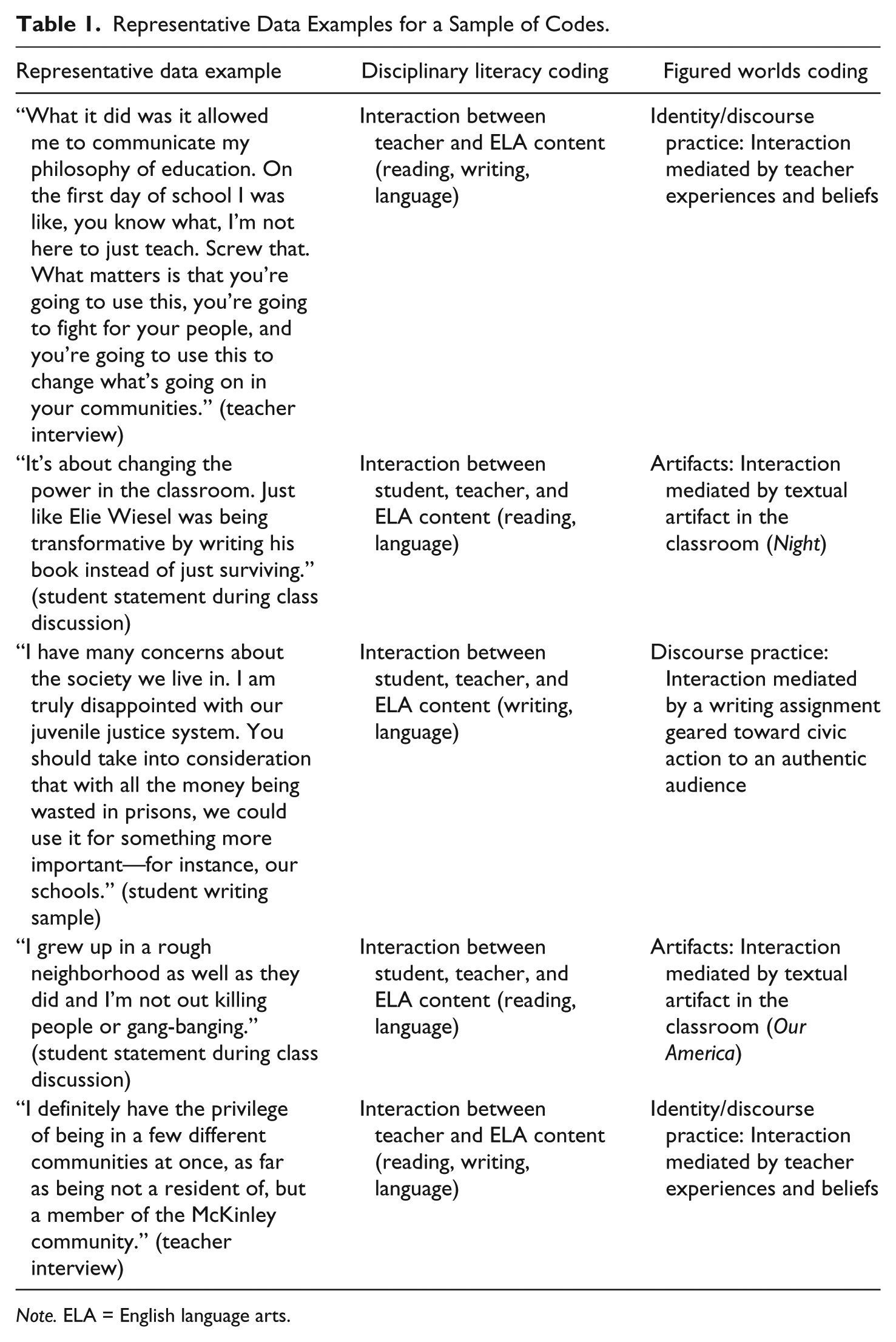
Note. ELA = English language arts.
Once the primary record had been established, the three authors engaged together in dialogic data generation (Carspecken, 1996) to gain multiple perspectives on what we saw and to foster consensus about the nature and purpose of the classroom figured worlds. To facilitate this process, Nicole shared data (including field notes, audio clips, and excerpts from interview transcripts) with Jerica and Ashley, and we discussed what we noticed about classroom practice related to the shared understandings of civic literacy learning that we had developed together. We then engaged in collective reflection to ensure that data interpretation and analysis accurately captured the perspectives of all participants. We collaboratively developed the names for the figured classroom worlds and discussed the possibilities and tensions experienced when striving to enact democratic practice in classrooms. All conversations honored the perspectives of the three authors as co-researchers (Cochran-Smith & Lytle, 2009). The co-researching and coauthoring processes speak to the trustworthiness of the qualitative findings as the three primary participants verified the reliability and validity of the data and their interpretation. Findings presented in the next sections were triangulated from observations, interviews, and artifact analysis and emerged from analytic memos that we wrote during the multiple coding cycles.
Findings
We organized our findings according to the holistic themes that emerged from our analysis of the entire corpus of data. We express these themes as each teacher’s classroom figured world.
The Figured World of Warrior Scholarship
In keeping with the analytic components of the figured world concept, we describe each classroom figured world in terms of the identities that are made available to participants through the discourse, social interactions, artifacts, and disciplinary literacy practices circulating in the room. We also note how these are influenced by the histories-in-self that the teacher and students bring to the space.
Identities and discourse practices
During the first few minutes that Nicole observed Jerica’s first-period class, as she was still taking in her surroundings, she heard Jerica’s instructions to students as they answered an introductory writing prompt: “If your pen is not to your page, you are not handling your business as a warrior-scholar.” Nicole was immediately intrigued by this term and wrote a note reminding herself to ask Jerica what it meant. It seemed that students had become accustomed to it and understood its significance. Indeed, over the course of observations that spring, the term warrior-scholar was uttered in Jerica’s class 20 times—19 times by Jerica herself, and 1 time by a student. It was used alternately as a form of encouragement (“You’ve gotta stand up and read it. That’s real warrior-scholar status”) and a form of praise (“I appreciate you stepping up like a warrior-scholar”).
When asked about the discourse of warrior-scholarship, Jerica explained that she developed this concept as a way to communicate to students her commitment to a “decolonizing pedagogy framework” in which literacy and learning are linked back to self- and social empowerment. She described working with a self-organized group of like-minded educators the summer before the school year started to figure out ways to increase student engagement with these ideas. The group read Daniel Solorzano and Dolores Delgado Bernal’s (2001) article about the various ways that minoritized students can resist the dominant logic of schooling and strove to translate its message into practice in their classrooms. Jerica explained that she and her colleagues asked themselves, “How do we create a culture of transformative resistance instead of this self-destructive resistance?” She decided to identify students as warrior-scholars to communicate how she wanted them to use their literacy skills. As she described, What it did was it allowed me to communicate my philosophy of education. On the first day of school I was like, you know what, I’m not here to just teach. Screw that. What matters is that you’re going to use this, you’re going to fight for your people, and you’re going to use this to change what’s going on in your communities. And that’s why I’m here. So, I think it has helped a lot for them to understand . . . why we’re doing what we do, and the sense of urgency that they need to have.
Jerica articulated a vision for student learning grounded in collective identity and community action (one that she has articulated previously in Coffey, 2015). This vision emerged from her history-in-self, particularly the politicization that she experienced in Chicana/o studies classes in college and the activist educator collaboratives in which she participated. Students seemed to internalize the concept of warrior-scholarship over the course of the school year and played with the idea of truly seeing themselves as warrior-scholars. When asked what the term meant to him, one student, Carlos, shared, “I think it’s about getting our education and helping our community instead of just trying to get out. To do better and give back.” He grinned shyly when asked if he considered himself a warrior-scholar, responding, “I’m getting there.” Another student, Stephanie, said that to be at that level, “you don’t punk out on your community. You try your best with your work. You’re the leader, and you try to do the right things.” All of the students interviewed considered warrior-scholar status something to aspire to and saw themselves getting closer to fulfilling its promise when they committed themselves to their academic work in Jerica’s class.
Jerica and her students engaged in a discourse practice that supported a critical civic purpose for literacy instruction and communicated the identities they strove to embody through their literacy practices. Jerica named disciplinary literacy activities such as reading and writing as indicative of warrior-scholarship to support a figured world of solidarity and community uplift in the face of inequity.
Classroom interactions and textual artifacts
Jerica organized her disciplinary units thematically around pressing controversial social issues. For much of the study’s duration, her instruction revolved around two essential questions: “Should juveniles ever be tried as adults?” and “Why don’t people stand up and fight back in the face of injustice?” She reported that she chose this focus after seeing students become enmeshed in the juvenile justice system and the school-to-prison pipeline. She thought that introducing students to theories such as social reproduction and transformative resistance would help them understand the role that society plays in the choices made by individuals and the ways they could break cycles of oppression.
After establishing the theoretical focus for a unit, she described immediately turning to choosing the textual artifacts that would ground it. As she put it, “I start there, what are the theories that I want to expose them to, and then kind of work backwards from there. What are the texts that I feel strongly about? I feel strongly about all the texts that I’ve used.” Again, this process hearkens back to Jerica’s choice to identify as an ELA teacher because of the freedom to choose texts that facilitate the teaching of particular literacy skills.
Mindful of the Common Core State Standards’ call for complex text sets, as well as her own civic goals, Jerica chose a wide range of textual artifacts with which to explore the themes of juvenile justice and the criminalization of youth. One of them was Luis Valdez’s (1979/1992) play, Zoot Suit, which explores a pivotal chapter in the racial history of Los Angeles. The play was paired with a reader of nonfiction essays and primary source documents from the time period, as well as excerpts from Freire’s Pedagogy of the Oppressed.
The core text of the class during the study was Our America, a journalistic narrative written by then-teenage authors LeAlan Jones and Lloyd Newman in collaboration with a public radio reporter, which focused on the young men’s attempts to understand a violent crime that occurred in their neighborhood (Jones, Newman, & Isay, 1998). A Socratic seminar offered students multiple opportunities to connect with Our America in ways that helped them articulate opinions on social issues. Jerica phrased the essential question for the seminar using a collective pronoun that invited identification with the text; she asked students, “Are we products of our environment, or do we have the power to shape our lives?” While students were using evidence from the text to explore the context of poverty and violence that led two young boys to commit a crime, they were also analyzing the societal factors that influenced their own lives.
Students quickly began making personal connections to the text. Carlos invoked the oppressive circumstances facing children living in Chicago’s South Side when he said, “I think that we have a choice. I grew up in a rough neighborhood as well as they did and I’m not out killing people or gang-banging.” Derek made a similar connection to the text as he vehemently rejected the idea that social forces could have an impact on his choices in life: “You won’t hear me on the street saying it’s because of my environment that I’m doing the stuff I’m doing. It really does not matter.” In both cases, the students demonstrated personal connections to the text by distinguishing the choices they make from those the characters made, and they also considered the impact that discourses about poverty and its possible consequences could have on their own lives through their references to their “rough neighborhood.”
Jerica built upon this discussion using the ELA standard related to business letters to develop an assignment bridging academic literacy, civic engagement, and social critique. She had students write letters about their concerns with California’s juvenile justice system to the state’s governor, Jerry Brown. For Jerica, this assignment gave students a chance to integrate what they had learned about the prison industrial complex with their literacy skills to take concrete action in the real world. An excerpt from one student’s letter reads as follows: I have many concerns about the society we live in. I am truly disappointed with our juvenile justice system. You should take into consideration that with all the money being wasted in prisons, we could use it for something more important—for instance, our schools. With all that money, we can motivate our children to stay in school instead of being guided into the wrong path. If it were up to me to make that difficult decision, I would recommend that we lower prison funds and raise the school fund. For example, to incarcerate a young person it costs $234,000 per year. Instead, we can be using all that money to help the youth become better people. You as the governor can provide us with rehabilitation programs so that teens can get the help needed.
Jerica’s figured world of citizenship sought to create learning opportunities for students that honored the feelings of civic alienation they often harbored while still promoting civic action. She accomplished this through appealing to a community history of struggle for freedom and situating students as beneficiaries of this struggle who bore responsibility to carry it on for future generations. This appeal was expressed through the traditional elements of a disciplinary literacy unit—through essential questions oriented toward civic issues, textual artifacts that were relevant to students’ lives and encouraged social action, and classroom interactions around reading, writing, and speaking that encouraged students to explore their roles and responsibilities as young citizens battling against injustice and to make interpretive decisions about complex issues. Crucially, the construction of this figured world was inevitably influenced by Jerica’s own identity and civic history. Her teaching represented a translation of the civic tensions she experienced as a woman of color into a curriculum and pedagogy of solidarity in which she participated alongside her students.
The Figured World of Bridge Building
We turn now to the different figured world being constructed across town in Ashley’s classroom.
Identities and discourse practices
A nervous energy permeated Ashley’s room on the third day of observations in her fifth-period class. Students were preparing to recite original poems in front of their classmates as the culmination of a poetry analysis unit. The poems they wrote were inspired by canonical works but tailored to their personal language styles. One student, Ana, walked to the front of the room and explained that she decided to write about her parents’ jobs after reading Langston Hughes’ (1922/1995) poem “Mother to Son.” Then, in a halting, quiet voice, she read as follows: Leaving at 4:30pm to Work cleaning Toilets Offices Vacuuming Picking up trash Mopping Coming back at 5 in the morning Why? Por que mami y papi se van? Leaving daughters alone Getting home from work tired Please God take care of mis padres
Ana’s classmates nodded as she spoke and afterwards praised her for the bravery she showed by sharing her emotions with them. One student, Luis, told her, “I can really relate because I don’t see my parents as much as I want to.” Nicole was struck not only by the caring discourse in the room but also by the ways that Ashley had encouraged students to bend traditional literary conventions to their own purposes to tell their personal stories using their linguistic resources.
In conversation later, Ashley acknowledged her commitment to building a supportive classroom community. As she explained, I think that my biggest strength as a teacher is that students, for the most part, see me as pretty loving and caring, and I feel that. Even when it’s hard, I definitely feel like my capacity to love and care is big for them.
Ashley believed that students needed to feel a high level of support to take the risks that she was going to ask them to take in her class. The nature of these risks involved stretching beyond their comfort zones and seeking to connect with each other and with a broader society that was not always as willing to connect with them. Students internalized this caring ethos; as one student, Carina, noted of Ashley’s classroom: “I think it is a safe space. I think we really do have the idea that we could all open up without worrying about the teacher judging us, first of all, and the students. Because we’re all really close friends.” Hector agreed, saying, “I feel comfortable talking to everybody in there.”
Ashley related this idea of connection to her view of citizenship. As she explained, I think that probably the main thing I do as a good citizen is that I’m a bit of a bridge builder. I definitely have the privilege of being in a few different communities at once, as far as being not a resident of, but a member of the McKinley community.
In both her teaching practice and her civic life, Ashley manifested a commitment to caring deeply for her students and the neighborhood in which they lived by carving out a role for herself as a “bridge builder” to connect them with a larger community through literacy. This bridge-building role relates back to her personal history of seeing language as a tool to operate across various social situations and her desire to connect to students across lines of difference in identity.
Importantly, Ashley insisted that the bridge be a two-way street. While she understood that her students needed to be able to access what she called the “culture of power” to achieve success, she believed that this culture needed to change to better connect with the resources and experiences of her students. As an example, she highlighted her practice of having students use canonical literature as writing models but then tweaking those models to insert their own voices. As she noted, “I worry that second-language learners are given the academic approach to literacy while other students get a more emancipatory approach.” She strove through her practice to construct bridges that could support bidirectional civic literacy communication.
Discourse practices that blended various forms of talk (i.e., code-switching between English and Spanish and between formal literary registers and more informal speech) were key to this bridge building as were discourse practices that consciously sought to foster trust and a collective identity, such as celebration of student writing. All of these practices were accomplished within the context of the disciplinary literacy activities of reading, writing, and sharing poetry.
Classroom interactions and textual artifacts
Many of the literacy practices in Ashley’s classroom during the study focused on Elie Wiesel’s memoir, Night (1956/2006). Ashley chose this text in collaboration with the 10th-grade world history teacher as they planned an interdisciplinary humanities unit about World War II. Ashley saw the integration of literacy and history curriculum as a way to further help students use their language skills to make connections between different subject areas and critically analyze their society-another practice that sprang from her civic history. She and her colleague developed essential questions for this unit: “How can we identify, recognize, and resist oppression?” and “Why do people bystand and why do they intervene?”
Ashley’s goal in this unit was not simply to help students understand oppression and resistance in a historical context through the study of the Holocaust but also to help them identify current examples of oppression and resistance in their lives to facilitate social change. As a result, while the unit opened with the study of Night, it was paired with analysis of an academic article that Ashley used to provoke discussion about the role of schools as institutions of either marginalization or empowerment for students.
Ashley’s practice mirrored that of Jerica as she also chose to introduce students to Solorzano and Delgado Bernal’s article about forms of student response to school conditions to discuss the balance between social influence and individual agency for our actions. (Both teachers were exposed to the article when students read it during Nicole’s YPAR program.) Like in Jerica’s class, Ashley’s students tried on different viewpoints—in this case, metaphorically straddling the bridge. Kelvin tried on a viewpoint that attributed the grades students get in class to nothing more or less than their individual effort, claiming, “We’re getting good grades because we do our work. Other kids can get good grades just the way we do—they just have to do their work.” Carina echoed his opinion, adding, “We just know that we earned that grade and we deserved it.” Quickly, however, Kara took issue with this viewpoint and began to consider the ways that social factors beyond effort might be at play, arguing, “It’s not just that we do our work and they don’t. They probably just need a little more attention.” Ashley encouraged students to think about the social conditions that structured their ability to succeed in school, from their home lives to their teachers to their resources. At this point, Carina contradicted her earlier statement, instead claiming that perhaps “the way society treats us makes us act the way we do.”
At this point, Ashley set up pieces of chart paper around the room and asked students to walk around brainstorming social and institutional forces that could negatively impact student success. Students were able to both identify forces and recognize the self-destructive (e.g., drugs and alcohol) and empowering (e.g., self-confidence) ways that students could exert agency over these forces. Ashley used students’ analyses to guide them through the four types of resistance the authors offer as possible responses students could take to oppressive school conditions and to apply that knowledge by thinking of different hypothetical ways they could respond to negative interactions with teachers.
Nicole sat with one group as they puzzled through the four types of resistance, asking them about the different responses they could have to a teacher who disrespected them. They argued that a reactionary response might be throwing something at the teacher, a self-defeating response might be failing the class, and a conformist response might be earning a good grade in spite of the teacher’s actions. They struggled a bit to articulate what “transformative resistance” to this teacher would look like—a form of resistance that Solorzano and Bernal (2001) define as “political, collective, conscious, and motivated by a sense that individual and social change is possible” (p. 320). As the students searched for a response that would meet these criteria, Nicole thought that, in a sense, they were searching for ways to fulfill Ashley’s biggest wish for them—that they would use their language abilities to interact with others across various boundaries of difference and create transformative change in their lives and in their society.
After a few more minutes, the group had a breakthrough. Jesus said, “Couldn’t transformative resistance be students teaching the class?” Luis added, “It’s about changing the power in the classroom. Just like Elie Wiesel was being transformative by writing his book instead of just surviving.” Ashley was walking by just as Luis made this revelation, and a huge smile spread across her face.
Ashley strove to create a figured world of citizenship characterized by true multidirectional connections in which all citizens’ voices would be honored and respected. Her ethic of caring had a politicized element to it. Caring was more than simply treating others with tolerance; it was about collaboratively changing the civic fabric to honor diverse perspectives. And again, these commitments were expressed through the disciplinary literacy practices of interacting with textual artifacts through reading, writing, listening, and speaking and making interpretive choices that encourage equity-oriented social action. They also emerged from her personal civic history of using language as a bridge to understanding and honoring identities different from her own.
Discussion
Our findings demonstrate how Jerica and Ashley imbued literacy instruction with a critical civic purpose that encouraged both analysis of current public life and dreams of future democratic possibilities. The interaction of their identities, practices, and contexts gave rise to distinct figured worlds of citizenship in their classrooms that strove to empower students personally, academically, and politically. We suggest that these figured worlds embody practical applications of sociocritical civic literacy learning in action. Two themes, linked to each of the research questions in turn, merit particular attention: the ways that both teachers used disciplinary literacy practices to create unique pathways to civic learning, and the opportunities that both teachers created for themselves to consider the relationship between their civic identities and their teaching. We relate both of these themes to current innovative research in the field of literacy education.
First, both teachers indicated that the nature of ELA offered broad possibilities for civically oriented learning. They used disciplinary practices—reading literature, writing authentic texts, and leveraging linguistic resources—to engage in democratic praxis. Key for Jerica and Ashley was the use of textual artifacts that drew students into compelling narrative worlds. These imaginative worlds encouraged students to analyze the world in which they lived, think about social problems, and employ the “social imagination” that Greene discussed to engage in civic dreaming aimed at changing the world for the better. Conversations in both classes demonstrated students trying on various civic identities as they wrestled with concepts of social reproduction and individual agency.
We argue that a key part of what distinguishes disciplinary literacy in ELA from disciplinary literacy in social studies in terms of possibilities for civic learning is ELA’s use of literary reasoning. Carol Lee (1993) argues that response to literature involves tackling “interpretive problems” through making inferences and drawing upon patterns of knowledge. Just as critical analyses of society often necessitate reading between the lines, Lee explains that literary reading “involves understanding meanings that are not explicitly stated” (p. 47). As such, literary reasoning offers a model for public deliberation about civic and political issues that is aspirational and creative. These are some of the qualities necessary for challenging entrenched inequities.
Indeed, this study builds upon a growing movement in literacy education to lay bare the ways in which ELA policy and practice privileges White, middle-class, patriarchal perspectives and to highlight the unique ways of knowing and being that minoritized students and teachers bring to the classroom to create more inclusive figured worlds of civic literacy achievement. Just as burgeoning research is calling attention to the ways of knowing (Muhammad & Haddix, 2016) and linguistic resources (Flores & Rosa, 2015) that minoritized students are bringing to the literacy classroom, we foreground the civic resources of perseverance, resistance, and critical hope that demand to be acknowledged and leveraged by classroom teachers.
Second, the views about literacy and citizenship that Jerica and Ashley expressed were invariably rooted in their personal identities, particularly their evolving understandings of race and their efforts to seek out opportunities for further learning about the relationship between the many facets of their identities and teaching. In terms of racial identity (Omi & Winant, 2015), Jerica highlighted her developing understandings of herself as a member of a racially minoritized group as crucial to the way she came to view society; she spoke of identifying with her students in a very personal way and of the impossibility of taking a neutral stance to literacy when considering the barriers her students encountered. Conversely, Ashley’s identity as a middle-class White woman provided her with a very different worldview and set of experiences, but she demonstrated willingness to struggle with the implications of her racial identity in the classroom to connect with students across boundaries of race and class. Our findings raise intriguing questions for further study—beyond the scope of this article—about the extent to which teachers’ racial identities make certain figured worlds possible (or impossible) for them to foster in their classrooms. For example, is it possible (or desirable) for White teachers to promote warrior-scholarship? What other possible figured worlds beyond warrior-scholarship and bridge building can be added to the typology, and how do they relate to race, class, gender, and other social constructs?
The fact that these teachers’ personal identities and histories followed them into the classroom and influenced the way they saw their students, their subject matter, and their roles as educators implies that current policies seeking to characterize the ideal teacher as an objective conduit of subject-area knowledge are flawed and misguided. Indeed, it was precisely because these teachers engaged in sustained reflection about how their teacher identities related to the other aspects of their lives that they were able to develop complex curriculum and pedagogy that engaged their students both academically and civically. They realized that the veneer of objectivity is simply a manifestation of a subjective commitment to a particular view of education (one that the sociocritical theorists discussed previously argue maintains a systemically unequal society), and instead chose to make a conscious commitment to one rooted in the democratic power of literacy.
This suggests that much more attention should be paid to formal and informal learning opportunities to help aspiring and inservice teachers articulate and clarify their identities, values, and beliefs as guiding touchstones for the practices they introduce in their classrooms. Sealey-Ruiz’s (2013) work in articulating pedagogies of racial literacy offers a road map for engaging in this excavation of identity with preservice and inservice teachers. Haddix (2015) calls for a reconstruction of literacy teacher identity that moves away from White, monolingual, middle-class norms and toward an embrace of multiple histories and experiences. If the field of ELA teacher education is to take sociocritical literacy learning seriously, there is a need for K-12 schools and universities to offer multiple and meaningful opportunities for educators to explore the complicated intersections of race, literacy, citizenship, access, and education that have characterized US history as the context within which classroom interactions are taking place.
A key limitation of this study is that it cannot make any causal claims about the extent to which the pedagogy in Jerica’s and Ashley’s classes inspired students to engage in particular civic activities or manifest specific commitments to civic engagement. This is a worthy subject for further study but beyond the scope of our current inquiry. The contribution we aimed for in this article was to document the organic processes through which classroom communities made possible particular civic ways of being and to offer visions of democratic life that honored students’ personal experiences and developing civic identities. Another limitation of our study is its focus on two teachers who shared a similar context in terms of geographic location, student demographics, and ideological commitments. As discussed throughout the article, there was still much diversity to be explored in the figured worlds that Jerica and Ashley created, but conducting this inquiry with a wider sample of teachers with more divergent contexts, beliefs, and experiences would undoubtedly make our analysis even more nuanced.
Sociocritical theory suggests that politics are present in every public exchange between citizens, including those that take place in schools. These enactments are not restricted to what is explicitly named civic education, nor are they confined to any particular grade level or subject area They are multifaceted and overlapping. When students are engaging with civic ideas in class, they are trying on civic identities and metaphorically communicating with the wider society through the common medium of language. Standardized models of curriculum and pedagogy ignore students’ membership in various communities, including those circumscribed by geography, race, and class, as well as the funds of knowledge contained in those communities. A sociocritical model of civic literacy learning that permeates the entire culture of schooling can deconstruct systems of inequality and lift up communities, both discursively and in practice, toward a future in which democracy is fully realized.
Supplemental Material
Supplemental_Material_784335 – Supplemental material for Warrior Scholars & Bridge Builders: Civic Dreaming in ELA Classrooms
Supplemental material, Supplemental_Material_784335 for Warrior Scholars & Bridge Builders: Civic Dreaming in ELA Classrooms by Nicole Mirra, Jerica Coffey and Ashley Englander in Journal of Literacy Research
Footnotes
Declaration of Conflicting Interests
The author(s) declared no potential conflicts of interest with respect to the research, authorship, and/or publication of this article.
Funding
The author(s) received no financial support for the research, authorship, and/or publication of this article.
References
Supplementary Material
Please find the following supplemental material available below.
For Open Access articles published under a Creative Commons License, all supplemental material carries the same license as the article it is associated with.
For non-Open Access articles published, all supplemental material carries a non-exclusive license, and permission requests for re-use of supplemental material or any part of supplemental material shall be sent directly to the copyright owner as specified in the copyright notice associated with the article.
