




Abstract
This article examines the digital storytelling practices between an African American mother and son. We used agency as a theoretical framework to explore how the two exercised their own power to collaborate on their digital story. As digital technologies became part of their practice, challenges and tensions arose when both participants attempted to override each other’s agency, as demonstrated in their interviews. Data were collected during digital storytelling workshops conducted at a university computer lab, church, and the participants’ home. Using thematic coding, we analyzed audio-recorded interviews to determine the participants’ agency in the context of their digital storytelling activity. We found how a mother and son worked together through resisting and redirecting when creating a digital story, and how their digital storytelling practices displayed evidence of agency. Implications include how familial interactions in digital storytelling practices contribute to the ways agency is conceptualized for families, educators, and researchers.
The parent–child dyads that are created during texting, blogging, and digital storytelling (Lewis, 2013, 2014; Lewis Ellison, 2016, 2017a) can not only enhance familial relations but also help parents and children self-identify, make choices, learn together, and enhance their communication. Without the constraints of school-based literacies, family literacies can enable parents and children to think and act more freely around digital tools, literacies, and practices, thus creating potential for more democratic and innovative familial unions. Examination of the ways children and parents use digital tools can also provide a unique lens for examining the negotiation of agency.
Agency is influenced by “intentionality and forethought” based on how learners act, choose, and communicate in an effort to achieve their intended goals (Bandura, 2001, p. 1; Dozier, Johnston, & Rogers, 2006; Lewis, 2016; Lewis Ellison, 2017a). Thus, it is vital to understand that agency and learning are best developed during the process of a valued activity. With every new task, children develop a sense of control of their learning processes. When children collaborate in activities with their peers and families, they not only learn from each other in social contexts but they also create active and sustaining learning communities (Vygotsky, 1978). These experiences help learners cultivate their identities, develop their voices, and encourage agency (Christianakis, 2010; Goldman, Booker, & McDermott, 2008; Toshalis & Nakkula, 2012).
When using digital technologies together, children and parents can come to understand digital practices, collaborate with each other, maintain engagement, and take notice of their own and each other’s learning. However, when children and their parents jointly negotiate agency while they are engaged in digital practices, conflicts can occur concerning goals, opinions, choices, and creativity. Issues of power can also dominate certain practices and relationships in the home, including children’s access to resources, tools, and the development of their identities (Barton & Hamilton, 1998; C. J. Lewis, Enciso, & Moje, 2007). As is the case in most relationships, one individual’s domination over another creates an imbalance of power in digital and nondigital spaces (Lewis, 2014; Lewis Ellison, 2014).
In this article, we explore how two members of an African American family—a mother, Chant, who is 36, and her son, Rem, who is 9—engaged in a digital storytelling project within and beyond their home. This examination of an illustrative mother–son dyad debunks deficit perspectives that portray African American parents as uninvolved and unengaged with their children’s academic experiences, and illustrates how the agential actions and interactions within a mother’s and son’s digital literacy practices complicate and encourage familial collaborations. As a theoretical framework undergirding this study, agency addresses the practices that materialize within this mother–son dyad, and clarifies the educational and societal benefits to positioning African Americans in the literacy field, thus promoting agency and empowerment across diverse social and geographic populations (Lewis, 2013, 2014; Lewis Ellison, 2016, 2017a).
Theoretical Framework and Literature Review
Agency
Agency is a concept that deserves more attention because it is the basis for empowerment—a primary goal for learning (Compton-Lilly & Graue, 2013; Holland, Lachicotte, Skinner, & Cain, 1998). Agency stems from (a) one’s understanding of self (Bruner, 1994), (b) the capacity to act upon one’s world and give it personal significance (Holland et al., 1998), and (c) the ability to identify and remake oneself (Moje & Lewis, 2007). Agency is also “fueled by improvisations that people bring to unique and often unexpected situations” ( Compton-Lilly & Graue, 2013 , p. 176). All individuals possess agency and can enact their agency either routinely or infrequently.
Agency is determined through voice, and as Holland et al. (1998) have noted, “Language guides action in the form of ‘voices’” (p. 179). In this way, individuals develop conscious conceptions of themselves as actors in socially and culturally constructed worlds (Holland et al., 1998). In other words, the notion of determining who individuals strive to be plays a part in constructing agentive identities (Ochs & Capps, 2001). Furthermore, Lantolf and Thorne (2006) argue that agency extends beyond behavior, and is deeply connected to one’s perceived relevance and significance to things and events. Bruner’s (1994) work on narrative defined agency through “the remembered self”: a moment of our recreation of a personal understanding of self (p. 53). He identified a “dialogical relationship between narrative and self” (as cited in Hughes & Robertson, 2012, p. 69) in which narratives and self simultaneously shape one another. Agency “is not simply the act of finding one’s own voice, but also about intervening in discourses of the everyday and cultivating rhetorical tactics that make interruptions and resistance an important part of any conversation” (Reynolds, 1998, p. 59).
Research has documented how children’s agency has “foundational learning, development, and wellbeing outcomes” (Mashford-Scott & Church, 2011, p. 15). Thus, children become agentic by interacting and participating with each other. In addition, agency within the socialization of families is important. In families, individuals learn to informally establish relationships with one other behaviorally, cognitively, and relationally. Early familial relationships determine how we establish more formal relationships within and outside home settings (Bronfenbrenner & Morris, 1998; Crowell, 2016; Kuczynski, 2003).
Erstad and Silseth (2008) have argued that there is an intersection between digital storytelling and agency, suggesting that when young people are provided opportunities to intersect their “informal ‘cultural codes’ with more formal ones in their own learning processes, agency might be fostered in a new way, with implications for democratic participation” (p. 214). We sought to explore agency in the context of digital storytelling by asking the following research question: “In what ways did the digital literacy and story-making practices of an African American family dyad (mother/son) display evidence of agency in the context of a family-focused digital storytelling activity?”
Digital Storytelling Among African American Communities and Youth
Digital storytelling has long been used as a tool for communication among African American youth. Studies have demonstrated the importance of digital storytelling practices in exploring pedagogical and meaning-making processes for African American youth (Guse et al., 2013; Hill & Vasudevan, 2008; Solomon, 2012) by exploring how students in book clubs compose digital stories about historical fiction (Kesler, Gibson, & Turansky, 2016).
Digital storytelling has also been used as a means of self-discovery for these youth. For instance, Vasudevan (2011) examined five African American adolescent males’ digitally mediated storytelling practices outside school. The participants used stories and movies as tools to make sense of their multimodal selves while interacting with artifacts that resembled their various communities and contexts. In an effort to eliminate the digital divide, Glynda Hull and Michael James created Digital Underground Storytelling for Youth (DUSTY) in 2001, an after-school program that offers digital storytelling and literacy development activities (i.e., music, poetry, and songwriting) for youth from various geographic, racial, cultural, and socioeconomic populations (Hull & Nelson, 2005). DUSTY has now expanded to multiple locations, and offers student digital storytellers the opportunity to express and empower themselves.
In addition, studies of digital storytelling among African American students have examined the roles of agency, identity, and digital authoring (stories told about oneself using digital tools; Davis, 2004). For instance, researchers have examined how African American youth created digital stories to shape their agentive practices and identities in online and offline spaces (Davis, 2004; Davis & Weinshenker, 2012; DeGennaro, 2008; Hall, 2011; Hull & Katz, 2006; Nixon, 2008; Vasudevan, 2006). In addition, Hall (2011) used critical literacy and Black feminist thought theories to specifically examine how three African American women used narrative scripts to represent themselves as writers, producers, and creators of their social worlds. Hall (2011) found that their texts and stories about Blackness could be transformed into legitimate pieces of writing, even in the context of White literary traditions. The intersections among these scholarly works illustrate how digital storytelling has been used and modeled, and how it has empowered and emancipated African Americans through developing shared practices, relationships, and voice.
And yet, little attention is given to the significance of digital storytelling practices across generations, especially for African American families, who are often omitted from research and schooling processes. Researchers like Robin (2008) have called for a “better theoretical framework” for the educational application of digital storytelling (p. 225). Digital storytelling practices play a critical role in how families can use stories to communicate, interact, and compose meaning with each other. In addition, through the use of digital media tools, these practices can help families understand their histories, themselves, and their world (Lambert, 2002; Lewis Ellison, 2016, 2017b; Reitmaier, Bidwell, & Marsden, 2011; Yuksel, Robin, & McNeil, 2011). Digital storytelling practices also help us explore the cultural and social transformations represented within digital stories (Lundby, 2008).
Digital Storytelling and Families
Even fewer studies have examined digital storytelling interactions between parents and their children. One international study relied on parents’ participation in rural community schools (Gyabak & Godina, 2011), while another used a digital storytelling framework to help participants determine the content of their stories (Moreillon & Hall, 2014). By using visuals, the authors were able to reach students’ parents and helped facilitate learning at the public library. Kucirkova, Messer, Sheehy, and Flewitt (2013) explored how a parent and child interacted when they shared a multimodal-personalized story using an iPad application. They found that this interaction not only produced pleasant oral storytelling practices within the dyad but also demonstrated the multiple modes engaged in their story-sharing interactions.
In addition, Figg and McCartney (2010) found that when university researchers, teacher candidates, language and technology instructors, student learners, and families from diverse backgrounds participated in a digital storytelling workshop, not only did the participants improve their writing and educational outcomes but teacher candidates also developed a greater appreciation of families’ involvement with their children. This observation helped teachers motivate the students, and parents were able to see their children performing at a high level of competency. Flottemesch (2013) used narrative theory and narrative performance theory to help undergraduate students understand intergenerational digital storytelling. Findings revealed that when students interviewed family members or community members from different generations, the students were more engaged in their learning. These students also “enhance[d] family dialogue, nurture[d] family values and belief systems, and promote[d] mutual appreciation and respect for members of the family unit” (p. 59).
Although limited, the extant scholarship has helped describe digital storytelling practices engaged by youth and the dire need for more research on the topic. It has also elucidated how strong dyadic relationships help support children’s cultural socializations (Clark & Ladd, 2000; McHale, Updegraff, & Whiteman, 2012). However, while the above studies involved parents and the family unit in the participation, collaboration, or creation of a digital story with their children, they did not focus on the importance of agency in digital storytelling/story-making practices between African American parents and children.
The ways in which African American mothers interact with their children around activities within and outside the home play a significant role in their children’s learning (Compton-Lilly, 2012; Edwards, 2004; T. Y. Lewis, 2011, 2013, 2014; Lewis Ellison, 2016; Rogers, 2003; Taylor & Dorsey-Gaines, 1988). This generational bond relates to social learning, academic achievement, development, and agency (Gadsden & Hall, 1996; Kreider, Caspe, Kennedy, & Weiss, 2007; T. Y. Lewis, 2013; Winfield, 1994). For African American families, digital storytelling can also nurture discursive practices (Foucault, 1971), as the power relations asserted through language acknowledge the speaker’s existing competences, help them understand resistance in interactive activities, and give voice to meaningful practices.
An investigation of this African American mother–son dyad offers ways to understand and explore how similar families engage in the processes of creating digital stories, how relationships are created when producing digital texts, and how familial digital storytelling fosters agentive practices.
Method
Using a case study design (Creswell, 2013; Merriam, 2001), we explored an African American mother’s and son’s social and cultural patterns, beliefs, values, behaviors, and tasks used to create their digital story. This case study design allowed us to pay close attention to the range and frequency of their interactions during digital workshops and interviews, their discourses during the digital story-making processes, and the materials they chose to use.
Context of the Study
This study took place at a university lab, the home of the dyad, and a church in the southeastern United States that the dyad attended. We collected data continuously over 1 year, with more intense collection occurring between April and September 2014. This family was selected from a larger group of families in which we were working in a project called the Dig-A-Fam: Families’ Digital Storytelling Practices project. 1 The dyad that is the focus of this study was drawn from that larger group.
Recruitment
I (Author 1) initially recruited possible parental participants from the community (e.g., university and church) and asked them to complete a questionnaire. The participants answered a 14-item, multiple-choice Likert-type scale and open-ended questionnaire, which addressed some of the following components: (a) the family’s collective access to and proficiency with digital tools in their personal, business, and social lives; (b) the type of broadband used in the families’ homes; and (c) the family’s print/online projects and length of time engaging in print/online projects with their children. Using the questionnaires, I initially selected five families to participate in the Dig-A-Fam: Families’ Digital Storytelling Practices project because they were frequent digital literacy users, they relied on a variety of digital tools, and the parents were very interested in working with their children on a digital storytelling project. Their practices were also extensive, and included researching websites, texting, and engaging online sites for informational purposes. For this article, we will introduce and discuss one family and their experiences during a digital workshop.
Dig-A-Fam: Families’ Digital Storytelling Practices project
Data for this project were elicited during the Dig-A-Fam project. The project included three 90-min workshops held at a university’s computer lab and a church. Families that participated received information on digital stories, and participated in family and group conversation circles (Lewis Ellison, 2017b). Participants also engaged in the construction of digital stories, most often in the labs, but sometimes at their homes.
I (Author 1, as the facilitator of the workshops) explained the components of a digital story and showed two examples, including one about my family. Participants were encouraged to answer the following questions concerning digital story composition: (a) What did you see while watching the digital stories? (b) What was the main idea of each story? (c) What did you see about the differences between each digital story? and (d) How did the stories shift your thinking as you prepare your own digital stories?
Family dyads generated digital story topics and themes, and later discussed them with the entire group to elicit assistance. I supplied the participants with a summary of the day’s activities, along with storyboarding templates for writing a script. I shared tips for scriptwriting by offering the following prompts: (a) Who is the audience for my story? (b) What is my dramatic question? and (c) What is the most important idea for my audience at this point in time? Due to participants’ home, work, and school schedules, we coordinated a convenient schedule for completing the tasks on a weekly and monthly basis.
Participants used Microsoft Windows Movie Maker (MWMM) to create the digital stories because it was the only available software in the university’s computer lab. Some of them were already familiar using MWMM. In addition, this video-making/editing software provided user-friendly access to create and publish videos online.
Participants
Chant
Thirty-six-year-old Chant is a social studies university professor at an urban university in the South. She is the mother of one son, Rem. Chant described spending more than 5 hr daily engaging in various digital tools, including her cell phone, laptop, and iPad. She also engaged in digital literacy practices to stay knowledgeable about the technologies her graduate students would need to teach digitally savvy students like her son. At the time of the study, Chant would often discuss Rem’s homework projects with her students, or taught them new strategies for using digital tools. Chant also engaged Rem in a variety of activities to stimulate his creativity. Aside from collaborative literacy practices such as reading, writing, sewing, and cooking, she often encouraged his communicative digital literacies (e.g., texting and FaceTime), participated in homework assignments (e.g., creating presentation software documents such as PowerPoints), and helped him troubleshoot with computers, cell phones, and digital cameras. She encouraged Rem’s acquisition and demonstration of digital tool competency by providing him with access to educational and community-wide workshops on reading, financial planning, and coding to boost those competencies both in and out of school. These experiences made him an outspoken user of such tools.
Rem
Rem was a soft-spoken but confident 9-year-old who was outgoing and inquisitive, and loved National Geographic magazines. As an “A” student, he demonstrated competence at school and home. Rem has had access to digital tools since birth, and both parents introduced him to the technological world in ways that have enhanced his digital literacy practices and interests. He was often on the computer conducting research for school, or on Chant’s phone, playing video games for leisure. When Rem visited Chant’s classroom after school, he became a handy assistant, teaching her to navigate digital tools and troubleshoot technological issues. He also enjoyed Skyping with his father and a friend who lived outside the United States. Rem had a suite of digital tools in the home (including an iPad mini and two PreSonus audio boxes), which he used to create a recording studio in his bedroom. He enjoyed creating websites, videos, and short movies along with his mother and friends using his iPad or desktop computer. Rem was confident with Python (a programming software for coding) and often used Java Script to code music, and GarageBand to make music or create sounds using the software’s library. Both Chant’s and Rem’s digital literacy practices demonstrated extensive forms of agentive practices as well as self-aware competence with the digital tools in their personal and academic lives.
Data Sources
Data sources consisted of audio-taped participant pre- and postinterviews about their digital and nondigital lives and of the workshops, videotaped observations of the digital workshops, and a video of participants creating the digital story at home (Merriam, 2001). Each of these data sources was critical to investigate our research question because they provided information about how this family integrated digital tools into their relationships. The postinterviews were designed to summarize the digital story’s creative processes.
Collectively, we administered pre- and postinterviews of Chant lasting for a total of 120 min, and took turns recording notes. Tisha interviewed Rem for a total of 30 min. The interviews took place at either a university office or by phone in the spring and fall of 2014 and 2015. There were some lapses when Chant and Rem were unavailable for interviews and workshops, and this caused delays in the study. Some of the interview questions focused on the participants’ Internet access and service, access to and frequency of use of digital tools, recreational and digital activities, and participants’ contributions to digital activities (see Online Appendix A).
Chant and Rem attended two digital storytelling workshops for a total of 120 min to create one digital story. In addition, Chant video recorded their activities while creating the digital story at home. The length of the video was 5:38.12. Two audio- and video-recorded observations were conducted at the digital workshop session, which was held at the university’s computer lab. In addition, on one occasion, Chant observed and video recorded Rem working on the digital story with her in his bedroom in their home, as we, the authors, were not present. In the video, we transcribed Chant’s and Rem’s conversations while they created their digital story.
Data Analysis
Chant’s and Rem’s audio- and video-recorded interviews and digital storytelling practices generate the data sources, and the transcribed recordings of their conversations (at the digital workshops and at home) were analyzed through thematic coding (Miles & Huberman, 1994). Data were analyzed continually and recursively during the research, with us writing analytical memos and notes to identify patterns in the data. Huan became more involved as the project progressed, and during the later stages, helped develop codes and themes.
Phase 1: Codes
We marked the texts of prospective descriptive codes related to our framework and research question (Creswell, 2013; Miles & Huberman, 1994). Collectively, we read through the data and asked questions to label the information we found. Such questions included the following: What is going on here? What do the data say/represent? What is the main phenomenon occurring? We established 14 initial codes in agreement between one another. They were (a) “working together,” (b) “trying to listen,” (c) “explanation,” (d) “tone,” (e) “lack of affirmation,” (f) “affective roles,” (g) “abilities,” (h) “attempting agency,” (i) “identity development,” (j) “imaginary play,” (k) “voice,” (l) “independence,” (m) “self-control,” and (n) “restricted.”
Phase 2: Themes
We confirmed the dependability of these codes by asking a group of 10 doctoral students to review a sample of the data. These students were part of Tisha’s qualitative research course about analytical techniques, research design, and managing data. We gave the students approximately 10% of the transcript data. After rereading, we realized that several of the initial codes were repetitious; therefore, we removed some and collapsed others. Next, we presented several novel samples of data, and asked the students to confirm which codes they might assign. With few exceptions, the doctoral students agreed on the same coding scheme. When they did not agree, we discussed the codes and altered them to more closely align with the group’s analysis of the data. After several rounds of coding and recoding, the most stable codes were “trying to listen,” “explanation,” “lack of affirmation,” and “attempting agency.”
Finally, we began to compare and collapse across the Phase 1 codes to create two broader themes. For example, the initial codes of “lack of affirmation” and “attempting agency” make up the broader theme of “resistance.” The codes “trying to listen” and “explanation” were clear indicators of the theme of “redirecting.” These themes represent how agency was enacted and negotiated between the participants.
Phase 3: Member checking
During this process, we shared the themes and, later, the manuscript drafts with Chant to clarify and confirm our credibility of the information. Based on her feedback, we revisited some data and reviewed her comments with a different lens. For example, during the postinterview, Chant provided new insights and descriptions of how she understood “redirecting” during the last digital storytelling workshop session. In addition, she explained Rem’s “resistance” with more clarity, especially concerning the ways in which his reactions during the sessions were similar to the ways he engaged with teachers and peers at school.
Researcher’s Positionality and Reflexivity
The commonalities between Chant and me (Author 1, African American, university professors, and colleagues) were evident, and the fact that I had known both Chant and Rem for 7 years reveals how my presence with this dyad may have affected their role in this project. However, as researcher and participant, Chant and I negotiated boundaries within these roles. My role varied as a researcher-participant and observer-participant continuously throughout the study. For instance, while leading the digital workshop sessions, I often communicated with them to better understand their thoughts and discoveries, or demonstrated a procedure to assist them in crafting their digital story. At other times, I watched from afar and listened to their conversations about choices and decisions they made while taking notes.
Although I am an African American woman researcher, I am not a mother. Nevertheless, I understood that Chant’s and Rem’s characteristics, interactions, and activities were their own literacies that attributed to their parent–child relationship (Lewis Ellison, 2014).
Findings
Two themes illuminate Chant’s and Rem’s vulnerabilities concerning resistance and redirecting, which not only perpetuated critical dimensions of agency but also influenced identity and power struggles for both. Rem demonstrated that he was more resistant when creating and producing digital texts with his mother than when interacting with his peers, sharing how he wanted to show his mother more things that he knew. Chant responded to Rem’s resistance by redirecting his practices during this activity, often adding her expertise as mother and professor to reach a common ground without hindering his growth. Their discussions about the creation of their digital story highlighted generational differences and demonstrated how they negotiated each other’s agency when digital tools became involved.
Resistance: “I didn’t need the directions to be explained because I knew what I was doing.”
Resistance can occur when highly competent children like Rem collaborate with peers or their parents on projects. When individuals refuse to engage in an activity and begin to challenge authority by exercising their margin of autonomy and free will, we call this resistance. Despite hierarchical relationships between collaborators, even the youngest participants can maintain resistance and agency (Crockenberg & Litman, 1990; Kuczynski, 2003). For example, during one incident, after watching a demonstration on how to upload photos to their digital story, Chant and Rem faced some difficulties completing the task.
Rem was eager to work on the computer, often taking the mouse from Chant and saying, “Let me do it,” “I know how to do it,” or signaling for his mother to stop working. (Indeed, on many occasions, Rem dismissed available assistance from his mother, and often refused any help.) In this instance, Chant and Rem were unable to fulfill this task. Although he was trying to share what he knew, he did not feel that he was being heard. At one point, he pushed his chair back and folded his arms. Chant and Tisha noticed Rem’s resistance, and Chant immediately began speaking with him: “Hold on, wait a minute! Listen, Rem! This is Ms. Tisha’s research project. You cannot go off and do what you want. We need to listen to Ms. Tisha’s instructions too. Okay? Do you hear me?” Rem remained quiet for approximately 1 min, then slowly pushed his chair back up to the table. The data illustrated how Rem appeared to be irritated because he wanted to demonstrate his competency in this activity, but felt that his skills were not taken into account. During a postinterview, Tisha asked him about that day, and he responded as follows:
I was feeling sad and mad. I was trying to help my mom. I was trying to tell her so we could work together to make [the digital story]. I felt like I was trying to do more stuff and no one was trying to listen. I didn’t need the directions to be explained because I knew what I was doing.
Tell me more.
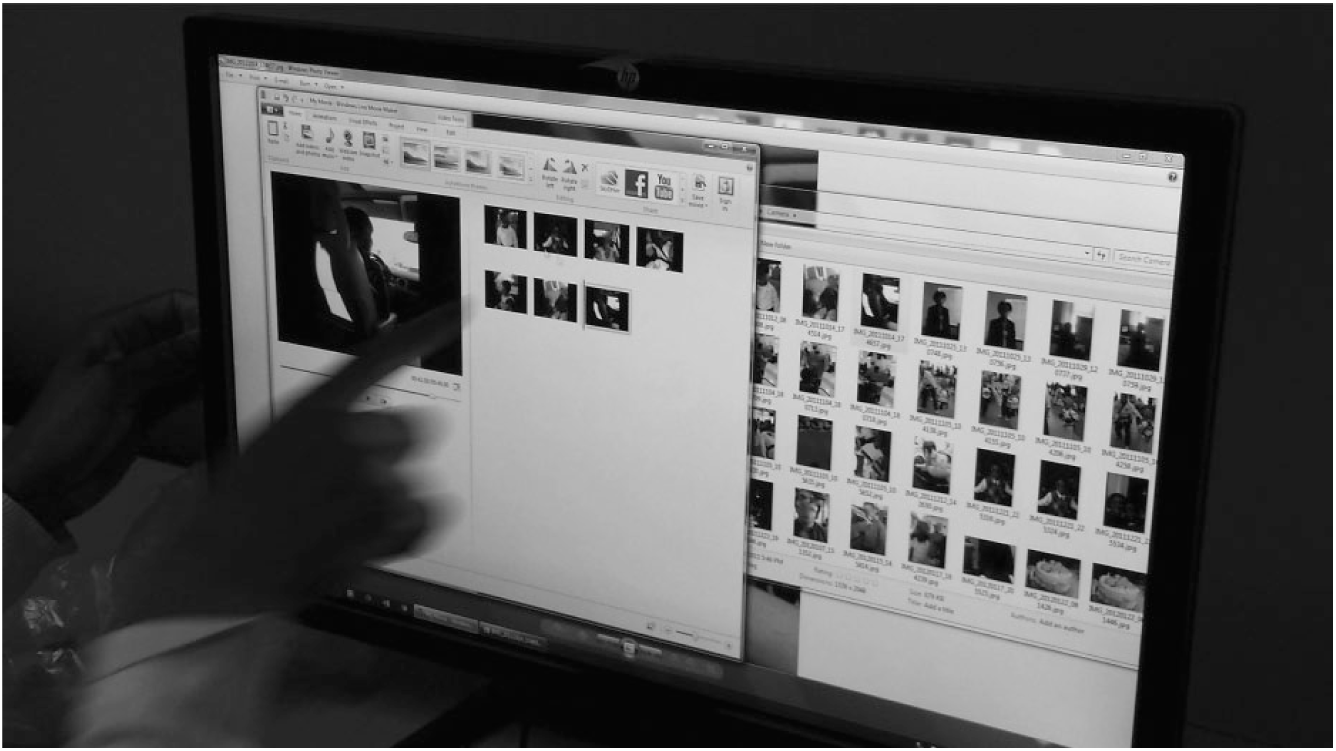
Chant and Rem are choosing photos to upload for their digital story.
I was trying to express that I already knew how to do that skill. I knew how to use Movie Maker, but I was trying to say that I already knew how to make the story…. I wanted it to be transitions and animations everywhere. Mom wouldn’t let me put it on there. It wasn’t what I wanted on there. I pressed buttons and used the keyboard. Wanted to use better pictures to move and change—that would have been cool.
Rem’s response was perhaps not merely about his need to be assertive. It was about his history of full access to digital tools, during which time he developed distinct cultural agencies and participated in creative, inspirational activities that connected him to an intended goal. When Rem said, “I got it,” he meant it, and he wanted others to understand and acknowledge that fact.
Rem expressed resistance to listening to instructions that he already knew, but there was also evidence of agency, as demonstrated by his comments. It was important for him to have ownership of the decisions made about things that were important to him. In fact, children like Rem have displayed multiple literacy practices and ways of knowing when navigating spaces that require pedagogical skills often not associated with school-based literacies (Cowan, 2010; Hull & Moje, 2012; Leu, Zawilinski, Forzani, & Timbrell, 2015). We analyzed Rem’s resistance both as a common practice among students involved in different activities, and as an action that called attention to his personal agency, which we may have been limiting by concluding that instructions were needed for someone already proficient in the activity. Perhaps instead, he needed more time to play, explore, and have choice, especially when engaged in digital play, or in playing alongside digital technologies such as video games and digital storytelling (Lewis Ellison, 2017a, 2017b; Lewis Ellison & Solomon, 2018; Marsh, Plowman, Yamada-Rice, Bishop, & Scott, 2016).
Rem’s actions led us to understand how some students—particularly students of color—often feel when they are silenced by adults who have their own agendas and do not allow them to use their own knowledge (Delpit, 1988; Ferguson, Phillips, Rowley, & Friedlander, 2015; Hodgkinson, 2003; Howard, 2008; U.S. Department of Health and Human Services, n.d.). Instead, the data illustrated how students like Rem “know how to learn in more ways than we know how to teach them,” according to Edmonds (1991; as cited in Cole, 2008). Indeed, when teachers refuse to work with students as coresearchers to facilitate their own agency and achieve their desired goals for the activity, such approaches can collide with students’ agencies and might impede learning (Matusov, Smith, Soslau, Marjanovic-Shane, & von Duyke, 2016; Park, 2008; Rush & Fecho, 2008; Zeichner, 1992).
Redirecting: “My role was initially the guide. I helped to organize the project.”
Our analysis revealed that Chant allowed Rem some freedom to “demonstrate his knowledge” and take control. Nevertheless, Chant was explicit in her preferences, which at times resulted in differences of creativity and agency. For instance, after Rem refused to work on the digital story during one session, Tisha asked Chant to share her interpretation of that occurrence during the postinterview reflection. According to Chant, Rem has a tendency to sometimes want to have that power, to be able to voice what he knows and what he has learned without necessarily giving full attention to what else is going on. As a mother, I feel it’s very important to teach him when he should speak up and when he needs to listen and show respect to the person that is presenting the information, whether he knows how to do everything or not. And in that position, I said, “Hold on, wait a minute!” I felt that we needed to have the full instructions on how to upload the pictures, and we were having some issues with it, but he wanted to assert his knowledge.
Chant’s need to shift Rem’s efforts back to the activity demonstrates how we define redirecting. Most adults with authority tend to redirect children’s attention back to an activity for completion in a timely manner. For Chant, as mother and “guide,” there was a give and take formed within the dyad: When Rem resisted, she sought to redirect him back to their work.
In a video conducted in their home, Chant and Rem discussed which elements to include in the digital story. While they worked together on intricate details of visuals, texts, and organization, Chant used various techniques—including compromise and negotiation—to direct and redirect Rem’s attention. At other times, she used her authority as his mother to override his decisions.
Okay. Wait, that doesn’t look right. That’s not how I want it to look. I tried to compromise.
I’m trying to fix the background.
That’s not the problem, though. Change the whole text to white; take the fading off.
[Rem is silent, still working on the story.]
You hear me?
So take this stuff off?
Yes, what you added. There is too much stuff going on. No! We didn’t have that initially.
Wait, look at it . . . please [in a low voice]. [Moves the laptop over so she can see it and plays the digital story again for her.]
No, what are you doing . . . No! Take that off.
While Chant videotaped their interaction and occasionally pointed to redirect Rem’s attention, this interaction illustrated how Chant’s adult authority and agency often overtook Rem’s childhood agency. At times, there was dissonance between Rem’s actual feelings and Chant’s interpretation of them. Rem’s plea for Chant to “Wait, look at it . . . please” was an attempt to direct his mother’s attention to what he had produced onscreen; however, his mother redirected him to reverse the changes. According to Chant, equity was a key component in her involvement with Rem. For example, when they engaged in this digital literacy practice, she allowed him to take control of the mouse and choose which photos to upload. However, their postinterviews suggested that such was not always the case:
My role was initially the guide. I helped to organize the project, [asking Rem:] “What are we going to do?” “What is the topic we’re going to use?” I asked the big questions. We discussed that together as partners. “What pictures would we like to use?” We both picked out pictures. “How would we sequence and order this picture?” I was more influential in that piece. Creating the timeline was my responsibility. Inserting and doing the technology piece and writing the captions was Rem’s responsibility. Throughout that process of writing the captions and also inserting the pictures, I assisted him, so if things were misspelled or read improperly, I would help facilitate that piece. The technology role—because that was his expertise, he did more of that. The initial organization piece—that’s my mommy expertise—I would say I helped him organize the presentation.
Mom uploaded pictures on [the] thumb drive and chose transitions for [the] story. Mom made the captions.
Although Chant allowed Rem to use some of his own ideas and exercise his agency as a knowledgeable digital storyteller, she also wanted to make their digital story more sophisticated. Although Rem articulated his modal choices when they created the digital story at home, they were not always shared (or validated) by his mother. Tisha asked him additional questions about this during the postinterview:
What did you learn from working with your mother?
I learned that sometimes people don’t use your ideas and it makes me feel sad. I’ll just forget about the idea. I think of the idea, forget, and try to do the idea on my own.
So your ideas expressed are very important. Why?
Most of the time the person I am working with, I have to listen to their ideas, and I have to tell them how to use the computer, but I have to follow their ideas.
The more he talked through his responses, the more Rem revealed his self-awareness of his feelings and his agency. In this way, his agency was negotiated. Rem and Chant demonstrated a shared responsibility toward co-constructing the digital story; however, their co-construction involved several negotiations that took the shape of resisting and redirecting each other. Nevertheless, they emerged from the experience feeling more empowered, more agentic, and closer as a family, as evidenced by Rem’s statement that he enjoyed “spending time with [his] mom.”
Viewing African American Families as Agentic
Results of this study highlighted how a mother and son’s digital literacy and storytelling practices displayed evidence of agency. Chant’s and Rem’s relationship is built on respect for each other’s mutual ideas and practices. Their agential actions were equally expressed throughout each activity while they capitalized on each other’s already existing digital literacies. Our analysis revealed the uniqueness and complexities of creating a digital story as a new collaborative practice for Chant and Rem, even though engaging in multiple digital literacy practices was normal for them due to their continual access to digital tools at home and in community spaces. Applying agency as a prominent framework for this research enabled us to carefully examine Chant’s and Rem’s relationship, their practices, and their narratives (Compton-Lilly & Graue, 2013; Holland et al., 1998; Moje & Lewis, 2007).
Nevertheless, several conflicting implications emerged from the findings: First, agency does not always present as a simple, positive response to an event. Data demonstrated how Rem became resistant when working on an activity with his mother. Indeed, resistance often transpires when students like Rem are not given the power to act on their own learning. Data also revealed that Rem felt silenced because both he and his mother had ideas about how best to complete their digital story, but those ideas were often incompatible, even though they were equally relevant to the completion of the digital story. In this case, the balance between an adult’s agency and a child’s was often challenging when digital technologies became part of the primary practice. Students like Rem live not only in a digital revolution but also in an age where infrastructure, access, and information are constantly changing. Educators, parents, and other adults must recognize that these students are amassing valuable knowledge both inside and outside the classroom, and can thus serve as collaborators in learning about and using these tools.
As researchers, we are deeply concerned that educators, researchers, and parents might constrain children who already know how to perform tasks related to maneuvering digital tools and texts. While observing Rem’s digital practices, Tisha saw a very different kind of learner—one that Chant acknowledged and supported, and one who was better able to flourish unrestrained. Therefore, space and time are relevant to how children like Rem learn. Through Rem’s verbal and nonverbal interactions, he has shown educators, researchers, and parents the importance of recognizing the digital learner with whom they work and live. By understanding these kinds of learners, educators can create classroom settings, wherein students’ and educators’ knowledge, voices, and roles inform each other. Indeed, when teachers instruct students about practices that involve digital tools, it is very possible that students have already mastered these practices on their own, and want to retain the power to act on their agentive practices to accomplish goals and complete tasks. Instead of relying on monolithic representations about students—especially students of color—teachers can capitalize on the skill sets and agencies with which their students enter the classroom. For instance, instead of subscribing to possible realities that depict deficit perceptions that may educationally, economically, and relationally affect students from this population, teachers should acknowledge that students bring unique cultural models (Gee, 1999)—for example, unwritten rules, practices, and resources—into the social setting of the classroom (Rogers, 2001).
As an African American mother and professor, Chant redirected and reflected cultural patterns and values to foster agency between herself and Rem. Thus, in spite of inevitable tensions and disagreements during the creation of a digital story, they were still able to negotiate and find a suitable balance for learning, communication, and collaboration vis-à-vis digital tools.
Our analysis also revealed that Chant’s and Rem’s roles and choices were closely linked to how they saw and came to know themselves as agents within this digital practice. These findings suggest that individuals’ engagement with digital tools and practices can both elucidate and modify the structure of their dyadic relationship. In addition, Chant and Rem already possessed the cultural resources and presence via their capital to maintain their valued statuses within their home and community contexts (Carter, 2003), something that may have been overlooked if the focus was on the final product alone. According to Chant, Rem’s teachers seemed to have an understanding and celebratory acknowledgment of his practices and knowledge produced from home. As the president of a parent–teacher association (PTA), Chant is equally engaged in various activities to help promote agency and literacy with Rem as well as with his classmates. By hosting workshops, organizing after-school programs, coordinating book drives, and at times teaching during and after school, she recognizes the dominant and nondominant cultural capital of all students and other parents, and assists them in gaining status and resources within and beyond academic borders. And yet, while Chant was autonomous with these roles and practices, she still struggled with navigating her son’s agency. As we reconcile these impulses, below we share specific implications to consider for families, educators, and researchers.
Implications: Conceptualizing Agency for Families, Educators, and Researchers
This study explored how an African American mother and son’s digital literacy and story-making practices displayed evidence of agency within the context of a family-focused digital storytelling activity. We investigated the ongoing push-pull of their discourse, and its role in agency and action. We explored how these discourses caused tensions of resistance and redirecting while creating the digital story, and how the data illustrated what happened when Rem was more adept with his digital literacy skills than Chant. Agency is significant to this research when thinking about how learning occurs within the process of a valued activity for families, educators, and researchers. The results from this study offer insights on how we can conceptualize agency across these contexts.
Redirecting families’ roles in agency
Research documents how children are generally dependent on others and, as they develop their competence, their dependence begins to decline, and they can display resistance (Barrera, Blumer, & Soenksen, 2011; Bradley, Pennar, & Iida, 2015; Eccles et al., 1993). Such was the case with this dyad; despite their occasional resistance, there were moments when Chant and Rem were also motivated and encouraged by their interactions. Their roles often transitioned from adult-and-child, to peer-and-peer, and to mother-and-son. Data also reminded us how most mothers’ senses of self are related to their being mothers rather than fathers. The findings may have revealed different results if these data examined the interactions between Rem and his father, as most children typically do not challenge their fathers’ roles or authority (Collins & Russell, 1991). This information is important when thinking about the agentive practices of both parents across digital, familial, church, ethnic, and community contexts. More research is needed to explore these roles and populations, which could help transform literacy education for children, especially African American children.
Redirecting educators’ proficiency about students’ agency and digital technologies
Agency is an important outcome of schooling. In a survey of more than 300,000 sixth- to ninth-grade students across 14 states, researchers recognized how classrooms play a critical role in developing or hindering students’ agency (Ferguson et al., 2015). Today’s students display agency through the digital technologies in which they engage on a daily basis (Dooley, Ellison, Welch, Allen, & Bauer, 2016; T. Y. Lewis, 2013; Lewis Ellison, 2014). Rem’s interest to take the lead with a digital storytelling activity was a skill in which he thrived and was able to make connections with his own life. Imagining an agentic world for him and students like him might include schooled activities that allow students to express their cultural and creative selves. This kind of learning can only occur when students have culturally agentic teachers who are committed to teaching and empowering students to recognize the intellectual and social competencies they bring into schools, and provide pedagogies that will propel student learning. By responding to the changing nature of students’ digital engagement, educators can acknowledge the diversity of students’ creative and agentic literacies, and can create curricula that stimulate students’ minds and future digital selves.
Redirecting agency studies in literacy education
Earlier, we mentioned Moje and Lewis’s (2007) definition of agency as the “strategic making and remaking of selves, identities, [and] activities” that are “embedded within relations of power” (p. 18). We highlighted how Chant and Rem were learners who had the opportunity to make, and remake themselves and their identities based on their interactions, as well as through the digital tools and processes used to create their digital story. We realized that by focusing solely on the completion of the activity, we would miss some of the creative and meaningful components of this dyad. Like Moje and Lewis, we wonder how other sociocultural literacy researchers have attended to the ways agency matters in people’s learning opportunities. Instead of viewing agency as isolated entities of accomplishing an activity alone, we may view it as a social phenomenon that encompasses meditational means (linguistic and semiotic resources) that are also negotiated between participants and their social worlds (Norris & Jones, 2005; C. Lewis, personal communication, August 16, 2017).
Along with these recommendations, this research could make an indelible mark on student and parental agency, digital literacy practices, African American parent–child dyads, teachers, and teaching and learning in ways that privilege the cultures, literacies, and practices of our students and their families. In this way, we resist the academic deficits of students and families of color, and redirect our thinking to educate an equal and agentic society.
Footnotes
Declaration of Conflicting Interests
The author(s) declared no potential conflicts of interest with respect to the research, authorship, and/or publication of this article.
Funding
The author(s) received no financial support for the research, authorship, and/or publication of this article.
Notes
References
Supplementary Material
Please find the following supplemental material available below.
For Open Access articles published under a Creative Commons License, all supplemental material carries the same license as the article it is associated with.
For non-Open Access articles published, all supplemental material carries a non-exclusive license, and permission requests for re-use of supplemental material or any part of supplemental material shall be sent directly to the copyright owner as specified in the copyright notice associated with the article.
