




Abstract
Through a series of racialized stories, I illustrate the familial knowledge, racial hauntings, and educational experiences that forge(d) the beginning and the continuing of my racial identity as a Black male. To examine these stories, I employ racial storytelling as a theoretical, methodological, curricular, and pedagogical tool to assist me in a deep excavation of my past, present, and future selves and to illuminate the literacies that my Black male body brings to the classroom. Racial storytelling illustrates how my racial encounters from the past situate themselves in the current moment and still haunt me today. As such, I (re)enter these embodied stories to demonstrate how life moments impact how I think about racial issues in today’s context. The questions that guide this line of inquiry are the following: (a) How can educators employ racial storytelling as a pedagogical and methodological practice? (b) How can language and literacy scholars of Color use the radical (self) imagination as a thought and concept to face our racial ghosts and to analyze our hauntings? In closing, I propose the radical (self) imagination as a recommendation for literacy scholars of Color and language and literacy education.
Prologue: The Ghosts of Future Present
It was my first time meeting with my 23 1 white preservice teachers since the decision was made not to indict Officer Darren Wilson for the unjust killing of Michael Brown. I stood in the classroom feeling vulnerable and empty. The conversation I was about to have was pivotal because it reflected many of the class readings and our prior discussions around issues of race, racism, and power. I asked, “By show of hands, how many of you have been following Michael Brown’s story?” When they stared blankly at me, I supplied more information: “You know, the unarmed Black male teenager who was killed by a white male police officer, Darren Wilson, in Ferguson, Missouri.” A heavy silence came over the room. Only one white female preservice teacher raised her hand to affirm that she had been staying current on the 2014 Ferguson uprising. Immediately, the silence was disrupted by another young white female preservice teacher, who proudly and boldly stated, “I don’t know much about this particular case, but I followed the story of Trayvon Jackson” (as cited in Baker-Bell, Butler, & Johnson, 2017, p. 122).
Dysconscious racism is a type of racism that implicitly accepts whiteness, the normalization of whiteness, and white privileges. King (1991) defines dysconscious racism as “an uncritical habit of mind (including perceptions, attitudes, assumptions, and beliefs) that justifies inequity and exploitation by accepting the existing order of things as given” (p. 135). For instance, when I hear dehumanizing comments such as, “I don’t know much about this particular case, but I followed the story of Trayvon Jackson” (it should have been Trayvon Martin) and witness the dysconscious racism, the blank stares, the silence, and the white fragility illustrated from my white preservice teachers, a cacophonic and euphonic disturbance of myself(ves) inevitably emerges (Baszile, 2006). As seen in my teacher education course, the physical and symbolic violence and erasure of Black bodies illustrate the urgency to center discussions and the lived experiences in our teacher education courses around race, racism, and the working of white supremacy. The story above illuminates that even in my own teacher education courses, my Black male body is unsafe (physically, emotionally, and spiritually), and I must continue to create ways to disrupt anti-Blackness ideologies and practices and to illuminate the literacies my Black male body brings to the classroom. Not only do I center the voices and experiences of Black people and people of color writ large, but I also center my voice(s), my experiences, and myself(ves).
My work as a language and literacy scholar for linguistic and racial diversity is deeply rooted in the cultural, racial, and historical past and present of my family and community. As such, these interlocking sets of knowledges and experiences have become part of a pedagogical and methodological process that reflects my multiple identities, which cannot be divorced from who I am as a teacher-scholar-activist. With this being said, my gendered experiences as a Black male are not disconnected from my racialized experiences. To this end, for a number of complicated, structural reasons, irrespective of our positions and professions, Black males encounter racial oppression and dehumanization within educational arenas and society writ large (e.g., police brutality, physical racial violence, mass incarceration, racial aggressions, symbolic violence, and spirit murder). However, oppression looks different for a middle-class Black male than it does for a working-class Black man or even a middle-class Black woman. To this end, I acknowledge that I hold a certain level of privilege as a man, but it is complicated by my racialized experiences. Therefore, my racial and gendered experiences serve as the foundation for my research and teaching. To illuminate, I consider my classroom a contested space. When I witness racist remarks, whether made intentionally or unintentionally, my past childhood self(ves) emerge. It is important to mention that I possess more than just a teacher’s voice/self in my classroom. By this, I mean when I am teaching and I hear deficit comments, my past childhood self(ves) is present and reminds me of my childhood encounters with race and racism. Not only does my childhood self and voice transpire, but also my present self as a Black male emerges. In relation to my racial stories, then, it makes sense to say that the construction of myself(ves) is the construction and dialogue between my childhood and my present and future self(ves).
Teaching in a contested space, for instance, demonstrates that having critical dialogue about race, racism, and whiteness triggers my repressed memories, transmitting me back to various times in the past and to different geographical locations and spaces. Drawing from Black liberatory orientation (Boutte, 2015; Boykin, 1994; King, 2005), I view the past, present, and future through a social time perspective, which Boutte (2015) asserts “is an orientation in which time is treated as passing through a social space rather than a material one, and in which time can be reoccurring, personal, and phenomenological” (p. 19). My conclusion, then, is that time and space are social constructs (see Kinloch, 2010); as a result, I am reminded that the tapestry of racism is constantly being interwoven throughout time and space and throughout our past, present, and future (see Figure 1).
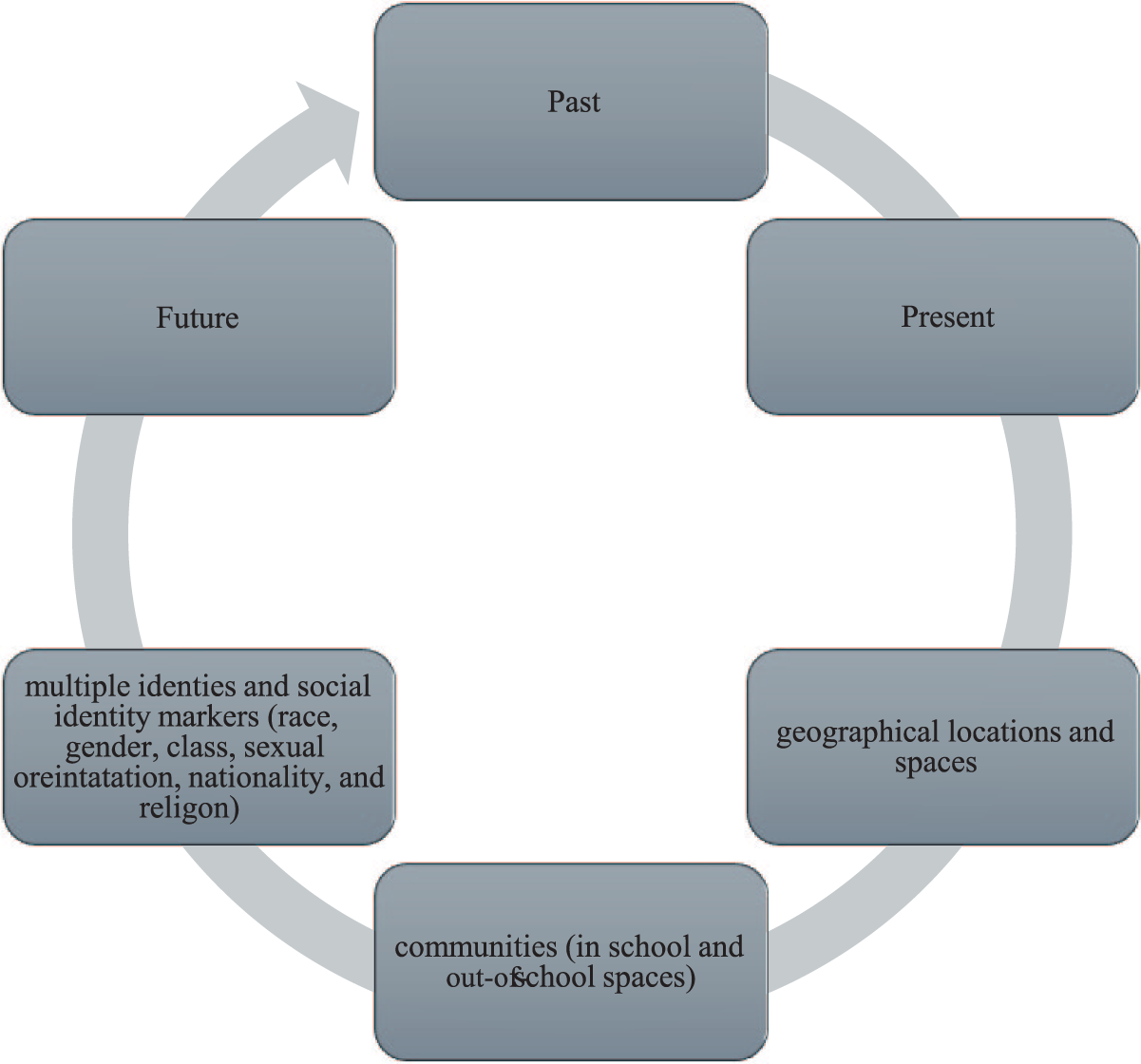
Modes of inquiry.
In this article, through a series of stories, I illustrate the familial knowledge and racialized and educational experiences that forge(d) the beginning and the continuing of my past, present, and future selves. I employ five genres: stream of consciousness, personal narrative, free verse poetry, photos, and student-written essays to document my racial hauntings, ghosts, and experiences. To examine these stories, I employ racial storytelling as a theoretical, methodological, curricular, and pedagogical tool to assist me in a deep excavation of myself(ves). Following each racial story, I provide an analysis through the process of self-actualization.
Building from the work of Baszile (2006), self-actualization serves as complex “breakthroughs” and “turning points” that have shaped my worldview. To illustrate, Baszile highlights one of her critical breakthroughs when she states, “Turning point: people whose identities are denied, troubled, invisible-ized must create the medium, the voice through which they become” (p. 95). As such, through self-actualization, I (re)enter these embodied stories to demonstrate how life moments impact how I/we think about racial issues in today’s context.
The questions that guide this line of inquiry are the following: (a) How can educators employ self-actualization and racial storytelling as pedagogical practices? (b) How can language and literacy scholars of Color use the radical (self) imagination as a thought and concept to face our racial ghosts and to analyze our hauntings? This article is organized to respond to these questions through, first, a discussion about the theoretical deployment of centering our past, present, and future self(ves). Then, I discuss the employment of self-actualization and racial storytelling as methodological and pedagogical practices. Following, I provide an in-depth practical application of a racial storytelling assignment that my preservice teachers completed as a course assignment. In closing, I propose the radical (self) imagination as a recommendation for language and literacy scholars of color and language and literacy education.
Theoretical Framework: Past, Present, and Future Self(ves)
Racial storytelling illustrates how my racial encounters from the past situate themselves in the current moment and still haunt me today. I deploy Gordon’s (1997) conception of haunting to describe and illustrate how the past shapes the present and how the past and present structure the possibilities of the future. It is the racial storytelling of these hauntings that can lead us to an understanding of ourselves and to feel empowered and free. Further, racial storytelling allows us to confront our racial hauntings and to work against our own miseducation while moving toward liberation and self-actualization (a more in-depth description of racial storytelling will come in the following section). Indeed, these hauntings illustrate how race has manifested itself within society, historically and in the present moment, and how race is going to directly impact our future. Race is a haunting that is often unseen—a haunting whose presence is not often recognized in most contexts and institutions, a haunting that appears to not be here, but its seething presence is always firmly present. Similarly, I am in agreement with Gordon (1997) when she writes, “to be haunted is to be tied to historical and social effects” (p. 190). As a person who is a Black male language and literacy scholar, I analyze and extrapolate how I am implicated in the historical processes. Hence, my racial hauntings assist me to understand that the ways I construct and produce knowledge are antithetical to the traditional knowledge production deemed acceptable and superior in academic spaces and society writ large.
Racial hauntings are continuous and deeply embedded within our lives and highlight how we carry these hauntings into our research, teaching, and service. It is important to note that these hauntings should not be considered repressed memories of the past; instead, we should use our hauntings as vehicles to help drive our pedagogical and methodological decisions in our classrooms. Confronting our racial and gendered ghosts is important because it is unhealthy and morally unethical to repress our memories (Bell, 1992; Dillard & Bell, 2011; Matias, 2016). Our racial hauntings can serve as an onto-epistemic and humanistic violent tool to dismantle white supremacist patriarchy. In other words, if we do not confront our racial ghosts, then it is an act of repressed and symbolic violence against y(our)self that ultimately continues the narcissism of whiteness and white supremacy (Matias, 2016). Just as repressed memories lead to physical and symbolic violence and protect whiteness, repressed memories block us from remaining human. In sum, then, when these memories (re)surface, scholars of Color (re)enter these experiences. (Re)entering these moments requires a deep level of vulnerability. Therefore, as educators, we have to be willing to own our feelings, particularly because we operate in a world where white rationality, patriarchy, and westernized thought illustrate emotions as a sign of weakness and portray that our emotions are detached from our truth, reasoning, body, mind, and soul (Baszile, 2010). For me, (re)entering these racialized memories often evokes feelings of passion, elation, love, frustration, anger, and rage.
Returning to the prologue, hearing such dehumanizing remarks from future educators oftentimes triggers feelings of Black rage.
When I speak of Black rage I am not by and large referring to violent outbursts directed at White people by Black people. Although Black rage unchecked can lead to such action, I am talking about the feelings of intense frustration—the killing rage, as bell hooks (1995) termed it, that creeps from the depths of one’s soul as a response to the profound and persistent White ignorance that shapes much of what we do in academia. (Baszile, 2010, p. 5)
hooks (1995) and Baszile (2010) explain that Black rage should not be misconstrued for hate. My Black rage is a coherent reaction against the exploitation, marginalization, and oppression of people who come from racially and linguistically diverse backgrounds. In addition, my Black rage has propelled me to think about my teaching and pedagogical practices as things that resist and subvert the traditional curricula and pedagogies, and it has propelled me to create classroom spaces where self-transformation, humanity, and liberation are infused throughout my curricula and pedagogical practices.
Method: Self-Actualization and Racial Storytelling
When education is the practice of freedom, students are not the only ones who are asked to share, to confess. Engaged pedagogy does not seek simply to empower students. Any classroom that employs a holistic model of learning will also be a place where teachers grow, and are empowered by the process. (hooks, 1998, p. 21)
If people who are educators and researchers of Color refuse to show our embodied vulnerabilities, we will not be able to create spaces for true empowerment for students (Hill, 2014). If we expect our students to be risk takers and to confess their stories, then we should be willing to take the same risks. As such, I argue that in our classrooms, we should center our self(ves) as a pedagogical practice. Teaching for liberation and human freedom is soul work—that is, it requires a deep excavation of the self(ves). When literacy scholars of Color bring ourselves to the classroom, it can help enhance our students’ understanding of our course material pertaining to critical race issues and racial justice work. However, it requires us to illustrate our vulnerabilities from taking a look within and tapping into our repressed memories and the subconscious. It requires us to revisit memories that we hope to forget but that continue to live on—memories that trigger feelings of joy, guilt, happiness, sadness, frustration, anger, and rage. Furthermore, hooks (1998) asserts, “most professors must practice being vulnerable in the classroom, being wholly present in mind, body, and sprit” (p. 21). Therefore, I believe we should teach students how to engage in self-liberation and human freedom through the process of self-actualization that leads to empowerment. Educators who practice self-actualization will be able to foster holistic pedagogical practices and teaching styles and methods for their students, which can positively affect our preservice and in-service teachers’ ways of knowing and being and to live more fully and deeply.
If we recognize education as an act of liberation and self-actualization, Baszile (2007) states that the reoccurring question then becomes, “Who am I?” To illustrate, she explicates that the curriculum we teach reflects our lived, raced, gendered, and classed experiences. As such, the curriculum becomes more than a box of materials, standards and indicators, and lesson plans for executing instruction; in this sense, it becomes autobiographical. Baszile (2007) writes that the curriculum is, “The category of identity, the notion of ‘self,’ which is not stable or fixed essence, but a vortex of psychosocial and discursive relations” (p. 95). Along the same lines, Pinar, Reynolds, Slattery, and Taubman (1994) contend that, “The study of identity enables us to portray how the politics we had thought were located ‘out there,’ in society, are lived through ‘in here,’ in our bodies, our minds, our everyday speech and conduct” (p. 9).
In this sense, the curriculum reflects our multiple identities and self(ves); furthermore, we carry our life histories and racialized experiences into our classrooms and research, and those racialized hauntings affect our curricular and pedagogical practices. Castenell and Pinar (1993) posit that the curriculum is a racialized text that mirrors the politics of race in the United States and beyond, and it reflects how the politics of race exist in our minds, our bodies, our spirits, and our selves (Baszile, 2006). To be clear, the traditional school curriculum has historically and contemporarily reflected eurocentric onto-epistemologies while inescapably killing the spirit and the humanity of children and youth of Color by marginalizing their voices, erasing their experiences, and overlooking them as producers and holders of knowledge.
From this perspective, educators of Color must work to transform the curriculum so that it does not mirror anti-Blackness (Dumas & Ross, 2016), anti-indigenous (Mays, 2017), and anti-Brown-ness (Martinez, 2016) beliefs or reinforce a male-centered, white education. Moreover, when teachers of Color possess the alacrity to subvert the traditional curriculum, our/their teaching practices, pedagogies, styles, and methods become sites of resistance. As a result, resistance exists within our own self-actualized entanglement with race, racism, and power. These moments of self-actualization need to be analyzed and understood pedagogically.
Returning to this notion of racial hauntings and ghosts, as scholars of Color, whether we acknowledge them or not, we all have racial hauntings. So now, the question becomes, How can teacher-educators of Color begin to identify/analyze our racial and gendered hauntings and confront our ghosts, and what does it mean for teacher education? To tackle these ghosts, I believe educators can utilize racial storytelling as a response to our racialized memories, repressions, suppressions, and oppressions. Racial storytelling enables us to tackle our racial hauntings and to work against our own miseducation while working toward self-transformation and liberation. As a pedagogical practice, engaging in racial storytelling creates a contested space that illustrates our stories do not solely belong to the self—in short, our racialized stories are not just our stories. Racial storytelling requires what Dillard and Bell (2011) call (re)membering. Dillard and Bell write that “it is our duty—our responsibility—to remember” (p. 347). The process of (re)membering through racial storytelling illustrates the intentionality of narrating these stories as ways to employ these memories and to preserve these racialized stories.
It is pivotal to note that racial storytelling is different from counter-storytelling and autoethnography. However, I do view counter-storytelling, autoethnography, and racial storytelling as modes of storytelling that can support one another and are members of the storytelling lineage. First, it is important to highlight that counter-storytelling is utilized by people of Color as a theoretical and/or methodological tool to counter and disrupt traditional and dehumanizing stories that institutions and society hold about people from different racial backgrounds and ethnic identities (see Boutte & Johnson, 2013; Johnson, 2016; Solórzano & Yosso, 2002). Second, Hill (2014) defines autoethnography as a set “of relationships between researchers and the researched, identity, and interests in narratives that include emotion and the body” (p. 168). Furthermore, autoethnography is a method, methodology, and process that challenges the traditional ways of writing and conducting research, and it views research as personal and political. In addition, autoethnography is a method that can be employed by white educators and scholars; however, autoethnographic work does not necessarily center racism, whiteness, and white supremacist patriarchy. Equally, for storytellers who are centering different critical approaches for people to tell their stores, racial storytelling is an option as racial storytelling allows us to (re)enter and to bear witness of our racialized past to assess where we are in the present so that we can begin to (re)imagine our future. It also illustrates how our multiple identities and our social identity markers (e.g., gender, class, sexual orientation, nationality, religion, language, and dis/ability) all influence how we are racialized and are always in complex dialogue with each other.
On the one hand, for people of Color, racial storytelling is merely telling a story involving race and racism without the gaze of the dominant narrative. Simply stated, our experiences and who we are as people of Color are not always in relation to or with white people. That is, racial storytelling does not have to be utilized to counter dominant narratives. The existence and humanization of people of Color should not have to be in opposition to white people. However, this does not mean counter-stories cannot transpire from racial storytelling.
On the other hand, racial storytelling is not only for people of Color; it is inclusive to white educators, researchers, children, and youth. white teachers and white students can engage in racial storytelling, particularly to tackle their own racism and to story their racialized experiences. To be clear, white people are the ghosts—your protection of whiteness and the protection of your white privilege are the things that produce these racial ghosts that lead to our (people of Color’s) racial hauntings. Moreover, to truly do justice-oriented work, white people have to engage in this process of racial storytelling because it can help lead to true self-actualization.
Self-Actualization
This is not to center or cater to whiteness! Suffice it to say, whiteness seethes through P-20 spaces. The educational system is riddled with neoliberal discourses, unjust polices, and traditional pedagogies that continue to sustain whiteness while indoctrinating white people to believe the specious claims that are painted about people of Color. white people have the privilege of shutting down and the luxury of not having to carry around the burden of race and racism, particularly when they do not feel the need to deal with these pressing issues (Aronson, 2017). People of Color do not have the same privilege—deal with it we must. To engage in true racial-justice-oriented work, white educators must look deep within and face their own racial ghosts. Indeed, when white educators work against whiteness and racial oppression and work and teach for full humanity and liberation, it requires a metaphorical death. In relation to this notion of a metaphorical death, it is important to note that for more than 500 years, the United States has always aimed to protect whiteness and white supremacist patriarchy. With this being said, white children, youth, and adults are possessed with what Dillon (2012) calls the spirit of slavery—she writes, “The spirit of slavery has its own desires that exceeds our conscious control or thought. But for the demonic to be exercised, you must first know that you are possessed” (p. 123). Building on those sentiments, Johnson, Jackson, Stovall, and Baszile (2017) argue that, “Such a radical love must work to acknowledge and defeat our capacity to be possessed” (p. 63).
Moreover, racial storytelling enables white people to tap into their repressed racial memories; it can take them back to a time, an experience, and a place that forces them to engage in critical self-reflection and commit to the deconstruction of whiteness and white supremacy. Moreover, racial storytelling can propel white teacher educators, educational researchers, and preservice and in-service teachers to be reflexive of how the spirit of whiteness infiltrates their minds, bodies, and souls—and, thus, requires them to question their involvement in the journey to racial justice. This requires a deep excavation of the self(ves) in relation to race and racism. This means tapping into their senses of racism by working assiduously to make discoveries: What does racism sound like? What does racism feel like? What does racism look like? And, what does racism taste like? In short, racial storytelling provides white educators with a new way to emotionally invest in the dismantling of racism, whiteness, and white supremacy, “in a way that fairly redistributes the racial burden of race” (Matias & Grosland, 2016, p. 2).
The Ghostly Matters of Race, Place, and Space in the South
My racial and gendered hauntings are connected to my experiences growing up in the South, particularly Edgefield, South Carolina. The context of Edgefield in relation to my raced, gendered, and educational experiences forged the beginnings of my multiple selves as a Black male. The South is key to understanding the historical and contemporary dimensions of race, racism, and white supremacist patriarchy in both educational and societal contexts (Morris & Monroe, 2009). Cutts, Love, and Davis (2012) posit that although the region has moved—publicly at least—beyond the days of separate and inherently unequal, cross-burning, lynching, sit-ins, etc., “the power of place” continues to impact the experiences of those who live, work, and are educated here. (p. 59)
The conceptualization of race and place interlocked with time and space mirrors, extends, and is extended by my geographical location, my social identities, and my subjectivities. Having just argued that the geographical context of the South is intertwined with my racial identities, now I want to complicate this point by providing a racial snapshot of the geographical context of Edgefield, South Carolina.
Edgefield is the home of Senator Strom Thurmond. He served as a U.S. senator for 48 years. During his tenure, Thurmond opposed the 1964 Civil Rights Act and pushed for the continuation of segregation. Edgefield County has a population of 4,500, and the county has one secondary school—Strom Thurmond High School (STHS). Each day, hundreds of students from different racial and ethnic backgrounds enter a high school that bears his name and conveys to students that he is a legendary hero and victor (Figure 2 illustrates STHS, located in Edgefield County School District and established in 1961). Currently, STHS serves roughly 800 students in Grades 9 to 12. African American/Black students make up 49.9% of the student body population, and white students are 43.3%, with Latinx and multiracial students making up 6% of the student demographics.
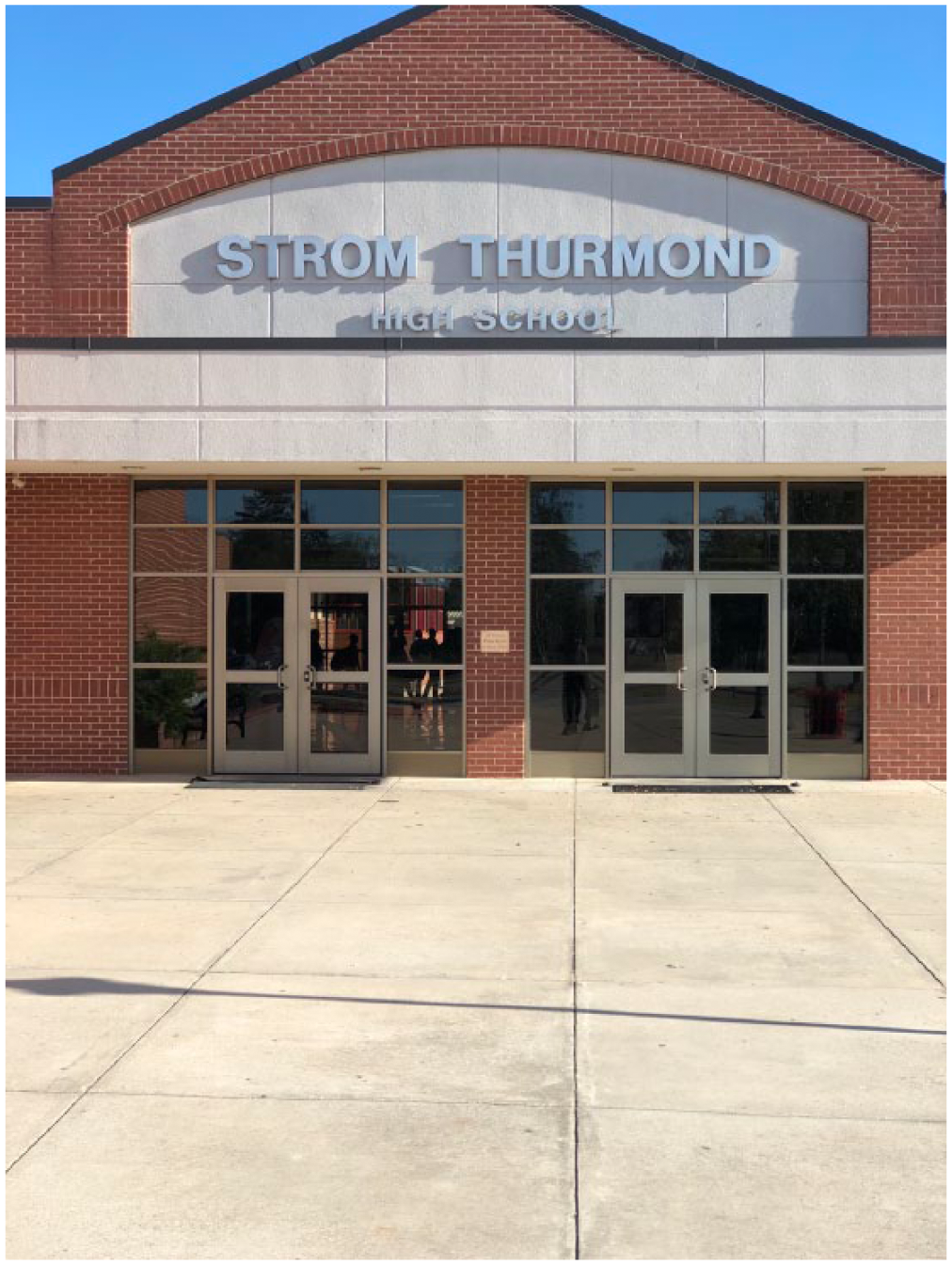
Strom Thurmond High School.
During my seventh-grade year (2001–2002), STHS had its first integrated prom (Smith, 2014). Prior to this, the high school held two separate proms—a prom for Black students and a prom for white students. In 2003, Black students, families, and communities pushed the school district and the school board to eradicate STHS’s “rebel” nickname and its old Southern colonel mascot (Figure 3; this was the official mascot from 1961 to 2004). The representation of the colonial mascot symbolized the confederate South and the oppression of Black people. Over 30 years later, in 2003, after careful deliberation, the school board voted to keep the rebel nickname and to adopt a bluetick hound as the new and current school symbol (see Figure 4). Historically, bluetick hounds were trained to track enslaved Africans and African Americans who were escaping for their freedom. I do not share these hauntings to vilify the South or my hometown of Edgefield County but to simply illustrate how these hauntings run deep and are the sources that shape my Southern roots as a Black male language and literacy scholar who grew up in the (New) South.

Southern Colonel Mascot from 1961-2004.
Bluetick Hound Mascot from 2004-Present.
Past Self: A Haunting of the Summer of ’96
It was the summer of 1996—the summer before I started fourth grade. I was 9 years old. I sat in my granddad’s living room playing with my X-Men Wolverine action figure. My great-aunt was in the kitchen preparing dinner, and the sweet aroma of her food drifted from the kitchen to the living room. It was around 5 o’clock and Walker, Texas Ranger played in the background. While multitasking between reading his mail and trying to keep up with the storylines from the show, my great-granddad yelled for my great-aunt. My aunt paced quickly from the kitchen to the living room. She stopped at the threshold. Wiping her hands with a dish cloth, she responded, “Yes, Daddy.” Sitting in his midbrown rocking chair with his golden brown wooden cane resting between his legs, he slowly leaned up and said, “I need for you to read this to me.” He reached out his thin, dark hand that was tendered with age—and he handed her the white, crinkled envelope. She walked to my great-granddad to take the envelope. She stood there silently reading it to herself. After my aunt finished reading the mail, she explained to him that it was a bill and the significance of why he had received this particular bill.
I continued to play with my X-Men action figure, particularly because I had no interest in Walker, Texas Ranger or the western shows my great-granddad would watch. After he asked my aunt a series of questions about the bill he had received, he began to read The Citizens News, the local newspaper for Edgefield County. During this particular moment, I became slightly confused. I tried to make sense of why my granddad asked my aunt to read his mail to him—yet, he was now reading the newspaper. With an inquisitive look, I asked, “Big Daddy, why did you ask Sista to read your mail to you?” (We called him Big Daddy instead of Grandpa or Granddad. I was told it took a special man or woman to be called Big Momma or Big Daddy.) The newspaper covered his face. Slowly, he began to lower the paper. He hesitated a moment before answering. I could see his heavy, watery eyes and his nose. I was somewhat nervous, because growing up, my cousins, sister, and I were told to stay out of grown folks’ business. Furthermore, I knew I had stepped into what (at the time) I thought was grown folks’ business, and I was uncertain about what his response or reaction would be. Slowly, he confessed, “I don’t know how to read.”
With a puzzled look resting on my face, I questioned, “What do you mean . . . you can’t read?” I was slightly confused because moments ago he was reading the newspaper. Before I could further investigate, he set the newspaper in his lap and he replied, I never finished school, which is why I am always tellin’ y’all to get an education and to stay in school. When I was in the third grade, I stopped going to school. I had to work and make money for my family.
My granddad paused for a second to recollect his thoughts and then he continued, My mom had just dressed me for school. I had on blue overalls. Once I was dressed, she kissed me and told me to have a good day. I ran to the front door. As I walked onto the porch, the white man who my dad worked for said he needed me to stay home to work. My dad was a sharecropper for this white man’s family . . . . I really wanted to get an education. I thought my dad was going to speak up to the white man, but my dad just stood there. Soon after this incident, I learned my dad never spoke back to White folks because he was afraid he would lose his life.
I sat there trying to process what my great-granddad had just explained to me. Then, he continued, I stopped going to school during the third grade because I had to sharecrop to help provide for my family. white folks didn’t want us to get an education. I made a promise to myself that one day when I have children, I would make sure they knew how to read and write—and all eight of my kids learned how to read and write. And guess what, they have all helped me with my reading and writing skills. Your uncle Frank and uncle Raymond taught me how to write and sign my name. And, my daughters have taught me certain words through reading the newspaper, mail, and books.
Recently, I spoke with my grandma and my great-aunts about my great-granddad’s educational and literacy experiences. Because this particular racialized encounter with my great-granddad happened when I was 9 years old, I wanted to further investigate my grandfather’s literacy and educational experiences now that I’m reentering this moment. While replaying a conversation between her and my granddad, my great-aunt Bonnie asserted, “Daddy loved and valued education. He loved it so much that sometimes when he thought about it”—she paused—”it would bring him to tears. I will never forget the first time I saw Dad cry. It was when I was an adult with my own children. He told me how much he hated that he couldn’t read to his children at night. And, while making this statement, he began to cry.” A silent pause filled the room—and then she reiterated, “That was the only time I saw my daddy cry.” Then, she proceeded to tell another story about my granddad’s critical literacy practices, particularly how he created his own literacy skills to maneuver through his career.
My grandfather worked for the Southern Railway Corporation for 32 years and had perfect attendance. Although my granddad worked on railroads, there were particular tasks that required traditional literacy skills. My grandma and great-aunts explained my great-granddad had to take measurements of the tires, which required in-print reading. Being the self-reliant, self-learned, and self-taught man he was, my great-granddad discovered how to read the measurements through creating his own literacy practices. He illustrated how his sacred and special literacy practices were only for him. I’ve heard many of my great-granddad’s railroad stories; however, there is one in particular that stands out to me. My great-granddad’s railroad company hired a white male mechanical engineer who had recently graduated from college. One day, the engineer was measuring the tires. My great-granddad noticed he was not measuring them accurately. When my great-granddad’s white male supervisor checked the mechanical engineer’s measurements, immediately, the supervisor recognized that the measurements were inaccurate. The supervisor asked my great-granddad, “Frank, why didn’t you help him? These measurements are wrong. You know how to do this.” My granddad replied, “He’s the one that just finished college—he’s supposed to know how to do this stuff.”
Self-actualization
Through my great-granddad’s stories about literacy, he showed me literacy is sacred and important within Black families and communities. This is demonstrated between my great-granddad and his children when he explained that his children taught him how to write his name, how to pronounce and recognize words, and how to decipher the meaning of words within context. Similarly, when my great-granddad asked my great-aunt to read his mail to him while he simultaneously read the newspaper, it was the first time I began to problematize this notion of what it means to be literate and what it means to be illiterate. In that moment, the dominant/traditional versions of literacy were put at odds against my family’s and community’s versions of literacy. I now understand my great-granddad was in fact reading the newspaper. Along with reading some print words and phrases, he, too, read for meaning through reading the images, artwork, and headings.
The intertextual threading of my great-granddad’s racialized stories into my own onto-epistemologies and worldview has led me to a consciousness of my consciousness (Baszile, 2006). By this, I mean I have now discovered the language and critical literacy practices for describing my psyche and conception of reading and literacy (Boutte, 2015; Haddix & Price-Dennis, 2013), and, hence, the disturbance of my selves. (Re)entering this moment with my great-granddad showcases his complex literacy and educational biographies. Literacy and race are intermixed. Moreover, my great-granddad’s literacy stories and experiences unpack the linkages of literacy, race, and white supremacy, which has assisted me to conceptualize how race situates itself within my research and teaching. Furthermore, my great-granddad’s story captures the essence of racialized literacies—ones that grew out of oppressive places but (re)created spaces where people who are/were oppressed can (re)imagine themselves as literate people, in spite of what whiteness tells them.
To illustrate, my great-granddad’s story about his limited amount of schooling experience explicates how access to education was denied to Black people. In addition, this story illuminates how the working of whiteness, white supremacist patriarchy, and anti-Blackness all prohibited many Black children, youth, and adults from learning to read or from honoring the language and literacies of Black people. My first racialized critical reading of the world comes from the raced and gendered stories from my great-granddad. Through his utilization of oral storytelling, I listened to my great-granddad’s stories and the narratives about him, and they have provided me with racial, familial, and gendered knowledge. Indeed, these social identity markers are/were the impetuses to my criticality, interpretation, and evaluation of my world(s).
Past Self: A Racial Memory of Sixth-Period ELA—Ms. Ryans and Me
Brrrnnnggg . . . Brrrnnggg—the bell rings for us to transition from lunch to sixth period. The smell of popcorn, chocolate, and candy permeate our seventh-grade hall. In between our goodbyes to our friends while trying to gobble down the last of our lunch, we scurry to make it to our next classes before the tardy bell rings. Teachers are standing outside their doors talking to one another, and there is clashing and banging of the lockers coupled with the screeching of our sneakers running across the shiny, checkered-box floors while the teachers scream, “Walk!” to signal us to stop running. It was sixth period, and I had Ms. Ryans for English language arts (ELA). Ms. Ryans found something special to love in each child, and she displayed it. When I was in the sixth grade, I remember riding the bus and hearing the older kids talk about her. She was an excellent teacher whose reputation preceded her.
Many of my peers who identified as Black appreciated having Ms. Ryans; she was one of the two Back female teachers on the seventh-grade hall. The other eight teachers we encountered were white, female, middle-class, and monolingual. In many ways, when we saw Ms. Ryans, we saw ourselves. For example, Ms. Ryans was a native of the school district. She knew and understood the community, the demographics, and most importantly, the students. Ms. Ryans provided me my first encounter with books where I learned about other cultures, the world, and myself.
Brrrnnnggg! The sound of the tardy bell rings. The chatter becomes silent. We open our yellow three-pronged folders. We fill out our reading log to begin our daily routine of 15 min of silent and independent reading during the beginning of each class. In a faint whisper, “Lamar.” Ms. Ryans calls for me to come over to her desk. I quietly walk to her desk. Click. Click. Ms. Ryans’ small brown hands click the computer mouse while she is taking attendance. I sit down in the blue chair. I can smell her sweet perfume and her aromatic body lotion. Adjacent to her computer screen is this white Styrofoam cup that she is drinking sweet tea from. Click. She finishes selecting the last few names left for attendance. Click. Then, she says, “I want to talk to you. It’s good you are doing well in all of your classes. But you need to be careful and maybe . . . cut back on how much you are talking in class.”
I am perplexed by her comment, and I begin to think about how I behave in my other classes. The worst thing I could think of was my talkative behavior. I turned my work in on time. I passed all of my quizzes and tests. I didn’t find the material too challenging, so when I finished my work, I tended to talk, but never too loud, where I was disrupting the entire class. I didn’t envision my talkative behavior as problematic—my parents didn’t play that! In keeping with racial storytelling, I reenact the conversation I had with Ms. Ryans in the form of a verse poem.
The White Styrofoam Cup
You need to watch how you are behaving in class.
Everybody
isn’t on your side.
As Ms. Ryans made this statement, her golden-brown finger simultaneously tapped the white Styrofoam cup.
Some people think you need some time out of school . . .
because
you’ve been too talkative in class.
You can’t trust them, she said.
As her golden-brown finger simultaneously tapped the white Styrofoam cup. I went back to my spot on the floor. Opened my book and stared at the pages. Replaying Our conversation. The tapping of the white cup symbolized white people, Particularly in this case my white teachers. and, Ms. Ryans was telling me not to trust them.
Self-actualization
During the summer of ’96, my great-granddad shared stories about his racialized experiences and his experiences growing up as a Black child and man in the South. A year later, during the fall of ’97, I had my first conscious and personal face-to-face encounter with racism. I will never forget that one pivotal incident from my fifth-grade class, of being disinvited from a white classmate’s pool party simply because of my Black skin. Three and a half years later, the teacher I trusted, just “keepin’ it real,” told me not to trust my white teachers. Simply put, she was telling me not to trust white people in general. It is important to note that Ms. Ryans’s comment about white people should not be conflated with hate. She was assisting me by bringing awareness to my understanding and conceptualization of white people, whiteness, race, racism, literacy, and education. Oftentimes, we conflate the feelings of “distrust” or “rage” with “hate.” These feelings are not synonymous. Ms. Ryans’s conversation with me was an act of love. In that moment, I (re)entered those unfortunately all-too-common incidents of being excluded, erased, and/or ridiculed. That particular day in Ms. Ryans’s sixth-period ELA classroom, I decided to dedicate my profession and life to disrupting racism and working toward supporting the humanity of all people through literacy. My goal was to be like Ms. Ryans, who was determined to be a teacher-activist and power for good in the world.
In addition, I draw on these particular racial narratives because these memories forge(d) the development of my multiple self(ves) as a Black male. Similarly, in conjunction with my racialized experiences, the texts I encountered from Ms. Ryans also affected my emergence of the self(ves). To be clear, my racialized experiences affected how I read books, understood the characters, and made meaning with the text. The implementation of culturally relevant texts and texts that centered race and racism helped me to make clear the roles race and racism play(ed) in society. Moreover, interacting with these texts helped me construct my identities as a Black male. With this being said, I view literacy as an onto-epistemological act—in this sense, reading is more than reading words on a page. Literacy reflects one’s cultural, racial, linguistic, and ethnic contexts, triumphs, and struggles: Block contends that reading is, in fact, a sociopsycholinguistic productive process which occurs as a transaction between the cultural, social, and personal psyche of the virtual reader, already a complex textual subject, and the verbal text. The purpose and the effect of this transaction is the production of meaning. Meaning is identity: The way I organize meaning is the way I represent me. (As cited in Baszile, 2006, p. 90)
We have heard stories of literacy as apolitical, which is grounded in westernized notions of what counts as literacy. Sadly, the traditional conceptions of literacy do not view literacy as a social practice but rather posit literacy as a technocratic and linear process (see the work of Haddix & Price-Dennis, 2013, for example). Similarly, these traditional literacy pedagogies and practices symbolically kill the spirit and humanity of people of Color. Unfortunately, this is not anything new. For centuries, literacy has been used as a tool to marginalize people of Color, and today, literacy has been co-opted and continues to oppress people of Color. Building on the words of Kirkland (2009), “literacy is a human issue, and by denying literacy, one also denies a person’s humanity” (p. 378). Although schools often utilize literacy as a tool to oppress youth of Color, I, as a Black male English educator, understand and teach literacy as an act of humanization. Therefore, I give a side-eye to educators who deny that racial, gender, and xenophobic oppressions against people of Color are not interconnected to our past and current language and literacy pedagogy and curriculum. I give a side-eye to educators who believe that we are teaching in a postracial society. To be direct, racism is not a construct from the past—it still lives and breathes in our present and it shapes our future. Race still matters!
A (Re)Visit of the Ghosts of Future Present
As I looked around the room, I thought to myself, I shouldn’t be surprised that the majority of you haven’t heard about or followed the recent events that are happening in Ferguson. Your privilege and whiteness protect you from having to know the names or the stories of Black people who have lost their lives to police brutality and white supremacy.
I stood there disheartened, bruised, and on fire. My thoughts continued to race: For 3 months, I have been the only person of Color present in this space. It is quite difficult to detach my Black male identity from who I am as a Black male English educator. Therefore, how can I discuss both of these racialized incidents with you as a way to help you recognize your unconsciousness and your privilege of not having to know or to care about the devaluation of Black lives?”
Self-Actualization
I’m not cray!
In that moment, I decided to release my repressed pain. I channeled the spirits of Black revolutionaries such as Harriet Tubman, Frederick Douglass, Sojourner Truth, Dr. Martin Luther King Jr., and Malcolm X (just to name a few). Glancing over the room, I took a deep breath, and I consciously stated, I have developed an ongoing rage and anger, but this rage and anger should not be conflated with hate. I am angry at the fact that Black bodies were/are misread in society and the very sight of our Black bodies positions us as subservient, criminals, and inhuman. . . . I am angry that Black and Brown youth are losing their bodies to the hands of white supremacy. I have a right to be angry because white supremacy shields you from having the willingness to learn or to understand the many forms of racism. Not only does white supremacy protect you from seeing the humanity in Black and Brown people, it also protects you from seeing the humanity within yourself. Furthermore, unintentionally and/or intentionally refusing to name and to recognize white supremacy and whiteness continues to hurt people of Color. . . . I am angry because it has been 3 months since Michael Brown’s death. His death ignited national attention across different racial and ethnic communities and within higher educational spaces, such as this institution. . . . I am angry because 2 days ago, Tamir Rice, a 12-year-old Black child, was killed playing in the park in Cleveland, Ohio, just four hours away from here. At this moment, I want you to take a few minutes to think through the following question: What does it mean to be human in the 21st century? (As cited in Baker-Bell, Butler, & Johnson, 2017, p. 122)
Implications: Teaching Our Racial Ghosts on “Monday Morning”—A Practical Application of Racial Storytelling
In the wake of racial violence, national organizations such as the National Council of Teachers of English (NCTE) and the Literacy Research Association (LRA) have charged literacy scholars, English educators, and ELA teachers to take the onus of our roles in the quest for racial justice (LRA, 2017; NCTE, 2015). Throughout this article, I have demonstrated how I, as Black male language and literacy scholar, engage in racial storytelling as a pedagogical practice. With this in mind, I offer a description and an example of a racial storytelling assignment that my preservice ELA teachers engage in to assist in their dismantling of race, racism, whiteness, and white supremacist patriarchy—while centering their racialized experiences and stories. Further, Matias and Grosland (2016) state, such a personalized process moves the discussions of racism from meaningless to personally invested. Suffice it to say that to move away from doing lip service to race studies, teacher education must directly engage whiteness and emotionality to deconstruct the hegemonic stronghold of white supremacy.” (p. 4)
I share this racial storytelling assignment as a way to help literacy scholars (re)imagine how we engage our preservice and in-service teachers in humanizing pedagogical practices so that in return, they can use these humanizing pedagogical practices in their current and future classrooms on “Monday morning” (Baker-Bell, Stanbrough, & Everett, 2017). In short, I provide this racial storytelling assignment as one of numerous assignments that educators can utilize to incorporate critical teaching methods, styles, and pedagogies in literacy classrooms.
The Racial Storytelling Assignment
Flowing out of the opening vignette, I engaged my preservice teachers in a space where I could truly create conditions for them to engage in racial-justice-oriented work; as such, I had to engage them in an ongoing process of critical self-awareness. It is imperative for ELA teachers to know themselves and understand how their racial past, present, and future shape their beliefs, values, and the multiple decisions they will make as teachers. The lesson I engaged my preservice teachers in also included how our social identities (religion, gender, class, nationality, language, etc.) shape who we are today. My humanizing assignment was a form of critical autobiography/memoir that provided my preservice teachers with an avenue to explicate their own critical incidents and to begin to consider how these racialized experiences shaped their beliefs about education, their images of language and literacy, and their decision to become a teacher.
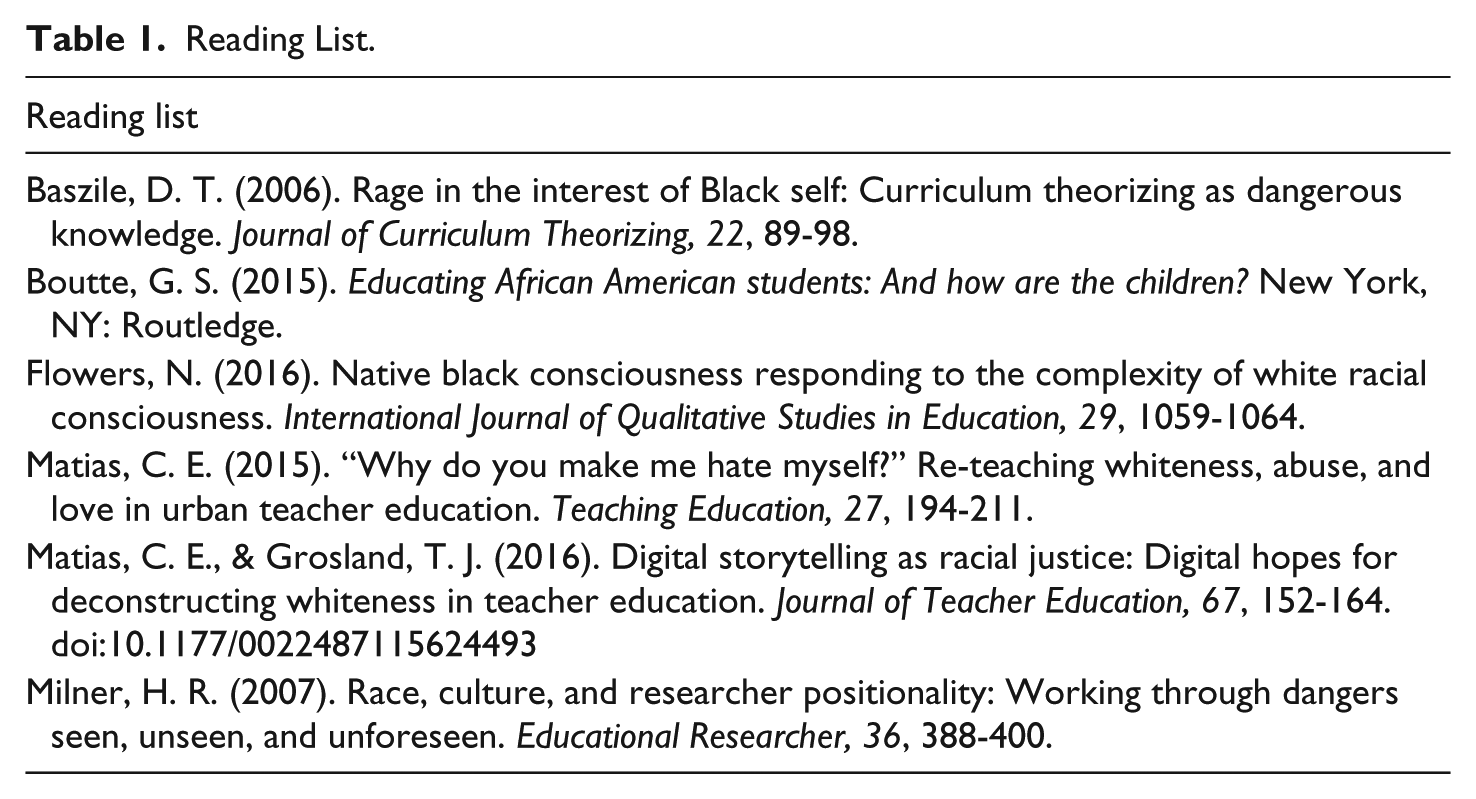
To prompt my students’ thoughts, I provided them with the following questions: (a) How have my lived and racialized realities contributed to my conceptualization of myself(ves) and others as racialized beings? (b) How does my racial background affect how I exist and operate within the world? (c) How have my educational experiences been racialized? Table 1 illustrates the reading list I gave to my preservice teachers.
Reading List.
Engaging students in this assignment prompted me to wonder what would happen when I engaged my students in conversations that matter.
Sample statements
In this section, I provide several snapshots and samples from preservice teachers’ racial storytelling assignment as a way to illustrate how these future ELA teachers engaged in deep critical self-reflection and to illuminate how racial storytelling assignment(s) can be utilized as a humanizing pedagogical practice. The selection of the students’ comments is reflective of my class racial and ethnic makeup. In this undergraduate literacy course, there were a total of 15 students—14 of those students identified as white. I had only one student of color, and she identified as biracial.
So, I guess I would consider myself one of the hopeful children who believed we made it to a “post-racial” society simply because I had never faced blatant racism. I was biracial, which somehow translated to the thought that we, as a nation, have overcome racism because I existed and remained unharmed. Boy, was I wrong. As much as I hate to admit this, I would say I was conditioned to be white. And, I don’t know if anyone is to blame for that. I don’t want to blame my parents—I’m sure my mom didn’t think anything of it, but I’m always wondering if my dad thought it was necessary. Maybe he thought I’d have better chances of making it. Maybe he thought it was safer. But I feel like a part of me is dying and struggling to breathe, and I don’t know what to do. This is why I want to be a teacher. Not to repair the mistakes that my parents may have unintentionally made, but to be there for the students who struggle with their identity just as much as I do. Children of Color need an adult standing in front of them with eyes, nose, and hair like them. I wonder what my life would be like if I had a teacher that looked like me. Would I be any different? Would I have appreciated them more than anyone else? I would like to think so. And to this day, I still have never had a biracial instructor. But that’s just life for a biracial kid—I guess. The only representation you get is yourself. However, my work is not only focused on being a role model for young mixed kids; I have a responsibility to help students of Color because I feel my story was forgotten in my education experience: Baszile (2006) states that “Black children didn’t need to know of their Blackness” (p. 93). As such, no one ever told me my story was not being told until I realized it in college. I owe it to my students to celebrate their own stories. I want them to see themselves in works; I want them to know they have every capability of achieving, even when the world seems to have turned their backs on us (biracial female student).
As the majority of incoming education students are still white, it is crucial to analyze the impacts of whiteness. No white educator can simply ignore their own positionality and how it relates to their experiences and their perspectives on institutions. Many white people felt like the prevalence of white perspectives (white authors, white educators, etc.) in their schooling is somehow neutral or unbiased, but in reality, these contexts coddle whiteness and allow white folks to be ignorant to race and racism. For non-white students, “official classroom spaces, for nondominant students, can often function as a white public space due to judgment based on white standards and practices” (Martinez, 2016, p. 76). In becoming cognizant of this experience, students of color are likely to have white educators who must check their perpetuation of whiteness. Once teacher education recognizes how “whites have become culturally white, it can engage in a deeper conversation of race and racism, move beyond guilt, anger, and denial needed to become whole-heartedly antiracist” (Matias, 2015, p. 206). (white female student)
The combination of my upbringing, educational experiences, and beliefs brings me to the question of how I see and exist within this world, as well as a reevaluation and reflection of my conceptualization of myself and others. For most of my life, I viewed myself as not being racist. I did not hate people of Color, I did not support violence and discrimination against them, and I certainly wasn’t vocally and outwardly racist. I thought it was impossible for me to be a “racialized being”—I am white. Although white is definitely a racial category, when I hear the term “racialized being,” I think of someone in a Black or Brown body—someone whose worldview and experiences have been shaped and dictated by their race or ethnicity. Reflecting now on my existence, I realize I am not only racist but also a racialized being—just not in the way I previously conceptualized it. Although I could easily refuse to admit it, I still carry biases, make assumptions, and catch myself stereotyping. It is uncomfortable and embarrassing to make that statement, but I am not ashamed to admit that I always consciously challenge myself to reshape my conceptualizations of myself and those around me. This is not a simple undertaking, and it is one I feel I will contend with my whole life. But, I would much rather challenge my thinking every day than to let myself fall into a simple pattern of bigotry, stereotyping, and prejudice. To do so would not only do myself and those around me a disservice, but it would be a disgrace to the education community as a whole. (white female student)
A term loved by my generation is brought to mind when I think about what kind of an English teacher the world needs me to be: a “woke” one. I have always found this term interesting because it puts into words the contrasting feelings I had before and after I became aware of my privilege, particularly by being intellectually challenged at MSU [Michigan State University]. Before my first racialized encounter as a fourth grader, I realized the people who I surrounded myself with had such an impact on how I viewed myself as a racialized being. Before I came to MSU, where I began to understand the immense privilege I had been carrying with me since the day I was born, I was asleep. I was unconcerned about issues of race, and I could afford to be this way. My eyes were closed. MSU’s intellectual and social spaces jarred me into reality; my experiences here were the cold water, the alarm clock, the mom throwing the shades open to let the sunshine in. I am of the opinion that no one can be “too woke.” It is a continuing process of making sure to be aware and respectful, as well as actively working against the systems of oppression that are at play in our society. It’s knowing that my use of the word woke doesn’t necessarily have the same connotations as when a person of color uses it in terms of being safe and questioning the power structure. In the classroom, it is being aware and taking action to ensure my students, especially those of color, feel represented in the curriculum, and feel respected as intellectuals and scholars. (white female student)
Throughout this section, I was intentional about delineating how racial storytelling provides preservice teachers with a space to confront their own relationship(s) with race and racism while building a positive racial consciousness and providing them with the knowledge to become antiracist beings. As I reflect on this assignment, I acknowledge that preservice teachers of color and white preservice teachers apply racial storytelling differently, particularly because of our/their different racialized experiences. For example, the racial story of Kali (pseudonym), the biracial student of color, allowed her to (re)enter her childhood and (re)analyze her experiences growing up as a biracial female with a mother who identified as white and a father who identified as Black. Kali’s (re)evaluation of her racialized past self provided a doorway for her present self to see that her Black biracial female body is still marginalized and unsafe. For instance, she exclaims, “But I feel like a part of me is dying and struggling to breathe and I don’t know what to do. This is why I want to be a teacher.” The racial storytelling assignment illustrated Kali’s inner disturbance and provided her with an outlet to be vulnerable, to take a deep look within, and to return to the perennial question of “Who am I?” Similarly, Kali’s racial story illustrated that engaging in critical work is an ongoing journey. As such, if she continues to engage in critical work and transformation, there will be many moments when she will experience a metaphorical death—metaphorical deaths occur when we are opened and willing to become more critically conscious about race, racism, and other intersecting oppressions. In short, Kali is experiencing her rebirth and continuous journey to self-liberation and human freedom. In return, her rebirth and self-liberation can propel her to provide students of Color with a classroom space for them to grow, to heal, and to learn about who they are culturally, racially, ethnically, and linguistically, but most importantly to love who they are.
In contrast, for white students, the racial storytelling assignment catapulted them to (re)enter their racial past to analyze how they are implicated in the racial oppression of people of Color and to evaluate how their racist ideologies, stereotypes, and prejudices are inescapable because of the working of whiteness and white supremacy. For instance, one white female student explains, Though I could easily refuse to admit it, I still carry biases, make assumptions, and catch myself stereotyping. It is uncomfortable and embarrassing to make that statement, but I am not ashamed to admit that I always consciously challenge myself to reshape my conceptualizations of myself and those around me. This is not a simple undertaking, and it is one I feel I will contend with my whole life.
Building on this statement, the white students who engaged in the racial storytelling assignment illuminated the importance of decentering whiteness not only in educational spaces but also in society writ large as ways to fight against racism and to authentically and humanely engage in antiracist practices. As one white female student pointed out, there are an immeasurable amount of white people walking around classrooms asleep and dismissive of the life histories and experiences of students of color. Furthermore, she goes on to explain that white teachers must #StayWoke in ELA classrooms. To illustrate, she contends, Before I came to MSU, where I began to understand the immense privilege I had been carrying with me since the day I was born, I was asleep. I was unconcerned about issues of race and I could afford to be this way. My eyes were closed.
In like manner, to create a #Woke classroom, Cherry-McDaniel (2017) explains that ELA teachers and English educators must create contested spaces where students can negotiate, analyze, and critique their identity formation. That is, a #Woke classroom is a transformative space that supports the interests and intricate identities of children and youth of Color. A #Woke classroom creates a humanizing space for students to become inclined to see themselves as critically race-conscious citizens.
In closing, the racial storytelling assignment enabled preservice teachers to critically reflect on their childhood experiences with their families and friends, trouble their educational experiences, and (re)enter pivotal racial moments that shape their racial awareness, sociopolitical consciousness, and reading and understanding of the world.
Conclusion: A Look Toward the Future—Embracing a Radical (Self) Imagination
Returning to this notion of the disturbance of the self(ves), it is evident my racial specters haunt my historical, contemporary, and collective memories. Thus, I am constantly reading, writing, and storying my racialized self(ves) into existence. Moreover, I have provided my past and present-day racialized stories as a means for me to “learn how to live with my ghosts” (Joubert, 2017). In other words, “learning to live with my ghosts” means to foreground how my racialized past assists me to understand how my present realities construct my future. To do this type of soul work, I have to embrace a radical (self) imagination—I have to begin to (re)imagine myself(ves) and the world in which I live. Simply stated, racial storytelling and self-actualization point toward the radical (self) imagination as a method of thought. Literacy scholars, English educators, and ELA teachers cannot engage in organic self-actualization and liberation if we do not embrace and live within the radical imaginary.
Our future self is ever-evolving and ever-changing. In light of the radical imagination, in order to build and create the world that does not exist, educators have to understand how racism, whiteness, anti-Blackness/indigenousness/Brown-ness, exploitation, and marginalization situate themselves and are situated in today’s society. In short, in the radical (self) imagination, racism, whiteness, anti-Blackness/Brown-ness/Indian-ness, and white supremacist patriarchy do not and cannot exist. Building on this notion of the radical imagination, Dantley and Green (2015) call for the field of education to reenvision the ways it defines and implements social justice work through embracing the historical imagination. The authors state, A historical imagination emerges when leaders critically reflect on the “history of the future” in their local context. This enables them to approach the pursuit of radical school and community transformation from a place that recalls the triumphs of the past while engaging an indomitable faith for a more socially just future. (p. 828)
The radical imagination compels language and literacy scholars and the field of English education to take action to eradicate a system that blocks the chances of creating the impossible—in this case, a more just and equitable world. Embracing the radical (self) imagination brings the human-ness and the humanity to language and literacy research and classrooms. If one does not see the humanity in others and within oneself, it is difficult to take on the radical (self) imagination. But first, the (re)imagining of y(our) selves must occur and y(our) hearts, minds, and souls have to be angered for justice and angered with the prophetic imagination (Dantley & Green, 2015) to create the world that we hope to see but that is not yet.
Footnotes
Declaration of Conflicting Interests
The author(s) declared no potential conflicts of interest with respect to the research, authorship, and/or publication of this article.
Funding
The author(s) received no financial support for the research, authorship, and/or publication of this article.
