




Abstract
Education reform, including methods to create greater gender equality, is an ongoing process in post-Apartheid South Africa. Using an African feminism theoretical framework and a critical content analysis approach, we examined the representation of female characters in a subset of supplementary reading titles created under an international development project. Through constant comparison of prepositions in the books, our findings indicated that the authors of these books (South African teachers) depicted females in complex, multifaceted, and, at times, contradictory roles. These panoramic roles created by the authors appeared to be situated in the very practical and lived experiences of children in South Africa. This study has implications for curriculum development in international settings.
Keywords
Attention to representations of gender in children’s literature assumes that traditional roles can be countered through school materials and that such changes can shift perceptions of gender roles and identities among children. In one study, for example, children exposed to nontraditional gender roles tended to change their views of female roles in society when exposed to new role representations in literature and other curricular materials (Nhundu, 2007). Other research has demonstrated that children’s books can be useful in countering gender stereotypes and promoting nontraditional gender roles (Gooden & Gooden, 2001; Turner-Bowker, 1996).
A study of gender portrayals in children’s literature is both a cultural and a feminist project. In this work, we consider the cultural content inherent in teacher-written children’s literature and the interpretations of feminism evident and exhibited by the authors of the books. We are interested in the practical implications of feminism positioned in teacher-generated children’s literature. We are interested in the practical implications of feminism positioned in teacher-generated children’s literature, particularly authorial intent and the representation of differences relative to gender roles. As such, our work is qualitative and framed within a feminist and multicultural approach.
Countries that are emerging from previously oppressive or separatist rule are taking active stances to alter gender representations. South Africa, an emerging democracy, is one such country. School officials now regard the representation of gender roles and formation of new women’s identities as vitally important in the school curriculum within this context (Erlank, 2008). To our knowledge, just a few studies have analyzed textbooks and supplemental reading books used in classrooms in South Africa for depiction of gender roles (see the work of Schoeman, 2009). In addition, no studies have looked at books created by South African teachers for use in their classrooms. And, no studies have linked the representation of women’s roles to cultural knowledge and feminist perspectives.
Our research attempts to contribute to the literature on the changing nature of gender representation and notions of female identity in the construction of reading materials for elementary students. We assume that the representation of women and girls in supplemental texts is related to the general perception of women and girls in society. That is, what South African teachers create in school materials reflects what they believe to be reality and what they wish to convey as desirable to children. Here, we examine the associations between an emerging African feminism and South African teachers’ perceptions and depictions of gender roles and women’s identities as evident in these supplemental classroom texts. Specifically, we wanted to describe how gender representations in teacher-developed supplementary reading materials align with an emerging feminism as articulated by feminist theorists in South Africa.
The materials were developed as part of an international curriculum development project, the Ithuba Writing Project (IWP), a material development project funded by the United States Agency for International Development (USAID). Through a collaborative process, teachers (male and female) created books for use in elementary-aged classrooms. The research questions that guided this study are as follows:
Here, we explore the depictions of women and girls and the illumination of new roles and identities for women in this society. Our research explored the nature of changing gender roles, identities, and new patterns of representation of women through classroom reading materials. In our analysis, we draw upon these new representations to suggest a connection between the books these teachers created and African feminism.
Background
South African Curriculum Standards and the IWP
The National Curriculum Statement (NCS) was in effect when the IWP team created the materials under examination in this study. The ministerial committee approved the NCS in 2002 and implemented it in 2004. The NCS stipulated policy on curriculum and assessment in schools. South Africa’s government of national unity inherited a segregated and imbalanced system of education. Before 1994, there were various departments of education, segregated by race, geography, and ideology. The NCS laid a foundation for one comprehensive curriculum, and the decision-making processes were representative and participatory. The NCS, grounded in outcomes-based education, included learning outcomes and knowledge, competencies, values, and attitudes for all subjects. The key principles and values that underpinned the curriculum, derived from the Constitution of South Africa, represented the nation’s social values, including the roles, responsibilities, and rights of citizens in South Africa. The curriculum, in consonance with the spirit of the Constitution, encouraged an awareness and understanding of the rich diversity of beliefs, cultures, and worldviews—all of which manifested the intended unity of the country. The Constitution guided the set of principles and values that the NCS followed. These principles and values included human rights, inclusivity, and social justice; these consequently reinforced the democratic values of the Constitution. The goal of the NCS was to ensure that the country saw social, political, cultural, and economic transformation.
In addition, the NCS aimed to reconcile a new education system following the apartheid education system, characterized by oppression and inequity in education because of racial discrimination. It was thought that the NCS could be a tool that would root out inequalities, racism, and social injustice. Racial segregation in South Africa began with the classification of people as Black, White, colored, and Indian during colonial times. This state of desegregation generated extreme economic inequalities. The NCS was a means of education transformation because it introduced the notion that people who were previously disadvantaged could (and should be able to) choose the language that guided learning and teaching in the schools that served their community.
The NCS, required supplementary materials to be created that aligned the new curriculum. Research has shown that supplementary reading materials are a necessity for adequate progress in reading achievement.Moreover, for our purposes here, we believe that the availability of supplemental reading materials might lead to changes in perceptions of gender and identity.
It was against this backdrop that a team of international curriculum developers assisted in the design, development, and publication of supplementary learning materials to support the standards and social reform in South Africa. The IWP, a one-time, USAID-funded project, was part of a larger plan of South African government to place learning materials written in the indigenous South African languages into the hands of teachers and learners to potentially impact the educational experiences of historically underrepresented populations in South Africa.
Due to the ongoing need to create materials for schools in post-Apartheid South Africa, the DOE in South Africa partnered with the University of Texas San Antonio and two South African nongovernmental organizations, the READ Educational Trust and the Molteno Institute for Language and Literacy, to design and develop supplementary reading materials for students in Grades 4, 5, and 6. Students in these grades had textbooks provided to them by the government, and the IWP was created to provide students with supplementary reading materials that were culturally relevant and tied to the NCS. Workshops led by 10 South African facilitators (and supported by four faculty members from the United States, including the second author of this study) guided South African teachers through the authoring of these books. The facilitators led the workshops (which took place in the local language of the community); the support team was there to help with technology issues and offer other logistical support services.
The majority of the South African authors were females (85%) with the vast majority of them being Black South Africans (98%). The subject matter of the books was relative to the experiences of fourth, fifth, and sixth graders living and attending school in South Africa. Through a series of three writing workshops based in the provinces of Gauteng (largely urban) and Limpopo and Mpumalanga (largely rural), teachers were engaged as authors—documenting and describing “lived experiences” and expert self-knowledge. These authors were encouraged to find the intersection between their own experiences/expertise and topics that children in Grades 4, 5, and 6 would find interesting. Black South African artists illustrated the books.
As authors, we were part of an international team that helped to develop picture books replete with instructional guidelines for implementation. Members of our team (workshop facilitators and faculty at U.S.-based universities) edited the locally authored stories in the following ways: developmental appropriateness, relevance, aesthetically appealing, various rhetorical forms, word identification, fluency, number of words per page, sentence patterns, and illustration and prose correspondence.
The IWP designed, developed, and produced 140 titles, printed more than 2.5 million books, in 11 official languages (English, Afrikaans, Setswana, Sesotho, Sepedi, isiZulu, Xitsonga, isiXhosa, SiSwati, isiNdebele, and Tshivenda). Furthermore, teachers’ guides instructionally integrated these supplementary readers with the NCS as an impetus for mathematics, natural science, or social studies lessons that followed the reading of the books. Finally, the local nongovernmental organization teams taught more than 8,000 teachers to utilize the new learning materials to their fullest potential.
Gender Equity and Women’s Identities in South African Schools
Significant gender inequities continue to prevail in South Africa. The HIV/AIDS epidemic, for example, continues to be characterized by gender inequalities: Young women are more likely to be HIV infected, especially if they are heads of households, than their male counterparts (Shisana, Rice, Zungu, & Zuma, 2010). Other studies demonstrate the ill effects of globalized economic and trade policies on women’s occupational roles and resources that contribute to poor economic status for families in Africa. These effects burden women and have serious negative consequences for their own and their families’ health, safety, and nutrition (Loewenson, Nolen, & Wamala, 2010).
The most recent measure of the effects of poor health, education, and lifestyles on women is the Gender Inequality Index (GII; measured by the United Nations Development Program [UNDP]). This measure captures the disadvantage of women in three dimensions: empowerment (representation of women in parliament and educational attainment, secondary level and above), economic activity (participation in the labor force), and reproductive health (maternal mortality and adolescent fertility). In 2010, the global Human Development Report estimated the GII for 138 countries to determine gender inequalities across all regions of the world as these substantially erode human development achievements. Sub-Saharan Africa has one of highest reported losses in human development (74%) due to significant gender disparities in education and high maternal mortality and adolescent fertility rates (UNDP, 2010, p. 19). Similarly, regional patterns reveal that the reproductive health of women is the largest contributor to gender inequality around the world; South Africa dropped 45 places in rank on the GII (UNDP, 2010, p. 25) due mainly to its relatively high maternal mortality ratio (p. 26). In summary, the UNDP report demonstrated the disadvantage of women in critical dimensions, pointing to the need for more proactive public policies and awareness.
Gender Representation in School Materials
Research on the representation of gender and gender identities in different texts continued to indicate a lingering favoring of males over females as recently as the late 1990s and early 2000s. In research on popular picture books, for example, Davis and McDaniel (1999) analyzed gender portrayal in Caldecott-winning books (U.S.-based) of the 1990s and found that a disproportionate percentage of men appeared over women in these books. Gooden and Gooden (2001) explored the representation of females in Notable Children’s Books from 1995 to 1999. Their findings indicated that female representation greatly increased since the 70s but gender stereotypes remained prevalent in children’s literature. Still another team of researchers (Hamilton, Anderson, Broaddus, & Young, 2006) explored the representation of females in 200 best-selling picture books in the United States. Their findings echoed those of previous studies: There were nearly twice as many male as female main characters and male characters appeared more often in illustrations than females. Importantly, females were represented as more nurturing and passive; males were seen in more outdoor scenes and in more active roles than females. Occupations were gender stereotyped, and more women than men appeared to have no paid occupation.
Representation of Girls and Women in Core Subject Materials
The line of research in which our work most aligns—that of the examination of materials used by teachers in schools as part of a core-learning program—has examined the appearance and the roles of girls and women in core textbooks in the United States (see, for example, Bordelon, 1985; Jacklin & Mischel, 1973; Purcell & Stewart, 1990; Turner-Bowker, 1996). The prevalence of studies in the area of reading was pervasive in the 70s and 80s (see Britton & Lumpkin, 1977; Fishman, 1976; Graebner, 1972; Grund-Slepack & Berlowitz, 1977; Heathcote, 1982; Hitchcock & Tompkins, 1987; Kinmon & Henderson, 1985; Marten & Matlin, 1976; Rupley, Garcia, & Longnion, 1981; Schulwitz, 1976; Tibbetts, 1978) with little research since then on current basal readers in the United States.
Educational researchers outside of the United States have also contributed to this line of research. In one of the earliest international studies, for example, Alrabaa (1985) used content analysis to explore the number of male and female characters/leading figures and subjects of biography in 28 Syrian textbooks. Alrabaa found that male characters clearly dominated the lessons (75%). The books portrayed women’s identities in very stereotypical ways, described for their beauty, obedience, and self-sacrifice. The men in the textbooks filled 84% of the occupations while women filled only 16%, with the largest number of female characters operating largely as homemakers.
Researchers involved in the analysis of children’s literature have found common prevalent themes. Females and males continue to be portrayed in traditional and stereotypical ways. Girls were more likely to be engaged in less imaginative roles that often included household chores and domestic activity. They were featured less than males in many texts and were glaringly absent from math or science texts. For example, Yaqin (2002) explored the gender roles and women’s identities in reading materials for young children in China. Across the books written and analyzed for young children (ages 4, 4, and 6 years), this researcher found that the males in the books were creative and independent and had far-reaching ideals. The females were mostly attentive to detail and displayed domestic sensibility. Girls in the books were far more likely to be engaged in household chores (75%) than boys (25%), and boys were far more engaged in intellectual (60%) and physical activities (85%) than girls (40% and 15%, respectively).
Ping and Weiling (2002) in their analysis of Chinese math books for children in Grades 1 to 5 found that there was a scant representation of girls in illustrations in these math books (only 33% of images examined contained girls). In looking at the gendering of occupations presented to children in the books, the team found that both males and females were restricted to traditional gender roles. Girls made up the majority of the passive and inferior positions when the team looked at the illustrations related to activities about learning math.
Likewise, Lee and Collins (2009) examined the nature and extent of gender stereotyping in 10 Australian English-language textbooks for middle school learners. The team used a content and linguistic analysis focusing on the ratio of male to female characters, the portrayal of women and men in social and domestic settings, the use of gender-inclusive language, and the ordering of female/male symmetrical constructions. Although there was a level of sensitivity to gender issues displayed by most of the writers who contributed to the textbooks, the findings of the team suggested that women characters had not achieved truly equitable treatment.
Finally, Schoeman (2009) examined post-1994 South African history textbooks to see how well the history textbooks built on the gender equality initiatives introduced since 1994. In her analysis, she used a nonprobability purposive sampling to identify a sample of history textbooks for her data. Her subsequent analysis demonstrated that images of men far exceeded those of women. Schoeman considered these textbooks “old-fashioned” because patriarchal ideology continued to stereotype the sexes. Males, often portrayed as active, assertive, and curious, were in contrast to females, portrayed as dependable, conforming, and obedient.
Although many continue to work on equalizing gender representation in textbooks used in schools, we argue for equal effort to be given to the examination of gender representation in lesser studied materials used by teachers and learners, particularly supplementary reading materials. Defined as those materials that add to the value of an existing reading program (such as a set of core textbooks that operationalized a state or national curriculum), supplementary reading materials provide learners with additional opportunities to use and practice skills and strategies taught in their core materials. In addition, we believe that supplementary reading materials offer learners opportunities to learn to love reading. As with core textbooks, supplementary learning materials can act as transmitters for social knowledge. In supplemental texts, readers might construct an understanding of gender roles, gender identities, and the role of women and men in society. This work is particularly important to undertake in developing countries, where governments are assuming great efforts to establish new schools and create classroom materials that represent the goals and interests of their society and established educational standards. It was under these conditions that we set out to study the gender representation in a set of teacher-authored supplementary reading materials in South Africa.
Theoretical Framework
The theoretical frame for our current study relies on analyses of gender and social relations. We assumed a general feminist view that put the social construction of gender at the heart of our inquiry (Evans, 2001). The social construction of gender assumes that gender is a fluid construct relative to the social, cultural, political, and economic influences evident in the lives of women and girls. Gender is not wholly determined based on biology alone but rather is created in the complex social relations that exist within a given society.
We relied on both multicultural and African feminist perspectives, in particular. Multicultural and African feminism suggests that women and girls will be empowered when their voices are brought to the center. When given voice, previously unacknowledged experiences and viewpoints will lead to new knowledge as well as personal and social empowerment (Alarcon, 1997; Ahikire, 2014).
In the research described below, we relied on the firsthand accounts of South African teachers who offered perspectives from their own position and experience. We regarded the multidimensional and context-specific accounts of women’s experience in South Africa. Equality and resistance were not evident in the same ways they might have been in a Western context. Issues of nationalism, state oppression, health disparities, and cultural traditions were apparent in the discourse of these South African teachers (Varga-Dobai, 2013).
African feminism has not evolved out of the staunch individualism and capitalist industrialized forces that have shaped Western notions of feminism (Cruz, 2015). A Western liberal feminism often simply assigns the traditional roles of boys and men onto girls and women, often resulting in females in Western children’s literature portrayed as characters that assume the characteristics previously attributed to boys and men. For example, female characters in Western children’s literature might seek adventure or look for someone to rescue, thus not transcending gender stereotyping (Varga-Dobai, 2013).
In contrast, African feminism emphasizes more varieties of public participation. The primary cultural position of African feminism is one that sees individuals as part of a recurring network of human relations whose goals it is to maintain harmony and promote the well-being of the group rather than ensure the success of individuals. The roles of women include the forging of relationships that are grounded in these lived practices of everyday life (Mikell, 1997). A sole focus on gender without consideration of context, culture, and ethnicity is an exclusionary practice and one that ignores the point of view of diverse women’s voices (Ahikire, 2014; Alarcon, 1997; Cruz, 2015).
Method
Previously, we conducted a thematic analysis of the IWP books (see Sailors, Martinez, & Villarreal, 2013). This incited us to investigate the portrayal of women in these same texts. In South Africa, women have historically played an important role in society. As South Africa was undergoing a process of reform, we thought such a study would have merit. We were particularly interested in the ways in which Black South African authoring teachers represented women. Therefore, we elected to analyze the IWP books categorized as containing “strong female characters” in the original study (Sailors et al., 2013).
We are a team of women academics: one of us is a Black South African scholar at an institute of higher education in South Africa and two of us are White scholars at U.S. institutions of higher education. While just one of us was involved in the initial ITHBU project that generated these texts, we all were familiar with the project and played various roles in its work over a period of time. We sought advice during our analysis process from another Black South African scholar; she is mentioned in our acknowledgments. Through our inquiry, we assert that a redressing of representation of girls and women in roles not previously assumed, or in numbers greater than previously noted, will influence the problem of perception about gender roles and gender identities. By manipulating the texts that contribute to socialization, we can work to alter bias and attitudes, thus resulting in positive views of girls and women (Thompson, 2003). We believe supplementary books offer affordances to counter gender misrepresentation and potentially harmful gender identities, just as they offer opportunities to practice reading skills and strategies.
We used content analysis (Hoffman, Wilson, Martinez, & Sailors, 2011; Krippendorff, 2004) as our analytic tool for this study. It allowed us to be flexible in analyzing, describing, and interpreting each story (White & Marsh, 2006). Krippendorff (2004) suggested that text might be analyzed by distinguishing words, phrases, propositions, and so on, and then contextualized based on circumstances surrounding the text, which would include our theoretical framework used to guide the reading of the text.
Data Sources and Sampling
We used purposeful sampling (Erlandson, Harris, Skipper, & Allen, 1993) to identify our dataset. Initially, we turned to the entire set of books created under the IWP; we only selected 90 books, using the following procedures. First, we used the original database of the entire set of IWP books to identify those that contained female characters (Sailors et al., 2013). Second, we selected books that represented features of realistic fiction; that is, stories that focused on the fidelity of life, ordinary people doing ordinary things, and the absence of fantasy, magic, and supernatural events (Temple, Martinez, & Yokota, 2015). The majority of the books included in this dataset contained females as the main character(s) in the story (60%); a smaller set of books (40%) contained female characters as supporting characters. We used the English versions of the books for this analysis as they were created by the author at the same time the mother tongue versions were written, thus providing us with confidence that the two versions were the same (Horan, Sailors, Martinez, Skerrett, & Makalela, 2011).
Data Coding and Analysis
We used qualitative research methods to analyze the data using an inductive approach drawing upon content analysis methods (Hoffman et al., 2011), specifically critical content analysis (Beach et al., 2009), because of its flexibility as a method for analyzing, describing and interpreting written text (White & Marsh, 2006). Critical content analysis, according to Beach and colleagues (2009) is,
A close reading of small amounts of text that are interpreted by the analyst and then contextualized in new narratives; a definition that is a hermeneutic, reader response oriented research stance that can be critical as well. What makes the study “critical” is not the methodology but the framework used to think within, through, and beyond the text. (pp. 2-3)
Content analysis becomes “critical” when the methodology used flushes out issues of overt or covert power found in texts. This kind of analysis requires a critical theoretical stance or framework to buttress the analyst’s purpose for the study (Hoffman et al., 2011). Our theoretical stance is a feminist lens, one that assumes that power relations have relegated women and girls to lesser status in society than men and boys.
Female scholars conducted the content analysis of the books for this study. Two members of the research team were graduate students: one in a college of education and the other in a college of communications. Two other members were faculty in colleges of education, one based in the United States and one based in South Africa. All members have international education experiences. The fourth member of the team was South African educator who provided ongoing interpretation and understanding of the dataset as codes, categories, and themes that emerged. During the analysis process, all team members read all the books. Each team member first read each book and created a research memo for it, noting interesting components of the book and thoughts to talk about with the research team. Afterward, all team members met to discuss interpretations of the books. We then uploaded the books into NVivo 8 (QSR International Pty Ltd, 2008).
Relying on qualitative research methods to analyze the data, we used an inductive data-driven, constant-comparison approach (Glaser & Strauss, 1967), analyzing all of the data from the books—proposition by proposition—for content related to female characters. We assigned codes to these propositions (referred to as nodes in NVIVO), and entered them into our codebook, which contained the definitions of each code. For example, the proposition, “it was Nonjabulo’s duty to clean, wash clothes, and cook,” was coded as “females as domestic keepers.” Similarly, the proposition, “Makgwale was named after a brave and well-known woman,” was coded as “strong female honored by society.” Finally, the proposition, “Katlego bowed her head and stood silently for a moment,” was coded as “strong female character making her own choices.” We referred back to the codebook as we moved through the process, constantly comparing the data with the existing codes. We modified the codes throughout, relying heavily on team discussions to do so (as a way of building consensus). In total, we coded 655 propositions, using 89 codes to label them. These codes became the basis for the creation of categories.
We allowed the codes to group together into emergent sub-categories; we relied heavily on the recurrent patterns (repetitious words, phrases, and/or actions) and used those patterns to create groups that we later called “sub-categories.” These sub-categories then clustered together to create categories. For example, in Table 1 (which illustrates our codes, sub-categories, and categories for one sample theme), three codes (“concerns of older female for younger’s well-being; females as keepers of domestic responsibility; older female as responsible for younger female”) were all clustered together to create the sub-category we labeled, “females as caring.”
Sample Codes, Coding Definitions, Sub-Categories, Categories, Within One Theme.
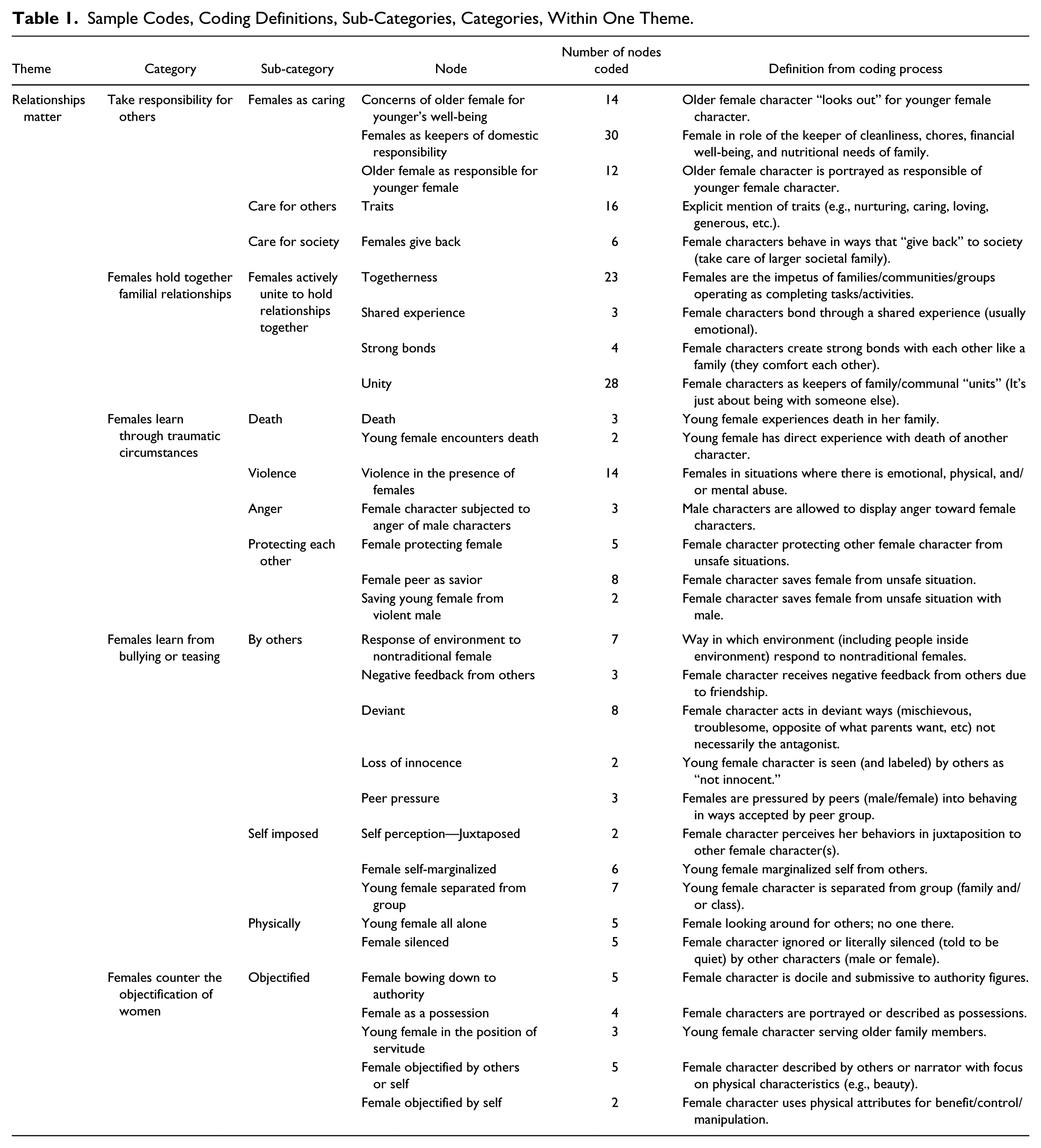
We organized our sub-categories into categories following the same emergent processes. For example, following the example in the previous paragraph, the three sub-categories of “females as caring, care for others, care for society” organized themselves into the category we labeled, “taking responsibility for others.”
Eventually, the categories were organized to reflect themes that were representative across the books. For example, following the previous example, the categories of “taking responsibility for others, females hold together familial relationships, females learn through traumatic experiences, females learn from bullying or teasing, females counter the objectification of women” grouped into one of our emergent themes, “relationships matter to females.”
Our process of formulating categories and themes was highly interactive and collaborative. We discussed the categorization until we reached 100% agreement. We handled disagreements through discussions and turning back to the original sources of data.
Although we address the limitations of this study in a separate section, it is important to note here those methodological decisions that may have influenced our findings. For example, we were only able to examine the content of the finished products, the books. Although these data provide a particular insight into what it means to be a female in a country that has seen radical changes in the past two decades, these data are limiting. Each of the books underwent several instantiations; an examination of each of the various revised versions might have yielded an even more nuanced manifestation of the identified themes. Those versions were not available to us, so we were unable to analyze them.
In addition, we did not analyze the images in the books. Although the teachers interacted with the illustrators and the teachers provided guidance related to revisions of the images, the teachers had very little control over the final product. For that reason, we did not feel an examination of the images in the books was in keeping with our research questions. Perhaps an examination of the interactions between teachers and illustrators would have yielded an even more nuanced manifestation of the identified themes as viewed through an analysis of the discourse that surrounded those interactions. In addition, a separate analysis of the images might also yield interesting portrayals of women in South African society. We did not collect such data.
We also opted to analyze only those books that were realistic fiction. Even though this only eliminated a small percentage of the books, a full analysis might have revealed more insight into the nature of girls as represented by the authors. Finally, we did not gather data on our participating authors. Thus, we were unable to complete any statistical analysis of the representation of females by author (male vs. female).
Results
Through our critical content analysis, three key themes emerged: (a) female characters are multifaceted, (b) relationships matter to females, and (c) females are valued members of society. We present each of these themes below with illustrative data from the stories, nestled within a brief summary of the book in which the coded data appears. However, we would like to begin with a caveat: There was a great deal of overlap in categories, which we expected; this is common in analyzing human behavior and interactions. In no way do the stories below solely capture the category or theme in which we placed them, but they do exemplify the categories and themes identified. We report the percentage of occurrences in each theme in Table 2 and in our text offer examples to help illustrate the data.
Frequency Count of Codes.
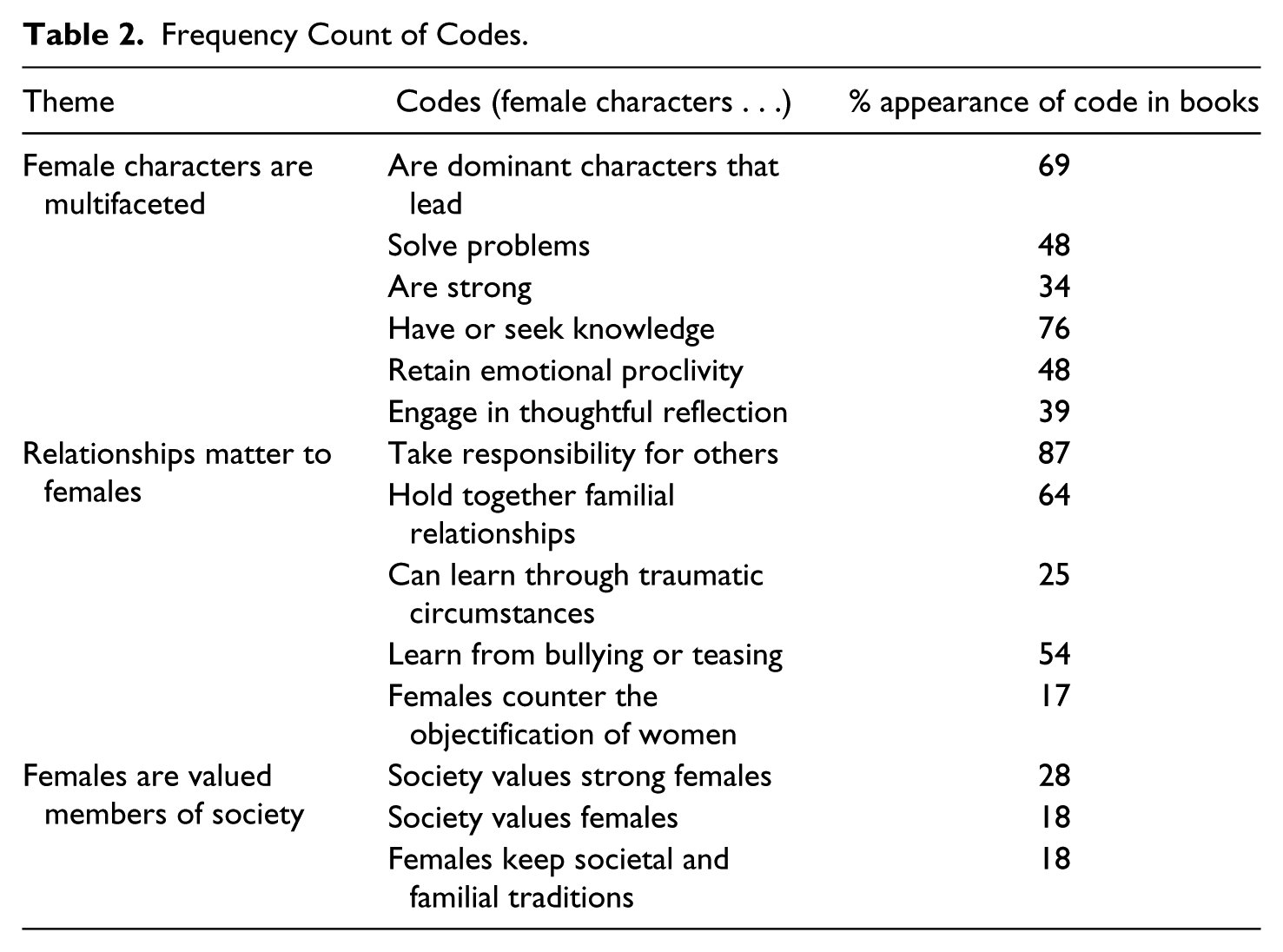
The themes we identified revealed that the South African teachers who authored these books depicted girls and women in multicultural, African feminist-influenced roles. Authors presented women and girls in these texts as strong, capable, thoughtful, resourceful, and highly resilient. Yet, girls and women in these stories did not lose their proclivity to engage in family-oriented, sensitive, and caring behaviors that exhibited concern about others. These South African teacher authors forged complex female characters that displayed a multiplicity of roles, which likely reflected the tensions of local and global relations within a society that is rapidly reconstructing itself. African women today wrestle with the need to assert their own identities to transform societal notions of gender roles as they seek more recognition in sociopolitical and economic arenas. For some time, pressure from outside (largely Western sources) have been forcing African leaders (mostly men) in many countries to restructure their economic and political systems, integrating women into these configurations and creating greater equity for women and families into society. African women are putting forward their own sociopolitical agendas at this unique time of opportunity to do so (Mikell, 1997). The themes evident in these stories indicate those desires and related tensions in a country like South Africa. Women who are dominant role models and leaders and strong women who are valued in society are among the themes that represent evidence of teacher authors seeing the need for women to assert themselves into new sociopolitical realms.
Female Characters Are Multifaceted
Our analysis indicated that teacher authors presented female characters in the stories as multifaceted characters, which can be discerned through the traits of the characters. There were five categories within this theme: Female characters are dominant and lead; they are strong and active problem solvers; they have or seek knowledge; they retain their emotional proclivity; and they are engaged in thoughtful reflection. These stories are indicative of the multicultural and feminist suppositions that once given voice, empowerment is realized.
Female characters are dominant and lead
In this category, authors presented female characters as authority figures and role models, who negotiated and bargained in various settings with various people. More than half (69%) of our books featured female characters, that dominated and led others. For example, in Sphenge’s Salt Turns Into Dreams (Mahlangu, 2008), the main character, Sphenge, loved school and wanted to become a teacher one day. At school, students made fun of her for not having school supplies and the teachers ignored her because she did not complete her homework. One evening, Sphenge became interested in selling salt as she realized, “that I can make money for my family by selling salt.” Involving her younger sisters in the process, Sphenge bought a large bag of salt, repackaged it into smaller bags, and sold it to the local people. Sphenge approached the principal and asked, “to use the money I earned to purchase school supplies for my sisters.” The principal, recognizing and wanting to reward Sphenge’s leadership, would not accept the money. Instead, Sphenge used the money to purchase new winter coats for her mother and twin sisters. This book illustrates the ways in which young females are capable of and willing to step into positions of leadership.
Female characters are strong and solve problems
The teacher authors presented female characters in this category as strong characters that made their own choices, were self-assured, and showed determination and diligence. In fact, one third of the books featured strong female characters (34%) that proactively solved problems (48%). For example, in What’s Growing in That Garden? (Manana, 2008), a 12-year old orphaned girl, Hlengwe, cared for her brothers and sisters. She had very little help and no money or food for herself and her siblings. Being self-assured, Hlengwe decided that she was going to grow a garden in her backyard, and “she applied what she learnt at school, and started her beautiful garden without any help.” Because of her determination, the garden started over-producing vegetables. Hlengwe gave the extra to people who needed it and sold the rest. Before she knew it, Hlengwe appeared in the local newspaper. Mrs. Obaja moved in with Hlengwe and her siblings and formed a new family. This story illustrates one of the many books that presented female characters that were self-assured, determined, and diligent in their actions.
Females have (or seek) knowledge
The teacher authors presented female characters as seekers and keepers of knowledge who expanded their knowledge by being self-reflective. The majority of the books we analyzed (76%) involved some approach to knowledge with a female character—the character(s) either sought information or were portrayed as knowledgeable or as keepers of knowledge. Furthermore, almost one third of the books (31%) presented female characters that expressed “lessons learned” through an event or circumstance and reflected about their personal behaviors. For example, in the book Pushkin (Gains, 2008), Precious and her younger sister Khethi found a kitten while walking home from school. At first, their mother allowed the girls to keep Pushkin but the feral cat’s nature took over and it repeatedly scratched Khethi, forcing the mother to make a tough decision. She told the girls to take the cat to the veterinarian who would euthanize it. Although horrified, the girls followed the orders. Along the way, a woman on the bus heard Pushkin cry from the bag in which the girls were carrying and offered to buy him. When the girls returned home and told the story, their mother was relieved that Pushkin found another home. At the end of the story, Precious returns home to find her mother, “in a quiet mood as she prepared dinner.” Precious reflected on her mother’s decision and realized parents “must sometimes make very difficult decisions” and as a result, she “grew up quite a bit that day.” This example was one of several books that portrayed female characters growing in their understanding of the world through self-reflection.
Females retain their emotional proclivities
In this category, our data pointed to females as characters who were comfortable verbalizing their emotions; other characters viewed these emotions as acceptable and commonplace. Almost half of the books (48%) presented characters and their emotional responses to situations, other characters, and/or themselves in positive ways. For example, in the book The Day I Will Never Forget (Mavhudze, 2008), emotional actions and reactions from female characters set the tone for the story. Best friends, Sasi and Thandi, often sought jackal berries from the bush. On one day in particular, the best friends and another character, Veronica, set out to collect the berries and “everyone was excited” about well-loved fruit. However, the tone of the story shifted into one of tension when Veronica threw a rock to retrieve the fruit from the tree, which is a common way that children claim fruit in South Africa. Rather than hitting the fruit, the rock hit Sasi in the head. Veronica is filled with fear and nervousness as Sasi bled profusely from the injury. In fact, all the children “were looking at me [Sasi] with fearful faces” and Sasi thought she “was going to die!” When Thandi’s mother found the girls, “she exclaimed, ‘Eish [a sound of surprise]!’” Veronica apologized, and although extremely upset, the apology comforted Sasi and she forgivingly assured Veronica that it was only an accident and they should be more careful. Sasi ends the story with, “Then my mother washed me all over again and fussed over me.” This book was illustrative of the number of books in which characters viewed the emotions of females as acceptable and commonplace. Female characters retained their capacity for emotive behavior while portrayed as strong and capable leaders.
Females engage in thoughtful reflection on learning
The teacher authors portrayed females as particularly thoughtful and reflective in approximately 40 % of the books. The main character of one book, Sit Still was one such character. The story opened with Olga and her classmates going on a trip to the zoo. While at the zoo, the children learned about different kinds of animals, including kangaroos, polar bears, and snakes. Olga got so engrossed at the lion cage she did not notice that her class had moved on without her. Initially overcome with helplessness, “I felt alone” and “I did not know what to do,” Olga then remembered what her teachers said to them that morning and she remained seated on the bench and waited for her class to come back for her . Just in time, her teacher and class found Olga and were able to watch the lions feed. This story exemplified a thoughtful, resourceful female character in several ways. First, Olga and her classmates were active recipients of the knowledge from the zoo guide. They took the information given to them seriously and thoughtfully; throughout the story, Olga often stated that she never knew something before hearing it from the guide. Second, even though the author portrayed Olga as lost and confused when separated from her group, Olga remembered the directions of her teacher and followed this matter-of-factly, without panic or needless fear. This response portrays Olga as a thoughtful and active thinker in challenging circumstances.
Relationships Matter to Females
The teacher authors presented the relationships of female characters as important. There were five categories in this theme: females characters take responsibility for others, female characters hold together familial relationships, females can learn through traumatic circumstances, female characters learn from bullying or teasing, and female characters counter the objectification of women. All of the findings, particularly those related to the importance of familial and social relationships among girls and women, reveal the presence of multicultural and African feminist perspectives. In addition, these findings indicate the importance of context in the emergence of feminist sensibilities among women in this setting.
Female characters take responsibility for others
Many of the stories (87%) in this category pointed to female characters as individuals who took responsibility and cared for others. Female characters were described using explicit mention of “caring” traits such as nurturing, caring, loving, and generous, to name a few. For example, older female characters held deep-seated concerns about the welfare of and were responsible for younger female characters. That is, older females often “looked out” for younger females. In addition, female characters were the keepers of domestic responsibility—the keepers of cleanliness, chores, financial well-being, and the nutritional needs of family.
The main character in the book Dear 1 (Modise, 2008), for example, exemplified these traits. The parents of a fifth grader, Zandile, died from complications of HIV/AIDS, leaving her and her siblings as orphans. Zandile was often tired after looking after her sisters and not having enough to eat. She wrote an anonymous letter to her teacher explaining the situation and asking questions about HIV/AIDS as she “decided to find out if she and her sisters were HIV positive.” For a while, she and the teacher continued this anonymous letter-writing relationship; throughout, “they started to bond through the exchange of these notes.” Finally, Zandile made her identity known to the teacher and her teacher arranged for extra food for the family. Zandile later found out that the teacher took a special interest in the family because her brother passed away due to complications of HIV/AIDS. With her teacher’s help, she “created a poster for their classroom to share what she had learned,” including, how to care for people with the illness, and how to prevent it.
This category also included stories in which female characters took leadership in the care of others in their communities. Female characters often viewed the larger community as part of their extended families. For example, in A Helping Hand (Mwale, 2008), the older female character in the story, Nonjabulo, was a very kind person. She gave to people who were in need and was always there to help when she could. Her daughter Zamokwakhe (approximately 11 years old) was the same way and “helped her classmates with their work” and “always gave things to needy learners at school.” When Zamokwakhe’s friend (Nonhlanhla) lost her grandmother and had no place to live, Zamokwakhe took the lead in finding the social office in town. Together, “girls took the bus to the district office where they asked to talk to a social worker” and inquired to see whether Zamokwakhe’s mother could care for Nonhlanhla. Once they understood the procedure, the girls shared this information with Nonjabulo, who eagerly acted to make Nonhlanhla a foster child. The story ends with the statement, “Zamokwakhe is clearly walking the very same path as she watched her mother walk” to take care of those around her. Both of these examples were illustrative of books where individual female characters took responsibility and cared for themselves, others, and their society.
Female characters hold together familial relationships
For many female characters in our dataset (64% of books), relationships were important. There was a sense of togetherness (females were the impetus of families, communities, and group operations in the completion of tasks and activities) and shared experiences (female characters bonded through a shared experience, usually emotional). Female characters enjoyed strong bonds (female characters comforted each other) and unity (female characters were keepers of family and communal “units”). For example, in one story similar to the traditional Little Red Hen tale, Everyone Loves Bread (Kumalo, 2008), the Mthethwa family loved bread, and they ate it with almost all of their meals. “But then she got a job outside the home,” and it was very difficult for Mama to make bread everyday for dinner. One day “she invited her family to help bake the bread,” but no one wanted to help her. When Mama served dinner that night, she did not pass the bread to anyone. She told them, “You didn’t help in baking the bread,” and so, “You won’t help in eating the bread.” The next day, she asked for help in baking bread for dinner that night, “they all came pushing and scrambling” to help. In addition to help in the kitchen, Mama also used the opportunity and started a family tradition (that appeared as an event in the final passage of the story). This book serves to illustrate the importance of relationships to female characters in the books we analyzed.
For some, females can learn through traumatic circumstances
Authors portrayed female characters as subjects of male anger and violence, finding themselves in situations where there were various kinds of abuse (emotional, physical and/or mental abuse) in more than 25% of the books in our dataset. Similarly, female characters in the stories encountered death, including death in the female’s family and death of another character. Finally, female characters in the stories protected each other from unsafe situations. For example, one main character, Londwi, encountered violence throughout the story, Another Chance (Mkhonza, 2008). These encounters centered on the antagonist in the story, Sipho, who was 5 years older than Londwi and attended the same elementary school. A bully himself, Sipho threatened to take the lunches of Londwi, her brother (Mandla), and Mandla’s friend (Zenzele). Early in the story, Sipho approached the group while on their way to school and demanded the children, “Give me your money or your food.” Sipho successfully took two lunches, but still unsatisfied gave Zenzele a “slow-motion punch to the stomach.” On a different day, Londwi chased a lizard after school and stumbled across an old, dark house. She heard an abusive man inside yelling for his food, screaming at a boy, “You lazy dog. Get outside!” When she first saw the child that had been thrown out of the house, she did not recognize him as Sipho. In the face of this violence, Londwi grew concerned. At the end of the story, Londwi realized that her attitude toward Sipho had changed as she recognized that he was a product of his environment. The children became friends. Even in the face of such violence, Londwi realized that a growing positive relationship with Sipho was beneficial not only for him but also for her. This book illustrates the nature of traumatic events sustained by female characters in the books and the ways in which relationships were a result of those events.
Female characters learn from bullying or teasing
Authors portrayed female characters as learning from bullying and teasing in 54% of our books: Females were not only the recipients of these actions, but engaged in them, too. The bullying and teasing was because of peer pressure, perceptions by others as being different, having some deviant characteristic, or because the female character defied traditional roles for girls. In most of these cases, others gave the ostracized female either very negative feedback or silenced/shunned them. In some cases (17%), the female character withdrew or retreated from others because of the bullying/teasing. For example, in the book Becoming a Young Woman (Ntuli, 2008), Nomsa was very outgoing and liked being with her friends. When she started getting acne, her self-esteem plummeted. She did not want to talk to anyone, did not want to attend school; she stopped participating in class as she could not “see who would want to be my friend.” Her classmates teased and called her names such as “scarface” and “ugly.” In fact, she “frequently covered her face with her hands.” Her teacher stepped in and went to visit Nomsa’s mother.” At first, Nomsa did not want to confide in her mother, but eventually she told her mother that she felt ugly. Her mother took her to the doctor who explained that pimples were a part of “leaving childhood and becoming a woman.” The female doctor gave Nomsa “a list of healthy practices you must follow,” which boosted Nomsa’s confidence. When approached by one of the girls who teased her (who now also suffered from acne), Nomsa “considered hurting Zsa-Zsa just as Zsa-Zsa had hurt her” but “Nomsa knew this was wrong.” Instead, “Nomsa explained to Zsa-Zsa the causes of pimples” and the “steps she could take to deal with the problem.” Although bullied, Nomsa (like many other characters in books that appeared in this category) learned and grew from the experience.
Female characters counter the objectification of women
Females countered the objectification of women in 17% of the books in our dataset. Some books presented characters that objectified a female character with a focus on the female’s physical characteristics; however, that message of outward beauty as important was debunked. For example, in the book The Best Fit (Mokele, 2008), three best friends, Dineo, Sebabatso, and Mpho, agreed “to enter a fashion contest to see who was the prettiest.” In the book, each character is described each in terms of her physical appearance with clear connections between the character that was expected to win (Sebabatso, “with her outward” beauty) and who was less likely to win (“Dineo, who was plain”). In the end, Dineo was the decided winner “because she sang so beautiful on the stage.” The story sent the ultimate message that “physical appearance was not what mattered, especially when physical beauty does not match inner beauty.” Even though the three friends competed against each other, their relationship remained true and Sebabatso and Mpho “expressed their happiness for Dineo.”
Females Are Valued Members of Society
Our analysis indicated that the authors of these supplementary books presented females as valued members of society. We had three categories found inside this theme: educated females are valued, strong females are valued, and females keep familial and societal traditions.
Educated females are valued
Educated females (12%) and professional women (26%) accounted for a portion of our dataset and these female characters were valued. Authors presented education as important for and by female characters. For example, in the book Never Give Up (Ramakonya, 2008), the main character explained how she became a lawyer. She was only 10 years old when her father died, upon which serious consequences ensued, including having to leave school because her “school fees were in arrears” and her “mother couldn’t pay them,” thus, “it would be the end of my school career.” According to the author, it was tradition in the Venda culture for uncles to gain control of property and material possessions of the families upon the death of the head of household. Devastated and with nothing to her name, this character met an old friend of her father’s who “took pity on me and gave me a lift.” Explaining to him what had happened, the friend wanted to “assist her [the mom] in raising us” and “wanted to take care of my studies.” The author “completed my studies . . . under the guardianship” of the friend and “in an effort to bring justice to others like ourselves” went on to “become a lawyer.” At the end of the story, this character voiced gratitude for the people who influenced, inspired, and assisted with her goal to complete school and become a lawyer. In other books where education was important to female characters, we often saw the dream of becoming a professional as well. Not surprisingly, the authors linked education and professionalism in many of the books.
Strong females are valued
Authors presented female characters as admired by other characters for their strength and age in more than 18% of the books we analyzed. In some books, for example, female characters displayed their physical strength or society honored their strength by the naming of geographical landmarks after them. In others, young male characters admired older female characters. Still in others, an explicit mention of age played a major role in how female characters perceived themselves or the ways others perceived them. For example, in the book Katlego, the Star of Limpopo (Teffo, 2008), learners were preparing to compete in a school competition that included poetry, reading, storytelling, drama, and public speaking. As each learner completed a presentation, the audience cheered in acceptance. That was, however, until the master of ceremonies called the final contestant, Katlego, a Grade 1 child, to the stage and “the child was not welcomed with clapping and whistling.” Instead, the audience shouted, “Don’t waste our time” and “take that child off the stage because she was so young. Rather than back down, “the little girl [Katlego] stood confidently on the stage” and confidently recited her poem, pitching “her voice high and low.” Delivering her poem with expression and excitement, when Katlego finished, “there was a hush throughout the hall” and the “audience rose to their feet clapping and whistling to express their appreciation of the child’s marvelous performance.” Not surprisingly, and perhaps due to her tenacity and courage, Katlego won the competition and was the star of the province.
Females keep societal and familial traditions
In this category, authors presented female characters as keepers of religious and cultural traditions in 18% of the books. In some books, female characters viewed religion as an important part of their lives (attending church meetings, for example), while characters in other books were actively involved in raising money for religious organizations. Female characters were valued for their “keeping” of cultural traditions, too. Older females were responsible for travel of younger characters as a way of introducing the younger characters to cultural traditions. Finally, it was clear in our analysis that female characters valued cultural traditions. For example, in the book Making a Dream Come True (Mhlabane, 2008), Mrs. Mgidi attempted to raise money for a new church and organized a cultural festival that included the “Swazis, Ndebeles, and Tsongas” because they are all represented in the area and because “all these groups have their own wonderful traditions.” Mrs. Mgidi invited “all the church members to cook traditional food,” and “wear their traditional clothes” for the festival. Furthermore, the community would “celebrate with traditional songs and dances.” Responding in excitement, Anele (a 10-year-old) dressed in her favorite Tsonga attire, wore “colorful head-wraps,” and carried “traditional beaded bags.” Just before the festival ended, Anele sang a song that she prepared, called, “God.” Her song was received so well, “some [members] were so moved they even decided to give additional donations to help build the new church.” At the end of the story, Mrs. Mgidi announced that the festival raised enough money for the members to build a new church. This story emphasized the connections between women, religion, and cultural traditions.
Discussion and Implications
We assume that the representation of gender roles and identities in school materials may contribute to changes in the perceptions of women and girls in society. We also assert that changes in these representations might actually lead to new configurations of the roles and identities of women and girls in a given society. In these stories, we see bold representations of historically and politically silenced South African woman and girls in picture books authored by South African teachers. It is possible that South African teachers used the opportunity to strategically (re)fashion new configurations of South African women, retaining some of their unique history, gender roles, and culture even as global influences and local sensibilities begin to shape their lives in new ways. It seems that they may have done so purposefully, choosing to portray that which had been omitted historically and culturally with new prospects and influences that are merging to depict South African women in new light within a post-apartheid era.
The image of the vital Black African women, whose strength and worthiness were hidden in apartheid society, are revealed here in the (re) presentation of strong, capable women leaders able to resolve problems, be assertive, and harness the political clout to care for themselves, their families and others in society. This reemergence of a multifaceted Black woman resonates with the work of contemporary African feminists in which new language and practices reflect a new positioning of women and feminism across the continent. It is clear that the feminist practice and discourse has been imbued into everyday social processes. More people have been exposed to central concepts of gender and the language of women’s rights, gender balance, and equity as these now appear to be part of everyday discourse (Acholonu, 1996; Ahikire, 2014; Cruz, 2015; Nzegwu, 2006).
South Africa, however, is in a conceptual shift regarding women’s roles and experiences. New gender relations are emerging from within the culture. These relations are producing substantive changes in social structures at the political and economic levels within South African society (Nzegwu, 2006). Women are gaining prominence in South Africa as they are in many African countries (Ahikire, 2014; Mikell, 1997). Such realities were reflected in the work of these teacher authors who portrayed girls and women in more dominant roles in society.
Importantly, women in South Africa and in other African countries also care about families and other social relationships, even as they are concerned about economic and political realities. In addition to being strong leaders, they also retain their identities as keepers of societal traditions and familial structures. They strongly desire to hold onto the traditional importance of familial values in addition to cultivating the need to assert themselves in new political formations. These sentiments were especially evident in the books’ themes of women keeping societal traditions, and women and girls caring for and being responsible for others in their families and communities. The stories here are testimonial to the multicultural African feminist perspective we described earlier in this article.
There is a logical essential connection between conceptual structures of the global, state, and local community and the gender–familial relationships in any given context. Based on our work, it appears as though these South African women recognize these dilemmas and actively seek to participate or challenge these roles through their construction of children’s literature. They want to bring these relations into the light to find resolution (Mikell, 1997).
The panoramas created by the teacher authors are also situated in the very practical and lived experiences of everyday South African women, girls, men, and boys, in ways that might contradict gender representations in other countries, particularly in Western contexts (Foulds, 2013). South African women, like many African women, are confronted with grave crises in their everyday life. Women have carried the brunt of crises in many African countries, including high mortality rates and the continued persistence of women in agrarian roles rather than professional ones (Mikell, 1997). The stories here reflect the continued struggles experienced by South African women in the stories created by teacher authors about death, hardship, and food shortages. More than this, the stories also reflect the breakthroughs made my feminism across the continent (Ahikire, 2014).
Multicultural and African feminism informed our analysis although it was not an explicit epistemology of the book development process. Our findings are indicative of the trends of these strands of feminism within the books. The development team asked these teachers to write about their lived experience, things they knew about and those things that children would find interesting. Although our work here is bound to a critical content analysis, we see that an underlying African feminist epistemology is revealed in the creation of characters and storylines through these books. African feminism exists in pockets that are regionally, culturally, and socially bound and highly contextual and local (Cruz, 2015; Meena, 1992; Mohanty, Russo, & Torres, 1991; Ray & Korteweg, 1999); therefore, local and specific iterations of multicultural and African feminism was likely experienced by the teacher authors. Those iterations seemingly reverberated through these texts.
Perhaps Western influences (media, social networking, popular culture, for example), coupled with changing demographics (growing Black middle class), have influenced these South African teacher authors. Perhaps the exchange among Western literacy experts (U.S. and South African based) with South African teacher authors offered opportunities to cultivate a richer, more complex dialogue around the books during their development process. The feminist perspective that comprised an aspect of our initial analysis of this study is concerned with equity of representation, contextual realities, the depiction of roles of females that disrupt existing gender roles, and the articulation of voices once unheard (Alvermann, Commeyras, Young, Randall, & Hinson, 1997). This discourse has led to stronger political perceptions of girls and women and a wider acceptance of girls and women’s emerging new roles that might lead, ultimately, to full equity for females within South African society. However, it is clear that these early manifestations of feminism across Africa are increasingly more complex. Our analysis of these texts suggests a particular perspective that includes fluidity between traditional and contemporary roles of females and a promising new manifestation of a uniquely African feminist standpoint. This standpoint reflects the desire to retain existing familial and many societal values, but strives for a more prominent political and economic profile for South African women. Cruz (2015) offers a description of African feminisms as situated in the principles of holism, collectivity, and situationality. Holism is concerned with social domains that run counter to dualistic worldviews. Collectivity considers the group rather than the individual as unit of analysis. Finally, situationality highlights how information is contingent on space and time in a given interaction.
There are some implications of our work. This work serves to educate Westerners about the realities of women’s lives in South Africa and the conceptions of a broadened feminism that exists outside of Western conceptions of feminism. The complexity of gender relations and the construction of gender in this context also may reveal the limitations of a Western feminist perspective on gender structures and gender roles in a new South Africa. It also illuminates the tensions experienced by South African women related to gender roles and the pressure to acquiesce to Western notions of gender equity and gender values.
From a pragmatic perspective, we believe our findings may also have implications for other donor-sponsored work in countries like South Africa. With such a focus on reading outcomes by donor governments such as the USAID, it is imperative that others who develop reading materials and programs take note of our findings. In previous places, we have written about the importance of locally produced reading materials for children, specifically the ways in which locally created books can replace the large number of inappropriate books for children in Sub-Saharan African countries. For example, students must have access to books that represent their lived experiences, their interests, and their languages, including home and official languages. Books must serve as mirrors of their lived experiences as well as windows of opportunity into the possibilities for their future Sailors, Makalela, & Hoffman, 2010). While we still believe this, the study under discussion may also suggest that opportunities for teachers to author books for their students may create spaces where teachers can construct and reconstruct lived experiences, especially those shared by females in South Africa.
Limitations
As with all interpretative research, this study has several limitations. First, the lack of voice of the authors of the books limits our findings. Interviews with the authors about the messages they were intentionally (or not) trying to send to readers may have offered insight that the current data does not allow us to access. In addition, our current dataset creates limits related to the purposes and intentions of the authors. What was the ultimate purpose for writing the stories they did? What were the intentional (and cognizant) messages these authors were trying to send to young readers? What was important about those messages and how did those messages correspond to the purposes of the authors?
In addition, we were not able to examine the ways in which girl (and boy) students in South Africa received the books. What sense of female do the book users make? Do the themes that we extrapolated through our research resonate with the meaning that these users make? How do students who use these books make connections to female figures in their personal lives? Do female figures in the books serve as role models for students? Do the female figures counter hegemonic models of female as seen through Western-influenced media? Do students perceive binary roles of women and men in ways similar to those of their teachers? Perhaps future research will address these questions.
Conclusion
Investigating gender roles through research involves both the particular and the universal. In this study, we see that a particular context offers unique perceptions of gender roles and gender identities that cannot be easily replicated in other settings. Yet the study of gender role representation and women’s identities assumes some universality across contexts. Gender role research must be carefully regarded when applied in international contexts, as its presumed universality assumes that all women want and need the same things. Some dialogue among those from diverse perspectives and experiences seems warranted and will counter the simplicity that threatens the importance of this work. Here we call for less universalistic methods and more attention to the local, particular. When forging new texts, for example, careful attention to the dialogue among the local and particular is key when engaging in cross-national, cross-cultural work. We must be vigilant about context, more aware of and less reliant on preconceived universalities.
Finally, it is very important to look at the stories these South African teachers are telling about their context and what they choose to share with children. The particular emphasis on gender representation, for example, speaks to the dynamic and evolving nature of social roles in this given context. Texts are very often reflective of larger political and social context and care should be taken to recognize the potential they hold for forging new social relationships and identities through written and depicted language.
Footnotes
Declaration of Conflicting Interests
The author(s) declared no potential conflicts of interest with respect to the research, authorship, and/or publication of this article.
Funding
The author(s) received no financial support for the research, authorship, and/or publication of this article.