




Abstract
In spite of views that children’s writing development is in large part a linguistic complex process involved in their engagement within and across social activities in and out of school, the literature is scant on the wide range of semiotic resources that children may draw on to animate their poetry writing and performances. Drawing from a case study of poetry writing and performance in one U.S. fifth-grade classroom, this article uses interpretive methods and textual analysis to ask the following questions: (a) What, if any, poetic language do children draw on and identify in their written poems? (b) What interdiscursive and intertextual writing practices do children draw on to write poetry? and (c) How, if at all, might the act of reading an original poem influence children’s writing practices and literacy learning? Highlighted by three focal students, data suggest that children’s poems most often used features, including stanza break, varied types of rhyme, alliteration, and metaphor. Furthermore, some children’s poems could even be classified into distinct poetic structures. The data also suggest that children appropriated and recontextualized content for a single poem from a variety of semiotic resources in and out of school. Finally, children’s performances were caught up with satisfying multiple audiences, including themselves. This study suggests that elementary children can control the process of poetry writing and performance through active integration of formal poetic language taught with interdiscursive and intertextual practices.
Introduction
In spite of poetry’s affordances for children to focus closely on the beauty, play, and emotive power of language (Elster & Hanauer, 2002), poetry writing remains underrepresented in the U.S. curriculum (Certo, Apol, Wibbens, & Yoon, 2010; Donovan & Smolkin, 2006; Scherff & Piazza, 2005). Drawing from a case study of poetry writing and performance in one U.S. fifth-grade classroom, the purpose of this article is threefold: (a) to understand what poetic language children draw on and identify in their written poems, (b) to trace any interdiscursive and intertextual writing practices that children draw on to write poetry, and (c) to understand how, if at all, the act of reading an original poem might influence children’s writing practices and literacy learning.
Previous research has tended to focus on the poetic language children write given particular instructional environments (Kamberelis, 1999; McClure, 1990; Steinbergh, 1999; Wilson, 2007; Wolf, 2006), such as ones that present students with “mentor texts” (Calkins, 2007; McClure, 1990) or “literary models (Wilson, 2007). In spite of views that children’s writing development is in large part a complex linguistic process involving their engagement within and across social activities in and out of school (Dyson, 2003), the literature is scant on the social practices that children draw on to animate their poetry writing (Christianakis, 2011). By social practices, I mean the ways in which children might actively integrate formal poetic language taught with their interdiscursive and intertextual writing practices (to be defined in the next section). Finally, while considerable scholarship has focused on the literacy benefits of children orally reading or performing previously published poems (e.g., Elster & Hanauer, 2002; Griffith & Rasinski, 2004; Martinez, Roser, & Strecker, 1999; Rasinski, Padak, Linek, & Sturtevant, 1994; Wilfong, 2008; Worthy & Prater, 2002), there are few investigations of the practices surrounding children’s performances of their own poetry.
Crafting Poetic Language Through Interdiscursive and Intertextual Practices
I frame this study primarily around poetic language theory (Jakobson, 1987; Tannen, 2007; Theune, 2007b), theories of writing as social practice (e.g., Bakhtin, 1986; Bazerman & Prior, 2005; Chapman, 1999; Miller, 1984; Street, 1993), and the role of audience awareness in performance theory (Goffman, 1959; Ivanic, 1998). To begin, there are poetic language features that are accepted by language theorists and linguists (e.g., Brown, 1999; Jakobson, 1987; Smitherman, 2000; Tannen, 2007; Theune, 2007b), some of which have been previously used for analyzing children’s poems (Kamberelis, 1999). Due to space limitations, I report primarily on the poetic features that can highlight tone and mood (e.g., repetition, rhyme, alliteration, metaphor) as well as the poetic structures that operate at the whole text level. After all, and following Theune (2007b), poems do not just have features, they also have structures, which can be thought of as the ways a poem distinctly turns, moves, and travels, often ending in surprise. Theune (2007a) clarified that poetic structure is fundamentally different from form (such as a haiku, acrostic, or limerick). According to Theune (2007a), most poems regardless of form—and including even free verse poems—have poetic structure. For example, Theune’s (2007b) classifications of poetic structures include the ironic (poems surprising the reader with a turn from set up to punch line), the concessional (poems turning from acceptance or defeat to making a positive argument), the elegaic (poems turning from loss to love to triumph over death), or the retrospective-prospective (poems turning from past to present to future). Theune (2007a) made the point that “structure’s great strength really is its familiarity . . . structure’s turning is something people do all the time with and in language” (p. 11). Nonetheless, there has been no exploration of the particular kinds of structural turns that might be in children’s poems, nor any attempt to trace the origins of those structures.
In addition to drawing on poetic language theory, this study is undergirded with theories of childhood writing as a social practice (Chapman, 1999; Dyson, 2003; Kamberelis & de la Luna, 2004). Following Dyson (2003), childhood writing can be thought of as a social practice influenced by the teacher, instructional task or resources, and also by other forces, including peers, family members, and popular culture. But what, specifically, might children’s poetry writing practices look like? Kamberelis and de la Luna (2004) explained that there are particular practices to keep in mind when analyzing children’s writing because such practices function as essential scaffolds for writing. First, interdiscursive practices or “adhering to abstract conventional ways of organizing language” (Kamberelis & de la Luna, 2004, p. 244) can be thought of as children simply writing a poem based on their knowledge of how a poem should generally look. For example, they may craft a poem that looks similar to other poetic texts they have encountered. Interdiscursive practices might be present, too, when children draw loosely on another poem’s structure or form, perhaps creating stanzas and shorter lines that look similar to other poems they have seen in or out of school. This loose adaptation may resemble the “mentor texts” (Calkins, 2007) or “literary models” (Wilson, 2007) that have been exposed to children. Yet, because poetic structural turns are something people do all the time with language (Theune, 2007a), it may be the case that the poetic structure children use in their poems resembles how they have heard language unfold orally, such as in formal school poetry readings or informal conversations or interactions in their child cultures.
Besides interdiscursive practices, children may also use intertextual practices which involve “the heterogeneous production of texts out of other specific texts or text fragments” (Kamberelis & de la Luna, 2004, p. 244). In other words, children may write poetry by drawing on partial textual content from another poem, text, or conversation. Dyson’s (1997, 2003) groundbreaking research on children’s writing suggests that children, in particular, negotiate social membership, friendship, and common interests through their intertextual practices. Although her research was in the context of children’s multigenre literacy practices (rather than just poetry), she found that children appropriated (borrowed or took over) textual content, then recontextualized (made new or fresh) that content for their own purposes. In particular, children in her study appropriated and recontextualized material from their school and home cultures, including lines from their school poetry books, lines from songs, and symbols from the media and popular culture (Dyson, 1997, 2003). In spite of the rich possibilities of both children’s interdiscursive and intertextual practices to scaffold children’s writing, these have yet to be studied in the discrete context of children writing poetry.
This study is thirdly framed by conceptions of audience awareness in performance theory (Goffman, 1959; Ivanic, 1998). Goffman (1959) described performance as “all the activity of an individual which occurs during a period marked by his [sic] continuous presence before a particular set of observers and which has some influence on the observers” (p. 32). These activities (whether it is a revision to a poem or deciding to read a different poem) seem important to isolate as they may signal children’s increasing audience awareness on the cusp of the performance (Goffman, 1959). Following Ivanic (1998), the children-as-performers are still learning how to give meaning to their texts and to create a favorable impression of themselves by making discursive turns in their writings as they anticipate their performances for specific audiences.
Mentor Texts and Appropriation as Tools for Scaffolding Children’s Poetry Writing
The research on children’s poetry writing has been growing slowly in the past few decades, with studies suggesting that poetry writing allows children to express their interests and lived cultural experiences (e.g., Cahnmann, 2006; Flint & Laman, 2012; Van Sluys & Labbo, 2006). These studies document the powerful subjects that children take up in their poems, but they do not highlight the poetic features and structures that children use in their poems. Likewise, previous research does not attempt to trace the social practices that elementary students might use to organize their poems, nor how children might draw partial textual content from sources both in and out of school.
Previous poetry writing research has focused on the poetic language features that children use in their poems relative to the instructional environment (Kamberelis, 1999; McClure, 1990; Steinbergh, 1999; Wilson, 2007; Wolf, 2006). In particular, features such as repetition, rhyme, and metaphor are ones which, according to Cazden (1976) and Tannen (2007), children have an affinity for in their language play. It is not surprising, then, that these features were sometimes found in the poems of children in school (e.g., Kamberelis, 1999; Schnoor, 2004; Steinbergh, 1999; Wilson, 2007), with more demonstration, particularly of metaphor, in studies of older elementary students (Steinbergh, 1999; Wilson, 2007). In a comprehensive study of primary children’s multigenre writing, Kamberelis (1999) found that a few of the 54 first- through third-grade children wrote sophisticated poems, rich with imagery and metaphor, from a prompt to “write about an animal,” but that most children wrote poems that tended to depend too heavily on rhyme and singsong meter patterns. He also concluded that their poems were shaped more like stories than poems.
Some literature demonstrates that when children are exposed to mentor texts or literary models (McClure, 1990; Wilson, 2007), they successfully incorporate poetic features in their texts that they had not used previously. For example, Wilson (2007) found that elementary children in the United Kingdom tended “to adapt the shape and words of the poems used as models” (p. 448) and were likely to “replicate” phrases from a teacher-presented model poem (p. 450). Besides mentor texts, poet-mentors themselves have been found to influence children’s poetry. Namely, Wolf (2006) found that when children participated in a workshop with a visiting poet-artist, children wrote poems rich with poetic features to convey meaning.
Because childhood writing practices can be influenced by particular social forces (e.g., teacher, instructional task or resources, peers, family members, and popular culture; Dyson, 2003), it would be useful to understand the myriad forces that may influence children’s compositions. However, it is less clear in the context of poetry writing how children draw broadly on a wide variety of textual content (including, but also extending beyond, the teacher-presented mentor texts; Christianakis, 2011; Dyson, 1997, 2003). One exception is Christianakis’s (2011) ethnography of urban fifth-grade children, which found that children wrote rap and poetry hybrid texts that included popular culture references that their peers would recognize. If, indeed, children draw on “the heterogeneous production of texts out of other specific texts or text fragments” for their writing (Kamberelis & de la Luna, 2004, p. 244), it would be revealing to understand this practice in the context of poetry writing.
Of course, the additional act of reading a poem for an audience can be a fresh literary experience for children (Certo, 2013). While research has demonstrated the literary affordances of reading previously published poetry, there is a dearth of research on children’s oral performances of their own verse. This considerable body of research, in the context of Readers Theater, has found that repeated oral readings of short, rhymed, “poetry scripts” improved children’s reading fluency (e.g., Griffith & Rasinski, 2004; Martinez et al., 1999; Rasinski et al., 1994; Wilfong, 2008; Worthy & Prater, 2002). Readers Theater’s characteristic focus on rehearsal and expressive performance has also been found to improve students’ confidence in reading poems for classmates, their motivation to read the poems and songs on their own, their attitudes toward literacy, and their reading proficiency overall (Wilfong, 2008; Worthy & Prater, 2002). Children, moreover, perceived such readings to be pleasurable and engaging (Rasinski et al., 1994; Wilfong, 2008).
Other research has also found that children’s oral and performative readings of previously published poetry can draw their attention to poetic language (Baumann, Ware, & Edwards, 2007; Elster & Hanauer, 2002). However, we know relatively little about how children grow as literacy learners when they orally read or perform their own poems. The performance studies of students’ written poetry is a scholarship that is growing, but focuses on the writing of youth/teens of high school age (e.g., Fisher, 2003; K. J. Jocson, 2008; Weinstein, 2010). Because poetry and spoken word programs have been found to increase confidence and understanding of genre and process among adolescents and young adults (e.g., Fisher, 2003; K. J. Jocson, 2008; Weinstein, 2009), it seems worthy to investigate the educative possibilities of children performing their written poetry.
In summary, while studies have concentrated on the poetic features of children’s poetry (Kamberelis, 1999; McClure, 1990; Steinbergh, 1999; Wolf, 2006), no studies focus on the larger poetic structures that children use in their poems in spite of structure’s potential for moving forward the themes in one’s writing (Theune, 2007b). Moreover, only a few studies have demonstrated links between children’s poetic language use and their tendency to borrow poetry from other texts and voices (Christianakis, 2011; Dyson, 1997, 2003; Wilson, 2007), specifically that children shape their poems from “literary models” presented by the teacher (Wilson, 2007). However, there is a dearth of research that attempts to trace the wide range of children’s complex interdiscursive and intertextual poetry writing practices, in spite of the usefulness of these practices as scaffolds for writing (Kamberelis & de la Luna, 2004). Finally, while the research literature acknowledges the literacy benefits of children orally performing previously published poems (e.g., Baumann et al., 2007; Elster & Hanauer, 2002; Griffith & Rasinski, 2004; Martinez et al., 1999; Rasinski et al., 1994; Wilfong, 2008; Worthy & Prater, 2002), the research is quiet about how children grow as poets and literacy learners from performing their own original poetry.
This study seeks to fill these gaps by responding to the following research questions:
Method
Interpretive Case Study Design
This investigation is a case study (Stake, 2000) of one U.S. fifth-grade classroom using an interpretive methodology (Erickson, 1986). I characterize the methodology as interpretive because it is an approach to qualitative research that, in the spirit of Erickson (1986), is primarily interested in what is happening in a particular social setting, what those events might mean to those involved, and how participants engage with one another (Erickson, Florio, & Buschman, 1980). The aim of such research is to cast a fine-grained analysis on a smaller sample to unearth findings that might not otherwise be apparent with other methodologies. Therefore, although I provide findings from the class (the case) overall, the majority of the findings section will highlight three focal students. In the spirit of Dyson (2008), I have selected particular children as illustrative of the breadth of findings, aiming for descriptions that are “theoretically rich, collectively comprehensive, but relatively short to portray the dimensions and dynamics of the children’s school writing” (Dyson, 2008, p. 126). This study was carried out in a natural setting, involved intimate interaction with children, took care to present perspectives of children, and used multiple data sources that were collected and analyzed inductively and recursively.
Role and Positionality
I approached this study as an observer-participant methodologist (Vidich, 1955). As such, I was not a distant observer, but an actively engaged researcher, educator, and poet. I revealed my identity as a poet through my introductions, dress, and readings of my poetry. My poems included details about me and my life, including my family, my Italian American descent, being raised in a middle-class Pennsylvania steel mill town, and teaching elementary school for 10 years in rural Virginia.
Setting and Participants
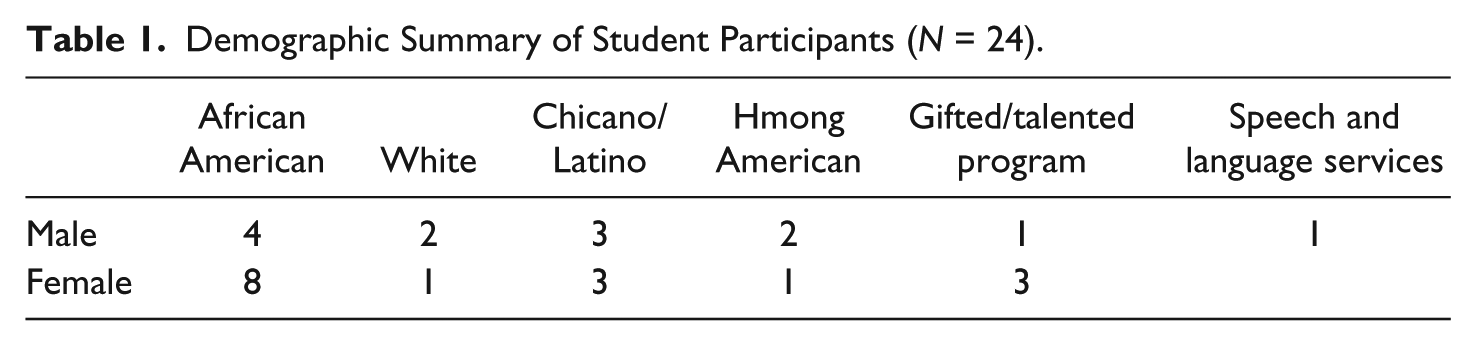
King Elementary is a public elementary school in a midsized metropolitan area in the mid-north-eastern part of the United States. At the time of the study, the school enrollment was 235 across Grades K-5. African Americans made up a substantial population of students at 70%, but the population also included students of Chicano/Latino, Hmong, and Caucasian descent. Approximately 90% of the student population qualified for free or reduced-price lunch. The teacher, Ms. Jorgenson, had been teaching fifth grade for several years. She had a reputation in the school for being a strong writing teacher. Twenty-seven students aged 10 to 11 were in the classroom (15 girls; 12 boys), and 24 (13 girls; 11 boys) consented to participate in the study (see Table 1). The focal students were selected for several reasons. First, Angelique’s, Jon’s, and Rejeanne’s (pseudonyms) poetry practices exemplify broad trends in the study, while concurrently demonstrating that each child will naturally have unique interests and idiosyncratic practices that influence their poems and performances. Although all three children were African American, they were selected because they represented a range of interests, personalities, skills, and composing activities. The children were also chosen because they wrote and performed a poem with differing subjects, moods, and language styles. In addition, Angelique, Jon, and Rejeanne were selected because they were seated in the same vicinity (in the back of the room), and children’s proximity to one another tended to influence their writing practices. Moreover, Angelique was chosen because the topic and structure of her poem were most taken up by other students in the classroom. Finally, Jon was selected because his poem was the only one publicly reproached by another peer in the class; thus, interpretations surrounding his writing and performance may have larger implications for understanding elementary children’s poetry writing.
Demographic Summary of Student Participants (N = 24).
Data Sources
The primary data included the 24 children’s poems (the ones they chose to perform) and interviews with them about their poems and performances. Secondary data (used to trace the interdiscursive and intertextual origins of the 24 children’s poems) included children’s previous drafts of poems, all children’s poems (not just the one performed) from the entire class, classroom poetry books and poems, videos of children’s performances, and field notes I kept each day of the project. In addition, I drafted one- to two-page conceptual memos (Heath & Street, 2008) at the end of each week to make sense of what I was observing.
Analytic Approach
Drawing on broad features suggested by language theorists (e.g., Brown, 1999; Jakobson, 1987; Kamberelis, 1999; Smitherman, 2000; Tannen, 2007; Theune, 2007b) and on my own poetry knowledge, I developed a Poetic Language Scheme (see Online Appendix A at jlr.sagepub.com). The purpose of the scheme was to engage in textual analysis (Bazerman & Prior, 2004) of the major poetic features and poetic structures that the 24 children used in their performed poems. This instrument was reviewed by three international scholars in the field of writing research and one poet, all of whom concurred with the general features. I then used this scheme to analyze the 24 students’ performed poetry, completing one for each child’s poem (see Online Appendix B at jlr.sagepub.com). The day after the culminating performance, a group of graduate students and I interviewed the students individually as they talked from their poetry portfolios about their selected poem and performance. In this article, I draw on interview protocol items (see Online Appendix C at jlr.sagepub.com) from Angelique’s, Jon’s, and Rejeanne’s semistructured interview that pertained to the poem that they chose to read at the performance. An advanced graduate student transcribed the interviews, and I edited them for accuracy. Interview transcripts were housed in Hyperresearch© (Hesse-Biber, Kinder, Dupuis, Dupuis, & Tornabene, 2010) where data underwent a content analysis (Miles & Huberman, 2002) along the interview protocol questions.
A second graduate student was employed to enhance credibility and dependability of the coding of the 24 children’s poems. In addition to my own coding, one graduate student in the department of English (who was also a poet) was trained in using the Poetic Language Scheme. For each of the features in the scheme, we calculated the percentage of agreement for each item of every poem. Average interrater reliability using the scheme was established at 93%. Occasional discrepancies related to whether or not some children used a particular poetic structure. In these rare instances, we discussed until we came to agreement. A third advanced literacy education graduate student was used to enhance credibility and dependability of the coding of the children’s interviews. While I coded all the interview transcripts, she independently coded half of the transcripts in Hyperresearch© (Hesse-Biber, Kinder, Dupuis, Dupuis, & Tornabene, 2010), where interrater reliability was established at 94%.
Because I was the only researcher interacting with children every day of the project, I independently made interpretations about all 24 students’ performed poems to trace some plausible interdiscursive and intertextual origins. I then took the results of the coding of the poems, the interviews, and children’s appropriations to select the three focal students whose poems and interviews were representative of the breadth of findings. Because I knew details about the students and their poems that the graduate students did not; I drafted the focal student descriptions, drawing on the data discussed above and on my written field notes. I began first with the child’s poem presented at the performance, describing its features and structures from the codes from the Poetry Coding Scheme and continually returning to the hard copy of the poem to glean meaning. I then augmented my coding of each poem with the child’s interview responses. I shifted back and forth between the poem and the transcript multiple times to review children’s responses against the poem and in the context of the entire interview. To trace some of the interdiscursive and intertextual origins of the focal students’ poems, I further reviewed and cross-checked their poems and interview responses with relevant secondary data sources. These included videos of children’s performances, previous drafts of poems, poems of children from the entire class, my daily field notes and weekly conceptual memos, reviews of classroom poetry books and poems, and notes from daily debriefings with Ms. Jorgensen. Finally, an English scholar, critic, and poet reviewed my write-up of the focal students for accuracy of the analysis of poetic structures and features.
The Instructional Approach for Writing and Performing Poetry
I facilitated poetry sessions 3 times per week across a month with students, for a total of 12 sessions, including the final performance. Ms. Jorgensen debriefed with me over lunch after the sessions, helping to provide a larger context to what I was learning about the students. I modeled my pedagogy after Chapman (1999) who conceived of genre as active and social, who argued for children’s “engagement, inquiry, exploration, personal connections and meaning-making, participation in a discourse community, apprenticeship and mentoring, collaboration, and talk about text” (p. 473). I encouraged students to draw on what they were learning about poetic language to craft a poem that most honored their subject and the mood they wanted to convey. This is what I refer to as a poetic-functional approach, one that emphasizes how poetic features and poetic structures might support the subject and mood of one’s poetry. The poetry writing environment could be characterized primarily as a hybrid between inviting (not requiring) students to write from a broad prompt or offering students an open-composing session where they could write on any topic. On five occasions, another community poet joined us. Differing by age, gender, racial/ethnic background, and performance style, the five guest poets made visible how content for one’s poetry can include a wide variety of written and oral forms. The visiting poets invariably demonstrated that poetry is shaped by individuals’ interests, experiences, culture, or social languages. For example, Blair’s spoken word poetry included references to the American television show The Simpsons and the American singer-songwriter, Michael Jackson. His poems also revealed his experiences as a Black man as well as narratives of his birth home of Detroit. Some of Blair’s poems were steeped in what Brown (1999) has described as African American cultural expression, one that, in Blair’s case, was marked by the orality of sermon, prayer, and work song.
Every poetry session began with a reading of a set of mentor texts that contained diversity by poet, historical context, subject, structure, form, theme, and mood. Then, I facilitated a brief discussion of children’s emotional reactions to the poems and their observations of how the poetic structures and features were working in the poems. On the classroom wipe-off board, the class community cocreated a list of working criteria of poetry’s characteristics (see Online Appendix D at jlr.sagepub.com). For four of the writing sessions, I, or a guest poet, invited students to write from a broad prompt. For example, when guest poet Laura Apol visited, she welcomed students to write a poem about a family member or anyone they cared about. Laura, before moving students into writing their own poems, distributed and read several family-themed poems. In five of the sessions, children were given what Dyson (2003) referred to as “open composing time” to write on a topic of choice. For example, in the first open-composing session, I shared with students my personal list of ideas for writing poems, and then I invited them to create their own lists. Students used the open-composing time to draft poems from their list, revise poems from a previous session, and/or compose a new poem. Finally, two of the sessions focused exclusively on performance, with tips for orally reading for an audience. For example, in one of the sessions, guest poet Logic discussed strategies for reading poems to an audience. Following, he modeled performance and then allowed students to practice performing in the classroom.
The culminating literacy event that children participated in was inspired by community poet Rina Risper who introduced students to the “Poetry Jam,” an open-mic session with an emcee. Titled by students themselves, the Super Spring Poetry Jam was characterized as an aesthetically heightened and more formalized mode of performance (Boal, 1995; Schechner, 1988). The event was held in the library with a raised platform stage containing a standing microphone. Forty-one fourth and fifth graders were seated on the floor, and, at tables and surrounding chairs, teachers, community poets, administrators, staff, parents, relatives, university professors, student teachers, and graduate students.
Findings
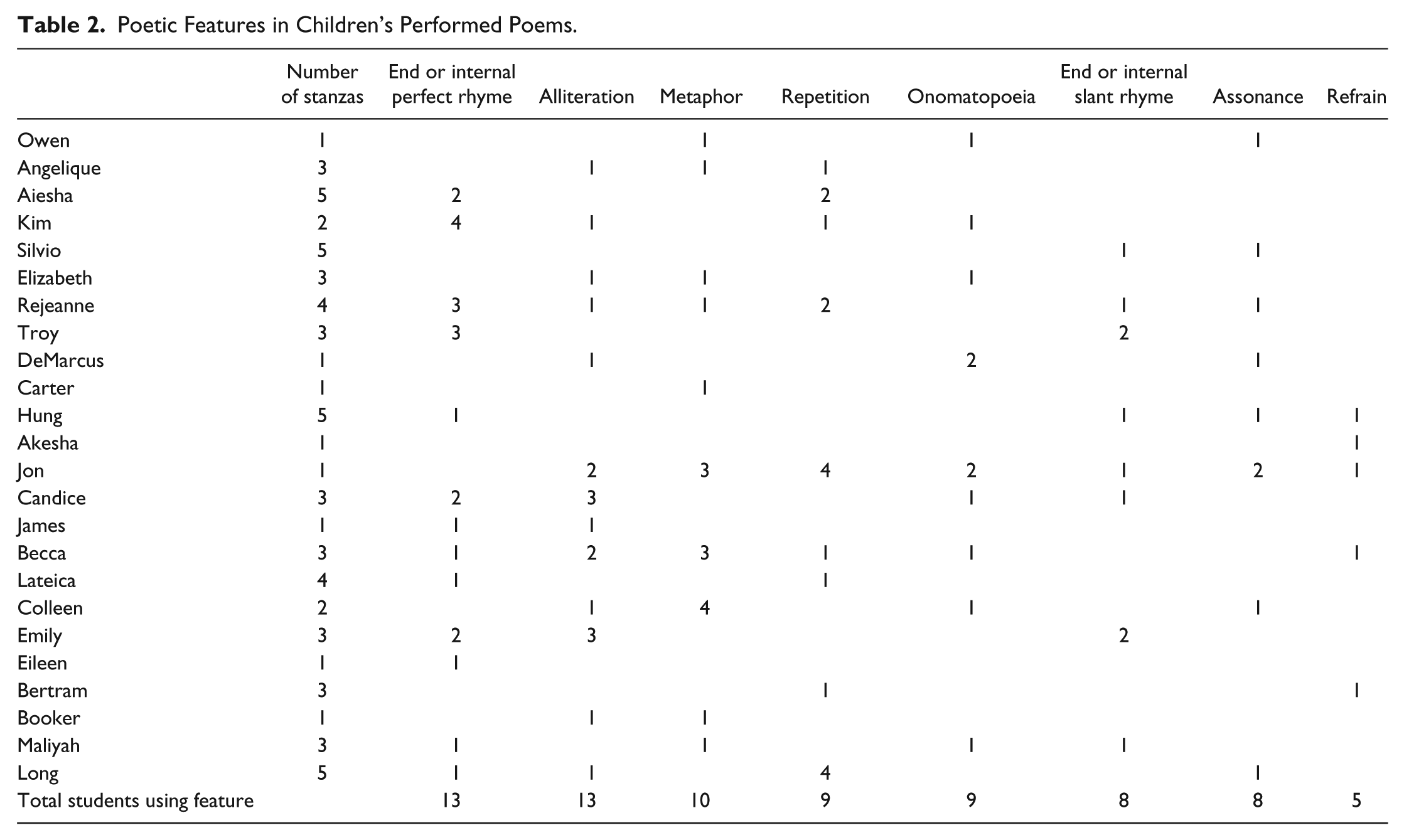
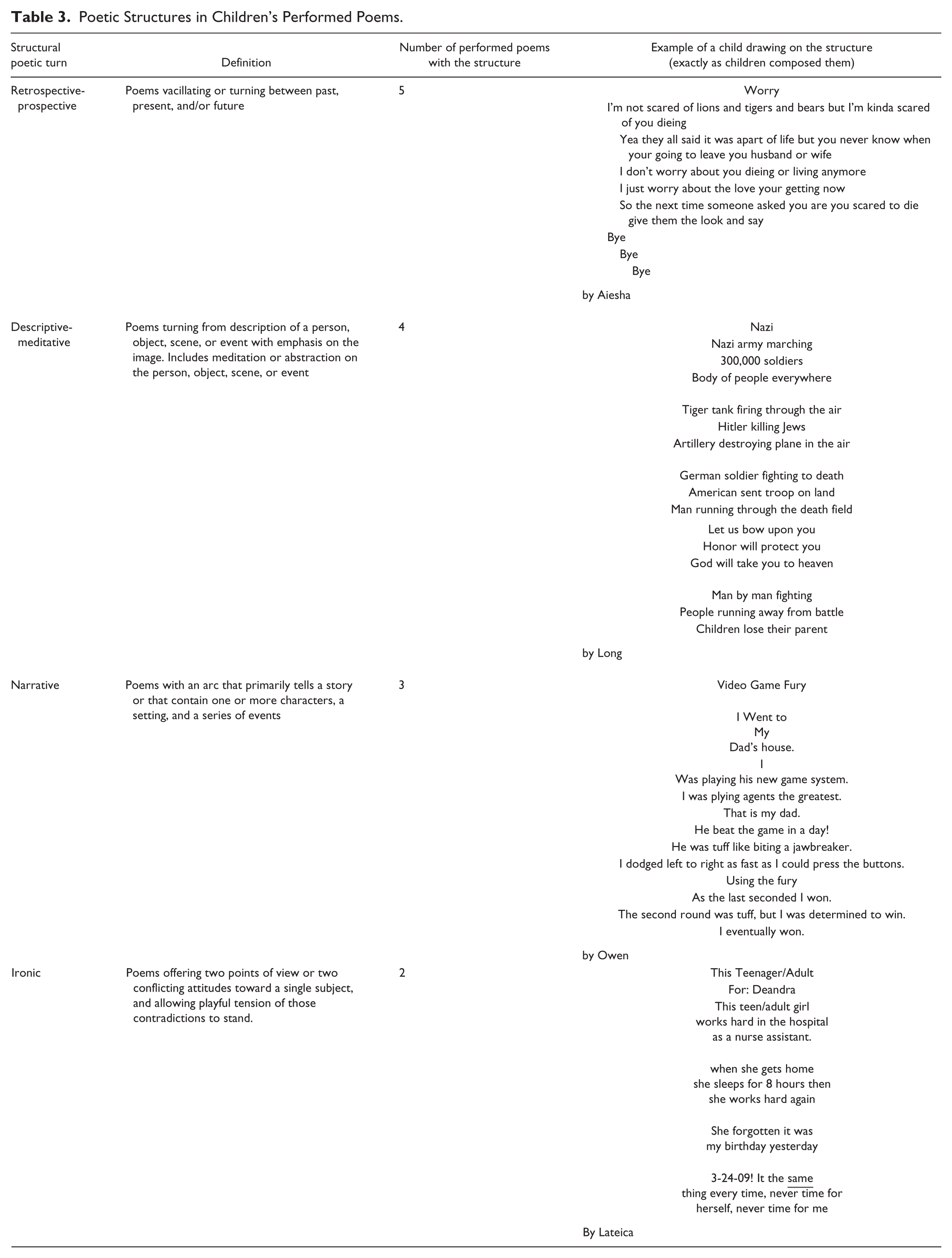
I begin by providing a description of findings from the class overall. Following, the majority of the results will focus on three focal students, highlighting three of the children’s poems. Recall the first research question framing this study was What, if any, poetic language features and structures do children draw on and identify in their written poetry? Findings revealed that the most commonly used poetic features in students’ performed poems were multistanzas, end or internal perfect rhyme, alliteration, and metaphor (see Table 2). Indeed, about half of the class drew on these features to highlight the subject and mood of their poems. Notably, eight students each used some sophisticated types of rhyme. One type was internal slant (or half) rhyme (e.g., sheep/meet), where one partially rhyming word occurs midline. Another type of sophisticated rhyme used was assonance or the repetition of vowel sounds to create an internal rhyming. In addition, nine children drew on features of repetition or onomatopoeia. The focal student descriptions will demonstrate how children’s use of poetic features and structures were not arbitrary, but rather helped to move the meaning and mood of their poems forward. Besides the broad range of poetic features that students drew on, some students’ poems could even be categorized as having a sophisticated poetic structure. Fourteen of the children’s poems could be categorized as having primarily a Retrospective-Prospective, Descriptive-Meditative, Narrative, or Ironic (see Table 3) structure. Although students demonstrated a range of poetic features and structures in their texts, they seemed less able to talk about them. Students mostly reasoned that their poems were poems because they contained stanza breaks, lines, descriptive words, and “feelings.”
Poetic Features in Children’s Performed Poems.
Poetic Structures in Children’s Performed Poems.
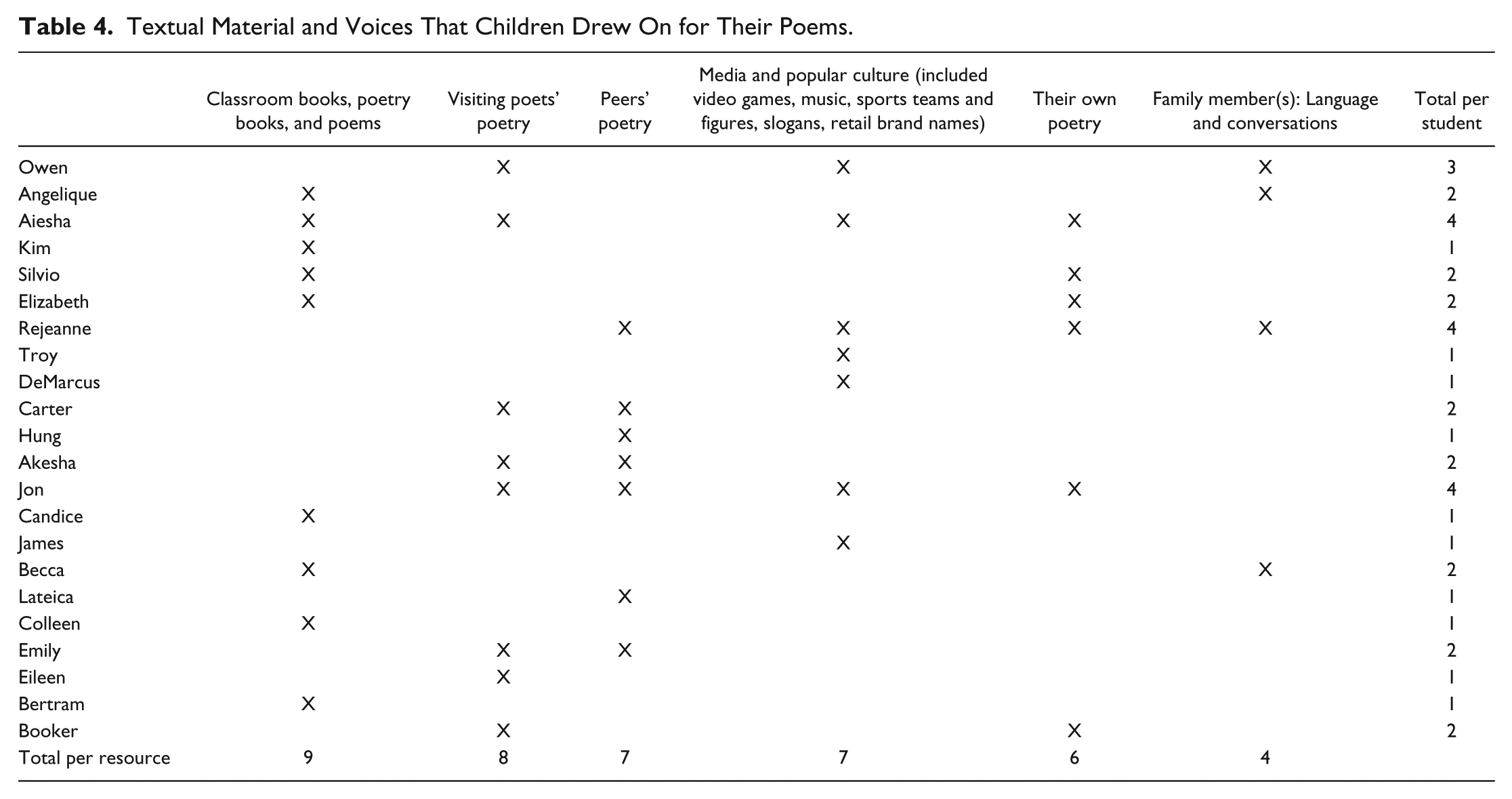
The second research question was What interdiscursive and intertextual practices do children draw on to write poetry? Findings included 22 of the students appropriated and recontextualized content for a single poem from a variety of semiotic material and voices that surrounded them in and out of school (see Table 4). The content for their poems could be traced to classroom books and individual poem handouts, peers, visiting poets, family members, and the media and popular culture. Of note, half of the students drew on more than one of these resources to write their poems. Classroom books, poetry books, and individual handouts of poems were the most popular source of children’s borrowing, whether they wrote a poem based loosely on a structure or wrote a poem with borrowed fragments. Closely following, however, children’s appropriations were from entire poems or fragments of poems from one of the visiting poets. This was followed closely by 7 students who either interdiscursively organized their poems similar to a peer or appropriated a fragment of poetry from a peer. Equally, that same number of students borrowed textual content from popular culture, including titles of video games, lines from songs, sports team names and figures, sports slogans, or retail brand names. Interestingly, 6 students borrowed poetry fragments for their poem from a previous poem they wrote. Finally, 4 students borrowed language for their poems from conversations heard in their homes. Findings suggest that children’s poetic language features and structures were supported by their interdiscursive and intertextual practices.
Textual Material and Voices That Children Drew On for Their Poems.
The third research question framing this study was How, if at all, might the act of reading an original poem influence children’s writing practices and literacy learning? In terms of performance, 23 of the students enthusiastically signed up for the Poetry Jam open mic, and most children wanted to read more than one of their poems. The focal student findings will illustrate how children’s perceptions of what they thought the adults and peers in the audience might value seemed to act as strong forces that influenced the poems children selected to read, the revisions they made, and how they chose to read their poems. That is, Jon, Angelique, and Rejeanne revised to varying degrees on the cusp of the final performance to achieve more dramatic effect. They also selected poems that were, to varying extents, interdiscursively similar to the ones they admired (such as poems in a mentor text or performed by a guest poet). Furthermore, children also selected poetry to read to an audience that contained intertextual lifts from poems in a mentor text or poems performed by a guest poet. These decisions seemed to be guided by the goal of pleasing the audience and themselves. One student elected not to read a poem, and Ms. Jorgenson, the visiting poets, and I respected and honored his wishes. As Lensmire (1994) explained, some children may feel there are great risks involved in writing for and speaking in front of their peers—risks to self, to their values and what they care about, and to their social positioning with peers.
As I move through each focal student in the next section, I begin with a brief description of Angelique, Jon, and Rejeanne. The focal student descriptions will focus on the practices surrounding the poem that each of these students selected to perform at the school poetry reading. Each focal student description will conclude with a summary of the main points relative to the research questions. In all instances where children’s poems are presented, they are exactly as the students wrote or typed them.
Angelique: Retrospective-Prospective, “White Space,” and Metaphor
Angelique was quiet but engaged throughout the project. Self-described as “shy,” she was seated in the rear of the classroom by the door. She seemed to be well-liked by her peers. She was one of several students who took copious notes during every poetry session. She was bused once a week to a pullout gifted program in the district. On the eighth day of the project, when students were given open-composing time, Angelique wrote Eyes of Our Loved Ones.
Grandma’s old eyes staring down at us our loved ones are watching those who passed away they are like special stars that we wish upon every night when we pass away we will watch our loved ones and they will wish upon us, too.
When asked what made Eyes of Our Loved Ones a poem, Angelique remarked,
Well, it doesn’t have rhyme, but poems don’t have to rhyme. And it has repetition with “our loved ones”. And with the white space [points to break between stanza], it pauses, and I like in a poem when it pauses for a minute and then it goes back to going on.
When asked why else Eyes of Our Loved Ones was a poem, she shared,
Because it has feelings in it. A book report, it doesn’t really have feelings. Book reports just tell you what the book was about. Like a poem tells you what you were thinking that day. I want to say it’s [poetry] like a journal, but it’s not. It’s shorter. Like when Becca got her shot and was scared, she wrote a poem about her shot.
Angelique’s talk about her poem “containing feelings” suggests that a poem should be emotive. Her poem displays a rather sophisticated and controlled hybrid poetic structure, what could be interpreted primarily as retrospective-prospective (Theune, 2007b; Yakich, 2007) and also elegiac (Powell, 2007; Theune, 2007b). Although Angelique’s poem shares feelings dear to her own heart, her poem also endeavors to appeal to all readers with the pronoun our in the title. Her poem, like some elegies, is an attempt to bring the deceased back to life, whether literally or metaphorically. Her poem is retrospective-prospective in that it begins in the present (Grandma’s old eyes/staring down at us), then turns to the past (those who passed away), then turns back to the present (they are like special stars), then, at last, turns to the future with the ending lines: when we pass away/we will watch/our loved ones and they/will wish upon us, too. The retrospective-prospective movement is characteristically signaled by grammatical shifts in verb tense. Yakich (2007) explained that the retrospective-prospective structure often shares “private dilemmas, traumas, or feelings dear to the speaker’s heart” (p. 61). Interestingly, once Angelique (already a popular student) was given credibility by the poet Logic choosing to read her poem—Angelique’s retrospective-prospective poetic structure was taken up by four other students in the class, such as Aiesha’s poem, Worry (see Table 3).
Angelique also displayed stanza sense, and her mentioning of the repeated phrase “our loved ones” demonstrates that she knows poetry has subtle features. Angelique’s poem is euphonic with a sound pattern that is harmonious, primarily through the use of repeated vowels and alliterative ws. There is also simile, a type of metaphor, with the image of Grandma’s eyes being compared with stars that are wished on every night. One might even interpret her poem as a child’s version of extended metaphor where eyes are symbolized and described as stars throughout her entire poem. When Angelique talked about how she got the idea for her poem, she related,
Well, there was the art picture book of eyes, and I just thought I could write about eyes. And my brother has been drawing pictures of my Grandma’s eyes, and they’re with lots of lines, and I liked that about her eyes.
She continued,
Sometimes we go see her grave and my mom rakes up the leaves in a heart around her stone. My poem reminds me of doing that, but I didn’t include that. In my second draft I put “Grandma’s old eyes” instead of “Grandma’s eyes.” When she died, she was about sixty-five, and she had a lot of wrinkles on her face and hands.
Angelique’s poetry writing practices demonstrate that she not only appropriated textual content from her family members (brother and possibly mother) but also interdiscursively organized her poem similar to a mentor text. Her poem is also somewhat reminiscent of the song “When You Wish Upon a Star” written by Leigh Harline and Ned Washington for Walt Disney’s (1940) animated musical fantasy film, Pinocchio.
The day prior to Angelique drafting Eyes of Our Loved Ones, I began the session sharing individual copies of the book, Heart to Heart (Greenberg, 2001), a collection of diverse poems paired with 20th-century art. Angelique settled on and volunteered to read the poem Pantoum for These Eyes by Kristine O’Connell George with the lines set alongside a print of eyes by artist Kiki Smith. O’Connell George’s first stanza read, “Let yourself slide under their spell—/these eyes have something to say/Write the stories these eyes tell,/look deeply, don’t look away.” Angelique’s poem is an interdiscursive attempt to organize her poem in an abstract way like O’Connell George did. That is, Angelique’s poem is not a pantoum, but Angelique places some repeating words (e.g., eyes, away) at the end of the line, much like O’Connell George. Eyes of Our Loved Ones is similarly euphonic to O’Connell George’s poem. Thus, the poem in the poetry book served as a resource that likely contributed to Angelique’s interdiscursive practices. Furthermore, the line /Write the stories these eyes tell/ served to set up Angelique’s dialogic response to the speaker in O’Connell’s poem.
On the day of the performance, Angelique read her poem from the page, the page held down low, and, similar to how her poem moved, Angelique faintly swayed side to side as she read the lines. She surprised many audience members (who knew her poem) by revising one phrase that she had not included in any previous draft. She changed “they are like special stars” to “they are like stars in pitch black night.” It is likely that in rehearsing reading her poem, she revised to add more dramatic effect to her metaphor—a stronger contrast to the bright stars. Angelique’s comments signal that it was her peers and a guest poet, Logic, who were instrumental in her choice to read Eyes of Our Loved Ones.
Well, I’m shy, so like, when we were in the classroom and picking what to read, and we were about to go down [to the library] to practice, I was really, really nervous but excited, cause I really wanted to do it. Cause I never did one, so my friend Aiesha that sits in front of me, she was encouraging me and so was Jon and Elizabeth. They said, “Read that poem that Logic [who demonstrated a performative reading of Eyes of Our Loved Ones] read, it’s really good.” And I said “Are you sure, I don’t think it’s that good?” And then everybody’s saying, “Yeah, yeah.” So I just decided to read it, and did, and it was great. And I was surprised everyone said, “Ahhhh” at the end and they liked it.
In summary, what we learn from Angelique is that she aptly drew on poetic features (e.g., euphonic sounds, stanzas and simile) to unfold a poem comparing Grandma’s eyes with stars. Moreover, Angelique’s poem could be categorized into a sophisticated poetic structure, with turns in her retrospective-prospective-elegy serving to honor the subject and mood of her poem. That several other children interdiscursively organized their own poems similar to Angelique’s suggests that children wanted to try this structure on so as to meditate on, and even be comforted by, the loss of someone. Although Angelique appropriated the semiotic material “Grandma’s Eyes” from her brother’s drawings, she clearly recontextualized the text for a draft title for her poem. She organized, appropriated and recontextualized a varied range of content for this single poem from across an array of textual material and voices that surrounded her in and out of school. Specifically, Angelique drafted her grandmother poem in class spurred by multiple semiotic resources—the least of which included the mentor text O’Connell George poem, an art print of eyes by Kiki Smith, drawings by her brother, and perhaps even the ritual of going to the cemetery with her mother. Angelique’s talk about her poem suggests that she knows poetry can have repetition, pauses, and emotive images, but that these features are dependent on the subject of the poem. Her reports furthermore suggest that she revised her poem with her audience in mind.
Jon: Description, Stylistic Imitation, and Sound Play
Jon sat four rows over from Angelique. He was highly inquisitive throughout the project, though I noticed he was one of a few students that Ms. Jorgensen sometimes corrected for side talking when adults or other peers were speaking. He was described by Ms. Jorgensen as someone who “struggled” in writing.
To understand Jon’s performance, it will be important to share his original choice of poem, then the poem he actually read at the event.
WHAT DO YOU KNOW? SCHOOL IS WHERE I GO YOU KNOW. TO GET AN EDUCATION YOU KNOW. YOU SHOULD HAVE AN EDUCATION YOU KNOW. IF NOT YOU’LL HAVE NO ONE NOTHING WORKING AT MC. DONALD’S YOU KNOW. MAKING 20 OR 30 THOUSAND DOLLARS A YEAR WHEN YOU COULD BE MAKING 80 OR 90 THOUSAND A YEAR WITH AN EDUCATION YOU KNOW. YOU NEED AN EDUCATION WITHOUT ONE YOU WON’T HAVE THE SAME LIFE AS YOU WOULD WITH AN EDUCATION YOU KNOW. THAT’S WHY I GO TO SCHOOL TO WRITE CURSIVE, DO MATH ON THE BOARD SCIENCE AND SOCIAL STUDIES. EDUCATION, EDUCATION, EDUCATION YOU KNOW. YOU HAVE TO LISTEN IN SCHOOL AND DO YOUR WORK YOU KNOW. AND WITH IT YOU COULD BE THE RICHEST MAN/OR WOMAN IN THE WORLD YOU KNOW. DO YOU KNOW? WHAT DO YOU KNOW?
Clearly, “What Do You Know?” successfully uses the vernacular practice of the refrain (the repeated “you know”)—and this gives the poem a church- or sermon-like voice with a preaching/teaching undertone. Jon also uses the practice of double negatives and repetition as intensifiers and the hyperbole of “the richest man,” practices that Brown (1999) and Smitherman (2000) suggested are defining characteristics of African American language. The poem’s structure might be described, on one hand, as using the dialectical argument structure, one that turns from thesis to antithesis to synthesis (Theune, 2007b). “What Do You Know?” vacillates not only in its perspective turning from speaker to reader but also in its turning from thesis (/you should have an education you know/) to an imagined antithesis with and without wealth (without one you won’t/have the same life as you would with an/education you know) to synthesis (/education, education, education you know/). On the other hand, focusing on the end of the poem, the structure could be read as offering a self-confirming turn. Essentially, Jon gives a brief quiz at the end of his poem, and the answer key to the quiz is the poem that precedes it.
Jon’s interdiscursive practices may be traced to the influence of the spoken word poet, Blair, who had visited the prior week, opening the session with My Name is Karl (http://www.youtube.com/watch?v=ycUaSsyJNtk)(Blair, 2010), a poem bookended by the line “I was drawn here.” The poem describes a time “the black guy from the Simpsons” found an N written on his locker at the Springfield nuclear power plant where he worked. The poem had significant repetition with a preaching/teaching quality arguing for the importance of “visible” rather than “invisible” friends. Jon adopted Blair’s style for a new rhetorical goal. The spoken word style and references to education were ones he may have thought his teacher, Blair and peers would simultaneously look upon favorably. When it was time for volunteers to read a poem for the class, a student in front of him, Rejeanne, urged him to read What Do You Know? However, when Jon read his poem, a classmate, Akesha, in the front row let out a confused and slightly sarcastic, “Huh?” Perhaps this peer’s utterance was enough to signal to him that a student trying on a spoken word poem was atypical, misunderstood, or not valued.
Interestingly, Jon showed up on the day of the Poetry Jam with an entirely new poem written in block text, and he was sporting a fake snake tattoo on his lower arm.
Snake Eyes Snake eyes beady vicious like a lion watching your every move like a mother watching her baby. Slashing whipping like a slave owner whipping slaves. Waiting for the right time to attack. A dangerous fierce animal sticking venom into its prey flesh killing it from inside out watching as it slowly dies no sound quiet. Waiting for it to die the beast the poisonous snake, the rattlesnake to be exact. When something looks into its eyes it gets petrified. That’s when the beast attacks. Snake eyes.
When asked in his interview how he got the idea for Snake Eyes, Jon shared,
Because they [Janine and Ms. Jorgensen] said we could take this one home [points to poetry journal] to write our poetry if we thought of something. Like, I was at my grandma’s house, and I went to the store and they had a tattoo machine. And I got a fake tattoo out of it, and the picture said “Snake Eyes.” So, like, I took it home, and then I looked at my tattoo and then just thought that I could write a poem about it.
Although Snake Eyes does not have a central or obvious poetic structure, the poem is certainly descriptive of the snake’s physical features and movements. The imagery is well realized with considerable sound play in the poem, particularly with the use of repetition, alliteration, assonance, slant or half rhymes, internal rhymes, and the metaphorical reference to slavery with slashing and whipping. The title and the last line of the poem serve as “bookends,” a repetition feature that Jon heard demonstrated in Blair’s poetry. He articulated why Snake Eyes is a poem.
I was just thinking, like, how snakes are like rattlesnakes are. Their eyes are beady and vicious. I thought of descriptive words to go with it. See [points to lines], I put “beady and vicious like a lion,” then “watching their every move like a mother watching her baby,” “slashing and whipping like a slave owner.”
Fascinatingly, Jon is trying on comparisons using three consecutive similes (a type of metaphor) in Snake Eyes, shaping them from across multiple instructional and social forces. First, his play with repetition, in the style of Blair, may have manifested itself in repeating comparisons with Blair’s stem “like a.” In addition, “like a mother watching her baby” can be traced to the short poem by Issa shared by poet Laura Apol at the end of Week 2 of the project. The poem, A Mother, reads,
a mother horse keeps watch while her child drinks
“Like a lion” is actually appropriated from one of Jon’s own poems from an earlier writing session where he wrote a poem about an animal. Finally, “slashing and whipping like a slave owner” may serve as a way for Jon to link to and recognize an African ancestry in the face of his audience.
Further adding to the complexity is that Jon’s poetry phrases “no sound/quiet” were arguably inspired by particular content and features in a peer’s poem. At the “practice run-through” of the Poetry Jam, a fourth-grade student, Matthew, closed a highly descriptive poem about a Komodo dragon eating its prey. The poem had the ending lines “no more noise/not a sound” and the final line “not a sound” was performed by Matthew with suspended syllable length and notably decreased volume.
Thus, Jon’s poetic features were appropriated and recontextualized from Blair’s spoken word style, fragments from mentor poetry texts in the classroom, a fragment from a peer in another class, and even intertextual lifts from his own poetry. Furthermore, Jon drew on other cultural material to help him achieve his purposes with his performance. Kirkland (2009) has suggested that older Black youth mark their flesh for particular purposes, and while younger Jon’s tattoo was, as he clarified, “fake,” it still served several purposes for him. First, Jon may have seen it as a way out of reading What Do You Know? a poem that he may have thought was not taken up by his peers in ways he had hoped. Second, the topic may have been a natural vehicle for him to impress others (and please himself) with his oral creativity. His choice of Snake Eyes also set him up favorably with peers, for “Snake Eyes” was not only his literal tattoo but also the name of a fictional character and ninja toy from a 2009 live action film G.I. Joe: The Rise of Cobra.
To summarize, Jon actively integrates his poetic language use with interdiscursive and intertextual practices. In Snake Eyes, he drew on a remarkable variety of sound play and metaphor that were highly similar stylistically to the poems of visiting poet Blair. Jon’s poems also evidence how he appropriated and recontextualized fragments of poetry from a wide range of semiotic resources (textual, oral/performative, pictorial) in and outside of the classroom, and, similar to Angelique, his ideas for what to write about were spurred outside of the classroom. We also learn that in spite of the numerous poetic features Jon uses in Snake Eyes, Jon primarily described his poem as having description. In terms of performance, while Angelique revised her poetic language slightly on the cusp of performance, Jon arrived with a completely new poem, one that was interdiscursively similar to the ones that spoken word Blair tended to perform and allowed him to incorporate the Snake Eyes symbol from popular culture. Finally, it is also worth noting that writing and performing poetry was a way for Jon, perceived as “struggling in writing,” to win favor of his audience through his display of poetic skill in the style of a spoken word poet.
Rejeanne: Irony, Rhyme, and Reading “Kinda Sassy”
Rejeanne was seated just in front of Jon. She was often turned around toward him, and they frequently talked to (and shared poems with) each other during the composing process. Although she was not as vocal as Jon throughout the project, Rejeanne had a dry sense of wit in her talk. When poet Laura Apol visited the classroom on Day 6 of the project, Rejeanne was invited to write from the broad prompt, “Write about a family member.” To support such writing, Laura shared several family-themed poems as mentor texts. In Rejeanne’s poem, she appropriated the advertising slogan “Just Do It,” making clear on the top of one of her drafts that it was “a reply to her mother.”
Just Do It My mom wants me to have an excellent education She tells me to correct the most insignificant things When I say why I get the reply “It’s for your benefit, not mine Do you want to go to college for free?” “Yes mom” that’s the reply from me So I fix it and I just do it Like NIKE just do it Then in my report card I Get. . . . . . . As and Bs
Just Do It contains a clear poetic structure: an ironic structure. This is a structure that Bakken (2007) described as offering “two points of view, or two conflicting attitudes toward a single subject, and allowing playful tension of those contradictory impulses to stand” (p. 10). The tension and turns between speaker and mother support the stanza breaks Rejeanne used, and there is a set up to a punch line of sorts in the last sentence—a metaphorical retort to her mother, much like the literal retort of “Just Do It.” The subject for Rejeanne’s poem was likely inspired by the poem Laura distributed by Issa titled A Mother. Rejeanne begins with the topical inspiration, but she uses a completely new poetic structure that includes the appropriation of the slogan Just Do It.
Nikes© (an American brand of athletic footwear) were never worn by Rejeanne during the project; nonetheless, she referenced shoes a total of 6 times in her interview. In fact, Rejeanne also used the slogan Just Do It in an earlier open-composing session where she attempted to write a haiku about Nikes©. Shoes were written about generally in two of her other poems, in the context of the importance of not judging others for the shoes they wear. Even in her interview, she reported,
As long as you know your poem is good, as long as you know you like your poem, that’s all that matters. That’s the same thing with like clothes and stuff. You could have some shoes that other people think are like butt-ugly. But if you like the shoes, it doesn’t matter. They were bought for you, not the other person.
In spite of such reports, along with Rejeanne’s moderate preoccupation with shoes, the Just Do It slogan may have allowed Rejeanne to identify with the popular brand name. The metaphor in which Just Do It appears (So I fix it and I just do it/Like NIKE just do it) is one that she may have felt would satisfy her peers’ curiosity with sports, status, and/or wealth.
Rejeanne interdiscursively organized her poem similar to a conversation a parent and child might have. Not only did the overall ironic poetic structure support this goal but also the poetic features served to move the meaning and mood of her poem forward. For example, the internal rhyme (why/reply), partial end rhyme (reply/mine), and exact rhyme (free/me) in Just Do It all serve to intensify a typical back and forth between parent and child. Rejeanne’s interview revealed her reliance on intertextual practices, for she reported that she borrowed some of the exact words that her mother used. She explained,
I did have to think a lot and stuff about what my mom usually says. At first I was going to keep the word “advancement,” and then a couple of days later, after we had wrote this, she [my mom] kept saying “benefit” over and over, so I erased it and changed it back to “benefit.”
Interestingly, Rejeanne takes up the topic and ideology of education, similar to Jon’s poem “What Do You Know?” Perhaps Rejeanne, like Jon, knew that the topic would be valued by a mixed audience of teachers, adults and peers. Recall too, however, that Rejeanne expressed a fondness of Jon’s poem, encouraging him to read it aloud for the class.
When asked why Just Do It was a poem, Rejeanne reported,
Because it has stanzas and lines, and it rhymes. And it’s not, like, in a story form. Because it means something. It has feelings. A story can just be like a funny story, but it doesn’t really have to have a meaning or anything. But a poem most of the time, it’s from people’s hearts, and it’s supposed to mean [her emphasis] something deeper.
Rejeanne reported that she drew on the use of a thesaurus to “impress the audience” with using the word “insignificant” as opposed to “small” for the things that her mother tells her to correct. Her comments demonstrate Rejeanne’s keen audience awareness, and that she revised her poem by clarifying for a nonclassroom audience. Her interview revealed further that she understood the function of lines—so much so that she emphasized the pause for one line even further with an ellipsis and a stanza break.
Well, I changed “Monday folder” to “report card” because not everyone knows what a “Monday folder” is. And at first I didn’t have a pause in between, but then I changed the pause [points to ellipsis at the end of a line]. The line that says “As and Bs” like has little dots, so I pause, and then they wonder what I get.
On the cusp of Rejeanne’s performance, she reportedly made notes directly on her poem to serve as a scaffold for her reading. She continued,
I wrote it over as neat as I could, and I put certain things on the paper that said “pause” or “read kinda sassy.” Some of the adults, they were laughing, like Mr. Blair and Logic and Laura Apol, they were laughing when I said, “She tells me to correct the most insignificant things.”
In summary, Rejeanne aptly drew on poetic features of repetition, rhyme, and metaphor in her “reply-to-mom” poem, though she primarily described her poem as having stanzas and lines, rhyme, and meaning something deeper. Rejeanne exemplified how children might interdiscursively organize their poems similar to conversations they have heard or participated in. Similar to Angelique and Jon, for this single poem, Rejeanne appropriated and recontextualized content from a variety of semiotic resources. Rejeanne’s appropriations could be traced to recurring conversational exchanges with her mother, the Nike© slogan, and likely even Jon’s poem about education. In terms of performance, similar to Angelique, Rejeanne revised her poem on the cusp of performance. Rejeanne’s ironic structure in Just Do It, with its textual irony, culminated in a performance that involved “reading kinda sassy.” These appropriations all functioned to make Just Do It a highly desirable choice for Rejeanne to read at the Poetry Jam. These appropriations and Rejeanne’s decision to read “kinda sassy” all functioned to please multiple audiences: herself (in a desire to be different), her peers, teachers, and guest poets.
Discussion
Findings of this study, demonstrating that children wrote poems by actively integrating formal poetic language with their interdiscursive and intertextual practices, contribute to our understanding of children writing and performing poetry in at least four important and related ways. First, this study enriches our understanding of poetic language theory (e.g., Brown, 1999; Jakobson, 1987; Smitherman, 2000; Tannen, 2007; Theune, 2007b), but in the discrete context of children’s poetry writing in one classroom. Specifically, this study extends the literature on children’s use of poetic features (Kamberelis, 1999; Steinbergh, 1999; Wilson, 2007) to document a wider range of features that older elementary children might use. This study suggests that by fifth grade, these students displayed strong stanza sense in their poems,formed their poetry into lines, and drew on repetition, rhyme, alliteration, and metaphor to enhance the meaning and mood of their poems. Recall that repetition, rhyme, and metaphor are features which, according to Cazden (1976) and Tannen (2007), children have a particular affinity for in their language play. This study demonstrates children were able to use various kinds of rhyme and sophisticated subtleties of rhyme, including internal rhyme, slant rhyme, and assonance. In addition, Angelique, Jon, and Rejeanne used alliteration in ways that fit the subject and mood of their poems. Furthermore, each child happened to include at least one metaphor in their poem. Students in this study often expressed their emotions and identities directly through those metaphors, whether it was identification with a popular culture icon or image, an attempt to link to one’s ancestry, or even a comforting image of what might happen to loved ones when they pass.
Second, this study also enriches our understanding of poetic language theory by demonstrating how the children were able to write poems with distinct poetic structures. Prior studies of children’s poetry writing have tended to focus on poetic features of children’s poetry (Kamberelis, 1999; McClure, 1990; Steinbergh, 1999) rather than larger poetic structures at play. The present study demonstrates how Theune’s (2007a, 2007b) work on poetic structure is highly relevant to the writing worlds of children. Findings indicate that children may try on some similar poetic structures that resemble the poems they encounter in school and that are even similar to structures that adult poets use (e.g., retrospective-prospective, elegy, dialectical-argumentative, and ironic). Furthermore, this study suggests that children’s structures, whether loosely or solidly framed, may sometimes be borrowed by some of their peers. It may also be the case that some children’s written poems will not have a central structure such as Jon’s Snake Eyes. After all, children are still being exposed to ways poems can turn. Angelique, Jon, and Rejeanne were not always able to say back some of the terminology of the sophisticated poetic features they were using. Over multiple genre experiences with reading and writing poetry in and out of school, perhaps children may increasingly be able to talk about the features they are using so ably in their poems.
Third, this study enriches our knowledge of how mentor texts can work as useful scaffolds for children to organize the overall look of their poems. This study found that interdiscursive practices occurred when Angelique, Jon, and Rejeanne were inspired by a particular poetic structure they encountered in a mentor text, a structure that a visiting poet used in an oral performance, or a structure they heard through conversational discourse. Indeed, Rejeanne’s performed poem and Jon’s abandoned one suggest that what is pervasive in conversation can be a scaffold for children’s poetry writing (Tannen, 2007; Theune, 2007b). I and other elementary writing scholars have previously touted the critical importance of using published “mentor texts” (e.g., Calkins, 2007), “model texts” (Certo, 2004), or “literary forms” (Wilson, 2007) to support children’s poetry writing. This study also confirms other work (Wolf, 2006) that inviting artists into the classroom can facilitate children’s use of poetic language. What this study underscores, however, is that children’s poems may not only be scaffolded by adults or mentor texts in the classroom. Building on Dyson (1997, 2003), this study suggests that children draw on any textual resources and voices in or out of school, including material from their families, other adults in school, their peers, and the media and popular culture.
These findings advance our understanding of childhood writing as social practice (Chapman, 1999; Dyson, 2003; Kamberelis & de la Luna, 2004) by focusing on poetry in particular. Similar to children in Dyson’s (2003) research, students appropriated material for their writing from their home and school cultures, including lines from their school books and symbols from the media and popular culture (Dyson, 1997, 2003). Similar to Christianakis’s (2011) research, and childhood writing research more generally (Dyson, 1997; Kamberelis & de la Luna, 2004), children in this study drew from a range of textual fragments, including those found in popular culture, for their poems. However, what was new in this study was that children’s borrowing was more numerous for a single poem, with sources, including classroom books, poetry books, individual poems, peers’ poetry, visiting poets’ performance styles, conversations with family members, the media and popular culture, and even children’s own poetry.
Finally, this study enriches the literature on children’s poetry performance. Elster and Hanauer (2002) found that reading previously published poetry was particularly well suited to capture children’s attention to language, and this study widens these findings to the context of children reading their original poetry. Similar to Readers Theater’s focus on rehearsal and expressive performance (Wilfong, 2008; Worthy & Prater, 2002), it appears that children rehearsing and performing their own poems has literacy benefits as well, namely, that the act helps build a sense of audience awareness. Findings here are similar to those at the adolescent level, in that the act of reading aloud a poem for an audience piqued an understanding of genre among children (e.g., Fisher, 2003; K. J. Jocson, 2008; Weinstein, 2009). What was key in this study was how children’s audience awareness seemed to influence their interdiscursive and intertextual writing practices. Goffman (1959) theorized that performers gather information about their audience based on their behavior, appearance, and an anticipation of what they might say or how they might respond. Angelique’s, Jon’s, and Rejeanne’s performances were marked by careful deliberations on which poem to perform, by getting advice and encouragement from peers, by revising for a sharper metaphor, by “impressing the audience” with sophisticated “thesaurus” vocabulary, or by deciding to perform poems with subjects, styles, symbols, or slogans that they perceived would place them favorably with the audience. It is a challenge for many individuals to understand what might be accepted by particular audiences and how those audiences might respond, but children in this study displayed audience awareness in particularly dexterous ways.
Implications and Conclusion
The significance of this study is that children can write poetry by actively integrating formal poetic language taught with interdiscursive and intertextual practices. Findings highlight the complexities of classroom children writing and performing poetry relative to instructional contexts and social practices. There are five educational implications, some of which are long-held assumptions about teaching poetry writing.
First, share mentor texts regularly in printed material and accompanied (if possible) by inviting poets to immerse students in the language of poetry. Similar to other research at both the secondary (Wiseman, 2011) and elementary (Wolf, 2006) levels, children in this study were enriched as literacy learners by engaging with published poems as well as with visiting poets from the community. Furthermore, this study suggests children not only learn to write poetry alongside poet-mentors, but they also may draw loosely on the actual voices of visiting poets. Because this study found a documented larger web of social forces and voices influencing students’ compositions, educators and visiting poets should ensure that children have opportunities to read and to see each other’s work, as the poems of peers might also serve as valuable “mentor texts.” Appropriation and fresh recontextualization are a part of the healthy play and experimentation that should take place in childhood poetry writing.
Second, this study suggests the idea of children being exposed to different poetic structures (Theune, 2007a, 2007b) may have tremendous pedagogical appeal for expanding the possibilities for children’s written poems in schools. I do not necessarily recommend a concentration on structures for the sake of imitating structures themselves, but rather exposure to mentor texts with varying poetic structures. With access to varying structures, children might draw on the structures as additional resources they can use to scaffold their poems. An emphasis on poetic structure might help children to write beyond the popularized forms of haiku, limerick, or cinquain, and it might also help students to refine their free verse poems.
Third, it is important instruction provide multiple occasions for children to practice orally reading their poetry. Such repeated performances may help elementary students gain an understanding of genre (including audience and purpose) and encourage students to revise their poetry on the cusp of performance.
Fourth, educators’ own pedagogical content knowledge, confidence, and enthusiasm are of vital importance when considering how best to support children’s poetry writing. Alas, some literature suggests teachers report a lack of confidence in teaching poetry writing (Certo, Apol, Wibbens, & Hawkins, 2012), a lack of knowledge of literary and linguistic metalanguage (Wilson & Myhill, 2012), and even a lack of teaching it altogether (Faust & Dressman, 2009). Although the focus of this study was not on classroom teacher practice, it seems reasonable that educators need more meaningful teacher education and professional development experiences with reading, writing, and teaching poetry (e.g., Certo et al., 2012; Dymoke & Hughes, 2009; Rosaen, 2003). Findings in this study suggest that teachers and students should explore, read, question, and talk with each other about a wide range of poetry, diverse by poet, historical context, subject, structure, form, subject, and mood. Consistent with other studies (Wilson, 2007), the writing of poetry should include a balance of open-composing time with some semiscaffolded ones. Throughout, educators might model genuine curiosity and passion for poetry. After all, successful poetry teaching can be nourished by the collective enthusiasm of teachers and children experiencing poetry together (Lambirth, Smith, & Steele, 2012).
Finally, elementary students should be invited to bring their own language practices to bear on their writing (e.g., Ball, 2006; Heath, 1983; Lee, 1992). In this study, Jon’s stylistic imitation and language practices, though taken up by his teachers and most of his classmates, were also publicly rejected by a classmate. The fact Jon chose not to read “What Do You Know?” suggests that even a single, subtle disapproval may be powerful enough for children to adjust their choice of performance text. In an interesting turn, however, later that week, when Akesha was assigned in-school suspension for reportedly fighting on the playground, she wrote a hybrid essay-poem on the assigned topic, “What Do You Want to Be When You Grow Up?” Her writing, titled “What Will You Be?” was closed with a poem loosely structured on Jon’s topic and style. Her writing was concluded with a “hidden” taking up of Jon’s poem, further evidencing children’s use of interdiscursive and intertextual practices.
You have to have a good education You see You have to push yourself You see You have to ask questions You see You have to take notes You see You have to set goals You see.
In classrooms, some argue the two genres that receive the most attention in writing are stories and informational texts (Donovan & Smolkin, 2006). This study suggests that because writing poetry can draw children’s attention to poetic language, they should be given more opportunities for writing and performing it in school. As this study illustrates, poetry writing is more than creative luxury in elementary writing curriculum. It is a highly linguistic, intellectual, social, and cultural act in which students engage both creatively and cognitively in writing and performing it. What is at stake here is not only engaging young people as literacy learners but also engaging them deeply with language and more fully with the human experience as writers of poetry.
Footnotes
Acknowledgements
My gratitude goes out to “Ms. Jorgensen,” the visiting poets, and the fifth-grade poets who participated in this project. Special thanks is also due to Lisa Hawkins, Andrew Catterall, and Julie Pratt who served as research assistants on the project. I thank Dorothea Anagnostopoulos, Samantha Caughlan, Mary Juzwik, Kati Macaluso, Susan Florio-Ruane, and Mike Theune for their valuable feedback on previous versions of the article. Finally, my appreciation goes to the editors and anonymous reviewers of Journal of Literacy Research (JLR) for their comments that helped bring this article to fruition.
Declaration of Conflicting Interests
The author(s) declared no potential conflicts of interest with respect to the research, authorship, and/or publication of this article.
Funding
The author(s) disclosed receipt of the following financial support for the research, authorship, and/or publication of this article: The author would like to thank the Spencer Foundation and Michigan State University’s Literacy Achievement Research Center for their financial support for this project.
Author Biography
References
Supplementary Material
Please find the following supplemental material available below.
For Open Access articles published under a Creative Commons License, all supplemental material carries the same license as the article it is associated with.
For non-Open Access articles published, all supplemental material carries a non-exclusive license, and permission requests for re-use of supplemental material or any part of supplemental material shall be sent directly to the copyright owner as specified in the copyright notice associated with the article.
