




Abstract
Rich and complex meaning making experiences, such as those associated with virtual play, sit uneasily with the view of literacy reflected in and sustained by current systems of accountability in education. This article develops a baroque perspective as a way of destabilizing the “regime of truth” associated with simple models of literacy—models that have emerged through educational reform. Building on post-structural approaches, we suggest that a baroque sensibility can help assert the messiness of educational experience and the contingent nature of meaning making that lie at the heart of literacy and learning. We draw on six techniques of the baroque exemplifying their use in an original methodological approach that we call “stacking stories.” These stories offer different accounts of actions and interactions in and around a virtual world visited by 9- and 10-year-old children in a U.K. classroom. The stories, together with the gaps, contradictions, continuities, and discontinuities between them, read together through a baroque lens, trouble the taken-for-granted. They evoke the affective intensities produced through interactions between body, text, and place as they infuse each other in multiple acts of meaning making. This baroque approach disturbs ways in which meanings are represented in both research and practice adding to post-structural accounts that foreground multiplicity and complexity. We suggest that such an approach provokes generous, ebullient, and vivid accounts of literacy that are elided by simple models of literacy.
Introduction
Stacks of cardboard boxes are scattered around the center of Barnsborough in places in which children’s avatars might just chance upon them. If they do, by hovering over these boxes, they will see a pop-up label explaining that they are in fact “boxes of poison.” How they got there and what purpose they might serve is not pre-determined, and discovering them might or might not map on to children’s interests, to the play of narratives that emerge in this virtual world and to the classroom in which it is accessed. Moreover, their discovery is only likely to occur during extended, exploratory, and open-ended action and interaction.
Playful story building of this sort, whether it involves drama, movie making, virtual play, or immersive engagement with written text, takes time and has multiple and complex learning outcomes—outcomes that may well defy quantification or easy measurement. Yet understanding narrative and the embedded opportunities for problem-solving and generating hypotheses that it encompasses are important and help to develop habits of mind and learning dispositions that schools should cultivate (Bruner, 2002; Wells, 1987). This narrative potential has been considered in a whole range of studies of playful engagement with and around texts, from the exploration of young children’s role-play (e.g., Daniels, 2014) to high school students’ creative interactions with video games (e.g., Beavis, 2014). However, the “impact” of such layered and emergent opportunities for meaning making is hard to pin down, despite our best efforts to “research,” capture, or report them, as they always assemble in the moment, defying containment, replication, or measurement.
Our field notes of such episodes underscore the slipperiness of studying this kind of emergent meaning making, taking place, as it does, in situations that we as researchers inevitably become part of. For example, I’m worried about intimidating Harry and also about tripping over a chair leg or trailing wire and disturbing the peace. I guess I was always well behaved at school and I still want to appear “well-behaved” in this classroom. I’m also worried that I’m not getting a good enough record of my thoughts, my feelings, what’s happening. Should I be focusing just on Harry as individual or should I be looking differently bounding the focus of my attention in another way?
Finding a way of talking about the complexities of meaning making in classrooms, and the traces of empirical material that are collected in the name of literacy research, is a central concern of this article. These complexities come to the fore when we explore the “scrumpled geographies” (Edwards, Ivanic, & Mannion, 2009) of virtual play but, as we have argued elsewhere (Burnett & Merchant, 2014), they may well be inherent in the instability of all meaning making. They become particularly pertinent, we suggest, when considered against accounts of literacy that assume a simple cognitive pathway between mind and text, accounts upheld through discourses of measurable outcomes and accountability structures (e.g., see Moss, 2012), accounts that persist despite considerable challenge from the literacy research community.
In recent years, there has been a growth in literacy research that uses post-structural orientations to challenge such simple views, and this study contributes to this endeavor. Adding to critiques of simple views of literacy, we adopt a baroque perspective as a way of thinking differently about classroom life, a perspective that de-stabilizes the “regime of truth” (Foucault, 1977) that has emerged in recent years and the resultant narrowing of what is recognized or counted as literacy (Maybin, 2013). In particular, we suggest that a baroque sensibility can enrich and challenge our understanding of the “messiness” of educational experience and those aspects of meaning making that lie at the heart of literacy and learning. In concert with work that problematizes or disrupts notions of context and representation, the baroque offers alternative ways of looking at complex environments, relationships, and meanings in educational institutions.
We begin by locating this work in relation to extant post-structuralist research and methodology, before elaborating on the baroque by way of a surprise encounter, which for us evokes how a baroque orientation can sensitize us to those affective, material, and embodied dimensions of meaning making that defy representation. Next, we exemplify how “techniques of the baroque” can be used to evoke a similar orientation within the study of virtual play and then show how these techniques contribute to the post-structuralist project of embracing complexity and ambiguity in literacies research.
Post-Structuralist “Tools for Thinking”
Research in the field of literacy studies has long worked to complicate and challenge simple views of literacy. Sociocultural analyses of literacy-as-situated-practice have charted the plurality of locally instantiated literacies, showing how they are inflected by different purposes, preferences, values, and power relations (Barton & Hamilton, 1998; Street, 1995), whereas work in the field of social semiotics has helped us to develop an understanding of the changing nature of communication and text from the perspective of multimodality (Kress, 1997). Curriculum and assessment procedures in many jurisdictions have been largely untouched by this work, continuing to reflect an autonomous model (Street, 1995) that presents literacy as a fixed set of skills, and literacy learning as a purely psycho-cognitive process. One notable exception is the pedagogy of multiliteracies (The New London Group, 1996), which has been influential in generating new perspectives that have contributed to and enriched classroom practice.
While recognizing the important contribution of such work in challenging simple accounts of literacy, researchers writing from a post-structuralist viewpoint have argued that both socio-cultural and socio-semiotic traditions work with the same kind of “fixed logic” that characterize the very psycho-cognitive accounts they oppose (Masny & Cole, 2012). Furthermore, the critique of representational logic argues that it “over-emphasises stability, structure, and repetition and underemphasizes the change, diversity, and innovation that are part of literacy in use” (Leander & Rowe, 2006, p. 432). There is, of course, much socio-cultural work that foregrounds messiness and contingency (e.g., Pahl, 2009), but post-structuralist literacy research introduces new ways of thinking and feeling with data that challenge the ontological realism that underpins much research in the social sciences (St.Pierre and Jackson, 2014). In so doing, it has foregrounded indeterminacy and divergence (see Honan, 2009) precipitating a shift toward those dimensions that elude representational treatment (Kontovourki, 2014).
For example, Leander and Boldt (2013) argue that the pedagogy of multiliteracies privileges intentionality as realized through design, while underplaying or erasing the significance of the spontaneous, the improvisational, and of affect. Drawing on Deleuze and Guattari (1987) and particularly the concepts of “rhizome” and “assemblage,” they argue for seeing meaning making as always in production and always emergent. They propose and exemplify non-representational readings that describe . . . literacy activity as not projected towards some textual end-point, but as living life in the ongoing present, forming relations and connections across signs, objects and bodies in often unexpected ways. Such activity is saturated with affect and emotion; it creates and is fed by an ongoing series of affective intensities that are different from the rational control of meanings and forms. (Leander & Boldt, 2013, p. 26)
Such work has animated a growing interest in the significance of embodiment and materiality in literacy studies and prompted some to re-configure conceptualizations of meaning making by thinking in terms of what Barad (2003) terms intra-activity, and a perspective that “allows matter its due as an active participant in the world’s becoming” (p. 803). Kuby, Rucker, and Kirchhofer’s (2015) analysis of classroom authoring practices using a range of classroom resources exemplifies this trend.
While representational accounts assume that language is the system through which everything must be understood (see Colebrook, 2012, for more detailed critique), post-structuralist readings urge us to open up to the indeterminate, the ephemeral, the ongoing, and the felt. They alert us to the sort of “affective intensities” described by Hollett and Ehret (2014) and those “aspects of experience and reality that do not present themselves in propositional or even in verbal form” (Sedgwick, 2003, p. 6). Often, these intensities are provoked by unexpected occurrences that provoke a heightened sense of reality (Dawney, 2013). We suggest that accounts like this are needed if educators and researchers are to explore the complexities of contemporary literacies and particularly those associated with playful opportunities for meaning making such as those described in the opening to this article. It is our contention that baroque techniques provide a powerful resource for doing this, and in what follows, we expand on the particular contribution of the baroque in generating such accounts.
Turning Toward the Baroque
In the arts, the baroque is associated with rich, ornate, exuberant, and often dramatic creations that confound simple or over-rational interpretation. Arising, according to art historians, as a counter-narrative to the simplicity of design associated with the rationality of the Reformation, the baroque offered a vision of splendor and complexity with uncertain boundaries of scale and coherence, to make a direct appeal to the audience; Kwa (2002) refers to this as “sensuous materiality” (p. 26). In some ways, the baroque itself defies definition (Lambert, 2004), but with the support of contemporary commentaries, we think that a baroque orientation can be evoked and that it can play a useful role in current educational research—a way of seeing and feeling things differently.
Central to our understanding of the baroque is the way in which it celebrates complexity, embraces ambiguity, and, in doing so, challenges orderly perspectives. To illustrate its disruptive power, we divert briefly from educational settings to recall one early morning on a visit to Philadelphia. As we walked the empty streets, we chanced upon the Magic Gardens, a collection of buildings and a garden decorated in mosaic, created by Isaiah Zagar in Philadelphia’s South Street (see Figures 1 and 2). While the Gardens share few aesthetic qualities with the baroque palaces of 16th-century Europe, for us, it seemed to exemplify the baroque as affect—something we had been considering as we ruminated on ways forward for literacy studies. The sudden appearance of the Magic Gardens—of which we knew nothing until this first encounter—disrupted our journey through the ordered grid of brick-built houses around South Street, stopping us in our tracks. It seemed at once to crumble from the surrounding block and to grow and creep within it. The affective intensity of this encounter destabilized our ordered route through the city, and simultaneously disrupted the rational lines of thinking we were pursuing as we talked and paced the streets.
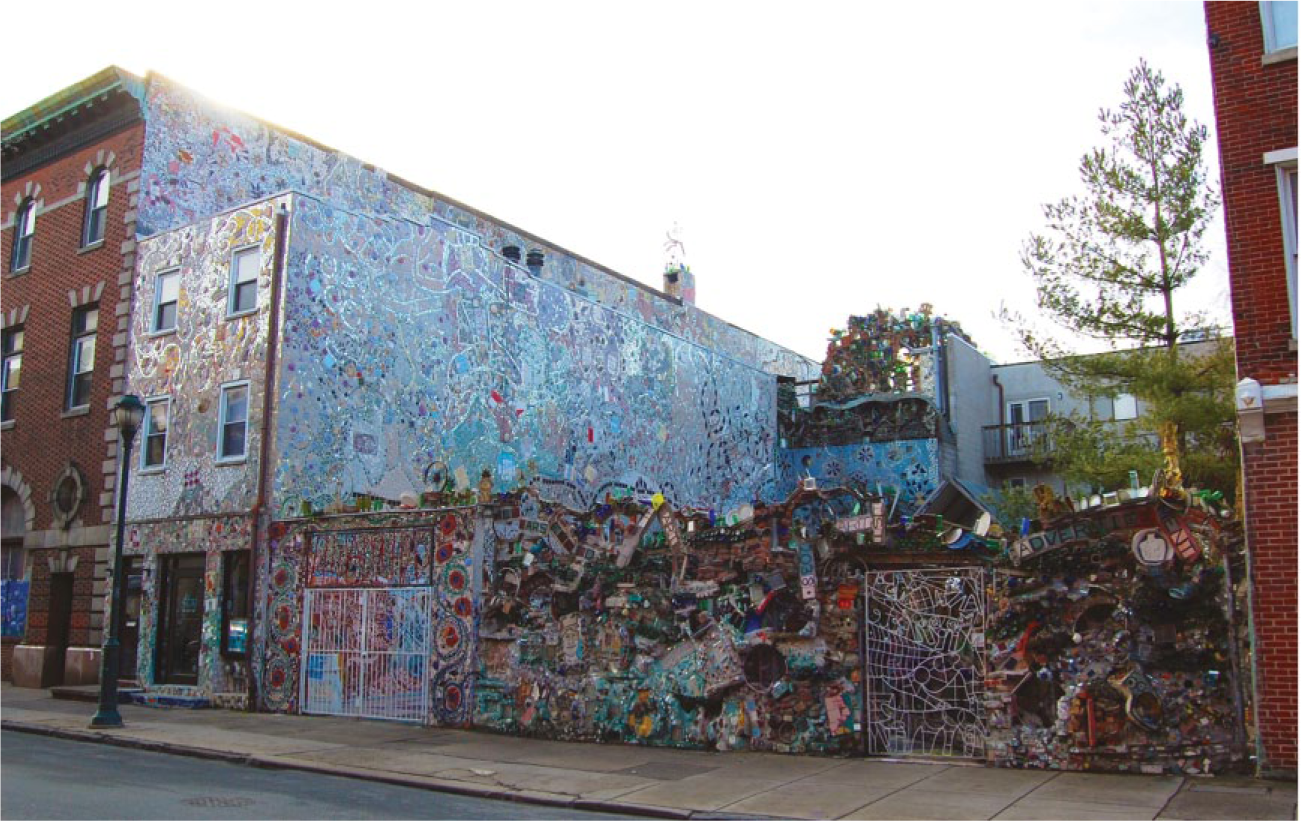
A view of the Magic Gardens, Philadelphia.
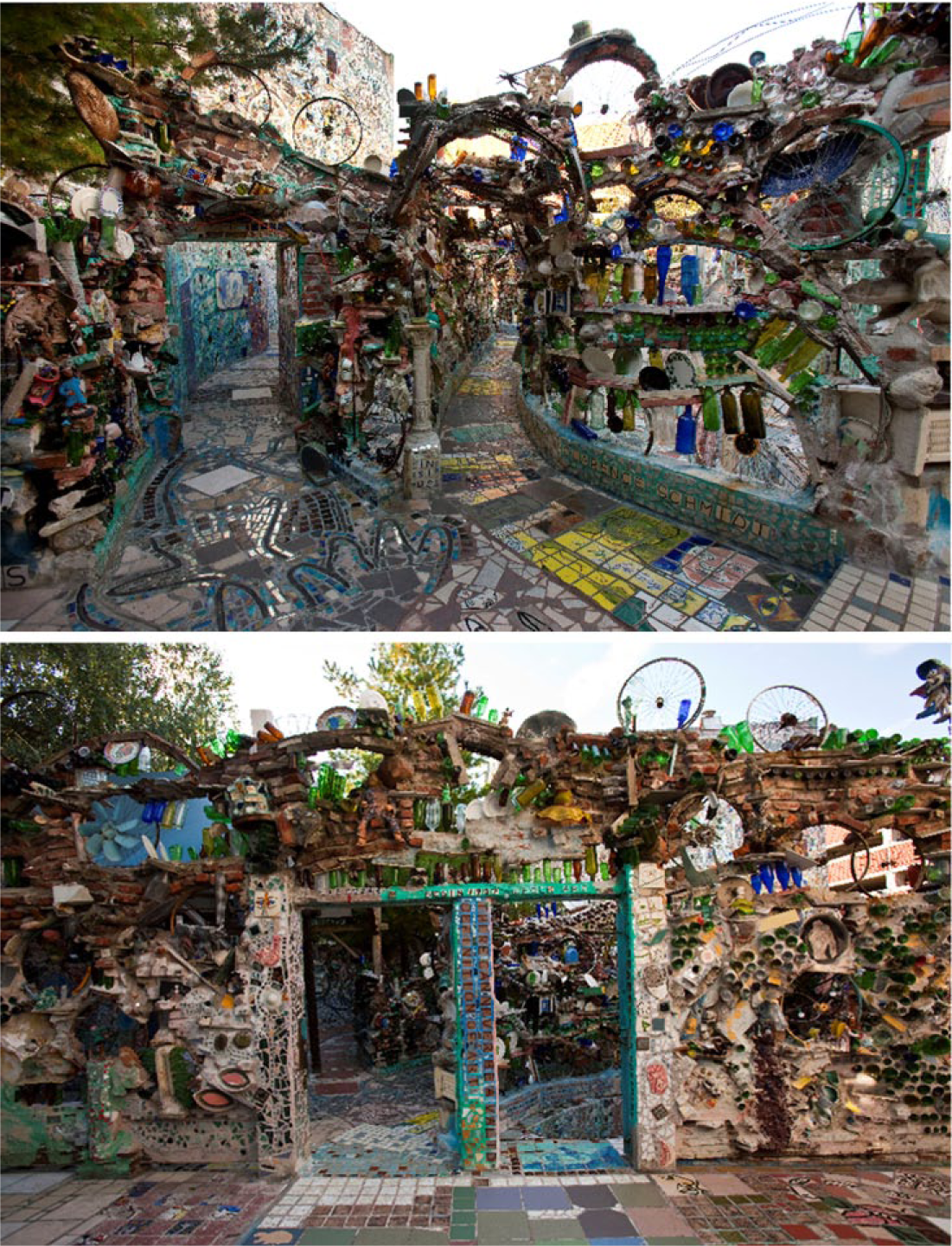
The Magic Gardens in detail.
Returning later when the garden was open to visitors, Cathy explored the interior, the alcoves, precipices, passages, and dead-ends embedded in the garden. As she wandered, perhaps momentarily part of the garden, she felt how the narrow pathways forced close encounters with intricate detailing that challenged what a wall, a divide, an environment can be, built from remnants and detritus from other times and spaces, assembling to generate something that was over-powering in the moment, but in which other ways of doing and being were immanent.
We include this brief diversion to the Magic Gardens because of what happened afterward. Enchanted by the Gardens, we had been alert to its textures, its details, but more significantly to the feelings it evoked—to the interruption of affect. And moving on through the streets, we began to notice the textures, the details, the feeling of other buildings that we might have missed had the Magic Gardens not stopped us in our tracks. This experience, we suggest, hints at what a “baroque sensibility” has to offer to literacy studies. It disrupts the idea of an all-seeing perspective prompting us not only to look but also to feel differently about the everyday and the mundane. The episode suggests that other things might become apparent if we applied this same sensitivity to literacy research. What resonances and textures, what details and supposed irrelevances, and which connections and relationships, or tracings and pathways might we notice, or feel? What might be included that would otherwise have been overlooked?
In what follows, we explore what emerges from this baroque orientation as we think with and re-work stories generated through the Barnsborough project—work based on an exploration of the potential of incorporating virtual play in an elementary school setting. We attempt to illustrate how the baroque can generate alternative ways of knowing, appreciating, noticing, and feeling what occurs—and how it might be put to work in understanding the complexities of literacy. In the next section, we elaborate on a series of baroque techniques before going on to illustrate what might be achieved by using them when considering meaning making in classrooms.
Baroque Technique
Partly inspired by the translation of Deleuze’s (2001) writing on Leibniz, an interest in baroque method has emerged in the fields of cultural studies and social science (Harbison, 2000; Lambert, 2004). For example, the work of Law and Mol (2002) and Law (2004b, 2011) illustrates how a contemporary baroque analysis might re-orient science and technology studies—but very little of this thinking has crossed over into educational research. One notable exception here is MacLure’s (2006) evocation of such moves as rupture, entanglement and fragmentation that work to explode the illusion of “clarity” and “visibility” that is associated with conventional linear accounts of education (p. 736). For Maclure (2006), the baroque offers complicating, disconcerting ways of engaging with educational scenes. It would recommend disruptive writing which intentionally undermines its own uncertainty, interferes with the hierarchical disposition of its conceptual structures, and blurs the illusory transparency of its access to the world. (p. 734)
In our own work (Burnett & Merchant, 2014; Burnett, Merchant, Pahl, & Rowsell, 2014), we have begun to sketch out how a baroque sensibility might animate literacy research by providing accounts or stories of how children make meaning in the hybrid spaces produced when new technologies are absorbed into classroom life. We have also suggested that such an approach has wider relevance in literacy and education. In what follows, we develop this notion of the baroque, by revisiting the virtual world project described in Burnett and Merchant (2014), developing our method of “stacking stories.”
In structuring this baroque reading of our empirical material, we draw on a re-interpretation of Law’s (2011) working paper, “Assembling the Baroque.” In this article, Law sets out six techniques of the baroque, which we list in Table 1 and build on later in the following sections.
Six Techniques of the Baroque.
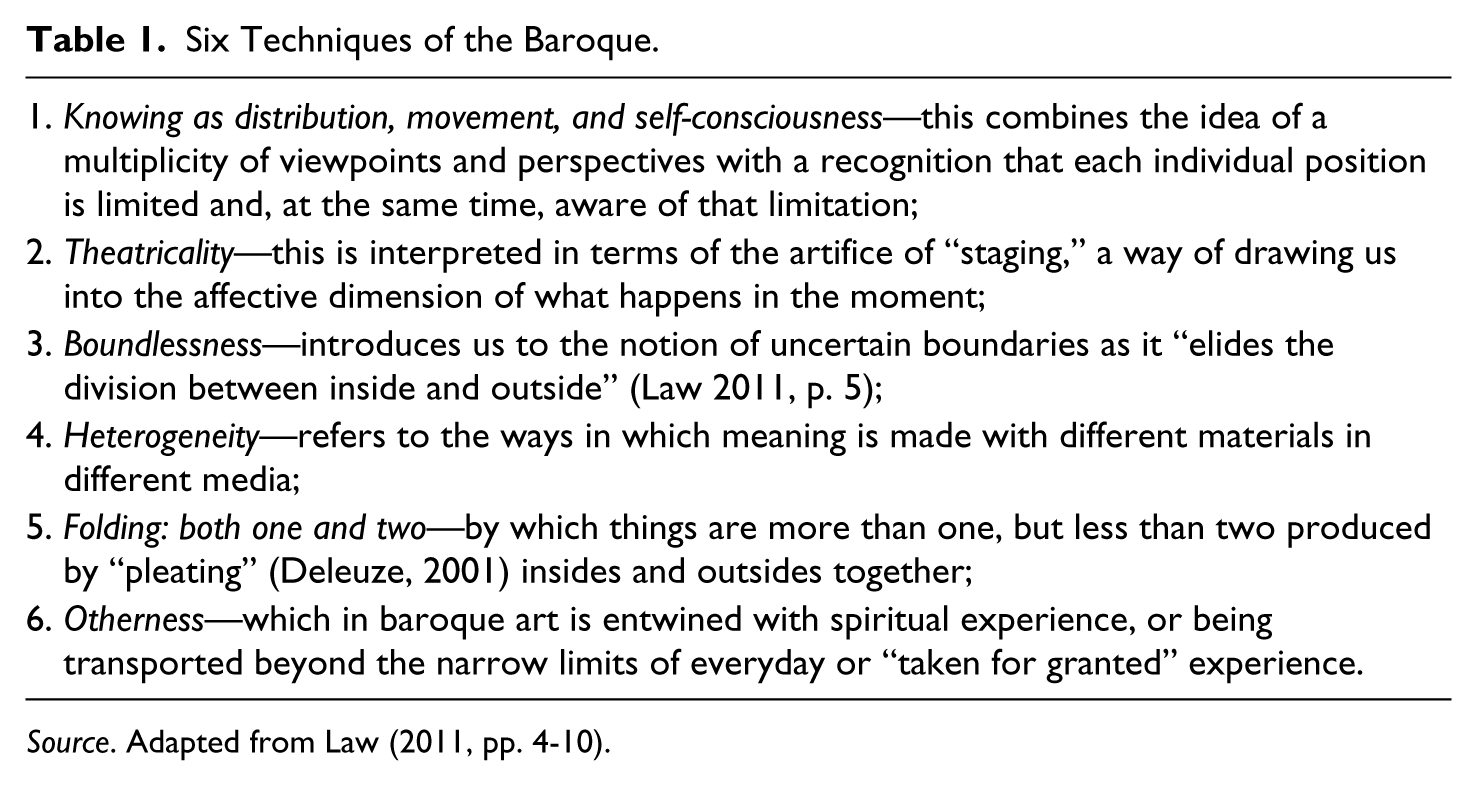
Source. Adapted from Law (2011, pp. 4-10).
Law (2011) suggests that these techniques might be seen as a set of “experimental resources for understanding and appreciating the empirical differently” (p. 11). He argues that they are not to be seen as better in any way, but just as alternatives that carry the potential to open up alternative perspectives. It is in the spirit of this provocation that we use these six techniques as resources for engaging differently with research data, through a method we refer to as stacking stories.
There is a parallel here between the role of the baroque in the history of art and our mobilization of these techniques in the current educational climate. If the historical baroque aimed to inspire us with a vision of something more vigorous and more elaborate in the face of increasing simplicity and conformity, then we aspire to something similar by validating the complexity of meaning making in a context that is dominated by the homogeneity of the so-called reform agenda.
Barnsborough Revisited
In experimenting with the baroque technique, we focus on one particular project in which virtual play was incorporated into a school classroom. We wanted to explore how children made meanings across online and offline spaces in work designed to provide opportunities for children to use technology in a meaningful and motivating context (Merchant, 2009, 2010). The virtual world in this case was Barnsborough, a secure environment built by Virtually Learning in the Active Worlds Educational Universe (www.activeworlds.com). Developed by a group of educators, researchers, and consultants, it was designed to provide a context for “new literacies” (Merchant, 2009).
Barnsborough is a 3D virtual world, an abandoned town that children explore through avatar-based play visiting interconnected locations such as a town hall, a cafe, and an old castle. Moving around this world, they encounter clues hinting at why the town is deserted in the form of dropped notes, hyperlinks, graffiti, wall posters, and labels. “Boxes of poison” is one of many such labels. Children have access to an online chat function through which they can greet one another, and pass comments and questions. Chat items appear not only initially above avatars’ heads but also in an ongoing scrolling chatlog at the bottom of the screen. They can also use other common virtual world functions such as teleporting between different places or flying from one location to another. Figure 3 gives an impression of the virtual world on-screen.
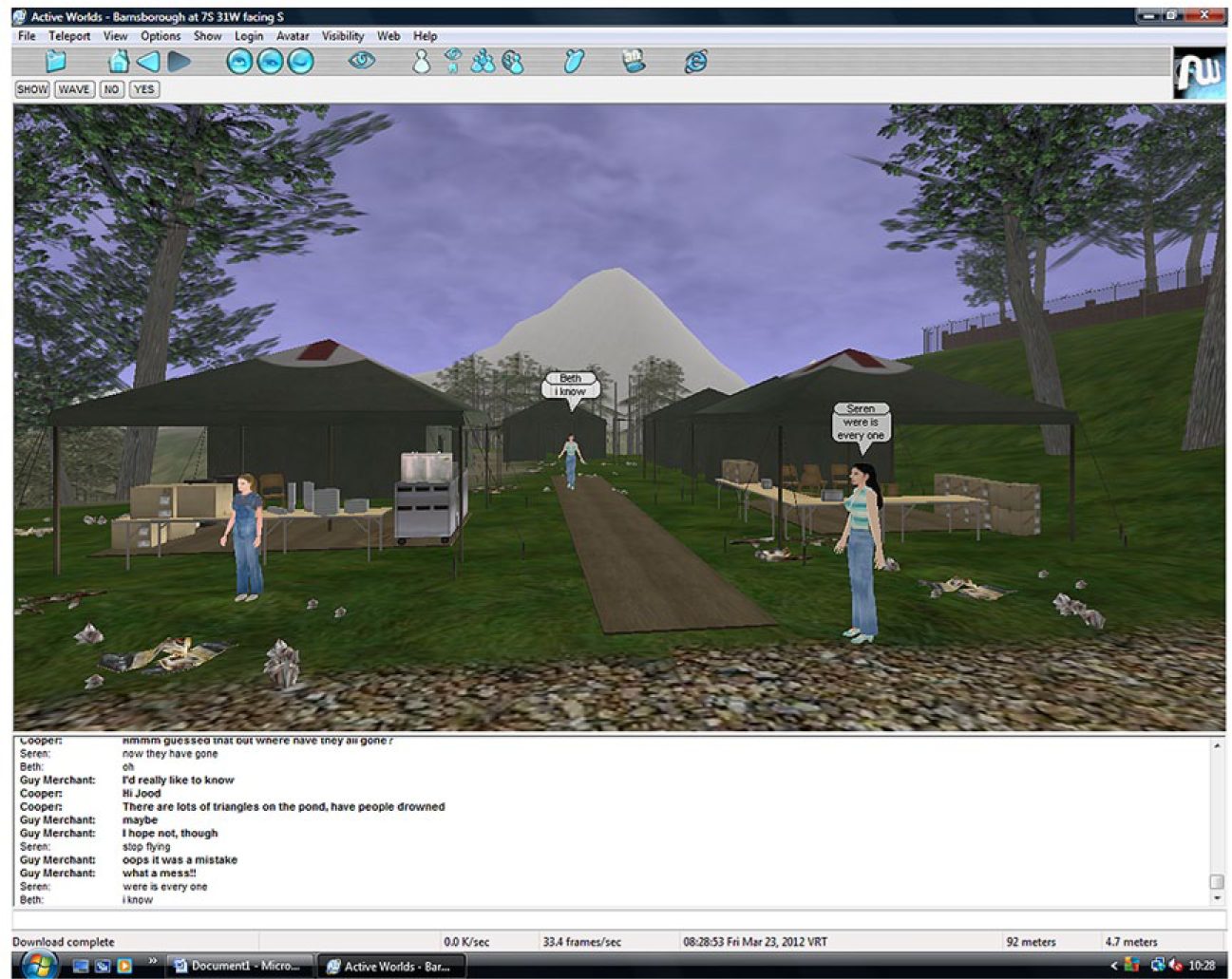
A screenshot of Barnsborough showing avatars and on-screen chat.
We studied 18 children, aged 9 to 10, from two schools in the north of England (for a fuller account, see Burnett & Merchant, 2014). All accessed the world using laptops in a single classroom. Children explored Barnsborough and attempted to solve the mystery of why the town was deserted using iPads and notepaper to record clues and their developing ideas. In investigating children’s meaning making, working with colleagues, we employed methods that aimed to establish multiple perspectives, seeing these as points of departure rather than as pieces of an established reality. We were interested in how children worked and played on- and offscreen, through words, gesture, gaze, and movement around the classroom and in the world.
Three researchers were present in the classroom. One video-recorded children as they interacted in and out of world to support close multimodal analysis (Taylor, 2012). A second and third (Cathy) took field notes: one observing focal children as they journeyed through the world, with the other focusing on broader flows of movement in the classroom as students moved around, working alone or forming temporary groupings. A fourth researcher (Guy) met the students in-world as an avatar. SMS messages were relayed to him from the classroom to alert areas of high activity in Barnsborough so that he could participate in them.
Stacking Stories as Baroque Method
In what follows, we juxtapose stories told from different perspectives—one from each of us, interspersed with a comic strip that animates the empirical material in an alternative way (See Figure 4). We refer to this as a process of stacking stories (Burnett & Merchant, 2014), a method designed to evoke a baroque perspective. These stories, generated from fragments, are just three of a multiplicity of stories that could be told about children’s explorations in Barnsborough. They are drawn from our empirical materials—field notes, video footage, the chatlog, and extracts from a school inspection report 1 and stack onto one another in a precarious fashion, as we see below. In the case of the comic strip, we re-present an episode from the data not only in a self-conscious/transparent way, partly to draw attention to the artifice of “reading” or “staging” research data, but also as a way of drawing attention to what is elided in the other, predominantly verbal accounts. We present the three stories in succession without comment with the intention that they will evoke partial takes on the complexity of the Barnsborough experience and raise questions and point to gaps and uncertainties about what lies between.
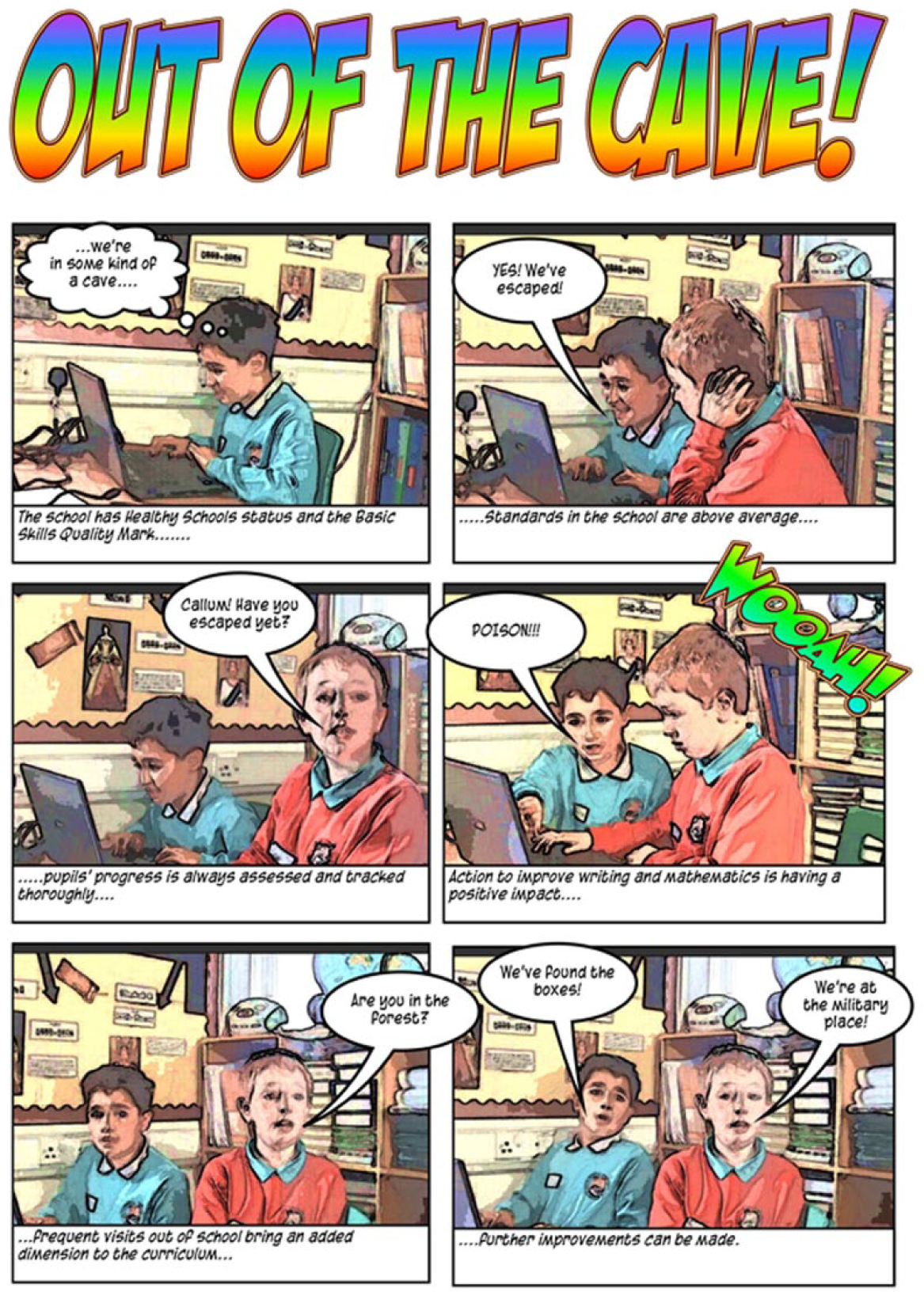
Out of the cave! Comic strip.
We invite readers to think with these materials, seeing and feeling them in terms of “‘baroque inventiveness,’ as novel combinations of a particular set of elements” (Kwa, 2002, p. 26) that suggest ways of understanding the classroom at that time. More important than the individual stories themselves is the process of stacking them together. Whereas a single story is inevitably bounded by its distinct beginning and ending, anchored in location, and structured around a sequence of events (Clough, 2002), here it is the gaps between the stories that are important. As we see these stories in relation to one another, boundedness starts to dissolve and the stories become rhizomic with threads of each appearing in the others, sometimes surfacing, sometimes disappearing from view as different characters, objects, settings, and actions are foregrounded.
By stacking these stories together, we are not attempting to arrive at a single truth through the artifice of triangulation, or even to suggest plural truths, but to allow each story to trouble the other’s take on what happened. This process enables us to move beyond seeing meaning making in terms of the “hierarchies of knowledge and linear thinking” that typify representational accounts (MacLure, 2011). So although we can identify nodes of coalescence through which stories are momentarily articulated, these nodes serve less to highlight convergence than to signal the multiple pathways (Deleuze & Guattari, 1987) that traverse the virtual/material on-screen/offscreen encounter with Barnsborough.
Boxes of Poison—Three Stacking Stories
Guy’s story
It seems that a small group of boys have latched on to me (at least I think they’re boys, the avatars have male names). I feel drawn into a familiar rapport between male teacher and male students, which I want to avoid. I’ve never been so aware of gender in the world before! Again I think about the classroom—what’s observable there? I notice the avatar “Rachael” entering the area, and then Alex suddenly appears, announcing in the chatlog that he has found some boxes of poison.
Outside the Internet cafe there is boxes of poison
What’s happened?
Boxes of poison and antidotes
[And then Rachael enters the chat]
Hi Guy
Hi
[Alex interrupts]
There is boxes of poison and gas masks
What has happened here
Guy?
[William appears]
Hi Guy I think there are daleks and aliens here because it says it in graffiti and on the wanted boards in the police station
I found a poster
Where, Rachael?
Its only lost dog
So
Overr heren Guy
Maybe that’s significant
I mean how would you fell if you lost a dog
What does that mean
I’d be gutted
0177447855555
The litter’s knocked over
Thats the number of the dog owner
I think the kids were looking for clues this time, dashing all over the place. Rachael though was much slower, not so talkative, and half the time I wondered just what was going on as her avatar stood mute and frozen to the spot. It’s really easy to start projecting at this point. To begin to imagine a Rachael who is reluctant to engage/slow to type/maybe slow to read/a bit awkward etc etc. I find this fascinating, because it lays bare a tendency that maybe all of us share in the “real” world. I’ve learnt through virtual world work to try and bracket all this . . . I mean I actually don’t know what’s going on for Rachael, and it could well be quite profound, quite ordinary, or simply quite unremarkable. But when Alex and then William start “interrupting” I start imagining there’s some gendered domination going on. And so when William appears to interrupt Rachael reading the Lost Dog poster (“its only lost dog”), I counter with: “I mean how would you fell [*feel] if you lost a dog.”
Out of the cave!
Cathy’s story
The children are back in the classroom after breaktime and continuing to explore Barnsborough. Alex is resuming the zoom round approach to exploring the world (“running” down streets and moving rapidly through the world). He’s sitting with Carl who’s watching. Alex manages the mouse though and provides a running commentary as he goes along: “I’m on my way there. I’m sprinting past the town hall.” [our co-researcher] and I settle round them, she with the video’ - so remove reference to ‘Linda’ with the video camera and me with my notebook. Alex lands on something and pauses: “This has to have something to do with it.” He turns the laptop round, showing a landscape with green footprints, and hands it to his friend, “My theory is it’s sure to mean something—mountain, using strange symbols, poisoned everyone—that’s my theory.” (Aside: I’ve written “mountain, using strange symbols, poisoned everyone” in my notes—is this exactly what Alex said or just my summary?) Alex carries on running through Barnsborough in 3 second bursts—run/stop/run/stop . . . When he sees a written text—a sign, a poster, a label, he moves towards it and then pauses to read, before running on. He notices a friend’s avatar—“There you are in the doorway. Follow me.” He sets off and comments “It might be zombies.” (Aside: in my notes, I haven’t recorded where he’s looking—at Carl, at his other friend, at the screen?) Outside the Internet café there are boxes. Alex uses the cursor to point at each box in turn and reads the floating labels that appear: “poison.” He goes back to other boxes further down the street: “I don’t see poison.” “Guy” appears on chat: “I’m coming to join you.” There is something creepy about this—about a disembodied sentence appearing to come from some all-knowing force. I haven’t heard any of the children discussing who he is or what he’s doing and I wonder if “Guy” is a phenomenon they discussed while outside at breaktime? Maybe this is why they later ask our co-researcher if she’s Guy. Alex goes back to the boxes of poison. He looks around at another box and hovers over the label so it appears on the screen. This one says “gas masks.” Alex calls out, “Mr B.—some boxes say gas masks and poison. I think it’s an apocalypse.” He looks back at the screen: “It might be aliens . . . What do these boxes say?” He notes comments down using the on-screen chat function. He seems to be using this more as a note-taking device than an opportunity to chat, and then takes a photo of the screen using his iPad. He clicks on the boxes again—“someone must have poisoned everyone . . . Maybe it was daleks.”
Using Baroque Technique
In these stories, the reader encounters many unanswered questions, undeveloped ideas, and vague hints of feelings and responses. For instance, what does Alex really feel, see, or think as he zooms around Barnsborough? How might the experience of an inspection and an inspection report inflect opportunities for children to engage in this kind of virtual play? To what extent do the stacking stories serve to foreground the boxes of poison we write about? Which other people and things play a part here in addition to the few children, adults, and objects that feature? Placing the stories together intensifies their partiality and messiness. We realize this may be frustrating for a reader—disengaging or alienating even, perhaps evoking a very different kind of affective intensity to the enchantment we experienced at the Magic Gardens in our opening discussion. But in the commentary that follows, we resist the urge to cradle each story in context or to arrive at a coherent, well-rounded analysis. To do so would be to achieve the kind of closure we challenge in this article. Rather than organizing these fragments into a neat account, we use them below to expand on each of the six techniques of the baroque introduced above and in doing so illustrate how such techniques can usefully interrupt our thinking with data and help us to “apprehend things otherwise” (Law, 2011). In this sense, we are re-interpreting Law’s baroque techniques and applying them to our own empirical materials.
Knowing as distribution, movement, and self-consciousness. As we observe, analyze, and feel our way through the research processes, we tangle together certain things and not others. The baroque invites us to be always open to other ways of knowing, to consider what happens if we set out to tangle things up differently. How else might we know or feel what is going on? Knowing, according to this perspective, is never finite but always in process. We intend our stacking stories to achieve this by tapping into the different kinds of orderings, or sense-makings, in virtual play. Each story is necessarily incomplete, demonstrating that what we know is always partial—there is always another story. Using this baroque perspective, the boundaries that define the extents and limits of individual stories begin to dissolve. For instance, in Cathy’s story, Alex is alone and next to Carl, and we sense his immersive experience of Barnsborough; for Guy, looking at the screen, Alex is just one of a group of “boys.” Each story probes the gaps in the other and reminds us that these particular stories are just a selection of the multiple stories that could be told to provide other perspectives, to pay attention to different dimensions and modalities. The novel combinations generated by these stories offer up the possibility of different traversals, connecting different nodes of meaning, tempting us to imagine a different telling, a fourth or fifth stacking story, in which another constellation of material objects and bodies takes shape. In place of the singular accounts of cause and effect that typify simple accounts of literacy, these multiple ways of conceiving the moment prompt us, as educationalists and researchers, to think expansively about practices and be always alert to other ways of knowing.
Theatricality. The essential theatricality of a baroque perspective sensitizes us to the affective. Law (2011) explains theatricality in terms of “knowing through staging,” a knowing through affect achieved through “the theatrical and its effects, its dialogues, its scenery and the multiplicity of its artifices” (p. 5). By putting these three stories together, like a series of episodes in a play, we make a small attempt at this as each story works to draw in the reader in different ways: Cathy in her predominantly third-person account of micro-practices evokes the dynamism of children’s immersive virtual world play, and Guy through a first-person account that he frames in terms of other previous encounters with Barnsborough. Separately these two short, rather ordinary narratives struggle to achieve an evocation of virtual play that is “phenomenologically real” (Kwa, 2002, p. 26). Cathy’s account approximates the perspective of the “objective social scientist . . . maintaining a safe distance between herself and research participants” (MacLure, 2011, p. 998); she reports speech and action on-screen and offscreen and mostly writes herself out of the scene, whereas Guy’s account has a measured reflective quality and we are left to imagine the lived on/offscreen reality that surrounds and infuses the chatlog. In contrast, the comic strip “Out of the cave!” allows a dialogue or tension between word and image, blending “linear, sequential text-like reading” (McCloud, 1993) and “simultaneous, all-over image-like viewing” (Smith, Hall, & Sousanis, 2015). It draws attention to the frame-by-frame movement of the children’s bodies, their brief comments as they talk to each other and call across the room to their classmates conveying a sense of dynamism, and the excitement of discovery as events unfold. This effect is highlighted by the juxtaposition of technical, “professional,” and passive phrases from the school inspection report (e.g., “pupils’ progress is monitored and tracked thoroughly”). This comic strip also perhaps works in Brechtian fashion, making its own artifice explicit and in doing so, undoing the artifice of the other two which involve less obtrusive workings with the empirical materials.
Boundlessness. For Law (2011), theatricality is partly achieved through undoing boundaries between the observed and the observer: by both feeling what is presented and looking at it, by being both inside and outside at the same time. Just like Cathy in the Magic Gardens, we invite the reader to both look at the classroom and be in it. Each story offers a different take on what it is like to both observe and feel meaning making. In Cathy’s story, Alex’s very individual exploration in Barnsborough is interpolated with the displaying of the laptop, and shouted comments to his teacher (Mr B). She presents him as both alone and with others. His running commentary suggests he is in the world moving through it (“I’m on my way”) but simultaneously looking at it (“It might be aliens”). In contrast, the visual element of the comic strip shows children sharing a laptop in a classroom, talking about their virtual play—but the commentary line locates this within a school under account, a place in which standards are “above average” and actions have been taken to “improve writing.” Such statements render children as the passive recipients of an education, rather than active meaning makers. In this text, we may feel the children’s excitement through the image but this is tempered by the inspection report that invites us to look dispassionately at the class. A rather different view is taken by Guy, as he stares into his screen seeing avatars and sometimes, through them, feels the classroom that he imagines. The three narratives unsettle each other, suggesting uncertain boundaries. Surely Cathy’s experiences are racked with tensions and relationships with other times and places, just as materialities are significant to Guy’s entry into Barnsborough via his laptop in his home office. Both are as selective and as confected as the comic strip. Reading them together unties the bounded certainty of each telling.
Heterogeneity. Baroque method invites us to use different media to explore phenomena and through these arrive at different ways of knowing. We use the comic strip and two different narratives to look differently at some of the framing concepts we recruit in the name of literacy research. Time, for example, has featured strongly in literacy curricula and neatly bounded segments or events are foregrounded as researchers focus on lessons, classrooms, projects, or interventions. In a comic strip of Barnsborough, we could simply have examined children’s learning in relation to what happens in “clocktime” (Ricoeur, 1985), using the comic form to present events unfolding moment by moment. Instead, we evoke another sequence in the contrapuntal inspection report extracts. Similarly Guy’s story suggests multiple time frames inviting us to see this event in relation to longer trajectories, such as his history of engagement with Barnsborough, his familiarity with gendered practices in classroom research, and so on. He recounts the episode in terms of a subjectivity that relates not just to these events in Barnsborough but to a series of becomings across multiple timescales. The different forms therefore enable a kind of “heterochrony” (Lemke, 2009; p. 280) as the episode is represented in different ways.
Folding: both one and two. We can understand both boundlessness and heterogeneity in terms of a multiplicity that “implies that different realities overlap and interface with one another. Their relations, partially co-ordinated, are complex and messy” (Law, 2004b, p. 61). In considering “folding” or “pleating,” we look at what happens as different realities emerge. As we saw above, the narratives work together to highlight the entwined experience of the material/virtual, on-screen/offscreen, classroom/Barnsborough ensemble. We also see how the three stories are folded into and at certain points articulate with one another. So we see avatars/poison/dogs/Guy and Alex momentarily converge before they diverge and prompt other pathways. Reading the stacking stories, these occurrences work as nodes around which different sites, different activities, and different meanings momentarily coalesce. The inside and outside are folded into each other: “The artifice of the fold separates inside and outside . . . but undoes that separation too” (Law, 2011, p. 8). Alex’s reference to daleks and an apocalypse suggests that he storied the world in terms of other preferences and texts. Meaning making did not just exist within the confines of the “Barnsborough project” but was folded into other histories and trajectories that were in turn folded into what happened in Barnsborough. Stacking stories as baroque method foregrounds what happens as events in a school site unfold to include multiple other times and places only to enfold them again in accounts of a particular place in time.
Otherness. In trying to grasp these different ways of knowing, Law encourages us to use baroque technique to pay attention to “otherness.” In our critique of simple models of literacy, “otherness” is helpful in pointing to dimensions of meaning making that go beyond those associated with ordered, cognitive-psychological accounts of literacy (see Hall, 2003). It acknowledges the baroque imperative to induce “specific forms of bodily sensibility far removed from those of asceticism” (Law, 2011, p. 3). We might focus, for example, on Alex’s sensory engagement with Barnsborough hinted at in Cathy’s description of the rhythmic way he toured the virtual town; or Guy’s sensing of his emerging presence in Barnsborough as it is conjured on the screen in front of him evoking other associations and felt responses; or the experiences that slip between the cracks of the three stacking stories such as Cathy’s embodied experience of the research process; or the embodied/not-bodied movement of all participants across classroom/virtual space. This kind of otherness sidesteps the future-facing (or perhaps deferred) preoccupations that frame literacy curricula, pedagogy, and assessment, such as the acquisition of skills or competencies or concerns with audience or purpose or text making. It concerns the emergent, embodied creation that Leander and Boldt (2013) identify, or the free-flowing in-the-moment improvisation that Burnett and Bailey (2014) outline in their account of children building in Minecraft.
In arguing for a need to take account of the bodily sensual dimensions missed by the representational, MacLure (2011) suggests, Perhaps we could try not to flee from these disconcerting sensations—those moments when we feel the body surging into the serious work of cognition, threatening to bring about the ruin of representation—and instead treat them as possible openings onto wonder. (p. 1006)
Wonder here evokes an uncertainty or unknowing that is an important counterpoint to the certainties that undergird the rigid and unitary accounts of literacy written into literacy policy and so-called reform. Importantly for us, it also evokes “wondrousness” and recognition of the excessive, the ebullient, the vivid, and the felt. An attention to otherness also shifts attention from meanings made or to be made to a focus on the process of meaning making that transcends purpose or design in its immediate sensuousness. And finally, the baroque alerts us once again to materiality—a materiality that is too often silent in accounts of literacy and literacy pedagogy.
Leveraging the Baroque for Political Purpose
The opportunities for meaning making in this virtual world project were clearly very different to the more individualized, paper-based and tightly structured activities that typify much contemporary literacy teaching in England and elsewhere. It could be argued that this kind of free-roaming virtual play exemplifies a kind of baroque pedagogy, in its celebration of the staged and artificial, its exuberance, and the explicit invitation to operate through multiple media and across multiple sites. While such an argument might reward further exploration, here we are more interested in how a baroque rendering of this work highlights multiplicity and what this adds to other post-structuralist accounts.
As Law argues, the baroque was always intended as interventionist. Just as the boxes of poison lurking in Barnsborough hint at possible disruption or insurrection, so the baroque attempts to disrupt or challenge: “It is about shaping the world, operating upon it, and formatting it in one way or another. Descriptions are never idle” (Law, 2011, p. 13). There is a parallel here between the role of the baroque in the history of art and our mobilization of these techniques in the current educational climate. If the baroque project aimed to inspire us with a vision of something more vigorous and more elaborate in the face of increasing simplicity and conformity, then we aspire to something similar by validating the complexity of meaning making in a context dominated by the homogeneity of the reform agenda.
The contribution of the baroque is to embrace uncertainty. Law (2004a) explores how the materiality of the research process is elided in scientific studies along with all its messiness, nuances, uncertainties, and irregularities. The techniques outlined here provide us with a means of interrogating this elision and alerting us to these complexities, to “improve our sensibilities to that which does not fit, to that which cannot be reduced to the conformable homogeneities of our more standard working practices”(Law, 2011, p. 11). A baroque orientation, like other post-structuralist accounts, highlights the inevitable instability and multiplicity of interventions, which “become” different things, and have consequences that are disparate and not predictable.
The novel process of stacking stories described here enabled us to acknowledge uncertainties, the complexities of affect, and things that were on the periphery of our attention, to acknowledge that there is always another set of meanings just outside our grasp. The process of stacking stories against one another alerts us to the cracks between the stories, unsettling the idea that there is a simple cognitive pathway between mind and text. Instead, we see “aberrant paths of communication,” that “there is never a totality of what is seen nor a unity of the points of view” (Deleuze & Guattari, 1984, p. 47). In this way, stacking stories evoke the idea of multiplicities, and as a consequence of this, the felt, embodied, material intensities of the process of meaning making as highlighted in the analysis above.
Of course the application of baroque technique through the stacking stories that we have presented here is only one possibility. A journal article simply does not afford much theatricality—and we are limited by our own creative powers, and an urge to reach a wide readership. It would of course be possible to turn our baroque technique to more radical ways of playing with and provoking interactions with data to produce generous, ebullient, and vivid accounts. These might involve elaborating on others’ uses of comic strips and narratives (e.g., Bailey, 2016; Lillis, 2011; Sousanis, 2012) or using other modes of creativity and performance (e.g., Denzin, 2003; MacLure, 2011), even as Law (2004a) muses, sculpture, music, or cookery. Such approaches would generate other ways of knowing.
In this respect, we would like to align our work with growing interest in the role of the felt in accounts of literacy, which we see, for example, in explorations of students’ engagement with literature (Ivey & Johnstone, 2013), of the significance of classroom relationships (Lewis, 2011) and work that evokes the notion of affective intensities (Hollett & Ehret, 2014). What our baroque technique offers is a way of troubling the taken-for-granted and signaling the affect produced through interactions between body, text, and place as they infuse each other through meaning making, intensities that are written out of official accounts of literacies. The baroque, in highlighting these omissions, acknowledges how experience works across media and undercuts the primacy of language. As Deleuze and Guattari (1987) write, in a description of the rhizome, “A semiotic chain is like a tuber agglomerating very diverse acts, not only linguistic, but also perceptive, mimetic, gestural, and cognitive” (p. 7). This in itself is productive, potentially transformative as “assemblages, like actors, are creative. They have novel effects and they make new things” (Law & Mol, 2008, p. 74). Knowing is never finite but always in process.
Using the baroque in this age of stultifying educational reform resonates with its historical emergence as a reaction against the overly formulated and regulated account of Christianity in the Reformation (Knox, 2000; Mulkahy, 2011). While the ideological and political orientation of the baroque has been the subject of much criticism for its association with feudalism, colonialism, and authoritarianism (Thomas, 2010), we suggest that a focus on the disruptive power of baroque technique offers much to educators and scholars working in an era dominated by simple views of literacy. These techniques can work as “sensitising resources” (Law, 2011, p. 14) that help us see meaning making in other ways, in the ways in which they foreground multiplicity and complexity, provoking generous, ebullient, and vivid accounts of literacy. The baroque, as “a set of tools for formatting experience, forms of understanding and realities” (p. 75), can challenge habitual readings of literacy practices in classrooms and elsewhere. Its focus on disruption and affect can complement other research approaches that explore the multiplicities of literacy as lived experience. It has the potential to generate new possibilities.
Baroque technique can therefore occupy important ground in the dialogue between research and practice. It acts a resource for those working to disrupt and challenge simple perspectives on literacy in their research, in their work with practitioners, and in their attempts to explore the complexities of new literacies. Our example illustrates how a baroque orientation can help us ply affective engagement with deep reflexive engagement. It mediates our delight—our wonder—as literacies assemble in classroom contexts, and this interruption of affect sensitizes us to the textures, details, and feelings that, although ephemeral in nature, offer new ways of approaching what literacies become—or might become—in classrooms.
Footnotes
Acknowledgements
The authors would like to thank Emily Smith and Nic Barlow for permission to use their photographs of Philadelphia’s Magic Gardens. Emily took the photograph of the façade and Nic the archway and passageway. We also acknowledge the contribution of our collaborators in this project: Chris Bailey, Karen Daniels, Emma Gill, Jemma Monkhouse, Julie Rayner and Roberta Taylor.
Declaration of Conflicting Interests
The author(s) declared no potential conflicts of interest with respect to the research, authorship, and/or publication of this article.
Funding
The author(s) disclosed receipt of the following financial support for the research, authorship, and/or publication of this article: This project was supported by a United Kingdom Literacy Association research grant.