




Abstract
In this single-case retrospective study, we examine the phenomenon of difficult experiences in schooling and literacy as described by Diana, age 25. Drawing on convergent theories of affect, new materialism, and critical dis/ability studies, we explore educational trajectories and complexities of entangled identities. Four open-ended interviews, a series of conversations, were conducted with Diana and analyzed through a rhizomatic lens. Our analysis illustrates Diana's participation histories and literacy trajectories (re)presenting dis/continuities of past, present, and future time, which bring to life emotional collisions, ruptures, and possibilities. As difficult experiences compel us to witness and to bear testimony, we address potential social and human consequences of labels and categories and argue that a new materialist approach to literacy research and critical dis/ability studies can powerfully frame research that calls out injustice and cultivates hope.
Affect is what sticks, or what sustains or preserves the connection between ideas, values, and objects. (Ahmed, 2010, p. 29)
This study investigates the phenomenon of difficult experiences (e.g., Dutro & Bien, 2014) in schooling, literacy, and life. Using a single-case retrospective study, we draw on convergent theories related to new materialism (Beucher et al., 2019; Fox & Alldred, 2015), inclusive of affect (Ahmed, 2010; see also Ehret & Leander, 2019), and critical disability studies (CDS) (Ellis et al., 2019). We explore the educational trajectories and complexities of entangled bodies building from CDS as a space to think, question, and critique social/theoretical/political issues while blending new theories and methods (Goodley, 2017). In doing so, we attend to experiences remembered and felt by an adult learner, Diana, age 25, who looks back in time and sees them reemerge in a trove of buried memories that (re)present categories of past↔present↔future human otherness, literacy trajectories, and dis/continuities (see Barad, 2010; Dernikos & Thiel, 2020; Wargo, 2019).
Dutro (2011) wrote of exposing wounds and exposed wounds, illustrating how traumatic events function differently in public and private spaces. When made public, stories can engender empathy either supporting or reifying existing assumptions. In this article, we extend Dutro's work to uncover how difficult experiences in private spaces become internalized and how stories and tropes about dis/abled people are taken up and circulated. We use the term dis/abled people to recognize the entangled identities, lived experiences, and possibilities of dis/ability. Although literacy researchers have problematized the affect of normative literacy practices that label and marginalize learners (e.g., Dernikos & Thiel, 2020; Dutro, 2011, 2019a, 2019b; Jones, 2013), little research exists on the nexus of affect/literacy/dis/ability. To this end, we illuminate the unfolding, embodied perceptions of Diana and the affect of her entangled literacies and dis/ability to disrupt and challenge common narratives that categorize learners.
Affect in teaching, learning, and life experiences is impacted by intensities and capacities of moments and events in time and space to produce movements, change, and relations, such as happiness, envy, shame, or anxiety, that affect bodies in different ways (Dernikos et al., 2020). Time and temporality are a “material/discursive/contextual dimension” of how people make sense of their experiences and lived-in worlds (Wargo, 2019, p. 131), and where affects are the “forces (intensities, energies, flows, etc.) that register on/with-in/across bodies to produce and shape personal/emotional experiences” (Dernikos et al., 2020, p. 5). Drawing on these notions of affective encounters and personal/emotional experiences in past–present time, we explore Diana's imbricated subjectivities, the conflicting positionings she takes up and resists, and her ways of knowing and becoming.
In thinking with the theories (see Jackson & Mazzei, 2012) that frame our study, we employ a rhizomatic conception of becoming that is neither linear nor hierarchical (see Bettez, 2015). We intentionally use language that includes slashes, parentheses, italics, and hyphenated words to (re)present how we think with theory, texts, and data (see Kuby & Crawford, 2018) within a new materialist framework. Data produced through narrative and artifactual memories of school and literacy experiences are material expressions of “time, temporality, and be(com)ing in literacy research” (Wargo, 2019, p. 135). Hence, our purpose is twofold: (a) to engage the affective disruptions of difficult experiences and their emotional residue over time (see Dernikos & Thiel, 2020; Dutro & Bien, 2014; Wargo, 2019) and (b) to address the multiplicity of Diana's subjectivities through conversations mirroring rhizomatic attributes (see Dernikos et al., 2020; Kuby, 2013).
Beucher et al. (2019) referred to “new materialisms” as a “family of thought” challenging notions of human agency and the dichotomization of human bodies and material objects (p. 445). New materialist theories examine materiality and recognize the affective potentials of relational networks of human and nonhuman bodies (Fox & Alldred, 2015). We acknowledge the complexities rippling through this work and recognize that interpretations are seldom innocuous or complete (Dutro & Bien, 2014).
Theorizing Affect, Literacy, and Critical Dis/Ability Studies
Citing Barad (2007), Beucher et al. (2019) called attention to the growing emphasis on materiality, which focuses on the ways human and nonhuman bodies come to matter. Within this framework, matter and meaning are not separate or determined by the other; instead, being and knowing are productive forces working synergistically. For example, flows of matter and meaning have an energy that can be sensed and felt—reminiscent of how re-awakened memories are brought to life or how bodies and things come together and sometimes rupture to produce new understandings. In this way, embodiment is a re-centering of how we come to know, experience, and make sense of bodies (Lenters & McDermott, 2020). New materialist theorizing mobilizes bodies and produces energies to open new vistas with unknown possibilities where understandings and engagements with data, things, and their effects are diffracted (Bozalek & Zembylas, 2017).
Diffraction offers an alternative to assumptions about reflexivity and agency, which ignore affect and emotional experiences, assigning responsibility to individuals for choices regardless of the forces shaping their decision-making (Bozalek & Zembylas, 2017). According to Bozalek and Zembylas (2017), the tendency for revelations, which diminish or invite alienation, is diffused because diffraction lessens the mirror of fixity in reflexivity and attunes to difference. Diffraction is about openness to others and being changed by/through each encounter; it is the process by which differences are made (Davies, 2014).
Embodying Past/Present/Future Literacies
The concept of literacies as embodied transcends narrow conceptions of literacy that emphasize “mind over body” (Kontovourki et al., 2020, p. 381). As such, Jones (2013) described the limitations of language to (re)present complexities of mind, body, and spirit. She called for reimaging literacies that can help make sense of bodies, which she defined as “literacies in the body” (p. 526). Literacies in the body refers to materiality—how literacies are acquired and made manifest.
By way of example, Jones (2013) pointed to round-robin reading with her students and noted their affect—avoidance of eye contact, shifting bodies, and flushed faces. She questioned the “body-wounding” literacies evident during this and similar instructional practices (p. 528). Jones encouraged educators to examine the materiality and unpredictability of these practices on bodies, which foregrounds the point that literacy is not a thing. Instead, literacy is a series of rhizomatic relations without beginning or end that are “composed and recomposed” (Boldt & Leander, 2020, p. 521). Thus, we are mindful of movements and affective encounters with literacies and bodies as sites of doing and being with the potential to “re-matter” literacies, learners, and pedagogies (Kontovourki et al., 2020, p. 382).
Studying Literacies in Time and Space
Lemke (2013) considered the concept of literacies in the body and questioned how the breadth of literacies “strung out along the trajectories of our days, weeks, and lives” might be studied (p. 57). In addition to studying literacies ethnographically, discursively, and semiotically, he suggested studying them phenomenologically and experientially. He maintained that doing so provides insights into how meaning is mediated by emotional experiences stemming from actions affecting next actions and the meanings assigned to them. For Lemke, feelings arise through emotional experiences, facilitating a sense of continuity with attendant possibilities to be evaluated and undertaken—or not. Accordingly, literacies in the body are mediated by actions and tied to emotional experiences linking across time scales (Boldt et al., 2015). The linking of embodied literacies and subjectivities or becoming across time and space matter because although subjectivities are not singular or fixed, emotions are mediated and porous (Boldt et al., 2015). They emerge from/within affective encounters with implications for thinking, feeling, and being and have the power to shape narratives about lives and literacies (see Dernikos & Thiel, 2020; Schmidt & Beucher, 2020; Wargo, 2019).
Emotion as Verb
When considering the affect of literacies in the body, Kuby (2013) raised the notion of emotion as verb to (re)present the entanglement of human and nonhuman bodies. Micciche (2007, as cited in Kuby, 2013) conceptualized this entanglement as “emerging relationally, in encounters between people, so that emotion takes form between bodies rather than residing in them” (p. 33). In classroom settings, emotions are generally kept private, held in check, and controlled. Kuby, however, asserted that emotions cannot be separated from actions or relations and one's lived experiences.
Drawing on narrative, critical sociocultural, and rhizomatic theories, Kuby (2013) situated emotion as something we do in relationship with others. She conceived of emotions as rhizomatic and connected them to emotional collisions that are unexpected and unpredictable and to rhizomatic analysis that welcomes movement and ruptures. Although she did not specifically theorize affect, she viewed emotion as relational and material. Like Kuby, we acknowledge the tensions in our work and consider the importance of affect in relation to felt experiences and emotional intensities. We likewise view relations of experiences as emotional collisions rather than things that are disconnected from bodies and affect. As there is no magic formula for “negotiating the complexities of human lives coming together” (Dutro, 2019b, p. 16), Dutro asked us to examine the felt connections of bodies within the “larger themes of another's experience” (p. 25). She observed that bodies testify to traumatic experiences by taking on embodied gestures and movements as they collide and come together.
Witnessing and Testifying
Witnessing and testifying speak to the entangled nature of bodies and trauma. A witness is someone who “both sees and retreats from seeing, remembers and resists remembering, listens for specificity but also listens to break a silencing, restrictive frame of reference” (Felman & Laub, 1992, as cited in Enciso, 2007, p. 68). And so, difficult experiences shared in education and community spaces are examples of witnessing and testifying; they are “circular and cyclical” and compel those who listen to bear testimony (Dutro, 2019b, p. 197). Dutro (2019b) made clear that the stakes are higher for some children based on how their stories are heard and interpreted. We suggest the same is true for adults, like Diana, whose childhood trauma lies dormant until it resurfaces. Such moments call for witnesses who pull together the emotional experiences of those who testify, creating moments of connection and shared vulnerability (Dutro, 2019b).
Countering the Affect of Dis/Ability
Educators have long separated actions and emotions in their teaching and research, employing practices that tend to ignore the dynamic synergism of affect, actions, and context.
Both literacy and CDS scholars note that education in the United States is about the “production of kinds of persons described first by ethnic, racial, and linguistic lines and second by supposed mental abilities” (McDermott et al., 2006, p. 12; see also Dudley-Marling, 2019; Goodley et al., 2018). The new materialist turn in CDS, however, challenges underlying assumptions about dis/ability, a split or bifurcated term that illustrates the relationship between disability and ability (Goodley et al., 2019). Unpacking dis/ability as embodied, material relations is central to these efforts, and attending to affect complicates differences between the interior and exterior worlds of human bodies (Goodley et al., 2018). In this vein, CDS and literacy scholars aim to shift discourses of (re)presentation from deficit to asset (Smagorinsky et al., 2019).
Borrowing from CDS scholars Oliver and Barnes (2012, as cited in Goodley et al., 2019), we define disability as “a phenomenon associated with the discrimination of people with sensory, physical, and cognitive impairments” (p. 973) and employ the concept of dis/ability to illustrate the relationship between disability/ability and to signify inequity and possibility. Goodley et al. (2019) explained that knowing something about dis/ability entails having a sense of ability and its relation to able bodies and minds. Liddiard et al. (2019) further likened dis/ability to an ontology of what it means to be human. They pointed out that in CDS, ableism focuses on idealized notions of global citizens who are able to maintain self-reliance and enhance human autonomy, whereas dis/ablism is a complementary but different process that marginalizes and excludes. In contrast, when ability is framed in new materialist ways, dis/ability joins increased categories of dis/abilities made possible by newly emerging technologies and theorizing together with “evolving versions of ability” (Liddiard et al., 2019, p. 158). Within a CDS framework, dis/ability confronts notions of normativity. It opens avenues to lived experiences and materiality—what is evaluated and deemed possible, inclusive of affect, emotion, and feeling, which speaks to the vulnerability of human-on-human existence and relations (Mitchell & Snyder, 2019).
Relatedly, Shildrick (2020) argued that dis/ability is not solely the concern of dis/abled people. She contended that developing “our understanding of all bodies is affected once we take the difference of dis/ability into account” (p. 32). The status of disabled and abled-bodied individuals is provisional rather than fixed, indicating a commonality that threatens existing boundaries of self and other. When we critique and question our assumptions, an anxiety is produced that breathes life into the process and engenders possibilities. For this reason, dis/ability cannot be reduced to difference, a lack, a failure, or “an essence of only becoming to be fixed” (Mitchell & Snyder, 2020, p. 53); instead, it is a mode of being “among multiple ways of becoming” (Shildrick, 2020, p. 41). Shildrick’s (2020) work exhorts us to uncover underlying motives that exclude and to push theoretical resources toward practices that disrupt the marginalization, oppression, and alienation of dis/abled people.
New materialistic theories in CDS offer a holistic approach to consider material environments and embodied experiences of dis/abled people (see Feely, 2016). As bodies exist within material contexts, their capacities are contextual, relational, and ongoing. New materialism integrates transformative agendas to interrogate notions of dis/ability, allowing for and creating in-depth analyses of disability-related perspectives (Feely, 2016; Kent et al., 2019). It centers on the complex material physiological and psychological realities of body and mind impairment (Goodley et al., 2019). Thus, new materialist theories and methods attend to dis/ability as both oppression and possibility by revealing its collective potential rather than highlighting individualized and limited (con)/figurations.
Both literacy and CDS scholars question educational practices that label and marginalize. With this in mind, we set in motion the entanglement of affect/literacy/dis/ability in relation to Diana and her re-memberings and re-tellings. We address potential social and human consequences of labels and categories and argue that a new materialist approach to literacy research and CDS can powerfully frame studies that call out injustice and cultivate hope.
Methodology: Knowings and Becomings
In this section, we elucidate the (re)presentation of materiality to situate the complexities and multiplicities of bodies, movement, and discursive practices (see Barad, 2003). We describe the context in which data were collected, a community women's literacy initiative, and explain our positionality and Heidi's relationship to Diana. We analyzed Diana's re-memberings and re-tellings of her literacy and life trajectory using rhizomatic analysis, a method commonly used in new materialist studies, and acknowledge the tenuousness of the methods we employed.
(Re)Presenting Materiality
Barad (2003) distinguished representations from the practice of representing—relations between a material entity and the ways in which it is (re)presented—to critique the primacy of language. She conceptualized a relational ontology that rejects the representationalist fixation on “words” and “things” and the problematic of their relationality, advocating instead a causal relationship between specific exclusionary practices embodied as specific material configurations of the world (i.e., discursive practices, (con)/figurations rather than “words”) and specific materialist phenomena (i.e., relations rather than “things”). (p. 814)
Data Sources: Complexifying the Context
Data for this study were taken from a larger narrative inquiry that Heidi conducted with Diana and four other women. The women participated in a neighborhood literacy initiative to prepare women with general equivalency diplomas (GEDs) as literacy tutors for women working on their GEDs (Bacon, 2014; Bacon et al., 2020). Diana, a White divorced mother of two, was recruited by the local adult literacy center because she lived in the neighborhood, completed the application, and submitted reference letters from her GED instructors. Diana participated in 40 h of preparation, 160 h of tutoring, and 30 h of biweekly mentoring over 2 years. She also volunteered at community literacy events and spoke about her tutoring experiences at a luncheon hosted by the literacy initiative's funder.
Researcher Positionality: Contextualizing Relations and Experiences
Heidi is an associate professor. She is an older white, monolingual woman who dropped out of school and later returned as a working mother to complete her education. Paula and Abdulsamad are international doctoral candidates who were not involved with the literacy initiative. They worked closely with Heidi for several years, were familiar with data from the narrative inquiry, and shared an interest in new materialist theories and methods. Paula and Abdulsamad brought fresh perspectives to the study, and as international students and English as a second language (ESL) and English as a foreign language (EFL) instructors from Brazil and Yemen, respectively, they have witnessed otherness and marginalization in the United States and abroad.
Heidi codeveloped the literacy initiative, coauthored an asset-based curriculum and tutor handbook, and co-coordinated the initiative during its first 2 years. During the second year of the initiative, she conducted a series of four unstructured interviews with Diana over 4 months. Each interview averaged 90 min. The interviews were audio-recorded and transcribed verbatim. Diana and Heidi bonded through tutor preparation, mentoring, and shared connections and conversations. Although they conversed often, data for this study were excerpted from the interview transcripts. It was during these interviews that Diana shared her closely held emotional experiences and memories, which were reanalyzed and reconceptualized for this study as tracings of data (see Jackson & Mazzei, 2012).
Data Analysis: Multiplicities, Mobilities, and Connections
Consistent with new materialist theories, we employed a rhizomatic analysis (Feely, 2016; Handsfield, 2007; Leander & Rowe, 2006) to embrace principles of multiplicity, mobility, and connections. Rhizomatic analysis draws from the notion that data, similar to rhizomes, are nonlinear and “cannot be contained” (Handsfield, 2007, p. 218); any part of a rhizome can sprout in any direction (Adkins, 2015). Drawing on Deleuze and Guattari (1987), Schmidt and Beucher (2020) described rhizomes as “traceable aspects of an assemblage” (p. 405). Like a rhizome, an assemblage is a process of making and unmaking and “arranging, organizing, fitting together” (Jackson & Mazzei, 2012, p. 1). It is a (con)/figuration of bodies, inclusive of “signs, material objects, events, practices, and utterances” (Lenters & McDermott, 2020, p. 21). Assemblages show how multiplicities connect to other multiplicities that form or extend a rhizome (Deleuze & Guattari, 1987; Feely, 2016); they also rupture and expand to produce new possibilities, connections, or lines of flight.
Tracings of data
We approached Diana's four interviews as a series of continued and overlapping conversations. Borrowing from Wortham and Reyes (2015), whose methods emphasize discourse analysis beyond the speech event, we began our analysis by identifying and excerpting story threads indicative of Diana's affective experiences. Rather than focus on Diana's discourses, we attended to affect, emotional intensities, and ruptures in her re-memberings and re-tellings and employed rhizomatic thinking to concentrate on Diana's oscillating emotions of hope and hopelessness, desire and acceptance, and corresponding and coexisting limits and possibilities. Patterns of discursive practices, affect, and complexities were identified and mapped onto a rhizome, as shown in Figure 1.
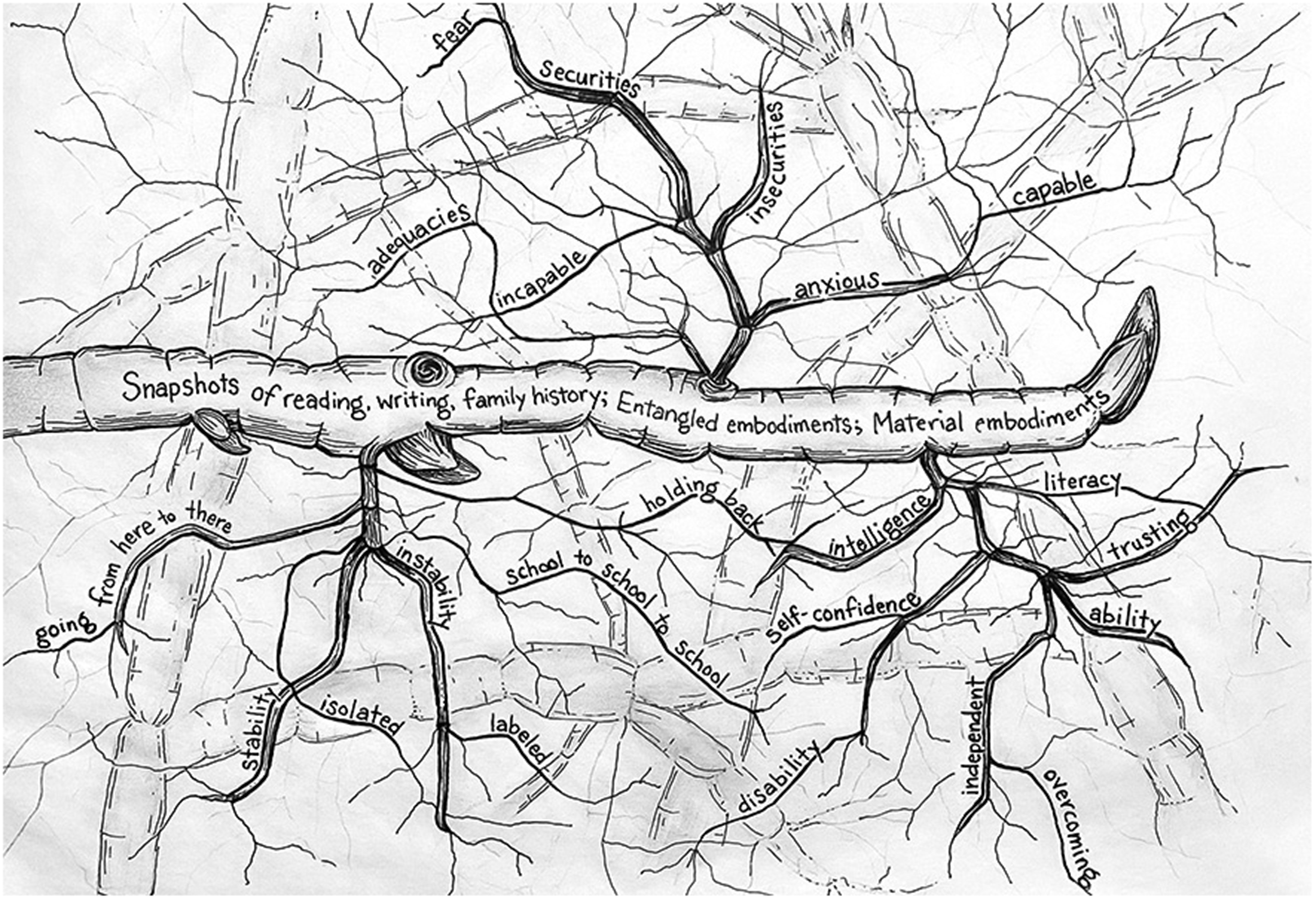
Rhizomatic entangled and embodied memories.
Figure 1 (re)presents the relations of connections that go back and forth in time and space, materializing Diana's affect. As we analyzed Diana's conversations with Heidi, we flattened and connected the tracings of data to show the dis/continuities, multiplicities, and multidirectional possibilities brought to life in rhizome-like fashion.
We were mindful of concretizing data and found Brinkmann’s (2014) description of data—“a breakdown, a situation, people interacting, discourses mobilized” (p. 723)—central to our thinking and analysis. Focusing on forms of meaning that linked and put in motion events as pressure points and trajectories of forces, we plugged in theories (Jackson & Mazzei, 2012) about affect/literacy/dis/ability, which we used to (re)present our findings. Plugging in requires examining how things are connected, and in doing so produces something new. It is about thinking with “both theory and data” (Jackson & Mazzei, 2012, p. 5). Essentially, plugging in involves (a) decentering theory and practice by showing how they are mutually constituted, (b) being deliberate and transparent about the theoretical concepts and analytical questions being used, and (c) working with data to make it “groan” with an abundance of meaning that creates new knowledge and shows its suppleness (Jackson & Mazzei, 2012, p. 5).
Because rhizomatic analysis is partial, it does not provide a final set of results but suggests questions and follows connections and trajectories (Feely, 2016; see also Jackson & Mazzei, 2012; St. Pierre & Jackson, 2014). Thus, our analysis sought to illuminate possibilities that live within/across Diana's experiences, relationships, and subjectivities; connect the tracings of data; and (re)present the different assemblages that have/may not have been uncovered or revealed. We recognize that like a fractal, the complexity of the whole and its parts can be fragmented in deep and countless ways.
Using Kuby’s (2013) notion of emotion as verb to foreground Diana's personal/emotional experiences, our sensemaking unfolded through reading, questioning, troubling, and connecting the tracings of data. Aligned with Brinkmann’s (2014) question of “How is it possible?” (p. 723), we considered questions like the following: How did Diana's personal/emotional experiences fuel her insecurities? How did her school environment influence her learning? Does she feel hope or desire, and for what? How does she know and how can we tell? What forces and intensities produced ruptures of possibility? Where does she go from here, and does she know? We addressed these wonderings and others in our attempt to unmask the in/visible forces affecting Diana's trajectory as expressed in the unfolding conversations.
Complexities Unfolding: Affect, Literacy, and Dis/Ability
Students who experience difficulties in school are sometimes described as dis/affected. But what does it mean to be dis/affected, and how does one become dis/affected? Diana's re-memberings and re-tellings reveal insights into these questions. After holding them back for years, Diana's difficult experiences and emotional intensities (re)surfaced during her conversations with Heidi.
Elaborating further, we see that Diana's early life was fractured. As a child, she lived with her mother, her brother, her mother's boyfriends, and sometimes strangers. When experiencing homelessness, the family lived in their car or with relatives and extended family. Haltingly and tearfully, Diana flashed back in time, sharing her childhood trauma: I did not have a good childhood. She [Diana's mother] had a drug problem for a long time so I was abandoned and whatnot. She’d come get us and we’d go from here to there to here to there, so I was never able to even learn how to read. I probably went to five different schools in one year. There was nobody at home who could help me with my homework. I guess back then in the ’80s and ’90s, they [the school] didn’t really pay much attention. They just labeled you LD [learning disabled] and threw you in these classes. I needed to be in class learning what I needed, but because they had me labeled LD, I was in the slower classes and not learning.
In Diana's re-telling, we sense the affect, trauma, movements, and collisions of “labeled” and “threw,” bringing to mind a stamp or brand—a metaphor of a “throwaway kid.” We note her use of “threw,” an act indicative of discarding, a body thrown out/into something, and we puzzle the emergence and instantiations of a seemingly discarded body. The phrase “in those classes” marks not only the classes as different, but also Diana by virtue of having been “thrown” into them, a move that denied a minor child the right to refuse.
Affective Intensities: Labeling
Labeled with a dis/ability, Diana was placed in a special education setting from kindergarten to fifth grade. In her re-memberings and re-tellings, Diana used third person, distancing her adult body from her childhood self as she explained: “They didn’t see she doesn’t have a learning disability. She just doesn’t have a structure to get the knowledge that she needs.” Diana's use of third person reveals the child who felt isolated, alone, and different. The words “didn’t see” map the dis/continuity of a physical presence that is also in/visible.
In another conversation with Heidi, Diana re-membered sitting in her classroom, looking out the window, watching parents pick up their children. She spoke of her childhood dream made material through its (re)telling: I had this dream when I was little. I’d be in class watching parents drive up in their cars and get their kids. I would pray every day that my mom or my biological father, especially my biological father, would pull up and save me. Even in sixth, seventh, and eighth grade, I always had this idea that he would come and take me away.
The intermingling of hope and hopelessness, according to Diana, was a force that drove her desire and effort to learn. She spoke several times of the teacher who changed her special education placement, a (re)occurring memory and rupture that opened new possibilities. I was in fifth grade. The school didn’t have the finances to have an LD program, so the teacher put these kids [dis/abled students] in lower reading groups. An aide helped the higher reading kids, and the lower reading kids would get all his [the teacher's] attention. He literally took me under his wing. He went to the principal and told the principal she does not have a learning disability. She's just behind and hasn’t learned everything. She's a fast learner.
De Schauwer et al. (2018) contended that the act of labeling constitutes difference within dis/ability discourses and can influence individuals into reductionist and binary ways of perceiving normativity and difference. Since affect is performed, the feelings one holds are socially conditioned in and by their relations with others (Goodley et al., 2018). To this effect, Smagorinsky et al. (2019) suggested that children who fall outside expected norms are set up for failure, which to Goodley et al. (2018) necessitated (re)considering school assemblages that sort and classify children.
Affective Intensities: Dis/Ability
Around this time, Diana's mother entered rehabilitation and met a minister whom she later married. Diana confided, “My mom got clean when I was in fifth grade and married my stepdad. He stepped in. He was my safe haven.” Her use of “stepped in” and “safe haven” speaks to affect and materiality. It alludes to feelings of safety and sanctuary, a need for respite from the maelstrom. For the first time in her life, Diana experienced a stable home with a stepfather who cared for her and a school environment where she could learn and develop her interests.
Diana took an interest in music, which took her away from “low-ability” reading groups and buoyed her self-esteem because she “picked it up quickly.” She learned to play several instruments and joined the school band. Music, as with her later tutoring experiences, helped her gain “confidence” and a sense of belonging in spaces she long perceived as “unkind” and “unjust.”
Given her early experiences, Diana's stories provide evidence of psycho-emotional disablism (Reeve, 2020), which (re)surfaced throughout her (re)membered and (re)told stories. Disablism, a form of oppression, involves the “social restriction of activity on people and the socially engendered understanding of their psycho-emotional well-being” (Thomas, 2007, as cited in Reeve, 2020, p. 103). Shildrick (2020) wrote that individuals value autonomy, agency, and control over their bodies, and those who are seen as physically or mentally compromised are made other, limiting their autonomy, agency, and self-control. As Ahmed (2004) suggested, the “I” and the “We” are “shaped by and even take the shape of contact with others” (p. 10). We surmise that Diana's perceived in/abilities were shaped by normative views of dis/ability with her image of self-refracted through the lens of her relations with others and how they viewed her.
Affective Intensities: Figuring It Out
Diana's entangled literacies, emotional experiences, and in/adequacies were complexified when she found herself pregnant and “caught up in circumstances.” Her future was unclear and murky. In addition to being pregnant, Diana experienced a severe anxiety attack and was diagnosed with obsessive compulsive disorder (OCD). She explained, “I have hidden struggles from my past and I didn’t know. I struggled and nobody knew. My anxiety was so bad.” Ginsburg and Rapp (2019) studied the disability world of students transitioning to college and work. They found the transition a “cultural freefall” for dis/abled students and noted that transitions and supports are often lacking, leaving students like Diana to fend for themselves (p. 84). This resonates, as in a later conversation, Diana mentioned having “no idea what to do after high school.” Graduating without a career pathway on top of her pregnancy and diagnosis contributed to a tenuousness she was unready to face, one that, according to Ginsburg and Rapp (2019), exacerbates the tensions between perceptions of normativity and the realities of dis/abled youth.
Lacking clarity, Diana dropped out of school in 11th grade to give herself time to “figure it out.” Looking back, she summarized her decision to leave school by stating, “I went the wrong direction.” Her statement suggests a rhizomatic openness, a wrong turn, the collision of a wounded body, memories swathed in emotions, and a future cloaked in unknowns with no beginning or end, movements in time and ruptures that later come full circle.
Affective Intensities: Literacies in the Body and Unfolding Complexities
As an adult learner in a vocational medical assisting program, Diana was required to take a writing course and express herself in writing, which conflicted with her deeply held need for privacy and self-protection. She acknowledged holding back: “I don’t want people to know much about me, so what I put out there is very technical. I’m like that in everything I write.” She described her writing as “dry” and “robotic.” A line of flight, a connection offering a new perspective, relates Dutro’s (2011) notion of exposed wounds and exposing wounds to Diana's experiences with writing and school-based literacies. Her story captures the essence of “what affect does in literacy classrooms in relation to particular bodies and the stories they tell and that are told about them” (Dutro, 2019a, p. 74). We pull back at the harshness of Diana's self-critique and wonder if this is a material remnant of long-lasting dispositions arising from past literacy practices that limited opportunities and excluded her from resources (see Compton-Lilly, 2007).
Through her re-memberings and re-tellings, Diana's embodiment of being labeled “LD” and “OCD” and its affect were made visible. As she unburdened herself in her conversations with Heidi, she candidly laid bare her in/securities and perceived in/adequacies. She told of her in/ability to express herself in writing. She recalled writing from her imagination as a child, which changed in high school because she “could not spell.” She blurted: “I couldn’t spell. I got bad grades. I hate people reading what I write. I’m scared of what people are going to say about it.” Diana found herself embroiled in conceptualizations and material consequences of “productive and restrictive” writing instruction (Zapata et al., 2018, p. 484).
Diana broke her cardinal rule of privacy, another rupture and line of flight, by telling her peers in the writing class about tutoring for the literacy organization and offering to tutor a classmate. With Diana's assistance, her classmate earned a higher grade on a paper, and Diana took exception. She expressed happiness for her classmate but confessed to harboring a “little grr.” Diana (re)membered feeling terrible that she did not do as well as her friend. She asked, “Why couldn’t I do that in my own work? If I could do it with hers, why couldn’t I do it in my own?” Diana also questioned her adequacy in relation to the student she tutored in the literacy initiative: “I was very sure I could help her, but you know there's always that voice in the back of your head that says what if you’re just causing her to fail.” This message of potential failure replayed in Diana's head, as she warred with herself and her emotions. Diana's affect seeps through her words. It is made material in and through her body—her memories and spoken words.
We witnessed Diana's testimony as she grappled with her subjectivities, torn between success and fear of failure. Despite her fear, Diana offered a convincing argument for her ability to help others. She admitted that “I was doing this and seeing the product of it, basically what you pay me to do, and then she [her classmate] gets this substantial grade. I’m actually helping people out there, so it made me feel better about what I do in the literacy program.” In addition to her friend, Diana successfully tutored three women, each of whom passed the GED. Yet, she continued to hold tightly to narratives of failure, which likely limited her possibilities for a wide-open future. As shown in Figure 1, Diana's re-memberings and re-tellings are rife with these dis/continuities and entangled literacies and subjectivities.
Caught up in contradictions, Diana contained and compartmentalized her success because she experienced it as tentative and fleeting. The embodiment of ordinary affects picks up “density and texture” while moving through the workings of bodies, dreams, and dramas (Stewart, 2007, p. 1). We are reminded of Stewart's notion of the body as an ongoing site of self-recognition and betrayal in that Diana's in/security and fear of causing others to fail hover and recombine in new (con)/figurations (see Reeve, 2020). In Diana's imaginary, the cloud of her past lingered, never to lay dormant or fully disperse.
Dis/continuities are present in Diana's feelings and beliefs about her future. For example, she confessed to feeling conflicted about becoming/being a medical assistant. Diana was partway through the program, but her work with the literacy initiative led her to float an untapped dream held close to her heart. Before committing her dream to words, Diana explained, “I don’t feel I’m capable of more.” She viewed herself as “capable of doing this job [medical assisting]” but incapable of more. Diana gave a weak, nervous laugh and stated: “If I were actually to do what I want to do, which is teach, I wouldn’t be good enough to teach those children I’d be teaching. I wouldn’t be able to, you know. I don’t want to mess up children. I don’t want to mess them up.”
In looking at these ruptures and unfolding complexities (Figure 1), we note the entanglements and newness that emerge. Diana's desire to be “good enough” persisted, swimming against an undercurrent of fear. The entanglement of affect, literacy, and ableism challenged the materialities of embodied school literacy experiences in a collision of “people, environments or institutions” and a “dys-appearing” body that was out of place or different (Reeve, 2020, p. 107). As both child and adult, Diana's difficult experiences and uncertainties of a future yet to be imagined produced a wall with slowly spreading cracks.
Affective Intensities: Expanding Spaces and Possibilities
Diana's wall of inner turmoil and roiling emotions, where feelings of failure clashed with growing confidence, were challenged by her experiences in the literacy initiative. Her experiences in the initiative opened new understanding in relation to her literacies. Reflecting back in time, she recalled: “I think, especially after I got out of LD classes, having the correct spelling showed how smart you were. I would bomb those spelling tests.” Diana equated accurate spelling of isolated words, a personal nemesis, with intelligence and her writing ability (Figure 1). In her mind/body, she had convinced herself that she was different and not smart.
Dudley-Marling (2019) asserted that dis/abled students receive instruction designed to re-mediate and fix them, which can exacerbate the way they experience and respond to difference. He advocated for meaningful texts and critiqued cognitive-behavioral models of instruction that ignore sociocultural and situated learning. Citing Elliott (2015), Dudley-Marling concluded that, in general, low-level, skills-based instruction limits access and opportunities for students to learn challenging curricula. Diana's stories affirm these ideas.
In the literacy initiative, Diana's experiences chipped away at her formerly held beliefs and literacy practices. She learned about miscues, as in when a reader misreads a word or phrase in a text, they are posing a problem—why did the reader say something other than what was written? What were they thinking when they miscued? Diana also learned strategies and routines beyond “sounding out” unknown words, freeing her from accurate, word-for-word reading. For Diana, miscues were “important to see and important to experience. It made me a better mom to know that you can have miscues and then understand that those miscues don’t mean you’re ignorant and your intelligence is below standards.” Reflecting back in time, Diana confided that the need for accurate reading, spelling, and perfect grammar had been “drilled” into her head, and when one is “labeled LD” and “can’t spell,” the person is “judged less intelligent.” The emotive verbs “drilled,” “labeled,” “can’t,” and “judged” expose rhizomatic fissures across time and space in how one thinks about dis/ability and what one does and performs in relation with themselves and others (see Kuby, 2013).
Diana's experiences highlight dis/continuities manifested through the discursive practices of literacies in the schools she attended. McDermott and Raley (2009) asked us to listen to the telltale bodies of children to see what is revealed. Diana's difficulties reading, writing, and spelling isolated words are illustrative of her feelings in physical and visceral ways—feelings that enveloped her and persisted into adulthood. She told of getting “really freaked out” when she felt people were “judging” her. One by one, she checked off the ways: “It's their body language. It's their facial expressions. It's those things I’ve seen before.” In her body, Diana felt the intimacy of colliding sensations shrouded in seemingly unchallenged conceptions and expectations of normativity. Nonetheless, they were real to Diana, and she fully tuned in to the “something” that felt like “something” (Stewart, 2007, p. 1). In rhizomatic fashion, we see the “affective intensities of proximal lives and distal consequences” (Dutro, 2019a, p. 89).
In a space of betwixt and between, Diana acknowledged, “I don’t feel dumb.” She came to understand that reading and writing were about sensemaking. Diana reasoned: Even though I’m not the best speller, writing is about the meaning behind what you’re writing and that's a big accomplishment. This experience [being in the women's literacy network] has really pushed me to not be scared to live life. I was kind of quiet, but when I made those connections, I saw women in a different way. I didn’t see really damaged women like my mom or my grandmother or my aunt. I saw women treating other women with respect and with dignity and that opened me up. They are not going to hurt me. They’re not going to call me names. It made me see women in a different light.
In another line of flight, Diana developed a friendship with her classmate in the medical assistant program. She shared: I have a friend now. I’ve never had a female best friend. It took me four months. I was helping another woman with her essay, and she was sitting next to me and knew I was a tutor. She asked me for help. She ended up coming to my house, and ever since then we’ve been friends. I can tell her anything and I can trust her not to tell a soul. I’ve never felt that way before.
Mitchell and Snyder (2019) argued that “suffering is the stuff of embodied existence. To experience embodiment is, by nature, to experience one's vulnerability” (p. 194). Diana's vulnerability produced ruptures and opened spaces for her to grow connections, allowing her to know and comprehend past–present relations and their previously buried parts (see Boldt et al., 2015; Dutro, 2019a; Lemke, 2013; Wargo, 2019).
When asked about her experiences re-membering and re-telling, she replied: “It was exhausting. I’ve guarded and buried so much that it's hard to even think. But good things have come of this. I’ve grown in my education and as a mother.” Diana described how profoundly difficult experiences affected not only her schooling and literacy trajectory but her essence and subjectivities across time and space. Although these experiences left her battered, they did not dampen her desire to learn. Diana connected education and learning with being a good mother. Along the way, she found a deepening sense of pride and independence in helping others. Diana stated: “I have a lot of pride because I’m doing something that's important for the community.” Her multiplicities and complexities remind us that affect, emotions, and feelings are tied to our learning trajectories. The dis/continuities of Diana's felt experiences exemplify that how we feel about what we do and what happens to us can influence our choices and actions in futurity.
Relations of Connections, Ruptures, and Lines of Flight
Diana's re-memberings and re-tellings reveal a history of abandonment, isolation, and insecurity. Her educational trajectory tended to be on-again, off-again. She carried her school and early childhood experiences with her in past–present time. Diana's chronicling of her experiences suggests a privately held journal not memorialized in writing. She agreed to participate in Heidi's study because she believed in the power of her stories to “help other women and children.” Her desire was a motivational cog that kept her going and moved her beyond the pain to expose and lay bare the emotional intensities of her experiences. It provided succor when the sharing overwhelmed and flooded her with memories and sustained her as she sought to reconcile and rekindle her knowing, being, and becoming.
Difficult experiences are real and present in classrooms. They take various forms and have differing impacts spanning ages, grades, and abilities. Diana's difficult experiences suggest a long-lasting legacy of what it means to be labeled, marked, and categorized. A CDS view of dis/ability, embodiment, and the educational trajectories of labeled learners contends that “for those with a dissed-ability, a missed ability, their bodies show less what they cannot do and more the marks put upon them by circumstances, by those seemingly not disabled at the time” (McDermott & Raley, 2009, p. 433; see also Dudley-Marling, 2019; Smagorinsky et al., 2019). Lodged in Diana's being, the materiality of labeling sifted through her memories, colored her thinking, and wrestled with her emotions. In contrast, the women's literacy initiative invited Diana to join a community of women who were “different…not closed off…open.” She was able to “let her guard down” after witnessing other women “letting their guard down.” Diana saw “women smiling and joking around and being okay with their speech and how they read,” a rupture that produced connections, possibilities, and friendship.
The act of witnessing is never neutral. A witness is someone whose presence is present, who listens, and who sees and senses the in/visible (Dutro, 2019b). As witnesses, we are responsible to Diana, to ourselves, and to our readers. As authors of this manuscript, we too are embodied and materialized through the production of a coauthored text that relied on the “plugging in of ideas, fragments, theory, selves, sensations, and so on” (Mazzei, 2014, p. 743). We witnessed Diana's speaking from her heart and the affect of her entangled and untangled beliefs about reading, spelling, and writing. Her path brought her into the orbit of the literacy initiative where she was introduced to different conceptions of literacy and literacy practices. Concepts prioritizing relationships and a holistic view of reading and writing facilitated acceptance and affirmation, a line of flight into other ways of thinking, knowing, and being.
Diana's teachers likely taught based on their knowledge of school literacies, which are embedded in histories of practice—materialized literacy practices and regimes of tasks that produce scores and labels (Pahl, 2014). Inherent in these practices is the unpredictable predictability of pedagogies that can wound bodies (Jones, 2013). Despite Diana's significant achievement in earning a GED, attending medical assistant classes, and successfully tutoring several women who earned their GEDs, the specter of labels continued to haunt her. Diana held back her heart's desire to teach; her entangled identities and lines of flight allowed her to connect, relate, dream, and wonder, but not commit. The weight of possible failure was too heavy to bear.
As Diana's experiences are not unique, we take up Jones' (2013) call to be “curious and imaginative about the body's unpredictability and its predictability and help us recognize the ‘automation’ within us that engages literacies because they already exist” (p. 528). Through our work with adult literacy and ESL/EFL learners, we are familiar with stories of students who are afraid to read because they make mistakes or who have difficulty committing their thoughts to paper due to concerns about spelling and grammar. It is troubling that notions of intelligence are caught up in accurate spelling and grammar. How can students be encouraged to practice a range of literacies when mired in spelling tests, grammar drills, and five-paragraph essays? How can we recommend that students read widely and often when they are called out, corrected, and shamed for making miscues? We underscore the need and advocate for inclusive curricula, texts, and responsive instruction regardless of where students are in their educational trajectories.
Moreover, we challenge the practice of labeling that can limit opportunities and resources and become self-limiting. We sense Diana was caught up in a bifurcated place of dis/ability, a deeply emotive feeling space that formed an assemblage of bodies, memories, texts, and material artifacts. Held tightly within, but revealed in conversation, Diana came to grips with her past and began to re-position herself as she glimpsed an alternate path and reached out to shape a different future. She worked to make peace with herself, accepting what she knew she could safely achieve without venturing too far into the unknown.
In the literacy initiative, Diana learned about literacies in the body that affirmed her capacities to learn and to know—literacies that empowered her thinking. She experienced instruction that was asset-based and resource-rich. She spoke of making changes in her home literacy practices and re-called teaching her fiancé about miscues and developing a reading routine for him to use when reading with her youngest son (Bacon, 2014). Diana re-membered sharing this story at mentoring and feeling honored and affirmed. Her affect rippled through her re-membered and re-told encounters in the literacy initiative, opening a constellation of considerations. When thinking back to her earlier experiences, she expressed a sense of righteous indignation over school-based literacies that “harm children.” She mused that “it [literacy] didn’t need to be so hard.”
Conclusion
In this study, we (re)present the materiality of Diana's affect and lived experiences. Her entangled experiences left her conflicted and afraid to acknowledge and act on her potential for fear it could all be snatched away. We concentrated on Diana's re-membered and re-told stories and how affect/literacy/dis/ability functioned in past–present time. Our aim was not to interpret Diana's reality, but to mobilize theory in a departure from expected ways of thinking and being and to emphasize the relational, social, and lasting nature of literacies in the body (Jones, 2013; Kuby & Crawford, 2018). The material effects of Diana's difficult experiences extend the conversation beyond P–12 and teacher preparation classrooms to adult and community spaces where adult learners come to seek another chance.
As we pondered the essence of qualitative studies to advance literacy research and practice, we carefully considered the unfolding of human experiences through a diffractive lens. New materialist theories and methods attend to bodies, both human and nonhuman, and why they matter. Such complexities are quintessential aspects of lived experience, and the convergence of affect, literacies, and CDS through a new materialist lens has currency for educators to advance equity and social justice. As a nonbinary method, rhizomatic analysis afforded the opportunity to embrace the entangled multiplicities of Diana's experiences and subjectivities to critically engage her knowings and becomings. We undertook this process by “thinking with theory” (see Jackson & Mazzei, 2012), illuminating our own in/adequacies and challenging us to extend our methodological reach and undertakings.
Our approach to Diana's experiences exposes the consequences of school literacy practices that can limit possibilities for learners to make connections and grow. In contrast, the women's literacy initiative provided curriculum and pedagogy that shifted Diana's thinking and practice of literacies in the body. Moreover, the literacy initiative was a space with numerous opportunities to establish relations and connections with other women who shared similar histories and experiences.
Diana's stories elucidate the importance of educational spaces for adults who were marginalized by their school histories and lived experiences. These spaces are critical for learners whose education was interrupted and who desire a fresh start. We urge educators across the educational continuum to consider the findings from this and similar studies to design programs, implement teaching practices, and conduct research that counters the dis/abling consequences of difficult experiences that wound bodies.
Footnotes
Acknowledgments
We humbly acknowledge the contributions of Emerita Professor Patricia L. Anders in the writing of this article. We thank the anonymous reviewers for their insightful feedback on earlier drafts of this manuscript and extend our thanks to Guofang Li for her thoughtful editorship.
Declaration of Conflicting Interests
The author(s) declared no potential conflicts of interest with respect to the research, authorship, and/or publication of this article.
Funding
The author(s) received no financial support for the research, authorship and/or publication of this article.

References
Supplementary Material
Please find the following supplemental material available below.
For Open Access articles published under a Creative Commons License, all supplemental material carries the same license as the article it is associated with.
For non-Open Access articles published, all supplemental material carries a non-exclusive license, and permission requests for re-use of supplemental material or any part of supplemental material shall be sent directly to the copyright owner as specified in the copyright notice associated with the article.
