




Abstract
This study explores the lived experiences of incarcerated fathers “being-in-text” with their children. It draws on Husserlian and Heideggerian notions of intentionality that are partly deconstructed by Derrida and further “posted” by Vagle’s notion of post-intentionality and Barad’s posthumanism. Of particular interest is a week-long prison-based mural project—framed in terms of multimodal, existential, identity work—that provided material support for fathers’ ontological shifts from being prisoners to being fathers in phenomenal time and space. The study revealed that being-in-text was lived as a contingent and suspenseful “being-in” time and space, oriented in a “being for” children, even as other forces of being-in-prison discouraged fathers from looking up toward horizons beyond prison walls. These dehumanizing forces of prison were a form of blind loyalty—a looking down and away from life outside prison and narratives of belonging. The study further revealed a possibility for becoming fathers as prisoners looked up into the eyes of (present and imagined) family members. Literacy events provide contexts for prisoners to be answerable to their children. But being-in-text and being-in-prison are lived as a singular and constant tension of “staging” that raises ethical concerns about the risks and costs of these ontological shifts. From this, an appeal is made for a nuanced valuing of prisoners as subjects rather than objects, and for further exploring a “posted” phenomenology’s role in literacy research and social justice work.
It brings us into a big circle of unity. And uh . . . how we feel when the camp is over—we in a whole different dimension. We, we, we, we, we, we’re touched on another level, for a time. You know, we doin’ time and we dealin with our kids at the same time
Overview
A father attempts to say what it was like to spend a week at camp with his daughter. It is hard to nail this down; the father is a federal prisoner and the day camp took place inside the prison. The experience cannot be captured with words, even though it involved storytelling and mural making. As lived, it was never contained in the camp activities but rather a phenomenon of continuous flux and emergence. How then can a literacy researcher come to understand the experience of being a father and child together in these textual events?
Taking up Vagle’s (2010) appeal to the literacy research community, I investigate some broad social- and literacy-related experiences of prisoners from a phenomenological perspective. My inquiry is similar to a sociocultural study of literacies in use (Heath, 1983; Street, 1984), in that it views literacy as a practice or event that shapes and is shaped by discursive and material forces near and far. The particular literacy event is a week-long composition project hosted by an organization called FamiliesTogether (FT; pseudonym) in which fathers and children create murals inside prison. The murals are multimodal texts—that is, texts comprised of words, images, and materials designed to tell a story—that are both produced and performed (Muth, 2011). The study focuses less on the meanings attributed to these texts than on how the meanings were lived. Take for example the notion of presence: An incarcerated father treasures a letter from his son because, he says, it makes him feel “present with him.” But how does he actually experience this presence? Is it in the form of guilt or joy? Does he feel his presence or absence? Where do the threads of his memories and dreams of the future take him as he re-reads the letter? Where does the letter, and the letters on the pages, take his memories and dreams? Do these presences bring him closer to family—in phenomenal time or space—or open up distances?
I foreground lived experience and the emergence of meanings, rather than particular meanings or themes. Rather than individuals or groups, my unit of analysis is phenomena—that which we live through and experience in the present, as they emerge, manifest themselves, and withdraw. In our everyday living, we find ourselves already in relationship with phenomena. Thus, “the primary purpose of phenomenology . . . research . . . is to study what it is like as we find-ourselves-being-in-relation-with-others” (Vagle, 2014, p. 20). Here, this applies to fathers finding themselves (a) being in prison among other prisoners and (b) being fathers in a week-long mural-making project with their children. I refer to the latter as being-in-text.
Being-in-text might start as a conversation about where to place images on paper but quickly turn to a personal question that has nothing ostensibly to do with the mural. As we shall see, these turns are staged (Biesta, 2012) by the unfolding experiences themselves, which is to say, one turn leads to another—against memories and competing loyalties that harden horizons and cause textual moments to be fraught with disappearing acts and intrusions by unwelcome guests.
Furthermore, being-in-text is dialogic; texts that family members find themselves in open-up spaces in which they are addressed and answerable (Bakhtin, 1993) to each other. Dialogue asks fathers to be open to others’ futures and past horizons, and to answer: Why did you hurt us? When are you coming home? Dialogue asks fathers to look up into spaces and times they’d rather forget. Dialogue not only brings contact but also opens up floodgates. Because dialogic forces that orient prisoners as fathers to their children must be understood within the context of other forces at play, I also explore a non-dialogic mode of being-in-prison—blind loyalty—that stages and is inseparable from being-in-text.
The study begins with an explanation of my approach to phenomenology and its connections to contemporary literacy research. Next, I describe methods and context, and then discuss what the study revealed about being-in-prison and being-in-text. I conclude with an appeal for valuing human beings in prison as (de-centered) subjects rather than objects, and for further exploring phenomenology’s role in literacy research and social justice work.
My Approach to Phenomenology
Phenomenology, a movement originating from Edmund Husserl (1859-1938) in the early 20th century, ignited an interest in lived experience that profoundly influenced the arts and the continental philosophies that followed, including existential phenomenology (e.g., Martin Heidegger, 1889-1976; Jean-Paul Sarte, 1905-1908; Hannah Arendt, 1906-1975; and Merleau-Ponty, 1908-1961) and hermeneutics (Hans-Georg Gadamer, 1900-2002). Phenomenology is a radically open approach to understanding the ways life becomes intelligible through everyday existence rather than a coherent or singular school of thought.
Philosophical Shifts in Phenomenology
I draw on Husserl, Heidegger, and Derrida, who, respectively, opened up radical ways for conceptualizing consciousness, being, and absence. Husserl (1900/1970) showed how consciousness of the world is intentional, which meant that our knowing of the world is inseparable from our subjective relationship to it. We are conscious for the world (Merleau-Ponty, 1945/2009). That is, we do not passively perceive the world like a camera on a pivot. Rather, we find ourselves conscious of that which we are already drawn to. Consciousness is never of a pure object “out there” because our subjectivity has already given form to it by the time consciousness catches up. If I am in a reflective mood when I look up from writing, the rain outside the window comforts me like an invitation to continue thinking. Consciousness does not merely know the world; in its pre-conscious selectivity, it constitutes it.
Pre-understanding is key to intentional consciousness. Sometimes referred to as pre-judgment, pre-consciousness, or pre-reflective thought, our pre-understandings (beliefs, fears, desires, moods, etc.) are the effects of our histories; they work in advance of, direct, and color our consciousness for the world. Husserl disentangled the pre-reflective experience to see the intentional phenomenon as it was apprehended in conscious thought. Phenomena are always “presented . . . in human consciousness through lived experience” (Vagle, 2014, p. 29).
Experiences are lived before comprehended. The structures of the experience are our pre-conscious relationships with it. For example, a father receives a letter from his son. Before he removes the letter from its envelope, he is already re-calling a poignant question his son asked on the phone yesterday, which is triggering a story about bullying in school, which is conjuring up visitors from a troubling past, and so on. In this hypothetical scenario, the phenomenon of receiving the letter (what we might call the stage for the reading of the letter) is not contained in the father’s pre-understandings or in the letter but in the intentional “dance” (Finlay, 2006) between them. To comprehend this dance, the researcher (and reader) must “look at what we usually look through” (Sokolowski, 2000, in Vagle, 2014, p. 12), that is, the father’s and our own pre-understandings, and how they fly up in front of our consciousness. Exploring these intentionalities, we consider the world emerging, and how it summons us, and we it.
Heidegger turned from Husserl’s consciousness-for the world toward an intentional being-in the world. The ontological turn was a move away from the human subject as the “source” of intentionality toward being that is out there—in the “there” (Heidegger, 1953/2010, p. 129) of the world. The phenomenon of our “being” is always as a “being-in.” Our being-in the world is lived pre-consciously in our intentional relationship to the world—as we find ourselves “brought there” by our moods and the other beings in the world. To continue the example from above, let’s imagine that the prison guard knows the father is concerned about a problem his son is having in school. When he hands the letter to the father, who is appearing vulnerable to the guard, the guard gives an affirming wink of support. The look from the guard encourages the father to be strong, to “be fatherly.” The phenomenon of receiving the letter is not merely intentional epistemologically (as a way of knowing about the letter); but it is also intentional ontologically (as a way of being a father). The ontological turn locates being in the object itself. In Heiddegerian terms, the fatherly being of the prisoner was an inseparable part of the structure of the phenomenon of receiving the letter.
In Husserl and early Heidegger, the presence of experience is paramount, as if the “thing” we are conscious of (Husserl) or our dwelling-in-the-world (Heidegger) transcends time and might reveal itself in its primordial essence. Derrida (1962) deconstructs Heidegger’s radical intentionality to undermine classical notions of presence, original forms, essence, and the centering of subjectivity. Being-in has no origin. The spoken word does not represent an original Platonic form, and the “free play” (Caputo, 1987, p. 186) of the written word does not hold still. What are the handwriting, creases, and expressions of the son’s letter, with their historical traces, telling the father now? If the flow of life is always agitating new truth, then there is hope for those who have been written about but never heard from. Deconstructing the present is a radical way of remaining open (Caputo, 1997).
A “Posted” Phenomenology
This study builds on two phenomenological concepts: From Husserl, the notion of intentionality, that is, consciousness of the world is an indissoluble relationship between knowing self and the object of its consciousness. From Heidegger, being-in-the-world, that is, self-world inseparability, goes deeper than pre-consciousness, to our very being; a shift in ontology rather than epistemology. However, I think these concepts with Derrida’s post-structural sensibility, all clearings for being-in-the-world are in flux, always busy staging new ones. The term “intentional” is “posted” (Vagle, 2014). Phenomena have no essences or origins that reveal themselves once our intentional projections are held at bay. And even in its being “out there,” being-in-the-world is not a Being that gathers-in the intelligible universe from its center; rather, being-in-the world might be scattered, plugged into the world with other beings, not first among other beings, often on the fringe, becoming something different.
Thus, “posted” intentionality and being-in-the world underpin this study’s phenomenological view of being-in-prison and being-in-text. For Vagle (2014), being-in is more or less in present states, like “being-in love” and “being-in despair” (p. 39). I saw the “in-ness” of prisoners-being-fathers as always on the verge of disappearing, for example, by being blinded by gang loyalty. But, as we shall see, there seemed to be something else going on: The fathers’ caring for their children (and vice versa) felt rooted and oriented. I refer to this stable aspect of being-in-text as being for.
Phenomenology and Literacy Research
In prior studies, I have framed the FT program as follows: a sociocultural literacy practice (Muth, 2011), the phenomenon of being-a-father in prison (Muth & Walker, 2013), and the lived experience of doing time (Muth, Walker, & Casad, 2014). Until now, I had not brought phenomenology to bear on literacy events themselves, to explore the lived experiences of being-in-text.
In December 2010, Mark Vagle noted that, despite phenomenology’s being on the “fringe” (p. 1) of literacy study in the United States, it shares commitments with other qualitative research methodologies such as “resistance to positivism, knowledge being situated in contexts, and rich descriptions of the question(s) under study” (p. 2). Few studies published in prominent literacy journals have self-identified as phenomenological. But over the past 15 years, post-structural scholarship has re-formulated literacy enactments as spaces of multimodal, existential, identity work; three key aspects of the FT mural project upon which this study is based and my literature review is organized.
Multimodal Texts and Materiality
The FT murals are multimodal texts that weave together captions, iconography, storylines, fabrics, and traces of the performances that hovered above the compositions (smudges, palimpsests, unfinished backgrounds; Muth, 2011). Extending the sociocultural research of the New Literacy Studies (Barton & Hamilton, 1998; Street, 1984), the New London Group (1996), and others, Honeyford (2014) enumerated ways multimodal texts open up dialogue, welcome marginalized texts, create spaces to challenge received identities, recast memories as epistemic resources, and position us as author-readers and producer-consumers.
Yet, despite or because of these affordances, multimodal literacy researchers have sometimes been criticized for taking this too far. Macaluso (2015) critiqued the way reader-response theory, one of the earliest unfreezings of author/reader binaries that revealed meaning making as coconstructed by reader and text, is sometimes applied to content pedagogies. Citing Lewis (2000), Macaluso cautions that some take reader-response theory to mean “the privileging of the personal or . . . Rorschach-like free associations between reader and text that reduced the text to . . . simply a passive tool in the psychological study of personality” (p. 211). Like Macaluso, Leander and Boldt (2013) also critiqued the way multiliteracies (multimodal) pedagogy has given away too much to human subjectivity, not because it ignores the coauthority of the printed text, but because it ignores the materiality and existentiality of lived textual experiences: . . . as [if they were] projects under the rational design of students and teachers. [As if] meanings of present and future identities, like texts, could be read off their expansions across new modalities and ways of being in the world . . . Text was conceptualized to include any artifact of production broadly conceived. (p. 24)
Leander and Boldt provide a sensibility that corrects for the overprivileging of human agency over that of the non-human. They show how conflating bodies with texts privileges discursive over material forces. This overlooks, for example, the way bodies are made capable by the affect of lying on a visiting room floor at camp (see Figures 1-3) as they plug into an “assemblage of time, place, [and] material object” (p. 29). One of the FT fathers explained that lying on the floor “showed [his son] that even though I used to be glam, now your dad don’t mind layin’ on the floor, paintin a paper, and tryin to . . . do our thing . . .” The father interpreted this event in narrative terms: “How I was, and how I used to be. And . . . you know it’s about bein’ humble now . . .” Yet, the pronoun shift from first person how I used to be to third its about bein’ humble now shows human discourse finding (losing?) its place in the material world. By confusing bodies with texts, the repetition of being-in an endlessly shifting material world collapses and is replaced with a representation, a story/script/text about the future. But narrative arcs that defer to future horizons gloss over the way beings are always (dis)placed in the present. Becoming supplants being, always emerging into the material present on the move.
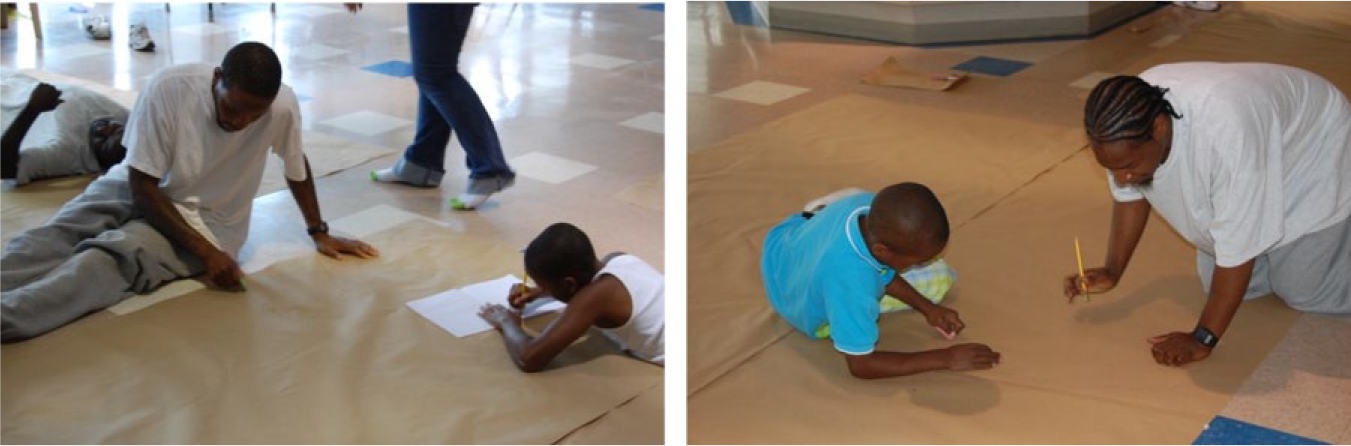
Imagining and designing murals, Monday.
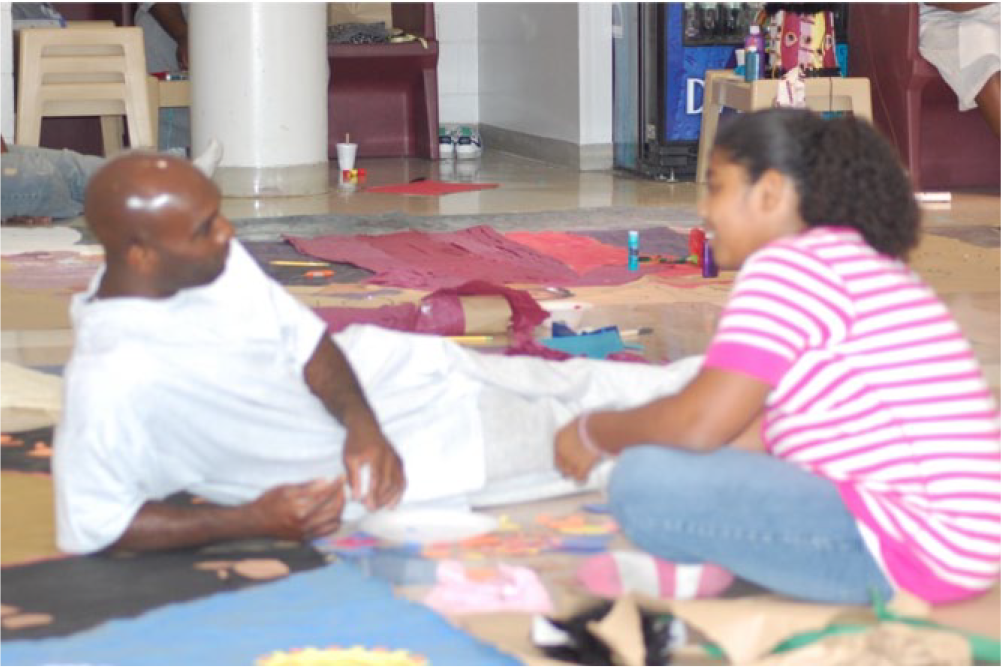
Time to talk, Wednesday.
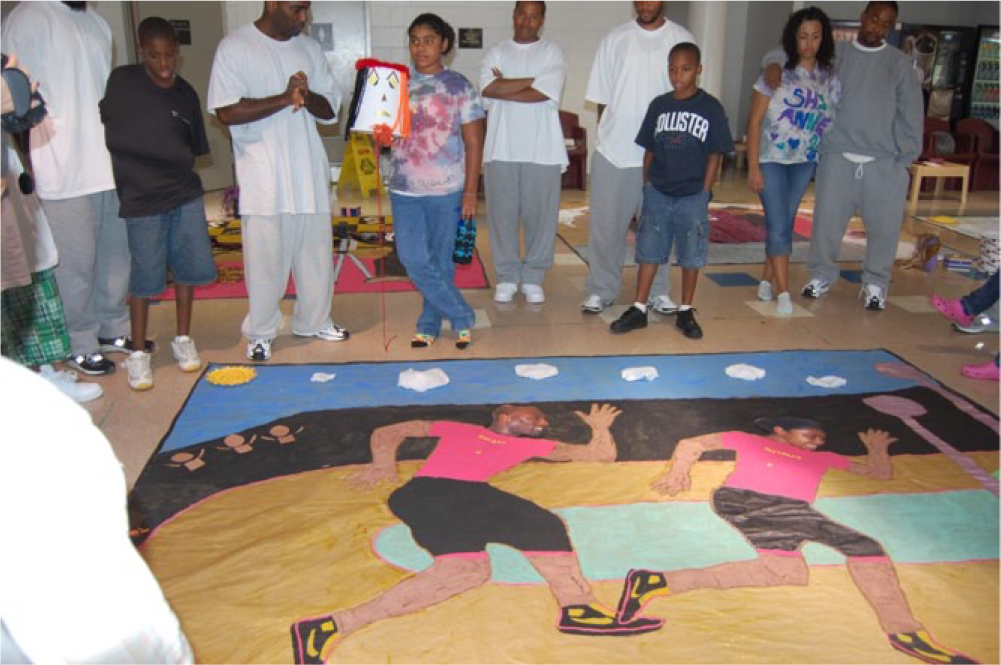
The Friday “mural walk,” when each family tells the story behind the mural.
I share Leander and Boldt’s de-essentialized view of human subjectivity that is always becoming because it never transcends the material world that continuously produces it. Yet, as we shall see, being in the world, as distinct from becoming, is also thinkable in a post-intentional (Vagle, 2014) phenomenology as enactments of incarcerated fathers being fathers who never finally write themselves in or out of the materializing difference. Becoming, flying off across the surfaces of experience, leaves trails that suspend moments of being. Phenomenological suspension is not nostalgia for a human (text)-centered universe. Derrida’s playful fleeing disrupts Heidegger’s solemn stillness (Caputo, 1997) and checks my narrativizing that always wants to turn a father’s becoming into a multimodal Text of Being.
The Existentials of Experience—In Text and Prison
Making the FT murals was a live performance (Muth, 2011) of identities and beings, experienced existentially. Bodies, relationships, space, and time are “existentials” (Van Manen, 1990, p. 172); pre-reflective being in the world is experienced as time, as space, as our bodies and relationships. Researchers have studied literacy as subjectively lived in/with bodies (Ehret & Hollett, 2014; Hughes-Decatur, 2011); time (Burgess, 2010; Compton-Lilly & Halverson, 2014); and space (Wilson, 2004; Wright, 2014). In this study, I want to know how prisoners-as-fathers-in-text “become the space [and time and relationship] they are in” (van Manen, p. 102).
If mural events are performances of identity in existential space and time, Lisa Guenther’s (2011) essay is a study of the effects of textual, social, and material deprivation. She conducted a secondary Husserlian analysis of Grassian’s (1983) evaluation of solitary confinement in Walpole Penitentiary, where men were held, on average, for 2 months. Each cell “had been sealed with a solid steel door blocking natural light, air flow, and a view to the outside; at the same time, all radios, televisions and reading materials apart from the Bible had been confiscated” (Guenther, 2011, p. 257). Grassian, a clinical psychiatrist, was serving as an expert witness representing the prisoners’ interests in a class action lawsuit. Prisoner statements such as these were typical: They come by [for breakfast] with four trays; the first has big pancakes—I think I’m going to get them. Then someone comes up and gives me tiny ones—they get real small, like silver dollars. I seem to see movements—real fast motions in front of me. Then seems like they’re doing things behind your back—can’t quite see them. Did someone just hit me? I dwell on it for hours. Melting, everything in the cell starts moving; everything gets darker, you feel you are losing your vision. I can’t concentrate, can’t read . . . Your mind’s narcotized . . . sometimes can’t grasp words in my mind that I know. Get stuck, have to think of another word. Memory is going. You feel you are losing something you might not get back. (p. 259)
Thinking with intentionality, Guenther asks, “What does our everyday experience of others have to do with our ability to think clearly, to perceive objects as real and stable, and to sustain a sense of affective well-being” (p. 275)? She answered by demonstrating how individual consciousness is “constitutively intertwined with the embodied consciousness of others” (p. 257) just as “being-in-the-world [is] inseparable in its full concreteness from the specific, determinate but open-ended world of its experience” (p. 262). Furthermore, the denial of intersubjective, intercorporeal relations with others—a “living mutual awakening” (p. 269) of self to other and other to self—precludes “the possibility of a meaningful, coherent experience of the world” (p. 266). In solitary confinement, . . . it’s not just that prisoners lose their sense of the distinction between reality and hallucination; they seem to descend into a generalized confusion that undermines their capacity to sustain a harmonious, coherent experience of the world. (p. 273)
When prisoners’ relational world is denied, their temporal being and capacity to think about basic reality can slip away. Muth and Walker (2013) found that incarcerated fathers (not in solitary confinement) do time through complex unstable strategies such as “looking down” and “looking up” (p. 300). Both strategies came with a cost: Looking down—focusing on prison life and attempting to avoid the outside world passing you by—helped one avoid guilt and depression resulting from the loss of loved ones. But, in ways not unlike the prisoners in Guenther’s study, looking down lead to an erosion of a narrative sense of self, that is, as memories of the past and orientations toward a future slipped away. Conversely, looking up created opportunities to nurture and rebuild ties with children, but their presence was continuously threatened by fear of abandonment and despair. As we shall see, looking up or down, as prisoners find themselves being fathers in prison and in text, produced substantial risks. Being, and being-in-text, is existentially and inseparably in-the-world.
Literacy and Identity
A third aspect of the mural experience was its capacity to open up spaces and times for identity work. Post-structural literacy studies conceptualize identities as inherently unstable performances of power, the familiarity and strangeness of which play out discursively. Thinking with these researchers provides a deeper understanding of identity’s contingency and stability, and texts’ ability to call us out. It is important, though, to distinguish fatherly identity from the lived experience of being fathers.
Performing identities in time and space involves “talking back to slurs and stereotypes” (Cruz, 2011; Enriquez, 2011; Kirkland, 2013; Winn, 2011; Wissman, 2009, p. 39). Jones (2012) applies Latour’s (1993) concept of thickening (cf. Holland & Lave, 2001; Wortham, 2001) to elementary-aged girls’ constructions of mothering identities—for example, the mother as one who puts others’ needs ahead of her own. She explains how identities “thicken” out of the re-telling of stories: . . . how one positions oneself in narratives is an important aspect of identity construction, and consistent positionings . . . that are repeated in narratives across time create a thickening of an identity (Wortham, 2001). This sense of self becomes a significant source from which a person draws as she interacts with others and the world around her. (p. 446)
Thickening identities result, in part, from the way we position ourselves in narratives that are contextually dependent, repetitive, and accumulative. Rather than being washed out by earlier identities, each identity layer is laminated to others, retaining a distinctive potency that resonates with and across layers, effecting hybrid identities. “Episodes of positioning create what we might think of as a laminate. They leave memories laced through feelings, bodily reactions, and the words and glances of others” (Holland & Leander, 2004, p. 131). As metaphor, “lamination” preserves both destabilized and stabilized aspects of identity performativity.
In this study, I use the term thicken to denote the habitual positioning of subjectivities that occurs when prisoners’ identities are produced as fathers through repeated episodes of contact (real or imagined) with their children. Their fatherly sense of self serves as a “stable force at play . . . in response to . . . those who are connected by relationships . . ” (Jones, 2012, p. 447). Answerability and faithfulness (Bakhtin, 1993, in Jones, 2012) to children might stabilize fathers’ positioned subjectivity, even as this thickened identity is threatened by layers of memory and the triggers of day-to-day life in prison.
Answerability also calls practitioners and researchers to be faithful witnesses (Cruz, 2011; Dutro, 2009) in their material/discursive connection to research subjects and students. Dutro and Bien (2014) described a “speaking wound” that connects listener to speaker, “forged by the voice of the Other that speaks at one and the same time to its own and its listener’s pain” (p. 12). Feeling my pain in others is a material “way of receiving the story, of listening to it, of drawing it into an interpretative conversation” (Hartman, 1995, in Dutro & Bien, 2014, p. 12).
By foregrounding the intentional relationships of researchers with their subjects, this study is not unique. The difference between the post-structural notions of “identity” and “being-in-the-world” is temporal. Although the two are lived as a single unity, they accent different aspects of experience. If identity refers to the meanings of self-emerging from (and shaping) experience, being-in-the-world connotes the as-ness of their unfolding, as meanings (including identities) are generating new intentions in pre-reflective living. Consider, for example, how Ahmed (2006) describes queer bodies as pre-reflectively oriented in space, oppressed by “straightening devices” (p. 70) like heterosexual family portraits hanging on dining room walls. In the as-ness of its unfolding, being oriented (lined up) is lived as tension. Citing Lefebvre (1991), Ahmed (2006) thinks of this tension as “an organ that perceives, a direction that may be conceived, and a directly lived moment progressing towards the horizon” (p. 423). Queer identities might thicken from (dis)oriented being-in-the-world. But identities as-they-are lived also stage our being; they are structures of lived experience. Identities are the interpretive horizons of our being (Weiss, 2011): . . . our identities serve as indispensable frameworks that structure the meaning we give to our everyday experiences. At the same time, our identities, as we have seen, are not fixed but fluid, continually being reshaped over time and across space by the events and relationships through which they are constructed in the first place. (p. 181)
In our never ending search for meaning, identities (like “father”) prop up temporal-spatial horizons that include and preclude future and past. As we shall see, the reverse is also true: Being-thrown-into-horizons is always an awakening and threat to identity. Phenomenal research takes up the unrest of these structures, unfolding in time, as they are lived.
Method
Over the past decade, my research has largely focused on prison-based intergenerational literacy programs. Recently, Barad (2008), Dahlberg, Dahlberg, and Nyström (2008), Vagle (2014), and Van Manen (1990, 2014) have opened up “post” phenomenological ways (described below) for me to study how fathers are being fathers as they engage with these programs. Returning to the data with new purpose, I began writing personal memos to work out an abiding interest that would orient me toward the research (Van Manen, 1990). My own “thickened” identity as White, middle class, father, literacy worker, camp volunteer, and prison researcher is an inseparable aspect of the study. The findings are not really “findings” as if they were discovered out there but rather understandings formed through my own lived experiences of doing the research as a father.
From these reflections, the following research questions were derived:
The questions were crafted to keep the following phenomenological concerns in the foreground: (a) as unfolding, not final (not “to be a father” but “being a father”); (b) as pre-reflective, not consciously determined (not “What it means being a father” but “What it is like being a father”); and (c) as concrete, not generic (not “being a father” but “being a father there, in prison”).
Setting, Subjects, Research Relationships, and Access
This phenomenological analysis is part of a larger study of FT (pseudonym) located in multiple prisons in the mid-Atlantic region of the United States. FT supports families through bi-monthly storybook recordings, bi-weekly video-conferencing, annual summer camps, and other projects. Fathers who have been incident report free for the past year are eligible to attend a week-long summer camp (9:00 a.m.-3:30 p.m.) in the prison visiting room with their 10- to 14-year-old children.
The mural project is the primary literacy event of this study and the centerpiece of the summer camp. On the first day, each family is provided a blank 6′ × 8′ canvas. An artist sits with the family and discusses possible themes—a shared remembrance, a missed pastime, a future fulfillment—and collectively they sketch out the design (see Figures 1-3). Experienced FT families and staff also provide support throughout the week (Muth, 2011). The compositions are performances as well as objects of art. When finished, they bear witness to an idealized event, sometimes drawn from a past experience or a hopeful future. The project provides safe structures for families to re-unite, lose themselves in a shared activity (Figure 2), and mingle leisurely with other families. From this fluid space and time, intimate conversations mix easily with the mundane. During the Friday “mural walk,” each family formally presents (Figure 3) their mural to the other members of the FT community by explaining the personal significance of the scene.
I have been a member of the FT board of directors since 2005 and have served as a counselor for five summer camps. From 1980 to 2005, I taught and administered education programs in the federal prison system, where many of the FT programs are located. As a retired teacher and prison staff member, I have been able to negotiate complex relationships with incarcerated men that would have been off-limits in the past. It is satisfying to meet their families and observe their interactions at camp, where the “normalness” of their loving, complicated, emotionally charged relationships surprises me every year. My relationships with fathers, prison staff, and FT volunteers are easy and pleasant, but sometimes when I switch hats from counselor to researcher, I feel like I am exploiting the fathers. Once I hosted a webinar with a FT father who had just been released from prison. Because he was confident and open during the prison camps and interviews, I thought he would see this as a chance to tell his story to a larger audience. Instead, the utter strangeness of being on the outside after 18 years and the way he was positioned “on stage” as an object of attention caused him to shut down. He infrequently returns my texts now, though we had corresponded regularly for 6 years. My research relationships are complicated and animated by opposing tensions: for example, the desire to reciprocate the affection bestowed on me at camp and the need to resist positioning myself as a family friend.
This study draws on a small subset of transcripts from a larger pool of data comprising 10 qualitative interviews (including three focus groups) with FT fathers conducted approximately 2 months after the summer camps of 2010 and 2011. All sessions were audio-recorded and transcribed, and lasted about 90 min. In all, 24 men (20 African American, 3 Latino, 1 Caucasian) participated. Fathers ranged in age from late twenties to late forties, and all but two came from large cities in the mid-Atlantic area. More than half of the fathers were serving 12 or more years; all were missing their children’s formative child-rearing years. Most (20 of 24) men earned their General Equivalency Diplomas (GED) in prison; approximately half were not living with their children at the time of arrest. The handful of fathers included in this study may be slightly more verbal than this larger group of interviewees, but share the same demographics. The study makes no claims to generalizability; rather, the selections were the result of a deliberate attempt to locate and think rich stories about fathers’ lived experience.
Thinking the Data
I selected excerpts from one focus group and three individual interviews based on the following “categorical” (Jackson & Mazzei, 2012, p. ix) criteria: (a) The stories conveyed fathers’ lived experiences of FT summer camp, or, in the case of Theo (see below), day-to-day being in prison; (b) the stories evoked feelings and vivid images, and, when possible, a sense of “wondering aloud” rather than closed categorical interpretations of experiences; and (c) the stories were not published previously.
My analysis advanced through a series of non-linear recursive moves. After reading the transcripts multiple times and writing memos about pre-understandings that might prevent the data from having its say (such as my tendency to think of human subjects as separate from the world), being-in-text emerged as the phenomenon of fathers and children being together in FT literacy events, in particular the mural project. In re-readings from this point on, all of the fathers’ utterances were considered in light of this “whole” phenomenon. I returned to the transcripts and began chunking them into meaning units (Dahlberg et al., 2008). For example, at one point a father was discussing the way he persisted in his schooling despite ridicule from other prisoners (see “Being-in (in)hospitable spaces” section). His narration suddenly shifted to a discussion about “blind loyalty.”
I demarked the juncture separating the two meaning units, careful not to discount statements that, at first look, seemed inane or lacking significance. After completing this, I returned to the transcript and began “tacking” (Dahlberg et al., 2008, p. 243) back and forth from parts (meaning units) to the phenomenon (being-in-text). I paid attention to arrivals and departures—why did a story about persistence in school precipitate a father’s discussion of blind loyalty? What did blind loyalty reveal about his pre-conscious being-in-prison? How might this instantiation of being-in-prison relate to being-in-text with children? I sometimes read on the surface, paying attention to how words appeared and their meanings. For example, the swerve to the meaning unit “blind loyalty” was set up as a proposition: “It’s not easy to do the right thing, if you will . . . I call [it] blind loyalty.” What are the effects of naming a phenomenon? And what is the lived experience of naming? Sometimes, I tried to go below the surface, paying attention to how my body was reacting and acting on the data (see “Epoché” section). I noted how fathers described experiences of time, space, bodies, and relationships and considered the way these existential “insight cultivators” (Van Manen, 2014, p. 325) showed and hid themselves in stories and what they might reveal about being-in-text.
Unlike other qualitative methods, such as grounded theory, the aim was not to develop themes but rather to see how meanings were lived and how they generated other meanings. Codification of experience cannot “produce phenomenological understanding” (van Manen, p. 319): . . . method is driven by a pathos: being swept up in a spell of wonder about phenomena as they appear . . . Phenomenology is more a method of questioning than answering; realizing that insights come to us in that mode of musing, reflective questioning . . . (p. 27)
An empathetic approximation of the pre-reflective experience of others inevitably falls short for at least three reasons: (a) The suspension of the flux to savor the moment of being violates the kinesis of becoming, (b) the intentional pre-conscious moment is lost once I (consciously) reflect back on worldly experience, and (c) the plugging in of my researching intervenes on the world (I am now part of the story emerging). How can I, in Merleau-Ponty’s (1945/2009) words, bring “to light phenomena which re-establish the unity of the object the moment [thought] destroys it” (p. 35). Phenomenology reminds us that the unity of living is beyond words that name it, while text “acquires meaning that overflows its ordinary informational sense” (van Manen, p. 265). Reading and writing phenomenologically require a (sensual) sense of linguistic limits and wonder at the affective forces at play always beyond and beneath conscious thought.
Epoché
As social science, phenomenology has evolved from its essentialist beginnings. Yet, it continues to be misconstrued in introductory qualitative research texts. For example, Creswell (2012) states, “The basic purpose of phenomenology is to reduce human experience to a description of the universal essence . . .” (p. 76). Pushing back, my deconstructed phenomenology is mindful of the risks of working with concepts laden with essentialist roots. Two such concepts are epoché and reduction.
A twofold attitude distinguishes phenomenological research. Van Manen (2014) claims that the phenomenological method is primarily abstemious reflection on the basic structures of the lived experience of human existence. Abstemious means that reflecting on experience aims to abstain from theoretical, polemical, suppositional, and emotional intoxications . . . lived experience means that phenomenology reflects on the pre-reflective . . . life of human existence as living through it. (p. 26)
In classical phenomenological inquiry, the twofold attitude of approaching experience involves (a) an abstaining “epoché” (from the French, epoché—to stop or suspend an era) that queries commonsense ways of looking on the world (as if it were “out there”) by attending to the projected structures researchers bring to it and attempting to bracket out their theoretical lenses and pre-judgments; and (b) a “reduction” (from the Latin, reducere, to bring back, restore) that approximates through reflection, the pre-reflective experience as it was being lived by the research participant. The Husserlian approach to epoché breaks with the Cartesian epistemology of a human subject that knows the world “out there.” Taking a different (intentional) route to knowing the world, however, Husserl still sought the essential, fixed, “thing itself,” once all our subjectivities had been abstemiously bracketed away long enough to see it.
A posthumanist sensibility, like post-intentionality, views being as never itself, always becoming something else. Furthermore, researchers are always contributing to the events they study. “To see, one must intervene,” Barad (2007, p. 51) says. Nevertheless, suspending the kinesis of becoming for the purpose of phenomenological analysis does not imply an essentialist epistemology or the privileging of presence over flux. Researchers need to step back occasionally and deliberately try to suspend their pre-judgment over the stories their participants are telling them. But bracketing away subjectivity, in itself, does not necessarily get the researcher closer to reality—though it might be a step toward understanding how subjectivity is elicited by the material/discursive world and through which the world is called out.
Bridling
The epoché in this study takes two forms—bridling and diffraction. First, the epoché tries to put my subjectivities into play as if they were something other than the world out there. This is less a bracketing away of my biases and more an iterative process of bridling (Dahlberg et al., 2008), sometimes pulling back on my intentional reins so I try to find meanings emerging from the world “out there,” and sometimes slackening the reins to investigate my pre-understandings. In this study, I wanted to lay my prison experience on a father vis-à-vis his experience of isolation in prison (see “Being-in (in)hospitable spaces” section). Bridling allowed me to question this projection and observe the pre-conscious ways I was giving—and suppressing—meanings in my interpretive re-telling. This projection was not done consciously; it happened before words or even bodily impulses reached my conscious understanding. Bridling helped me keep in check a distortion rooted in my very different prison experience.
But bridling is more than a “backward looking” (Vagle, 2014, p. 67) restraint; it is a “forward looking” way of staying open by letting phenomena “present themselves in all their multiplicity [by] . . . not imposing ourselves on [them]” (Dahlberg et al., 2008, p. 122). Slackening, but not severing, the intentional threads that connect my subjectivities to the narratives of my research participants gave me “elbow room” (Vagle, 2014, p. 68) to remain on alert for the arrival of the phenomenon. Bridling my own encounter with isolation in prison as a teacher, I (a) discovered and checked my pre-conscious move to ascribe agency to the prisoner’s experience and (b) remained open to a multiplicity of ways his own isolation was lived.
Diffraction
From Karen Barad’s (2008) posthumanist perspective, it is impossible to not impose my subjectivity on the object-world, because, for one thing, the world is always diffracted through the material of my body. Arguably, bridling is not inconsistent with this idea (even as it attempts to resist it), but diffraction deliberately moves to plug my subjectivity into the fathers’ narratives in a way that makes me a part of the phenomenon itself. Bridling separates my subjectivities (however fleetingly) to consider at times the subjects and objects of the study; diffraction injects me into the study to see what emerges from my deliberate reading of the fathers’ stories from a particular vantage point. Epoché-as-diffraction was seeing how, for example, my own being a father and researcher plugged into and materially helped configure an image of a father as he was produced by, and productive of, the bi-polar forces of prison that disoriented and re-oriented him to his family (see “Being a father and shifting ontologies” section).
Similar to Vagle’s (2014) idea of giving and finding meaning, a diffracted reading is always an intervention, a giving/finding. Jackson and Mazzei (2012) note that “this installation of our research selves into the events as narrated by [research participants] produces a different account . . . of the mutual production of agency” in the stories they shared (p. 332). It is not a question of pitting my pre-understanding against what the subject said. I have “insert(ed) [myself] into the event that emerges in [my] reading” (p. 131).
Validity in phenomenological study is not an “audit trail” demonstrating how subjectivity has been contained, nor ultimately about “what really happened” (Freeman, 2011, p. 544). Validity rests with the text’s capacity to incite understanding, touch readers, and help them see themselves in others. Truthfulness is conveyed when the author’s giving/finding of meaning is presented as a (not the) faithful re-telling of a lived experience.
A twofold epoché helped contain and explore my subjectivities as discursive-material aspects of the re-telling of fathers’ stories of being-in prison and text. Through bridling and diffraction, I tried, respectively, to stay open to and see by entering their world in time, space, bodies, texts, relationships, and becoming—as their being fathers was always arriving and withdrawing, never finally present, always in motion.
Findings and Givings
Findings—which are also “givings” (Vagle, 2014) as my intentional writing cannot help but give to the findings—are organized in three sections. Because of the find-and-give nature of the writing, it would be misleading to present “findings” in one section and “discuss” them in another. Epoché and reduction are two aspects of one method; the two are in conversation throughout.
Being-in-text must be understood as part of being-in-prison. Being-in-text is a dynamism within a broader ubiquitous dynamism of reciprocity and isolation—the more or less opened and closed ways of relating to others in prison. Before developing the lived experiences of being-in-text, I first foreground a chilling prison experience that calls on fathers to have blind loyalty to their regionally allied group inside prison. Blind loyalty does not constitute a “type of” experience. It merely serves as one of innumerable ways being-in-prison is always countering, backgrounding, overshadowing, and constituting prisoners being fathers for their children. As we shall see, it is not possible to think—or feel—being-in-text without getting a feel for this larger relational context.
In the first section, I develop the “thematic structure” (Van Manen, 1990, p. 101) of staging, the way being-in-prison stages, or opens up, phenomenal space and time. My writing will combine aspects of epoché (my intentional relationships to the phenomenon) and reduction (the evocation of the phenomenon, in this case, some thematic structures of staging and blind loyalty). In the second section, I show how being-in-text embodies a twofold tension consisting of its hunkering down below the chill of prison, and its looking up into the eyes of loved ones. In the final section, I take a closer look at how a father’s rooted orientation, his being-for, is always being uprooted, and consider again my own giving/finding of meaning to the phenomenon of being-in-text.
Being-in-Prison: The Stage for Being-in-Text
I found FT family members witnessing (Cruz, 2011) each other and being heard. I wondered how these intense experiences were staged inside prison. To gain an understanding of the staging of being-in-text, I turned to stories of day-to-day prison experiences told by prisoners.
Being-in (in)hospitable spaces
In prison, minding your own business is sometimes easier said than done. Here is how one father, Theo (his and all names are pseudonyms), describes the call for involuntary membership in regional alliances: . . . it’s not easy doing the right thing . . . I call [it] blind loyalty. Suppose I don’t know a guy’s name . . . don’t know why he’s locked up [or] why he’s fighting right now. However, I do know that he’s from D.C. and I am obligated to help him. Blind loyalty. If I don’t help him, it’s a chance that I’m going to be . . . “checked in” to D.C. for the rest of my time . . . repercussions for letting your, quote un-quote “homie,” be hurt. Blind.
No one is a stranger in prison; every FT father has relatives and acquaintances in prison. By the time they arrive at the facility, they are already checked in to D.C., Baltimore, Richmond, and other regional affiliations. I fathom this blind allegiance as a “fragility of dwelling” (Weiss, 2006, p. 159), “the edges of any identity’s limits . . . the space of the bounding and undoing of the identities which constitute it” (p. 158). Blind loyalty stages intentional spaces where identities form and are informed by the boundaries of their own concealments and extensions.
I re-call a time when I first started working in prison at age 30. The setting was the staff training facility alongside the river that wrapped around the reservation. During breaks, I felt a strong need to befriend the correctional officers hanging out at the river bank and, simultaneously, the desire to go off on my own to write in my journal. I chose the latter, though the officers were welcoming and easygoing. Going off on my own was filled with doubt (Was I a snob? damaging my rapport with officers? cut out for prison work?). But in this self-imposed exclusion, I experienced an acute sense of identity as a teacher with a different orientation to prisoners than the custodial staff who were training us. My identity as a prison teacher was (per)forming in a lived space of exclusion.
In my epoché, I discover that I want to ascribe a similar “upside” to Theo’s experience. I try again to really listen to his words: “I don’t know why he’s locked up, I don’t even know why he’s fighting right now. However, I do know that he’s from D.C. I am obligated to help him.” My experience was radically different (in terms of physical danger alone); by ascribing agency to his experience, I discounted the severity and powerlessness of prison life. I draw from this bridling a give and take of meaning. I strive to be open to the despair and powerlessness that constitutes his being-in-prison, yet allow for the possibility of subversion at the boundaries. To look for evidence of this resistance, I return to Theo’s transcript to see what prompted him to talk about blind loyalty.
Staging (in)hospitable spaces
Theo’s storytelling reveals movements (stagings) of re-called meanings arriving and departing. Right before Theo spoke about blind loyalty, he was explaining how he had spent the past 12 years of his incarceration trying to understand how he came to commit murder and confront the pain he caused his family. He recorded his investigations in journals which eventually became a book
1
: I needed to know why was I like I am. Why did I react to passion in such a way? Why was I like I am? What made me be this way?
When he was 16 years old, Theo murdered Misha, his daughter’s mother: We were both just children tryin’ to find our way. We had support, but I don’t think we had as much as we needed as young adults—particularly tryin’ to raise a child. I basically killed her for seein’ passion marks on her neck, after earlier events had took place, prior to that time. I don’t blame it on the stress, depression—I blame it on myself.
Theo self-surrendered and for the next 6 years had only intermittent contact with his daughter Linnie. After 7 years, he was transferred to a prison closer to home. He resumed contact with Linnie through the FT video-conferencing storybook programs. The cumulative assemblage of literacy projects had a softening effect on his family. In this vignette, his mother and daughter were visiting him in person: My daughter’s grandmother, Miss Alice was nice enough to allow [my mother], for a time, to bring my daughter Linnie to see me. One visit stand out to me—just out of nowhere, I don’t even know what the conversation was, but my daughter [who was six or seven at the time] just looked up at me and said, “Why did you kill Misha?” And Misha was her mother. And the second question that followed was “Are you going to kill me?” And I just froze.
Theo’s new presence in his daughter’s life led to 3 years of intense confrontations with his daughter. Toward the end of this period, Linnie and Theo participated in a FT summer camp and created their first mural. Shortly after that, Alice, his mother-in-law—the mother of the woman he murdered—decided she wanted to visit Theo herself. He describes the first confrontation with Alice in the prison visiting room some 10 years after he took her daughter’s life: They would call your name on the intercom, and you would know to stand up so your visitor would know where . . . to find you . . . I was sittin’ there, and I hear “Theo M____,” I didn’t even wanna stand up . . . I didn’t want to own that name . . . I spotted Miss Alice and my daughter walkin’ toward me, and, I mean, everything came back. I could remember the times that me and her danced together and she would holler out the back window if she saw me doin’ somethin’—“Boy, you better stop. You go in the house.” or, “You know better” and, of course, the memories of her daughter. Everything just came shooting back. And my forehead was beading up a sweat. My hands . . . My heart was racing. And as she got a certain distance where I could really see her face, her features—what was so unlikely, if you will, was the smile that broke out in her face. And it melted me. It [Laugh/sigh]—it broke me down. And I hugged her, and I talked to her. I told her everything that happened. From one point to the other—detail to detail. And I told her I was sorry. And she said she’d forgiven me. And I just felt this burden come off me that I didn’t even realize I was carryin’ around. She told me she loved me and she could tell that I’d changed. And my life hasn’t been the same since. It’s the greatest mercy that I know that I don’t deserve, that came my way.
Theo’s story moved through multiple times, spaces, and events, creating chasms between present guilt and past innocence, blind loyalty and a terrifying moment when he could “really see.” At this point in the interview, I asked him, “What is that like, having the desire to be open and being in a penitentiary?” He replied with a brief story about how he defied an older prisoner who mocked him for studying for GED in prison: “And I went on and kept on through . . . though the tension, violence, blind loyalty.”
What might those preceding anecdotes—about being vulnerable to family anger and rejection and asserting his commitment to education (“through the tensions and violence”)—tell us about how Theo lived the experience of blind loyalty? How was it that these tellings—about being open to chasms that awaken a happy and guilty past and threaten its loss—staged the story of blind loyalty? What does this movement suggest about intentional ways of being-in-the-world? I consider these questions while tacking back and forth between “the whole” of Theo’s narrative and the particular turns of his story.
Looking down, looking up
Theo’s being-in-prison moves through complex temporal-spatial experiences. Blind loyalty signified a closing; it appears in the narrative as a violent inescapable structure of prison life that blinds him . . . To what? My diffracted fatherly answer: To his being open to, paying witness to, family anger, and the potential for rejection and forgiveness. Witnessing is seeing, but more than that, it is an orientation, a directed way of seeing. Theo is blinded in a certain direction, in a certain way that threatens reciprocity and being open to family. His resistance reveals his desire to see.
FT fathers have described two ways of looking—looking down and looking up (Muth & Walker, 2013). They used the phrase “doin’ time” to refer to keeping one’s head down and remaining “on alert” to the world inside, taking it one day at a time. Looking down provided a numbing relief from feeling guilty and worrying about loved ones back home, and from confronting the dangers and imagined agonies that the future holds for them and their families.
Looking down is the passive mode of blind loyalty (readiness to fight is the active mode). It is an isolated way of being-in-prison, a disorientation from the life outside. Intentional looking (up and down) is Theo’s projection of himself in the world. He looks up and is vulnerable (open) to his pasts, and extends into them. Blind loyalty suspends past and future, cuts him off. Theo is now in check, in prison, locked down. This protects him from society’s condemnation but comes at a cost, including the loss of a narrative sense of belonging to family: I hadn’t seen [my brother] in 11 years. When he got here, he ran up and hugged me, he cried. I didn’t feel nothin’ . . . I never asked, “Where was the emotions . . . when my daughter was out there and she needed you? To this day I haven’t seen any of my siblings, nor my parents in nine or ten years. I love my brother . . . but I cannot make the connection.
Being open and closed are aspects of the same lived experience. If being-in-prison were a blind mode of being (and, as we explore next, being-in-text an open mode), nevertheless the one stages the other. But this is a false binary. They are not thickened performances of identity, although identities certainly accumulate out of lived experience. Rather, the phenomenal world is uncontained—“Forms of transcendence fly up like sparks from a fire” (Merleau-Ponty, 1945/2009, p. xv)—and resists the urge to cohere. Being open and being closed are structures of the same intentional being-in-the-world. Theo inhabits the material world, not as a visitor but as an extension of it. “Bodies inhabit space by how they reach for objects, just as objects in turn extend what we can reach” (Ahmed, 2006, p. 110). A father might be looking down when suddenly the prison guard calls him out and hands him a letter.
Theo’s prison life is oriented, directed, even in his downward looking, blinded disorientation (The most radical form of this disorientation may be found among prisoners in solitary confinement; compare Guenther, 2011; Binelli, 2015). Theo inhabits prison as the objects of prisons—rec yards, phone calls, homies, classrooms—open up spaces in which his being-a-father might extend or get put in check. The objects are too close and too distant. He is always extending into the world, even when space and time are off-limits. Whether he looks up or down, blind loyalty and the call of his family are always there, poised for invasion: I was in a cell by myself. One day I opened up some strawberry kool aid. Soon as the pack hit me I broke out in tears and I laid back and fell on my bed. I did not know what was goin’ . . . I had begun to visualize . . . Misha. She loved strawberry and fruit punch soda and kool aid . . . She would get it on her lips and I would kiss it off.
Or again, The question, “Why can I kill the person that I loved the most?” haunted me. When I’m playin’ cards, I would just get stuck. “Theo, it’s your turn to throw—it’s on you.” When I’m playin’ basketball I would just hold the ball and stop.
Staging is the way we are always becoming in a world on the move. It is being and it clears the way for being; a “directly lived moment progressing towards the horizon” (Lefebvre, 1991, p. 423). In its polarizing movements, being-in-prison calls Theo into becoming other, aligned with or against his choosing. Blind loyalty is a stage for, and inextricable component of, being-in-text.
Being-in-Text
Being-in-text is lived in the mode of staging new possibilities, always opening up, and opened up by, new becomings. Being-in-text entails a double threat—the isolation of looking down, the anguish of looking up. Intimate literacy events can be anything but safe for FT family members looking up to each other; yet, being-in-text holds even when there are too many answerable questions. Phenomenology illuminates the ontological labor of being-a-father in text.
Skating on thin ice
The intentional unity of being and world is delicate. The present moment feels harmonious until suddenly a hill appears on the horizon (it was always there); behind it, danger is waiting. I might feel at home in the world when, inexplicably, a sense of abandonment takes hold. Where did it come from? How did I get here? FT fathers and children find themselves re-united at camp, hovering over large blank canvases as intimidating as empty notebooks. Mural themes slowly emerge, conjuring precious moments from the past or an idealized future.
Being-in-text skates across the surface of murals and sometimes falls through into dangerous places of guilt (and hope). Here, looking up is on thin ice; a mirror image of blind loyalty. Seeing the hurt and being blind—the odd couple in the ice capade. If looking down stages its own resistance, so does looking up. Things get tense, and even in artfully designed activity there is a fierce need to put your eyes somewhere, as my attempt to plug into the experience suggests, There is very little looking down going on, but quite a lot of looking under the eyes of the other. Self-consciousness is the cost of looking up; my hate, my guilt, my fear, my vulnerability . . . is all too much. Pass the glitter, look at the butcher paper beneath us! Yet, while inhabiting these tense spaces, they sense each other, they begin to speak and listen and tell stories about themselves. (field notes, August 8, 2011)
Difficulty looking is not an unfamiliar experience for some FT fathers. One father reflects on a recent visit with his daughter: When she do see me, when she do come up here and see me, I can tell it’s like, she like, it hurt cause I can’t really look. . . . It’s cool when I’m on the phone, but when she come up here and see me? And when she gotta leave, she really don’t want to leave, but, you know, she’s grown out of the stage where she cry when she leave. She don’t cry when she leave now.
His being-in the visiting room with her was hard to pin down: “. . . when she do see me . . . I can tell it’s like, she like, it hurt cause I can’t really look . . .” Grammatically speaking, the subject folds itself into the object. What was “it” he was seeing? He looks up to see his daughter seeing him as if she were asking something of his very being. Dialogic reciprocal openness engages the “deepest level of living in the world alongside others. The world might impress a look upon us and ask who we are” (Saevi & Foran, 2012, p. 52). Answerability pulls in too much time and space. It is confusing and upsetting to look; there is a seductive safety in closing one’s eyes (or having them shut).
Being a father and shifting ontologies
Being-in-text refers to the way fathers and children experience openings and closings, extensions and lock-downs, as they skate around on thin ice, writing and performing family stories through art, journaling, and other literacy events. Unlike a routine prison visit, the mural project sustains a dialogic orientation among families that thickens over the week: . . . cause see, what FT does is brings us together. It brings us into a big circle of unity. You know, everybody joinin’ in together, man. We all just like one big family. And uh, it feels, like he said, about how we feel when the camp is over—we in a whole different dimension. We, we, we, we, we we’re touched on another level, for a time. You know, we doin’ time and we dealin with our kids at the same time.
For a while, in the “circle of unity,” fathers were “touched” rather than “in-check.” Touch unifies, brings together, but so does being in check. The difference in the two alliances might be considered psychologically, as coercion v. choice. But the difference, phenomenologically understood, is ontological—being a prisoner from District of Columbia v. being a father. Here is how one father, Timothy, describes watching his daughter move freely around the visiting room, interacting playfully with other children and fathers working on their murals: I was like “Man, I can sit out for this, and stay out of the way just to see her react.” I didn’t want her to feel like she was trapped when she came—like she had to be . . . locked into me . . . I wanted to be able to observe her in the activities, like you might be in the house . . . you might wash dishes and look outside to see your child in the yard playing.
My diffractive relating this story—being on stage—draws me to the kitchen window (Did he say kitchen?). Looking out into the backyard of my own childhood, I see open spaces where children abound, “playing guns” with air rifles, running with abandon across lawns and under hedges. I also see Timothy’s daughter running in her backyard—definitely not playing guns—but, in his gaze, happy and free. I resist ghettoizing the image. Abby (currently a successful college student) was the social center of the FT kids; the one they looked to organize evening games and scary ghost walks. “Seeing as a father” staged my seeing as a child, as a being with a past.
Timothy sees the child in his daughter at play, sees as a father who was once a child. His encounter with Abby is ontological. He sees her being a daughter. To really hear his story is to be moved ontologically, as a father seeing his 11-year-old daughter “being herself” for the first time: Because it was, it was one of the first time that I, I ever really got to see her just act without restriction, like . . . I didn’t have to tell her to sit down or be quiet and all that. She was just bein’ herself, and I got to see that. (emphasis added)
Being-in-text at FT camp shifted prisoners’ ontologies and orientations for a while. Identities performed and inscribed in murals accumulated and thickened. Families drifted toward blind alleys, but materials and texts always called them back—in structured activities that took the pressure off conversation, a well-lit room with wide open floor space, and relaxed rules that enabled everyone to move about freely. Undoubtedly, these helped in the staging. But the phenomenal “set” (e.g., a kitchen window) was both a being-in-text and that which drew beings into it, in its letting in sweet (and perhaps frightening) light. By the end of the week, the entire group of prisoners and children—representing rival cities—were bantering and mingling playfully, looking up, as if at a community picnic.
Being-for
Being-in-text is displacing and orienting, lived as being-in a contingent place of blindness and light and as something susceptible to the pull of gravity—an oriented being-for others. But, as we have seen, being-in-the-world is its own staging, an excess of possibility. Being “is its possibilities as possibilities” (Heidegger, 1953/2010, p. 141). For Theo and other fathers, blind loyalty and being open for others are one experience—its horizons of hope and despair are always waiting to be staged, upstaged, held in check, re-opened.
Intentional, de-centered, oriented
The mural-making experience, with its unique temporal and spatial extensions, opened times and places for families to coconstruct new texts about themselves and sometimes closed them down. Intimate conversations were oriented in being-for but always thrown askew in being-in.
On the visiting room floor, prisoners, children, staff, and volunteers sprawled over large sheets of butcher paper, creating family murals. Louis (father) and Malik (son), first-time campers, worked by themselves for large stretches of time, moving in and out of conversation. Here is Louis’ recounting: He was . . . floodin’ me with questions. [laughs] “What about this!” And “OK . . . Um—da-da-da-da-da!” “Ah slow down! We got time . . .” But after he got over the fact that we had more than 15 minutes [the limit that the prison places on phone calls] he was able to kinda settle down, and flow with it, and . . . just enjoy each other . . . What [we] don’t say to each other says as much, or sometimes more than what [we] do say to each other. And so we . . . was able to do these projects together . . . quietly—you know? And . . . he’s sprinklin’ in questions he’s been meanin’ to ask me. [Laughs] There were some profound questions too . . . . We was talkin’[and] during that little, one minute, moment, Malik asked me, “Um, did you and my mother ever get married?”
The structure of the mural project allowed for quiet time together, a time for “settling down,” a “flow.” Dialogue includes the spaces between words: “What [we] don’t say to each other.” Louis provides a lengthy explanation to Malik that hints, but does not state, that the person he thought was his biological mother (Gloria) was actually his step mother, and that his biological mother, Cherl—to whom Louis had been married—had committed suicide: Look, um, me and Gloria—never got married because I was already married to a woman named Cherl [his biological mother]. And she had some big beautiful brown eyes, just like you. So he asked me, “Um, so where’s she at?” So I was like, “You know, she’s dead.” “How’d she die?” “Well, she killed herself. Suicide.” So he said, “So why’d she kill herself.” I said, “You know, because she was depressed.” Some people are stronger than others when it comes to depression . . . And he says, “I don’t care how sad I get, I’ll never kill myself.” I’m like, man that’s beautiful [laughs] . . . ’cause that’s one of my biggest concerns—that it’s hereditary.
Malik addresses Louis as his son. Louis finds himself projecting fear (and guilt?) that Malik might have inherited the genetic tendency toward suicide while tactfully attending to the ineffable tenor of Malik’s voice. Malik looked into his eyes: . . . So then he says, “Well, did my mother know her?” [Louis laughs, then looks flummoxed] Wow . . . And that’s the look that I had—that I had on my face when he asked me that, cause guess what he said? He stopped, and he looked at me and he said, “You know what? I shouldn’tve asked you that, right?” I’m like, a nine year old child has the self-awareness to be able to notice—you know, to be able to say that.
Louis and Malik are “faithful[ly] witnessing” (Cruz, 2011, p. 549) each other. They “look up” tentatively and are greeted by dangerous past and future that confound as much as comfort. Nevertheless, for now, their oriented being-for holds.
Being-in, being-for
Being-for surfaced in the being-in that threatened to weaken its gravity (consider the intensity on the last day of camp, while the clock ticks down the remaining minutes of the mural project). I sense this emerging threat in Louis’ astonishment as he looks up tentatively and faces Malik’s “profound” questions. Conversely, looking down never ruled the day either. If this were so, Theo’s blind loyalty would simply be loyalty. To be loyal to the regional code, Theo had to look down, look away from the past and future that oriented him, lose his sight and his narrative, close down dialogic ways of being with others. In blind loyalty, his being-for is present as absence. Without being-for, perhaps blind loyalty would feel more at-home, less like a violation and termination.
Being-in is like being “thrown” (Heidegger, 1953/2010, p. 131) in jail and finding oneself already called into a particular space and time. But it is kinetic—an intentional give and take with the world that opens and closes spaces and time, simultaneously welcomed and unwelcomed. Being-inescapably-in is a shifting horizon of Theo’s calling, calling him; a presence always exiting; an absence. Being-in is reflexive and reactive; its agency is not exclusively his own, and its presence is unruly and fearsome.
Being-for is the withdrawing ground of being-in. Being-for has more human agency than being-in, but I do not believe that being-for was lived directly by the fathers. Rather, their strong orientation toward their children was always “lived” in the world, from within a fragile being-in. Being-for returned in different ways of being-in—a prisoner resisting blind loyalty, a father seeing his daughter being-herself-in-text. I cannot say with certainty that all fathers were oriented to their children with the same intensity of being-for. Perhaps for some, summer camp was a nice diversion or a selfish indulgence. But in my being true to the fathers and children I have come to know through FT, being-for presented itself as a structure of being-in-prison, much as Guenther (2011) found sociality to be integral to one’s hold on reality. Being-for rested on no fixed ground; it surfaced and re-surfaced in the praxis of family members being-in-text, calling to and seeing, slowing down, avoiding, opening up, re-calling, looking away, hiding in and around words and things. Being-for does not so much describe a lived experience as suggest a familiar way of being-in the experience as lived from somewhere; i.e., as a lived orientation toward others.
Phenomenology and the Sovereignty of the Subject in Literacy Research
In this study of fathers finding themselves being-in-text with their children, I did not question the sincerity of a father’s being-for his child (nor the child’s for the father), nor attempt to unmask the idealized persons (Goffman, 1956) that the fathers enact at FT camp. I left no audit trail to prove I hadn’t distorted the story through my giving/finding of meaning. Instead, “posted” phenomenology provided tools to approach the prisoners’ experiences in ways (bridling and diffraction) that brought me into the thresholds of their stories in my intentional relating to them. My writing back to lived experiences (the reduction) was ultimately not about emergent themes; my giving/finding was an attempt to bring the reader with me into the story (Jackson & Mazzei, 2012). A speaking wound (Dutro & Bien, 2014) connects us.
Rather than what fathers were doing in camp, this study asked about their being in intense, unpredictable, and oriented relationships with their children, through prison-based literacy events. Being-in-prison and being-in-text were inseparable stagings for each other, where the gravitational pull of being-for intensified and withdrew. Beyond dialogue, forces that perpetuate violence and fragment families were materially present as well as discursively so. It is not possible to understand being-in-text without an appreciation for the dehumanizing processes of prison, where fathers typically do not look up and are loyal to that which disorients them from their lives outside prison. Yet, their disorientation is what it is not. Phenomenology shines a light on the way being-for is lived as being-in, which is to say as relationships never fully given and never fully abandoned.
This ontological view is quite at odds with the behaviorism that frames most prison policy in the United States today (Costelloe & Warner, 2006). In Freirean (Freire, 1970) terms, the paradigm shift is the difference between viewing prisoners as objects (their needs assessed and written down by others) and as subjects who–however de-centered, impermanent, and thrown into the “there” of the world– strive to write their own texts of belonging. But the objectifying of students is not a challenge limited to prison education. Saevi and Foran (2012) remind us, Today’s culture is forgetting the sovereignty of the subject in the homogenizing process of globalization. This forgetting of the subject, the person, the human being, the child, as the basis of experience and memory is not only a crisis for culture, but is . . . an educational crisis. We wish to raise . . . awareness . . . by asking once again to see the child. (p. 50)
The sovereignty of the subject is often forgotten in literacy policy and pedagogy. Prisoners (and their families) especially become objects of control in programs where they are invisible in their being. A phenomenological lens helps make their potentiality as vulnerable and answerable family members visible. It also reveals the astonishing power of an assemblage of literacy activities that coheres over time (in their repetition) to bring families together in the familiarity of their being for each other—an outcome beyond measure.
New questions have emerged. In programs like FT, is being-for as stable a ground for the children’s lived experience as it appears to be for fathers? Do children’s identities as daughters and sons “thicken” gradually, and if so, what does this suggest about their initial FT camp experiences, when they are thrown into texts with those who had once (or more than once) abandoned them? Does being-for the father persist over time (as it seems to have for Linnie and Malik and other children I have worked with over the years)? Does its openness leave children vulnerable to being hurt again?
I wonder how the staging of being-in-text emerges from other prison-based collaborative literacy projects, and how prisoners, in their reading and writing, clear times and spaces to look up and be open. What kind of lived spaces do prison-based poetry slams, creative writing groups and book clubs stage? How can literacy projects best support incarcerated beings in their looking up?
Finally, the study draws out some aspects of being-in-text and not others. I have only addressed being in terms of certain kinds of dialogic/material experiences—where fathers are addressed by, and answerable to, their children. In my prison-based literacy work, I have heard others addressed—the universe, the researcher, the past, an idealized self; and I’ve heard stories about the absence of being addressed, the fading and disappearance of addresses and of being answerable to impersonal technologies of surveillance. Through literacy programs, prisoners are prone to finding themselves in text in intense ways. The very act of reflective writing presumes a conscious taking stock, a looking up. In the absence of a sensitive research method, we know very little about how prisoners find themselves in their being-in-text-in-prison, what it costs them and their families to do so, or how, out of impossible contexts, it stages dialogic moments of unity, even as those presences are always exiting the stage.
Footnotes
Acknowledgements
The author would like to thank Hilary Hughes, Leila Christenbury, Ross Collin, Mark Vagle, Ginger Walker, Susan Watson, David Yaden, and all the Journal of Literacy Research editors and reviewers for their invaluable encouragement and insightful comments.
Declaration of Conflicting Interests
The author declared no potential conflicts of interest with respect to the research, authorship, and/or publication of this article
Funding
The author received no financial support for the research, authorship, and/or publication of this article.