




Abstract
This ethnographic study reports on one elementary literacy coach’s response to high-stakes testing and her approach to support third- through fifth-grade teachers in a Title I school in Texas. Sources of data included field notes and observations of classes and meetings, audio/video recordings, and transcribed interviews. The findings illustrate how the literacy coach used her knowledge and beliefs about teaching reading along with her position of leadership to craft alternative responses to an environment that endorsed a skills-based approach to teaching reading and placed a strong emphasis on test preparation. Specifically, the literacy coach enriched the skills-based reading curriculum with reading workshop, supported teachers’ learning and growth with teacher-centered inquiry groups, and focused on language and authentic literature as a way of preparing students for the test. These findings suggest that the literacy coach played an important role in supporting teachers with negotiating the demands of a high-stakes testing environment and in ways that did not necessarily compromise the literacy coach’s beliefs. These findings also suggest the importance of a supportive school environment where teachers have a sense of community for support and professional growth.
Rory [a fourth-grade teacher] helped me think about it because she said something about you help us find our teacher voice. You help us figure out who we are as teachers. Part of that is taking what comes from the state, from the district, from a mandate, and figuring out how to work around it or use what you can and leave the rest. Or how to get the job done without making waves that are going to be harmful for you or the kids in the long run. It was helpful when she said that the other day because I thought, that’s the part of the job that I struggle with the most being that in the middle person and sometimes having to say here’s this, let’s talk about these curriculum road maps. When I know that when I taught, I didn’t use them. But it’s all about balance and as long as we work in a system that’s set up this way, we have to, we’re going to have to learn to juggle that stuff and the good stuff, and hopefully over time all the good stuff will keep growing.
This quote came from Gina (all names are pseudonyms), a literacy coach at an elementary school, as she reflected on her role. Situated in a high-stakes testing environment, Gina felt intense pressure to raise test scores. She felt conflicted by the incongruity of test preparation and teaching in ways she supported. Her role was further complicated as she negotiated how to support teachers and follow district expectations at the same time.
Research that examines responses to high-stakes testing environments has mainly focused on teachers (Amrein & Berliner, 2003; Amrein-Beardsley, Berliner, & Rideau, 2010; Assaf, 2008; Boardman & Woodruff, 2004; Hoffman, Assaf, & Paris, 2001; Sleeter & Stillman, 2007), and also includes the responses of students (e.g., Dutro & Selland, 2012; Triplett & Barksdale, 2005) parents (e.g., Barksdale-Ladd & Thomas, 2000), and administrators (e.g., Diamond & Spillane, 2005). These studies do not, however, give special consideration to how literacy coaches respond. As literacy coaches are positioned as experts in charge of teacher and student learning, their response to high-stakes testing is important for understanding how high-stakes testing plays out in schools and why individuals might respond in certain ways. This study addresses this need by focusing on Gina and the approaches she took in supporting teachers with high-stakes reading testing, including an examination of what she called “the good stuff.” Specifically, this study asks the following research questions:
Before exploring the findings in relation to these two questions, I provide a theoretical framework for the study as well as situate this study in terms of the research on high-stakes testing and literacy coaching.
Theoretical Framework
Literacy and Teaching as Situated Practice
Sociocultural and sociopolitical perspectives guided how I studied the literacy practices and interactions in the school. These perspectives have important implications for understanding literacy and teaching in terms of the ways in which they are socially, culturally, historically, and politically situated. From this stance, literacy can be understood as a tool for exploring, claiming, or transforming thought and experience (Gutiérrez, 2008; Vygotsky, 1978). Instead of viewing reading and writing as discrete skills in isolation, I view literacy as an ideological practice within communities that is “implicated in power relations and embedded in specific cultural meanings and practices” (Street, 1995, p. 1). To understand literacy is, thus, to understand it in terms of people’s literacy practices, values, beliefs, and actions. This perspective is important for understanding how literacy teaching practices in a school are situated not just within a classroom but in a larger context. Literacy activities include processes as well as social events and interactions and the various social spaces we inhabit as part of our personal histories (Gutiérrez, 2004). From this perspective, there is not one literacy, but multiple literacies (many different ways of reading and writing connected to speaking and listening), each embedded in specific sociocultural practices and each connected to a distinctive and political set of norms, values, and beliefs about language, literacy, and identity (Scribner & Cole, 1981).
In terms of teaching, sociocultural and sociopolitical perspectives highlight teaching as a culturally sensitive and interactive process related to the social variables of power, race, class, and gender (Apple, 1996; Luke, 2003). This is important for understanding how power is constructed and enacted in educational settings. Schools are places that potentially reproduce existing hierarchies, with privilege given to particular kinds of knowledge or experiences. They are institutions with the goal of changing people’s values, skills, and knowledge bases (Heath, 1983). The resulting teaching practices are in response to the particular political context, such as high-stakes testing, within which the school is situated (Baker & Luke, 1991). Children’s opportunities to learn are governed by those with power, wherein schools both afford and constrain their ability to learn because of the way everyday interactions are supported and shaped by the institution of schooling (Lewis, Encisco, & Moje, 2007). Furthermore, the use of high-stakes testing to make decisions about students and schools has the ability to preserve social status, as those with power are able to maintain and influence the structures that work to their own children’s advantage (Nichols & Berliner, 2007). These perspectives informed my understanding of how teaching, in particular the actions taken by the literacy coach, operated as a political act within the school.
Literature Review
High-Stakes Testing
High-stakes testing highlights the political landscape of schooling, where test scores are equated with student success, as well as school success (R. S. Brandt, 2007). These tests are considered “high-stakes” because of their weight in making decisions about grade-level promotion, student graduation, and other important decisions that affect school communities (Heubert & Hauser, 1999; Madaus, 1988). Some also consider the publication of test results as another dimension that adds to its being “high-stakes” (McNeil, 2000). While policy makers may suggest the positive impact of high-stakes testing in terms of the raising of scores (Linn, 2000; Popham, 1987), research contradicts these findings, showing that increased student achievement and higher test scores are not synonymous of one another (Lee, 2006). Researchers who question the effect of high-stakes testing on student achievement point out the discrepancy in test scores when compared with other data such as reading scores on the National Assessment of Educational Progress (NAEP; Nichols, Glass, & Berliner, 2006), drop-out rates for minority students (Foote, 2007), and the exclusion of some students from the testing pool (e.g., students who receive special education support; Amrein & Berliner, 2002).
Research on the effects of high-stakes tests has found that an overemphasis on testing leads to a narrowing of the curriculum with a focus on basic skills and test preparation. Using qualitative meta-analysis, Au (2007) reviewed 49 qualitative studies related to high-stakes testing in the United States. He found there is a significant relationship between the implementation of high-stakes testing and changes in the curriculum at three levels: control of the content (mainly narrowing of the curriculum), control of the format (generally resulting in fragmenting the curriculum into smaller, isolated parts), and pedagogical control (largely the use of teacher-centered practices). Au concluded that high-stakes tests encourage curricular alignment to the tests and that high-stakes accountability provides external control over teaching (Moe, 2003).
In addition, because teachers are pressured to “teach to the test,” they generally spend more time teaching tested objectives with little or no attention paid to untested objectives (Shepard, 1990) and take instructional time away from nontested subjects like social studies and science (Jacob, 2005). There is also a positive correlation between the greater the stakes of a test and the amount of time spent on test preparation (Herman & Golan, 1991).
Decontextualized test preparation, or teaching to the test, reduces teaching to an act of raising test scores through drill on practice items and benchmark tests, even to the extent of replacing the curriculum with test preparation (McNeil & Valenzuela, 2001), and diminishes teaching practices to the level of answering and analyzing students’ answers to multiple-choice questions because the pressure is so great to succeed on them (M. L. Smith, 1991).
Materials that resemble tests are another consequence of high-stakes testing (Darling-Hammond & Wise, 1985). These materials often replace the use of children’s literature, and researchers have attributed this to various reasons that include time constraints; a lack of encouragement, or even discouragement, from administrators; and because teachers may not see the value in using children’s literature (MacGillivray, Ardell, & Palma, 2004; Williams & Bauer, 2006), despite a large body of research that contradicts this belief (e.g., Morrow & Gambrell, 2000; Roser, Battle, & Zoch, 2009).
The kind of teaching which results from the severe pressure to raise test scores is often controlled and conflicts with teachers’ understanding of excellent teaching, especially for students from diverse backgrounds (Achinstein & Ogawa, 2006). Such practices often create inequities in schooling such as the amount of time spent on test preparation and the use of commercially prepared materials at the expense of more authentic reading materials (Camilli & Monfils, 2004), and raise concerns for the quality of instruction such as whether or not teachers are able to take into account the sociocultural needs of their students (McNeil & Valenzuela, 2001; Skerrett & Hargreaves, 2008). Researchers have cautioned against the use of high-stakes testing because of the potentially damaging effects it has on teaching, teachers, and students. In particular, researchers are concerned with the negative effects of high-stakes testing on minority and low-performing students in terms of graduation rates and the over classification of minority students in special education, which exempts them from taking the same standardized tests as their peers (Figlio & Getzler, 2002; Haney, 2000; Valenzuela, 2005).
Teachers’ Response to High-Stakes Testing
Research that focuses on teachers’ response to high-stakes testing has demonstrated that teachers construct varied responses to curricular mandates (e.g., Grant, 2001; Sloan, 2006). Teaching under the regime of high-stakes testing makes it difficult for teachers to navigate accountability pressures and still teach in academically challenging, student-centered ways. Most often, research studies have documented how teachers acquiesce to mandated curricula and testing cultures through practices such as focusing solely on tested objectives (Shepard, 1990), using materials that resemble the tests (Darling-Hammond & Wise, 1985), taking time away from nontested subjects (Jacob, 2005), and increasing time spent on test preparation (Hoffman et al., 2001).
In a study of how two teachers in Texas differed in their enactment of language arts teaching, Dooley and Assaf (2009) noted that context matters in terms of understanding teachers’ varied approaches to high-stakes testing despite sharing similar beliefs. Their findings supported the literature that urban schools are most often negatively affected by testing pressures (e.g., aligning instruction with testing), thereby encouraging inequitable teaching practices. In a similar study of a reading specialist, Assaf (2008) found that working in the context of a school district that strongly pushed testing curriculum presented challenges where the reading specialist negotiated her own beliefs and knowledge about teaching. The result was that she abandoned her previous instruction to accommodate teaching to the test, despite compromises to her professional identity.
By contrast, S. A. Parsons, Metzger, Askew, and Carswell (2011) showed how having support from administration with the provision of professional development made a difference for one Title I school as they adopted project-based literacy instruction. In this case, the context where teachers worked allowed them to construct alternative responses to accountability standards, where their instruction was driven by innovative approaches rather than restrictive curricular mandates. Specifically, the authors found that the teachers used interdisciplinary instruction, encouraged student collaboration, evoked student choice, and incorporated active participation into their teaching.
In addition to the importance of context, some studies have argued for the importance of resistance for teachers in sustaining their professional commitments and continuing to provide quality literacy instruction (e.g., Dooley, 2005; Pease-Alvarez & Samway, 2008), whereas other studies have noted the importance of teacher agency in navigating high-stakes testing pressures (e.g., Zoch, 2013). In terms of practice, a common approach used by teachers is the teaching of testing as a distinct genre in which students learn the features of the test while teachers ensure their own familiarity with the test ahead of time (e.g., Hornof, 2008; Santman, 2002; Shelton & Fu, 2004).
In a study of how 10 teachers tackled high-stakes testing, Sleeter and Stillman (2007) drew on the case studies of elementary and middle school teachers in California who worked in underperforming schools. Grounded in the research that indicates a qualified teacher has the greatest influence on student achievement (Darling-Hammond, 2000), Sleeter and Stillman found that the strategies these teachers enacted to navigate standards and accountability pressures included prioritizing standards to address the problem of too many standards to cover; organizing content around meaningful, culturally relevant material; creating a culture of going to college; and using social learning and collaborative teaching processes.
Understanding how teachers position themselves and negotiate complex curricular demands offers important insight into the educational system at large. The decisions they make help us understand how they make sense of, negotiate, and reconstruct educational policies (Menken & Garcia, 2010). Researchers who examine the complexity of teacher negotiation have highlighted the ways in which teachers’ beliefs and prior experiences influence their actions, have identified ways in which teachers redesign the curriculum and classroom spaces in response to their contexts, and have examined the complexities of how teachers construct their identity in response to multiple ideologies (e.g., Handsfield, Crumpler, & Dean, 2010; Rex & Nelson, 2004). Similarly, researchers who have investigated teachers’ interactions with policy, such as language policy, offer valuable insight for understanding policy as something that is dynamic and performed moment-to-moment in everyday social practices (McCarty, 2011). In their study of how primary school English teachers in China enacted a curricular reform, Zhang and Hu (2010) highlighted factors that influenced teachers’ interpretation and construction of the pedagogical approaches—their beliefs about language teaching, their understanding of the curriculum, their perception of students’ needs, the prevalent instructional practices in their context, the available resources, and the support for the adoption of the innovation.
Literacy Coaching
Literacy coaching is an evolving role responsive to and representative of changes in schools. Bean and Wilson (1981) reported the emergence of literacy coaches as far back as the 1930s as teachers responded to needs for improving reading programs, mainly as supervisors. During the 1960s, the role of literacy coaches shifted to that of “colleagueship” with more of an emphasis placed on working in equal relationships with teachers. In current times, especially with federal legislation focused on reading achievement, the role of the literacy coach has received increasingly more attention. According to the position statement of the International Reading Association (2004), literacy coaches are supposed to support teachers and provide ongoing professional development. Sailors and Shanklin (2010) elaborated further to define coaching as the “sustained classroom-based support from a qualified and knowledgeable individual who models research-based strategies and explores with teachers how to incorporate these practices using the teachers’ own students” (p. 1).
In a synthesis of the literature on literacy coaches, L’Allier, Elish-Piper, and Bean (2010) illustrated the complexity and variability involved with being a literacy coach. They attempt to bring some guidance to a role that may vary from context to context by identifying seven guiding principles for literacy coaches in the elementary grades. These include the following: Coaching requires specialized knowledge; time spent working directly with teachers should be the focus; collaborative relationships are a key to successful coaching; there are a core set of activities that coaches should focus on (i.e., discussing student assessments with teachers); coaches need to be intentional and flexible; coaches must be literacy leaders in their schools; and coaching evolves over time. Based on empirical studies, the researchers developed these guiding principles as a way of suggesting what literacy coaches need in terms of qualifications and how they should spend their time.
As a form of professional development embedded in schools, literacy coaching offers promising outcomes to promote student learning (Toll, 2005). Subsequently, literacy coaching has received increasingly more attention from researchers. In summation, the majority of the literature on literacy coaches can be divided into three categories: how coaches spend their time, the impact they have on students and/or teachers, and what teachers think about coaches. Researchers interested in literacy coaches’ roles (e.g., Dole & Donaldson, 2006; Roller, 2006; Walpole & Blarney, 2008) have examined issues such as building relationships with teachers (e.g., Rainville & Jones, 2008), supporting teachers with data-driven decision making (e.g., Marsh, McCombs, & Martorell, 2010), and working directly with students (e.g., Bean, Draper, Hall, Vandermolen, & Zigmond, 2010). Other areas of research examine literacy coaches’ relationships with teachers (e.g., Ippolito, 2010; Joyce & Showers, 2003; Stephens et al., 2011), teacher practice (e.g., Steckel, 2009; Vanderburg & Stephens, 2010; Walpole, McKenna, Uribe-Zarain, & Lamitina, 2010), and student achievement (e.g., Elish-Piper & L’Allier, 2011).
One study that highlights the complexity of literacy coaching examined first-year elementary literacy coaches as they participated in professional development through a district–university partnership (Hunt & Handsfield, 2013). The researchers focused on how the literacy coaches positioned themselves within their institutional spaces, especially how their emotions related to issues of power, identity, and positioning. They found that coaches experienced tension with needing to present themselves as literacy experts while also trying to form collaborative and trusting relationships with teachers. Hunt and Handsfield concluded that literacy coaching is much more complex than just outlining a list of roles that a literacy coach should fill. They argued that the role of the literacy coach needs to be reconceptualized with more attention paid to their social positioning and that definitions of literacy coaching need to be made based on the local context, taking into consideration teachers’ needs and the school environment.
The majority of studies about literacy coaching have been in elementary school settings, specifically with Grades K-3. The reason for this can be attributed to the enactment of Reading First (U.S. Department of Education, 2002), which includes the use of reading (literacy) coaches whose work is restricted to Grades K-3. With so much attention and resources given to these grade levels under Reading First, there are fewer studies that examine literacy coaches working with fourth and fifth grades, or in middle or high school settings.
At the same time, while literacy coaches are hired to connect professional development with classroom practices and student learning, there is no research that addresses actions taken by coaches to purposely navigate the accountability standards created from high-stakes testing. Context is an important and contributing factor to how one teaches. Just as teachers make decisions based on the particular setting in which they work, literacy coaches also enact different practices depending on their settings. The majority of research on literacy coaches has been conducted in K-3 settings with different accountability statuses from grade levels responsible for high-stakes testing (with the exception of third grade). For example, Coburn and Woulfin (2012) studied one school where they were interested in how literacy coaches mediated the relationship between policy and practice. Working with two literacy coaches, administrators, and first- and second-grade teachers, Coburn and Woulfin demonstrated how the literacy coaches played a key role in influencing how teachers responded to Reading First policy, with data collected the year before Reading First was implemented and the first year of its implementation. They argued that it is just as important to examine the political roles of literacy coaches as their educative roles, particularly when considering how they mediate the relationship between policy and practice. As high-stakes testing continues to dominate public educational settings, it is also important to broaden our understanding of what it means to be a literacy coach in these settings where policy is directly tied to high-stakes testing.
In addition to national policy, other contextual factors that are important to take into consideration include the school and district, which affect literacy coaches (A. T. Smith, 2007). For example, in a study of middle and high school literacy coaches in Wyoming, Rush (2013) found that contextual factors made a difference in what literacy coaches were able to do. Contextual factors included gaining teachers’ permission to work with them (enrollment) and the degree to which the literacy coaches’ work was embedded in the professional development structures of their schools and districts. These contextual factors often determined how much coaching they were able to provide and how much time they were able to spend on literacy-related issues. Administrative support as well as literacy coaches’ involvement in school leadership and alignment between the school’s professional development framework and their practices was important.
This study begins to fill two gaps in the literature. First, it focuses on the work of a literacy coach assigned to work with Grades 3 to 5, the grade levels required to take high-stakes tests in elementary schools. Second, this study investigates the literacy coach’s actions within the context of the pressure to prepare students for high-stakes literacy tests. The data show how the literacy coach enacted her pedagogical beliefs by supporting teachers in crafting teaching practices that balanced test preparation with practices she found to be defensible. Being in a position of working with teachers and administrators, the actions taken up by the literacy coach demonstrate how literacy coaching is a political act situated in a political context shaped by high-stakes testing.
Method
Research Design
This study was part of a larger ethnographic study in which I explored literacy instruction at all grade levels (pre-K to fifth grade) in relation to school reform. Here I report only on the literacy coach’s work with supporting third to fifth grades with reading because the focus of this article is on the role the literacy coach played in supporting teachers with high-stakes reading testing, and third to fifth grades were the only grades that took the reading tests. Fourth-grade students also took the state writing test, but because this was the only grade level that took the writing test, writing instruction was not as emphasized in the school as reading instruction. While Gina did support the teachers with writing, most of her attention was on providing reading support and my analysis follows how she did this.
I drew from an ethnographic design (Emerson, Fretz, & Shaw, 1995; Glesne, 2006) to examine the everyday tasks related to teaching, learning, and the culture of the school. This approach allowed me to study Gina’s experiences as well as her relationships with other teachers and the reading curriculum. I paid close attention to the range of interactions Gina had with teachers, the kinds of reading activities students were asked to do, the materials used, and the discourses about reading.
Context
The school, Brazos Elementary, was a Title I school in a metropolitan city in Texas with student enrollment approaching 1,000. Most of the students were Latinos (97%) whose parents indicated that Spanish was spoken at home. With such a large student body, grade levels included between six and seven teachers, most of whom had bilingual Spanish/English or English as a Second Language certification. Roughly half of all grade levels included bilingual classrooms. The use of English or Spanish correlated with the language in which students were learning to read and write. With little exception, the majority of instruction in third- to fifth-grade classrooms occurred in English. This was reflective of the district’s encouragement to transition students into English as soon as possible for testing purposes.
In Texas, the accountability test used at the time for grade-level promotions was the Texas Assessment of Knowledge and Skills (TAKS). This was administered to students in third grade through 11th grade. All grade levels took the reading and math tests, whereas writing, social studies, and science were only tested at certain grade levels. The state used school test scores to classify schools into one of four categories: exemplary, recognized, academically acceptable, or academically unacceptable (Texas Education Agency, 2007-2008). Historically, Brazos Elementary was classified as “academically acceptable,” although still considered “low performing.” At the end of Gina’s second year as a literacy coach at Brazos Elementary, the test scores improved significantly enough that the school was reclassified by the state as “recognized.” Although I did not specifically collect data on test scores, this information was often provided during interviews and meetings.
Even with an increase in test scores, the culture of the school was largely shaped by the political climate of testing where all teachers understood the importance of test scores. The result was that success and student achievement were often discussed in relation to test scores as evidenced by interviews and observations. Despite the heavy emphasis on test scores by the state and district, the trusting relationship between the Gina and the principal, Lucia, contributed to the culture of the school where teachers generally felt supported and able to pursue the kinds of practices for which Gina advocated. The increase in test scores along with the relationship Gina had with Lucia are two important factors to highlight, as they may have contributed to Gina’s ability to do the kind of work she was doing at the time. Like Gina, Lucia was in her third year at Brazos Elementary. Prior to accepting her first position as a principal, Lucia worked at one other school in the district as an assistant principal, an instructional reading coach, and a classroom teacher over a 14-year span. Lucia described her role as the principal as being more of a facilitator rather than a director who sought advice from the coaches (Interview, May 11, 2012).
Gina felt supported as well as appreciated and trusted by Lucia (Field Notes, Instructional Meeting, April 15, 2011). In describing her relationship with Lucia, Gina said, “She trusts that I can make decisions about those kinds of things that will serve kids well” (Interview, September 24, 2010). This point of view was reciprocated when Lucia described Gina as “really strong and has a passion for reading, for literacy and just at what she does, and I think doing what’s best for kids” (Interview, September 24, 2010). The trusting relationship they had helped Gina feel she could do her job as she saw fit and with the autonomy to define her role as a literacy coach and to make decisions.
Participants
The literacy coach
Gina, a White female in her early 30s, was in her third year of being a literacy coach at Brazos Elementary. Prior to this appointment, she taught for 6 years as a classroom teacher (including second, third, and fourth grades) at two other elementary schools, with student populations similar to that of Brazos Elementary. Gina graduated from a teacher preparation program that included a specialization in reading (requiring additional courses in literacy) and earned her master’s degree from the same university with a concentration in literacy instruction. In addition to her elementary teaching certification, she was also certified as an English as Second Language teacher, was National Board certified, and had an advanced state licensure to teach reading in Grades K-12 (“Master Reading Teacher”). Although Gina did not speak Spanish fluently, she still provided support in bilingual classrooms with the aid of the classroom teacher to translate when necessary. She often interjected Spanish words into her teaching when she knew a word or thought it would be helpful for students to hear.
Gina was generally well respected by the teachers she worked with. As evidenced through interviews and interactions, they saw Gina as “a very strong advocate for literacy . . . and up to date on lots of research” (June, Fourth-Grade Bilingual Teacher, Interview, September 22, 2010). The various roles she enacted were similar to what other researchers have reported about literacy coaches that include duties such as observing teachers, providing teachers with feedback, and working directly with students (e.g., Bean et al., 2010; Marsh, McCombs, & Martorell, 2010; Roller, 2006).
Gina worked closely with both teachers and administrators. Sometimes this involved promoting literacy practices she deigned as good teaching and sometimes this involved implementing expectations that came from the district. Having to do both was often a source of tension for Gina. To begin to illustrate her various roles and the ways in which she often experienced tension, I return to the introductory quote. As Gina reflected on her role toward the end of the school year, she said,
Rory [a fourth-grade teacher] helped me think about it because she said something about you help us find our
In this excerpt, Gina’s use of the term “middle person” shows one way she viewed her job as a literacy coach because of how she worked closely with both classroom teachers and administrators. A characteristic of being in the middle sometimes meant implementing materials that she did not necessarily find useful such as the use of curriculum road maps (curriculum pacing guides created by the school district).
Gina often talked about her work and education as belonging to a larger system. She never explicitly defined what the larger system was, but some of the identifiers she provided were “the state,” “the district,” and “mandates.” This larger system was something she viewed as attempting to control and dictate teaching. Part of being the “middle person” thus also referred to working within this larger system and making negotiations based on what she was expected to do along with what she believed was “good.” Gina used words like “balance” and “juggle” to describe her approach to coaching in a larger system.
It is also important to note Gina’s reference to a fourth-grade teacher who described her as helping teachers find their “teacher voice.” This highlights an aspect of Gina’s role where she saw herself as an advocate for teachers. She did not just tell teachers what to do, but she was genuinely interested in their growth and independence as teachers beyond raising test scores. For example, as will be discussed later, Gina facilitated teacher inquiry groups to develop teachers’ knowledge.
Secondary participants
To explore Gina’s work as it related to high-stakes testing, there were other participants that included four third-grade teachers, five fourth-grade teachers, six fifth-grade teachers, four student teachers assigned to third to fifth grades, and the principal. Gina’s interactions with these secondary participants help to illustrate her role in the school and how she supported teachers with test preparation.
The researcher
Research is inherently biased and representative of the position of the researcher whose lens affects what is observed, interpreted, and ultimately understood (Lincoln & Guba, 1985; McCutcheon, 1982). To address this, I examine my background and how my roles at Brazos Elementary played a part in the research process and interpretation of the data.
I attended Kindergarten through graduate school in the same city where Brazos Elementary is located, and I worked in the same school district for 6 years as a bilingual Spanish/English elementary school teacher. The school where I worked was similar to Brazos Elementary in terms of geographic location, demographics, and test scores. I came into this study with the belief that high-stakes testing undermines effective instruction and teacher professionalism, and test preparation took up too much instructional time. I also held preconceived notions about what I believe is quality literacy teaching, such as the use of a workshop model for teaching (Atwell, 1987; Calkins, 2001). I recognize that my own personal beliefs about how children should be taught and my own disregard for high-stakes testing framed the way I approached this study. In particular, I placed value on “alternative approaches” to preparing students for tests, and as discussed in the findings, I interpreted many of the literacy coach’s actions as such.
Gina and I met when we worked together for 3 years as classroom teachers. I recognized her as an outstanding teacher based on observations, conversations, and the degrees she received from the university. My assumption that Gina was an outstanding coach was influenced by literacy coaching scholarship (e.g., L’Allier et al., 2010), which provides a foundation for describing effective literacy coaches, defining the role of coaches, and explaining what their qualifications should be. I was interested in how Gina’s work as a teacher translated to that of a literacy coach, particularly because she did not believe in only teaching to the test. Given the context where she worked—a historically low-performing school with a recent change in status—I saw this as an ideal setting to investigate the relationship between literacy teaching and high-stakes testing. I was mindful of the fact that her beliefs and actions would provide insightful information about navigating a high-stakes testing context.
My role as researcher was further complicated because of other roles I had in the school. I was also a supervisor for four student teachers and I was a teaching assistant for an undergraduate literacy course that met there once a week to tutor students. As a supervisor, I observed the student teachers, provided them with feedback, and met with their assigned cooperating teachers to discuss their progress. While serving in these roles, I did not collect data because it was important to focus on my duties as a supervisor and teaching assistant, and it was important for me that staff members and student teachers understood that my role in the school extended beyond that of a researcher. I felt that collecting data, such as video recording, would have compromised my position and responsibilities. There was one exception to this, however, with regard to taking field notes. When I observed the four student teachers, I regularly took notes on their teaching to provide them with feedback. The notes I took were similar to field notes in that they were descriptive of their actions and speech. In addition, in the same way that I expanded my field notes after observations, I also went back and reviewed these notes to add more information in the preparation for debriefing sessions. I used these notes as an additional source of data.
All of these experiences provided me with increased opportunities to observe in the school and participate in various school activities. These experiences heightened my sense of having insider status (Merriam et al., 2001), yet I recognize that I was primarily viewed by my participants as a researcher pursuing research interests and that any report of my findings is based on my own perceptions and assumptions that are influenced by my background and past experiences (Hymes, 1982). In particular, my work as a former bilingual teacher in a similar school influenced me during the research process. I was familiar with many of the routines and functions of Brazos Elementary such as the curriculum, the format of weekly meetings, the kinds of expectations administration had for teachers (e.g., teachers should have daily schedules posted in the classroom), the student population, and monthly walk-throughs conducted by district representatives. In many ways having this prior knowledge was helpful, but at the same time, it also means I held some preconceived expectations and assumptions, such as my belief that Gina had a positive influence or my assumption that teachers would be interested in alternative ways to prepare students for testing.
My position also influenced how I collected and interpreted the data. Even though one of my roles consisted of evaluating student teachers, I did not want Gina or other staff members to feel I was evaluating them. Instead, I wanted them to understand that I was there to learn from them, and I expressed this view when I obtained informed consent. With regard to interpreting the data, there were many practices I did not question because of my own experiences in a similar school. For example, because I was familiar with the role of the literacy coach to meet with teachers during planning time each week, I did not necessarily question this practice, but rather, I used my own experiences to understand that this was one of the roles of the literacy coach. While I tried to remain as objective as possible, I acknowledge that my perspective is not neutral, especially because of my own experiences in the classroom, including my negative feelings toward high-stakes testing.
Sources of Data
I observed meetings and classrooms across the 2010-2011 school year. These observations yielded the following data: expanded field notes, transcribed video/audio recordings, field notes from informal conversations with staff members, observational notes of student teachers, photographs of classrooms and materials, and documents such as photocopies of lesson plans and handouts. The meetings I observed were with Gina meeting one-on-one with individual teachers, with an entire grade level, and with administrative personnel and other curriculum coaches. In terms of observing classroom interactions, I observed both in classrooms where Gina was either teaching or observing, and in classrooms where Gina was not present. The amount of time I observed in classrooms and meetings averaged from 45 min to 2 hr, and anywhere from 1 to 5 days per week across the school year. In total, I conducted 110 classroom observations and 35 observations of meetings.
Another source of data included semiformal interviews (Spradley, 1979; Weiss, 1994) that lasted approximately 1 hr. I interviewed the literacy coach 4 times during the school year. For other participants, my goal was to interview them twice, once at the beginning of the year and once at the end of the year. I managed to do this for 13 participants, and for seven, I was only able to interview once due to scheduling. Rather than use a question–answer structure that positioned the participant as a passive provider of answers, I tried to create a conversation. I used an interview protocol as a guide and reference rather than as a checklist that needed to be completed (see the appendix for examples of the questions asked during interviews). The overall goal of these semiformal interviews was to seek understanding from each participant’s point of view and to contribute to the data I collected from observations. The questions I asked teachers related to their teaching of literacy, the decisions they made, the sources of influence on their teaching, and their background such as number of years of teaching and the college they attended. Questions that specifically addressed the research questions included the following: “What influences the way you teach and the things you teach?” and “Tell me about how your practice has changed from last year to this year? Sources of influence?” These questions were included to find out whether teachers attributed the literacy coach to their teaching and in what ways.
Data Analysis
Data analysis occurred in two main phases. The first phase began with reading field notes and interview transcripts line by line on a weekly basis. During this iterative process, I read each data source at least 3 times to develop categories and theoretical hypotheses (Glaser & Strauss, 1967; Merriam, 2002). Table 1 provides an example of the development of categories along with initial codes. I conducted the initial open coding by writing directly in the margins of printed transcripts and field notes. Drawing on the theoretical framework, I developed these codes while trying to understand literacy in terms of the practices, values, beliefs, and actions that were revealed (Street, 1995). The codes were descriptive of the general topic (e.g., teacher asks literacy coach to observe her teaching; literacy coach wants teachers to feel supported) and often included exact wording from the data (e.g., teacher views literacy coach as “an advocate for literacy”).
Example of the Development of Codes and Categories From Data.
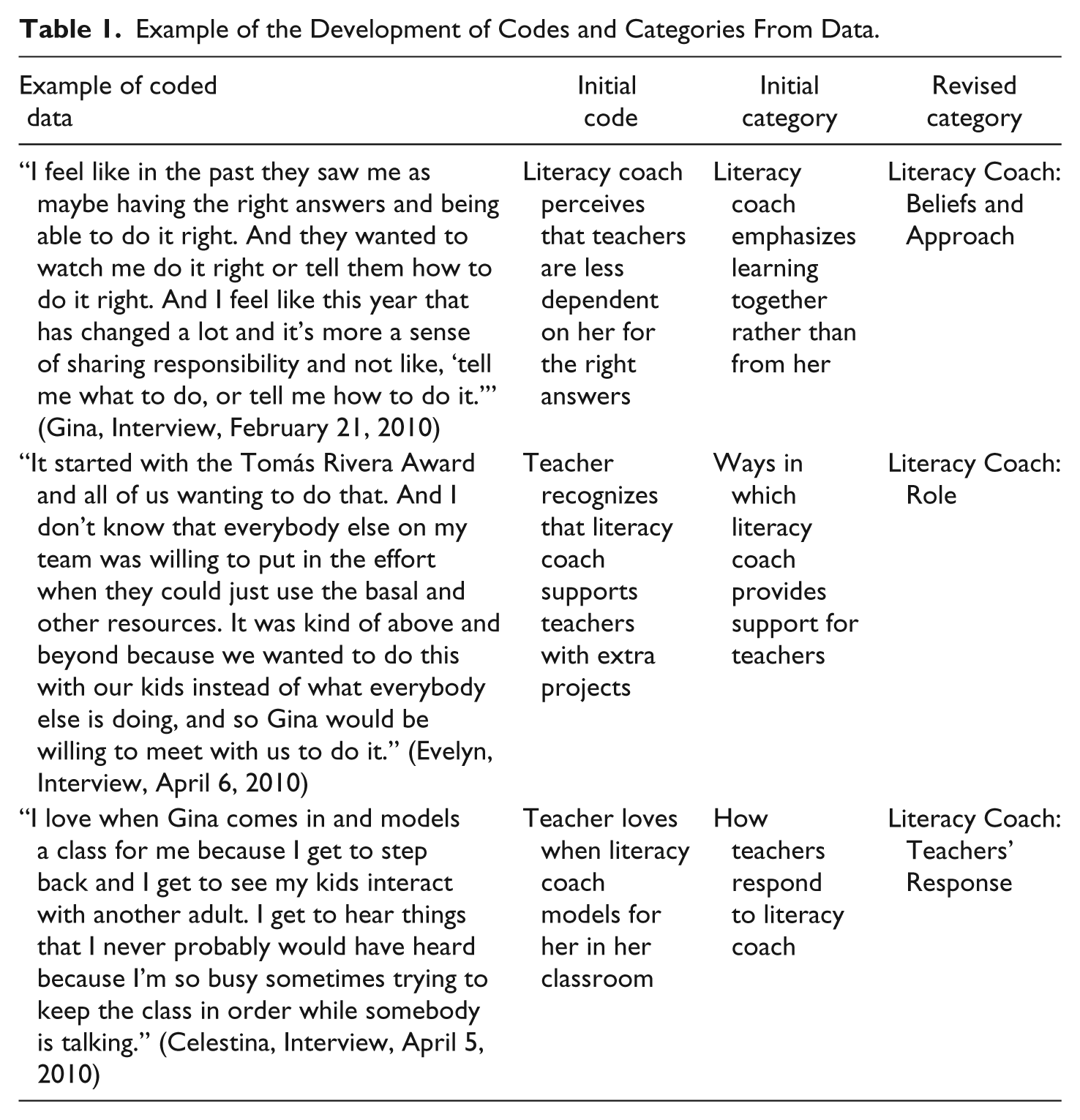
I drew on data from pre-K to fifth grade to understand how reading and writing were taught and talked about in the school as a whole. This yielded more than 200 codes, which I input into ATLAS.ti, a computer software program designed for conducting qualitative research. The software allowed me to collapse the initial codes into 73 categories based on similarity and overlap (Strauss & Corbin, 1998). For example, what was previously coded weekly assessment, benchmark test, and grade-level common assessment were combined under the category of Assessment. Further analysis of these categories allowed me to condense them into 43 meaningful units with descriptive subcategories. To illustrate, the larger category of Literacy Teaching resulted in subcategories such as Literacy Teaching: Materials; Literacy Teaching: Text Choice; and Literacy Teaching: Vocabulary. This led to the identification of eight final categories linked by the common theme of how reform efforts played out in the school. Literacy Coach was one of these categories that emerged as most salient in the data, and led to the second phase of analysis, which is the focus of this article.
During the second phase of analysis, I limited my data set to the sources that directly included the literacy coach, third- to fifth-grade teachers, and other staff members who were involved in making decisions related to high-stakes testing. I reread the data to focus on characterizing and describing the literacy coach’s actions. This phase of analysis was informed by the literature on literacy coaches and their roles, in which I grounded my understanding of what literacy coaches do, while being open to other ways of understanding literacy coaching based on Gina’s practices. This phase of analysis was also informed by what I knew about Gina, such as my assumption that she was an excellent teacher and coach based on having worked with her, as well as what I knew about the larger context—the school, the district, and state mandates—based on my experiences as a classroom teacher.
This process involved creating new codes (e.g., literacy coach encourages teachers to use reading workshop; literacy coach makes sure teachers are familiar with wording on tests) and categories (e.g., structuring reading time; knowing the test) that supported and characterized what the literacy coach did in relation to high-stakes testing. Throughout this phase, I was also able to use negative case analysis (Seale, 2000) to show examples of confounding evidence, such as when Gina took a hands-off approach with some teachers whom she did not build a rapport with and therefore did not directly support.
I wrote analytic memos (Yin, 1984) to develop an understanding of the data in relation to the research questions, the literature on high-stakes testing and literacy coaching, and theoretical frameworks on literacy and teaching as situated practice. In particular, I paid attention to what Gina did and the decisions she made in relation to the context. By situating her work as a literacy coach within social, cultural, historical, and political contexts, I was able to recognize how her work was mediated within a larger system.
Trustworthiness
I took the following measures to ensure trustworthiness: spending an extended time in the field, triangulation of data collection methods and sources, peer debriefing, negative case analysis, member checking, clarification of my own biases and subjectivity, and using thick description to write up the findings (Lincoln & Guba, 1985; Mertens, 2005). I spent an entire school year at Brazos Elementary to conduct prolonged and persistent observations. This was an attempt to understand the culture of the school, develop trusting relationships with the participants, and understand the phenomena beyond my preconceived notions and biases. To ensure triangulation of my methods and data sources, I used multiple data sources for finding patterns and themes. To incorporate peer debriefing into my study, I asked colleagues to review my data and claims. This helped broaden my perspective because I was aware of my own biases and assumptions surrounding high-stakes testing and Gina’s effectiveness as a literacy coach. Member checking occurred during the last part of data collection as a way of ensuring that my interpretations of the data were accurate. During the final interviews, I shared my understandings and emerging theories with staff members so they could provide clarification or verification. For example, teachers were able to confirm that Gina was an important source of influence on their literacy teaching and that having her helped them understand high-stakes testing beyond only having to teach to the test.
Findings: Supplementing Test Preparation and a Skills-Based Approach to Teaching Reading
The findings presented here are told from the perspective of a former classroom teacher who, like Gina, struggled with negative feelings toward high-stakes tests, but held the conviction that it was possible to provide quality instruction to students in spite of a robust testing climate. I focus on three main ways that Gina navigated and responded to this context in which she supplemented and enhanced the dominant curriculum that was largely focused on skills and test preparation. First, she strived to create classrooms where all kids were supported with reading as individuals through the use of reading workshop. Second, she fostered an environment where teachers were engaged in supportive relationship building and connectedness through the use of teacher-centered inquiry groups. Last, Gina helped teachers engage students in reading authentic literature as much was possible with direct connections made to test preparation by focusing on testing language.
Supporting Readers as Individuals
A skills-based approach to teaching reading reflects a belief that reading can be divided into a series of subskills (e.g., main idea, sequencing events) that can be taught and mastered to improve reading (Dole, Duffy, Roehler, & Pearson, 1991). This approach presents a narrow definition of literacy that is reduced to discrete skills in isolation without clear connections to meaningful uses of literacy (Apple, 2002; D. Brandt & Clinton, 2002) and does not recognize what the reader brings to a text or the transaction that occurs between a reader and the text (Rosenblatt, 1994).
The district emphasized skills-based instruction to promote student success on the high-stakes reading test. For example, the district created the reading curriculum based on skills that corresponded with the state objectives for student learning. These were organized for teachers in the curriculum road maps, which were pacing guides that designated the order in which skills should be taught and the amount of time spent on each skill, typically organized into 1- or 2-week units, regardless of students’ needs.
Gina’s response to the skills-based curriculum was to encourage teachers to use reading workshop as a way of structuring their reading block so they could not only address the district’s curriculum but also address individual needs. Reading workshop supports students’ reading growth through the use of mini-lessons to teach skills, habits, and strategies; the use of conferences to further assess and teach according to individual needs; preserved time for independent reading; and by promoting student choice of reading material (Atwell, 1987, 2007; Calkins, 2001; Serafini, 2001). Workshop approaches allow teachers to structure their teaching in ways that acknowledge literacy learning as an individual process. In an era of testing and accountability, authentic workshop approaches to teaching may not always be a direct counterpart to skills-based teaching, although many researchers have shown how teachers hold to workshop values and continue to develop these pedagogies despite accountability mandates (e.g., Higgins, Miller, & Wegmann, 2006; Santman, 2002; Seely Flint & Laman, 2012; Wolf & Wolf, 2002). Gina’s approach relates to what researchers have shown where workshop teaching does not necessarily replace the dominant curriculum, but instead offers a way to negotiate expectations set forth by the school, the district, or curricular mandates.
The result was that Gina was able to offset the skills-based instruction by ensuring students spent time daily on independent reading and that teachers closely watched individual readers rather than have instruction only driven by the skill of the week. For most teachers, using reading workshop was new. Before Gina came to Brazos Elementary, most teachers either did not incorporate independent reading time into their daily schedule, or the time was primarily short in duration and did not necessarily inform instruction (Gina, Interview, September 24, 2010). Creating time for predictable, daily independent reading is an important tenet of reading workshop, and provides students with the opportunity to apply strategies and respond to texts as well as build their fluency, vocabulary, comprehension, and background knowledge (Anderson, Wilson, & Fielding, 1988; Calkins, 2001; Routman, 2002). Conferring allows teachers to support readers with intentions that reach beyond a predetermined set of skills, and teachers can assess individual needs, differentiate instruction, and form relationships (Atwell, 1987, 2007).
Prior to using reading workshop, most teachers relied on whole class lessons to teach reading (Gina, Interview, September 24, 2010). Including reading workshop in the daily schedule thus required restructuring and support from Gina to initiate, manage, and use the time effectively. Gina helped teachers by providing them with information about reading workshop and by modeling in their classrooms how to conduct mini-lessons and talk to students about their reading. Gina also helped teachers by ensuring they had classroom libraries stocked with a wide variety of texts organized for students to readily choose from.
In the following example, I show how Gina supported Celestina, a third-grade bilingual teacher, with reading workshop by modeling in her classroom. Celestina had been struggling with getting her reading workshop started at the beginning of the year and she appealed to Gina for help by saying that “what was happening out there [during reading workshop] wasn’t okay. I felt like the independent reading time was a waste of time” (Celestina, Interview, October 5, 2010). To begin supporting Celestina, Gina came and observed during reading workshop. The following day she came back to conduct a mini-lesson with the students about procedures for reading workshop that included a conversation about having special places to sit and read. Gina began the conversation by asking students to reflect on how reading workshop had been going. Students described the experience as “bad because students were talking” (Field Notes, August 31, 2010). Gina then asked the students to think with her about what they could do differently to ensure reading was happening. After brainstorming ideas that promoted students’ responsibility for their reading, Gina provided some procedural instructions about how students should get their books.
As illustrated by this example, Gina supported Celestina’s implementation of reading workshop in two ways. First, she modeled for Celestina how to address challenges, and second, she used the format of a mini-lesson to involve students in problem solving. This demonstrates how Gina worked with teachers by showing them rather than telling what to do. She modeled constructivist practices that privileged a cooperative approach to teaching and learning. Also, she promoted reading workshop as a way of teaching students that is based on what students have to contribute and recognizes that they can problem-solve when difficulties arise. This particular mini-lesson was focused on a classroom management issue that stemmed from behaviors associated with independent reading. Reading workshop supports readers’ interactions with texts and their use of strategies, thus developing reading habits that are more authentic than solely focusing on isolated reading skills (Calkins, 2001).
After Gina released students to read independently, she continued to support Celestina by modeling reading conferences with individual students. The following is an example from field notes of Gina conferring with Jennifer about her reading (Field Notes, August 31, 2010). The excerpt is divided into four sections with interpretation following each section.
Gina sits next to Jennifer and listens as she reads a book about the character Froggy (a series of picture books written by Jonathan London). Gina says, “You are doing a good job. Tell me a little about the story. What did I miss?” Jennifer talks about Froggy going to school and continues retelling the story.
By beginning the conference with listening to Jennifer read, Gina was able to assess Jennifer’s oral reading. She then followed by asking Jennifer to tell her about the book, which allowed Gina to become familiar with the reading material and assess Jennifer’s comprehension. This is an example of how reading workshop gives students choice over their reading material and how the format of the reading conference allows for dialogue instead of asking students a list of comprehension questions focused on skills. This is also an example of how promoting student choice can position the student as expert because she may be more familiar with the text than the teacher.
Gina responds by saying, “You’re making a prediction about what’s going to happen. What made you think that?” After Jennifer responds, Gina says, “You used that illustration as a clue.” Gina asks Jennifer, “Have you ever been to a sleep over where people tell scary stories? How do you think Froggy is going to feel?” Jennifer says, “Scared.” Gina, “Yeah, I would agree with that.”
Gina called attention to a strategy Jennifer was using when she said, “You’re making a prediction about what’s going to happen.” To follow up, Gina then asked Jennifer to explain how she arrived at this prediction. By saying this, Gina noticed and named what Jennifer was already doing by calling attention to one of her strengths as a reader. This shows how reading workshop can help teachers build on students’ strengths, rather than predetermined skills all students should be taught.
Gina asks, “Is this a just right book for you?” Jennifer nods her head yes and Gina says, “Yeah, I would agree with that.”
This reflects an earlier conversation Celestina had with the students about encouraging them to choose books that are not too difficult to read independently. One component of reading workshop consists of allowing students to choose what they want to read rather than be assigned what to read (Atwell, 1987). To support teachers with allowing students to choose their own texts, Gina encouraged them to conduct mini-lessons with students about how to choose a “just right book.” Teacher-created posters about choosing books were displayed in all of the classrooms where Gina worked with teachers on reading workshop. Gina reinforced students’ responsibility over choosing appropriate texts when she asked Jennifer whether this book was a “just right book” for her.
Gina then points to a page in the book and rereads the phrase, “Skin crawl.” She explains to Jennifer that this is a phrase the author used “to say that Froggy is scared and freaked out.” Gina thanks Jennifer for talking with her and writes some notes in her notebook before moving to sit with another student.
Gina recognized that Jennifer, who was an English language learner, might not understand the phrase “skin crawl.” To support her comprehension and language development, Gina explained the meaning before bringing the conference to an end. This was also a way for Gina to model for Celestina, and then later talk about how reading conferences can consist of a teaching point that is based on what the teacher directly observes (Calkins, 2001), rather than a prescribed set of skills or objectives designated ahead of time.
The one-on-one conferences that are a part of the reading workshop structure allowed Gina to carefully observe Jennifer and individualize her instruction. The reading conference also allows for students to engage in meaningful and authentic talk about what they are reading, rather than answering questions aimed at covering a required skill or objective. Gina’s teaching was not only individualized but was also grounded in Jennifer’s own strengths as a reader. This approach to assessing and teaching reading is responsive to students in ways that a strictly skills-based approach to teaching where everyone receives the same instruction is not.
In addition, Gina was able to model for Celestina the kinds of talk and observations that teachers engage in during reading conferences. This modeling helped emphasize the teachers’ role during reading workshop as providing support and individualized instruction rather than serving as a monitor to ensure students are reading. For Celestina, Gina’s modeling also provided a way to observe her own students from a different perspective. She described this experience by saying,
I love when Gina comes in and models a class for me because I get to step back and I get to see my kids interact with another adult. I get to hear things that I never probably would have heard because I’m so busy sometimes trying to keep the class in order while somebody is talking. (Interview, April 5, 2010)
While modeling benefited teachers by showing them what to do and say, it also provided Celestina the opportunity to understand her students in a way she might not have otherwise. Having another teacher in the classroom allowed Celestina to focus on the students rather than on teaching and classroom management. The continued emphasis on students was another way that reading workshop benefited teachers and students. Had Gina not emphasized and supported teachers in the use of reading workshop, teachers may have continued to focus on reading rather than readers—with priority given to skills taught in a sequential predetermined fashion rather than in response to what students needed as individuals.
Fostering Supportive Relationships
At the district level, professional development consisted of workshops on how to teach certain reading skills or how to teach test-taking strategies, reflective of the district’s approach to teaching reading as an accumulation of skills. In these workshops, emphasis was placed on giving information to teachers with the intent that they were going to be “trained,” rather than identify or build on the expertise of the group. These workshops were also short in duration, lasting only a few hours. There was no follow-up, and they were not centered on the needs of the teachers (Gina, Interview, May 19, 2010). Researchers have demonstrated the ineffectiveness of this approach to professional development where information is truncated and focused on prescribed ideas with little to no attention given to agency or how knowledge is shaped by personal, interpersonal, contextual, and situational factors that shift over time (Cochran-Smith & Lytle, 2001; Darling-Hammond, 1998; Olson & Craig, 2001).
Just as Gina supplemented the reading curriculum, she also supplemented the professional development available to teachers. She still conducted the traditional forms of professional development that the district expected her to do (i.e., train teachers how to use the testing binders provided by the district with information about how to teach test-taking strategies), but for her, professional development meant more than just focusing on skills or test preparation—It meant building teachers’ knowledge of teaching reading and acknowledging that learning occurs through social engagement. In turn, Gina facilitated teacher learning through teacher-centered inquiry groups and encouraged teachers’ involvement with local organizations.
Learning together
The teacher inquiry groups were voluntary and based on what teachers wanted to learn about or felt they struggled with, rather than what Gina or the district thought teachers should know about (Gina, Interview, May 19, 2010). These informal meetings were held throughout the school year. In an effort to accommodate multiple schedules and interests, Gina created various opportunities for teachers to meet that included times before and after school. After surveying teachers to find out what they were interested in learning about, she created inquiry groups on topics such as reading workshop, reading response notebooks, and reading comprehension. This involved setting a weekly or biweekly meeting time along with identifying a professional book for the group to read (e.g., Reading With Meaning, Miller, 2002; and Notebook Connections: Strategies for a Reader’s Notebook, Buckner, 2008). Gina purchased the books using funds from the school budget, and she also secured a grant from an outside source to purchase professional books on a wide range of topics. The texts she chose reflect the literacy practices she valued and are tied to a larger discourse that represents literacy as embedded in social events and cultural meanings.
The inquiry groups served as an important way for Gina to form relationships with teachers, support them with their reading instruction, and understand the needs of their students, despite the pressures they felt to focus on skills or test preparation. Rather than “train” teachers, she approached teacher learning through an inquiry approach where she positioned herself as a learner and engaged in inquiry with them, using their questions to guide learning opportunities. This also allowed her to build on the expertise of the group. Research has shown how these are pivotal features of professional development to support teacher knowledge development and transformative change in teaching practices (J. Parsons, Stobart, Compton, Humby, & Drake, in press; Rodgers & Pinnell, 2002). Gina’s position as a learner is also important with regard to issues of being an expert, power, and the ability to form relationships with teachers. This can be related to Britzman’s (2003) conceptualization of teacher as expert, where she argues that the problems with this standpoint are that teachers then become viewed as a source of knowledge where nothing is left to learn. Being the expert thus creates power differentials that may hinder the ability to form relationships, an essential part of working closely with teachers (Rainville & Jones, 2008). Gina’s ability to form relationships with teachers and learn with them created a different kind of professional development experience where she was invested in the collective learning of the group, rather than transmitting information to them as the expert.
June, a fourth-grade bilingual teacher, described these groups by saying, “We might talk about gripes in the classroom. It ends up being supportive. We share materials and ideas. It helps me so I don’t feel so alone. Gina always has interesting information to share. She’s very in the loop” (Interview, April 19, 2010). As June described, these meeting times became much more than learning about a similar topic, but a strong source of support for teachers to make it through the school year when they felt discouraged. The flexibility of the groups to take the lead from what teachers wanted to talk about, rather than stick to a predetermined agenda, was also helpful for teachers to talk about their “teaching life” (Gina, Interview, February 21, 2010) and created a space where their ideas mattered (Grossman, Wineburg, & Woolworth, 2001).
While teachers often communicated that they viewed Gina as an expert, she emphasized the belief that they were learning together as opposed to only learning from her. Getting to this place was something that Gina had to develop over time.
I feel like in the past they saw me as having the right answers and being able to do it right. And they wanted to watch me do it right or tell them how to do it right. And I feel like this year that has changed a lot and it’s more a sense of sharing responsibility and not like, “tell me what to do, or tell me how to do it.” (Interview, February 21, 2010)
Shifting teachers’ understanding of professional development from what they were used to—a traditional model of being told and “trained”—to an understanding that learning and knowledge can come from within the group opened up more possibilities for the teachers’ growth and sense of community. Belonging to a community has important implications for teacher learning and growth (Lave & Wenger, 1991; Skerrett, 2010) because it acknowledges the role of social engagement in learning with an emphasis on collaboration and relationships. In addition, communities are important for teachers to mediate problems of practice and are linked to outcomes such as teacher retention and increased student learning (National Council of Teachers of English, 2010). The development of community advances when teachers have the opportunity to see each other as part of a collective enterprise over an extended amount of time (Barab & Duffy, 1998). Teacher inquiry groups position teachers as experts in a system that does not necessarily position teachers as such when they are handed mandated curriculum and told how to teach.
A fourth-grade teacher, Nicki, used the term “professional learning community” to describe how she viewed working with Gina. “You know she was under that umbrella of evaluating me, but I think maybe we’ve removed that because we’ve become this professional learning community where we’re all learning from each other” (Interview, October 13, 2010). Because Nicki recognized Gina as part of the learning community, she did not view her as someone who evaluated her first and foremost. Gina’s role from her point of view fits into what is known about professional learning communities—that hierarchies established in more traditional forms of professional development are lessened because of the collaborative nature of learning and inquiry (Grossman et al., 2001).
In addition to meeting outside of regular school hours, Gina recognized the value of having teachers learn from each other by observing in their own classrooms. She described this as “using the resources and experts we have here on our campus” (Interview, February 21, 2010). The teacher inquiry groups served as a starting point for teachers to learn from and with each other, and often this grew into what Gina called “learning walks” where teachers observed in other teachers’ classrooms. This required coordination on Gina’s part to obtain substitute teachers or arrange for other staff members to cover classes. Gina participated in these learning walks by observing with teachers to be a part of the discussion of what teachers were learning from each other and to show how she was learning with and from them as well.
The sense of community that Gina helped foster made it possible for teachers to learn together, collaboratively investigate their own teaching, and reflect on their practice. These alternative forms of professional development occurred across the school year and were flexible in meeting the needs of the teachers. By positioning teachers as someone everyone can learn from, Gina furthered the sense of belonging to a learning community, with expertise spread among the group rather than belonging to one individual.
Learning with other professionals
In addition to what Gina facilitated at the school level, she encouraged teachers to participate in groups and conferences in the local area as well as at the national level. For example, Gina belonged to a social justice teacher inquiry group for teachers. She encouraged teachers to attend the group’s monthly meetings and even helped host some of the meetings at Brazos Elementary. The agenda for these meetings varied and included sharing ideas for lessons about social justice, reading professional books as well as children’s literature, and listening to guest speakers. Removed from test preparation and teaching reading as a set of isolated skills, this group was another way that Gina encouraged teachers to expand their teaching repertoires and knowledge.
Because of their affiliation with the social justice teacher inquiry group, Gina and some of the teachers were invited to participate in a ceremony honoring the award winner of the Tomás Rivera Book Award hosted at a local university. Gina helped third- and fourth-grade teachers who were interested in participating create a special unit to teach students about Tomás Rivera and to present student work at the ceremony. In preparation, Gina and the teachers met to plan, gather resources, and coordinate the details of taking their students to the ceremony. They collected the award winning books from the current and past years to read with their students and developed a writing project based on the books. At the ceremony, their students’ work was displayed and they met the honored author and illustrator. Evelyn, a third-grade teacher, later attributed Gina with her help in the presentation.
It started with the Tomás Rivera Award and all of us wanting to do that. And I don’t know that everybody else on my team was willing to put in the effort when they could just use the basal and other resources. It was kind of above and beyond because we wanted to do this with our kids instead of what everybody else is doing, and so Gina would be willing to meet with us to do it. (Interview, April 6, 2010)
In this description, Evelyn acknowledged the support the group received from Gina to execute their plan while also describing the ways in which their work was more than what was required, something that most teachers did not want to involve themselves with because of what Evelyn described as an extra time requirement. Because teachers were expected to follow the curriculum road maps, developing a project such as this was deemed as something extra. With Gina’s support, the teachers worked together to develop the unit and were able to tie it back into the standards they were expected to teach (e.g., cause and effect) while using the award winning books. The culmination of their work reinforced their sense of community and gave them an added purpose that extended beyond the walls of their classrooms and a skills-based environment. This is another example of how teacher-centered inquiry groups can enrich teachers’ pedagogy and support their learning together, even in the context of a test-driven setting.
Engaging Students in Reading Authentic Literature
Passing the high-stakes tests was clearly a focus of the school district, as evidenced by expectations to work on test preparation. These expectations were communicated with teachers through the workshops mentioned earlier in which teachers were trained how to teach test-taking strategies. The district provided support by purchasing materials that resembled the state tests—worksheets that contained reading passages and multiple-choice questions. In addition to sending district representatives to the school to meet with teachers as a way of monitoring them and ensuring they were spending time on test preparation and tested objectives, administrators and curricular coaches such as literacy coaches were also expected to enforce test preparation (Gina, Interview, September 24, 2010).
The depth to which teachers were expected to focus on test preparation often results in a narrowing of the curriculum with little or no attention given to untested objectives or subjects (Jacob, 2005). For Gina, it was important to avert these negative effects as much as possible. She supported teachers in developing their own plan to prepare students for testing, with an emphasis on reading “authentic literature” rather than passages written for the purpose of providing test practice. Authentic literature was a term Gina used to refer to trade books. There were three main strategies that Gina used to ensure teachers were working directly on test preparation in ways that did not compromise her beliefs about quality literacy teaching. First, Gina made sure teachers were familiar with the language used on the test so they could infuse the same discourses in their teaching. Second, Gina showed teachers how to use authentic literature along with the testing language to teach tested objectives. Last, Gina worked with teachers to create their own test-like assessments based on the texts they were reading.
Understanding the language of the test
Gina made sure teachers were familiar with not only the content of the state tests but also the wording used on the tests so they could then help their students learn it. Knowing the exact phrasing used to test certain objectives was helpful so teachers could develop strategies for answering different types of questions. Gina helped teachers learn the testing language during weekly team planning meetings. This involved careful study of the sentence stems used on the reading test (Field Notes, February 9, 2011). The sentence stems refer to the parts of a sentence or question that provide a clue as to what type of skill is being tested. When teachers were familiar with the wording used to test certain skills, they were able to use the same language with their students when discussing those skills. In a meeting with fifth-grade teachers, Gina described this approach as something she did as a classroom teacher, “I used to do that, still use authentic literature and one TAKS-like question on my chart. We want to start teaching them strategies that are helpful for certain types of questions so they can understand the types of questions” (Field Notes, December 10, 2010).
Tests used in previous years were a principal resource for learning the testing language. The school district also used some of these as benchmark tests to monitor student progress during the year. In the following example, Gina met with fourth-grade teachers to review students’ results on a benchmark test given midyear (Field Notes, December 13, 2010). The teachers were sitting around a large table in Gina’s office with each of their students’ test booklets in front of them. They were discussing frequently missed test items.
We need to look in the test booklet to read the test item and see what objective is being tested. Summary and sequencing are part of the same objective, but they look very different on the actual test. If it says “according to the passage,” that’s inference right? “According to the passage, President Lincoln was influenced by . . .” Gina agrees with Nicki that the question is testing students’ knowledge of inferring.
This interaction illustrates the ways in which teachers and Gina studied test items to identify the skills tested by focusing on the testing language. This attention to language translated to having much of the same kinds of conversations with students. In the following example, Rory, a fourth-grade teacher, worked with a small group of students on test preparation (Field Notes, March 29, 2011).
The reader can tell . . . What else? The reader can conclude . . . From what the reader learns . . . I am going to tell you a hint. Lucky you are in this group because I have lots of hints. Put a star because it’s usually about how a character feels. Those character traits we are learning about. If we understand our character all we have to do is say that’s true about my character or that’s not true, she wouldn’t do that. So our strategy then is going to be true or false? You can ask yourself, would my character do that? Or say that?
In this example, Rory pointed out the wording that was associated with questions about character traits (“The reader can tell . . . The reader can conclude . . . From what the reader learns . . .”) and then described a strategy for answering these types of questions. She emphasized the phrasing used, identified the skill being tested, and then suggested a strategy for answering the question. To supplement this approach, Rory, like many teachers, used a testing word bank to highlight the testing language. These word banks consisted of words that were important because students were likely going to encounter them on the TAKS test, for example, words like “probably” and “mostly” (Field Notes, January 20, 2011).
Using authentic literature to teach tested objectives
Understanding the testing language served as a starting point for Gina to support teachers’ understanding of the test. Rather than rely on worksheets, Gina showed teachers how to combine the testing language with authentic literature to cover the required skills and objectives. Continuing to use authentic literature was an important part of how Gina believed literacy education should be regardless of testing pressures. Gina emphasized the importance of authentic literature by planning with teachers, recommending and providing books, and she even helped two third-grade teachers receive a US$2,000 grant to buy culturally relevant children’s literature for the school.
As Gina encouraged teachers to use authentic literature, even when they were directly working on test preparation, she supported them by showing them how they could introduce the tested objectives during their read-alouds. Gina stressed the importance of giving students opportunities to respond to the readings through conversation. The resulting discussions gave students the ability to voice their own opinions and questions about the readings, and gave teachers the chance to teach tested skills. Teachers infused the language of the test into their read-alouds through conversation and by creating their own questions about the story that were modeled after the reading test.
An illustration of what this looked like comes from Arturo’s third-grade bilingual class. After reading aloud My Brother Martin (King Farris, 2003) and having a discussion about discrimination, Arturo used a chart to guide students’ thinking about the story in relation to tested objectives. Arturo’s chart was similar to what Gina showed teachers to create on large pieces of bulletin board paper to call attention to testing language and capture student responses. Arturo chose to make his chart on a letter-sized piece of paper that he projected using a document camera. The chart was divided into four columns that were labeled character analysis, reasonable predictions, cause and effect, and author’s message. Under each heading were the questions that matched each objective—Based on the selection, what can the reader tell about the characters? Based on the events in the story, what would most likely happen next? What were the causes and/or effects of the character’s actions/decisions? At the end of the selection, what can the reader tell about the author’s message? The chart was also divided into rows so that each book read was assigned a row and the answers to the questions could be written in the corresponding cells. Arturo guided students through each item on the chart and recorded students’ responses in the appropriate cells. The following is an example of Arturo’s teaching (Field Notes, February 8, 2011).
Arturo reads aloud, “Based on the selection, what can the reader tell about the characters?” He asks who were the main characters. Raúl says they were Martin Luther King, Jr. and his family. What can we say? What can we infer? What can we conclude about the characters based on the book? We can say here they had hope. He writes on the chart “Tenían esperanza.” (They had hope.) They used nonviolence. They never gave up. Arturo records their answers on the chart. When we infer it’s not something we already know, it’s something we don’t know. We can say that they have hope. It doesn’t say specifically that they had hope and never gave up.
In this example, Arturo focused on four tested objectives that were all related to inferring. Having already introduced each of the four objectives in previous weeks, he used My Brother Martin to reinforce and review what they already covered. At the end of this transcription, Arturo highlighted the term “infer” and made the connection between what they were thinking about as being the same as making an inference. Having the chart with the different columns for questions was a way for Arturo to visually focus his students’ attention on the testing language and their responses. As an alternative to worksheets created to look like the test with multiple-choice questions, the chart connected to the authentic literature Arturo chose and was secondary to student talk. Arturo allowed conversation about the story to come first, and then later the chart served as a guide to focus that talk on the skill of inferring.
Using authentic literature to assess tested objectives
Just as Gina supported teachers in using authentic literature to teach tested objectives, she also showed them how the same texts could be used for assessment. While the district supplied assessments that resembled the state test, Gina preferred to use teacher-created assessments. These were based on carefully chosen books for read-alouds. Because teachers were familiar with the testing language, they were able to incorporate the same wording in their teaching as well as in their assessments.
The district expected each grade level to use the same weekly assessment to make comparisons across classes. Most teachers in the district relied on the assessments that came directly from the assessments the district purchased. Rather than take this approach, Gina helped teachers write their own. She showed them how to align the assessments with the TAKS test by making sure they were assessing the tested objectives. This approach allowed Gina and the teachers to comply with the expectations to practice test taking and use grade-level assessments, but without having to rely on commercially produced worksheets.
The following is an example of how Gina supported teachers in creating these assessments. She was sitting with third-grade teachers as they planned a unit on “people that make a difference” and that focused on using context clues to figure out word meaning—a tested objective with which students struggled. They examined the book Harvesting Hope (Krull, 2003) to create assessment questions (Field Notes, January 25, 2011).
Gina has suggested they use the word “baked” for students to identify the meaning. The teachers look at the way the word is used in the book to select answer choices. They are thinking of answer choices that might be tricky for students. Héctor suggests they use “to heat” as an answer choice that might mislead students. For one of those that could be, but I guess I would say “to make hot” since it says, “baked the soil rock hard.” That’s probably the better answer. Which should be the right answer? Heated and dried out. Are they going to have one like that on the test? Where there’s a similar answer choice? Yeah. We are going to have to practice. You’re going to be guiding them through and talking through the process. Maybe I’ll just put “to warm” and they’ll see which is better. Once they decide on the answer choices for “baked,” Gina suggests they use “battered” for another test question because of how well it is supported by the context.
In this example, Gina helped third-grade teachers develop an assessment based on a book they were going to use for a read-aloud. The book was part of a cohesive unit based on a common theme. Rather than select a commercially produced worksheet with a reading passage that was disconnected from students’ learning and class conversations, Gina helped the teachers create an assessment that fit in with the themed unit. This is an example of how Gina supported teachers in making negotiations so that test preparation fit into their teaching rather than making their teaching fit into test preparation.
Discussion
This study examined Gina’s approach to being a literacy coach. Much of what she did echoes what the literature says about effective literacy coaches (e.g., working directly with teachers; forming collaborative relationships; L’Allier et al., 2010). Extending beyond this literature, this study offers insight about literacy coaching within the context of high-stakes testing. Specifically, this study was guided by these questions:
Through my analysis, I have shown how Gina responded to this context by making negotiations that allowed her to align with the intentions of the state and district while still promoting the practices she deemed valuable. Using a framework of literacy and teaching as situated practice allowed me to understand how her practices were reflective of not only her own values and beliefs but also the norms and values dominating the larger context where decisions are made by others who privilege the kind of knowledge that can be demonstrated through high-stakes tests. A large part of what Gina did was supplement the curriculum and professional development structures that were already in place. She used reading workshop to balance the skills-based instruction the district advocated for and to support students as individuals. Teacher inquiry groups allowed her to support teachers beyond the traditional professional development the district required. She demonstrated her investment in teacher growth when she positioned herself as a learner and engaged in collaborative relationships with them. Finally, her support in adopting an alternative approach to test preparation that combined authentic literature with a focus on testing language allowed teachers to prepare students for testing beyond the drill of using worksheets. All of these actions can be understood as ideological practices embroiled in a larger system of power relations and differing values.
In the following section, I will elaborate on the ways that Gina negotiated this context by examining her work in relation to contextual factors, with an emphasis on the importance of literacy leadership from key players such as literacy coaches in high-stakes testing environments. This will be followed by a discussion of the importance of a supportive school environment, with acknowledgment of some of the challenges Gina faced with regard to working with resistant teachers and staffing problems because she was not able to serve all teachers.
Teachers must not only be experts in their fields with regard to content and methods but must also be sophisticated navigators of social, cultural, and political contexts in ways that reach the needs of learners and satisfy administration. The particular decisions Gina made can be better understood when considering how contextual factors may have influenced those decisions. The district interpreted state policy in ways that privileged testing, and the curriculum was therefore largely determined by what was tested. From a sociocultural and political standpoint, the resulting practices reflected the norms and values of the setting—high-stakes testing.
Situating Gina’s work within a highly politicized environment helps to explain why she made certain decisions. For example, had high-stakes testing been removed from the setting, it is likely that Gina still would have encouraged and supported teachers to use reading workshop and authentic literature, but she probably would not have chosen to layer testing language into read-alouds and assessments. The decision to do so therefore reflects the prevailing obligation she had to ensure that students were prepared for the test. Although testing compromised her beliefs about teaching, Gina knew that resisting testing was not the answer. Instead she developed her own answers that reflected her knowledge of quality literacy teaching and how to support teachers. She did so in positive ways such as supplementing the curriculum and offering support in ways that trumped the potentially oppressive practices that often accompany skills-based reading teaching and a focus on test preparation.
As literacy coaches support teachers, it makes sense to understand in what ways literacy coaches might not only support teachers’ literacy instruction but also support their negotiations of the political terrain. The actions Gina took in this context can be understood in terms of how she negotiated the competing beliefs about literacy and literacy instruction—between what she believed and valued and what the district adopted. While she herself had to implement many of the district’s approaches, such as training teachers on test-taking strategies, she found a way to align her practices with both the district’s expectations and her own knowledge and beliefs. In these ways, she was able to reshape the top-down policies, which she referred to as part of the “larger system,” from the bottom up. As a powerful political actor in the school, Gina helped and empowered teachers to work under the stressful conditions of high-stakes testing. A large part of what Gina did was build community and a sense of being “right there with you,” which she saw as being vital to her role even though she understood it to be “a hard job” (Interview, May 19, 2010). Because schools are complex organizations belonging to a larger network where inequitable practices are often promoted, it is increasingly important for teachers to be responsive to their teaching contexts and to promote responsible decision-making practices. The ability to do so can be enhanced when teachers work in concert with others and in spaces that allow for collaborative learning and teaching to emerge. Teachers need to be able to engage in sustained encounters with “like-others” to generate support and a knowledge base (Shulman, 2004). Having Gina’s strong leadership helped the teachers at Brazos Elementary contest the adverse consequences of accountability and create leverage for themselves and the practices they valued the most. These findings can help teachers and preservice teachers see that teaching does not necessarily have to mean compromising all beliefs and that it is possible to negotiate the demands of a high-stakes testing environment.
Understanding what Gina did is promising and offers implications for other literacy coaches and how they can support teachers. These findings also have implications for school districts and how they can utilize literacy coaches in effective ways. With such an emphasis on high-stakes testing guided by accountability standards (e.g., the Common Core State Standards for most schools in the country), school districts need to think carefully about how they interpret the role of literacy coaches and reimagine how they can be key players with regard to testing.
In similar settings where testing holds such a great amount of power, issues of inequity often arise because of the influence on curriculum and teaching practices, especially for students of diverse backgrounds and/or in low-income schools (Dooley & Assaf, 2009; Skerrett & Hargreaves, 2008). When test-based teaching practices are privileged, the educational experience for these students may be compromised, thereby contributing to social stratification. This highlights the importance of key players like Gina who are able to negotiate such contexts in ways that provide more equitable literacy education. When strong leaders, such as literacy coaches, are at the helm of literacy teaching and decision making, there is great potential for positive change in high-stakes accountability environments.
The findings from this study also serve as a reminder that a supportive school environment is important and affects what literacy coaches are able to do (Atteberry & Bryk, 2011; Carlisle & Berebitsky, 2010; Coburn, 2004; Hunt & Handsfield, 2013; Marsh et al., 2008; Rush, 2013). Had the culture of the school been different, Gina might not have been able to have the same kind of influence or provide literacy leadership the way she saw fit. With a supportive principal, Gina’s work balanced getting the desired results—increased test scores—and using the practices she believed in. At the same time, it should be noted that while Gina worked in an overall supportive environment based on her relationship with the principal and many teachers, there were some limitations with regard to how well she could support teachers—mainly in regard to resistant teachers and problems of staffing.
Most of the teachers Gina worked with readily adopted her approaches and shared similar beliefs about teaching reading. I have written about these teachers in ways that positioned them as open to learning from Gina and readily adopting her approaches. I have also positioned Gina as someone who was helpful and knowledgeable about how to support teachers with literacy teaching. There were, however, a few teachers (they were the minority) who Gina was not able to work with in the same ways because of resistance. This is important to mention because while the focus of this article has been on the literacy coach and how she supported teachers, I also want to be clear that her work was not without its limitations. Acknowledging how Gina also struggled with aspects of her job provides more depth and understanding of just how complex school systems are to work within.
Whatever their reasons might have been—different beliefs or goals, a disinterest in engaging with her, a perception that her approaches were too time-consuming, questioning the need to change practices—some teachers presented a challenge for Gina, and she took somewhat of a hands-off approach to focus her attention on the teachers who were open to working with her, rather than force relationships and approaches on those who were not interested. When asked about the reasons why she did not work with all teachers in the same ways, Gina explained that she felt like she had a lot to learn about how to work with what she called “struggling teachers.”
Teachers that we know are struggling, who will appear open to working with me largely because the principal has recommended that, but then I don’t see them taking on a lot of the things we talked about. Or when I do share or model and talk with them, there’s a lot of, kind of dismissal, of those ideas. [I’m] learning that that’s something that I’m not very strong at, figuring out how to still work with them and how to, I don’t know, how to help teachers change. (Interview, February 21, 2010)
The teachers Gina described were ones she positioned as not only “struggling” but also difficult to work with. These teachers were positioned as such not only by Gina but also by administration that echoed similar descriptions of them. When Gina encountered resistance, she felt unsure of how to offer help because she did not think she was having an influence on their teaching. The tension Gina felt with these teachers is important to note because it serves as a reminder that just as literacy coaches negotiate the larger political context, they also have to navigate their local contexts. This includes the differing ideologies and levels of engagement of teachers.
Beyond “struggling teachers,” there were a few teachers who Gina also positioned as difficult to work with because they had differing beliefs about literacy teaching. As a result, Gina found these teachers did not alter their practices based on her advice. Had the testing scores of these teachers warranted concern by the school’s administration, these teachers would likely have been reassigned to a nontesting grade (which occurred in years past according to the principal) or Gina would have provided intervention at the prompting of the principal. For this small number of teachers who did not welcome Gina’s support, they were getting the kinds of results they wanted in terms of using a skills-based approach and focusing on test preparation. This raises questions about how teaching goals and views about literacy get enacted in the classroom. As these teachers had favorable test scores, they may not have recognized the need to change their practices. This would inherently reinforce certain ways of learning and doing school and privileging a certain type of reading. This serves as an example of how test scores not only validate teaching practices that might otherwise be deemed ineffective or undesirable (e.g., Round Robin Reading), but how they also validate testing as a measure of learning. From a sociocultural perspective, when high-stakes test scores are privileged above other measures of learning, the resulting message is that test scores are the best, perhaps only way, to evaluate student achievement in reading, and success is therefore defined as such. At Brazos Elementary, getting results, regardless of the approach, provided reinforcement, even when those approaches were in opposition to what Gina valued.
This also brings up problems of equity for students who were assigned to these classrooms. The message they received about what counts as literacy and success may have been different from the message communicated to students in other classrooms where Gina had influence. Also, the approach used by the principal to reassign teachers to nontested grade levels brings up another issue of equity for students where teachers who were deemed as ineffective were reassigned to nontested grade levels.
Another difficulty presented by working in this environment was a problem of access within the school. Because Gina was so focused on supporting third- to fifth-grade teachers, she did not have the time to work with teachers in nontested grades (pre-K to second grade), and funds were not available to hire a literacy coach to work with these other grade levels. This was a problem that she recognized and that the principal and teachers in other grade levels also voiced. This difference in which teachers Gina was able to work with created a division in the school for some and how well they perceived they were being supported. For example, Karen, a Kindergarten teacher, complained, “I don’t feel supported. Do I feel there’s support for upper grades? Yes. TAKS grades, yes. Gina is the reading coach. I have not ever seen her come to any of our meetings” (Interview, April 13, 2010). Karen’s frustration illustrates how resources like the literacy coach were allocated differently because of testing. Karen’s comment also serves as a reminder of how testing can be difficult for everyone in a school system, not just those at tested grade levels.
Conclusion
There were many ways in which Gina’s success as a literacy coach was evident, but even with the best of her intentions, there were some things that Gina could not do in terms of working in a high-stakes testing environment. Namely, Gina could not completely ignore the tests. Therefore, embedded in her practices were the larger, highly politicized discourses about success in public schools equating test scores (R. S. Brandt, 2007). As a consequence, everything she did inherently revolved around the test. Even when using authentic literature, the goals always connected back to the test—using testing language, creating test-like questions, and using tested objectives. In this way, we can see how certain kinds of reading and practices were privileged because of testing and were never completely autonomous of the larger context. The integral power that a testing culture has over a school presents challenges, even for literacy coaches like Gina who try to find ways around it. What was important about Gina, though, was her ability and willingness to juggle the demands of the “larger system” and her own ideas about what constitutes “the good stuff.” So even though at the end of the day there was still the test, Gina fashioned her own set of responses in spite of the test. While there is no way to avoid the current political context, Gina shows us how a literacy coach can be an important player involved in making negotiations and performing her own political acts aimed at shaping the context as much as she is also shaped by it.
Footnotes
Appendix
Declaration of Conflicting Interests
The author(s) declared no potential conflicts of interest with respect to the research, authorship, and/or publication of this article.
Funding
The author(s) received no financial support for the research, authorship, and/or publication of this article.