




Abstract
This 3-year qualitative study examined how 26 teachers in four U.S. secondary schools addressed the literacy demands of curriculum materials based on standards from the National Council of Teachers of Mathematics. It was grounded in sociocultural perspectives that encourage study of language in local contexts, including classrooms, communities, and disciplines. The research question asked, “How do secondary mathematics teachers in a teacher–researcher collaboration understand and address the literacy demands of standards-based curriculum materials?” An interdisciplinary team of literacy and mathematics education researchers and graduate students worked with teachers to examine required curriculum materials, plan lessons, and share resources, while collecting qualitative data to capture teachers’ understandings and actions. Findings indicated that teachers responded in three ways to the materials’ literacy demands: (a) they used the materials selectively to bypass or reduce the literacy demands, (b) they augmented use of the materials with literacy support, or (c) they integrated use of the materials into long-term frameworks to develop mathematics and literacy learning simultaneously. The study suggests the value of using insights from mathematics and literacy to inform mathematics curriculum design and reminds us to take teachers’ perspectives toward such materials seriously, particularly when they collaborate to address issues about the materials’ use in their own school contexts.
Keywords
Literacy scholars have long argued that content-area teachers should develop students’ understanding of key concepts and domain-specific literacy to enhance such understanding (Draper, Broomhead, Jensen, Nokes, & Siebert, 2010; Moje, 2007; Shanahan, Shanahan, & Misischia, 2011). Similarly, mathematics education scholars have demonstrated how language and context shape mathematics understandings and have sought ways to help students develop these insights (Sfard, 2007; Siebert & Hendrickson, 2010). Two generations of National Council of Teachers of Mathematics (NCTM; 1989, 2000) Standards and research-based, Standards-aligned curriculum materials were developed so that U.S. students would read, write, and collaborate to complete investigations (Senk & Thompson, 2002). Researchers have studied how mathematics teachers use these curriculum materials (Drake & Sherin, 2006; Remillard, Herbel-Eisenmann, & Lloyd, 2009; Stein, Grover, & Henningsen, 1996), but how mathematics teachers attend to their literacy demands has not been well documented.
This article describes our 3-year qualitative study of how 26 mathematics teachers in four U.S. secondary schools understood and addressed the literacy demands of their Standards-based curriculum materials. The perspectives of our collaborators have much to say about the design of curriculum materials addressing standards in both literacy and mathematics, including current U.S. Common Core State Standards in English language arts and in mathematics (National Governors Association, Council of Chief State School Officers, 2010a; 2010b). These perspectives are especially useful as secondary educators and university-based partners develop expectations for local implementation of such materials.
Review of Related Literature
This section explores two main bodies of literature grounding this study. First, we review scholarship related to the intersection between literacy and mathematics. Next, we consider research related to how mathematics teachers use curriculum materials. Taken together, these two bodies of literature point to the potential to be found in understanding and enhancing the ways teachers attend to literacy as part of their use of mathematics curriculum materials.
Intersections of Literacy and Mathematics
Intersections between literacy and mathematics have attracted attention by various groups of scholars over time. Some of this work has been done by literacy experts identifying with varying traditions such as content-area reading, literacy across the curriculum, or, more recently, disciplinary literacy (Conley, 2007; Muth, 1993; Shanahan et al., 2011). Other mathematics educators have conducted studies, often under the cover term of “mathematics communication” (Siebert & Hendrickson, 2010). In rare but productive instances, scholars have worked across disciplines to generate new insights (Draper & Siebert, 2004; Siegel, Borasi, & Fonzi, 1998).
Since the early 1900s, scholars have recommended that secondary school teachers instruct students in how to read in the disciplines. Evolving mid-century research into the cognitive processes involved in reading yielded a surge of attention to developing secondary school students’ vocabulary and comprehension (Moore, Readence, & Rickelman, 1983). Herber (1970) argued that youth would benefit from subject-area teachers’ assistance to “acquire the skills they need for adequate study of all the materials required in their subjects” (p. v), a more functional approach than the generalized skills instruction provided by reading and English teachers. His instructional framework included three phases: preparation (activating background knowledge, vocabulary development, and purpose setting), guidance (developing skills and concepts through students’ interaction with teachers and with reading and reasoning guides), and independence (applying both skills and concepts to new learning situations with text). Herber included a reading and reasoning guide for geometry in his textbook, and several of his doctoral students researched various methods to support reading in mathematics class (e.g., Riley, 1979). His framework foreshadowed the gradual release of responsibility (GRR) model articulated by Pearson and Gallagher (1983). Both are concerned with developing student independence, though GRR is more explicitly Vygotskian in its orientation to teachers’ role as knowledgeable others who explain and model literacy strategies prior to guiding students’ application. Such perspectives continue to resonate in popular professional texts on teaching reading in secondary content areas (Buehl, 2001; Daniels & Zemelman, 2004).
The focus of literacy research changed in the 1980s and early 1990s with increased attention to social context and a broadening of researcher concerns (Barton, Hamilton, & Ivanič, 2000; Street, 1984). Research into reading in mathematics called for the development of instructional approaches sensitive to math teachers’ beliefs and concerns (Muth, 1993) as well as for consideration of the multimodal demands associated with the mixing of print, numerals, symbols, and graphics in mathematical texts (Osterholm, 2005). Borasi, Siegel, and Fonzi pursued the most sustained inquiry into reading and mathematics (Borasi & Siegel, 2001; Siegel et al., 1998; Siegel & Fonzi, 1995). They identified a wide range of reading practices and texts (e.g., teacher-written explanations, children’s picture books, newspapers) used in inquiry-driven secondary mathematics classes, concluding that, “reading is so interrelated with writing, talking, and other modes of communication that ultimately it is pedagogically limiting to define reading in too literal a way” (Siegel & Fonzi, 1995, p. 660).
This expansion of focus from reading to a wider range of language processes led to the use of terms such as “content literacy” and “literacy across the curriculum.” Literacy researchers encouraged subject-area teachers to add support for students’ writing and classroom discussion (e.g., Conley, 2007). Mathematics educators conducted numerous investigations of aspects of mathematical communication, including the benefits of writing in mathematics (Countryman, 1992; Morgan, 1998). Evidence accumulated that regular writing in mathematics could improve students’ metacognition (Pugalee, 2001) and allow students to explain their reasoning (Baxter, Woodward, & Olson, 2005).
Other scholarship grounded in sociocultural perspectives that Gee (2000) characterized as the “social turn” (p. 180) revealed that secondary mathematics classes, like other discourse communities, require teachers and students to communicate in ways that help constitute what counts as mathematics (Lerman, 2001; Sfard, 2007). These studies outlined a key role for teachers in mediating student participation in the discourse. For example, Rittenhouse (1998) characterized the teacher’s role in mathematical conversation as “stepping in”—making contributions as a participant—and “stepping out”—teaching the rules and norms of successful participation. Sherin (2002) studied the efforts of an American middle school teacher to promote regular discussions that balanced attention to process and student ideas with consideration of mathematical content. Goos (2004) revealed the central place of communication in one Australian secondary teacher’s efforts to create a culture of inquiry in his classroom. These studies demonstrated how language extends students’ engagement in inquiry-focused tasks and how teachers mediate such language. They also revealed that students from less dominant cultural groups, including those most likely to attend urban schools, often have less experience with linguistic and textual practices prevalent in mathematics classrooms than more privileged students (Boaler, 2002; Ladson-Billings, 1997; Zevenbergen, 2000).
Most secondary teachers, however, did not take up recommendations to support students’ language and literacy use. Veteran teachers explained that they were not well-qualified to support youth who struggle with reading and writing and claimed that attention to literacy reduced time for teaching content (Bintz, 1997; Ratekin, Simpson, Alvermann, & Dishner, 1985). New teachers who took content literacy courses required for certification in some states reported that such courses created interest for them in attending to literacy (Hall, 2005; Maniaci & Chandler-Olcott, 2010), but they often found their literacy instruction thwarted by concerns about classroom management and lack of collegial support (O’Brien & Stewart, 1989). Ntenza (2006) found uneven opportunities for mathematical writing in six South African schools, despite recommendations to increase journal keeping and other informal writing in the government-sponsored curriculum.
Several literature reviews sought to explain why teachers did not enact recommendations about literacy in subject-area classes more reliably. Alvermann and Moore (1991) argued that most reading-focused research had attended too little to aspects of secondary school culture, such as demand for order, accountability, and availability of resources. O’Brien, Stewart, and Moje (1995) also called for consideration of the institutional and social complexities driving curriculum, pedagogy, and secondary school culture.
The field of disciplinary literacy recently emerged to address such issues directly. Moje (2007) argued that what was missing from the “cognitive strategies work” continuing to dominate the literature was “attention to the specific demands of the practices—and thus, the texts—of the disciplines” (p. 16). She also argued that attending to this omission could build “an understanding of how knowledge is produced in the disciplines,” making disciplinary literacies more explicit, teachable, and accessible to diverse learners (Moje, 2008, p. 97). This stance has been critiqued by others (Heller, 2010) who suggest that most disciplinary literacy would be better developed in higher education.
Research grounded in a disciplinary perspective suggests that adult experts read and write mathematics with precise goals and strategies only hinted by previous work on mathematics communication. For instance, Shanahan et al. (2011) described differences in how expert readers from three disciplines, including theoretical mathematics, engaged in close reading. Drawing on other research into mathematicians’ reading of mathematical arguments, Weber and Mejia-Ramos (2013) challenged some aspects of Shanahan et al.’s findings about the nature of reading for mathematicians while supporting others. Both research teams agreed that further inquiry into mathematical reading is needed to develop effective pedagogies. Because this line of scholarship is relatively new, it remains to be seen whether secondary teachers will take up its recommendations more readily than those associated with earlier research or whether instruction grounded in such perspectives will lead to greater student engagement and achievement.
Curiously absent in these waves of scholarship on literacy and mathematics has been emphasis on the sustained use of literacy rich mathematics curriculum materials to support students’ development of mathematics communication. Mathematics educators have been more likely than literacy educators to explore the outcomes of discrete curriculum tasks when reporting on students’ reading, writing, and talk (e.g., Herbel-Eisenmann, 2002). But neither literacy nor mathematics scholars have considered the potential impact of addressing literacy through use of curriculum materials over time. There is, however, considerable helpful literature on mathematics curriculum materials use more generally, discussed next. This literature illuminates how mathematics teachers understand, enact, and modify curriculum materials in complex classroom contexts.
Use of Mathematics Curriculum Materials
Research on teachers’ textbook use in various subject areas, including mathematics, emerged in the late 1970s, around the time that interest in content-area reading intensified. Early studies framed teachers’ use of curriculum materials in terms of fidelity of implementation—the degree to which teachers’ enactments matched published curriculum (Remillard, 2005). The unit of analysis was often the individual teacher, with limited attention to the influence of context or social interaction. Lack of fidelity was often attributed to teachers’ lack of content knowledge or unfamiliarity with new materials (Manouchehri & Goodman, 1998).
NCTM’s 1989 publication of influential standards led to a flurry of curriculum development, much of it supported by the National Science Foundation, which also funded systematic inquiry into materials implementation (Remillard et al., 2009). Developers were optimistic about the potential for high-quality, research-based curriculum resources to support greater emphasis in schools on problem solving, reasoning, and communicating (Stigler & Hiebert, 2004), as well as greater curriculum coherence (Ferrini-Mundy, Burrill, & Schmidt, 2007). Such optimism was particularly keen in under-performing urban districts, where leaders adopted standards-based materials expecting their use to prompt change in teacher practice and increases in student motivation and achievement (Stein & Kim, 2009).
A more complex picture emerged, however, as researchers documented teachers’ use of these materials over time, often with a sociocultural lens that mathematics educators, like their counterparts in literacy, increasingly began to adopt in the 1980s and 1990s. This work revealed that the adoption of new curriculum programs often had little impact on day-to-day classroom practice (Ball & Cohen, 1996; Stein et al., 1996). Teachers struggled to understand and use new materials (Stein et al., 1996), and they often constructed pedagogy with those materials in ways that recapitulated existing beliefs and experiences (Remillard, 2005).
But teachers’ adaptations did not always reflect a resistance to change. Qualitative studies documented teachers’ interactions with curriculum materials were varied and context-specific. For example, in a study of two urban elementary teachers, Drake and Sherin (2006) found that “teachers’ narrative identities as learners and teachers of mathematics frame the ways in which they use and adapt a reform-oriented mathematics curriculum” (p. 154). Teachers’ adaptations were influenced by their backgrounds as mathematics students, current perceptions of mathematics, and family experiences. Given these complex influences, researchers argued that “for curricula to be a vehicle for reform, teachers must be supported and guided in making adaptations that maintain the goals of the curriculum materials, while still meeting the needs of their students and their particular teaching contexts” (p. 159).
Evidence suggests that professional learning communities in which teachers interact with each other as well as with university researchers can help teachers navigate standards-based materials (Doerr & Chandler-Olcott, 2009; El Barrio-Hunter College PDS Partnership Writing Collective, 2009; Zhao, Visnovska, & McClain, 2004). One example is the El Barrio-Hunter College partnership, where teacher researchers working side by side with professors embraced a collective process of “starting with high-quality curriculum materials and making them better for our children” (p. 119). Acknowledging that no curriculum series, however well-designed, could precisely address a population’s learning needs, group members co-constructed plans for implementing and supplementing the materials that would be responsive to changing student needs. Their work was informed by analysis of student artifacts and the development of case studies.
Projects like these, combined with greater concern for context in general, led researchers to reconceptualize the construct of curriculum fidelity. It was no longer suitable to offer just two dichotomous positions: following or subverting curriculum materials (Remillard, 2005). Although researchers continued to be concerned about the impact on instructional quality if teachers deviated too far from published materials, they also acknowledged that teachers could have legitimate, context-specific reasons for doing so. These scholars developed frameworks to capture the moves teachers made with curriculum, including selection of available resources, interpretation of those materials in planning and instruction, reconciliation of competing perspectives, and modification of the materials when necessary (Brown, 2009).
In this tradition, Chval, Chavez, Reys, and Tarr (2009) proposed the idea of integrity in textbook use, which they defined as (a) regular use of the textbook by the teacher and students over the instructional period . . ., (b) use of a significant portion of the textbook to determine content emphasis and instructional design . . ., and (c) utilization of instructional strategies consistent with the pedagogical orientation of the textbook. (p. 72)
Chval and colleagues argued that examination of teacher practice using this construct was not intended to privilege district-adopted textbooks but, rather, to document how teachers used the textbook “in order to determine whether it primarily influences the content, pedagogy, and the nature of student activity” (pp. 82-83). In their view, lack of such documentation made it impossible to link the adoption of any set of materials to student outcomes, suggesting that a more dynamic view of curriculum use would help leverage the potential of standards-based materials.
Research into teachers’ mathematics curriculum use has expanded over time, including what Remillard et al. (2009) called “a growing body of scholarship in mathematics education and research on teaching that places teachers at the center” (p. 3). Studies have accounted more explicitly for influences on teachers’ use, including their content knowledge; their beliefs about the subject matter, learning, and their students; and their access to professional discourse in their schools and other networks. To date, though, the literacy demands of standards-based curriculum materials, and teachers’ pedagogical responses to those demands, have not been systematically studied.
Summary
Research at the intersection of literacy and mathematics suggests that it can be valuable for secondary teachers to support students’ reading, writing, and oral language development in mathematics classes, although teachers’ uptake of these suggestions has been limited and the role of curriculum materials in this process has been under-specified. Much is known about how mathematics teachers use standards-based curriculum materials, as well as what resources support them in learning to do so, but little of that research focuses on how teachers learn to mediate the materials’ literacy demands. Research in literacy and mathematics education has been characterized by a recent “social turn” (Gee, 2000), but no one has systematically explored how literacy is enacted and supported in sustained local use of standards-based materials. The study described here was intended to do so.
Method
This qualitative study involved collaboration of a university research team with secondary mathematics teachers in four school sites. Our research team drew on ideas from required curriculum materials, research, and each other to co-plan instruction and share resources with teachers. Throughout this process, we collected qualitative data to capture teachers’ perspectives on the materials, literacy, mathematics, students, state testing requirements, classroom practices, and project participation to note how our collaborating teachers understood and addressed the literacy demands of their standards-based curriculum materials.
Theoretical Perspectives
The study was grounded in the sociocultural notion that language, literacy, and learning are situated in local contexts, including classrooms, communities, and disciplines (Barton et al., 2000; Bernstein, 1990; Lerman, 2001). Scholars in this tradition have moved from looking at learning as an individual, isolated cognitive activity to “focus[ing] on social and cultural interaction” (Gee, 2000, p. 180). According to Gee, Knowledge and meaning are seen as emerging from social practices or activities in which people, environments, tools, technologies, objects, words, acts, and symbols are all linked to (“networked” with) each other and dynamically interact with and on each other. (p. 184)
In this view, thinking is mediated by cultural tools, such as language. Drawing on Wenger (1998), Gee also argued that knowledge is “distributed across the social practices” (p. 181) within a community of practice. Rogoff (1990) explained such practices as “learned systems of activity in which knowledge consists of standing rules for behavior appropriate to a particular socially assembled situation” (p. 33). Learning can thus be seen as apprenticeship in communities where “active novices advance their skills and understanding through participation with more skilled partners in culturally organized activities” (p. 39).
School–university collaborations have long been argued as communities of practice that capitalize on varied perspectives (Cochran-Smith & Lytle, 1993; Lesh & Kelly, 1999; Richardson, 1994). Through social interaction and shared inquiry, both teachers and researchers serve as what Vygotsky (1978) called “more capable” others (p. 86). Members of such communities bring different expertise—including content knowledge, pedagogical approaches, knowledge of students and communities, and insights about local and institutional expectations—to consideration of how research and practice inform each other.
Setting and Participants
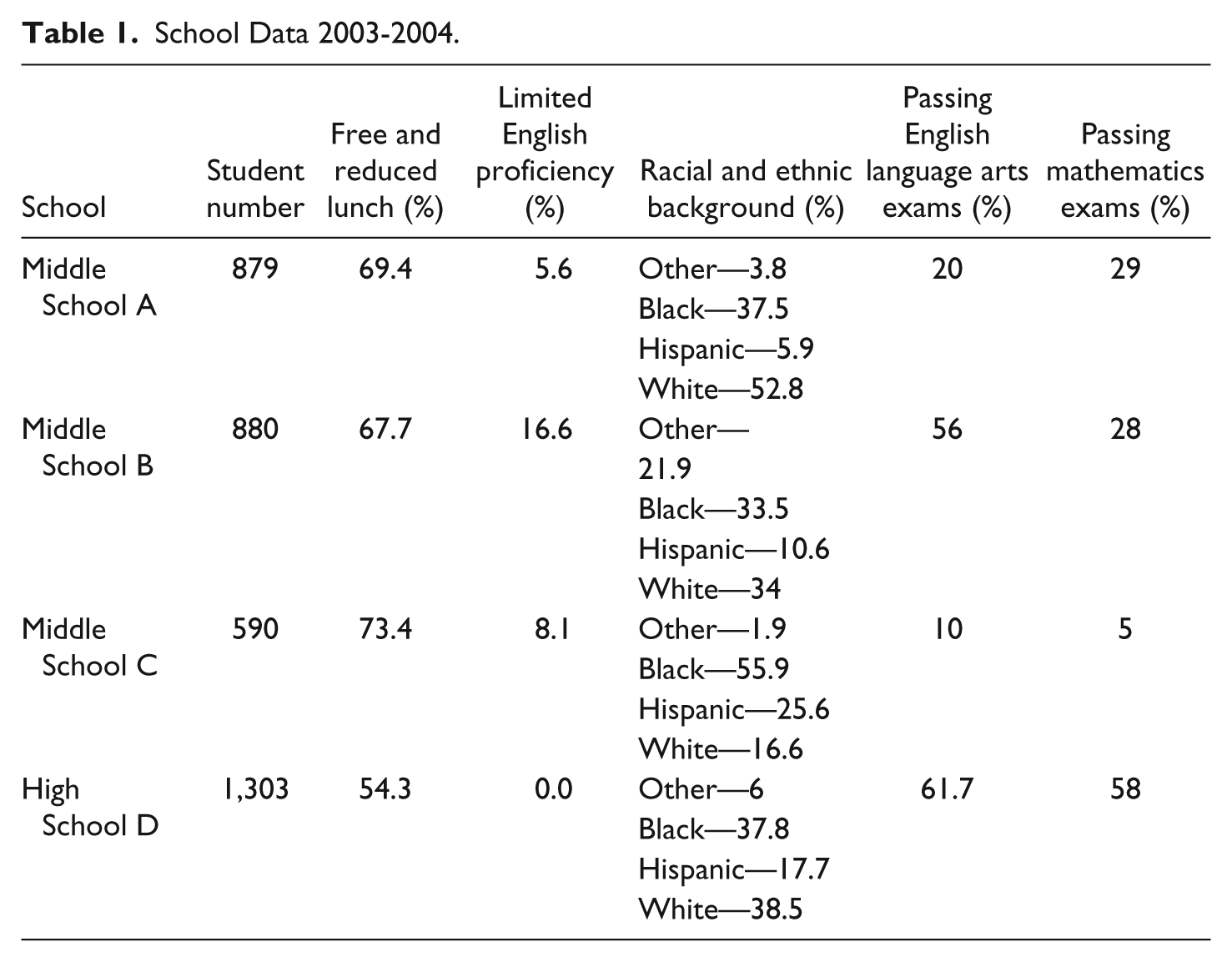
Our study took place in a mid-sized urban district in the northeast United States where students persistently struggled with literacy and mathematics achievement. District leaders adopted new curriculum materials to address this issue and were concerned about their perceived literacy demands, making the district a suitable site for our study. We chose to work in its lowest performing high school and its three feeder middle schools (see Table 1) because we thought that teachers in those schools would share urgency about interacting in a learning community with others.
School Data 2003-2004.
All teachers assigned to teach mathematics in the four buildings volunteered to participate at the study’s outset, including five male and 21 female teachers of varying ages and experience. All were White except one, who identified as African American. Over the years, several teachers rotated in and out of project activities due to changes in teaching assignments and other obligations, but no one withdrew from the study.
Roles of the Researchers
Our research team included university faculty and graduate students in mathematics education and literacy education. This included four tenured, White female teacher educators with secondary teaching experience, two in mathematics (Doerr & Masingila) and two in literacy (Chandler-Olcott & Hinchman), the authors of this article. Each was assigned one graduate assistant and paired with one school to participate in study groups, plan with teachers, observe and discuss instruction, and interview teachers. To benefit from our varied expertise, mathematics graduate students were paired with literacy faculty and vice versa. We also discussed and learned from our disciplinary differences during research team meetings.
We viewed ourselves as members of a community of practice that included the teachers, not as professional development providers intending to promote change over time. Several of us previously had positive experiences with teacher–researcher collaborations that led us to expect that teachers would bring knowledge of students, content, school context, and state expectations to that community of practice. Although we did not expect the differences in our social location as teacher educators and K-12 practitioners to be erased within that shared community, such a framing typically muted the status differences. And, indeed, there were multiple instances throughout the project in each of the four schools of both synergy and disagreement between teachers and researchers. This suggested that teachers were not intimidated by potential power differentials associated with researchers’ roles.
Curriculum Materials
Prior to the study, the teachers had used the required new curriculum materials for 1 year. Before this, middle-level teachers used teacher-made materials, and high school teachers used another textbook series. The district adoption committee selected the Connected Mathematics Project [CMP] (Lappan, Fey, Fitzgerald, Friel, & Phillips, 1998) for middle school and Discovering Mathematics [DM] (Murdock, Kamischke, & Kamischke, 2002, 2004; Serra, 2003) for high school because the committee members found the materials’ research base persuasive, thought the materials would be motivating to students, and hoped to enhance students’ performance on state tests by using the materials. At initial adoption, teachers were offered district-sponsored professional development, including summer training and in-service workshops, though not all teachers involved in our study pursued these opportunities.
Both sets of materials were developed to address NCTM (1989, 2000) Standards and were well regarded by mathematics educators for their coherence and rigorous research-development cycle. Both used a “launch, explore, and summarize” framework to support instruction centered on student inquiry, with investigations embedded in real-life contexts such as the study of variables and patterns during a bicycle trip (see Figure 1 for a typical two-page spread from a student booklet). Unlike the materials they replaced, both series required students to read a mix of narrative, expository text, and visual displays of data; make predictions; explain their solutions; and reflect on mathematical concepts orally and in writing.
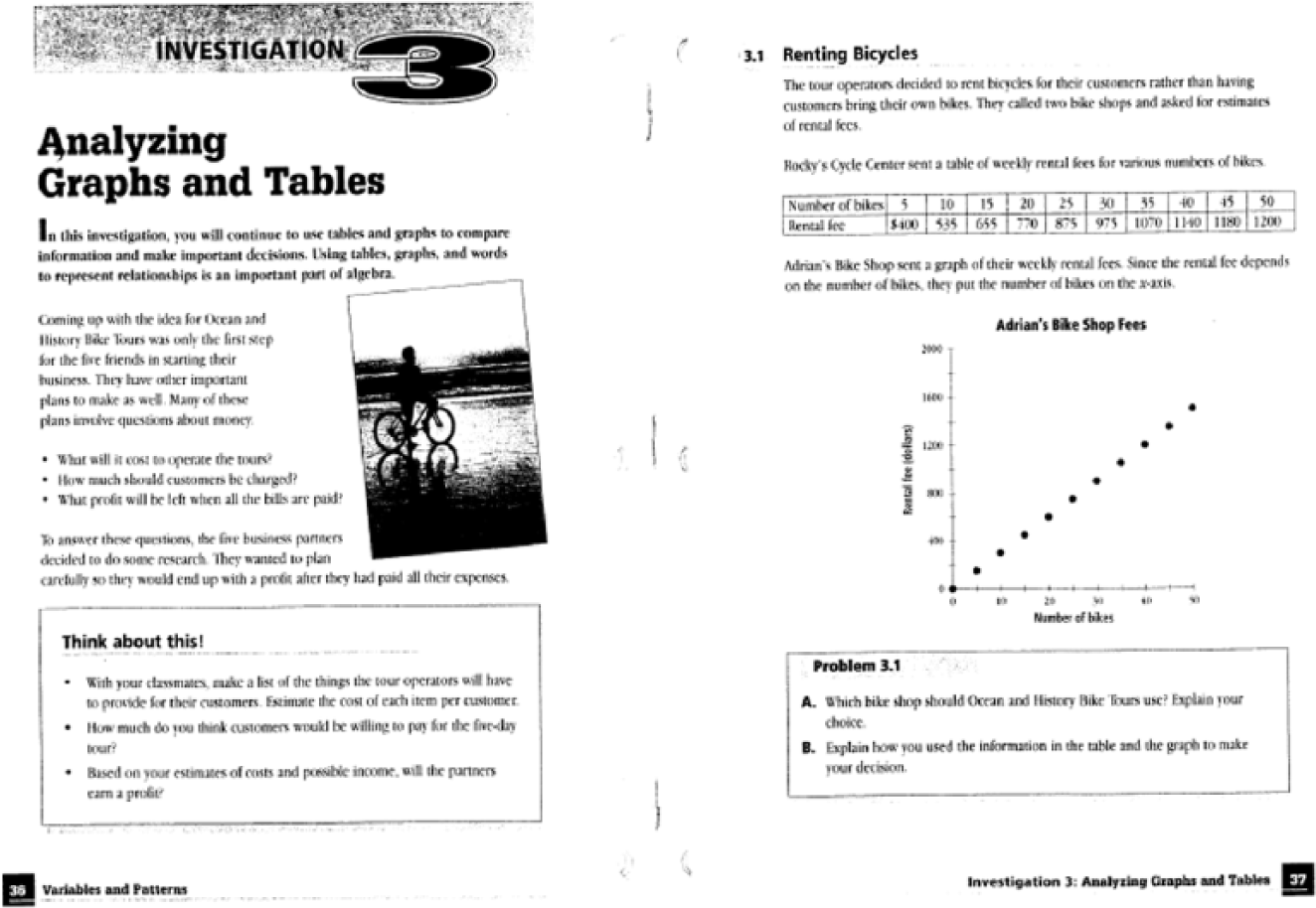
Text sample excerpted from Variables and Patterns (Lappan, et. al., 2002, pp. 36-37)
Project Activities
To launch the project, researchers held school-based discussions to elicit and document participants’ understandings of and actions related to the literacy demands of the standards-based materials. Subsequent meetings at each site varied in type and substance according to school schedules, participant availability, interest, and need. Over the 3 years of the project, school-based study groups met at least twice a month to discuss instructional strategies and student work, and teachers from several schools, most notably Middle School B and High School D, participated in regularly scheduled cycles of collaborative planning, observation, and debriefing.
Prior to the start of school in Year 1, we held a weeklong summer retreat framed around cognitive and social aspects of content-area literacy pedagogy, as articulated by Moje (2000). During the week, participants analyzed a cross-project list of literacy demands offered by the curriculum materials and explored the use of several instructional approaches to support students’ reading and writing. We also provided time for teachers to plan a unit with which to begin the school year. Four additional projectwide meetings took place during that academic year to share instructional ideas and coordinate collaborative planning. Because of teachers’ growing interest in ways to generate classroom talk about mathematics, we invited a speaker with expertise in cooperative learning (Kagan, 1992) to conduct a workshop for project teachers, and we selected a short article on fostering students’ official mathematics language (OML; Herbel-Eisenmann, 2002) that each school team read and discussed.
We organized Year 2 activities around students’ development of mathematics and literacy independence because teacher talk focused on this topic throughout the first year within and across sites. Our weeklong summer retreat to launch Year 2 focused on planning intended to achieve student independence. Teachers and researchers viewed and discussed classroom video from the project and shared ideas to facilitate discussion and problem solving. As in the previous year, participants planned an upcoming unit. Our four projectwide meetings during the school year were organized and hosted after school by each site team, with teachers taking turns sharing instructional ideas they found useful for supporting students’ oral language use.
To avoid conflicts with district-sponsored professional development, we scheduled the retreat prior to Year 3 over 2 days, one at the beginning and one at the end of the summer. We invited teachers to share school-specific planning, such as developing grade-level vocabulary lists and identifying key mathematical concepts for units. Projectwide meetings in Year 3 were organized as the second-year meetings were, by teacher teams from each school.
Data Sources and Analysis
Consistent with many teacher–researcher collaborations, the study drew on a variety of qualitative data to capture planning, teaching, and other project activities. We had access to a complete set of teacher’s guides and student books for the standards-based curriculum series that the district adopted for middle and high school, and these became part of the data set. We collected additional curriculum materials developed, used, or referenced by teachers, such as study guides, problem sets, and released state testing items. We kept copies of district and state communiqués about mathematics, including district-issued pacing guides.
In addition to collecting artifacts, all research team members took field notes to record four projectwide meetings annually, three summer retreats ranging from 2 to 5 days each, four monthly site-based meetings each school year, and one to two classroom observations per teacher per month. Most teachers also allowed us to videotape lessons annually, and we transcribed these tapes. Faculty researchers interviewed participants from their assigned site using the semi-structured protocol in Figure 2; these interviews took place at the launch of the project and then in each successive spring. These interviews were taped and transcribed. We used a common protocol to elicit a broad range of teachers’ perspectives on addressing the literacy demands of their materials. We used these data to construct understandings of the district and school sites as communities of practice, inform our planning of project activities, and consider patterns across sites and years. This rich range of triangulated data, our longitudinal immersion in the school sites, and the multiple perspectives afforded by an interdisciplinary research team were all central to our efforts to establish trustworthiness (Lincoln & Guba, 1985) for our findings.
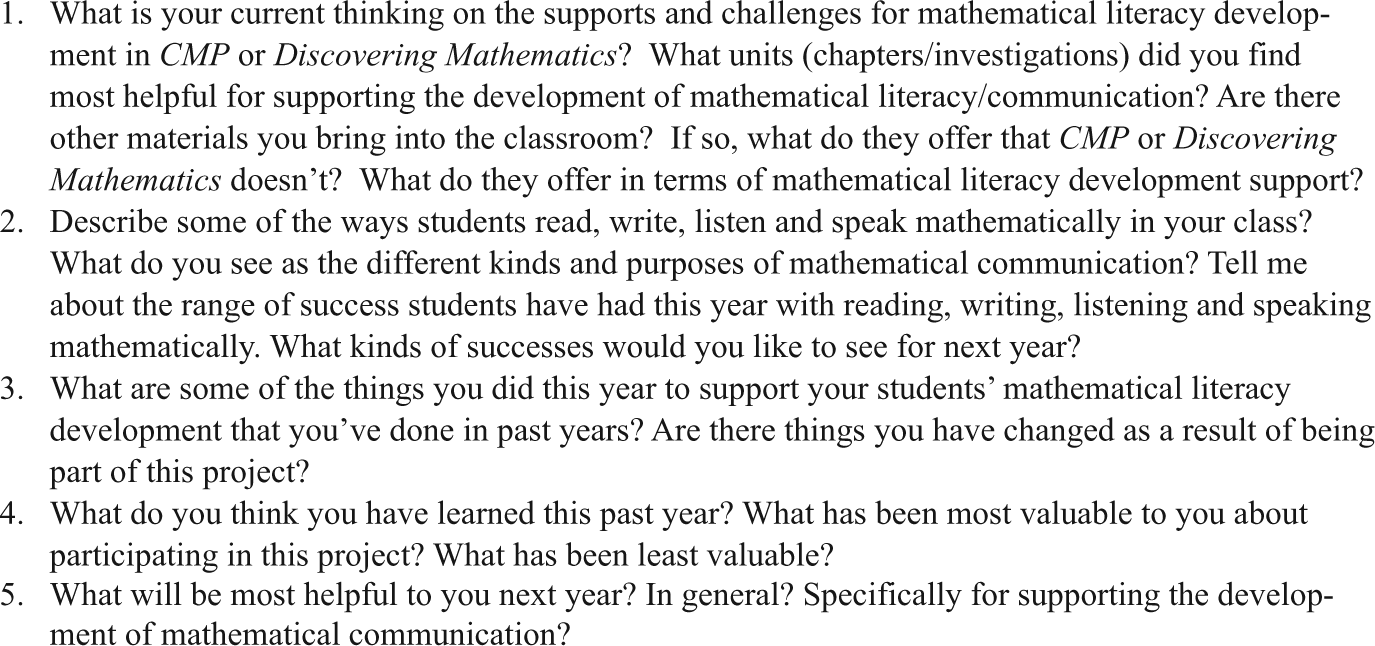
End-of-year interview protocol.
Our inductive analysis began after the initial interviews so that we could use patterns in the data to plan the first summer retreat with participants. Beginning in the fall of Year 1 and continuing for the project’s duration, we met twice a month to share field notes and artifacts from our ongoing interactions within the four sites and during cross-project meetings. Our early analytic conversations focused on teachers’ understandings of the demands of the materials, the moves they made to address those demands, and how we could facilitate sharing of teacher insights across the project.
In Year 2, we began preliminary coding of our data. Each researcher read transcripts and field notes independently, making lists of potential descriptive codes. We shared these lists at our semi-monthly meetings, resolving differences in terminology and combining codes through discussion. For instance, we discussed at length how to code Middle School A teachers’ use of Saxon mathematics materials that their principal purchased and required. We eventually coded this example, which several Middle School A participants discussed in interviews, as “alternative materials” because they had not been adopted at the district level.
Once we established a stable list, we coded all data with HyperRESEARCH™ software using these categories: (a) teacher practices, (b) teacher perspectives, (c) student learning, (d) district materials, (e) alternative materials, (f) reading, (g) writing, (h) oral language, and (i) vocabulary. We agreed to code data snippets with as many categories as were relevant so that we could explore emergent themes with depth and attention to context. Once this process was complete, we generated reports by category to identify themes within and across each category. For example, when we examined data coded as “teacher practices,” “materials,” and “alternative materials,” we could see how teachers differed in their use of required materials.
A concern for student independence surfaced in teachers’ talk from the beginning of the project, cutting across codes such as reading, writing, and vocabulary. We explored this theme with teachers by discussing one articulation of how to develop independence—Pearson and Gallagher’s (1983) GRR framework—during the summer retreat between Year 1 and Year 2 of the project. Language from this framework, including modeling and guided practice, surfaced consistently in the data from Years 2 and 3.
In Year 3, we began to understand with more nuance how teachers’ materials use mediated and was mediated by their membership in such communities of practice as the state, school district, schools, classrooms, and our project. This led us to compose descriptive profiles for each participant that distilled key ideas from his or her classroom and interview data and highlighted the information sources on which he or she drew, including each site-based research team. These profiles also summarized data for each teacher related to the main descriptive codes from the earlier stages of the analysis process (e.g., materials/alternative materials, reading/writing/oral language/vocabulary). Comparing and contrasting the profiles allowed us to notice how individuals were influenced by their various and varied communities of practices.
To capture the variation we were noticing, we created a graph to chart teachers’ degree of what Chval and colleagues (2009) called textbook integrity on one axis and the extent to which teachers planned for gradual release on the other. We then estimated a position on the graph for each teacher—first independently then arriving at consensus. Our intent with such plotting was to discern possible influences on teachers’ practices, such as teacher experience and grade level.
As we discussed the profiles and the graph, we realized that teachers’ practices could be clustered according to three categories: (a) selective use of the curriculum materials to foreground mathematics learning and reduce or eliminate literacy demands, (b) augmentation of their use of the materials with literacy supports, or (c) integration of their use of the materials into long-term plans for developing students’ literacy and mathematics independence. These categories were similar to those identified in previous studies of mathematics materials implementation (Brown, 2009; Remillard, 2005). Their variations in implementing the required curriculum seemed linked, in this case, to their understandings of relationships between learning mathematics and literacy.
As we attempted to identify each teacher as a member of a category, we realized that this process essentialized individuals in ways that did not accurately represent their complexity as practitioners. Some teachers used one approach more often than others, to be sure, but most used multiple approaches, and some changed their approaches over time. These patterns led us to cast the categories as a typology of approaches and not discrete labels for individuals. At the same time, the grid-driven analysis and discussion revealed that teachers on the same school teams tended to explain their teaching and use materials in similar ways, although not uniformly so. This pattern seemed significant because it complicated some of the previous conclusions about teachers’ relative fidelity to curriculum materials, and it hinted at the influence of each school-specific community of practice, including the research team, on teachers’ understandings and actions. Given these realizations, we chose to organize our findings, discussed in the next section, around the three approaches, with attention to school-specific concerns threaded throughout each section.
Findings
Both researchers and teachers began our collaboration with excitement about the potential for student engagement offered by the standards-based curriculum materials. Teachers in all four schools believed that the investigations’ story lines would help learners understand mathematics in everyday life, and they valued the materials’ rich use of vocabulary. Yet teachers were concerned with what they perceived as mismatches between students’ backgrounds and wordings of narratives. They also had reservations about the investigations’ inquiry stance and alignment with state testing frameworks. Individuals’ understandings of these affordances and constraints were mediated by their backgrounds and their participation in various discourse communities, resulting in three sets of approaches to addressing the materials’ literacy demands.
Using the Curriculum Materials Selectively to Bypass Literacy Demands
No teachers bypassed use of the district-selected curriculum materials completely, but many of them used approaches that alleviated the need to attend to the materials’ literacy demands. They did this by omitting investigations or units, by using the materials in ways inconsistent with the materials’ inquiry-driven orientation (Chval et al., 2009), and/or by supplementing the materials with other resources. In these cases, teachers typically framed literacy demands as time-intensive hurdles, separate from learning mathematics—a stance echoing mid-century content literacy notions bifurcating reading from subject-area learning (Herber, 1970). This perspective was articulated early in the project by Ms. Nokes from Middle School B: “I looked at all that reading and I thought, ‘I’ll cut it down to the nitty gritty. What do you have to know? What do we have to do? Here it is.’ You know, in the interest of time.”
Selective use of the district-required materials was especially prevalent at Middle School A, led by an energetic principal who viewed boosting mathematics achievement as urgent. Because she remained a bit skeptical that the standards-based materials alone would yield desired outcomes, she created additional mathematics intervention classes, purchased supplementary curriculum materials focused on learning mathematical facts, and hired outside consultants to engage her teachers in analyzing state testing frameworks. Her staff drew on these additional discourses to explain their selective use, as illustrated by these notes from an eighth-grade planning meeting: I [Kelly Chandler-Olcott] asked Ms. Landis if she had a sense of which investigations she planned to do of the six in the booklet, and she began to flip through them. She then identified problems she would probably ask them to do, rather than the investigation itself. As we examined Investigation 6, which focused on irrational numbers, Ms. Letterman said that this would require a “refresher course” for her . . . Then, Ms. Letterman said, “Aren’t [Investigations] 3 and 4 the important ones?” Ms. Landis agreed, saying that she “wouldn’t touch” Investigation 5 because it was “more high school,” but that she would “steal a little out of 4 because it’s on perimeter. That could show up on an assessment.”
The conversation between Ms. Landis, Ms. Letterman, and Dr. Chandler-Olcott illuminated the complex web of influences on teachers’ selection, including their mathematics knowledge; their worries about alignment with state tests; and their view of the standards-based curriculum materials as what Stein and Kim (2009) called modular, organized as a series of parts subject to disassembly and resequencing. Teachers with similar concerns—both at Middle School A and, less commonly, in other sites—often invited students to complete a sampling of selected problems rather than pursue situated inquiry within the full sequence of investigations. Such an approach reduced students’ opportunity to read, write, and discuss investigations and likely undercut the materials’ goals related to the sequential development of conceptual understanding.
Other teachers simply read and explained the texts to students, sometimes out of concern for time, as Ms. Nokes mentioned, and other times because they saw the materials as too difficult for students to comprehend on their own. For example, one High School D teacher, Mr. Phillips, read an investigation aloud and then paraphrased the text for students: In Investigation 3.1, you worked with rates. Rates have a 1 in the denominator . . . [Mr. Phillips continues reading.] So we aren’t doing anything new. We are using what we’ve done before. We need to set up the scale for the x- and y-axis. What’s the biggest length in miles? 189 So it would make sense to have the scale go up to 200. You can make each line worth 10 and mark every other one, every 20. So set up your scale like that [he gestures to one labeled on the overhead]. On the y-axis, go by 15s but you can label every 30. Skip a line, then 30, skip a line, then 60.
Mr. Phillips told students how to complete a task they might have figured out themselves through following directions in the text, especially working in pairs for support. His approach obviated the need for students to read and apply what they already knew about setting up graphs. In this example and others, students practiced a skill on which they likely would be tested, but with more teacher support than they might have needed (and certainly more than they would have been allowed in an authentic testing situation).
Other teachers addressed literacy demands by helping students to complete inquiry as outlined in the approved materials but then reviewing key concepts separately, using alternative materials which they trusted more. For instance, after Middle School C teacher Mr. Edwards completed a CMP unit on prime and composite numbers with his sixth graders, he provided additional instruction: [Mr. Edwards] says that he wants to teach them as many ways as he can to simplify fractions. He says, “Let’s take 6/8.” He puts fraction pieces on the overhead so they show up on the screen. He has 8 eighths, arranged in a circle. He asks how much he has. The class answers “one whole.” He asks how many 8ths they need. Students say 6. He takes away 2 eighths and asks what the students need to do to reduce the fraction.
He then handed out a worksheet with 65 practice problems and told students to work on the easy ones first. He supplemented the district-endorsed materials with such direct teaching because he did not think the investigations prepared his students adequately. The supplementation likely provided skills practice, but it also may have undermined a later CMP unit on fraction equivalence and reduced students’ opportunities to read and comprehend connections across investigations. Such use of alternative materials was most prevalent in the middle schools, where teachers had assembled—and often created—their own materials prior to the district adoption.
Teachers’ selective use of the materials positioned us as researchers in complicated ways. On one hand, the study was intended to explore how teachers understood and addressed the literacy demands of standards-based materials, not mathematics materials in general, and it was challenging to pursue that purpose when numerous participants, most notably those from Middle School A, used the adopted materials with less integrity than we anticipated. On the other hand, the curriculum implementation literature (Manouchehri & Goodman, 1998; Remillard et al., 2009) caused us to expect some variation in teachers’ perspectives and usage, and our ability to build trusting, collaborative relationships with teachers depended on not being seen as the district’s “curriculum police.” To manage these concerns, we chose to interact with and document teachers’ practice around the literacy demands in all the materials they used, rather than lobbying for greater integrity of use with the district-endorsed materials.
Summary
Teachers’ selective use of the curriculum materials to bypass the materials’ literacy demands took several forms: mining the materials for particular problems, reading to and interpreting texts for students, and supplementing investigations in ways that undermined the materials’ investigative orientation and instructional goals. These moves represented teachers’ efforts to address the mathematics content they recognized as important, which they separated from mathematics communication. Such efforts reduced opportunities for students to construct meaning from reading, writing, and discussing mathematical texts, which researchers saw as not only potentially problematic but also understandable, given such factors as pressure to raise test scores, school leadership’s varying messages about curriculum integrity, and teachers’ concerns about addressing gaps in students’ knowledge and skills with limited time.
Augmenting Use of the Curriculum Materials With Support for Students’ Literacy
As the project progressed, most teachers experimented, in collaboration with researchers, with approaches to address the curriculum materials’ literacy demands, as we expected they would. Drawing on recommendations from the content literacy and mathematics communication literatures (e.g., Buehl, 2001; Herbel-Eisenmann, 2002; Moje, 2000; Murray, 2004), these approaches attended explicitly to reading, writing, and oral language during mathematics lessons. Like the approaches described in the previous findings category, such augmentations were typically intended to reduce the literacy demands for students and foreground the mathematics more manageably. Unlike the previous approaches, however, the approaches in this category were intended to engage students themselves in dealing with the literacy demands.
Teachers’ concerns about students’ lack of independence during the first year of the project caused the research team to introduce GRR (Pearson & Gallagher, 1983), a construct described earlier in this article. As Ms. Donatello from Middle School B explained it, [teachers] want kids to do more on their own. We want them to be able to read, we want them to be able to write. We want them to think amongst themselves, or think by themselves, and that’s all the gradual of release of responsibility.
To support this goal, teachers and researchers discussed this instructional model during the second summer retreat, and the framework seemed to resonate for many teachers as they considered methods over the next 2 years for supporting students’ mathematics and literacy learning.
Teachers who embraced a gradual release perspective on literacy often needed guidance beyond what was provided in the required curriculum materials, however. The CMP teacher’s guides, for instance, typically included instructions such as these from the launch for an investigation focused on linear relationships in Moving Straight Ahead: “Read the introduction, and discuss observing and predicting from patterns” (Lappan, Fey, Fitzgerald, Friel, & Phillips, 2004, p. 5). Teachers who bypassed the literacy demands would either skip the introduction, which did not include any problems to work, or read it aloud and explain it to their students. Teachers who augmented the materials used approaches requiring student readers to do more interpretive work—for instance, to read with peer support prior to classwide discussion of the text. One example came from Ms. Zimmerman’s eighth-grade classroom at Middle School C, where students were beginning to investigate slope: Look at these two pages. We could read them out loud, but we’re going to do something different. What could an author do to let you know that things are important? Look at the two pages. . . . Put dots next to it. . . . Those are called bullets. Okay, I want you guys to read this passage until it says 5.1 and I want you to write down with your partner one important thing that is in it.
In explaining that authors use bullets to make important points explicit and inviting students to read and analyze the text with a peer, Ms. Zimmerman augmented her curriculum materials, drawing on professional literature provided by both Kathleen Hinchman and her school’s literacy specialist suggesting that teachers explain and model how readers use text features to note important ideas (Buehl, 2001). This was not an element highlighted by the teacher’s guide, which was silent about how teachers should mediate students’ interactions with the text. It provided only these terse directions: “Have each group measure a set of stairs and determine the ratio of rise to run” and “Remind groups to measure at least two different steps and to organize their findings” (Lappan et al., 2004, p. 65). But Ms. Zimmerman, like a number of other teachers who augmented the materials, felt that providing literacy-related supports would make it easier for students to access and explore the mathematical concepts in the investigations. Her use of peer support was intended to move students toward greater independence as mathematical readers.
However, some teachers linked the GRR construct to beliefs about urban students’ supposed deficits (Boaler, 2002; Ladson-Billings, 1997). For instance, Middle School C teacher, Mr. Vincent, shared his belief that it was necessary to engage in “slow release” around reading and vocabulary because “our kids” have “literacy problems and learned helplessness. It is a slower process here in the inner city than in the country . . . Each step has to be shown three or four times.” Like many of his project colleagues, Mr. Vincent augmented directions in the CMP teacher’s guides with explicit teaching of mathematics vocabulary. Sometimes teachers explained their moves with reference to deficit-oriented discourses, as Mr. Vincent did in the above case, expressing concerns that students’ backgrounds left them less prepared for the curriculum; at other times, they used more neutral frames, invoking, instead, students’ lack of familiarity with mathematics discourse.
Other teachers used GRR to conceptualize how their instructional practices might construct independent or dependent behaviors in students. Middle School A’s Ms. George noted after the first 2 years of the project that her attempts to increase students’ writing and mathematical talk had been productive. But she was dissatisfied with her lack of attention to promoting students’ independence as readers, lamenting that, “I did a lot of the reading for them.” Her realization caused her to set reading as a goal for Year 3: “I really need to do some more with the reading and the gradual release of responsibility . . . because I really have taken that responsibility myself.” At the end of that year, she reported, “I would say that we did a lot of concentrating on vocabulary and a lot of deciphering text so that they can chunk it and break it down and see what the question is really asking you.” Data from this year revealed Ms. George to be using approaches consistent with the content literacy literature (Buehl, 2001; Daniels & Zemelman, 2004) to help students access mathematical tasks.
Another example of such scaffolding occurred at High School D around a teacher-developed tool meant to support students’ reading of Discovering Algebra. The teachers at this site were among the first to use GRR in their language, and they applied it first to revising tools they called “templates” that they developed prior to the project. Their original templates were study guides to support students’ reading of investigations, separating questions grouped in the text as a single numbered item, providing space for students to show work, and offering students tables to record values. At a projectwide sharing session led by High School D, Ms. Inglenook described the team’s rationale for the templates: [W]e had two reasons. One is because it gave them a structure to write things down . . . And the second reason was some of the things in the book: some of the questions are confusing. This would all be one sentence, so they wouldn’t know how many questions to answer. And some of the questions are rhetorical, where some are not. And so we tried to separate the rhetorical questions away, and let them know they were rhetorical . . . So it was helping them break down what is difficult text.
As Ms. Inglenook further explained, the templates’ original design was static: each was similar in layout and level of detail. But the teachers’ adoption of a GRR perspective changed the structure of the templates used within and across grades. To illustrate the shift, Ms. Inglenook shared samples of templates used at different times of the year and in different courses to demonstrate how teachers’ expectations for student independence around textbook reading and inquiry increased over time.
This work prefigured, in important ways, the systematic, collaborative attempts to attend to literacy and mathematics that are described in the next section. But there were some key differences as well: Much of the High School D teachers’ language suggested a focus on helping students deal with the barriers to conceptual understanding presented by the materials more than on developing concepts and mathematical reading skills simultaneously. In addition, team members were unevenly invested in the templates: Some were active creators of the tools and adapted them in light of students’ demonstrated needs, whereas others, particularly newer teachers, tended to receive them from others and use them less flexibly. Nonetheless, colleagues expressed curiosity about the high school templates, and individuals in each site developed heuristics to guide students’ reading of CMP tasks as well as word problems from other sources.
In addition to their efforts to support mathematical reading, many project teachers embraced the idea of asking students to write to consolidate and communicate their thinking. This idea was briefly discussed by both Key Curriculum (“A journal is a place where students can record and reflect on their experience learning math”) and CMP (“In their journals, students can take notes, solve investigation problems, and record their ideas about Mathematical Reflections questions”). It was elaborated further by literature on writing to learn mathematics (Countryman, 1992; Morgan, 1998; Ntenza, 2006). Some teachers used unit-concluding, open-ended questions from the curriculum materials as writing prompts, as they had been instructed to do during district training, whereas other teachers identified writing opportunities not specified by the materials. Mr. Vincent at Middle School C, for instance, often asked his students to write a letter to a hypothetical friend who missed class, an idea borrowed from a professional text (Murray, 2004) shared by the team’s literacy researchers. He explained this choice in terms of mathematics vocabulary acquisition: “hopefully by putting [new words] into more context . . . they would learn them better.” During Years 2 and 3, all four school teams shared prompts and student writing samples during projectwide meetings they facilitated, creating collective energy and interest in a perspective articulated most clearly by High School D’s Ms. Inglenook: “I am beginning to see how valuable [writing] is in not only helping me to assess how well the students are understanding what I am teaching them, but what I am missing when I am teaching them.” Such a view tended to foreground writing as part of a teaching-learning-assessment cycle, however, more than as a means to produce and learn mathematics.
Teachers also began to connect written and oral communication in mathematics. For instance, High School D’s Ms. Gregory asked students to talk, then write about new terms: Once you’ve read that and you sort of talk about it with your partner for a minute or two, I’d like you to write a definition for the balancing method [of solving linear equations]. Now, of course, you can copy that definition out of the back of the book like we sometimes do, but make sure you understand that definition. Remember, when we write the definitions, we want it to be useful to us. So if you’re not sure what the definition of the balancing method is actually saying, try to understand it, talk about it with your partner, and then paraphrase it, or write it in your own words, okay?
While linkages between oral language and writing were discussed briefly in the teacher’s guides for Discovering Algebra, teachers and researchers discussed this idea more extensively, including during site-based discussions of a researcher-selected article (Herbel-Eisenmann, 2002) about the value of students’ use of everyday and contextual language to support their acquisition of OML.
A number of teachers took up this idea of OML—precise discourse used to explain ideas in a mathematics community of practice—in their planning as well as their interactions with students. For instance, Middle School A teacher, Ms. Harrison, made a connection between direction, a contextual use of language, and positives and negatives, official math language, when her seventh graders were playing a CMP game about changes in score: Remember that I said the positives and negatives are like directions? When you tell me left and right, you know, the direction, you can’t just say, go to Oak St, go to the stop sign, turn, go to the stop light, turn, when you see [store], turn and you’re there. Okay, that doesn’t work. You have to tell me left or right. And for math, the incorrect [score] for us means the negatives and the correct means the positives.
As Ms. Harrison circulated to listen to students’ explanations, she encouraged those using everyday language to move toward using OML.
When numerous teachers asked to learn more about supporting students’ discussion using OML, we hired a Kagan (1992) trainer for a projectwide workshop on cooperative learning, a teaching method suggested but not explained with much detail in the curriculum materials. Teachers from all four sites used Kagan activities to provide practice with sample high-stakes test items as well as rehearsal of explanations. Middle school participants often mined the Application-Connection-Extensions (ACE) section following each CMP investigation for problems that students could solve and discuss. The questions were contextualized within a narrative storyline in ways similar to the main investigation, and the teacher’s guide suggested selecting them based on student needs revealed by the previous problems. Field notes from Middle School B teacher Ms. Donatello’s classroom during Year 2 documented that she used Kagan’s Rally Coach structure—two students alternating between solving problems and coaching/checking each other’s work—in January, March, and May. She explained, I was using those [structures] to encourage kids to talk among themselves and have less talking from me. To instruct each other, and actually just help retention, I think. And then using that verbal language that they practice, to do some writing prompts with that.
In this way, Ms. Donatello combined high-quality tasks from the materials with her knowledge from the Kagan training and writing-focused project sessions to promote student engagement with and social interaction around mathematics content. Her work was reminiscent of the productive adaptations reported by Drake and Sherin (2006) and Brown (2009).
The approaches described in this category were those the research team envisioned would be most common at the study’s outset, given our understandings of the standards-based materials and our prior interactions within the district. Generally consistent with recommendations in the content literacy and mathematics communication literature, such approaches were indeed the most prevalent in our data. Researchers recommended them readily, and teachers from all four sites, even Middle School A where considerable selective use took place, experimented with them and shared their experiences in both school-specific and cross-project contexts.
Summary
Teachers augmented their use of the standards-based curriculum materials with various approaches intended to support students’ reading, writing, and oral language. Unlike the first set of approaches, which involved teachers in selecting and using the materials to bypass or reduce the literacy demands, the approaches in this category drew on teachers’ ideas from professional reading, each other, and researchers to help students navigate the literacy demands themselves. Teachers who used these approaches sought to develop students’ independence as learners of mathematics and literacy, which they appeared to see as related, though separable, goals—a view consistent with content literacy literature such as Buehl (2001).
Integrating Use of the Curriculum Materials Into Long-Term Plans for Mathematics and Literacy Development
Analysis of data from Years 2 and 3 revealed a third category of approaches used by participants from one site, Middle School B. These teachers noted that the literacy demands of the standards-based curriculum materials were similar within and across grades, with no suggestions for teaching students to deal with these demands with progressive independence. Admiring the way the materials developed mathematics concepts in a spiral within and across grades (Stein & Kim, 2009), they integrated their use of the materials into plans with long-term goals for both mathematics and literacy development. In service of these goals, they used approaches that were often similar to those profiled in the section on augmentation, but their orientation was different: They saw mathematics and literacy learning as intertwined, requiring sustained and simultaneous attention.
One articulation of this perspective came from a conference presentation that Ms. Nokes, Ms. Donatello, and Ms. Oliver made in Year 2 with Helen Doerr. Ms. Nokes explained, [In CMP] we didn’t have the same support for the literacy, the reading and the writing of the math in the program, that we did for the math. There were all kinds of suggestions, ideas, different strategies that you could use for the math, and we didn’t see that for the reading . . . CMP language was pretty much written horizontally, kind of flat, the language, the words that they’re using, [it] is pretty much the same from the beginning of sixth grade . . . . So we weren’t seeing that same natural progression in the literacy.
That Ms. Nokes made this argument is notable, given that she was a proponent when the study began of using the curriculum materials selectively, to reduce what she called their “verbiage.”
Ms. Nokes and her colleagues’ consideration of how to address mathematics and literacy learning simultaneously was sparked early in Year 2 when Ms. Donegan decided during a planning session with Dr. Doerr, the mathematics educator who led the Middle School B team, that she wanted to plan all the writing her eighth graders would do for an entire unit. She and other Middle School B teachers had experimented early in the study with quick writes and mini lessons similar to augmentations mentioned in the previous section, but Ms. Donegan wanted to be more systematic in her planning. To this end, she selected writing tasks from the unit on symmetry and transformations called Kaleidoscopes, Hubcaps, and Mirrors, drawing primarily from the Application and Connection questions. Dr. Doerr shared what came to be called Ms. Donegan’s “writing plan” with Ms. Nokes and Ms. Oliver, the two school’s sixth-grade teachers, during another planning session. This conversation led these two teachers to design a similar writing plan together for one of their own units.
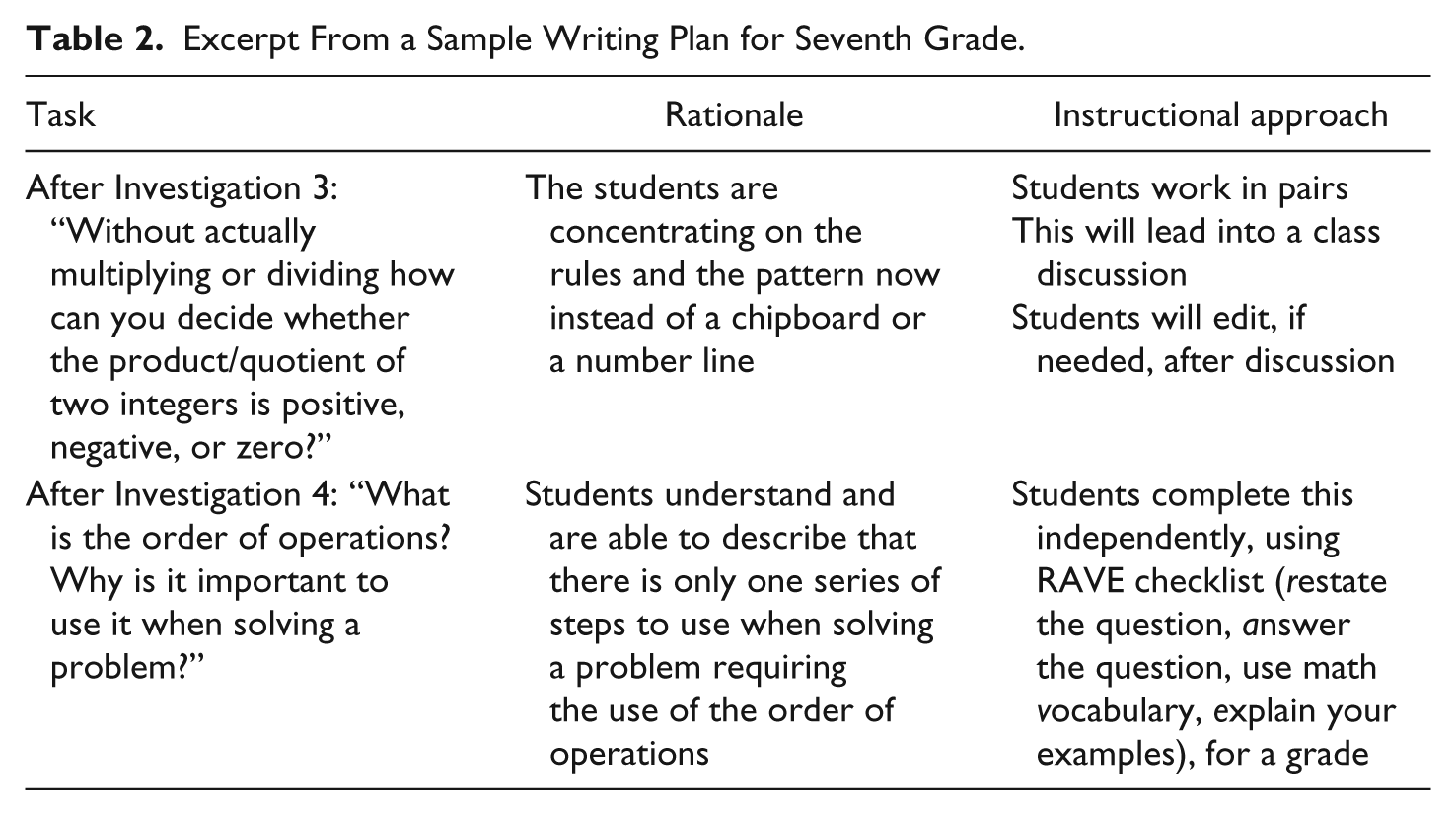
When other Middle School B mathematics teachers expressed interest in creating yearlong plans for each grade level, the school team decided to spend a week during the summer on this process. Dr. Doerr enlisted Dr. Chandler-Olcott, the literacy educator assigned to Middle School A, to work with her and the Middle School B teachers for 2 days during this week. After reviewing drafts of the writing plans, Dr. Chandler-Olcott suggested that they might be more helpful to others if the authors added some commentary to accompany each task. By week’s end, the team created a framework they used during the next school year: (a) a writing prompt, verbatim or modified from a CMP task; (b) a rationale for its selection; and (c) a brief description of instructional approach(es) to support student completion (see Table 2). Some tasks required descriptions or explanations using print, while others, in keeping with the multimodality of mathematics (Osterholm, 2005), required drawings, graphs, or symbols. Tasks at the beginning of the unit called for more teacher direction with language such as, “Model completely. Teacher led, teacher directed, whole group [instruction]. Answer the question and show an example.” Toward the end, the plan called for more student independence: “Discuss [the] table [from the lesson] with a partner. Independent written response [to the question].”
Excerpt From a Sample Writing Plan for Seventh Grade.
Drawing on the gradual release model previously explored in the project, Middle School B teachers sequenced their support so that students would be expected to write more independently in June than they had in September, and across the grade levels, so that eighth graders would receive less support than sixth graders. Ms. Oliver explained this decision with, We really need a planned progression. We really have to thoughtfully look at how we bring students from this level up to the next level. How do you get . . . to a place where a student is . . . an independent writer of math, really able to show understanding?
As teachers implemented their writing plans, they gathered and discussed examples of student work at varying levels of proficiency. This collaborative analysis helped teachers to determine next steps for groups of students, and it also built a common bank of student work to address Ms. Donatello’s critique, shared by others, that “none of [my students’ responses] look like this,” referring to the sample responses included in CMP teacher’s guides. Middle School B participants used these exemplars to articulate expectations for student writing in sixth through eighth grade. They also used the samples as models in mini lessons to help students consider the level of quality needed for mathematical writing in various contexts, including the state test.
The Middle School B team presented this work at a projectwide meeting they hosted late in Year 2 of the project. Although teachers from other schools expressed interest, they asked more questions and made more exit-slip comments about the Kagan structures the Middle School B teachers described that same day. When Middle School B hosted the Year 3 meeting, the team devoted time again to sharing their writing plans, with several chiming in to explain how the work had evolved. Ms. Donatello talked about the sources they had drawn on for prompts to include in the writing plans: the adopted CMP books, new versions of CMP2 that they had received as samples, and prompts “we made up . . . of our own.” Ms. Nokes claimed that “it’s really the process of working through the writing plan that’s the valuable part” and emphasized the provisional nature of their plans.
Over time, Middle School B teachers’ success with writing plans led them to envision instruction to develop students’ mathematical reading. Ms. Donegan was particularly articulate about the need to develop approaches beyond short-term scaffolding: I mean we can keep breaking [the text] down, taking a problem that’s asking five different things, and breaking it down into five different questions, but what’s our goal? Don’t we want them to be able to read that one on their own?
She and her colleagues argued that the reading demands of the materials should not be lamented or bypassed but rather seen as opportunities for proactive teaching. As a result, the Middle School B team turned to working together on plans to scaffold students’ mathematical reading development over time, which became the focus of a follow-up research project.
Middle School B’s collaborative progress appeared to depend on a number of factors. When the study began, their state test scores were slightly better in math and significantly better in English than the other middle schools in the project, likely creating more patience by both staff and administrators for planning with a longer term payoff. The presence of veteran sixth-grade teachers Ms. Nokes and Ms. Oliver, both elementary-certified, offered literacy expertise that could be applied to math. The team also leveraged researchers’ disciplinary expertise effectively: Dr. Doerr led explorations of the material’s mathematical content during school-specific planning meetings and retreats, helping teachers to appreciate their conceptual logic and organization, and she sought site-specific recommendations from and interactions with literacy researchers in addition to regularly scheduled project meetings.
Summary
Middle School B teachers developed approaches to make reading, writing, and oral language integral to their mathematics instruction. Some initially shared views about the adopted curriculum materials that justified selective use. Over the project, however, they developed an appreciation for how the standards-based materials were organized conceptually that helped them construct new insights about the materials’ constraints and affordances for literacy development. They augmented the materials with approaches that, like those in the previous section, were intended to provide more explicit literacy support. What made the Middle School B work distinctive was that they drew on gradual release to design within- and across-grade collaborative plans to address long-term goals for students’ independent mathematics communication as well as conceptual learning. They came to see such goals as inextricably linked, and they worked with each other and with researchers to address them.
Discussion
We undertook this study confident that we could learn much about mathematics, literacy, and curriculum and instruction from collaborating with U.S. secondary mathematics teachers who grappled each day with addressing the literacy demands of their standards-based curriculum materials. We were not disappointed: Teachers in this local context offered a range of responses to the materials’ literacy demands, including using the materials selectively to bypass or reduce the literacy demands, augmenting use of the materials with support for literacy, and integrating use of the materials into long-term frameworks to develop mathematics and literacy learning simultaneously. These findings were consistent with earlier research suggesting that mathematics teachers tend not to use curriculum materials strictly in their published form (Drake & Sherin, 2006; Remillard, 2005), though our contribution reveals how teachers’ concerns for students’ literacy needs, combined with their pedagogical backgrounds and desires for success with state tests, complicate their decision making in ways that have rarely been documented.
The study revealed that some affordances of the standards-based materials came with corresponding constraints. The real-world scenarios generated interest for students who were familiar with them and provided a situated context for vocabulary use. But they also created new barriers to learning for students lacking relevant background and cultural capital (Bernstein, 1990) to understand specific scenarios in the materials, which led some teachers to draw generalizations and lower their expectations in inappropriate ways. Similarly, while everyday and bridging language (Herbel-Eisenmann, 2002) in some portions of the materials helped to scaffold students’ access to mathematical concepts and a more formal academic register, many students needed skillful teacher mediation to recognize and toggle between these different social languages (Gee, 2000).
Ms. Nokes’s observation that “We didn’t have the same support [from the materials] for literacy that we did for math” reminded us that neither the materials themselves nor professional development teachers were offered outside our project to support their adoption addressed the materials’ literacy demands. Despite these gaps, attention to reading, writing, and oral language was common in many classrooms by the end of the project. Variations existed, but overall our teacher collaborators seemed more receptive to ideas for addressing literacy than participants in some other studies (e.g., Bintz, 1997; Ntenza, 2006). Where teachers varied most was the degree to which they saw literacy learning as separable from mathematics learning and the degree to which they planned for GRR. Such variations were linked to different influences, including experience level, degree of concern for state test results, administrative emphases, and—notably—the degree to which they collaborated with each other and with researchers in their respective school sites.
Middle School B was the site within the project where teachers were most likely to attend to developing students’ independence without separating mathematics from literacy. By the study’s end, they expressed confidence that their GRR-driven planning had put them on the path to improving students’ mathematical communication and understandings. Our experience suggests that such work could be productive over the long term, especially when undertaken by a school collaborative that examines student work to inform daily decisions.
Ms. Nokes’s comment also articulates a critique of the curriculum materials that the research team and a number of teachers came to share by the end of our project. Although the materials provided opportunities for students to communicate mathematically, how teachers should support and develop communicative independence was not addressed. Suggestions in these guides tended to represent a level of instructional support that did not vary, regardless of whether a lesson was intended for the beginning or end of the school year and regardless of grade level. GRR with reference to literacy was not built explicitly into the materials’ design, though it was for mathematics conceptual development.
We suspect that the curriculum materials’ developers expected that mathematics teachers would mediate students’ interactions with those materials, regardless of how they were sequenced during the school year, and that this mediation was preferable to students’ struggling unproductively with inconsiderate text. Our study, particularly the approaches developed by the Middle School B team, suggests that mathematical communication can be scaffolded too, and that school-based communities of practice may be best suited to developing sequencing and explanations that scaffold particular students’ problem solving and concept acquisition. The Middle School B community of practice merged literacy, mathematics, and classroom perspectives, yielding an integrated approach that began to approximate current conceptions of disciplinary literacy (Draper et al., 2010; Moje, 2007).
Limitations
Our study had a number of limitations. First, our decision to pursue a collaborative qualitative study in a complex urban context had costs and benefits. Our collaborative relationships helped both teachers and researchers expand their understandings of mathematics communication, but they also made it different to tease out particular sources for ideas. We cannot identify with certainty what aspects of our collaboration yielded particular understandings and practices. Similarly, although the collaborative design allowed us to assert with some confidence that teachers pursued different courses of action to address the literacy demands of their curriculum materials, we cannot say whether one set of approaches—more specifically, those embraced by Middle School B participants—was associated with greater increases in student achievement than another. Such an assertion needs testing with a different research design.
A second limitation was the lack of cultural, linguistic, and gender diversity among researchers and teachers working in a context with diverse students. Although our demographics were not different from American teachers or teacher educators, this homogeneity likely limited the instructional approaches our team adopted and adapted as well as our interpretations of data.
A third limitation was the project’s timing. Like all qualitative studies, it took place in a particular setting at a particular time, which of necessity reduces the findings’ applicability. A further complication was the long arc associated with collecting, analyzing, and communicating data from a multi-year, multi-site, and multi-investigator endeavor. We began the work prior to publication of some key pieces on disciplinary literacy (e.g., Moje, 2007; Shanahan & Shanahan, 2008). Although we found this scholarship compelling, it did not frame our work with teachers, and we found it challenging to combine the broader sociocultural lens we did use with some of its tenets, particularly its emphasis on insights from the abstract and specialized literacies used by mathematicians in higher education (Shanahan et al., 2011; Weber & Mejia-Ramos, 2013).
At times, we worried that the window on the study’s usefulness had closed. As we persisted with analysis, we realized that the contextualized reading, problem solving, and communicating privileged by CMP and Key Curriculum remain relevant to current debates about college and career readiness that include but are not limited to the U.S. Common Core Standards. Most K-12 students do not become theoretical mathematicians but rather use mathematics in various fields and life circumstances. The challenge, thus, became to articulate the study’s relevance in a scholarly context that had changed since we began our project but where the ideas articulated in the NCTM (1989, 2000) Standards remain influential.
Implications for Research
Teachers’ planning around mathematics and literacy is a complex, under-theorized phenomenon that we are only just now beginning to understand. New research projects can explore effectiveness of different ways of mediating students’ oral and written language use in mathematics instruction, particularly instruction designed to develop what the Common Core Standards call mathematical practices, “ways in which developing student practitioners of the discipline of mathematics increasingly ought to engage with the subject matter as they grow in mathematical maturity and expertise” (National Governors Association, Council of Chief State School Officers, 2010b, n.p.). As Langer (2001) did with English language arts, we can explore the variations of how exemplary teachers, identified by test scores and other measures of achievement and engagement, address students’ acquisition and use of mathematics discourse in their classrooms (Temple & Hinchman, 2014).
Such research would also benefit from fine-grained attention to teachers’ horizontal and vertical planning. In this study, we worked with multiple teachers simultaneously, seeing weekly instruction in multiple classes. This sampling was useful, particularly when we examined slices over a 3-year period, but it prevented us from seeing the same classes over consecutive lessons. Given the iterative organization of most curriculum series, continuity of observations over time might yield more insight into the literacy-related practices that “make reform-oriented approaches accessible to all students” (Boaler, 2002, p. 254).
Implications for Practice
The study contributes to debates about the use of curriculum materials to address long-standing achievement gaps (Ladson-Billings, 1997; Zevenbergen, 2000). Our teachers also reflected such concerns, sometimes drawing on deficit-oriented ideas about students and other times on performance data and perceptions of students’ strengths. Such concerns appeared to be key to decisions by some participants to use the materials selectively or to provide scaffolding for the literacy demands even when students might not have needed it. The study suggests that more teachers, including those in urban schools, might choose to use inquiry-driven materials with integrity (Chval et al., 2009) if such concerns were reframed and addressed in ways that highlight opportunity and high expectations rather than blaming student victims (Boaler, 2002). Promising directions for such work are offered by Gutstein’s (2005) work on reading and writing mathematics for social justice and Gonzalez, Andrade, Civil, and Moll’s (2001) application of a funds of knowledge perspective to mathematics. These lessons will be important to those developing curriculum materials and professional development to support implementation of new standards in literacy and mathematics, including but not limited to the U.S. Common Core State Standards (e.g., Calkins, Ehrenworth, & Lehman, 2012; Hirsch, Lappan, & Reys, 2012).
Scholars need to develop a nuanced set of recommendations for secondary teachers who seek to support students’ development of both mathematics and literacy. Such recommendations will need to balance addressing curricular coherence and integrity with allowing teachers to address specific local needs (Drake & Sherin, 2006; El Barrio-Hunter College PDS Partnership Writing Collective, 2009). Middle School B’s work within the larger frame of our project may provide a provisional model for doing this if we also recognize another of Ms. Nokes’ cautions: “It’s really the process” of collaborative curriculum mapping, co-constructing insights through long-term planning revised systematically in response to student work, that matters most.
Our experiences working across disciplines in this study support Siebert and Hendrickson’s (2010) claim that “The combined skill set of literacy specialists and mathematics teachers is exactly what is needed to develop literacy instruction for the mathematics classroom” (p. 52). In addition to collaboration among teacher educators (Draper & Siebert, 2004), we believe that K-12 mathematics and literacy teachers should also be encouraged to work closely together. If both partners contribute equitably to the collaboration, they may be less likely to bifurcate mathematics and literacy. Successful partnerships could be studied closely to yield principles and practices that may resonate more for teachers than largely generic content-area literacy recommendations (O’Brien et al., 1995) or college-derived disciplinary approaches (Heller, 2010).
As national standards and international testing frameworks prompt a new iteration of curriculum materials development, our study suggests the value of considering such constructs with an interdisciplinary lens, with a broad conception of literacy and insights from both mathematics and literacy specialists informing design. It also suggests the importance of taking teachers’ perspectives toward such materials seriously, particularly when they collaborate with each other and with researchers to address issues associated with the materials’ use. As Remillard, Herbel-Eisenmann & Lloyd (2009) argued, Understanding what teachers do with mathematics curriculum materials and why, as well as how their choices influence classroom activity, is critical for informing ongoing work surrounding the development of new programs, their adoption in the world of practice, and what students learn as a result. (p. 3)
Footnotes
Declaration of Conflicting Interests
The author(s) declared no potential conflicts of interest with respect to the research, authorship, and/or publication of this article.
Funding
This material is based upon work supported by the National Science Foundation under Grant Number 0231807. Any opinions, findings, conclusions, or recommendations expressed in this material are those of the authors and do not necessarily reflect the views of the NSF.