




Abstract
As new standards require that teachers and schools move to incorporate argument writing beginning in the earliest grades, young children’s interactions with opportunities to formulate claims require further investigation. This article, part of a yearlong ethnographic study of a first-grade class, examines young children’s practices of argument writing during a 6-week unit that invited them to take a stance on issues in their lives they considered unfair. I utilize feminist epistemologies to understand the ways children drew on their embodied knowledge to make normative claims about the world and investigate social justice concerns. Analysis focuses on the teacher’s and students’ characterizations of writing arguments and the discursive negotiation of what writing comes to mean for differently situated participants, including areas of contestation. This study illuminates the interrelationship between specific features of argument, the premises of the genre, and children’s lived experiences, and proposes a continuum of argumentation. In contrast to the dominant rationalities codified in writing standards and curricular mandates, findings suggest that young children engaged with composing arguments in ways that displayed an alternative rationality derived from their social locations. Through sponsorship from their teacher, the children came to see their personal experiences as central to the arguments they were constructing, and their role as writers as moving beyond disinterested discernment of contrasting perspectives to seeing themselves as invested in the issues under study. Implications for research and practice in early childhood literacy are discussed.
The advent of the Common Core State Standards (CCSS) has brought argument, long a featured genre in high school and higher education contexts, as a subject of attention for writing in the elementary and early childhood grades. Standards for writing arguments and opinions emphasize “support[ing] claims with clear reasons and relevant evidence,” with a focus on structure and the logical exposition of ideas to back up an expressed assertion (CCSS Initiative, 2010). Despite their neutral language, such policies, like all literacy practices, are inherently ideological (Street, 1984), and must be understood within hierarchies of power that position particular notions of evidence, logic, argumentation styles, or claims as valid and others as less so. Students’ and teachers’ practices of argument writing may be animated by different conceptions of the genre, for instance, as a set of features or as socially mediated activity (Russell, 1997). The classroom context is also important, such as the relevance of specific topics around which to make claims, the extent to which arguments are envisioned as audience centered or form centered, and the orchestration of school writing opportunities (Bazerman, 1994; Ghiso, 2011; Toulmin, 1958/2003). Researchers document an over-reliance on the structures of argument writing as a delineated set of features transmitted from teacher to student as opposed to an emphasis on the uses and social construction of the genre (Newell, Beach, Smith, & VanDerHeide, 2011).
Early childhood education poses particular considerations in the teaching and learning of argumentation. Young children are often viewed “through the life world of adults” and “mainly as individual learners of adult practices” (Dyson, 2013, p. 401). Conceptions of childhood that align with developmental frameworks may deem young children as not yet ready to engage in the perspective-taking and de-centering of self that is required in formulating arguments (Anderson, 2008), which may leave them more susceptible to transmission-based instruction focusing primarily on structural features. As well, the privileging of conflict-free classrooms (New, Mardell, & Robinson, 2005) often circumscribes curriculum to “safe” topics less likely to cause genuine debate and contestation. These ideologies of early education may devalue young children’s social negotiation of the genre at the intersection of curricular mandates such as the CCSS and their own literacy practices and childhood cultures. As teachers and schools move to incorporate argument writing beginning in the earliest grades, young children’s interactions with opportunities to formulate claims require further investigation.
This article, part of a larger ethnographic study of a first-grade writing time, examines a 6-week unit in which the teacher invited young children to argue for “an opinion you feel really strongly about in your life or in the world” (transcript excerpt). In their classroom inquiry, the children engaged in explorations of the structures of arguments within self-identified topics in which they were invested. I utilize feminist epistemologies to understand the ways children drew on their embodied knowledge to make normative claims about the world. Through sponsorship from their teacher, the children came to see their personal investments and experiences as central to the arguments they were constructing, and their role as writers as moving beyond disinterested discernment of contrasting opinions to seeing themselves as implicated in the issues under study. In contrast to the dominant rationalities codified in writing standards and curricular mandates, I found that young children engaged with composing arguments in ways that displayed an alternative rationality derived from their experiences.
Theoretical Framings
This study brings together feminist frameworks that underscore the socially situated epistemic resources mediating our interactions with the world, and New Literacy Studies scholarship that examines the role of literacy practices in such positionings. Feminist theorists from across a range of scholarly fields and philosophical orientations have long critiqued positivist constructions of knowledge as objective truths that rely on a pure rationality devoid of bias (Harding, 1993; Tong, 2013). They emphasize how dominant patriarchical structures marginalize ways of knowing that draw on emotion, intuition, and experience as informed by gendered (and raced and classed) oppression, which are positioned as “subjective” in relationship to a masculinist “objective” rationality. Feminist philosophers in the tradition of postpositive realism (Alcoff, 2006; Mohanty, 1997; Moya, 2002) argue that individuals’ experiences derived from their identities can be a source of knowledge that can lead to more (or less) accurate understandings about our shared world. From this perspective, it is not that a particular identity “yields knowledge in and of itself, but that it contains resources from which new knowledges can be developed with critical and theoretical reflection” (Alcoff, 2007, p. 46). While identities are socially (re)constructed as based on one’s particular and evolving hermeneutic horizons, the knowledges of differently located individuals are not purely relative. In particular, the experiences of communities whose knowledges have historically been devalued may have an epistemic advantage or privilege (Campano, 2007; Moya, 2002) in understanding how the world is structured hierarchically, while members of dominant social groups may have “a pattern of belief-forming practices” that result in mystification and “systematic ignorance” (Alcoff, 2007, p. 48) of inequality. Because identities are intersecting and mutually constituted (Hames-García, 2011), not stable or unitary, these positionings are contextual rather than rigidly determined.
Epistemologies derived from experience cannot be separated from the “visible” manifestations of identity as they are inscribed in and negotiated from the materiality of the body. Alcoff (2006) writes that “both race and sex . . . are most definitely physical, marked on and through the body, lived as material experience, visible as surface phenomena” (p. 102). As such, the body functions as a text that is subject to dominant notions of how particular bodies should look and behave—a body discursively and materially regulated and performed repeatedly over time (Anzaldúa, 1999; Butler, 1993; Davies, 2000; Hamera, 2005; Kamler, 1997). For the literacy field, attention to embodiment can illuminate how “we engage and cultivate literacies for making sense of bodies,” and “the literacies embedded in, performed through, and experienced as bodies” (Jones, 2013, p. 525).
Schools are one institutional context where bodies are expected to conform to ideal dispositions that often align with dominant raced, classed, gendered, and abled norms and with White middle-class notions of literacy engagement (e.g., Dutro, 2010; Enriquez, 2011; Hughes-Decatur, 2011; Kamler, 1997; Leafgren, 2011; Lewis, 2001). In early childhood classrooms, literacy instruction is often accompanied by explicit monitoring of the physicality of attentive reading and writing—how the body should be positioned, who can talk and when, and what ways of knowing are treated as valid. These material arrangements typically reify a mind–body dichotomy whereby knowledge is derived from “a rational consciousness that is ‘unfettered by the body’ (Boler, 2002, p. 332)” (Leafgren, 2011, p. 35). The binary also entails an omission of emotion in knowledge generation (Boler, 1999; Dutro, 2011; Probyn, 2004), an affective dimension that, being “separate from the mind, [is] hence irrational and in need of discipline” (Lewis & Tierney, 2013, p. 290). Feminist epistemologies with a focus on embodiment point to the constructed nature of such dichotomies, and argue for the body—as visceral, material, and discursive—as “a site of knowledge” (Hamera, 2005, p. 70). The privileging of situated ways of knowing are an attempt to reason from the perspective of one’s embodied experience (Harding, 1993).
Reasoning and Objectivity
One of the key features of argumentation is the notion of objective reasoning. A feminist perspective makes visible how what counts as objective reasoning is normalized through structures of power. From the tradition of postpositive realism, objectivity is redefined from “a condition of absolute and achieved certainty that is context transcendent, subject independent, and free of theoretical bias” (and thus unattainable), to “an ideal of inquiry necessarily involving theoretical bias and interest” (Moya, 2002, p. 14). All claims and arguments involve interpretations informed by our social locations, but ongoing inquiry surfaces and interrogates presuppositions, differentiating between some biases that are counterproductive and other perspectives that are necessary for developing increasingly more accurate understandings (Mohanty, 2001).
In the field of literacy, scholars in the tradition of New Literacy Studies have explored how literacy is not a neutral and “autonomous” (Street, 1984) set of skills, but rather multiple practices that are co-constructed within particular contexts. As Barton and Hamilton (2000) note, the concept of literacy practices can provide a means of “conceptualizing the link between the activities of reading and writing and the social structures in which they are embedded and which they help shape” (p. 7). While different individuals and communities may participate in a range of literacy practices, certain types of interactions—ones that correlate with the ideologies of dominant groups—are normalized. School settings in the United States have been shown to privilege academic literacies that align with White middle-class practices (e.g., Heath, 1983). Attention to power underscores how some literacy practices may be coded as more rational and others as more emotional or biased. Students’ interactions with reading and writing in classrooms thus entails not merely acquisition of skills, such as structuring a piece of writing, but rather negotiating among various literate repertoires that are differentially valued, and which work to position students as more or less successful literacy learners. In this article, I interrogate the autonomous facade of current standards for argument writing by examining how a first-grade teacher and her students navigated opportunities for authorship in the genre. I contend that the children enacted an alternative rationality by drawing on knowledge from their experiences and seeing writing as genuine and invested inquiry rather than solely as a display of literate conventions.
Literature Review
Research on argument typically relies on Toulmin’s (1958/2003) model, which characterizes this genre of writing as having specific traits, namely, a claim supported by evidence, bridged by lexical qualifiers, warrants, and rebuttals to countering perspectives (Newell et al., 2011). As Lunsford (2002) emphasizes, the other valence of Toulmin’s work is the ways that argument is dependent on, and must be understood within, specific fields or contexts. She notes that in many cases, research on argument “favors the researchers’ stable definitions of context (if they address context at all) instead of accounting for the participants’ understandings of the contexts they co-construct” (p. 114). Attending to a more robust formulation of context would uncover how any model ought to be understood as a dynamic set of social practices, shaped by varying interpretations, purposes, and at times competing ideas of what constitute plausible claims and evidence. Understanding student and teachers’ interactions in the practice of argument writing entails considering not only an authored product, as in a student essay or a teacher’s modeled example, but also the “micro-level, local interactions” (Lunsford, 2002, p. 120) through which such parameters are negotiated and enacted.
Russell (1997), drawing on cultural historical activity theory, argues for the need to link these interactional moments to the “long-term objects of activity and the motives individuals have for acting (including writing) in certain ways and not others that grow out of social practices beyond the classroom” (p. 507), thus bringing together micro and macro levels of analysis. Argument writing in classrooms entails historical relationships of power, such as the role of school-based literacies in privileging particular notions of rationality, and the ways that any genre is continually open to change, resistance, and transformation (Bazerman, 1994). Such perspectives shift the focus from stable features of a particular text to the work texts do when mobilized individually and collectively in a context.
Scholars also remind us of the importance of instruction in mediating how argument is conceptualized within particular settings. In an analysis of argument writing in a seventh-grade classroom, Nystrand and Graff (2001) argue that competing demands and messages can result in educational spaces that impair rather than support writing. As they note, argument is not a solitary recitation of facts, but inherently involves interaction, contestation, and dialogue, both with an implied audience and with members of the classroom writing community who may help challenge and flesh out the arguments of their peers by providing a different perspective. Nystrand and Graff emphasize, however, that “these processes are often short-circuited when knowledge is routinely treated, as it is in many classrooms, as a given—fixed, and found in texts” (p. 482). In the context that is the focus of their study, they found that the teacher’s attention to form above content, the limited time available for discussion, and the additional classroom literacy activities that foregrounded compliance rather than extended deliberations, created conditions that hindered critical thinking and dialogue. Thus, investigating young children’s practices of argument writing also necessitates close attention to the teacher’s pedagogical invitations.
Argument Writing With Young Children
While there is a significant body of literature on argument writing with older students (e.g., VanDerHeide & Newell, 2013; Wolf, 2011), there is little attention to this issue in elementary school classrooms and a virtual invisibility of young children’s engagement with the genre. In a review of research between 1999 and 2004, Juzwik et al. (2006) found that genres and writing were the least studied problem in P-12 settings, with a scarcity of scholarship in early childhood contexts. At the elementary school level, argument writing is “commonly called persuasive writing” (Anderson, 2008, p. 272). While it is beyond the scope of this article to examine the differences between persuasion and argumentation, one divergence is that “in contrast to simply attempting to persuade someone to believe or do something, evidence-based argumentation involves making a claim supported by reasons or evidence from multiple sources that connects to the claims in a principled way” (Newell et al., 2011, p. 275). Thus, persuasion may involve assent by any means (e.g., advertisements) while argumentation involves a principled exposition of claims and evidence and refutation of counterclaims. These distinctions in the field as reflected in the terminology of persuasion versus argument, however, may not map onto how the genres are enacted within elementary school contexts.
In the classroom that is the focus of this study, the teacher engaged the students in what she referred to as a persuasive writing unit, but, following Anderson (2008), her orchestration of the writing opportunities were indicative of characteristics of argument writing. The curricular guides for the school district also highlighted dimensions of argumentation, describing persuasive writing as “hav[ing] several functions: to state and support a position, opinion, or issue, or to defend, to refute, or to argue” (Curriculum artifact, p. 4). Given the little research available on writing arguments at the elementary and primary levels, and the ways that persuasive and argument writing are treated as interchangeable in the early grades, I looked to literature that followed both of these terms, focusing instead on the elements of claims, evidence, and counterclaims in arguing for a perspective on an issue.
Persuasive/argument writing typically garners much less attention in school settings than personal or informational writing (Crowhurst, 1991), though the CCSS and high stakes literacy assessments have brought recent attention to how teachers may support students’ competencies in this area (Calkins, Ehrenworth, & Lehman, 2012). As part of a study of persuasive letter-writing in two elementary settings, one urban and one suburban, Anderson (2008) reviews the literature on argument and persuasion, noting the prevalence of developmental views of young students’ capabilities, including notions that children are too young to decenter themselves to argue a point and lack the rhetorical sophistication and cognitive abilities necessary for this type of writing, which develop as children mature (e.g., Anderson, Chinn, Chang, Waggoner, & Yi, 1997; Felton & Kuhn, 2001). Through her analysis of student work, Anderson found that third and fourth graders were indeed able to construct arguments, and did so in ways that reflected differing discursive patterns across the two schools as related to the teachers’ mediation of the task, community discourse practices, and students’ social locations.
For early childhood contexts, developmental discourses are particularly entrenched. Comber (2003) notes that often “the child literacy learner is positioned as a maturing individual—a biological subject—who grows and blossoms with the right conditions and supports” (p. 355). These perspectives become actualized in characterizations of children needing to be protected from exploration of “difficult” topics and not being able to grapple with issues beyond the self. Early childhood researchers have demonstrated the range of ways young children can engage in critically deconstructing texts, constructing alternative representations, and exploring social justice issues (e.g., Comber & Nixon, 2008; Comber, Thomson, & Wells, 2001; Vasquez, 2004) without the imposition of an adult model of criticality. These inquiries tap into children’s interests, questions, and views of the world, and extend personal experiences to broader concerns, whether the experiences of others or how inequalities have structural roots. Riley and Reedy (2005) found that young children between the ages of 5 and 7 successfully engaged with argument writing within “controversial topic[s] . . . children can relate to” (p. 45), and with teacher guidance in the form of cognitive frames and role-plays that concretized the idea of taking different perspectives. Though there is a relatively small literature on young children’s “argument” writing that is labeled as such, scholarship in the tradition of critical literacy involves elements of the genre as it was conceptualized in the context of this study, specifically with regard to advocating for social change (Vasquez & Felderman, 2013) and examining how features of texts are evidence of particular viewpoints rather than neutral modes of communication (Vasquez, 2007). This research points to how aspects of argument may be flourishing within critical inquiries in early childhood contexts.
Method
Findings highlighted in this article are part of a larger ethnographic study (Erickson, 1986; Heath & Street, 2008) of the “writing time” in a first-grade classroom. The K-4 school was located in a large Northeastern city, and served approximately 270 students in 10 classrooms, about half of whom received free and reduced lunch. The first-grade class was made up of 20 students, split evenly among girls and boys; 16 of the children were African American, which mirrored the demographics of the school. Their teacher, referred to as “Teacher Blanche,” had been at the school for 4 years, with 3 years at a previous institution. She was a teacher researcher (Cochran-Smith & Lytle, 2009) who took an inquiry stance into her own practice. Blanche structured the daily class writing time following a workshop format (Calkins, 1994) organized around different genres, which she blended with her own critical and practitioner research frameworks. As I have documented elsewhere, Teacher Blanche sought to create a space where children could explore topics that mattered to them and draw on their experiences as a source of knowledge (Ghiso, 2010, 2011). The classroom was selected because it was a context with robust daily writing opportunities where children had choice in writing topics. As at the time of the study assessments and curricular guidelines in the district focused almost exclusively on reading, in many schools writing had been relegated to a once weekly activity and often took the form of disconnected prompts that supported the reading skills being taught (e.g., writing about one’s favorite hat because that week students were studying the short “a” sound, as delineated in the mandated curricular materials). Blanche’s classroom offered an opportunity to attend to children’s writing as informed by (and informing) their social worlds.
The larger study investigated the following research questions:
Through ethnographic methods, I sought to understand “how the choices and actions of all members constitute an enacted curriculum” (Erickson, 1986, p. 129). I was particularly interested in how meanings of what counts as writing were negotiated among the children and the teacher. For this article, I focus specifically on a persuasive/argument writing unit undertaken by the class in February and March of the academic year. I explore how the teacher orchestrated the writing of argument during a 6-week unit of study, and how children engaged with these opportunities both in their written products as well as their discursive negotiation of argumentation around themes of their choosing. Throughout the study, I adopted an “inquiry stance” alongside the teacher and students, “a continual process of making current arrangements problematic [and] questioning the ways knowledge and practice are constructed” (Cochran-Smith & Lytle, 2009, p. 121), which also involved attending to my own positionality in the research process.
Data Collection and Analysis
During 2004-2005, I was a participant observer in the class’ writing time, an average of two mornings per week and during their writing celebrations, with additional time spent getting to know the children in other contexts during the school day. While in the classroom, I took field notes on the teacher’s and students’ participation and audiotaped all parts of the writing time, including whole-group writing conversations, exchanges that occurred during the independent writing time (between Blanche and individual students as well as talk among peers while writing), and sharing time, which I then transcribed. For all students, I collected their published pieces throughout the year. These were the works that students selected to revise, edit, and illustrate, and which they brought to the writing celebrations that culminated each writing cycle. I selected seven students to focus on in greater detail, four girls (two African American, one White, and one part Algerian) and three boys (African American) because their work was representative of the class’ range of writing abilities and themes explored. For these students, I collected virtually all work produced during writing time, including lengthy pieces reworked over time, completed but “unpublished” works, and texts abandoned mid-stream. I also made sure to alternate sitting in the vicinity of the focal students during the writing time, and thus the recorded small group conversations featured a subset of them and peers who were at the same table or nearby. Children decided daily where to sit for writing, so these arrangements were fluid. Each writing time, I collected the pieces from the students at that table to anchor the recorded exchanges. I gathered documents and artifacts relating to the context in which this study took place, such as curriculum guidelines, pacing guides, and mandated language arts programs that were utilized in the school.
I conducted formal interviews with nine of the 20 students in the class, during which time I was able to talk with children about their understandings of the writing time, themselves as writers, and their work. In addition to the focal students, I interviewed two other children who had often sat near them and thus were captured in recorded exchanges. I spoke informally to students during the writing time about their in-progress works and when they expressed interest in my presence in the classroom; these insights were included in my field notes. Teacher Blanche and I engaged in regular conversations after the writing time to discuss particular occurrences or interactions, as well as more overarching beliefs about the writing time. I wrote reflective memos on these exchanges.
I began my analysis by reading through my corpus of student work, field notes, and transcripts, using open coding (Strauss & Corbin, 1998) to identify recurring themes of the “kinds of things (and kinds and kinds of things) relevant to social actions in the routine conduct of social interaction” (Erickson, 2004, p. 487). For the focused analysis of the persuasive/argument writing unit in particular, I organized and examined the data along three levels: (a) I attended to the different structures of the writing time and documented interactions within each, noting the content of student and teacher talk as well as patterns of discursive moves such as the teacher’s use of student work to discuss specific components of writing; (b) I examined the student work produced during the writing unit, noting the stage of revision, content themes, structural features, and characteristics of illustrations in the draft and final product; and (c) I used notes and analytical memos to hone in on “patterned regularities” (Wolcott, 1994) or critical moments, so as to understand the characteristics of argument as a form of activity within the writing community and how argument writing was constructed through student and teacher talk. For example, I tracked conversations about “change” because my initial codings had surfaced this concept and wording as recurrent within the writing unit. Methods of discourse analysis (Fairclough, 2003; Rogers, 2004; van Dijk, 1993) helped me examine transcripts to understand, within the local domain, the teacher’s and students’ characterizations of writing argument, the discursive negotiation of what writing comes to mean for different participants, and the areas of contestation or contradiction. Attention to discourse also helped me situate these classroom interactions in relationship to the ways argument writing and children as writers are constructed within institutional and societal domains (Rogers, 2004), for example, as instantiated in curricular mandates and educational policies targeting literacy instruction. I tracked specific discursive constructions (Janks, 2010), such as lexicalization of key concepts (“writing” and “writer” and for this unit “argument” and “opinion”), voice (passive or active to refer to students and teachers), nominal groups (such as the curriculum being referred to as an entity), and modals (will, should) to see how such word choices constructed local notions of what it means to write arguments as compared with how this practice was characterized in mandated curricula (pp. 74-77). I also examined turn-taking and topic control within interactions to see how aspects of writing argument were negotiated between teacher and students and among peers.
Data analysis was “a process of moving in analytic circles” (Creswell, 1998, p. 142) that involved an oscillation between generating categories inductively from the data and examining the corpus through theoretical constructs (Erickson, 2004) in a recursive and iterative process (Bogdan & Biklen, 2003). I attended to the various dimensions of argument writing as described in the research literature: the features of argument (Toulmin, 1958/2003), the micro-interactions through which notions of argument are constructed (Lunsford, 2002), and the more macro patterns of activity (Russell, 1997) regarding the characterizations of argument that are privileged in educational policies and within the lifeworld of the first-grade writing community. I also focused on how children’s experiences were “relevant in the formulation of knowledge claims”: what “access to perceptual facts” (Alcoff, 2006, p. 43) they provided or obscured, the role of emotions in children’s argumentation, and the ways the positions they took in argumentation overlapped with their “visible identities” as “marked on and through the body” (Alcoff, 2006, p. 102).
First-Grade Writing Time and the Argument Unit
First thing on any given morning for the duration of the year, the first graders gathered on the rug with their teacher for what she called their “writing conversation,” a variation on the writing workshop mini-lesson (Calkins, 1994) where the teacher would highlight particular aspects of writing within the unit under study and “challenge” students to try different techniques or consider particular viewpoints. Though teacher directed, in these conversations Blanche highlighted students’ work as a basis of insight for peers. Afterward, children would spread to writing spots around the room, negotiating numerous intellectual choices with regard to both the content they were developing as well as the form of their message. Blanche would “conference” one-on-one with students about their work, with nearby peers at times weighing in on the topic at hand. Children could—and did—use each other and the classroom space as resources for writing, consulting peers about possible writing topics, sharing related stories, checking the word wall for spellings, or looking up research information in classroom texts. Though students were not required to follow specific challenges, they did need to complete one work that was in the spirit of the genre of inquiry by the end of each unit, when the class participated in a “writing celebration.” At this ritual event, students made public their revised pieces to each other as well as to a varying array of visitors who were invited to join the group.
Blanche nurtured a writing time ethos that valued children’s experiences as a site of knowledge and emphasized purposes of writing beyond the classroom, in particular how writing could be a means of social change. According to Blanche, she chose to schedule the writing time at the beginning of the day
in part because of my long experience that children arrive at school brimming with stories to tell. Rather than needing to silence the stories so that the work can begin, I am able to invite children to make the stories the work. (Interview excerpt)
In the class, Blanche also emphasized a larger sociopolitical purpose for authorship—that “words can really change the world” and that children should “talk with their pencils” (transcript excerpt) to share their perspectives. The link between writing and social justice aligned with Blanche’s critical literacy stance, which she communicated in multiple ways. For example, she shared issues that mattered to her (such as how budget cuts had affected the school’s African Dance Programs), encouraged civic participation (e.g., selecting a first-grade representative to the school council and carving out class time for discussion of topics raised there), and arranged for the group to read multicultural literature, historical fiction, and current events together, with a specific focus on civil rights and African American legacies of resistance.
Argument Writing and Embodied Rationalities
For the persuasive/argument unit, Blanche began by asking students to write about “something you have a strong opinion about, something you think is unfair in your life or in the world” (transcript excerpt). The key groundings for the unit were the notions of articulating and proving one’s perspective, and how an argument about issues in children’s lived experiences connected to equity (“fairness”). In the introduction of the genre, these parameters were left intentionally vague, so that students could determine for themselves the focus of their work. Blanche would conference with students and inquire whether the chosen topic was one they “care[d] enough to write about.” As the unit of study progressed, Blanche frequently requested that students “prove it!” [their arguments] rather than take their words at face value, and also explicitly highlighted modes of organizing one’s claims and refuting contrasting perspectives.
It may be useful to conceptualize the practices of argument writing as a continuum between different models of rationality (Figure 1). Curricular guides for argument writing typically privilege dominant models of rationality. In contrast, Blanches’ orchestration of opportunities for argument writing and the ways children engaged with these openings exemplify what I characterize as an alternative embodied rationality.
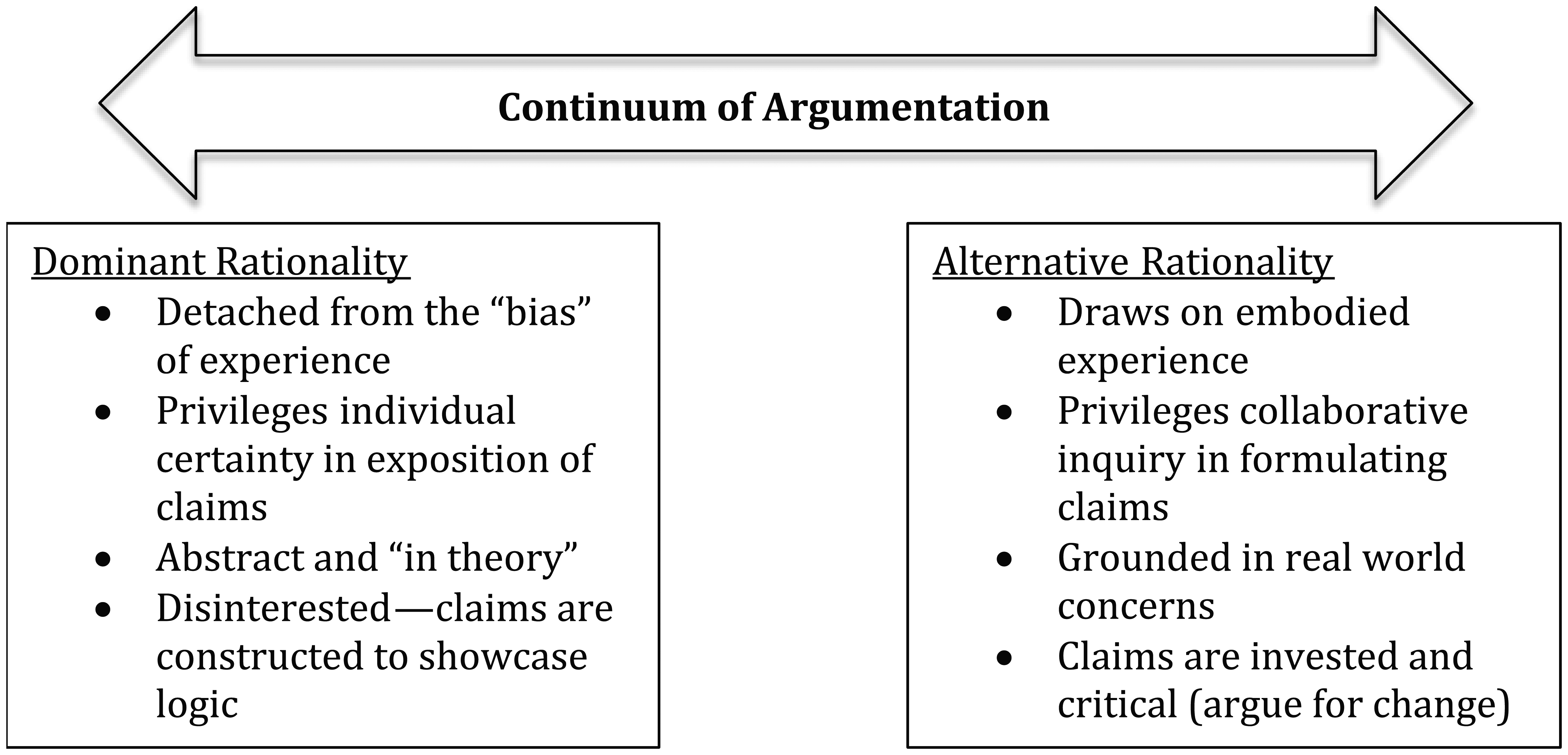
Continuum of argumentation.
An example drawn from a curricular guide for CCSS-aligned literacy instruction used in many schools (ReadyGEN) helps illustrate aspects of a dominant rationality on one end of the continuum. In it, students are asked to “develop claims about topics and texts . . . us[ing] sound reasoning and relevant evidence to support their claims” (Pearson Inc., 2014, p. 1). The instruction is predicated on “teaching students the value of strong content, organization, and style” (Pearson Inc., 2013, p. 2), a pedagogical goal accomplished through reading aloud and analyzing model texts, and then writing prompts whereby students draw on evidence presented by the author to make claims in response (e.g., “write an opinion telling whether [you] think the author gives enough evidence to support the idea that Johnny Appleseed was an important figure”; Pearson Inc., 2013, p. 2). This type of instruction centers close readings of a text and writing as response, and underscores that “writing from sources requires precision, accuracy, clarity, use of evidence, and the ability to make a convincing claim” (Pearson Inc., 2013, p. 1).
A dominant notion of rationality would consider it necessary to set aside personal experience to make more detached and “objective” claims. In the above curricular example, qualifiers such as “sound” reasoning and “relevant” claims point to the existence of reasoning that may be considered less valid, and mark claims as stronger when they tie back to the authority of a seemingly neutral text. An alternative rationality, by contrast, would view social location and identity as epistemic resources in constructing claims that are just as valid. A dominant rationality would more likely characterize a successful argument through its certainty (delineated through words such as “precision, accuracy, clarity”; Pearson Inc., 2013, p. 1). At least in an educational context, the stance on topics is more likely to be abstract and disinterested, such as presenting an issue on which students have to take a position (e.g., the author’s take on Johnny Appleseed). In this case, an exemplar piece would likely be tied to features of arguments such as organization, grounding a thesis on supporting details, considering and refuting counterclaims, and certainty with regard to the expressed position. Argument in such a context typically takes up an issue in the abstract as an intellectual display. The ways that the first graders in this study engaged with the practice of argument presented an alternative rationality characterized by privileging collaborative inquiry and difference of opinion in formulating claims, rather than rushing to certainty, and basing arguments in real-world concerns and in the service of social change. For the children, the practice of argument writing became a form of social justice inquiry grounded in their lived experiences.
This heuristic is not meant to be purely dichotomous, but to represent contrasting ends of a more varied and nuanced spectrum of argumentation. Even if mandated to implement writing instruction that aligns with dominant rationalities, teachers do not instrumentally deploy pedagogical scripts, nor do students simply passively accept them. Rather, the curriculum is negotiated among teachers and students within specific contexts. In the sections that follow, I examine how the first-grade children engaged with the argument unit by mobilizing their lived experiences, grounding their writing in real-world concerns, and connecting argument to social change—all dimensions of an alternative rationality. I then document how the parameters for writing arguments were part of a collaborative inquiry—an interplay between, on one hand, the teacher’s efforts to honor children’s embodied knowledge and build a stance of social critique and, on the other hand, the ways these pedagogical goals were navigated and contested by the children. The featured examples were selected because they illustrate important themes in the unit as well as patterns of collective inquiry. I intentionally begin with the work of the students because much of the teacher’s pedagogy was built from her observations of children’s writing practices.
Building Claims From Experience: “From These Stories You Could Create Some Really Powerful Arguments”
Brianna, a young African American girl, decided to write an argument against graffiti she titled, “Why Do They Have Spray Paint and Other Stuff?” which she worked on over the course of the 6 weeks of the unit (Figure 2).
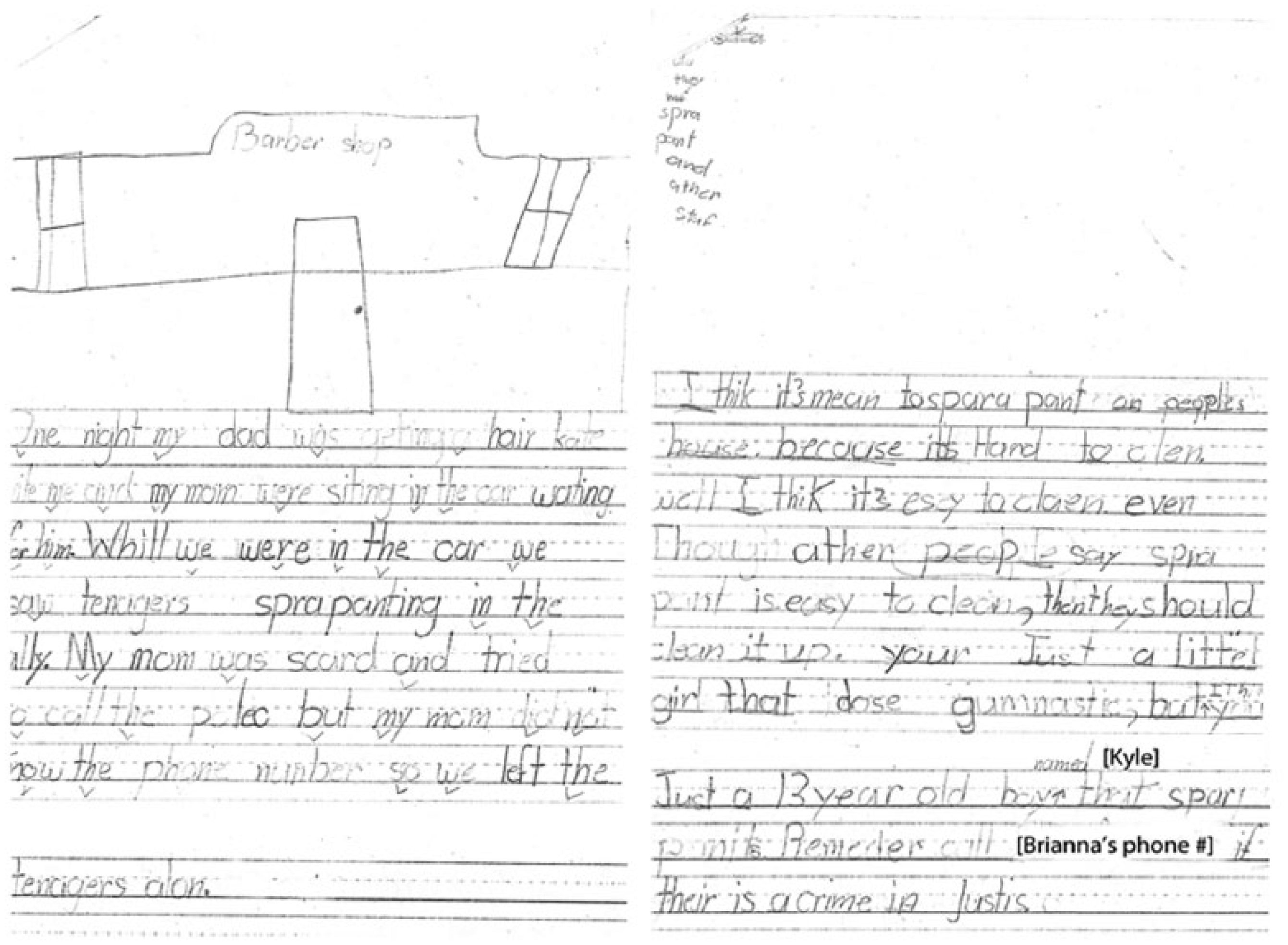
Brianna’s writing about graffiti.
In this piece, Brianna recounts how she witnessed someone spray-painting on walls while out with her family, thus placing her experiences with the selected topic front and center. She states her position in characteristic early childhood terms (“I think it’s mean”) and reasons that the spray paint is difficult to remove. The line that follows, “Well, I think it’s easy to clean” functions as a literal voicing of the opposing opinion, a likely response to the teacher’s lessons focusing on the need to take into account counterarguments when making a case for a position. Brianna then goes on to refute this contrasting perspective by, as her teacher put it, “talking back” (field notes) to people who would think differently.
As the piece goes on, it becomes clear that it is not a “generic” disagreeing person that Brianna is addressing, but a specific older child, Kyle. Brianna includes an exchange between them that suggests her awareness of how her credibility is tied to her social identity. Kyle is depicted as proclaiming, “You’re just a little girl that does gymnastics.” Brianna displays consciousness of the ways she is interpellated as “a little girl” and thus read as less powerful because she inhabits “a certain kind of body” (Butler, 2009, p. 53) constructed along gendered and aged hierarchies. She anticipates the identity prejudice (Fricker, 2007) that would discredit her position as a knower on the visibility of her social location (Alcoff, 2006), and directly challenges her interlocutor. Brianna volleys back the male affront that she is “just” a “little girl” by stating her take that he is also “just” something—“just a 13-year-old boy named Kyle that spray paints.” With her repetition of the term “just” across the two sentences and the reversal of key identity markers (“girl” to “boy,” “little” to “13-year-old”), Brianna emphasizes that these embodied power differentials cannot serve as the rationale for rendering some claims more valid than others. Having begun the piece portraying herself as a passive observer to spray-painting, an act which could not be stopped because the adult at the scene did not have the phone number of the authorities, Brianna bookends her argument by giving readers her personal phone number and positioning herself as the person to adjudicate “crime[s] in justice.”
Brianna took up opportunities for writing argument by drawing on her personal experiences, a move which, far from being viewed as an obstacle to “pure” and “detached” logical reasoning, was valued by the teacher as a resource “relevant to the formulation of various knowledge claims” (Alcoff, 2006, p. 43). The day following a writing conference where Teacher Blanche learned about the eyewitness account of spray-painting, she asked Brianna to share this narrative with her peers, and stressed that “it’s from these stories you could create some really powerful arguments” (transcript excerpt). She then invited others to share the personal accounts that inform their opinions.
Arguments About Gun Violence
Included in the narratives shared were children’s experiences with gun violence in their city (for a more in-depth discussion of children’s responses, see Ghiso, 2011). The site for this research study has consistently been in the top 10 cities in the country with most gun-related homicides, and this everyday reality surfaced in children’s writing and discussions. Seven of the 20 children in the class crafted arguments either exclusively or partially about gun control and gun violence, with six of them choosing to revise these pieces for the culminating writing celebration. Ranging from 30 to 138 words in length, the arguments and supporting points were nuanced, but all shared a critique of the status quo: that no one should own guns, that only police should have guns, that the police or the military could use guns in certain but not all circumstances, that innocent people die in shootings, and that guns scare people.
Seven-year-old Isani drew on a personal experience of witnessing gun violence for an argument titled, “No Shooting Guns.” In her writing, she moves from her individual account—“one time I was in my house and five men were shooting and I was scared”—to a more universal appeal: that “you should not shoot because people could be scared” and “people could get killed.” Isani concludes with a conditional clause: “If you did not have guns, it would change my city” (textual excerpt). Coupled with Isani’s testimonial of the state of affairs on gun violence, her speculative comment serves as an authoritative assertion for her claims. In the face of inequitable social conditions, the imagination can provide the best argument for change.
In his piece on the topic (Figure 3), Khalil argues that “you should not use guns” because “they are not good,” “you can go to jail,” and “people or animals should not be killed.”
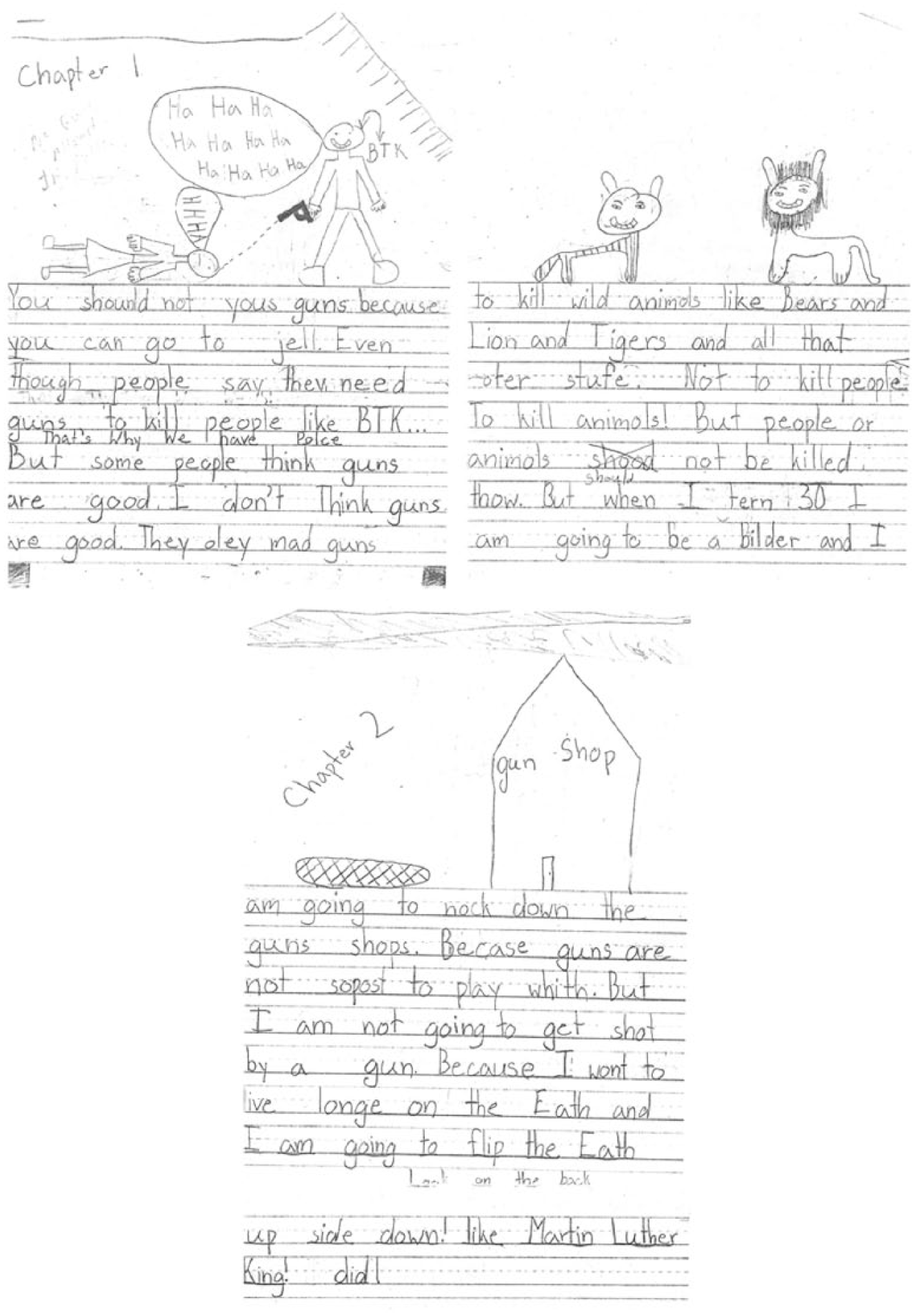
Khalil’s argument “No Guns Allowed”.
Khalil references media reports from the time of the apprehension of Kansas serial killer BTK to understand an opposing perspective. His reasoning anticipates many adult viewpoints that gun violence can be prevented by arming citizens who would be prepared to take action through their own justified use of force. Khalil rebuts this assertion and instead suggests that this should be the role of police. In the second half of his writing, Khalil invokes his future 30-year-old self who influences this reality—With active verbs, he will physically “knock down the gun shops” and “flip the Earth upside down” to challenge the status quo, in the legacy of Dr. King.
The arguments against gun violence authored by Khalil and his peers reflect their participation in communities of meaning (Sánchez-Casal & Macdonald, 2009) that derive knowledge of the world through shared social locations. Many of the children lived in a context where gun violence was not merely an abstract topic of debate, but a reality that was experienced bodily, and which gave rise to immediate and visceral insights into this topic. Gun violence obviously makes children and their families vulnerable to harm. Furthermore, it circumscribes children’s movements, as many parents require that they remain inside while playing, or even move residences to avoid danger. Isani forefronts the fear she experienced, an emotion which “played a central role in students’ agentive and critical engagement with texts and ideas” (Lewis & Tierney, 2013, p. 302). There was also a larger discourse that the families and children participated in regarding concerns about how guns came to Black and Brown neighborhoods and why law enforcement was not more involved in protecting all city residents equally. We can speculate that for children like Isani or Khalil, writing an argument opposing guns also served to oppose a criminalized visible identity that was perpetuated in the media.
Throughout the unit, the first graders were not making a formalist argument about the constitutional right to bear arms, but enacting an alternative rationality by conceptualizing their arguments from their experiences of being vulnerable to gun violence. Teacher Blanche emphasized to the class the importance of stories “about things that you had seen in the world that scared you, that worried you, that made you think something has got to change” (transcript excerpt). Experiences brought in by the children were recognized in the classroom as embodied ways of knowing. A feminist perspective underscores how the social context and one’s emotions were part of—rather than divorced from or a hindrance to—the intellectual work of writing arguments.
Directing Arguments Toward Social Change
The first graders’ embodied experiences drew attention to social inequities and propelled a desire for social change. As Sánchez-Casal and Macdonald (2009) argue, “communities of meaning equip students with potentially subversive epistemic tools” by emphasizing the “collective” and “situated character of knowledge-making” (p. 27). Throughout the unit, the children, supported by their teacher, deliberated on what it might mean to take action on their positions.
“How Would You Help?” Peter’s Trash
One morning, the class discussed concrete ways for bringing about change by weighing in on the problem of littering they had observed while walking through the neighborhood on a class trip. Various solutions were put forth, including installing giant litter boxes and baggies to collect pet waste, designating specific areas for animals to go to the bathroom, putting up signs that say “No Garbage,” or moving to a different location away from trash and undesirable materials. Peter added,
I think no one cares.
So part of the challenge is making people care. I’d buy that. So how are you gonna make people care?
[Other children share ideas]
Or, or maybe people should help out.
How?
Well, even though it’s not their mess they should help people.
I think that’s a lovely idea. It reminds me actually of the rule of [our class], even if you didn’t do it, how’re you gonna fix it?
Peter articulates two ideas: that there is a level of apathy that influences people’s responses to littering and that individuals should help regardless of whether they are personally responsible for the present conditions. These suggestions consider the ethical aspects of the littering problem by identifying an obstacle to change and a potential solution that capitalizes on collective rather than individual accountability.
A bit later in the writing time, Peter and his peers continued to grapple with the notion of what could constitute change:
I could help.
How would you help?
Pick it up.
You could pick up some trash and throw it away, that’s one way you could help.
But there’s a reason why my mom stops me ’cause I can’t pick the trash up.
’cause it’s dirty?
[nods].
It strikes me also that you’re a big brother, and you have little sister who really listens to you. I bet you could help convince your sisters not to throw trash in the ground.
My mom stops that.
And you could set a good example too. What else could you do? What could you do out in the schoolyard?
I could pick up the trash and throw it away.
I bet you could even stop some of that from happening before it even hit the ground.
Yeah! Once it hit the ground just pick it up and throw it in the trash and wash your hands.
Or even before somebody throws it down on the ground.
If you see some maybe flying on the ground you could try to catch it.
Or all you gotta do is somebody try to jam it.
I wonder why there are no trash people or sweeper cars.
Teacher Blanche explicitly engages Peter in considering what change might entail, and in doing so reinforces critical investment as an aspect of how argumentation is conceptualized in the class. Though Peter can think of the obvious solution, this idea poses a challenge because it appears to be at odds with the expressed viewpoint of his mother—an authoritative body who, like the teacher, also has the power to regulate his behavior.
Once this tension is named, Teacher Blanche and Peter attempt to mediate between the available options for change. Blanche suggests that Peter is also an influential figure and can help others, like his younger siblings, to think more carefully before littering, or to see the consequences of their actions. Peter, however, does not consider this option to “count”: It is his mother who tells his siblings what to do or not do, and thus his role as an authority figure that can set a good example seems contrived. Though Blanche continues to forefront the idea that Peter could be a role model against littering, whether at home or in the schoolyard, Peter and his peers, Brianna and Andreas, pursue other possible actions, some with imaginative flights of fancy. Andreas infers that the reason Peter’s mother objects to his picking up trash is a concern about the germs it may carry, and thus suggests that Peter pick up it regardless, but then wash his hands to still follow the spirit—if not the letter—of his mother’s suggestion. Brianna, in response to her teacher’s suggestion that littering can be stopped before the act takes place, rather than fixed after the fact, proposes a game of catch on the lookout for flying trash. The children’s concerns regarding the dangers picking up trash may pose, including spreading germs or disease or handling unidentified and potentially harmful objects, reference the vulnerability of children’s bodies and the role of protectors who have authority to control how children use their bodies in particular contexts. Taking action aligned with one’s argument entailed contending with such positionings. In both Andreas’ and Brianna’s propositions, advocating for change is envisioned as a physical transgression, risking their bodies for the social change they seek.
Amid these various possibilities, Peter mulls over an observation that connects the problem of littering to systemic inequities. By noting, “I wonder why there’s no trash people or sweeper cars,” Peter speculates about a possible link between trash on the streets and the operation of systems designed to address that problem. His lines of reasoning probe at different layers of the issue: why people seem not to care, what role the trash collection system plays, and how people like him and his friends might pitch in to help address the situation. Peter’s observations provide points of entry into explorations of these facets of littering; for instance, they could lead to a classroom inquiry into how structural disparities such as inadequate sanitation programs can rationally result in an apathetic stance.
After the conversation, Peter wrote with conviction about his desire for social change, adding to his writing the lines, “I need to change this soon. If I don’t change this then the world won’t be a better place to live. I will change it.” Peter’s illustration of his final piece suggests how he imagined his personal involvement (Figure 4). In the image, Peter urges “everybody” to dispose of trash responsibly, shifting the teachers’ emphasis on influencing his immediate family to addressing a broader audience and with it his initial concern of public indifference.
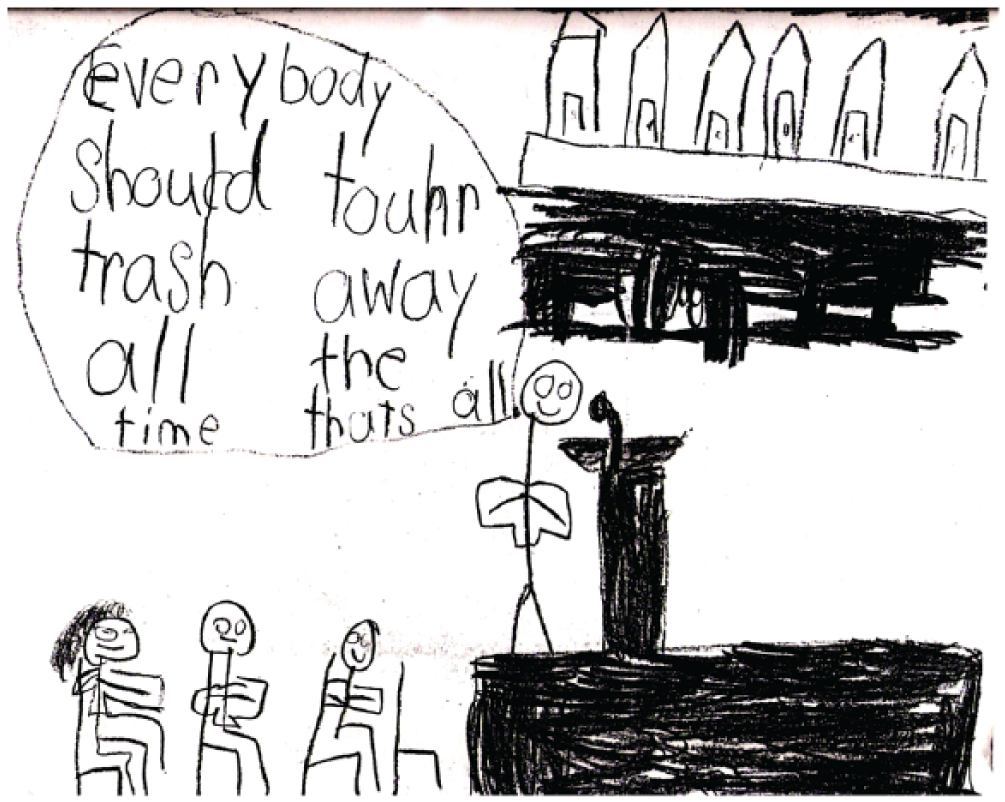
Peter’s trash illustration.
On one level, if the goal for change is to get rid of trash, the decision not to pick it up may appear irrational. From an alternative rationality informed by feminist theory, however, one’s actions cannot be divorced from the social conditions and contexts within which the choice occurs. Neither collecting the trash oneself nor instructing a family member on the issue are appropriate solutions without taking into account the problem’s systemic roots. More than Peter’s own sister, who likely knows not to throw trash on the ground, it is “everybody,” including public officials responsible for coordinating equitable distribution of sanitation services, who must be involved in bringing about change. Throughout their writing and discussions, the children grounded their knowledge construction in problem-posing (Freire, 1970/2007)—not as abstract intellectual exercises but formulated from the realities of their lives—and entertained wonderings without clear-cut resolutions. As such, the children’s literacy practices in the genre embraced inquiry and exploration over the certainty that characterizes dominant models of argumentation.
Learning, Navigating, and Contesting the Parameters of Argument
Given Nystrand and Graff’s (2001) assertions that teachers convey important messages about expectations for argument writing through their actions, I now turn my attention from the children’s works to the ways these pieces were constructed within Blanche’s pedagogical invitations. I focus first on an excerpt from a whole-group writing conversation because it was often during this time that Blanche explicitly framed instruction around content, intention, audience, and structure—aspects of argument writing that are most often treated as autonomous (Street, 1984). I then spotlight an example of a teacher–student exchange to draw attention to how Blanche’s conceptions of argument writing were negotiated with and contested by students.
The “Even Though-Comma-Talk Back” Pattern
During a whole-class writing conversation, Teacher Blanche shared one possible pattern for structuring an argument, choosing to focus on a strategy she had noticed one of the children, Kayla, using the previous day. By directing the class’ attention to Kayla’s method of organizing contrasting viewpoints and details, Blanche addressed genre demands in a way that located expertise about writing with the students rather than solely with a teacher or text.
Kayla really challenged herself to think about how somebody might be able to argue the opposite opinion. The opposite opinion being that people need to have guns. And Kayla came up with this very interesting idea. I think I remember it, you correct me if I’m wrong. This really stuck with me because I think that you wrote about this in such an elegant way. So Kayla came up with the idea that some people would say we need to have guns because there are bad guys and if there are bad guys we need to have guns to make sure they don’t do bad things to us . . . The way Kayla sets this idea up in one sentence was so smart. She wants to talk back to the people who say people have to have guns. There are bad guys and we need to be able to take care of the bad guys with guns. Kayla answered that. She said, “No, I still disagree. We can put bad guys in jail.”
For a little bit.
For a little bit. Right. So look at how Kayla set up the sentence. One sentence. Watch.
Blanche proceeded to write Kayla’s sentence on chart paper, and to draw students’ attention to the way her statement was structured:
This is Kayla’s opinion. Look at how this is set up: “Even though people say they need guns to kill crooks,” that’s the opposite opinion, comma, here’s Kayla’s answer, “They can put them in jail for a little bit.” She sets up the opposite opinion, then she talks back to it. I wonder if you could find a way to use this pattern, the “even though-comma-talk back” pattern, to talk back to someone who has an opposite opinion than yours.
This interaction illustrates several important features of Blanche’s instruction. First, by drawing attention to the work of one of the children in the class, Blanche disrupts notions of teaching as the top-down transmission of knowledge from teacher to student—a hierarchy that is tied to conceptions of young children as particular bodies whose intellectual growth is predicated on taking in information from a more experienced adult. When Blanche recounts Kayla’s “talking back” to a contrasting opinion, she is careful to note, “I think I remember it, you correct me if I’m wrong.” This statement establishes the intellectual work as Kayla’s and gives the student an opening to correct the teacher’s representation of her writing. Kayla does just that, contextualizing her opinion in favor of incarcerating criminals “for a little bit.”
The interaction also emphasizes the inextricable relationship between exploration of content and attention to the conventions of writing such as organization, punctuation, and grammar. Blanche explicates the structure of Kayla’s argument, naming the different clauses and its connecting punctuation, and offers it up as one possible organization for the class to try out. In the days that followed, she would do the same with another student’s writing, offering the pattern, “They say, but I say” as one that children could try out, and also sharing a teacher-derived strategy of organizing the writing into “part 1, part 2, and part 3” that would include a thesis statement, reasons for such claims, and a conclusion. Such deliberate attention to academic conventions was framed within students’ own writing and the issues they were exploring, rather than taught as a template prior to writing.
Half of the class followed Kayla’s lead and used the “even though-comma-talk back pattern” to consider dissenting perspectives in topics as far reaching as year-round schooling, chores, sleeping late, graffiti, smoking, and gun violence. They argued, for instance, that “Even though my sister is bigger than me, she could use a little help from me [with chores]”; that “Even though people say we need guns to kill people like BTK, that’s why we have police”; or that, with regard to having school in the summer, “Even though people can’t have a break off, you can have two weeks off.” This “even though-comma-talk back pattern” provided an organizing focus that arose from the knowledge of students in the class, offering opportunities for discussion of structural features while highlighting children as writing experts who learn from each other.
Contesting Views on “Difference of Opinion”
Blanche emphasized to the class that arguments typically entail a difference of opinion; as such, topics likely to be viewed from multiple perspectives would be particularly fruitful choices for writing. Teacher–student exchanges involved negotiating among these official classroom discourses (Dyson, 2003) and children’s own understandings and purposes. Interactions such as the one I present below expose how children navigated and contested the teacher’s conception of argument.
The following conversation unfolded as Blanche discussed with Peter an anti-smoking piece he was writing:
So, Peter, you’re making a smoking argument. This is an interesting time in our city to be making this argument.
[reading aloud] “Some people say smoking is OK, but I think you could die.”
So think about what part of smoking people disagree with. I think at this point that everybody agrees that smoking is bad for you. The problem is that people—
—My mom smokes.
They know it’s bad for them, but they can’t stop.
They can’t stop.
It is a habit that is hard to break. So I don’t know that there is anybody that would argue that smoking is good for you. But there are certainly—
—Lots of people smoke. I think people that don’t know.
You know Peter, I contend they know it’s bad for you, they just can’t stop. So you could make an argument that everybody should have to stop smoking.
But my uncle, my dad’s cousin, he smokes. I keep telling him, stop smoking, it’s bad for you, but he won’t stop, he’s addicted.
Right, right. So what do we do about that? One of the things we’re arguing about right now, here in [city], is whether people should be allowed to smoke in restaurants.
NOOO!
There are people who say they should be allowed to smoke in restaurants because they paid the money to go.
Only in the smoking part.
There are people who say Brianna that you shouldn’t be able to smoke in any part of a restaurant, that you should have to go outside if you need to light a cigarette. So that may be a piece of this argument that you wanna pick up on.
I wanna make it [the argument] strong.
Do make it strong, but make sure that you are making an argument that is really something that there would be a difference of opinion around. Nobody would argue that smoking is good for you.
Nobody.
We know that.
Nobody!
The problem is some people can’t stop. So think about what you would say about that.
You need to give them medicine.
[rereads his sentence] “Some people say smoking is OK, but I think you could die.”
Peter states his claim that even though “some people say smoking is ok,” this practice is dangerous and deadly. Blanche then contextualizes Peter’s topic within local city politics, specifically an initiative new at the time to ban smoking in restaurants, thus validating the subject as a matter of public conversation and opening the forum of popular debate to Peter and his first-grade peers. The children only briefly take up the scenario presented by Blanche and directly counter her assertions that no one would argue that smoking is good for you. In the fourth and eighth conversational turns, Peter interrupts Blanche’s characterization of smoking’s harmfulness as an agreed-upon perspective, instead offering rebuttals through examples of people who smoke. The children’s exchanges highlight the contrast between the practice of smoking, which constitutes implicit support of it, and understandings of the danger of such habits.
Blanche’s efforts to locate the conversation in civic and ethical debates seem to be steering children toward an abstract argument regarding the relationship between freedom of choice over one’s actions and public health. The children, however, are more concerned with feminist notions of care (Collins, 2000; Tong, 2013; Tronto, 2005). They grapple with the reality that some of their family members smoke despite health warnings, and discuss the addictive qualities of tobacco that make it difficult to quit smoking despite knowing the risks it poses. They mark the physical impacts of smoking—debilitation, addiction, death—that affect the particular bodies of family members rather than “people” in the abstract. The argument against smoking is informed by the emotions this health hazard brings up, such as the fear of what may happen to Peter’s mom or Kayla’s uncle, a concern that may prompt Peter’s goal to “make it [the argument] strong.” Peter and his friends discuss smoking not as a rhetorical abstraction or an exercise in formal logic, but as a topic inseparable from the well-being of their families. They base their arguments in personal experiences that inform their perspectives, which may in part contribute to their sense of commitment and urgency in addressing social issues.
A salient feature of Blanche’s exchanges with the students is her efforts to underscore difference of opinion and link to public debates on social issues. The notion that a topic is not disputed enough and that children should strive to engage in contestation rather than resolution is a departure from much curriculum and assessment for young children, which often aligns with dominant rationalities that privilege certainty in the exposition of claims. Her attempt to introduce facets of the issue she considers disputed is not taken up by students, and this move is also very telling. The children enact agency in contesting the teacher’s vision for their writing pieces. This pushback would likely not occur with such vigor within a classroom structured along the top-down instruction of argument features.
Discussion
Examining first graders’ writing of arguments as a “case” provides an opportunity to understand structural features of a specific genre, often the most salient aspect of writing instruction, within students’ knowledge as derived from their lived experiences, childhood cultures, and the social negotiation of meaning within which classroom writing occurs. Figure 5 depicts the interrelationship of genre features, the premises of the genre within the classroom inquiry, and the lifeworlds of the first graders.
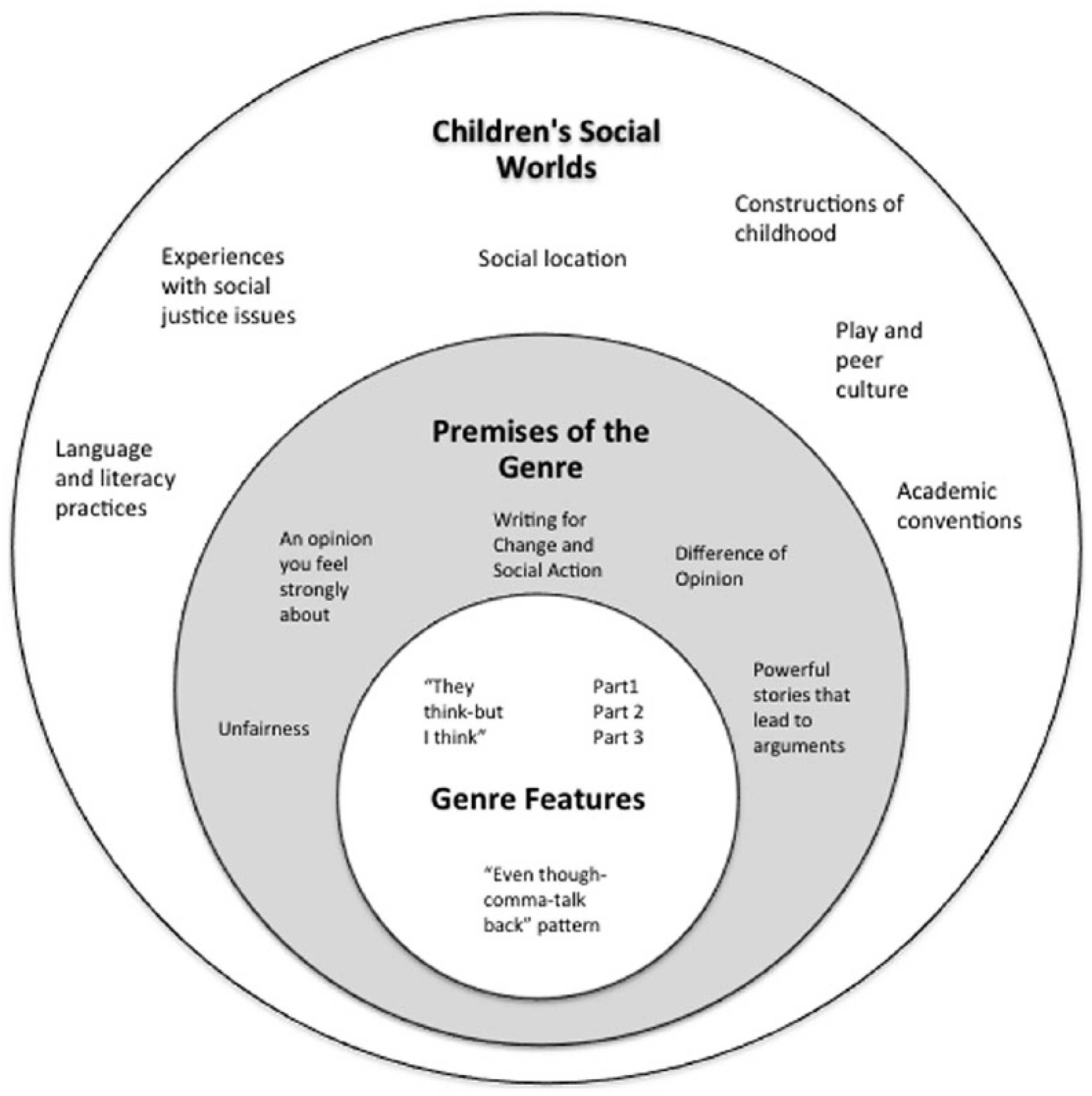
Practices of argument writing in first grade.
As the examples featured in this article illustrate, the children and the teacher engaged in explicit discussions about features of arguments such as claims, counterclaims, organizational structure, and editing conventions. These teaching points were developed in the specific context of the writing community, and thus combined language and insights from the children’s own writing. The choice of the terminology “pattern” in naming conventions like the “even though-comma-talk back pattern” made the concept accessible and linked writing to other interdisciplinary inquiries. The writing patterns showcased drew heavily, though not exclusively, from the actual work of the children. The teacher also spotlighted an example from her writing that involved three parts of an argument, thus balancing the children’s models with her own.
The specific features were deployed to fulfill broader premises of the genre as enacted within the class, which forwarded alternative rationalities of argumentation. Teacher Blanche framed writing of arguments as communicating an opinion you feel strongly about, connected to unfairness in the world or in your life, informed by personal experiences, involving a difference of opinion, and bringing about change. The writings and conversations of Brianna, Khalil, Isani, Peter, and others point to the ways children interacted with these principles, and the uneasy relationship between a teachers’ goals, as informed by policies and mandates but also her own pedagogical and epistemological commitments, and the ways children took up, navigated, or at times resisted such premises for writing. Teacher Blanche strived to convey in her practice a vision of the genre that put specific features toward aims in which the children were invested. In many curricular guides and assessments, the topic of focus generally takes a backseat to how an author is laying out the evidence to support a particular perspective. The content of the piece thus becomes a vehicle through which to demonstrate logical reasoning and argumentation, rather than an end in itself, often to display such skills for the teacher. In this first-grade writing community, however, techniques of argumentation were embedded within students’ own inquiries: The teacher asked that students take up issues they cared deeply about and that addressed equity in their lives and in the world, and to think specifically about the personal experiences that informed their arguments.
This is not to obscure tensions among the purposes for writing arguments, what types of arguments “count,” and how children interpret, resist, and/or transform a teacher’s pedagogical invitations. Such contested terrains become visible when examining how both the features and premises of a genre are negotiated within children’s lived experiences and social worlds. This framing includes children’s identities and experiences, such as intersecting gendered, aged, raced, and classed group affiliations, which inform their hermeneutic horizons, their familiarity with particular social justice issues, their varied language and literacy practices, including their play, the interactions of these practices with academic literacies, and the impact of broader discourses such as educational policies, curricular mandates, and constructions of childhood. The ways children interacted with classroom opportunities for writing, and the teacher’s sponsorship of such spaces (Ghiso, 2010), informed and were informed by the nested elements of the genre.
Conclusion
The work of the first graders presents important considerations for early childhood literacy research and practice. The new emphasis on argumentation in the CCSS traces down literacy skills deemed necessary in higher education to the earliest grades, backward mapping the PreK-12 curriculum based on a particular vision of what it means to engage in literacy. This model raises questions regarding what aspects of argument writing are being traced down to early childhood contexts, and how these are enacted within classrooms. The instructional overreliance on specific features of argument (Newell et al., 2011), coupled with the fact that this genre can seem like a new addition to the early childhood curriculum, may lead to a sidelining of the broader premises and contexts of argumentation. As the first graders’ authoring practices featured in this article attest, young children’s engagement with taking a position, providing evidence, and considering opposing perspectives needs to be located within issues they are invested in exploring, or the genre may risk becoming a rote exercise imposed on students rather than an opportunity for children to deepen, refine, or alter their perspectives.
It is also important to consider how incorporating skills from secondary and higher education in early childhood settings may impose an adult conceptualization of argument writing rather than considering the ways in which young children engage in forming and backing up opinions within their own childhood cultures. Examining children’s notions and practices of argument writing can reveal different starting points based in young children’s concerns. This study suggests that children are very much able to decenter themselves and take up critical issues, but did so in ways that were grounded in knowledge derived from their own social locations. The current policy and curricular focus on providing evidence from the authority of a text rather than from what readers and writers bring to their interactions with texts have the potential to stymie generative lines of inquiry for young children, and to reify a dominant model of rationality that sets up a binary between experience and objective reasoning. This classroom learning community, by contrast, derived argumentation and critical thought from the embodied experiences of children themselves. Thus, in seeking to understand argument writing with young children, it would be important to investigate how these literacies are negotiated within the specificity of classroom communities and informed by alternative rationalities that mobilize experience to make claims about the world and how it may be transformed for the better.
Footnotes
Declaration of Conflicting Interests
The author(s) declared no potential conflicts of interest with respect to the research, authorship, and/or publication of this article.
Funding
The author(s) received no financial support for the research, authorship, and/or publication of this article.