




Abstract
This research investigates how three female Nigerian high school students were taught to deploy critical multimodal literacy to interrogate texts and reconstruct unequal social structures. A class of ninth-grade students in an all-women school was given instruction through the analysis of how multiple modes were used to represent meanings in textbooks. Data were collected from multiple sources, including students’ interviews, observations, classroom videos, social media posts, and artifacts of students’ literacies to analyze how they reflect on and critique their personal experiences in Nigeria within and through the English curriculum. The findings suggest that the teacher and students co-constructed possibilities for the learners to critique the social production of gender and resist structural practices that diminish their voices and their literacy learning. The findings indicate a need for English teachers in Nigeria to enact critical multimodal literacy pedagogy which relates instruction to female students’ interests to promote agency and change.
There is an urgent need for English curriculum in Nigeria to change its reading instruction emphasis from grammatical rules to integrating multimodal literacy practices into instruction, so that teachers can prepare students to read and create multimodal texts. The high school curriculum focuses exclusively on language-based topics such as adjectives, tenses, and verbs without paying attention to students’ home literacies 1 such as surfing the web, emailing, texting, blogging, chatting, posting messages and images on social network sites, and reading and writing multimodal texts. To compound the situation, the curriculum appears to treat literacy as neutral and value-free, without much consideration to how biases against female students are reproduced or how the students draw on their own knowledge and identities as resources to shape literacy learning (Kendrick & Jones, 2008; Kendrick, Jones, Mutonyi, & Norton, 2006).
It is not surprising that more than 50% of female students in Nigeria drop out of school before reaching the 12th grade. Educational statistics between 2004 and 2008 from Nigerian Universal Basic Education Commission showed that “the gross enrollment ratio of girls is significantly lower than that of boys” (British Council Nigeria, 2012, p. 29). The United Nations Educational, Scientific and Cultural Organization (UNESCO; 2008) reported that girls’ completion rates of school in Nigeria are lower than boys, particularly in the northern states, where girls’ completion rates were as low as 7.8%. Many factors influence the education of female students. Some parents prefer sending their boys to school “because only sons inherit and carry on the family name” (Mahdi, 2011, p. 11). Other factors include early marriage, pregnancy, and poor quality teaching. Also, in many communities women are regarded as subordinate to men (Badawi, 2007). The effect of these gender biases is that women are more likely to abandon educational aspirations (Obanya, 2010).
In Nigeria, where English serves as a third or fourth language for many people because of historical reasons such as colonialism, postcolonialism, and globalization, literacy instruction needs to include a focus on multimodal literacies (Hoffman, Rogers, Sailors, & Tierney, 2011). Indeed, to prepare female students to fully participate in today’s socially and linguistically diverse and technologically developing Nigerian society, literacy teachers have to teach them to read diverse materials, including multimodal, interactive, nonlinear and linear texts, texts in multiple languages, print-based texts, and texts being delivered on screen or live (Anstey & Bull, 2006). More importantly, because of gender inequality, literacy instruction must address important issues of how gender dynamics and other social structures play crucial roles in female education in Nigeria. The research suggests that literacy teachers in Nigeria need to pay close attention to how critical literacy informs teaching regarding “how power relations are subverted or questioned, how males and females are represented as gendered subjects, how they are empowered, how relations are revisioned, and how feminist ideology is embedded in the text” (Parsons, 2004, p. 140). Critical literacy opens up possibilities for female students to integrate their self-identities in creating texts that are socially and culturally relevant to their lives (Ajayi, 2015, 2012; Rogers, Mosley & Kramer, 2009).
The research objective of this study is to show how the participants and I (the teacher/researcher) co-construct the possibility of using critical multimodal literacy to critique texts and reconstruct unequal social structures. One research question guided the study: How do the students in the case studies employ critical multimodal literacy to contest the messages of the textbook they read after they are taught to critically read their world by questioning social inequality?
This study is important as theories of literacy developed and investigated in the United States and other majority White, European, Western-based contexts need to be tested, refined, and challenged by studies of literacy practices in other parts of the world (Hoffman et al., 2011). The contexts of Nigerian female high school students and their multimodal literacies are an important component of this enhanced discussion of multiliteracies. This research examines the issues of literacy, critical literacy, and multimodal literacies in Nigeria where English language and literacy instruction is assumed to be neutral, and consequently students are not taught to investigate the politics of representation in textbooks. In addition, this study has applications around the world as in various societies, literacy, class, and gender are continual areas of contention and competing political ideologies. This research addresses the challenges facing teachers through critical examinations of forces that produce societal inequities. Hence, this study contributes to issues of global significance.
My interest in the present study is to make visible what is possible if the teacher provides female Nigerian students critical opportunities to use multimodal resources to critically frame the interpretations of texts. I identify myself, among other positionings, as Yoruba (from the Western part of Nigeria), naturalized American male and a literacy teacher educator. I was educated in Nigeria, where I learned English through memorizing grammar rules as a result of curricula that emphasized learning discrete, rule-governed English. This experience accounts for why I return to Nigeria every summer to teach English.
This research is influenced by poststructuralist and feminist critical theorists, including Lather (1991) and Weedon (2000). Feminist critical theory is concerned with placing women’s lives and perspectives at the center of analysis. I believe that men can take antipatriarchal standpoints. Indeed, in the last several decades, women and men have addressed themselves to issues that are integrally related to practical politics: class, female sexual/gender identity politics, and education (Weedon, 2000). Throughout the research process, I see myself as an advocate of gender equality. I use critical questions to problematize the reproduction of social inequality in the students’ literacy instruction and offer the potential for transformative learning.
Literacy Practices and Critical Multimodal Literacy
The field of literacy has been theorized as multiple, social, and contextual. Three related and complementary fields have recently emerged: new literacy studies (NLS), multiliteracies, and multimodal literacies. The advocates of NLS theorize literacy as everyday social practices that vary across cultures and contexts (Barton & Hamilton, 1998; Street, 2003). The New London Group (1996) used multiliteracies to refer to literacy curricula and pedagogy that respond to increasingly diverse and global societies and the burgeoning textual forms afforded by multimodal resources. The term multimodality is used in this study to describe the interconnections and interrelations among differing modes of representation that coexist in a multimodal text and how the different modes provide differing affordances for interpreting texts (Kress et al., 2005).
Building from Bezemer and Kress (2008), Janks (2010) and Ajayi (2009, 2015) I use the term critical multimodal literacy to suggest how the teacher and students in this study combine language, drawings, spatiality, and Facebook as tools of choice to interrogate the inequitable, cultural positioning of women in textbooks. While traditional critical literacy also requires readers to critically examine an author’s message and assumption, its practice and theory tend to rely on language. However, critical multimodal literacy emphasizes integration of multiple modes and media for meaning making and offers the possibility of increased agency for female students to bring their personal and community-based resources—their everyday literacies and self-identities—into classrooms in ways that are significant for learning (Ajayi, 2015; Kress et al., 2005). Using the affordances of critical multimodal literacy, Nigerian students have the opportunity to overcome the constraints of cultural biases and develop “agentive selves, using the [available] repertoire of tools, resources, relationships, and cultural artifacts” (Hull & Katz, 2006, p. 47). Critical multimodal literacy is especially promising for Nigerian female students because it allows them to use multimodal and media resources to critically reflect on the relationship between texts and their lives. For literacy pedagogy to be relevant, it must prepare students to be critical, to know the text and context, and connect texts to their lives (Freire, 1970).
Situating Multimodal Literacy Practices in the Nigerian Context
The conceptualizations of multimodality in developed nations, including the United States, do not straightforwardly apply in developing African nations as huge inequalities exist in the access, use, and outcomes of new technologies between rich and poor nations (Warschauer & Matuchniak, 2010). Most students in Nigeria use inexpensive cell phones to connect to the Internet as they do not have access to computers at home and school. Students also use cyber cafés and business centers to access the Internet. With the challenges of connectivity, Nigerians commonly use wireless connections, mobile devices, and GSM (Global Satellite Mobile) modems as modes for access through GSM service providers such as Mobile Telephone Network (MTN) and GlobalCom. More than 48 million Nigerians are estimated to surf the Web regularly (Internet World Stats, 2012).
Even with the gap between Nigerian female students’ home literacies and in-school literacy instruction, limited studies have examined how literacy teachers use critical multimodal literacy to create opportunities for female students to critique textbooks as sites of power imbalances. Kendrick and Jones (2008) suggested that female students use drawing and photography to highlight the relationship between life opportunities and literacy in Uganda. In an investigation of how the school curricula can best support English learning for Ugandan female students, Kendrick et al. (2006) concluded that integration of the students’ visual media offered “innovative possibilities for how teachers might validate students’ literacies, experiences and culture” (p. 111).
Stein (2004) examined how pupils use English, histories, and multimodality to construct texts that demonstrate the hybridity of urban life in South Africa and concluded that the students became creative and active transformers of culture and asserted their understanding of the historical-cultural world in which they lived. Janks (2010) explored how poor students in South Africa constructed texts and challenged teachers to use critical literacy approaches that help students to examine their local situations and assist them in acting to make the world a better place. While Janks related critical literacy to issues of power and identity in post-Apartheid South Africa, she did not focus on female issues. In particular, she overlooked the notion of the social production of gender and everyday resistance to gendered social practices.
Stein and Newfield (2004) described how students in Johannesburg deployed semiotics to construct images of themselves and concluded that the pupils produced multimodal texts that expressed different relations and indicated the representational resources available to them. Prinsloo and Walton (2008) examined how South African students use the multimodal resources of the computer to learn; they concluded that the pupils’ literacies mirrored the marginalized status of their community. However, neither study showed how the students used critical multimodal literacy to interrogate the inequalities of power embedded in textbooks nor how they resisted cultural practices that excluded their voices.
The present study builds on the existing literature by linking the students’ home literacies to in-school literacy to show how they interrogate inequalities of power. The study also pays attention to how students engage in critical multimodal readings of their worlds and reject the social structures that have historically marginalized them from full participation in society. The research further extends the available studies by focusing on how the teacher and students in Nigeria can co-construct the possibility of using critical multimodal literacy to interrogate textbooks as sites of power imbalances in classrooms. Finally, this study highlights what is possible: Critical multimodal literacy with a multimodal focus can offer female students a possibility of increased agency.
Multimodal Literacy: A Theoretical Framing
Perspectives from NLS emphasize literacy as a set of social practices in specific cultural environments. However, the recent revolution in communication technologies has brought about shifts in logo-centric definitions of literacy and literacy practices. New technologies have resulted in new media and integration of multimodal resources for literacy practices. Essentially, multimodal elements of texts are becoming more complex, more dynamic, and more salient while linguistic elements are becoming less so; hence, there has been a shift in focus from linguistic features to elements of design (Kress & van Leeuwen, 2006).
The implication of NLS’s perspectives is that multimodal practices are central to teaching textual dispositions that build the literate habitus of embodied knowledge and repertoires of practice and generate student positions, dispositions, and position-taking. Students’ cultural capital (e.g., habitus of embodied knowledge and skills) serves as a shaping tool as they traverse across different social fields of learning and cultural identity (Bourdieu, 1999). In particular, knowledge construction in multimodal texts has the potential to prepare students to bring their cultural capital into interpretations of texts and expand possibilities of subverting social values. Social semiotic theorists argue that critical literacy and multimodal literacy offer students the possibility of (a) using personal experiences to critique unequal social relations; (b) relating texts to their lives to produce alternative interpretations; (c) using their repertoires of resources, tools, relationships, technologies, and cultural artifacts to develop an agentive self; and (d) developing a critical consciousness and transforming the world (Freire, 1970).
In summary, critical multimodal literacy has the potential to prepare Nigerian female students to question inequalities of power as they relate to textual practices. The process of creating and analyzing multimodal texts provides a more promising conceptual framework for Nigerian female students to resist cultural practices that marginalize their rights and their voices.
Method
Data for this study were collected from multiple case studies that included three students, each serving as a “telling case” (Mitchell, 1984, p. 239) of how Nigerian female students from a ninth-grade reading class critique textbooks. Case studies are empirical research designed to collect and analyze data from several real-life cases and provide an in-depth understanding of specific issues (Creswell, 2013). Case studies enable the analyst “to establish theoretically valid connections between events and phenomena which previously were ineluctable” (Mitchell, 1984, p. 239). The approach helped to highlight my effort as a teacher-researcher in a grammar-dominated curriculum in which I attempted to incorporate students’ home literacies. The approach also helped me to recognize the limits of teachers, including the requirement to teach in-school literacy that may not draw on students’ home literacies.
All 38 students in the class chosen for this research agreed to participate. I screened them further, and the final three students were selected because they (a) were interested in a study of women’s issues, (b) were struggling in school literacy, and (c) had social media accounts. This was a theoretical sampling (Creswell, 2013) as the selection of the three case studies was deliberately motivated to show the students’ different perspectives on how they interrogated structural practices that placed limitations on their literacy learning.
Prior to contacting St. Theresa (all names in this study were pseudonyms for anonymity/confidentiality), the site of the study, I obtained permission from the State Ministry of Education for the students to participate in the research. In the first week, I explained the study and procedures (e.g., that I would make home visits and learn about the participants’ home literacies) to the students and their parents. The parents signed the consent form, providing permission to the 38 students (including the three students in the case studies) to participate in the research and videotaping sessions. The students were Haminat, Stella, and Bose.
Through self-reflections, I became cognizant of questions about my position and interpretative authority as the instructor and researcher. As a male in my 50s, I considered myself an outsider to some aspects of the students’ literacies. However, I worked to build trusting and caring relations with the students by carefully listening to them and sharing my interpretations with them. I promised them to not discuss the conversations and interviews they had with me with their parents.
The Context of the Study
St. Theresa is a public school for ninth- to 12th-grade students in Ibadan. Public schools in Nigeria offer free education for all students. The school was chosen for the research because it was an all-female school, and some English teachers who were contacted through letters indicated their interest in the study and its focus on literacy and women’s rights. The school had 487 students in 2009/2010 academic year, with 23 teachers (21 women and two men), one female principal. Also, 21 teachers had bachelor’s degrees in education and two were working on their teaching credentials. Eighteen teachers had been teaching in the school for more than 10 years.
The school was founded by Christian missionaries to cater to the education of women in Ibadan. The city is largely dominated by the Yoruba ethnic group, though other groups such as Hausa and Igbo live in large numbers in the city (National Population Commission, 2006). There are multiple religions, including Islam, Christianity, and traditional African religions. Many residents of Ibadan work as civil servants, teachers, doctors, petty traders, 2 farmers, laborers, and so on.
The main industries in Ibadan are a flour milling facility, a cocoa-processing factory, and a Coca-Cola plant. Ibadan is a major trading center for agricultural products such as cotton, fruits, and vegetables. Ibadan has some major educational institutions, including the University of Ibadan. Ibadan also has 988 public elementary and high schools.
Data Collection
I collaborated with the class teacher to design and teach literacy lessons in a ninth-grade class twice per week over 5 months during the regular school year. I worked with the teacher to match the English curriculum and critical multimodal literacy in ways that allowed instruction to address issues related to identity, agency, and power—issues historically resisted in Nigerian classrooms. The teacher taught the students for the remaining 3 days. I visited the class daily in the first 2 weeks to familiarize myself with the students and classroom procedures. Each lesson lasted 90 min. To all the students to grow accustomed to the presence of video equipment, I also set up two video cameras that clearly captured the entire classroom.
I visited the three students at home 1 hr per week between May and August 2011 to observe how literacy practices are embedded in their everyday lives. Prior to the visits, I developed semistructured interview questions to collect data about the students’ literacies: What kind of texts do you read at home? What literacy resources from the family and community do you use? Do you have access to a computer at home? Do you go to cyber cafés? What kind of social media do you use? I designed the interview questions to connect with the overarching research question because when the school literacy curriculum is built on a broad view of literacy as multiple, social, and cultural practices in diverse social institutions, student learning is potentially more intellectually stimulating and motivating (Ajayi, 2015; Cope & Kalantzis, 2009).
The interviews at home were conducted in Yoruba (the students’ home language), so that the students could be more relaxed. However, interviews in the school were in English in accordance with the school’s English-only policy. The interviews were tape-recorded and later transcribed. I kept fieldnotes to document the students’ home literacy resources such as TV, books, and newspapers. At the beginning of the fifth week, the three students wrote a two-page autobiography in which they developed a personal profile and described the meanings that literacies have for them.
Summary of Teaching Procedures
I designed a Four-Stage Participatory Reading Model (FSPRM) for this study. This approach views research as social change and facilitates knowledge production as opposed to knowledge gathering. The method shifts the traditional balance of knowledge from “closed, to open; from individual, to group; from verbal, to visual; from measuring, to comparing” (Chambers, 1997, p. 104). The method allowed me to use critical multimodal literacy practices in the following subheadings to prepare the three students for the “final activities” section that I used for data analysis.
From the 7th week to the 18th week, I taught the class to critically read pictures, titles, and story layouts. The activity was designed to help the students gain the knowledge to use visual literacy for critique of Nigerian society and culture. The class read “A Hollow Chamber” (Tell Communications, 2009, p. 38), a text relating to the celebration of the 10th anniversary of democracy in Nigeria.
Critical Reading
The class was divided into six groups, with the participating students in three of the groups. Each group “read” the pictures of 22 male politicians described in the text as “Principal Officers of the National Assembly.” The groups discussed how visuals, language, and layouts contributed to meaning making in the text. I encouraged the students to query underlying assumptions of the text. I modeled critical reading by using critical questions to frame arguments to prompt critical responses from students: How does the text relate to my life? What view of reality is represented in the text? What biases do I see in the story? All the students posted their work on a Facebook group wall.
Deconstruction
I prepared the students to deconstruct the messages of the text using the dialogical approach (Freire, 1970). I worked with the class to investigate the assumptions underlying what they read and discussed gender bias in texts. I problematized the contradictions underlying the gendered social practices by asking questions that focused the students’ analysis on gender inequality and development of alternative perspectives: What do the pictures tell you about democracy in Nigeria? Are women represented in the text? If yes, how are they represented? If no, why are they not represented? Rewrite the story to show an alternative viewpoint. Throughout this study, the students analyzed multimodal texts for practice, including newspapers.
Reconstruction
The students had opportunities to design a critical response to the texts. Reconstructing texts to reflect women’s struggles, voices, identities, and gender roles was challenging for the students. I demonstrated how texts represent particular points of view and silence others. The students worked in groups to retell the story using multimodal narratives.
Connecting With Social Media
For homework, the class was assigned to read the online biography of Olufunmilayo Ransome Kuti—the first Nigerian woman politician/women’s rights activist. The class reflected on the story and posted comments on its Facebook group wall, an account created for this research. Even though most of the students “friend” and/or follow each other on Facebook prior to this study, I created a Facebook group, made visible to the Facebook community, to allow the class members to chat with each other on a central page. I read the postings of the three cases daily. The activity created a space for the students to bridge the gap between in-school and home literacies as the affordances of new media have transformative potential in the literacy learning of children in African schools (Prinsloo & Walton, 2008).
Final Activities
Weeks 19 and 20 of the study were videotaped for a total of 90 min to collect multimodal data (Norris, 2004). The class read “The Rivers Osun and Oba” from the English textbook. The story depicts Sango as a wealthy and powerful king who has three wives. The wives spend most of their time catering to the king’s needs. Competition about who is the best at preparing Sango’s meals leads to jealousy among the wives. Oba, whose food the king has always complained about, cuts off and cooks her ears to satisfy her husband. When Sango finds out he has eaten human flesh, he tries to kill Oba. Later, the king is remorseful and kills himself. The town blames the women for the tragedy.
The students worked in groups on the following: Draw pictures to show your understanding of the story; who do you blame for the tragedy; how can you rewrite the story to show how you think it should end? The activity was designed to help the students acquire the ability to read texts critically and use multimodal literacies to construct texts of their own.
Next day, the three students participated in a group interview for 30 to 45 min. They responded to open-ended questions: (a) What is the meaning of your drawing? (b) What are your views about the story? (c) In what ways, if any, does Facebook help you to share your ideas in this class? (d) What does the story tell you about gender in Nigeria? (e) What literacy activities do you do on Facebook that you will like to do in your English lessons? (f) In what ways, if any, does the use of drawings help you to convey your understanding of the story?
Data Analysis
I adopted the theoretical framework of New London Group (1996) and Kress (2003) for data analysis. They theorize that NLS should help students (a) draw on multimodal resources to question textual messages and redesign texts to produce alternative meanings and (b) draw upon familiar cultural and epistemological values to interpret the world.
To analyze the data, fieldnotes of my commentaries and observations were typewritten into 58 double-spaced pages. The visual and audio aspects of the video were transcribed using the methodological framework for multimodal interactional analysis, an analytic method concerned with describing what people express and react to in specific interactional situations (Norris, 2004). Selection of specific focal texts was guided by the research question as I focused on where a convention was broken, such as when a student contested or critiqued ideas in the textbook or drew an image that depicted unconventional meanings. I transcribed the spoken utterances of the students to organize the classroom discourse. To capture a specific event, I took a series of screen shots that represented the event in the video and pasted it into a Word document. I then overlaid on the transcript descriptive notes of each event, including what the students said, student/student and student/teacher interactions, and the multimodal resources the students used. I used the same process to retrieve the students’ postings from Facebook.
For analysis of the students’ artifacts (34 pages of Facebook postings, biographies, students’ multimodal drawings), I used a multimodal social semiotic approach, an analytic method that focuses on understanding how individuals use all modes of representation as socially shaped resources for meaning making (Bezemer & Jewitt, 2010). To analyze visual images, I employed Kress and van Leeuwen’s (2006) Grammar of Visual Design which states that in multimodal texts, information is presented in a certain way such as Given–New structure, where information placed on the left is Given (information that is already known to the reader) while the message placed on the right is New (information not known to the reader and deserving special attention). Also, information can be presented in the Real–Ideal structure where the information at the top represents the Ideal (the generalized or idealized essence of the information and the most salient part) while the message at the bottom is the Real (the evidence or the more practical information). The drawings were categorized thematically according to the research question and to generate criteria for data sampling. I focused on critical interpretation of how the students used drawings, still photos, and language to realize, transform, and design the meanings of the texts they read.
For the analysis of the interviews and classroom observations, a qualitative, interpretative research method was used. I adopted microanalytic method—a line-by-line analysis of the qualitative data (Corbin & Strauss, 2008). I carefully identified phrases, sentences, and themes pertinent to the research question and selected ideas for analysis. The data were broken into portions and compared for differences and similarities. Using axial coding, I related concepts to each other to ensure the integrity of the emerging themes across the data (Corbin & Strauss, 2008), thus allowing me to make explicit connections between categories. Concepts such as “I want my drawing to show a man who has one wife” and “My drawing shows that men and women are equal” were grouped under the category of critiquing gender inequality. Using comparative analysis, I compared vignettes for similarities and differences. Ideas found to be conceptually similar were sorted into the same categories and coded. Table 1 exemplifies the coding processes to show how the students’ discourse was initially coded and then selectively coded to determine emerging themes.
A Sample of Coded Categories Across Data.
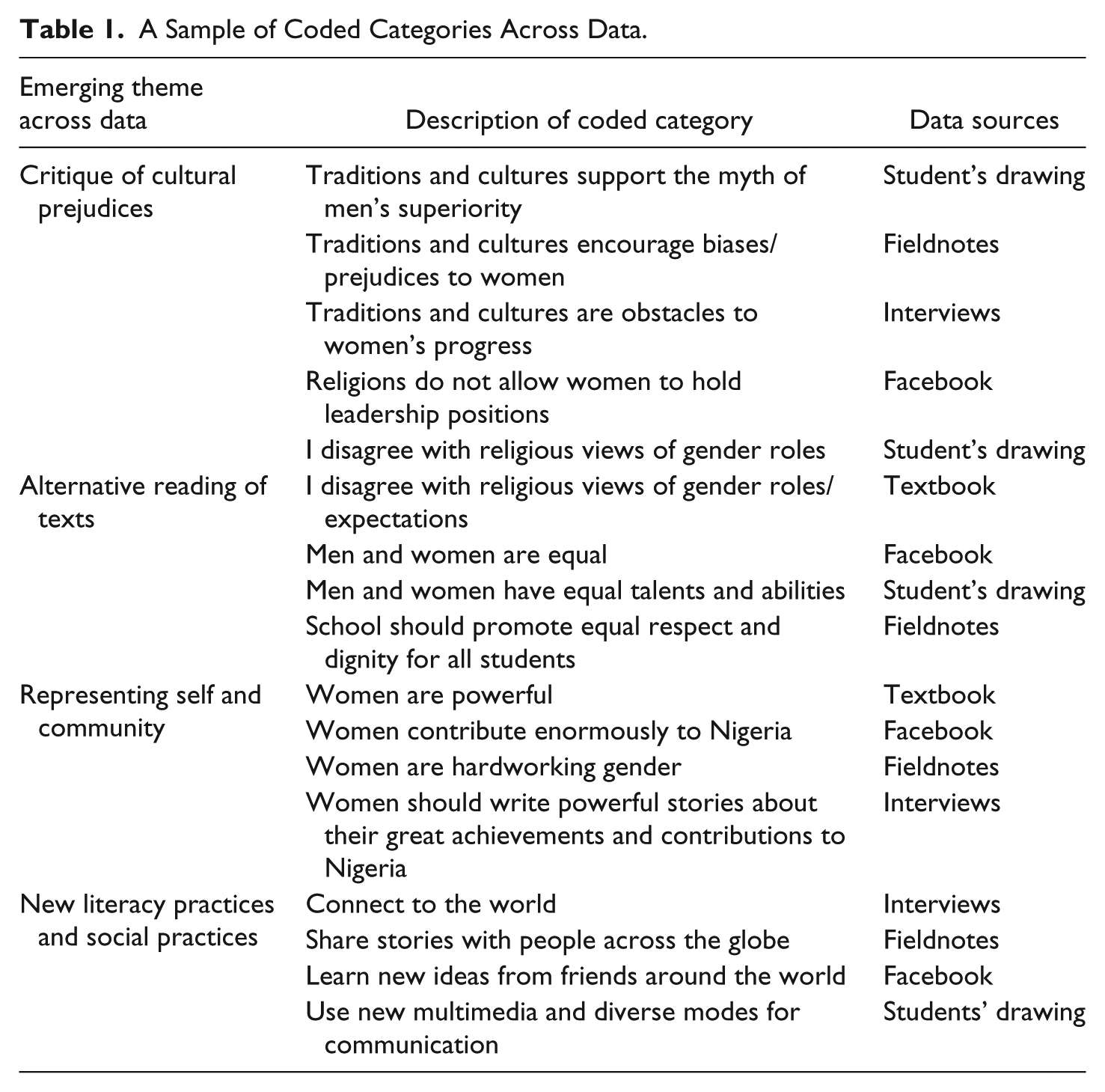
Selective coding (Corbin & Strauss, 2008) was then used to integrate, refine, and capture recurring patterns across the narratives. Four categories emerged; critical multimodal literacies allowed the participants to (a) critique cultural prejudices in texts, (b) provide alternative readings, (c) represent self and community, and (d) engage in new literacy practices. Table 2 shows how I identified specific phrases and sentences that the students used to express emerging literate identity and link what they learned from the social worlds.
Sample of Coding Processes.
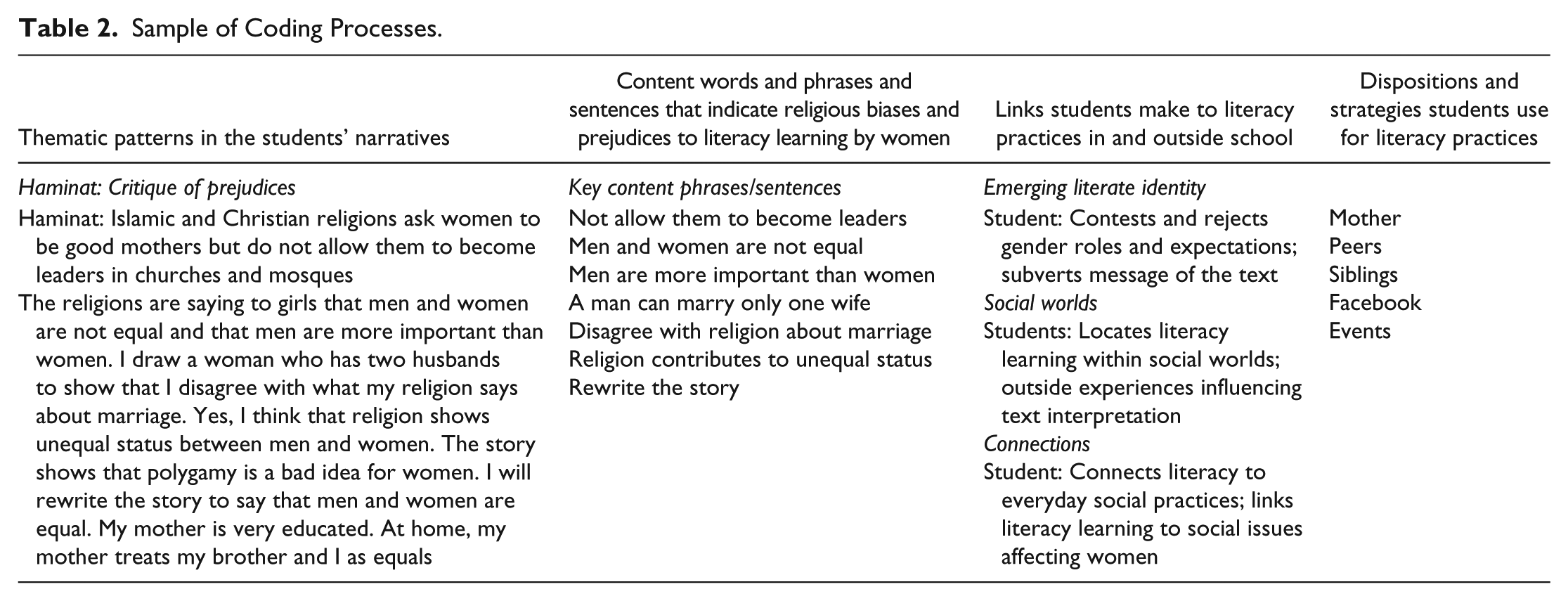
Emerging Themes and Discussion
The research objective of this study is to show how the students in the case studies and I co-construct the possibility of using critical multimodal literacy to interrogate textbooks and reconstruct unequal social structures. In this section, I discuss the four emerging themes, provide in-depth portraits of the students, and highlight how each student’s work illustrates a different theme from the overall data. For example, Haminat represents how the three students use critical multimodal literacy to critique prejudices in the textbook. The portrait method is appropriate for this study because it allows me to select, arrange, and emphasize the themes that produce a full picture of the research participants (Lawrence-Lightfoot, 2005). The findings are generalized because the perspectives of the three students are representative of others in the class as they share similar experiences and viewpoints.
Haminat
Based on my fieldnotes, observations, and conversations with Haminat, she does not like literacy lessons. Haminat explains during an interview: “All we do is read quietly and answer questions.” She writes, “The story we read are not interesting.” However, the fieldnotes show that Haminat is good at drawing and spends a lot of time drawing sketches. Haminat also enjoys reading nonschool texts such as comics and cartoons. She is 15 years old from an Islamic family. Both parents are Yoruba. Haminat speaks Yoruba as her first language and English and Arabic as second and foreign languages, respectively. Haminat uses her mother’s laptop to surf the Web, connect with social media, and send messages to friends. Large pictures of Prophet Mohammed and Bob Marley are posted on the walls at her home.
Women can change traditions
At the beginning of the sixth week, the class reads “The Rivers Osun and Oba.” The group uses the Four-Stage Reading Model that the class had practiced several times during this study. The group addresses the question: “Who do you blame for the tragedy in the story?” At the beginning of the discussion, the group has divergent views. While two students suggest that Sango should be blamed for the tragedy, Haminat argues that Nigerian culture that encourages insensitivity to women should be blamed. Another student argues that “women can change traditions that are not good for them.”
The group moves to the next question: “Should a woman be able to marry many husbands?” The group argues that a woman cannot marry two husbands because Nigerian culture and religions are against such a marriage. Haminat argues that religious dogma encourages women to be good mothers “but does not encourage them to become leaders in churches or mosques.” According to her, the religions are saying to girls: “Men and women are not equal and that men are more important in Nigeria.” Haminat uses multimodal narratives (Figure 1) to reject the social production of gender in Nigeria.
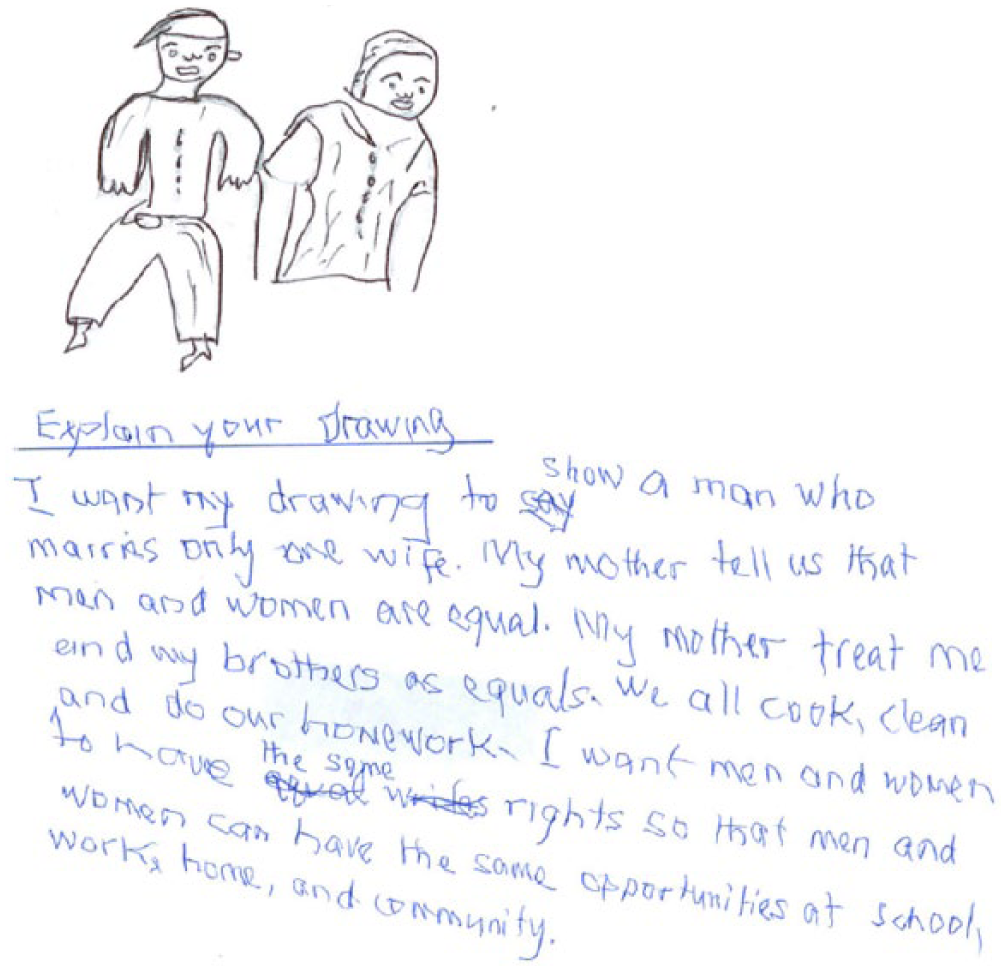
“I want men and women to have the same rights.”
In Figure 1, Haminat brings her home literacies such as surfing websites, reading Facebook, engine searching, cutting and pasting, and creating multimodal drawings to use in this class, practices that typically are not encouraged in in-school literacy. Figure 1 shows that Haminat may have the tacit knowledge of the principles of multimodal design. However, she cannot provide explicit explanation of her multimodal text. A multimodal analysis of Figure 1 suggests a Real–Ideal structure (Kress & van Leeuwen, 2006), where the visual text at the top is the Ideal (the most salient part) while the written text at the bottom is the Real (the more practical information). The visual text (the image of one man and one wife) is the most salient part of the frame, and the written text serves to elaborate on the message communicated visually in Figure 1: that men and women are equal and deserve the same rights and equal opportunities. The Ideal is the place for production, contestation, and reproduction of the social meanings of women and equality in Nigeria.
During the follow-up interview, Haminat explains her multimodal narrative: I want my drawing and the message to show a man who marries only one wife [in contrast to the position of my culture]. My mother tell[s] us that men and women are equal . . . I want men and women to have the same rights so that men and women can have the same opportunities.
Critiquing the text
Haminat, in her Facebook postings, employs the combination of a visual image and verbal text to critique and reconstruct unequal social structures: The story we read today is not fair to women. The story shows that polygamy is a bad idea. My culture allows a man to marry many wives, which is really bad because polygamy causes jealousy and quarrel that destroy the family.
Figure 2 shows that Haminat imports (from the Internet) an image of a successful female African political leader (Sirleaf) and adds a verbal text to make the point that “just as a man can become the president of Nigeria so also can a woman.”
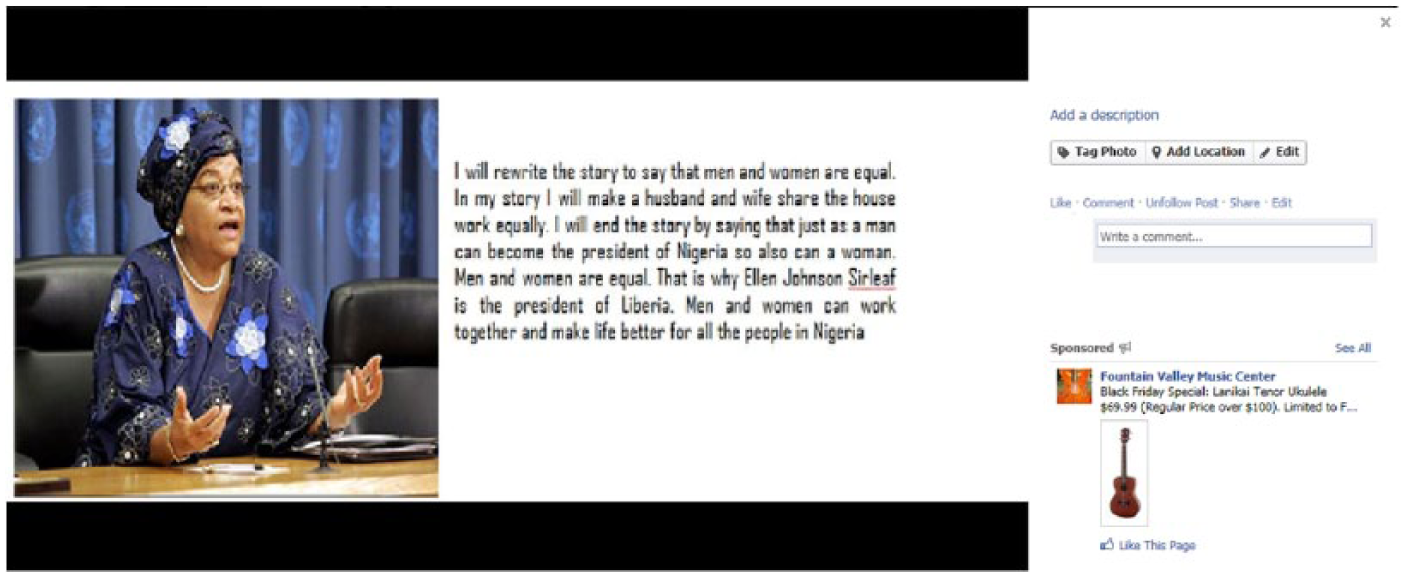
A woman can also become the president of Nigeria.
However, while Haminat imports and posts photographs on Facebook, she may not have the skills to analyze information communicated in multimedia representations as such knowledge is not taught in schools. A multimodal analysis of Figure 2 shows that the frame realizes a Given–New structure, where the visual image is the Given (information that is already known to readers and placed on the left) and written text as the New (information not known to the reader and deserving special attention; positioned on the right). In other words, Sirleaf as a Liberian female president is “known” information, while the argument that men and women are equal is new.
Figure 2 shows that social networks are important literacy tools for interpretations of textbooks, as Facebook offers the students opportunities to import photographs and combine visuals and words to reject the cultural model made available in textbooks, and constructs their view of equality: Women and men are equal and need to work together for the development of Nigeria. Haminat uses Facebook to appropriate and subvert the message of the textbook by showing a photograph of an African female political leader. Haminat notes, “My mother teaches us [her children] that men and women are equal.” Haminat’s mother becomes instrumental in her rejection of cultural practices that portray women as inferior to men.
During a follow-up interview, Haminat states that she posts the image of the president of Liberia to encourage “all girls to think and dream big about what they can do for themselves.” Haminat argues that because women are marginalized at decision-making levels, their voices are not represented; hence, their issues and concerns, such as education, violence against women, and equal opportunity for political participation, are rarely given priority in the male-dominated Nigerian politics. For example, in 2008, only nine (8%) of the 109 senators, 25 (6.9%) of the 360 members of House of Representatives, and one (2.7%) of the 36 governors were females, even though women accounted for 54% of the Nigerian population.
More worrisome, more than 80% of women in eight northern states of Nigeria are illiterate, less than 4% of the female students in the region complete high school education, and more than 65% of girls are forced into marriage between the ages of 14 and 16. The data suggest that not only are women grossly underrepresented at the decision-making levels of Nigerian government, such marginalization may have led to gender disparity, including unequal economic opportunities and political marginalization. Haminat blames women’s marginalization on religion, early marriage, and political parties with their “godfatherism”—a patronage system that has the power to control who contests elections—which often favors men.
During an interview, Haminat states that she surfs the Web on her cell phone to know what is going on. She likes to send emails from a nearby café to friends. She also likes to read Facebook pages and posts messages for people to read. She argues that texting, emailing, and social network media are “very important for talking to other girls about women’s issues.” Haminat notes that the technologies help her “learn what other girls think” about issues such as marriage and political participation. Haminat also notes that she usually takes photos with her cell phone during weddings, birthdays, EId-al-Fitr and EId al-Adha (Islamic festivals), and parties and shares such photos with friends. She adorns her room with drawings of herself, her mother, and grandmother.
At home, Haminat reads and writes different genres, including letters, the Holy Quran, cartoons, girls’ magazines, and fictional and nonfictional stories. Her writings are targeted to multiple audiences and perform different literacy functions. She keeps a diary in which she writes about love, ambitions, and disappointments. On her Facebook page, she writes about social issues such as “power [electric] failure in Ibadan,” “petrol scarcity,” and “street protest.”
Critically framing interpretation of texts
The data analysis indicates that Haminat, like the other students in the case studies, is beginning to use critical multimodal literacy to (a) critically frame interpretation of texts, (b) make personal connections to texts, (c) disrupt dogma to argue for gender equality, (d) engage in new literacies and new social practices, and (e) identify specific agents (her mother, peers, family, and shared cultural knowledge) in her proclivities, critical analysis of texts, and taking a critical stance toward women’s issues. In addition to subverting the cultural message of the text, the three students in the case studies provide a counternarration that men and women have equal talents and should use their knowledge to build Nigeria. Hence, Nigerian literacy teachers need to rethink in-school literacy in ways that allow educators to prepare female students to use critical multimodal literacy to interrogate social production of gender in textbooks and classroom dialogues as Stella begins to do in this study.
Stella
Classroom videos, observations, Facebook, and fieldnotes indicate that Stella is a serious student who likes reading, even though her English teacher notes that she is underperforming in class. She notes in her biography that she is frustrated by the challenges of English lessons: “English is too difficult because there are too many [grammar] rules to learn . . . The textbook is boring. The stories are not interesting.” However, Stella likes to read online. She reads diverse texts, including the Bible, comic books, cartoons, short stories, and celebrity magazines. Stella has Facebook and Twitter accounts, and “she friend[s] and follow[s] many people” to make links and build relationships Stella uploads music and written texts to the Facebook wall. She creates a montage of photographs with captions and provides hyperlinks to webpages for people to read funny stories: “A Pastor and His Son,” “Runaway Wife,” and “The Foolish Husband.”
Stella’s biography indicates that her father is Igbo (from the eastern part of Nigeria), whereas her mother is Yoruba. Stella comes from a Christian house. Her father completed elementary education, whereas her mother did not. The family speaks Yoruba, Igbo, and English and code switch and code mix between the languages. Stella helps her parents write important dates such as births, deaths, and appointments in a diary.
A counternarration
Stella and her group critically analyze the textbook. The classroom video shows that the group follows the Four-Stage Reading Model by beginning its discussion with the question: What is the message of this story? Stella argues that both men and women in the story are victims of the old-age tradition. She argues, “Polygamy is a bad idea for Sango [the King] and the wives because it is not good for a man to marry many wives as it is bad for a woman to marry many husbands.” The group further works on the question: “Why is polygamy bad for a man or woman? Why is polygamy bad for the society?” Stella explains that polygamy is bad for the society because “men and women have equal talents and abilities,” and that “all men and women should use their talents to build Nigeria.” Stella draws Figure 3 to show her understanding of the text.
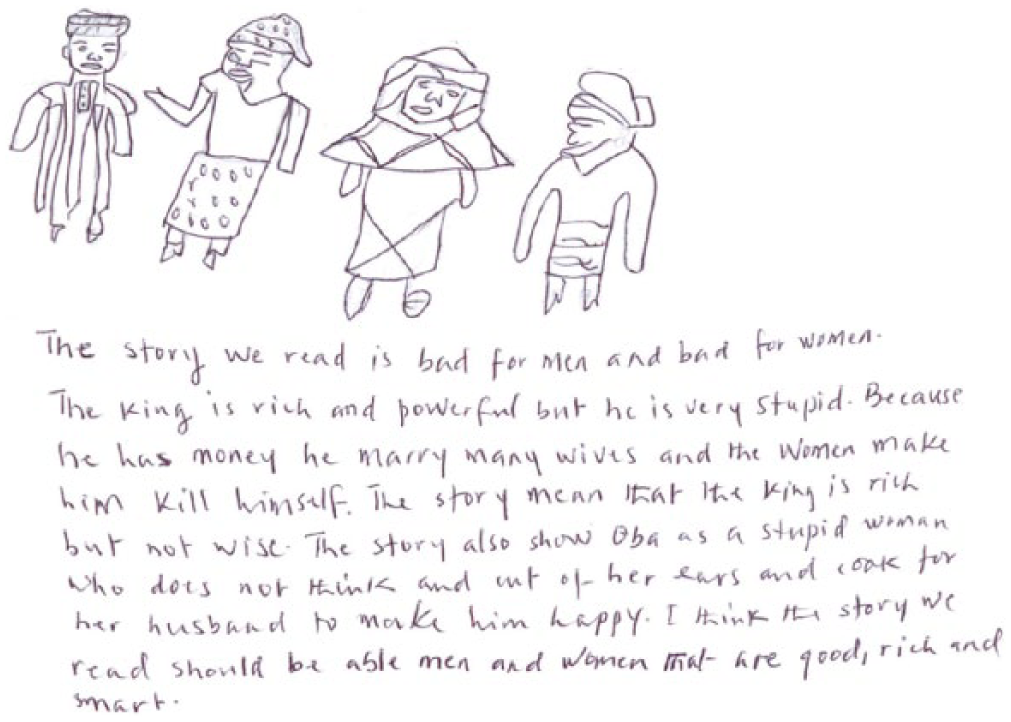
Textbooks should portray men and women who are good and smart.
A multimodal analysis of Figure 3 shows a Real–Ideal structure. The visual text (the Ideal) is given salience as an idealized message, whereas the written text (the Real) explains the message in the visual text. As the Ideal is the place to contest or reaffirm the underlying values of the culture, Stella subverts the cultural message of the text and provides a counternarration: “Men and women have equal talents and should use their knowledge together to build Nigeria.”
During the follow-up interview, a student in the group explains that her multimodal narrative shows that a “king [that] is rich and powerful but very stupid.” Stella argues that “the Aristo 3 [king] brings tragedy to his kingdom because he likes women.” Stella argues that the school should “teach about equal rights for all and no one is [should be] treated better because of gender.” She explains that Nigerian culture encourages rich men to take advantage of young women. Stella argues that Nigeria can only develop with the participation of all men and women. Stella explains that the role of Nigerian schools is to promote conditions that allow students to treat one another with respect and dignity. The student argues that schools should rethink gender role assignments and how social beliefs socialize boys and girls into specific social expectations and practices.
Engaging with the principle of design
Stella posts Figure 4 on the Facebook group wall to summarize her interpretation of the story.
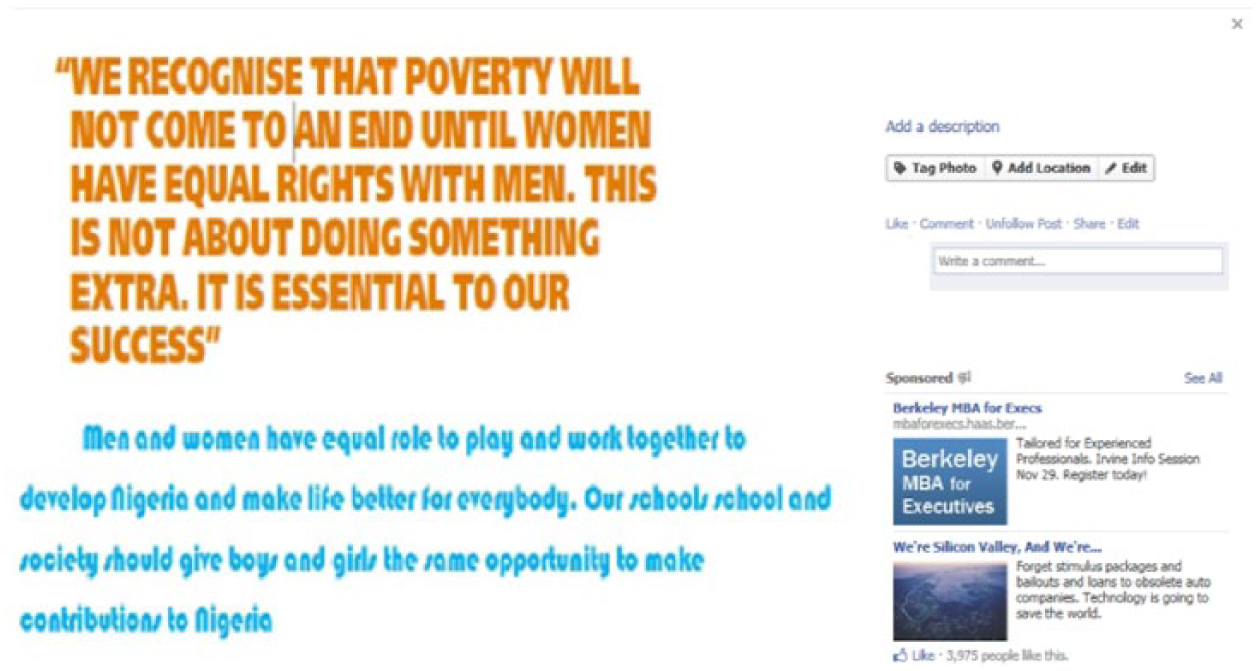
Nigerian women should have equal rights.
The layout of Figure 4 shows visual hierarchy, that is, the relationship and emphasis based on relative importance of textual elements in a frame. Figure 4 is designed to direct teenage readers, who are always in a hurry, to the relevant information as quickly as possible on the Facebook page. The font of the quote is in bold, capital letters, and the written text is in big blocks of text. Because people read the English alphabet in a left-to-right and top-to-bottom order, the layout helps focus teenage readers’ eyes as they can quickly scan Facebook pages and locate important postings. Facebook pages, usually cluttered with different information and texts that are eye-catching (e.g., bold, large, or colorful) are more likely to attract the attention of readers. In Figure 4, Stella puts the main text in the upper-left corner in bold letters and the supplementary explanation (in small letters) at the bottom of the page. The large space surrounding the written text not only enhances the ability of readers to scan the text, but it also adds to the visual appeal of the design.
Figure 4 suggests that Stella understands the principle of design. During the follow-up interview, she explains that she “copied and pasted the quote” from the Internet (Figure 4) to make the point that “men and women are equal and they need to work together to develop Nigeria and make life better for everybody.” She notes that the quote aptly summarizes her view on gender inequality in Nigeria. However, Stella acknowledges that she has problems navigating different websites, accessing and responding to information online, and uploading images and videos onto Facebook.
Deconstructing literacy text
Data indicate that with instruction from the teacher, Stella, like other students, is learning to (a) deconstruct literacy texts to reject stories that maintain traditions and privileges for men, (b) transform texts by constructing a counternarrative that suggests equality among genders, (c) conceptualize social media as a crucial resource for self and community, and (d) use her tacit knowledge of cultural forms (multimodal narratives, multimedia literacies, and experiences of inequality) acquired at home for her critique of unequal social structures in this study. Furthermore, critical multimodal literacy empowers the students, including Bose, the third student, to create personal narratives about who they are and what they aspire to become.
Bose
Classroom observations, fieldnotes, and artifacts show that Bose struggles with learning English. Indeed, her teacher’s records indicate that she is failing the class. According to Bose, “English lessons are always not interesting.” However, she likes to read comic books, cartoons, surf the web, draw, and post images on her Facebook wall. Bose is Yoruba from a Christian family. Neither of her parents graduated from elementary school. Her father attended adult school to learn how to read and write. Her mother stays at home, whereas her father works as a bricklayer. She has three siblings who help her with homework. There is a TV in the sitting room. The sitting room is decorated with posters and family pictures.
Gender equity in classroom
Bose and her group analyze the story in the textbook. Using the Four-Stage Reading Model, the students start their discussion with the prompt: “Do you think the story is fair to Sango or the wives?” The group suggests that the story is not fair to women because it paints women negatively—that women are “jealous” and “fight [among] themselves.” Bose also argues that the story “shows Sango as a rich and powerful king who can buy women.” Bose notes that the root of polygamy is not religion or culture but poverty. She argues, “Rich Muslims send their daughters to school; only poor parents do not allow their daughters to go to school.” In her drawing, Bose rejects the underlying message of the story and instead argues that the root of inequality in Nigeria is the lack of equal opportunities for women.
Figure 5 shows a Real–Ideal structure; the visual text is the most salient part of the frame. The Ideal (the image of three women) gives preeminence to Nigerian women. The student, during the interview, argues that women in her drawing are successful: The women in my drawing are governors, presidents, army generals, lawyers and businesswomen . . . They have good work [careers] and earn good money. In my drawing, I tell the story of women, their positions and what they contribute to our country.
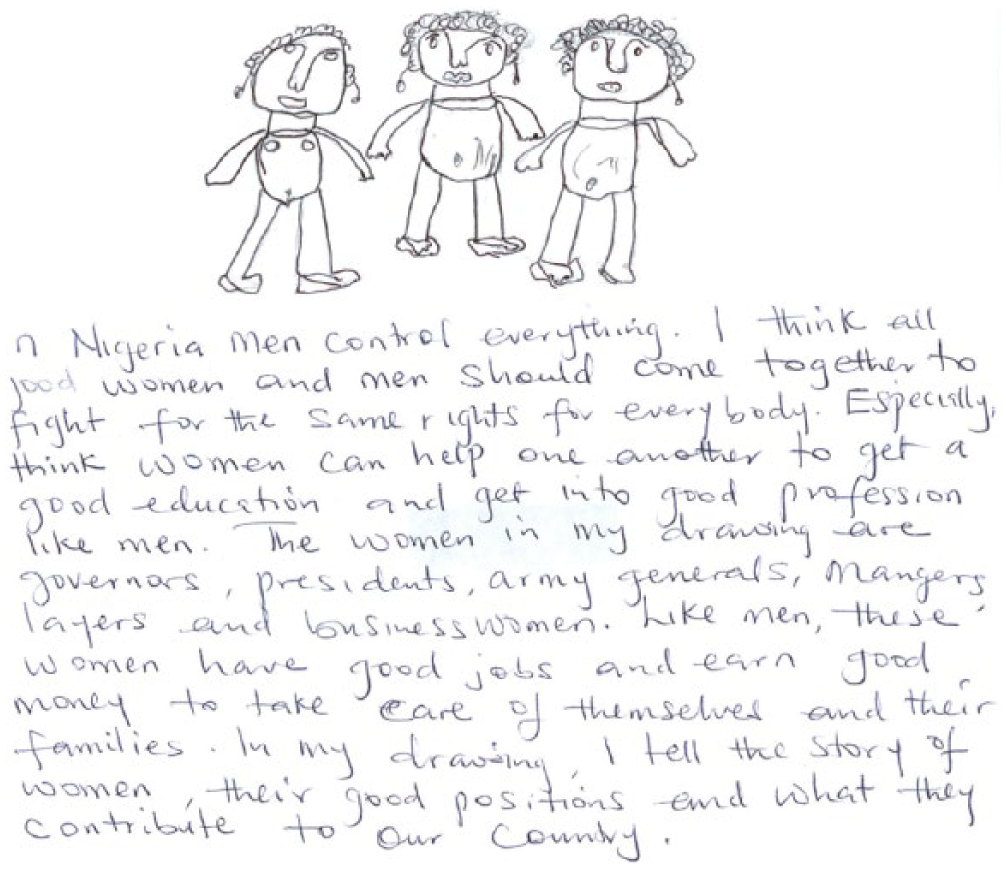
The root of inequality in Nigeria is the lack of equal opportunities for women.
When I ask her the meaning of her story, Bose explains, “Nigeria women are hard working . . . Women too want more opportunities so that we can become whatever [we] want to be.”
Creating multimodal interpretation
Bose posts Figure 6 on Facebook to show her interpretation of the story. Figure 6 realizes the Given–New structure, where the visual text is the New and is given salience. The New of the structure is a photo of African women (presumably Nigerians) holding a banner calling on all people to join them to move the nation forward. The photo shows women with broad smiles and happy faces (who are empowered to change their lives), contrary to the subordinate role of women in the textbook. The photograph portrays the women as happy warriors, with fists in the air, who are determined to resist oppression and claim their rights (the fist in the air is a symbol of defiance and resistance in Nigerian politics). The Given (the caption) is written in Lucida Handwriting font and red color. The layout of the caption shows that the offline words (the out-of-shape words—women and Nigeria) are in capital letters and bold. The layout, bold font, font style, font size, and red color combine to make salient the centrality of “women” in the caption: Nigeria’s progress is intrinsically linked to the progress of women.
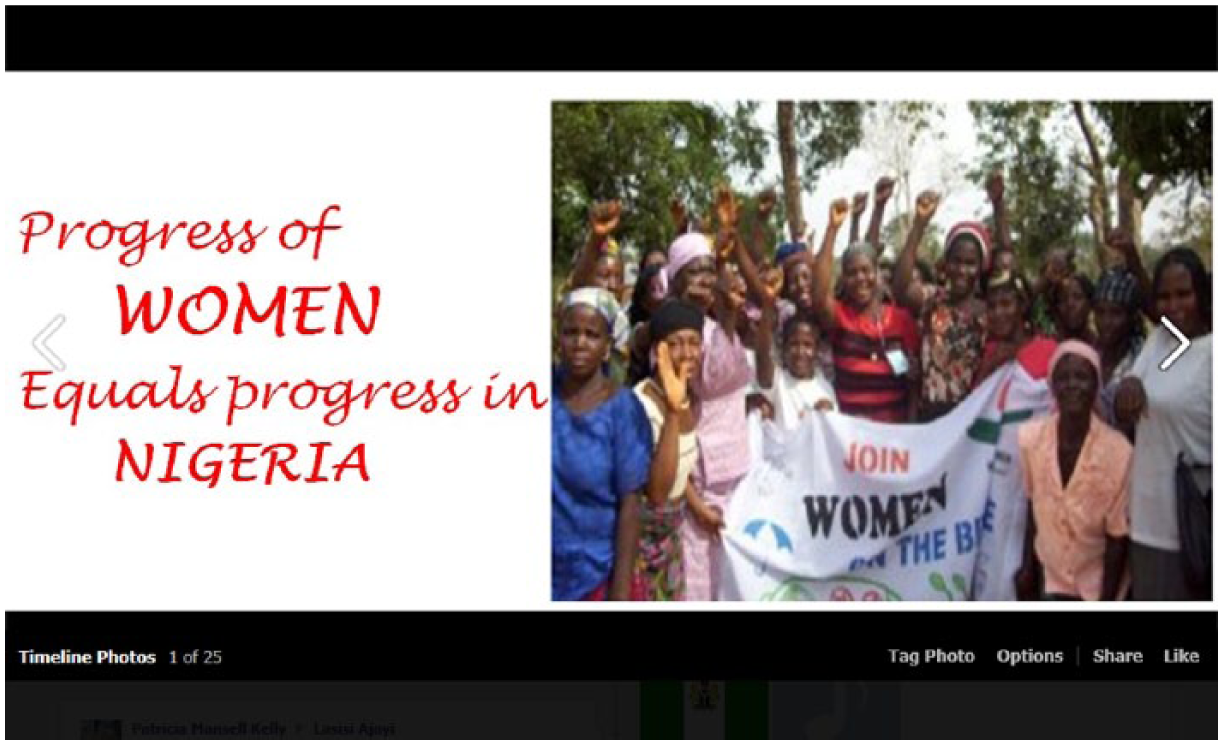
Nigeria’s progress is linked to the progress of women.
During the interview, Bose explains her posting: “What I want to do is to tell the story of women in Nigeria. Women contribute a lot to this country. The story [in the textbook] is negative to women.” In another posting, she writes, What I learn from the story is that women too should write stories of women and tell the world about great women and their great achievements. My mother told me of the stories of Moremi Ajasoro [a pre-colonial Yoruba woman] who saved Ile-Ife from invaders and Efunsetan Aniwura (Iyalode of Ibadan) who was a rich woman and a political leader.
Bose states that she uses a cell phone to access her Facebook account, check her email messages, surf the web, upload images, and share pictures with friends. Bose notes that her cell phone allows her to stay connected to friends as she has 870 friends on Facebook and 197 Twitter followers. She likes the Internet because “I can find information to solve problems and it allows me to tell the world about me.” On her Facebook page, she creates profile pictures that portray her daily activities: going to school, singing in church, playing, and so on. Bose envisions different audiences with different interests and concerns. She posts quotes of Fela Kuti (a deceased Nigerian musician) on her wall: “You know what I want? I want the world to change,” “With my music, I create change,” and “I must identify myself with Africa. Then I will have an identity.” She also writes a list of her favorite short stories on her Facebook page.
Unlike school instruction, which tends not to be pedagogically organized to connect home–school literacies, the data analysis indicates that Bose uses multimedia to connect the textbook to the politico-economic structures of Nigerian society. She constructs an oppositional reading, which allows her to tell her story and the collective story of Nigerian women. The story from her mother provides an impetus for her to rethink gender roles as she argues: “Women should write stories of great women and tell the world about their great achievements.”
Challenges of new literacies
It is significant that Bose knows how to use the affordances of new media, even though new media skills have not been taught. The student uses social networks for self-expression, community engagement, and new literacies as she engages in diverse activities that require communication and collaboration in online communities. Bose also reframes the language of social relationships by learning to use “new language”: profile, Google, upload, download, posting, and many more tools to describe her literacy activities. The examples illustrate the situated and community-based nature of literacy practices in online communities. However, Bose, like other students in the case studies, has significant challenges navigating social media, including adopting a more critical stance toward online texts. She states that she is frequently tricked into 419 (Nigerian scams that promise potential fraud victims large sums of money), pornographic websites, harassment, unwanted sexual advances, hateful speech, and threats.
Creating an agentive self
Bose, like other students, starts to use critical multimodal literacy to (a) create an agentive self—one who is capable of influencing the direction of her life; (b) provide a critique of the economic structure that serves as an impediment to literacy learning for women; (c) use multimodal possibilities to create a sense of solidarity with women; (d) deploy the resources of friends, family, and social media for critical analysis of texts; (e) use a range of opportunities, proclivities, and strategies for literacy practices; and (f) face challenges in navigating new media.
Discussion
This section provides an interpretation of the findings from all three students in the case studies. The findings suggest that critical multimodal literacy provides the students opportunities to question the message of social inequality in the textbook they read. Specifically, the students rewrite themselves by using critical multimodal literacy as a source of empowerment to question the social production of gender. The crucial issue for teachers is to understand how in-school literacy can recruit students’ outside school literacies to leverage literacy learning. This is important as the students’ conceptions, uses, and functions of literacy relate to events, social practices, ideologies, discourses, and self-identities (Hull & Schultz, 2008). Students come to school with knowledge and assumptions, and ideas about the social worlds in which they live (Rogers et al., 2009). With the shifting social conditions in Nigeria, literacy instruction needs to emphasize the multiple and situated literacies that students bring into classrooms. A pedagogy of critical multimodal literacy builds on the conception of literacy as meaning-as-transformation and literacy activities as identity formation (Cope & Kalantzis, 2009).
A crucial issue is how Nigerian teachers can rethink literacy instruction and materials to focus on the everyday meanings and uses of literacy in the social and cultural contexts of the society (Barton & Hamilton, 1998). The students’ use of critical multimodal literacy suggests that opportunities for learners to participate in the creation of knowledge have increased tremendously for Nigerian female students with unprecedented access to new literacy tools, including social media and multimodal resources. The newly enabled new-media- and multimodal-based knowledge may have diversified knowledge creation and empowered anyone with access to the Internet and cell phones in Nigeria to challenge the traditional language/print-based literacy curricula typically designed by educated, middle-aged male experts. Although teaching critical multimodal literacy faces significant challenges as traditional (grammar-based) literacy curricula dominate instruction in Nigerian schools. In particular, the notion of critical multimodal literacy is foreign to Nigerian schools, teachers, and students.
School policies require teachers to teach with fidelity to textbooks and avoid controversial topics. Hence, textual analysis is constrained as students, out of deference and allegiance to the school authority or parents, may consider it inappropriate to question dominant views even when such views may be oppressive to women or other social groups. For example, a student from a polygamous home who was initially part of this study withdrew from participation. She explained to me that it was not right for children to critically analyze the role of polygamy and Islam in the society.
The example of this student indicates that critical multimodal literacy requires teachers who are committed to creating more just, more human, and equal worlds for men and women. Such teachers can use critical multimodal literacy to link home–school literacies and create new learning possibilities for Nigerian female students. For example, the students in this study use critical multimodal literacy to situate self-construction more collectively to reflect the experiences and perspectives of Nigerian women. Hence, Bose employs visual images and Facebook to tell stories that create solidarity among Nigerian women and highlight what they consider to be attributes of the female gender to celebrate women’s achievements. The students also use critical multimodal literacy to learn new skills that allow them to develop conceptions of themselves as actors in culturally and socially constructed worlds. The students’ critical multimodal literacy practices show that they “define and redefine themselves, voicing agentive selves through creation of multimodal texts” (Hull & Katz, 2006, p. 71).
Critical multimodal literacy of the students involves integration of multiple modes and media for communication (Kress, 2003). Carrington (2005) argued that new multimodal technologies and new political contexts are ushering in “new texts, social practices, and accompany literacies” (p. 172). Indeed, literacies associated with multimedia are increasingly becoming salient to the acquisition of new blends of knowledge, cognitive habits, and intellectual practices crucially important to engage with and gain access to student learning and social practices in multicultural Nigerian classrooms. Such literacies are much more complex than school-based curriculum and require different cognitive abilities than print-based literacy (Kress et al., 2005). The findings here suggest that critical multimodal literacy may become increasingly central to understanding how students develop a critical analysis of texts, subvert gender relations, and feel empowered to critique unequal social structures. Hence, schools, teachers, curriculum designers, and textbook authors need to rethink what counts as literacy in light of students’ burgeoning home literacy practices and make visible the close interconnections and interrelations that exist between new media literacies and students’ new literacies and social practices (Hull & Schultz, 2008).
Implications and Conclusion
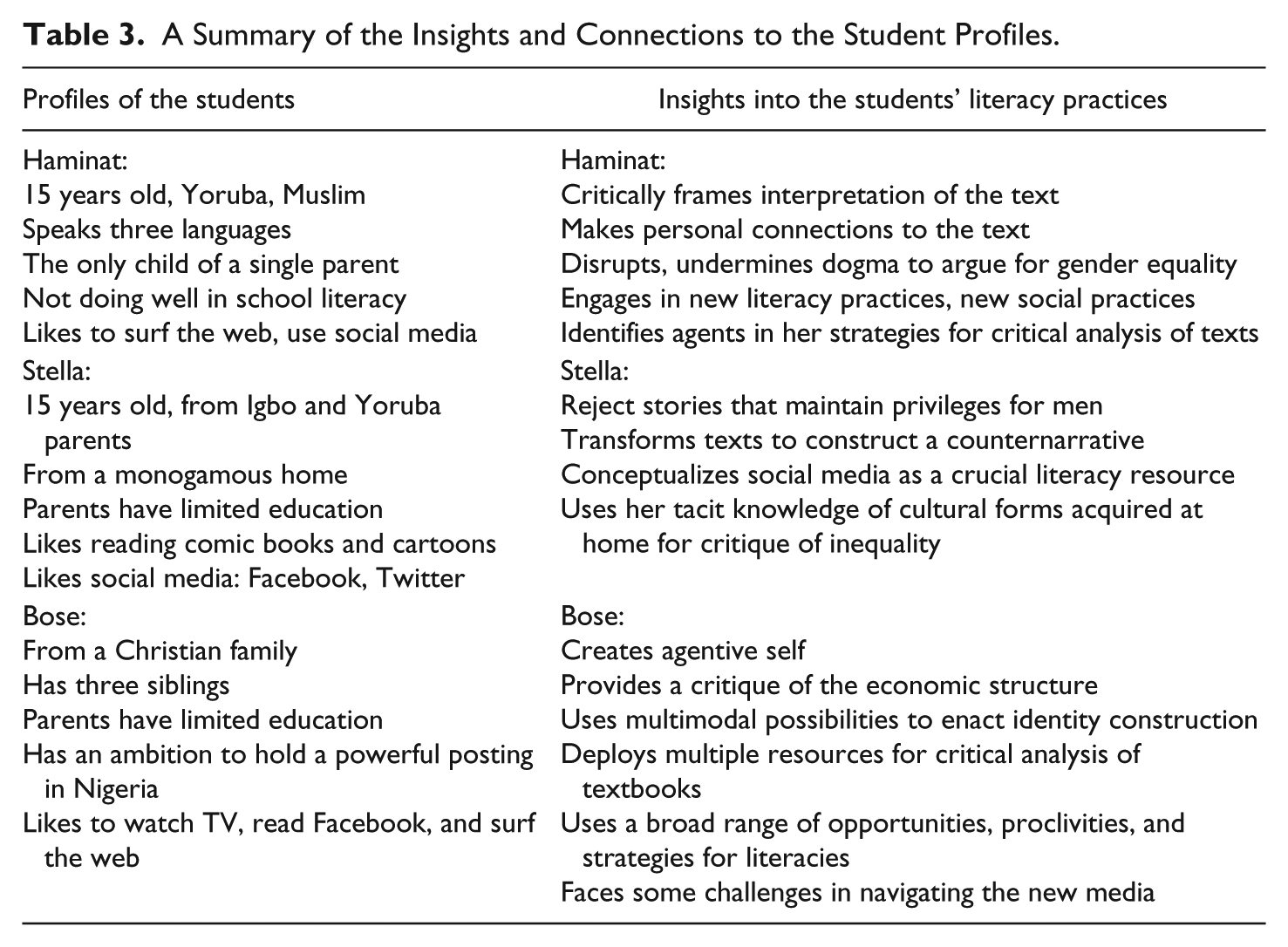
This study shows how the three students and I co-construct the possibility of using critical multimodal literacy to critique texts and reconstruct unequal social structures in the classroom. Table 3 provides a summary of the insights and connections to the student profiles.
A Summary of the Insights and Connections to the Student Profiles.
The findings have important implications for literacy teachers, researchers, teacher education, and school policies in Nigeria.
Literacy Teachers and Other School Personnel
Literacy teachers in Nigeria may need to enact critical multimodal pedagogy that bridges in-school literacy and students’ outside school literacies, social interests, and discursive practices. In Nigerian classrooms where many students struggle with the English-dominant curricula, critical multimodal literacy offers them compensatory resources for integrating images, audio, and language to present their answers instead of relying on English. Furthermore, there is a need for schools to emphasize ongoing high-quality professional development activities that prepare teachers to understand students’ motivations, modal preferences, the modes they value, and limitations they face in using these tools for literacy. Moreover, rather than the vertical, hierarchical top-down approaches associated with the grammar approach to literacy instruction, teachers may have to develop horizontal, participatory, student-centered pedagogical models that allow educators to share decision-making processes with students.
Teaching critical multimodal literacy is participatory and collaborative work. Literacy teachers should involve female students in teaching/learning processes by tapping into their outside school experiences. Teachers can ask students to share their insights about social media in classrooms. Also, literacy teachers can use successful local and national women as resources for teaching by inviting them to classes as guest speakers to talk about real-life experiences of how they overcome gender inequality in Nigeria. Furthermore, teachers can ask female students to bring artifacts from their social media to class and use them to teach how to critique individuals’ views and perspectives, and yet have respect for difference. An important aspect of literacy is to develop the knowledge to critique the status quo and work as agents of social change to eliminate biases and critique relationships between discourses and influences that promote inequality (Freire, 1970).
Research
While the findings in this study are promising for critical multimodal literacy in Nigeria, there is a need for more comparative studies of female students within and across different communities to collect data from larger samples to better understand cultural and discursive practices that such students employ for literacies. Such research can provide answers to some fundamental questions about literacy education in Nigeria: What literate identities, cultural and social practices, and discursive strategies do female students from different backgrounds and socioeconomic groups bring into schools? How do female students’ outside school literacies differ from school literacy? What special knowledge, skills, and dispositions will teachers need to incorporate students’ home/community literacies into in-school literacy? Furthermore, there is a need for a longitudinal study to examine whether the students continue to use critical multimodal literacy they learned in this research as they progress through their high school education.
Teacher Education
Teacher education programs (TEPs) in Nigeria should envision to prepare future teachers to develop innovative and culturally relevant practices that value students’ critical multimodal literacies as important learning tools and incorporate such resources into traditional literacy instruction (Hull & Schultz, 2008). TEPs should also prepare future teachers to teach their own students to (a) use different analytical perspectives such as learners’ subjectivities and linguistic and cultural repertoires as assets for transforming textual interpretations and (b) use critical multimodal literacies to interrogate texts and the sociopolitical contexts of production/circulation of cultural texts. In this way, TEPs will prepare future teachers to recognize and build on students’ values through which they engage with and think about their own literacy worlds, interests, experiences, motivations, and identities (Hull & Schultz, 2008).
School Policies
New school policies in Nigeria should articulate a new understanding of what counts as literacy knowledge in today’s society. First, school policies should recognize students’ outside school literacies which are increasingly multiplex, influential, substantive, and highly significant and have strong connections to and implications for the cognitive work and academic literacies that students engage in in-school literacy. Hence, school policies must value both print and new media tools of students and incorporate critical multimodal literacies into traditional curricula. Critical multimodal literacies have the potential to empower students to be both critical thinkers and creative consumers/producers of multimodal texts in/out of school—the kind of literacy practices that the school purports to value. Second, new policies should account for the technological, economic, cognitive, and affective factors that shape literacy practices. School policies can harness students’ interest in the bourgeoning digital texts and multimodal literacies to prepare them for multimodal learning—where knowledge is produced and consumed as multimodal texts, artifacts, and discourses (Bezemer & Kress, 2008). More importantly, teachers should conduct classroom-based research on innovative and culturally relevant teaching practices and use their findings to participate in policy debates at every level of schooling.
Footnotes
Acknowledgements
Thanks to the Rotary International for providing the Grants for University Teachers Scholar Award that enabled to do this research in Nigeria.
Declaration of Conflicting Interests
The author(s) declared no potential conflicts of interest with respect to the research, authorship, and/or publication of this article.
Funding
The author(s) received no financial support for the research, authorship, and/or publication of this article.