




Abstract
Many English language learners (ELLs) and children living in poverty begin school with substantially less English vocabulary knowledge than their monolingual, economically advantaged peers. Without effective intervention, these vocabulary gaps are likely to contribute to long-term reading failure. This quasi-experimental study examined the extent to which a family literacy program (FLP) moderated vocabulary development of 158 ELLs (prekindergarten through third grade) from low-income families in relation to children’s level of vocabulary knowledge (at, moderately below, or substantially below national norms) on program entry. The FLP activities focused on supporting parents’ development of English literacy and on teaching them effective ways to engage their children in authentic, home-based literacy events and practices that could be expected to prepare their children for success in school. Findings indicated that although all children demonstrated substantial language and literacy growth, children with the lowest pretest vocabulary knowledge achieved the greatest vocabulary gains and these gains differed significantly from their demographically matched peers who did not participate in the FLP. Gains for treatment and control children with middle and high pretest vocabulary knowledge (relative to this sample) did not differ significantly. Findings suggest that an FLP emphasizing authentic literacy practices holds particular promise in closing vocabulary gaps among children who enter early childhood classrooms with especially limited English vocabulary knowledge.
For children living in poverty (Biemiller & Slonim, 2001; Hart & Risley, 1995; Neuman, 2006; Oller & Eilers, 2002; White, Graves, & Slater, 1990) and acquiring English as an additional language (August, Carlo, Dressler, & Snow, 2005; Mancilla-Martinez & Lesaux, 2011; Oller & Eilers, 2002), large and persistent vocabulary knowledge gaps often emerge in the early years. When left unaddressed, these are detrimental to long-term literacy achievement (Biemiller, 2006; Cunningham & Stanovich, 1997; Hart & Risley, 1995). Ample evidence demonstrates that children who enter school with less vocabulary knowledge score lower on reading comprehension measures in later grades than children who enter school with more vocabulary knowledge (Cunningham & Stanovich, 1997; Hart & Risley, 1995; Sénéchal, Ouellette, & Rodney, 2006; Whitehurst & Lonigan, 1998). Evidence also indicates that the gap between children with limited and rich vocabulary knowledge widens over time (Biemiller & Slonim, 2001; Hart & Risley, 1995; Stanovich, 1986) and, for some, the gap remains despite school-based intervention (Marulis & Neuman, 2010; Penno, Wilkinson, & Moore, 2002). Among children achieving reading comprehension proficiency in fourth grade, just 2% are English language learners (ELLs) and 24% are children from low-income families (National Assessment of Educational Progress, 2011). The number of ELL children in American schools is rapidly growing with an estimated 4.7 million enrolled in public schools across the United States during the 2009-2010 school year (Nachazel & Yohn, 2012) and the number of children living in low-income families has been increasing since 2006, with 45% now identified as poor and near poor (Addy, Engelhardt, & Skinner, 2013). Achievement gaps combined with changing demographics underscore a pressing need for intervention programs and practices prior to or very early in children’s schooling that emphasize vocabulary development as well as other foundational skills.
Family literacy programs (FLPs) often are considered as one way to address the needs of ELL children who are from families with low socioeconomic status (SES). Although FLPs vary widely, they generally are programs designed to help parents support their children’s academic achievement. They vary in design, with some offering services directly to parents and children, and others offering services to the parent with the expectation that the benefit will be “through the parent” to their children. In a meta-analysis of 30 studies (47 samples) in which participants were preschoolers, kindergartens, or primary-grade children, van Steensel, McElvany, Kurvers, and Herppich (2011) found that FLPs made modest contributions to children’s literacy achievement (i.e., d = 0.18 for code-related skills and d = 0.22 for comprehension-related abilities). However, this study also raised a number of unanswered questions. First, it yielded effect sizes considerably smaller than those reported in earlier studies (e.g., Mol, Bus, de Jong, & Smeets, 2008; Sénéchal &Young, 2008), a difference van Steensel et al. attributed to methodological differences in the measures examined and also to methods used to estimate weighted mean effect sizes. Second, unlike other studies (e.g., Sénéchal & Young, 2008), van Steensel et al. found that effect sizes did not differ as a function of program type or sample characteristics. Van Steensel et al. speculated that the lack of moderator effects might be explained by the lack of heterogeneity in the examined variables and in the lack of data about treatment fidelity, but the precise reasons are unknown.
Given the nature of these findings, although one could draw a general conclusion that family literacy interventions have the potential to make a difference in children’s academic success, the small effect sizes and the lack of differential effects according to either program type or participants’ characteristics diminishes the likelihood that FLPs can be relied on to make a substantial contribution to the problem of underachievement for ELLs from low-income families.
As we considered these findings and evidence indicating that children with greater vocabulary knowledge acquire new vocabulary more rapidly than children with less vocabulary knowledge (Biemiller & Slonim, 2001), we wondered if we might find a different pattern of results if we conducted a more fine-grained analysis, looking specifically at program effects based on individuals’ English vocabulary knowledge at the outset. That is, does an FLP provide more or less benefit based on children’s initial English vocabulary knowledge? We reasoned that particularly at a time when most school districts have severely limited resources—both in time and money—understanding the specific learning profiles that are best served by particular interventions could allow very targeted use of resources and, as such, could be of substantial importance in addressing the problem of high levels of literacy failure among many urban school children. Our reasoning led us first to review literature related to differential FLP effects due to levels of vocabulary knowledge, which we found to be sparse; that, in turn, led us to the design and implementation of the study described herein. In the sections that follow, we first describe the literature that undergirded our work. We then describe the details of the study designed to answer the following question: What is the impact of parent participation in an FLP on the phonological awareness and vocabulary development of ELL children entering early childhood education settings with particularly low levels of English vocabulary knowledge?
Vocabulary Gaps and Reading Development
Children begin school with wide variation in the number of words they know, and the extent of children’s early vocabulary knowledge holds significant implications for early and later reading development. In early years, children with larger vocabularies develop greater sensitivity to the phonological structure of words than children with smaller vocabularies (Metsala, 1999, 2011). As phonological awareness is a prerequisite to developing word reading skills (e.g., Blachman, 2000; Phillips & Torgesen, 2006), this relationship has clear implications for reading achievement. But the influence of vocabulary knowledge on reading achievement does not end here. Vocabulary knowledge also influences the development of word recognition ability, as words with familiar meanings are recognized more accurately and rapidly than unfamiliar words (Adams, 1990; Perfetti, 1985; Stahl & Hiebert, 2005). In later grades, as texts become more conceptually dense, lack of vocabulary knowledge becomes a “bottleneck” for reading comprehension as readers must have sufficient knowledge of the meanings of essential concepts and content-bearing words in text to support comprehension (e.g., Anderson & Freebody, 1981; Dale, 1965; Pressley, 2006; RAND Reading Study Group, 2002; Vellutino, 2003).
Moreover, the importance of early vocabulary knowledge to overall reading proficiency is heightened by the bidirectional relationship of these two constructs. As Nagy (2005) explains, “Having a big vocabulary does contribute to being a better reader. But being a good reader also contributes to having a bigger vocabulary” (p. 34). This is because as vocabulary knowledge supports reading development, increased reading skill can support the development of motivation to read (Guthrie & Anderson, 1999), facilitate time spent reading (R. C. Anderson, Wilson, & Fielding, 1988), support wide reading and, in turn, expose readers to vocabulary that might otherwise not be encountered, thereby building new vocabulary knowledge (Nagy, 1988; Nagy, Herman, & Anderson, 1985; Perfetti, 2007). Enhanced vocabulary knowledge, then, supports future reading and ongoing development of vocabulary (Graves, August, & Mancilla-Martinez, 2013; Perfetti, 2007; Stanovich, 1986). In sum, early vocabulary gaps not only have the potential to constrain early reading development but also once reading delay sets in, without intervention, vocabulary growth itself is likely to be further delimited.
Although this evidence illustrates the cumulative nature of vocabulary knowledge and its relationship to reading development, it is largely derived from studies examining outcomes for monolingual English-speaking children. When we consider children acquiring English as an additional language, evidence shows that reading develops similarly to monolingual children indicating that vocabulary knowledge is also a critical factor for L2 reading development (August et al., 2005; Mancilla-Martinez & Lesaux, 2010; Proctor, Carlo, August, & Snow, 2005; Verhoeven, 2011). However, there are additional complexities in vocabulary learning and reading development for ELL children as they must develop oral language proficiency and this, in turn mediates their vocabulary learning (Fitzgerald, 1995; Scarborough, 2001). Such learning is an enormous undertaking that requires learning English labels for known concepts in children’s first language (Graves et al., 2013; Lesaux & Geva, 2006) along with the 3,000 to 4,000 words per year monolingual English speakers acquire on average (Nagy & Anderson, 1984).
Early vocabulary gaps are associated with a range of factors including low SES (Biemiller & Slonim, 2001; Hart & Risley, 1995; White et al., 1990); low levels of parent education (Hart & Risley, 1995; Rauh, Parker, Garfinkel, Perry, & Andrews, 2003); and limited oral language proficiency in the first language (Geva & Genesee, 2006). Gaps in early vocabulary might be further exacerbated when preschool-based instructional opportunities are limited (Dickinson, McCabe, & Essex, 2006). The consequences of these combined risk factors can be seen in a series of longitudinal studies that traced the trajectory of reading development for ELL preschoolers from low-income families with limited English vocabulary knowledge (Mancilla-Martinez & Lesaux, 2010, 2011). Preschoolers in these studies lagged substantially behind national vocabulary norms (Mancilla-Martinez & Lesaux, 2011) and, 8 years later, were unable to comprehend text beyond a second-grade reading level (Mancilla-Martinez & Lesaux, 2010).
In sum, the consequences of inadequate vocabulary knowledge on school entry are well-documented: children who enter school with low levels of vocabulary knowledge experience high rates of reading failure and often their failure persists throughout later school years. The question, then, is what types of early childhood education interventions hold promise to develop a large store of vocabulary in the early years and, by so doing, support reading success?
Can FLPs Moderate the Vocabulary Gap?
FLPs are grounded in the assumption that parents play an integral role in their children’s academic achievement and that children’s homes are a key context for supporting literacy and language development (Edwards & Turner, 2009). Although FLPs vary widely in program goals and features (e.g., parent training focused on school-based goals vs. authentic, home-based literacy events), learning contexts (home vs. at school), and family demographics (e.g., SES and language background), evidence documents positive effects of FLPs on parent/child home literacy practices (Brooks, Gorman, Harman, Hutchison, & Wilkin, 1996; Neuman & Gallagher, 1994; Paratore, 1993; Purcell-Gates et al., 2012; Rodríguez-Brown, 2004; Zhang, Pelletier, & Doyle, 2010). Moreover, evidence consistently demonstrates positive effects on children’s literacy outcomes (Anderson, Purcell-Gates, Jang, & Gagné, 2010; Brooks et al., 1996; Glynn, 1996; Hirst, Hannon, & Nutbrown, 2010; Jordan, Snow, & Porche, 2000; Páez, Bock, & Pizzo, 2011; Paratore et al., 2011; Rodríguez-Brown, 2004; Sénéchal & Young, 2008; van Steensel et al., 2011) and language outcomes (Anderson et al., 2010; Brooks et al., 1996; Jordan et al., 2000; Neuman & Gallagher, 1994; Páez et al., 2011; Paratore et al., 2011; Rodríguez-Brown, 2004; van Steensel et al., 2011; Zhang et al., 2010). The combined evidence suggests that FLPs have some effect on the learning lives of families and on their children’s language and literacy achievement.
However, given the established importance of vocabulary in reading achievement over both the short and long term, it is reasonable to expect that to make a significant and lasting contribution to children’s academic success, an intervention must contribute to closing the vocabulary gap between ELLs of low SES who have limited English proficiency and their economically advantaged monolingual peers. To gain insight into the extent to which FLPs can affect the vocabulary gap, we turned to studies investigating the effects of two different types of FLPs on children’s vocabulary outcomes: FLPs that provide instruction in both first language (L1) and English (L2); and FLPs that provide instruction in English only with an emphasis on incorporating effective literacy practices within authentic family literacy events.
FLPs That Provide Instruction in L1 and L2
FLPs that include instruction in both L1 and L2 are grounded in evidence that there are cross-language influences on literacy and language development (Genesee, Geva, Dressler, & Kamil, 2006); and also on the premise that families’ primary language affords sociolinguistic opportunities (e.g., adult–child interactions around primary language storybooks) that expand concept knowledge which, in turn, can be accessed in L2 as children develop L2 proficiency (Roberts, 2008). In a study of one such approach, Roberts (2008) examined the efficacy of a bilingual storybook reading intervention wherein parents (all of whom were ELLs, L1 was Spanish or Hmong, and of low SES) received brief training in read-aloud practices with a storybook in L1 or L2. Preschoolers were randomly assigned to one of two treatment groups (TGs; L1 or L2 storybook) using a crossover design. During the first 6 weeks, half of the children brought home a storybook in L1 and half brought home the storybook in L2. For the latter 6 weeks, the storybook language was alternated by group. Preschoolers first brought home each focal storybook for at-home read-alouds across 1 week. Then, the same text was read aloud in participating preschoolers’ classroom, combined with explicit vocabulary instruction for select storybook vocabulary and preschoolers’ pretend readings. At the conclusion of the intervention, all children demonstrated significant growth across vocabulary measures (i.e., curriculum-based vocabulary and standardized measures of oral language [English and Spanish Peabody Picture Vocabulary Test–III [PPVT-III], and Preschool Individual Developmental English Activities (IDEA) Oral Language Proficiency Test]), with no significant differences in gains achieved by children who were read aloud text in L1 versus children who were read aloud text in L2. Moreover, there were no differences in gains by children’s initial vocabulary size. Children demonstrated significant growth in storybook vocabulary knowledge after home read-alouds and additional vocabulary growth after classroom read-alouds. These findings suggest that this FLP contributed to children’s language growth regardless of initial English vocabulary size (MPPVT = 63 standard score points) and the gains children achieved represented a moderately large reduction in the vocabulary gap (i.e., approximately a 10-standardized-point gain). Roberts, however, did not examine intervention effects on reading development.
Research examining other FLP programs that also include instruction in L1 and L2 (Hirst et al., 2010; Páez et al., 2011; Zhang et al., 2010) differed from Roberts (2008) in that the FLP models extended beyond a storybook reading focus by addressing a broad range of early literacy and language goals (e.g., phonemic awareness, letter/sound recognition, oral language development through everyday parent–child talk). These program models also differed in learning contexts (e.g., home-based visits, field trips, school-based), family demographics (two studies did not report family SES), and intervention duration (ranging from 8 weeks to 1 year).
For example, Páez et al. (2011) also examined the impact of an FLP wherein parents read aloud Spanish versions of texts read to students in English at school. However, this FLP model differed from Roberts’s (2008) in the use of thematic units and emphasis on early literacy skills. Eight kindergarten classrooms were randomly assigned to a TG (Spanish home intervention linked with an English classroom) or control group (CG; English classroom only). Across 16 weeks, parents of children in treatment classrooms attended monthly workshops wherein program emphases paralleled classroom instruction. Parents learned about strategies for supporting their children’s early literacy (i.e., phonological awareness and decoding) and language development (i.e., vocabulary, extended discourse, and narrative retelling). During each workshop, parents received three Spanish picture books that were the same books read in English in children’s classroom, two other thematically related texts, and supporting materials such as Spanish vocabulary for words targeted in the classroom and suggested prompts for storybook reading. Classroom instruction included four thematic units with each unit lasting 4 weeks. During the first three weeks of a unit, teachers implemented four brief (15-20 min) read-aloud lessons and review lessons during the fourth week. Read-aloud lessons included comprehensive vocabulary instruction and discussion of story content. Findings indicated that although TG (n = 27, L1 Spanish) and control children (n = 21, L1 Spanish) achieved comparable vocabulary gains on standardized measures, TG children outperformed controls on word recognition and word knowledge depth (i.e., produce definitions) measures.
In another study, Hirst et al. (2010) evaluated an adaptation to Raising Early Achievement in Literacy (REAL), an FLP aimed at developing parents’ and children’s literacy and language. Sixteen participating families, residing in a low-income inner-city Pakistani community, were randomly selected from a waiting list. Eight children whose parents attended traditional REAL were matched to eight children whose parents attended bilingual REAL. Matching criteria were participating preschoolers’ demographic background and pretest performance on the measure used to assess literacy outcomes. Across 12 months, traditional REAL was implemented through home visits and group meetings (i.e., school-based and field trips). Home visits occurred every 3 weeks and focused on book sharing, writing, environmental print, and oral language. Instructors provided literacy resources (e.g., writing materials, books, magnetic letters) and engaged children in literacy and language activities to develop children’s early literacy skills and serve as models for parents. Instructors also supported parents in implementing focal practices. These practices were embedded within a four-component framework: opportunities for literacy development, recognition of children’s accomplishments, interactions between parents and children, and models of literacy (ORIM, Opportunities, Recognition, Interaction Models). Four group meetings focused on the ORIM framework and focal skills. Bilingual REAL shared all the same features as traditional REAL with two exceptions: instructors and families used L1 (families spoke as many as four languages) and L2 and instructors supported families’ cultural and religious literacy uses. Although all children demonstrated literacy growth on a curriculum-based measure (i.e., the Sheffield Early Literacy Development Profile), children whose families participated in bilingual REAL achieved significantly larger gains. Interpretation of the results is limited, however, by the possibility of sampling bias caused by using a matching criterion (literacy performance test used at both pretest and postintervention) that was affected by the treatment (see Stuart & Rubin, 2008, for a discussion). Hirst et al. did not examine intervention effects on children’s language growth.
In a third study, Zhang et al. (2010) examined FLP effects on 42 preschoolers’ literacy and language development immediately following and 6 months after the intervention. Chinese families with limited English proficiency and their preschool children participated. With this 8-week intervention, parents and children jointly attended 2-hr daily sessions. Each session was based on a literacy- and/or language-related topic (e.g., literature for enjoyment, talking with your child, letters and sounds, writing with your child) and all sessions were consistently structured. Segment 1 comprised big book shared reading with parents, children, and FLP facilitators. Segment 2 comprised breakout activities—parents worked with instructors on the focal topic in L1 while children worked with instructors on activities related to the focal topic in L1 and L2. Segment 3 comprised joint activities—parents and children engaged in shared activities to implement taught practices. Families were also given predictable text and resources (e.g., writing materials, magnetic letters) for follow-up at-home reading and other literacy activities. Immediately following the intervention, researchers found moderately large FLP effects on preschoolers L1 expressive language (η2 = 0.14 on Chinese Expressive One Word Vocabulary Test [EVT] raw score gains) and large effects on preschoolers English expressive language (η2 = 0.17 on English EVT raw score gains). Yet, there were no significant program effects on a standardized measure of receptive vocabulary in L1 or L2 or on outcomes 6 months following the intervention.
Taken together, these findings suggest that FLPs contribute to promoting literacy and language development among ELLs at least in the short term. With the exception of Roberts (2008), studies have not been able to indicate whether these gains reduce the vocabulary gap as neither the outcome measures nor the data reported permit consideration of initial vocabulary size and growth relative to national norms (e.g., standardized scores).
FLPs That Prepare Children for School-Based Success Through Authentic Literacy Events
FLPs categorized as supporting academic success through authentic literacy events were those that emphasized engaging children in home literacy events situated within families’ ongoing daily routines and activities and also coherent with the types of literacy interactions and activities that are known to prepare children for the demands of classroom literacy. Those included in this analysis served participants from low-SES, immigrant families with limited oral English proficiency. For example, Purcell-Gates and her colleagues (Anderson et al., 2010; Purcell-Gates et al., 2012), examined effects of Literacy for Life (LFL) on 14 preschoolers’ literacy and language growth. Children were from families representing nine countries of origin and displayed a range of L2 proficiency (ranging from little to no receptive English, first languages were not reported). Across 12 months, parents and children jointly attended two 2-hr weekly sessions. LFL emphasized “real-world” literacy activities (e.g., reading menus to order food, writing letters to maintain friendships, reading for enjoyment) and focused on adult and child literacy development. LFL comprised three components: (a) family-time-together to help families learn strategies for promoting their children’s literacy development, (b) adult literacy instruction with direct instruction to increase their English literacy abilities, and (c) emergent literacy instruction embedded within authentic, text-mediated activities (e.g., children developed play materials and scenarios with pictures and labels). At posttest, all children demonstrated significant growth on a standardized measure of early literacy skills (Test of Early Reading Ability–III [TERA-3] composite score). Moreover, children with high exposure (75% or more) to “real-life” literacy activities had greater gains than children who had less exposure as documented by researchers’ field notes. These findings suggest this type of FLP can narrow reading achievement gaps. However, Purcell-Gates et al. did not measure children’s vocabulary knowledge.
In another study, Paratore et al. (2011) examined an FLP that also emphasized situating literacy experiences within the fabric of families’ daily lives. Curriculum was organized into weekly thematic units and individual sessions had three primary components: (a) parents read and wrote about topics of adult interest, (b) parents read and wrote about family literacy including how literacy routines are embedded in their daily lives, and (c) parents read and discussed children’s books. In this 2-year quasi-experimental study, we sought to determine FLP effects on children’s (preschool to kindergarten) literacy and language development. TG children (n = 53) each had a family member participating in the FLP and were matched (by families’ demographic background including country of origin, parent education, and months in the United States as well as child’s grade) to CG children (n = 53) who each had a family member on the FLP waiting list. Across the sample, seven languages were represented and at pretest most displayed limited English vocabulary knowledge. Each week, parents attended three or four 2-hr sessions wherein they developed their literacy and language knowledge and learned about ways to support their children’s literacy and language, with emphasis on ways to embed literacy and language activities within ongoing family routines. Parents’ length of FLP participation varied but all participants completed a minimum of 60 hr. Findings indicated moderately large program effects on children’s literacy growth (η2p = 0.11, as measured by a standardized composite from the Phonological Awareness Literacy Screening Test [PALS]) and moderately small program effects on children’s vocabulary learning (η2p = 0.04, as measured by PPVT-IV standard scores). Vocabulary gains achieved by TG children represented a sizable vocabulary gap reduction (approximately 15 standard score points). Moreover, by the time participating kindergartners were in first grade, twice as many TG children were reading on or above grade level as compared with CGs (54%, 27%, respectively). These findings provide additional evidence that FLPs may narrow vocabulary and reading achievement gaps. However, these findings do not lend insight into effect size for children with more or less initial English vocabulary knowledge.
Overall, despite programmatic and demographic differences, studies suggest that FLPs employing evidence-based practices extend ELL children’s opportunities for literacy and language development and these opportunities contribute to a reduction in the vocabulary and reading achievement gap. However, these studies are few in number and do not provide clear evidence of FLP impact on children’s literacy and language outcomes for children with varying levels of English vocabulary knowledge. Given the evidence that children with greater vocabulary knowledge acquire new vocabulary more rapidly than children with less vocabulary knowledge (e.g., Biemiller & Slonim, 2001) and the evidence that school-based interventions often fall short in closing the vocabulary gap (e.g., Marulis & Neuman, 2010), particularly for ELLs from low-SES families (Mancilla-Martinez & Lesaux, 2010, 2011), research is needed to determine the extent to which an FLP can be expected to support such children’s language and literacy achievement. To address this need, the present study examined differences in FLP benefits among low-SES ELLs with varied levels of English vocabulary knowledge at the intervention outset.
Method
Setting and Participants
Setting
The setting was an FLP situated in a small urban school district serving primarily immigrant, high-poverty children and their families. Increasingly, the community comprises families who speak a first language other than English, a demographic that has grown from 71% of the PreK-Grade 12 student population in 1999 to 84% in 2008. Participation is voluntary and for the last decade, the FLP has maintained a waiting list of approximately 160 families.
The FLP provides direct service to parents and, through parents, to children. Parents receive free English literacy instruction and are provided strategies and various types of texts (e.g., children’s books, informational pamphlets) to use on their own and with their children. During each week (for a minimum of 12 weeks per semester) parents participate in 6 to 8 hr of instruction (four mornings or three evenings) offered during fall and spring cycles. Half of instructional time is dedicated to reading and writing texts of adult interest. These texts are typically timely and consequential, typically chosen by parents in response to interest in or questions about current events in their neighborhoods or communities, in their children’s schools, or information about their homelands and cultural groups. The other half of the time is spent on texts of importance to child development and learning, including children’s books.
Each day, teachers provide explicit instruction to help parents improve their own English literacy and to help them support their children’s literacy development. A cornerstone of daily and weekly routines is family storybook reading. Each week, teachers introduce a focal book, model the types of read-aloud strategies parents might use when sharing the book with children, and parents practice reading the book aloud in preparation for reading at home with their children.
Classes are taught by a teaching team comprising two teachers who are graduate students in literacy and language education and three tutors attending various undergraduate programs in the same university. The teaching team comprises individuals who are bilingual (with at least one English–Spanish bilingual) and culturally diverse. Classes are deliberately formed to be heterogeneous: They include parents who originate from a variety of cultures, speak several different languages as their first language, differ in their English proficiency, level of formal schooling, and length of time in the mainland United States, and have children ranging in age from infants to adolescents. Although the goal is to form teaching teams that include teachers and tutors who represent the languages and cultures of adults in each class, representing the full range depends on successful recruitment of teachers and tutors who, as a team, represent all of the languages and cultures.
Within each class session, learners work as part of a large group, in small groups or pairs, or independently. Groups are formed depending on the nature of the text and task with the intention of providing parents the opportunity, at times, to work with people with whom they share common literacy and language learning needs; common knowledge, experiences, and goals; and at other times, to work with individuals whose experiences are different from their own.
English is the common language of instruction and English literacy is parents’ main goal for both themselves and their children. All adult readings and children’s books of the week are in English, although the program also provides a large lending library that includes English–Spanish bilingual books and a smaller collection of bilingual books in other languages. Learners’ first languages are used in class and small-group discussions to facilitate parents’ understanding, and learners are encouraged to write in the language of their choosing.
All TG and CG children attended the public school district that housed the FLP and students received instruction in English only. The public school curriculum is separate from the FLP curriculum. Preschool and kindergarten children attended the district’s early literacy school and primary-grade children attended one of four primary-grade schools, all located in the same complex. Early literacy education is a major area of focus for the school district. Classroom teachers in this school district receive ongoing professional development to support implementation of new or existing literacy curricula, and in some classrooms, teachers receive in-class coaching. At the time of the study, prekindergarten teachers used Read Together: Talk Together, a commercially published program based on the technique of dialogic reading. In addition, some prekindergarten teachers used Opening the World of Learning (OWL), a prekindergarten program designed to support oral language development and early literacy skills. Kindergarten through third-grade teachers used the Open Court Reading Program to frame their instruction. Implementation of the school-based curriculum was highly structured and supervised by school administrators, with teachers observed and held accountable for following the daily routine that included a whole-class read-aloud and skill instruction each morning and small-group work each afternoon.
Participants
The study was conducted over 2 years with two different cohorts and enrollment in the study was voluntary. TG children resided in families in which one parent participated in the FLP, and the parent participated in the intergenerational literacy program (ILP) for at least one instructional cycle (a minimum of 12 weeks). All FLP participants who met these criteria and had at least one child enrolled in preschool to Grade 2 were invited to participate. All who agreed were enrolled in the study. CG children were invited from a sample of families who inquired about FLP participation, met eligibility requirements, but were placed on the program’s waiting list because there were no spaces available. For inclusion in this study, we identified those on the waiting list who had at least one child in prekindergarten to Grade 2 and who had demographic backgrounds (i.e., ethnicity, first language, years in United States, and years of parent education) comparable with TG families.
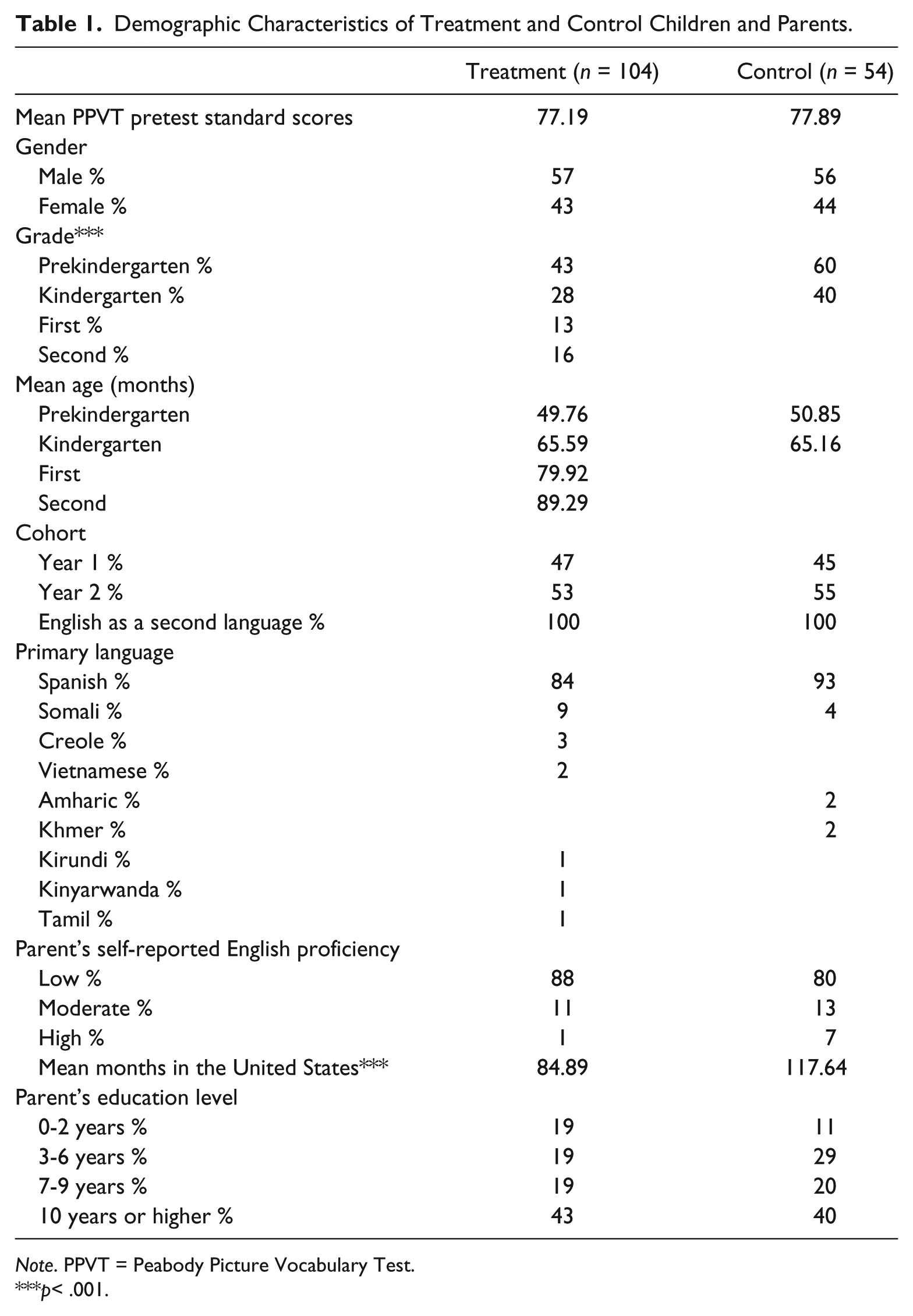
All participants (parents and children) spoke English as a second language; nine different first languages and 18 countries of origin were represented in the sample (see Table 1). There was a wide range in participating parents’ years of education with slightly more than half of TG and CG parents reporting 9 or fewer years of education (see Table 1). There were no significant differences between the proportion of TG and CG parents with each first language, years of education, or English proficiency. However, due to low response rates among CG families, our final CG sample comprised families with greater months in the United States than TG families, TG M = 84.99, CG M = 117.64, t(157) = 3.29, p = .001. For TG parents, hours of participation in the FLP ranged with a mean of 340.88 total hours of attendance. TG parents from both cohorts received instruction from the same teachers implementing the aforementioned instructional model and strategies.
Demographic Characteristics of Treatment and Control Children and Parents.
Note. PPVT = Peabody Picture Vocabulary Test.
p< .001.
There were 158 participating children with the majority of children in preschool through first grade at the study onset. All attended either the district’s early childhood or primary-grade school. Poverty rates for this district were high with mean rates of children eligible for free and reduced lunch across cohorts at 82.3%. Children in TG and CG did not differ in rates of school attendance or in incidence of grade retention. At pretest, on the PPVT, this sample achieved below a nationally standardized sample. For both groups, mean pretest vocabulary scores were equivalent to approximately 1.5 standard deviations below the normative average score of 100. Moreover, there were no significant differences between groups on gender or cohort. However, due to low response rates among CG families, CG comprised only preschool and kindergartner children while TG comprised preschool through second-grade children. There were significant differences between groups by grade (29% of TG children attended first through second, χ2 = 19.56, p< .001). Because of this difference we included grade as covariates in the model specification process and observed no effect. We present demographic characteristics of our sample in Table 1.
Data Sources
Data sources included family and child background information and children’s literacy and language outcomes. Each is described in the section that follows.
Family and background information and FLP program participation
Two data sources were used to gather background information. TG parents completed enrollment forms on FLP entry documenting family demographic data (e.g., ethnicity, years of residency in the United States, years of formal education, first language, country of origin). CG parents completed a questionnaire that sought the same information. English and Spanish versions were available and parents were offered the opportunity to complete the questionnaire with a research assistant.
Phonological awareness and language outcomes
Two assessments were administered to document children’s language and phonological awareness outcomes. The English PPVT-4 (L. M. Dunn & Dunn, 2007), an assessment of English receptive vocabulary and concept knowledge, was administered to assess language knowledge. We administered the English PPVT-4 because our goal was to determine if the vocabulary gap closed between ELLs and monolingual English speakers. Use of a normed measure of English vocabulary knowledge permitted us to compare vocabulary growth in relation to a normative monolingual English-speaking sample. To our knowledge, there were no standardized vocabulary measures in each of the participating children’s first languages available that would allow us to make such comparisons. PPVT-4 Form A was used during fall testing and Form B was used during spring testing. PPVT-4 was administered by research assistants to preschool and kindergarten children attending half-day programs and all primary-grade children (TG n = 90; CG n = 40). Preschool and kindergarten children attending the extended-day program were administered the PPVT-III (L. Dunn, Dunn, Williams, Wang, & Booklets, 1997) by literacy or early childhood specialists as part of the schoolwide literacy assessment program or in accordance with an Early Reading First Grant Award (TG n = 14; CG n = 14). Given the strong relationship between the two versions of the tests (r = .84; L. M. Dunn & Dunn, 2007), the school’s scores were accepted as valid for the purposes of this study. Other research has demonstrated performance on both versions to be comparable (Jara, 2011). The PPVT requires children to select the best visual representation of a spoken target word from a two by two array of pictures. PPVT raw scores were calculated and converted into a standard score in accordance with the testing manual.
The appropriate grade-level version of the English PALS (Invernizzi, Juel, Swank, & Meier, 2003-2005; Invernizzi, Meier, & Juel, 2003-2005; Invernizzi, Sullivan, Meier, & Swank, 2004) was administered to measure phonological awareness. The English version of PALs was administered because all children were receiving instruction in English. As with prior research (Rogers & Helman, 2009), examination in English would allow us to observe the degree of children’s phonological awareness growth in the language in which children were developing their literacy skills. Each test version comprises multiple subtests measuring an array of literacy skills. For preschool children, these include Alphabet Recognition (upper and lowercase combined), Letter Sounds, Beginning Sound Awareness, Rhyme Awareness, and Print and Word Awareness subtest scores. For kindergarten children, these include Individual Rhyme Awareness, Letter Sounds, Individual Beginning Sound Awareness, Alphabet Recognition (lowercase only), Concept of Word (total score), and Total Spelling scores. To examine the particular relationship between vocabulary knowledge and phonological awareness, we calculated a composite of phonological awareness subtest scores for preschool and kindergarten children. This composite comprised the sum of Beginning Sound Awareness and Rhyme Awareness subtest scores for preschool children and the sum of Individual Beginning Sound Awareness and Individual Rhyme Awareness for kindergarten children. The Grades 1 to 3 version of PALS did not include subtests that directly measure phonological awareness and as such we did not include Grades 1 to 3 PALS data in our analyses of phonological awareness growth.
For Cohort 1, phonological awareness and language measures were administered in the fall and the spring of Year 1; for Cohort 2, phonological awareness and language measures were administered in the fall and spring of Year 2. The children who were tested by school personnel as part of the Early Reading First grant program completed the PPVT and PALS within the context of the regular school day. All other testing took place outside of the child’s regular classroom time and was conducted in a quiet and private space within the school setting. In most cases, both tests were administered on the same day within about a 30-min session.
Analytic Process
To determine if gains in children’s vocabulary knowledge and phonological awareness differed by pretest vocabulary knowledge and as a function of parent participation in the FLP, we used ordinary least squares (OLS) regression methods to fit a carefully selected taxonomy of regression models. When analyzing data where participants demonstrate very low pretest scores, regression to the mean is a risk. We accounted for this threat to validity through a design that includes a CG, allowing us to see treatment effects through a significant difference in gains between TG and CG children (Zhang & Tomblin, 2003). We used standardized gain scores (calculated as posttest minus pretest) for each outcome as they permitted analyses with the larger sample and interpretation of effect size. For the PPVT, standard scores also permitted comparisons with a normative monolingual English-speaking sample. A PPVT standard score gain of 15 points represents a gain equivalent to one standard deviation. A gain of 7.5 points represents a gain equivalent to 0.50 standard deviations. If a PPVT pretest standard score was below the mean (100), posttest gains represent a reduction in the performance gap as compared with a normative sample.
For the phonological awareness composite (ZPA; converted to a z score by grade to have a mean of zero and a standard deviation of one), standardized scores permitted us to make comparisons relative to the sample mean. A negative gain z score indicates that children demonstrated less growth relative to the sample mean for that particular grade and does not necessarily indicate that there was a decline in scores from pretest to posttest.
Seven students were missing outcome data due to absence from school or incomplete test administration. In all cases, students were missing data on just one of either the PPVT or PALs. Data appeared to be missing at random and we did not detect any differences between students who were and were not missing data. For students missing pretest scores, we set their score to the mean score for other students in the same grade (Allison, 2001). In the single case of a student missing a posttest score, we dropped this student from analyses. We illustrate our model specification process in Table 3 and Table 5 (each fitted model is listed in order of increasing complexity) and discuss each below.
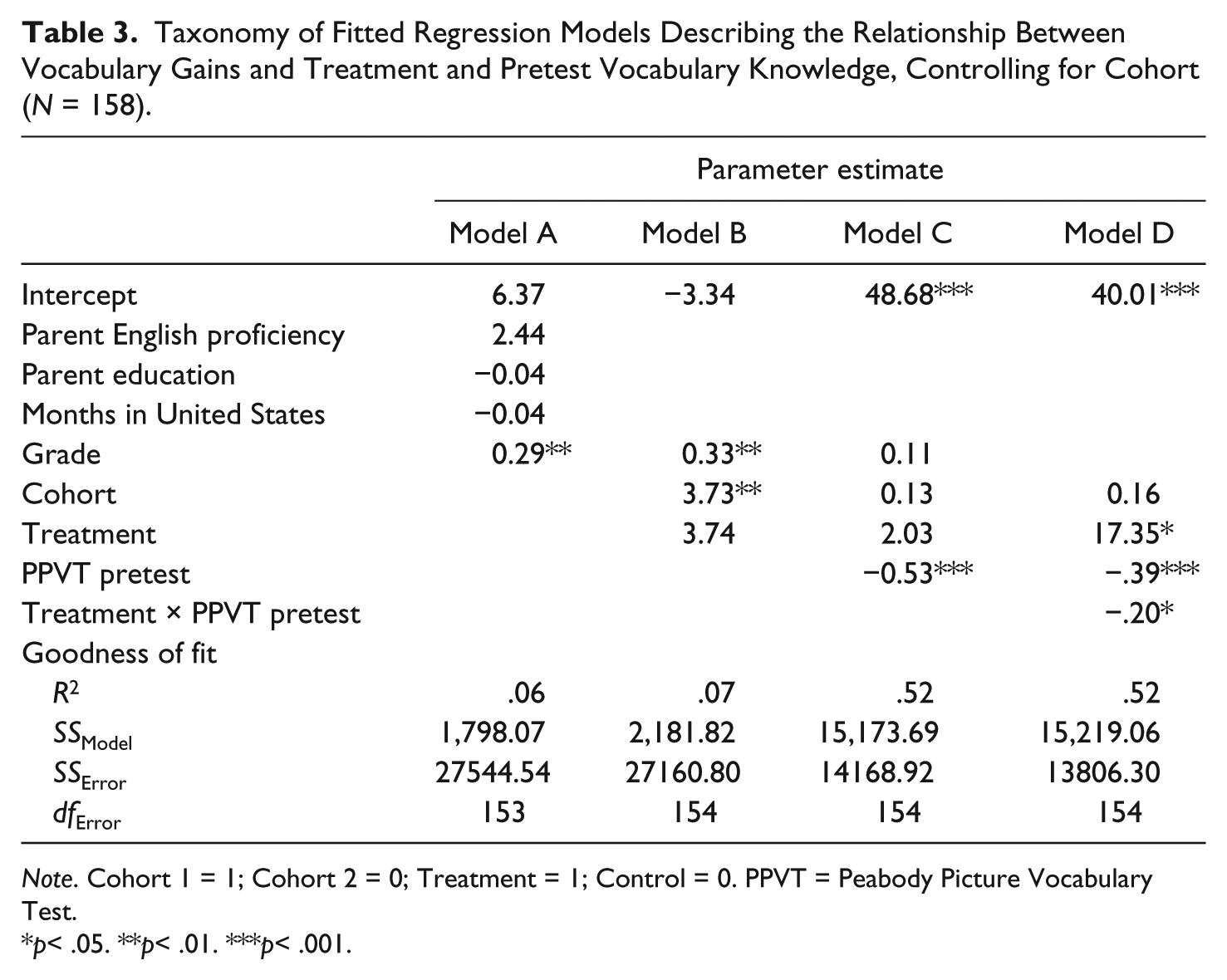
For both outcomes, we specified our models systematically, starting with demographic covariates (parent years of education, parent self-reported English proficiency, months in the United States and children’s grade) as prior research suggests that these covariates may influence children’s vocabulary and phonological awareness performance. We regressed PPVT standard score gains on the demographic covariates and found no statistically significant effects for all covariates except child’s grade (Table 3, Model A). Similarly, we regressed ZPA gains on the demographic covariates and found no statistically significant effects of for all covariates except child’s grade (Table 5, Model A). Thus, we did not include parent education, parent English proficiency, or months in the United States in subsequent models.
To examine effects of the FLP on children’s vocabulary gains, we then regressed PPVT standard score gains on treatment, controlling for cohort and grade to examine the total effect of parent FLP participation on children’s PPVT standard score gains. We controlled for cohort to account for any unobserved differences between cohorts (e.g., differences in the skill of the FLP teacher between Year 1 and Year 2). We observed no effect of grade and therefore did not include grade in subsequent models. Although initially we found no significant effect of treatment (Table 3, Model B), we retained it in the model because it was a central design covariate. Next, we estimated the total effect of pretest vocabulary knowledge, controlling for treatment and cohort and found evidence of a main effect of pretest vocabulary level (Table 3, Model C). Thus, we retained pretest vocabulary knowledge in specifying our final model. In this final model, we estimated the differential effects of vocabulary pretest and treatment by including a Treatment x PPVT pretest interaction (Table 3, Model D).
Because we found statistically significant evidence of differential effects of the FLP on children’s vocabulary gains, we also conducted post hoc GLH tests to determine if the estimated vocabulary gains differed significantly for TG and CG children with varying levels of pretest vocabulary knowledge (PPVT Pretest standard score M = 77.43, SD = 17.88). Using GLH testing allowed us to examine the predicted gains for children with low, middle, and high pretest vocabulary scores (as opposed to examining differences in observed means for each subgroup). By doing so, we maintained the statistical power afforded by the total sample size and brought it to bear on the fitted mean comparison between TG and CG children at specific values of the covariate. We defined low as PPVT pretest standard scores that were one standard deviation or more below the total sample mean (0-60 points, M = 46.00, SD = 17.93); middle as PPVT pretest standard scores within one standard deviation from the total sample mean (61-95 points, M = 78.85, SD = 8.53); and high as PPVT pretest standard scores that were more than one standard deviation above the total sample mean (96-124 points, M = 104.72, SD = 6.84).
To examine effects of the FLP on children’s ZPA gains, we followed the same model specification process as when examining vocabulary gains. We first regressed ZPA on treatment controlling for cohort and grade to examine the total effect of parent FLP participation on children’s gains in phonological awareness and found statistically significant evidence of a main effect of treatment (Table 5, Model B). Next, we estimated the total effect of vocabulary knowledge at pretest, while accounting for treatment, cohort, and grade. We found statistically significant evidence of a main effect of group but not pretest vocabulary knowledge (Table 5, Model C). Although GLH testing confirmed that pretest vocabulary knowledge did not have a statistically significant effect on ZPA gains, F(1, 123) = 0.35; p = .553, we retained pretest vocabulary knowledge as a control in our final fitted model because of the effects on pretest vocabulary knowledge on vocabulary gains and this was the variable of interest.
Results
We first present results of the examination of vocabulary gains followed by the results of the examination of phonological awareness gains. For each set of findings, we provide descriptive statistics to compare observed differences in mean score gains between TG and CG children with low, middle, and high levels of pretest vocabulary knowledge. Then, we describe regression findings and post hoc GLH testing estimating the differential effects of parent participation in the FLP as a function of treatment and pretest vocabulary knowledge.
Differential Effects on Vocabulary Gains
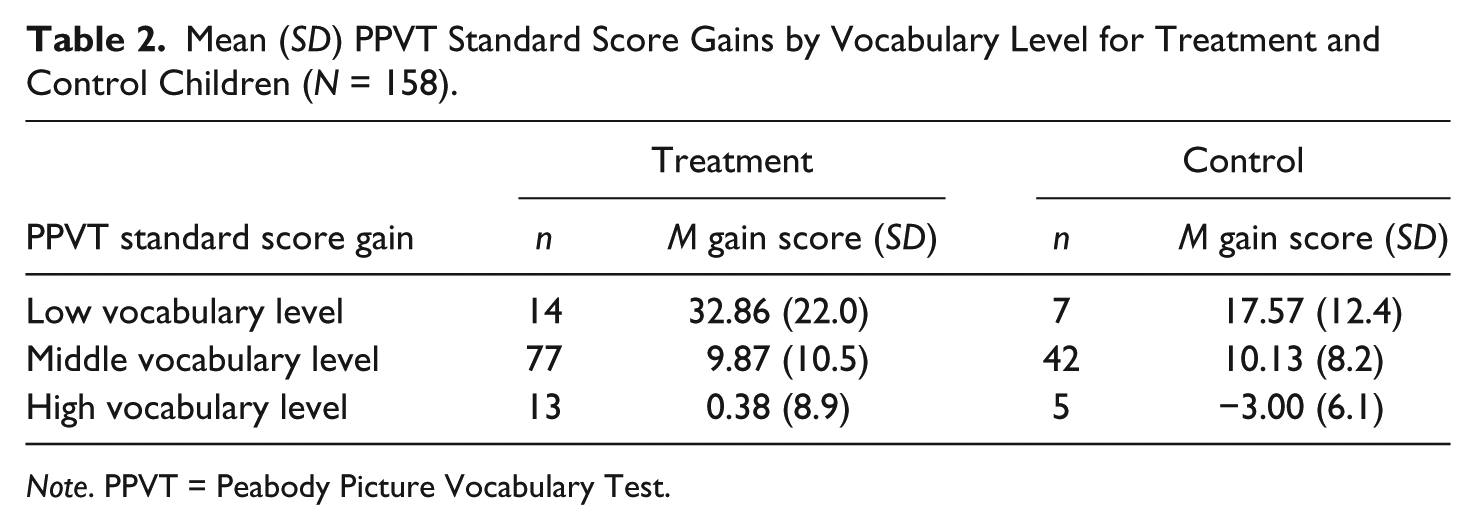
TG children with low vocabulary knowledge achieved substantially larger vocabulary gains than their CG peers, corresponding to 2.19 standard deviations for TG children and 1.17 standard deviations for CG children (Table 2). Gains made for TG and CG children with middle and high vocabulary levels were comparable.
Mean (SD) PPVT Standard Score Gains by Vocabulary Level for Treatment and Control Children (N = 158).
Note. PPVT = Peabody Picture Vocabulary Test.
As displayed in Model D (Table 3), there was a significant main effect of treatment. We estimated that for every point gain achieved by CG children, TG achieved approximately 17 PPVT standard score points (equivalent to 1.16 standard deviations), even when controlling for PPVT pretest scores. Moreover, we found a significant main effect of pretest vocabulary knowledge indicating that on average, children with lower pretest vocabulary scores demonstrated higher vocabulary gains, even when controlling for parent participation in the FLP. Finally, we found that these effects differed as a function of parent participation in the FLP. That is, TG children with lower vocabulary knowledge demonstrated greater vocabulary gains than CG children with lower vocabulary knowledge, above and beyond the total effect of vocabulary knowledge at pretest.
Taxonomy of Fitted Regression Models Describing the Relationship Between Vocabulary Gains and Treatment and Pretest Vocabulary Knowledge, Controlling for Cohort (N = 158).
Note. Cohort 1 = 1; Cohort 2 = 0; Treatment = 1; Control = 0. PPVT = Peabody Picture Vocabulary Test.
p< .05. **p< .01. ***p< .001.
Furthermore, post hoc GLH testing revealed that FLP exerted the greatest effects on TG children with the lowest level of pretest vocabulary knowledge, F(1, 153) = 5.35, p = .022. On average, prototypical (i.e., predicted mean values for the underlying population) TG children with mean low pretest vocabulary knowledge (46.00) achieved gains that were 8.15 points (equivalent to 0.54 SD) greater than CG children with comparable pretest vocabulary knowledge. In contrast, differences in vocabulary gains achieved by children with mean middle and mean high levels of pretest vocabulary knowledge did not differ significantly, F(1, 153) = 0.65, p = .420; F(1, 153) = 1.70, p = .195, respectively. On average, there was a difference of 1.58 points in gains achieved by prototypical TG and CG children with middle pretest vocabularyknowledge (78.85). Similarly, on average, there was a 3.60 point difference in gains achieved by prototypical TG and CG children with high pretest vocabulary knowledge (104.72). In Figure 1, we illustrate differences in PPVT standard score gains.
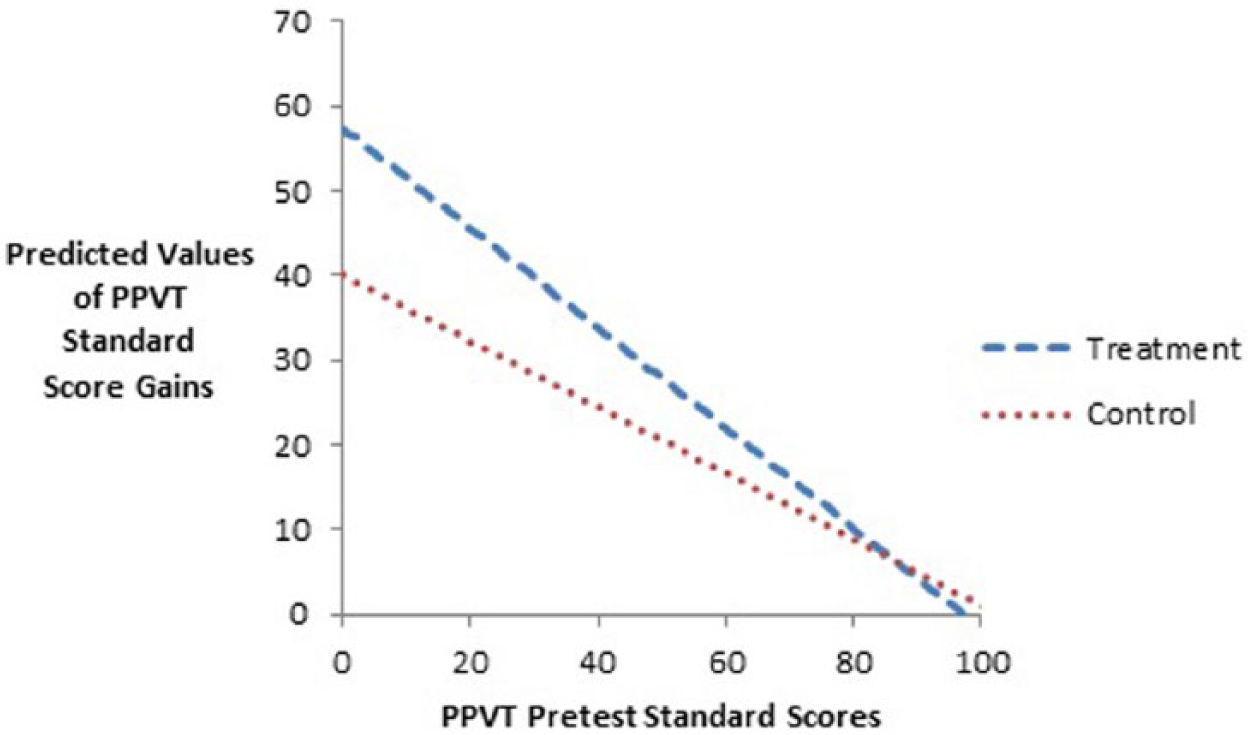
Predicted values of PPVT standard score gains for prototypical treatment and control children, controlling for cohort (N = 158).
Differential Effects on Phonological Awareness Gains
Across vocabulary levels, TG children achieved higher gains in ZPA than CG children and the size of the gains were comparable across all levels of pretest vocabulary knowledge (Table 4). These comparable gains suggest that ZPA performance did not differ by pretest vocabulary knowledge. The difference in ZPA gains between TG and CG children was highest for TG children with high vocabulary knowledge (0.81 SD). The differences in gains between TG and CG children with low and middle levels of pretest vocabulary knowledge were comparable (0.51 SD, 0.39 SD, respectively).
PALS Phonological Awareness Standardized Score Gains by Vocabulary Level for Treatment and Control Children (n = 128).
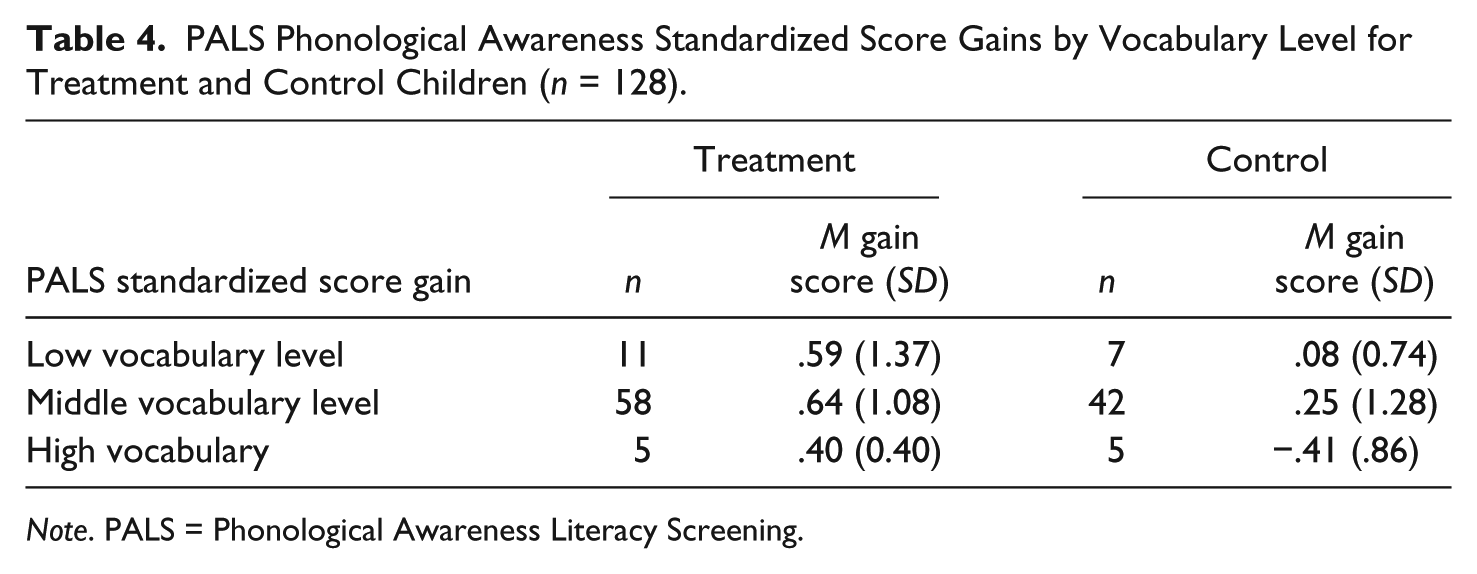
Note. PALS = Phonological Awareness Literacy Screening.
Examination of the estimated slope parameters for treatment (Table 5,Model C) demonstrate that there was a significant main effect of treatment on ZPA when controlling for cohort, grade, and pretest vocabulary knowledge. That is, on average, TG children achieved greater gains in phonological awareness than CG children when controlling for pretest vocabulary knowledge, grade, or cohort.
Taxonomy of Fitted Regression Models Describing the Relationship Between Phonological Awareness Gains and Treatment Controlling for Pretest Vocabulary Knowledge, Grade, and Cohort (n = 128).
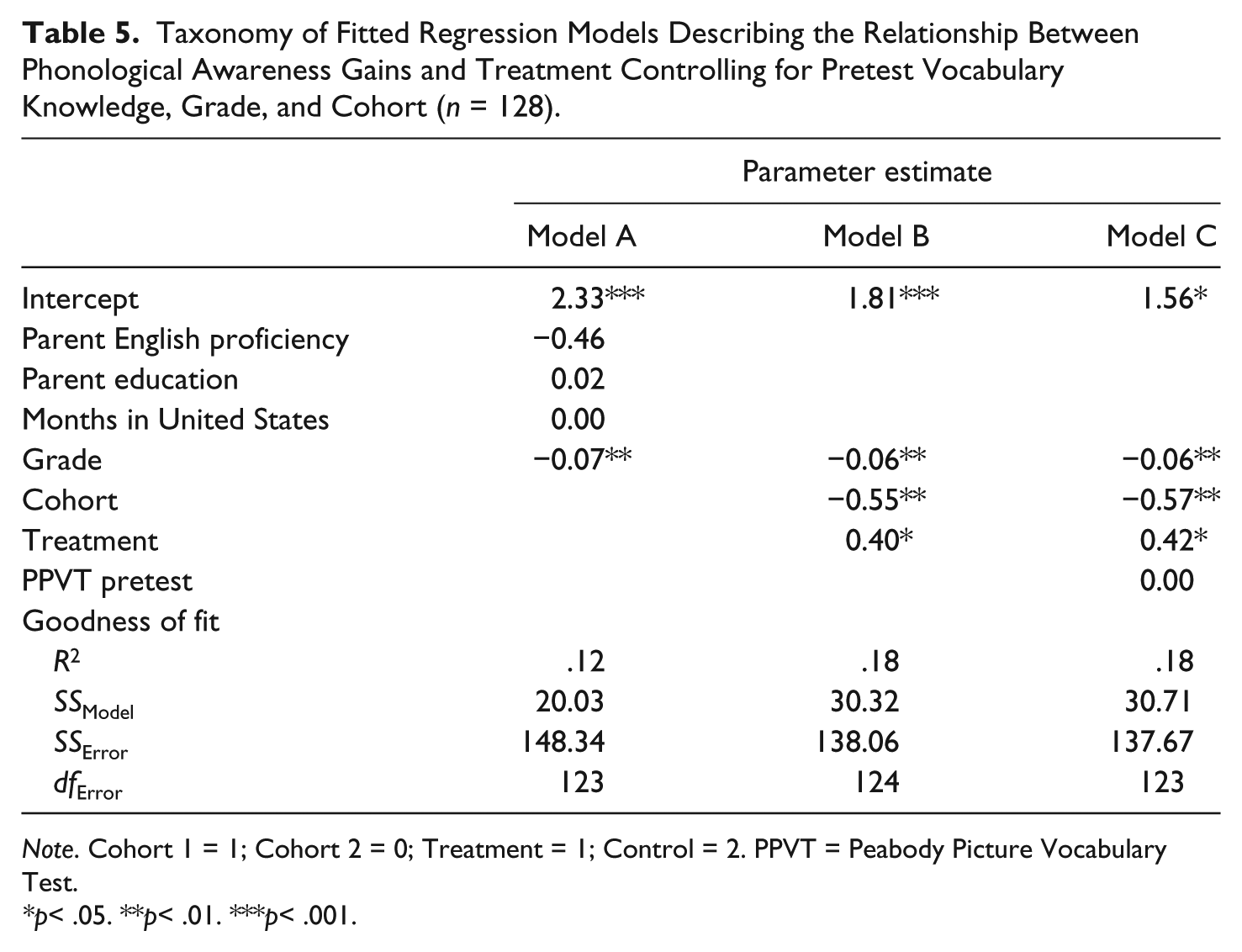
Note. Cohort 1 = 1; Cohort 2 = 0; Treatment = 1; Control = 2. PPVT = Peabody Picture Vocabulary Test.
p< .05. **p< .01. ***p< .001.
Discussion
We began this study with an interest in examining the extent to which an FLP had differential effects on vocabulary and phonological awareness development depending on children’s initial vocabulary knowledge. This work was prompted by evidence that, in the absence of effective of intervention, ELLs from low-income families who begin school with limited English vocabulary knowledge often demonstrate a trajectory of poor literacy achievement (e.g., Mancilla-Martinez & Lesaux, 2010, 2011). In addition, we were guided by evidence suggesting the promise of family literacy interventions to support children’s literacy and language development. Through this analysis, we sought to understand more fully the contribution of an FLP on vocabulary development for ELLs at-risk of poor literacy achievement.
We studied two groups of children: a TG group whose parents were enrolled in the FLP and a CG group who were demographically similar but whose parents were not FLP participants. Children in both groups resided in high-poverty households with parents who had immigrated to the United States. All children attended the same school district and received classroom instruction based on the same instructional principles and framework. All children were ELLs and, on entry, performed, on average, 1.5 standard deviations below the national mean on a test of English vocabulary knowledge. Parents of TG children were enrolled in an FLP that placed equal emphasis on improving adult literacy and language abilities and supporting the types of parent–child shared literacy interactions that are known to prepare children for school-based success. Most of the parents self-reported having limited English proficiency.
Results indicated that overall, TG children achieved greater gains in vocabulary than CG children; and the largest effects on vocabulary development were observed when comparing TG and CG children with the lowest vocabulary knowledge at the study outset (equivalent to 3.8 standard deviations below a normative sample). Observed vocabulary gains on a standardized measure of vocabulary knowledge for children with the least amount of vocabulary knowledge were large (equivalent to 2.19 standard deviations), thus representing a substantial decrease in the vocabulary gap between them and a normative sample. Across vocabulary levels, TG participants outperformed their CG peers on measures of phonological awareness. However, gains in phonological awareness did not differ as a function of children’s pretest vocabulary knowledge.
To understand and explain the effects the FLP exerted on children’s literacy and language development, we turn first to the bioecological theory of human development (e.g., Bronfenbrenner & Morris, 2006) and the role the context of this particular FLP might have had in mediating children’s literacy and language development. Bronfenbrenner and Morris explain that children develop within a complex system of relationships affected by multiple contexts (i.e., immediate contexts such as family and school and remote contexts such as educational policy): Especially in its early phases, but also throughout life course, human development takes place through processes of progressively more complex reciprocal interactions between an active, evolving biopsychological human organism and the persons, objects, and symbols in its immediate external environment. To be effective, the interaction must occur on a fairly regular basis over extended periods of time. (p. 797)
The FLP we studied emphasized complex reciprocal interactions between and among FLP instructors, parents, their children, and their children’s teachers over an extended period of time. Although instruction was entirely situated within a school-based context, FLP classes were routinely structured around texts and discussions that emerged from families’ out-of-school experiences. Texts were deliberately selected to respond to parents’ requests to investigate and discuss pressing social issues that challenged this particular group of families (e.g., housing, food security, health care, personal safety, child rearing, interacting with their children’s teachers). As parents explored ways to support their children’s academic learning, the focus was systematically on situated practice in homes and communities, as parents were prompted and guided to explore ways to engage their children in rich language and literacy experiences during everyday events such as meal time, walking to and from school, running errands, playing, religious activities, and bedtime. In addition, the FLP was deliberate in introducing parents and children to new routines and practices that are known to map on to the demands of the children’s classroom literacy programs (e.g., helping children with homework, shared parent–child book reading, or engaging children in extended conversations using sophisticated and interesting language). Although we did not study parents and children in their home contexts, we know anecdotally from literacy logs in which parents recorded their out-of-class literacy activities that they made clear attempts to engage in literacy events on their own and with their children in the course of their daily activities.
Although CG parents expressed interest in attending the FLP, and by so doing demonstrated a certain disposition toward improving their own and their child’s English literacy and language development, they did not have access to the same authentic and comprehensive guidance to negotiate the complex systems of homes, schools, and communities. Thus, even if they sought to support their children’s schooling by being responsive to school requests, such as homework help or attendance at school meetings, they may not have had specific knowledge about ways to situate literacy and language learning within their family and community systems or specific knowledge about how to negotiate the systems of classrooms and schools. Given that TG children with the lowest vocabulary knowledge achieved significantly larger vocabulary gains than their CG counterparts, it may have been the case that the FLP achieved the sought-after changes in children’s home ecologies to the advantage of their children’s English vocabulary development. That is, the FLP may have supported or increased incidences of complex reciprocal literacy interactions between TG parents and children, whereas in the absence of FLP guidance, this was not the case for CG parents and children. We can only speculate such differences were present as we did not document or compare the home literacy contexts of TG and CG participants at the outset nor did we directly measure changes in home ecologies. Future research is needed to test the assumption that these changes occurred and, if so, to examine the precise nature (i.e., quantity and quality) of the changes, the ways that parents situated literacy events within family routines, and the contributions of particular events and routines to differences in language and literacy growth.
Although we can conclude that findings in the present study are consistent with theory on development from a bioecological perspective (Bronfenbrenner & Morris, 2006) and with previous FLP research documenting large vocabulary gains for ELLs (Roberts, 2008; Zhang et al., 2010), we wondered about the differences between our study and others relative to the function of initial vocabulary size. Recall that we found that children with very low English vocabulary knowledge achieved significantly larger gains than children with more English vocabulary knowledge contrasts with evidence from other studies; van Steensel et al. (2011) and Roberts (2008) found that vocabulary gains associated with family literacy interventions did not differ as a function of initial vocabulary size.
To make sense of these different findings, we considered differences in the participants across these studies. Studies examined by van Steensel et al. included a very small representation of ELLs; as such, their conclusion may not generalize to the underlying population of ELLs. Children studied by Roberts (2008), however, were all ELLs from low-SES families. One possible explanation for a significant differential effect of the FLP on language outcomes in our study but not in Roberts is sample size. It may be the case that Roberts’s sample size (N = 33) did not have the power to study associations between initial vocabulary size and language gains. A second possibility may be that the profiles of children in these studies differed in terms of their pretest vocabulary knowledge. The subsample of children we studied with low vocabulary knowledge demonstrated substantially lower initial English vocabulary knowledge as compared with the children Roberts studied (MPPVT = 46, MPPVT = 68, respectively). Instead, the subsample of children we studied with middle vocabulary knowledge appear to more closely reflect the children Roberts studied in initial vocabulary size and growth. Mean initial vocabulary size for children we studied with middle pretest vocabulary knowledge was 78 standard score points and mean initial vocabulary size for the children Roberts studied was 68 standard score points. Thus both groups of children gained approximately 10 standard score points. Had Roberts included participants with substantially lower vocabulary levels, she may have observed similar differences in learning gains.
A third possibility could be related to differences in the FLPs. The FLP model employed by Roberts involved training parents to employ read-aloud practices for texts that were also read aloud to children at school. As noted previously, the FLP model we studied reflected a broader focus that included ecologically valid home literacy practices (e.g., direct parent–child interactions around literacy tasks such as reading aloud storybooks, talking about other literacy activities such as cooking or shopping, using literacy for reading and writing notes and grocery lists) as well as school-based literacy practices (e.g., read-aloud practices, language play, supporting homework) to support parent and child intergenerational literacy and language growth. Given the differences in each study’s sample, one explanation is that children with very low vocabulary knowledge might have benefited from an FLP model that emphasized more situated practice, whereas, children with less limited vocabulary knowledge (i.e., middle levels of vocabulary knowledge) might have benefited from a primary emphasis on storybook reading practices at home and at school (similar to that studied by Roberts).
Finally, an explanation for the different findings may rest in the selection of the shared storybooks. In Roberts’s study, books used at home and at school were the same; in the FLP we studied, parents chose at-home books to read. Although establishing coherence between home and school literacy practices is generally regarded as a hallmark of effective practice (Páez et al., 2011; Roberts, 2008), in this case, use of at-home books different from those used in the classroom may have served to expose children to a broader range of vocabulary and concepts, and by doing so, extended their opportunities to learn. This explanation would be consistent with the finding that children in classrooms who participated in wide reading outperformed (on comprehension measures) their peers who participated in repeated readings (M. R. Kuhn et al., 2006)
In sum, we can only speculate about the particular reason for differences in the finding that children with high and low vocabulary knowledge experienced varied effects from an FLP. However, given the evidence at hand, we believe it is fair to conclude that the differential effect we observed is a trustworthy finding. Understanding precisely what contributed to these differences will require further research with attention to contribution of factors such as coherence in home and school, shared storybooks, and ecologically situated literacy events versus school-like literacy events.
Considering Rival Explanations and Limitations
Although we are encouraged by these outcomes, we acknowledge that our findings could be explained by factors other than the mediation effects of the FLP. There are four factors that had the potential to threaten the trustworthiness of our findings: (a) the nature of the CG, (b) the use of data from cohorts from 2 different years, (c) different grade levels and different classrooms, and (d) the use of English-only assessments. We believe we took adequate steps to minimize potential confounding from each of these factors, such that our findings can be accepted as trustworthy. In this section, we describe those steps.
Nature of the TG and CG
TG and CG were formed from a group of parents participating in the FLP and a group not participating. One could argue, then, that the formation of these groups was fatally flawed because of a difference among TG and CG parents in their disposition toward issues such as learning aspirations for themselves or their children or parents’ roles and responsibilities related to their children’s schooling. We controlled for this threat by identifying CG participants from a population of parents who had applied for enrollment in the FLP, were interviewed by FLP faculty to confirm eligibility, and then placed on a waiting list. (This is the FLP’s routine procedure and is unrelated to study procedures.) Thus, we could expect that CG participants had a disposition toward parent and child learning and parent involvement similar to that of their TG peers. One could also argue that despite similar dispositions toward educational aspirations and parent involvement, residents of this community are particularly diverse, and pairs may have varied on consequential demographic and academic characteristics. We minimized this threat by matching TG–CG pairs on three characteristics: country of origin, first language, and parental education. In addition, we included months in the United States in our model specification process and observed no effect.
Cohort data from two different years
Our cohorts were formed from parents participating in the FLP from two different years and, as such, there may have been variability in FLP instruction and fidelity. Although we believed that this confound was minimized because the same FLP curriculum was carried out by the same instructors during both years, we retained cohort as a control covariate and observed no effect.
Differing grade levels and classrooms
Outcomes could have been influenced by effects of either differing grade levels or differing school-based programs children received. Relative to different grade levels, we considered the possibility that, because TG children comprised preschoolers through second graders and CG children comprised preschoolers through kindergartners, TG’s vocabulary growth could be accounted for by greater exposure to English in school and the community. We took two steps to account for this possibility. First, we included grade and months in the United States as covariates in the model specification process and found no effect of either covariate. Second, we used standardized scores that were calculated based on children’s age to account for potential confounding resulting from a sample of differing ages.
We also considered the possibility that differences in outcomes might have been accounted for by differences in the quality and type of curriculum in different classrooms. As we designed the study, we reasoned that potential differences based on the classroom curriculum and practices would be minimized because at each grade level, teachers used a mandated, scripted curriculum for a specified time period each day. In addition, as part of the school district’s policies and routines, its literacy leaders systematically visited classrooms to monitor the quality of instruction and its fidelity to the school’s instructional model and curriculum. After the conduct of the study, to account for potential differences in instructional programs across grades, we included grade level in our statistical modeling and observed no effect.
English-only assessments
We used measures of English vocabulary knowledge and phonological awareness rather than measures in L1. We recognized at the outset that the PPVT-4 was normed on English-speaking populations and as such it might not provide a true representation of children’s total vocabulary knowledge at pre- and posttest. However, our purpose was to determine if the FLP closed the vocabulary gap between ELLs (representing nine different primary languages) and monolingual English speakers. Because, to our knowledge, there were no standardized measures of first language proficiency for all languages represented in our sample, use of a measure normed on an English-speaking sample allowed us to make such a comparison. We also recognized that measuring phonological awareness in a child’s first language would provide us the truest representation of a children’s phonological awareness. However, because both TG and CG children, all of whom were ELLs, received classroom instruction entirely in English, use of an English assessment permitted us to measure growth in the language in which children were developing their literacy skills. We also standardized outcomes for phonological awareness by the mean by grade for participating children and thus allowed us to examine phonological awareness growth relative to our sample.
We also wondered if it might be the case that the differences we observed were independent of the FLP intervention and instead could be attributed to the possibility that children with the lowest levels of English vocabulary knowledge were acquiring English labels for words known in L1, a task that is easier than acquiring vocabulary for concepts unfamiliar in both L1 and L2. However, for that explanation to be accepted, we would have seen equal gains among TG and CG participants, and we did not. Children whose parents participated in the FLP achieved significantly greater gains than CG peers.
It is important to note that rates of parent attendance varied widely, both in total number of hours completed and in the length of time. We acknowledge this as a limitation in understanding precisely the relationship between hours of attendance and children’s literacy and language growth, but we argue that in comparing the TG and CG, the overall question we posed was simply if the intervention had an impact. These findings suggest that it did. Future studies should examine the question of dosage—how many hours over what length of time leads to optimal outcomes.
Significance
When we consider these findings in light of early literacy and vocabulary research, we find that the vocabulary outcomes suggest particular promise. Studies (e.g., Paris, 2005, 2011) show that early literacy skills (e.g., phonological awareness, alphabet recognition, alphabet knowledge) are generally easily acquired with effective instruction. However, accelerating vocabulary growth is a much more complex endeavor (Dickinson, Freiberg, & Barnes, 2011) and evidence-based interventions targeting word learning within the school context have not been successful in closing the vocabulary gap (e.g., Marulis & Neuman, 2010; Penno et al., 2002). Because of such challenges and the multifaceted and cumulative manner in which word knowledge affects reading achievement, interventions demonstrating accelerated vocabulary learning have substantial significance—a significance that may extend beyond the effects demonstrated in this study as existing knowledge anchors new knowledge making it easier for children to acquire additional knowledge (Alexander & Jetton, 2000; Duke, Pearson, Strachan, & Billman, 2011). As such, children with accelerated vocabulary learning may be well-situated for more rapid vocabulary growth, which, in turn, may promote additional reading development and word learning (Perfetti, 2007; Stanovich, 1986). Findings from Paratore et al. (2011) show significantly more children whose parents participated in an FLP were reading at or above grade level than CG children, which lends support to this interpretation.
Results suggest that FLPs that foster complex and reciprocal interactions with authentic literacy and language activities between parents and children may hold particular promise in supporting substantial vocabulary growth for low-income ELLs with large vocabulary gaps. In addition, although children with both substantial and moderate vocabulary gaps achieved gains, children in other studies (e.g., Roberts, 2008) suggest that a less comprehensive intervention (e.g., focusing specifically on storybook reading practices) may be an equally beneficial intervention for those with smaller vocabulary gaps. These findings may hold implications for the ways funds and resources are allocated as we strive to meet the diverse needs of families and children. For example, FLPs designed for families of children with very limited English vocabulary knowledge may require greater resource allocation and intensive and comprehensive intervention similar to the FLP we studied. This FLP offered parents a minimum 8 hr a week for 12 weeks, focused on authentic and situated literacy practice, and provided explicit instruction. Whereas in contexts where children are more rapidly developing vocabulary knowledge (similar to those we studied with middle vocabulary knowledge or those studied by Roberts, 2008), less intensive programs involving brief training with storybook reading practices to support complex and reciprocal interactions requiring fewer resources may be sufficient.
Conclusion
In sum, the differential effects demonstrated in this study suggest that FLPs that focus on effective and frequent use of activities such as shared book reading and language play in contexts that build on ecologically valid family routines can make a meaningful contribution to closing the vocabulary gap that is often evident on school entry and typically widens in subsequent years. If these findings hold on further examination, then, there are some important implications. To better support young children’s literacy and language development, policy makers and program developers will need to broaden conceptions of how to support young children’s literacy development to contexts beyond school. This includes developing and instantiating educational policies and practices that effectively support families with diverse backgrounds and learning profiles in fostering home literacy experiences that promote their children’s literacy development.
Footnotes
Appendix
Sample Daily Routines
| 8:30-8:45 | Literacy logs |
| Parents keep at-home literacy logs documenting family literacy events and other topics of interest | |
| Parents share their logs with each other in small groups | |
| 8:45-8:55 | Preview daily text (adult text or children’s book) |
| 8:55-9:15 | Whole group text introduction |
| Activate parents’ background knowledge to support connections with text topic | |
| Build knowledge through explicit instruction of key vocabulary | |
| Share text (all or part) through read aloud | |
| 9:15-10:15 | Small-group reading and discussion |
| Parents reread text (all or part) in small groups | |
| Small-group discussion of book | |
| Writing response | |
| 10:15-10:25 | Whole group wrap-up and discussion to generate new topics |
| Discussion of focal text | |
| Discussion and identification of next topic for exploration |
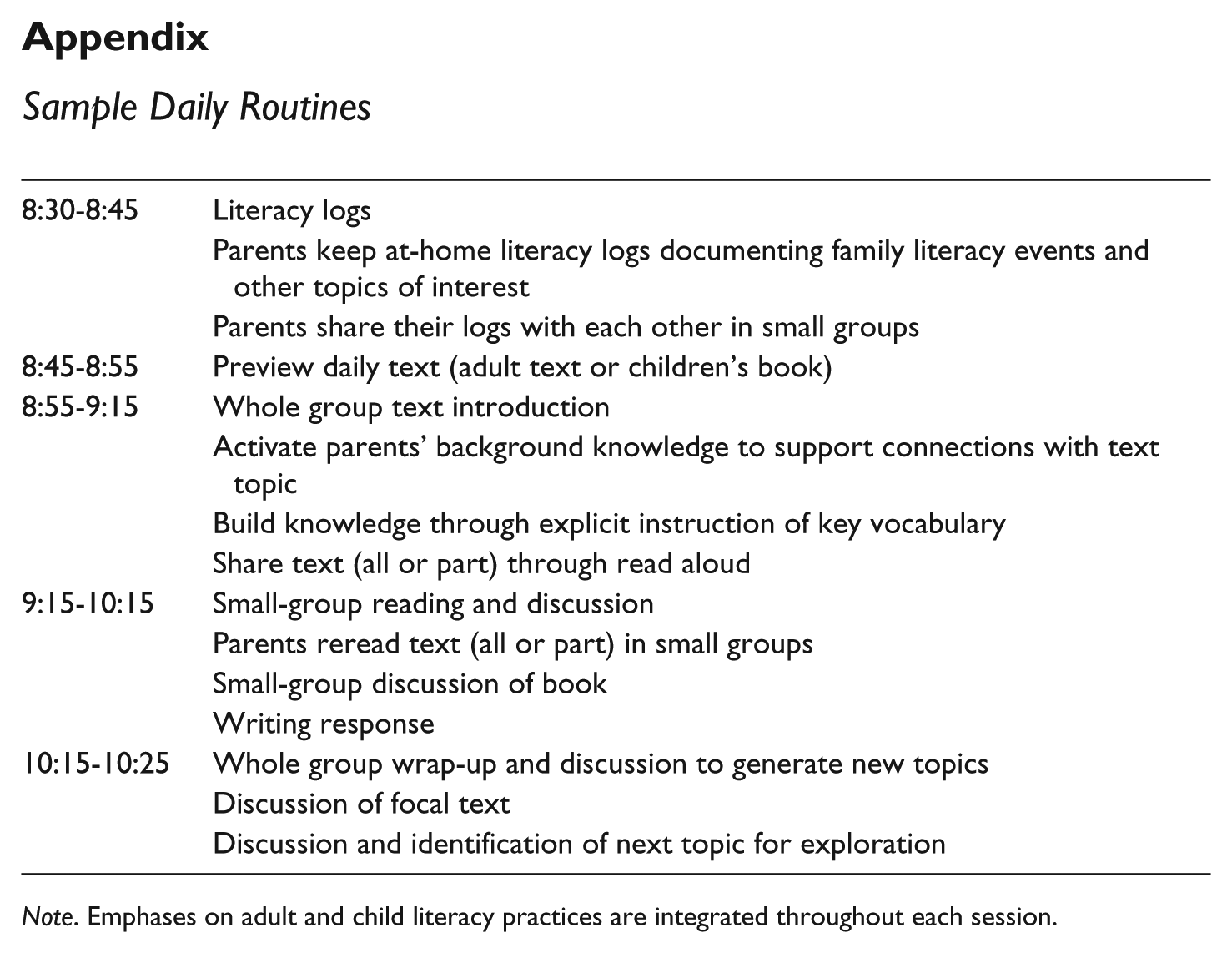
Note. Emphases on adult and child literacy practices are integrated throughout each session.
Declaration of Conflicting Interests
The authors declared no potential conflicts of interest with respect to the research, authorship, and/or publication of this article.
Funding
The authors disclosed receipt of the following financial support for the research, authorship, and/or publication of this article: This project was funded by Nellie Mae Education Foundation, grant number: 98285