




Abstract
Scaffolding is widely referenced in educational literature and practice, in literacy education in particular, but often in reductive ways. Scaffolding is key for diverse youth in high-need settings, but few studies examine complexities and tensions of scaffolding in practice. This study asked how, if at all, teachers at a California high school with a mission to prepare urban, low-income, mostly Latina/o youth for academics and college admission enacted scaffolding to help students, many of them English learners, achieve academic goals. Drawing upon school and classroom data collected over a year and a half, including videorecorded observations, interviews, and student work samples, the study used observation instruments and qualitative analyses to answer questions using two teacher cases.
Considering scaffolding for whom, teachers supported students they hoped to see achieve but whom they felt needed many supports, given histories of low test scores and some academic failure. In scaffolding for what purpose(s), much attention was devoted to scaffolding basic and intermediate levels of literacy activity, with less evidence of scaffolding disciplinary literacy and higher-order thinking. For scaffolding how, planned scaffolds of sequenced activities dominated, with promising examples of interactional scaffolds. One teacher case illustrates routine support, while the second illustrates scaffolding aligned with core elements of contingency, fading, and transfer of responsibility and with use of sociocultural dimensions of learning. The study highlights promise and tensions in scaffolding learning for Latino/a students in one urban public high school, with implications for teaching youth of color in low-income settings, teaching English learners, and preparing teachers for this work.
Alumni come back and tell us, “You held our hand too much.” Students we have tell us, “You don’t hold my hand enough.” So translate holding hands to scaffolding and you get the tension that the teachers have to balance and struggle with and fight with. How much is too much? How much is not enough? They’re not going to be ready for college. They’re going to get to college and not be able to do this.
Alexis is reflecting on scaffolding at Urban College Academy (UCA), a California public charter high school with a mission to prepare urban, low-income, mostly Latina/o youth for academics and college admission. Alexis names a tension she and other UCA teachers reported: a need to scaffold amply while also transferring control of learning to students in anticipation of more independent work once in college. Her description of this tension—teachers must struggle and fight with it—marks its intensity, due in part to an urgency teachers found in trying to gauge the degree of scaffolding needed for many students who entered high school 3 to 4 years below grade level in language, literacy, and mathematics. Alexis’ holding hands analogy also highlights her caring. She spoke of commitment to social justice education, to teaching urban Latina/o youth, and to the UCA mission. However, she and similarly committed colleagues worried if their scaffolding was appropriate. These are themes we explore regarding scaffolding at UCA.
This research is part of a project investigating promising practices in three California high schools demonstrating some success in meeting the needs of Latina/o youth in low-income urban communities. Latina/os are the largest growing population in the United States, accounting for more than half the total U.S. population growth between 2000 and 2010, with California, site for the present study, accounting for 14 million, or 28% of the total Hispanic 2 population in the United States (Ennis, Rios-Vargas, & Albert, 2011). In California, more than half of all preK-12 public school students are Hispanic (National Center for Education Statistics [NCES], 2011). Also, English learners (ELs) in public schools, who receive assistance in developing English language proficiency, are 10% of the U.S. public school population, with nearly 29% of California public school students classified as ELs (NCES, 2011) and 85% of these speaking Spanish in their homes (Hill, 2012). On most measures of academic performance, Latina/os lag behind especially White and most Asian American students, with Spanish-speaking ELs performing far below their non-EL counterparts and needing strong links between academic and EL instruction (Hill, 2012). In addition, the Latina/o high school drop-out rate in California for 2007-2008 was 26%, compared with 12% for White students (California Department of Education [CDE], 2009).
Against this backdrop, UCA’s goals of academic success and college admission required faculty dialogue. In the process of exploring ways to engage students in academic activity and to accelerate student learning, school leaders and teachers agreed on a need for lots of instructional support. To address such support, scaffolding emerged as a key theme in UCA’s discourse and professional development. For the present study, we sought to understand how, if at all, UCA teachers took up a focus on scaffolding to help students achieve academic goals. Scaffolding as a construct is widely used in educational literature and practice but often in reductive ways. We need to know more, in more nuanced ways, about scaffolding for diverse youth in high need settings. Our study responds to this need, asking this research question:
Three sub-questions focused on (a) Scaffolding for whom? (b) For what purposes? and (c) How? We also inquired into teachers’ tensions in scaffolding the learning of UCA students, as reflected in Alexis’ opening quote. We focused our study on contrasting cases of two teachers, Alexis and Consuelo. Both took up the UCA goal of providing much instructional support to students. However, the ways Alexis did so is what we are calling routine support, while Consuelo’s support practices more closely align with current conceptions of instructional scaffolding. We also examine the implications of this difference.
Theoretical Framework: Scaffolding for Whom, for What, and How?
Our framework draws upon research on teaching and learning, scaffolding, and literacy. Building on Vygotsky’s (1962) zone of proximal development (ZPD), scaffolding typically targets the gap between current performance and levels learners may reach without assistance (Wood, Bruner, & Ross, 1976). Effective scaffolding may reduce cognitive load (Hmelo-Silver, Duncan, & Chinn, 2007). The construct of scaffolding originated in studies of tutoring, drawing upon work on caregivers’ attention to children’s learning, then navigated into classroom research and practice. Moving from dyadic tutoring to full-class instruction yielded possibility and many questions (Applebee & Langer, 1983; Langer & Applebee, 1986; Pea, 2004; Stone, 1998b).
Reviewing a decade of relevant research, van de Pol, Volman, and Beishuizen (2010) found that three instructional conditions must be met to align with core scaffolding constructs. First is contingency, which involves responsiveness to learners and their performances and needs. In reading, a contingent view reveals decisions teachers make moment-by-moment about the kind, level, and amount of help to provide at points of difficulty (Rodgers, 2004). Second is fading or gradual withdrawal. As learners gain capacity, teachers may fade scaffolding, inviting learners to strive for ultimate goals with fewer deliberate supports in place. Fading has not been widely explored in empirical studies (Pea, 2004). Third is transfer of responsibility to increase learner control. For scaffolding to occur, “the teacher must apply scaffolding strategies that are clearly contingent (i.e., based upon student responses). This support must be faded over time with, as a result, increased student responsibility for the task at hand” (van de Pol et al., 2010, p. 275, italics added). Also needed are diagnostic strategies to reveal students’ conceptions (van de Pol, Volman, & Beishuizen, 2009). Without these, routine supports may be inappropriate for students’ current understandings.
The scaffolding metaphor has lost power due to a focus on constructing stable edifices, rather than reciprocal interactions, communication dynamics, and conceptual reorganization that occurs (Stone, 1998a). Scaffolding requires moving beyond routine support to adaptive teaching, being able to assess and redirect literacy activity, and adding tailored supports, with meaningful rationales for innovation (Athanases, Bennett, & Wahleithner, in press; Duffy et al., 2008; Parsons, 2012). If supports are not adjusted, students may complete tasks robotically or disengage due to micro-level activity not situated in larger contexts and purposes. Worksheets targeting specific needs can be useful in an instructional toolkit but problematic if they dominate or get disconnected from larger purposes. Scaffolds may need more than a task focus, with attention to weaving in skills and knowledge from elsewhere, to recontextualize a literacy event as meaningful (Dyson, 1990). Even direct instruction can be used strategically and effectively as scaffolding when, for example, it follows students’ engagement in inquiry activities (Schwartz & Bransford, 1998). Scaffolding needs to be person- and context-specific, sensitive to learner intentions and cultural and literacy resources (Dyson, 1999).
Sociocultural learning theory highlights two elements particularly salient in scaffolding. The first is that instructional assistance attends to particular students in class, their cultural and linguistic resources, and funds of knowledge (Moll, Amanti, Neff, & Gonzalez, 1992). This may include connecting forms of literacy from the “first space” of home and community with the “second space” of formal school practices to construct a third space in which often marginal forms and processes of literacy get repositioned (Gutiérrez, Baquedano-Lopez, & Tejeda, 1999; Lee, 2007). Scaffolding also needs in-the-moment adjustments to ways in which learning unfolds in real time. Learning is not a stable process but is ever changing, and effective assistance needs to keep pace to guide expansive learning (Engeström, 2001). These various issues frame a set of questions we sought to answer through analyses we conducted of scaffolding practices at UCA.
Scaffolding for Whom?
The first question is scaffolding for whom? Scaffolding practice often assumes one size fits all, problematic for heterogeneous classes where students’ ZPDs on a task vary widely. The need to gauge ZPDs for many youth of color in low-income schools can be even greater, given histories of educational inequities. From its origin, scaffolding considers differentiated support, challenging when considering varied learning preferences and needs of culturally and linguistically diverse youth. Teachers construct students as particular learners, sometimes expecting success or failure based on community or school culture expectations (Varenne & McDermott, 1998). This impacts the scaffolds teachers use and how they use them. Often scaffolding assumes deficit perspectives on youth of color and ELs (Walqui, 2011), that they have no cultural or linguistic resources to tap, and that they are not individual, agentive learners (Dyson, 1999). Diversity of learners calls for varied kinds and degrees of scaffolding, for different times and purposes.
Youth from non-dominant communities, including youth of color and ELs, benefit from particular kinds of support for learning. First, as we noted, culture and language enable students to build on prior knowledge by accessing cultural and linguistic resources (Au & Kawakami, 1994; Bruer, 1994; Irvine, 2002; Ladson-Billings, 1995; Moll et al., 1992; Sawyer, 2006; Valenzuela, 1999). Collaboration enables community building, joint productive activity, and instructional conversations where students co-construct knowledge (Brown & Campione, 1990; Ladson-Billings, 1994; Lave & Wenger, 1991; Sawyer, 2006; Vygotsky, 1978). Code breaking teaches disciplinary, linguistic, and cultural codes of academic learning (Schleppegrell, 2004; Valdés, Bunch, Snow, & Lee, 2005). Code breaking can support academic achievement, helping students gain access to the culture of power (Delpit, 1988).
For ELs, culture and language, collaboration, and code breaking are ideal reservoirs for scaffolding (Gibbons, 2002; Lucas & Villegas, 2010; Walqui, 2011). Supports include students’ native language (Faltis, Arias, & Ramirez-Marin, 2010; Téllez & Waxman, 2006); extralinguistic resources, text and oral language modifications, and explicit instructions (Lucas & Villegas, 2011); differentiation by language proficiency level (Lucas, Villegas, & Freedson-Gonzalez, 2008); and multimodal strategies (Gibbons, 2009). Collaboration can support academic English development (Wong-Fillmore & Snow, 2005), with flexible grouping structures and interactions with fluent English speakers (Faltis et al., 2010; Rumberger & Gándara, 2004). Code breaking for ELs includes support for comprehending complex texts (Gibbons, 2009) in different content areas that include different language demands (Bailey & Butler, 2002) and explicit attention to language form and function (Schleppegrell, 2004) assessed through multiple means (de Oliveira & Athanases, 2007).
Scaffolding for What Purposes?
Our second question is scaffolding for what purposes? In literacy, scaffolding may target basic literacy routines (reading fluency, note-taking structures); intermediate, generic academic literacy work (e.g., comprehension strategies); and disciplinary targets (e.g., learning to think like an historian, mathematician, literary critic) (Shanahan & Shanahan, 2008). As standardized testing has eclipsed pedagogical decision making, teachers increasingly focus on basic literacy routines, skills, and test preparation to the detriment of larger literacy activity and language production (Enright, Torres-Torretti, & Carreón, 2012; Stillman, 2011). Scaffolding discrete literacy tasks separate from larger purposes signals a problem of intentionality (Langer & Applebee, 1986).
There is particular danger in teaching diverse youth and particularly ELs of focusing on just discrete tasks, basics, vocabulary, mechanics, and language errors, minimizing attention to content knowledge development (Bartolomé, 1998; Bruna, Vann, & Escudero, 2007; Mohan & Slater, 2006; Valdés et al., 2005). Such work can lead to intellectually impoverished curricula, instead of casting work with ELs and others as high challenge, high support (Hammond, 2006). In addition to a focus on larger goals, another answer to scaffolding for what purposes is prolepsis (Cole, 1996), linking future actions with the present, or placing the end in the beginning. Teachers can design activity so students access rich potential of larger goals within focused present action.
Scaffolding How?
Our third question is scaffolding how? Means of scaffolding include planned supports (prior knowledge, sequenced tasks to learn challenging concepts, and varied participant structures) and interactional work using oral discourse to prompt elaboration, build academic literacy, and move discourse forward (Hammond & Gibbons, 2005). While scaffolds more frequently refer to planned processes and tools, recent research has recovered the interactional nature of scaffolding from its origins in one-on-one tutorials. Teacher feedback assists learners to elaborate thinking on the external plane of talk (Vygotsky, 1962). Relevant feedback forms include extending talk with probes; appropriating contributions in the form of wordings, ideas, and information, which are in turn built into the discourse; and recasting student wording into academic, disciplinary discourse (Hammond & Gibbons, 2005). Casting interactions as a site for scaffolding marks collaborative effort of teacher and students and the role of dialogue in scaffolding reading and other domains (Palincsar, 1986). In this view, scaffolding is woven into the fabric of instructional conversation in ways that support meaning making with texts (Many, 2002). One problem is a homogeneity of planned scaffolds, often drawn from top-down curricula, when a better model allows negotiation and transfer to occur in literacy activity (Dyson, 1999). Teacher and student interactions highlight the reciprocal nature of teaching and learning and how instructional discourse can scaffold self-regulation, which is more a social process than an individual one (Meyer & Turner, 2002).
While we have reports of teaching and learning in classrooms of diverse youth in which instructional support has played an important role, there is no clear consensus on a conception of scaffolding in classroom practice (Pea, 2004), much less on scaffolding learning of urban youth of color. Our study contributes to this work, focused on Latina/o youth, many of them ELs. Ways thoughtful teachers challenge Latina/o students and support content knowledge development and not just skills and test-taking strategies warrants investigation. Because scaffolding emerged as a UCA theme, there is a chance to learn about teachers’ practices, distinctions between routine support and scaffolding, and teachers’ reflections on tensions in the work. Although situated in the United States, our study also uses recent international perspectives, among others, to frame complexities of scaffolding, including Australian researchers’ focus on interactional scaffolds (Christie, 2005; Hammond, 2006; Hammond & Gibbons, 2005) and Dutch researchers’ renewal of core scaffolding constructs (van de Pol et al., 2009, 2010). Drawing upon these and other works, our framework uses three questions (scaffolding for whom, for what purposes, and how) to guide analyses. Also, we use scaffolding features of contingency, fading, and transfer of responsibility to highlight themes and tensions. Finally, teacher cases provide opportunity to examine varied ways instructional support occurs, to advance understandings of scaffolding especially as it relates to teaching and learning of youth of color in low-income settings, and Latina/o youth in particular.
Method
Context for the Study
UCA is a small urban public charter school in a large California city, enrolling predominantly Latina/os of mostly Mexican descent. UCA focuses on promoting a college-going culture, pledging to accelerate learning of students, on average, 3 to 4 years behind grade level on various testing indicators, and who failed at least one middle school class. Nearly a third of UCA students were designated ELs at the time of this study, developing English language proficiency along with subject matter learning, and many more were formerly designated ELs. A UCA goal was to challenge deficit frames and re-label students academically successful, with many activities serving that goal (Achinstein, Ogawa, & Curry, 2012). One focus of goal setting and professional development at UCA was the use of instructional scaffolding and literacy development.
Data Collection
Because we focus the present study on two teacher cases, data collected from those two teachers’ work comprise the core data set for analysis. These data were drawn from the full project database, collected over a year and a half at UCA. This full database included field notes of school activities; field notes and video-recorded observations of classroom instruction; interviews with teachers, staff, students, and parents; a teacher survey; documents, lesson plans, and photos of school and classroom displays; focus groups with teachers and students; and student work samples. The present study focused on instructional data, supported by the larger database. For the full data set, to provide classroom perspectives and reflective interviews, six focal teachers had been selected with diverse representation of subjects (two each for English, history, and mathematics) and diversity of race/ethnicity and gender. The two focal teacher cases are drawn from this group.
The research team worked with focal teachers to identify a focal class per teacher for close study. For each teacher’s focal class, the team conducted six observations, typically on two consecutive days, two each per autumn, winter, and spring periods. Each class period ran 60 to 90 min. Per observation, data included video and audiotape records, field notes, photos of board notes, teacher handouts, and, when possible, student work samples. Per pair of observations, a teacher interview was conducted (three per year aligned with the observation cycle), with an exit interview the following year. Other focal teacher data included surveys and focus groups, as well as student focus group data from focal teachers’ classes. Focal teachers worked with researchers to identify a diverse group of 8 to 10 focal students per class, to collect and track student work.
Data Analysis
Classroom observation data were scored employing the Classroom Assessment Scoring System (CLASS; Pianta, Hamre, Haynes, Mintz, & La Paro, 2006) and Standards Performance Continuum (SPC; Hilberg, Doherty, Tharp, & Estrada, 2003). These instruments assessed a range of instructional dimensions, based on research suggesting that interactions between students and adults are the primary mechanism of student development and learning (see the appendix). Instruments were used on three videotaped observations per focal teacher, one per period of the academic year, for a total of three observed classes per teacher. Researchers were trained and checked for reliability in use of observation instruments and scored items on a 1 to 7 scale (CLASS) and on a scale for SPC later adapted to align with a 1 to 7 scale. For each of 13 constructs, two researchers scored at timed intervals, 3 times per observation. Scores were averaged per selected moments and per class observation. Average scores per construct were tabulated for all focal teachers.
Beyond the structured observation protocols, qualitative analyses also included initial coding identifying classroom interactions related to elements of support from our framework (culture and language, collaborative learning structures, and code breaking). Next, we generated pattern codes, using the constant comparative method (Strauss & Corbin, 1990) to create new codes and themes about quality and dimensions of interactions. We used discourse analysis to code features of scaffolding in video-recorded lessons, field notes, instructional artifacts, student work, and teacher and student interviews. Drawing on recorded lessons, artifacts, and field notes, we constructed a matrix for recorded lessons (six per teacher), mapping classroom activities by topic, duration, purpose, action for student engagement (listen, read, and speak), nature of academic challenge, and supports. Using these lesson matrices, classroom data, and teacher interviews, we analyzed scaffolding practices through several lenses.
Aligned with our framework, we used three questions about scaffolding to guide further analyses. As noted, Alexis provides a case of routine support without strong alignment with key scaffolding constructs. Nonetheless, we use scaffolding in these guiding questions as goal language. To answer scaffolding for whom, we examined data qualitatively to discern how teachers constructed students as learners, and what support they perceived students needed, with special attention to students developing English language proficiency. To answer our second question, scaffolding for what purposes, we examined intentions for scaffolding. Following Shanahan and Shanahan (2008), we analyzed classroom activity for levels of academic literacy and challenge (basic, intermediate, disciplinary), to discern level of academic challenge targeted by supports. We also used key ideas from the Common Core State Standards (CCSS; National Governors Association Center for Best Practices & Council of Chief State School Officers, 2010) to analyze kinds of academic and disciplinary literacy activities for which teachers constructed supports. We also reviewed teacher interviews for stated purposes and goals for what specific supports would achieve for student learning. Repeated review of taped lessons, field notes, artifacts, and interviews enabled triangulation of claims about scaffolding intentions.
For scaffolding how, we coded for planned scaffolds (prior knowledge, task sequencing, participant structures) and interactional scaffolds (extending talk, appropriating and recasting language into academic and disciplinary discourse; Hammond & Gibbons, 2005). Using discourse analysis, we examined how, if at all, interactional scaffolds moved discourse and learning forward. We analyzed means of scaffolding for evidence of cultural and linguistic resources, how students responded, and whether students took up such resources and subject matter constructs in their writing. We also examined the degree to which scaffolding included critical elements of contingency, fading, and transfer of responsibility (van de Pol et al., 2010).
Selection of Two Focal Teachers as Cases
To deepen analyses, we selected two teachers from literacy-rich subjects (one English, one history). These teachers provide contrasting cases of ways in which instructional support was enacted. Both teachers took up the UCA call to support students in instructional activity. However, the degree to which their support practices aligned with core constructs of instructional scaffolding differed. Using these two cases enabled us to uncover the complexities of instructional support and the tensions two teachers felt in trying to make these supports serve their Latina/o students.
Our analyses found both were caring teachers who were reflective about scaffolding. These teachers provided critical cases, examples of strategic importance related to the general problem (Flyvbjerg, 2006) of how to scaffold literacy learning for urban low-income Latina/o youth, many of them currently or recently developing English language proficiency. These teachers also afforded comparisons and contrasts to add complexity to analyses. For similarities, both teachers came to UCA highly qualified with credentials in subjects they taught and undergraduate degrees and/or credentials from highly regarded universities. Second, both teachers taught classes in which the majority of students were or had been recently classified as ELs, enabling us to consider scaffolding for students developing or strengthening English language proficiency. Third, both were in their first 3 years of teaching during most data collection, enabling explorations into early-career teachers wrestling with tensions of constructing scaffolding for urban Latina/o youth.
Teacher selection also provided contrasts in classroom teaching contexts, first in course and grade level (11th-grade English, required; 12th-grade history/economics/government, elective). Also, while Alexis noted collaborative lesson-generation and discussion of scaffolding in the English Department, she typically initiated these, serving as resource for colleagues. In contrast, Consuelo taught in a department of like-minded teachers all prepared in the same teacher education program, which featured historical thinking. Their bulletin boards and walls displayed similar attention to scaffolding historical thinking. Finally, these teachers’ focal classes contrasted in number of ELs, with Alexis having more ELs (Table 1). This difference revealed contrasts in instructional support practices. Similarities and differences in intentions and means of support deepened analyses. We report the two cases, drawing upon the array of data sources and analyses described, including tensions in teachers’ work of supporting their students’ literacy activity.
English Language Proficiency Levels of Students in Two Case Study Teachers’ Classes.
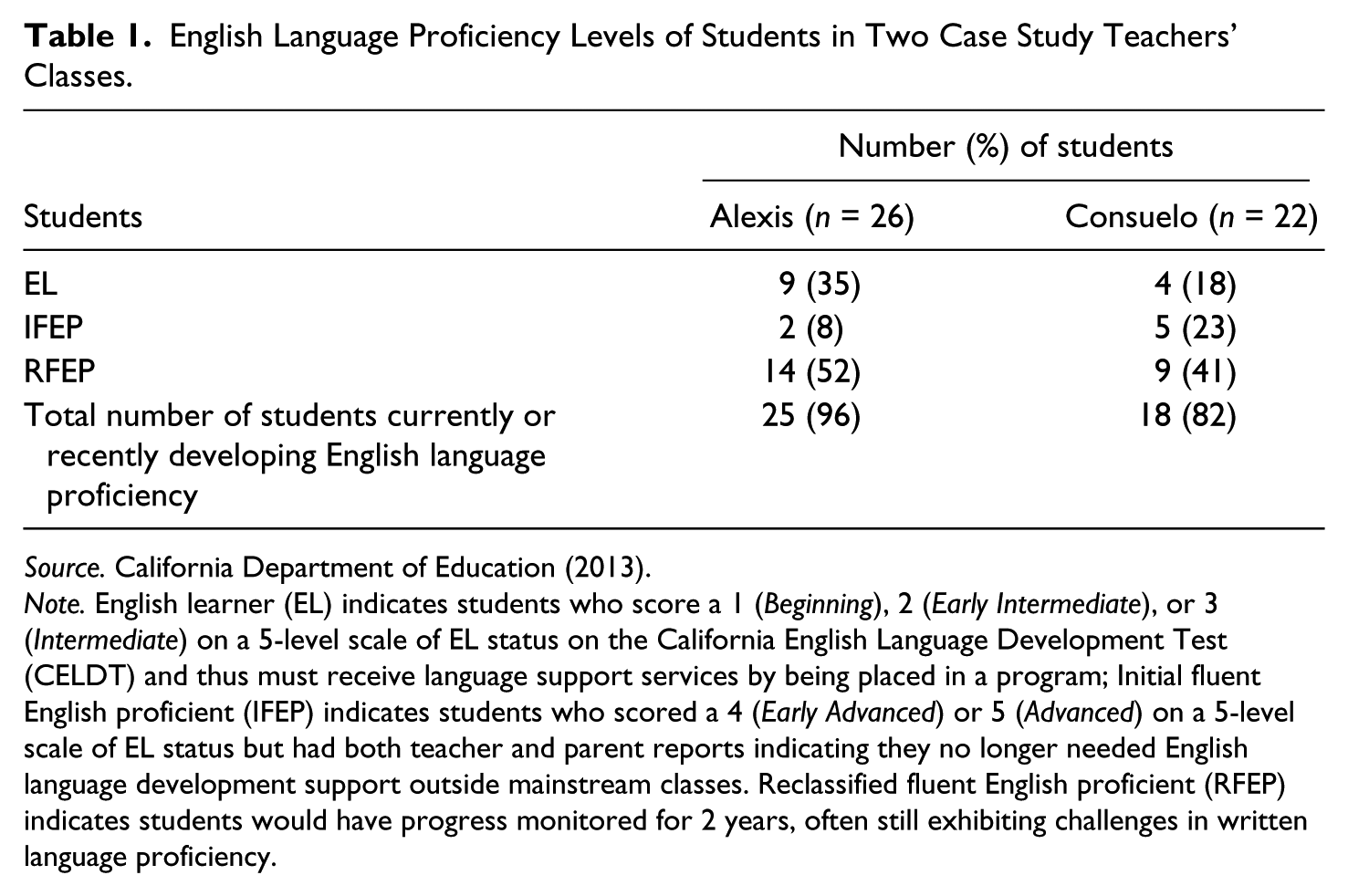
Note. English learner (EL) indicates students who score a 1 (Beginning), 2 (Early Intermediate), or 3 (Intermediate) on a 5-level scale of EL status on the California English Language Development Test (CELDT) and thus must receive language support services by being placed in a program; Initial fluent English proficient (IFEP) indicates students who scored a 4 (Early Advanced) or 5 (Advanced) on a 5-level scale of EL status but had both teacher and parent reports indicating they no longer needed English language development support outside mainstream classes. Reclassified fluent English proficient (RFEP) indicates students would have progress monitored for 2 years, often still exhibiting challenges in written language proficiency.
Alexis and 11th-Grade English: Routine Support in Highly Channeled Instruction
Our case of Alexis illustrates a teacher deeply committed to social justice, to the academic success of Latina/o students, and to the school push to provide ample support for her students—but whose instructional support practices seldom align with core elements of scaffolding. What we see in the case of Alexis is instead a range of highly structured supports that assist her students’ learning at times and constrict their learning at others. The case also illustrates ways in which a fairly new teacher finds tensions in designing goals and supports for her student population.
A third-year English teacher, Alexis identified as one quarter Mexican and was committed to schooling of Latina/os in urban, low-income settings. She felt her students had fewer privileges and academic opportunities than she had experienced, spurring her commitments. Alexis had long-held convictions of social justice and felt UCA’s mission was solid. In the focal 11th-grade English class, 96% of Alexis’ students were currently or recently developing English language proficiency and levels varied greatly (Table 1). Nearly all of her students likely would need extra language supports for writing. Lessons observed focused on the novel Kindred 3 (Butler, 1979) in the fall and The Crucible 4 (Miller, 1953) in winter. Spring observations documented essay writing and computer activity. Across observations, among the highest interaction mean scores Alexis received were for Teacher Sensitivity (5.9, 7-point scale) and Positive Climate (6.4), reflecting “emotional connection and relationships among teachers and students, and the warmth, respect, and enjoyment communicated by verbal and non-verbal interactions” (see the appendix). This climate provides relational recognition for Latina/o youth (Rodriguez, 2012)—a foundation to engage students in activity—and helps foster trust and community, especially important for support of ELs.
Scaffolding for Whom: “Baby Steps” and Tethering for Students Academically Behind
Alexis defined scaffolding as “baby steps between wherever that student is and the end product that you want them to create or have in their brain.” She constructed supports for students she positioned as needing to work in small steps, in unison, tethered to her as guide. Alexis noted urgency in supporting her students, most behind academically, at least one at a fifth-grade reading level. Nearly all of her students had English language proficiency challenges, even if only in writing. Alexis noted issues with comprehension, if a text is “so far above their ZPD”: If you don’t provide a scaffold of some kind, they’re just going to get overwhelmed and it’s going to make no sense to them and they’ll be disillusioned and it’ll color not only their experience with the book, it will color their experience with the class and with you and teachers in general and schools in general, and it’s just more bad news.
Alexis identifies risks of approaching a book without scaffolds. The book will make no sense to them, a risk of missed learning opportunity. She notes risks of disengagement: students will get overwhelmed and disillusioned, coloring their experience with the book, and with class, teacher, and teachers and schools in general. Alexis offers a coda on lack of scaffolding: it’s just more bad news. She sees scaffolding as a support line between students and a focal text and content, and between a student and his or her relationship to schooling and its key actors.
Aligned with conceptions of students and their needs, Alexis sequenced tasks on a ladder of instruction: “I need enough little rungs to help my students get to that place.” She typically provided challenges within reach, in a small ZPD for students, favoring high support over high challenge. She often reduced task complexity, saying, Don’t do that now. Twice in a lesson she stated, We will do this in baby steps, revealing how she constructed students as needing close rungs. She stated, “My job is to give them those building blocks, those training wheels, until they don’t need them.” Alexis had students read The Crucible aloud to assess what they grasped in the language and to help them keep plot details and characters straight, reducing task complexity to a baby step unaccompanied by strategic reading comprehension activities or literary analysis.
Also related to scaffolding for whom, Alexis was mindful of ways to tap students’ cultural experiences as part of her regimen of supports. To deepen engagement with Kindred, she drew on readings to have students construct “a multiple-worlds pie chart for the main character.” First, however, she had them construct such charts for their own worlds to get “a snapshot of where kids are at.” Students color-coded places in their worlds, then feelings about them. Alexis noted that red denoted “I don’t feel I belong there” and that “Kids had red all over the place.” Alexis reported conviction about exploring diversity in students’ lives and in course texts, casting her students as ripe for critical thinking activity about race and diversity in the context of her English class.
Alexis felt tension in how much support to use. School and professional development leaders provided ideas, including sentence starters, vocabulary routines, Do Now activities, and exit slips, but Alexis had concern: “By the time they’re juniors, they should not need sentence starters.” She wanted scaffolds contingent upon need: “When you’re taking baby steps and they’re that small and that scaffolded, you don’t exercise your brain in thinking about the purpose of the sentence. You just exercise the brain in thinking about which sentence starter to use.” Alexis notes a tension between routine support and support that responds to ongoing understandings of need, observed or diagnosed with targeted activities. She highlights how a scaffold becomes a routine eclipsing its underlying purpose. By becoming reified as activity, the sentence starter no longer guides students toward meaning making. Alexis added, They become so enfeebled by this process that even ones who are strong to begin with end up begging for sentence starters, even by the end of their junior year. I remember [a male student] saying, “What do I write?” “What are you writing?” “I’m writing this.” “What’s the purpose of that? Who is your audience? What are you supposed to say to them?”
Even as she favored baby steps, Alexis struggled with a worry that she was fostering an enfeebled state by constructing her students as similar, all needing highly structured routine support.
Scaffolding for What Purposes: College Behavior and Intermediate Academic Literacy
Much of Alexis’ support served two purposes—one more entry-level and behavioral, a second serving generic academic literacy. A UCA college-preparation goal was for students to read, write, and speak daily. For a “Participation & College Readiness” grade, Alexis tracked group and individual work, rewarding on-task behavior. She eschewed cold-calling with questions students could not successfully answer. She instead would “help them answer successfully by: presenting the question in multiple modes (spoken, written/posted) and rephrasings; providing sentence starters and/or models & examples; and allowing time to think, discuss with a partner, and respond in writing.” The supports include multimodal strategies to assist EL learning. Alexis awarded points for behaviors she deemed fitting: “what good group work ‘looks like’ and ‘sounds like’ (e.g., ‘leaning towards your partner,’ ‘pointing to the paper,’ ‘talking about which sentence starter to use’).” These behaviors worked at a foundational level for academic readiness but were not clearly linked to larger goals the behaviors might serve, a key dimension of scaffolding.
Table 2 shows Alexis also used structured assistance for intermediate, generic academic literacy (Shanahan & Shanahan, 2008). For language, assistance featured language production, including vocabulary, language acquisition strategies, and sentence starters. Reading supports aided comprehending complex text, reading with a purpose, and understanding character, more generic literacy processes. The table also shows that for writing support, assistance focused on code breaking (decoding writing prompts) and several supports for argumentation, including taking a position, locating strong evidence, and developing commentary. Answering scaffolding for what purposes, we found Alexis provided assistance for a range of enabling literacies related to language production, reading comprehension, and writing, especially helpful for current and former ELs. However, these generic supports tended toward routines not linked to larger subject matter goals.
Alexis: Routine Support for General Academic Literacy.
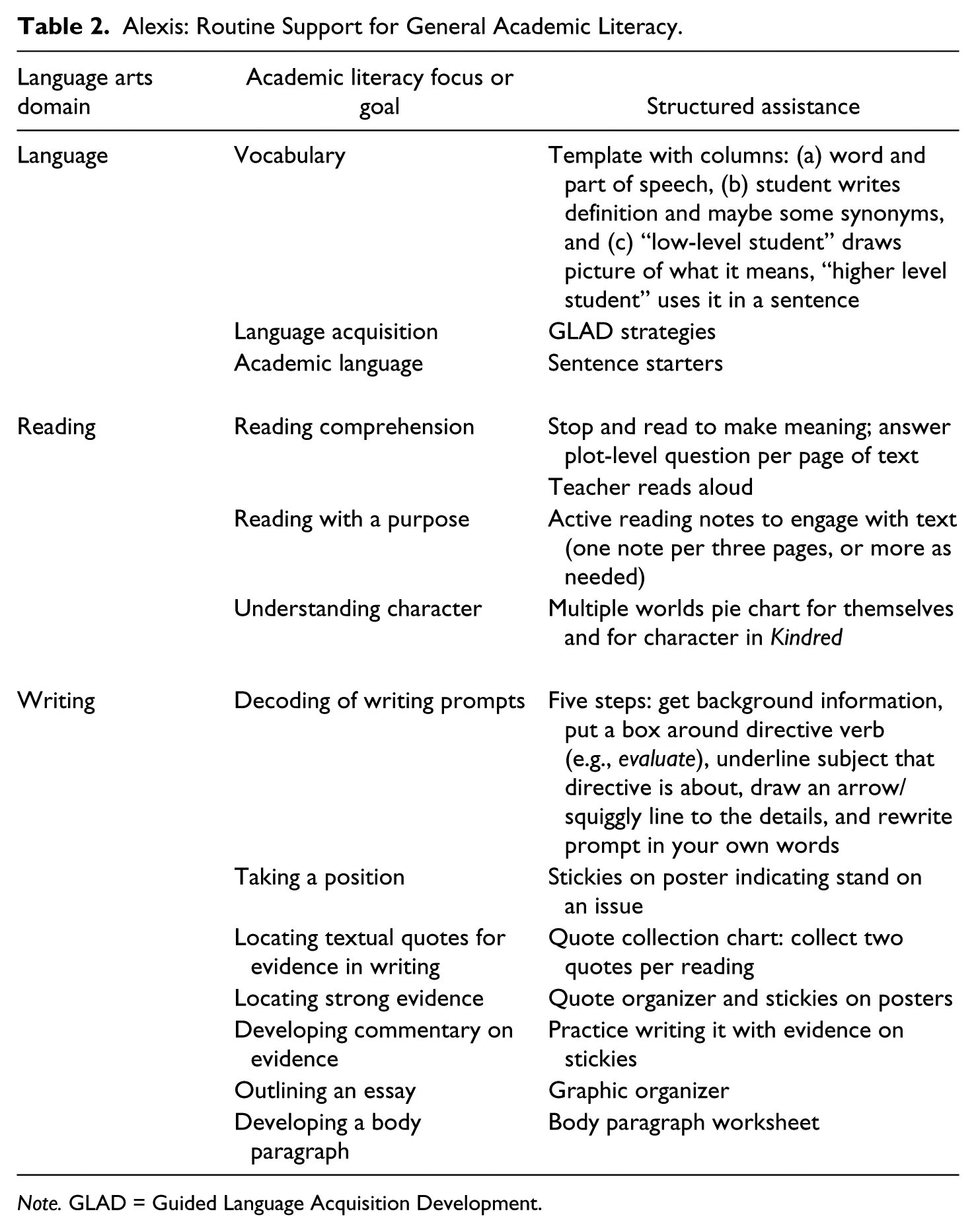
Note. GLAD = Guided Language Acquisition Development.
Although less evident, support for character study in reading and argumentation in writing demonstrate Alexis’ attention at times to supporting disciplinary learning. However, the assistance we observed Alexis provide students seldom engaged nuances of subject matter goals. For Alexis, there was a tension: “Thinking like a literary scholar. I talk about it explicitly when we’re writing. I’ll say, ‘And literary scholars will say or do—thank you, that’s what the literary scholar would say or think.’” She noted that standards support literary analysis including “figurative language, figures of speech, these very literary things.” She wanted to study, “Hmm, what does that idiom mean?” or “Oh, look at how we compared this to a rose, and what that must imply.” However, she found there were “so many other things to deal with,” adding, If they do end up actually analyzing a piece of literature, I scaffold the ___ out of analysis. But I wouldn’t say that UCA’s English department is out to make kids literary. We’re out to make kids proficient in English, and really, we ought to be compared to the Spanish department, because they’re again trying to get a kid proficient in the language.
With 96% of her students currently or recently ELs, Alexis stressed English proficiency. She distilled a tension of scaffolding for what: “Can you understand what this sentence meant?” versus “Can you go to a deeper place with it? Can you infer something beyond the surface, or just beyond that first inference?” This is why, she said, “I’m forcing them to do close reading.” While recognizing disciplinary literacy goals, Alexis clarifies a tension she felt in scaffolding that work. In addition, she noted a contributing factor was a lack of attention to higher level academic scaffolding for disciplinary thinking in department- and school-level discourse and activity.
Scaffolding How in Alexis’ Class Through Highly Regulated Activity: “Are You With Me?”
The routine support column (Table 2) reveals patterns. Alexis used an array of supports, often as baby steps, to guide students toward task completion and academic literacy goals. The forms of assistance show how she takes nothing for granted on what students know and can do without support. For example, a five-step process of decoding writing prompts works on code breaking such prompts as an entry point for essay writing. Such support can serve students, especially ELs, not only in writing essays for exams but also for essay writing in a range of subjects.
Regulative function to assist with college-readying behaviors
Alexis kept attention on her and with her. Aligned with school norms, she greeted students at the door, posted agendas, had a “do now” activity prepared with handouts at students’ tables, and monitored task completion carefully. In a fall observation, Alexis was among students: circulating, monitoring, mitigating disengagement. Alexis’ question “Are you with me?” marks an attempt to keep students connected with her actions. She kept students tethered to her as she led. In a spring computer lab observation, Alexis moved among students, checking progress, asking what assistance was needed, clarifying next steps. This kept students on task and helped guide essay writing. Students were engaged in computer work, and again Alexis was with them and working to keep them with her. In tasks and transitions, in particular, students stayed with Alexis. This task monitoring worked to minimize disengagement and so nobody would fall through the cracks. These task-focused claims were corroborated by Alexis’ high mean interaction score of 6.4 (7-point scale) for Productivity, which considers how well a teacher manages time and routines (see the appendix). These acts function in “a first order or regulative register, to do with the overall goals, directions, pacing and sequencing of classroom activity” (Christie, 2005, p. 3). Successful teaching occurs if regulation converges with “a second order or instructional register, to do with the particular ‘content’ being taught and learned” (Christie, 2005, p. 3). The instructional register was less evident, with a mid-level mean score of 4.43 for Alexis for Content Understanding, which relates to interactions among teacher and students that lead to an integrated understanding of facts, skills, concepts, and principles, or depth of lesson content in an academic discipline. These patterns raise questions about the degree to which Alexis created opportunities to explore content understanding and original thinking.
Participant structures as assistance
Across sample observations, Alexis averaged 12 min of group work per 90-min period. Two main functions were plot review for quiz preparation and group reading of texts. In one lesson, students reviewed quiz questions for The Crucible at tables. Alexis checked planners and homework. After 10 min, she pulled the class together to retake the oral quiz. In the same session, students spent 18 min in group oral reading of five pages from The Crucible. In another lesson on The Crucible, Alexis used Socratic seminar with open-ended questions. Students discussed in two groups, one after the other, with Alexis as moderator and scribe—one focused on factors that encouraged witch hunts, the second on characters. Alexis told students not to raise hands but to talk to each other. However, when students spoke, they dictated to Alexis who stood at the board writing down their thoughts. Routines and recall questions dominated the talk, constricting academic challenge and a goal of collaborative, intellectual dialogue. As with small group, students at times spoke together, but these participant structures did not demonstrate much student crosstalk or co-construction of meaning for support of academically challenging work. Again, a quantitative measure corroborated this. The mean score for Alexis was 3.9 (1-7 scale) for Regard for Adolescent Perspectives, which includes, During discussions and group work, students talk openly with one another in a free exchange, give and take of ideas which does not revolve around the teacher. At the high end, student talk may predominate or be equal to teacher talk. (Appendix)
Mid-level mean scores on this construct corroborated themes from qualitative data. The picture that emerges is that while participant structures offered some group exchange, they did not include transfer of responsibility to students, which would be a sign of scaffolding disciplinary discourse.
Channeling and focusing
After study of Kindred, Alexis guided the writing of a multi-paragraph essay. In a class activity, students constructed thesis statements and selected quotations from the text as “strong evidence.” Students then completed an essay outline with thesis statement and pieces of evidence, drafted body paragraphs, completed a multi-paragraph essay, and wrote a one-page post-final draft reflection. Three ideas in CCSS for literature study Grades 11 to 12 (National Governors Association Center for Best Practices & Council of Chief State School Officers, 2010) provide a useful frame here: cite strong evidence, determine two or more themes from literary works, and analyze author’s choices. We found little evidence in observations or student writing of analysis of author’s choices and mixed evidence of the first two key ideas. Students did not determine a theme; Alexis supplied it: Kindred shows how those who were slaves became complicit in their own oppression. Second, she supplied ideas and helped students collectively generate others for how this complicity was evidenced in actions of characters in Kindred; some were listed on the board: survival/danger, guilt, fear, peer pressure, and ego. Alexis offered no degree of freedom in determining the essay theme and provided a sentence starter requiring that students use the complicity theme and simply identify which three ideas they would select for filling out the body of the essay. In these ways, she has channeled and focused students’ learning (Pea, 2004). If we extend Pea’s water metaphor, we see Alexis ensures that the waters of the long essay are navigable, with pilings clearly marking the dredged channel. However, we also see that the lesson does little to promote response to literature, analysis of text, or autonomous thought. There clearly is routine support, but there is little space for transfer of responsibility to students for generating original thinking.
Regarding the CCSS key idea of generating strong evidence, Alexis took students through a focused set of activities beginning with locating quotes to post on a “Strong Evidence Poster,” with warrants for their use. Students selected pieces of evidence from the poster for their thesis and added analysis. All but one student selected two quotes from the poster (as directed), most copied page numbers for quotes from the poster, and just under 60% demonstrated they grasped the concept of complicity in oppression. Those who did not show that understanding offered ideas about being victimized (“getting beaten,” “being talked down to,” “experiencing violence”) but not how this makes one complicit in oppressing oneself or others. This step-by-step process that built toward essay writing enabled students across all five levels of English language proficiency to accomplish some writing goals for what CCSS identify as key to the informative/exploratory text type. All nine focal students attempt and most accomplish three of five standards for this text type—introducing topic and organizing ideas, developing topic with examples and quotations, and concluding what was generated. The other two standards are more language-oriented in nature, difficult for ELs, so focal student writing provides evidence of varying degrees of success. Eight of nine focal students, excepting one beginning level EL (Level 1 on an English language proficiency scale of 1-5), compose an introduction with thesis that contains three main points. All focal students introduce the theme of complicity in oppression, mostly in a single introductory paragraph. All but two Level 1 ELs show understanding of the concept, with one struggling with the concepts of both complicity and oppression, introducing them in the topic sentence for his second paragraph: “People learn to become complicit by oppressing fear.”
With profoundly different levels of English language proficiency, two students provide contrasting examples of command of English as they write, yet both provide evidence that Alexis’ routine support has served them. Hector was a Level 1 EL, and Beatriz scored at a Level 5, designating her Reclassified Fluent English Proficient. This designation indicates Beatriz would have her progress monitored for 2 years and likely would often still exhibit challenges in written language proficiency. Both students introduce the theme of complicity in oppression with some clarity. In body paragraphs, they develop reasons and provide quotes from the book as evidence. They both have concluding paragraphs that support the information presented in the essay.
Hector begins his essay with the sentence, Imagine that you were a slave back then in that time, asking readers to imagine themselves as enslaved people, but he does not provide context for ideas to be presented. He takes four short paragraphs for an introduction and ends it with his thesis as an independent paragraph, disconnected from previous points: A person becomes complicit on oppressing themselves and others by showing fear, survival, and accepting oppressive language. In the body of his essay, Hector uses some quotes from the book to support claims but without much elaboration. He uses many features of spoken English such as frequent use of the conjunctions because and and; he also struggles with conventions such as punctuation.
In contrast, Beatriz, from her opening, provides historical context with detail and makes a transition between context and the book’s theme of complicity. Her final introduction sentence reads, “In the book Kindred, Octavia Butler shows that because of fear, the struggle for survival, and the acceptance of slavery, a person is forced to become complicit in oppression.” She names the author and three points she later elaborates with quotes from the book. Beatriz demonstrates some language challenges also: two sentence fragments, two run-on sentences, a paragraph with multiple changes in tense. However, she demonstrates a high degree of proficiency in managing her four-page, multi-paragraph essay. Although her language frequently is sophisticated and college level, Beatriz reports she struggles with writing and benefited from support: “I’m not really good with my writing. And she [Alexis] did a lot of step-by-step things.” Regarding a college entry English Language placement practice test, Beatriz noted of Alexis’ teaching as follows: We learned how to decode the prompt and just literally do it step-by-step. There’s no right way or wrong, but she found a way for us to know that this is going to work and you’re going to pass with that.
A question remains if Alexis’ students can independently navigate waters of academic writing and meet literature study standards of developing themes and analyzing authors’ choices, when a task is less channeled and focused and support is faded. Still, Alexis’ students exhibited ways the highly structured assistance supported some attention to grade-level writing.
Routine support or meaningful scaffold
Alexis noted that a danger of routine supports was reduction of independent thought:
I’ve seen people with [strong] skills choose to go the easy route and use the sentence starters I give and just fill in the form, plug and chug, and be done. And really not give it a whole lot of thought.
It was a tension: “If you don’t have those scaffolds, they’re not going to get skills they need in order to be college-going, actually get to college, enroll, and do well,” but many are unprepared, “relying on sentence starters, not on understanding the purpose of the sentence or the paragraph, the purpose of the entire paper.” She asked students, Can you make really cool leaning turns when you’re on training wheels? No, you can’t. You can’t maneuver as well. If you don’t need this, don’t use it. But if you do need this, please, there is no shame in using this. Use it as much as you want until you feel comfortable writing the sentence on your own, with your own words.
Although she was highly reflective about this scaffolding tension, Alexis still tended to construct scaffolding as a process of routine support, only infrequently tapping students’ sociocultural resources as support for disciplinary learning and rarely adjusting or fading routine supports in ways contingent upon student performance and language.
Consuelo and 12th-Grade Government: Scaffolding Engaged Citizenship
In contrast to Alexis, Consuelo provides a case of a new teacher using supports in ways frequently aligned with conceptions of scaffolding in our framework. We see how Consuelo uses supports that directly consider her particular students and their out-of-school lives and interests. We also see ways Consuelo constructs classroom interaction as a space in which she can scaffold students’ language production and academic and disciplinary literacy. Consuelo is even newer to the profession than Alexis—just a first-year teacher. The case shows how she taps her educational and life knowledge and experiences but, like Alexis, finds a great deal of tension in discerning appropriate levels and means of support to guide her students en route to college admission.
A California-raised Latina, Consuelo was a first-year teacher committed to UCA’s mission and to meeting academic needs of Latina/o students. She reported ways she identified with students and their feeling marginalized in the United States. Consuelo worked to broaden awareness of social, governmental, political, and economic issues. Her 12th-grade elective government class consisted of 22 Latina/o students of whom 18 (82%) were currently, or recently, developing English language proficiency at various levels (Table 1). Like Alexis, Consuelo created a positive classroom climate, reflected in quantitative and qualitative analyses. She also reported similar tensions in scaffolding students’ learning. However, Consuelo provides a case of a teacher scaffolding disciplinary learning tasks and using interactional scaffolds to complement a wide range of planned scaffolds. The latter includes selection of texts that related culturally and linguistically to students’ lives, carefully sequenced activities to build understanding, and participant structures to support learning.
Scaffolding for Whom: Latina/o Students With Cultural Resources to Tap
In her scaffolding regimen, Consuelo used culture and community (local and classroom) as resources. In scaffolding for whom, we found Consuelo frequently scaffolded learning for youth she constructed as (a) Latina/o, (b) living in particular communities, (c) future engaged citizens, (d) resources for each other’s learning, and (e) current or former ELs. These ways she constructed her students were evident in her choice of curricular topics and texts, in examples she chose for illustration, in activities she designed, and in classroom discourse she guided.
In a pair of lessons at election time, for example, Consuelo explored themes relevant to her students, including why many Latina/os in California do not vote. She used newspaper editorials, writing and reading activities, a video by Michael Moore, a televised Spanish language ad related to voting, and class discussion to engage students in thinking critically about authors and sources of opinions students read and about their own futures as voting citizens. In a lesson later in the year, Consuelo constructed a lesson to identify social welfare programs as a means of examining how the U.S. government attempts to promote economic well-being. Table 3 displays features of that lesson, including topics, activities, and uses of culture and community as learning resources.
Consuelo: Using Culture and Community as Part of a Scaffolding Regimen in One Lesson.
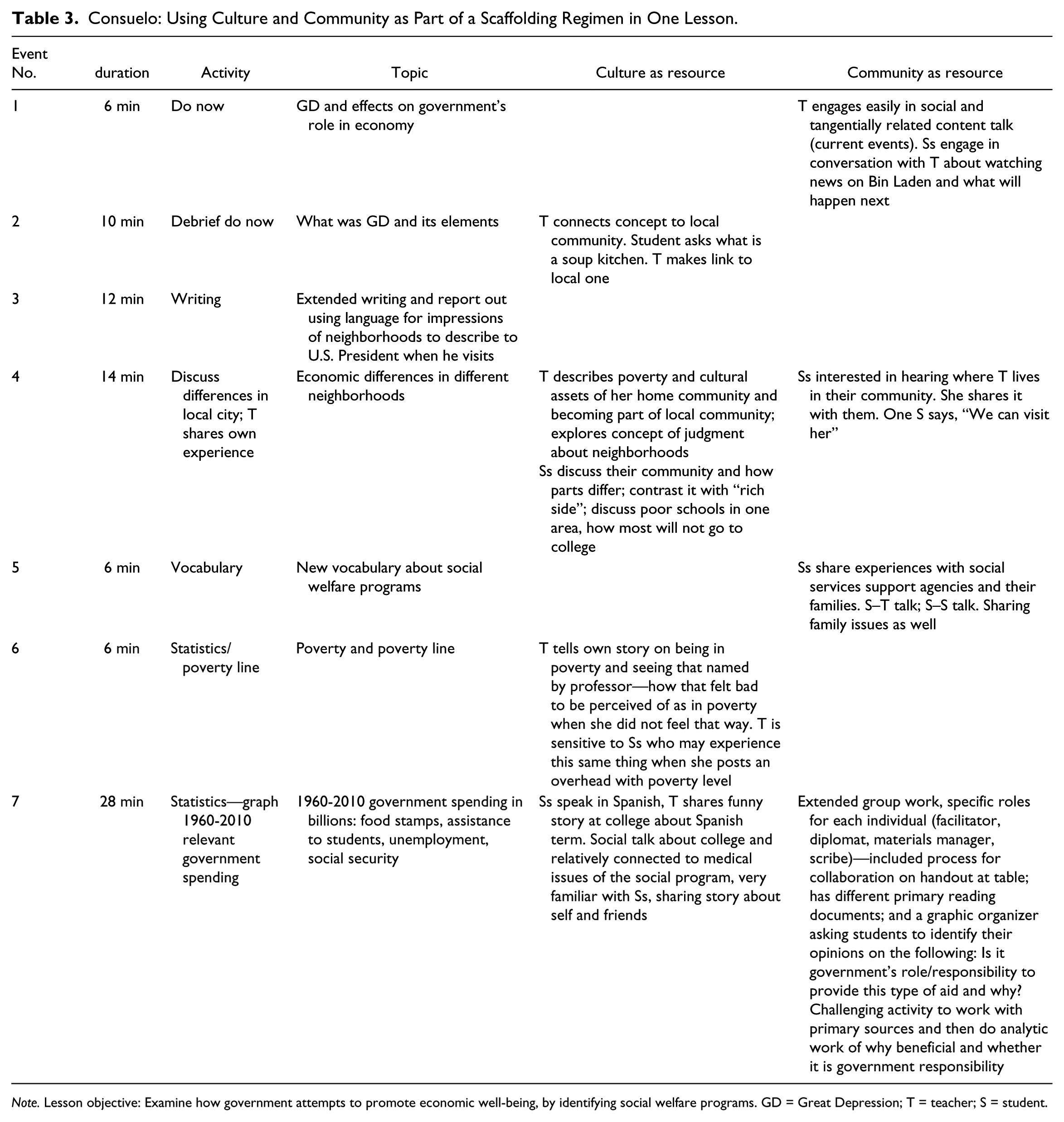
Note. Lesson objective: Examine how government attempts to promote economic well-being, by identifying social welfare programs. GD = Great Depression; T = teacher; S = student.
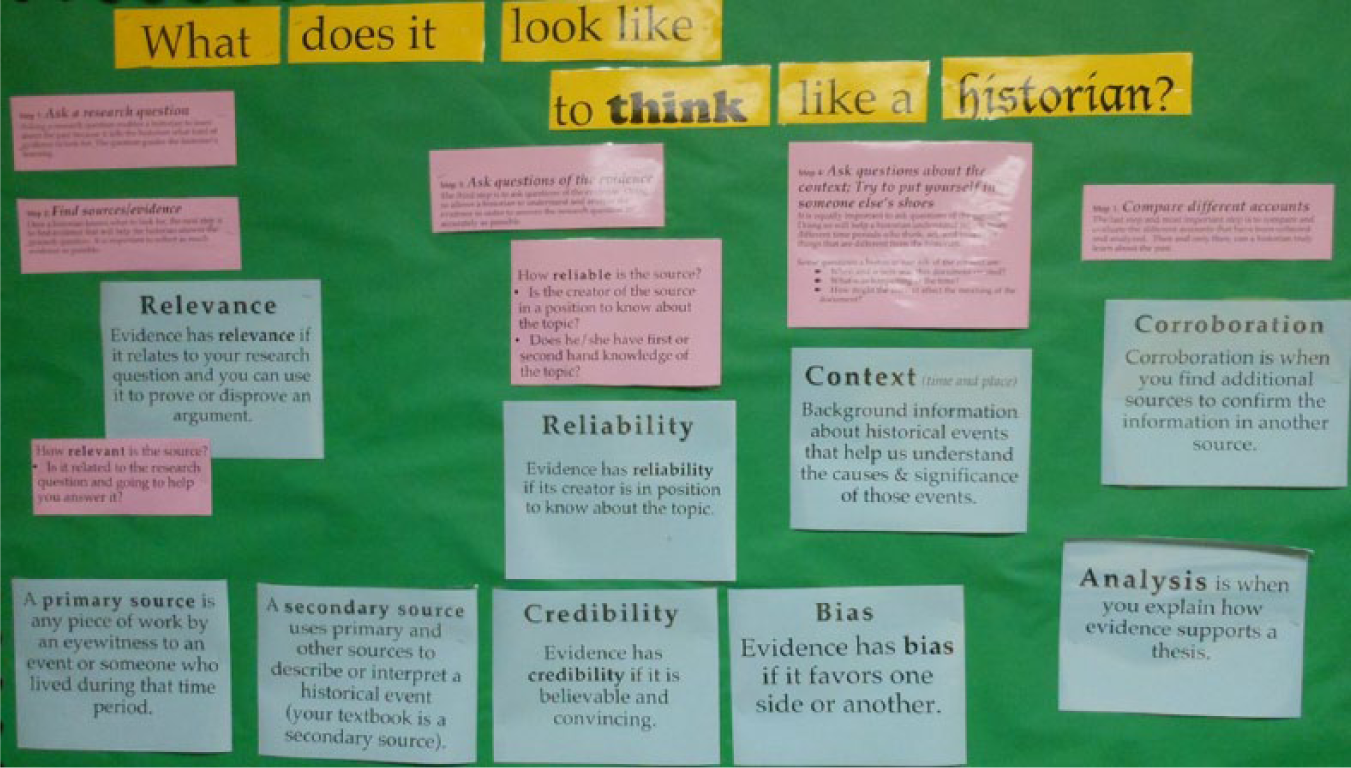
Scaffolding disciplinary literacy: Consuelo’s bulletin board.
The table shows (column labeled Culture as Resource) that Consuelo used her experiences as a Latina in California urban neighborhoods to illustrate economic disparities. For Event No. 4 (Table 3, row 4), in particular, this teacher sharing served as a scaffold to engage students in parallel talk. In her modeling, Consuelo included descriptions of poverty and of cultural assets of “Delicious Mexican food restaurants that remind me of Mexico” and “walls along alley ways tagged up with gang signs but also with colorful murals” to demonstrate to students her own experiences as a Latina growing up in California. Consuelo explained later how she wanted to include both problems and assets in her community. In this exchange with students, Consuelo also described how, when she first came to the local city, someone told her not to go to the area where the school is located, but when she came to the area, she felt like it was home.
After her modeling, students discussed how parts of town differ. They characterized their community as violent with cops at school, Latinos with gangs, and youth at schools with teachers who do not care. Students also identified that the community has “hard working-class” people and that Mexican restaurants make it feel like a “little Mexico,” both assets. They contrasted it with the “rich side” of town and had an extended conversation about poor schools in one area and how most students will not go to college, versus schools on the other side of town and college access. The class took up what Consuelo modeled: a balance of identifying economic disparities and considering cultural resources in impoverished communities—assets beyond a deficit lens of “have nots.” Consuelo’s modeling, with culture as resource, scaffolded students’ discussion.
Scaffolding for What: Toward Disciplinary Learning and Critical Thinking
In Consuelo’s instruction, she worked to develop students’ disciplinary literacy. A wall exhibit (Figure 1) describes historical thinking (asking a research question, asking questions of evidence, comparing different accounts). The exhibit includes historical thinking concepts, including relevance, primary versus secondary sources, reliability, credibility, context, bias, corroboration, and analysis. Consuelo supported learning of these thinking processes and concepts, using analysis of historical thinking and critical analysis of historical sources and artifacts. Consuelo’s lessons frequently explored these concepts and thinking processes using content relevant to local, cultural, and larger sociopolitical issues, thereby scaffolding her Latina/o students’ engagements with subject matter content.
Scaffolding disciplinary literacy had an impact. In the assignment on Latina/o voting patterns, students needed to read and synthesize three editorials, briefly analyzing both their content and perspectives. Students used a jigsaw activity with a matrix note-taking sheet to track ideas and quotes from all three documents on both reasons Latina/os do not vote and what has been done to increase the Latina/o vote. The activity assisted students in making a claim, selecting evidence, and constructing a reasoned argument using that evidence. Although Consuelo has provided the resources to use, she has scaffolded student learning by transferring responsibility to students to craft a claim, locate valid evidence, and warrant its use in their writing. The scaffold served essay writing. For contrast, we illustrate with work by two students. Isabel scored either a 4 (Early Advanced) or 5 (Advanced) on a 5-level scale of EL status on the English language proficiency exam. She was designated Initial Fluent English Proficient, indicating she had both teacher and parent reports stating she no longer needed English language development support outside mainstream classes. Manuela, who received extra support, was an EL testing at a basic literacy level. Predictably, Isabel’s notes and writing were more accomplished in elaboration and detail, asking critical questions and using linguistic resources for constructing academic prose. Still, both students demonstrate some success in disciplinary writing scaffolded by Consuelo.
Isabel took notes in document margins, asked critical questions (e.g., Why don’t political parties take Latinos seriously?), and collected quotes on a jigsaw sheet. She wrote a pair of two-page paragraphs for the essay—one on why Latinos don’t vote, a second on how to improve Latino voter turnout. She sets up each argument, followed by reference to an article and a direct quote, then comments on it. For example, she states, “Another reason why Latinos don’t vote is because many Latinos are not looking or care for politics, many are immigrants only looking to better their lives. For example, in document B . . .” She names the article, says “the author claims that,” uses a quote, then comments: “Because many immigrants are just looking to work to be able to support both them as well as their families, they don’t care for politics so they are less likely to go out and vote.” Her work shows clear reasoning, use of multiple perspectives, and some cause and effect, keys to historical thinking and writing. Both long paragraphs end in summary, for example, In conclusion some of the things helping improve voter turnout rates, are that they are trying to regulate same day voting, educating Latinos on the political process, and continuing to elect Latinos into positions in politics in order to push more Latinos and get them involved.
Isabel composed a clear introduction, body, and conclusion; used connectors to link ideas (the next reason, because, for example, although); and had solid sentence structures and mechanics.
Manuela highlighted on documents to comment, reiterate, paraphrase, and ask a question, making connections to herself. On jigsaw notes, she recorded document quotes but with little detail. Still, for her essay, she uses Consuelo’s jigsaw scaffold to collect ideas on voter turnout rates and what they mean. She elaborates at times but often is not explicit, leaving a reader to infer her intention. Although she does not set up direct quotes from texts, she uses them, taken from the jigsaw scaffold sheet, with correct mechanics to cite them. She has seven arguments across two long paragraphs, uses a direct document quote for each, only once following with commentary. She argues, “Also to improve the voter turnout candidates have calmed their self down on talking bad about immigrants who are Latinos.” She follows with a setup for evidence (“From the article . . .”), names the document, and moves to a direct quote with no commentary after. Manuela concludes with “If candidates payed attention to this examples of Latinos to vote the voters vote would increase by a big percent.” She has few warrants for quotes as evidence, her conclusion is less comprehensive than Isabel’s, and her English language resources for writing are less sophisticated than Isabel’s. These issues may indicate a need for more intermediate literacy development related to general argumentative writing. Still, Manuela used Consuelo’s scaffolds to engage in disciplinary thinking and critical questioning.
Although Isabel composed more complete responses than Manuela and a lucid essay that exceeded what Manuela accomplished, both took a position on a government-related issue, mined texts for quotations as evidence and support for claims about developing knowledge, and used multiple sources—elements of historical/social studies thinking and general academic literacy. From a sociocultural perspective, Consuelo scaffolded the activity by linking content to students’ cultural resources as they engaged in argumentation. Both Isabel and Manuela demonstrated that they used Consuelo’s scaffolds to explore a government issue of direct cultural relevance to them and stretched their thinking. Although her students demonstrate understanding of disciplinary ideas, Consuelo is aware that she has heavily guided the work: “Scaffolding is necessary. We are asking our students to push themselves. We want high level thinking, but we need to get students there without discouraging them.” However, Consuelo was equally concerned with gradual withdrawal: When does a scaffolding become a crutch—when they become too dependent and scared to go off on their own? It’s a tension. Do I scaffold it for everyone? How do I do different scaffolds? That requires more time. We don’t have that. How do we do differentiation?
Calling unnecessary scaffolds a crutch, Consuelo argues that different scaffolds likely are needed, that such work requires scaffolding expertise (How do we do differentiation?), and that such activity requires time, another challenge: We don’t have that.
A focus on fading was salient for Consuelo, who argued for a nuanced model: “I don’t know when to take the scaffolds away. At the end of the day it does a disservice to them.” The challenge of fading was so salient to Consuelo’s scaffolding conception that in a final interview, she used the phrase take the scaffolding away 12 times and related language (e.g., the scaffolding can be removed over time and When do we stop scaffolding?). Consuelo highlights a need for teacher knowledge development in fading scaffolds: “What are the tools to implement and take them away? The progression of the scaffolds and when do we take the scaffolds away?” She calls for knowledge and tools to enact fading. Consuelo acknowledged support from the academic dean at UCA in how to differentiate scaffolds for different grades but nonetheless remarked on the topic of gradual withdrawal of scaffolds: “This is not a conversation that staff is having.”
Scaffolding How in Consuelo’s Class: Planned Supports and Interactional Scaffolds
Planned supports in Consuelo’s instruction
For scaffolding purposes in Consuelo’s instruction, we highlighted planned scaffolds. Another planned scaffold in Consuelo’s repertoire was participant structures for collaboration, opportunities for students at all English proficiency levels to produce language in meaningful ways in groups and teacher-led talk. In discussing Table 3 (scaffolds in one of Consuelo’s lessons), we highlighted culture as resource. The table also shows in Event 7 (row 7) and the far right column that the lesson’s culminating activity, running 28 min, was group work fostering co-construction of knowledge. As the table notes, this group work was supported by specific roles for group members (facilitator, diplomat, materials manager, and scribe), which supported engagement. The collaboration process was detailed on a handout at each table (supporting the routine). Deeper learning processes and disciplinary activity were supported by use of different primary documents and a graphic organizer asking students to state opinions on the following: Is it government’s role/responsibility to provide this type of aid and why? This was an academically challenging activity to work with primary sources and then do analytic work of why they were or were not beneficial and whether it is government’s responsibility to provide aid to citizens in need. The carefully planned supports hit a range of literacy targets. In addition, the group activity, which was structured with clearly defined roles, transferred responsibility to the students for engaging in interactive inquiry into the government’s role in providing aid to citizens in need. In this way, the group activity served as a scaffold for disciplinary learning.
Interactional scaffolds to move discourse and learning forward
Interactional scaffolds are contingent upon what arises in classroom discourse. Consuelo did not settle for first responses. She continually probed. In one instance, she asked students to peruse a document, discern the author’s political ideologies, and predict article content. After a female student described the article content, Consuelo called on a male whose response was “interviews with people.” Consuelo probed, “About what?” The student added, “Their point of view.” Consuelo probed again: “Do you think it’s for or against?” He responded, “Against.” Consuelo persisted: “Against who or what?” Despite such brief responses from this student, Consuelo used four probes to get him to eventually offer an ideological stance of some sort, the target of her original question.
The following example again shows how Consuelo interacted with students contingently, in response to teaching and learning opportunities presented in the discourse.
1. T: If you don’t know a lot about an election, should you still go out and vote? 2. Who thinks yes? (T counts) Why S1? 3. S1: I think people should actually take the initiative to find out more about the 4. people because they are the people that actually are going to be the ones in 5. charge and I think they should go before they try to vote for them. 6. T: OK so you’re saying . . . this goes towards maybe more of a No then. You 7. need to be informed first in order to make an informed decision. Yes, who 8. would agree with that? 9. S2: But then again it’s like your own personal bias. 10. T: OK tell me more about, what do you mean it’s your own personal bias? 11. S2: Like how there are Republicans, that’s what you believe, there could be 12. facts and maybe this is wrong, but if that’s what you believe they are not going 13. to vote for the opposite. Some things should be voted . . . win, don’t win. 14. T: So you’re saying even if people do get all this information, they are still 15. going to stick to their beliefs. Is that what you’re saying? So they’re still going 16. to be biased in some way? 17. S3: But at least you’ll be informed. 18. T: So maybe you have two sides of the story now. Good, alright.
Consuelo uses interactional scaffolding strategies to move discourse and learning forward. In Lines 1 to 2, she uses a question to gauge students’ opinions on going out to vote when people are not informed about elections. Following one student’s response (S1) in Lines 3 to 5, Consuelo starts out with so you’re saying, indicating she will clarify what S1 just stated. In Lines 6 to 7, she uses the scaffolding strategy of recasting S1’s wording into academic discourse: You need to be informed first in order to make an informed decision. Student 1’s use of the wording to find out more about the people to (lines 3-4) is changed to need to be informed in Consuelo’s recasting. This exchange also exemplifies Consuelo’s use of more academic language related to voter turnout, need to be informed and informed decision, language picked up later in the lesson and in subsequent lessons.
Her recasting also serves to move the discourse forward through her question, Yes, who would agree with that? (Lines 7-8) as a way to engage more students in discussion. In Line 9, Student 2 contributes by adding to what was just discussed, but then again it’s like your own personal bias. Then, in Line 10, Consuelo utilizes the scaffolding strategy of extending talk to “push” the student toward responses that elaborate and justify her thinking and point of view through the use of OK tell me more about, what do you mean it’s your own personal bias? Consuelo hands back responsibility to the student for continuing the conversation. This move serves to prolong the talk and lead to longer and more productive sequences of meaning. This is what occurs in Lines 11 to 13 after Consuelo’s probe for the student to tell her more. In Lines 14 to 16, Consuelo uses an additional scaffolding strategy of appropriation by using S2’s contributions to clarify what she just said and in turn this is built into the discourse. In Line 17, S3 replies to what Consuelo just said by utilizing the same academic language feature that Consuelo introduced in Lines 6 to 7, informed.
This discourse sequence exemplifies how Consuelo used scaffolding strategies within discussion. These strategies served the goal of moving the discourse forward by recasting student contributions, extending students’ talk, and appropriating student contributions so more could be added. This discourse sequence can be contrasted with a more typical initiate–respond–evaluate (IRE) sequence in which a teacher stops at evaluating a student’s contribution instead of moving the discourse forward so that more can be learned about a topic. Also, Consuelo uses these scaffolding strategies to advance understanding “on the floor” so that disciplinary perspectives and academic language of the discipline of social science get explored: the importance of making an informed decision in voting in a democracy and the impact of personal bias on voting patterns. Aligned with these observations were Consuelo’s high classroom interaction mean scores for two constructs. First was Language and Literacy Development (“assists language use or literacy development through questioning, rephrasing, or modeling”; SPC rubric)—the very moves we observed—for which Consuelo had a mean score of 5.7 (7-point scale), contrasted with a mean of 3.2 across other focal teachers. Second was Consuelo’s high mean score for Quality of Feedback, which assesses “the degree to which feedback expands and extends learning and understanding and encourages student participation” (see the appendix); for this construct, her mean score was 6.4, higher by far than the mean of 3.9 across observations of other focal teachers.
Transferring responsibility
Although her planned and interactional scaffolds guided learning, Consuelo wanted to transfer responsibility more fully to students: “Scaffolding is to foster independence. With that hope.” She noted a “lack of training hinders that independent responsibility piece,” arguing a need for knowledge of how to do more with scaffolding than merely plan series of supports. This recurrent tension for Consuelo is particularly problematic for Latina/o students she wants to support in intellectual activity, academics, and engaged citizenship: If we are saying, “Oh no, you are not underachieving,” then why are we still holding your hand? We need to let go of your hand. We need to prove it to you. Because we have those scaffolds so much, it hinders their belief that they can do it.
Consuelo’s use of hinders suggests a damaging impact of over-scaffolding. Although she remarked continually about a need for teacher education on scaffolding nuances, especially for her student population, Consuelo offers ideas to address the tensions, suggesting that the teacher must move past reliance on scaffolds: We need to prove it to you. She also describes a need for transparency, to seed transfer of responsibility: “Maybe we need to be more explicit with students about the fact that we are giving them scaffolds, and we are going to take them away.” Such transfer enables greater learner control. Without it, there is a loss of ability to reach larger academic goals.
Discussion
Our study highlights promise and tensions in developing scaffolding to meet the needs of low-income Latina/o students in one urban public high school. UCA had a school-wide emphasis on scaffolding as a means of strengthening the academic preparation of students academically behind and historically underserved. Through a pair of teacher cases, we examined ways two committed teachers took up this scaffolding goal, highlighting contrasting approaches to providing instructional support. Considering scaffolding for whom, both teachers supported students they wanted to see achieve in college but who they felt needed many supports, given histories of low Latina/o college-going rates and students’ histories of low test scores and some academic failure. Both Alexis and Consuelo provided comprehension support for complex texts, structures and conventions for argumentative writing, and explicit attention to language form and function. These all are particularly important for potential first-generation college-goers and current and former ELs.
However, our case of Alexis highlights how purposes and methods of providing support for students yielded what we called routine support in a range of ways but did not illustrate instructional scaffolding as we conceptualized it in our framework that drew on a large body of relevant research. In the work of Alexis, we found much evidence of planned supports. Selection and sequencing of tasks and texts was widely in evidence. A visual display of some of Alexis’ supports (Table 2) highlighted the range of reading, writing, and speaking goals, range of processes she used, and care with support. This demonstrates Alexis’ commitment to ensuring that no student would fall in the cracks in her class by growing overwhelmed and disengaging.
As for scaffolding for what purpose(s), much of Alexis’ attention was devoted to scaffolding basic and intermediate levels of literacy activity. Alexis noted pressure to address intermediate levels—students’ enabling literacies for functioning effectively in academic contexts. She reported how she regretted not being able, in her estimation, to engage students in disciplinary activity of literary analysis. This tension Alexis felt may be attributed to several factors: little department unity in striving toward disciplinary literacy goals, her students needing support in developing English language proficiency, and therefore, in Alexis’ estimation, needing greater supports for language goals of English language arts (ELA) before taking on literary analysis.
In scaffolding how, we found that Alexis’ routine support tended toward sequenced tasks in what she referred to as “baby steps” and close rungs on a ladder. Alexis channeled and focused literacy activity in ways that enabled her students to achieve some success in constructing forms of argument needed for academic work, and students complied with and appear to have appreciated the guidance. However, based on available data, the assistance tended to focus on supports as separated from larger disciplinary goals and purposes. In addition, there was little attention to the sociocultural dimensions of learning as students worked within structures but without independent goal setting, interpretation and original analysis, or rich engagement with their own cultural and linguistic experiences as resources for learning. Group work supported partnering but with little social construction of knowledge, and routine support did not appear contingent upon students’ emerging written and spoken performances.
Consuelo provides a contrasting case and illustrates how routine support can assume elements of instructional scaffolding aligned with core conceptions from the research literature. Consuelo also worked on intermediate literacy but in the context of disciplinary literacy goals. The wall display of supports for historical thinking and historical analysis illustrated this focus. These processes and concepts were central in much of Consuelo’s instructional activity we observed and in much of the student discourse and written products. Consuelo also tapped a range of cultural and linguistic resources for contemporary urban Latina/o youth she hoped would develop increasing awareness of larger and local social issues and democratic processes. While she engaged students in exploring and critiquing social and economic inequity, Consuelo modeled a process students took up of both critiquing inequities and honoring assets of impoverished predominantly Latina/o urban communities. Consuelo also constructed her students as learners who could engage meaningfully with others in participant structures that promoted the co-construction of knowledge.
In answering scaffolding how, we displayed scaffolds Consuelo used for a single lesson (Table 3) that demonstrated a range of planned scaffolds tapping cultural and linguistic resources and orchestrating collaborative learning. Consuelo also illustrated use of interactional scaffolds, unplanned supports used in oral discourse with potential to move discourse and learning forward. As we illustrated, Consuelo probed in discussion to elicit lengthier and more targeted responses, appropriating student language and recasting it into more academic language and aligned with disciplinary goals. In this way, Consuelo’s support was contingent upon student contributions to the discourse, scaffolding academic language and learning.
Both teachers reported that scaffolding at UCA may not have prepared students for independent thinking and academic work they would encounter in college. The teachers knew they sometimes handheld, fostering dependence on supports. Both case study teachers struggled to adapt supports to current or particular needs, wanted to learn how to fade scaffolds, and reported a need to transfer responsibility to students, with support working at times at cross-purposes with the intention of academic rigor. Scaffolding needs to be gradually withdrawn as students internalize patterns (Langer & Applebee, 1986). When scaffolds become reified and inflexible, they lose their function. Both teachers cast the challenges of scaffolding student learning as tensions, particularly the tension between providing too little support, leading to student disengagement or possible failure, and too much support in the form of hand-holding. Alexis recognized that some of what she referred to as scaffolds could become routines like training wheels that constrain the capacity “to make really cool leaning turns.” Both teachers reported a need for more knowledge of how to support students in striving for higher goals. These teachers’ critiques of certain school-wide “scaffolds,” such as sentence starters, speak to the larger educational context of scripted curricula and testing regimens that in many cases promote reductive conceptions of subject matter knowledge and emphasize skills and bite-size understandings over higher order thinking.
A limitation of our study is our focus on case study teachers we deliberately selected because they showed promise in supporting learning for Latino/a youth and ELs. Teachers at UCA benefited from a mission to meet the needs of urban Latino/a youth, all of whom entered high school academically underprepared and with some experience with academic failure. Most teachers do not work in small, public charter schools with leaders and colleagues coalesced around such a social justice mission. Teachers in large comprehensive high schools with rapidly changing demographics may need even greater attention to a coherent mission supporting underserved youth and ongoing discourse for how to meaningfully scaffold diverse students’ learning. Nonetheless, our study, focused on one school and two teacher cases, offers a rich set of ideas, examples, and tensions that contribute to more nuanced understandings of scaffolding and its challenges and to literatures on meeting the needs of diverse students and Latina/o youth in particular.
As we have seen in recent decades, many students of color, students in lower income communities, and ELs frequently suffer the most from contexts in which curricula grow impoverished, basic skills get foregrounded, and higher academic goals recede. Concerns of Alexis and Consuelo regarding tensions in their instructional support practices speak to ways in which the educational community needs to think hard about and develop scaffolding models that address these tensions and with particular attention to ways routine support can assume the form of instructional scaffolding that taps students’ cultural and linguistic resources, structures co-construction of knowledge, is contingent upon learners’ contributions, and transfers responsibility for learning to students. Without such attention, schools such as UCA and committed teachers such as Alexis and Consuelo work heroically to accelerate learning of those low-income students of color who enter high school underprepared on a trajectory toward college but without focused support. That support can come in the form of more sophisticated models of scaffolding that simultaneously focus on basic and intermediate literacy activity, engagement, and success and support rich disciplinary literacy activity, higher order thinking, and engagement with academic learning that is meaningful locally and in larger social contexts.
Implications
Both case study teachers in our study were novices in their first 3 years of teaching, and both called for greater skills and knowledge for fading and transfer of responsibility in scaffolding practice. Pre-service and in-service education may need more explicit attention to complexities, core constructs, and tensions in scaffolding, especially when schools have a commitment to accelerate learning of students academically behind and those developing English language proficiency, while also engaging in content area explorations and literacy development. Such work may require tools Consuelo called for, as well as transparency in scaffolding.
Our case of Consuelo highlights a special role of interactional scaffolds. Teacher education can help develop expertise for supporting growth in language proficiency and disciplinary literacy through interactional scaffolds in classroom discourse. Talk is fleeting, and teachers need support to practice discourse moves they can make and to learn of positive and negative impact such moves can have on extending talk and building understanding. Substantive engagement in talk, scaffolded with high-quality feedback and other discourse strategies, can support group understanding and individual subject matter learning (Nystrand & Gamoran, 1991).
Ways in which many educators and researchers use scaffolding as a metaphor have moved far from core constructs. Drawing upon diverse and international perspectives helped us craft a framework with a set of questions that can serve as a heuristic for other investigations. Answering scaffolding for whom may shed light on scaffolding for what purposes and scaffolding how. Regarding purposes, the field needs rich scaffolding examples and analyses of teachers who construct their learners as capable of handling challenging disciplinary literacy activity even as they are developing their linguistic repertoires and proficiency. Regarding methods and processes, we need models of fading scaffolding with diverse youth, and Latina/o youth in particular, whose teachers view them as capable of handling transfer of responsibility for their own learning.
Footnotes
Appendix
Acknowledgements
This study is part of a program of research on schools and classrooms organized to support Latina/o educational success. Thanks to our research colleagues whose important contributions helped make this study possible: Betty Achinstein (Lead PI), Rodney Ogawa, Marnie Curry, and Serena Padilla. Thanks also to Joanna Wong and Shu-Wen Lan for assistance with our literature review. Earlier versions of this article were presented at the American Educational Research Association Annual Meeting, Vancouver, 2012, and the Annual Convention of the National Council of Teachers of English, Boston, 2013.
Declaration of Conflicting Interests
The author(s) declared no potential conflicts of interest with respect to the research, authorship, and/or publication of this article.
Funding
This study was supported by a grant from the W. T. Grant Foundation.