




Abstract
This multi-sited ethnographic study examines the ways in which Latino and Asian immigrant parents’ English learning through two church-based ESL programs in a Southeastern U.S. city affects their family literacy and home language practices. It demonstrates that the parents’ participation in the programs is an empowering experience promoting ESL acquisition and funds of knowledge, which in turn advances their family literacy. This study also finds that the programs do not promote linguistic assimilation, devalue or erase immigrant parents’ home language. Instead, they facilitate the parents to reclaim their home language and support children’s home language development. The “family literacy ecology of communities” framework is proposed in this study. It indicates that church-based ESL programs as social mediators for situating immigrant adult English learners within real-life communities, empowering their family literacy, accessing communities of power, and having a voice in the larger society. Implications for ESL adult programs and future studies are presented.
Keywords
Latinos and Asians in the United States are the two rapidly growing immigrant populations because of high immigration and birth rates (Hernandez, Denton, & Macartney, 2008). They have increasingly settled in Southern and Midwestern states, which do not traditionally have concentrations of immigrant communities. The recent U.S. report estimates that 54% of immigrant parents with children younger than 18 years had limited English proficiency (Batalova & Fix, 2010). Their children seem to develop high levels of English language proficiency and societal values through socialization in school life, whereas fewer maintain or develop home language (Birman, 2006; Hwang, Wood, & Fujimoto, 2010; Portes & Rumbaut, 2006; Wong Fillmore, 1991, 2000).
The increased disjuncture of language and acculturation between parents and children in immigrant families, in turn, leads to increased immediate effects such as parent–child interaction breakdown (Tseng & Fuligni, 2000). For the long-term effects, the disjuncture results in reduction of parental authority because of parents’ dependence on children to negotiate power dynamics of the largely English-speaking public sphere (Reynolds & Orellana, 2009), family estrangement (Qin, 2006), loss of family literacy (Auerbach, 1989), and constraints of children’s access to higher education (Valdés, 1996, 2004). Thus, the parent–child disconnect in language and literacy in immigrant families where English is not the primary language of the parents is a contemporary and needed research topic. Most research on English as a second language (ESL) and home language in the contexts of communities focuses upon immigrant children (Gregory, Vytra, Choudhury, Ilankuberan, Kwapong, & Woodham, 2013; Weisburd, 2008; Wong, 2008; Zhou & Kim, 2006), rather than on parents’ ESL learning. Significantly, the emerging literature calls for particular attention paid to research on community contexts for immigrant parents’ language and cultural development and its effect on family literacy (Auerbach, 1989; Bigelow & Schwarz, 2010; Weinstein-Shr, 1993).
The purpose of this multi-sited ethnographic study is to examine the ways in which Latino and Asian immigrant parents’ English learning through two church-based ESL programs in a Southeastern U.S. city may, in turn, affect their family literacy. Specifically, this study addresses two questions: “How may immigrant parents’ participation in the church-based ESL programs be associated with changes in their family literacy?” “How may immigrant parents’ English learning through the programs influence home language use?”
Auerbach’s (1989) broadened concept of family literacy was adopted in this study. Focusing primarily on immigrant and refugee families, Auerbach acknowledges that family literacy should include direct parent–child interactions around literacy tasks such as reading to children. And not only that, other aspects of family literacy work should also include parents developing own literacy and working independently on reading and writing, using literacy to address family and community concerns, supporting home language and culture development, parents mutually addressing child-rearing concerns, and interacting with the school system.
Review of Related Literature: Language and Literacy Practices in Immigrant Families
By documenting the phenomenon of language and literacy practices in Latino and Asian immigrant families in the fields of anthropological linguistics, bilingualism, and immigrant education, four trends inform this research to understand the complex dynamics around language and literacy.
Differences of Language and Acculturation in Immigrant Families
Valdés (2004) argues that in socializing with American schools and communities, “immigrant students and their families travel very long distances. These distances are physical, emotional and psychological” (p. 12). In the distances, children’s home language rapidly diminishes with the beginning of their preschool, and they increasingly shift from home language to English language (Birman, 2006; Worthy, 2006). Research has addressed societal and individual factors in influencing immigrant children’s language and cultural shift. At a societal level, the prestige or status of English in the United States and belonging in English-speaking schools may contribute to children’s language switch (Wong Fillmore, 1991). At an individual level, immigrant children’s language and cultural shift may be fastened by their cultural preferences and parents’ encouragement to acquire English fluency and a familiarity with the host culture for academic and occupational success (Jia & Aaronson, 2003; Knafo & Schwartz, 2001). Such research demonstrates how context matters for immigrant children’s language use and cultural adaptation, whereas relatively little attention has been given to explore immigrant parents’ English and cultural learning experiences.
The inaccessibility of ESL classes in the United States and lack of confidence in the ability to learn play a role in immigrant parents’ failure to acquire English literacy (Auerbach, 1996; Bigelow & Schwarz, 2010). Parents with limited proficiency in English seem more oriented toward their ethnic communities and speaking home language (Kwak, 2003). A great deal has been written that language and acculturation gaps contribute to greater generational dissonance (Portes & Rumbaut, 2006). Immigrant parents feel a sense of pride mingled with a sense of loss seeing children learn English and acculturate into the mainstream society. Asian immigrant parents’ sense of loss concerns parent–child communication breakdown (Gorman, 1998; Hwang et al., 2010; Qin, 2006) and lack of understanding the “funds of knowledge” (Moll, Amanti, Neff, & González, 1992) that children possess. Similarly, Latino immigrant parents demonstrate that speaking different languages limits their opportunities to shape family joint activities and communications with children and school teachers (Smokowski, Rose, & Bacallao, 2008; Valdés, 1996). In addition, immigrant parents often depend on children to interact with the English-speaking communities (Jones & Trickett, 2005; McQuillan & Tse, 1995). Such “language broker” and “culture broker” roles create stress for children as well as a loss of parental authority and respect (Zhou, 1997).
Despite the dilemmas of language use and acculturation in immigrant families, very few studies have examined social mediators for facing the dilemmas. This study is to address how church-based ESL programs may work as social mediators to challenge the dilemmas.
Social Nature of Biculturalism, Bilingualism, and Biliteracy
Recent work indicates that biculturalism, bilingualism, and biliteracy are positively related to individual, familial, and community resources. Smokowski et al. (2008) find that biculturalism and native cultural involvement demonstrate more social support among Latino immigrant families; Zhou and Bankston (1998) address that bilingualism facilitates connections between Asian immigrant parents and their children and it also enables children to get benefits from their ethnic communities. In addition, by examining the experiences of one group of U.S. native biliterates, Tse (2001) argues that biliterate access and practices are aided by perceived language vitality from parents, peers, social structures as well as by biliterate environments and experiences. Current research on home language maintenance in immigrant families has shed light on contributions of home language acquisition to building pride in cultural identity (Lee, 2002; Schecter & Bayley, 1997) and familial relationship and communication (Portes & Hao, 2002; Tseng & Fuligni, 2000).
Accordingly, Delpit (1988) advocates that home language should not be an expense when promoting American minority children’s access to Standard English for communicating with the wider society. However, Delpit’s position encounters the dilemma of “access paradox” (Janks, 2010, p. 24): How can social structures provide access to immigrants’ English acquisition, while at the same time enhance their home language and literacy practices? The present study is to address this issue in an attempt to account for how immigrant parents’ participation in church-based ESL programs affects their home language and literacy practices.
Intersections of Children’s Literacy Development and Family Literacy
Literacy helps people act on daily realities (Auerbach, 1989; Freire, 1970). Research specifies that parental literacy practices include daily interpersonal communication, teaching and learning for the sake of literacy, shared storybook or newspaper reading with children, discussion of current events with children, and school-related activities (Kahne & Sporte, 2008). The Harvard Families and Literacy Study finds that children’s literacy acquisition is more affected by indirect literacy practices, including frequency of parents’ interactions with children, enrichment activities, and parental involvement with the schools rather than direct literacy activities such as assisting children with homework (Chall & Snow, 1982). After examining parents in four Mexican-descent families, Schecter and Bayley (1997, 2002) further indicate that family literacy practices with engagement in reading and writing can transform into academic success. These research suggests that parental literacy practices not only contribute to children’s civic commitment and opportunities to become successful readers, but they also provide access for parents to transmit their values of education and expectations for success. Such research also highlights that parents’ literacy ability and levels of literacy engagement affect that of their children.
Though research emphasizes the important role of parents in family literacy, available findings indicate that immigrant parents often self-label themselves and are easily labeled as “disadvantaged” or “deficit” models in terms of their limited English proficiency and lack of access to social engagement in recruiting support outside their ethnic communities (Campano, 2007). The findings contribute to this study in examining how immigrant parents’ participation in church-based ESL programs may affect their roles in family literacy. Specifically, how does their participation invest in or constrain dynamics for family literacy and language use?
Church-Based Literacy With Immigrant Families
The importance of church in supporting immigrants’ language and literacy learning has been drawing growing research attention in English-speaking countries. For immigrant adults, Kristjansson (2003) finds that a church-sponsored ESL program for Canadian immigrant adults creates a caring community which facilitates their cultural transition and adjustment to life through classroom discourse. Also, Frye’s (1999) research on a church-based ESL class for American Latino immigrant women reports that the class provides them with opportunities to think critically about their lives, which in turn broadens their scope. These studies contribute to the literature about immigrant adults’ ESL literacy education in terms of their experiences and motivations, whereas little is on the interaction between immigrant adults’ ESL learning and family literacy.
For immigrant children’s becoming literate in faith settings, in the United Kingdom, Gregory et al. (2013) and Gregory, Long, and Volk (2004) examine immigrant children’s language and literacy learning through faith class and home settings in London. They propose the notion of syncretic literacy to interpret that “children syncretize narratives from everyday life experiences with those of their faith to increase their knowledge, and their linguistic and cognitive skills” (Gregory et al., 2013, p. 342). This notion highlights the impact of faith literacy practices on children’s cultural, religious, and linguistic identities. In the United States, Baquedano-López’s (2002) ethnographic study on Latino immigrant children’s Spanish-based language and literacy socialization at a Parish in Los Angeles indicates that religious literacy practices help Latino immigrant children construct meanings of self and community, and link them to the worldviews of the larger Mexican community. Another study by Ek (2005) examines the critical role of a Spanish-language Protestant church in southern California regarding language, literacy, and identity for Latino immigrant children. It argues that Spanish literacy practices keep children on God’s path and provide them with support, guidance and caring. Clearly, such studies in ethnic faith settings highlight the nature of immigrant children’s faith literacy practices in shaping their identities.
We review the literature on the complexity and socio-contextual nature of immigrant family literacy, arguing that this study may provide insights into the interactions of family literacy and immigrant parents’ becoming literate in English in Caucasian church settings. These insights will warrant more attention to community-based social structures in affecting immigrant family literacy and serving the public good.
Theoretical Framework
The current literature highlights language and literacy as interactive practices patterned by social institutions, cultural contexts, and power relations. Therefore, we located this study within the socio-contextual framework of language and literacy (Auerbach, 1989; Barton, 2007; Hornberger, 2003), which recognizes language and literacy as social practices “observable in events which are mediated by written texts” (Barton & Hamilton, 2000, p. 9). Foundational to literacy practices are three components: literacy practices, literacy events, and texts. Literacy events are “those occasions in which the talk revolves around a piece of writing” (Heath, 1983, p. 386). Heath’s concept of literacy events indicates “the importance of a mix of oral and literate features in everyday communication” (Street, 1995, p. 133). It further emphasizes that literacy is not merely reading and writing, but also about interaction between texts and readers, readers and readers, readers and everyday practices.
Because individuals involve their attitudes, feelings, values, and social relationships in literacy events, the New Literacy Studies perceive literacy practices as social practices that signal explicitly the nature of the social, cultural, historical, ideological, and identity construction of literacy (Barton, 2007; Cook-Gumperz, 2006; Garrett & Baquedano-López, 2002; Gee, 2001). Auerbach (1989) proposes the socio-contextual approach to family literacy, which indicates that immigrant parents enhance their literacy by addressing problems that arise from the social conditions they confront. She argues that the essence of family literacy is to strengthen communication within families and use literacy to advocate for themselves, children, and family needs in the home and beyond. This view foregrounds literacy acquisition as a sociopolitical act (Freire, 1970), a way for liberation and reading the knowledge of the world. It conceives of literacy learners as agents in negotiating with situated contexts and individuals. Such a perspective enables this study to examine the consequences of immigrant parents’ church-based ESL learning on exercising their agency in family literacy.
The socio-contextual views of language and literacy underscore the interaction between language and literacy acquisition and environment. Based on the sociocultural theory of learning (Lave & Wenger, 1991; Nieto, 2002; Vygotsky, 1978), literacy acquisition is not an individual achievement but is seen instead as a co-constructed activity and a product of social interaction under mentors’ guidance or peer collaboration in communities of practice. Grounded in this view, this study may contribute to a more complete understanding of immigrant parents’ church-based literacy acquisition and its effect on family literacy across cultural and linguistic boarders.
Scholars are increasingly using the metaphor of “literacy ecology” to examine the interaction between literacy practices and contexts (Barton, 2007; Hornberger, 2003; Janks, 2010; Norton, 2007; van Lier, 2004). By noting that people construct language values and literacy practices in their situated communities, these scholars stress language and literacy as an ideological practice and a site of struggle for the acquisition of power and equity. The metaphor of “literacy ecology” highlights language and literacy learners as social and whole persons. Such a stance enables this study to envision what immigrant parents acquire in church-based ESL programs is not separate parts but permeates all family literacy practices.
Method
Informed by ESL literacy studies in various sociocultural and economic contexts (Chao, 2013; Heath, 1983) and the contextualized character of language (van Lier, 2004), ethnographic methods are uniquely suited for this research.
Site and Participant Selection
We conducted this study from March 2011 to June 2012 in a Southeastern U.S. university town. Two reasons encouraged us to select faith settings as research sites. First, faith settings can influence what counts as literacy and why an individual should be literate (Kapitske, 1995). Second, the location of this study is in the “Bible Belt,” a Southeastern U.S. city where evangelical Christian churches play a significant role in the local culture and communities. This study will contribute to looking at what makes churches visible to recent immigrants and makes recent immigrants more visible to churches (Wenski, 1998). We used purposive sampling to select the programs and Latino and Asian participants. Our consideration given to the Latino and Asian groups was the unprecedented growth of the two groups settled in Southeastern U.S. towns. Two criteria were used in selecting participants:
(a) The non-profit adult ESL programs were built on an informal curriculum with a focus on English skills and American culture.
(b) 100% of the adult learners who were parents of K-12 school children registered in the same class.
Three strategies were used to access the programs. First, we got a list of ESL programs available in the community from the local city school system. Then, we visited or contacted the programs by phone to see if they would allow our study. Second, we recruited a program through the first researcher’s professor who acted as a consultant in her church’s youth club. Third, another unique access, was the first researcher’s previous involvement in a church-based ESL program as a volunteer teaching assistant. The program coordinator and the ESL instructors were willing to give us entry into other adult ESL programs. With these recruitment strategies, we identified 11 immigrant parents in two different church-based ESL programs. Table 1 presents their demographic information.
Demographic Information of Study Participants.
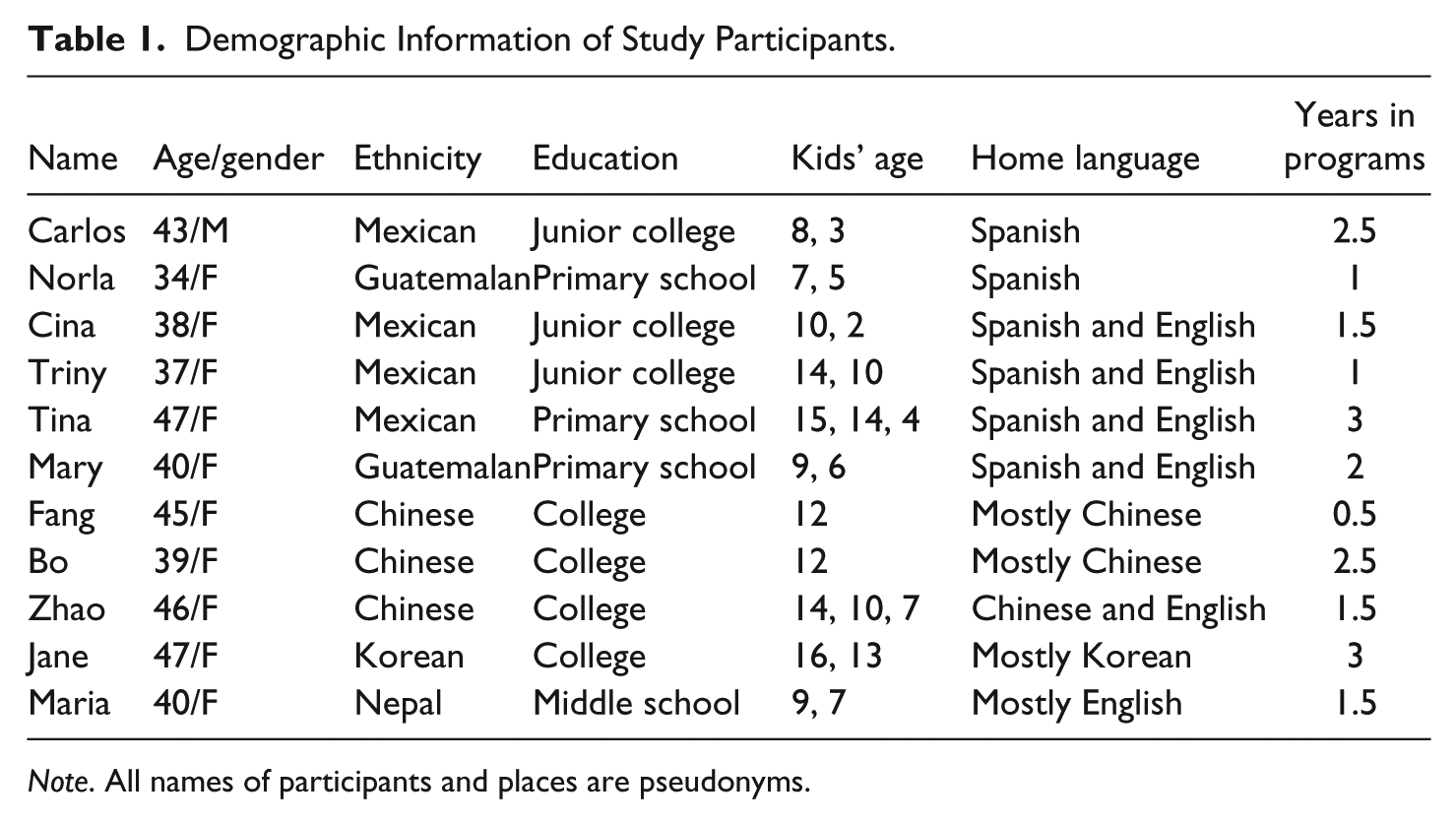
Note. All names of participants and places are pseudonyms.
Program Background
The ESL program in Christ Baptist Church (CBC) was founded in September 1967. The program was “a place of acquiring conversational English, American culture, new friendship, and world awareness” (2011-2012 Academic Year Program Brochure). The immigrant adults’ length of residence in the United States ranged from 3 months to 11 years with a mean of 7.6 years. Twenty-nine of 31 enrolled adult learners are Asian adults. Five Asian immigrant parents were recruited from the advanced ESL class. The class was provided on Wednesday morning from 9:30 a.m. to 12:00 p.m. in CBC. Between 10:40 a.m. and 11:15 a.m. was fellowship time, in which the program participants enjoyed refreshments and talked with each other. During this time, the program emphasized or honored current local community events, cultural exchanges, holidays, and birthdays of program participants. The instructional materials included Side by Side (3rd edition), a worldwide ESL training textbook integrating conversation practice in a basic and functional format, and News for You, a weekly published newspaper reporting world and national events.
The ESL program in Zion Church (ZC) was started in August 2007. The program provided immigrant adults with survival English. It had 60 registered adults, 59 Latino immigrants, and 1 from Iran. Their average length of residence in the United States ranged from 1 month to 20 years, with a mean of 5 years. The mean time they learned English in the program was 2.5 years. Six Latino parents in the advanced ESL class participated in this study. The class was conducted on Wednesday evening from 6:30 p.m. to 8:00 p.m. A nursery and children’s ministry classes were available. The instructional materials were ESL Beginner (Boguchwal, Pugni, Ramdelholl, Robbian, 2010), a book teaching basic English grammar concepts with illustrations of daily life in easy-to-understand language. Magazines and vocabulary flash cards were used as supplementary materials.
The two ESL programs were immersion programs; all teaching was done in English. The ESL instructors and program coordinators were White, middle-class, and monolingual.
Researcher Reflexivity
Ethnographic data collection and analysis is informed and influenced by ethnographer reflexivity, “a process by which ethnographers reveal their self-perceptions, . . . see their research within historical and structural constraints that result from asymmetrical power distributions” (Heath & Street, 2008, p. 123). Our bilingual and bicultural identities were a reflexive asset in establishing rapport with study participants. The first researcher is of Chinese descent, and the second researcher is of Hispanic descent. We both have full proficiency in English and our native languages. These cultural and linguistic identities made us sensitive to immigrant parents’ language learning and the importance of English in the host society. In addition, the first researcher’s long-term assistance in CBC’s ESL program enabled her to build intimate relationships with the participants. These allowed more authentic and richer accounts. We were also mindful of the educational gap between the participants and us. We negotiated the asymmetrical power distributions with the participants by sharing our coding and memos with them and providing them with educational information such as university-sponsored family story-reading time.
Data Collection
We collected data from three ethnographic sources, including weekly observations, semi-structured interviews, and artifacts. Our primary data were weekly observations in the ESL classes as well as the program activities such as field trips and church-sponsored community events. To give structure to the observations, we followed an observation sheet with three columns (see the appendix). The “Episode” column requires specific description of the physical contexts such as activities, symbolic objects, and non-verbal cues. The “Label” column indicates labeling the episode such as learner as doer or learner as cultural inquirer. The “Aha Realizations” column records insights along with questions raised in the fieldwork. This column consisted analytical memos to keep ongoing data analysis as cumulative. We recorded over 120 sets of observation sheets which demonstrated “thick description” (Geertz, 1983). Barton and Hamilton (2000) stress, “[literacy] practices are not observable units of behavior since they also involve values, attitudes, feelings and social relationships” (p. 7). Thus, we also engaged in semi-structured interviews with parent participants, their ESL instructors, and program coordinators. We developed interview questions from the observation sheets to explore three areas: the participants’ awareness of English and home language in their lives, family literacy practices, and the interaction of their church-based ESL learning and family literacy. Each semi-structured interview lasted around one and a half hours in their preferred language at their preferred sites. The interviews with Chinese-speaking parents were conducted in Chinese and those with non-Chinese immigrant parents in English. Four participants selected their houses or apartments, and the others used the churches as interview places. Each participant was interviewed three times, at the beginning, the middle, and the end of the project respectively. The interviews were audio-recorded and transcribed in the form of Standard English. Artifacts served as a supplementary data source. We collected relevant documents, flyers, notices, and the participants’ journals and emails. For each artifact, we made notes of how and in what context it was used, reused, distributed, and produced. Because artifacts “get us close to lived experience” (Hodder, 2003, p. 162), they acted as tools for eliciting the participants’ further comments during the interviews. The three sources yielded a wealth of detailed and multi-layered data.
Data Analysis
We used constant comparative analysis (Corbin & Strauss, 2008). First, we reread all the observation sheets and interview transcripts. We jotted down more detailed memos to identify the emerging themes on the interaction between immigrant parents’ church-based ESL learning and family literacy. The memos were discussed between the researchers and shared with the related participants for consensus and clarification. They were also used as the basis for integrating the individual data into one larger database. Second, the memos were reread and a list of specific examples and quotations related to the memos were sorted and assigned under the common themes for units of meanings. Through developing a list of codes reflecting the emerging themes from the larger database, the core themes were identified. Then, we created an analysis map to evoke relationships between immigrant parents’ ESL learning experiences and family literacy practices. The analysis map was used to address the ways in which parents, children, and community stakeholders were mutually relational and constitutive.
Findings
The data demonstrate that the immigrant parents’ participation in the church-based ESL programs empowers their family literacy and use of home language. This empowering experience promotes a variety of direct or indirect family literacy practices, including investment in family-together literacy, interaction with children’s schools, independence to address family and ethnic community issues, and reclaimed ownership of home language.
Investment in Family-Together Literacy
Our data indicate that the immigrant parents’ participation in the church-based ESL programs invests in direct family literacy practices such as shared literacy events with children as well as engagement in children’s literacy learning activities. For example, Fang explained:
My son and I read the newspaper together. His homework assignment is to write a current event every Wednesday and do a presentation in class the next day. He is excited to see the newspaper I bring home from the ESL class. He told that his classmates read the same newspaper. We share understandings of culture and events in the newspaper. I feel close to his mind, his schooling . . . ESL class keeps me updated. (Fang, interview, October 20, 2011)
The newspaper in Fang’s ESL class has become a shared home literacy learning material with her son. Furthermore, it is a mechanism for activating family literacy events such as ideas and cultural knowledge exchange. As Fang noted, not only has the church-based ESL learning kept her informed and “updated,” but also informative and involved with her son’s school work. Such shared literacy practices also occurred in Carlos’s home.
My daughter kept my essay “My Hometown” into her folder. She had the same essay prompt. She considered that mine could help her. (Carlos, interview, February 3, 2012)
Carlos is proud that he sets a positive role model for his daughter’s literacy learning. He perceives his church-based ESL learning experience as “DOUBLE LEARNING” as shown in his journal:
It is DOUBLE LEARNING. I improve English and learn many issues. I am also a learning model for my kids. (Carlos’s journal, January 24, 2012)
Carlos’s participation in the program becomes an educational resource for his daughter’s literacy practices. Maria also explicated her “DOUBLE LEARNING” in the program:
We have more topics for dinner talk. I tell my children interesting things I learn in ESL classes. Like today, we talked about study on chimpanzees. They love to hear it. (Maria, interview, October 16, 2011)
Maria integrates the ESL class literacy practices into family dinner talk. This integration not only enhances the frequency of her interactions with children but also broadens their horizons.
Participation in the church-based ESL classes facilitates the immigrant parents’ engagement in direct family literacy practices, including shared newspaper reading, family discussion of current events, and more involvement in children’s school learning. In addition, it is a social dynamic for activating indirect family literacy practices such as parent–child communication and family enrichment activities. Mary reported:
I used to feel kids and me living in two different worlds, my Spanish world and their English world. I know nothing about Halloween or Thanksgiving holidays. Kids learn these at school, but they cannot explain them to me in Spanish. I experienced these holidays in my ESL class. Now, I can share the things with them. (Mary, interview, April 10, 2011)
Mary’s ESL learning enables her to experience an increasing degree of acculturation and intergenerational cohesion. Jane similarly recounted,
Before I went to the class, when kids talked about situations in the U.S., I didn’t know the situations. Today I can catch up with their meanings, tell them my ideas. (Jane, interview, October 26, 2011)
Jane and Tina also addressed the role of the programs in their family enrichment activities:
The program is my savior, my extended family. Kids enjoy it. We like going to the program’s Zumba class or weekend activities. (Jane, interview, January 19, 2012) After my husband passed away, we didn’t have trips. But to this church, my children like it and trust it. This is the only place my kids miss. I think they feel like that they have friends there and help them a lot. (Tina, interview, November 3, 2011)
The programs create access to involve the immigrant parents’ children in family enrichment activities. Auerbach (1989) argues that frequency of children’s outings with parents has a strong effect on building family-together literacy. So the programs indirectly invest in the immigrant parents’ family literacy through offering parent–child enrichment activities.
Increased participation in the church-based ESL programs enhances the immigrant parents’ English proficiency, cultural knowledge, and family enrichment activities. These invest in the parents’ agency exercising in direct or indirect family literacy practices.
Interaction With Children’s Schools
In addition to investing in family-together literacy practices, the church-based ESL programs shape access for the immigrant parents’ active participation in school activities. Julie, the coordinator of CBC’s ESL program, responded:
Two teachers in our church would like us to come and talk about culture to their classes. Our students are happy to do it. They are very brave to use English. I am proud of them. (Julie, interview, November 30, 2011)
Julie views involving the parents in school activities as an English learning experience. Importantly, the parents found a sense of worth and responsibility after they participated in school activities. As Zhao expressed herself in an email to Julie, I enjoyed some voluntary activities to introduce Chinese culture such as paper-cutting, cheongsam [traditional Chinese-style dress], at the high schools and elementary schools. It was a very exciting experience for me because the kids showed enthusiastic interests in my culture. (Zhao’s email to Julie, November 10, 2011)
Being considered a cultural resource to the schools makes Zhao feel valued and respected. Building on the immigrant parents’ cultural diversity, the ESL program creates opportunities for them to contribute to school activities, which in turn empowers their sense of contribution. Their school involvement is also an advantage for their children. Bo offered how she felt after involving in school activities:
I used to feel shut out of school, because my English is not good. I even could not imagine I can talk with kids in the school classrooms. But I did. My daughter is proud of me for doing this. (Bo, interview, December 6, 2011)
With English improvement, the parents feel comfortable in communicating with their children’s school teachers. In explaining this, Carlos and Triny reported:
I help my daughter with homework. Sometimes I ask her teacher some questions. Sometimes I write notes like “I don’t understand this, can you explain it to me?” So she explains it to me face to face. Sometimes she gives back the same notes with answers. If I don’t understand the answers, it will be difficult. (Carlos, interview, February 29, 2012) I did not attend Open House before my English was OK. Now, I feel comfortable to go, even though I cannot understand all. I want to see the kids’ teachers. It [English] gives me the opportunity. (Triny, interview, May 8, 2011)
Carlos and Triny place high value on their children’s education. They recognize that English literacy proficiency is the key to communicating with their children’s teachers as well as empowering them to practice agency in bettering their children’s education. Their ESL instructor stressed:
My students are very keen on children’s education. They want to speak better English for children and school things. They want to go in the teacher–parent meetings, have their children be proud of them, not be embarrassed. (Maggie, interview, March 12, 2012)
Furthermore, the immigrant parents in this research view that the program instructors and coordinators provide advocacy to help them seek social justice in their children’s school lives. Carlos explained:
My daughter was bullied by some children at school. They called her, “You are bad, Latino.” I talked to her teacher and the director, they did nothing. It is not right. My ESL teacher called the school. We feel we are not alone. We have more people caring us. She is willing to help us. She teaches me to make a phone call or write a letter in dealing with it. Literacy survives us. (Carlos, interview, November 14, 2011)
Carlos receives institutional power from Maggie for resistance to his daughter’s bullying incident and challenging school authorities. Maggie’s willingness to help makes Carlos feel “we are not alone.” In providing advocacy, her support leads Carlos to identify the power of language and literacy: “A precondition for social and cultural emancipation” (Giroux, 1987, p. 2).
The ways that the programs empower the immigrant parents’ interactions with the schools manifest in two ways. First, the programs serve as community brokers to connect the schools with the parents. They use the community as a site of learning for the immigrant parents and a resource to integrate ESL education into community engagement. By doing so, they promote the parents’ confidence and frequency of interactions with school teachers. Second, the programs provide literacy support and advocacy to seek social justice. As the ESL instructor, Luci, said: “I teach my students English, because they need it to defend themselves and their families.”
Independence to Address Family and Ethnic Community Issues
We found that the immigrant parents tend to use literacy to address family and ethnic community issues with their increasing participation in the programs. Triny recounted:
My teacher teaches us money exchange, writing checks, government functions. I used to send my child to do those for me, issues like asking for meals, going to bank or different places. I feel free now. I can do it alone. (Triny, interview, November 10, 2011)
Since developing her own English literacy, Triny can use it to individually and independently deal with family issues. Literacy has become socially and emotionally significant in Triny’s daily life. Her sense of freedom comes from English literacy proficiency. In addition to gaining emotional benefits, the ESL instructor, Maggie, explained that participation in the program may lead to the immigrant parents’ economic gains:
I teach them unspoken codes, like shaking hands. Their employers would treat them better. I have taken my students to their job applications. One of my students works for my next door neighbor, clean the house. Her husband does the yards two times a week. My neighbor’s son is a doctor. My student’s friend got a job to clean the doctor’s offices at night. They are actually able to move out of the small mobile home into a nice apartment and school zone. Things like that. (Maggie, interview, March 12, 2012)
Maggie provides her students with employment assistance by teaching them unspoken codes and using her own social networks. She wants her students to improve their social conditions to strengthen their family literacy. Besides using literacy to independently address family issues, some immigrant parents in this study serve as references and advocates for their own ethnic community. Bo explained: “People asked me about where to get handicapped service, child care, or . . . I learn a lot from the church. It survives me, and I can help others.”
Some immigrant parents also serve as language brokers for their own communities, communicating with schools and housing managers:
I received phone calls from the school teachers. They said, “We have problems with this child, can you speak with the father?” I said: “Yes, let me call him. Let me go.” I am a volunteer. A lot of cases like this, health care or post office services. My kids call me “busy bee.” I am glad to use literacy to help people. The people who do not come to the ESL classes have to learn English, because they are here. Their children are here. (Carlos, interview, February 29, 2012)
Carlos and Bo’s church-based ESL learning enables them to contribute to their ethnic communities. They model the use of literacy in daily family and community activities. As ZC’s ESL program coordinator, Sally, stated:
Our program teaches students English. I think we are giving them a life jacket, to keep them above water enough. When we teach Norla English and gave her skills to be able to fill out the medical forms, forms for her children’s schools, when she goes to the school to fill in the forms next year, she is not only able to help herself, she is able to go to her neighbors: “I know enough English now. Let me help you.” They can help each other. So even [though] I only teach one student English, I potentially teach five families, because they are in community. Even their neighbors never come to our ESL class, they gain benefits from Norla’s knowing English. (Sally, interview, January 25, 2012)
Teaching the parents English is giving them and their community “a life jacket.” Sally’s words reveal that the programs prepare the parents to become bilingual advocates for their own families and communities.
The church-based ESL programs provide the immigrant parents with access to the language of power and parent empowerment. They invest in parents’ literacy, but they also encourage the parents to be “a life jacket” for their neighborhood and community.
Reclaimed Ownership of Home Language
The immigrant parents in this study have identified that the programs play an important role in fostering appreciation for their home language. Mary noted,
I grew up in poverty in Guatemala. I will never keep my children there. I want them to be American, as Americanized as possible, and put that [things connected to Guatemala] behind them, including Spanish. (Mary, interview, October 12, 2011)
Mary desired her children to be as Americanized as possible before her participation in the programs. She used to insist to “learn pure English, give Spanish up.” Mary attempted to cut the language bond for the children. However, one field class changed her language attitudes.
We went to the local library. We had a meeting with some kids, “A smile is the same in every language.” My classmates introduced languages, like Chinese, Korean, Japanese . . . Spanish is my language. (Mary, interview, March 5, 2012)
The field trip fosters a climate of respect for all languages. It allowed Mary to realize the value of her native language and claim back ownership of it. Mary’s experience reinforces Hornberger’s (1998) argument that individuals practicing their home language literacy usually express a general appreciation for all languages and work hard to learn English. Similarly, the immigrant parents’ attitudes toward home language are also influenced by that of their instructors or the program coordinators. Julie, the coordinator of CBC’s ESL program, recounted:
It is a shame to lose home language. It doesn’t make any sense, just because you have a language, you cannot allow yourself not to see the beauty in your own language, and also see the beauty in the English language. It is not the one better than the other. They are just different . . . I would like to learn Chinese or Spanish, but I wouldn’t give my English up. They are two treasures. I took a choice of one treasure, another treasure, you can have both treasures. (Julie, interview, January 25, 2012)
The parents reported that they felt respected by embedding home language practices within the classrooms and beyond such as biblical words in Spanish on the classroom’s boards.
When asked about how the parents felt about the biblical words, Tina and Cina said:
Good to see it written in Spanish, because it is hard to see something here written in Spanish. It is very valuable to see something spelled in Spanish. I feel respected. When I got into the door, it is the first thing I saw, and I started reading it. I feel happy and excited. (Tina, interview, February 3, 2012) It [Spanish] is part of me. That means they are interested in me, in my native language. I appreciate it. (Cina, interview, October 8, 2011)
Tina feels accepted to see the Biblical verses in Spanish on the boards. She perceives that the program respects and values the diversity that the immigrant parents bring to the program. Cina claims Spanish as her linguistic territory and identity marker, saying, “It is part of me.” She appreciates that the program accommodates linguistic diversity. Sally explained why she wrote biblical verses in Spanish in her email to the first researcher.
I wanted to share a verse with our students in their native language just as a way to “build a bridge.” Sharing encouraging words with them in their native language I hope lets them know that we appreciate where they’re coming from, that we value Scripture, and that by speaking (in writing) their language we show them love. Two of our main goals are to build trust with our Spanish-speaking neighbors (and those of any other language who join us) and to show them Christ’s love. While we use an immersion program, using their language isn’t forbidden. It’s not used regularly in class, since we believe that using it too much can slow down their learning. However, when it comes to “chatting” with the students before & after class, I do try to use some Spanish. It’s my hope that sharing Scripture also lets our students know our motivation for our classes is Christ’s love. (Sally’s email to the first researcher, March 27, 2012)
Sally wants to use a little biblical verse in Spanish as “a bridge” to convey Christ’s love and build trust and mutual respect. Importantly, it enables the parents to identify their linguistic strength and promote awareness of children’s home language practices. Triny stated:
I like children to fit into American culture better. So I learn English and speak English at home. I used to get mad when the kids talked something in English I could not understand. I also got mad when I spoke English, but they could not understand. Now I feel my kids should be able to know Spanish. So I teach them Spanish. They like it because they can teach their classmates. They teach me English. They feel they are smart. (Triny, interview, December 8, 2011)
Building on recognition of her Spanish language, Triny has developed a relationship of peer study with her children in family literacy practices.
The church-based ESL programs make the immigrant parents’ native languages visible in and beyond the classrooms. They also provide the parents with opportunities to use home language in community activities. Similar to Norton’s research that finds “when learners engage in literacy practices, they are also engaged in acts of identity” (2010, p. 10), the programs facilitate immigrant parents to recognize their linguistic power and empower them to reclaim the ownership of it.
Discussion
Family literacy is considered as any literacy work that supports parents to make a better life for their families (Auerbach, 1989). Drawing on this broader definition of family literacy, this study explores how two church-based ESL programs in a Southeastern U.S. city construct “family literacy ecology of communities” by providing Latino and Asian immigrant parents with ESL services. This study highlights the significant role that the programs play in promoting immigrant parents’ reclaimed ownership of and appreciation for their home languages.
There are four unintended and intended consequences for family literacy by participating in the church-based ESL programs, including investment in family-together literacy practices, interaction with children’s schools, independence to address family and ethnic community issues, and reclaimed ownership of home language. The programs see immigrant parents as part of a larger community of English speakers. They make extensive efforts to enrich immigrant parents’ English learning by providing them with survival English instructions. For example, the ESL instructors taught immigrant parents how to read children’s report cards, fill out money orders, or pay car insurance. As Bo and Triny expressed, the programs use literacy to strengthen their ability to care for families. The central point of the participants’ comments is that the church-based ESL literacy practices mediate and permeate the everyday activities of immigrant families.
In addition, the programs are sources of funds of knowledge for immigrant parents. Local knowledge is used in the church-based ESL literacy education. Through field class, a way of reaching out to the community, the programs use it as part of language, literacy, and cultural learning. By doing so, the programs not only build the parents’ confidence in their own ESL literacy learning, but they also empower them to exercise parental authority and agency in family literacy practices. For instance, Fang invested more time and interests in talking about current events with her son as well as sharing literacy learning activities with him. Also, beyond Carlos’s essay of “my hometown” as reflection on his intimate moments, it also serves as a mediator for his daughter to learn about Carlos, rather than a sample essay for her literacy learning. This enriches parent–child communication and also fosters a mutual understanding and a climate of family literacy. Similarly, immigrant parents’ ESL proficiency improvement increases opportunities for them in school involvement and advocacy for their children and ethnic communities. In this case, the transformation of literacy happens on multiple levels—personal, relational, familial, and communal. This verifies Braun’s statement that “environments which enable adult learners to enhance their own literacies, and at the same time provide environments which promote the literacies of their children” (1991, p. 1). Thus, the programs’ literacy practices connect immigrant family generations. They are transmitted to the home through the immigrant parents, which in turn transform home contexts into sites for mainstream literacy practices. While some studies look at the increased disjuncture of language and acculturation between parents and children in immigrant families where English is not the parents’ primary language, this study looks at the role of the church-based ESL programs as social mediators for connecting the disjuncture.
Even though the church-based ESL programs facilitate immigrant parents to enhance ESL proficiency and family literacy, they do not promote linguistic assimilation, devalue or erase their home language. Sally, the coordinator of ZC’s ESL program, explained that sharing a little verse in immigrant adults’ native languages was to “ . . . ‘build a bridge’ . . . lets them know that we appreciate where they’re coming from, . . ., and that by speaking (in writing) their language we show them love.” Something in Sally’s words indexes a deep emotion, love, and the impact of faith on the instructors’ passion for teaching. It can also be considered church-based ESL programs as lands of linguistic celebration. The participants perceive that the programs stimulate pride in their home language and help them reaffirm home language, their linguistic identity marker. In addressing Janks’s “access paradox” (2010, p. 24) related to dominance and access, the programs use immigrant parents’ language diversity as a springboard for maintaining their linguistic legacy and promoting a sense of pride in their home languages. Through engaging immigrant parents into home language practices in the communities and the church ESL classrooms, the programs place the parents “in a position of relative power in a given literacy event” (Norton, 2010, p. 13). As a result, some immigrant parents begin to reclaim their home language, but they also support the development of their children’s home language. For example, Mary used to see Spanish use at home as an obstacle to her children’s English language and cultural acquisition, but now she has given up “pure English” family literacy practices. Triny also developed a peer-study relationship with her children in home language and English literacy practices.
Furthermore, with the promoting of immigrant parents’ ESL proficiency, the programs help parents use their bilingual strength to access communities of power and have a voice in the larger society. Carlos, a Latino immigrant parent, moves from being an adult English learner to a language broker for his ethnic community by advocating with schools and communities. Such experiences enable Carlos as well as other immigrant parents to “regain their sense of themselves as agents who can act to transform the social situations in which they find themselves” (Janks, 2010, p. 13). Immigrant parents’ church-based ESL acquisition is “an act of knowing” (Freire, 1985, p. 55), which engages them “in the constant problematizing of their existential situations” (Freire, 1985, p. 56). Consistent with the socio-contextual views of language and literacy, the findings of this study substantiate that “the more diverse the contexts for using literacy, the wider the range of literacy achievement factors affected” (Auerbach, 1989, p. 173).
The church-based ESL programs have created “family literacy ecology of communities” by engaging and mediating immigrant parents into ESL and home language practices within the contexts of home, school, and community. To fill the “family literacy ecology of communities” shown in Figure 1, the programs serve as social mediators for situating parents’ literacy practices within real-life communities.
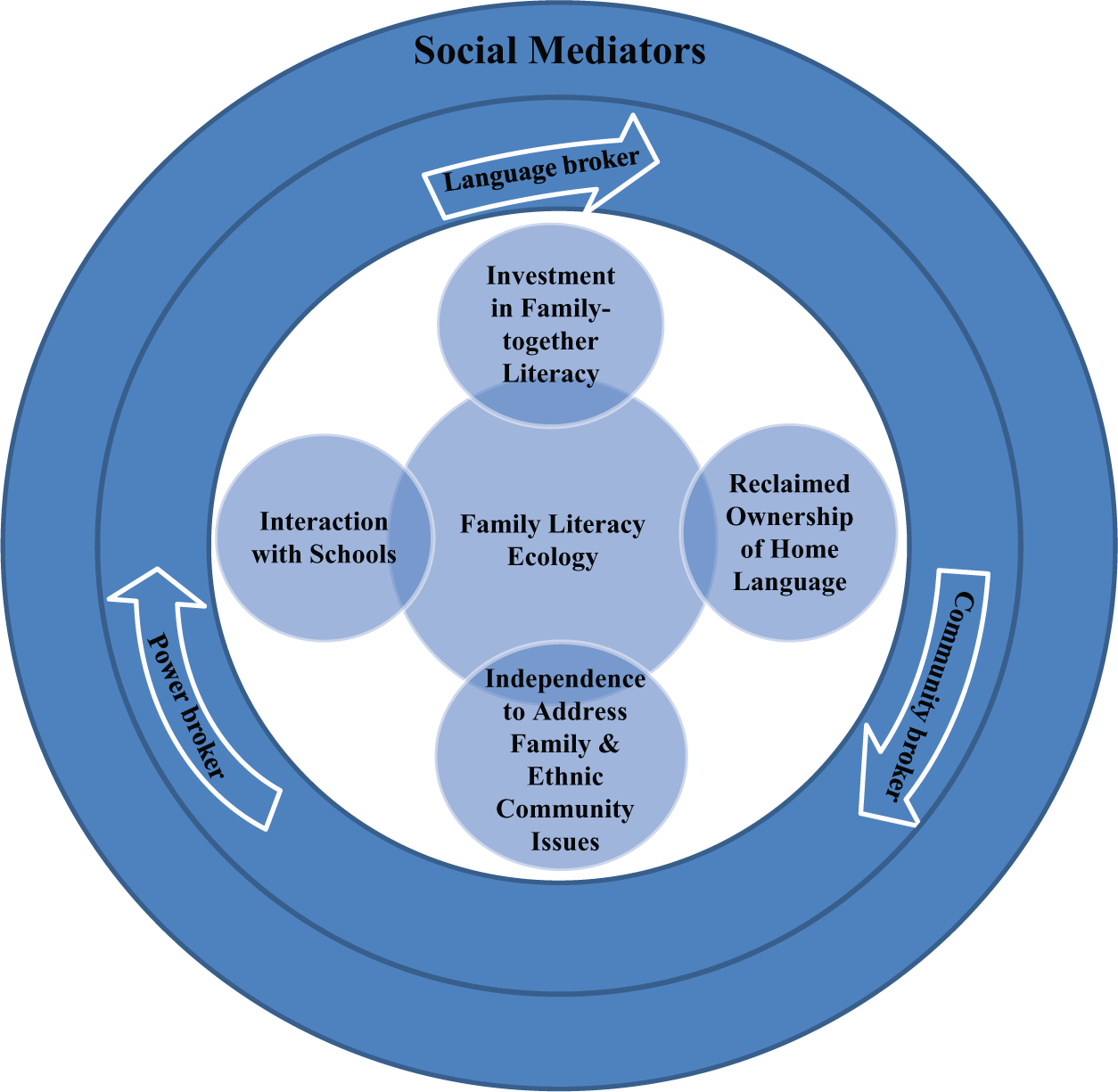
Social mediators: Empowering “family literacy ecology of communities.”
Van Lier (2004) argues an emergent language and literacy learning as “a matter of relationships” and a result of social activity and interaction with the environment (p. 53). The programs extend immigrant parents’ literacy practices from the physical setting of church classrooms to the communities and their families. For instance, Sally highlights her perspective of 1 ≥ 5: “So even [though] I only teach one student English, I potentially teach five families, because they are in community.” She views ESL literacy as “the mediating force of knowledge” (Freire & Macedo, 1987, p. 53). Immigrant parents’ English learning is an empowering experience for them. It mediates the relationships between an individual immigrant adult learner and his or her situated community. Within the framework of “family literacy ecology of communities,” the programs mediate immigrant parents’ ESL learning and their family literacy practices. This framework stresses the interdependent and embedded nature of family literacy. It reinforces Norton’s argument that literacy is “about relationships between text and reader, student and teacher, classroom and community . . . ” (2010, p. 10). As a result, the programs are critical language and literacy learning spaces to empower immigrant parents’ agency in accessing social, economic, and educational resources and power for their families and communities. In this sense, literacy intersects power. Immigrant parents’ experiences in these spaces allow them to construct the “family literacy ecology of communities” shown in Figure 1.
The framework of “family literacy ecology of communities” created by this study highlights that family literacy is mediated and constructed by the interaction between social mediators, such as family, school, and community. Data of this study show that the church-based ESL programs act as language, community, and power brokers to link immigrant parents and their families to the naturalized and nurtured literacy interaction.
Conclusion and Implications for Future Studies
Grounded in the socio-contextual views of language and literacy, this study explores the ways in which Latino and Asian immigrant parents’ English learning through two church-based ESL programs in a Southeastern U.S. city affects their family literacy and home language use. The immigrant parents in this study perceive that their church-based ESL learning is an empowering experience promoting ESL acquisition and funds of knowledge, which in turn advances their family literacy. This “DOUBLE LEARNING” experience, as Carlos said, enhances immigrant parents’ respect and appreciation for all languages, and the awareness to develop their children’s home language practices. The framework of the “family literacy ecology of communities” highlights the embedded and interdependent nature of family literacy. It is in line with Auerbach’s (1989) argument that “literacy . . . is not isolated as a separate, autonomous, add-on instructional activity” (p. 173).
Through the framework of “family literacy ecology of communities,” this study invites deeper understanding of how and why social institutions such as church-based adult ESL programs should perceive immigrant adult English learners as multi-layered beings: English learner, home language speaker, neighbor, ethnic and non-ethnic community member, and parent of monolingual or bilingual children. Based on the findings of this study, adult ESL literacy programs should play an integral role in appropriating ESL learning and ESL use into everyday family literacy practices. This study suggests that adult ESL programs need to act as language, community, and power brokers by providing support for immigrant adults and families. These may empower immigrant adults’ literacy practices, community engagement, and agency exercises. This study reminds literacy researchers and practitioners to recognize the richness of literacy practices nested in immigrant adults’ families and communities.
We believe that the ethnographic nature of this study and its method will provide a foundation for future research with immigrant adult English learners. Nevertheless, we realize that even though the sample of this study is representative, future survey research may generalize the interaction of church-based ESL programs and immigrant family literacy. Future qualitative studies can be done to explore how immigrant parents and their children’s participation in church-based ESL programs may affect their religions and religious literacy. Also, future studies are needed to explore the cultural differences of Latino and Asian immigrant parents in understanding family literacy and home language use.
Footnotes
Appendix
Acknowledgements
We are grateful to the study participants in this research.
Declaration of Conflicting Interests
The author(s) declared no potential conflicts of interest with respect to the research, authorship, and/or publication of this article.
Funding
The author(s) received no financial support for the research, authorship, and/or publication of this article.