




Abstract
This study aimed to describe home literacy (HL) activities of Spanish-/English-speaking children of low–socioeconomic status backgrounds and examine the relationship between HL and performance on standardized assessments. Parents of 65 dual-language learners (DLLs) in kindergarten completed an HL questionnaire. Parents reported an average of 17 books at home and engaged in active HL activities for 24 minutes a day on average. The relations between HL activities and performance were evaluated using correlations and regression. Analyses revealed a significant relation between HL and children’s language abilities, as measured by a bilingual measure of morphosyntax and semantics. Children’s reported interest in reading was also positively associated with their phonological awareness skills. HL was significantly related to child interest in reading and language performance. These findings suggest that home literacy plays a role in the language and literacy development of DLLs.
Keywords
HL skills of children from linguistic-minority backgrounds are of key interest in education research as schools in the United States serve an increasing diverse population of young children. The population of children from linguistic-minority backgrounds includes children categorized as dual-language learners (DLLs), an umbrella term used to refer to children learning two or more languages at the same time (Halle et al., 2014). Florida schools, like schools in many states in the United States, serve a growing percentage of children who are DLLs and speak a language other than English at home. Florida alone serves 265,000 students who speak a language at home other than English (Florida Department of Education, 2015). Among the growing proportion of DLL students, Spanish-/English-speaking children are the largest linguistic minority. HL of Spanish-/English-speaking children is an important area of continued study given that more than half the growth in the population in the United States between 2000 and 2010 can be attributed to an increase in the Hispanic population (Pew Hispanic Center; Sherrill & Mayo, 2014). By 2025 the Hispanic population is expected to be the largest U.S. minority group (Passel & Cohn, 2008). Considering the important role of HL and the growing number of children who are DLLs, it is important for us as educators to understand the early HL experiences of children from language-minority backgrounds. Existing HL studies, however, have primarily focused on homes in which English is the primary language spoken.
In the existing literature, there is insufficient description of DLLs’ HL practices as emergent literacy skills take shape in the early grades. This is primarily because DLLs exhibit diversity in their HL practices, and they clearly do not constitute an entirely homogenous group in terms of language knowledge or access to literacy outside school. Their literacy practices seem to connect to family use of the minority language at home and access to formal schooling in that language (Buac, Gross, & Kaushanskaya, 2014; Hammer et al., 2012; Hoff, Welsh, Place, & Ribot, 2014). Other factors have been deemed relevant in the literacy practices of DLLs, namely, parental educational attainment and family access to printed materials (Breit-Smith et al., 2010).
Influence of Socioeconomic Status (SES)
In addition to potential influences of language-minority backgrounds on HL, economic disadvantages may place children from low-SES family backgrounds at additional risk for poor achievement. Prior to beginning kindergarten, children from low-income homes demonstrate diminished emergent literacy skills compared to their peers from higher-income homes (O’Donnell, 2008). SES significantly predicts English-reading skills for Spanish-/English-speaking children in the early grades (Howard et al., 2014). Parents of children living in poverty also report less frequent engagement in HL activities with their children compared to parents of children living above the poverty threshold (Mamedova & Redford, 2015). The disproportionate prevalence of childhood poverty among Spanish-speaking DLLs (Federal Interagency Forum on Child and Family Statistics, 2016) places them at increased risk for delayed acquisition of language and literacy (Suarez-Orozco & Suarez-Orozco, 2001). In 2015, the poverty rate among Spanish-speaking children in the United States was 32% (Kena et al., 2015). DLLs who have parents with low education levels are considered to be among the most at risk for impoverished literacy experiences (Koskinen et al., 2000; Suarez-Orozco & Suarez-Orozco, 2001).
SES and maternal education appear to influence HL (Breit-Smith et al., 2010). Data from the National Assessment of Educational Progress suggest that impoverished families have fewer print materials in the home and are less likely to engage in educational activities at home than families of higher-SES backgrounds (Hernandez, 2011). The SES gap in HL is reportedly widening, as the frequency of HL activities has shown an upward trend on average for families of middle and high-SES backgrounds between 1993 and 1999 based on data from the National Center on Educational Statistics; however, this upward trend was not observed in low-SES households (Nord, Lennon, Liu, & Chandler, 1999). Findings in the literature suggest income and time spent in work-related activities may shape HL activities and access to print in the home. A persistent differential in HL practices was apparent in a more recent study (Breit-Smith et al., 2010) that also reported that parents’ report of HL practices differed by income level.
Defining HL
In approaching the topic of HL, we first review key concepts and terms necessary for understanding the existing literature. The term home literacy has been used to refer to a variety of activities and practices. The relevant literature has examined different aspects of HL, including average daily duration and/or weekly frequency of adult reading and writing; child-supported reading and writing activities at home; print-related activities, such as visiting the library and number of books in the home; and active teaching efforts, such as pointing out letters and words in various media (Baker, Fernandez-Fein, Scher, & Williams, 1998; Burgess et al., 2002; Bus et al., 1995; Farver, Xu, Eppe, & Lonigan, 2006; Farver, Xu, Lonigan, & Eppe, 2013; Hart et al., 2009; Mol & Bus, 2011; Phillips & Lonigan, 2009; Rodriguez et al., 2009). HL practices have been indexed in various ways and through different items, including quantity measures (e.g., the number of times books are read to children, number of minutes that children experienced reading at home by a parent each day, and frequency of literacy-related activities per week; Boudreau, 1997, 2005); and quality measures (e.g., parents’ initiation of verbal interaction with child; Rodriguez et al., 2009).
Theoretical Motivation
It is thought that children’s early literacy experiences at home and in their communities shape and influence their engagement and outcomes in language and literacy. Viewing literacy as a social practice (Barton, Hamilton, & Ivanič, 2000) largely motivated the current study, in that it would be expected that the cultural practices and linguistic background of the family may shape and influence early language and literacy experiences in the home. Given this social framework for HL, children’s early literacy experiences are thought to be encapsulated in and shaped by the beliefs, traditions, routines, and practices of the family (Purcell-Gates, Jacobson, & Degener, 2004). Children’s HL activities may be expected to be unique to the cultural linguistic environments of the family, and it would be expected that HL would show a positive relationship to language and literacy outcomes.
In recognizing that cultural differences in HL practices may be influenced by beliefs, values, and child-rearing practices, we focused the literature review to describe the HL of families of DLLs who are Hispanic specifically (Boyce et al, 2004; Gonzalez & Uhing, 2008; Lynch, 2009; Yarosz & Barnett, 2001). According to the current definitions for race and ethnicity constructed by the U.S. Office of Management and Budget (1997), the term Hispanic refers to individuals from Spanish-speaking cultures or origins independent of race. This definition allows the terms Hispanic and Latino to be used interchangeably, although there is some disagreement regarding this practice (Lopez, 2013). In the present paper, we use the term Hispanic to refer to individuals from Spanish-speaking backgrounds and focus our discussion of DLLs on those who may define themselves as Hispanic.
The HL practices of Hispanic families are of particular interest in light of recent data from the Federal Interagency Forum on Child and Family Statistics (2015), which indicated that Hispanic families read less frequently to their children, based on a comparison that 90% of non-Hispanic White families reported reading at least three times per week to their children and only 71% of Hispanic families reported reading three times per week. This gap reflects the pattern that has been observed consistently in the United States: Hispanic families report reading less to their children than non-Hispanic White, non-Hispanic Black, and Asian/Pacific Islander families (Federal Interagency Forum on Child and Family Statistics, 2013).
The HL practices of Mexican-American families are described in a study of 38 families from rural, urban, and migrant backgrounds in a midwestern state (Lynch, 2009). Parents reported that engagement in reading activities was most frequently characterized by reading calendars, tickets, labels, signs, mail, e-mails, and container print on a daily basis. On a weekly basis, most families reported that they read e-mails, menus at restaurants, advertisements, coupons, and the horoscope. Approximately half of the participants reported reading a fiction book or the Bible in the past year.
The existing literature identifies several factors that may influence HL and/or create shifts in HL practices, including acculturation, seasonal work, and lack of home permanence (Purcell-Gates, 2013; Reese & Gallimore, 2000). One study suggested that parents in the United States from Mexico and Central America may show shifts in beliefs and practices during acculturation, demonstrating an influence of mainstream school values and media-promoted parenting routines (Reese & Gallimore, 2000). Another study (Purcell-Gates, 2013), which examined the literacy practices of Mexican-American families of migrant backgrounds using interviews with parents and teachers, reported that some HL practices remained constant (e.g., letter writing, reading spiritual verses) whereas other practices (e.g., number of books in the home and frequency of reading) varied depending on seasonal work and home permanence. Purcell-Gates (2013) also noted that it may be difficult for families who relocate seasonally to move or store books given a nonpermanent residence, which would negatively influence HL practices.
A growing body of research has highlighted HL practices in Puerto Rican families (Hammer, 2000; Hammer, Miccio, & Wagstaff, 2003; Hammer, Nimmo, Cohen, Clemons, & Achenbach, 2002). One such study, Hammer et al. (2003), conducted an initial investigation of English literacy activities in 43 Puerto Rican bilingual preschoolers (28 simultaneous bilinguals, who had learned English and Spanish from birth, and 15 sequential Spanish-English learners, who had been exposed to Spanish from birth and had learned English upon school entrance). No differences were found between simultaneous and sequential language learners. However, mothers’ emphasis on learning activities varied within the total sample. The authors reported that mothers of simultaneous DLLs read to their children 2 to 4 days a week on average, compared to mothers of sequential Spanish-English learners, who read once a week on average. They also found differences between groups in the parents’ emphasis on literacy achievement (Hammer et al., 2003).
Among influencing factors, differences in the amount of English use at home may account for variability in HL within samples of children from Hispanic backgrounds. Hammer, Rodriguez, Lawrence, and Miccio (2007) compared HL beliefs and practices of 81 Puerto Rican families in the United States between a group of mothers who had spoken English and Spanish to their children on a regular basis since birth (n = 51) and a comparison group who primarily spoke Spanish at home and began learning English upon Head Start entrance at age 3 (n = 31). The results indicated that both groups averaged six to 10 books in the home. There were no significant differences in beliefs between the groups; however, there were differences in literacy practices, with mothers who spoke English and Spanish at home teaching their children early literacy skills and reading books two to four times a week compared to the comparison group, who read books only once per week.
More recently, Hammer, Farkas, and Maczuga (2010) examined the cultural differences in HL practices with a larger sample (1,015 children in the FACES 1997 database who attended the Head Start program), including 223 Hispanic children but only those who were proficient in English. The findings suggested that higher maternal education was associated with more literacy activities at home. Additionally, children from Hispanic backgrounds engaged in literacy activities at home less frequently than children whose parents reported non-Hispanic White backgrounds. Additionally, HL activities were related to vocabulary abilities but not to letter-word identification skills.
Relationship to Child Outcomes: Critical Components of HL
Although researchers generally agree HL activities are important, there is some discrepancy regarding which components have the strongest relationship to child outcomes (Howard et al., 2014). Several studies report moderate to strong relationships between HL activities and language and literacy performance (Burgess et al., 2002; DeJong & Leseman, 2001; Sénéchal & LeFevre, 2002). Other studies found less robust relationships (Roberts, Jurgens, & Burchinal, 2005) or found HL to significantly predict a specific developmental language aspect, such as vocabulary, but not performance on other early literacy tasks (e.g., letter-word identification; Hammer et al., 2010). To further explicate the differences in findings across the literature, we reviewed trends in the previous literature with attention to the populations considered and measures used in an attempt to identify essential components of HL to consider.
In a seminal study of HL, Burgess et al. (2002) examined the importance of shared reading at home in children’s improved language development based on a sample of 97 children born to middle-income families in northern Florida. Children were tested at two time points using several language tests, including measures of grammatical closure and grammatical understanding, in addition to a questionnaire of HL practices, termed HL environment in this study. Burgess et al. conceptualized and clustered activities that involved active elements or active teaching (e.g., parent reading to the child) separately from aspects of the HL environment that were passive or involved passive exposure to print (e.g., how many books were in the home or how often the child saw adults engaged in silent reading). Active elements of the HL questionnaire were statistically significant in 13 of the 21 correlations of all HL elements, with average correlation between HL environment and oral language measures of .41. The findings suggested that early parent–child reading time may be conducive to increased reading abilities in children (Burgess et al., 2002).
In contrast to Burgess et al. (2002), Roberts et al. (2005) found moderate correlations between individual aspects of HL activities (e.g., frequency of shared reading was related to children’s enjoyment of reading) but found few significant relationships between HL and children’s language and literacy performance. Differences between the studies’ findings could be partially explained by the aspects of HL examined, different tests used to measure language and literacy performance, or differences in populations sampled. Based on results of the Roberts et al.’s longitudinal study (18 months to 5 years old) describing 72 African American children’s language and literacy, performance was not found to be predicted by frequency of shared reading or children’s enjoyment of reading. Use of strategies and maternal sensitivity or responsiveness were significantly related to receptive vocabulary (i.e., Peabody Picture Vocabulary Test [PPVT] scores) but not significantly related to performance on other language and literacy tests. General responsiveness in the home environment was the strongest predictor of children’s language and literacy performance.
Recognizing that HL activities and practices differ across families, and considering the importance of supporting children’s early literacy, additional research is needed on the HL activities and practices of DLLs from low-SES backgrounds. New efforts in relating family literacy practices at home to DLLs’ formal performance in school can expand our understanding of young DLLs’ language and literacy outcomes. Additional data on Hispanic DLLs’ family literacy practices are also needed to inform the design of family literacy programs for Spanish-English speakers. Our goal was to add to the literature characterizing Hispanic DLLs’ HL activities. In response, this study aimed to (a) describe HL practices experienced by children from Spanish-speaking backgrounds and (b) examine the relationship between reported HL practices and child performance on formal language and literacy assessments.
Method
Participants
The study included a subsample of 65 Spanish-/English-speaking children who were enrolled in kindergarten and whose families had consented for them to participate in a vocabulary learning intervention study. Eligibility was based on having at least one caregiver in the home whose primary language was Spanish. Potential participants were identified by cooperating teachers at participating schools and were asked to participate through written consent forms. Following guidelines of the Human Subjects Committee, the authors did not receive any information about potential participants until receipt of informed consent.
Upon receiving informed consent from families, investigators contacted caregivers by telephone to gather demographic information and to ensure eligibility as a Spanish-English speaker. Of the total participants, 51 were children from four elementary schools in one school district in rural northern Florida, and 14 children were from an elementary school in a separate district in northwestern Florida. All children were enrolled in partnering schools participating in the vocabulary learning intervention study. The sample included 35 girls and 30 boys ranging in age from 60 to 86 months, with a mean of 69 months (SD = 6.18), or 5 years 9 months. Mothers were the predominant primary caregivers and respondents to the interviews (89%, n = 58). In other cases, fathers responded to the HL surveys (11%, n = 7). The average age of the caregivers was 30 years old (SD = 4 years).
All children attended public schools where English was the language of instruction. All of the schools were considered to be low-SES schools based on district reports of the percentage of free and reduced lunch. Additionally, 88% of families reported eligibility for free lunch; 3%, reduced lunch; and 9% did not reply. Children in the sample had typical nonverbal intellectual abilities, evidenced by performance on a nonverbal test of intelligence (M = 93.65, SD = 16.16). No significant differences in test scores were obtained between the two school districts. Consequently, results are reported for the full sample. Additional descriptive demographics are provided in Table 1.
Sample Demographic Characteristics

Linguistic environments
All children had at least one parent in the home who reported speaking Spanish, although the frequency of use varied. On average, families reported that Spanish was exclusively used 32% of the time over the week for the participating sample (SD = 19.5). Waking hours at home in a family environment were tabulated through initial phone interviews with parents at the onset of the study, not part of the HL surveys. The number of hours speaking Spanish at home between breakfast time and evening hours after school dismissal suggested children spoke Spanish to their parents between the hours of 6 and 9 p.m., or between the evening meal and bedtime.
Most of the parents spoke Spanish at home and at work-related situations because the area where families lived was predominantly Spanish speaking. Only two parents reported they were English-Spanish balanced bilinguals, as they had arrived in the United States as children and had been formally educated in English. In addition, four families reported oral use of a Central American dialectal variation (Mizteco or Guateca). The children of these families were exposed to English in school, Spanish at home, plus Mizteco or Guateca by at least one family member. In interviews, another source of linguistic diversity was noted in grandparents’ use of Spanish, either daily (6% of families) or over the weekend (13% of families). Children also spoke some Spanish at school during regular school hours because there were some bilingual educators who were fluent in Spanish.
Materials
HL
To allow for comparison of results against prior work, we combined components of standardized HL measures from large national databases and remained consistent with point values assigned in previous studies. The investigators used an established parent questionnaire, Early Literacy Questionnaire, as the foundational tool for this research because it had been evaluated previously in the literature (Boudreau, 1997, 2005). Construct validity of the items is supported by previous report of a strong relation between standardized measures of early literacy and parent report of literacy practices (Boudreau, 2005). All questions were retained from the original survey, which included questions proximally related to HL (e.g., frequency of reading and number of books in the home), as well as more distally related questions, such as frequency of drawing (arts and craft activities) and music/rhyming. Although such questions may appear distally relevant to HL at the surface level, questions about drawing, singing songs, and coloring are often included in HL surveys (Boudreau, 2005; Breit-Smith et al., 2010; Hammer et al., 2003) given that such activities provide adults opportunities to name pictures, talk about images, expose children to language, and point out print and writing conventions similar to joint activities with picture books or visits to the library.
To compare results with previous reports that utilize the National Household Education Survey (NHES) database, four additional questions from the NHES (Breit-Smith et al., 2010) were added to the Early Literacy Questionnaire:
How often do you or someone in your family read to your child?
How often do you or someone in your family teach the child letters?
How often do you or someone in your family teach the child words or numbers?
How often do you or someone in your family teach the child songs or music?
Based on the recommendations of previous researchers (Breit-Smith et al., 2010), additional response options were also added, such as including every day to the Likert scales and following up with specific time estimates in minutes per day and hours per week. Therefore, response options for these questions were (1) never, (2) once a month, (3) once a week, (4) every day, and (5) several times per day. Parents were then asked, “On average, how many hours per day?” Dichotomous-response items (e.g., visiting the library in the past month) were scored as (1) no or (5) yes. Qualitative questions were also included based on the recommendation of previous studies (Breit-Smith et al., 2010) suggesting quality of literacy activities may be as important to child outcomes as frequency of literacy activities (Dieterich, Assel, Swank, Smith, & Landry, 2006; Hammer et al., 2010). Some of the qualitative questions were as follows:
Are there any specific books you read with your child?
What are some of your child’s favorite books?
Let us know any concerns about your child’s reading development.
Language and literacy assessments
The Woodcock Reading Mastery Tests, Third Edition (WRMT-III; Woodcock, 2011) Letter Identification, Phonological Awareness, and Rapid Automatic Naming subtests were administered in fall of the kindergarten year for 75% of the participants and in January for 25% of the participants, who entered the school district mid–school year. The WRMT-III is a set of tests for measuring oral language and academic achievement normed on individuals 4 to 79 years old. The test’s validity was based on normative data gathered on than 3,360 individuals (including 2,600 school-age participants) in 45 states in the United States.
The Bilingual English-Spanish Assessment (BESA; Peña, Gutiérrez-Clellen, Iglesias, Goldstein, & Bedore, 2014) morphosyntax and semantics subtests were administered in English and Spanish to assess global Spanish/English language performance. The test allows children to respond in Spanish, English, or both. The Spanish Morphosyntax subtest was found to have good sensitivity for Spanish-speaking or Spanish-dominant bilingual children 5 years 2 months to 5 years 11 months old. Preliminary analysis of the Spanish Semantics subtest reported coefficient alphas between .78 and .84, and coefficient alphas between .81 and .92 for the English Semantics test (Bedore, Peña, Gillam, & Ho, 2010).
The PPVT-4 (Dunn & Dunn, 2007) was administered to assess children’s receptive vocabulary understanding in English. The PPVT-4 is a norm-referenced measure of receptive vocabulary in English (normed for 2 to 90 years). The assessment takes 10 to 15 minutes to administer, and the child is asked to point to a auditorily labeled target picture given a choice of four. A standard score of 85 to 115 is considered to be within normal limits. The measure was normed on 3,540 individuals in the United States reflecting the U.S. population distribution with regard to sex, race-ethnicity, geographic region, SES, and clinical diagnosis. Split-half reliability by age was M = .94 (SD = 3.6).
The Test de Vocabulario en Imagenes Peabody (TVIP; Dunn, Lugo, Padilla, & Dunn, 1986) is a norm-referenced measure of receptive vocabulary in Spanish designed for ages 2 years 6 months to 17 years 11 months. Similar to the PPVT-4, the TVIP takes 10 to 15 minutes to administer as the child is asked to point to the picture that matches the stimulus word spoken by the test administrator. Normal range is considered to be 85 to 115. The TVIP was normed on 2,707 monolingual Spanish-speaking children from Mexico and Puerto Rico. Weighted scores were used to correct the uneven SES distribution according to the U.S. Census (2012). Median reliability was .93.
The Primary Test of Nonverbal Intelligence (PTONI; Ehrler & McGhee, 2008) was administered at the onset of the study as a measure of reasoning abilities. This measure takes approximately 5 to 15 minutes to administer. The PTONI was normed on 1,010 children in 38 states with alpha reliability coefficients on internal consistency at .90 to .97.
Procedures
The survey was administered over the phone rather than in person in an effort to adjust to parents’ availability because most of the parents were seasonal workers with long hours and varied working locations. Phone-based interviews were favored over written questionnaires to reduce the potential for selection bias; more literate parents may be more interested and willing to read a written survey compared to parents with limited literacy skills. Upon receipt of informed consent during the 2013–2014 school year, the phone surveys were initiated in Spanish with participants immediately following collection of background demographic information. Families could respond in English or Spanish. The third author, who is a native Spanish speaker, and two trained graduate research assistants, who are Spanish heritage speakers, conducted the HL surveys. 1 Prior to initiating phone calls to potential participants, the project coordinator conducted training on data collection methods and reviewed the script for phone calls with the research assistants.
Parents’ responses regarding HL activities were recorded and handwritten on a paper survey during the phone call. Investigators converted the scaled responses to numeric values (i.e., 1–5 scale) and entered responses in the electronic database. Minutes per day and hours per week were entered based on reported frequency. The research assistants met with the coordinator weekly to discuss any discrepancies between responses and multiple-choice options on the response form provided. The form was revised accordingly. For example, when parents responded with a range, such as estimating that they read 40 to 50 minutes, the mean was entered (45 in the example) in the database to represent estimated amount of time. Similarly, when parents responded with a range for the number of books (e.g., three to four books in the home), the middle of the range (3.5 in the example) was recorded in the database.
Additional trained undergraduate and graduate research assistants majoring in speech-language pathology conducted language and literacy assessments individually in the children’s schools. All research assistants received training with observation and practice on the standardized tests prior to administration. The order of test administration was randomized to avoid an order effect. Standardized tests were administered over multiple sessions to limit error due to fatigue, with approximately 30 minutes on average in each testing session. Scoring was conducted by two independent scorers to ensure accuracy.
Preparation for Analyses
Individual item responses were z scored and aggregated based on underlying constructs. This approach was taken to balance the contribution of each item response to the final composite and to allow for inclusion of respondents with some missing data (see Cohen, Cohen, West, & Aiken, 2003). Items specific to HL were separated into active and passive clusters. Passive HL activities included access and exposure to print. We selected three items to create this composite: number of total books in the home, number of books in Spanish, and number of books in English. Active HL activities included the number of times parents reported reading to children, teaching letters, teaching words or numbers, teaching music, and teaching art, and if they had been to the library in the past month. Responses were converted to a 1-to-5 scale, taking the standard deviation, range, and frequency of responses into account, and then averaged. This clustering methodology was based on those utilized by Breit-Smith et al. (2010) and those recommended by Cohen et al. (2003).
The investigators also created a composite measure of child interest in reading from survey item responses. Parent report of the following were included: how often the child asks to read, the child’s enjoyment of reading, how often the child pretends to read, and the child’s interest in adult materials, such as newspapers or magazines. Each item was placed on a 1-to-5 scale and averaged to produce the composite score.
Results
During data collection, participants retained the right to not respond to any question for any reason. Consequently, there were some survey items that were not completed by all 65 participating caregivers. Little’s test of data missing completely at random (MCAR) indicated that data were not missing completely at random for the entire questionnaire, χ²(184) = 224.44, p = .022. However, further inspection of the patterns of missing values revealed that the smallest number of responses was recorded for follow-up questions on the questionnaire (e.g., reporting estimated hours per week spent reading). When follow-up questions were not included in the MCAR test, results revealed that any remaining missing data were MCAR, χ²(100) = 97.36, p = .556. Because data from these follow-up questions were not used in any of the planned analyses, but were intended to include qualitative depth, these data were included as in the descriptive results only. These results were all reported with a note of the number of participants who responded to those questions.
Descriptive data on HL activities are reported first to describe the HL practices. Table 2 provides a summary of average reported HL activities. The number of books parents reported to have in their home ranged from 0 to 100. Most of these books were reported to be written in English (M = 15.81, SD = 17), with few books written in Spanish (M = 1.92, SD = 2.45). In the current study, most families (58 of 63) reported having fewer than 50 books at home. Although 50 is an arbitrary criterion, fewer than 50 books describes 92% of our sample, with only five families reporting 50 or more books at home. Parents did report that their children had access to printed materials in Spanish in their communities. Respondents indicated that 31% of the children were exposed to Spanish forms of printed materials through Sunday school instruction at their local church.
Average Reported Home Literacy Activities

Scored as 1 = never, 2 = once a month, 3 = once a week, 4 = every day, 5 = several times per day.
Families in the current study reported actively engaging in teaching emergent literacy concepts with regularity. Most parents (72%) indicated direct letter instruction occurred daily, and an additional 23% reported teaching letters on a weekly basis. Similarly, 81% of parents reported teaching words or numbers every day, and an additional 14% reported teaching on a weekly basis. Overall, parents reported engaging in arts-and-crafts activities less frequently, although most parents (88%) participated in arts and crafts with their child at least once a week. Families taught music or songs with the lowest frequency; less than half (44%) sang with their children daily, with 28% reporting never teaching music or songs. Figure 1 provides visual representation of families’ distribution of teaching activities. In this population of families, older siblings were often engaging the children in literacy activities after school. Over one quarter (32%) of parents from the participating sample reported that older siblings had active involvement in homework completion activities with the young DLLs during the week, although parents declined to describe siblings’ roles in detail.

Frequency of parent teaching by type of activity.
When asked about the frequency of reading, the 65% of families reported reading daily, and an additional 31% reported reading at least once a week. One outlier presented on each end of the continuum: One family reported reading only once a month on average, and one family reported reading with the child several times a day. During a typical shared reading session, parents reported reading zero to four books, averaging 1.75 (SD = 1.00) books per sitting. Table 3 provides additional information regarding reported HL activities.
Frequency Distributions of Responses Regarding Home Literacy Activities

Language and Emergent Literacy Performance
Descriptive data for children’s performance on language and literacy measures are provided in Table 4. Participants generally scored below average but within normal limits (85–115) on language measures with three areas of exception: English vocabulary, English morphosyntax, and Spanish morphosyntax. Mean performance was below the normal expected range (compared to monolingual norms) on English receptive vocabulary (M = 82.03, SD = 15.67) and English morphosyntax (M = 82.36, SD = 13.76). Additionally, children’s performance on Spanish morphosyntax measure was also low on average and showed large variability (M = 84.11, SD = 22.75).
Children’s Average Performance on Standardized Language and Literacy Assessments

Note. PPVT-4 = Peabody Picture Vocabulary Test-4 (Dunn & Dunn, 2004); TVIP = Test de Vocabulario en Imágenes Peabody (Dunn, Lugo, Padilla, & Dunn, 1981); PTONI = Preschool Test of Nonverbal Intelligence (Ehrler & McGhee, 2008); WRMT-III = Woodcock Reading Mastery Tests, Third Edition (Woodcock, 2011); Letter ID = Letter Identification; PA = Phonological Awareness; RAN = Rapid Automated Naming; BESA = Bilingual English-Spanish Assessment (Peña, Gutiérrez-Clellen, Iglesias, Goldstein, & Bedore, 2014).
Relationships
Next, relationships between variables are reported to accomplish the second research aim, examining the relationship between reported HL practices and child performance on formal language and literacy assessments. Pearson’s r was obtained as a correlation coefficient, as recommended for variables including more than five possible ordered responses. Table 5 provides a summary of correlations between measures. There were missing data for the BESA Language Index score due to the fact that the BESA was not administered at all schools; therefore, we conducted a Levene’s test for equality of means to compare performance of participants with and without BESA data. The results of the t tests indicated that there were no significant mean differences on passive HL (t = .111, p = .553) and active HL (t = .814, p = .287) composite scores or receptive English vocabulary (t = .11, p = .707) between children with and without BESA data. As a result, we retained the BESA Language Index data in subsequent analyses despite missing data.
Correlations Between Home Literacy Activities and Standardized Test Scores
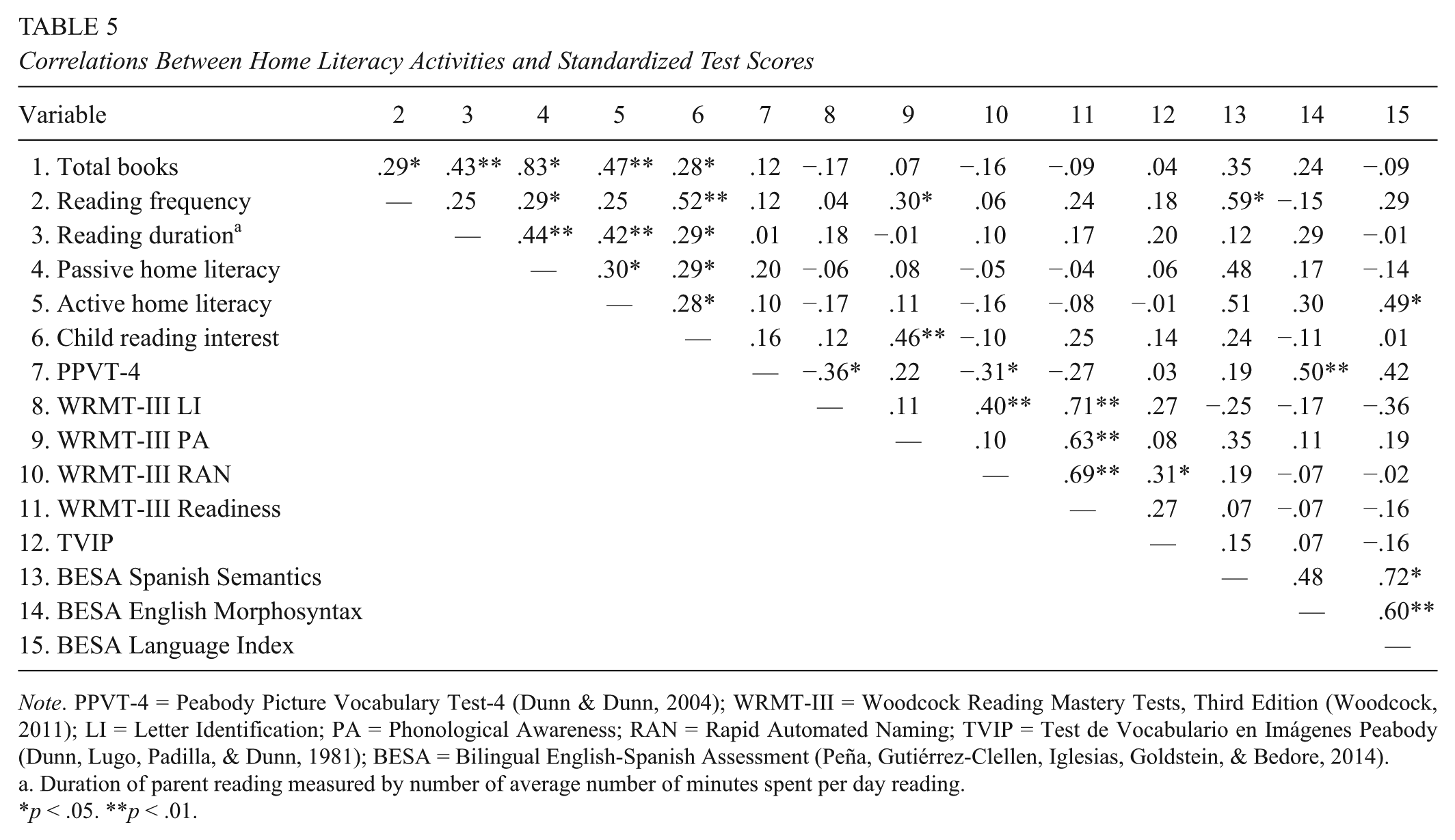
Note. PPVT-4 = Peabody Picture Vocabulary Test-4 (Dunn & Dunn, 2004); WRMT-III = Woodcock Reading Mastery Tests, Third Edition (Woodcock, 2011); LI = Letter Identification; PA = Phonological Awareness; RAN = Rapid Automated Naming; TVIP = Test de Vocabulario en Imágenes Peabody (Dunn, Lugo, Padilla, & Dunn, 1981); BESA = Bilingual English-Spanish Assessment (Peña, Gutiérrez-Clellen, Iglesias, Goldstein, & Bedore, 2014).
Duration of parent reading measured by number of average number of minutes spent per day reading.
p < .05. **p < .01.
Correlational analyses revealed multiple relations within the survey response items and within children’s scores on the standardized tests. Few significant relations were obtained, however, between reported HL practices and test scores. Exceptions revealed (a) reading frequency and phonological awareness scores were positively related, (b) reading frequency and Spanish semantics scores were positively related, (c) child interest in reading and phonological awareness scores were positively related, and (d) active HL practices and overall language ability, as measured by the BESA Language Index, were positively related.
Linear regression revealed that, given average reported active HL activities, children were predicted to obtain a BESA Language Index score of 95.20 (SE = 1.82). No covariates were included due to the non-normality of potential covariates of interest (e.g., parent education and primary language spoken at home), which violates the assumptions of linear regression. Full results are shown in Table 6. Further examination of how specific components of active HL predicted children’s scores were restricted due to the small sample of children who completed the entire BESA (n = 21). To detect a large effect with just two predictors, a sample size of at least 31 is necessary to achieve .80 power.
Linear Regression Predicting Children’s BESA Score

Note. BESA = Bilingual English-Spanish Assessment (Peña, Gutiérrez-Clellen, Iglesias, Goldstein, & Bedore, 2014).
To examine how specific survey item responses predicted children’s phonological awareness scores, as measured by the WRMT-III Phonological Awareness subtest, multiple linear regression was employed. Collinearity diagnostics revealed strong evidence of collinearity between survey responses to “How often does your child ask you to read to him or her?” and “How often to you read to your child?” To reflect child interest in reading, only participants’ responses to how often the child asks to read was included in the multiple regression analysis. Power analyses revealed that the available sample size allowed for detection of a moderate effect with four predictors and .80 power.
The analysis revealed that 15% of the variance in phonological awareness scores was predicted by survey items related to child interest in reading. Given an average reported interest on all items, children were predicted to receive a score of 87.61 (SE = 1.98) on the WRMT-III Phonological Awareness subtest. Children’s reported interest in reading newspapers or magazines was a significant individual predictor of phonological awareness scores, but no additional individual survey items were uniquely significant. Full results are reported in Table 7.
Linear Regression Predicting Children’s Phonological Awareness Scores

Discussion
In the current study, parents of children from low-income Spanish-/English-speaking backgrounds reported an average of 17 books at home, and 28% had visited a library with the child in the past month. Parents engaged in HL activities with an average of 24.61 minutes a day in reading; teaching letters, words, and numbers; and art activities. There was a significant positive relationship between Spanish-English performance (measured by the BESA Language Index) and active HL and between phonological awareness and reported child interest in literacy activities. No other measures of language and literacy performance were significantly associated with the parents’ reports of HL activities or environment.
Comparison to Previous Literature
The duration of reported reading time appeared to be similar between participants in the current study and average durations reported in the literature. The finding that parents of kindergarten children read an average of 25 minutes per day was similar to previous findings in the literature for monolinguals. For example, Breit-Smith et al. (2010) observed that parents of typically developing preschool children reported reading an average of 23.89 minutes per day. Upon further examination, Breit-Smith et al. found that the reported home reading practices differed by income level for monolinguals. Our sample, however, was entirely composed of families from low-SES backgrounds. Consequently, there was insufficient heterogeneity in SES to test for differences in HL practices by family SES in the present study.
The frequency of reading appeared to be lower for the current participants than averages reported in the previous literature. The finding that parents reported reading books to the child four times a week was somewhat lower than expected compared to previous studies (Scarborough & Dobrich, 1994; Sénéchal, 2006). Scarborough and Dobrich (1994) reported that on average, parents read 4.5 to 10.5 times per week, with children from low-income families being read to less frequently than children of middle-SES backgrounds. From another perspective, however, the finding from the current study that 68% of families read daily appeared somewhat comparable to the frequency expectations produced in the report of the Federal Interagency Forum on Child and Family Statistics (2015), which indicated that 71% of Hispanic families read to their children at least three times per week, which was lower than the national norm of 90% for non-Hispanic White families. These results should be interpreted cautiously as we cannot assume that the duration and frequency of reading time were conceptualized the same way by all families. It is possible that some families counted time the child was holding a book as reading time, whereas other parents restricted the estimated time to instances in which children were actively engaged in looking at books together and talking about the story or pictures.
In light of the previous findings on number of books in the home, the current results indicating parents had an average of 17 books in the home appeared to be most similar to findings reported for Puerto Rican families in which mothers, on average, reported having fewer than 10 adult and children’s books in the home (Hammer et al., 2003). Although it was beyond the scope of the current study to identify causal factors, possible explanations for the small number of books in the home may include low SES, which could negatively impact the physical resources of the families. Additionally, numerous other potentially contributing factors existed, such as access to print in Spanish, the literacy skills of the parents, maternal education, and the cultural value placed on such activities. Irrespective of cause, the current findings substantiate that children of families from linguistically diverse and low-resource backgrounds may experience additional challenges in access to print.
Relationship to Language and Literacy Performance
Perhaps the most surprising finding was the limited relationship between reported HL activities and children’s performance on English language and literacy measures, outside of the BESA Language Index. Notably, phonological awareness, although related to reported child interest in reading, was not related with any reported HL activities. In other studies (Burgess et al., 2002), elements of the HL questionnaires (e.g., age at which shared reading started) demonstrated statistically significant correlations relationships to oral language measures. However, Burgess et al. (2002) tested children at two different times, and the sample was composed of middle-class families. The posttesting measures in Burgess et al. were administered 1 year after the initial start of the investigation, so their findings reflect developmental factors within a 1-year period that our study did not capture. In a sample representing Spanish-/English-speaking families from low-SES backgrounds, such as the current study, the lack of relationship between active HL and child language may involve other factors that did not influence middle-class families’ HL experiences.
The current findings are somewhat consistent with Hammer et al.’s (2010) findings suggesting that HL activities were associated with vocabulary abilities but not with their letter-word identification skills. In the current study, children generally scored below average but within normal limits (85–115) on language measures, with three areas of exception: English vocabulary, English morphosyntax, and Spanish morphosyntax. Hammer et al. (2010) suggested that quality of activity could have influenced letter-word identification rather than the quantity or frequency. Considering the different patterns in HL practices of culturally diverse families, longitudinal assessment of children’s vocabulary may be useful to expand our understanding of HL trends.
Equally plausible in explaining the lack of relationship between HL and performance on standardized tests is the explanation that our traditional measure of HL did not fully capture the unique literacy activities that were contributing to children’s literacy performance. Future research may be warranted with further attention to literacy activities that may be unique to language-minority households (Lynch, 2009; Orellana, Reynolds, Dorner, & Meza, 2003; Purcell-Gates, 2013). It is possible that parents and siblings have separate influences on literacy practices (Duursma et al., 2007), such as the tendency of older siblings to paraphrase written text for language-minority families (Orellana et al., 2003). The extent of this influence, however, is beyond the scope of the current study and remains to be further investigated within the broad social context.
The finding that phonological awareness was significantly associated with increased child interest in reading suggests some link between child engagement with print materials and the development of emergent literacy skills. Specifically, children who were reported to more frequently express interest in adult reading materials, such as newspapers, demonstrated higher performance on the measure of phonological awareness. One possible explanation for this finding is that children who interact with adult-directed materials may have more print exposure coupled with joint attention with an adult, consequently leading to active engagement with print that facilitates the development of phonological awareness. Although examination of causal associations is not the focus of the present work, exploration into parent–child interactions based on the type of print material used during HL activities is a topic of interest that is recommended for future work.
Our findings add to the literature describing HL environments of young Spanish-speaking children from homes in the United States where a minority language is spoken. Additional studies in this area are warranted, and there is value in adding additional descriptive data to the available literature, in response to the growing percentage of children from language-minority homes in the United States. Given potential differences in the sociocultural backgrounds and resources afforded by disproportionally low SES of Spanish-speaking families in the United States, it is possible that multiple sources of influence may shape HL activities and access to print in the home.
Limitations and Further Research
Current findings should be interpreted cautiously, as the study involved a relatively small sample and had few measures per construct. Although the response rate was considered relatively good, families who are likely to respond to such invitations may be inherently different in their HL practices than nonresponders. Nine families provided consent for participation in the present study but shared phone numbers that were later disconnected. Households with disconnected phones may reflect families with lower physical and financial resources, so it cannot be assumed that they would have reported similar experiences as families who successfully completed the phone interview.
Limitations of the measures of HL should be considered in interpreting the findings. Results regarding duration of frequency of HL activities must be interpreted cautiously, as it is possible that families conceptualized reading with their child differently than the interviewer. On a similar note, it cannot be assumed that reading time involved active engagement for all respondents or engagement for the duration of the reading time. It is possible that there were cultural and familial differences in interaction styles and variations in parents’ roles in teaching children language and literacy during shared reading.
For some families, reading time may have involved dialogic reading with comments and open-ended questions, whereas other families may have conceptualized reading time as having books out in the child’s proximity, giving the child books at bedtime, or encouraging pointing to pictures in books. Additionally, because few parents opted to provide detailed information about the involvement of siblings in the HL environment, no conclusions can be drawn regarding the importance of whole-family involvement in literacy acquisition. It is recommended that future research intended to examine the HL environment of DLLs focus on family involvement as well as differences in interaction style across families, including measures more sensitive to social practices.
It should also be noted that these findings reflect participants’ self-reported perceptions of their HL, and the data gathered related to children’s experiences at the age of kindergarten only. Unfortunately, we did not have access to information about children’s prior educational experiences at home, childcare, or preschool. It should be noted that foundation skills, such as vocabulary, are built on experiences extending back to the child’s early infant and toddler development. In response, additional studies are needed with a longitudinal perspective to better capture language and literacy development prior to school entry. It is also possible that as parents engage in increasing acculturation to mainstream culture and develop more frequent contacts with schools with subsequent school years, their HL practices may well change, both quantitatively and qualitatively (Reese & Gallimore, 2000).
Additionally, the sample was relatively homogenous in SES, as evidenced by child lunch status and parent education. To evaluate the unique relation between HL practices and children’s language and literacy outcomes independent of SES, more variation in socioeconomic background would be needed. It is recommended that researchers continue to make efforts to explore how SES may influence and interact with other factors, such as HL practices, to affect outcomes for children from Spanish-speaking backgrounds.
Implications
It was the intent of the current study not to judge families’ HL activities but rather to describe HL practices of families from language-minority low-income backgrounds. It is hoped that adding to the knowledge base may lead to proactive approaches to support and bolster children’s early HL. Understanding diverse backgrounds related to HL may enhance family–professional partnerships and inform practices. The fact that children’s interest in books was associated with HL items, such as number of books in the household and the frequency and duration of reading, validates the importance of early reading as a contributor to school achievement (Scarborough & Dobrich, 1994). Findings suggest that educators should be mindful of differences in experiences and access to print, particularly with children from low-SES and linguistically diverse backgrounds. The lower access to print and thus less frequent engagement in HL activities may suggest that additional efforts and resources are warranted to build the capacity of families from language-minority backgrounds to provide HL environmental stimulation for early literacy development.
Footnotes
Acknowledgements
The authors are grateful for the support of research assistants, particularly Jennifer Lebet, who assisted with contacting families and data management. The research reported here was supported by the Institute of Education Sciences, U.S. Department of Education, through Grant R305A130460 to Florida State University. The opinions expressed are those of the authors and do not represent views of the Institute of Education Sciences or the U.S. Department of Education.
1.
The term native speaker is used to refer to an individual raised as a monolingual in the home language, which is the social-majority language, whereas the term heritage speaker is used to refer to an individual who has a minority language at home and is formally educated in the social-majority language.

Authors
CARLA WOOD is an associate professor in the School of Communication Science and Disorders at Florida State University. Her research and teaching efforts focus on child language and literacy development and disorders.
LISA FITTON is currently completing her doctoral studies in the School of Communication Science and Disorders at Florida State University. Her research interests are in the evidence-based instruction and assessment of children from culturally and linguistically diverse backgrounds, with a specific focus on reading and writing development and on rigorous quantitative methodology.
ESTRELLA RODRIGUEZ is an assistant professor in research at the School of Communication Science and Disorders at Florida State University. Her teaching and research focuses on dual language learning, heritage Spanish speakers and home literacy.