




Abstract
This study reports two stages of research into the discourses of poetry education in the United States from the early 20th to the early 21st centuries. The first is an original study that traces the history of discourses about teaching poetry, and the second is a coda or concluding analysis that raises questions about how history functions as a trope and whether or how the history of poetry education matters in the present. In the original study, we photocopied, inventoried, coded, and noted patterns of discourse over virtually every article published on the teaching of poetry in the oldest practice-oriented journal of literacy education in the United States, English Journal, from 1912 to 2005. In the coda that follows, we revisited and refined conclusions from our initial round of investigation in light of the theoretical implications of three models of historical and social change: Parsonian functionalist theories, Marxist/neo-Marxist theories of dialectical materialism, and Foucauldian theories of discourse, power, and practice. In conclusion, we consider the implications of history and of historical thinking for present and future research and practice.
Discussions about issues of research and practice within literacy studies very often reference history in support of scholars’ claims. We have read, for example, that the First Grade Studies of the 1960s and indeed the expansion of educational research in general at the time were the result of the Cold War and Soviet advances in space technology (Pearson, 1997). Similarly, Literature as Exploration by Louise Rosenblatt (1938) has been described as a critical but at the time unheralded response to New Criticism and as an intellectual precursor to Reader Response theory in the 1970s (Clifford, 1990). Process writing and research are often traced to a single point of origin, Emig’s (1971) study of the composing processes of 12th graders. And, finally, in the 1990s, some early literacy researchers argued that Whole Language was nothing more than the “whole word” pedagogy of the 1950s and 1960s cast in new terms (Dressman, McCarty, & Benson, 1998).
Our interest in these claims stems not from revisionist arguments about the historical accuracy of some of them (e.g., Willis & Harris, 1997; Dressman & Webster, 2001), but rather from the fact that they are made at all, from the apparent rhetorical work they perform within discourses of literacy studies, and from what they suggest about the historical consciousness and suppositions of scholars in the field. History clearly matters to literacy researchers and educators, but why and how? Was the association of the Great Debate with the Cold War intended to lend early literacy research an air of geopolitical and national strategic significance it otherwise would not have had, or, as Willis and Harris (1997) have suggested, was it an attempt to distract the field from issues of desegregation and civil rights? Why does it matter years after the eclipse of New Criticism and Reader Response that Rosenblatt was “there” first? And how would practice, theory, policy, or research be changed if process writing research and pedagogy were thought to have had one point of origin or many, or if in the late 1980s and early 1990s Whole Language was nothing new, as its critics argued, or theoretically fresh, as its proponents claimed at the time?
Just as critical and intriguing to us as the rhetorical work of history within literacy education are assumptions about how history works as a process—that is, how past events are linked to present and future events, and what the quality and ultimate trajectory of those links may be. For instance, looking across the examples above, a recurrent theme is of continuity: of patterns identified in the past that are recapitulated in the present; or even more basically, the assumption that ideas and research findings in one period have a direct influence on later ideas and research, and that the lines of causality or influence are relatively easy to trace across decades. Another theme is of origins: that the beginnings of particular ideas or arguments are identifiable and definite, and so can be traced; and, by implication, that there is a pattern of development of ideas and issues over time that will lead to their eventual resolution and to a third theme, progress. In effect, history in these accounts is more than a hypothetical construct, something pulled together ex post facto to explain the past in terms of the present. It is itself a force, a thing with agency that pulls memory and documentation into objectified sensibility, and, one might assume, into something that could and should be respected and counted upon.
Background of the Study
Because it is the oldest and most universal of literary forms and yet the genre that is perhaps least taught in schools today, and because of its historical continuity across the history of English education in the United States, we selected poetry as the focus of our research and English Journal (EJ) as the focus of our inquiry. We planned to read and analyze every article on the teaching of poetry published in that journal from its first issue in 1912 to the last in the year that our inquiry began, in 2005. The original study followed a very straightforward, albeit extended, post-positivist process of analysis, in which we individually read, inventoried, and compared notes on 530 articles over a period of several years, with two goals in mind. One goal was to “map,” or describe the field of poetry education as it was presented to readers in the journal over 94 years—a map that would enable us to produce an historical narrative of poetry education over the period. This would entail identifying the editorial history of the journal, who wrote for the journal, trends in what constituted best practice (and the best poetry to teach) over the years, and identifying the basic arguments and theories used in support of those practices. A second goal was to determine whether the history of literary criticism and of education from the early and middle years of the period as we informally understood it would be reflected in articles published from the teens to when we began our teaching careers. We were curious to know, in other words, how relatively accurate we would find our historical awareness of the period to be, or whether in returning to primary documents we would discover intervening influences on our thinking that would push us to revise that understanding and ways of thinking about the place of poetry within secondary English education. However, in the course of conducting our original analysis, and particularly as we began to look for patterns in the inventoried data, we became aware that “history” itself was a problematic construct—that what we presumed history to be and to be made up of was not obvious, and that there were many different ways to “do history,” each of which might be equally valid but very different from the next. In particular, questions of what caused change from one time period to another, or in the discourses of time periods, of how those changes were recognized or not, of the weight that was given or not given to them, or even whether “cause” and/or “change” could be assumed to exist and function meaningfully within one’s analysis, seized our imaginations, while the indecision we experienced as we pondered the implications of our common-sense notions of history produced little concrete progress in our research.
Our delay in resolving these last questions was such (we began the original analysis in 2005 and completed it in 2008) that over time, we found ourselves publishing “parts” of our findings—a brief recounting of “watershed” articles in the history of the journal (Dressman & Faust, 2006); an essay presenting preliminary findings with a focus on one historical trend identified in our analysis (Faust & Dressman, 2009); and a book on teaching poetry that drew partly from practices that were discovered in the original analysis (Dressman, 2010)—even as we struggled to resolve our concerns about the tropics of history. In the end, we chose not to “resolve” our concerns, but to confront them by interpreting the patterns that we “found” or that “emerged” from our analysis through three very different theoretical accounts of historical stability and change over time, and to report this interpretation as a coda, or concluding summary statement, for the original study.
The study published here thus has two parts: The original study, whose findings we present in full in this journal for the first time, and a concluding coda, which presents a summary exploration and critique of the assumptions about history that grounded our original research questions and investigation. We acknowledge that the combination of a post-positivist research study with a highly theoretical, post-modernist critique conducted by the same authors after the fact of the original study is unconventional, and may strike some readers as awkward. Yet, it is an accurate representation of the long path of our inquiry, and as such we argue that it also provides new insights not only into the challenges of doing literacy research currently but into the challenges of teaching poetry now and in the last century.
Methods: The Original Study
Data Collection
The title and contents of each issue from Volumes 1 (1912) to 94 (2004-2005) of EJ were skimmed and all feature articles with a focus on poetry, poets, and the teaching of poetry were photocopied by Mark Dressman at the University of Illinois. In this initial step, we sought to include in the data set articles with any mention of poetry or poetic language. A second copy of each article was made and mailed to Mark Faust at the University of Georgia. Initially, more than 600 articles were collected, including collections of original poetry published in the 1980s and 1990s; however, a closer reading showed that approximately one hundred did not pertain to poetry or its teaching in any significant way (for example, they might have the word “poem” or “poetry” in the title, but these words functioned as metaphors for broad literary issues that were not specifically about poems, poetry, or poets). These articles, as well as the collections of original poetry, were rejected for further analysis. Five hundred thirty articles were selected for full analysis. We also compiled a list of editors over the journal’s history, and noted other developments in its history of publication, such as changes in format and number of issues per volume.
Initially, we agreed to divide the articles, with Mark Dressman reading those in the even-numbered volumes and Mark Faust reading those in the odd-numbered volumes. As we read, we used constant-comparative methods (Corbin & Strauss, 1990; Glaser & Strauss, 1967) to develop a system of codes that categorized the genre of each article (Theory; Research; Background; Principles; Lesson Plan; Creative). We focused much of our attention during this period on developing a set of categories that would describe each article’s pedagogical orientation toward the teaching of poetry and eventually settled on two main categories, “Populist” and “Formalist,” with a third “Other” category reserved for a handful of articles that did not fit within either primary category (see the “Findings” section for a detailed discussion of these orientations). Our shared understanding of the differences among the codes, particularly the distinction between Populist and Formalist orientations, became very clear over time. “Populist,” in our coding, referred to pieces typically authored by teachers and less often by university professors, in which poetry was “used” by students and teachers in some inventive, often perfomative, and always unexpected way (in parody, in choral reading, in conjunction with music or another literary text). In clear contrast, “Formalist” approaches always “honored” the poem and its poet in some studied, academic way, and involved very precise, “expert” readings of the poem based in the authority of the instructor or, in the years before New Criticism, on the poet’s biography and the particular formal “type” of poem under analysis. We found remarkably few approaches in our reading that attempted to “blend” the two approaches or that departed from either general orientation toward poetry in a significant way. We also recorded the professional background of the author or authors when indicated and composed a short annotation describing each article’s contents and any salient features. During this initial process we telephoned or e-mailed our observations on a very regular—sometimes daily but at least weekly—basis, to develop and then maintain a shared understanding of our coding scheme. After we had read through our odd or even volumes and discussed our ongoing general impressions of our reading, we switched and read the volumes the other investigator had read, independently recording our own category and orientation ratings.
Data Analysis
In a continuation of our coding process, we exchanged all data compiled for our respective (even- and odd-numbered) volumes and then we each read the other half of the articles, comparing our codes for categories and pedagogical orientation. In the case of approximately 30 articles, where we disagreed, we reread articles and then discussed our reasoning via telephone or e-mail. Again, our shared understanding of the categories and their general discreetness was such that in these instances, we typically realized that one of us had misread an article and had categorized it incorrectly, not that we differed significantly on what constituted the definition of a category. When this occurred we adjusted our individual ratings to agree with our new understanding. Through this process, we calculate our initial level of inter-rater reliability to be 94% and our final level, after conferencing, to be 98%. In the end, we agreed to disagree on genre categorization for all but nine of the 530 articles, and on the pedagogical orientation of all but ten of the 530 articles. This first stage of analysis made it possible to document differences among articles and perspectives in a chronological fashion, and provided evidence for our subsequent identification and interpretation of patterns in the data. By linking changes in patterns to national historical events, movements in literary criticism, and trends in U.S. education during the period, we were also able to establish patterns of causality that would account for the changes in patterns and perspectives over time.
Method: The Coda
As we noted in the Introduction above, accounting for historical causality did not explain or provide a discussion of what implications the patterns we identified might have in the present and for the future of poetry education, or by extension for literacy education in general—in other words, to provide for an explanation, in the end, of why or how an historical analysis of the discourses of poetry education in one very prominent journal could or should matter. In pursuit of this goal, our intuition pushed us to investigate three very different and often conflicting theories of historical and social change, and then to use these to interrogate the “facts” of our investigation. These perspectives were chosen on the basis of the differences from each other in terms of their assumptions about the causes of human social behavior and history, and because they are well-known theories that are still in use or, in the case of Parsons’ influence on cybernetic theory, have had significant influence on current discourses of social change. They were not chosen as “the best” theories, nor were they intended in our analysis to be “tested” against each other, but rather to provide perspective and to demonstrate the extent to which a particular historical framework might influence the interpretation of our findings. They were the functionalism of Talcott Parsons (1964; Parsons & Shils, 1951; Rocher, 1975); the historical dialectics of classical Marxist (Kolakowski & Falla, 2005; Marx, 2008; McLellan, 1988) and neo-Marxist (e.g., Gramsci, 1988) theory; and the post-structural historical materialism of Michel Foucault (1970, 1972; Olssen, Codd, & O’Neill, 2004). At this stage of the analysis, our practice was to interpret the historical account through the precepts, or assumptions, of each of these schools of theory, with particular attention to their explanations of how and why change occurs. Our approach was hermeneutic (Gadamer, 1994). We moved from the historical account generated from the analysis of the original study, paying particular attention to anomalies within that narrative, out to the narratives of social and historical continuity and change presented in each of the three theories, and then back, making repeated comparisons between each theory and our historical account. Rather than present an overview of these frameworks here, each is summarily described in the Coda and followed immediately by its application to an interpretation of our findings.
Findings: Original Study
This section provides our initial presentation of findings from the analysis of the original study. These findings are presented in chronological order, and are followed by our initial and historically “naïve” interpretation of our principal finding of two orientations, or conversations, toward poetry and its teaching that marked discourse in EJ throughout its history. This analysis was conducted and written prior to our application of three social theories, in which we considered the implications of three perspectives on how history “works” and subsequently of how history might “work” within the discourses of poety—and by extension—literacy education.
Poetry Teaching in Editorial Context
1912-1954
For the first 42 years of its existence, two individuals, James Fleming Hosic and W. Wilbur Hatfield, shared responsibility as the principal editors of what was then referred to as The English Journal. Early volumes were small in size and contained few if any illustrations, pictures, themed issues, or featured departments. In 1928, two separate editions, one targeting secondary and the other college English teachers, were published. The journal’s status and leading role in promoting the teaching of poetry in the first half of the century are suggested by the critics and poets who published in both editions of EJ at this time, from Louis Untermeyer in 1924 and 1932 to J. B. Priestley in 1929 and 1930, Ezra Pound in 1933, Mark Van Doren in 1934, Allen Tate in 1940, and Cleanth Brooks in 1948.
1955-1972
From 1955 to 1973, the journal was edited first by Dwight L. Burton and then by Richard S. Alm. From the early to mid 1960s, a poetry editor, B. Jo Kinnick, was appointed and a regular column under the sponsorship of the NCTE Committee on Poetry in the High School, first titled “Modern Poetry in the Classroom,” and then “Poetry in the Classroom,” was a regular feature. Each column contained a single article, often authored by a member of the Committee, that featured a “close reading” of a lyric poem with notes for instruction.
1973-present
The EJ of today, published in magazine format with an illustrated cover, eye-catching graphics, multiple feature editors, and frequent themed issues, took form in late 1973 under the editorship of Stephen Judy. Judy’s editorship also inaugurated what we would describe as The Age of the Editor—a period that continues to today, in which editors serve for shorter periods and exercise far greater control over graphics, layout, and how the journal’s features are organized than their predecessors in the first 60 years of the journal’s history. Not surprisingly, then, we also found the greatest variation in the ways that poetry and its teaching were featured in the journal during this period, from an all-time high of 21 features on poetry in Volume 91 (2001-2002) to a single article each in Volumes 86 (1997) and 87 (1998). This period also saw the introduction of a regular feature in which collections of three or more original poems were published, first with little commentary or author identification, and later with brief comments and author bios.
Interpreting Historical Continuities: 1912 to Viet Nam
Although the dimensions, editorial organization, and degree of emphasis placed on poetry within EJ have varied significantly over the years, there is much within the articles themselves, even from the journal’s first decades of publication, that current readers would find very familiar. Ninety years ago as now, EJ’s editorial mission and focus has been the improvement of English education in secondary and undergraduate (typically underclass) classrooms in North America, and its principal readers and contributors have usually been practicing teachers and teacher educators, with occasional contributions from specialists in literary theory and criticism. Consequently, even within articles that present analyses of specific poets’ lives and work or that argue for one interpretation or analytical approach over another, the articles are always addressed to teachers and in terms that imply the authors know and understand their students’ educational needs, if not their interests.
The analysis of the period from 1912 to the early 1970s identified two parallel “conversations,” or pedagogical orientations, within articles published in EJ about the nature of poetry and how it should be taught. Although terminology shifted within the conversations over time and periodically one conversation would seem to have eclipsed the other in the force and volume of its argument, the core principles and perspectives of each side remained remarkably stable and persistent during this period.
Formalism
In one conversation, which takes a Formalist perspective, poems were regarded as artistic objects, that is, as complex literary jewels that captured the genius of the English language and Anglophone civilization in a particular period of its history. A focus on “correct” taste and interpretation of these jewels—their acquisition as tokens of cultural capital (see Bourdieu, 1984)—was a central concern of authors with a Formalist orientation. The proper approach to reading poetry, it followed, was through the rigorous study of poetry’s formal elements, such as meter, rhyme scheme, literary allusion, and form (e.g., sonnet, ode, or ballad)—an exercise intended to build appreciation within a reader for not only a particular poem but its linguistic heritage. In this process, each poem was seen to stand alone as a representative of a particular genre or tradition, and its appreciation was largely self-contained and focused on the words of the poem and their traditional ordering in lines, couplets, quatrains, or stanzas. Learning about the lives of the great poets and identifying their work within specific time frames and movements was also considered an important part of the poetry curriculum. Finally, only the “greatest” poems and poets were considered worthy of teaching, and much time and energy was devoted within Formalist articles to discussing the position of a particular poet or poem within the canonical hierarchy.
Although the best-known expression of Formalism was the school of literary criticism known as New Criticism, the two should not be equated. Formalism both preceded and continued beyond New Criticism’s heyday from the 1930s into the 1960s. Writing in 1912, for example, Harry G. Paul argued,
That every student early in his high-school course should learn the simpler matters of metrics, together with illustrative lines, and should learn them as thoroughly as ever he did his multiplication tables, seems to me so obvious as scarcely to need statement. (p. 521)
In 1924, Morris B. Sanford railed against reform of the English curriculum, noting that when he eliminated the reading of Milton and Burke in his classes, student interest increased, but that as a result students became “inferior in their ability to read and understand a difficult passage” (p. 199). Similarly, in 1933 Norma Solve wrote “in praise of difficulty”:
The mistaken conception of art as play—because art has some of the qualities of play—has given rise to the cult of pleasure, of the easy, in the literature classroom. Carried to its extreme this becomes a cult of amusement, which eschews the hard, denies the right of serious thought as deadly dull, and deifies enjoyment. (p. 636)
Solve claimed that a lack of rigor on the part of her high school teachers led her to misunderstand and to “detest” The Rime of the Ancient Mariner, whereas the sturdier approach adopted by her college professors “changed my feeling of distaste into a more perfect realization” (p. 638) of the poem’s greatness.
Formalism’s zenith within EJ came in the early and mid-1960s when New Critical “close readings” of lyric poems, first by 20th century U.S. and then earlier British poets, were virtually the only models of poetry instruction published in the journal. After 1967, experimental poetic forms and instructional approaches, such as those advocated by Helen W. English in “Rock Poetry, Relevance, and Revelation,” in 1970, and by Suzanne Howell in “Unlocking the Box: An Experiment in Literary Response,” in 1977, became more predominant, but the Formalist conversation was not over within the journal. It continued through the 1970s in articles touting “linguistic” approaches to the study of poetry, as in “Linguistics in Poetry,” by Yakira H. Frank in 1970, and re-emerged briefly in a themed issue in 1988 (Volume 77, Number 4) devoted to the poetry of William Wordsworth. Ironically, since the 1970s, traces of Formalism’s emphasis on poetry as a source of cultural heritage and great language—albeit now as an indicator of the diversity, rather than exclusivity, of English speakers—may have been most evident in articles and issues focusing on multicultural literature and the poetry of American Indians, Latinos, and African Americans.
Populism
The second conversation during this period in the history of EJ took a Populist orientation to poetry and its teaching. In this perspective, poetry was described as a wonderful but never a quasi-sacred form of expression. Rather, poems were seen as belonging not to the ages or to the English language but to readers who were empowered to read and to use them as they saw fit—in dramatic performances, in parodies, or as sources for ideas and language in the writing of their own poems. Rather than place each poem in its “proper” structural and historical context, proponents of the Populist view focused on the contemporary and on the meaning of poetry within current events and culture. Students were urged to collect their own favorite poems without regard to time and to organize them as they saw fit. Choral reading and other forms of performance that emphasized contemporary interpretations, writing in parody of particular genres or styles, were much-approved activities. In short, what a student and a teacher could make or do with poetry and poetic language, and general gains in the linguistic proficiency that resulted for learners, rather than acquiring formal and historical knowledge about poetry, was seen as the goal of reading poetry in secondary classrooms.
Like Formalism, Populism was also in evidence from the earliest issues of the journal. In a 1915 article, “A Creative Approach to the Study of Literature,” Frank Chandler chided “university-bred instructors” who “insist on foisting upon their unhappy high-school charges the methods of university scholarship” (p. 281). Chandler’s approach, which he illustrated with an example from the teaching of The Rubaiyat of Omar Khayyam, was to have students “catch the spirit and lilt of Omar by trying to write in his style” (p. 284). In an article from 1918, Susanna T. O’Connor described her work with “the class of high-school seniors who were not going to college”—a condition that freed her from the chore of teaching them “Milton, Pope, Arnold, Browning, and the poems in the Golden Treasury” (p. 447). Instead, O’Connor had her students select their own poets and poems from volumes of modern poetry checked-out from the local library, which they then were free to copy into notebooks and share with classmates in an oral poetry seminar.
As the Populist conversation evolved in the 1920s, 30s, and 40s, its advocates frequently cited developments in adolescent psychology in an effort to warrant ever greater attention to helping young readers connect with poetry in ways that were age appropriate and in agreement with May Pringle’s claim in 1925 that “the most important element in a teaching situation is the student” (p. 305). An example is an article by Muriel Cashell published in 1941 that described an open-ended approach to teaching The Rime of the Ancient Mariner. Cashell began with in-class reading, but introduced background information to help students picture the author “as an old and beloved friend” (p. 740). Following a full class period devoted to evoking “our ill-fated journey,” Cashell relinquished the floor, allowing students’ responses to drive the discussion in class. She reported, “The questions asked by the boys and girls were vivid and stimulating and showed evidence of true perplexity and real thinking” (p. 741). Students then met in groups to discuss their responses and to develop ideas for writing “themes” that later on were presented in class before invited guests (other teachers). Cashell described herself as a “silent observer” of the process, “offering comments and explanations only when I felt them to be essential” (p. 741).
Populist conversation within EJ dwindled to a bare whisper from the late 1950s to the mid 1960s, with less than one article with a Populist orientation published per volume—that is, per year. And then, beginning in 1967 and continuing through the remainder of the Vietnam War, the Civil Rights Movement, and into Watergate, it was, comparatively, as though a dam had burst. An article in 1967 by William E. Stafford reporting a session at the 1966 NCTE Convention that featured major U.S. poets and English educators gave some premonition of what was to come. According to Stafford, “The general drift had been that poetry draws on the wellsprings of life and that we should all accommodate to various kinds of poetry, and be happy to bring students into such a rich heritage” (p. 951). But then poet Robert Bly stood up and shouted,
“Not at all!”—from the front row. And—alive and kicking—the assembled ingredients went critical. Robert Bly did not accept easily some kinds of poetry. Further, he contended that poets and all others present should never blur immediate first issues that their society faced—namely, for the American people, the war in Viet Nam. (pp. 951-952)
Stafford’s (1967) report was followed in 1968 by articles with titles like “Why I Don’t Teach Poetry,” by Margaret B. Ackerman; “A Psychedelic Poetry Unit . . . Why Not?,” by Rita Jean Childs; and in 1969 by a spate of articles focusing once again on the writing of poetry in experimental forms, such as “Concrete Poetry: Creative Writing for All Students,” by Lavonne Mueller. These were followed in 1970 by articles such as “Teaching the Poetry of War,” by Sally P. Hansen; “The Poet and the Laundry List,” by Irene W. Sherwood; and “Writing Song Lyrics,” by LaVerne W. Coffin; in 1971, “American Oral Literature: Our Forgotten Heritage,” by Gerald Haslam; in 1972, “Contemporary Poetry: WHEN IS NOW?,” by William Fisher; and so on.
To be sure, Formalist conversation was not quieted. In 1972, Don Gutteridge published “The Affective Fallacy and the Student’s Response to Poetry,” in which he argued,
Many of our current dilemmas are probably due to the increased permissiveness of a society which puts few demands (mental or physical) on its children, a society in which the term discipline can only be used by faculty members susurrating timidly behind closed doors. (p. 210)
Moreover, the publication of many articles featuring close readings of canonical poets’ work continued throughout the 70s, 80s, and into the 90s. But it is also clear that in this period Formalism was not where the “action” of poetry teaching was. By the mid-70s, Populist conversation had adopted the terms and language of Reader Response criticism in the making of its arguments, just as, 40 years before, Formalists had used New Criticism to articulate their point of view.
Challenges, 1912-1970
How was it, then, that during the first two-thirds of EJ’s history, neither Formalism, Populism, nor a synthesis of the two ever fully prevailed? One hypothesis could be that this was due to two interrelated reasons. First, although there was great deal of “conversation” about poetry and its teaching in EJ over the years, ironically, there was relatively little communication between holders of the two points of view. Instead, the lines of discourse tended to operate much like a televised political debate, in which each side made its case to an audience (in this case, the readers of EJ), with direct address to the other side only made in an occasional barbed remark. The second reason is that the reticence of each side to engage the other directly was most likely due to each side’s awareness of fatal flaws within its own argument.
In the case of Formalism, that flaw, stated clearly and consistently and even on occasion admitted by its advocates, was that it taught students to fear and loathe the study of poetry. As Robert Burroughs succinctly put it in 1977, the effect on students was that “[f]irst of all, they really hate poetry. It’s not that they just say they hate it; they really do” (p. 50). In 1929, H. Ward McGraw celebrated The Rime of the Ancient Mariner as a perfect vehicle for “giving the high school student an idea of what things go to make up good poetry and for teaching him what to look for in poetry” (p. 732). McGraw outlined a tripartite strategy that is still popular with many teachers today: Present the poem by reading it aloud; next, invite “general discussion” of “facts,” “imagery,” and “author’s purpose”; then, re-read the poem based on detailed discussion questions aimed at orchestrating a sound close reading of the text. But this approach typically failed to engage students. Klise S. King stated bluntly in 1941: “The teaching of classic poetry in high school presents some very real problems. A rather large group of pupils claim that they do not understand such poetry and that they get little pleasure from reading it” (p. 36). Janice Cavallaro’s (1983) words also echo across generations when she talks about feeling at one and the same time “certain that our upcoming poetry unit would be painful and worthless” and “determined to find an approach that would develop understanding of poetry’s rudiments and appreciation of its power” (p. 27, italics added).
But Populism also had its blind spots. In their narratives, the authors of Populist articles were typically very keen to describe the occasional or marginal circumstances that provoked (and permitted) their abandonment of standard curricular approaches. Their students weren’t going to college anyway (O’Connor, 1918), or it was just a summer course and the author “was faced with teaching twentieth century literature to a group of (college) sophomores, some of whom found difficulty in understanding the more symbolic parts of Dick and Jane stories” (Briggs, 1960, p. 311). Or, just the opposite: The kids were so gifted educationally and intellectually that the teacher figured he could afford to experiment, as in the case in 1936 of Henry C. Fenn, who taught “city poetry” to his students and then invited them to write some of their own at the Teachers College (Columbia University) lab school. Or, there was a national crisis, as in the case of “Conscripting Literature for a Present Emergency,” by Matilda Bailey in 1942, or the books in the school library were out of date, as in the case of “Modern Literature in the Small High School,” by Winifred Littell in 1916.
In almost every Populist story that was told, crisis licensed real innovation that led to substantial student engagement with poetic texts. And yet, crisis did more than that. It also provided Populist authors with the chance to evade, rather than solve, the problem that Formalists confronted head-on, namely, how to educate all students in the glories of the English language: To provide everyone, not just the college-bound and the culturally privileged, with a taste of the language of Beowulf and The Canterbury Tales; to gain some familiarity with the form and substance of Shakespearean sonnets; to grasp the implications of the imagery of The Wasteland for their own society; and in its last years to experience not only a cultural connection to poetry by multicultural authors, but to study that poetry’s structural complexities and heritage with rigor and without trivialization. Neither did crisis provide a foundation for solving these problems within the curriculum, for once the crisis was passed, the hegemony of the standard curriculum returned and the concerns and problems of Formalism were once again reasserted.
A second and no less troubling problem during this period surrounded questions of the availability and diversity of poetry deemed worth teaching. In the first decade of the journal, the only source of poems in an overwhelming majority of articles seemed to be a now-antiquated anthology, Palgrave’s Golden Treasury (1898), in which Victorian and British Romantic poems were the most recent works included. In the early 1920s, with the advent of “modern” American poetry (e.g., the work of Robert Frost, Carl Sandburg, Edna St. Vincent Millay, and Amy Lowell) and the publication of Louis Untermeyer’s The New Era in American Poetry in 1919, options opened a bit and the journal regularly featured articles introducing readers to current U.S. and British poets and their work. But the focus, within a U.S. context at least, remained exclusively White and largely male, with nearly all poets discussed coming either from New England or the upper Midwest. Through the 1930s, 1940s, and even into the 1950s and 1960s, Robert Frost was by far the most featured poet. And well into the 1960s, the Beats were still considered avant garde and teaching them was described as a daring, even defiant, pedagogical act.
An even more enduring and at times disgraceful problem in this period was the almost total lack of attention paid by the journal as a whole and within articles to poets of color and their work, especially within the journal’s first 50 years. Although we did expect to find a greater emphasis on diversity and multiculturalism in more recent volumes, it was shocking how little was found in the journal through the 1960s. For example, the first mention of any poet of color in the journal was a brief reference by Winifred Littell in 1916 to Paul Lawrence Dunbar. Another reference was made in 1945 by Vivienne Anderson to a visit by Langston Hughes to her classroom, and in 1954, a brief paragraph about a choral reading of a poem by James Weldon Johnson appeared in an article by Mary Baloyan. Prior to 1970, we could find only two references to African American students, one in a 1925 article by Irma Eareckson and another in 1950 by Mardie Weatherby Endres. Both are patronizing, if not racist, by today’s standards. Endres, for example, wrote: “Orestes, (an) eighth-grade Negro boy who at one time gave promise of becoming the most notorious trouble-maker of the school, was now acclaimed for his recitation of a most solemn and lengthy piece” (p. 507). There were no references to any group other than African Americans during the journal’s first 50 years in the articles on poetry that were analyzed. The first article that was devoted solely to the poetry of any U.S. minority culture did not appear until 1970, in “Dream Motif in Contemporary Negro Poetry,” by DeLois Garrett. Articles including discussion of the poetry of Latina/Latinos, American Indians, Asian Americans, and other prominent groups also began to appear and become more prominent in EJ at this time.
1970s to the Present
Perhaps the most graphic illustration of the sea change that occurred within articles on poetry and its teaching is represented by the chart in Table 1. That chart shows that from Volumes 1 to 60 (1912 to 1971), Populist and Formalist orientations to poetry were roughly equal in numbers overall, with each orientation predominating in some ten-volume spans, but always with a substantial representation in the journal from the other perspective. Beginning with Volumes 61-63 (1972-1974), however, a trend was initiated in which, in every ten-volume span the discrepancy in percentages of Populist vs. Formalist orientations increased until, by Volumes 91-94 (2001-2002 to 2004-2005), 93% of articles were rated Populist while only 7% were rated Formalist in their pedagogical approach.
Percentages of Articles Rated as Populist, Formalist, Other, or Disagree by Totals Over 10 Volumes and Years.
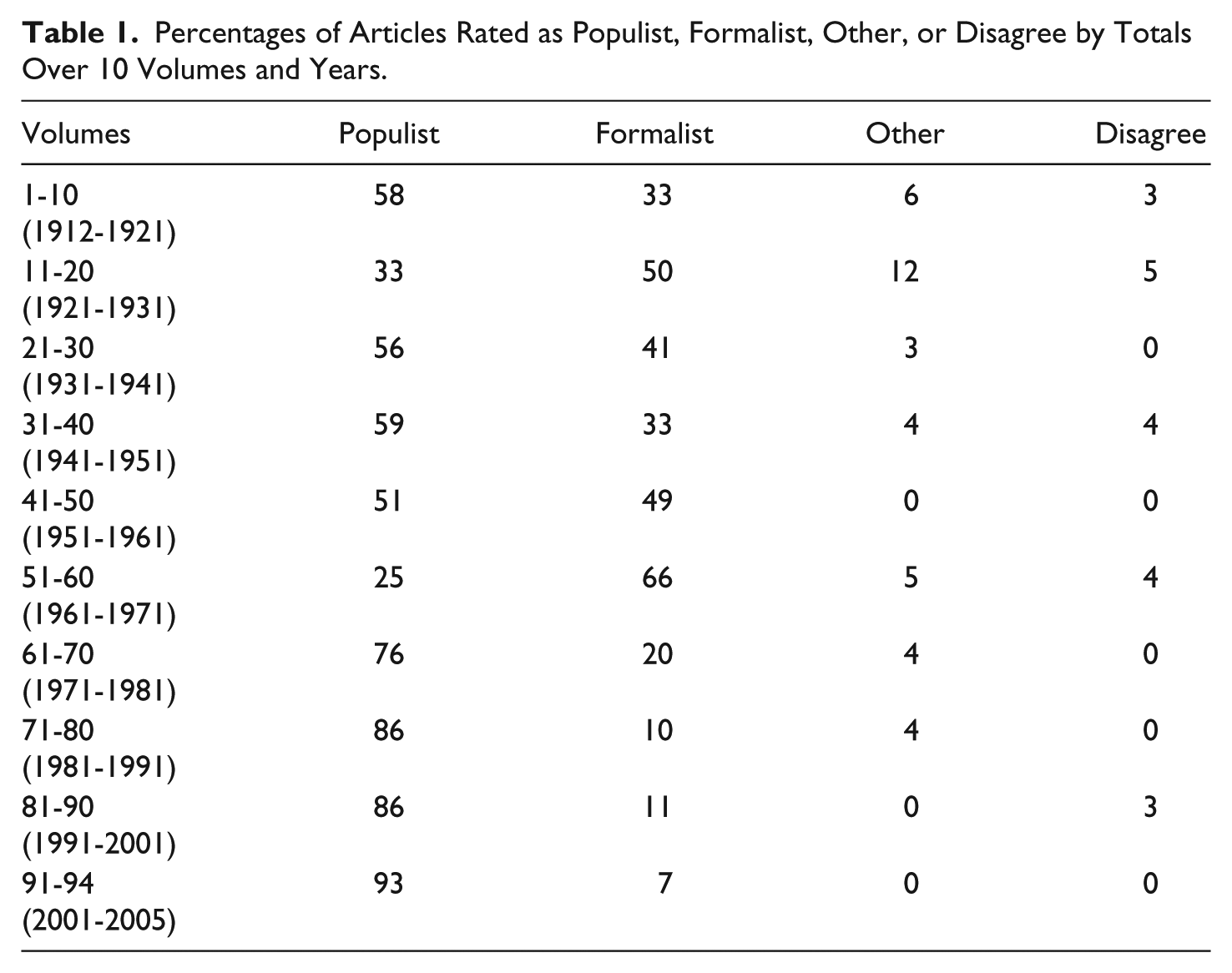
A closer comparison of articles before and after Volume 60 suggests a far more complex turn of events than can be explained as the simple triumph of Populist arguments over Formalism, however. Prior to Volume 60, Formalism was the far more theorized (and, by university scholars, authorized) orientation toward poetry and its teaching. In its first 20 volumes, the journal featured a series of literary scholars and critics, from Louis Untermeyer to Percy Boynton to Edward Davison, all of whom proclaimed a new era in American and British poetry, and who set themselves up as the educators of English teachers’ taste and the arbiters of the English curriculum. With the rise of New Criticism beginning in the 1930s and continuing through the late 1960s, the Formalist emphasis on close reading of texts was virtually the only fully articulated approach to reading poetry. During this early period, articles taking a Populist orientation seldom cited theory in support of their arguments, nor did they challenge directly the precepts of close reading; instead, they were grounded in practical complaints about students’ resistance to poetry when taught in a New Critical manner.
The record after Volume 60 (1971), however, shows a shift in the ways that each side warranted its arguments. During the period of transition in the 1970s (Volumes 61-65, 1972-1978), Populist articles continued to argue on practical and atheoretical grounds. Students were portrayed as more engaged when new poetic forms and experiential approaches were tried, and it was their increased interest within a period of great social experimentation that tended to justify authors’ arguments. But thereafter, Populist approaches were increasingly justified by new theories, as through references to Reader Response in the late 1970s and 1980s. Even more radically, beginning in the 1990s and continuing to 2005, an increasing number of articles advocated instructional approaches that broke fully with the image of a poem as a self-contained work of art. Although Bakhtinian and poststructuralist theory was not directly referred to in these articles, their advocacy of practices such as the juxtaposition of poems with paintings or of poems with novels strongly suggested the development of a new image of poems as texts shot-through or permeated by the semiotic traces of other texts and cultural times. Theory, in other words, had become the possession and the prerogative of Populism in the later period, whereas by contrast in the few articles of the period that we identified as Formalist in their orientation, arguments tended to be grounded in complaints about the demise of educational standards.
Discussion: History or Tradition?
These findings from the original study have provided some insight into our original research goals about mapping the course of the discourse about poetry education in the pre-eminent practitioner journal of the field over 94 years and about whether our personal understanding of the history of poetry and of literature would be reflected in our reading of the 530 articles. With respect to the first goal, the evidence presented here points to its achievement for the most part. We emerged from our reading with a very clear and often very detailed grasp of the broad tensions and course of poetry education in the United States in the 20th century, as well as a strong appreciation for the passion and professionalism and deep thoughtfulness of our progenitors, whether they argued for Formalist or Populist points of view and approaches.
With respect to the second goal, we acknowledge some surprises from our research. First, we were surprised to see how little direct reference was made in the articles we read to literary theory of any type. Both Formalism and Populism, for example, were found to precede what, from the late 20th century to the present, have been codified as “New Criticism” and “Reader Response.” Even during the heyday of New Criticism from the 1930s to mid-1960s, little direct mention was made to its principles, although some of the great critics of the century (e.g., J. B. Priestley, Mark Van Doren, Alan Tate) published articles in the journal during these years and a special feature of the journal throughout the 1960s presented a “close reading” of a canonical poem as an instructional model. We found even less direct reference to Reader Response critics from the late 1960s forward, including Louise Rosenblatt, although their general Populist focus on placing the meanings and uses of poetry by students in the foreground of instruction was clearly present.
At the same time, the findings from this research have led us to become more circumspect with respect to the influence of professional discourses within journals on the day to day practice of teaching. We note, for example, and based not on the evidence of 530 articles on poetry education published in one journal over nearly a century but on our own lived experience as English teachers and educators since the 1970s, that the “triumph” of Populism within the pages of EJ seems to represent a pyrrhic victory for that orientation, that is, a victory that may have produced few consequences for practice within English classrooms. In 2011 as in our youth and in the 1920s, 1940s, and 1950s, teacher-led analysis of literary texts of all sorts and of poetry in particular rather than either Formalist “close reading” or Populist “Reader Response” remains the dominant instructional approach, and selections still tend largely toward canonical authors supplemented randomly by a writer of color (typically Langston Hughes). This observation is supported by two major studies of English instruction in U.S. classrooms, one published a few years prior to the shift we noted in our analysis (Squire & Applebee, 1968), and one published in 1993 (Applebee), when Formalist perspectives were almost non-existent within EJ.
These studies are particularly instructive because in each case only schools and classrooms that were considered to exemplify best practice were analyzed, and yet in neither study did the researchers conclude that the instruction they observed was always exemplary. James Squire and Roger Applebee (1968), writing in a period when Formalist, New Critical approaches were considered “best,” reported that
[I]t was comforting to find that explication was mentioned more frequently than any other approach to poetry, disconcerting to discover that it was mentioned specifically by only 28 percent of the classes. This only substantiates other data indicating that close reading is not nearly so widespread as journal articles would lead one to believe, and that, when it does occur, it is more likely to be used with short works like poems than with passages from novels or plays. (pp. 111-112)
Twenty-five years later in 1993, Arthur Applebee, writing from a very different perspective, reported: “[A]n observer summarized at the end of a visit to a department that prided itself on fostering close, analytical readings of text”:
Instruction was primarily teacher-centered. Even though we saw discussions, we did not see many free exchanges of students’ responses. We did not see much emphasis on strategies that could be applied to new reading situations or other techniques that could make students independent of their teachers’ questions. However, several teachers apparently recognize this problem and indicated that they are becoming more student-centered. (p. 125)
Applebee concluded, “The observers’ summary comments suggested that when teachers focused on student response, this often represented a concern with motivation. In these classrooms, response was treated as a way to get students engaged in a text before moving on to analysis” (p. 125).
In neither 1968 nor 1993 did then-prevailing views of what constituted “best practice” prevail in the actual practices of English classrooms. Reading through both reports, it would seem that other factors such as teachers’ (and schools’) appraisals of student aptitude and interest, departmental traditions (and, we suspect, peer-pressure), and the socializing experiences of undergraduate English programs and student teaching were far more influential in determining what and how English as a subject and poetry as a genre were taught. In other words, it is culture—tradition—and not history per se, and even less the best practice narratives of professional journals like EJ that seems to best explain what and how poetry is and was taught in U.S. English classrooms.
Findings: Coda
In summary and in light of the preceding discussion, then, how might we interpret and find meaning in the history of poetry teaching as it is instantiated in 94 volumes of EJ, what implications might our analysis still hold for both poetry, and perhaps literary and literacy education now and in the future, and how does history as a trope figure into answering these questions? As we have noted in the previous discussions, our findings have raised additional questions for us about the history of poetry education vs. traditions of practice, and our laying out of the “facts” of poetry education’s course in EJ has led us to wonder not only about its implications but about the constructs of history and change themselves.
In pursuit of some insight into our questions about the implications of history and our informal assumptions about it as a construct, we have turned to three formal and very different theories of history and social change: Parsonian Functionalism, Marxist/Gramscian Materialism, and Foucauldian Archaeology and Genealogy. The three theories were chosen because each is quite different from and unrelated to the others, and because at one time in the last 60 years, each has been ascendant within the discourses of social theory. Again, our purpose in selecting these three was not to test one against the other and declare a “winner,” but rather to use each as a demonstration of the extent to which any theory or set of assumptions can bend an interpretation of events, and as a foil against which our unacknowledged assumptions as researchers about why history in general and the history of poetry education in particular matters might be exposed.
Talcott Parsons: Structural Functionalism
Although his work is seldom cited (except in reference to ideas considered outdated) or built upon today, from the 1950s through the 1960s, Talcott Parsons’ “voluntaristic” theory of social action was easily the most prominent theory of social behavior within U.S. academic circles. In keeping with other universal theories of the period that sought to reduce and explain, in one stroke, the dynamics of physical (e.g., Einstein), psychological (e.g., Skinner), logical (e.g., Russell; Wittgenstein), and cultural (e.g., Levi-Strauss) realms, Parsons sought to explain the behavior of individuals, relatively small and self-contained social groups such as families, schools, organizations, and communities, and larger societies such as nations and perhaps the world as a whole, as a single system.
Parsons’ work today would be described as having close affinity with systems theory and cybernetics. According to his commentator and critic, Edward Devereux (1961), Parsons’ theoretical work began as an attempt to reconcile three prevailing schools of social theory of the early 20th century: economic utilitarianism, which stressed rationality and goal orientation at the expense of broader human motivations; positivism, which stressed the reduction of human behavior to components and formulas at the expense of voluntarism, or free choice; and idealism, which stressed human values and forces such as “the spirit of the times” without specifying their origins or their dynamics. For Parsons, the task was to explain how individuals, groups, and societies maintained the capacity to make choices and to act voluntarily, yet within clear constraints imposed on them by their material conditions and relations of dependence and interdependence on each other. In other words, Parsons argued that for individuals, groups, and societies to function productively, systems, structures, and processes must provide each of these social units with a range of options for social action that did not unduly impinge on the opportunities or choices of other social units. Moreover, for the system to function well, it should “tend toward equilibrium”—that is, the tendency must be for individuals, groups, and societies to seek a balance of forces, both internally and in their external relations with each other. Not surprisingly, perhaps (or perhaps so for Parson’s later critics who did not see U.S. society as balanced or equitable in this period), Parson’s implicit model of such a functional system was his own: U.S. society at mid-century.
An application of Parson’s social theoretical perspective to our findings might focus on the relative equilibrium between Formalist and Populist perspectives that existed from 1912 to the early 1970s and the apparent disequilibrium that followed. It might also explain the differences between these two periods as the function of differences in the relatively steady editorship of the earlier period vs. the shorter editorships of the later period, and also as the result of external shifts within academia and society as a whole. It could be, in other words, that a relative balance between Formalist and Populist discourses existed in the journal in the earlier period because EJ’s early editors, James Hosic and Wilbur Hatfield, and those who immediately followed in their footsteps, Dwight Burton and Richard Alm, held a strong editorial commitment to balancing “theory” with “practice,” whereas later editors did not.
The difference may also be explainable by examining EJ’s status and role within the field of English education before and after 1970. If a journal is imagined as a discursive system and its readers and authors as members of a social group united by the journal and the field of practice that journal represents and helps to sustain, then as the sole journal of the National Council of Teachers of English focusing on secondary and early college English education until the late 1960s-early 1970s, its mandate and membership would have been broad, and the range of perspectives voiced within its issues would have also been necessarily inclusive and relatively balanced. The transitional period of the late 1960s, however, saw a diversification of publications in the NCTE portfolio, with the inauguration of four new journals, each of which “stole away” a portion of EJ’s constituency, with university researchers from colleges of education now publishing in Research in the Teaching of English, humanities-oriented community college instructors publishing in Teaching English in the Two-Year College, teacher educators publishing in English Education, and later, middle school educators publishing in Voices from the Middle. In other words, as EJ’s readership became narrower in its focus, the range of perspectives needed to maintain equilibrium within the journal, and the social group it instantiated would have become narrower. Thus, it would be inaccurate to describe the lack of balance between Populist and Formalist discourses that we noticed from 1970 onward as a sign of disequilibrium within the journal, because EJ could now be characterized as a subsystem within a larger system of journals focusing on secondary and post-secondary English education—a system whose subsystems now acted to maintain a measure of equilibrium within the field.
Finally, other shifts that we noticed, such as an increased focus on teacher professionalism and multicultural and non-canonical forms of literature from the 1970s onward, may be explained as the product of interactions with broader societal changes and social groups. Thus, a Parsonian account of the history of poetry education in EJ would seem to offer a clear and rational explanation of the forces that shaped its history and that account in part for the journal’s enduring relevance and popularity over nearly a century. Yet, for reasons similar to those that led to Parsons’ decline as a social theoretical force in the 1970s, this application also overlooks or even glosses over a number of issues. First, as Black (1961) and other critics have noted, Parson’s focus on the maintenance of equilibrium within a social system produces an image of systems as largely static and unchanging, and offers little theorization of how social change occurs. Parsons realized this and argued that change occurs as “cultural values” change, yet his account of what produces shifts in cultural values is not very clear or prominent in his work. If social systems tend toward equilibrium, this also implies that within each system some forces of disequilibrium must also be present and at work. But disequilibrium has a negative connotation in Parsons’ work, whereas historically, these forces, such as feminism and the civil rights movement, are seen by most social theorists today (and most English educators) to be positive forces working toward a redress in historic imbalances of power, or in the capacity of individuals, groups, and societies to undertake voluntaristic social action on their own and others’ behalf. What seems undeveloped in Parson’s theory is an account of how imbalances of power function within social systems, and how these imbalances are or are not addressed over time. More specifically and in reference to the history of poetry education within EJ, an account of the shift in power from Formalist to Populist discourses within the journal is lacking. One implication might be that Formalist discourse and its power to influence practice migrated from EJ to other journals where it persists today. Another might be that Formalism simply disappeared as a discourse within the field of literacy studies. On the one hand, a quick survey of these other journals within the field (e.g., College English; Journal of Adult and Adolescent Literacy; Horn Book Magazine) would likely show that Formalism is no more prevalent in them than in EJ. But on the other hand, a survey of preservice and practicing English teachers of the “best way” to teach a Shakespearean sonnet or the poetry of the British Romantics would likely show that while Formalism is largely absent in NCTE’s publications it is alive and well in the discourses of present and future English teachers. This may be because the discourses of literacy education in general and poetry education in particular are not contained within the journals of major literacy organizations, but are more influenced by authors and critics publishing within the public media (e.g., Bennett, 2000; Bloom, 1995; Cheney, 1996; Hirsch, 1988; Paglia, 2007).
Marx and/or Gramsci: Dialectical Materialism and/or Hegemony/Counterhegemony?
An alternative social theoretical perspective that does take power and its imbalances into account is presented in the work of Karl Marx (Kolakowski & Falla, 2005) and the later neo-Marxist, Antonio Gramsci (1988). While related, the theories of these two individuals and the schools of theory they produced also have some significant differences, and are presented here in dialectic tension. From a Hegel-inspired Marxist perspective, we might interpret the parallel conversations between Formalism and Populism prior to the early 1970s as a dialectic in which the anti-thesis of Populist approaches struggles against the thesis (and theorizing) of Formalism, until, out of a period of great social, cultural, and political turmoil marked historically by the Vietnam War, the Civil and Women’s Rights Movements, a newly empowered and politically conscious proletariat of teachers and readers rises up to take control of its own destiny. Empowered by the intellectual discourse and materialist theory of left-leaning academics, this proletariat produces a synthesis of ideas and practices in which aspects of the Populist concern for playfulness, diversity, and reader empowerment are grounded in the Formalist concern for practices grounded in a rigorous and intellectually challenging theory of textuality.
In this new period, teachers and readers are no longer alienated from the texts with which they labor and the tensions and injustices of the prior era are largely resolved, at least within the journal’s pages and for its editors and readership. It is the resolution of tensions, in the Marxist view, that explains the homogeneity of pedagogical orientation in the journal since the mid-1970s, and so our continued labeling of this new orientation in the face of documented fundamental changes in theory after the 1970s as Populist would be inaccurate.
However, an alternate account anchored in a more nuanced Gramscian perspective on power may provide a broader and more perspicacious explanation of our findings. In this view, which places greater emphasis on the shift in control of the theoretical discourse about poetry within literary criticism as a field, New Criticism is characterized as the hegemonic discourse of poetry education throughout much of the first two thirds of EJ’s history, whereas the atheoretical arguments of Populism are characterized as a counter-hegemonic movement—that is, as a movement that is organic and uncentered in its articulation and guerrilla-like in its tactics. In a moment of great social, cultural, and political upheaval, Populism is described as managing to seize the upper hand within the journal and then to sustain itself through theorizing practices that legitimate and stabilize its status as the new hegemonic discourse.
Yet the “resolution” of the tension between Formalist and Populist orientations described by the Marxist account, from a Gramscian perspective, is not real. Instead, it is seen as dependent on the enforcement, by its editors and readership, of strict rules of discursive conduct and either the exclusion or the draconic limitation of counter-hegemonic orientations and points of view within the journal. From this perspective, the homogeneity of pedagogical orientation that we observed in the later period of the journal would be due largely to the enforcement of these strict, albeit largely tacit, discursive rules.
The possibility of this explanation is reinforced when it is considered in light of the Parsonian analysis presented above. If, as was noted, the divestment of major constituencies of EJ’s readership in the late 1960s signaled a narrowing of the journal’s editorial mission, it might also signal the rise of identity politics and semiotics among the editors, reviewers, and readers of the journal. In other words, as the editorial mission of the journal shifted from representing a wide range of constituencies and constituent perspectives to representing only the interests of senior secondary English education, definitions of what constituted “good” teaching and “best” practice would likely also narrow, as a means of maintaining internal equilibrium and presenting a unified voice and self-definition to potential external forces of disequilibrium. In the anti-authoritarian political atmosphere of the late 1960s and early 1970s, Populism, with its focus on student-centeredness rather than text-centeredness, would become the defining discourse of the “good” teacher, and Formalism its antithesis.
This explanation also highlights the extent to which factors external to the internal debate over best practices in poetry education—the splintering the journal’s readership; national politics; editorial tenures—likely influenced the course of that debate within the journal. While these external factors were not “random” or serendipitous—that is, not accidental in the sense that they were precipitated by or linked to broad historical and cultural trends in which the readers, authors, and editors of EJ were also participants—their occurrence and influence could not have been predicted in advance, and are also largely outside the frameworks of Parsonian and Marxist/Gramscian theory.
Foucault: Archeaology and Geneaology
A third theory that plays on the possibility that history may be less a matter of grand movements than coincidental events that become discursively epistemic over time is found scattered in the empirical studies and essays of the French philosopher of history, Michel Foucault. Although Foucault’s theories and views on history are found throughout his extensive oeuvre and are beyond full discussion in this article, two of the best-known tropes, or guiding metaphors, archaeology and geneaology, suggest provocative and generative interpretations of our study and its findings.
Archaeology refers to a method of historical analysis of the épistémè, or the structure of thought (Davidson, 1986; Foucault, 1970), of a particular discourse within a specific (and relatively short) period of history (Foucault, 1972; Macey, 1995). Although Foucault’s own definitions of the term are elusive (see Macey, 1995, pp. 161-163), his discussion of the term across multiple works suggests a meaning and use that is analogic, in many ways, to conventional meanings and uses of the term. When archaeologists seek to uncover the internal structure and relations among the physical remains of a ruin under excavation and link that structure to other structures and ruins within a culture, they seek to build an understanding of how people in that time and space lived, that is, of their practices. Similarly, Foucault’s archaeology refers to a method whereby the ideational structure of a set of practices is excavated from the ruins or traces of its discourses—that is, its texts—to build an understanding of how people understood those practices within a particular discursive time and space. Quite pointedly, Foucault distinguishes his archaeological method from conventional histories of ideas, which he dismisses as “teleological” in their attempt to trace the development of ideas over time, and implicitly to suggest intellectual progress.
Our research project is not archaeological in the Foucauldian sense, although a comparison between Foucauldian archaeology and our method raises important questions. For example, our focus on the progression of discourses and ideas over time is more constitutive of a history of ideas than of archaeology. In addition, the focus of our “excavation” is narrower, and relations between the discourse of poetry in EJ and other discourses within the journal, as well as discourses of poetry in other sites, such as literary criticism and other journals of the period, is also narrower. Finally, our focus on differences in the practices of poetry education within the journal is more practically oriented and does not include a focus on philosophical questions about literacy and textual genres. These questions might include: What is a poem, as opposed to other genres? How do discourses of poetry relate to discourses of power/knowledge and language within education and society at large? How are the discourses of poetry in the journal not progressive but relational to other discourses of education and literacy within the same period?
Foucault borrowed his second metaphor, genealogy, from Nietzsche, and used it as part of his critique of the modernist tendency of historians to impose a search for origins and endpoints on historical analysis (Foucault, 1972; Macey, 1995; Rabinow, 1984). Again, there are analogies to be drawn between conventional uses of the term to describe the tracing of one’s ancestry into the past and Foucault’s use of the term, but with an ironic inversion of normative assumptions about genealogy’s outcome. Whereas one might typically see genealogy as an attempt to trace one’s “family tree,” Foucault would note that, in fact, genealogy is a process of tracing one’s “family roots.” This is because any individual is the product of two parents, who in turn are the product of four parents, who in turn are the product of eight parents, who are the product of sixteen parents, then 32 parents, then 64, and so on, until within relatively few generations, that original individual’s origin is lost in a past that spreads back limitlessly across hundreds, thousands, or even millions of progenitors, each of whom has contributed equally to the individual within a particular generation, and whose identity quickly becomes impossible to trace fully. Thus, the project of genealogy is not one of discovering one’s identity or origins; it is, to the contrary and quite ironically, the project whereby one’s identity and origins are discovered to be dissipated and unrecoverable:
The purpose of history, guided by genealogy, is not to discover the roots of our identity, but to commit itself to its dissipation. It does not seek to define our unique threshold of emergence, the homeland to which metaphysicians promise a return; it seems to make visible all of those discontinuities that cross us. (Rabinow, 1984, p. 95)
Not only the lineage of individuals but also the origin of ideas, the causes of events, and the development over time of cultures, movements, and their identities—all of which constitute the subject matter of standard historical practices—can be characterized as not only unachievable but intellectually untenable projects when their genealogical implications are considered.
So, too, genealogy makes clear that the course of poetry education traced in our analysis is one selected from among many unknown alternatives—unknown because the practical and intellectual antecedents of each of the 530 articles analyzed were not and could never be identified, even if all the references of each were traced. Like the genetic links to far-flung parts of the world that individuals discover through analysis of their DNA (consider the example in the 2008 election of Barack Obama’s “relationship” to Dick Cheney), the limitations of the research process, whether by design or necessity or caprice, may lead to the imposition of patterns and meanings, driven by assumptions that origins and teleological trajectories of history do exist, but that would disappear if “all the data” could be included in the research.
Yet in making this point we are not admitting to any flaws in the design or execution of our research. We did read and come to agreement on our coding of virtually every article on the teaching of poetry published in EJ over 94 years. Our rationale for sampling every article in this journal, which throughout its history has been recognized as the leading practitioner journal in secondary English education in North America, was sound. And finally, we were able to document, from article to article, two distinct points of view about what poetry is and how it should be taught. Foucault’s genealogical critique of modernist conceptions of history does not highlight possible flaws in our project, but in any historical project that would seek to find the “origin” of discourses, to definitively find their path across an extended period of time, or to project their future outcome. It points, in other words, not to errors in our methods but to flaws in our assumptions about how history should look and how the findings of an historical research process should be presented to make sense of them to us and others.
The greatest of these flaws might be to assume a priori that there are patterns to be found in our data. What if there weren’t, or what if instead of reading through the articles chronologically (a practice that tacitly suggested that we would find a progression of ideas over time), we had randomly chosen articles to read and code? Although we cannot be certain after the fact, it seems highly likely that the distinctions between what we termed Formalist and Populist discourses of poetry and poetry education would have become evident no matter the order in which the articles were analyzed, and that the presence of both discourses would have been detected in each decade of at least the journal’s first 60 years.
Beyond this finding, however, a geneaological critique raises doubts, due to the lack of either direct intertextual or causal connections among the articles. Within relatively short periods of time we were able to determine commonalities among articles in what we termed the Populist and Formalist traditions. For example, from the late-teens to early 1930s, many Formalist articles featured studies of “new” U.S. poets, largely from New England and the Midwest, such as Edgar Lee Masters, Carl Sandberg, and Robert Frost. Later, from the late 1930s through the 1950s, formalist articles were more theoretical and focused on explaining New Criticism to teachers. In the late 1950s several articles we coded as Populist were slightly rebellious in tone, as were those published at the end of the 1960s, when the first articles featuring poets of color were also published. Yet, we were unable to find traces of development from one trend to the next. Instead, these short-term focuses of the journal were largely discontinuous, to the extent that it would be erroneous to project a line of development in either Populist or Formalist discourses across the journal’s history.
In Foucauldian terms, shifts in discourses and practices such as those in EJ or, far more grandly, from the Renaissance to the Enlightenment, or, as Foucault described in The Order of Things (1970) from one way of studying scientific relations to another, are simply characterized as “ruptures” whose causes are multiple, scattered, and often a matter of chance. Thus, the “triumph” of Populism over Formalism in EJ may be described from a Foucauldian perspective as the result of a chance combination of multiple forces, from the exhaustion of New Criticism’s intellectual currency to the rebellion against authority spawned by the Viet Nam War and the Civil Rights and Feminist movements, to the narrowing of the journal’s audience following the publication of new journals by NCTE. Ironically, then, a Foucauldian explanation of the rise of Populism in EJ over the past four decades arrives at roughly the same conclusion as that of Parsons and Marx/Gramsci in combination, but through processes characterized as more discursive than systematic or mechanical.
Conclusion: Does History Matter?
From the preceding discussion, then, we might take the very nihilistic lesson that when it comes to accounting for how poetry is taught in classrooms, neither history nor published discourses of best practice matter much in comparison with coincidence and the private, intimate discourses of tradition with which teachers are in daily contact. However, that is not the lesson that we take from our study. Our own professional experiences have taught us something quite different, namely that against the status quo and the forces of social and cultural reproduction, many teachers do strive for innovation and are quite creative problem solvers. Our personal experience is reinforced by the fact that of the 530 articles that we analyzed, at least 226 were written by secondary educators.
Moreover, if we have learned one lesson from our analysis it is to avoid overgeneralization and the cliché. Poststructurally, discourses may be “always already falling apart” but arguments about poetry education do get made and acted upon. “The more things change, the more they stay the same.” Yet, the shifting patterns in specific approaches over the decades, the virtual elimination of Formalist discourse and the very needed push toward diversification of poetic voices that we noted from the 1970s onward within the journal represent consequential changes in the discourses of poetry education within EJ, even as we also noted a persistent general and unresolved debate between Populism and Formalism over the years. Theories of history and social change have the power to interrogate researchers’ unacknowledged assumptions and provide generative insights, but they cannot and are not meant to predict or explain outcomes at micrographic levels reliably.
By the same token, if history is imagined as the objective reconstruction of the past, then it can’t matter for the clichéd reason first coined by George Satayana (1905-1906/1998) that those who cannot remember the past are condemned to repeat it. An understanding of history that lacked awareness of how the historical imagination is itself a construct of its own time and discourses would tend to reproduce discursively, or lead to the repetition, of old habits rather than to their interruption within one’s own present. Survivors of wars, holocausts and cycles of economic boom and bust may swear to remember mistakes of the past as a hedge against their reoccurrence, and yet reoccur they do; the conceit that one knows history’s lessons and how to engage them may become, in an ironic twist, history’s reproductive template, not the key to avoiding its lessons. Similarly but obviously in a much less expansive context, we see little value in continuing to frame discussions about poetry education in “Formalist vs. Populist” terms, and we warn against the possibility that the narrative presented in this study may naturalize or prolong what has proven itself over the past decades to be a polarizing and unproductive debate.
As an antidote to this situation, perhaps history matters most when it is approached as though it had no key and there were no lessons. But then, what would it be? Like Foucault, perhaps we might then think of history as a trove of artifacts, waiting to be made sense of, not idiosyncratically or recklessly (as the purely self-interested may do), but for purposes that serve the interests of the historically underserved, by creatively—geneaologically—locating and naming ideas and practices in the past that pierce the arrogance of systemic, bureaucratic accounts and complicate the quixotic romanticism of dialectical materialism, or reflexively, the grand overstatements of Foucauldian historicism. It might matter also as a source of ideas to be pillaged and reassembled into something new but also old, something substructurally complex and linked to traces from society’s past but not bound by old uses. Doing history might become, then, not a hedge against the future, but a hedge against the present—a way of finding the resources to contradict assumed links to the past and of using past practices to reinvigorate those of the present.
For example, standard historical narratives of poetry (and also literary) education in the United States have tended to take a theory-centric view, in which New Criticism, characterized typically as an authoritarian, teacher-centered, and very tedious set of practices, is eventually overcome by the more “balanced” approaches of Louise Rosenblatt and other Reader Response critics. But our findings show that Formalist approaches in poetry education predated New Criticism, and we rarely found any reference to Rosenblatt or other Reader Response critics in the Populist articles that we read. Again, we also found that throughout its history, a discontinuous (because they did not reference each other or typically connect with any school of theory) but steadily present discourse of highly creative and innovative approaches to reading, writing, and performing poetry, authored mainly by practitioners and teacher educators, appeared in the journal. This suggests to us that throughout the 20th century, some highly creative teachers—perhaps a minority of teachers, but highly creative people are nearly always in the minority—found the time and space to do highly creative work, despite or perhaps sometimes in rebellion against whatever theoretical discourses predominated at the time.
For example, the writing of parodies—contemporary imitations of the structure and diction of classics—by students for a variety of genres (not simply the Shakespearean sonnet, as is common in classrooms today) was promoted in the first decades of the journal (Chandler, 1915; Glicksberg, 1940). Choral reading of poetry, in which a group of students “scores”—divides up words or lines for dramatic group recitation—a poem and then rehearses it for presentation before an audience, is a technique largely relegated to the teaching of “fluency” in primary classrooms and East Asian English programs today, but in the 1930s it was a competitive activity in many U.S. high schools (Loar, 1932; Renz, 1936). Finally, articles advocating the teaching of “city poetry”—poems with a specifically “urban” feel and appeal for urban youth—are echoed in today’s poetry slams and calls for the teaching of hip-hop and rap (M. T. Fisher, 2007; Hill, 2009); but reference to these articles could expand and deepen current movements through their inclusion of antecedent genres such as “jazz” and “blues” poetry that have all but been forgotten today (Fenn, 1936; Smith, 1932). What is most promising about these practices, however, is that while their means are Populist, their ends—to develop students’ comprehension of figurative language and of the relationship between a poem’s ideas and the structure and sound of its language—are largely Formalist. Through this fusion of means and ends, many of the best “best practice” narratives of EJ effectively resolved, albeit without the recognition they deserved, the schism between Populist and Formalist approaches that inhibited the development of creative and rigorous approaches to teaching poetry over the years.
The primary lesson of history that we take from these masters of practice and from our analysis, then, is to avoid the “lessons of history,” and instead to pilfer freely from whatever old ideas we can to make teaching new again. In conclusion, we wonder if, by analogy, this lesson might not also be applied to other “great debates” within literacy studies over the past century. What if, for example, all the while researchers and theorists battled over the “best way” to teach early reading, gifted primary teachers were finding (and writing about) practical ways to combine the engagement of well-written texts with the development of phonetic/orthographic proficiency? Or, if writing teachers were finding ways to develop writers’ “voices” along with teaching students how to write with power and precision across multiple genres and for multiple audiences? In the interest of exploring these possibilities and in conclusion, we offer the findings of our own inquiry and its model of historical research as a possible guide.
Footnotes
Declaration of Conflicting Interests
The author(s) declared no potential conflicts of interest with respect to the research, authorship, and/or publication of this article.
Funding
The author(s) received no financial support for the research, authorship, and/or publication of this article.